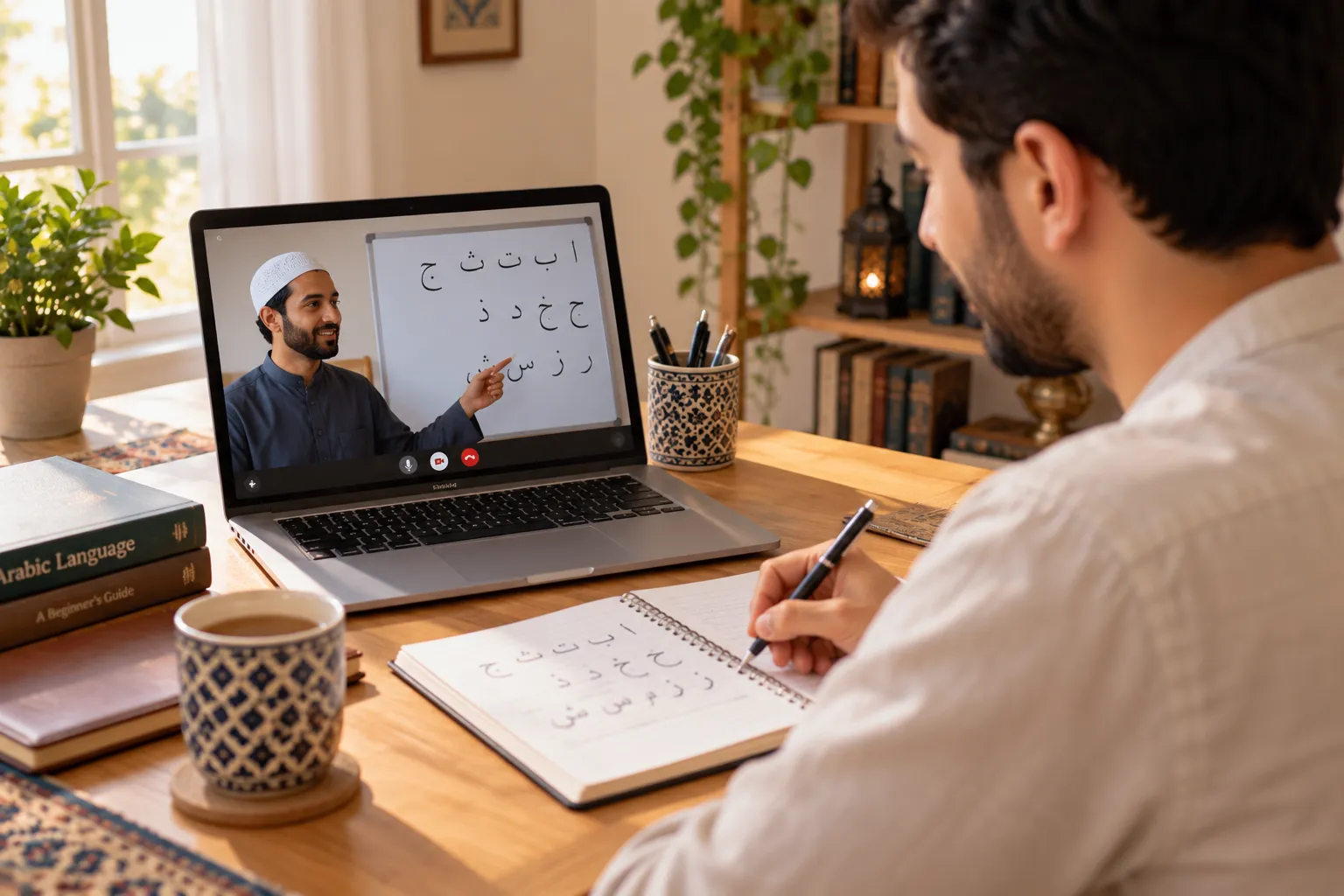
Here is something that surprises many beginners: the Arabic they've heard in Friday khutbahs, read in the Quran, and encountered in formal Arab media — that flowing, structured, beautifully articulate Arabic — is not some ancient relic locked away in academic libraries.
It's alive. It's spoken today. And it starts with a greeting.
Fus'ha Arabic — Modern Standard Arabic — is the form of Arabic shared across the entire Arab world. It's the Arabic of the Quran, of international broadcasting, of formal education, and of written communication across twenty-two countries. It's also the Arabic that, when you learn it, gives you access to something extraordinary: a single linguistic key that unlocks the entire Arabic-speaking world at once.
And every serious journey into this language begins the same way: with how you say hello.
This guide is your complete, beginner-friendly introduction to Fus'ha Arabic greetings — the phrases used in real life, formal contexts, respectful conversation, and Islamic social culture. You'll find Arabic script, transliteration, pronunciation guidance, and practical conversation examples throughout. By the end, you'll have a working foundation of authentic Arabic greetings that you can begin using with confidence.
Welcome to the language of the Quran. Let's begin.
What Is Fus'ha Arabic — and Why Does It Matter?
The Arabic That Everyone Understands
Arabic is not a single uniform language. Across the Arab world, there are dozens of regional dialects — Egyptian, Levantine, Gulf, Moroccan, Iraqi, and more. These dialects share roots but can sound quite different from one another. A Moroccan and a Saudi might struggle to follow each other's casual conversation.
But there is one form of Arabic that transcends all of that: Fus'ha — also known as Modern Standard Arabic (MSA) or, in Arabic, الفصحى (al-fusha), meaning "the most eloquent" or "the purest."
Fus'ha is:
The Arabic of the Quran and Islamic texts
The Arabic of formal education across all Arab countries
The Arabic of newspapers, books, and official media
The Arabic of international communication between Arabs of different regions
The Arabic used in formal speeches, presentations, and ceremonies
When an Egyptian scholar addresses a Moroccan audience, they speak Fus'ha. When the Quran is recited, it is in Fus'ha. When an Arabic textbook is written, it's written in Fus'ha.
This universality is what makes it the most valuable form of Arabic to learn — especially for those studying the Quran, pursuing formal Arabic education, or wanting to communicate respectfully across the Arabic-speaking world.
Fus'ha vs. Dialect: What's the Difference for Greetings?
In practice, the line between Fus'ha greetings and their dialect equivalents is often thin. Many greetings — particularly Islamic ones — are essentially the same across all forms of Arabic because they are rooted in Quranic language and prophetic tradition.
The key difference tends to appear in:
Vocabulary choices — Fus'ha uses classical roots; dialects often use simplified or borrowed words
Grammar forms — Fus'ha maintains precise grammatical endings; dialects often drop or modify them
Register — Fus'ha greetings feel more formal and respectful; dialect versions are more casual
For a beginner, the practical takeaway is this: the Fus'ha greetings you learn will be understood everywhere. A dialect speaker may use a different casual expression with their friends — but they will always understand and respect a Fus'ha greeting. It carries weight.
The Foundation: Assalamu Alaikum
The Greeting That Defines Islamic Arabic
Before any phrase, before any cultural nuance, before morning greetings or formal salutations — there is the salaam.
Arabic: اَلسَّلَامُ عَلَيْكُمْ Transliteration: Assalāmu Alaykum Meaning: Peace be upon you
This is the greeting of Islam. It is rooted in the Quran, established by the Prophet ﷺ, and used by over one and a half billion Muslims worldwide. In Fus'ha Arabic, it is spoken with its full, clear pronunciation — each syllable distinct, the alif of assalam clean and open, the kaf of alaykum crisp and clear.
The Full Greeting
The salaam has an extended form, and in Fus'ha — which preserves the completeness of expressions — this extended form is particularly at home:
Arabic: اَلسَّلَامُ عَلَيْكُمْ وَرَحْمَةُ اللهِ وَبَرَكَاتُهُ Transliteration: Assalāmu Alaykum Wa Rahmatullāhi Wa Barakātuh Meaning: Peace be upon you, and the mercy of Allah, and His blessings
The Response
Arabic: وَعَلَيْكُمُ السَّلَامُ Transliteration: Wa Alaykumu Assalām Meaning: And upon you be peace
Full response: Arabic: وَعَلَيْكُمُ السَّلَامُ وَرَحْمَةُ اللهِ وَبَرَكَاتُهُ Transliteration: Wa Alaykumu Assalāmu Wa Rahmatullāhi Wa Barakātuh Meaning: And upon you be peace, and the mercy of Allah, and His blessings
The Virtue of Beginning With Salaam
The Prophet Muhammad ﷺ said: "The best of the two people is the one who begins with the greeting of salaam." (Al-Adab al-Mufrad, authenticated by Al-Albani)
In Fus'ha Arabic, this phrase is not just a linguistic formality. It is the opening act of respect between two people — a prayer for peace offered before anything else is said. When you learn to say it with the full Fus'ha pronunciation, you are not merely greeting someone. You are standing in a tradition that stretches from the earliest days of Islam to this very moment.
Fus'ha Pronunciation Notes for Assalamu Alaikum
اَلسَّلَامُ — The lam (ل) doubles here due to the definite article al merging with the sun letter sin (س). It sounds like as-salāmu, not al-salāmu.
عَلَيْكُمْ — The ع (Ayn) at the beginning is the distinctive Arabic throat sound. It's a voiced, constricted vowel from the back of the throat. Don't skip it — approximating it, even imperfectly, matters for authentic Fus'ha.
The final vowels (the dammah on -kum) are pronounced in Fus'ha, unlike in many dialects where they are dropped. This is part of what makes Fus'ha sound more complete and formal.
Core Fus'ha Greetings for Daily Use
The Universal Greeting: Marhaban
Arabic: مَرْحَبًا Transliteration: Marhaban Meaning: Hello / Welcome
Marhaban is the most widely understood greeting across the Arab world. In Fus'ha, the final -an (nunation, or tanwin) is pronounced — mar-ha-BAN — giving it the full classical flavor. In casual speech, many people drop the final -an and say simply marhaba, but knowing the Fus'ha form is both correct and impressive.
Response: Arabic: أَهْلاً وَسَهْلاً Transliteration: Ahlan Wa Sahlan Meaning: Welcome (lit. "You are among family and on easy ground")
This response is pure Fus'ha in origin and meaning. Ahlan comes from ahl — family, people. Sahlan comes from sahl — ease, level ground. Together, they communicate: you are in a place of belonging and comfort. It is one of the warmest expressions in the entire Arabic language.
Short response: Arabic: أَهْلاً بِكَ Transliteration: Ahlan Bika (to a male) / Ahlan Biki (to a female) Meaning: Welcome to you
How Are You? — Fus'ha Forms
This is where Fus'ha distinguishes itself most clearly from casual dialects.
Arabic | Transliteration | Meaning | Register |
|---|---|---|---|
كَيْفَ حَالُكَ؟ | Kayfa Hāluka? | How are you? (to a male) | Standard Fus'ha |
كَيْفَ حَالُكِ؟ | Kayfa Hāluki? | How are you? (to a female) | Standard Fus'ha |
كَيْفَ حَالُكُمْ؟ | Kayfa Hālukum? | How are you? (to a group) | Standard Fus'ha |
كَيْفَ الْأَحْوَالُ؟ | Kayfa al-Ahwāl? | How are things? | Slightly more formal |
مَا أَخْبَارُكَ؟ | Mā Akhbāruka? | What is your news? | Formal Fus'ha |
هَلْ أَنْتَ بِخَيْرٍ؟ | Hal Anta Bikhayrin? | Are you well? | Very formal |
Pronunciation note: In Fus'ha, the case endings are spoken. Hāluka ends in a clear -uka (dammah), not the dropped -ak of colloquial Arabic. This case-ending precision is the hallmark of authentic Fus'ha speech.
Common Fus'ha responses:
Arabic | Transliteration | Meaning |
|---|---|---|
بِخَيْرٍ، شُكْرًا | Bikhayrin, Shukran | Fine, thank you |
اَلْحَمْدُ لِلَّه | Alhamdu Lillāh | Praise be to Allah (I'm well) |
تَمَامًا، شُكْرًا | Tamāman, Shukran | Perfectly, thank you |
جَيِّدٌ، شُكْرًا | Jayyidun, Shukran | Good, thank you |
بِخَيْرٍ بِفَضْلِ اللهِ | Bikhayrin Bifadlillāh | Well, by Allah's grace |
Morning and Evening Greetings in Fus'ha
Good Morning — The Poetic Exchange
Arabic: صَبَاحُ الْخَيْرِ Transliteration: Sabāhu al-Khayr Meaning: Good morning (lit. "Morning of goodness")
Response: Arabic: صَبَاحُ النُّورِ Transliteration: Sabāhu an-Nūr Meaning: Morning of light
In Fus'ha, notice the genitive construction: Sabāhu al-Khayr — "the morning of goodness" — the -u ending on Sabāhu indicates the nominative case, and the phrase is a complete nominal sentence in classical Arabic grammar. It means not just "good morning" but "May your morning be goodness itself."
When you respond with Sabāhu an-Nūr, you are wishing them a morning of nūr — light, divine illumination. This word appears in the Quran repeatedly in the most exalted contexts. To offer someone a morning of it is, in the Arabic linguistic imagination, a generous and beautiful thing.
Extended morning variants:
Greeting | Transliteration | Response | Transliteration |
|---|---|---|---|
صَبَاحُ الْخَيْرِ | Sabāhu al-Khayr | صَبَاحُ النُّورِ | Sabāhu an-Nūr |
صَبَاحُ الْفَرَحِ | Sabāhu al-Farah | صَبَاحُ السُّرُورِ | Sabāhu as-Surūr |
صَبَاحُ الْيَاسَمِينِ | Sabāhu al-Yāsamīn | صَبَاحُ الْوَرْدِ | Sabāhu al-Ward |
Sabāhu al-Farah — "morning of joy" — is met with Sabāhu as-Surūr, "morning of happiness." The pattern of beauty-matching-beauty is native to Fus'ha's poetic register.
Good Evening
Arabic: مَسَاءُ الْخَيْرِ Transliteration: Masā'u al-Khayr Meaning: Good evening (lit. "Evening of goodness")
Response: Arabic: مَسَاءُ النُّورِ Transliteration: Masā'u an-Nūr Meaning: Evening of light
The same structure, the same elegance, carried into the evening.
Pronunciation note: Masā'u — the hamza (ء) in masā' is pronounced, giving a slight glottal stop before the u ending. In Fus'ha, this is clear and distinct.
Formal Fus'ha Greetings for Specific Contexts
Greeting a Teacher or Scholar
In Fus'ha Arabic culture — particularly in educational and religious settings — greetings carry additional weight and there are expressions specifically suited to showing respect.
Arabic: حَيَّاكَ اللهُ Transliteration: Hayyāka Allāhu Meaning: May Allah grant you life / May Allah bless your presence
This is a deeply classical Fus'ha expression. It was used by the Prophet ﷺ and the early Arabs as a greeting of honor. When you greet a teacher, scholar, or elder with Hayyāka Allāhu, you are invoking Allah's blessing over their existence. Few greetings carry more genuine respect.
Response: Arabic: وَإِيَّاكَ Transliteration: Wa Iyyāka Meaning: And you too / And the same to you
Welcoming a Guest in Fus'ha
Arabic: أَهْلاً وَسَهْلاً وَمَرْحَبًا Transliteration: Ahlan Wa Sahlan Wa Marhaban Meaning: Most welcome — a fuller, more emphatic welcome
Arabic: تَفَضَّلْ Transliteration: Tafaddal (to a male) / Tafaddalī (to a female) / Tafaddalū (to a group) Meaning: Please, come in / Go ahead / Help yourself
Tafaddal is one of the most useful words in Arabic hospitality. It is Fus'ha in origin and universally understood. You'll hear it at doorways, at dining tables, and in any context where someone is being invited to proceed or helped to feel at ease.
Greetings in Formal and Professional Settings
In formal Fus'ha contexts — classrooms, official meetings, public presentations — the greetings carry more structure:
Opening a formal address: Arabic: اَلسَّلَامُ عَلَيْكُمْ وَرَحْمَةُ اللهِ وَبَرَكَاتُهُ Followed by: Arabic: أَهْلاً وَسَهْلاً بِكُمْ جَمِيعًا Transliteration: Ahlan Wa Sahlan Bikum Jamī'an Meaning: Welcome to you all
This is how a teacher opens a lesson, how a speaker begins an address, how a host welcomes an audience in formal Arabic settings. It's a pattern worth knowing because it appears constantly in Arabic media, educational content, and religious programming.
Farewells in Fus'ha Arabic
Parting With Grace
How you say goodbye matters as much as how you say hello.
Arabic | Transliteration | Meaning |
|---|---|---|
مَعَ السَّلَامَةِ | Ma'a as-Salāmah | Goodbye (lit. "with safety") |
إِلَى اللِّقَاءِ | Ilā al-Liqā' | Until we meet again |
فِي أَمَانِ اللهِ | Fī Amāni Allāh | In Allah's protection |
وَدَاعًا | Wadā'an | Farewell (more formal) |
تَصَبَّحْ عَلَى خَيْرٍ | Tasabbah 'alā Khayr | Good night (lit. "wake to goodness") |
وَأَنْتَ مِنْ أَهْلِهِ | Wa Anta min Ahlih | And may you be of its people (response to good night) |
Fī Amāni Allāh — "in Allah's protection" — is one of the most beautiful farewells in Arabic. It is Fus'ha in its completeness, Islamic in its meaning, and genuinely warm in its intent. When you say this to someone departing, you are placing them in divine care. That is a farewell worth knowing.
Expressions of Gratitude and Blessing in Fus'ha
Daily Phrases That Are Fus'ha at Their Core
Many of the most commonly used Arabic expressions are Fus'ha in origin — rooted in Quranic vocabulary and classical usage.
Arabic | Transliteration | Meaning | When Used |
|---|---|---|---|
شُكْرًا | Shukran | Thank you | Universal |
شُكْرًا جَزِيلاً | Shukran Jazīlan | Thank you very much | More formal/warm |
عَفْوًا | 'Afwan | You're welcome / Excuse me | Response to thank you |
مِنْ فَضْلِكَ | Min Fadlika | Please (making a request) | Formal request |
لَوْ سَمَحْتَ | Law Samaht | If you would allow / Please | Polite request |
اَلْحَمْدُ لِلَّهِ | Alhamdu Lillāh | All praise is for Allah | After any good |
مَاشَاءَ اللهُ | Māshā' Allāh | What Allah has willed | Admiration / gratitude |
إِنْ شَاءَ اللهُ | In Shā' Allāh | If Allah wills | Future intentions |
بِسْمِ اللهِ | Bismillāh | In the name of Allah | Before beginning |
بَارَكَ اللهُ فِيكَ | Bāraka Allāhu Fīk | May Allah bless you | Warm appreciation |
A note on بَارَكَ اللهُ فِيكَ:
This phrase — Bāraka Allāhu Fīk (to a male) or Bāraka Allāhu Fīki (to a female) — is one of the most beautiful expressions of gratitude in Fus'ha Arabic. It goes beyond "thank you." It invokes an actual blessing from Allah upon the person. Use it when someone has done something genuinely kind, and watch how it lands.
A Complete Fus'ha Dialogue: From Hello to Goodbye
Putting It All Together
Here is a natural, complete Fus'ha exchange — the kind you might hear in a formal educational setting, at a mosque, or in a respectful social encounter:
Ahmad: اَلسَّلَامُ عَلَيْكُمْ وَرَحْمَةُ اللهِ وَبَرَكَاتُهُ Assalāmu Alaykum Wa Rahmatullāhi Wa Barakātuh Peace be upon you, and the mercy of Allah, and His blessings.
Sara: وَعَلَيْكُمُ السَّلَامُ وَرَحْمَةُ اللهِ وَبَرَكَاتُهُ Wa Alaykumu Assalāmu Wa Rahmatullāhi Wa Barakātuh And upon you be peace, and the mercy of Allah, and His blessings.
Ahmad: صَبَاحُ الْخَيْرِ. كَيْفَ حَالُكِ؟ Sabāhu al-Khayr. Kayfa Hāluki? Good morning. How are you?
Sara: صَبَاحُ النُّورِ. اَلْحَمْدُ لِلَّهِ، بِخَيْرٍ. وَأَنْتَ؟ Sabāhu an-Nūr. Alhamdu Lillāh, Bikhayrin. Wa Anta? Morning of light. Praise Allah, well. And you?
Ahmad: بِخَيْرٍ بِفَضْلِ اللهِ. تَفَضَّلِي. Bikhayrin Bifadlillāh. Tafaddalī. Well, by Allah's grace. Please come in.
Sara: شُكْرًا جَزِيلاً. Shukran Jazīlan. Thank you very much.
Ahmad: عَفْوًا. فِي أَمَانِ اللهِ. 'Afwan. Fī Amāni Allāh. You're welcome. In Allah's protection.
This exchange is complete, correct Fus'ha. It is formal enough to be used in any respectful context and natural enough to feel warm and genuine. Every phrase in it can be learned in a matter of days.
Fus'ha Pronunciation: Key Sounds for Beginners
The Sounds That Make Fus'ha Distinctive
One of the things that distinguishes Fus'ha from colloquial Arabic is its precision of pronunciation. Here are the sounds most important for greetings:
The ع (Ayn) — ع
Found in: Alaykum, Afwan, Shukran (the -an ending involves breath)
This is the most distinctive Arabic sound for English speakers. It's a voiced pharyngeal fricative — produced by constricting the throat and adding voice. The best way to approximate it: imagine the sound you make when a doctor asks you to say "ahhh," but with more constriction and voicing. It will come with practice.
The ح (Ha) — ح
Found in: Hāluka, Alhamdu
Breathier than the English "h" — imagine breathing out on a cold day to see your breath, but with more intentional air. It's the whispered version of the Ayn.
The خ (Kha) — خ
Found in: Khayr, Bikhayrin
Like the "ch" in the Scottish "loch" or the German "Bach." A back-of-throat friction sound. Many beginners find this one easier than the Ayn.
The غ (Ghayn) — غ
Like a voiced version of the Kha — the same position in the throat, but with voice added. It resembles the French "r" or the sound of gargling softly.
Case endings in Fus'ha:
This is important. In Fus'ha, words have grammatical endings — short vowel sounds at the end of words — that are generally dropped in dialects. In Sabāhu al-Khayr, the -u on Sabāhu is spoken. In Bikhayrin, the -in ending is spoken. This case-ending precision is what gives Fus'ha its musical, complete quality.
At the beginner stage, focus on approximating these endings rather than perfecting them. They will become natural through consistent exposure and practice.
Common Beginner Mistakes With Fus'ha Greetings
What to Watch For — and How to Correct It
1. Dropping case endings (tanwin and I'rab)
Many beginners have more exposure to dialect Arabic than Fus'ha and unconsciously drop the final vowels. In Fus'ha, Shukran ends in a clear -an, Jayyidun ends in -un, Bikhayrin in -in. Listen carefully to formal Arabic speakers and replicate what you hear.
2. Swapping Fus'ha vocabulary for dialect words
Some common dialect words have different Fus'ha equivalents. For example, "okay" in Egyptian Arabic is tamam — which is perfectly acceptable. But in Fus'ha, hasanan (حَسَنًا) or jayyidun (جَيِّدٌ) are more authentic. As a beginner, use what you know — but be aware that Fus'ha has its own vocabulary choices.
3. Confusing the gender forms
Arabic grammar marks gender in verbs and pronouns. Kayfa Hāluka (to a male) vs. Kayfa Hāluki (to a female). Tafaddal (to a male) vs. Tafaddalī (to a female). Getting these right shows genuine attention to the language. Getting them wrong is forgiven — but trying is always noticed and appreciated.
4. Rushing the Ayn (ع)
Many beginners skip over the ع or pronounce it as a regular vowel. In Fus'ha — and especially in Quranic recitation — the Ayn is a full, distinct sound. Practice it in isolation before incorporating it into full phrases. Alaykum pronounced without the Ayn is clearly missing something to a native ear.
5. Over-formalizing casual moments
Fus'ha is appropriate in formal, educational, and religious contexts. Using highly formal Fus'ha with a close friend in a casual setting can feel slightly stiff. Be aware of register. In everyday casual conversation, a blend of Fus'ha-rooted expressions and warm tone is ideal.
Tips for Memorizing Fus'ha Greetings Effectively
How to Make These Phrases Stick
1. Learn the salaam first — and use it immediately
Assalamu Alaikum is your starting point and your anchor. It's the most important, most universal, most spiritually significant phrase in Arabic. Say it every day, to every appropriate person. Let it become effortless before you move to the next phrase.
2. Work through one section per day
Don't try to absorb this entire guide in one sitting. Learn morning greetings until they're natural. Then evening. Then the how-are-you phrases. Slow and steady is not a metaphor here — it is the actual mechanism of language learning.
3. Pair the Arabic script with what you're learning
When you write a phrase to practice, write it in Arabic script — not just transliteration. Your eyes need to recognize the script as much as your mouth needs to produce the sounds. They reinforce each other.
4. Listen to formal Arabic media
Arabic news channels, Islamic lectures in Arabic, Quran recitation with reading — all of these expose your ear to authentic Fus'ha pronunciation in context. Greetings appear constantly in formal Arabic media, and hearing them used naturally is irreplaceable.
5. Practice out loud — always
Reading Arabic silently does not train your tongue. The sounds of Fus'ha — particularly the pharyngeal consonants — require physical practice. Say every phrase out loud, multiple times, until your mouth stops fighting you.
6. Connect greetings to your worship
Many Fus'ha greetings appear in daily Islamic practice. Assalamu Alaikum concludes every salah. Alhamdu Lillāh follows every good thing. Bismillāh precedes every action. You are likely already using Fus'ha Arabic dozens of times a day without realizing it. That recognition builds confidence.
The Islamic Dimension: Why Spreading Salaam Matters
A Greeting With Roots in the Divine
The salaam is not simply an Arabic cultural convention. It is a practice established by divine instruction, carried by prophetic example, and described in Islamic tradition as one of the pillars of a healthy Muslim community.
Allah says in the Quran:
"And when you are greeted with a greeting, greet in return with what is better than it, or return it equally." — Surah An-Nisa (4:86)
The Quran explicitly instructs Muslims to at minimum return a greeting with its equivalent — and ideally to return it with something even more generous. This is the theological foundation for why the full extended salaam (with Wa Rahmatullāhi Wa Barakātuh) is encouraged. It is the "better than" response.
The Prophet ﷺ also said: "Spread the salaam among yourselves." (Sahih Muslim) Not just among people you know. Not just among people you like. Among yourselves — the community, the ummah, the people you pass in the street.
Every time you learn a Fus'ha greeting and use it with sincerity, you are participating in something that the Prophet ﷺ described as foundational to Muslim love and unity. That is a remarkable thing to carry into something as simple as saying hello.
FAQ: Fus'ha Arabic Greetings for Beginners
What exactly is Fus'ha Arabic, and how is it different from spoken Arabic?
Fus'ha — Modern Standard Arabic — is the formal, standardized form of Arabic used across the Arab world in writing, education, media, and formal speech. It is rooted in Classical Arabic, the language of the Quran. Spoken or colloquial Arabic refers to the regional dialects used in everyday informal conversation — Egyptian, Levantine, Gulf, Moroccan, and so on. The key difference for greetings: Fus'ha greetings are universally understood and carry a formal, respectful register. Dialect greetings are region-specific and more casual.
Should I learn Fus'ha or a dialect first?
For Quran learners and those wanting a universal foundation, Fus'ha is the right starting point. It gives you access to the Quran, Islamic texts, formal Arabic media, and respectful communication across all Arabic-speaking regions. Dialects are excellent for casual conversation in specific regions, but Fus'ha is the common denominator. Many language educators recommend Fus'ha first — particularly if connecting with the Quran is part of your goal.
Will Fus'ha greetings actually be understood in everyday life?
Absolutely. Every Arabic-speaking person is educated in Fus'ha and understands it completely. A Fus'ha greeting in a casual setting may feel slightly formal, but it will always be understood, appreciated, and respected. For Islamic greetings specifically — the salaam, Alhamdu Lillāh, Bismillāh — these transcend all dialect boundaries entirely.
How do I know when to use the male or female form of a greeting?
Arabic is a grammatically gendered language. When speaking directly to one person, you use the form that matches their gender: -ka endings for male, -ki endings for female. So Kayfa Hāluka to a man, Kayfa Hāluki to a woman. For groups, you use the plural form: Kayfa Hālukum. This may feel unfamiliar at first, but it becomes instinctive with practice. Mistakes are always forgiven — effort is always noticed.
How long will it take to feel confident with Fus'ha greetings?
With daily practice — speaking the phrases out loud, writing them in Arabic script, and using them with real people — most beginners feel genuinely comfortable with the core greeting set within two to three weeks. The more challenging sounds (like the Ayn) may take a bit longer to master, but even an approximate version communicates warmth and effort. Consistency, not intensity, is the key.
Is learning Fus'ha greetings useful for Quran learning?
Deeply so. Quranic Arabic is Fus'ha at its most precise and profound. The more familiar you become with Fus'ha vocabulary, sounds, and structures — even through something as simple as greetings — the more accessible the Quran becomes. Words like salām, rahmah, barakah, nūr, khayr — all of these appear in both daily Fus'ha greetings and the pages of the Quran. They are the same language. Every greeting you learn is a step toward the Book.
Final Thoughts: Fus'ha Begins With Hello
There is a beautiful symmetry in the fact that Fus'ha Arabic — the language of the Quran, the shared tongue of the Arab world, the vehicle of fourteen centuries of Islamic scholarship and civilization — begins, for most learners, with a greeting.
Not a grammar rule. Not a conjugation chart. A greeting.
Because that is what language actually is, at its root: the desire to reach another person. To say, in whatever tongue: I see you. I wish you well. I am here.
In Fus'ha Arabic, those intentions are wrapped in extraordinary beauty. A morning of goodness met with a morning of light. Peace upon you returned with mercy and blessings. A farewell that places the departing one in divine protection.
These are not just phrases to memorize. They are a way of moving through the world with intention — honoring the people you encounter, honoring the language that connects you to the Quran, honoring the tradition that stretches from the Prophet ﷺ through every Muslim who has ever said Assalamu Alaikum to a stranger and meant it.
If you are ready to go deeper — to build Fus'ha fluency, to read the Quran with understanding, to engage with Arabic as the living, beautiful, accessible language it truly is — that journey is exactly what Araby Academy is built for. Our one-on-one Arabic and Quran lessons are designed for real learners at real stages of life, taught by teachers who believe that every student deserves to meet this language with confidence and joy.
Start here. Start with Assalamu Alaikum.
The rest of Arabic is waiting on the other side of that door.