How to Learn Quran Online: The Complete Beginner's Guide to Quran, Tajweed & Arabic in 2025
Learning the Quran has always been one of the most sacred commitments a Muslim can make. For centuries, it meant sitting at the feet of a scholar, traveling long distances, or being fortunate enough to live near a qualified teacher. Today, something remarkable has changed — and it has nothing to do with the commitment itself.
The commitment is still there. The dedication, the patience, the love of the Book of Allah — all of that remains exactly as it always was. What has changed is access. You can now sit in your home in London, Lagos, or Los Angeles and receive one-on-one Quran instruction from a qualified teacher thousands of miles away, in real time, on a schedule that actually works for your life.
This guide is for every Muslim — whether you're a complete beginner who has never opened a Mus'haf digitally, a parent looking to enroll your child, or an adult who has been wanting to return to the Quran for years but didn't know where to start. By the end, you'll know exactly how online Quran learning works, what to look for in a teacher, how to learn tajweed properly, and how to make your lessons stick long-term.
Let's begin.
What Does It Actually Mean to Learn Quran Online?
The phrase "learn Quran online" is searched millions of times each month — but it means very different things to different people. For some, it means learning to recite correctly. For others, it means memorizing (hifz). For others still, it means understanding the Arabic language well enough to engage with the text directly.
Most learners, especially beginners, need to start in the same place: learning to read Arabic script and apply the basic rules of tajweed. From there, the path branches depending on your goals.
Here's a simple breakdown of what online Quran learning typically includes:
Qaida / Noorani Qaida — foundational reading and Arabic alphabet for beginners
Quran recitation — reading from the Mus'haf with proper pronunciation
Tajweed rules — the science of correct Quranic recitation
Hifz (memorization) — structured memorization of the Quran
Arabic language — understanding what you're reading (Quranic or Modern Standard Arabic)
Tafsir introduction — basic understanding of Quranic meaning and context
A good online Quran platform will help you identify exactly where you are and what you need — then build a learning path around that.
Why Learn Quran Online? The Real Benefits
There's sometimes hesitation around online learning, especially for something as sacred as the Quran. It's worth addressing this directly: online Quran education, when done properly, is not a compromise. For many students, it is genuinely better than what was previously available to them.
Here's why.
You Get One-on-One Attention
In most traditional settings — weekend Islamic schools, group classes at the masjid — a teacher might have 10 to 20 students at once. That means feedback is limited, mistakes go uncorrected for weeks, and the pace is always set by the group, not the individual.
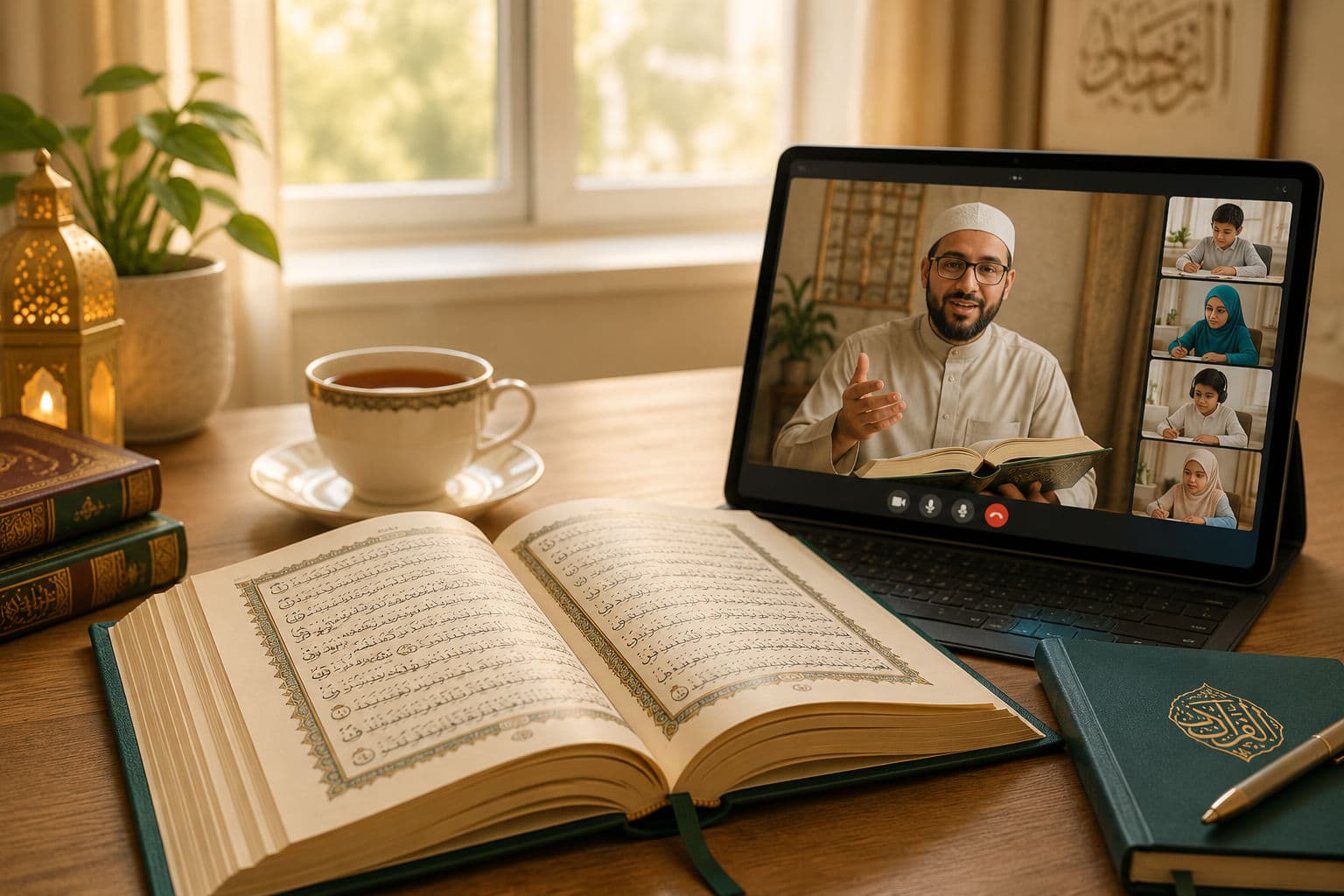
Online learning at a quality platform like Araby Academy is built around private, one-on-one sessions. Your teacher listens to you recite. Every session is entirely about your progress.
Your Schedule Doesn't Have to Break
This might be the most practical benefit of all. Between school, work, family, and everything else life demands, finding a fixed weekly class slot that actually fits can feel impossible. Online Quran lessons give you the flexibility to book sessions that work around your real life — morning before work, after the kids are in bed, on weekends, whenever works.
You Have Access to Qualified Teachers Worldwide
Geography used to limit everything. If you lived somewhere without a qualified Quran teacher nearby, your options were slim. Online learning removes that barrier entirely. You can study with experienced, certified teachers regardless of where you live.
You Progress Faster
This surprises many new students, but one-on-one online lessons tend to produce faster progress than group classes. The reason is simple: every minute of the lesson is focused on you. There's no waiting for other students, no managing group dynamics, no interruptions. Just you and your teacher, working through the material efficiently.
Understanding Tajweed: Why It Matters More Than You Think
One of the most common questions from new learners is: "Do I really need to learn tajweed? Can't I just read the Quran normally?"
It's an understandable question. But here's what you need to know.
What Is Tajweed?
Tajweed (تجويد) is the set of rules governing the proper pronunciation and recitation of the Quran. The word itself comes from the Arabic root meaning "to improve" or "to make better." Every letter in the Quran has a precise point of articulation. Every word has rules about how letters interact, when sounds are prolonged, when they are merged, and when they are cut short.
The Prophet Muhammad ﷺ received the Quran with these rules, and they have been transmitted orally from teacher to student in an unbroken chain since that time. When you learn tajweed from a qualified teacher, you are plugging into that living tradition.
Can Mispronunciation Change Meaning?
Yes — and this is not a minor concern. In Arabic, changing a single vowel or lengthening a sound incorrectly can shift the meaning of a word entirely. The scholars of tajweed distinguished between two levels of recitation error:
Al-Lahn al-Jali (الَّلحن الجلي) — clear, obvious mistakes that change meaning, which are forbidden
Al-Lahn al-Khafi (الَّلحن الخفي) — subtle, hidden mistakes that violate a rule but don't change meaning, which are disliked
The goal of tajweed study isn't perfection for its own sake — it's respect for the Word of Allah. And that's a goal worth pursuing.
How Long Does It Take to Learn Tajweed?
This is one of those questions where the honest answer is: it depends. For a complete beginner with no background in Arabic, developing solid foundational tajweed typically takes anywhere from 6 to 18 months of consistent study. For someone who can already read Arabic but hasn't learned the rules formally, it can come together much faster.
What matters more than the timeline is the consistency. Two or three sessions per week, every week, will take you much further than an intensive burst followed by long gaps.
How to Learn Arabic Alongside the Quran
Many Muslims recite the Quran every day without understanding what they're saying. There's real reward in that recitation — but imagine what it would feel like to understand the words you're reading in salah. Imagine hearing Surah Al-Fatiha and following every phrase with understanding. That experience is available to you.
Quranic Arabic vs. Modern Standard Arabic
These are two distinct but related things:
Quranic Arabic is the classical language of the Quran. It has its own vocabulary, grammatical structures, and stylistic features. If your primary goal is understanding the Quran, this is where to focus.
Modern Standard Arabic (MSA) is the formal Arabic used in contemporary media, literature, and formal communication across the Arab world. It shares a strong grammatical foundation with Quranic Arabic but has its own vocabulary and usage patterns.
For most Quran learners, starting with Quranic Arabic vocabulary and grammar makes the most direct impact on how they experience the Quran. Later, expanding into MSA opens up even more of the Arabic-speaking world.
How Do You Start Learning Arabic Online?
The most effective approach is structured, progressive, and connected to material you already care about. Here's a practical entry path:
Start with the Arabic alphabet — understanding letters, their forms in different positions, and basic vowel marks (harakat)
Move into basic Quranic vocabulary — the 100-200 most repeated words in the Quran cover a large percentage of the text
Learn basic sentence structure — Arabic grammar follows clear patterns once you understand the logic
Practice with real Quranic passages — applying what you've learned to actual ayaat makes it stick
Build with your teacher — a good Arabic teacher will pace your progress around what serves your Quran goals
At Araby Academy, Arabic lessons are designed to connect directly to Quranic understanding — so you're not learning abstract grammar exercises, you're learning a language you'll use immediately.
How to Choose the Right Online Quran Teacher
The teacher makes or breaks the learning experience. This is true in every subject, but it's especially true with Quranic education — because you're not just learning a skill, you're being guided in your relationship with the words of Allah.
Here's what to look for.
Qualifications and Ijazah
An Ijazah (إجازة) is a traditional Islamic certification indicating that a teacher has received authorization to teach Quran from their own teacher, who received it from theirs, in a chain going back to the Prophet ﷺ. This is the gold standard for Quran instruction.
Not every teacher will have a full ijazah, but every teacher should be able to speak clearly about their training background, who they studied under, and what level of certification they hold. Ask.
Teaching Style and Patience
Especially for children and complete beginners, patience is not optional — it's essential. A teacher who gets frustrated at mistakes, rushes through material, or doesn't explain concepts clearly will set a student back. Look for someone who:
Explains the why behind rules, not just the what
Adjusts their pace to match the student
Gives positive, constructive feedback
Makes the student feel comfortable asking questions
Trial Lessons
Any reputable online Quran platform will offer a trial lesson before you commit. Use it. Pay attention not just to what the teacher knows, but to how they teach, how they communicate, and how comfortable you or your child felt in the session.
Learning Quran for Children: A Parent's Guide
If you're a parent trying to give your children a connection to the Quran, you've already taken one of the most important steps: deciding that it matters. The next step is building an environment where it can actually happen.
What Age Should Children Start?
There's no universal answer, but most Islamic educators recommend starting with the Arabic alphabet around ages 4 to 6, moving into basic Quran recitation from ages 6 to 7 onwards. The key at this stage is making it joyful, not mechanical.
Children who associate the Quran with positive, encouraging experiences carry that love into adulthood. Children who associate it with pressure, frustration, or fear often grow up with complicated feelings toward the text.
How to Support Your Child's Online Quran Learning
Be present during sessions when they're young — especially for the first few months
Create a dedicated learning space — even a small corner with a tablet and their Mus'haf
Review with them between sessions — 10 minutes of daily practice makes a huge difference
Celebrate milestones — finishing a surah, learning a new rule, completing a level
Speak positively about the teacher — children pick up on parental attitudes
Common Mistakes New Online Quran Students Make
Knowing what to avoid is just as important as knowing what to do. Here are the most common pitfalls — and how to sidestep them.
Starting Without a Clear Goal
"I want to learn Quran" is a starting point, not a goal. Before your first lesson, try to articulate something more specific:
I want to recite Surah Al-Baqarah correctly by the end of the year.
I want to memorize Juz' Amma within six months.
I want to understand Al-Fatiha in Arabic.
Specific goals give your teacher something to build toward — and they give you something to measure progress against.
Skipping Revision Between Sessions
One of the biggest predictors of slow progress is treating each lesson as a standalone event. Learning Quran requires spaced repetition — reviewing what you've covered at regular intervals so it moves from short-term to long-term memory.
A simple rule: for every one hour of new instruction, spend two hours revising. That ratio will transform your retention.
Expecting Perfection Too Soon
Tajweed takes time. Arabic takes time. Memorization takes time. Students who get discouraged because they're not "good enough" after a few months have often set unrealistic expectations. Progress in Quranic study is measured in years, not weeks — and every ayah you recite correctly, every rule you internalize, is an act of worship regardless of where you are in the journey.
Choosing a Platform Purely on Price
Free or very cheap options often come without any real quality control — unqualified teachers, inconsistent scheduling, no curriculum structure, no accountability. When it comes to something as important as Quranic education, value matters more than bargain pricing.
Practical Tips to Accelerate Your Quran Learning Online
These are the habits that separate students who make steady, meaningful progress from those who plateau.
Build a Consistent Daily Practice
Even 15 minutes every day will outperform 2 hours once a week. Daily contact with the Arabic script, with the sounds of Quranic Arabic, with the ayaat you're memorizing — it keeps everything fresh and continually reinforces what you've learned.
Record Your Recitation
Most students don't do this, which is why most students miss easy corrections. Recording yourself and listening back activates a different part of your brain. You hear things you simply don't notice in the moment of reciting.
Use Multiple Senses
Read with your eyes, recite with your voice, write what you're memorizing. The more sensory pathways you involve, the deeper the encoding. Some students find that writing Quranic verses by hand — even just a few times — dramatically improves both their reading fluency and their memorization.
Connect to Meaning
If you're memorizing or reciting a surah, take 10 minutes to read a translation and brief tafsir of those verses. Understanding what you're saying anchors the words in your memory and makes the recitation feel alive rather than mechanical.
Communicate Openly with Your Teacher
Tell your teacher when something isn't clicking. Tell them when the pace feels too fast or too slow. Tell them what's hard, what's coming naturally, what your goals are shifting toward. A good teacher can adapt — but only if they know what you need.
What to Expect From Your First Month of Online Quran Lessons
The first month sets the tone for everything that follows. Here's a realistic picture of what you should expect.
Week 1–2: Getting oriented. Your teacher will assess your current level, establish your goals, and begin building rapport. If you're starting from scratch, expect to work on the Arabic alphabet, basic letter recognition, and the sounds of Arabic.
Week 3–4: Building foundations. You'll start seeing connections — letters you recognize, sounds that are becoming familiar, maybe your first short surah taking shape. Progress may feel slow, but it isn't. The roots are going deep.
End of Month One: You should feel clearer about your path, comfortable with your teacher, and able to see a real difference from where you started. If something feels off — the teacher isn't a good fit, the sessions aren't productive — this is the time to raise it or make a change.
Frequently Asked Questions About Learning Quran Online
How many lessons per week do I need to make real progress?
For most beginners, two to three lessons per week strikes the right balance between instruction and revision time. One lesson per week can work for students with very limited schedules, but progress will be slower. More than three sessions weekly is usually only advisable for intensive hifz programs.
Can non-Arabic speakers really learn tajweed properly?
Absolutely. In fact, non-native Arabic speakers often learn tajweed more deliberately than native speakers — because they have to consciously understand each rule rather than relying on intuition. Many of the finest Quran reciters in the world are non-Arabs. What matters is quality instruction, consistent practice, and patience with the process.
What equipment do I need for online Quran lessons?
The good news: it's minimal. You need a stable internet connection, a device with a camera and microphone (a smartphone, tablet, or laptop all work), a Mus'haf (either physical or a trusted digital version), and a quiet space where you can recite comfortably. Most platforms will tell you their preferred video call software — typically Zoom, Google Meet, or a built-in platform feature.
Is online Quran learning appropriate for very young children?
Yes, with the right setup. Children as young as 4 or 5 can begin with Arabic alphabet foundations online, especially when a parent is present to help maintain focus and engagement. The key is short session durations — 20 to 30 minutes is usually ideal for young children — and a teacher who knows how to work with that age group through a screen.
How do I know if I'm choosing a trustworthy online Quran platform?
Look for these indicators of quality and trust:
Qualified, verified teachers with transparent backgrounds
Trial lessons before any financial commitment
Structured curriculum rather than ad hoc sessions
Student reviews and testimonials that feel genuine
Clear communication about scheduling, pricing, and cancellation policies
Responsive support when questions or issues arise
If a platform makes it hard to find this information, that itself is a signal.
What if I want to memorize the entire Quran online — is that realistic?
Many students have completed full hifz through online programs — and for motivated students with the right teacher, it is absolutely achievable. It requires substantial commitment: typically daily sessions, multiple hours of daily review, and a structured long-term plan. But the door is fully open. What online hifz programs have shown is that the connection between teacher and student can be just as real — and just as transformative — over a screen as it is in person.
The Spiritual Dimension: Why This Journey Is Worth It
It would be easy to write this entire article about logistics, features, and best practices — and those things matter. But it's worth pausing to acknowledge what's really at stake.
The Quran is not just a language subject. It's not a skill set. It is, for Muslims, the literal speech of Allah — the final revelation, preserved letter-by-letter, transmitted through generations of devoted scholars and teachers across fourteen centuries.
When you sit down for your first online Quran lesson, you are joining a chain. You are connecting yourself to the student who sat before the teacher before you, and to the one before that, going all the way back to the companions of the Prophet ﷺ. That is not a small thing.
And the beauty of this moment in history is that the doors to that chain are more open than they have ever been. The barriers of geography, of cost, of schedule — they are lower than ever before. What remains is the decision: Am I going to begin?
Final Thoughts
Learning Quran online is not about convenience for its own sake. It's about removing the barriers that have kept so many Muslims from the relationship with the Quran that they've always wanted — the relationship that nourishes, steadies, and transforms.
Whether you're a complete beginner taking your first steps into Arabic letters, a parent building your child's foundation, or an adult returning to a practice that drifted away — the path is open and the tools are here.
At Araby Academy, we've built our entire approach around one goal: making sure that every student who wants to learn Quran, improve their tajweed, and grow in Arabic actually does it — with qualified teachers, real structure, and lessons designed around your life.
The best time to start was yesterday. The next best time is right now.
Take your first lesson today — and begin the journey that lasts a lifetime.