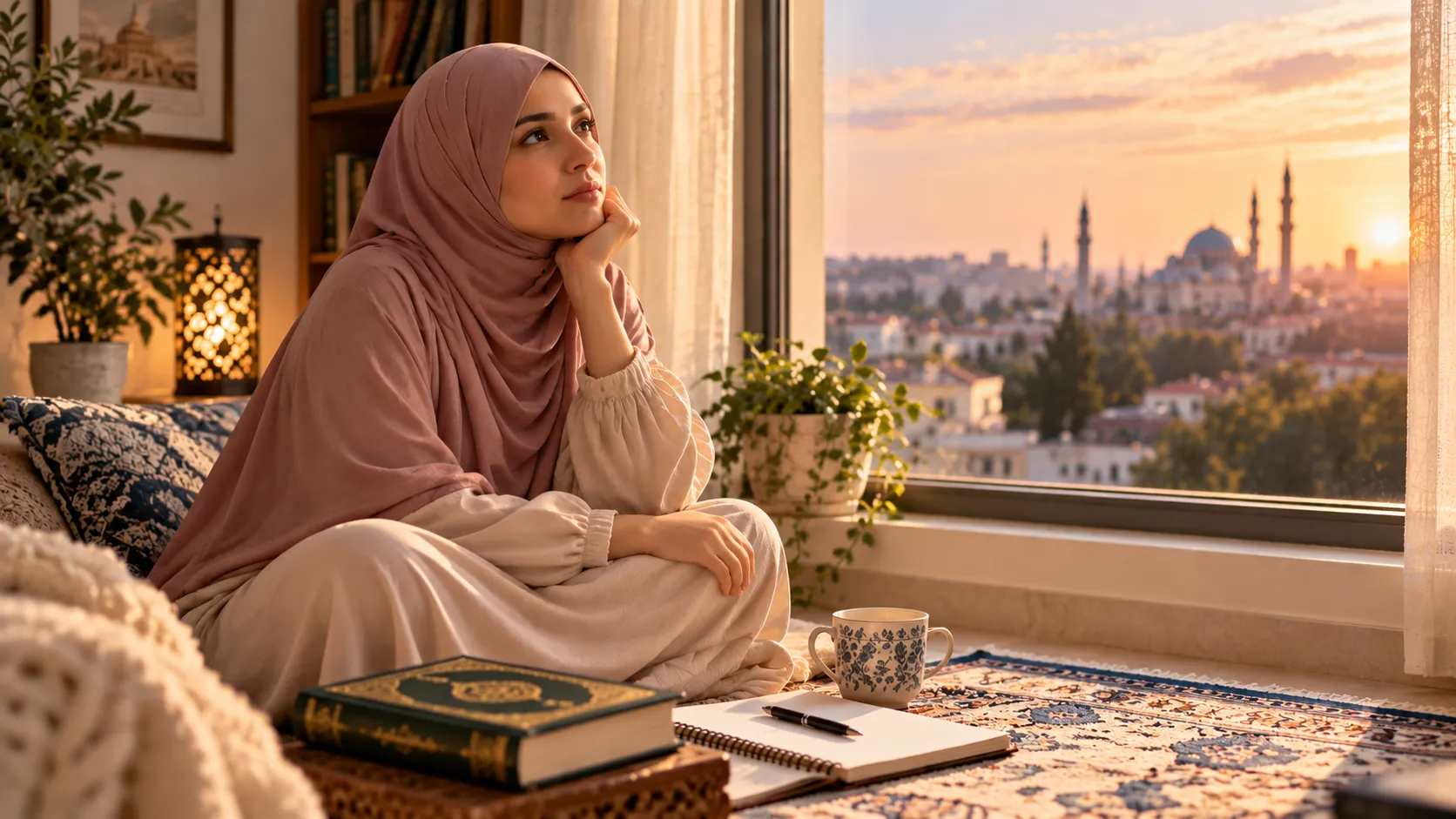
🌍 1. Introduction: Modesty at the Crossroads of Tradition and Modernity
In an era characterized by relentless visibility, digital exhibition, and the curated presentation of the self, modesty occupies a uniquely paradoxical position. It is simultaneously preserved as a timeless virtue and challenged as an outdated concept. Social media platforms reward exposure, cultural norms increasingly equate confidence with visibility, and identity is often expressed through outward display. Within this environment, modesty—particularly in its visible forms—appears countercultural.
For Muslim women living in Western societies, the hijab exists at the intersection of these competing ideologies. It is not merely an item of clothing; it is a visible manifestation of belief, a declaration of values, and, at times, an act of quiet resistance. The decision to wear it carries layers of meaning—spiritual, psychological, and social—that extend far beyond aesthetics.
The modern world, with all its advancements and freedoms, has also introduced new tensions. The individual is encouraged to define themselves independently, yet societal pressures subtly dictate what is acceptable. In this landscape, the hijab becomes a focal point—a symbol interpreted through multiple, often conflicting, lenses.
Thus, modesty today stands not as a relic of the past, but as a living, evolving principle negotiating its place in a rapidly changing world.
🧕 2. Understanding Hijab Beyond the Fabric
The hijab is frequently misunderstood as a simple head covering. However, reducing it to fabric alone strips it of its profound spiritual and ethical dimensions. In Islamic thought, modesty—ḥayāʾ—is a holistic concept that encompasses behavior, speech, intention, and appearance.
The physical hijab serves as an outward expression of an inward state. It reflects mindfulness of God, self-respect, and a conscious choice to embody dignity. It is not about erasing identity but about redefining how identity is presented and perceived.
Importantly, the hijab is not intended to suppress individuality. Rather, it reorients attention away from physical appearance as the primary marker of worth. In a culture that often equates value with attractiveness, this shift is both radical and deeply empowering.
Moreover, understanding hijab requires distinguishing between religious principles and cultural practices. Across different Muslim societies, the styles, colors, and forms of modest dress vary widely. This diversity highlights that while the principle is ثابت (constant), its expression is flexible.
Thus, the hijab is not a limitation—it is a conscious framework for living with intention and purpose.
🏛️ 3. Historical Context of Hijab in Islamic Civilization
To fully appreciate the hijab, one must examine its historical roots. In early Islamic society, modesty was embedded within a broader ethical system that emphasized respect, community harmony, and spiritual awareness.
The Qur’anic guidance on modesty addressed both men and women, encouraging a culture of mutual dignity. Over time, as Islam spread across regions—from Arabia to Persia, Africa, and South Asia—local customs influenced how modesty was practiced.
This resulted in a rich tapestry of expressions: flowing abayas in the Gulf, colorful scarves in Southeast Asia, and layered garments in South Asia. Each reflected a fusion of religious values and cultural aesthetics.
Importantly, this historical diversity demonstrates that hijab is not monolithic. It has never been confined to a single form or style. Instead, it has adapted to context while preserving its core intention.
Understanding this history helps dispel the myth that hijab is rigid or culturally uniform. It is, in fact, a dynamic tradition rooted in timeless principles.
🌆 4. The Western Cultural Landscape
Western societies often emphasize autonomy, visibility, and self-expression. Fashion becomes a powerful medium through which identity is communicated. Trends encourage experimentation, boldness, and, at times, exposure.
Within this cultural framework, the hijab can appear contradictory. It represents restraint in a context that celebrates display. It prioritizes inward values over outward validation.
This contrast often leads to misunderstanding. The hijab may be perceived as restrictive or imposed, rather than chosen and meaningful. Such interpretations reveal more about cultural assumptions than about the practice itself.
Additionally, the Western emphasis on individualism can create tension for those whose identities are shaped by both personal conviction and religious tradition. The hijab challenges the notion that freedom must look a certain way.
In reality, true autonomy includes the freedom to choose modesty.
🧠 5. Identity Formation Among Muslim Women in the West
For Muslim women in Western societies, identity formation is a complex and evolving process. It involves navigating multiple cultural frameworks, expectations, and personal beliefs.
The hijab often becomes central to this journey. It serves as both a grounding force and a point of reflection. Wearing it may reinforce a sense of belonging to a global Muslim community, while simultaneously distinguishing one within local contexts.
This dual identity—being both Western and Muslim—is not inherently contradictory. However, it requires negotiation. Individuals must reconcile societal norms with personal convictions.
Many women describe this process as empowering yet challenging. It fosters self-awareness, resilience, and a deeper understanding of faith.
At times, this journey includes questioning, growth, and redefinition. The hijab is not merely worn—it is lived, experienced, and continually understood in new ways.
⚠️ 6. Social Pressures and Misconceptions
Social interactions often reveal the gap between perception and reality. Muslim women who wear the hijab frequently encounter misconceptions shaped by media narratives and cultural stereotypes.
These experiences can range from overt discrimination to subtle microaggressions—lingering stares, intrusive questions, or assumptions about oppression. While individually minor, such moments accumulate, influencing emotional well-being.
The burden of representation is another challenge. Hijab-wearing women may feel pressure to “represent Islam” in every interaction, navigating expectations with care.
Despite these challenges, many respond with patience and education. They engage in dialogue, challenge misconceptions, and redefine narratives.
Over time, these interactions can foster understanding. However, the responsibility should not rest solely on those being misunderstood.
🎓 7. Professional and Academic Challenges
In professional and academic environments, the hijab can unintentionally become a focal point. Bias—whether conscious or unconscious—may influence opportunities, interactions, and perceptions.
Research has shown disparities in hiring practices, where visible religious symbols can affect decision-making. In classrooms, students may face questions that others are not asked.
Navigating these spaces requires both competence and resilience. Many women develop strategies to assert their capabilities while addressing misconceptions.
Importantly, the presence of hijab-wearing professionals challenges stereotypes. It expands representation and demonstrates that faith and excellence coexist.
Over time, visibility can become a catalyst for change.
💭 8. Psychological and Emotional Dimensions
The emotional journey of practicing hijab in the West is deeply nuanced. It encompasses confidence, vulnerability, pride, and, at times, doubt.
Maintaining conviction in the face of scrutiny requires a strong internal foundation. Faith often serves as a source of strength, providing clarity and purpose.
However, moments of struggle are natural. External pressures can lead to internal questioning. These moments should not be viewed as ضعف (weakness), but as part of a human journey.
Support systems—family, friends, and community—play a vital role. They provide reassurance, encouragement, and understanding.
Ultimately, the psychological experience of hijab is not static. It evolves, deepens, and strengthens over time.
👨👩👧 9. Family and Community Influences
Family and community significantly shape perceptions of hijab. For some, it is introduced as a cherished tradition. For others, it may involve negotiation and personal discovery.
Generational differences often emerge. Parents may emphasize preservation of identity, while younger individuals navigate integration.
Supportive environments can nurture confidence and understanding. Conversely, rigid expectations may create tension.
Healthy dialogue is essential. It allows for growth, empathy, and mutual respect.
The hijab, when embraced with understanding, becomes a shared value rather than a point of conflict.
✨ 10. Empowerment Through Choice
One of the most powerful aspects of the hijab is its potential for empowerment. Contrary to stereotypes, many women view it as an expression of autonomy.
Choosing to wear the hijab can be a deeply personal decision. It reflects alignment with values, identity, and purpose.
In a world that often dictates standards of beauty and behavior, the hijab offers an alternative narrative. It shifts focus from external validation to внутренний смысл (inner meaning).
This choice redefines empowerment—not as conformity to societal norms, but as authenticity.
📱 11. Digital Spaces and Representation
The rise of digital platforms has transformed how hijab is perceived and discussed. Social media provides space for storytelling, connection, and representation.
Muslim women share their experiences, challenges, and achievements. They challenge stereotypes and showcase diversity.
These platforms foster community. They connect individuals across borders, creating networks of support.
At the same time, digital spaces can amplify scrutiny. Navigating them requires balance and awareness.
Ultimately, representation matters. Visibility shapes understanding.
🧭 12. Practical Strategies for Navigating Challenges
Successfully navigating life with hijab in the West requires both внутреннюю работу (inner work) and practical strategies:
💡 Knowledge: Understanding the spiritual basis strengthens conviction
🗣️ Communication: Addressing misconceptions with clarity and confidence
🤝 Community: Building supportive networks
🧠 Emotional intelligence: Managing interactions with wisdom
🛡️ Resilience: Maintaining self-worth despite challenges
These strategies empower individuals to move through society with confidence and grace.
🌐 13. The Future of Modesty in a Globalized World
Globalization is reshaping cultural conversations. As societies become more interconnected, exposure to diverse perspectives increases.
This creates opportunities for understanding. Misconceptions can be challenged through dialogue and education.
The future of modesty may not lie in conformity, but in coexistence. Different expressions of identity can exist side by side.
In such a world, the hijab will continue to evolve—not in essence, but in perception.
🕊️ Conclusion
Practicing hijab in the West is not a simple act—it is a multifaceted journey. It involves faith, identity, resilience, and growth.
Despite challenges, the essence of modesty remains ثابتة (steadfast). It offers meaning in a world often driven by surface.
The hijab is not merely worn—it is lived. It is a quiet strength, a conscious choice, and a profound expression of belief.
In the intersection of modernity and tradition, it stands not as a contradiction, but as a testament to the enduring power of values.