Imagine Recognizing Words While the Quran Is Being Recited
You are standing in the rows of Taraweeh. The imam's recitation rises and falls, and it is beautiful, but for most of it you are carried by the sound rather than the meaning.
Then something changes.
A word passes by that you recognize: الله. A moment later, رب. Later, رحمة, يوم, كتاب, آمنوا, جنة, نار, علم, عمل. You cannot yet follow the whole sentence. But the recitation is no longer one unbroken stream of unfamiliar sound. Small, bright islands of meaning are appearing in it.
This is one of the most rewarding early stages of learning Quranic Arabic, and it starts sooner than most people expect. You do not need years of grammar before the Quran begins to feel a little less closed. Learning the most common words in the Quran gives you an efficient first set of landmarks, and you will start noticing them in Salah, in Quran reading, and in recitation you listen to on the way to work.
But here is the principle that should stay with you through this whole guide:
Recognizing individual Quranic words is not the same as being able to interpret the Quran.
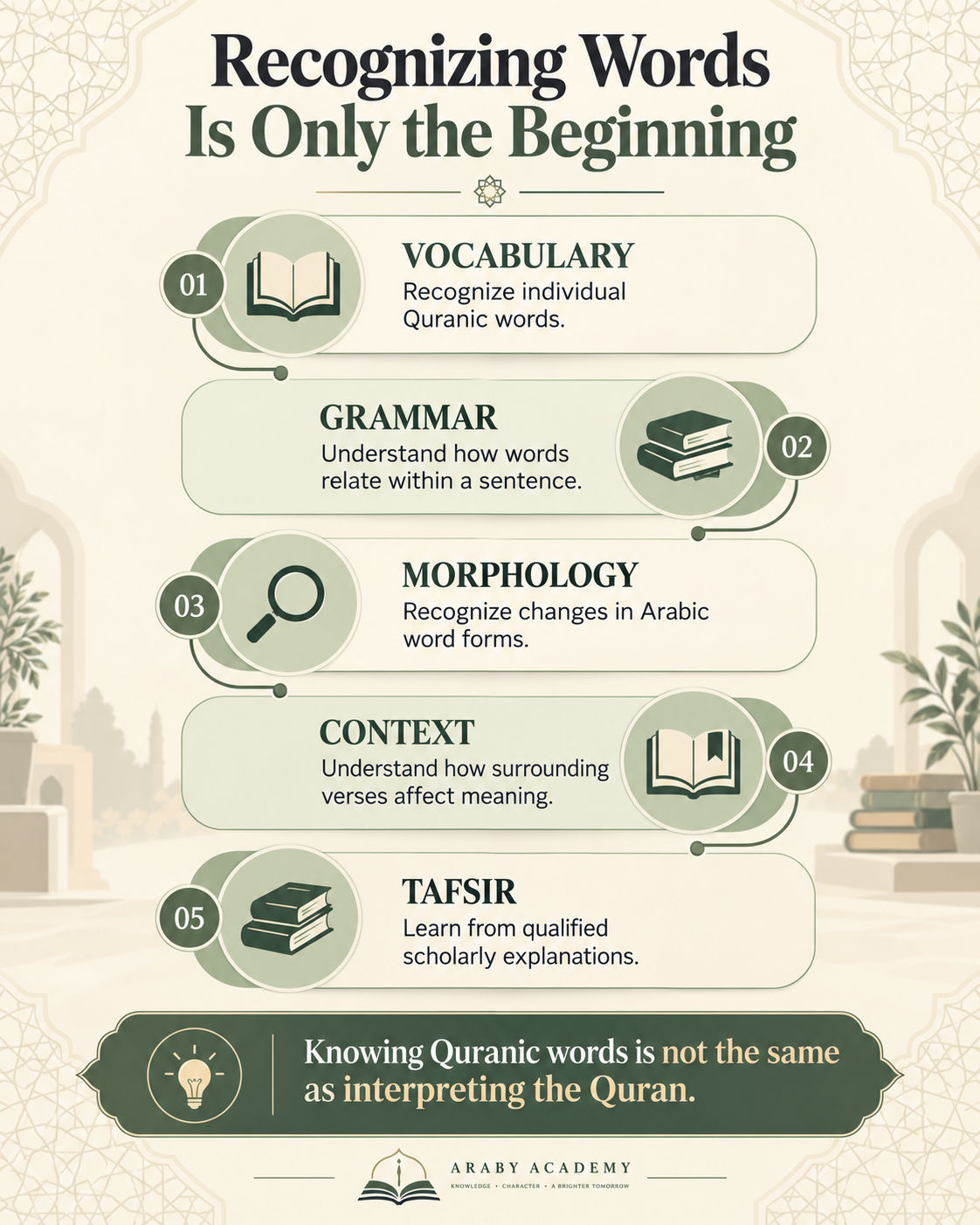
Knowing that a verse contains "Lord," "day," and "religion" tells you something. Understanding what the verse says also requires grammar, morphology, context, the way Arabic builds a sentence, and the guidance of Tafsir and qualified scholars. Vocabulary is the foundation. It is not the whole building.
With that in mind, this article gives you:
a curated list of 100 high-frequency, high-usefulness Quranic words, organized by theme rather than dumped as a wall of text,
an honest explanation of how "most common" is measured (and why viral statistics about it deserve caution),
study plans, memory techniques, and practical exercises,
a clear picture of what to learn after vocabulary.
How Much Quran Can You Understand by Learning Common Words?
You may have seen claims such as "learn 100 words and understand 50% of the Quran" or "300 words cover 80% of the text." They are appealing, and they circulate widely. They are also very hard to verify, because they usually do not say what was counted, or how.
Here is why such numbers vary so much from source to source:
What counts as a "word"? In Arabic script, many small words attach to the word that follows. The phrase wa-bi-l-ḥaqq ("and with the truth") is written as one visual word, but it contains three separate items.
Surface forms or lemmas? The forms قال ("he said"), يقول ("he says"), and قالوا ("they said") are three different surface forms of one underlying verb. Counting forms and counting lemmas give very different totals.
Roots or words? One root can produce many distinct words with different meanings. Grouping by root shrinks the list dramatically, but it also mixes together words that a reader must treat separately.
Repeated words. Does a statistic count each occurrence (so a very frequent word counts thousands of times), or each different word once?
Different corpora and versions. Different linguistic databases make different analytical decisions, so their numbers do not always match.
So we will not repeat a viral percentage. What we can say honestly is this:
A relatively small set of words does appear again and again across the Quran, and learning that high-frequency vocabulary is an unusually efficient place for a beginner to start. It still does not equal full comprehension of the text.
Think of it like learning the streets of a new city. Knowing the twenty main roads helps you recognize where you are almost immediately. It does not mean you can navigate every alley, and it certainly does not make you a city planner.
Before the List: 5 Things Beginners Need to Know
You do not need any grammar background for this article. But five small ideas will make the vocabulary list much easier to use.
1. Arabic Words Change Form
Arabic words often look different depending on who is doing the action, how many are involved, or how the word is used in the sentence. The same verb appears as:
Form | Transliteration | Rough meaning |
|---|---|---|
قَالَ | qāla | he said |
قَالُوا | qālū | they said |
يَقُولُ | yaqūlu | he says |
قُلْ | qul | say! |
These are not four unrelated words. They are variations of one verb built on the same three letters. In this article, verbs are listed in their basic dictionary form: the past tense, "he" form (for example, قَالَ, "he said"). Nouns are listed in their basic singular form. When you meet the other forms in the Quran, you will gradually learn to see the same word underneath.
2. Arabic Uses Roots
Most Arabic words are built from a root, usually three consonants that carry a core idea. Take the root ك ت ب (k-t-b), connected with the idea of writing:
كَتَبَ (kataba): to write, or to prescribe or decree
كِتَاب (kitāb): book, scripture, something written
كَاتِب (kātib): one who writes, a scribe
Spotting a familiar root can help you recognize a family of words. But a root is a clue, not a translation. Two words from the same root can have meanings that drift apart, and a technical term (like Muslim or ṣalāh) carries a specific meaning that is more than "root idea + pattern." We will return to this in the section on learning words in families.

3. Small Words Matter
Words like مِن (from), فِي (in), عَلَىٰ (on), إِلَىٰ (to), and لَا (no/not) look far less exciting than "Paradise" or "mercy." But they hold sentences together. A learner who knows "Paradise," "Fire," and "believers" but not the small words can pick out the topic of a verse and still miss what is being said about it. That is why the list below begins with them.
4. One Arabic Word Can Have Multiple Meanings
Arabic words carry a range of meaning, and context decides which part of that range is active. For example, دِين can mean "religion" or "way of life" in one verse, and "recompense" or "judgment" in another. So in this article you will see a core meaning first, then contextual meanings where they matter. Please avoid memorizing "Arabic word = one permanent English word." That habit is comfortable and unreliable.
5. Vocabulary Is the Beginning, Not the End
After vocabulary come the next layers: grammar (how words relate inside a sentence), morphology (how words are built and how forms change), context (what surrounds the verse), and Tafsir (scholarly explanation). We will map that path near the end of the article.
The Most Common Words in the Quran: How This List Was Built
Because the title makes a frequency claim, it is fair to show the method.
Source. The frequency data behind this list comes from the Quranic Arabic Corpus (corpus.quran.com), a word-by-word morphological database created by Kais Dukes at the University of Leeds and now maintained by the Quran.com team. It records the Quran's roughly 77,400 words (the exact total depends on counting conventions) together with grammatical analysis.
What the Corpus counts. It reports frequency by lemma, meaning it groups word forms that differ only by inflection. It lists about 3,680 non-verb lemmas separately from about 1,475 verb entries, and the verb entries are grouped by root and verb form.
Two things to notice:
The same-looking word can be split by function. The Corpus lists مَا several times, once for each job it does, for example as a relative pronoun (1,266 occurrences), as a negative particle (704), and as a question word (92). Several other small words behave the same way.
Attached prefixes like وَ ("and") and بِـ ("with/by") do not appear in the lemma ranking at all. They are analyzed as prefixes on the following word. They are extremely frequent, but the ranking below cannot show it.
For that reason, the Corpus's counts cannot be divided by ~77,400 to produce a tidy "percentage of the Quran." They count analyzed segments, not visual words on the page.
For orientation, here are the top items from the Corpus (counts as reported by the Corpus when this article was prepared; later versions may differ slightly):
Most frequent non-verb lemmas
Rank | Arabic | Transliteration | Meaning | Corpus count |
|---|---|---|---|---|
1 | مِن | min | from, of | 3,226 |
2 | ٱللَّه | Allāh | Allah | 2,699 |
3 | فِي | fī | in | 1,701 |
4 | إِنَّ | inna | indeed | 1,682 |
5 | عَلَىٰ | ʿalā | on, upon | 1,445 |
6 | ٱلَّذِي | alladhī | who, that | 1,442 |
7 | لَا | lā | no, not | 1,364 |
8 | مَا | mā | that which, what | 1,266 |
9 | رَبّ | rabb | Lord | 975 |
10 | إِلَىٰ | ilā | to, toward | 742 |
Most frequent verbs (grouped by root and form)
Arabic | Transliteration | Meaning | Corpus count |
|---|---|---|---|
قَالَ | qāla | to say | 1,618 |
كَانَ | kāna | to be | 1,358 |
ءَامَنَ | āmana | to believe | 537 |
عَلِمَ | ʿalima | to know | 382 |
جَعَلَ | jaʿala | to make | 340 |

How the 100 words were chosen. This is a curated list of 100 of the most frequently occurring and most useful Quranic words, not a claim of an exact "top 100 by rank." We:
began from the Corpus's frequency lists for lemmas and verbs,
included the high-frequency function words first, since a learner cannot read a sentence without them,
merged same-looking words that the Corpus splits by function (such as the several uses of مَا) into one entry, and explained the range of uses,
included Allah, Quran, and Jahannam although the Corpus tags them as proper nouns, because no Quranic vocabulary list makes sense without them,
left out most other proper names (such as prophets' names) and some very frequent grammatical items (for example أَنَّ, أَنْ, أَمْ, هَلْ, كَيْفَ) so the list would balance frequency with thematic usefulness. You will meet those words quickly once you start reading.
Every entry below appears in the Quran, and the roots come from established Arabic lexical analysis. Where the root of a word is debated, or where a root would be inappropriate (for example, for particles), we say so instead of guessing.
A note on spelling and transliteration. The vocabulary tables use standard Arabic spelling with vowel marks so beginners can read them. The Quranic phrases are given with standard vowelling based on the Ḥafṣ reading; the printed Mushaf may show small Uthmani spelling conventions (such as the small dagger alif in هَٰذَا or ٱلصَّلَوٰة). Always compare with a printed Mushaf when you study. Transliteration key: ʿ = the letter ʿayn, ʾ = hamzah, ā ī ū = long vowels, ḥ ṣ ḍ ṭ ẓ = the "heavy" or emphatic letters, and dh, th, kh, gh, sh are single Arabic letters.
The 100 Common Quranic Words
The words are arranged in nine groups. Each group has a compact table for review, followed by a numbered list showing the word in a real Quranic phrase, with a short learning note. On a phone, you can study one group at a time.
Group 1: Essential Particles, Pronouns, and Connectors (Words 1–24)
These are the words that hold Quranic sentences together. You will meet them in nearly every verse.
# | Arabic | Say it | Meaning (type) | Root |
|---|---|---|---|---|
1 | مِنْ | min | from, of, some of (preposition) | none |
2 | فِي | fī | in, within (preposition) | none |
3 | عَلَىٰ | ʿalā | on, upon, over (preposition) | none |
4 | إِلَىٰ | ilā | to, toward (preposition) | none |
5 | عَنْ | ʿan | about, from, away from (preposition) | none |
6 | مَعَ | maʿa | with, together with (preposition/adverb) | none |
7 | بَيْنَ | bayna | between, among (noun used as adverb) | ب ي ن |
8 | لَا | lā | no, not, do not (particle) | none |
9 | مَا | mā | what, that which; not (particle/pronoun) | none |
10 | لَمْ | lam | did not (particle) | none |
11 | لَنْ | lan | will not, will never (particle) | none |
12 | إِنَّ | inna | indeed, truly (particle) | none |
13 | قَدْ | qad | indeed, already (particle) | none |
14 | ثُمَّ | thumma | then, after that (conjunction) | none |
15 | أَوْ | aw | or (conjunction) | none |
16 | بَلْ | bal | rather, nay (particle) | none |
17 | إِلَّا | illā | except, only (particle) | none |
18 | إِذَا | idhā | when, if (adverb) | none |
19 | الَّذِي | alladhī | who, which, that (relative pronoun) | none |
20 | مَنْ | man | who, whoever (pronoun) | none |
21 | هَٰذَا | hādhā | this (demonstrative) | none |
22 | ذَٰلِكَ | dhālika | that (demonstrative) | none |
23 | هُوَ | huwa | he, it (pronoun) | none |
24 | كُلّ | kull | every, each, all (noun) | ك ل ل |
In the Quran
مِنْ: «هُدًى مِّن رَّبِّهِمْ», "guidance from their Lord" (Al-Baqarah 2:5). Note: the most frequent word in the Corpus's lemma table. Without vowel marks, مِن (from) and مَن (who) look identical, so context and vowelling tell them apart.
فِي: «لَا رَيْبَ فِيهِ», "there is no doubt in it" (Al-Baqarah 2:2). Note: with a pronoun it becomes فِيهِ ("in it/him") or فِيهَا ("in it/her/there").
عَلَىٰ: «أُولَٰئِكَ عَلَىٰ هُدًى», "those are upon guidance" (Al-Baqarah 2:5). Note: before a pronoun it changes shape: عَلَيْهِ, عَلَيْهِمْ ("upon him," "upon them").
إِلَىٰ: «وَإِنَّا إِلَيْهِ رَاجِعُونَ», "and indeed, to Him we will return" (Al-Baqarah 2:156). Note: same pattern as عَلَىٰ: إِلَيْهِ = "to him/Him."
عَنْ: «رَّضِيَ اللَّهُ عَنْهُمْ وَرَضُوا عَنْهُ», "Allah is pleased with them, and they are pleased with Him" (Al-Bayyinah 98:8). Note: the Arabic uses "away from/about," which is why English translations vary: "about," "from," or, as here, "with" after "pleased."
مَعَ: «وَهُوَ مَعَكُمْ أَيْنَ مَا كُنتُمْ», "and He is with you wherever you are" (Al-Ḥadīd 57:4). Note: watch for مَعَكُمْ ("with you all") and مَعَنَا ("with us").
بَيْنَ: «لَا نُفَرِّقُ بَيْنَ أَحَدٍ مِّن رُّسُلِهِ», "we make no distinction between any of His messengers" (Al-Baqarah 2:285). Note: often means "between" but can be "among."
لَا: «لَا إِكْرَاهَ فِي الدِّينِ», "there is no compulsion in religion" (Al-Baqarah 2:256). Note: لَا has several jobs, including plain negation ("no/not") and prohibition ("do not"). Context decides.
مَا: «مَا وَدَّعَكَ رَبُّكَ وَمَا قَلَىٰ», "Your Lord has not abandoned you, nor has He detested you" (Aḍ-Ḍuḥā 93:3). Note: here مَا means "not." Elsewhere it means "what" or "that which." The Corpus tracks these as separate uses.
لَمْ: «لَمْ يَلِدْ وَلَمْ يُولَدْ», "He neither begets nor is born" (Al-Ikhlāṣ 112:3). Note: لَمْ + a present-form verb gives a past-tense "did not." Literally, "He did not beget and was not begotten."
لَنْ: «لَن تَنَالُوا الْبِرَّ», "you will never attain righteousness" (Āl ʿImrān 3:92). Note: لَنْ negates the future ("will not/will never"), so it looks ahead where لَمْ looks back.
إِنَّ: «إِنَّ مَعَ الْعُسْرِ يُسْرًا», "indeed, with hardship comes ease" (Ash-Sharḥ 94:6). Note: it often attaches to pronouns: إِنَّهُ ("indeed he/it"), إِنَّا ("indeed we"), إِنَّكَ ("indeed you").
قَدْ: «قَدْ أَفْلَحَ مَن زَكَّاهَا», "he has certainly succeeded who purifies it" (Ash-Shams 91:9). Note: with a past-tense verb it often adds emphasis ("indeed/has certainly").
ثُمَّ: «ثُمَّ يُمِيتُكُمْ ثُمَّ يُحْيِيكُمْ», "then He causes you to die, then gives you life" (Al-Baqarah 2:28). Note: it marks sequence, usually with a gap in time or stage.
أَوْ: «أَوْ كَصَيِّبٍ مِّنَ السَّمَاءِ», "or like a rainstorm from the sky" (Al-Baqarah 2:19). Note: it offers an alternative or another comparison.
بَلْ: «بَلْ هُوَ قُرْآنٌ مَّجِيدٌ», "rather, it is a glorious Quran" (Al-Burūj 85:21). Note: it often corrects or moves past what came before.
إِلَّا: «لَا إِلَٰهَ إِلَّا هُوَ», "there is no deity except Him" (Al-Baqarah 2:255). Note: after a negative, إِلَّا produces "only/except." This one pattern is the heart of the shahādah.
إِذَا: «إِذَا جَاءَ نَصْرُ اللَّهِ وَالْفَتْحُ», "when the help of Allah comes, and the victory" (An-Naṣr 110:1). Note: for events expected to happen; often "when."
الَّذِي: «رَبِّكَ الَّذِي خَلَقَ», "your Lord who created" (Al-ʿAlaq 96:1). Note: plural الَّذِينَ ("those who") and feminine الَّتِي are the same word in other forms.
مَنْ: «فَمَن يَعْمَلْ مِثْقَالَ ذَرَّةٍ خَيْرًا يَرَهُ», "so whoever does an atom's weight of good will see it" (Az-Zalzalah 99:7). Note: مَنْ refers to persons, while مَا usually refers to things.
هَٰذَا: «هَٰذَا مِن فَضْلِ رَبِّي», "this is from the favor of my Lord" (An-Naml 27:40). Note: feminine is هَٰذِهِ.
ذَٰلِكَ: «ذَٰلِكَ الْكِتَابُ لَا رَيْبَ فِيهِ», "that is the Book; there is no doubt in it" (Al-Baqarah 2:2). Note: هَٰذَا points to something near; ذَٰلِكَ to something farther away.
هُوَ: «قُلْ هُوَ اللَّهُ أَحَدٌ», "say: He is Allah, One" (Al-Ikhlāṣ 112:1). Note: plural هُمْ ("they"), feminine هِيَ ("she/it").
كُلّ: «إِنَّ اللَّهَ عَلَىٰ كُلِّ شَيْءٍ قَدِيرٌ», "indeed, Allah is over all things capable" (Al-Baqarah 2:20). Note: before a singular noun it means "every/each," and before a definite plural, "all of."
Group 2: Allah, Faith, and Worship (Words 25–35)
# | Arabic | Say it | Meaning (type) | Root |
|---|---|---|---|---|
25 | اللَّه | Allāh | Allah (proper name) | see note |
26 | رَبّ | rabb | Lord, Sustainer, Master (noun) | ر ب ب |
27 | إِلَٰه | ilāh | god, deity (noun) | أ ل ه |
28 | آمَنَ | āmana | he believed (verb) | أ م ن |
29 | كَفَرَ | kafara | he disbelieved (verb) | ك ف ر |
30 | عَبَدَ | ʿabada | he worshipped (verb) | ع ب د |
31 | صَلَاة | ṣalāh | prayer (noun) | ص ل و |
32 | ذِكْر | dhikr | remembrance, mention, reminder (noun) | ذ ك ر |
33 | دِين | dīn | religion, way of life; recompense (noun) | د ي ن |
34 | هُدًى | hudā | guidance (noun) | ه د ي |
35 | حَقّ | ḥaqq | truth; right, due (noun) | ح ق ق |
In the Quran
اللَّه: «بِسْمِ اللَّهِ الرَّحْمَٰنِ الرَّحِيمِ», "in the name of Allah, the Most Merciful, the Especially Merciful" (Al-Fātiḥah 1:1, counting the basmalah as verse 1 as in the Ḥafṣ numbering). Note: the Corpus tags it as a proper noun. Scholars have discussed its linguistic derivation, so this guide does not assign it a root as a certainty.
رَبّ: «رَبِّ الْعَالَمِينَ», "Lord of the worlds" (Al-Fātiḥah 1:2). Note: رَبّ carries the idea of one who nurtures, owns, and sustains, which is why "Lord" alone is only part of it.
إِلَٰه: «وَإِلَٰهُكُمْ إِلَٰهٌ وَاحِدٌ», "and your God is one God" (Al-Baqarah 2:163). Note: إِلَٰه (a deity) is different from اللَّه (the name of the One God). That difference matters when you read لَا إِلَٰهَ إِلَّا اللَّهُ.
آمَنَ: «الَّذِينَ يُؤْمِنُونَ بِالْغَيْبِ», "who believe in the unseen" (Al-Baqarah 2:3). Note: same root as أَمْن (security) and أَمِين (trustworthy). Watch for آمَنُوا ("they believed").
كَفَرَ: «إِنَّ الَّذِينَ كَفَرُوا سَوَاءٌ عَلَيْهِمْ», "indeed, those who disbelieve, it is all the same to them" (Al-Baqarah 2:6). Note: depending on context it can mean rejecting faith or being ungrateful. Classical lexicons connect the root with the idea of covering.
عَبَدَ: «إِيَّاكَ نَعْبُدُ», "You alone we worship" (Al-Fātiḥah 1:5). Note: the Arabic puts إِيَّاكَ ("You alone") first, which is the source of the "alone."
صَلَاة: «وَيُقِيمُونَ الصَّلَاةَ», "and they establish prayer" (Al-Baqarah 2:3). Note: you will see it printed as ٱلصَّلَوٰة in the Uthmani script. It is the same word.
ذِكْر: «أَلَا بِذِكْرِ اللَّهِ تَطْمَئِنُّ الْقُلُوبُ», "surely, in the remembrance of Allah hearts find rest" (Ar-Raʿd 13:28). Note: الذِّكْر is sometimes used for the Quran itself (for example, Al-Ḥijr 15:9).
دِين: «لَكُمْ دِينُكُمْ وَلِيَ دِينِ», "for you is your religion, and for me is my religion" (Al-Kāfirūn 109:6). Note: in مَالِكِ يَوْمِ الدِّينِ (1:4), the word means "recompense/judgment."
هُدًى: «هُدًى لِّلْمُتَّقِينَ», "a guidance for the God-conscious" (Al-Baqarah 2:2). Note: the related verb هَدَى ("he guided") appears in اهْدِنَا in Al-Fātiḥah.
حَقّ: «جَاءَ الْحَقُّ وَزَهَقَ الْبَاطِلُ», "the truth has come, and falsehood has vanished" (Al-Isrāʾ 17:81). Note: it can also mean "a right" or "what is due." الْحَقّ is also commonly listed among Allah's names.
Group 3: People and Humanity (Words 36–46)
# | Arabic | Say it | Meaning (type) | Root |
|---|---|---|---|---|
36 | قَوْم | qawm | people, community, nation (noun) | ق و م |
37 | نَاس | nās | people, mankind (noun) | see note |
38 | إِنسَان | insān | human being (noun) | أ ن س |
39 | مُؤْمِن | muʾmin | believer (noun) | أ م ن |
40 | رَسُول | rasūl | messenger (noun) | ر س ل |
41 | نَبِيّ | nabī | prophet (noun) | ن ب أ |
42 | عَبْد | ʿabd | servant, worshipper (noun) | ع ب د |
43 | أَهْل | ahl | family, people of, folk of (noun) | أ ه ل |
44 | أَصْحَاب | aṣḥāb | companions, people of (plural noun) | ص ح ب |
45 | نَفْس | nafs | self, soul, person (noun) | ن ف س |
46 | ظَالِم | ẓālim | wrongdoer, unjust person (noun) | ظ ل م |
In the Quran
قَوْم: «يَا قَوْمِ اعْبُدُوا اللَّهَ مَا لَكُم مِّنْ إِلَٰهٍ غَيْرُهُ», "O my people, worship Allah; you have no deity other than Him" (Al-Aʿrāf 7:59). Note: the prophets' address to their communities begins يَا قَوْمِ, "O my people."
نَاس: «قُلْ أَعُوذُ بِرَبِّ النَّاسِ», "say: I seek refuge in the Lord of mankind" (An-Nās 114:1). Note: lexicographers differ on the root of this word, so none is given here.
إِنسَان: «عَلَّمَ الْإِنسَانَ مَا لَمْ يَعْلَمْ», "He taught man what he did not know" (Al-ʿAlaq 96:5). Note: الْإِنسَان speaks of the human being as a kind of creature.
مُؤْمِن: «إِنَّمَا الْمُؤْمِنُونَ إِخْوَةٌ», "the believers are but brothers" (Al-Ḥujurāt 49:10). Note: built on the same root as آمَنَ. It is a participle meaning "one who believes."
رَسُول: «مُّحَمَّدٌ رَّسُولُ اللَّهِ», "Muhammad is the Messenger of Allah" (Al-Fatḥ 48:29). Note: from the root idea of sending; the verb أَرْسَلَ means "he sent."
نَبِيّ: «يَا أَيُّهَا النَّبِيُّ», "O Prophet" (Al-Aḥzāb 33:45). Note: رَسُول and نَبِيّ are related but not identical terms in Islamic scholarship, and the difference is a topic for a teacher to explain.
عَبْد: «عَلَىٰ عَبْدِنَا», "upon Our servant" (Al-Baqarah 2:23). Note: the plural عِبَاد appears in phrases such as عِبَادِي ("My servants").
أَهْل: «يَا أَهْلَ الْكِتَابِ», "O People of the Book" (Āl ʿImrān 3:64). Note: in the Quran it can mean a person's household or the people belonging to something.
أَصْحَاب: «أُولَٰئِكَ أَصْحَابُ الْجَنَّةِ», "those are the companions of Paradise" (Al-Baqarah 2:82). Note: singular صَاحِب. In "people of Paradise," "companions" means those who belong there.
نَفْس: «وَنَفْسٍ وَمَا سَوَّاهَا», "and by the soul and He who proportioned it" (Ash-Shams 91:7). Note: depending on context it can be "self," "soul," or "person," as in كُلُّ نَفْسٍ ("every soul/person").
ظَالِم: «وَالْكَافِرُونَ هُمُ الظَّالِمُونَ», "and the disbelievers, they are the wrongdoers" (Al-Baqarah 2:254). Note: related to the verb ظَلَمَ ("he wronged") and the noun ظُلْم ("wrongdoing").
Group 4: The Quran, Knowledge, and Communication (Words 47–57)
# | Arabic | Say it | Meaning (type) | Root |
|---|---|---|---|---|
47 | كِتَاب | kitāb | book, scripture; decree (noun) | ك ت ب |
48 | آيَة | āyah | sign, miracle; verse (noun) | أ ي ي |
49 | قُرْآن | qurʾān | Quran; recitation (noun) | ق ر أ |
50 | قَالَ | qāla | he said (verb) | ق و ل |
51 | عَلِمَ | ʿalima | he knew (verb) | ع ل م |
52 | عِلْم | ʿilm | knowledge (noun) | ع ل م |
53 | سَمِعَ | samiʿa | he heard (verb) | س م ع |
54 | رَأَى | raʾā | he saw (verb) | ر أ ي |
55 | عَقَلَ | ʿaqala | he understood, used reason (verb) | ع ق ل |
56 | تَلَا | talā | he recited; he followed (verb) | ت ل و |
57 | أَنزَلَ | anzala | he sent down, revealed (verb) | ن ز ل |

In the Quran
كِتَاب: «أَنزَلَ عَلَىٰ عَبْدِهِ الْكِتَابَ», "He sent down upon His servant the Book" (Al-Kahf 18:1). Note: can mean "scripture," a general "book," or "decree" depending on context.
آيَة: «وَمِنْ آيَاتِهِ خَلْقُ السَّمَاوَاتِ وَالْأَرْضِ», "and among His signs is the creation of the heavens and the earth" (Ar-Rūm 30:22). Note: it means "sign" here, and also "verse of the Quran" elsewhere. Both senses are one word.
قُرْآن: «إِنَّا أَنزَلْنَاهُ قُرْآنًا عَرَبِيًّا لَّعَلَّكُمْ تَعْقِلُونَ», "indeed, We have sent it down as an Arabic Quran so that you may understand" (Yūsuf 12:2). Note: linked to the root of "reading/reciting."
قَالَ: «وَإِذْ قَالَ رَبُّكَ لِلْمَلَائِكَةِ», "and when your Lord said to the angels" (Al-Baqarah 2:30). Note: the command قُلْ ("say!") comes from this same verb, and you will see it constantly.
عَلِمَ: «وَاللَّهُ يَعْلَمُ وَأَنتُمْ لَا تَعْلَمُونَ», "and Allah knows, and you do not know" (Al-Baqarah 2:216). Note: the verb has many forms. يَعْلَمُ means "he knows."
عِلْم: «وَقُل رَّبِّ زِدْنِي عِلْمًا», "and say: My Lord, increase me in knowledge" (Ṭā Hā 20:114). Note: a verb and a noun from one root sit side by side in this list, a small taste of "word families."
سَمِعَ: «قَدْ سَمِعَ اللَّهُ قَوْلَ الَّتِي تُجَادِلُكَ», "Allah has certainly heard the speech of the one who argues with you" (Al-Mujādilah 58:1). Note: here قَدْ adds emphasis.
رَأَى: «أَلَمْ تَرَ كَيْفَ فَعَلَ رَبُّكَ», "have you not seen how your Lord dealt" (Al-Fīl 105:1). Note: an irregular verb; the "he sees" form looks different (يَرَىٰ, and here تَرَ).
عَقَلَ: «أَفَلَا تَعْقِلُونَ», "will you not then reason?" (Al-Baqarah 2:44). Note: it appears mostly in forms like تَعْقِلُونَ and يَعْقِلُونَ.
تَلَا: «يَتْلُونَهُ حَقَّ تِلَاوَتِهِ», "they recite it as it should be recited" (Al-Baqarah 2:121). Note: تِلَاوَة ("recitation") is the noun form.
أَنزَلَ: «إِنَّا أَنزَلْنَاهُ فِي لَيْلَةِ الْقَدْرِ», "indeed, We sent it down on the Night of Decree" (Al-Qadr 97:1). Note: a related verb, نَزَّلَ, also means "to send down."