You open your first Arabic lesson feeling excited. Then you see the alphabet. The letters run right to left, and each one changes shape depending on where it sits in a word. Some sounds don't exist in English. Nouns have gender, verbs follow patterns you haven't met before, and someone mentions that the Arabic in books differs from the Arabic people speak at home.
Soon one question takes over: "How long is this going to take?"
How long does it take to learn Arabic? It depends on what "learn Arabic" means to you. Arabic is absolutely learnable, but it isn't a single finish line. You might recognize the letters within weeks. You might read simple vowelled words within a few months, and understand common Quranic vocabulary within the first year of steady study. Holding conversations, reading Modern Standard Arabic (MSA), and reaching advanced proficiency come at very different stages.
Think of this article as a roadmap, not a countdown. It shows what each stage involves, what affects your speed, and how to set a goal you can actually measure.
How Long Does It Take to Learn Arabic? The Short Answer
Most beginners see visible progress, such as recognizing letters and reading simple words, within a few weeks to a few months of consistent study. Functional skills, like basic conversation or understanding common Quranic phrases, usually take many months to a couple of years. Advanced proficiency typically takes several years of sustained study and exposure. There is no single number.
Before asking "how long," define the goal. Someone who wants to follow the common words in Salah has a much smaller first target than someone who wants to discuss complex topics entirely in Arabic. Study habits matter too. Twenty minutes three times a week produces very different results from regular lessons plus daily practice.
Seven things shape your timeline:
Your goal: Quran comprehension, conversation, MSA reading, or professional use
Your starting level: whether you've never seen Arabic letters or already read the Quran script
The type of Arabic: MSA, Quranic/Classical, or a spoken dialect
Study frequency
Quality of instruction
Amount of active practice
Consistency over months and years
What Does "Learning Arabic" Actually Mean?
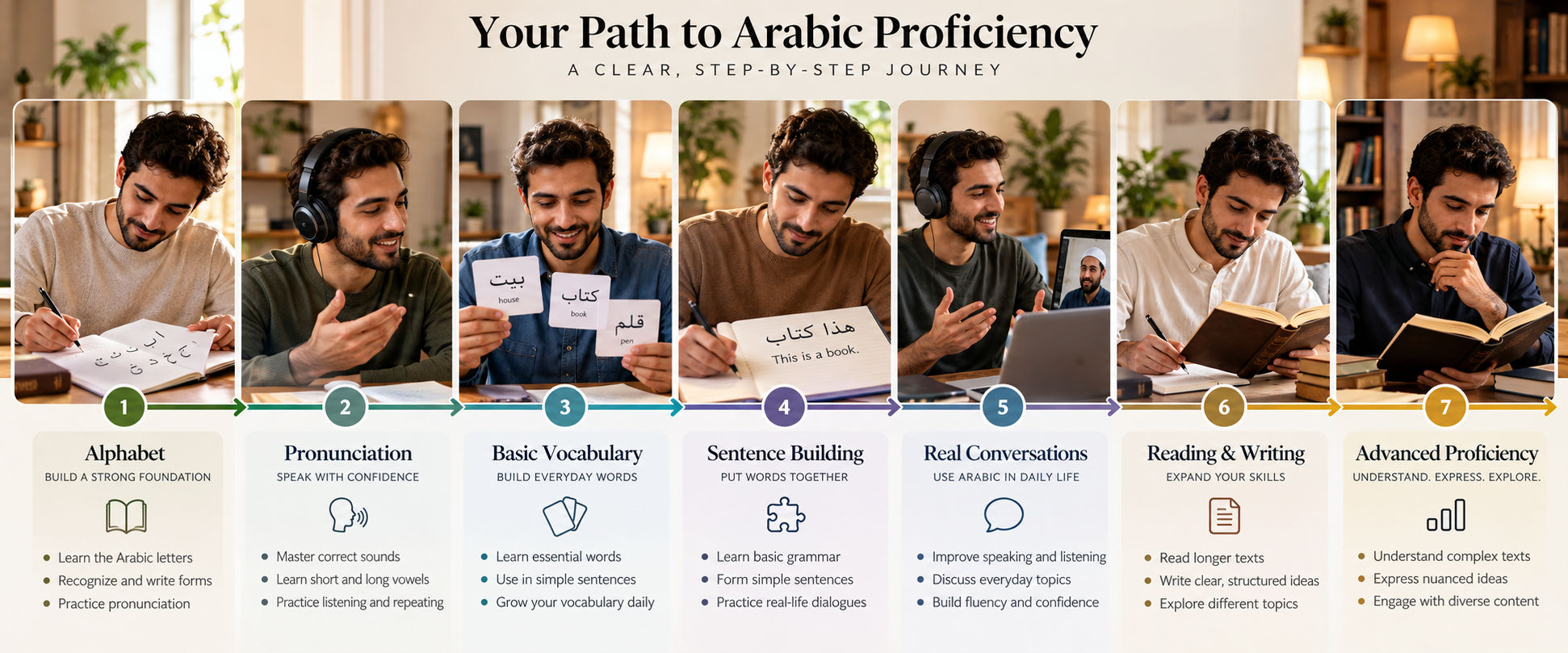
People use "learn Arabic" for very different goals. Here is a useful progression. Each stage needs a different amount of study.
Goal 1: Learn the Arabic Alphabet
You can recognize the letters, tell their different forms apart, understand how they connect, and begin decoding words.
Goal 2: Read Arabic Words
You can sound out words, especially when vowel marks are written.
Reading Arabic aloud does not automatically mean understanding Arabic. This matters a great deal for Quran students. Many Muslims read the Quran script fluently without understanding the meaning. That is a real achievement, but it is a different skill from comprehension.
Goal 3: Understand Basic Vocabulary
You recognize common words and simple expressions.
Goal 4: Hold Simple Conversations
You can introduce yourself, ask basic questions, understand common answers, and talk about everyday topics.
Goal 5: Understand Quranic Vocabulary and Basic Grammar
You start noticing repeated Quranic words and grammatical structures.
Goal 6: Read Modern Standard Arabic
You gradually understand educational texts, articles, books, and formal media at your level.
Goal 7: Reach Advanced Proficiency
You understand nuance, express complex ideas, read sophisticated texts, and use Arabic independently.
Reaching Goal 1 is very different from reaching Goal 7. That is why a single answer to "how long" doesn't exist.
A Realistic Arabic Learning Timeline
The table below gives broad, illustrative ranges for a beginner who studies consistently. These are illustrative estimates, not guarantees. Progress varies a lot between learners.
Learning Goal | What Progress May Look Like | Typical Study Commitment | Illustrative Range |
|---|---|---|---|
Alphabet | Recognize and write letters | Short daily practice | Days to a few weeks |
Basic reading | Decode simple vowelled words | Consistent beginner study | Roughly 1–3 months |
Basic vocabulary | Recognize common words | Regular vocabulary review | Grows steadily from month 1 |
Beginner conversation | Handle simple interactions | Speaking + listening practice | Often several months |
Quranic Arabic foundation | Recognize common vocabulary and grammar | Structured Quranic Arabic study | Often 6–18 months |
Intermediate Arabic | Understand increasingly complex material | Sustained study and exposure | Often 2–3+ years |
Advanced proficiency | Use Arabic independently in complex contexts | Long-term intensive study | Several years or more |
Ranges like these assume steady effort. If you study irregularly, they stretch. If you study more intensively with good feedback, some stages may come sooner.
How Many Hours Does It Take to Learn Arabic?
You will often see the figure "2,200 hours" attached to Arabic. It comes from the U.S. Foreign Service Institute (FSI), and it is widely misquoted, so here is what it actually describes.
What it measures. The FSI compiled approximate learning expectations based on how long it typically takes English-speaking students to reach Speaking 3 and Reading 3, described as General Professional Proficiency. Arabic sits in the FSI's hardest category, with an estimate of about 88 weeks or 2,200 class hours of intensive training. MustGoLangmitra
Who it applies to. Those figures describe a specific group. According to the description reproduced by one reference site, FSI students are typically 30–40 years old, native English speakers with good aptitude for formal language study, who already know one or more other foreign languages, and who study in small classes. Their schedule involves around 25 class hours per week plus 3–4 hours a day of self-study. MustGoMustGo
What it does not mean. It is not the number of hours every person needs to "become fluent." It describes intensive government training toward professional working proficiency in both speaking and reading. One summary notes that these figures don't map onto a part-time learner's calendar time, which can look very different. Nor does it describe most Quran students' goals. Understanding common Quranic vocabulary and grammar is a different and much narrower target than diplomatic-level speaking. Langmitra
A simple illustration: if you study one hour a day, that is roughly 365 hours a year. The FSI figure describes something very different from casual study, so don't divide 2,200 by your daily hours and call the result your deadline. Use it for one thing only, which is to understand that advanced, professional-level Arabic is a multi-year project. Meaningful progress toward smaller goals starts much sooner.
Is Arabic Really One of the Hardest Languages to Learn?
Arabic is often ranked among the most demanding languages for English speakers. The difficulty is real, but it isn't the whole story.
What makes Arabic challenging for English speakers:
A different writing system, written right to left
Sounds that may be unfamiliar
Root-and-pattern morphology, meaning words are built from roots in patterns
Grammatical structures that differ from English
Vocabulary that is distant from English, with few cognates
The gap between formal Arabic and spoken dialects
What gets easier with familiarity:
Arabic spelling has systematic features
Roots help you recognize word families, so one root can unlock many words
Word patterns become familiar over time
Frequent vocabulary repeats constantly
Connected script becomes automatic with practice
Quran students meet the same important words again and again
So is Arabic hard to learn? It is demanding, and it takes patience. But it is not "the hardest language in the world" in any absolute sense. Difficulty depends on your native language, your goals, your exposure, and your language-learning experience. A structured approach makes the challenge manageable.
Which Arabic Are You Trying to Learn?
"Arabic" covers several varieties, and your choice affects your timeline.
Modern Standard Arabic (MSA)
MSA is the formal standard used in books, education, news, formal speeches, and official communication across the Arab world. It is the version most Arabic courses for non-native speakers teach.
Quranic/Classical Arabic
Quranic Arabic is the Arabic of the Quran. Understanding it requires vocabulary, grammar, and morphology, and eventually deeper linguistic study. Quranic Arabic and MSA are not completely separate languages. They share a great deal of vocabulary, grammar, and structure, so learning one helps with the other. There are still real differences in vocabulary, style, and usage, and Quranic study involves features you won't meet in a newspaper.
Spoken Arabic Dialects
Everyday speech varies by region. Major groups include:
Egyptian Arabic
Levantine Arabic (Syria, Lebanon, Jordan, Palestine)
Gulf Arabic
Maghrebi varieties (Morocco, Algeria, Tunisia)
If your goal is everyday conversation, you may want to study a spoken variety alongside a foundation in MSA, or after it, depending on where you'll use it. If your goal is the Quran, dialect study isn't necessary at the start.
How Long Does It Take to Learn Quranic Arabic?
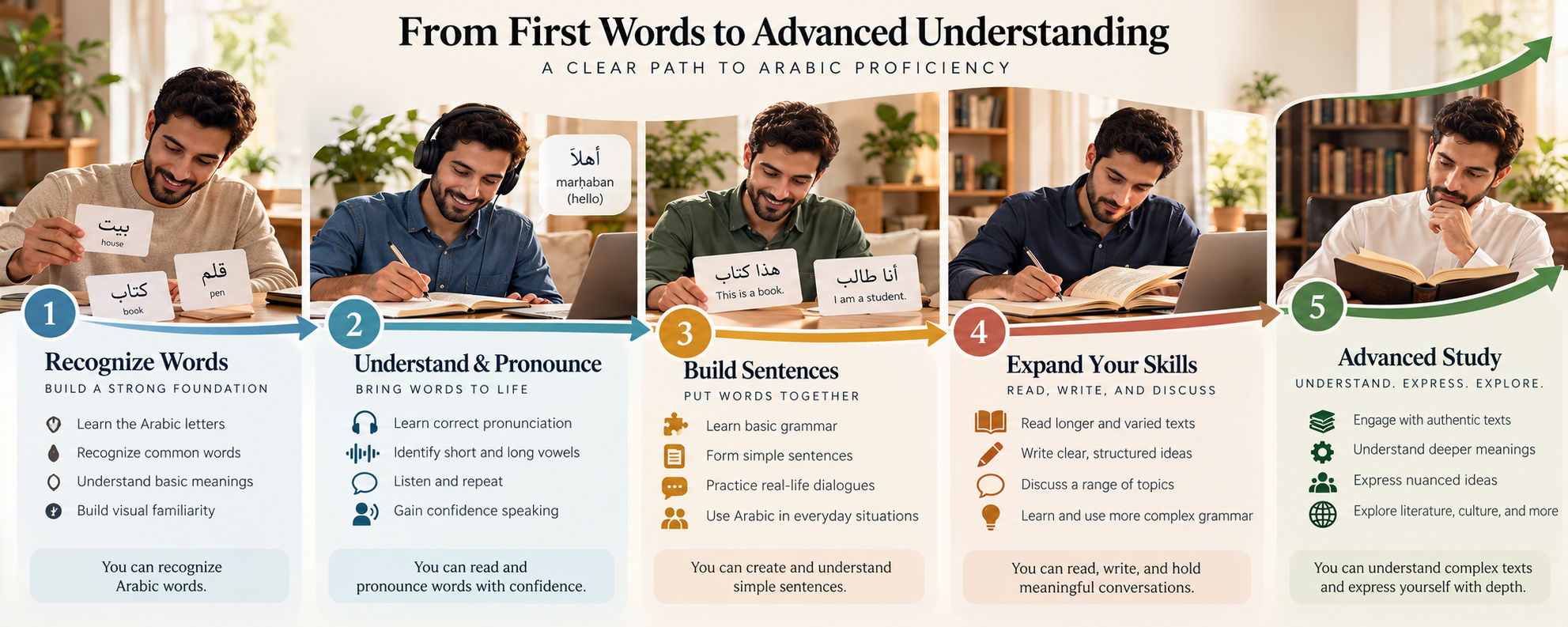
"Understanding the Quran" has levels, and it helps to know which one you are aiming for. A useful way to see it is in five stages.
Stage 1: Recognizing Common Quranic Words
You begin noticing recurring vocabulary as you recite and listen. This can start within the first months of study.
Stage 2: Understanding Basic Quranic Sentences
You combine vocabulary with elementary grammar to follow short, simple verses.
Stage 3: Understanding Morphology
You recognize roots, verb forms, pronouns, and word patterns, and words start to feel connected instead of separate.
Stage 4: Following More Complex Verses
You understand increasingly sophisticated structures, while still relying on translation and Tafsir.
Stage 5: Advanced Quranic Arabic
You engage with deeper grammatical, rhetorical, and classical linguistic features. This takes long-term study.
For many committed learners, a solid foundation in Stages 1–3 takes somewhere between several months and a couple of years, depending on study intensity and instruction. Stages 4 and 5 are long-term.
An important boundary: learning Quranic Arabic does not make someone automatically qualified to interpret the Quran independently. Interpretation draws on knowledge beyond language, including context, Hadith sciences, jurisprudence, and scholarly tradition. Language study should complement reliable Tafsir and qualified scholarship, not replace it.
Can You Learn Arabic in 3 Months?
You can make meaningful progress in three months. You should not expect fluency.
A committed beginner might realistically:
Learn the alphabet and letter forms
Develop basic reading skills with vowel marks
Build a starter vocabulary of useful words
Understand a few simple grammatical patterns
Use some basic expressions
Recognize common Quranic words
That is a real foundation. But be cautious of marketing that promises Arabic fluency in 90 days. Meaningful progress is different from fluency claims. The first is achievable. The second, for most learners, isn't.
Can You Learn Arabic in 6 Months?
Six months of structured, consistent study can produce substantial progress, especially when you combine:
Teacher-led lessons
Daily review
Reading
Listening
Vocabulary building
Speaking, where relevant to your goal
Grammar practice
A diligent learner might, for example, read short vowelled texts with growing confidence, understand basic sentence structures, follow slow and simple audio, hold a very basic conversation, or recognize familiar words and structures in short Surahs. Results still depend heavily on how many hours you study and which skills you target. Six months of casual study looks very different from six months of focused study.
What About One Year?
A year of consistent learning can create a strong foundation. But "I studied Arabic for a year" tells us surprisingly little. Compare three students.
Student A studies one hour a week and rarely reviews. After a year, they know the alphabet and some vocabulary, but much has faded because there was little repetition.
Student B has structured lessons several times a week and studies 20–30 minutes most days. After a year, they read confidently, know a solid core vocabulary, and understand basic grammar. They can handle simple conversations or basic Quranic sentences, depending on their focus.
Student C studies intensively, receives regular instruction, listens to Arabic daily, reads often, and practices actively. After a year, they are noticeably further along in comprehension and expression.
All three "studied for a year." Their results differ greatly. Hours and quality of engagement matter more than calendar time alone.
8 Factors That Determine How Fast You Learn Arabic
1. Your Goal
Quran comprehension, conversation, MSA reading, travel, academic study, and professional fluency each need different skills. A clear target saves time because you study what matters for it.
2. Your Native Language
Similarity between your first language and Arabic can affect the learning curve. Speakers of languages with shared vocabulary or sounds may find some parts easier. Speakers of other languages may find them harder. This is about linguistic overlap, not about any group of people. Individual differences are larger than any generalization.
3. Previous Arabic Exposure
A Muslim who already reads Quranic script begins differently from someone who has never seen Arabic letters. They start with a real advantage in script recognition and pronunciation. But Quran-reading ability does not necessarily equal Arabic comprehension. You may still be starting from zero in vocabulary and grammar.
4. Study Frequency
Short, regular study beats irregular cramming. Daily exposure keeps material fresh. A long gap followed by a marathon session mostly rebuilds what was forgotten.
5. Quality of Instruction
A qualified teacher can spot pronunciation and grammar mistakes you may not notice yourself. Good instruction also gives you a sensible order of topics, so you don't waste time on material you aren't ready for.
6. Active Practice
Watching Arabic videos passively is not the same as practicing. Active practice includes:
Reading aloud
Writing
Recalling vocabulary from memory
Answering questions
Speaking
Applying grammar in your own sentences
Passive exposure helps, but active recall is what strengthens memory.
7. Listening Exposure
Listening comprehension grows gradually. Start with slow, clear audio at your level and repeat it. Over time, your ear adapts to the sounds and rhythm, and words you once couldn't separate begin to stand out.
8. Consistency
A sustainable routine outperforms short bursts of motivation. Motivation rises and falls. A small, realistic habit keeps you moving on the days you don't feel like studying.
How Much Arabic Should You Study Every Day?
There is no perfect number. Choose one you can keep up.
15 Minutes Per Day
Suitable for very busy learners who want gradual progress.
5 minutes vocabulary
5 minutes reading
5 minutes review
30 Minutes Per Day
10 minutes vocabulary
10 minutes grammar
10 minutes reading or listening
60 Minutes Per Day
A structured lesson or review
Vocabulary
Reading
Listening
Speaking or written exercises
A smaller routine kept up for months can outperform an ambitious two-hour schedule abandoned after two weeks. Start with what you can sustain, then increase it when your routine is stable.
A 12-Month Arabic Roadmap for Beginners
This roadmap is illustrative. Not every learner will reach the same outcomes, and you should adjust the pace to your goal, schedule, and instruction.
Months 1–2: Foundations
Alphabet and letter forms
Sounds and pronunciation
Short vowels
Reading basic words
Essential vocabulary
For Quran-focused students, introduce accurate pronunciation early. Good habits are much easier to build than to correct later.
Months 3–4: Build Simple Sentences
Pronouns
Gender
Basic nouns and adjectives
Common verbs
Simple sentence structures
High-frequency vocabulary
Months 5–6: Strengthen Comprehension
Reading short texts
Listening practice
Vocabulary expansion
Basic verb structures
Question formation
Practical application
Months 7–9: Move Toward Intermediate Skills
Longer texts
More grammar
Listening comprehension
Speaking, where relevant
Quranic passages for Quran-focused students
Months 10–12: Consolidate and Expand
Identify weaknesses and target them
Increase vocabulary
Read more independently
Sustained listening
Deeper grammar
Structured Quranic Arabic or conversational practice, depending on your goals
The plan is flexible. If a stage takes longer, that is normal. Moving on too early costs more than staying a few extra weeks.
Arabic Roadmap for Quran-Focused Students
If your main goal is the Quran, your path looks a little different.
Step 1: Arabic letters and pronunciation
Step 2: Reading Quranic Arabic accurately
Step 3: Common Quranic vocabulary
Step 4: Basic Arabic grammar
Step 5: Pronouns and verb structures
Step 6: Arabic morphology and roots
Step 7: Study short Surahs word by word
Step 8: Continue with structured Quranic Arabic and reliable Tafsir
Tajweed and Arabic language study overlap, but they are not identical. Tajweed is the discipline of reciting the Quran with correct pronunciation and rules. Arabic language study is about understanding meaning, vocabulary, and grammar. A student may recite beautifully without understanding the language. Another may understand Arabic well and still need Tajweed training to recite correctly. Most Quran students benefit from developing both.
The Biggest Mistakes That Slow Arabic Learners Down
Mistake 1: Trying to Learn Everything at Once
MSA, Quranic Arabic, several dialects, and advanced grammar together is too much for most beginners. Pick one main goal first.
Mistake 2: Memorizing Huge Vocabulary Lists Without Context
Words stick better inside phrases, sentences, and meaningful examples than in isolated lists.
Mistake 3: Studying Grammar but Never Using Arabic
Grammar rules only become skills when you apply them by reading, speaking, or writing.
Mistake 4: Depending on Transliteration for Too Long
Transliteration helps on day one, but relying on it delays your reading and makes pronunciation less accurate. Move to Arabic script gradually.
Mistake 5: Being Afraid of Mistakes
Mistakes are part of language development. Each corrected error is progress.
Mistake 6: Studying Intensively and Then Disappearing for Weeks
Long gaps undo momentum. Steady, smaller sessions win.
Mistake 7: Comparing Yourself With Other Students
Learners have different backgrounds, schedules, goals, and exposure. Compare yourself with your own past ability.
Mistake 8: Waiting Until You "Know Enough" Before Reading or Listening
Use graded material from the early stages. You don't need to understand everything, only enough to keep learning.
Can You Learn Arabic by Yourself?
Yes, to a meaningful extent. Self-study is valuable for:
Vocabulary building
Reading practice
Reviewing grammar
Listening
Flashcards and repetition
Teacher feedback adds the most in areas that are hard to judge alone:
Pronunciation
Correcting persistent errors
Speaking practice
Grammar clarification
Accountability
Choosing appropriate material
Quranic pronunciation and Tajweed
You don't need to pay for lessons to make progress. But many learners find that independent practice combined with qualified instruction works better than either alone.
Online Arabic Classes vs Self-Study
Factor | Self-Study | Teacher-Led Learning |
|---|---|---|
Flexibility | High | Depends on schedule |
Feedback | Limited | Direct |
Pronunciation correction | Difficult | Strong advantage |
Cost | Often lower | Usually higher |
Structure | Learner must create it | Usually provided |
Accountability | Self-directed | Built in |
Personalized explanations | Limited | Strong advantage |
Neither approach is right for everyone. A common and effective pattern is to take regular online Arabic classes for guidance and correction, then use self-study for daily repetition between lessons.
How to Know You're Actually Making Progress
Counting months is a weak metric. Ask yourself instead whether you can now:
Recognize more Arabic words
Read faster than three months ago
Understand basic sentence patterns
Recall vocabulary without translating first
Recognize Quranic words while listening to recitation
Understand simple audio
Form basic sentences
Identify grammatical structures you previously missed
Measure yourself against your earlier ability, not against fluent speakers. Progress in a language is often quiet, and these checks make it visible.
What Does "Fluent in Arabic" Mean?
"Fluency" is not one thing. Language proficiency is multidimensional. Someone may:
Read very well but speak hesitantly
Understand Quranic Arabic but struggle with everyday Egyptian Arabic
Speak a dialect comfortably but find formal MSA texts difficult
That is why "How long until I'm fluent?" is a less useful question than "How long until I can do X in Arabic?" Replace X with a specific task, and you get something you can plan for and measure.
A Better Way to Set Your Arabic Goal
Vague goals produce vague progress. Try turning them into specific ones.
Instead of "I want to learn Arabic," try: "Within three months, I want to read vowelled Arabic words more confidently."
Instead of "I want to understand the Quran," try: "I want to learn the vocabulary and basic grammar of Surah Al-Fatihah and ten short Surahs."
Instead of "I want to speak Arabic," try: "I want to hold a five-minute conversation about myself and my daily routine."
Specific goals tell you what to study, when you have arrived, and what to do next.
Learning Arabic for Children vs Adults
Children and adults learn differently, and neither is simply better. Don't assume children "absorb languages effortlessly." Children benefit from the right setting, but they still need regular, quality exposure.
For children, what tends to help:
Short lessons that match their attention span
Repetition
Games
Visual learning
Songs or rhythmic learning, where appropriate
Storytelling
Regular interaction with a teacher
Positive reinforcement
Adults have their own strengths:
Ability to use explicit grammar explanations
Clear goal setting
Capacity for independent review
Understanding how they learn best
Adults are n, studying Arabic onlineot "too old" to learn Arabic. They often progress well because they bring focus and strategy. Parents choosing lessons for a child should look for a patient teacher, a gentle pace, and enough repetition to build confidence.
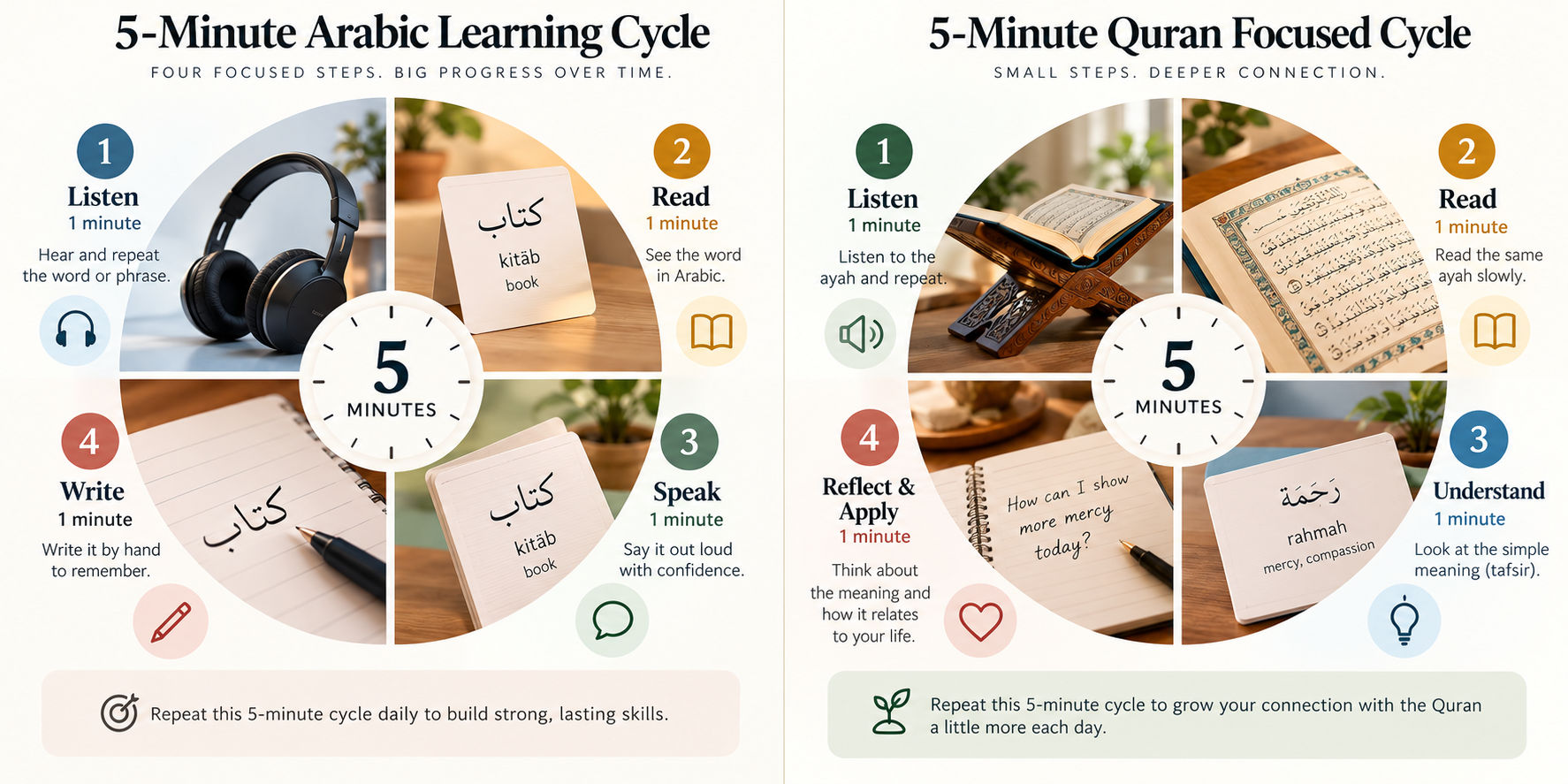
If You Only Have 20 Minutes a Day
A simple daily routine:
5 minutes: Vocabulary review
5 minutes: Arabic reading
5 minutes: Grammar or sentence study
5 minutes: Listening
A Quran-focused version:
5 minutes: Quranic vocabulary
5 minutes: Arabic grammar
5 minutes: Read a short Quran passage
5 minutes: Identify words and structures you've learned
Twenty minutes a day adds up to over 120 hours in a year. Consistency matters more than session length.
When Should You Start Speaking Arabic?
If your goal is conversation or MSA, you don't need to master grammar first. Simple speaking can begin early, on topics like:
Introductions and greetings
Family
Daily routine
Food
Study
Simple questions
Speaking early builds confidence and reveals gaps you can then study.
Quranic Arabic learners are in a different position. If your goal is to understand the Quran rather than hold spontaneous conversations, spoken practice is optional. Your priorities are accurate reading, vocabulary, grammar, and recitation.
How to Make Arabic Learning Faster Without Taking Shortcuts
Learning efficiently is not the same as looking for a shortcut. There are no secret hacks, but there are habits that reduce wasted time:
Take consistent lessons
Use active recall
Space your reviews
Read graded texts
Listen repeatedly to the same audio
Practice speaking, if relevant
Learn vocabulary in context
Apply new material immediately
Get teacher correction
Focus on one clear Arabic goal
Why Structure Matters?
A beginner learning independently may spend months jumping between alphabet videos, grammar PDFs, random vocabulary lists, Quran lessons, and dialect content, without a coherent path. Each resource may be good, but the sequence is missing.
A structured curriculum can help by teaching material in a sensible order and showing you what to study next. That is one reason many learners look for Arabic lessons for beginners with a qualified teacher. Araby Academy offers one-to-one Arabic lessons, Quranic Arabic, Quran reading, Tajweed, and children's programs, with personalized learning plans for non-native speakers.
Frequently Asked Questions
1. How long does it take to learn Arabic for a beginner?
It depends on the goal. Recognizing letters may take days to weeks, and basic reading a few months. Conversation or Quranic comprehension usually takes many months to a couple of years, and advanced proficiency takes several years.
2. Can I learn Arabic in 3 months?
You can make meaningful progress, such as learning the alphabet, reading simple words, and building basic vocabulary. Fluency in three months is not realistic for most beginners.
3. Can I become fluent in Arabic in one year?
Most learners will not reach advanced fluency in one year. A year of consistent, well-structured study can build a strong foundation and enable simple communication or basic Quranic understanding.
4. How many hours a day should I study Arabic?
Choose a routine you can sustain. Fifteen to thirty minutes daily works for many people, and sixty minutes speeds progress if you can keep it up. Consistency matters more than length.
5. Is Arabic difficult to learn?
Arabic is challenging for English speakers because of its script, sounds, and morphology. But it is systematic, and difficulty eases with practice. A clear goal and regular study make it manageable.
6. How long does it take to learn Quranic Arabic?
Foundational understanding of vocabulary and basic grammar often takes several months to a couple of years. Advanced Quranic Arabic is a long-term study.
7. Should I learn Modern Standard Arabic or Quranic Arabic first?
It depends on your goal. They are closely related, so learning either helps with the other. If your main aim is the Quran, start with Quranic Arabic. If you want broader reading and formal communication, start with MSA.
8. Can I learn Arabic by myself?
Yes, especially vocabulary, reading, and listening. Feedback on pronunciation, speaking, and Tajweed is easier to get from a teacher.
9. What is the fastest effective way to learn Arabic?
Regular lessons, daily active practice, spaced review, and a single clear goal. There are no reliable shortcuts.
10. Is it easier to learn Arabic if I can already read the Quran?
Reading the script is a real head start, because you don't begin from zero with letters and sounds. But reading is not comprehension, so you still need to learn vocabulary and grammar.
Conclusion: So, How Long Does It Take to Learn Arabic?
The most useful answer to "How long does it take to learn Arabic?" is that Arabic is learned in stages. The alphabet becomes familiar relatively early. Reading develops through practice. Vocabulary accumulates gradually, and grammar begins connecting the words. Listening gets clearer. Quranic passages start to show familiar structures, and conversations get easier. Advanced proficiency takes sustained effort over years.
So the important question is not "How quickly can I finish Arabic?" but "What can I consistently do this week that moves me toward the Arabic I want to understand and use?"
Choose one clear goal, build a routine you can sustain, and measure yourself against where you started. If you'd like a guided path, Araby Academy's one-to-one Arabic and Quranic Arabic lessons for non-native speakers are built to help you take that next step.