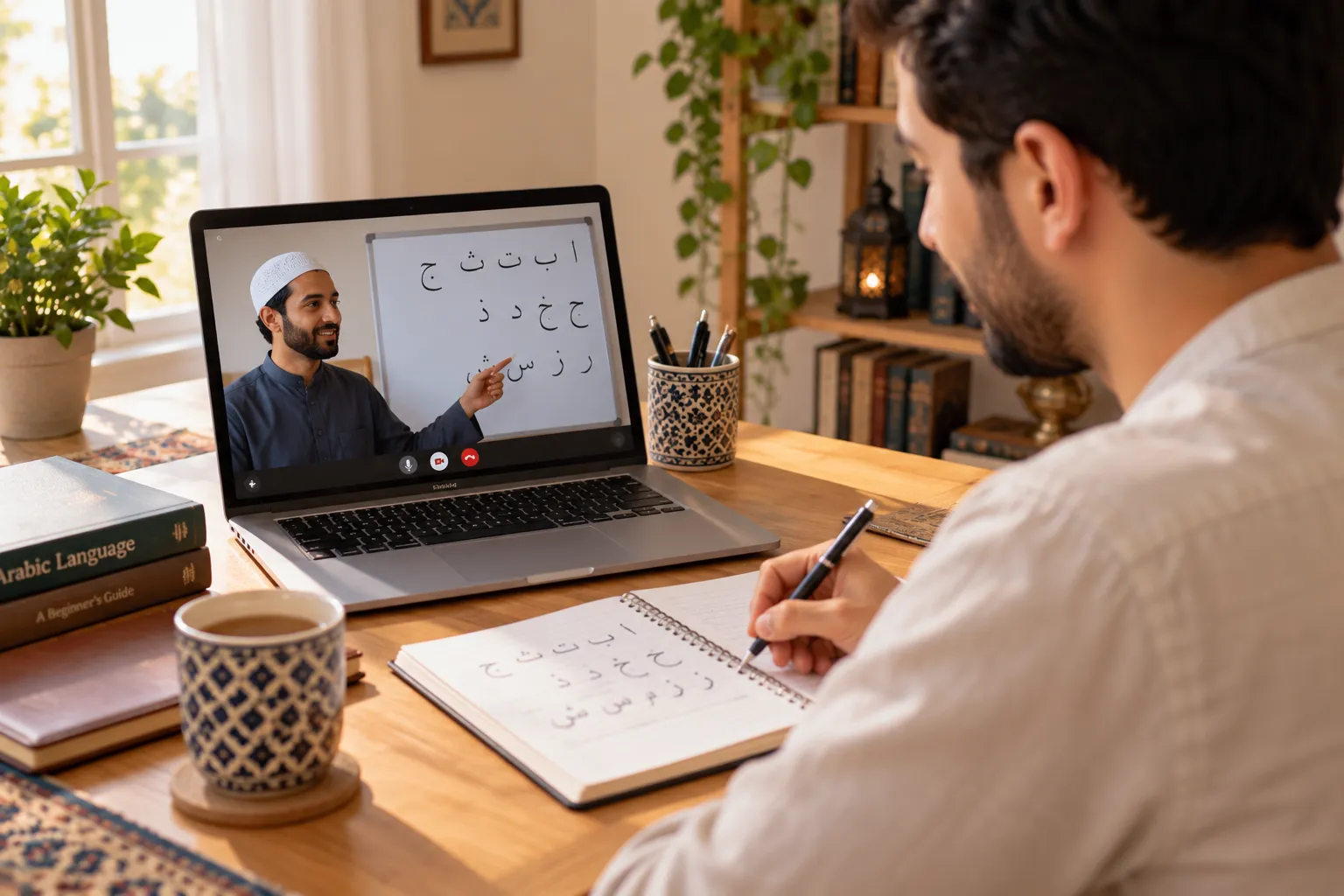
Introduction: Quran Learning Is No Longer Limited by Geography
For generations, learning the Quran depended heavily on which teachers were available nearby. A family might live far from a mosque, in a small Muslim community, or in a country where qualified Quran teachers are hard to find. Work schedules, school runs, and daily life often made regular in-person lessons difficult too.
Online learning has changed this. A student in a small town can now learn from a teacher hundreds of miles away. A parent can sit beside their child during a lesson instead of driving across the city for one. A busy professional can fit a lesson into a lunch break.
But access alone does not guarantee quality. Many people search "learn Quran online" without knowing what to look for, how lessons actually work, or how to tell a strong teacher from a weak one.
The real question is not simply "Can I learn Quran online?" It is "How can I learn Quran correctly, consistently, safely, and with a teacher who understands my needs?"
This guide answers that question in full — for beginners, parents, adults returning to the Quran after years away, new Muslims, and anyone trying to make an informed decision.
What Does It Mean to Learn Quran Online?
"Learning Quran online" is not one single goal. It can mean several different things, and knowing which one applies to you makes it much easier to choose the right course or teacher.
Learning Arabic Letters
For complete beginners who cannot yet recognize the Arabic alphabet. This is the starting point for anyone who cannot read Arabic script at all.
Learning to Read Quran
Moving from recognizing individual letters to reading connected words and short verses with growing fluency.
Improving Quran Recitation
For readers who already know the alphabet but want to correct pronunciation mistakes, hesitation, or poor fluency.
Learning Tajweed
Studying the rules that govern how Quranic Arabic should be pronounced, including letter articulation points, elongation, and the correct treatment of specific letter combinations.
Quran Memorization (Hifz)
Memorizing new portions of the Quran with a teacher's guidance and structured review.
Quran Revision
Maintaining and strengthening previously memorized portions so they are not forgotten.
Quran Understanding
Learning translation, vocabulary, and tafsir (scholarly explanation) to understand the meaning of what is being recited.
Before choosing a course or teacher, it helps to be honest about which of these actually describes your current goal. A new Muslim learning Al-Fatihah for prayer has very different needs from an adult preparing to begin memorization.

Can You Really Learn Quran Online?
Yes — with the right conditions. Live online lessons can replicate much of what happens in an in-person class:
The teacher models correct pronunciation aloud.
The student recites back.
The teacher corrects mistakes in real time.
Screen sharing allows both sides to follow the same text.
Digital materials, recordings, and homework support practice between sessions.
Repetition and gradual correction build accuracy over time.
That said, online learning has real limitations. A weak internet connection can distort pronunciation feedback. Poor-quality microphones can hide subtle mistakes. Some children find it harder to stay focused on a screen than in a physical room with a teacher present.
The honest conclusion: what determines success is not whether a lesson happens online, but the quality of the teacher, curriculum, feedback, technology, and the student's own consistency. Online learning is a method of access — not a guarantee of quality on its own.
Is It Permissible to Learn Quran Online?
Online communication is simply a means of instruction. The Islamic principles that apply to any teacher-student relationship — appropriate conduct, modesty, safeguarding, sincerity in seeking knowledge, and trustworthy transmission of the Quran — continue to apply whether the lesson happens in a classroom or over a video call.
Questions about specific arrangements, such as appropriate gender pairings between teacher and student or particular family situations, can involve nuance that depends on individual circumstances. EDITORIAL VERIFICATION REQUIRED: any specific fatwa-level ruling on this topic should be confirmed with a qualified scholar rather than generalized here. As a general practice, many families prefer female teachers for female students and children, and male teachers for male students, which is a reasonable and widely followed approach rather than a claim of a single universal ruling.
Do You Need a Teacher to Learn Quran?
Some things can be learned independently:
Recognizing the Arabic alphabet
Building vocabulary
Learning Tajweed terminology and definitions
Listening to correct recitation for exposure
Reviewing previously learned material
Understanding basic theory behind Tajweed rules
Other things are very difficult to self-correct:
Makharij — the precise articulation points of Arabic letters
Ghunnah — the nasal sound applied in specific letter combinations
Madd — correct elongation timing
Subtle pronunciation errors that sound "close enough" to an untrained ear
Overall recitation fluency
Memorization mistakes that quietly become habits
Quran recitation has traditionally relied heavily on oral transmission — a qualified teacher listening, correcting, and modeling, generation after generation. This is not a small detail; it is the reason Quran learning has never functioned as a purely self-taught subject, even for skilled independent learners.
Books, apps, and recordings are still valuable. They are excellent for practice, review, and reinforcement. But they work best as a complement to a teacher, not a replacement for one.
What Should a Complete Beginner Learn First?
Curricula vary between teachers and academies, but a common progression looks like this:
Stage | Focus |
|---|---|
1. Arabic Alphabet | Recognizing each letter and its written forms |
2. Letter Sounds | Correct pronunciation of individual letters |
3. Harakat | Fathah, Kasrah, and Dammah (short vowel marks) |
4. Joining Letters | Reading connected Arabic script |
5. Sukoon, Shaddah, Tanween | Core reading mechanics |
6. Quran Words and Short Verses | Applying reading skills to real text |
7. Makharij and Basic Tajweed | Improving pronunciation accuracy |
8. Building Fluency | Reading longer passages smoothly |
9. Continued Tajweed Development | Refining accuracy over time |
There is no single "correct" sequence used by every teacher, but this order reflects how reading skills typically build on each other.
Can You Learn Quran Online Without Knowing Arabic?
Yes. Learning to read Quranic Arabic is different from learning to understand or speak conversational Arabic.
A beginner does not need to know Arabic vocabulary or grammar before learning to recognize letters and read them correctly. Millions of Muslims around the world read the Quran fluently in Arabic without speaking the language day to day.
That said, learning Quranic Arabic and studying tafsir later can deepen a person's connection to what they are reciting. Many students start with reading and Tajweed, then move toward understanding meaning as a separate, ongoing goal.
Learning Tajweed Online
Tajweed refers to the set of rules that govern the correct pronunciation of the Quran — how letters are articulated, how sounds are elongated, and how specific letter combinations should be handled. The goal of Tajweed is to recite the Quran as closely as possible to how it was transmitted from the Prophet ﷺ.
Online Tajweed instruction typically involves:
The teacher demonstrating a rule aloud
The student repeating it back
Immediate correction of pronunciation
Application of the rule inside real Quranic verses, not just isolated examples
Repetition across multiple lessons until the rule becomes natural
Listening is essential — Tajweed is fundamentally an oral skill, so a student needs to hear correct pronunciation repeatedly and recite aloud themselves, rather than only reading rules from a book.
Related reading: [Tajweed for Beginners: What It Is, Why It Matters, and How to Start]

Can You Memorize Quran Online?
Yes, structured Hifz (memorization) programs can work online. A typical process includes:
Memorizing a small, manageable new portion between lessons
Reciting that portion to the teacher for correction
Ongoing revision of previously memorized sections
Regular testing to check retention
Accountability through consistent scheduling
Memorization without regular revision is fragile — the Quran is memorized far more easily than it is retained. A workable Hifz plan always includes structured review, not just new memorization.
There is no realistic universal timeline for memorizing the Quran. Progress depends on age, memory retention, consistency, lesson frequency, and how much daily revision a student actually completes. Be cautious of any program promising a fixed, guaranteed memorization timeline — retention varies significantly between individuals.
Online Quran Classes for Adults
Starting or returning to Quran learning as an adult comes with its own challenges:
Limited time around work and family responsibilities
Embarrassment about starting "from zero" later in life
Previously learned habits that now need correction
Fear of making mistakes in front of a teacher
Inconsistent weekly schedules
None of this makes an adult a poor candidate for learning. One-to-one lessons are often especially useful for adults, since pacing, correction, and scheduling can be built entirely around one person's needs rather than a group's average pace.
Beginning as an adult is common and completely normal. Many lifelong reciters of the Quran started well into adulthood. There is no cutoff age for learning to read the Quran correctly.

Online Quran Classes for Children
A child's Quran education should build both skill and a positive relationship with the Quran — not just correct recitation.
Key considerations for children's online lessons include:
Attention span — younger children need shorter, more interactive lessons
Repetition and positive reinforcement — praise for effort, not just accuracy
Appropriate homework — short and achievable, not overwhelming
Teacher personality — patience and warmth matter as much as knowledge for young learners
Parent involvement — especially for children too young to manage a lesson independently
Avoiding excessive correction — constant interruption can discourage a child from wanting to recite at all
Safeguarding — appropriate, transparent communication between teacher, child, and parent
A child who dreads their Quran lesson is a warning sign, regardless of how accurate their recitation becomes. The long-term goal is a child who wants to open the Quran, not one who associates it only with correction and pressure.
What Age Should Children Start Online Quran Lessons?
There is no single universal age that fits every child. Readiness depends on:
Language development
Attention span
Ability to follow simple instructions
Personal interest
How well the lesson is designed for the child's age
Teacher experience with young learners
Parent involvement during the lesson
It helps to separate different stages of learning:
Exposure to the Quran (listening, simple recognition) can begin very young, informally, at home.
Formal letter and reading instruction usually suits early-to-mid childhood, once a child can sit and focus for short structured periods.
Tajweed study typically follows once basic reading is established.
Memorization can begin at various ages depending on the individual child's readiness and interest.
These are general educational observations, not religious rulings — families and teachers should use judgment based on the individual child.
Online Quran Learning for Teenagers
Teenagers often need a different approach than younger children. Consider:
Growing independence and preference for some autonomy in scheduling
Competing demands from school workload
The importance of teacher rapport — a teenager is far more engaged with a teacher they respect and relate to
Clearer, more concrete goals (finishing a memorization target, mastering a Tajweed rule, understanding a surah's meaning)
Reduced reliance on constant parental pressure, replaced with encouragement and check-ins
Teenagers generally respond better when they feel some ownership over their Quran learning rather than feeling it is entirely imposed on them.

Online Quran Classes for New Muslims
New Muslims often need a different starting point than someone raised reciting the Quran from childhood. Common early priorities include:
Learning Al-Fatihah, since it is recited in every unit of prayer
Learning the Arabic sounds needed for correct Salah recitation
Basic Quran reading skills
Foundational Tajweed
Essential Islamic knowledge needed for daily practice
It is usually more helpful to prioritize a small, functional set of skills first rather than presenting a new Muslim with a complete, multi-year Quran curriculum on day one. Compassion and pacing matter greatly here — many new Muslims are also adjusting to significant life changes at the same time.
One-to-One vs Group Quran Classes
Factor | One-to-One | Group |
|---|---|---|
Teacher attention | Fully focused on one student | Divided among several students |
Personalized correction | Immediate and specific | Slower, less individualized |
Pace | Set entirely by the student | Set by the average pace of the group |
Social interaction | Minimal | Present, which some children enjoy |
Scheduling | Easier to arrange around one person | Depends on coordinating multiple schedules |
Cost | Generally higher per hour | Generally lower per hour |
Suitability for beginners | Strong, especially for pronunciation correction | Workable, but correction may be less precise |
Suitability for children | Good for children needing focused attention | Good for social, motivated learners who enjoy peers |
Neither format is universally better. A shy adult beginner correcting years of mispronunciation may benefit enormously from one-to-one attention. A sociable child who thrives around peers might stay more motivated in a small group. The right choice depends on the learner, not a fixed rule.
Live Classes vs Recorded Quran Courses
Live instruction allows real-time correction, direct interaction, and adjustment based on how the student is actually performing that day. This matters greatly for pronunciation-focused learning, since a recording cannot hear a student recite back and correct them.
Recorded courses are useful for foundational theory, revisiting a concept multiple times, and learning at flexible hours. However, they cannot correct a student's live pronunciation.
Hybrid learning — combining recorded lessons for theory with live sessions for recitation and correction — can offer a practical middle ground for some learners.
Because Tajweed and recitation are fundamentally about sound and correction, live feedback is difficult to fully replace with recorded content alone.
How to Choose an Online Quran Teacher
This is one of the most important decisions in the entire process. Evaluate teachers on:
Quran competence — Can they recite accurately and confidently themselves?
Tajweed knowledge — Do they understand the rules deeply enough to explain why a mistake is a mistake, not just correct it?
Teaching ability — Knowing the Quran well and teaching it well to beginners are different skills. Ask about experience teaching your specific level.
Communication — Can they explain corrections clearly, in a language you understand?
Patience — Especially critical for children and nervous adult beginners.
Experience with your age group — A strong adult-focused teacher is not automatically a strong children's teacher, and vice versa.
Reliability — Consistent attendance and structured lessons, rather than frequent cancellations.
Professional boundaries — Clear, appropriate, and transparent communication, especially where children are involved.
Avoid judging a teacher purely on personality or friendliness. A kind teacher who cannot correct Tajweed accurately will not help a student progress, and a knowledgeable teacher who cannot communicate patiently may discourage a beginner.
What Qualifications Should a Quran Teacher Have?
Look for a combination of the following, understanding that requirements can reasonably vary by teaching level:
Strong, accurate Quran recitation
Solid Tajweed competence
Demonstrated teaching experience, ideally with your age group
Appropriate Islamic character and conduct
Reliable references or institutional screening
Ijazah, where relevant to the specific teaching context
An Ijazah is a formal certification indicating that a teacher has studied a text (often the Quran, recited according to a specific method or Qira'ah) directly with a qualified teacher and received authorization to transmit it onward, typically tracing a chain of transmission back through the generations.
Not every good beginner-level Quran teacher needs to hold an Ijazah — teaching a child the alphabet is a different task from teaching advanced Tajweed, teaching a formal Qira'at (recitation style), or being authorized to grant Ijazah to others. It is reasonable to expect stronger, more formal credentials as the level of instruction becomes more advanced.
How to Choose an Online Quran Academy
Before enrolling with any provider, investigate:
Teacher quality and screening — How are teachers vetted?
Curriculum — Is there a clear, structured plan, or improvised lessons?
Placement assessment — Is the student's actual level assessed before starting?
Lesson format options — One-to-one, group, or both?
Progress tracking — How is progress communicated to the student or parent?
Parent communication — For children's classes, how are updates shared?
Trial or introductory process — Some providers offer this; not all do.
Scheduling flexibility — Can lessons work around your time zone and routine?
Cancellation and rescheduling policies — What happens when a lesson needs to move?
Technology requirements — What platform is used, and is it reliable?
Safeguarding practices — Ask directly how child safety is handled.
Privacy practices — How is personal and lesson data handled?
Teacher continuity — Will the student keep the same teacher over time, or change frequently?
Support availability — Is there someone to contact with concerns?
Clear pricing — Are costs transparent, with no hidden fees?
Red Flags When Choosing Online Quran Classes
Be cautious of providers that show these warning signs:
Guarantees of Quran mastery or memorization in an unrealistically short time
Teacher qualifications that cannot be clearly explained or verified
No visible curriculum or structure
Little to no feedback on recitation
Constant, unexplained changes in assigned teacher
Excessive pressure placed on children to perform
Shaming or harsh criticism of mistakes
Weak or unclear safeguarding practices
Hidden fees not disclosed up front
Homework loads inappropriate for the learner's age or level
No way for parents to understand how their child is actually progressing
None of this means every provider showing one small issue is untrustworthy — but a pattern of several of these signs is worth taking seriously.
Online Safety and Child Safeguarding
This deserves serious attention from every parent considering online Quran classes for a child. Good practice generally includes:
Parents knowing exactly who is teaching their child, with some form of verified identity or background screening
Communication happening through official, monitored channels rather than a teacher's personal contact details
Transparent, agreed scheduling rather than informal or unpredictable arrangements
Parents having visibility into lessons where appropriate, especially for younger children
Careful protection of a child's personal information
Clear, appropriate boundaries between teacher and student outside of lesson time
A clear process for reporting any concern
No unnecessary private contact between teacher and child outside scheduled, supervised lessons
Parents should feel entirely comfortable asking any provider directly about their safeguarding policies before enrolling. A trustworthy academy will answer these questions clearly and without defensiveness.
What Does a Good Online Quran Lesson Look Like?
One reasonable lesson structure looks like this. This is a general teaching model, not a religious requirement:
Opening review — revisiting the previous lesson and past corrections
New skill — introducing one manageable new concept
Guided practice — the student practices with the teacher present
Quran application — applying the new skill inside actual Quranic text
Correction — the teacher identifies the most important mistakes to address first
Homework — a short, realistic practice task before the next lesson
How Long Should Online Quran Lessons Be?
There is no fixed universal rule, but general patterns include:
Young children often do best with shorter lessons (roughly 20–30 minutes), since attention naturally fades quickly.
Older children can often manage slightly longer sessions with variety built in.
Teenagers and adults can typically sustain 30–45 minute focused lessons, sometimes longer for memorization-focused study.
Lesson quality and focused attention matter far more than simply maximizing minutes. A distracted 45-minute lesson is less valuable than a focused 20-minute one.
How Many Quran Lessons Per Week?
This depends heavily on goals, age, and available time. General patterns:
One lesson per week plus daily home practice can work for steady, sustainable progress.
Two to three shorter lessons per week often suit students working on Tajweed correction or building reading fluency.
More intensive schedules are sometimes used for focused memorization goals, but require significant daily commitment outside lessons too.
No provider can honestly promise a fixed outcome tied to a specific number of weekly lessons — consistency and practice matter as much as lesson frequency.
How Much Should You Practice Between Lessons?
Lessons alone are rarely enough for steady improvement. Realistic practice examples:
5 minutes — for very young children or extremely busy adults, simply to maintain contact with the material
10–15 minutes — a solid baseline for beginners building consistency
Longer sessions — appropriate for memorization or more advanced goals, where daily revision becomes essential
Consistency matters more than duration. Ten focused minutes daily will usually outperform one long, unfocused session per week.
How Long Does It Take to Learn Quran Online?
There is no single honest answer to this question, because "learning Quran" can mean many different things:
Recognizing the Arabic alphabet
Reading independently, even slowly
Reading fluently
Applying basic Tajweed correctly
Mastering advanced Tajweed
Memorizing specific surahs or portions
Memorizing the entire Quran
Understanding Quranic Arabic and meaning
Progress depends on starting level, age, lesson frequency, quality of practice, teacher effectiveness, language background, and individual learning pace. Be skeptical of any provider offering a fixed, guaranteed timeline — genuine progress varies significantly from person to person, and no online academy can accurately promise identical results for every student.
How to Know Whether You Are Making Progress
Reasonable, balanced indicators of progress include:
Fewer repeated pronunciation mistakes over time
Greater ability to read without heavy teacher prompting
Increasing fluency and smoother pacing
Better recognition of Tajweed rules while reading
Growing ability to self-correct before the teacher intervenes
Stronger retention during memorization review
More confidence reciting aloud
More consistent, self-driven practice habits
For children, parents can also watch for softer signs: increased willingness to recite, less resistance to lessons, and visible pride in what they've learned. Progress is not only measured by speed.
What Technology Do You Need?
Keep this simple and practical:
A stable internet connection
A computer or tablet where possible (a phone can work, but a larger screen helps with reading text)
A reasonably clear microphone — audio quality directly affects how well a teacher can correct pronunciation
Headphones, if useful for reducing background noise
A camera, where the platform and teacher use video
A digital Quran or shared reading material
A quiet space to reduce distractions during the lesson
Expensive equipment is not necessary. A reliable internet connection and clear audio matter far more than a high-end device.
How to Create a Good Quran Learning Environment at Home
Choose a quiet, consistent location for lessons
Have materials (Mushaf, notebook, pen) ready before the lesson starts
Charge devices in advance
Turn off notifications during lesson time
Keep a notebook for corrections and homework
Have a parent nearby for younger children, even if not directly involved
Keep lesson timing consistent from week to week

How Parents Can Support Online Quran Learning
Build a predictable daily or weekly routine around practice
Communicate with the teacher about concerns or progress
Sit with younger children during home practice when possible
Monitor progress without turning it into pressure
Avoid comparing one child's pace to another's
Praise effort and consistency, not just accuracy
Take corrections seriously without making Quran lessons feel stressful or punitive
A child's long-term relationship with the Quran is shaped as much by how learning feels as by how quickly they progress.
Common Online Quran Learning Mistakes
Mistake | Better Approach |
|---|---|
Choosing a teacher based only on price | Weigh qualifications and teaching fit alongside cost |
Changing teachers frequently | Give a consistent teacher time to understand the student's needs |
Expecting the teacher to do all the work | Build in regular home practice |
Skipping practice between lessons | Set a small, realistic daily practice target |
Judging progress only by attendance | Track actual skill improvement, not just showing up |
Using lesson lengths unsuitable for a child's age | Match lesson length to attention span |
Ignoring repeated Tajweed corrections | Revisit and drill corrections until they stick |
Setting unrealistic memorization targets | Set achievable, teacher-guided goals |
Comparing children's progress to each other | Focus on each learner's individual pace |
Relying on transliteration indefinitely | Use transliteration only as a temporary bridge |
Trying to progress too quickly | Build a strong foundation before advancing |
Giving up after a slow period | Expect plateaus as a normal part of learning |
A Step-by-Step Plan to Start Learning Quran Online
Identify your goal — reading, Tajweed correction, memorization, or understanding.
Assess your current level honestly, or ask a teacher to assess it for you.
Decide your preferred learning format — one-to-one, group, live, recorded, or hybrid.
Evaluate teachers or academies using the criteria above.
Attend an assessment or trial lesson where available — not every provider offers this, so ask directly.
Set a realistic weekly schedule you can actually maintain.
Establish a home practice routine, even if brief.
Review progress regularly with your teacher.
Adjust your plan when something isn't working — pace, teacher fit, or lesson format.
Stay consistent — steady, unglamorous practice outperforms occasional bursts of intensity.
Common Learner Scenarios
The following are illustrative examples only, not testimonials.
The Busy Parent — Has only a few free evening slots per week. Prioritizes flexible scheduling and short, focused lessons that fit around family life.
The Complete Adult Beginner — Cannot yet recognize all Arabic letters. Benefits from a patient, one-to-one teacher and a slow, foundational pace with no pressure to "catch up."
The Child Abroad — Lives somewhere with very limited access to local Quran teachers. Online lessons provide access that would otherwise be unavailable.
The Teenager — Wants more independence and a teacher they genuinely connect with, rather than lessons that feel imposed by parents alone.
The New Muslim — Prioritizes learning Al-Fatihah and the essentials needed for prayer before pursuing a broader Quran curriculum.
The Hifz Student — Needs a structured memorization and revision plan, with consistent teacher accountability and daily practice built into their routine.
Frequently Asked Questions
1. Can I learn Quran online? Yes. Live online lessons with a qualified teacher can teach reading, Tajweed, and memorization effectively, provided the technology, teacher quality, and student consistency are all reasonably strong.
2. Is learning Quran online effective? It can be, but effectiveness depends more on teacher quality, feedback, and consistent practice than on the format itself.
3. Is it permissible to learn Quran online? Online communication is simply a method of instruction. General Islamic principles around appropriate conduct and trustworthy teaching still apply. For specific personal rulings, consult a qualified scholar.
4. Can beginners learn Quran online? Yes, including complete beginners who do not yet know the Arabic alphabet.
5. Can adults learn Quran online? Yes. Many adults begin or return to Quran learning later in life, and one-to-one lessons can work well for adult schedules and pacing.
6. Can children learn Quran online? Yes, with lessons designed around the child's attention span, age, and level, and appropriate parental involvement.
7. What age should children start online Quran classes? There is no single universal age. Readiness depends on attention span, language development, and interest rather than age alone.
8. Can new Muslims learn Quran online? Yes. Many new Muslims start with Al-Fatihah and essential prayer recitation before moving into a broader curriculum.
9. Do I need to know Arabic first? No. Reading Quranic Arabic does not require conversational Arabic fluency, though understanding Arabic can deepen long-term engagement with the text.
10. Can I learn Tajweed online? Yes, through live instruction that includes listening, repetition, and real-time correction.
11. Can I memorize Quran online? Yes, with a structured plan that includes new memorization, teacher correction, and regular revision.
12. Do I need a Quran teacher? For accurate pronunciation and Tajweed correction, yes. Independent study can support learning, but it is very difficult to self-correct subtle recitation errors.
13. How long does it take to learn Quran? It depends entirely on the goal — reading, Tajweed, or full memorization — and on individual pace, consistency, and starting level. There is no fixed universal timeline.
14. How many Quran classes should I take each week? This varies by goal and schedule. Many students do well with one to three lessons weekly, supported by daily practice.
15. Are one-to-one Quran lessons better than group lessons? Neither is universally better. One-to-one lessons suit focused correction; group lessons suit learners who benefit from social motivation.
16. How do I choose a Quran teacher online? Evaluate recitation competence, Tajweed knowledge, teaching experience with your age group, patience, communication, and reliability.
17. What should I look for in an online Quran academy? Clear curriculum, teacher screening, transparent pricing, safeguarding practices, and honest communication about progress.
18. How can parents monitor children's progress? Through regular teacher communication, visible homework, and noticing gradual improvements in fluency, confidence, and willingness to recite.
19. Can I learn Quran online for free? Some free resources exist for exposure and revision, but individualized correction from a qualified teacher typically requires paid instruction.
20. What equipment do I need for online Quran classes? A stable internet connection, a clear microphone, a device with a reasonably sized screen, and a quiet space are usually sufficient.
Conclusion: The Right Teacher, Consistent Practice, and Patience
Geography does not have to prevent anyone from learning the Quran properly. Beginners can start from zero. Adults are never too old to begin. Children can learn in an environment that builds both skill and a genuine love for the Quran.
Online learning can provide valuable access to teachers who would otherwise be out of reach — but access alone is not enough. What matters is a qualified, patient teacher who corrects rather than simply listens, a realistic practice routine between lessons, and enough patience to let Tajweed and fluency develop gradually rather than being rushed.
The goal was never simply to finish a course. It is a lasting, lifelong relationship with the Quran.
1. Online Quran Learning Roadmap
Stage | Focus | Typical Learner |
|---|---|---|
1 | Arabic alphabet recognition | Complete beginners |
2 | Letter sounds and pronunciation | Complete beginners |
3 | Harakat (short vowels) | Early beginners |
4 | Joining letters into words | Early beginners |
5 | Sukoon, Shaddah, Tanween | Developing readers |
6 | Reading Quran words and short verses | Developing readers |
7 | Makharij and basic Tajweed | Improving readers |
8 | Building fluency across longer passages | Intermediate readers |
9 | Continued Tajweed refinement | Intermediate to advanced |
10 | Memorization (Hifz) and structured revision | Students pursuing Hifz |
11 | Quranic Arabic and meaning (tafsir) | Students seeking deeper understanding |
2. One-to-One vs Group Classes Comparison
Factor | One-to-One | Group |
|---|---|---|
Teacher attention | Fully individual | Shared among students |
Correction speed and precision | High | Moderate |
Pace | Fully personalized | Set by group average |
Cost per hour | Higher | Lower |
Social element | Minimal | Present |
Best suited for | Focused correction, shy learners, fast progress on specific goals | Motivated learners who enjoy peer interaction |
Scheduling | Easiest to arrange | Requires coordinating multiple students |
3. Live vs Recorded Classes Comparison
Factor | Live Instruction | Recorded Courses |
|---|---|---|
Real-time correction | Yes | No |
Flexibility of timing | Limited to scheduled slots | Full flexibility |
Best for | Recitation, Tajweed correction, memorization checking | Theory, revision, repeated review of a concept |
Interaction | Direct, two-way | One-way |
Cost | Generally higher | Generally lower |
Ideal use | Primary teaching method for pronunciation-based skills | Supplement to live lessons |
4. Online Quran Academy Evaluation Checklist
Teacher qualifications and screening process explained clearly
Curriculum structure is visible, not improvised
Placement or level assessment offered before starting
One-to-one and/or group formats available to suit your needs
Progress tracking and regular feedback provided
Clear parent communication process (for children's classes)
Trial or introductory lesson available, or clearly stated if not
Scheduling works with your time zone and routine
Cancellation and rescheduling policy is clearly stated
Technology platform is reliable and simple to use
Safeguarding practices are explained when asked
Privacy and data handling practices are transparent
Teacher continuity is reasonably consistent
Support is available if a concern arises
Pricing is transparent with no hidden fees
5. Parent's Online Quran Class Checklist
Before Choosing a Course
Confirm teacher screening and safeguarding practices
Ask about lesson length options suited to your child's age
Ask how corrections are delivered (encouraging vs. harsh)
Confirm communication channels used with your child
Before the First Lesson
Test internet connection and device audio
Prepare a quiet, distraction-free space
Have a Mushaf and notebook ready
Sit nearby for the first few lessons if your child is young
Weekly Practice
Set a short, realistic daily practice time
Review homework together briefly
Praise effort and consistency, not just accuracy
Monthly Progress Review
Check in with the teacher on progress
Note improvements in fluency and confidence
Adjust pace or format if something isn't working
Questions for Parents to Ask Providers
How are teachers screened?
What happens if my child and their teacher aren't a good fit?
How will I know my child is progressing?
What is your safeguarding and communication policy?
What is your cancellation and rescheduling process?