Introduction: Tajweed Is More Learnable Than It Looks
If you've ever opened a Tajweed book, you may have felt your heart sink a little. Words like Ikhfa, Idgham, Ghunnah, Qalqalah, Madd, and Makhraj appear on almost every page, and none of them look familiar. It's easy to assume that Tajweed is a subject reserved for scholars, Hafiz students, or people who grew up speaking Arabic.
That assumption isn't true, and it stops a lot of sincere learners from ever starting.
Children and adults alike learn Tajweed gradually, one sound and one rule at a time. Nobody memorizes every technical term before improving their recitation — in fact, most people improve their recitation while they're still learning the terms.
Here's the simplest possible starting definition:
Tajweed is the study and practice of reciting the Quran while giving Arabic letters and sounds their proper pronunciation and applying the recitation rules that have been passed down from the Prophet ﷺ.
That's it. Everything else in this guide builds on that one idea. By the end, you'll understand what Tajweed actually is, why Muslims give it so much attention, and — most importantly — exactly what to practice first.
What Does Tajweed Mean?
The word Tajweed comes from Arabic:
Arabic: التجويد
Transliteration: Tajwīd
Root meaning: to make something good, improved, or excellent
Linguistically, Tajweed simply means "improvement" or "doing something well." In the context of the Quran, it took on a specific technical meaning: reciting the Quran by giving every letter its correct articulation point, its correct characteristics, and applying the rules that govern how letters interact with each other in continuous speech.
A simple (though imperfect) analogy: think of Tajweed like proper diction in singing or public speaking. A singer doesn't invent new lyrics — they simply pronounce the existing words clearly, with the right emphasis and timing. Tajweed works the same way. It doesn't change the words of the Quran; it protects how those words are pronounced.
Why Is Tajweed Important?
Muslims recite the Quran believing it to be the literal, unaltered speech of Allah. Because of that belief, precision in recitation has always mattered — not as an academic exercise, but as a form of respect and care for the text itself.
Allah commands the Prophet ﷺ in the Quran:
Arabic: وَرَتِّلِ ٱلْقُرْءَانَ تَرْتِيلًا Transliteration: Wa rattili-l-Qur'āna tartīlā Translation: "...and recite the Qur'an with measured recitation." This command appears in Surah Al-Muzzammil (73:4).
Classical commentators explain that tartil means reciting slowly, distinctly, and thoughtfully — pronouncing each letter clearly rather than rushing through the words. The scholar al-Raghib explained that tartil originally means arranging the parts of speech well and making them distinct, so the Quran should not be recited in haste but in a leisurely, deliberate, and well-measured tone. Tajweed, as a formal discipline, grew out of this instruction — it is the detailed, codified way scholars later organized what "reciting distinctly and correctly" actually requires, letter by letter.
Beyond the direct instruction to recite with care, Tajweed matters practically because it:
Preserves the Quran's pronunciation as it has been transmitted for over 1,400 years
Helps prevent errors that could change the meaning of a word
Slows recitation down, which naturally increases focus and reflection
Builds confidence, because you're reciting with a clear method rather than guessing
Connects you to a living chain of teachers and students that stretches back to the earliest generations of Islam
None of this means recitation must be flawless to have value. It means Tajweed gives structure to an act of worship that Muslims are encouraged to keep improving throughout their lives.
Is Tajweed Obligatory?
This is one of the most common — and most misunderstood — questions beginners ask. The honest answer requires a few distinctions rather than a single yes-or-no statement.
Scholars generally separate a few different things:
Reciting correctly enough to avoid changing the meaning of the words. Most scholars agree this level of accuracy is required of every Muslim who recites the Quran, particularly in prayer, because getting a word wrong enough to alter its meaning is a serious error.
Learning the formal theory and terminology of Tajweed (the names of rules, categories of Madd, classifications of letters, and so on). This is widely treated as a communal obligation — what scholars call fard kifāyah (فرض كفاية), meaning it is sufficient if enough people in the community master it and teach others; not every individual is required to become a Tajweed specialist.
Applying the detailed rules in one's personal recitation with full technical precision. Scholars differ on how strictly this level applies to every reciter versus being a recommended standard of excellence.
You may come across the famous line from the poem of Imam Ibn al-Jazari, a foundational scholar of Quranic recitation, which is often translated as: "Applying Tajweed is a binding necessity; whoever does not apply Tajweed to the Quran is sinful." Scholars have discussed this line extensively, and many explain it as referring primarily to avoiding clear, meaning-changing errors — not to demanding flawless mastery of every technical classification from every reciter. (Note: the precise wording and scholarly commentary on this line should be reviewed editorially before publication — see Source Verification Notes.)
The practical takeaway for a beginner: you are not sinning by being a beginner. You are not required to have memorized Tajweed terminology before you're "allowed" to recite. What matters is that you're moving in the direction of correct, careful recitation — and that you're not intentionally reciting incorrectly out of laziness once you know better. Tajweed is a lifelong pursuit of excellence, not a licensing exam you must pass before opening the Quran.
What Happens If I Make Mistakes Reading the Quran?
Traditional Quranic sciences distinguish between two broad categories of recitation error.
Major/Clear Errors — اللحن الجلي (al-laḥn al-jalī)
These are mistakes obvious even to someone with basic Arabic knowledge — for example, changing a letter, a vowel, or a grammatical ending in a way that alters the meaning or the correct structure of the word. These are the errors beginners are most encouraged to work on eliminating, since they affect the integrity of what's being recited.
Subtle/Hidden Errors — اللحن الخفي (al-laḥn al-khafī)
These relate to the finer points of pronunciation and rule application — things like not fully applying Ghunnah, softening a letter that should be emphasized, or slightly misjudging the length of a Madd. These errors don't usually change the meaning of the word, but they affect the quality and precision of the recitation. Refining these is where formal Tajweed study becomes most valuable.
If this distinction makes you anxious, take a breath. Every beginner recites with some degree of both types of error at first. That's not a spiritual failure — it's simply where learning begins. The entire purpose of a structured Tajweed journey is to gradually reduce these mistakes with guidance, not to demand instant perfection.
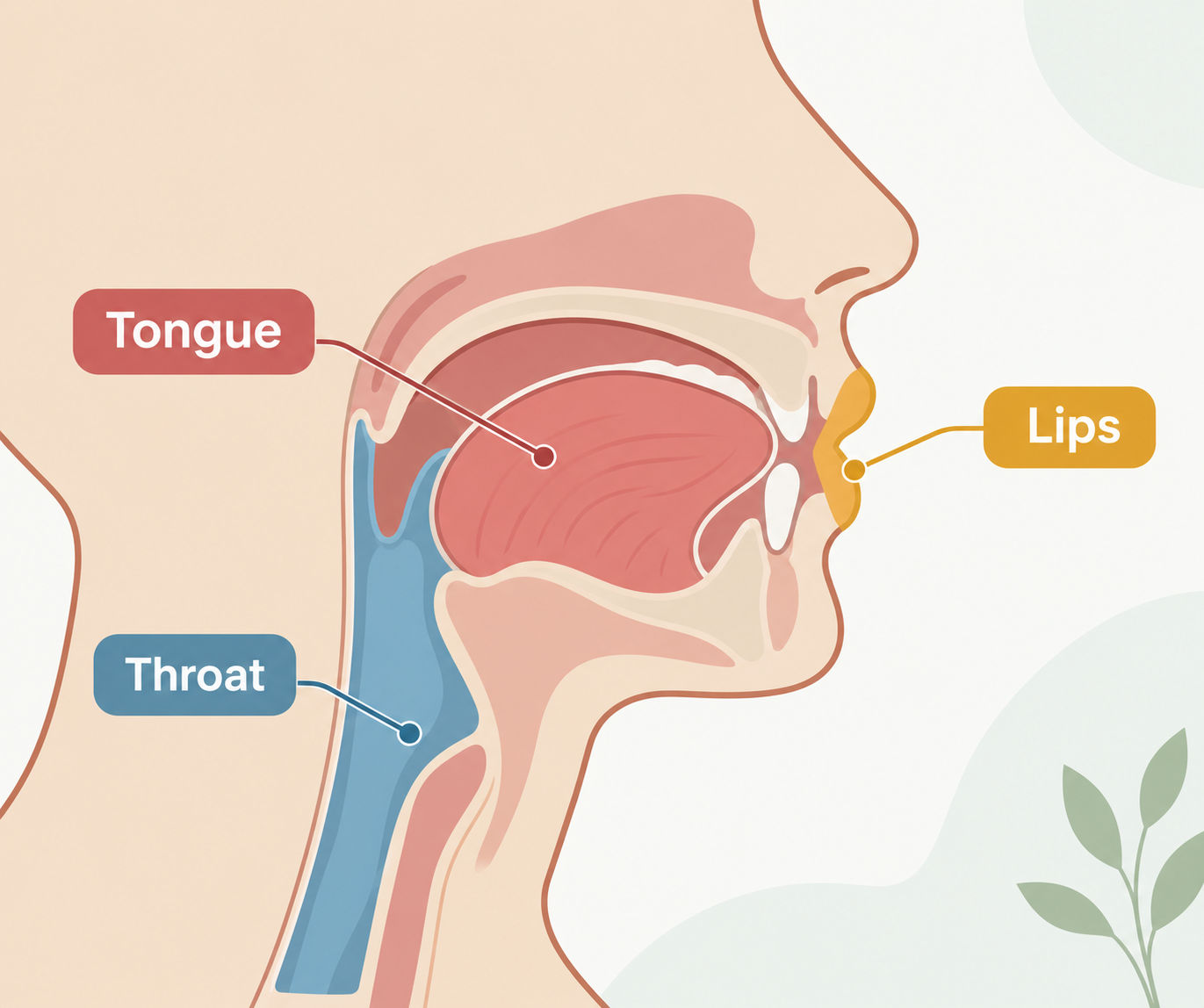
The Most Important Tajweed Foundation: Makharij
Arabic: مخارج الحروف Transliteration: Makhārij al-Ḥurūf Meaning: the articulation points of Arabic letters — literally, the places where each letter's sound originates in the mouth or throat.
Before learning any rule about how letters interact with each other, a learner needs to know how each letter sounds on its own. This is the foundation everything else is built on. If you don't know where a sound is supposed to come from, no amount of memorized rules will make your recitation accurate.
Arabic letters are broadly articulated from a few general zones:
The throat (letters like ء ه ع ح غ خ)
The tongue, touching different parts of the mouth and teeth depending on the letter
The lips (letters like ب م و)
The nasal passage, which produces the Ghunnah (nasal) sound associated with certain letters
Beginners — especially non-Arabic speakers — often mix up letters that don't exist as separate sounds in their own language. Common confusion pairs include:
ح and ه (two different "h" sounds — one deep in the throat, one lighter)
ع and أ (a throat-constricted sound versus a simple glottal stop)
ق and ك (a deep-throat "q" versus a lighter "k")
ص and س (a heavy "s" versus a light "s")
ض and د (a heavy, tongue-pressed "d" versus a light "d")
ط and ت (a heavy "t" versus a light "t")
ذ , ز , and ظ (three related but distinct sounds)
Try this: Say the word "Allah" (الله) slowly, paying attention to your tongue position on the ل. Then try to isolate just the ح sound in "الرحمن" (ar-Raḥmān) — notice it comes from deeper in the throat than an English "h."
This is exactly the kind of thing that's hard to self-correct from a book. You can read a description of where a sound "should" come from, but you often can't hear your own mistake without someone else pointing it out — which is why listening to a qualified reciter, and ideally getting live correction, matters so much at this stage.
Sifat: The Characteristics of Arabic Letters
Arabic: صفات الحروف Transliteration: Ṣifāt al-Ḥurūf Meaning: the characteristics or qualities of each letter beyond just its articulation point.
Two letters can come from a similar place in the mouth but sound completely different because of their characteristics. For example, some letters are naturally "heavy" and full in sound, while others are "light." Some letters are pronounced with a puff of breath, while others are pronounced with the breath held back. Some carry an echo-like quality when they have sukoon, and others don't.
Beginner-friendly examples:
Whispered vs. voiced letters: some letters (like ت ك) are pronounced with breath escaping, while others (like ب د) are pronounced with the vocal cords vibrating and no extra breath.
Heavy vs. light letters: letters like ص ض ط ظ ق give a fuller, rounder sound than their lighter counterparts.
Makharij tells you where a sound comes from. Sifat tells you how it should sound once it gets there. You need both working together to pronounce a letter correctly — which is one reason Tajweed teachers usually introduce them side by side rather than treating them as separate subjects.
Noon Sakinah and Tanween
Arabic: نْ (Noon Sakinah — a noon with no vowel) Tanween: ـً ـٍ ـٌ (the double vowel marks at the end of many nouns)
Noon Sakinah and tanween are grouped together because they behave the same way: what happens to their sound depends entirely on the letter that comes immediately after them. Rather than one fixed pronunciation, there are four possible outcomes.
Izhar — الإظهار (Clear Pronunciation)
The noon or tanween is pronounced clearly and fully, with no change, when followed by one of the six throat letters: ء ه ع ح غ خ.
Example: "مَنْ آمَنَ" — appearing, for instance, in Surah Al-Baqarah 2:62 — where the noon before the hamzah (أ) is pronounced clearly, with no merging or nasal change.
Memory tip: Throat letters keep the noon "out in the open" — nothing hides or changes it.
Idgham — الإدغام (Merging)
The noon or tanween sound merges into the following letter, when that letter is one of six: ي ن م و ل ر. Depending on the letter, the merge either keeps a nasal (Ghunnah) sound or drops it.
Example: the phrase a widely cited textbook example is "فَمَن يَعْمَلْ" in Surah Az-Zalzalah (99:7), where the noon of "مَن" merges into the ي of "يَعْمَلْ" with a nasal sound.
Memory tip: Think of these six letters as "absorbing" the noon sound into themselves.
Iqlab — الإقلاب (Changing/Flipping)
The noon or tanween is converted into a meem sound (م) when followed by the letter ب, along with a light nasal hum.
Example: the very common Quranic phrase "مِنْ بَعْدِ" ("from after"), which appears in multiple places including Surah Al-Baqarah 2:27. The noon of "مِنْ" is pronounced as a meem sound before ب.
Memory tip: ب is the only "flip" letter — noon becomes meem right before it.
Ikhfa — الإخفاء (Hiding)
The noon or tanween is partially hidden — pronounced neither fully clearly nor fully merged — with a nasal sound, before the remaining fifteen letters not covered above.
Example: "مِن شَرِّ" in Surah An-Nas (113:2) — "مِن شَرِّ مَا خَلَقَ." The noon before ش is neither clearly pronounced nor fully merged; it's softened with nasalization.
Memory tip: Ikhfa letters are the "everything else" group — when in doubt, hide it gently.
Quick Summary Table
Rule | Arabic | Trigger Letters | What Happens |
|---|---|---|---|
Izhar | الإظهار | ء ه ع ح غ خ | Noon/tanween pronounced clearly |
Idgham | الإدغام | ي ن م و ل ر | Noon/tanween merges into next letter |
Iqlab | الإقلاب | ب | Noon/tanween becomes a meem sound |
Ikhfa | الإخفاء | Remaining 15 letters | Noon/tanween softened with nasal sound |
Ghunnah
Arabic: الغنة Transliteration: Ghunnah Meaning: a nasal sound produced specifically through the letters ن and م when certain conditions apply, such as when they carry a shaddah, or in the Idgham and Ikhfa rules described above.
A common beginner mistake is assuming that any noon or meem sound involves the same amount of nasalization. In reality, Ghunnah has more prominence in some situations (like a shaddah on ن or م) than in others. Another common mistake is exaggerating the nasal sound into something that sounds more like a hum through the whole word rather than a controlled sound held for an appropriate duration on the noon or meem itself.
Try this: Practice saying "إِنَّ" (inna) slowly, holding the nasal sound on the shaddah-marked noon for a clear, deliberate moment — not rushed, not exaggerated.
Meem Sakinah Rules
Arabic: مْ Transliteration: Meem Sākinah — a meem with no vowel.
Just like Noon Sakinah, a Meem Sakinah changes depending on what follows it — though with only three possible outcomes instead of four.
Ikhfa Shafawi (الإخفاء الشفوي): when Meem Sakinah is followed by ب, it's pronounced with lips lightly closed and a nasal sound, similar in spirit to regular Ikhfa. Example: "تَرْمِيهِم بِحِجَارَةٍ" in Surah Al-Fil (105:4).
Idgham Shafawi (الإدغام الشفوي): when Meem Sakinah is followed by another meem, the two merge into one meem with a nasal sound.
Izhar Shafawi (الإظهار الشفوي): when Meem Sakinah is followed by any letter other than ب or م, it's pronounced clearly with the lips, without extra nasalization.
The name "Shafawi" comes from شفة (lip), because all three rules revolve around the lip-based meem sound.
What Is Madd?
Arabic: المد Transliteration: Madd Meaning: the lengthening or elongation of a vowel sound.
Before learning Madd's many classifications, it helps to grasp the basic idea: some vowel sounds in the Quran are held longer than others, based on specific letters and conditions.
The most basic form is Natural Madd (Madd Asli/Tabi'i) — a lengthening of about two counts that occurs whenever an alif follows a fatha, a waw sukoon follows a damma, or a ya sukoon follows a kasra.
Examples: the alif in "قَالَ" (qāla), the waw in "يَقُولُ" (yaqūlu), and the ya in "قِيلَ" (qīla) each represent this natural two-count lengthening.
Beyond natural Madd, there are several more advanced categories — Madd caused by a hamzah, Madd caused by sukoon, and Madd at a pause — each with its own length and conditions. Beginners don't need to master every category immediately. What matters most at first is training your ear: listening carefully to a qualified reciter so you internalize how a lengthened sound should feel, rather than trying to calculate counts from a written description alone. As you progress, a teacher will introduce the fuller Madd classifications in more depth.
What Is Qalqalah?
Arabic: القلقلة Transliteration: Qalqalah Meaning: a slight "bouncing" or echoing sound produced on certain letters when they carry a sukoon.
The Qalqalah letters are ق ط ب ج د (often remembered with the phrase "قُطُبْ جَدّ"). When one of these letters has a sukoon — especially at the end of a word where you stop — it produces a brief, controlled echo rather than being pronounced as a flat, silent stop.
Example: in Surah Al-Falaq (113:1), "قُلْ أَعُوذُ بِرَبِّ الْفَلَقِ," the ق at the end of "الْفَلَق" carries this bouncing quality when you pause there, and the ل in "قُلْ" shows a lighter version of it mid-recitation.
A common beginner mistake is turning this echo into a full extra vowel sound — for instance, pronouncing "قُلْ" as though it had a short "u" tacked onto the end. Qalqalah should remain a light, controlled bounce, not a new syllable.
Heavy and Light Letters
Arabic: تفخيم (Tafkhim) and ترقيق (Tarqiq) Meaning: "heaviness" and "lightness" in how certain letters are pronounced.
Some Arabic letters are always pronounced with a fuller, rounder, "heavier" quality — these include letters like خ ص ض ط ظ غ ق. Others are always light. A few letters, most notably ر (ra) and the ل (lam) in the word "Allah," change between heavy and light depending on their vowel and surrounding letters.
English speakers often struggle here because English doesn't distinguish between heavy and light versions of the same letter the way Arabic does. A heavy ر, for example, is pronounced with the back of the tongue raised and the mouth more rounded, while a light ر is flatter and more forward.
Example: the ر in "رَبّ" (with a fatha) is heavy, while the ر in "مِرْيَة" (preceded by a kasra) is light.
The detailed rules for exactly when ر and the lam of Allah shift between heavy and light are covered more thoroughly once a learner has built a foundation — this section is meant only to introduce the concept.
Stopping and Starting: Waqf and Ibtida
Arabic: الوقف (Waqf) and الابتداء (Ibtida) Meaning: where a reciter pauses (Waqf) and where they resume (Ibtida).
Stopping in the wrong place can distort or even change the meaning of a verse. That's why Quranic mushafs include small stop symbols in the margin — marks that indicate whether stopping at a particular point is preferred, permitted, or discouraged.
At a beginner level, it's enough to know that these symbols exist and that learning to recognize the most common ones (like the "meem" symbol for a required stop, or the "sad-lam-ya" symbol suggesting it's better to continue) will come naturally as you read more Quran with a teacher's guidance. Detailed Waqf rules — including where certain stops are strongly recommended versus simply allowed — are typically introduced later in a structured curriculum.
A Beginner's Tajweed Cheat Sheet
Rule | Arabic | Simple Meaning | Beginner Priority |
|---|---|---|---|
Makharij | مخارج الحروف | Where each letter's sound originates | Highest — learn first |
Sifat | صفات الحروف | The qualities of each letter's sound | Highest — learn alongside Makharij |
Noon Sakinah/Tanween | أحكام النون الساكنة والتنوين | How noon/tanween change before certain letters | High |
Ghunnah | الغنة | The nasal sound on noon/meem | High |
Meem Sakinah | أحكام الميم الساكنة | How meem changes before certain letters | Medium-High |
Madd | المد | Lengthening certain vowel sounds | Medium-High |
Qalqalah | القلقلة | A light bounce on certain sukoon letters | Medium |
Tafkhim/Tarqiq | التفخيم والترقيق | Heavy vs. light letter pronunciation | Medium |
Waqf/Ibtida | الوقف والابتداء | Where to pause and resume | Introduced gradually |
(This table is a review aid, not a substitute for guided learning.)
What Should a Complete Beginner Learn First?
There isn't only one "correct" sequence — curricula and teachers vary — but most structured programs follow a similar logical progression:
Stage 1: Arabic Letters and Sounds — recognizing and pronouncing each letter individually.
Stage 2: Makharij — refining exactly where each sound originates.
Stage 3: Short Vowels, Sukoon, and Shaddah — reading basic vowel markings accurately.
Stage 4: Basic Quran Reading — reading short surahs slowly, focusing on accuracy over speed.
Stage 5: Noon Sakinah and Tanween — Izhar, Idgham, Iqlab, Ikhfa.
Stage 6: Meem Sakinah and Ghunnah.
Stage 7: Madd — starting with natural Madd, then more advanced categories.
Stage 8: Qalqalah.
Stage 9: Heavy and Light Sounds — Tafkhim and Tarqiq.
Stage 10: Waqf and More Advanced Rules — refining stopping points and remaining details.
This sequence is a helpful guide, not a rigid law. A teacher may reorder stages based on your existing reading level, native language, or specific weak points.
Can You Learn Tajweed by Yourself?
Partially — and it's worth being honest about which parts.
What you can effectively study independently:
Terminology and rule categories (what Ikhfa or Madd is, conceptually)
Recognizing rules when you see them written in the Quran
Listening to qualified reciters regularly
Reviewing and revising what you've already learned
Reading explanations and working through practice exercises
What's harder to self-assess:
Your own Makharij — you often can't hear when your own pronunciation of a letter is off
Subtle pronunciation quality (Sifat)
Ghunnah duration and quality
Precise Madd timing
Errors that have become habitual without you realizing it
This is why Quranic recitation has traditionally been transmitted orally, from teacher to student, in an unbroken chain — not simply read out of a book. Technology hasn't made this tradition irrelevant; recordings, apps, and online lessons are genuinely useful supplements. But they work best alongside personal correction, not as a full replacement for it, because a recording can't listen to you and tell you what to fix.

Why Learning Tajweed With a Teacher Helps
A knowledgeable teacher brings several things a book or app alone cannot:
Immediate correction the moment a mistake happens, before it becomes a habit
Accurate modeling — hearing a letter or rule pronounced correctly, live, as many times as needed
Personalized feedback based on your specific native language and recurring errors
Identifying mistakes you can't hear yourself making
Accountability and structured progress, rather than learning in a scattered way
Encouragement, especially during the stages where progress feels slow
This is one of the reasons platforms like Araby Academy focus on one-to-one online Quran and Tajweed classes rather than only pre-recorded content — correct pronunciation is difficult to build purely from self-study, and consistent, personalized feedback tends to shorten the distance between "knowing the rule" and "applying it correctly."
Tajweed for Adults: Is It Too Late?
No. Full stop.
It's common for adults to feel embarrassed starting Tajweed later in life — especially if they never learned Arabic, learned incorrectly as children and have to unlearn habits, have a strong accent from their native language, read slowly, need to relearn something as basic as Al-Fatihah, or are beginning shortly after accepting Islam.
None of that reflects poorly on you. Every reciter, including those who eventually become confident and accurate, started exactly where you are now. The hadith of the Prophet ﷺ addresses this directly. Narrated from Aisha (may Allah be pleased with her), the Prophet ﷺ said:
"Such a person as recites the Qur'an and masters it by heart, will be with the noble righteous scribes. And such a person exerts himself to learn the Qur'an by heart, and recites it with great difficulty, will have a double reward." — Sahih al-Bukhari 4937; a similar wording is recorded in Sahih Muslim 798.
This hadith isn't given to suggest that struggling reciters shouldn't seek correction — it's given to reassure sincere strugglers that their effort itself is rewarded, not wasted. The goal isn't to stay struggling forever; it's to keep improving, one session at a time, without feeling that difficulty disqualifies you from the reward of trying.

Tajweed for Children
Children learn Tajweed differently than adults, and expecting classroom-style theory from a six-year-old usually backfires. Effective approaches for children emphasize:
Imitation — children absorb correct pronunciation by hearing it repeatedly, more than by being told rules
Listening first, reciting second
Short practice sessions — a focused five to ten minutes often works better than a long, tiring one
Repetition without pressure
Positive correction — pointing out what to fix without discouraging language
Age-appropriate expectations — a young child doesn't need Tajweed terminology yet, just accurate sound
Avoiding constant interruption, which can make a child anxious about every syllable
Teacher modeling, where the child hears the correct version immediately after making a mistake, rather than being lectured about the rule behind it
Parents play an important role here too, even without formal Tajweed knowledge themselves: creating a warm, unhurried environment where a child wants to keep coming back to the Quran matters just as much as pronunciation accuracy. A child who loves reciting slowly will improve. A child who dreads correction may avoid practicing altogether.
Example scenario: A parent notices their teenager rushing through Al-Fatihah in prayer, dropping several Madd letters. Rather than correcting every word at once, they focus on one verse a day, practicing it slowly together after Maghrib, gradually restoring the lengthened vowels without turning it into a stressful drill.
Tajweed for New Muslims
New Muslims are often learning several things simultaneously: how to pray, Al-Fatihah, basic Arabic letters, foundational Islamic beliefs, and Quran recitation — all at once. Tajweed doesn't need to be front and center on day one.
A realistic starting sequence for a new Muslim often looks like this:
Learn to read the Arabic alphabet and basic vowel markings.
Learn Al-Fatihah with correct pronunciation, focused specifically on avoiding meaning-changing errors, since it's recited in every prayer.
Begin building general Makharij awareness alongside continued prayer practice.
Gradually add short, commonly recited surahs.
Introduce formal Tajweed terminology and rule categories once the basics of reading feel more comfortable.
The goal in this stage is not overwhelming perfection — it's functional, respectful recitation that allows valid prayer, paired with a long-term plan (ideally guided by a teacher) to keep refining accuracy over time.
Common Tajweed Mistakes Beginners Make
Learning rules without practicing them out loud. Reading about Ikhfa isn't the same as training your mouth to do it.
Focusing on terminology instead of sound. Knowing the name "Iqlab" matters less than being able to produce the correct sound.
Relying permanently on English transliteration. Transliteration is a helpful bridge, not a long-term substitute for reading Arabic script.
Practicing incorrect pronunciation repeatedly, which reinforces the wrong habit instead of correcting it.
Trying to learn every rule simultaneously. Overloading yourself leads to confusion, not mastery.
Comparing yourself to expert reciters. Their fluency took years; comparing your week-one recitation to theirs isn't a fair measure of your progress.
Copying highly ornamented, melodic recitation styles before mastering the basics. Beauty in recitation should come after — not instead of — accuracy.
Ignoring Makharij because it feels less "exciting" than named rules like Idgham or Qalqalah.
Reading too quickly, which is the opposite of what tartil asks for.
Becoming discouraged by correction, instead of treating it as the fastest path to improvement.
Switching teachers or methods constantly, which prevents any one approach from building momentum.
Assuming fluency in spoken Arabic guarantees correct Tajweed. Everyday conversational Arabic and precise Quranic articulation are related but not identical skills — many native Arabic speakers still study Tajweed formally.

How to Practice Tajweed Every Day
Consistency beats intensity. A short daily habit will take you further than an occasional long session.
10-Minute Beginner Routine
2 minutes: articulation practice — isolate a few letters you find difficult
3 minutes: listen to a short passage from a clear reciter
3 minutes: recite the same passage slowly yourself
2 minutes: review one specific correction from a teacher or recording
20-Minute Routine
5 minutes: warm-up articulation and Sifat review
5 minutes: listen and repeat a short passage in small phrases
5 minutes: recite independently, applying a specific rule you're focused on that week
5 minutes: review, note mistakes, and plan the next day's focus
Parent-and-Child Routine
Parent recites a short phrase; child repeats it immediately
Rotate turns reciting a familiar short surah
End with one specific, gentle correction — not a list of everything that needs fixing

How to Practice With Quran Audio
Choose a clear reciter known for measured, distinct recitation rather than very fast styles, especially early on.
Select a short passage — a few verses is enough for focused practice.
Listen carefully before attempting to recite it yourself.
Repeat small portions, phrase by phrase, rather than the whole passage at once.
Pay close attention to pronunciation, not just the general rhythm.
Record yourself reciting, if that helps you notice gaps between what you intend and what you actually produce.
Compare your recording carefully to the reference recitation.
Bring persistent mistakes to a teacher for correction — self-comparison can catch some errors, but not all of them.
Imitating audio is genuinely useful, but it doesn't guarantee correct Tajweed on its own — it's easy to imitate a rhythm or melody while still missing a subtle Makhraj or Sifat detail that only a trained ear would catch.
A 30-Day Tajweed Beginner Plan
This is an educational practice framework meant to build foundations and a consistent habit — not a promise that anyone will "master" Tajweed in 30 days. Real mastery develops over years of guided practice.
Week 1: Arabic Sounds and Makharij
Daily focus: Review the Arabic alphabet; isolate and practice 3–4 letters per day, especially commonly confused pairs.
Practice suggestion: Record yourself saying each letter and compare it to a reference audio.
Weekly review: Can you pronounce all 28 letters individually with reasonable accuracy?
Checkpoint: If possible, have a teacher listen to your letter pronunciation this week.
Week 2: Noon, Meem, and Ghunnah
Daily focus: Learn one Noon Sakinah/Tanween rule every 1–2 days (Izhar, Idgham, Iqlab, Ikhfa), then Meem Sakinah rules.
Practice suggestion: Find 2–3 Quranic examples of each rule and practice them slowly.
Weekly review: Can you identify which rule applies when you see noon sakinah or tanween in a verse?
Checkpoint: Ask a teacher to check your Ghunnah duration and quality.
Week 3: Madd, Qalqalah, and Heavy/Light Sounds
Daily focus: Practice natural Madd, then introduce Qalqalah letters, then heavy/light letter distinctions.
Practice suggestion: Choose a short surah and mark every Madd and Qalqalah letter you find in it.
Weekly review: Can you consistently hold a natural Madd for roughly two counts?
Checkpoint: Have a teacher confirm your Qalqalah isn't turning into an extra vowel sound.
Week 4: Applying Rules to Short Surahs
Daily focus: Recite a short, familiar surah daily, deliberately applying everything learned so far.
Practice suggestion: Choose one surah (such as Al-Fatihah or a short surah from Juz Amma) and refine it across the whole week rather than switching daily.
Weekly review: Compare your recitation at the start versus the end of the week.
Checkpoint: Schedule a fuller review session with a teacher to identify your next learning priorities.
How Long Does It Take to Learn Tajweed?
There's no single honest answer that applies to everyone, because progress depends on real variables:
Your starting reading level in Arabic
General familiarity with the Arabic language
How often you practice
Whether you receive regular teacher feedback
Your age and prior learning experience
Specific pronunciation challenges tied to your native language
What level of mastery you're aiming for
It also helps to separate different milestones:
Understanding basic rules (recognizing Izhar vs. Ikhfa, for example) can often happen within weeks.
Applying basic rules consistently in your own recitation typically takes months of regular practice.
Reading consistently with good, reliable Tajweed across varied passages usually develops over a year or more of steady study.
Advanced mastery — the kind associated with certified Quran teachers — is often the product of years of dedicated study under qualified scholars.
No structured program can honestly promise fluency in a fixed number of weeks. What a good program can promise is steady, measurable progress if you show up consistently.
Frequently Asked Questions About Tajweed
1. What is Tajweed? Tajweed is the set of rules and practices for reciting the Quran with correct pronunciation, giving each letter its proper articulation point and characteristics.
2. What does Tajweed mean in English? It roughly translates to "improvement" or "making something excellent," referring specifically to excellence in Quranic recitation.
3. Why is Tajweed important? It helps preserve accurate pronunciation of the Quran, prevents meaning-changing errors, and reflects the Quranic instruction to recite with tartil — slow, measured, distinct recitation.
4. Is Tajweed mandatory? Avoiding meaning-changing errors in recitation is widely required. Mastering the full theoretical and technical detail of Tajweed is generally considered a communal obligation (fard kifayah) rather than mandatory for every individual, according to many scholars.
5. Can I read Quran without Tajweed? Yes, especially as a beginner — but the goal is to keep improving toward more accurate recitation over time, not to remain at a beginner level indefinitely.
6. What Tajweed rule should I learn first? Makharij (letter articulation points) and Sifat (letter characteristics) form the foundation everything else builds on.
7. Can I learn Tajweed by myself? Partially. You can learn terminology, rule recognition, and general listening skills independently, but subtle pronunciation errors are hard to self-correct without a teacher.
8. Do I need an Arabic teacher to learn Tajweed? A qualified teacher isn't strictly required to begin, but is strongly recommended for catching pronunciation mistakes you can't hear in yourself.
9. How long does it take to learn Tajweed? Basic rule recognition can take weeks; consistent application takes months; deeper mastery typically takes years of guided practice.
10. Can adults learn Tajweed? Yes. Age is not a barrier, and many adults successfully learn Tajweed and improve their recitation significantly later in life.
11. How should children learn Tajweed? Primarily through listening, imitation, short practice sessions, and gentle correction — not through heavy theoretical instruction.
12. Can new Muslims learn Tajweed? Yes, though it's usually introduced gradually alongside other essentials like learning Al-Fatihah and basic prayer.
13. What is the difference between Tajweed and Quran recitation? Quran recitation is the general act of reading the Quran aloud; Tajweed is the specific set of rules that governs how that recitation should be pronounced correctly.
14. What is the difference between Tajweed and Arabic pronunciation? General Arabic pronunciation covers everyday spoken Arabic; Tajweed applies a more precise, codified standard specifically for Quranic recitation, including rules that don't apply in ordinary speech.
15. How can I practice Tajweed at home? With short daily routines combining listening, slow repetition, and periodic review with a teacher or knowledgeable reciter to catch mistakes early.
Final Thoughts: Start With One Sound at a Time
Tajweed can look intimidating from the outside, with its long list of Arabic terms and detailed categories. But nobody learns it all at once, and nobody is expected to.
Mistakes are part of the process, not a sign that you're failing. Adults are not too old to start. Children need patient encouragement as much as they need correction. Consistency — a few focused minutes most days — will take you further than occasional long sessions ever will. And listening closely to a qualified reciter, paired with honest feedback from a teacher, remains one of the most valuable tools available to any learner.
The goal was never to memorize a list of rules for its own sake. It's to recite the words of the Quran with the care, attention, and sincerity they deserve — one sound, one verse, one small correction at a time.
If you'd like structured, one-to-one guidance as you begin, Araby Academy offers personalized Quran and Tajweed classes designed to meet beginners exactly where they are, whether you're a child just starting out, an adult returning to the Quran after years away, or a new Muslim building your foundation from scratch.
5. Beginner Tajweed Cheat Sheet
Rule | Arabic | Simple Meaning | Beginner Priority |
|---|---|---|---|
Makharij | مخارج الحروف | Where each letter's sound originates | Highest |
Sifat | صفات الحروف | Qualities of each letter's sound | Highest |
Noon Sakinah/Tanween (Izhar, Idgham, Iqlab, Ikhfa) | أحكام النون الساكنة والتنوين | How noon/tanween change before certain letters | High |
Ghunnah | الغنة | Nasal sound on noon/meem | High |
Meem Sakinah (Ikhfa/Idgham/Izhar Shafawi) | أحكام الميم الساكنة | How meem changes before certain letters | Medium-High |
Madd | المد | Lengthening certain vowels | Medium-High |
Qalqalah | القلقلة | Light bounce on certain sukoon letters | Medium |
Tafkhim/Tarqiq | التفخيم والترقيق | Heavy vs. light letters | Medium |
Waqf/Ibtida | الوقف والابتداء | Where to pause and resume | Gradual/Ongoing |
6. 30-Day Tajweed Beginner Plan
Week 1 — Arabic Sounds and Makharij: Daily letter drills, focus on commonly confused pairs; end-of-week teacher check on pronunciation.
Week 2 — Noon, Meem, and Ghunnah: One rule every 1–2 days; find and practice real Quranic examples; teacher checkpoint on Ghunnah quality.
Week 3 — Madd, Qalqalah, Heavy/Light Sounds: Mark examples in a short surah; practice natural Madd timing and Qalqalah control; teacher checkpoint to confirm Qalqalah isn't becoming an extra vowel.
Week 4 — Applying Rules to Short Surahs: Refine one familiar surah across the whole week, applying everything learned; full review session with a teacher to plan next steps.
Framing note: This is a foundation-building and habit-forming framework, not a mastery guarantee.
7. Islamic & Tajweed Source Verification Notes
# | Claim | Source Type | Exact Reference | Quotes/Paraphrases | Verification Status |
|---|---|---|---|---|---|
1 | Command to recite the Quran with tartil (measured recitation) | Quran | Surah Al-Muzzammil, 73:4 — "وَرَتِّلِ الْقُرْآنَ تَرْتِيلًا" | Quoted (Arabic) + paraphrased translation | Verified via multiple tafsir sources (Maarif-ul-Quran, Ibn Kathir summary) |
2 | Meaning of tartil as slow, distinct, well-measured recitation | Tafsir | Tafsir Maarif-ul-Quran (citing Imam al-Raghib's al-Mufradat) on 73:4 | Paraphrased | Verified |
3 | Hadith on the skilled reciter being with the noble scribes, and the struggling reciter earning double reward | Hadith | Sahih al-Bukhari 4937 (Book 65, Hadith 458); parallel narration Sahih Muslim 798 | Quoted (English translation) | Verified via sunnah.com-sourced references and multiple hadith databases |
4 | Distinction between avoiding meaning-changing errors (fard 'ayn-level expectation) vs. mastering full Tajweed theory (fard kifayah) | Scholarly/fiqh discussion | General scholarly discussion found across classical and contemporary Tajweed/fiqh literature | Paraphrased, presented as general scholarly discussion, not attributed to one named scholar or fatwa | EDITORIAL VERIFICATION REQUIRED — recommend citing a specific contemporary fatwa body or named scholar before publication for stronger sourcing |
5 | Ibn al-Jazari's poetic line on Tajweed being a "binding necessity" | Islamic literature (didactic poem) | Al-Muqaddimah al-Jazariyyah, attributed to Imam Ibn al-Jazari | Paraphrased translation of a commonly cited line | EDITORIAL VERIFICATION REQUIRED — exact Arabic wording, line number, and scholarly commentary on its intended scope should be confirmed against a critical edition of the poem before publication |
6 | Classification of errors into al-lahn al-jali (clear) and al-lahn al-khafi (hidden) | Traditional Quranic recitation science (Ulum al-Qur'an / Tajweed manuals) | Standard classification found in classical and modern Tajweed textbooks | Paraphrased | Standard, widely-attested terminology; no single verse/hadith attached |
7 | Definitions and letter groupings for Izhar, Idgham, Iqlab, Ikhfa | Tajweed science | Standard classical Tajweed manuals (e.g., texts building on Ibn al-Jazari's framework) | Paraphrased | Standard, widely-attested terminology |
8 | Quranic example "مَنْ آمَنَ" for Izhar | Quran | Surah Al-Baqarah 2:62 (phrase appears in context of "مَنْ آمَنَ بِاللَّهِ وَالْيَوْمِ الْآخِرِ") | Referenced, not directly quoted as full verse | Recommend final Arabic-text check against a printed mushaf before publication |
9 | Quranic example "فَمَن يَعْمَلْ" for Idgham | Quran | Surah Az-Zalzalah 99:7 | Referenced | Recommend final Arabic-text check against a printed mushaf before publication |
10 | Quranic example "مِنْ بَعْدِ" for Iqlab | Quran | Appears in multiple places, including Surah Al-Baqarah 2:27 | Referenced | Recommend final Arabic-text check against a printed mushaf before publication |
11 | Quranic example "مِن شَرِّ" for Ikhfa | Quran | Surah An-Nas 113:2 | Referenced | Recommend final Arabic-text check against a printed mushaf before publication |
12 | Quranic example "تَرْمِيهِم بِحِجَارَةٍ" for Ikhfa Shafawi | Quran | Surah Al-Fil 105:4 | Referenced | Recommend final Arabic-text check against a printed mushaf before publication |
13 | Quranic example "قُلْ أَعُوذُ بِرَبِّ الْفَلَقِ" for Qalqalah | Quran | Surah Al-Falaq 113:1 | Referenced | Recommend final Arabic-text check against a printed mushaf before publication |
14 | Madd examples ("قَالَ," "يَقُولُ," "قِيلَ") | Tajweed illustration (general Arabic words, also Quranic occurrences) | Common across the Quran; not tied to one specific verse in this article | Illustrative, general | Low risk — common words, standard textbook examples |