
Introduction: Why Is It So Hard to Stay Consistent With the Quran?
It usually starts with good intentions. Someone decides, sincerely, that today is the day they start reading Quran every single day. For a while, it works. A few days. Maybe a few weeks.
Then life happens.
Work gets busy. A child needs help with homework, or won't sleep, or gets sick. A late night turns into a missed Fajr, which turns into a missed reading session. One missed day becomes two, then a week, and slowly the mushaf goes back on the shelf — not out of a lack of love for the Quran, but because the plan was never built to survive an ordinary, imperfect week.
If this sounds familiar, it does not mean something is wrong with your faith or your intentions. It usually means the system was the problem, not the sincerity behind it. Many Muslims set Quran goals based on their best possible day — a quiet morning, a light schedule, high motivation — and then feel like they have failed when real life doesn't cooperate.
This article takes a different approach. Instead of relying on motivation alone, it walks through how to build a Quran routine small enough, flexible enough, and realistic enough to survive ordinary life — the version of your week that actually happens, not the version you wish you had.
The goal is not a perfect streak. It's a lasting relationship with the Quran that can grow, adapt, and recover, year after year.
Why a Daily Relationship With the Quran Matters
The Quran holds a unique place in the life of a Muslim. It is described in its own verses as a source of guidance, healing, and reflection — not a book to be read once and set aside, but one meant to be returned to again and again.
Allah describes the Quran as:
"[This is] a blessed Book which We have revealed to you, [O Muhammad], that they might reflect upon its verses and that those of understanding would be reminded." — Surah Sad, 38:29
Notice what this verse emphasizes: reflection (tadabbur), not just recitation. A daily relationship with the Quran is not only about completing pages — it's about creating regular, repeated opportunities for the heart to engage with revelation.
This is different from claiming that a specific daily Quran routine guarantees wealth, ease, or a particular outcome in this life. The Quran is not a formula for worldly results. Its promised benefits are guidance, reward, and closeness to Allah — and those tend to grow through steady, ongoing engagement rather than occasional bursts of intensity.
That's precisely why consistency deserves more attention than intensity.
Small but Consistent: An Islamic Principle That Changes Everything
One of the most practical pieces of prophetic guidance for habit-building — long before "habit-building" was a modern term — comes from a hadith narrated by Aisha (may Allah be pleased with her):
The Prophet ﷺ was asked, "What deeds are loved most by Allah?" He said, "The most regular and constant, even if they are few." He added, "Do not take on more than you are able to do." — Sahih al-Bukhari 6465
This hadith directly addresses the exact struggle most people have with the Quran: the temptation to start big and burn out. The Prophet ﷺ was not describing a special "Quran rule" here — this is a general principle about worship as a whole, and it applies powerfully to Quran engagement.
Compare two approaches:
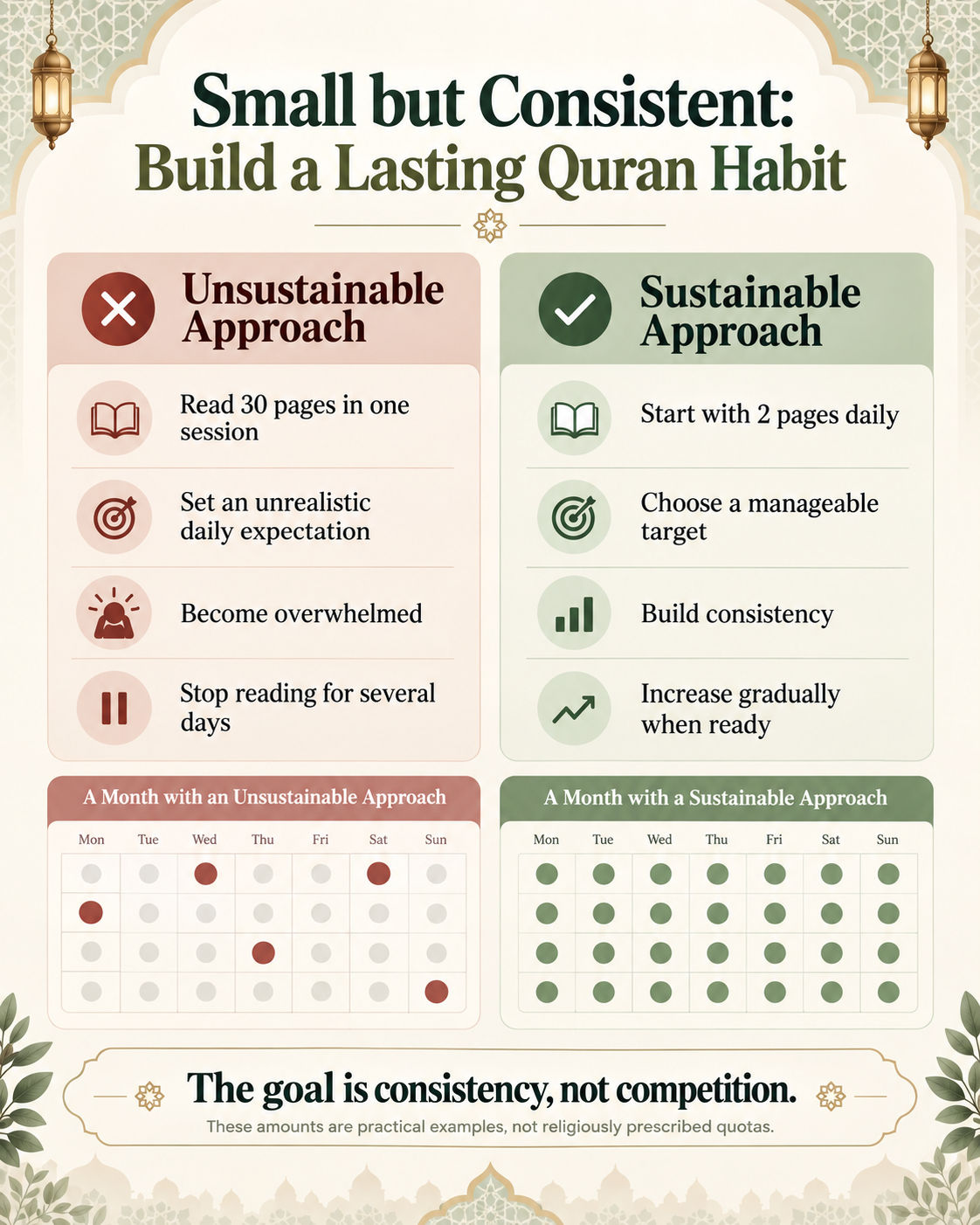
Unsustainable approach: Reading 30 pages in one sitting, feeling inspired, then reading nothing for the next two weeks because the target was never realistic to begin with.
Sustainable approach: Reading two pages every day, without exception, and slowly increasing that amount as it becomes second nature.
Over a year, the second approach produces far more consistent engagement with the Quran — and far less guilt — than the first. This does not mean page count alone measures spiritual quality; a person reading two pages with presence and reflection is not "behind" someone who skims thirty pages distractedly. The point is sustainability, not competition.
Step 1: Define What "Daily Quran" Means for You
Before building a routine, it helps to get specific about what you actually want your daily Quran time to include. "Quran engagement" can mean several different things, and conflating them often leads to frustration.
Consider these categories:
Recitation — reading the Arabic text aloud or silently
Tajweed practice — working on correct pronunciation and articulation
Memorization — committing verses to memory
Revision — reviewing what has already been memorized
Listening — hearing Quran recitation from a qualified reciter
Reading translation — engaging with the meaning in your own language
Studying tafsir — reading scholarly explanation of verses
Reflection (tadabbur) — pausing to think about the meaning of what was read
These activities complement each other, but they are not interchangeable. Listening to Quran is beneficial and can be part of a daily routine, but it is not the same act of worship as personally reciting. Reading a translation helps you understand meaning, but a translation is not the Arabic Quran itself — it is a human attempt to convey its meaning.
Practical tip: Choose one primary activity as your daily anchor (usually recitation), and treat the others as optional additions you can build in later. Trying to do all seven every day from week one is a common reason routines collapse.
Step 2: Start Smaller Than You Think You Need To
Most people overestimate what they can sustain and underestimate what a small amount, repeated daily, can accomplish over time.
Here's a rough guide based on where you're starting from:
Starting Point | Realistic Daily Target |
|---|---|
Very busy beginner | 5 minutes |
Developing reader | 1–2 pages |
More established reader | A consistent larger portion suited to your schedule |
These are practical starting examples, not religious requirements — there is no single Quran quota every Muslim must meet each day. The right amount is the amount you can realistically keep up on a hard day, not just your best day.
Try this today: Pick a target so small it feels almost too easy. If 5 minutes feels like "not enough," that's usually a sign it's the right place to start — you can always do more once it's a habit.
Step 3: Attach Quran to an Existing Routine
Habit-building research and everyday experience agree on one thing: new habits stick far more easily when they're attached to something you already do consistently. This is sometimes called "habit stacking" — pairing a new behavior with an existing cue.
Possible anchors to attach your Quran time to:
Right after Fajr prayer
After a different daily Salah
After your morning coffee or tea
Before leaving for work or school
During a lunch break
After putting children to bed
Right before sleeping
To be clear: these are scheduling suggestions based on your existing routine, not claims that one time carries special religious merit over another — unless specific evidence establishes that (more on timing below).
Sample routine (morning anchor): Wake up → pray Fajr → read two pages before putting the mushaf down → start the day.
Sample routine (evening anchor): Finish dinner cleanup → five minutes of Quran before checking your phone → continue the evening.
Step 4: Choose a Consistent Time
What is the best time to read Quran? There's no single mandatory answer, but understanding the trade-offs of different times can help you choose wisely.
Early Morning
Before the noise of the day begins, many people find their mind is quieter and less distracted. This can make focus easier, though it's not always realistic for parents of young children or people with irregular schedules.
After Salah
Attaching Quran time to a prayer you already perform daily gives you a built-in, unmissable cue. This is one of the most reliable anchors because the habit is already there — you're just extending it slightly.
Lunch Break
For students and office workers, a short Quran session during a lunch break can turn "dead time" into meaningful time, especially when read from a phone app or pocket mushaf.
Evening
Families sometimes find the evening — after dinner, before homework or screen time — works better for shared Quran time together.
Before Bed
Convenient because it's easy to remember, but also vulnerable: tiredness can turn five minutes into zero minutes on hard days. If you choose this time, keep your target very small so tiredness doesn't derail it entirely.
There is no single universal schedule that works for everyone. Choose the time that survives your actual week — not the time that looks best on paper.
Step 5: Create a Quran-Friendly Environment
Small changes to your environment can make a big difference in whether a habit survives. This is often called "reducing friction" — removing the small obstacles that quietly discourage a habit before it even starts.
Practical ideas:
Keep the mushaf in a visible, accessible, and respectfully placed location
Set up a quiet corner or designated reading spot
Keep translation, notebook, or Tajweed materials together in one place
Bookmark your next page so you never waste time searching
Keep headphones nearby for listening practice during commutes or chores
Reduce phone notifications during your Quran time
Open the Quran before opening any other app in the morning
None of these steps require significant time or money. They simply make the right choice the easy choice.
Step 6: Stop Making Your Phone the Default
For many people, the biggest obstacle to a daily Quran habit isn't lack of time — it's where that time actually goes. Notifications, short-form videos, messaging, and endless scrolling can quietly absorb the exact ten or fifteen minutes that could have gone to Quran.
This isn't about treating technology as inherently bad. It's about being honest about where your default attention goes, and gently redirecting a small piece of it.
Practical ideas:
Read Quran before opening social media in the morning, not after
Use built-in app timers or screen-time limits during your Quran window
Turn on do-not-disturb mode for your designated Quran time
Move distracting apps off your home screen so they take an extra step to open
Try a short "phone-free" period built around your Quran session
Unrealistic advice like "delete all your apps" rarely lasts. Small, specific friction — like requiring one extra tap to open a distracting app — is often enough to tip the balance.
Step 7: Read at Your Current Level
If you feel embarrassed about reading slowly, mispronouncing words, or needing to sound out letters as an adult, you are far from alone — and the Quran itself has something reassuring to say about exactly this situation.
The Prophet ﷺ said, "The one who recites the Qur'an and is skilled in it will be with the noble, righteous scribes (the angels), and the one who recites it with difficulty, stumbling over it, will have a double reward." — Sahih al-Bukhari 4937; Sahih Muslim 798
This hadith speaks directly to the person who struggles. Difficulty in recitation is not a mark of failure — the effort itself carries its own reward. Comparing yourself to a fluent reciter with years of practice is not a fair comparison, and it shouldn't be the reason you avoid opening the Quran altogether.
A few reminders for readers at any level:
Slow reading is still learning — fluency comes from repetition, not from waiting until you're "ready"
Mistakes should be corrected gradually, ideally with a teacher's feedback, not through self-criticism
Adults absolutely can improve their Quran reading — there is no age cutoff for this
Difficulty is not a valid reason to stop; it's simply part of the process
Try this today: If you've been avoiding Quran time because you're embarrassed about how you sound, read one line today anyway — even if it takes a full minute to sound out three words.
What If I Cannot Read Arabic?
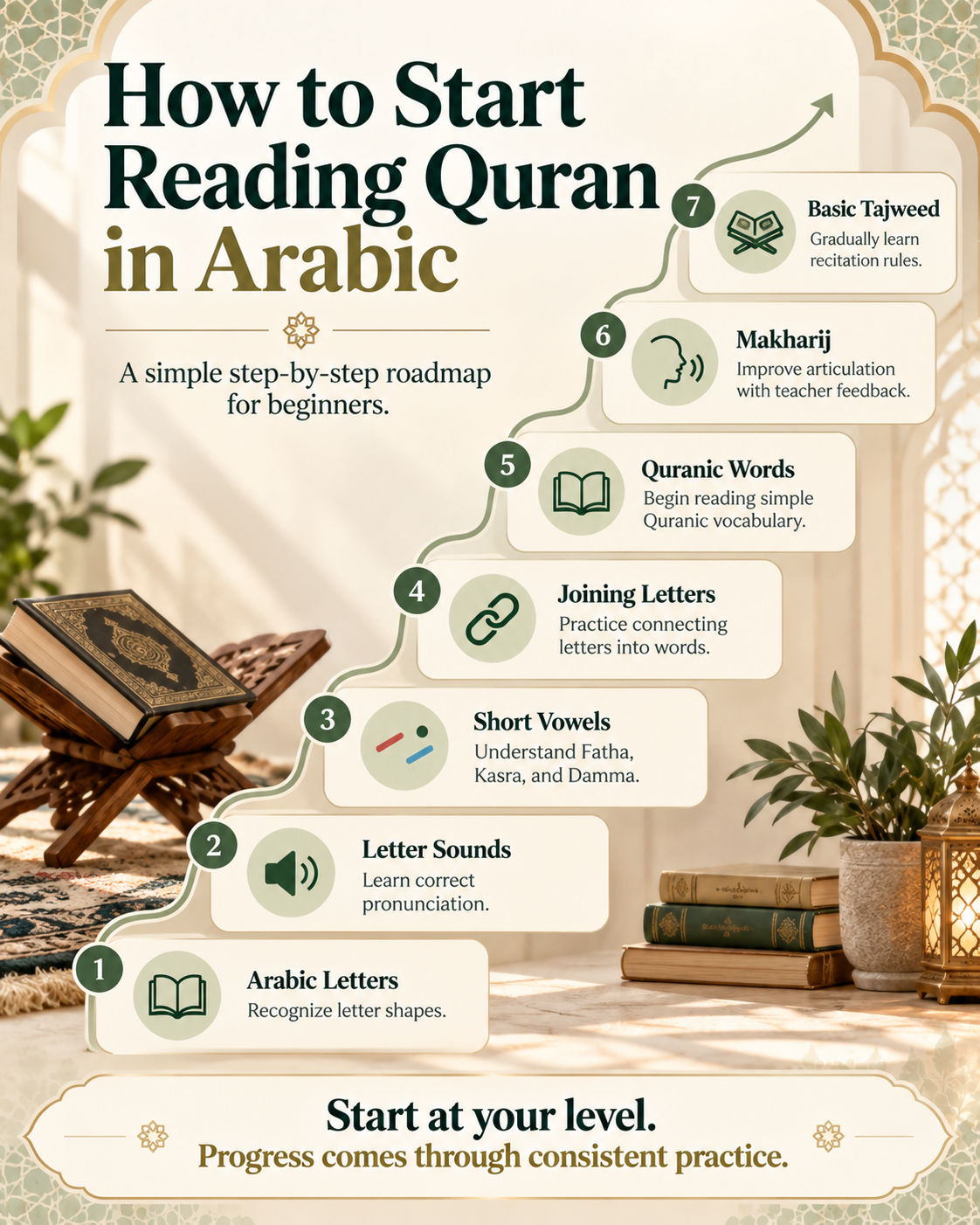
If you can't yet read Arabic script, a daily Quran habit is still absolutely possible — it just starts one level earlier. Here is a realistic progression:
Learn the Arabic letters and their individual shapes
Learn the sounds each letter makes
Learn the short vowels (fatha, kasra, damma) and how they change pronunciation
Practice joining letters together into simple words
Begin reading simple Quranic words with a teacher's guidance
Work specifically on pronunciation (makharij — where each letter's sound originates)
Gradually introduce Tajweed rules once basic reading is comfortable
While you're working through this progression, listening to Quran recitation and reading a trustworthy translation are genuinely valuable — they build familiarity with the sounds and meaning of the Quran. But it's worth being honest about the goal: transliteration (Quranic Arabic written in Latin letters) is a helpful temporary bridge, not an ideal permanent substitute for learning to read the actual Arabic script. Most learners benefit from treating transliteration as a stepping stone rather than a long-term plan.
A structured Arabic-reading program with a qualified teacher — the kind of one-to-one instruction offered through Araby Academy — can meaningfully shorten this learning curve, especially for adults who feel self-conscious learning something "from scratch."
Step 8: Improve Tajweed Gradually
Tajweed — the set of rules governing correct Quranic pronunciation — matters because it helps preserve the accuracy of how the Quran is recited, exactly as it was revealed. Allah instructs in the Quran:
"Or add to it, and recite the Qur'an with measured recitation." — Surah Al-Muzzammil, 73:4
This verse uses the word tarteel — a slow, clear, measured style of recitation, as opposed to rushing through the text. Tajweed builds on this principle with specific rules for pronunciation and articulation.
That said, beginners should not feel they need to master every Tajweed rule before opening the Quran. Tajweed is learned gradually, layer by layer:
Makharij — the correct articulation points of each letter
Basic letter pronunciation — distinguishing similar-sounding letters
Elongation (madd) — knowing when and how long to extend certain sounds
Ghunnah — the nasal sound in specific letter combinations
Noon and Meem rules — how these letters behave in different contexts
Qalqalah — the slight echo/bounce on certain letters
Stopping rules (waqf) — where it is appropriate to pause while reciting
Trying to absorb all of this at once is overwhelming. A better approach: pick one rule, practice it consistently for a few weeks with feedback from a teacher or recorded self-review, then move to the next. (For a deeper walkthrough, see Tajweed for Beginners: What It Is, Why It Matters, and How to Start.)
Step 9: Combine Recitation With Understanding
Reciting the Quran is an act of worship in itself, even without understanding every word. But understanding deepens the experience and often becomes the thing that makes a habit want to continue, rather than feeling like an obligation.
Ways to build understanding into your routine without overhauling it:
Read a reliable, well-reviewed translation alongside your Arabic recitation
Study a small number of verses at a time rather than rushing through pages
Consult a trustworthy tafsir (scholarly explanation) for verses that raise questions
Keep a short reflection notebook — even one sentence per session is valuable
Learn recurring Quranic vocabulary so verses start to feel more familiar over time
Occasionally study one short surah in depth rather than always moving forward
One important distinction: personal reflection (tadabbur) — thinking about what a verse means to you and how it applies to your life — is different from independently issuing tafsir or religious rulings. Reflecting on a verse's relevance to your day is encouraged; drawing formal religious conclusions from it on your own is not the same thing, and should be left to those with the qualifications to do so.
Step 10: Track Consistency Without Turning Quran Into a Score
Tracking can genuinely help a new habit take hold — seeing a simple record of "yes, I did this today" builds momentum and makes gaps visible before they become long absences.
Useful, low-effort tracking tools:
A wall calendar with a simple mark for each day
A checklist app or note on your phone
A dedicated Quran journal
A basic habit-tracking app
The risk worth naming honestly: turning your Quran habit into a numbers game can shift the goal away from the relationship itself. If a missed day starts to feel like "failure" rather than a normal part of life, the tracker has become the point instead of the tool. Use tracking to notice patterns and stay accountable — not as a scoreboard for self-judgment.
The "Never Miss Twice" Approach
This is a practical, modern rule of thumb — not an Islamic term or a piece of Sunnah — but it's a genuinely useful way to think about consistency.
The idea is simple: if you miss your Quran session today, treat tomorrow as non-negotiable. One missed day is a normal part of life. Two missed days in a row starts to build a new pattern — the pattern of not reading.
The emphasis here is on recovery speed, not perfection. Nobody sustains a habit for years without ever missing a day. What separates a lasting habit from an abandoned one is usually how quickly a person returns after a gap.
What Should You Do If You Miss Several Days?
If it's already been a week, two weeks, or longer since you last opened the Quran, this section is for you — and it's meant to be read without guilt.
The wrong response is:
"I broke my streak, so I've already failed. I'll start again next month when I can do it properly."
That thinking is exactly what turns a short gap into a long one. Instead:
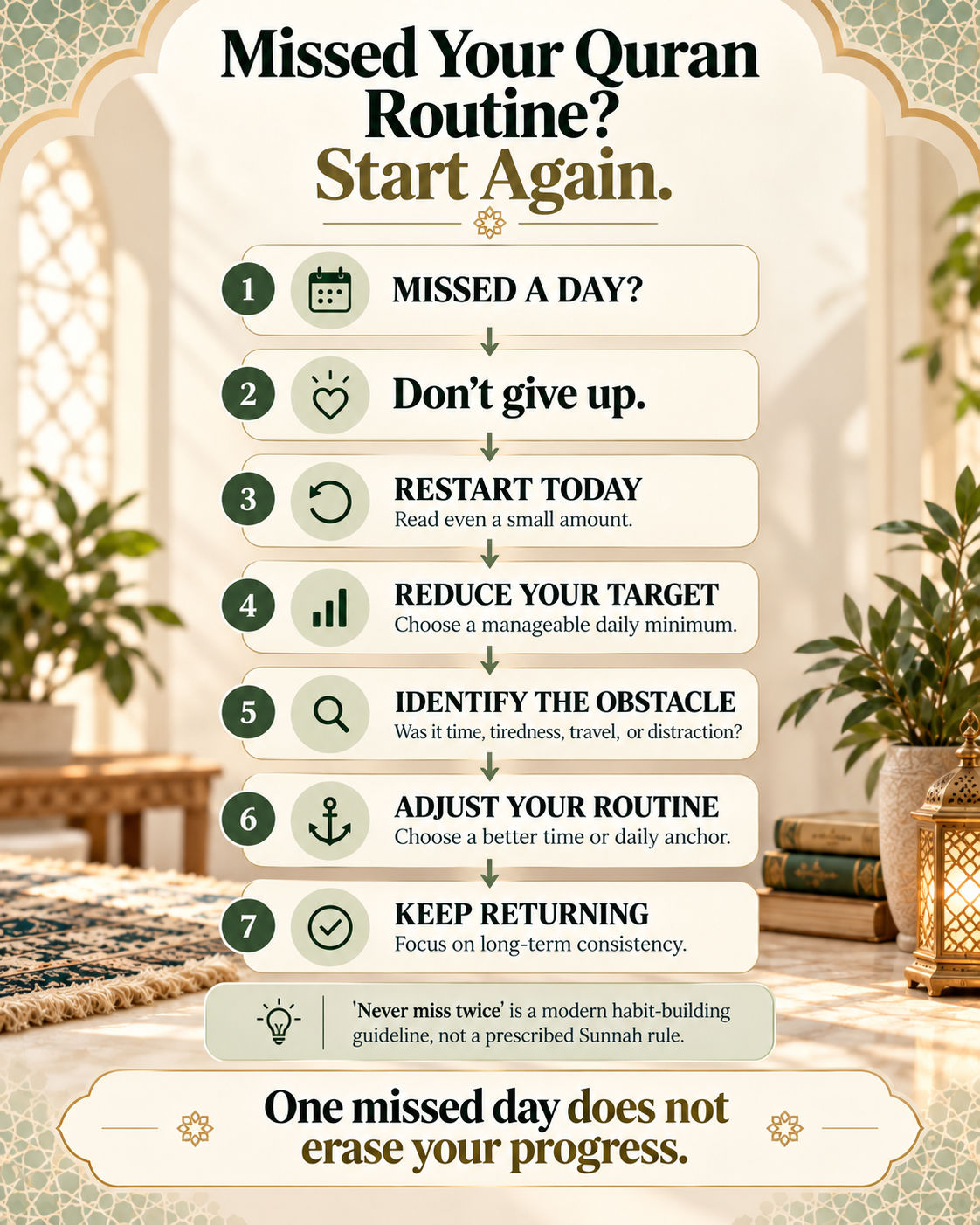
Restart today, immediately — don't wait for a symbolic "clean" starting point like the 1st of the month or the start of Ramadan
Reduce your target if needed — if 20 minutes felt sustainable before but doesn't now, drop to 5 minutes rather than staying stuck
Identify what disrupted the routine — a new work schedule, a newborn, travel, burnout — naming the cause helps you adjust rather than repeat the same collapse
Adjust your schedule or anchor — the time or cue that worked before may no longer fit your life; that's fine, choose a new one
Continue without excessive self-criticism — guilt rarely produces consistency; a fresh, realistic start usually does
.
How Much Quran Should I Read Every Day?
There is no single page count that applies to every Muslim. The right amount depends on several honest factors:
Your current reading ability
The time genuinely available in your day
Your specific Quran goals (recitation, memorization, understanding)
Family and caregiving responsibilities
Work or study demands
Health and energy levels
Any existing memorization commitments
Rather than a universal number, here are practical starting points by situation — treat these as examples, not religious requirements:
Situation | Possible Starting Routine |
|---|---|
Very busy beginner | 5 minutes |
New Quran reader | A few lines |
Developing reader | 1–2 pages |
Regular reader | A consistent larger portion |
Memorization student | Recitation + revision session |
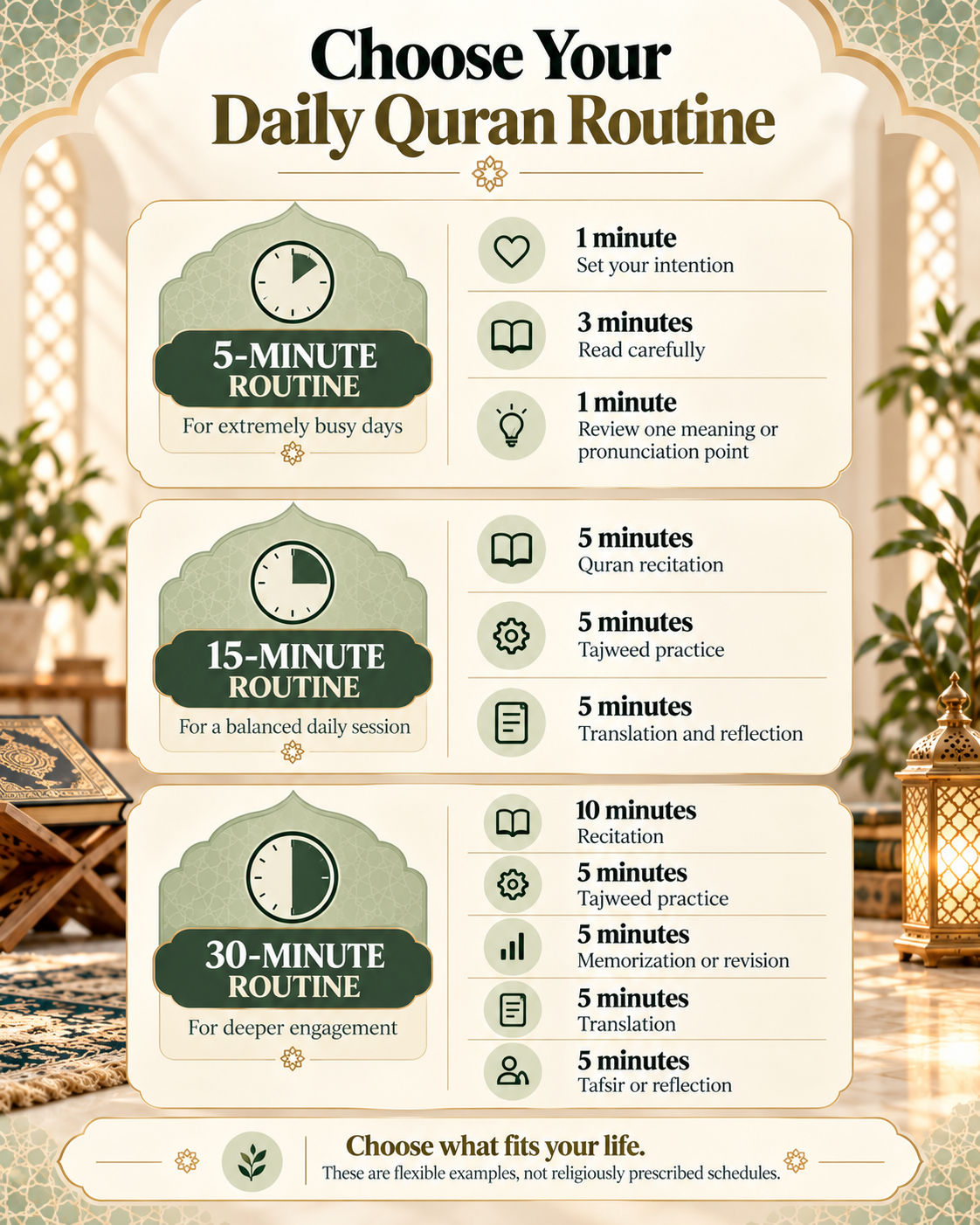
A 5-Minute Quran Routine for Extremely Busy Days
For the days when everything else has already taken over:
1 minute — sit down, take a breath, and set your intention
3 minutes — read carefully, even if it's a short passage
1 minute — review one word's meaning or one pronunciation correction
The purpose of this routine isn't to replace a longer session — it's to prevent the "all or nothing" mindset where a busy day becomes a zero day.
A 15-Minute Daily Quran Routine
A balanced option for a typical day:
5 minutes — recitation of your current portion
5 minutes — focused Tajweed practice on one rule or a few difficult words
5 minutes — reading the translation of what you just recited and reflecting briefly
A 30-Minute Quran Routine
For days with more available time:
10 minutes — recitation
5 minutes — Tajweed correction and practice
5 minutes — memorization or revision of previously memorized verses
5 minutes — translation reading
5 minutes — tafsir study or written reflection
How Busy Parents Can Build a Quran Habit
Parenting comes with real, unavoidable constraints: interrupted sleep, school runs, cooking, work, and the near-constant needs of young children. A Quran routine built for a single, focused adult with quiet mornings simply won't survive parenthood unmodified — and that's fine.
Realistic strategies for parents:
Shrink the session — 5–10 minutes is a full session during this stage of life, not a compromise
Read with children nearby — your Quran time doesn't require total silence; modeling it in front of your kids has its own value
Create a short family Quran moment — even five minutes together after a meal builds the habit for everyone
Use listening time wisely — Quran recitation during the school-run commute or while cooking can supplement (not replace) personal recitation
Share the load with a co-parent where possible — trading off who reads with the children, or who gets quiet time, prevents one parent from carrying the whole routine alone
The goal during this season of life is not an elaborate routine — it's staying connected at all, in whatever form that takes.
How to Build a Quran Habit for Children
This deserves real attention, because the goal isn't simply a child who can recite fluently — it's a child who grows up wanting to stay connected to the Quran.
Key principles:
Model it, don't just assign it. Children notice whether Quran is something parents do themselves or only something children are told to do.
Keep sessions short and age-appropriate. A five-year-old and a twelve-year-old need very different session lengths and expectations.
Praise effort, not just accuracy. A child who tries hard and mispronounces a word needs encouragement, not correction as the first response.
Build routine over intensity. A consistent five-minute daily session beats an occasional 45-minute one for building lifelong habits.
Get appropriate teacher feedback. A qualified Quran teacher — whether in person or through structured online lessons — can catch pronunciation issues early and keep a child progressing without parent-child friction over correction.
Avoid fear-based motivation. Associating the Quran primarily with punishment or threats tends to create long-term avoidance, not love for the text.
Make it part of ordinary family life, not a separate, dreaded task bolted onto the day.
The deeper goal: a child who, twenty years from now, still opens the Quran — not because they were forced to as a child, but because it feels like home.
Quran Habits for Teenagers
Teenagers face a different set of pressures: school workload, social life, growing independence, and near-constant phone access. Quran routines that worked in childhood often need to change shape during these years.
What tends to help:
Involve teens in setting their own realistic goal, rather than imposing one — ownership matters more at this stage than at any earlier one
Respect their need for independence in how and when they engage, within reasonable boundaries
Avoid turning Quran into a recurring source of conflict — a habit associated mainly with arguments rarely survives into adulthood
Connect Quran to identity, not just obligation — conversations about what a verse means to them, not just correctness of recitation
Reduce excessive monitoring in favor of periodic, low-pressure check-ins
A teenager who chooses a small, personally meaningful Quran habit is far more likely to keep it as an adult than one who follows a parent-imposed routine out of compliance alone.
Quran Habits for New Muslims
If you recently embraced Islam, welcome — and know that a daily Quran habit does not need to be your very first priority, or something you rush.
New Muslims are often learning several things simultaneously:
How to perform Salah
Al-Fatihah and other short surahs needed for prayer
Basic Arabic letters and pronunciation
Foundational Islamic beliefs and practices
Quran recitation
Given everything already on your plate, gradual progress is not just acceptable — it's the wise approach. Start with a few minutes of listening and simple reading, focus first on the surahs needed for prayer, and let your Quran engagement deepen naturally as your foundation grows. There is no ambitious target you need to hit in your first weeks or months as a Muslim.
Reading Quran as a Family
A shared family Quran habit reinforces individual routines and creates a natural, low-pressure environment for children to grow up in. Ideas to try:
A short family Quran circle once a day or a few times a week
Reading one short surah together, out loud, taking turns
Parent-child reading, where a parent listens and gently corrects
Listen-and-repeat practice for younger children who aren't reading independently yet
A brief discussion of one verse's meaning at the dinner table
A weekly tafsir session for older children and teens
A family memorization challenge — framed as encouragement, not competition, to avoid discouraging slower learners
Keep these routines flexible. A family that manages a consistent five-minute Quran moment most days will build a far stronger relationship with the Quran than one attempting an ambitious program that collapses within a month.
Do You Need a Quran Teacher?
Independent practice can accomplish a great deal — especially for building the daily habit itself, doing revision, and general reading practice. But a teacher becomes particularly valuable for things that are difficult to self-correct:
Pronunciation correction — many mistakes are invisible to the reader but obvious to a trained ear
Makharij and Tajweed — precise articulation is hard to learn purely from books or apps
Personalized feedback — a teacher can identify exactly which rules or letters need the most work
Accountability — a scheduled lesson creates a natural checkpoint that supports the daily habit
Structured progression — moving through material in a logical order rather than guessing what to learn next
A space for questions — especially valuable for new Muslims and parents teaching children
One-to-one online Quran instruction — the kind of flexible, personalized model offered through Araby Academy — can be especially useful for learners who need scheduling flexibility along with consistent, individual feedback. This isn't a requirement for everyone, but for many learners, especially those working on Tajweed or Arabic reading from the ground up, it significantly shortens the path to real progress.
Common Reasons Quran Habits Fail
Problem | Practical Correction |
|---|---|
Starting too big | Cut the target in half — or more — and rebuild from there |
Relying entirely on motivation | Attach the habit to an existing routine cue instead |
No consistent time or trigger | Pick one anchor point and protect it |
Unrealistic schedule | Choose a target that survives your hardest days, not your best ones |
Perfectionism | Accept a slow, imperfect session over no session at all |
Comparing yourself to others | Focus on your own progress and pace |
Rushing to "finish pages" | Slow down; comprehension and Tajweed matter more than speed |
Ignoring comprehension entirely | Add a small translation-reading step |
No feedback when it's needed | Consider a teacher, even for occasional check-ins |
Excessive phone distraction | Read Quran before opening distracting apps |
Missing one day and quitting entirely | Use the "never miss twice" approach |
A routine that only works during Ramadan | Build a smaller, permanent year-round minimum |
Treating Quran as another productivity checklist item | Reconnect with the "why" — a relationship, not a task |
How to Maintain Your Quran Habit After Ramadan
Many Muslims read far more Quran during Ramadan than at any other time of year — and then find that habit disappears almost entirely once Ramadan ends. This is extremely common, and understanding why can help you avoid it.
During Ramadan, several supports are in place simultaneously: communal motivation, taraweeh prayers, a shared spiritual atmosphere, and often lighter or restructured daily schedules. When Ramadan ends, all of those supports disappear at once — but many people try to keep the same volume of reading without any of the surrounding structure. The routine collapses because it was never designed to run without Ramadan's built-in support system.
A practical "Ramadan exit strategy":
Reduce volume rather than stopping entirely. If you read multiple pages daily during Ramadan, drop to a smaller but still meaningful amount — not zero.
Preserve the same reading cue. If your Ramadan habit was tied to a specific prayer or time, keep that same cue going year-round.
Choose a permanent post-Ramadan minimum before Ramadan even ends, so there's no gap where you're deciding what comes next.
Continue one specific Quran goal — whether that's a memorization portion, a Tajweed focus, or simply consistent daily reading.
Maintain family Quran time if it was established during Ramadan, even in a shorter form.
Continue teacher lessons rather than pausing them until "next Ramadan."
Review your progress monthly to catch a slipping habit early, before it fully disappears.
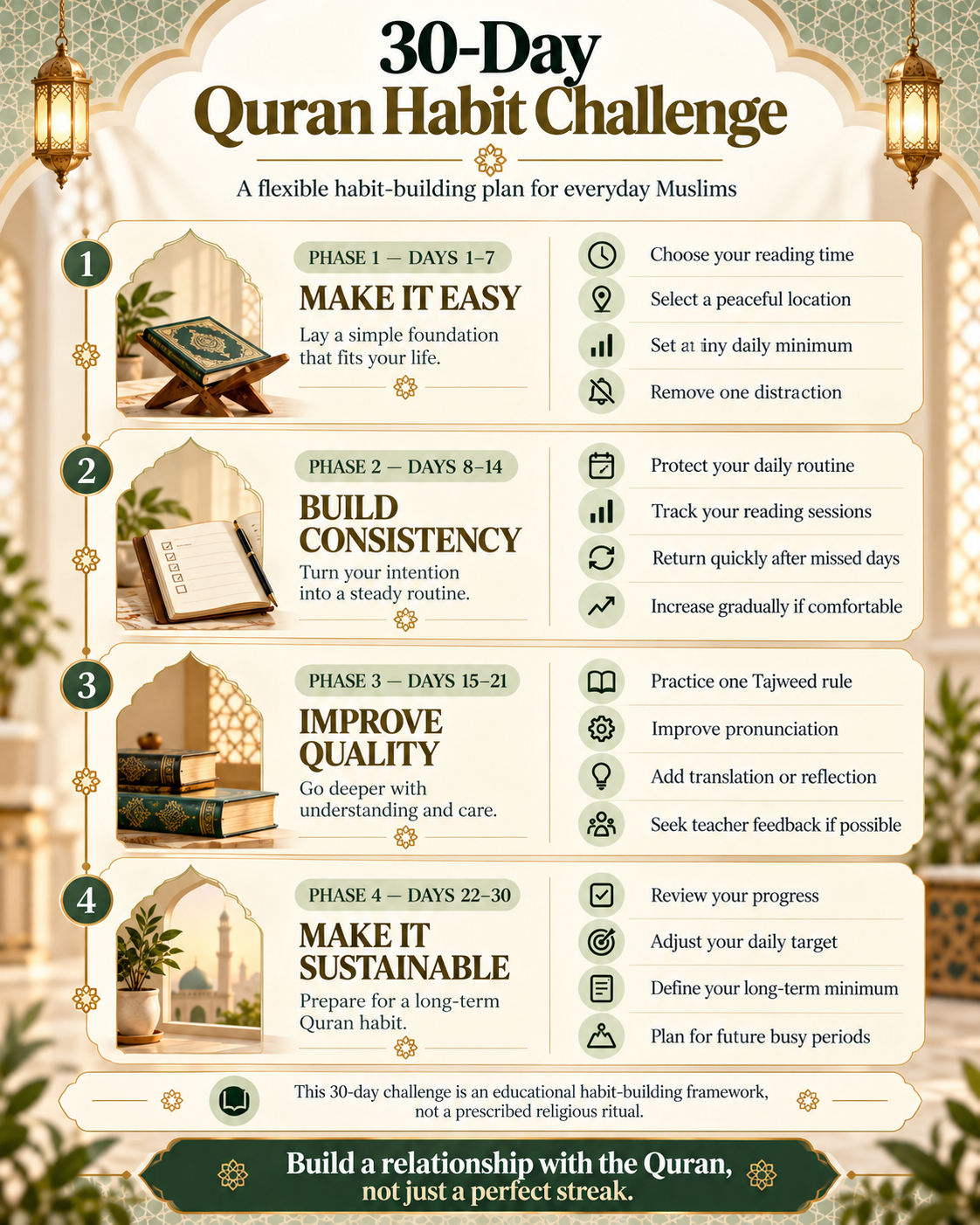
A 30-Day Quran Habit Challenge
This is an educational habit-building framework — not a religiously prescribed 30-day program. Use it as a flexible structure, not a rigid rulebook.
Phase | Days | Focus |
|---|---|---|
Make It Easy | 1–7 | Choose your time, choose your location, set a tiny minimum, remove distractions |
Build Consistency | 8–14 | Protect the cue, increase gradually if it feels natural, track your sessions, recover quickly after any missed day |
Improve Quality | 15–21 | Focus on Tajweed, pronunciation, and understanding; consider teacher feedback |
Make It Sustainable | 22–30 | Evaluate what's working, adjust your target, define a long-term minimum, plan ahead for busy periods |
A full day-by-day breakdown, along with a printable version of this challenge, appears later in this package.
Your Personal Quran Habit Plan
Use this simple framework to define your own routine. It works well printed out or copied into a notes app.
My daily Quran time: _______________ My location: _______________ My minimum daily target: _______________ My main Quran goal: _______________ My biggest distraction: _______________ How I will reduce it: _______________ My teacher/accountability support: _______________ What I will do after missing a day: _______________

Frequently Asked Questions
1. How can I make Quran a daily habit? Start with a target small enough to keep up on your hardest day, attach it to an existing routine (like after a prayer), and reduce friction by keeping your mushaf accessible and distractions minimized.
2. How much Quran should I read every day? There's no universal amount. Busy beginners often start with 5 minutes or a few lines; more established readers may manage several pages. The right amount is whatever you can sustain consistently.
3. What is the best time to read Quran? Whatever time reliably fits your schedule — often right after a daily prayer, since the habit cue already exists. There's no single mandatory time for everyone.
4. Is reading one page of Quran a day enough to start? Yes. A small, consistent amount that you actually maintain is more valuable long-term than an ambitious target you abandon after a few weeks.
5. What if I miss a day of Quran reading? Resume the next day without excessive guilt. One missed day is normal; the goal is preventing it from becoming two, then a longer gap.
6. How do I restart reading Quran after a long break? Start again immediately, with a smaller target if needed, rather than waiting for a symbolic "clean" starting point.
7. Can I listen to Quran instead of reading? Listening is valuable and can be part of your routine, but it's not the same act of worship as personally reciting. Use listening as a complement, not a full replacement.
8. Should I read Quran in Arabic if I do not understand it? Yes — reciting the Arabic Quran is an act of worship in itself. Pairing it with translation study helps you understand meaning alongside recitation.
9. Should I read a Quran translation every day? It's a valuable addition for building understanding, but a translation is not the Arabic Quran itself. Many people pair a smaller amount of translation reading with their Arabic recitation.
10. How can I improve my Quran reading? Practice consistently, focus on one Tajweed rule at a time, and get feedback from a qualified teacher who can catch mistakes you can't hear yourself.
11. How can busy parents find time for Quran? Shrink the session to 5–10 minutes, read with children nearby rather than requiring total silence, and consider brief family Quran moments instead of long solo sessions.
12. How can I encourage my child to read Quran daily? Model the habit yourself, keep sessions short and age-appropriate, and praise effort over perfect accuracy. Avoid fear-based motivation.
13. How can teenagers build a Quran habit? Involve them in setting their own realistic goal, respect their growing independence, and avoid letting Quran become a recurring source of conflict.
14. Do I need a Quran teacher? Not strictly, but a teacher is especially valuable for pronunciation correction, Tajweed, and personalized feedback that's hard to get through independent practice alone.
15. How can I maintain Quran reading after Ramadan? Reduce your volume rather than stopping entirely, keep the same reading cue you used during Ramadan, and set a permanent minimum before Ramadan ends.
Final Thoughts: Build a Relationship, Not Just a Streak
A daily Quran habit isn't primarily about protecting a perfect streak. It's about building a lifelong relationship with Allah's Book — one that can bend without breaking when life gets difficult, and that always leaves room to come back.
A few reminders to carry forward:
Start where you are, not where you wish you were.
Start small if that's what it takes to start at all.
Improve gradually — fluency and understanding both come with time.
Don't let embarrassment about your current level keep you from opening the Quran.
Don't let one missed day become one missed month.
Seek correction and feedback when you need it.
Pair recitation with understanding whenever you can.
Let your children see the Quran as a natural, unforced part of family life.
Whatever happens, keep returning.
If you're looking for structured support along the way — whether that's Tajweed correction, help learning to read Arabic, or guided Quran lessons for your children — one-to-one online learning through Araby Academy is there for exactly this kind of steady, long-term progress.
Daily Quran Habit Quick-Start Checklist
Print this page or save it as a quick reference.
[ ] Choose ONE primary Quran activity to anchor your habit (usually recitation)
[ ] Pick a target small enough to survive your hardest day (start with 5 minutes if unsure)
[ ] Attach your Quran time to an existing daily routine (a prayer, a meal, a commute)
[ ] Choose a consistent time and write it down
[ ] Keep your mushaf/app in a visible, easy-to-reach place
[ ] Bookmark your next page so there's no delay before starting
[ ] Reduce phone notifications during your Quran time
[ ] Read Quran before opening social media in the morning
[ ] Track your sessions with a simple calendar or checklist — not as a scoreboard
[ ] Apply the "never miss twice" rule if a day is missed
[ ] Revisit and adjust your target every few weeks as life changes
[ ] Consider a qualified teacher for Tajweed and pronunciation feedback
5-Minute, 15-Minute, and 30-Minute Quran Routines
5-Minute Routine (for extremely busy days)
Time | Activity |
|---|---|
1 min | Settle in, set your intention |
3 min | Read carefully, even if it's a short passage |
1 min | Review one word's meaning or one pronunciation point |
15-Minute Routine (balanced daily option)
Time | Activity |
|---|---|
5 min | Recitation of your current portion |
5 min | Tajweed practice on one rule or a few difficult words |
5 min | Read the translation and reflect briefly |
30-Minute Routine (for days with more time)
Time | Activity |
|---|---|
10 min | Recitation |
5 min | Tajweed correction and practice |
5 min | Memorization or revision |
5 min | Translation reading |
5 min | Tafsir study or written reflection |
30-Day Quran Habit Challenge
Educational habit-building framework — not a religiously prescribed program.
Days | Phase | Daily Focus |
|---|---|---|
1–3 | Make It Easy | Choose your time and location; set a tiny minimum target |
4–7 | Make It Easy | Remove one specific distraction (e.g., phone notifications); protect your chosen time |
8–10 | Build Consistency | Hold your minimum target steady; mark each day on a tracker |
11–14 | Build Consistency | If a day is missed, apply "never miss twice"; consider a small, natural increase |
15–17 | Improve Quality | Choose one Tajweed rule to focus on this week |
18–21 | Improve Quality | Add a short translation-reading or reflection step; seek teacher feedback if possible |
22–25 | Make It Sustainable | Review what's working and what isn't; adjust your target honestly |
26–28 | Make It Sustainable | Define your long-term daily minimum going forward |
29–30 | Make It Sustainable | Plan for your next busy period (travel, exams, a new baby) before it happens |
Personal Quran Habit Plan Template
(Printable version — copy into a notes app or print directly)
MY PERSONAL QURAN HABIT PLAN

My daily Quran time: ___________________________
My location: ___________________________
My minimum daily target: ___________________________
My main Quran goal (recitation / memorization / Tajweed / understanding): ___________________________
My biggest distraction: ___________________________
How I will reduce it: ___________________________
My teacher/accountability support: ___________________________
What I will do after missing a day: ___________________________