You want your child to build a real relationship with the Quran. The local mosque runs classes several days a week. An online academy offers live individual lessons that could fit around school and family life. Both look promising, and the questions start. Will my child learn better in person? Will an online teacher give more individual attention? Will they miss out on the community? Which is safer? Which is worth the cost? Do we really have to choose?
The short answer: neither option is universally better, and you may not have to choose. The best learning environment depends less on whether a lesson happens online or in a mosque and more on the quality of the teaching, how well it suits your child, consistency, safeguarding, and what your family can sustain. Many families do well with the mosque, some with live online lessons, and some with both.
This article compares typical mosque-based instruction with live one-to-one online instruction. It is written to be useful whichever route you take.
Understanding the Two Models
What Are Local Mosque Quran Classes?
Mosque-based Quran education takes many forms:
After-school Quran classes
Weekend Islamic schools
Group Quran reading lessons
Small-group Tajweed (the rules of correct recitation) classes
Individual recitation sessions
Hifz (memorization) programs
Wider community-based Islamic education
Mosques differ a great deal. Some run organized curricula with qualified teachers, individual assessments, and regular progress reviews. Others rely on smaller community arrangements or volunteer support. Neither assumption is safe: a mosque may offer individual lessons, may pay professional teachers, and may meet high standards. You can only judge a specific program by looking at it.
What Are Online Quran Classes?
"Online" also covers several different things:
Live one-to-one lessons
Live small-group lessons
Larger virtual classrooms
Prerecorded courses
Independent digital resources
Hybrid arrangements
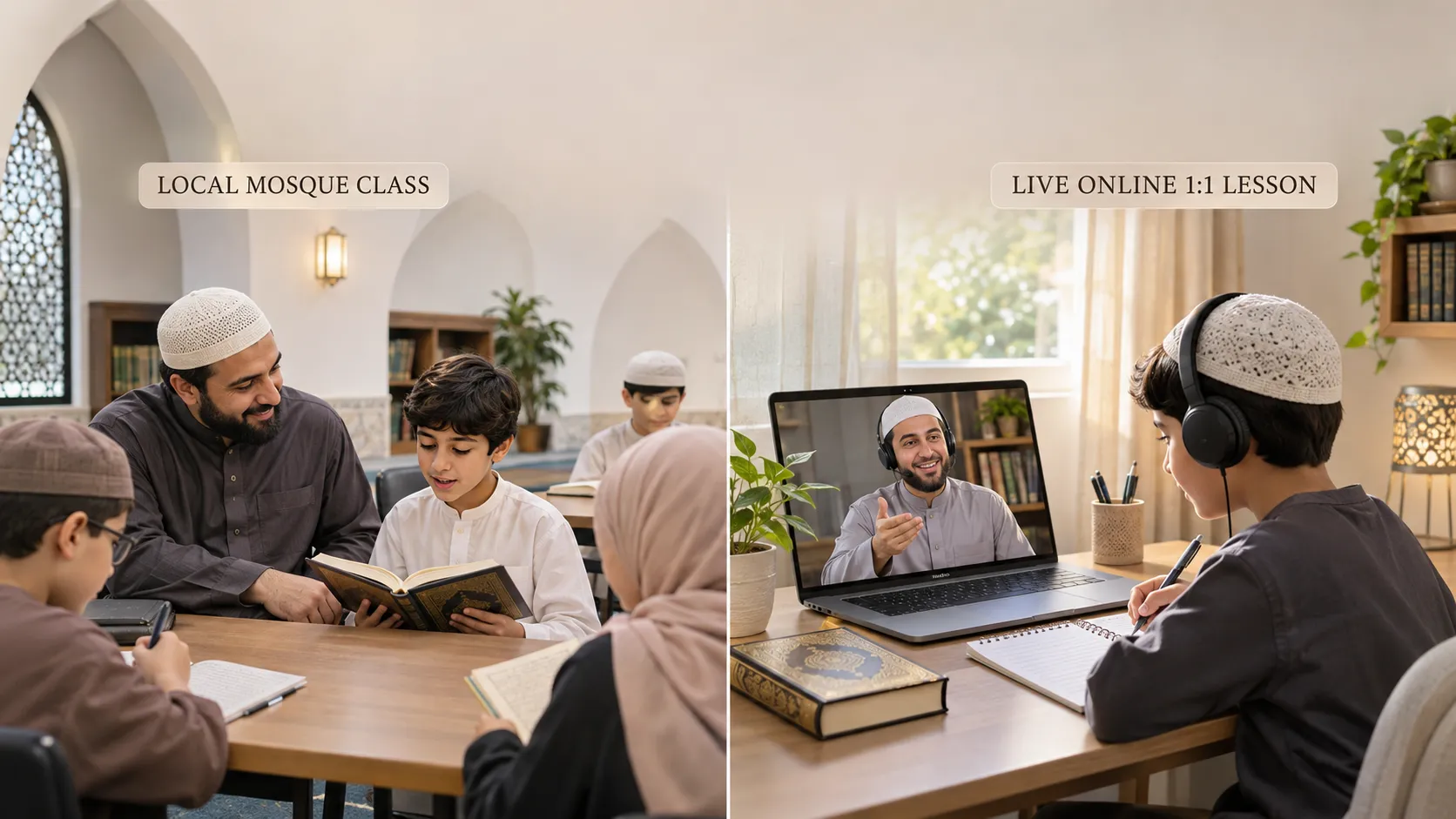
These are different educational models. A live private lesson and a prerecorded video course are not comparable, so this article compares typical mosque instruction with live one-to-one online lessons, the format Araby Academy offers for its paid lessons.
Why the Teaching Model Matters More Than the Location
Many strengths can exist in either setting: individualized instruction, qualified teachers, structured curricula, regular assessment, corrective feedback, child-friendly teaching, progress monitoring, and sound safeguarding. A mosque can offer private lessons, and an online academy can run group classes. So the useful question is not "online or mosque?" but "what is the actual teaching arrangement, and how good is it?"
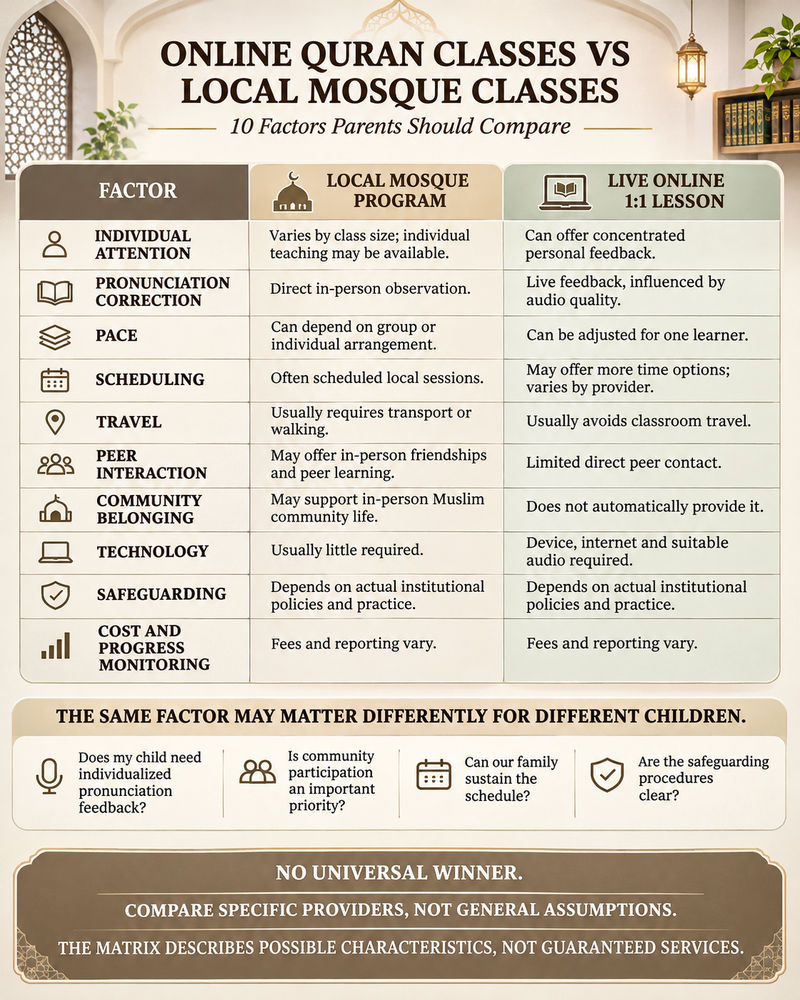
Comparison at a Glance
Factor | Local mosque classes | Live one-to-one online Quran classes |
|---|---|---|
Individual attention | May involve shared teacher attention in group settings; some mosques offer individual or small-group sessions | Can provide individualized feedback when instruction is genuinely one-to-one |
Teacher accessibility | Limited to teachers available locally | May offer access to teachers beyond the local area |
Pronunciation correction | Teacher can observe articulation and behavior directly | Depends on audio quality and the teacher's listening skill; some articulation details are harder to observe |
Learning pace | May follow the group's pace unless individually adjusted | Can be adjusted to the individual child |
Scheduling | Often fixed timetables; varies by mosque | May offer broader options; varies by provider |
Transportation | Travel, drop-off, and collection usually required | May reduce travel requirements |
Social interaction | In-person peers, with opportunities for friendships | Primarily a teacher-student relationship; peer contact is limited |
Community belonging | May offer stronger in-person participation | Does not automatically provide community participation |
Islamic environment | Learning takes place in a place of worship | Learning takes place at home; the atmosphere is shaped by the family |
Parental involvement | Often limited to drop-off and periodic feedback | Parents are often nearby and can help with setup and routine, within the provider's policies |
Progress monitoring | Varies; some provide formal reports, others informal feedback | Varies; depends on the provider's practices |
Technology | Little needed | Needs a device, a stable connection, and a suitable audio setup |
Safeguarding | Depends on the institution's policies and implementation | Depends on the institution's policies and implementation |
Cost | May be free, donation-based, subsidized, or fee-based | Varies by provider; usually fee-based |
Suitability | Often suits children who enjoy group settings | Often suits children who need individual pacing or whose circumstances limit travel |
No row declares a winner, and none should. The right answer depends on which rows matter most for your child.
Teaching Quality and Individual Attention
Which Option Provides More Individual Attention?
Group, small-group, and individual instruction work differently. Class size can affect how often each child recites, how specific the feedback is, how well the pace fits, and how much time a child spends waiting.
Group settings also have real benefits: peer modeling, shared learning, social encouragement, and hearing different voices recite. A child who watches a classmate read confidently may be motivated to try. Group instruction is not inherently ineffective, and a private lesson is not automatically better. A well-run group class with a skilled teacher can beat a poorly planned individual lesson.
Educational research gives some general context. The Education Endowment Foundation's Teaching and Learning Toolkit reports positive average effects for both one-to-one and small-group tuition in school subjects, and notes that results vary with how the tuition is delivered. This research concerns school academic subjects, not Quran education. It supports the general principle that targeted, responsive instruction can help. It does not prove that any particular Quran lesson will work better. We are not aware of high-quality studies directly comparing mosque-based Quran classes with online Quran academies, so parents should treat any claim of such a comparison with caution.
Can an Online Teacher Correct Pronunciation Properly?
Live online lessons can support the core steps of recitation teaching:
The teacher demonstrates.
The student repeats.
The teacher listens closely.
The teacher identifies differences in pronunciation.
The teacher corrects makharij (the points of articulation of Arabic letters) and applies Tajweed rules.
The student practices again with guidance.
There are real limitations. Microphone quality, internet interruptions, background noise, and audio compression can blur subtle sounds. A teacher in the same room can also see lip, jaw, and tongue movement more directly, and can notice a child's posture or behavior. So online pronunciation teaching is not always equivalent to in-person teaching. But accurate Tajweed can be taught remotely, and focused live feedback can produce meaningful improvement when the audio is good and the teacher listens carefully.
Which Environment Is Better for Learning Tajweed?
Tajweed is not a set of rules to memorize. It is a skill that depends on:
Teacher knowledge
Accurate modeling of recitation
Student practice
Corrective feedback
Sensible progression
Regular assessment
Both mosque-based and online teaching can supply these. Neither guarantees mastery. What matters is whether a particular teacher listens, corrects specifically, and builds on what the child already does well.
Which Option Is Better for Memorization?
Memorization needs individual recitation time, careful revision monitoring, realistic targets, error correction, accountability, and encouragement. Mosque Hifz programs can offer peer motivation and routine, while individual online sessions can give concentrated attention to each child's revision. Both can work when well structured. There is no reliable evidence that one format produces faster memorization, and anyone who promises it is overstating. (Memorization is covered in more depth in other Araby Academy articles.)
Teacher Qualifications and Ability
Does Location Tell You How Qualified the Teacher Is?
No. Whether lessons are online or in a mosque says nothing on its own about teaching quality. Look at:
Recitation accuracy
Tajweed knowledge
Relevant qualifications
Experience teaching children
Communication skills
Classroom management
Respectful, specific correction
Understanding of beginners
Professional conduct
Safeguarding awareness
A skilled Hafiz (someone who has memorized the whole Quran) is not automatically a good teacher of children. Formal qualifications also do not guarantee effective teaching. Both mosques and online academies vary in how they select teachers, so ask each one directly rather than assuming.
How Can Parents Evaluate Teacher Quality?
You do not need to be an expert in Tajweed to notice good teaching. Ask yourself:
Does the teacher explain clearly?
Does the teacher listen carefully to your child's recitation?
Are corrections specific rather than general?
Does your child get real opportunities to recite?
Is the pace right for your child?
Are mistakes corrected respectfully?
Do you understand the learning goals?
Can you raise concerns through an appropriate channel and be heard?
Social Development and Islamic Identity
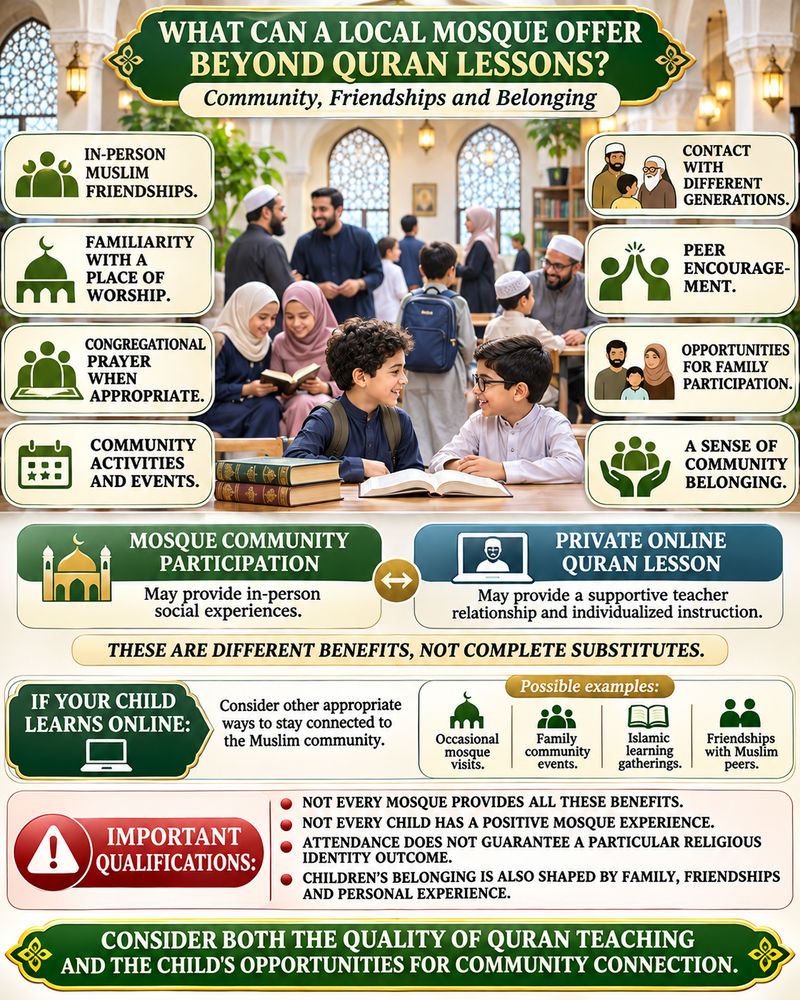
What Can a Local Mosque Offer Beyond Quran Lessons?
A mosque can offer things that no lesson format can fully replace:
In-person relationships with other Muslims
Familiarity with a place of worship
Opportunities for congregational prayer where appropriate
Friendships with Muslim peers
Community activities and events
Contact with different generations
A sense of belonging
Opportunities for the whole family to take part
Learning by watching community practices
These can matter especially for Muslim children growing up where they are a minority. Not every mosque offers all of them, and not every child has a positive experience of mosque life. No research guarantees identity outcomes from mosque attendance, so this is best understood as a plausible and widely recognized benefit rather than a proven result.
Can Online Quran Classes Provide the Same Social Experience?
Honestly, no. A live one-to-one online lesson is primarily a relationship between a teacher and a student. It can offer a supportive connection with a qualified teacher, regular contact with Islamic learning, individual guidance, and a space for questions. It does not automatically provide in-person friendships, congregational worship, community participation, shared physical learning, or the other social roles a mosque plays. An online academy does not replace the mosque, and families who choose online lessons should think about how their child will stay connected to a Muslim community in other ways.
Does Attending a Mosque Automatically Strengthen Islamic Identity?
Not by itself. A child's sense of Islamic identity and belonging is shaped by many things: family relationships, practice at home, friendships, the quality of teaching, cultural context, personal understanding, and positive or negative experiences. A child who attends a mosque without feeling welcomed may not develop a stronger connection, and a child who studies online within a warm, practicing family may be deeply connected. Consider both the quality of instruction and the breadth of community involvement.
Flexibility, Scheduling, and Family Life
Which Option Is Easier for Busy Families?
Mosque classes may involve fixed timetables, travel, drop-off and collection, coordination with school hours and siblings' activities, difficult travel in bad weather, and limited local teacher availability. Not every mosque is inflexible, and some are very accommodating.
Online lessons may reduce travel, offer more scheduling options, and open access to teachers elsewhere. They also require a device, a reliable connection, a quiet space, and sometimes coordination across time zones. Scheduling flexibility varies by academy and is never unlimited.
What If You Have Several Children?
Several children bring different ages, reading levels, goals, and schedules. A mosque can simplify logistics when siblings attend the same place at the same time, even if their levels differ. One-to-one online lessons can fit each child's level more closely, but they may need separate time slots, separate devices, and more parental supervision. Siblings should not assume they can share a single paid one-to-one lesson. Ask any provider how it handles several children before deciding.
Which Option Is More Sustainable Over Several Years?
Quran learning is long-term, so sustainability matters as much as quality. Consider travel demands, changing school schedules, work commitments, teacher continuity, cost, your child's engagement, and family responsibilities. The easiest option is not always the best educationally, and the best option on paper fails if the family cannot keep it up. Aim for something good enough in both respects.
Learning Engagement and Different Children's Needs
Which Environment Helps Children Concentrate Better?
Children differ. Some focus better with a physical classroom, peers, group routines, and in-person interaction. Others do better with fewer group distractions, individual attention, a familiar home setting, and a flexible pace.
Each setting has its own challenges. Mosque group settings can involve noise, waiting for a turn to recite, peer distractions, and mixed levels. Home-based online settings can involve household interruptions, device distractions, screen fatigue, limited movement, and technical glitches. Online learning does not cause attention difficulties, and group classes are not unsuitable for every easily distracted child. If you have concerns about your child's attention or development, speak to a qualified professional rather than relying on a choice of Quran class.
What About Shy or Anxious Children?
Some shy children settle more easily in a private lesson. Others grow more confident through familiar peers and regular community contact. What helps most in either setting is teacher rapport, predictable routines, respectful correction, realistic expectations, gradual participation, and good communication between parent and teacher. Avoiding all social contact is not a general solution, and Quran lessons are not a treatment for anxiety.
What About Children With Additional Learning Needs?
Helpful adjustments might include a slower pace, accessible materials, clear instructions, shorter activities, fewer distractions, visual or audio support, breaks, and individualized feedback. What a provider can offer depends on its capabilities and your child's needs. Not every online academy has specialist support, and not every mosque lacks accommodations. Talk about your child's needs with any institution before enrolling, and treat these adjustments as educational support, not medical treatment.
Safeguarding and Child Protection
This matters regardless of format, and it should never be used to frighten parents toward one option.
Is Online Quran Learning Safer Than Mosque Classes?
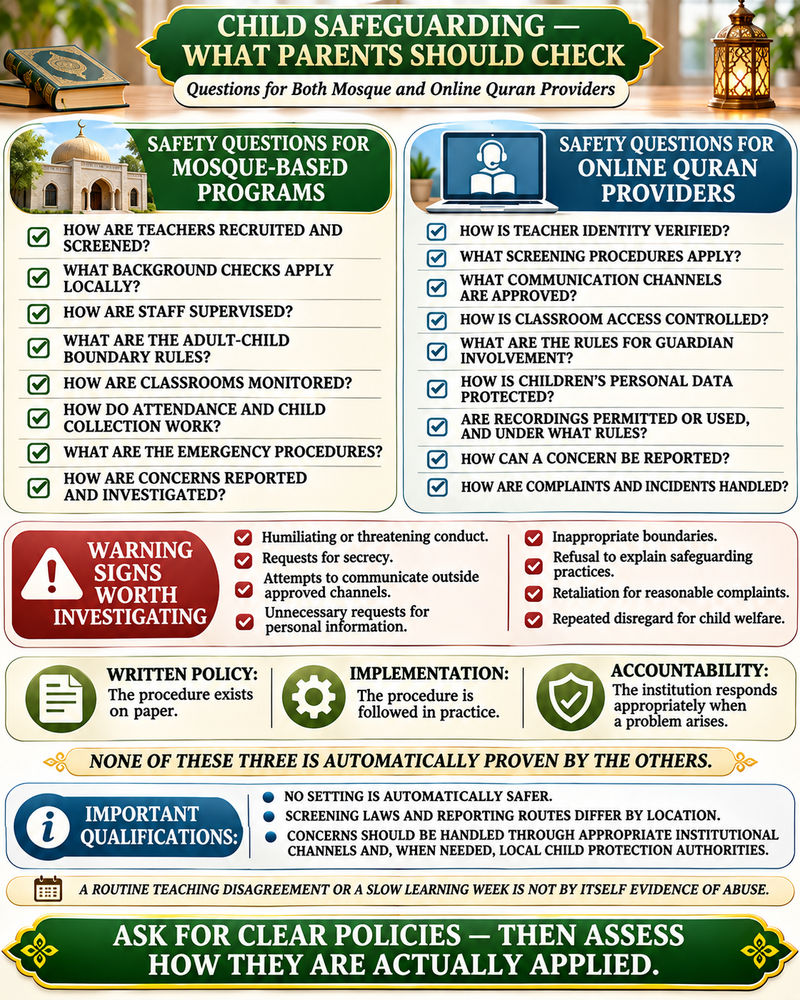
Neither setting is automatically safer because of where it takes place. Safety depends on policies, teacher screening, professional boundaries, supervision, communication rules, reporting channels, staff training, privacy protection, and whether these are actually followed and enforced. Physical and online settings have different risk profiles, and neither eliminates risk.
What to Check at a Mosque-Based Program
How teachers are recruited and screened
Which background checks apply (legal requirements and screening systems differ between countries and regions)
How staff are supervised
Rules on appropriate adult-child boundaries
Whether classrooms are visible and supervised
Attendance and child collection procedures
Emergency procedures
How concerns are reported and complaints handled
Expected standards of staff conduct
What to Check at an Online Quran Academy
How teacher identity is verified
What screening procedures apply
Rules on professional communication between teachers and children
How child accounts and classroom access are controlled
How guardians can be involved
The privacy policy and how children's personal information is handled
Rules on recording lessons
How inappropriate behavior is reported
Support and complaint channels
How incidents are handled
Ask these questions of any provider and judge the answers on their merits. Do not assume a feature exists because it is common elsewhere.
Warning Signs Worth Taking Seriously
Humiliating or threatening communication
Requests for secrecy
Attempts to move communication outside approved channels
Unnecessary requests for personal information
Inappropriate adult-child boundaries
Refusal to explain safeguarding procedures
Retaliation against reasonable complaints
Repeated disregard for your child's welfare
A teaching disagreement is not abuse, and a slow week is not a warning sign. If something does concern you, use the institution's reporting channel and, where necessary, contact your local child protection or safeguarding authority. Laws and reporting routes differ by country, so check the guidance that applies to you.
Why Transparency Matters
A trustworthy institution should be able to explain its policies and reporting procedures plainly. It helps to separate three things: having a written policy, applying it consistently, and being accountable when something goes wrong. A policy on paper does not guarantee safety, but a provider that cannot or will not explain its approach deserves caution. Organizations such as the NSPCC publish general guidance on child safeguarding that can help you frame your questions (see References).
The Real Cost of Quran Education
Are Mosque Classes Always Cheaper?
Not necessarily. Mosque programs may be free, donation-supported, community-subsidized, fee-based, or privately organized, and costs vary widely. Online lessons also have different pricing structures. Neither is reliably cheaper, and mosque education is not always free.
Compare Total Cost, Not Just the Fee
Consider direct costs:
Tuition and registration fees
Books and materials
Transport and parking
Devices and internet access
Extra tutoring
Missed or unused lessons, where relevant
Then consider time and logistics separately: travel time, schedule coordination, and the effort of managing several children. It is not necessary to put a money value on your time; just be aware that it is a real cost.
An Illustrative Example
This is a hypothetical example, not real fee or travel data.
A family attends two mosque sessions per week. Each session needs a 20-minute journey to the mosque and 20 minutes back.
One round trip: 20 + 20 = 40 minutes
Two sessions: 2 × 40 = 80 minutes of travel per week
Over a 36-week school year: 80 × 36 = 2,880 minutes, or 48 hours
If a parent drives home during the lesson and returns to collect the child, that is four 20-minute journeys per session, or 80 minutes per session and 160 minutes per week. Online lessons would not need this travel, but they may involve tuition and technology costs the mosque does not. This example does not show that online learning is cheaper overall. It shows why comparing only the lesson fee can mislead.
What Does Educational Value Mean?
Value depends on actual instructional time, opportunities for individual recitation, quality of feedback, teacher expertise, your child's engagement, accessibility, long-term consistency, and broader community benefits. Group lessons still have value while the teacher works with other students, since children can learn from listening. Compare what each service actually provides rather than the price alone. Check any provider's current fees directly, since prices change.
Parental Involvement and Progress Monitoring
Which Option Makes Progress Easier to Follow?
Both can offer teacher feedback, progress conversations, recitation assessments, learning goals, assigned practice, periodic reviews, written summaries, or digital records. What exists depends on the institution. Do not assume an online academy has a parent dashboard or that a mosque lacks formal reports. Ask each provider how it reports progress and how often.
What Should Parents Actually Measure?
Useful indicators include:
Recognition of Arabic letters
Reading accuracy
Pronunciation improvement
Connected reading
Application of Tajweed
Confidence in recitation
Retention of what has been memorized
Consistency
Understanding of the learning goals
Healthy engagement
Judge progress against your child's starting point. Pages completed, number of Surahs memorized, reading speed, comparison with other children, and number of lessons attended can each be misleading if used alone.
How Involved Should Parents Be?
Age-appropriate support helps: preparing your child for lessons, keeping a routine, encouraging manageable practice, raising concerns, reviewing goals together, and handling technical setup. Too much intervention during a lesson can interfere with the relationship between teacher and child. Do not record lessons secretly. Follow the institution's own classroom and safeguarding rules.
The Hybrid Approach
Can a Child Learn Online and Still Attend the Mosque?
Yes, where it is practical and educationally sensible. You do not have to pick one exclusively. Online lessons can support individual reading practice, targeted pronunciation correction, Tajweed, structured memorization support, and personal goals. The mosque can offer community relationships, congregational worship where appropriate, Islamic activities, friendships, in-person religious education, and wider involvement. A mosque can also remain your child's main Quran provider, with online lessons as extra support. Mosques are not only social spaces; they can be excellent teaching institutions.
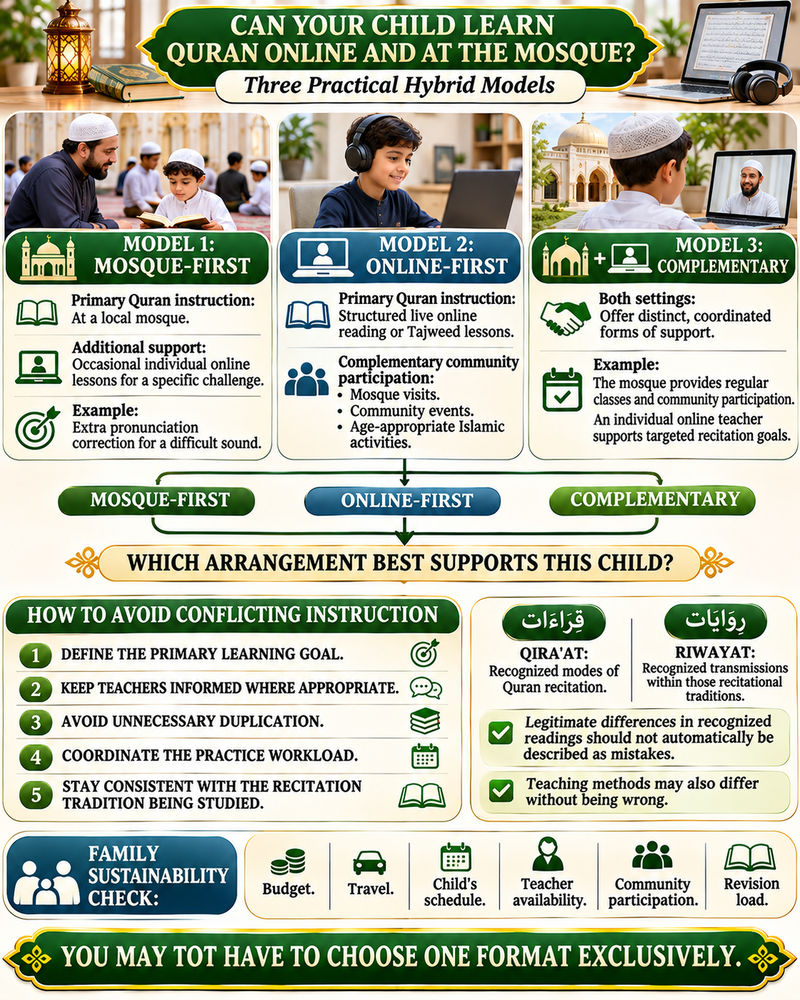
Three Possible Hybrid Models
Mosque-first: Most Quran instruction happens at the mosque, with occasional individual online support for a specific need.
Online-first: Structured reading or Tajweed lessons happen online, while regular mosque and community participation continues.
Complementary: Both environments provide different but coordinated support.
Which suits you depends on your child's needs, the teachers available, your schedule, your budget, how consistent the teaching can be, and your access to a community.
Avoiding Conflicting Instruction
Several teachers can create friction. Terminology, sequence, memorization targets, expectations, revision methods, and recitation traditions may differ. These differences are not necessarily errors, since recognized qira'at (canonical modes of recitation) and riwayat (their transmissions) legitimately vary, and teachers may use different methods. To keep things smooth:
Set clear learning goals.
Keep teachers informed where appropriate.
Avoid unnecessary duplication.
Coordinate workload.
Stay consistent with the recitation tradition your child is studying.
Realistic Family Scenarios
These are hypothetical illustrations, not real families or Araby Academy testimonials.
1. The family with an excellent local mosque. The child enjoys the classes, the teaching is sound, the schedule works, and the family values the community. Staying put is a strong choice. There is no reason to change a successful arrangement without a clear need.
2. The family far from a mosque. Regular travel is hard, and the child needs structured reading instruction. Live online lessons may be a practical solution. The family can also look for other ways to take part in community life, such as occasional mosque visits, community events, or contact with other Muslim families.
3. The child who needs targeted Tajweed correction. The child attends mosque classes but needs more individual pronunciation feedback. Supplementary one-to-one lessons may address that specific need. This does not mean the mosque teacher is unqualified; large groups simply limit individual time.
4. The family with several children. The children differ in age, level, and schedule. The mosque may simplify logistics, while individual online lessons may match each child's level more closely. A mix, or different choices for different children, can work.
5. The child who thrives in a group. The child learns well with peers and enjoys the classroom. Group-based mosque instruction may suit them, and individual lessons are not automatically better.
6. The child who struggles with the current format. The child finds it hard to take part or get enough feedback. Before switching, find the cause. Options include talking to the current teacher, changing the class size, trying individual sessions, adjusting the schedule, or asking about accommodations. Not every difficulty needs a move online.
A Parent's Decision Framework
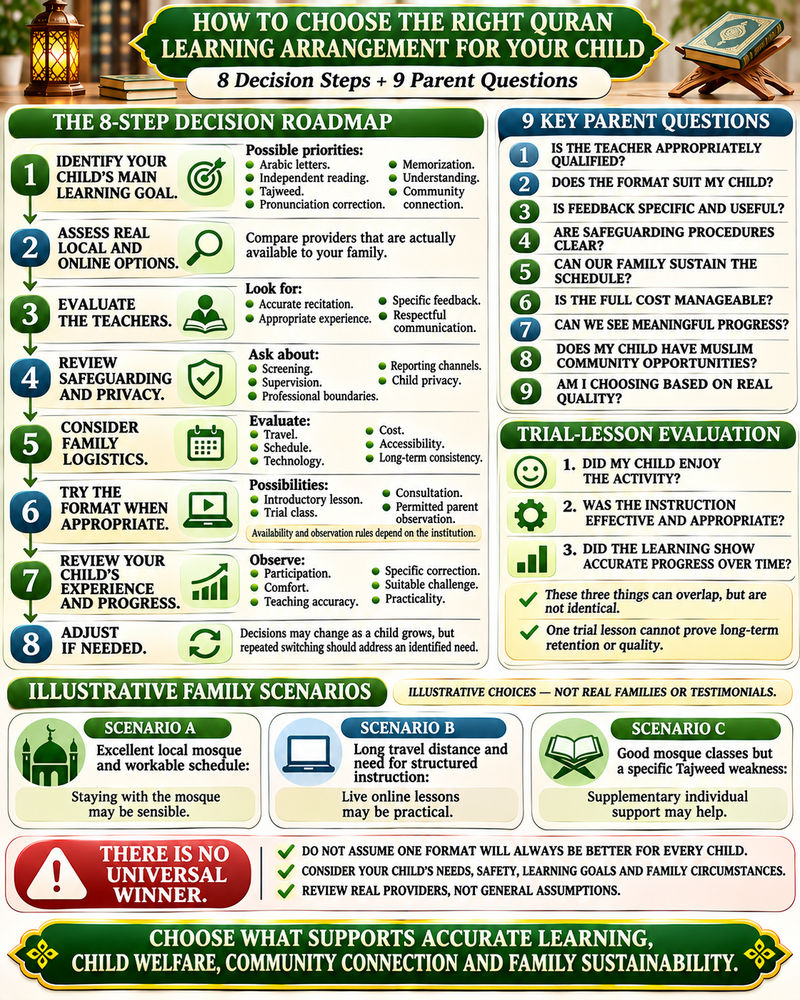
Identify your child's main goal. Learning the letters, reading independently, improving Tajweed, correcting pronunciation, memorizing, understanding Islam, or joining a community? These point toward different arrangements.
Assess your real options. Compare the actual mosque and online providers available to you. Do not compare an idealized academy with an assumed weak mosque, or the reverse.
Evaluate the teachers. Look at qualifications, teaching ability, communication, and conduct.
Review safeguarding and privacy. Ask institution-specific questions.
Consider family logistics. Weigh scheduling, travel, cost, accessibility, and sustainability.
Try the format. Where available and permitted, use an introductory lesson, a trial class, a consultation, or an appropriate parent observation arrangement.
Review your child's response and progress. Look at engagement, comfort, appropriate challenge, accuracy, feedback, progress, and practicality.
Adjust when needed. A first decision is not permanent. But do not keep switching teachers without identifying what the underlying problem is.
Quick checklist:
Is the teacher appropriately qualified?
Does the format suit my child?
Is my child getting useful corrective feedback?
Do I understand the safeguarding arrangements?
Can we keep up the schedule?
Is the cost sustainable?
Can we see meaningful progress?
Does my child have opportunities for Muslim community involvement?
Am I choosing based on real quality, not assumptions?
How to Evaluate a Trial Lesson
A trial lesson can show you how the teacher communicates, how the pace feels, whether your child takes part, how pronunciation is corrected, whether the arrangement suits your child, and how the technology works. One lesson cannot tell you about long-term quality. Watch whether the teacher notices your child's current level and responds to it.
It also helps to separate three things that often overlap but are not the same:
A child enjoying an activity
A child receiving effective instruction
A child making progress that lasts
If you are considering live one-to-one Quran lessons for your child, Araby Academy offers eligible students up to three free 30-minute trial lessons, subject to availability and applicable booking and confirmation requirements. The trials are scheduled separately, and a request does not guarantee a confirmed appointment. Trying a trial does not mean leaving your local mosque. You can find out more at arabyacademy.com.
An Islamic Perspective on Quran Education
The Quran encourages careful recitation: "…and recite the Quran with measured recitation" (Quran 73:4), a verse often cited in connection with Tajweed. It also reminds believers that Allah raises those who have knowledge by degrees (Quran 58:11), and models the supplication "My Lord, increase me in knowledge" (Quran 20:114).
The Prophet ﷺ said:
خَيْرُكُمْ مَنْ تَعَلَّمَ الْقُرْآنَ وَعَلَّمَهُ
"The best among you are those who learn the Quran and teach it." (Sahih al-Bukhari 5027)
On the value of mosques, the Quran says that Allah's mosques are maintained by those who believe in Allah and the Last Day (Quran 9:18). A narration in Sahih Muslim (2699) describes tranquility descending on people who gather in a house of Allah to recite and study the Book of Allah together.
These texts show the high value of learning the Quran and of gathering in mosques. They do not rank one teaching format above another, and they do not make any particular paid service a religious obligation. Please check the wording and context of the verses and narrations above with a trusted scholar or an authoritative translation before quoting them elsewhere. The value of a child's learning does not depend on which institution they attend, and respect for mosques and for sound online education can sit together.
Frequently Asked Questions
Are online Quran classes better than mosque classes?
Not universally. Quality depends on the teacher, the teaching structure, the child, and the family's circumstances. Each format has real strengths.
Can children learn Tajweed effectively online?
They can make real progress with a skilled teacher, good audio, and regular practice. Limitations such as sound quality and reduced visibility of articulation are real, and no format guarantees mastery.
Are mosque Quran classes usually cheaper?
Not necessarily. Some are free or subsidized and others charge fees. Compare the total cost, including travel, materials, and time.
Are one-to-one lessons better than group lessons?
One-to-one lessons can give more individual feedback and a more flexible pace. Group lessons offer peer learning and social benefits. Which is better depends on the child and the quality of teaching.
Can online lessons replace mosque attendance?
No. A private lesson does not replace congregational worship, friendships, or community life. Many families use both.
Can my child attend both?
Yes, where practical. Coordinate goals and workload between teachers to avoid conflicting instruction.
Which environment is safer?
Neither is automatically safer. Ask each provider about screening, supervision, communication rules, privacy, and reporting, and see whether the answers are clear.
What if we live far from a mosque?
Live online lessons may be a practical way to access structured instruction. Look for other ways to stay connected to a Muslim community, such as events, gatherings, or occasional visits.
What if my child struggles in group classes?
Find the cause first. Talk to the teacher, consider smaller classes or individual sessions, and ask about accommodations before changing institutions.
Conclusion
You do not have to choose between Quran education and Muslim community life. A local mosque can be an excellent choice when it offers qualified instruction, appropriate support, a workable schedule, positive community experiences, sound safeguarding, and real progress. Live one-to-one online lessons can be especially useful when a child needs individual attention, targeted pronunciation correction, flexible scheduling, access to suitable teachers beyond the local area, or supplementary support. A hybrid arrangement can combine the strengths of both.
Judge actual quality instead of assuming one format is always better, and be willing to adjust as your child grows. If you would like to explore live one-to-one Quran and Tajweed lessons, Araby Academy offers eligible students up to three free 30-minute trial lessons, subject to availability and applicable eligibility, booking, and confirmation requirements. You can request one at arabyacademy.com.
The best Quran learning arrangement is the one that supports accurate learning, protects your child's welfare, remains sustainable for your family, and helps your child build a lasting relationship with the Quran.