A parent is searching for a Quran teacher for their child. One candidate has memorized the entire Quran. Another holds an Ijazah. A third studied at a respected Islamic institution, and a fourth advertises fifteen years of experience. All seem qualified, yet the parent still cannot tell who will actually help their child learn. An adult choosing a teacher for themselves faces the same uncertainty.
The short answer: to choose a good Quran teacher, evaluate subject expertise, teaching ability, professional conduct, and fit with the individual learner together. Memorization, an Ijazah, a respected institution, and long experience are all valuable evidence. None of them alone shows that someone can teach your child or you effectively and safely.
This guide gives you seven observable signs, explains the qualifications you will hear about, lists red flags, and offers questions and a trial lesson checklist. It applies wherever you choose to study.
The Islamic Responsibility of Teaching the Quran
The Prophet ﷺ said:
خَيْرُكُمْ مَنْ تَعَلَّمَ الْقُرْآنَ وَعَلَّمَهُ
"The best among you are those who learn the Quran and teach it." (Sahih al-Bukhari, 5027)
This hadith shows how highly Islam regards teaching the Quran. It also implies a responsibility: preserving accurate recitation, transmitting knowledge faithfully, correcting mistakes with care, and treating students respectfully.
Several Quranic verses are relevant to the spirit of good instruction:
Quran 16:125 calls to the way of your Lord "with wisdom and good instruction" (بِالْحِكْمَةِ وَالْمَوْعِظَةِ الْحَسَنَةِ).
Quran 3:159 describes the Prophet's gentleness with his community, noting that harshness would have driven people away from him.
Quran 73:4 instructs: وَرَتِّلِ الْقُرْآنَ تَرْتِيلًا, "and recite the Quran with measured recitation."
These verses are not a modern teacher accreditation standard, and this article does not present them as one. They describe ideals of wisdom, gentleness, and care, which we can apply to the practical question of choosing a teacher. Also remember that we can observe behavior and teaching practice, but we cannot judge anyone's sincerity from the outside. That belongs to Allah.
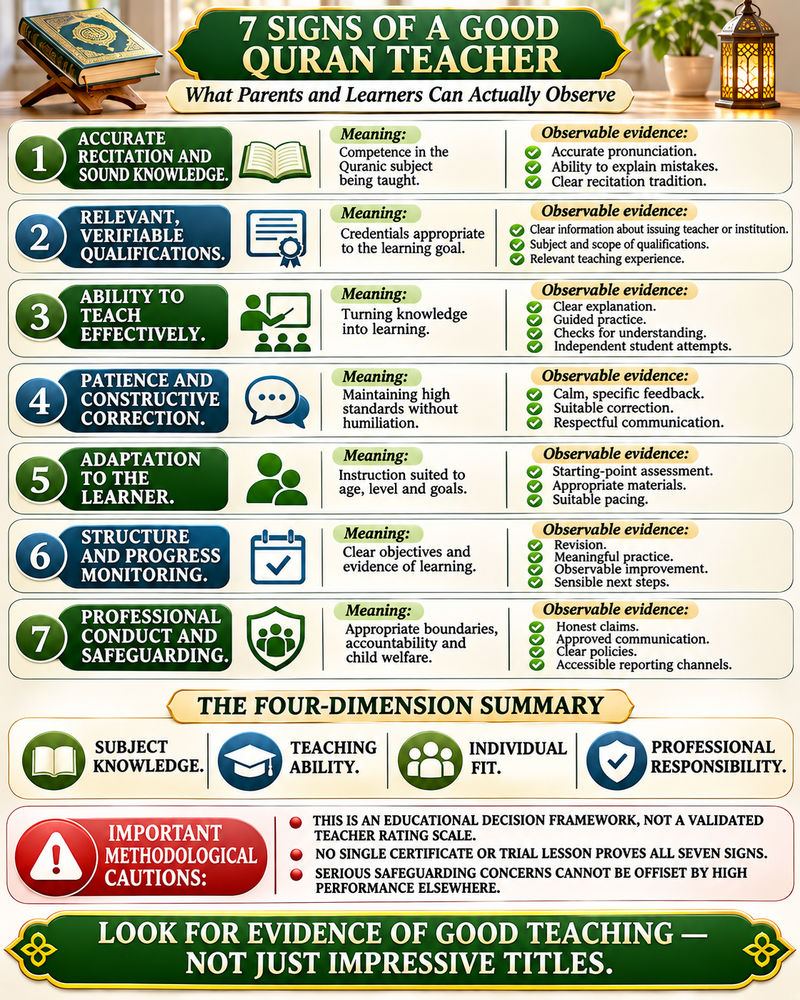
The Seven Signs at a Glance
Sign | What it means | What you can observe |
|---|---|---|
1. Accurate recitation and sound knowledge | Competence in the subject being taught | Clear pronunciation, ability to explain and correct, honest about the recitation tradition taught |
2. Relevant, verifiable qualifications | Credentials that match your learning goal | Clear answers about who issued them, what they cover, and the teaching experience behind them |
3. Ability to teach | Turning knowledge into learning | Clear explanations, guided practice, checking understanding |
4. Patience and constructive correction | Correcting without humiliating | Specific, respectful feedback; rigor without intimidation |
5. Adaptation to the learner | Lessons shaped by age, level, and goals | Starting-point assessment, suitable materials and pace |
6. Structure and progress monitoring | Clear objectives and evidence of improvement | Revision, a sensible next step, honest progress updates |
7. Professional conduct and safeguarding | Trustworthy, accountable behavior | Honest claims, appropriate boundaries, clear policies and reporting routes |
The sections below take each sign in turn.
Sign 1: Accurate Quran Recitation and Sound Knowledge
A Quran teacher needs competence in the subject being taught. For recitation teaching, that typically includes:
Makharij al-Huruf (مَخَارِجُ الْحُرُوف): the articulation points of Arabic letters.
Sifat al-Huruf (صِفَاتُ الْحُرُوف): the characteristics of letters, such as emphasis or lightness.
Tajweed (تَجْوِيد): the rules for reciting correctly, including madd (prolongation), ghunnah (nasalization), and appropriate stopping and continuing.
Fluency and the ability to recognize recitation errors.
Voice, accuracy, and teaching are different things
A beautiful voice is not the same as accurate pronunciation. Accurate pronunciation is not the same as understanding the principles of Tajweed. And understanding the principles is not the same as being able to explain and correct someone else's recitation. A teacher does not need to sound like a famous reciter to teach well, and a famous-sounding voice does not prove technical accuracy.
What a competent correction looks like
A capable teacher can:
Demonstrate the sound accurately.
Identify the student's specific mistake.
Explain the correction.
Give a suitable example.
Listen to the next attempt.
Confirm whether improvement has happened.
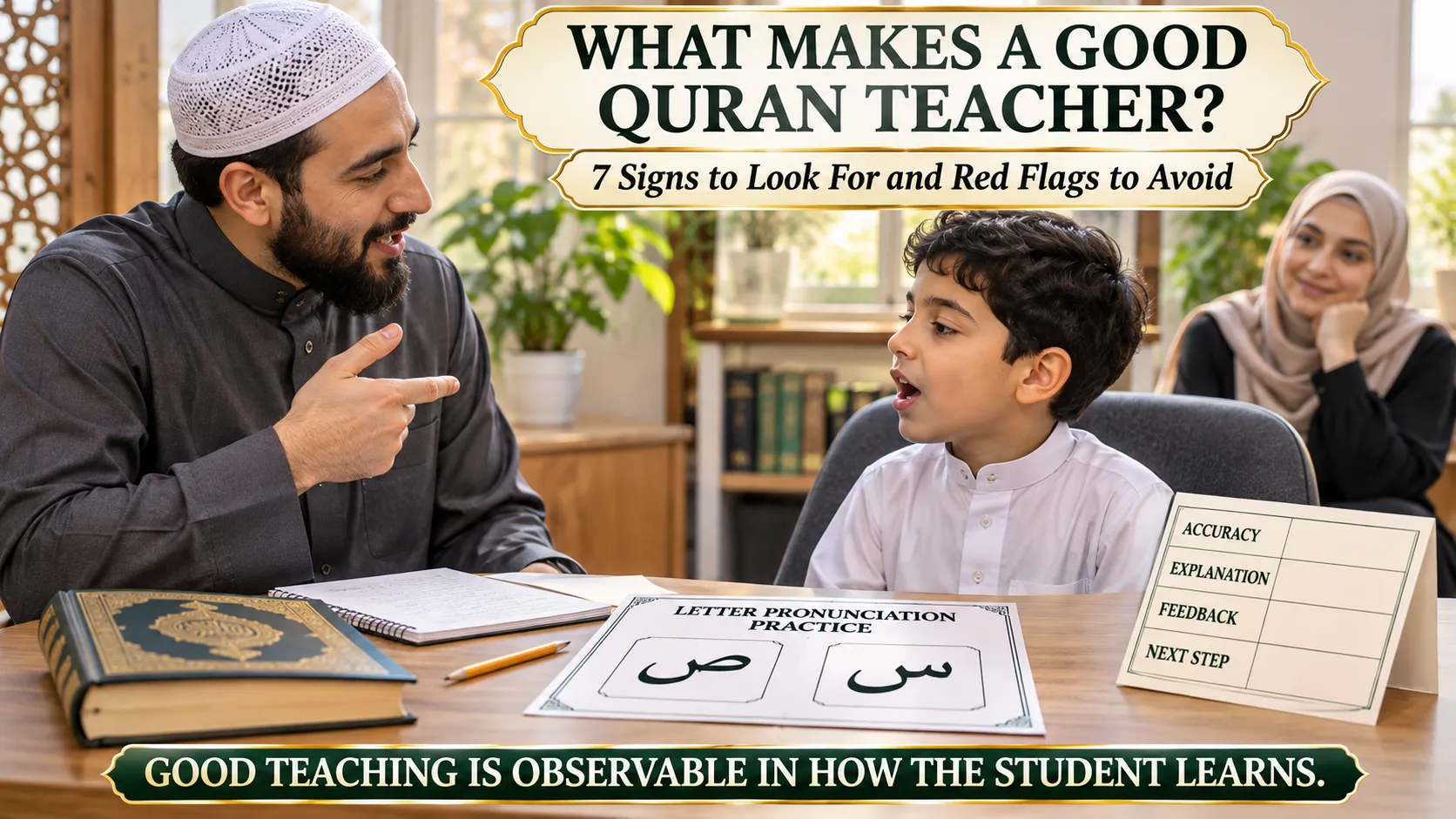
Take the letters ص and س. Both are whistling-type sounds, but ص is an emphatic letter pronounced with the back of the tongue raised, which gives it a fuller quality, while س is light. English has no exact equivalent for either, so approximations can mislead. A teacher who can model the difference, notice when a student blurs the two, and guide them to the correction is showing real competence. (Our planned guide to articulation points will cover this in detail.)
Legitimate differences between recitations
Recognized Qira'at (قِرَاءَات, canonical recitation traditions) and their Riwayat (رِوَايَات, specific transmissions) can differ in valid ways. A good teacher tells you which tradition they teach and does not treat a valid difference as an error.
If you cannot judge Arabic pronunciation
Most parents cannot, and reading this article will not change that. Instead, rely on:
Relevant, verified qualifications.
Transparent teacher assessment by the institution.
Independent qualified guidance, such as asking a trusted, knowledgeable person to listen to a trial lesson.
Observable teaching practice (Sign 3).
A clear explanation of the recitation tradition being taught.
Sign 2: Relevant and Verifiable Qualifications
Islamic educational terms are often used loosely in marketing. Here is what the main ones mean.
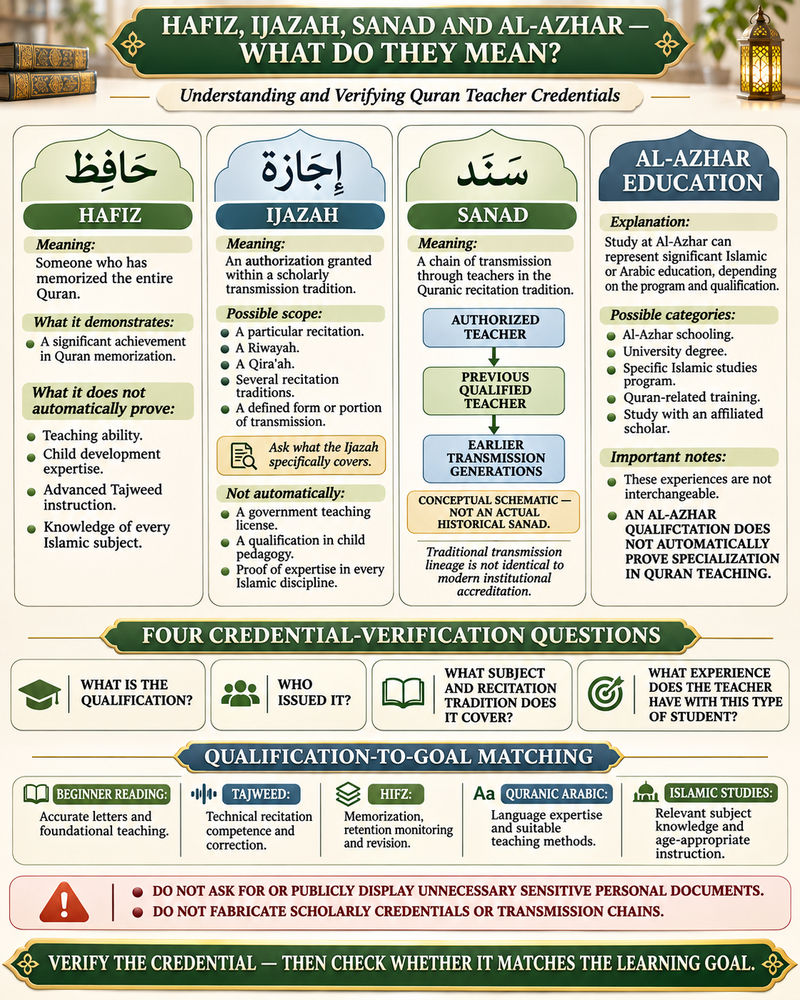
What is a Hafiz?
A Hafiz (حَافِظ) is someone who has memorized the entire Quran. This is a significant achievement and can be very valuable for teaching, especially in Hifz programs. But memorization is different from Tajweed mastery, teaching skill, experience with children, jurisprudence (Fiqh), or formal teaching qualifications. Not every Quran reading teacher must be a Hafiz, and being a Hafiz does not by itself qualify someone to teach every Islamic subject.
What is an Ijazah?
An Ijazah (إِجَازَة) is an authorization granted within a scholarly transmission tradition, typically by a teacher who has themselves received authorization. Quran-related Ijazat vary in scope. They may cover recitation generally, a particular Riwayah or Qira'ah, several recitation traditions, or a specified portion or form of transmission. Requirements differ between institutions and scholars.
An Ijazah is not a government teaching license, and it does not automatically show skill in child development or lesson design. It is strong evidence of recitation competence within its stated scope, so ask what the scope is.
What is a Sanad?
A Sanad (سَنَد) is the chain of transmission linking a reciter or teacher, through named teachers, back to the Prophet ﷺ. Within traditional Quranic education, it expresses the principle that recitation is received from qualified teachers and not only learned from books. It is a concept of transmission, not modern institutional accreditation. Most parents cannot independently verify a Sanad, so do not expect to. Ask the teacher or academy how they describe and substantiate their credentials.
Does an Al-Azhar qualification matter?
It can. Study at Al-Azhar may represent substantial Islamic or Arabic education, depending on the qualification, faculty, program, and level. These are different things and should not be treated as interchangeable:
Studying at an Al-Azhar school.
Graduating from Al-Azhar University.
Completing a specific Islamic studies program.
Holding a Quran-related qualification.
Studying privately with an Al-Azhar-affiliated scholar.
Not every Al-Azhar graduate specializes in Quran teaching, and a teacher without an Al-Azhar qualification is not necessarily less competent. (A separate Araby Academy article will cover Al-Azhar's history and structure in more depth.)
Which qualifications fit which goal?
Learning goal | Relevant expertise | Additional teaching skills |
|---|---|---|
Beginner Quran reading | Accurate letter pronunciation, foundational Tajweed | Clear sequencing, patience with beginners, age-appropriate methods |
Tajweed refinement | Strong Tajweed knowledge, ability to diagnose errors | Targeted correction, explaining why a sound is wrong |
Quran memorization (Hifz) | Strong memorization, recitation accuracy, often Hifz teaching experience | Revision systems, retention checks, sensible targets |
Quranic Arabic | Arabic language training | Experience teaching non-native speakers |
Islamic studies for children | Sound basic Islamic knowledge | Engaging, age-appropriate delivery |
A recitation qualification does not automatically establish expertise in Tafsir, Hadith sciences, Fiqh, or Arabic grammar. Match the credential to the subject.
How to verify qualifications reasonably
Reasonable questions include:
What qualification does the teacher hold, and who issued it?
What subject does it cover, and which recitation tradition?
What teaching experience do they have with learners of this age and level?
Has the institution assessed the teacher's competence?
You do not need to ask for sensitive personal documents, and you should not make public accusations based on incomplete information. A trustworthy institution should be able to describe its teacher qualification and verification standards clearly.
Sign 3: The Ability to Teach Effectively
Educational researchers distinguish subject knowledge from the knowledge of how to teach that subject. Lee Shulman called this pedagogical content knowledge: knowing which examples, explanations, and sequences help learners grasp a particular topic. In plain terms, a person can know Tajweed thoroughly and still not know how to explain it to a seven-year-old.
Effective teaching typically includes clear explanations, logical sequencing, demonstration, guided practice, checking understanding, corrective feedback, chances for independent attempts, and adapting when an explanation does not work.
What effective Quran teaching can look like
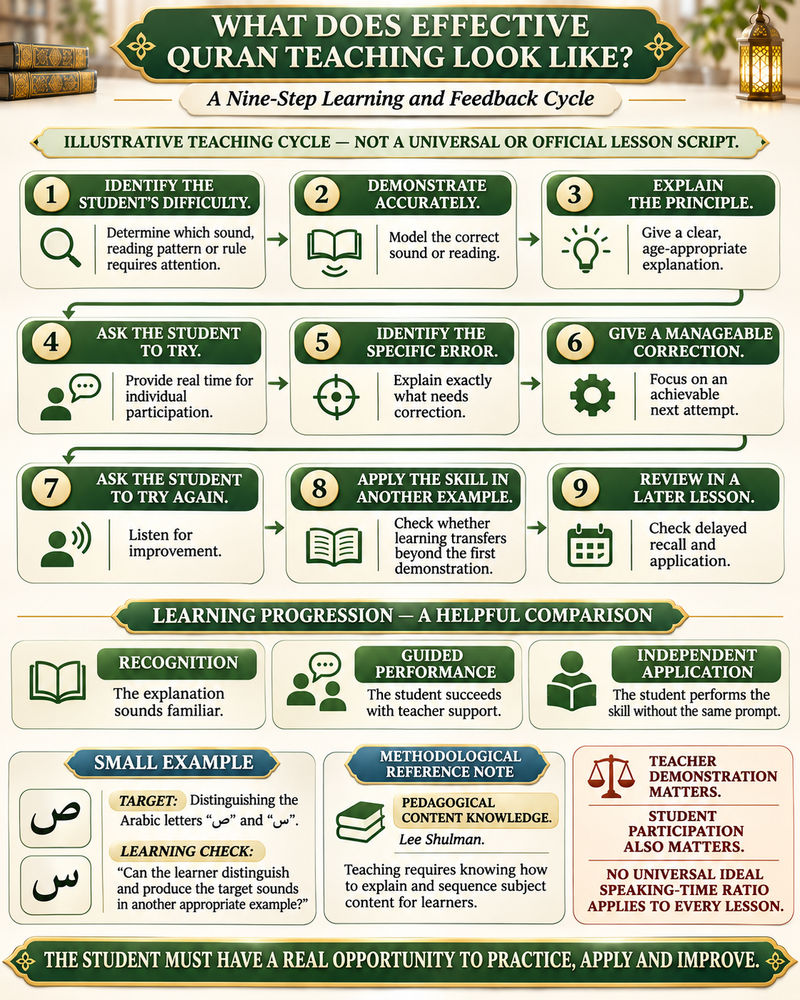
This is an illustrative cycle, not an official Araby Academy procedure, and it varies by lesson and student:
Identify the student's current difficulty.
Demonstrate the correct sound or reading pattern.
Explain the relevant principle.
Ask the student to try.
Identify the specific mistake.
Give a manageable correction.
Ask the student to try again.
Apply the correction in another example.
Review the skill in a later lesson.
A good teacher checks understanding
"Do you understand?" rarely tells you much, because students often say yes out of politeness or uncertainty. Better checks ask the student to demonstrate a sound, read an unfamiliar word, apply a recent rule, explain an idea simply, recite independently, or recall earlier material. Recognizing an explanation is not the same as applying a skill independently.
The student needs time to participate
A lesson made up almost entirely of the teacher reciting gives little evidence of what the student can actually do. Teacher demonstration is an essential part of instruction, though, and there is no universal ideal ratio of teacher to student time. The right balance depends on the goal.
Sign 4: Patience, Respect, and Constructive Correction
Accurate Quran instruction requires correction. A good teacher does not ignore important mistakes just to keep the student comfortable. But correction should be specific, respectful, understandable, proportionate, and focused on the skill rather than the student's worth.
What constructive correction sounds like
Here is a hypothetical contrast.
Unhelpful: "That is wrong. You never listen."
Constructive: "Let's work on this letter separately. Listen to the difference, then try the word again."
The second version names the problem, offers a model, and gives the learner a clear next action. No single script is required, but the principle holds: the student should leave knowing what to fix and how.
Patience does not mean lowering standards
A good teacher may repeat a correction, ask for a passage to be re-read, assign extra practice, or delay moving forward until a foundation is secure. These are not signs of poor teaching. Humiliation, intimidation, and inappropriate pressure are different, and they are not acceptable.
Supporting a struggling child
A good teacher might adjust the explanation, simplify the task, offer a smaller next step, allow processing time, try to identify where the difficulty actually lies, and keep the parent informed. Children will sometimes find lessons challenging, and a good teacher cannot prevent all frustration. A teacher should also not diagnose learning disabilities or psychological conditions.
Respecting adult learners
Adult beginners should be taught as adults, even when learning the letters. That means respecting their previous learning experiences, goals, cultural backgrounds, questions, pace, and work and family commitments.
The Prophet ﷺ also taught that the one who recites skillfully is with the noble angels, while the one who recites with difficulty and finds it hard has a double reward (Sahih al-Bukhari 4937; Sahih Muslim 798). This is a reminder that struggling learners deserve dignity and encouragement.
Sign 5: Adaptation to Age, Level, and Learning Goals
A good Quran teacher finds the learner's starting point instead of giving everyone the same material. These are illustrative profiles, not official academy placement categories.
A young beginner may need short activities, simple instructions, letter recognition, guided pronunciation, engaging methods, and predictable routines.
An older child who can read may need accuracy work, Tajweed foundations, targeted pronunciation correction, fluency, and suitable independent practice.
An adult beginner may need age-appropriate materials, clear explanations, a flexible pace, respectful correction, and practical study routines.
A new Muslim may need unfamiliar terms explained, Arabic reading foundations, essential Quranic passages, cultural sensitivity, and a clear distinction between translation and recitation.
A Hifz student may need accurate memorization, structured revision, retention checks, error correction, and sensible targets.
Why an initial assessment matters
A teacher may look at letter recognition, reading fluency, pronunciation, Tajweed knowledge, existing memorization, revision habits, learning goals, and past education. The purpose is to find a sensible starting point. It should not feel like a competitive exam.
A good teacher knows their limits
Good teachers refer specialized questions elsewhere: complex Fiqh rulings, advanced theology, specialized Tafsir, or concerns about speech, hearing, or learning needs that call for professional assessment. Quran teachers should not give medical or psychological diagnoses. Knowing the limits of your expertise is a sign of responsibility.
Sign 6: Structured Learning and Meaningful Progress
Attending lessons, completing activities, acquiring skills, retaining knowledge, and applying skills independently are not the same thing. Good Quran education keeps these distinctions in view.
What a learning plan may include
Depending on the student, a plan might include the starting point, short-term objectives, lesson activities, independent practice, revision, progress checks, and adjustments. It does not need to be a formal written document or an identical curriculum for everyone, but you should be able to understand where the learner is headed.
What real progress looks like
Progress is measured against the student's own starting point. Examples include:
Recognizing letters that were previously unfamiliar.
Reading connected words more accurately.
Distinguishing similar Arabic sounds.
Applying a Tajweed rule correctly.
Making fewer repeated mistakes.
Reading a passage with less help.
Retaining previously memorized verses.
Building more consistent revision habits.
Teaching quality should not be judged only by pages completed, Surahs memorized, reading speed, lessons attended, or comparisons with other students.
Why revision matters
Revision means revisiting foundational reading skills, recurring pronunciation errors, Tajweed rules in new passages, and memorized material. Research on distributed practice and retrieval practice (see References) indicates that spacing out review and actively recalling material support learning. This is general learning research, not Quran-specific evidence, and no revision schedule guarantees permanent retention.
If progress seems slow
Slow progress does not automatically mean poor teaching. Possible factors include too little practice, inconsistent attendance, unaddressed foundational gaps, unsuitable materials, poor pacing, technical problems, individual learning needs, or unrealistic expectations. Rather than assigning blame to the teacher or the student, ask the teacher for the learning objectives and the evidence of progress, and discuss them together.
Sign 7: Professional Conduct and Safeguarding
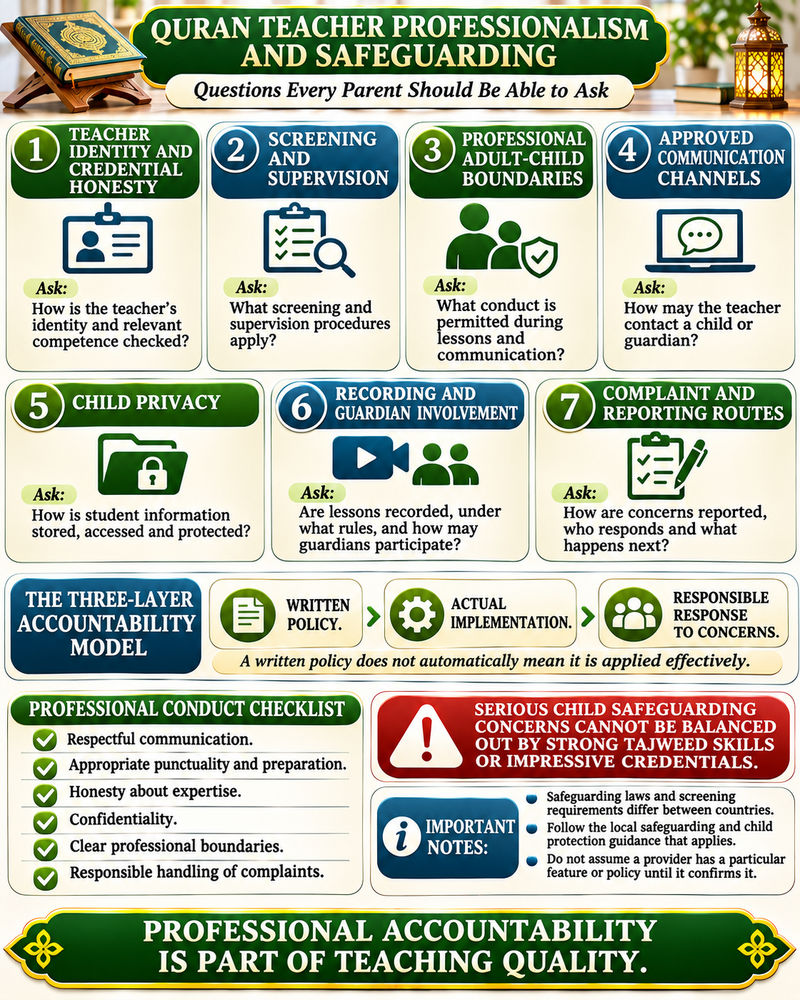
Professional conduct matters in all Quran education and especially when children are involved. It includes respectful communication, reliable boundaries, preparation, punctuality, honesty about qualifications, confidentiality, responsible handling of student information, appropriate communication channels, and institutional accountability.
Professional boundaries in child education
Parents should understand how teachers communicate with children, which channels are permitted, what parental involvement is appropriate, how concerns can be reported, how student information is handled, and which policies apply. Safeguarding laws and expectations differ between countries, so check your local authority's guidance for specifics.
Questions for an online academy
Online learning does not remove safeguarding risks. Reasonable questions include:
How are teacher identities verified?
What screening procedures apply?
How is classroom access managed?
What are the rules on communication with minors?
What privacy protections apply?
What are the rules about recording?
How can parents report concerns, and who responds?
Expect clear answers from the academy itself. Policies and technical protections vary between providers, so rely on what each academy confirms in writing, not on assumptions.
Trustworthiness and honesty
A trustworthy teacher avoids fabricating qualifications, making unsupported religious claims, inventing Quran or Hadith references, guaranteeing unrealistic outcomes, overstating expertise, discouraging reasonable questions, or making inappropriate personal requests. These are observable professional behaviors. They are not judgments of anyone's inner religious state.
Red Flags to Avoid When Choosing a Quran Teacher
Not every concern is misconduct. It helps to distinguish four levels:
A teaching preference: a style you do not love but that works.
A correctable educational problem: raise it and see whether it improves.
A repeated professional concern: pattern, not a one-off.
A serious safeguarding issue: requires prompt action.
A teacher is not unsafe simply because their style differs from your preference.
Category A: Educational concerns
Repeatedly ignoring important recitation mistakes.
No meaningful opportunities for the student to practice.
The same approach for every student.
Moving ahead despite essential gaps.
Vague feedback that does not help improvement.
Unrealistic guarantees.
Category B: Professional and credential concerns
Misrepresenting qualifications.
Contradictory claims about experience.
Refusing reasonable clarification about relevant credentials.
Repeatedly failing to communicate about significant lesson problems.
Unsupported claims of Islamic knowledge.
Pressure toward unnecessary financial commitments.
Category C: Serious safeguarding concerns
Humiliating or threatening a child.
Requests for secrecy.
Attempts to bypass approved communication channels.
Inappropriate adult-child boundaries.
Unnecessary requests for sensitive personal information.
Retaliation against a legitimate complaint.
Sexualized communication or behavior.
Warning sign | Why it matters | Appropriate next step |
|---|---|---|
Important mistakes never corrected | Errors become habits | Raise it with the teacher; ask how they plan to address it |
Contradictory claims about credentials | Trust depends on honesty | Ask for clarification through the academy |
Same lesson regardless of level | The student's needs are not being met | Request an assessment or a plan adjustment |
Pressure for unnecessary payment | Possible exploitation | Decline and seek written terms |
Secrecy requests or off-platform contact with a child | Classic boundary violation | Stop the interaction, document it, report to the institution and local authorities |
Humiliation or threats | Harm to the child | Prioritize the child's safety and report |
For serious safeguarding concerns, put the child's safety first, pause the interaction where appropriate, and use the institution's reporting channel and your local safeguarding or child protection authorities. Do not confront a potentially dangerous person on your own. Strong teaching never offsets a serious safeguarding concern.
Questions to Ask Before Choosing a Quran Teacher
Ask these in a friendly, curious tone, not as an interrogation. Some are best answered by the academy, not the individual teacher.
What Quran-related qualifications do you hold? Useful answers name the qualification, issuer, and scope.
Which subjects and recitation traditions can you teach? Look for clarity and honest limits.
Have you taught students of this age and level? Specific examples help.
How do you identify a new student's starting level?
How do you correct pronunciation mistakes? Listen for specific methods, not vague reassurance.
How do you decide when a student is ready to move on?
How do you build in revision?
What do you do when a student struggles with a skill?
How do you communicate progress?
What independent practice do you recommend?
What professional and safeguarding policies apply?
How can a student or parent raise a concern?
There is no required script. A good answer is concrete, honest, and understandable.
How to Evaluate a Quran Teacher During a Trial Lesson
A trial lesson gives useful evidence, but one short session cannot show everything about long-term quality.
Before the lesson
Define your learning goal, prepare questions, describe the student's current ability accurately, review the teacher information provided, and understand the lesson arrangements.
During the lesson
Where appropriate and permitted, notice:
Whether the teacher finds the student's starting point.
Whether instructions are clear.
Whether the student gets chances to practice.
Whether mistakes are corrected specifically.
Whether the pace suits the student.
Whether the teacher responds respectfully.
Whether the activity has a clear learning purpose.
Whether the student can ask questions.
Parental observation must follow the institution's classroom and safeguarding policies, so ask what is permitted instead of assuming.
After the lesson
Ask yourselves:
What did the student actually practice?
What difficulty did the teacher identify?
Was the feedback useful?
Does the student know the next step?
Were there any professional concerns?
Does this arrangement seem sustainable?
Enjoyment matters but should not be the only test. A student can enjoy a lesson without gaining skills, and a challenging lesson can be effective if the challenge is appropriate and respectfully managed.
A Seven-Point Teacher Evaluation Checklist
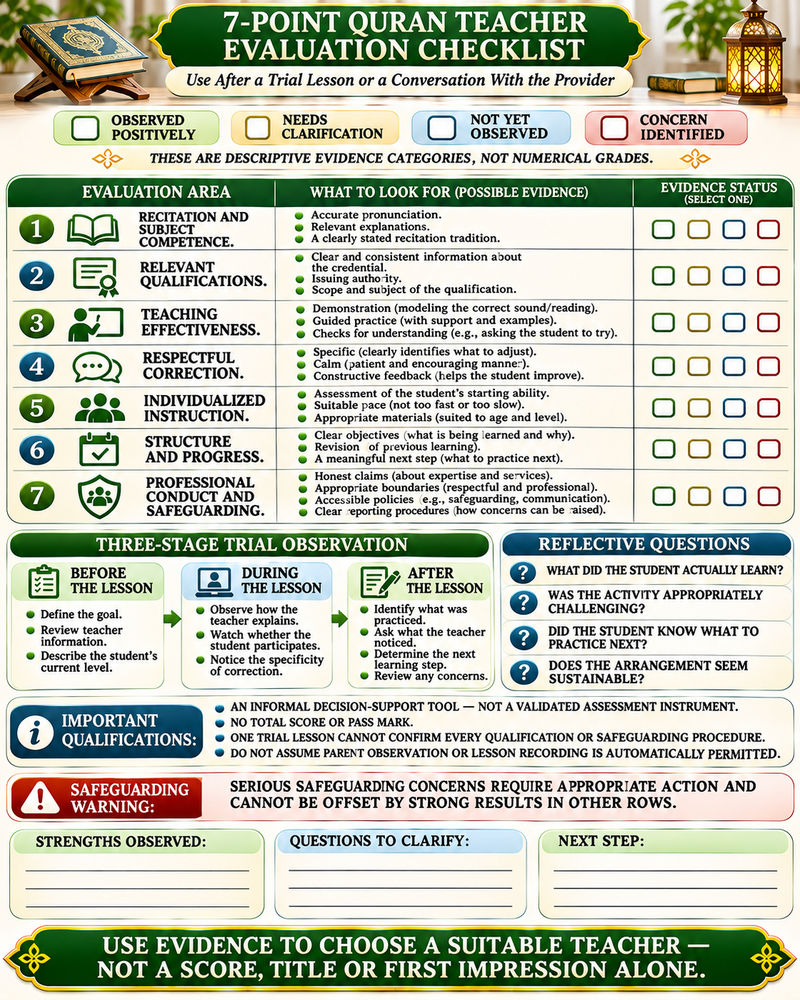
Use this after a trial lesson or a conversation with the academy. For each row, choose one: Observed positively, Needs clarification, Not yet observed, or Concern identified.
Evaluation criterion | Evidence to look for | Your observation |
|---|---|---|
1. Recitation and subject competence | Clear pronunciation, accurate explanations, stated recitation tradition | |
2. Relevant qualifications | Clear, consistent answers about credentials and scope | |
3. Teaching effectiveness | Demonstration, guided practice, checking understanding | |
4. Respectful correction | Specific, calm, constructive feedback | |
5. Individualized instruction | Starting-point assessment, suitable pace and materials | |
6. Structure and progress | Objectives, revision, clear next steps | |
7. Professional conduct and safeguarding | Honest claims, clear boundaries, accessible policies |
This is an informal decision-support tool. It is not a validated assessment instrument, an official Araby Academy rating system, a substitute for credential verification, a formal safeguarding assessment, or a guarantee of suitability. It has no scores or pass marks. Several criteria, especially qualifications and safeguarding, need more evidence than one trial lesson can provide. And a serious concern under criterion 7 cannot be balanced out by strong results elsewhere.
Must the Best Quran Teacher Be a Native Arabic Speaker?
No, though native fluency can be valuable. Native-speaker status alone does not establish accurate recitation, Tajweed expertise, Quranic studies qualifications, teaching effectiveness, the ability to explain to non-Arabic speakers, experience with children, or professional conduct. Many non-native speakers build excellent recitation competence and relevant qualifications.
Focus on verified subject competence, accurate recitation, clear communication in a language you share, appropriate language proficiency, and experience with learners like you. Nationality or ethnicity is not a measure of quality in either direction.
Online vs In-Person Teachers
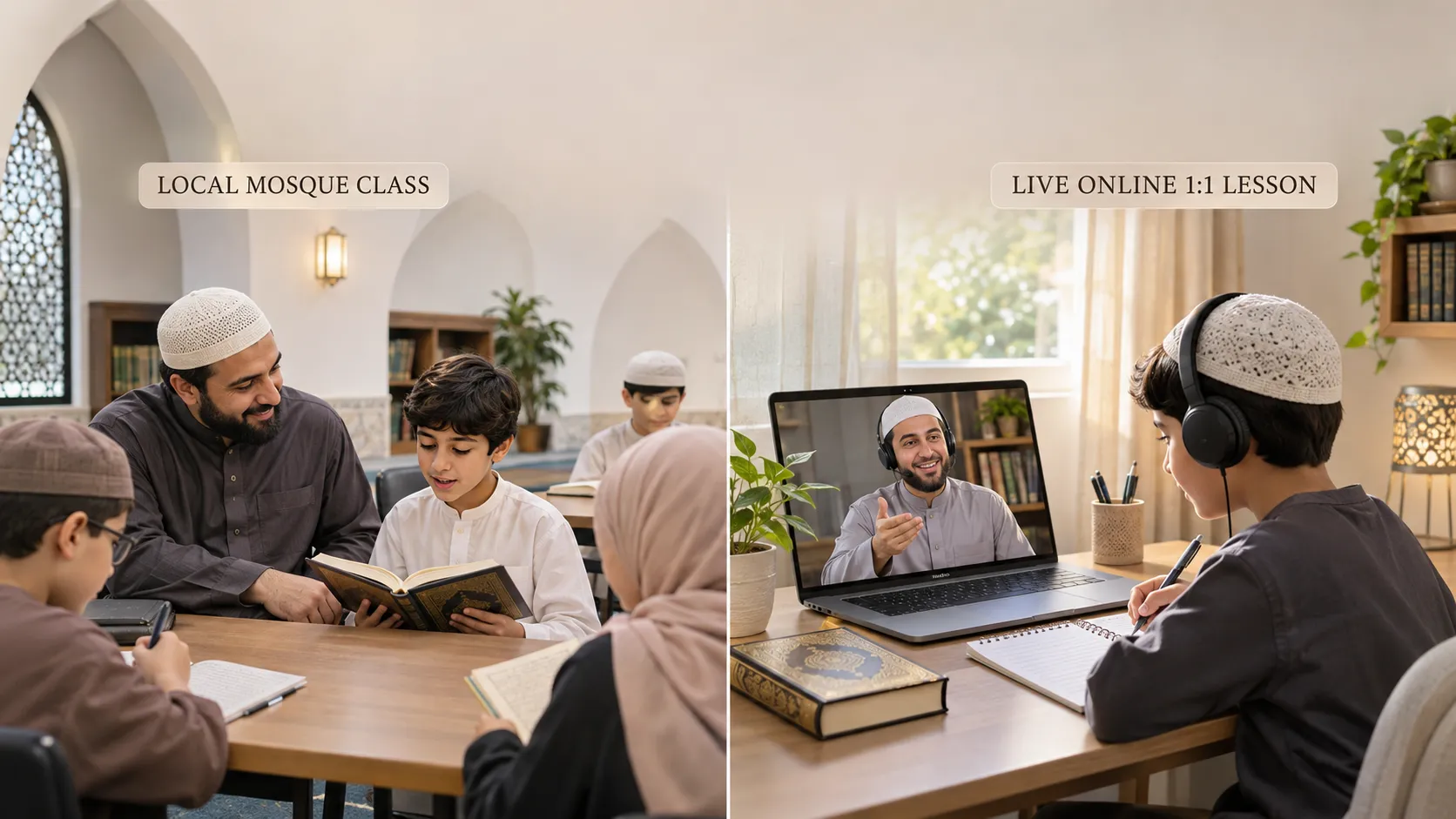
Teacher quality should be judged separately from location. (Our article Online Quran Classes vs the Local Mosque compares the environments in depth.)
For online lessons, consider audio clarity, comfort with technology, the ability to demonstrate pronunciation remotely, engagement, communication, and privacy and safeguarding practices. For in-person lessons, consider classroom organization, direct observation, group management, individual feedback, and supervision.
Online teachers are not automatically better, and mosque teachers are not automatically less qualified. Live one-to-one lessons can offer individualized feedback, depending on the teacher's competence and the lesson design.
When Should You Consider Changing Your Quran Teacher?
Distinguish temporary difficulty from persistent unsuitability. Reasons to review include:
Repeatedly unclear explanations.
A lasting mismatch between pace and needs.
No meaningful corrective feedback.
Unaddressed foundational gaps.
Repeated communication problems.
Misrepresented qualifications.
Serious safeguarding concerns.
For ordinary educational concerns: name the specific problem, raise it respectfully, ask for clarification or an adjustment, see whether things improve, and consider another teacher if they do not. Switching teachers at every difficulty rarely helps, since learning is sometimes simply hard. But no one has to stay with an unsuitable teacher indefinitely.
For serious safeguarding concerns: put safety first, do not require a child to continue an unsafe interaction, use the appropriate reporting channels, and seek local safeguarding help.
Trying Live One-to-One Lessons with Araby Academy
If you are looking for a Quran teacher and would like to experience live individualized instruction before making a longer-term decision, eligible students can request up to three free 30-minute trial lessons with Araby Academy, subject to availability and applicable booking and confirmation requirements. Trial lessons are scheduled separately. Submitting a request is not the same as a confirmed appointment.
Araby Academy offers live one-to-one Quran, Tajweed, Arabic language, and Islamic education. You can use the questions and checklist above during a trial lesson, whichever provider you are considering. To request a trial, visit arabyacademy.com.
Frequently Asked Questions
Does a Quran teacher have to be a Hafiz?
No. Memorizing the Quran is valuable, especially for Hifz teaching, but a teacher of Quran reading or Tajweed need not be a Hafiz. Look for competence in the subject being taught.
Does a Quran teacher need an Ijazah?
Not universally. An Ijazah is strong evidence of authorized recitation competence within its scope, but its requirements vary and it does not by itself show teaching skill. Ask what it covers.
What is the difference between a Hafiz and a teacher with an Ijazah?
A Hafiz has memorized the Quran. An Ijazah is an authorization to transmit recitation or another specified subject. They can overlap, but neither implies the other.
Are Al-Azhar graduates always qualified Quran teachers?
No. Al-Azhar study can represent significant learning, but programs differ and not every graduate specializes in Quran teaching.
How can I evaluate a Quran teacher if I do not know Arabic?
Rely on verified qualifications, the institution's assessment of its teachers, observable teaching practice, and independent guidance from a qualified person you trust.
What should I look for in a Quran trial lesson?
Whether the teacher finds the starting point, explains clearly, lets the student practice, corrects specifically and respectfully, and ends with a clear next step.
Can a strict Quran teacher still be a good teacher?
Yes, if the strictness means high standards and consistent practice. Humiliation, intimidation, and inappropriate pressure are never acceptable.
How do I know whether my child is making progress?
Look for fewer repeated mistakes, more accurate reading, better retention, and less assistance needed, measured against your child's own starting point. Ask the teacher for concrete evidence.
Conclusion
A good Quran teacher is more than someone who recites beautifully. Look for:
Accurate recitation and sound knowledge.
Relevant and verifiable qualifications.
Effective teaching ability.
Patience and respectful correction.
Adaptation to individual learning needs.
Structured learning and progress monitoring.
Professional conduct and safeguarding.
Qualifications are important evidence, and teaching practice shows how that expertise is applied. Ask reasonable questions, use introductory lessons to gather real evidence, and judge the fit with your actual goals. No teacher suits every learner.
If you would like to try live one-to-one lessons, eligible students can request up to three free 30-minute trial lessons with Araby Academy, subject to availability and applicable eligibility, booking, and confirmation requirements.
The right Quran teacher does more than transmit knowledge. They help students develop accurate recitation, meaningful understanding, sustainable learning habits, and a respectful relationship with the Quran.