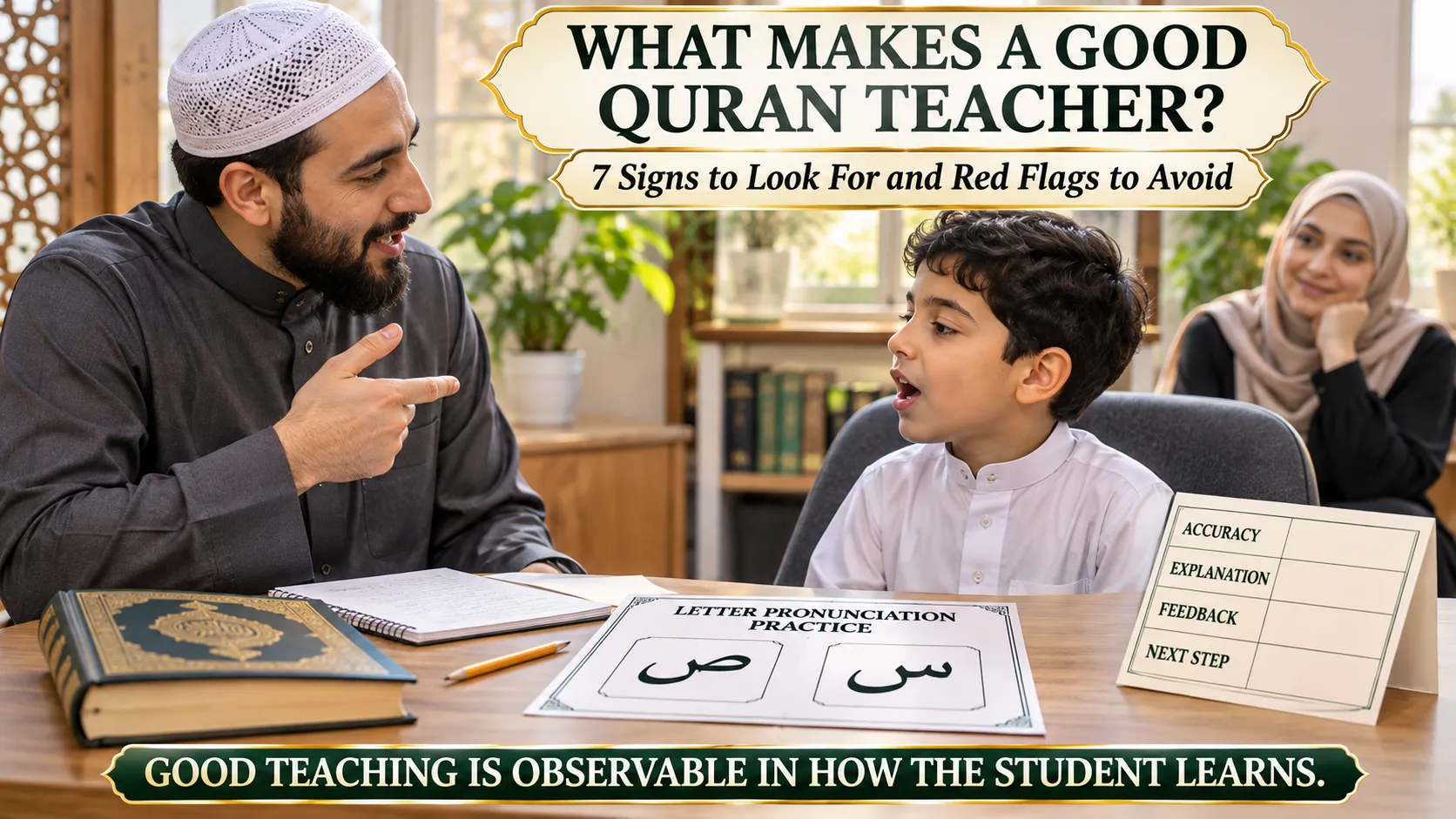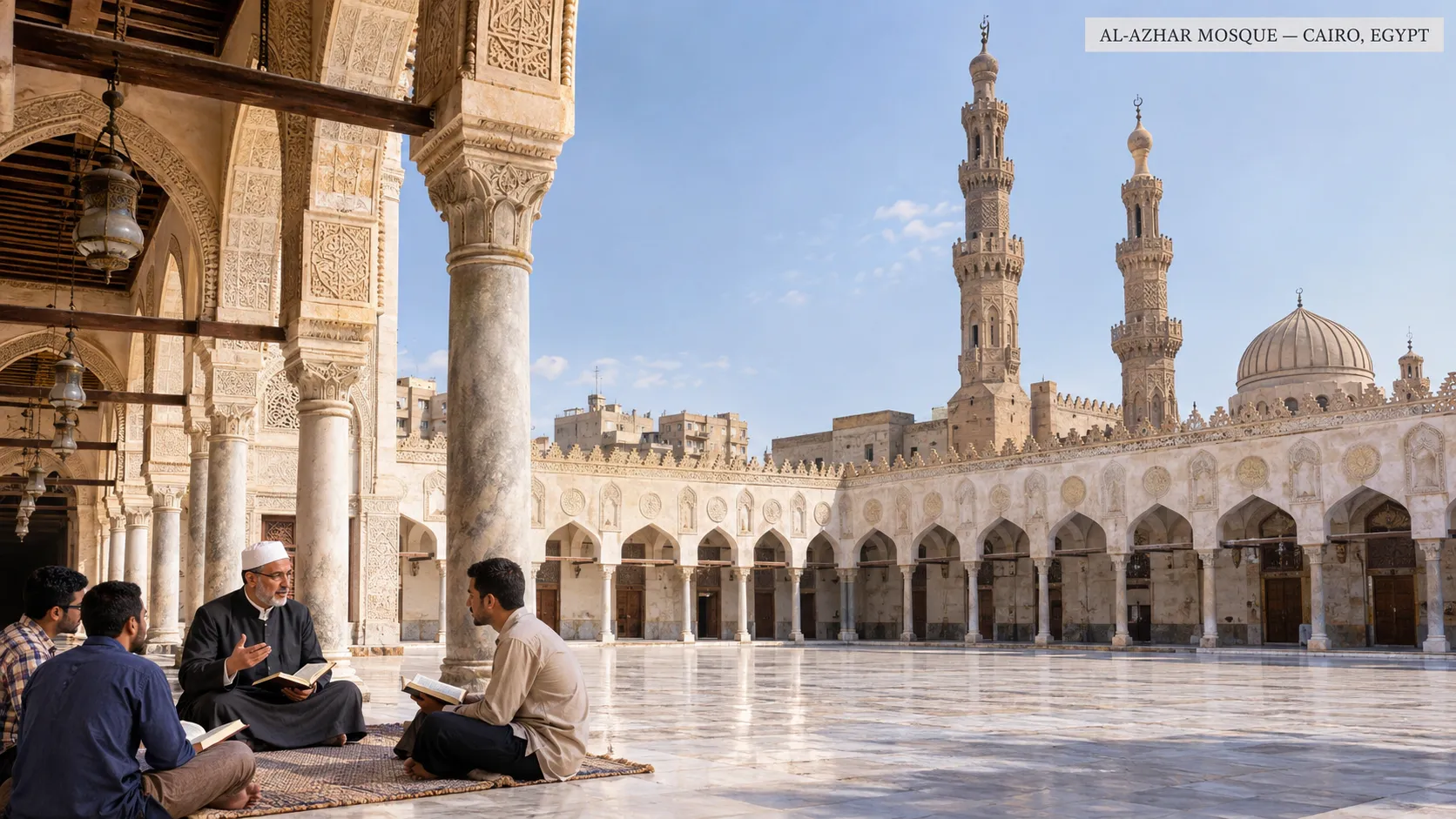
Imagine you are comparing online Quran teachers. One profile says: "Al-Azhar graduate." You recognise the name, but a few questions come to mind. Is Al-Azhar a mosque, a university or a school? Does every graduate know the Quran by heart? Does the qualification include an Ijazah? Does it make someone a better teacher?
The short answer: Al-Azhar al-Sharif (الأزهر الشريف) is a historic Egyptian institution in Cairo. It began as a mosque in the tenth century and is now also a large educational system that includes a university and a network of pre-university institutes. An appropriate Al-Azhar background can be meaningful evidence of a teacher's training in Arabic and the Islamic sciences. But "Al-Azhar" covers many programs and levels, so the specific qualification, specialisation and demonstrated teaching ability matter more than the name alone.
This guide explains what Al-Azhar is, how it developed, what its qualifications can and cannot tell you, and how to evaluate any Quran teacher fairly, whether or not they studied in Egypt.
What Exactly Is Al-Azhar?
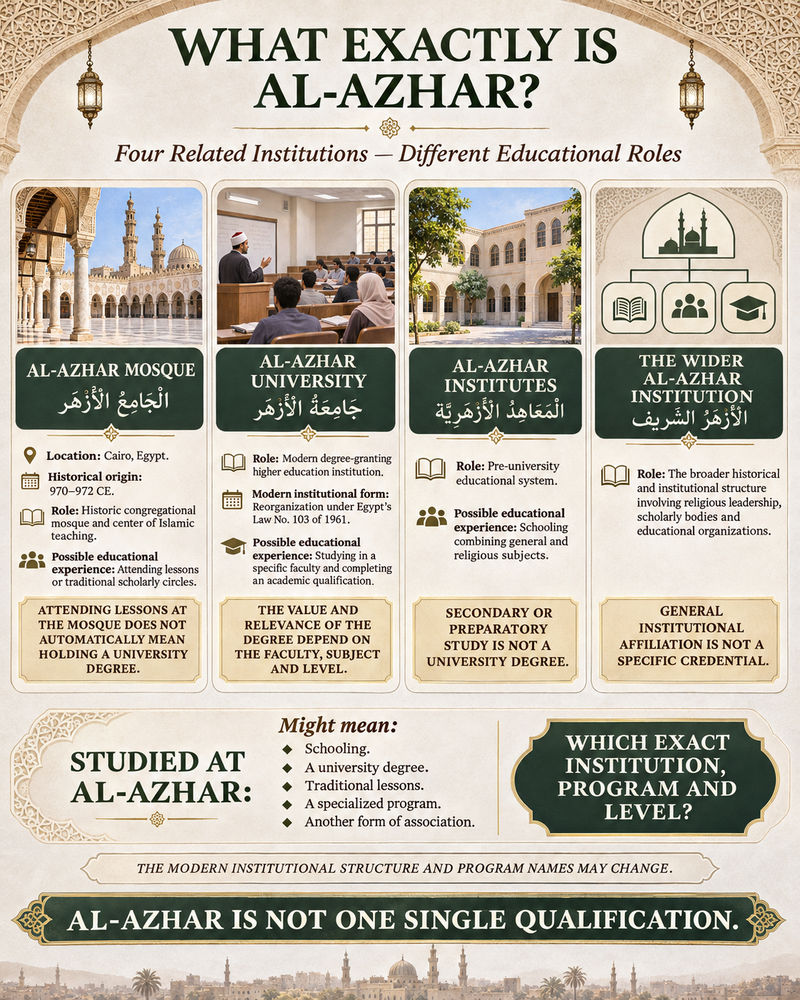
Al-Azhar is not one thing. People use the name for several related but distinct bodies, and mixing them up is the most common source of confusion in teacher profiles.
Institution | Primary role | What studying there may mean |
|---|---|---|
Al-Azhar Mosque (الجامع الأزهر) | A historic congregational mosque in Cairo, founded 970 CE. Historically a centre of teaching. | Attending lessons or circles at the mosque. This alone does not imply a university degree. |
Al-Azhar University (جامعة الأزهر) | The higher-education body, established in its modern form by law in 1961. It has faculties in Islamic and Arabic studies and in other fields. | A university degree whose meaning depends entirely on the faculty and level. |
Al-Azhar Institutes (المعاهد الأزهرية) | The pre-university schooling system (preparatory and secondary stages) run within Al-Azhar's wider structure. | Schooling that usually combines religious and general subjects. Not a university qualification. |
The wider Al-Azhar institution | The overall body that includes the Grand Imam, scholarly councils, the university and the institutes. | An institutional affiliation, not a specific credential. |
Someone who "studied at Al-Azhar" might have attended an institute as a teenager, completed a university degree, or taken lessons from a scholar linked to the mosque. These are different experiences. Since the 1961 reorganisation, the mosque and the university have been formally distinct, though they share a history and a name.
I could not confirm a single authoritative English-language description of the current structure, so terminology and programs may change. Ask a teacher or academy to state the exact institution and level instead of relying on the general label.
How Al-Azhar Began
Al-Azhar began in the Fatimid period. The Fatimids were an Ismaili Shi'a dynasty that ruled from North Africa and conquered Egypt in 969 CE. Their general, Jawhar al-Siqilli, acting for the caliph al-Mu'izz li-Din Allah, founded the new city of Cairo (al-Qahira) and began building its congregational mosque.
Several dates are cited, and they refer to different events:
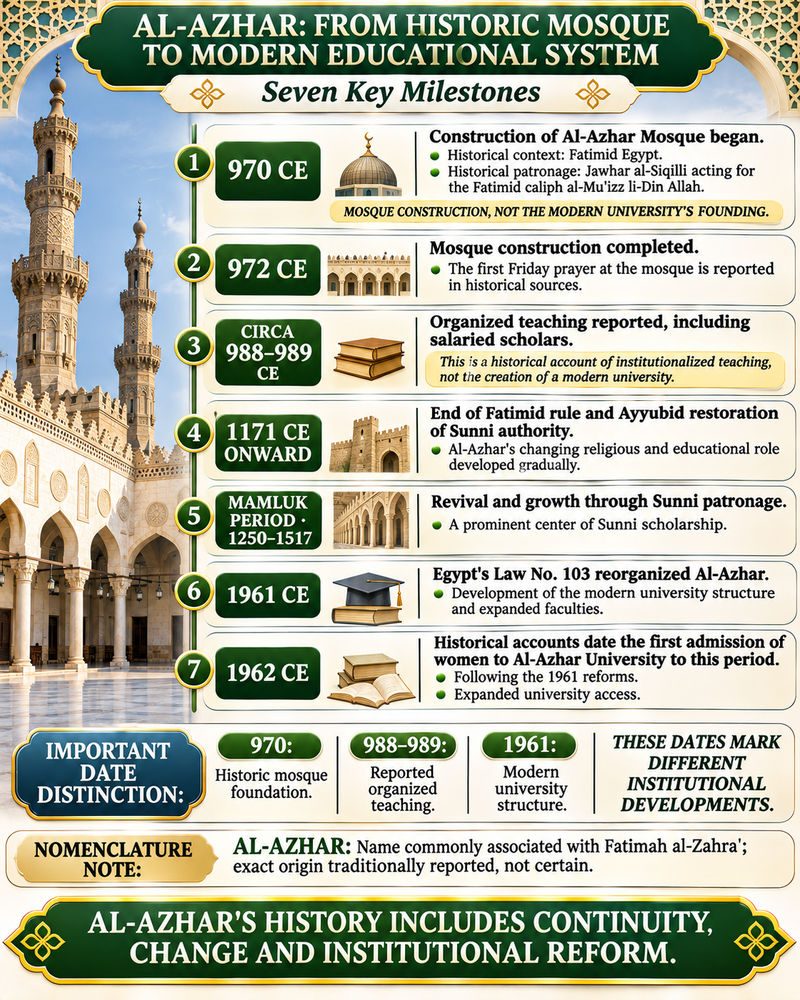
970 CE: Construction began. Sources give 4 April 970 (24 Jumada al-Ula 359 AH).
972 CE: The mosque was completed, and sources report the first Friday prayer in Ramadan 972.
988 to 989 CE: The mosque is generally described as becoming an organised teaching institution, when scholars were reportedly salaried to teach there.
1961: Egypt's Law No. 103 reorganised Al-Azhar and gave the university its modern form.
So "founded in 970" is accurate for the mosque only. It is not accurate for the modern university or the institutes.
Al-Azhar was originally an Ismaili Shi'a institution. Its later identity as a major centre of Sunni learning came through centuries of change, not at its founding. This is simply part of the record, and it explains why Al-Azhar's history is more interesting than a single unbroken story.
The name is usually linked to Fatimah al-Zahra' (the daughter of the Prophet ﷺ, whom the Fatimids revered as an ancestor), since al-Azhar is related to al-Zahra'. This is the commonly reported explanation, but it is an inference and not certain.
How Al-Azhar Became a Major Sunni Centre
Fatimid period (969 to 1171). The mosque served the dynasty's religious and educational aims. Teaching there reflected Ismaili doctrine.
Ayyubid period (from 1171). Salah al-Din (Saladin) ended Fatimid rule and restored Sunni authority in Egypt. Sources report that Al-Azhar lost its role as a main congregational mosque and was deprioritised for a time. The shift was gradual, though, and not a single event that instantly transformed the institution.
Mamluk period (1250 to 1517). Under Sunni Mamluk patronage, Al-Azhar was revived. Rulers and wealthy donors supported its buildings, teachers and students, and it became a prominent centre of Sunni teaching alongside other Cairo institutions.
Ottoman period (1517 to 1798 and after). Al-Azhar remained a leading destination for students from Egypt and beyond. Students were often organised by region or origin into residential and study arrangements called riwaqs. The leadership role of a senior scholar, the Shaykh al-Azhar, also developed in this period.
Modern period. Nineteenth- and twentieth-century reforms introduced examinations, fixed curricula and state oversight. The most sweeping was Law No. 103 of 1961, which restructured the institution, created modern faculties and brought Al-Azhar under closer government involvement. Women were first admitted to the university in 1962.
Period or date | Development | Educational significance |
|---|---|---|
970 to 972 CE | Mosque built under Jawhar al-Siqilli for al-Mu'izz | Established the site, in a Fatimid Ismaili context |
c. 988 to 989 | Organised teaching reported | Beginning of documented scholarly instruction |
1171 onward | Ayyubid restoration of Sunni authority | Period of reduced prominence and changing identity |
Mamluk era | Revival under Sunni patronage | Growth as a Sunni centre of learning |
Ottoman era | Regional student communities and leading scholars | Wider reach and an established scholarly community |
19th to early 20th century | Reforms, examinations, regulations | More formal structure |
1961 | Law No. 103 | Modern university, new faculties |
1962 | Women first admitted | Wider access |
Is Al-Azhar the Oldest University in the World?
It is often described this way, but the claim needs care.
Al-Azhar is best described as one of the world's oldest and most historically significant centres of Islamic higher learning. Whether it is "the oldest university" depends on what you count:
A mosque with a teaching function is not the same as a university in the modern sense.
Organised teaching is not the same as a degree-granting institution.
Educational activity has not been equally intense in every century.
The modern university dates to 1961.
Other institutions have strong claims to being very old as well, including al-Qarawiyyin in Fez. Comparing them mainly shows how loosely "university" is used across periods. There is no need to treat this as a contest. Al-Azhar's importance does not depend on winning it.
Why Al-Azhar Became So Influential
Age alone does not explain Al-Azhar's reputation. Over centuries it built a record in several areas:
Quranic sciences and tafsir, the study of Quranic interpretation.
Arabic language studies, which are essential for understanding the Quran and classical texts.
Fiqh (Islamic jurisprudence) and hadith studies.
Scholarly transmission, in which teachers pass on knowledge, texts and authorisations to students.
A student community that drew people from many regions, who later returned home to teach.
Four traditional terms help make sense of this:
Halaqah (حلقة): a teaching circle in which students gather around a teacher.
Riwaq (رواق): in Al-Azhar's history, a section of the mosque associated with students from a particular region or group, serving as a study and living arrangement. The term has varied by context.
Ijazah (إجازة): an authorisation from a teacher to transmit a text or skill, such as a recitation.
Sanad (سند): the chain of transmission through which something has been passed from teacher to teacher.
Traditional Islamic education has never followed one identical model, and not every Al-Azhar student has received the same kind of authorisation. These historical arrangements are not current universal requirements.
Al-Azhar and the Four Sunni Schools
Al-Azhar's modern scholarly tradition is Sunni and has historically accommodated the four main Sunni schools of jurisprudence (madhhabs): Hanafi, Maliki, Shafi'i and Hanbali.
It helps to keep several terms apart:
Fiqh: Islamic jurisprudence, the study of rulings.
Madhhab: a school of fiqh.
Tajweed: the rules of correct Quran recitation.
Qira'at: the recognised modes of recitation, which are not schools of law.
Aqidah/theology: the study of belief.
A madhhab is not a recitation tradition. A teacher's school of fiqh tells you nothing about which recitation they teach. Nor does every graduate master all four schools, and curricula differ by faculty. Studying recognised differences between scholars is a normal part of Islamic education and is not a sign of weakness. Al-Azhar is an important institution but not the sole authority in Sunni Islam.
What Do Students Actually Study?
It depends on the level, institution, faculty, department, program and period. Possible subjects include:
Quranic studies: recitation, memorisation in some programs, Tajweed, Qira'at in specialist programs, and 'Ulum al-Qur'an (the sciences of the Quran).
Tafsir: interpretation, with linguistic and contextual analysis.
Hadith: the Prophet's traditions, terminology and methods of evaluating transmission.
Fiqh and Usul al-Fiqh: jurisprudence and its principles.
Arabic: nahw (grammar), sarf (morphology), balaghah (rhetoric) and literature.
Al-Azhar University also has faculties outside religious studies. Britannica notes that faculties such as medicine and engineering were added after the 1960s reforms. Academic sources also list agriculture, commerce and others.
This distinction is important. A graduate of a medical or engineering faculty does not automatically hold specialist Quranic qualifications. A graduate in Islamic studies may specialise in something other than recitation instruction. No one should assume every Al-Azhar student completed all of the subjects above.
Levels and Pathways: Why "Studied at Al-Azhar" Needs Clarifying
Several educational backgrounds can all be described as "Al-Azhar":
Pre-university study at an Azhar institute (preparatory and secondary stages).
An undergraduate university degree.
Postgraduate study.
A specialist Quran or Qira'at track.
Traditional lessons with a scholar.
Not every student follows one continuous path from childhood to university. Names of programs and degrees change, so please do not treat the list as a complete map. Ask for the precise qualification.
Educational description | What it may establish | What it does not automatically establish |
|---|---|---|
Completed secondary education at an Al-Azhar institute | Foundation in religious and Arabic studies | A university degree or Quran teaching skill |
Graduated from Al-Azhar University (faculty unspecified) | University-level study | Quranic or recitation specialisation |
Degree in Islamic studies or Arabic | Structured knowledge in the field | Expertise in Tajweed or Qira'at teaching |
Specialist Quranic studies or recitation program | Targeted academic preparation | An Ijazah, Hifz or teaching ability |
Studied with a scholar associated with Al-Azhar | Possible traditional learning | A formal degree, unless stated |
No pathway is universally superior for every Quran teaching role.
Does Every Al-Azhar Student Memorise the Quran?
No, and this is a common assumption. Memorisation has an honoured place in many Islamic educational programs, but requirements differ by stage, faculty, program, admission rules and period. I did not find an authoritative current statement of a single universal requirement, and none should be assumed. Do not assume that every graduate is a Hafiz, or that every student receives an Ijazah.
If a teacher says they have memorised the whole Quran, evaluate that separately from where they studied. These are different things:
Memorising the Quran.
Retaining it accurately over time.
Reciting it with sound Tajweed.
Holding a recitation Ijazah.
Teaching memorisation effectively.
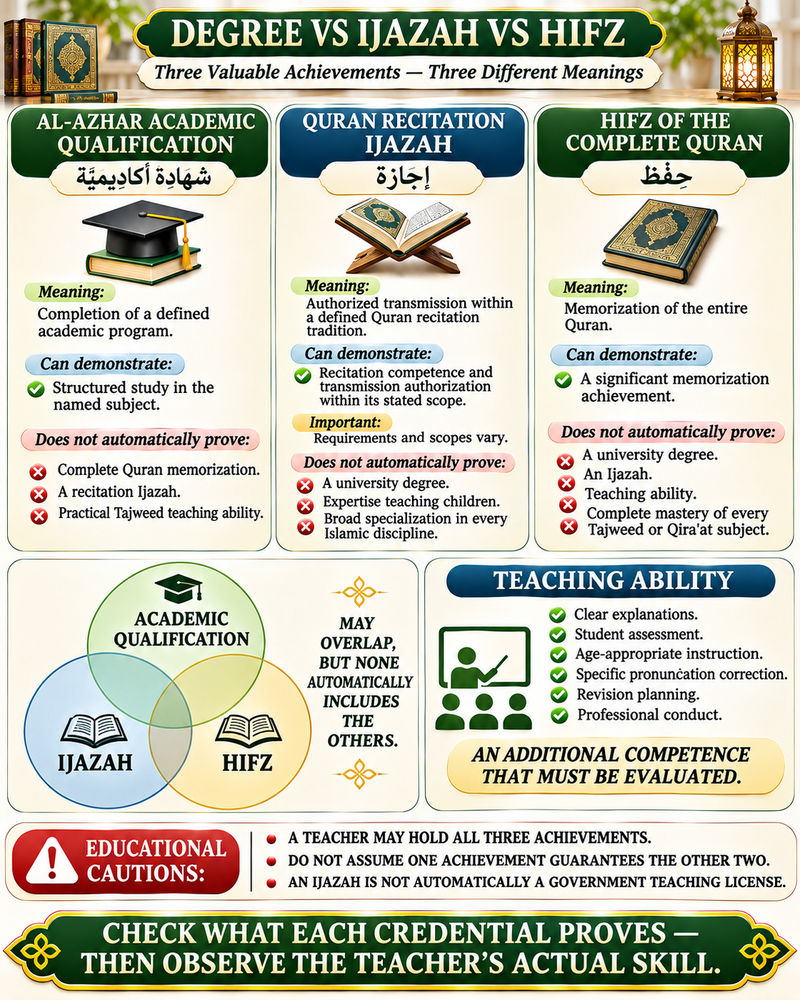
Degree, Ijazah and Hifz Are Three Different Things
An Al-Azhar academic qualification is tied to a specific program, level and specialisation.
An Ijazah (إجازة) is an authorisation within a chain of transmission. A recitation Ijazah usually relates to a particular recitation (for example, Hafs 'an 'Asim) and is granted after the student recites to a qualified teacher. Ijazahs do not all have the same scope or assessment standards, and an Ijazah is not a government teaching licence.
Hifz (حفظ) is memorisation of the Quran. A Hafiz is someone who has memorised all of it.
One person can hold all three, but you should not assume it.
Credential or achievement | What it may demonstrate | What it does not automatically demonstrate |
|---|---|---|
Relevant Al-Azhar degree | Formal study in a field | Recitation skill or teaching ability |
Quran recitation Ijazah | Authorised transmission of a specific recitation | Degree-level study or classroom skill |
Hifz of the entire Quran | Memorisation | Tajweed accuracy or ability to teach |
Tajweed qualification | Knowledge of recitation rules | Experience with beginners or children |
Teaching qualification | Training in pedagogy | Quranic expertise |
Practical teaching experience | Applied teaching record | Formal academic credentials |
Academic qualifications are not irrelevant to traditional scholarship, and traditional authorisations are not inferior to degrees. They serve different purposes.
Al-Azhar and the Science of Recitation
Accurate recitation rests on several connected subjects:
Tajweed: the rules for reciting the Quran correctly.
Makharij al-Huruf: the points of articulation of the Arabic letters.
Sifat al-Huruf: the characteristics of the letters.
Qira'at: the recognised modes of recitation.
Riwayat: specific narrations within them, such as Hafs 'an 'Asim or Warsh 'an Nafi'.
Sanad: the chain through which a recitation is received.
Recognised differences between Qira'at are legitimate and are not mistakes. Specialist programs may teach these subjects systematically, but check which ones a particular program actually covers before assuming it. A scholar of tafsir and a specialist in recitation often have different training. And Al-Azhar is not the only institution preserving authentic recitation traditions.
Why an Al-Azhar Background May Matter
If the program is relevant, an Al-Azhar background may offer several potential strengths. These are possibilities, not guarantees.
Structured Islamic education. A systematic program may give broad exposure to Islamic disciplines and scholarly methods.
Arabic knowledge. Relevant Arabic study may help a teacher explain pronunciation, structure and Quranic vocabulary.
Familiarity with scholarly traditions. A teacher may know recognised sources and methods of interpretation.
Subject-specific expertise. A specialist Quran or recitation qualification may show relevant academic preparation.
Experience of formal learning. Sustained study, assessment and progression can build discipline.
Wider Islamic context. A teacher may be better placed to explain Quranic concepts within a sound educational framework.
An Al-Azhar graduate is not guaranteed to have superior recitation, advanced Tajweed, teaching skill, experience with children, fluent English, understanding of Western Muslim family life, an Ijazah or full memorisation. Qualifications and observable teaching ability both matter.
What an Al-Azhar Qualification Does Not Guarantee
A degree alone does not necessarily establish:
Expertise in every Islamic discipline.
Correct application of every Tajweed rule.
Skill in teaching pronunciation.
Experience with beginners or children.
Clear communication in English.
Competence teaching online.
Patience, professionalism or good safeguarding practice.
Suitability for a particular student.
Subject knowledge and teaching ability are separate skills. Consider two hypothetical teachers:
Teacher A has a relevant Islamic degree and strong scholarly knowledge but limited experience with young non-Arabic-speaking beginners. Teacher B has a verified recitation qualification and years of experience helping young beginners read accurately.
Neither is better in every case. For a six-year-old learning letters, Teacher B's evidence may matter more. For an adult wanting to study Quranic grammar in depth, Teacher A's background may be more relevant. Qualifications should be read against the task at hand. This does not undermine academic degrees. It puts them in context.
Can a Good Quran Teacher Come From Somewhere Other Than Al-Azhar?
Yes. Quranic education has flourished across the Muslim world through many institutions and traditions. A qualified teacher may have studied at:
Other Islamic universities.
Specialist Quran institutes.
Recognised recitation programs.
Traditional study with qualified scholars, with a verified Ijazah.
Teacher training programs.
Al-Azhar has no exclusive authority over Quran education. A teacher educated elsewhere is not less competent for that reason, and nationality is no measure of teaching quality. What matters is accurate recitation, appropriate qualifications, subject expertise, effective teaching, professional conduct and suitability for the learner.
What About Teachers for Western Muslim Families?
A strong scholarly background is valuable, but families in the UK, US, Canada, Australia and Europe have additional practical concerns. Can the teacher:
Explain concepts in a language the student understands?
Teach non-Arabic-speaking beginners?
Correct pronunciation clearly and specifically?
Explain unfamiliar terms?
Adapt to different ages?
Identify the student's starting point?
Communicate respectfully with parents?
Teach well online?
Arabic fluency and English teaching ability are separate skills. Not every Egyptian teacher speaks fluent English, and not every Al-Azhar graduate is familiar with Western school culture. The reverse is also true: many are excellent communicators. Clear communication matters most for young children, new Muslims, adult beginners, students unfamiliar with Arabic and learners correcting long-standing pronunciation habits. A teacher need not share a student's cultural background to teach well.
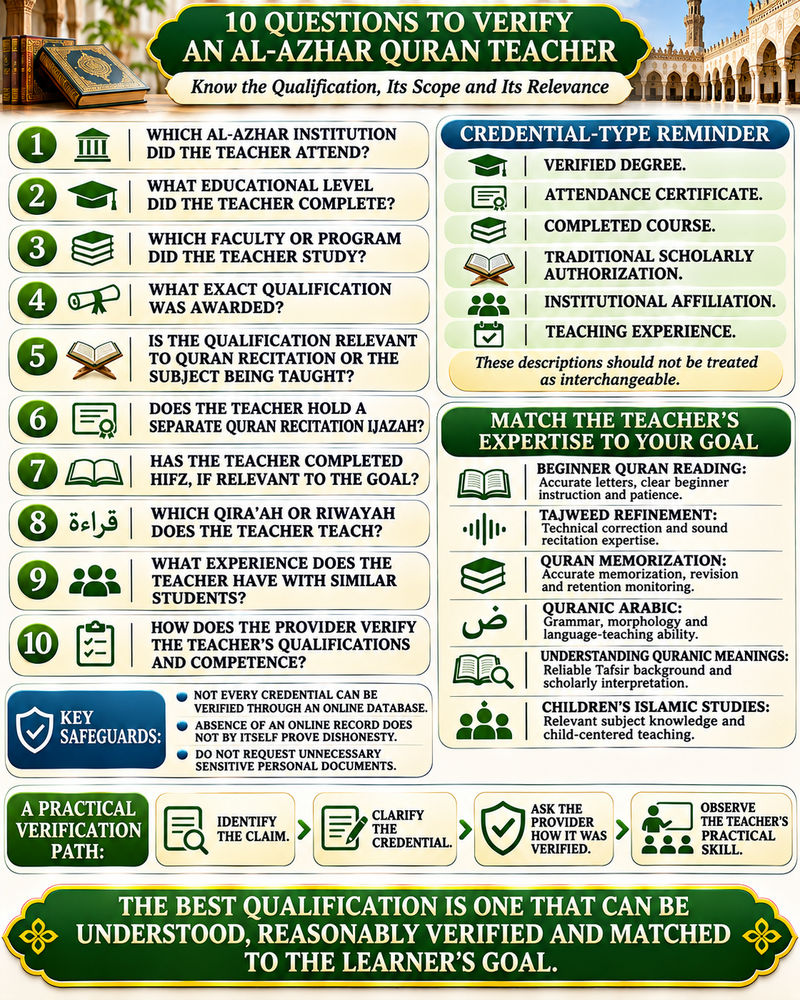
How to Verify an Al-Azhar Teacher's Qualifications
You can ask:
Which Al-Azhar institution did the teacher attend?
What level was completed?
Which faculty or program?
What qualification was awarded?
Is it relevant to Quran recitation or the subject you want?
Does the teacher hold a separate recitation Ijazah?
Has the teacher completed Hifz, if relevant?
Which recitation does the teacher teach?
What experience does the teacher have with similar students?
How does the academy verify qualifications and teaching competence?
Some questions are best answered by the academy and not the individual teacher. It helps to distinguish between:
A verified academic degree.
A certificate of attendance.
A completed course.
A traditional scholarly authorisation.
Institutional affiliation.
Employment history.
Teaching experience.
There is no public Al-Azhar graduate database that I can point you to, and not every qualification can be checked online. Missing online documentation does not prove dishonesty. A reasonable approach is to ask the academy how it verifies credentials and to request appropriate clarification. Parents should not demand unnecessary sensitive personal documents.
Matching Qualifications to Your Goal
Learning goal | Relevant teacher expertise | Additional qualities to evaluate |
|---|---|---|
Learning to read the Quran | Accurate letter pronunciation, foundational reading instruction | Patience, beginner methods |
Improving Tajweed | Sound Tajweed knowledge, ability to hear and correct errors | Clear explanations, specific feedback |
Memorising the Quran | Accurate memorisation, revision methods, retention monitoring | Consistency, structured review |
Learning Quranic Arabic | Grammar, morphology, vocabulary, language-teaching methods | Clear English or student's language |
Understanding meanings | Quranic studies knowledge, reliable tafsir sources | Awareness of interpretive limits |
Islamic studies for children | Appropriate subject knowledge | Age-appropriate, child-centred communication |
One teacher may cover several of these areas, but no teacher should be assumed equally qualified for all of them.
Using a Trial Lesson
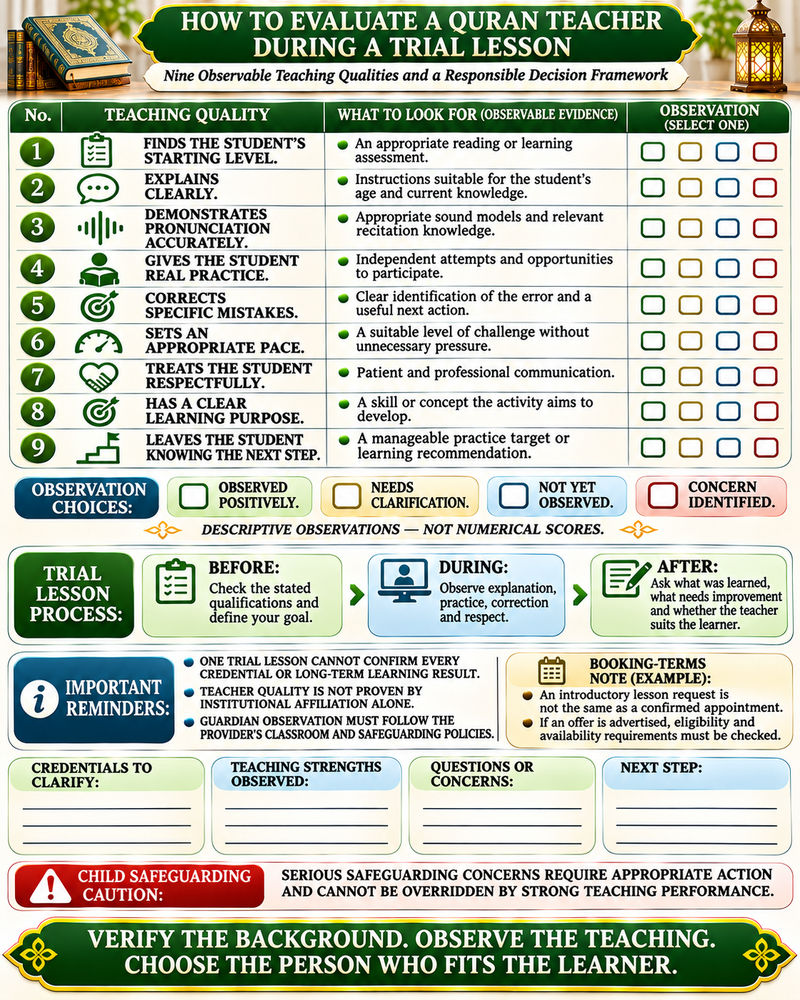
Qualifications are only part of the evidence. A trial lesson can show how a teacher teaches. Consider whether the teacher:
Finds out the student's starting level.
Explains clearly.
Demonstrates pronunciation accurately.
Gives the student real practice.
Corrects mistakes specifically.
Sets an appropriate pace.
Treats the student respectfully.
Has a clear purpose for the lesson.
Leaves the student knowing the next step.
Parents who wish to sit in should follow the academy's policies. One lesson cannot verify every credential or prove long-term effectiveness. For a fuller evaluation framework, see our separate article on what makes a good Quran teacher.
If you are exploring Quran teachers and would like to experience live individualised instruction, Araby Academy offers eligible students up to three free 30-minute trial lessons, subject to availability and applicable booking and confirmation requirements. A trial request does not guarantee a particular teacher, qualification or appointment time, and the three trials are scheduled separately.
The Islamic Importance of Seeking Knowledge
Several texts speak to learning from knowledgeable people. None refers to Al-Azhar, which was founded long after the Prophet ﷺ, and none makes choosing any institution a religious duty.
Quran 20:114: "وَقُل رَّبِّ زِدْنِي عِلْمًا", "And say: My Lord, increase me in knowledge."
Quran 16:43 and 21:7: "فَاسْأَلُوا أَهْلَ الذِّكْرِ إِن كُنتُمْ لَا تَعْلَمُونَ", "Ask the people of the Reminder if you do not know." These verses were revealed in a specific context, concerning questions about earlier prophets and scriptures. Scholars have also drawn from them the broader principle of consulting those who have knowledge.
Hadith (Sahih al-Bukhari): "خَيْرُكُمْ مَنْ تَعَلَّمَ الْقُرْآنَ وَعَلَّمَهُ", "The best of you are those who learn the Quran and teach it" (narrated by 'Uthman ibn 'Affan).
The principle is to learn from people with real knowledge and to teach well. How to apply it to a particular teacher is a matter for careful judgment.
Frequently Asked Questions
What is Al-Azhar?
A historic Egyptian Islamic institution in Cairo that began as a mosque in 970 CE and now includes a university and a network of pre-university institutes.
What is the difference between Al-Azhar Mosque and Al-Azhar University?
The mosque is the historic place of worship and teaching. The university is the modern degree-granting institution, established in its current form by Law No. 103 of 1961. They are related but not the same.
Is Al-Azhar the oldest university in the world?
It is among the oldest and most significant centres of Islamic higher learning, but whether it is "the oldest university" depends on how a university is defined.
Does every Al-Azhar graduate memorise the Quran or hold an Ijazah?
No. Requirements differ by program, and neither should be assumed. Ask the teacher directly.
Are Al-Azhar graduates automatically qualified to teach Quran?
Not automatically. Relevance depends on the program studied, the person's recitation ability and their teaching skill.
Can someone be a qualified Quran teacher without studying at Al-Azhar?
Yes. Many excellent teachers were trained through other institutions, specialist programs or traditional scholarly transmission.
Do all Al-Azhar graduates speak English?
No. Arabic scholarship and English teaching ability are different skills, so check communication in a trial lesson.
How can I verify a teacher's qualifications?
Ask which institution, level, program and qualification, and ask the academy how it verifies credentials. Not every qualification can be verified online.
Conclusion
Al-Azhar's importance comes from more than its age. Its long scholarly history, its Arabic and Islamic scholarship and its role in training generations of students make it a significant institution in Muslim education. An appropriate Al-Azhar qualification can be a meaningful part of evaluating a Quran teacher.
It should not replace that evaluation. Look at the teacher's actual educational background and specialisation, recitation competence, Tajweed knowledge, relevant qualifications, teaching experience, communication and conduct, and whether they suit the learner. Qualified teachers also come from other authentic Islamic educational traditions.
If you would like to see live one-to-one instruction for yourself, Araby Academy offers eligible students up to three free 30-minute trial lessons, subject to availability and applicable eligibility, booking and confirmation requirements. Araby Academy has no official relationship with Al-Azhar, and a trial does not guarantee a teacher with any particular qualification.
A respected educational tradition can provide a strong foundation. The value of a Quran teacher is shown in accurate knowledge, responsible teaching, integrity and the ability to help students learn.