
You are scrolling through your phone and see a beautifully designed image: "The Prophet Muhammad said..." It has thousands of likes and shares. But did the Prophet actually say it? Was it translated accurately? Where was it recorded, and who transmitted it?
The short answer: Muslim Hadith scholars do not judge a report by its popularity or its appeal. They examine the chain of transmission, evaluate each narrator, compare different versions, look for hidden defects, and weigh all of this evidence before giving a judgment. That judgment may be strong, qualified, disputed, or negative. Likes, shares, and elegant design are not evidence.
This guide explains how that process works in the classical Sunni Hadith sciences (Ulum al-Hadith, also called Mustalah al-Hadith). It also shows how ordinary readers can use scholars' conclusions responsibly, without pretending that one article makes anyone a Hadith critic.
What Is a Hadith, and Why Does Authentication Matter?
What is a Hadith in Islam?
A Hadith (حديث) is a report about the Prophet Muhammad ﷺ. It may describe his statements, his actions, his approval of something said or done in front of him, and, in many definitions, his character or physical description. Hadith are transmitted by people, which is why the study of authenticity focuses so heavily on those people.
Sunnah (سنة) is related but not identical. In discussions of Hadith, it often refers to the Prophet's way as reported. In jurisprudence, it may refer to a legal category. In creed or other contexts, its meaning shifts again. Scholars of different disciplines define it with different emphases, so no single definition fits every context.
Four questions are often confused, and they are separate:
Is the report recorded in a collection? Being recorded is not the same as being verified.
Is it judged authentic? This is the focus of Hadith criticism.
Is it interpreted correctly? A genuine report can be misunderstood.
Is it used as evidence in law or theology? This involves further scholarly principles, such as context and the weighing of other evidence.
A report can pass one stage and still require work at the next. For the wider context of the Prophet's life, see the Araby Academy seerah resources on our site.
Why did Muslims develop authentication methods?
Islamic learning spread across regions and generations. Reports passed through many people with different memories, habits, and levels of care. Over time, scholars faced honest mistakes, conflicting versions, and deliberate fabrication.
Early evidence shows scrutiny was already part of the picture. Muslim ibn al-Hajjaj records in the introduction to his Sahih a statement from the early scholar Muhammad ibn Sirin (d. 110 AH): people had not originally asked about chains, but after turmoil arose they began to ask for the names of narrators. Muslim also records Abdullah ibn al-Mubarak's view that the isnad is part of the religion. Reports also describe Companions seeking confirmation of a report before acting on it.
This does not mean a finished science appeared in a single year. Terminology and methods matured over generations. Nor does it mean criticism began only when the major collections were compiled. Both claims would be inaccurate.
Isnad and Matn: The Two Parts of a Report
What is an isnad?
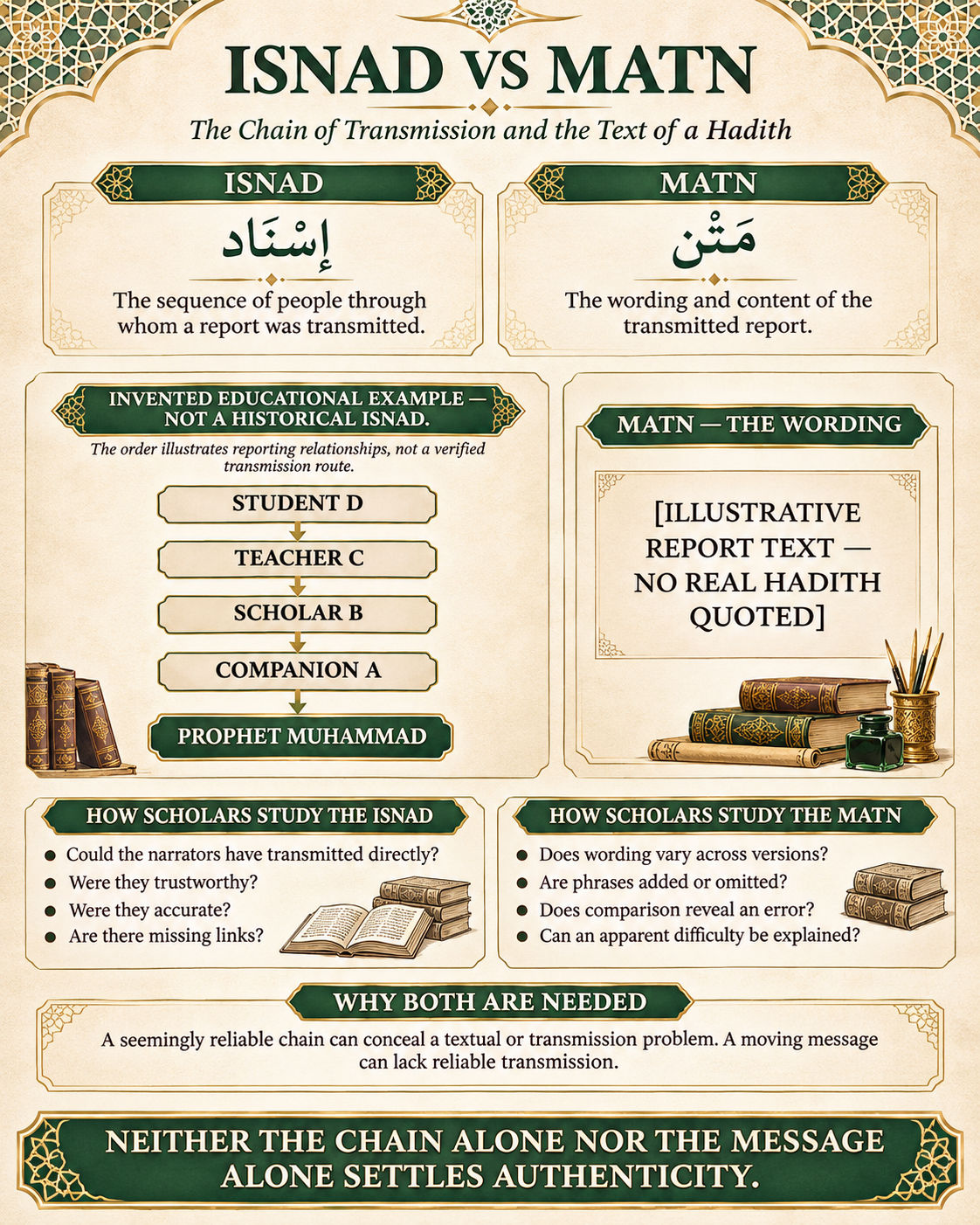
The isnad (إسناد) is the chain of transmission: the sequence of people who passed a report down. The related term sanad (سند) refers to the chain itself or the route it takes. Many scholars use the two terms nearly interchangeably, though some technical contexts distinguish them.
Here is a purely invented educational example, not a historical chain:
Student D reports from Teacher C, who reports from Scholar B, who reports from Companion A, who reports from the Prophet ﷺ.
Scholars ask about every link. Could D have met C? Was C reliable? Did B actually transmit this to C? A list of impressive names proves nothing by itself.
What is the matn?
The matn (متن) is the text of the report: its wording and content. Scholars compare the wording across versions and look for added or omitted phrases. They consider context and consider whether a transmission error may have occurred. They also examine whether a textual difficulty can be explained.
Hadith criticism is therefore not only about chains. But it is also not a license to reject whatever sounds unfamiliar. A surprising meaning does not make a report fabricated, and a pleasant meaning does not make it authentic. Classical criticism of the text is a technical practice based on comparison with stronger evidence, not personal taste.
Why both matter
Consider two general (not real) situations. In one, every narrator in a chain appears reliable, yet comparison with stronger narrations reveals a subtle error in the wording. In the other, the message is moving and plausible, but the transmission history is unreliable. Neither the chain alone nor the message alone settles the question. Scholars weigh the evidence together.
The Five Conditions of a Sahih Hadith
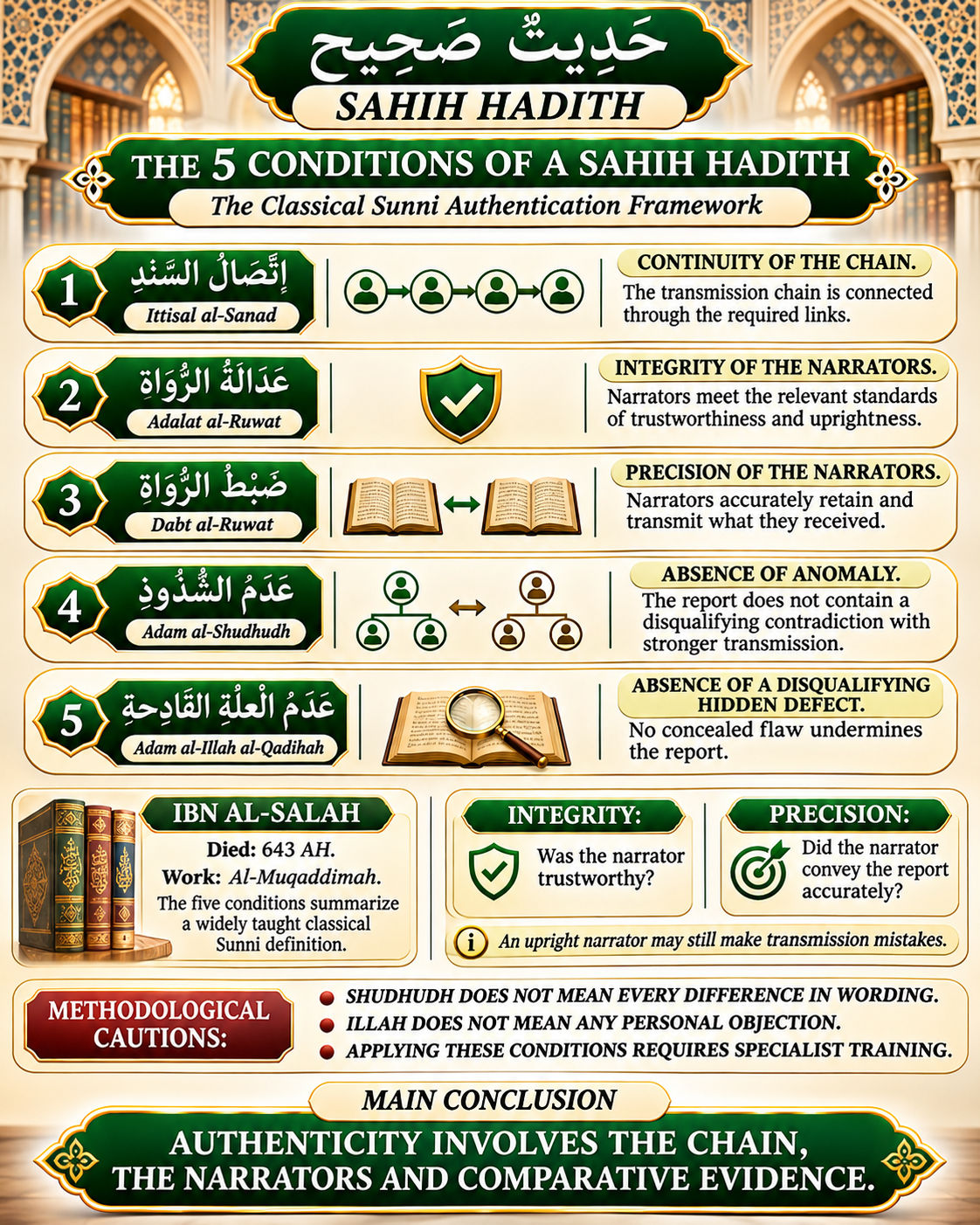
In the classical Sunni framework, Ibn al-Salah (d. 643 AH) in his Muqaddimah defined the Sahih (صحيح) Hadith as one whose chain is connected through reliable, precise narrators from the beginning to the end, without shudhudh or illah. This is commonly taught as five conditions.
Continuity of the chain (اتصال السند, ittisal al-sanad). Each narrator received the report from the one before him.
Integrity of the narrators (عدالة الرواة, adalat al-ruwat). Each is known for religious commitment and trustworthiness, and is not known for lying or flagrant misconduct.
Precision of the narrators (ضبط الرواة, dabt al-ruwat). Each retained and conveyed the report accurately, whether from memory or from written records.
No anomaly (عدم الشذوذ, adam al-shudhudh). The report does not contradict what stronger or more numerous narrators transmitted.
No disqualifying hidden defect (عدم العلة القادحة, adam al-illah al-qadihah). No concealed flaw undermines it.
Several clarifications matter.
Integrity and precision are different. An honest, devout person may still make mistakes in narration. Both qualities are needed.
Shudhudh is technical. It does not mean "any difference in wording." Scholars apply it to specific contradictions between a narrator and others who are more reliable or more numerous.
An illah is not any objection. It is a concealed flaw, often detected only after collecting and comparing routes.
This is not a checklist for readers. The conditions describe the framework, but applying them requires specialist training and access to the full body of narrations and biographical literature.
This is the framework of the Sunni Hadith tradition, and other Islamic communities have their own methods .
How Scholars Investigate Narrators
What is Jarh wa Ta'dil?
Jarh wa Ta'dil (الجرح والتعديل) is the critical evaluation of narrators. Jarh is criticism and ta'dil is endorsement. Scholars assessed narrators for:
integrity and reputation
memory and precision
use of written books
known errors
changes in reliability over time
teachers and students
patterns in what they transmitted
This produced an extensive biographical and critical literature, including Ibn Abi Hatim's al-Jarh wa al-Ta'dil. It is not comparable to a modern criminal background check. The scholars were assessing a person's trustworthiness and accuracy as a transmitter, in the specific context of reporting religious knowledge.
Critics did not always agree. A narrator might be considered reliable by one scholar and criticized by another, because scholars differed in what they had observed, how strictly they assessed memory, and how they weighed different kinds of evidence.
Did two narrators actually meet?
Scholars investigate whether a link is plausible and supported. Relevant evidence includes birth and death dates, places of residence, travel, teacher-student relationships, and the wording of the report. Living in the same century does not prove direct transmission.
Two technical terms help here.
Sama' (سماع): hearing directly from a teacher, often indicated by expressions such as "I heard."
An'anah (عنعنة): reporting with the ambiguous word "an" ("from") without clarifying how the report was received.
The problem of tadlis (تدليس) arises when a narrator conceals a defect in the chain, for example by implying direct hearing when it did not occur. Narrators known for this get closer scrutiny, and scholars classify them by how often and in what ways they did it.
There is no single rule on which every scholar agrees for all cases of an'anah. A well-known example is the discussion in Muslim's introduction. Muslim argued that when two narrators were contemporaries and the narrator is not known for tadlis, their link may be accepted. Other scholars, widely reported to include al-Bukhari and Ali ibn al-Madini, looked for evidence of at least one meeting. The difference in methodology is documented and shows how legitimate disagreement works.
Honest but with a weak memory
A narrator may be completely upright yet weak in retention. Scholars may therefore ask:
Did he narrate from memory or from a reliable book?
Were his mistakes limited to certain periods or certain teachers?
Did his memory change later in life?
How does his transmission compare with that of other narrators?
Such questions lead to nuanced assessments rather than a simple "trustworthy" or "untrustworthy."
Sahih, Hasan, Da'if, and Mawdu'
The main categories
Category | General meaning | Important qualification |
|---|---|---|
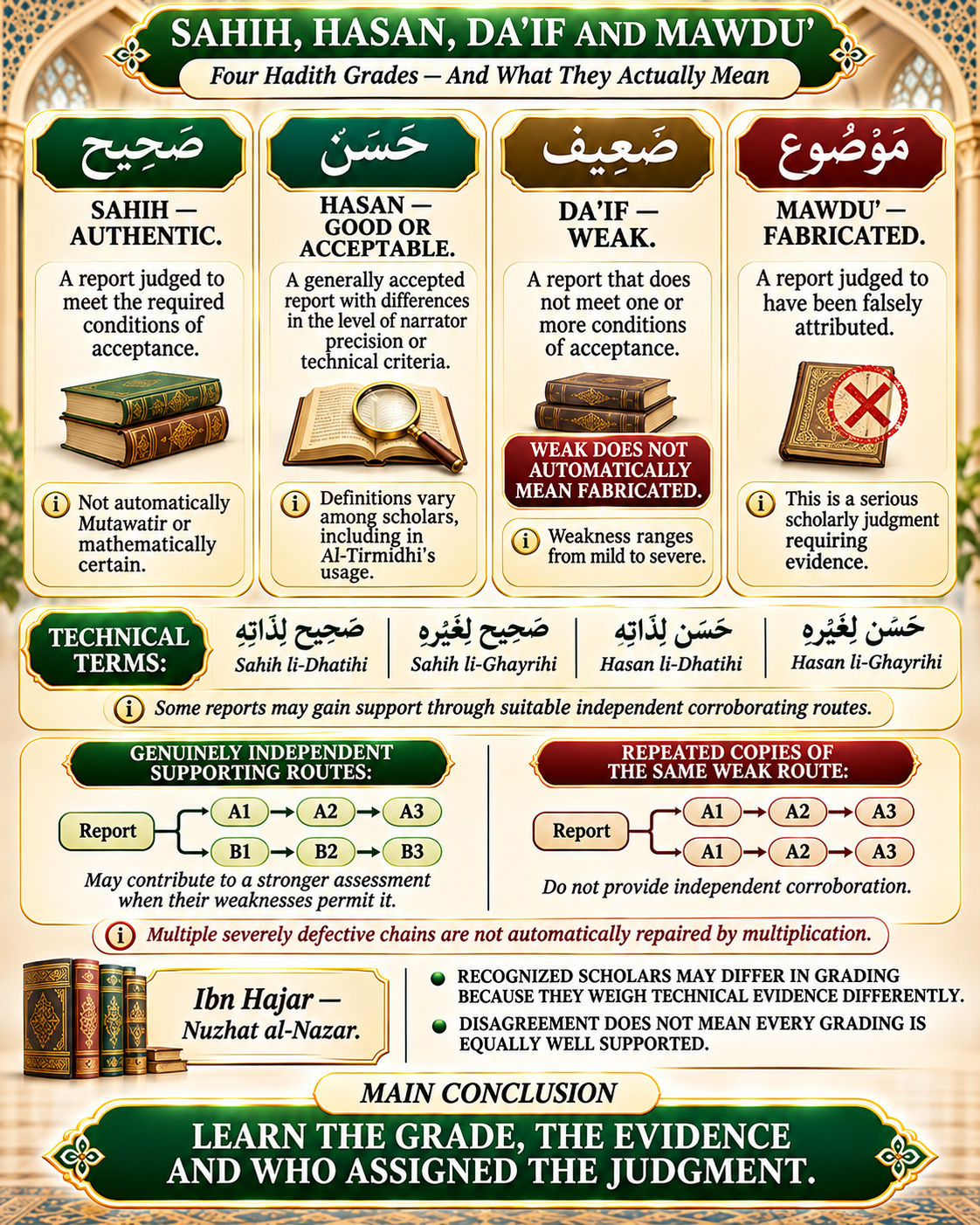
Sahih (صحيح) | Meets the five conditions | Not "100% proven"; a scholarly judgment that the report is reliably established. Many Sahih reports are not mutawatir (transmitted by so many routes that falsehood is ruled out). |
Hasan (حسن) | Close to Sahih, with narrators of somewhat lighter precision | Not simply a Hadith that "sounds good." Definitions vary, including in al-Tirmidhi's usage. |
Da'if (ضعيف) | Lacks one or more conditions of acceptance | Does not mean fabricated. Weakness ranges from mild to severe. |
Mawdu' (موضوع) | Fabricated or falsely attributed | A serious judgment requiring strong evidence. |
Scholars also use terms such as Sahih li-dhatihi (authentic in itself), Sahih li-ghayrihi (authentic through support), Hasan li-dhatihi, and Hasan li-ghayrihi. In Ibn Hajar's presentation in Nuzhat al-Nazar, a Hasan report that is supported by other routes may be raised in rank. A weak report whose weakness is mild may also be strengthened by other routes.
This does not mean that any number of weak chains automatically produces a stronger report. The nature of the weakness matters. A narrator accused of lying cannot generally be repaired by adding more such chains, and repeated copies of the same chain are not independent evidence.
Does "weak" mean the Prophet never said it?
Not necessarily. Three situations should be kept apart:
Insufficient evidence to establish attribution to the Prophet.
Evidence suggesting fabrication.
Rejection for a specific technical weakness, such as a break in the chain or a narrator's poor memory.
A weak grading means the evidence does not meet the standard to attribute the words to the Prophet with confidence. It is not automatically a historical finding that the event never occurred. Likewise, a morally beautiful message does not establish that the Prophet said it. This is why careful wording matters: "this has not been established as a Hadith" is different from "this is a lie."
Can scholars disagree about authenticity?
Yes. Recognized specialists may differ because of:
different assessments of narrators
access to different transmission routes
different readings of technical evidence
different evaluations of a possible hidden defect
different weighing of corroborating routes
differing methodological judgments
Disagreement does not mean there are no standards. Nor does it mean every position is equally well supported, or that a reader may simply choose whichever grade they prefer. It means the evidence has to be weighed by someone qualified to do so.
How Scholars Compare Reports
Why multiple narrations matter
Collecting all the routes of a report reveals which narrators agree, who added wording, who left something out, and who made a mistake. Two technical terms matter:
Mutaba'at (متابعات, singular mutaba'ah): another narrator who reports the same report from the same source as the narrator under examination, or from a higher point in the chain.
Shawahid (شواهد, singular shahid): a report through a different Companion with the same or similar meaning.
Some scholars use these terms with slightly different emphases, and the details are technical. The key idea is that corroboration can support a report when the routes are genuinely independent and their weaknesses are of a kind that support can address. Repeated publication of the same report, or chains that all depend on one weak narrator, do not count as independent routes.
What is a hidden defect (illah)?
An illah (علة) is a concealed flaw in a report that appears sound on the surface. Detecting it can require extensive comparison and expert judgment. Examples discussed in classical works include:
a chain that appears connected but is better transmitted as disconnected
a statement attributed to the Prophet that stronger evidence attributes to a Companion
a narrator mixing two reports together
Dedicated works on this subject, such as the Ilal of Ibn Abi Hatim and the Ilal of al-Daraqutni, record such cases. This is why a chain that looks fine at first glance may still need further examination, and why one cannot assess it simply by reading names.
Is it only about the chain?
No. Scholars evaluate chain and text, and compare reports against stronger evidence and established transmission patterns. This differs from modern personal plausibility judgments ("this sounds wrong to me"), which are not the same as classical Hadith criticism. It is also important to separate:
Authenticity (is it established?)
Interpretation (what does it mean?)
Legal application (how is it used?)
Historical context (what situation did it address?)
The Major Collections
Sahih al-Bukhari and Sahih Muslim
Sahih al-Bukhari was compiled by Muhammad ibn Isma'il al-Bukhari (d. 256 AH). Sahih Muslim was compiled by Muslim ibn al-Hajjaj (d. 261 AH). Both set out to include reports they judged authentic, and both are especially highly regarded in Sunni scholarship. Their reputation rests on strict selection, close study of narrators, and the later acceptance of their work by the scholarly community.
Three clarifications are important.
Their status is not that of the Quran. The Quran is revelation preserved with a unique, continuous transmission; the collections are human scholarly works compiling Prophetic reports. (For the Quran's preservation, see Araby Academy's resources on the topic.)
Other collections are not "all weak." Many contain authentic material.
Scholars have discussed a limited number of narrations in the two books, for example al-Daraqutni's critiques, and later scholars such as Ibn Hajar responded to many of them. This is part of normal scholarly engagement and does not reduce the books' overall standing in the tradition.
Abu Dawud, al-Tirmidhi, al-Nasa'i, and Ibn Majah
These four Sunan collections, together with the two Sahihs, are often called the "Six Books." Their compilers were Abu Dawud (d. 275 AH), al-Tirmidhi (d. 279 AH), al-Nasa'i (d. 303 AH), and Ibn Majah (d. 273 AH).
Their purposes and inclusion criteria differ. Many focus on reports relevant to legal rulings. Some compilers comment on their narrations, such as al-Tirmidhi's frequent use of "hasan," "sahih," and "gharib," or Abu Dawud's discussion of his approach in his letter to the people of Mecca. But finding a report in one of these books does not automatically establish that it is authentic. They include reports of varying strength, and later scholars have graded them individually.
Are all Muslims using the same collections?
No. The Sunni and Shia traditions have different major Hadith collections and approaches to evaluating transmission. Shia scholarship, for example, relies on works such as al-Kafi and has its own biographical and evaluative traditions. This article explains the Sunni Hadith sciences framework and does not claim to summarize every school's method. Differences in methodology are a matter of scholarship and should be discussed with respect.
Three Examples of Hadith Evaluation
Example 1: A widely accepted authentic Hadith
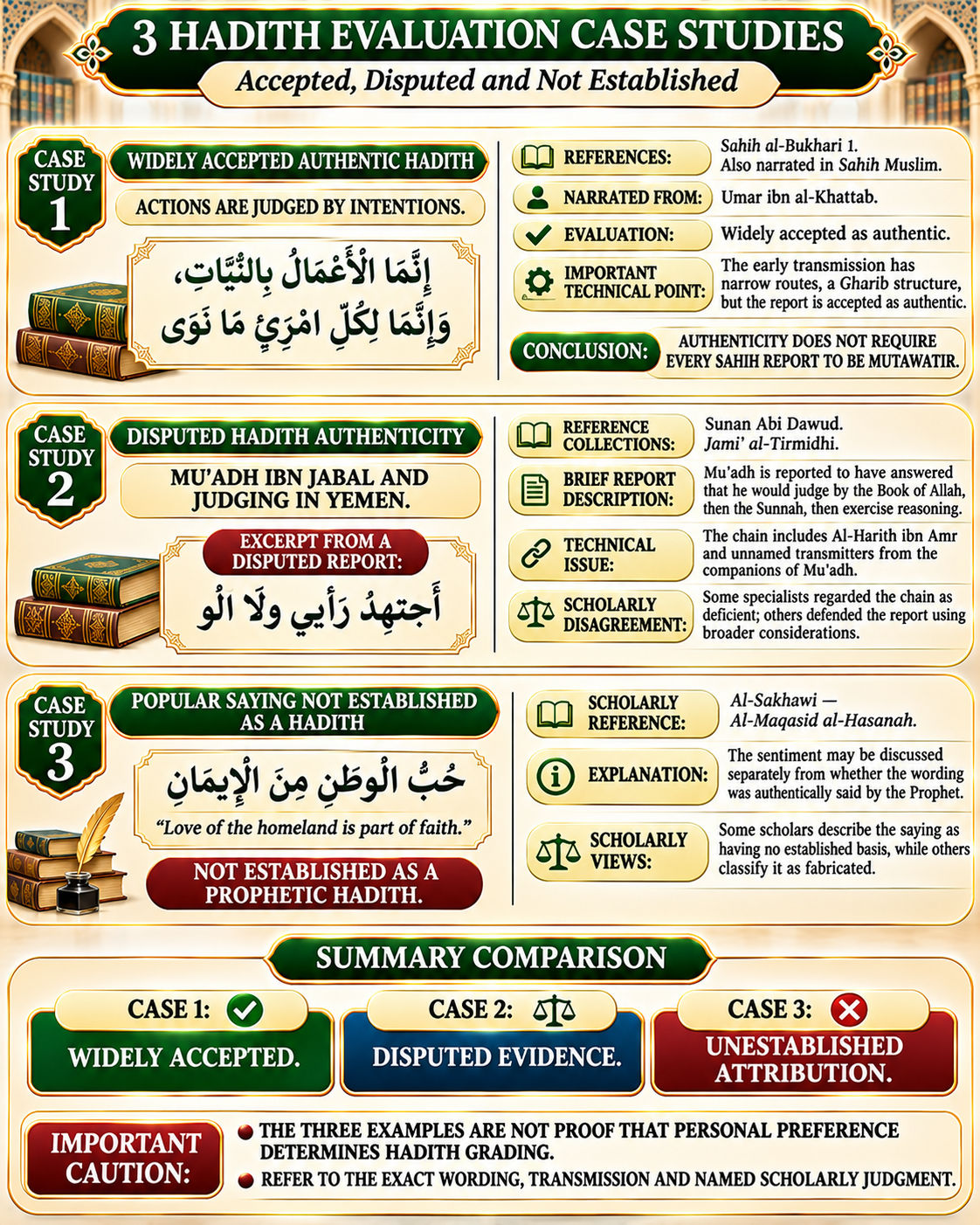
The Hadith "Actions are judged by intentions" (إنما الأعمال بالنيات، وإنما لكل امرئ ما نوى) is narrated by Umar ibn al-Khattab. It is the first report in Sahih al-Bukhari and is also in Sahih Muslim (reference numbers vary slightly between editions).
Its transmission is well discussed: in the early layers it comes through a single narrator at each level, and it became widely narrated only from later narrators. Scholars call this structure gharib in the technical sense. Yet it is among the most widely accepted reports in the tradition.
This example shows that authenticity is not the same as being mutawatir, and that a report with a narrow early transmission can be firmly accepted when scholars judge the chain reliable and the community receives it.
Example 2: A report with disputed authenticity
The report of Mu'adh ibn Jabal being sent to Yemen, asked how he would judge, and answering that he would use the Book of God, then the Sunnah, and then "I will exercise my own reasoning" (أجتهد رأيي ولا آلو), is recorded by Abu Dawud and al-Tirmidhi. The issue lies in its chain: it passes through al-Harith ibn Amr and then "some men of Homs from the companions of Mu'adh," whose names are not given.
Scholars have assessed it differently. Al-Bukhari remarked that it was not established. Al-Tirmidhi noted that its chain was not connected in his view. Ibn Hazm rejected it, and later graders such as al-Albani classified it as weak. On the other hand, al-Khatib al-Baghdadi and Ibn al-Qayyim defended it, partly because of its acceptance among jurists and the standing of Mu'adh's students.
The disagreement exists because the chain contains narrators who are unnamed or little known, and scholars weigh that differently. It also shows that a legal principle, such as the use of reasoned judgment, does not rest on one report alone.
Example 3: A popular saying without a sound basis
"Love of the homeland is part of faith" (حب الوطن من الإيمان) is widely quoted as a Hadith. Scholars who compiled popular sayings, such as al-Sakhawi in al-Maqasid al-Hasanah, did not find an established source for it, and later specialists have described it as having no basis as a Prophetic report, with some grading it fabricated.
Notice the careful distinction. Some scholars have noted that the meaning may be understood in a sound way, but that does not make it a Hadith. A statement lacking a verified source is not automatically the same as a proven fabrication, but it cannot be attributed to the Prophet. Popularity, a pleasant meaning, and common repetition do not establish authenticity.
How Ordinary Muslims Can Check a Hadith
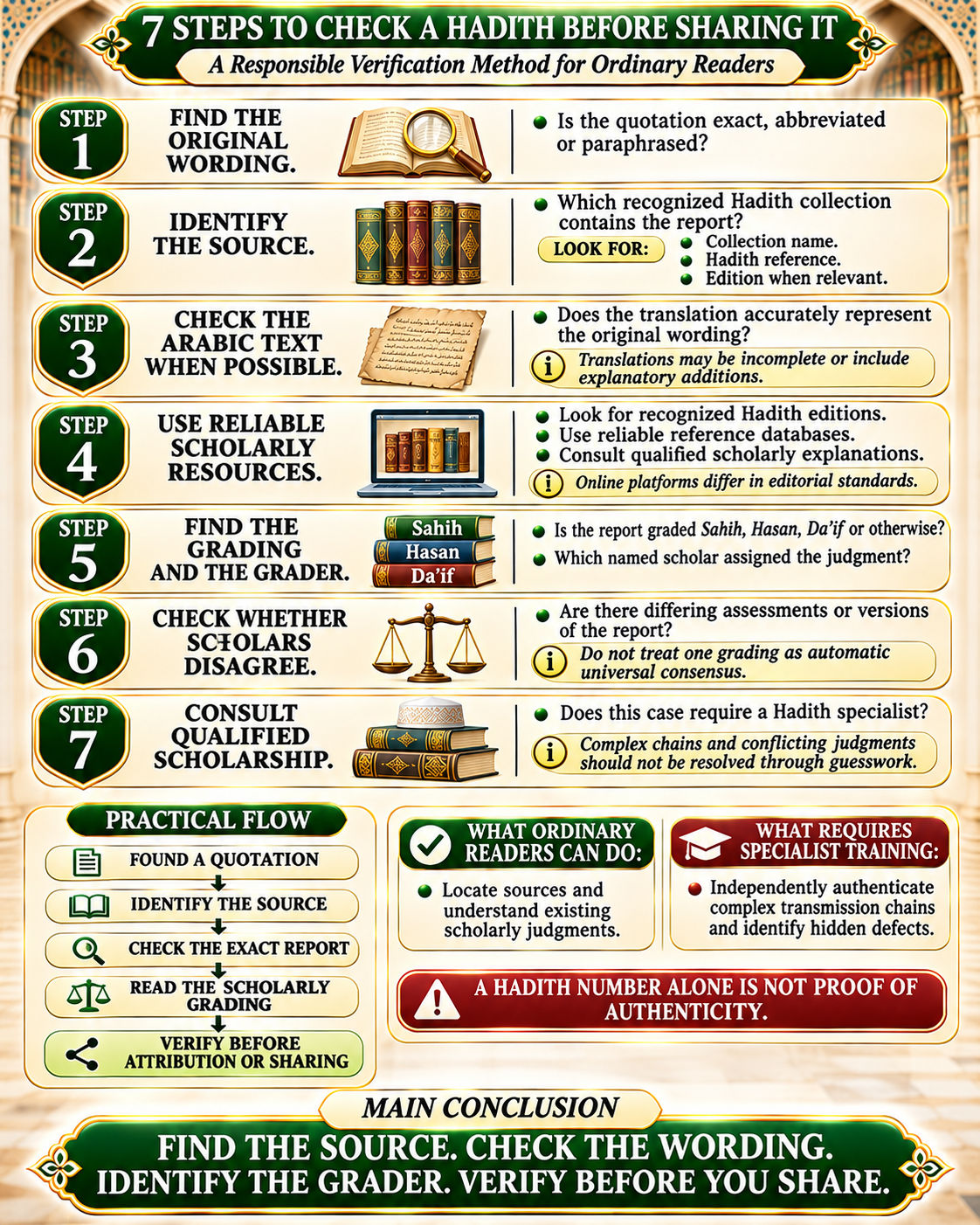
A practical seven-step method
Find the original wording. Is the quotation exact, abbreviated, or paraphrased?
Identify the source. Look for a recognized collection and a specific reference.
Check the Arabic when possible. Translations can shift meaning or add words.
Use a reliable database or scholarly edition. Online databases differ in editorial standards and grading approach.
Read the grading and who assigned it. A grade without a named scholar is weak information.
Check whether scholars disagree. Do not treat one grading as a universal consensus.
Consult qualified scholarship for difficult cases. If the chain is complex or gradings conflict, a specialist is needed.
None of this means you should try to grade complex chains yourself after one introductory article. The aim is to find and understand the judgments of qualified scholars.
Verifying Hadith shared on social media
Warning signs include:
no source or reference
a vague claim such as "reported in Hadith"
an unusually dramatic promise or threat
no Arabic text
an apparently misleading translation
an image with a quotation and no verification
These are reasons to investigate, not proof of fabrication. A source number alone does not establish authenticity either, because numbers can be wrong or point to a weak report. Until you have checked, avoid attributing the words confidently to the Prophet.
When two websites give different grades
Reasons include:
different scholars' assessments
different transmission routes of similar reports
different editions
database errors
confusion between similar narrations
different terminology
Check the exact Arabic text and the named scholar behind each grade. Do not choose the one that fits your preference.
Frequently Asked Questions
How do Muslims know if a Hadith is authentic?
Scholars examine the chain, the reliability and precision of each narrator, the connection between them, the text, other versions, and possible hidden defects, then assign a judgment.
What are the five conditions of a Sahih Hadith?
Continuous chain, narrator integrity, narrator precision, absence of anomaly (shudhudh), and absence of a disqualifying hidden defect (illah).
What is the difference between isnad and matn?
The isnad is the chain of narrators. The matn is the text of the report.
Does da'if mean fabricated?
No. A weak report fails to meet the conditions of acceptance, in degrees. A fabricated report (mawdu') is a far more serious judgment.
Are all Hadith in Sahih al-Bukhari authentic?
The book is regarded as the most authentic after the Quran in the Sunni tradition, and the scholarly community has accepted it very widely. Scholars have discussed a small number of narrations, and the tradition has its own responses to those discussions.
Can a Hadith have a strong chain but a hidden defect?
Yes. That is the idea of illah: a flaw that only emerges through comparison of routes and expert analysis.
Why do some websites give different grades?
Because scholars may differ, editions and routes may differ, and databases may contain errors. Look for the named grader and the Arabic text.
What is Jarh wa Ta'dil?
The scholarly evaluation of narrators, covering both integrity and precision.
Conclusion
Hadith authenticity is not decided by popularity, attractive wording, or the mere presence of a source number. Recognized scholarship weighs transmission chains, narrator reliability, continuity, precision, textual comparison, hidden defects, and corroborating evidence. The result can be strong, qualified, disputed, or negative, and that range of judgments reflects the care of the discipline, not a flaw in it.
For readers, the practical lesson is simple: verify before you share, rely on credible sources, learn the scholarly context, and approach the topic with humility. A Hadith deserves to be quoted only when we know where it comes from.
If you would like to study Islam and Arabic with structure and guidance, Araby Academy offers live one-to-one Islamic studies and Arabic language lessons.