You have been asking for the same thing for a long time. Perhaps it is healing for someone you love, relief from a heavy burden, or guidance about your future. Then a quiet thought arrives: Allah already knows what I need. He knew before I asked. So why am I still asking?
This is a sincere theological question, not a sign of weak faith. Many believers carry it in silence.
We do not make dua to inform Allah of something He does not know. Dua is an act of worship. It is a way of turning to Him, acknowledging our need, seeking His help, and acting within the relationship between divine decree and the means He has placed in the world. Allah's complete knowledge and our asking do not contradict each other. Nothing in this article promises that a particular request will be granted in the form we hope for.
Quranic translations follow Sahih International. Hadith numbers follow the standard collections and may differ slightly between editions.
Does Allah Already Know What We Need?
Yes. The Quran affirms that Allah's knowledge encompasses everything: what we say, what we hide, and what has not yet happened.
وَإِن تَجْهَرْ بِالْقَوْلِ فَإِنَّهُ يَعْلَمُ السِّرَّ وَأَخْفَى
"And if you speak aloud, then indeed, He knows the secret and what is [even more] hidden." (Quran 20:7)
وَلَقَدْ خَلَقْنَا الْإِنسَانَ وَنَعْلَمُ مَا تُوَسْوِسُ بِهِ نَفْسُهُ ۖ وَنَحْنُ أَقْرَبُ إِلَيْهِ مِنْ حَبْلِ الْوَرِيدِ
"And We have already created man and know what his soul whispers to him, and We are closer to him than [his] jugular vein." (Quran 50:16)
Another verse says that not a leaf falls without His knowledge (Quran 6:59). Islamic theology affirms this without asking how divine knowledge works, since we have no access to that. We affirm what revelation tells us and stop there.
Here is the key point. If knowing our need made asking pointless, Allah would not have told us to ask. Yet He repeatedly commands and invites supplication while knowing everything. So knowing a need and inviting someone to ask are not contradictory. Asking must serve a purpose other than information transfer.
Dua Is Not Giving Allah Information
Consider a limited human analogy. A parent may know exactly what their child needs, yet the child's request still matters. It expresses trust, dependence, and relationship.
This analogy has limits, and it should be held loosely. Allah does not gain knowledge, emotional satisfaction, or benefit from our requests as a parent might. He is free of need, and we are the needy ones:
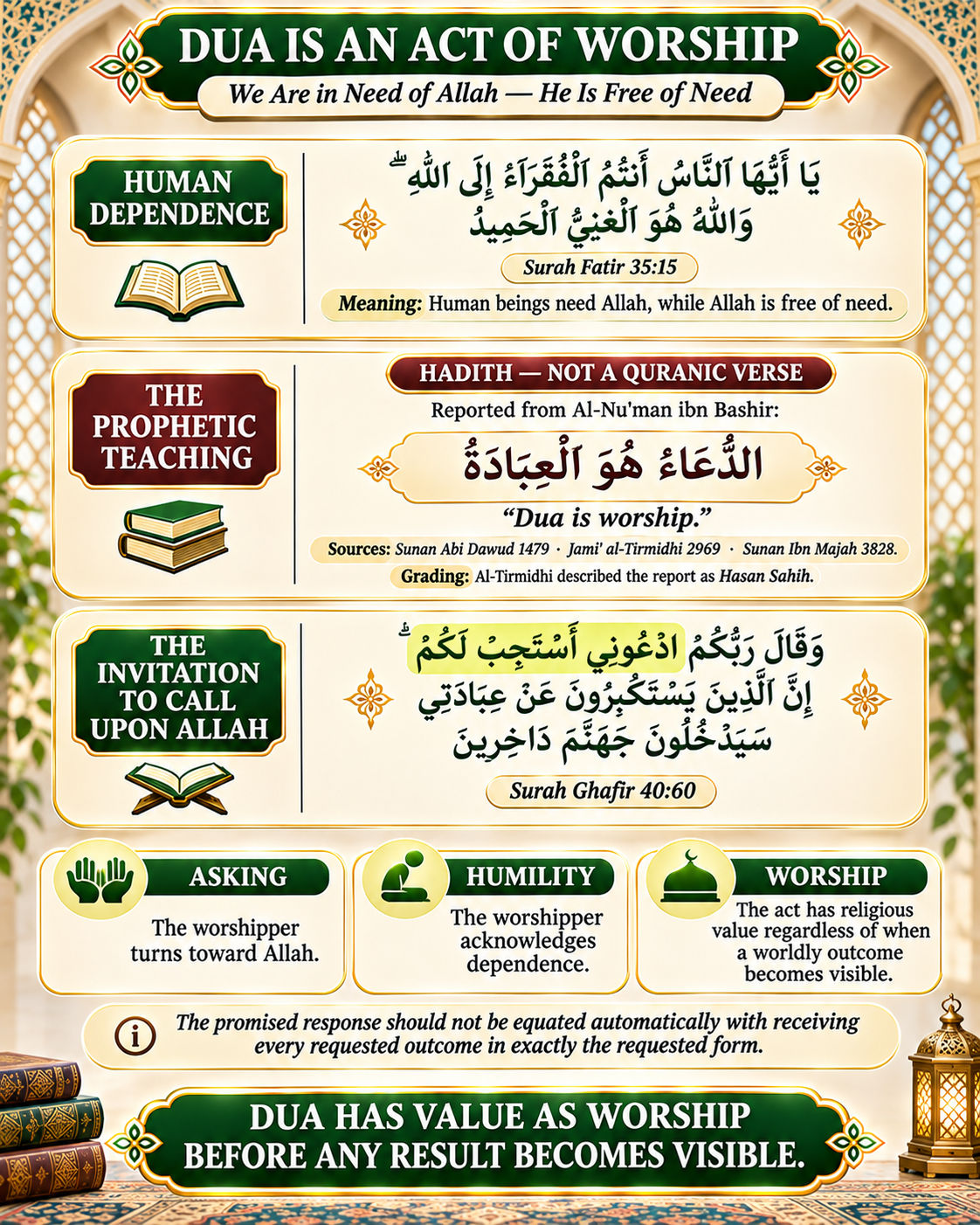
يَا أَيُّهَا النَّاسُ أَنتُمُ الْفُقَرَاءُ إِلَى اللَّهِ ۖ وَاللَّهُ هُوَ الْغَنِيُّ الْحَمِيدُ
"O mankind, you are those in need of Allah, while Allah is the Free of need, the Praiseworthy." (Quran 35:15)
So the purpose of dua cannot be derived from analogy alone. It has to be understood through revelation, which tells us what dua is. Asking acknowledges that we are creatures who depend on our Lord, and that He alone can give, withhold, heal, and guide. The benefit of that acknowledgment returns to us.
Why Is Dua an Act of Worship?
"Dua Is Worship"
The Prophet ﷺ said:
الدُّعَاءُ هُوَ الْعِبَادَةُ
"Dua is worship."
He then recited Quran 40:60. The report is from al-Nu'man ibn Bashir, in Sunan Abi Dawud (1479), Jami' al-Tirmidhi (2969), and Sunan Ibn Majah (3828). Al-Tirmidhi graded it hasan sahih.
Here is the verse:
وَقَالَ رَبُّكُمُ ادْعُونِي أَسْتَجِبْ لَكُمْ ۚ إِنَّ الَّذِينَ يَسْتَكْبِرُونَ عَنْ عِبَادَتِي سَيَدْخُلُونَ جَهَنَّمَ دَاخِرِينَ
"And your Lord says, 'Call upon Me; I will respond to you. Indeed, those who disdain My worship will enter Hell [rendered] contemptible.'" (Quran 40:60)
Commentators connect "My worship" in the verse with supplication, and the hadith supports that link. Refusing to ask out of pride is treated as a serious matter. Humbly asking, by contrast, is worship in itself.
What Dua Expresses
Dua carries a cluster of meanings that no other act expresses in quite the same way:
Humility: we admit we are not self-sufficient.
Dependence: we turn to the One who is able.
Hope: we believe He is generous and merciful.
Recognition of limits: we cannot control outcomes.
Trust: we place our affairs with Him.
Gratitude: we praise Him for what we already have.
This means dua has value even before any answer is visible. A person who says "My Lord, I am in need" has already done something of religious worth, whatever the outcome.
Two Senses of Dua
Scholars, including Ibn Taymiyyah and Ibn al-Qayyim, describe two overlapping senses of du'a' in the Quran. Du'a' al-mas'ala (دعاء المسألة) is supplication involving requests. Du'a' al-'ibada (دعاء العبادة) is dua in the wider sense of worship: praising, glorifying, and devoting oneself to Allah. Every request is also an act of devotion, and not every act of devotion is a request. This is why dua can be meaningful even when the requested outcome remains uncertain.
Why Does Allah Tell Us to Call Upon Him?
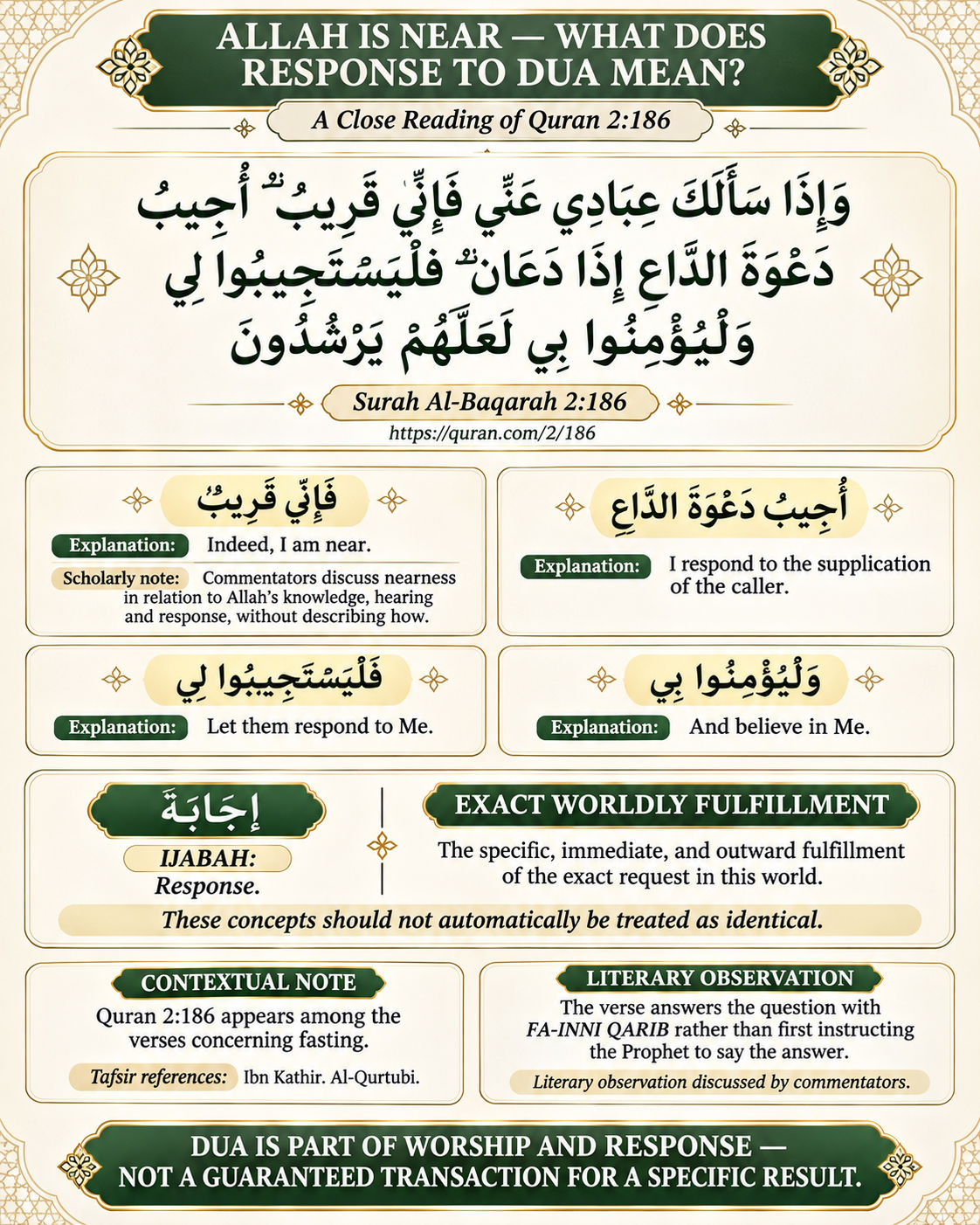
وَإِذَا سَأَلَكَ عِبَادِي عَنِّي فَإِنِّي قَرِيبٌ ۖ أُجِيبُ دَعْوَةَ الدَّاعِ إِذَا دَعَانِ ۖ فَلْيَسْتَجِيبُوا لِي وَلْيُؤْمِنُوا بِي لَعَلَّهُمْ يَرْشُدُونَ
"And when My servants ask you concerning Me, indeed I am near. I respond to the invocation of the supplicant when he calls upon Me. So let them respond to Me and believe in Me that they may be [rightly] guided." (Quran 2:186)
Many commentators note that, unlike similar verses, this one does not begin its answer with "Say." Allah replies directly: "I am near." It sits among the verses on fasting (2:183 to 187), and Ibn Kathir understands this placement as pointing to the value of supplication there. Commentators generally understand nearness here as nearness in knowledge, hearing, and response, without asking how.
The verse does two things. It promises response, and it asks for a response in return: obedience and faith, "that they may be guided." Dua sits inside a relationship, not a transaction.
What does "respond" mean? Quran 40:60 says "I will respond to you." Scholars, including al-Qurtubi, distinguish between the response (ijaba) and the exact fulfillment of what was asked. Allah's response is real. Its form belongs to His wisdom, which is why the Prophet ﷺ described several forms of response, discussed below. Nothing in these verses promises that every request will materialize exactly as imagined.
If Everything Is Decreed, Can Dua Make a Difference?
Knowledge, Decree, and Means
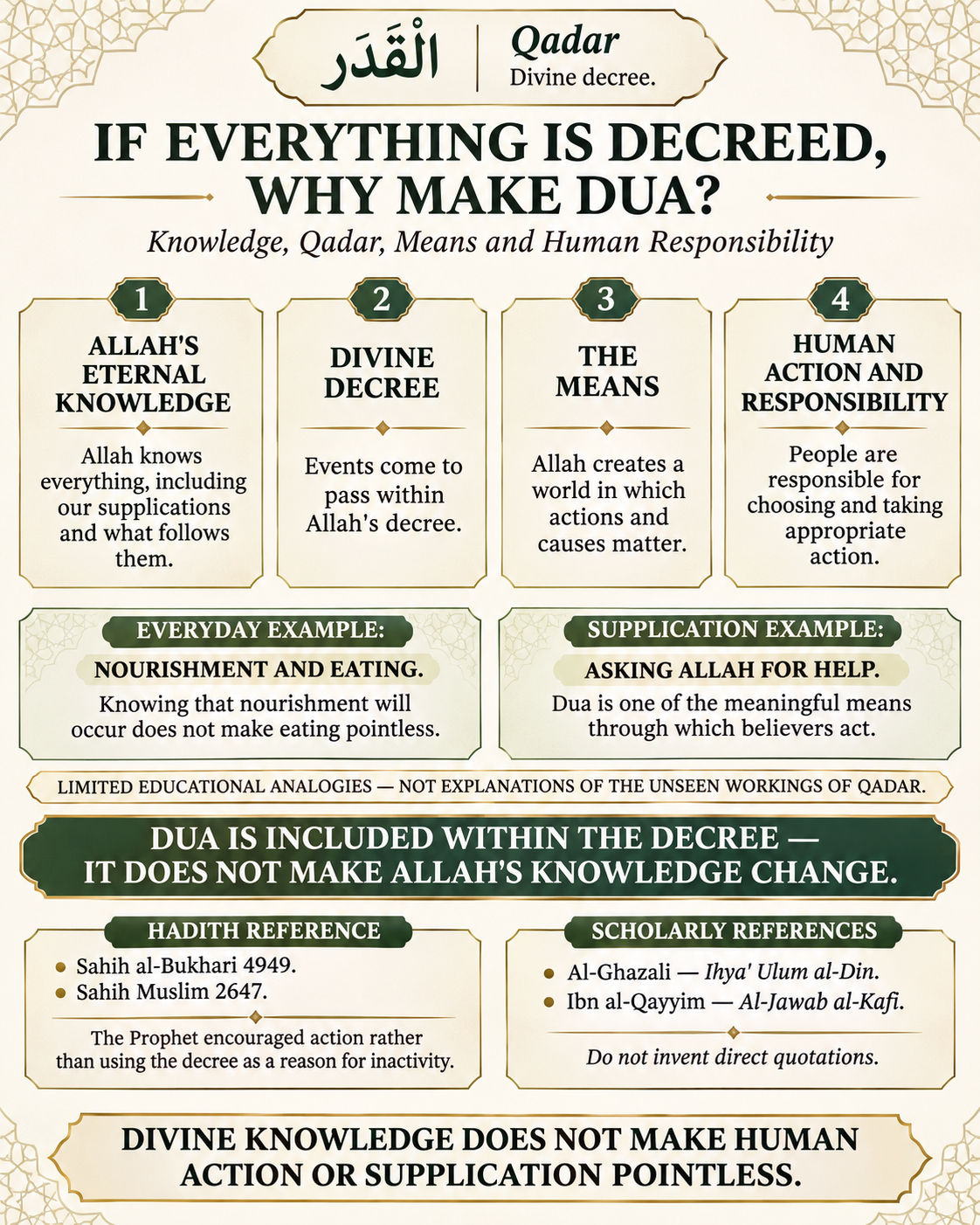
Qadar (القَدَر) is divine decree. Islamic theology distinguishes between:
Allah's eternal knowledge, which includes everything, including our dua and its response.
The decree, by which events come to pass.
The means, the causes through which Allah brings events about.
Human action and responsibility, which are real.
Dua belongs among the means. Allah's knowing that you will be nourished does not make eating pointless, because eating is part of how nourishment happens. Likewise, Allah knowing what will occur does not make asking pointless, because asking is part of what occurs.
This analogy illustrates the relationship between means and outcomes. It does not explain the unseen workings of Qadar. And it does not make dua a lever that gives us control over destiny. Divine decree is not an impersonal machine. It is the decree of a Lord who is near, hears, and responds.
The Companions raised a similar objection. They asked whether they should rely on what is written and stop acting. The Prophet ﷺ replied that everyone is facilitated for what he was created for, so they should act (Sahih al-Bukhari 4949, Sahih Muslim 2647). The reply does not dismiss the question. It redirects it toward action, and asking is one such action.
Al-Ghazali, in the Ihya', and Ibn al-Qayyim, in al-Jawab al-Kafi, both address the objection "what use is dua if the decree is fixed?" Their answers are broadly the same: dua is itself one of the causes Allah has decreed.
Does Dua Change Destiny?
A frequently quoted narration reads:
لَا يَرُدُّ الْقَضَاءَ إِلَّا الدُّعَاءُ، وَلَا يَزِيدُ فِي الْعُمُرِ إِلَّا الْبِرُّ
"Nothing repels the decree except dua, and nothing increases lifespan except righteousness."
Al-Tirmidhi records it from Salman al-Farisi (2139), with wording that varies between al-qada' and al-qadar across reports, and a related report appears in Ibn Majah. Al-Tirmidhi described it as gharib (reported through a single route). Later hadith scholars disagree on its strength. Some, such as al-Albani, graded it hasan, and others questioned its chain. For that reason, this article does not build its argument on it. The core claims here rest on the Quran and on better-attested hadith.
Scholars who accept the narration explain it in several ways, and these are later theological explanations, not words of the narration itself. Some distinguish Allah's eternal, unchanging knowledge from what is recorded in books known to the angels, which may be conditional. They often connect this with:
يَمْحُو اللَّهُ مَا يَشَاءُ وَيُثْبِتُ ۖ وَعِندَهُ أُمُّ الْكِتَابِ
"Allah eliminates what He wills or confirms, and with Him is the Mother of the Book." (Quran 13:39)
Commentators differ on this verse. Some apply it to conditional records, with the Mother of the Book as the unchanging reference. Others relate it to the abrogation of rulings or to other matters. Another approach says dua is among the causes included in the decree from the start, so nothing in Allah's knowledge is revised. Theological schools do not all use identical terminology, and this article does not claim a single consensus beyond the common ground: Allah's knowledge does not change, dua is real and meaningful, and humans do not control destiny.
Why Make Dua and Still Take Action?
Dua and effort belong together. The Prophet ﷺ said that if people relied on Allah as He should be relied upon, He would provide for them as He provides for birds, which leave in the morning empty and return full (Jami' al-Tirmidhi 2344, hasan sahih). The bird goes out. It does not wait in the nest.
A narration also reports that a man asked whether he should tie his camel and trust Allah, or leave it and trust. The Prophet ﷺ said to tie it and trust (Jami' al-Tirmidhi 2517). Al-Tirmidhi called it gharib, and some scholars, such as al-Albani, graded it hasan, so it is cited here as supporting evidence only. A firmly authentic report in Sahih Muslim (2664) gives similar guidance: strive for what benefits you, seek Allah's help, and do not give up.
In practice:
A student studies while asking for beneficial knowledge.
A person seeks medical care while praying for healing. The Prophet ﷺ said Allah did not send down a disease without sending down a cure (Sahih al-Bukhari 5678).
Someone applies for jobs while making dua.
A family works on resolving a conflict while asking for reconciliation.
Tawakkul is not passivity. It is doing what is reasonable and entrusting the result to Allah. Dua never replaces medical care, professional advice, or necessary action, and it does not guarantee success.
Why Does Allah Not Always Give Us What We Ask For?
Different Forms of Response
The Prophet ﷺ said that no Muslim makes a dua without Allah giving it to him or turning away from him an equivalent harm, as long as he does not ask for sin or the severing of family ties (Jami' al-Tirmidhi 3573, hasan sahih). A report in Musnad Ahmad (11133), which a number of later scholars graded authentic, states three possibilities: the request is granted sooner, it is stored for the Hereafter, or an equivalent evil is averted. When the Companions said they would then ask for more, he replied that Allah is more generous still.
This teaching describes the kinds of response that exist. It does not let us say which one applies to a specific dua. Quran 2:216 reminds us: "Perhaps you hate a thing and it is good for you... and Allah knows, while you know not." The general teaching points to wisdom beyond our view. It does not authorize guesses about individual cases.
So this article will not say, "Allah withheld this because something better is coming next month." It will not say your prayer was rejected for weak faith. It will not say correct dua always yields the exact result. And it will not say every delay means a greater worldly reward is being prepared. None of these claims is justified for any individual.
If You Have Been Asking for Years
Some readers have asked for years and are tired. Several things are true at once:
Your grief is legitimate. Patience does not mean suppressing sorrow. The Quran's own prophets voiced theirs.
Hope and pain can coexist. Hope does not require denying how hard it is.
You can keep acting responsibly and keep seeking appropriate help, from doctors, counselors, family, and trusted friends.
You can also ask for strength, guidance, and well-being alongside your original request, and ask for steadiness when the answer is unclear.
A hadith in Sahih al-Bukhari (6340) and Sahih Muslim (2735) says the dua of a person is answered as long as he is not hasty, saying "I made dua and was not answered." Muslim's version adds that he becomes weary and abandons dua. Scholars read this as a caution against giving up on asking Allah, not as an accusation against those who are hurting. It is a gentle warning against concluding that the door is closed. It is not a verdict on anyone's sincerity.
Prophet Zakariyya's supplication is one example:
رَبِّ إِنِّي وَهَنَ الْعَظْمُ مِنِّي وَاشْتَعَلَ الرَّأْسُ شَيْبًا وَلَمْ أَكُن بِدُعَائِكَ رَبِّ شَقِيًّا
"My Lord, indeed my bones have weakened, and my head has filled with white, and never have I been in my supplication to You, my Lord, unhappy." (Quran 19:4)
He called "a private call" (19:3), speaking from age and need. And Prophet Yaqub said:
إِنَّمَا أَشْكُو بَثِّي وَحُزْنِي إِلَى اللَّهِ
"I only complain of my suffering and my grief to Allah." (Quran 12:86)
Bringing grief to Allah is not weakness. Yet their stories do not guarantee that every believer's situation will resolve as theirs did.
Does Delay Mean Allah Is Angry?
No. A delayed or unmet request does not by itself establish Allah's displeasure. We cannot read His judgment of a specific person from a worldly outcome, and no one should diagnose someone's spiritual state from their circumstances. Illness, infertility, poverty, and loss are not proofs of weak faith or divine anger.
Self-examination and repentance remain part of a healthy religious life at all times, but they are separate from interpreting hardship. Guidance on conditions of dua exists to help people, and it should never become an accusation against those who are suffering.
What Does Islam Teach About Making Dua?
Etiquette is described in the Quran and authentic hadith, as guidance and not a formula that guarantees results:
Humility and privacy: "Call upon your Lord in humility and privately" (Quran 7:55).
Praise first: the Prophet ﷺ recommended beginning with praise of Allah and blessings upon him before asking (Jami' al-Tirmidhi 3477, hasan sahih).
Using His names: "To Allah belong the best names, so invoke Him by them" (Quran 7:180).
Hope and fear together: the prophets "used to hasten to good deeds and call upon Us in hope and fear" (Quran 21:90).
Avoiding sin and severing family ties, as the hadith above notes.
Patience and consistency, without hastening to conclude that one has not been answered.
No fixed number of repetitions or mandatory wording exists for personal dua. Muslims may make personal supplication in any language they understand. Prescribed acts of worship, such as the recitation in Salah, have their own juristic rules, and scholars differ in details about language there, so consult a qualified scholar for specifics.
Five Misunderstandings About Dua
1. "If Allah knows my needs, asking is pointless." Dua is worship and an expression of dependence. Allah commanded it knowing everything.
2. "If something is decreed, dua cannot matter." Dua is among the means within the decree, like eating or seeking treatment. Acting was never pointless because of Qadar.
3. "If my dua is not fulfilled, Allah did not hear me." Allah's knowledge and hearing are not measured by the outcome. Response can take other forms, and we cannot know which applies in a particular case.
4. "If I have enough faith, I will receive exactly what I ask." No text supports such a universal promise. It also turns hardship into an accusation, which this article rejects.
5. "Making dua means I do not need to act." Tawakkul includes effort. The bird goes out in the morning.
What Can We Learn From the Duas of the Prophets?
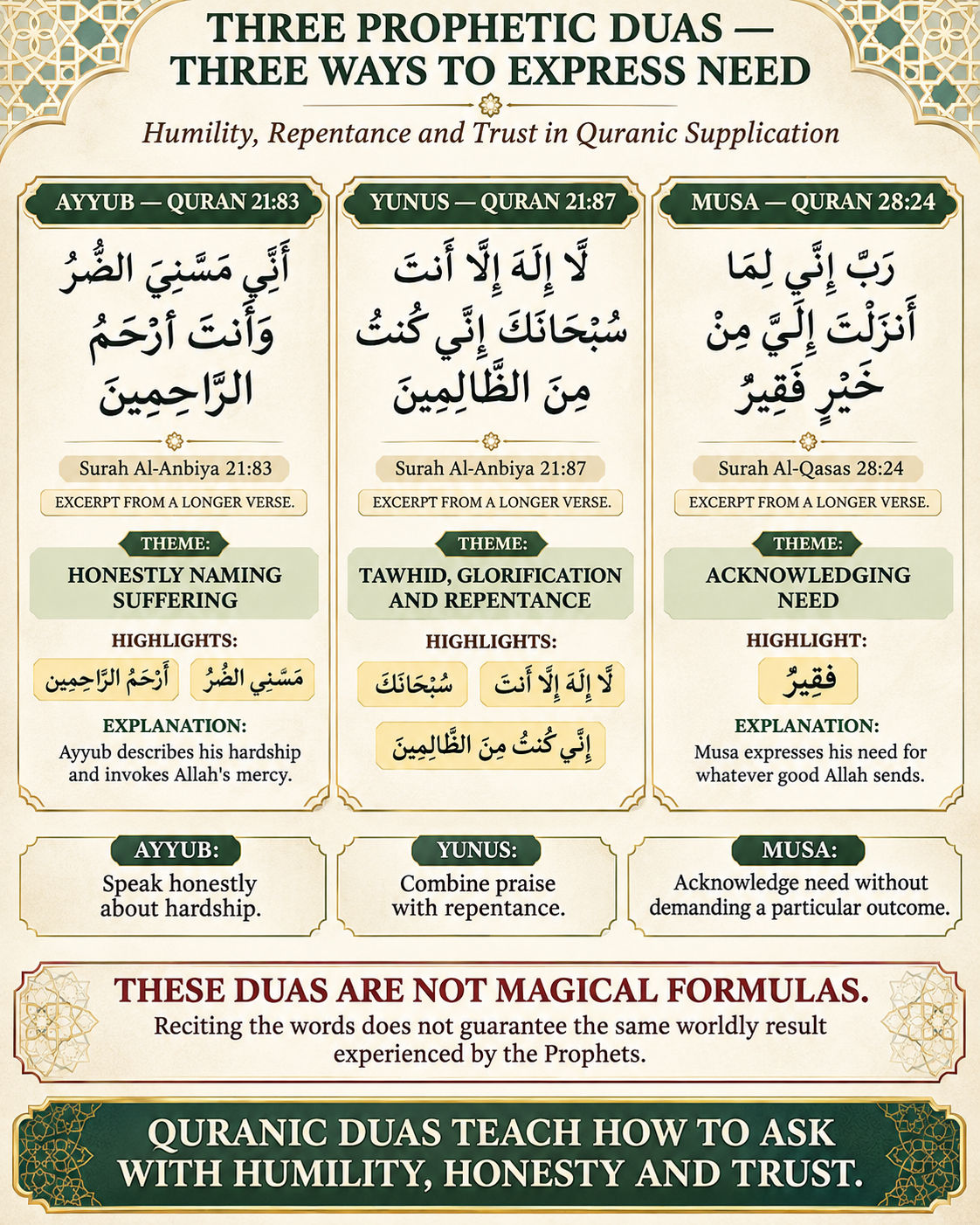
Ayyub (Job):
أَنِّي مَسَّنِيَ الضُّرُّ وَأَنتَ أَرْحَمُ الرَّاحِمِينَ
"Indeed, adversity has touched me, and You are the Most Merciful of the merciful." (Quran 21:83)
He states his condition and describes his Lord, without even spelling out a request. Commentators generally read this as a model of patient, humble supplication. The lesson is that describing our need honestly is itself a form of asking.
Yunus (Jonah):
لَّا إِلَٰهَ إِلَّا أَنتَ سُبْحَانَكَ إِنِّي كُنتُ مِنَ الظَّالِمِينَ
"There is no deity except You; exalted are You. Indeed, I have been of the wrongdoers." (Quran 21:87)
He called "in the darknesses," which commentators often describe as the darkness of night, sea, and the fish. His words combine affirmation of Allah's oneness, glorification, and repentance. The lesson is that dua can begin with praise and honesty, not demands.
Musa (Moses):
رَبِّ إِنِّي لِمَا أَنزَلْتَ إِلَيَّ مِنْ خَيْرٍ فَقِيرٌ
"My Lord, indeed I am, for whatever good You would send down to me, in need." (Quran 28:24)
He had fled to Madyan, travel-worn and alone, and had just helped two women water their flocks. Many commentators understand this as an indirect request for sustenance. The lesson is acknowledging need plainly.
These are not magical formulas. Repeating a prophet's words does not guarantee the same worldly result. Their value lies in what they teach about speaking to Allah: honestly, humbly, and with trust.
How to Make Dua With Understanding and Trust
Begin by remembering that Allah already knows. Dua is not information transfer.
Ask sincerely. Name your needs, hopes, fears, and gratitude.
Use words you understand. Meaning makes dua more present.
Continue responsible action. Seek means, advice, and care.
Do not make your faith conditional on a specific outcome. Hopeful asking differs from treating one result as proof of faith.
Be patient without suppressing emotion. Uncertainty is hard, and sadness is not disbelief.
Keep learning. Study Quranic supplications, their meanings, and their contexts.
None of this is a required routine, and following it does not guarantee any outcome.
How Understanding Quranic Arabic Can Deepen Dua
Sincere dua in any language is valid, and fluency in Arabic is not a condition for it. Still, understanding the Arabic of Quranic supplications can make recitation and reflection more intentional.
Many prophetic duas begin with Rabb (رَبّ), often translated "Lord," though the word carries notions of nurturing, sustaining, and caring for someone. A reader who learns this hears "Rabbi" or "Rabbana" differently. Learning the words for need (faqir), mercy (rahma), guidance (huda), and repentance (tawba) brings similar depth. You can explore this through Araby Academy's guides on what Quranic Arabic is, how roots connect Quranic words, and Quranic words that go beyond a single English translation. If you are starting from nothing, this step-by-step roadmap to learning Quranic Arabic is a good place to begin, and the complete beginner's guide to learning Quran online covers the wider picture.
Quick Reference
Question | Islamic explanation | Important clarification |
|---|---|---|
Why ask if Allah knows? | Dua is worship and dependence (Quran 40:60; Tirmidhi 2969). | It is not information transfer. |
Can dua affect outcomes? | Scholars see dua as among the means within the decree. | It gives no control over destiny; Allah's knowledge does not change. |
Does dua replace action? | No. Tawakkul includes effort. | Seek medical and practical help. |
Why might an answer be delayed? | The response can take several forms (Tirmidhi 3573). | We cannot know the reason in an individual case. |
Does an unmet request mean rejection? | Not necessarily. | It is not proof of anger or weak faith. |
Must dua be in Arabic? | Personal dua may be in any language. | Rules for Salah recitation are separate. |
Frequently Asked Questions
Does Allah need us to ask Him?
No. Allah is free of need, and we are the needy ones (Quran 35:15). He invites us to ask, and the benefit returns to us.
Can dua change Qadar?
Scholars address this through the relationship between decree, causes, and divine knowledge. Dua is one of the means within the decree, and Allah's eternal knowledge does not change. Explanations of the disputed narration vary among scholars.
Why doesn't Allah answer every dua the way we want?
The response can come in other forms, as described in the hadith above, and divine wisdom exceeds our view. We cannot know why a specific request was not granted in the form we hoped for.
Does Allah hear silent prayers?
Yes. Allah knows what is hidden and what the soul whispers (Quran 20:7, 50:16), and Zakariyya called upon Him in a private call (19:3).
Can I make dua in English?
Yes, for personal supplication. Prayer in the language you understand is not less meaningful. For recitation within Salah, consult a qualified scholar.
What is the difference between dua and tawakkul?
Dua is asking Allah. Tawakkul is entrusting your affairs to Him after taking reasonable means. They work together.
What should I do when my dua seems unanswered?
Keep asking, including for strength and guidance. Continue responsible effort, seek support from trusted people, and allow yourself to grieve. A delay does not mean Allah is displeased with you.
Conclusion
Dua is not an attempt to inform Allah of what He does not know. It is worship, dependence, trust, hope, and turning toward Him. Allah's complete knowledge and human supplication are not in tension within Islamic theology. He knows, and He still invites us to ask.
Dua remains meaningful even when the worldly outcome is uncertain. Ask honestly, understand what you are saying, combine it with responsible action, and bring your sorrow and hopes to the One who is near.
If you would like to understand the Arabic behind these supplications, Araby Academy offers live one-to-one Quranic Arabic and Islamic studies lessons.