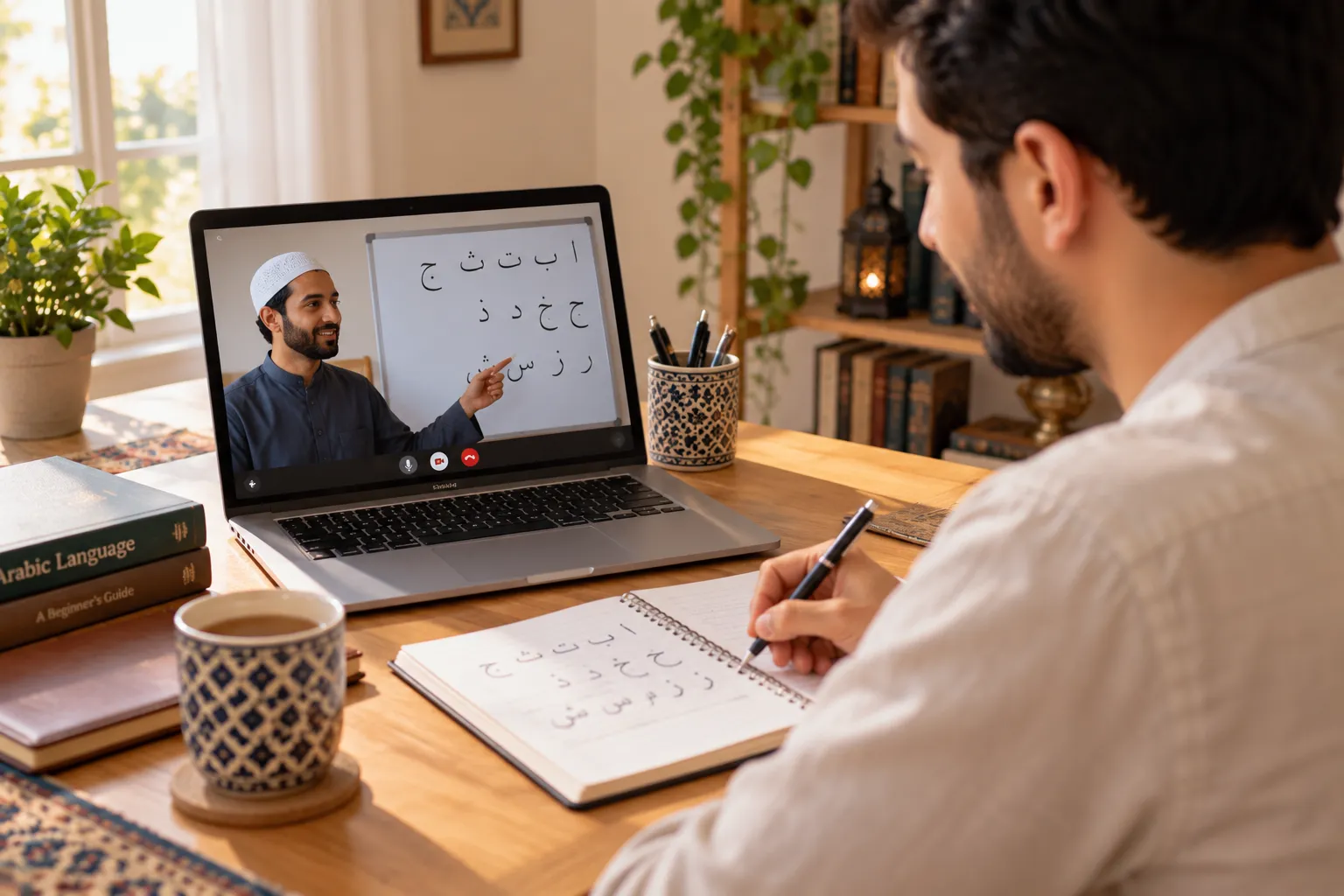
Picture a Muslim who recites Surah Al-Fatihah every day. Their pronunciation is careful, and they may have known the Surah by heart since childhood. Then someone asks, "What does each Arabic word actually mean?" They know the English translation, but not how the Arabic itself works. If that sounds familiar, there is nothing to be ashamed of. Pronunciation, memorization, and comprehension are connected skills, but they are not the same skill.
Quranic Arabic is the form of Arabic found in the Quran, traditionally studied within Classical Arabic scholarship. Learning it involves more than recognizing letters: students explore vocabulary, word roots, grammar, sentence structure, and meaning in context. It is closely related to Modern Standard Arabic but differs in usage, style, and historical context. Beginners can start understanding Quranic passages without first becoming fluent in spoken Arabic.
Memorizing a simple translation is useful, but [IL-01: ten Arabic words in the Quran with meanings that go beyond one English word] demonstrate why context is essential. This guide explains what Quranic Arabic is, how it relates to other forms of Arabic, which skills it involves, and how a beginner can start responsibly. It offers a realistic map, not a promise of instant mastery.
Quick Overview
Question | Short Answer |
|---|---|
What is Quranic Arabic? | The Arabic language of the Quran |
Is it another alphabet? | No; it uses Arabic script |
Is it the same as Tajweed? | No |
Is it identical to Modern Standard Arabic? | Not exactly |
Can English-speaking beginners learn it? | Yes, through structured study |
Do I need to speak an Arabic dialect? | Not necessarily |
Does vocabulary alone guarantee understanding? | No |
Do I still need Tafsir? | Yes, for reliable interpretation |
What Is Quranic Arabic?
The phrase is used in two ways. It can refer to the Arabic found in the Quran itself, and it can name an educational path: courses that prioritize Quranic vocabulary, morphology, grammar, and comprehension. Neither use means the Quran is written in a language unrelated to Arabic. There is no secret "Quranic dialect." The Quran is in Arabic, and Quranic Arabic is that Arabic, studied through its authentic text, its linguistic features, and its interpretive tradition.
What makes it distinctive for students is context: recurring vocabulary with important religious meanings, a unique literary style, and fourteen centuries of scholarly commentary.
Is Quranic Arabic the Same as Classical Arabic?
They are very closely related, though the terms are not interchangeable. Classical Arabic usually refers to the Arabic of the earliest literary and scholarly centuries, including pre-Islamic poetry, the Quran, and the works that followed. In the early Islamic centuries, scholars such as Sibawayh systematized Arabic grammar, and later lexicographers compiled dictionaries such as Lisan al-Arab. Grammarians and commentators often cite early poetry as evidence for how a word was used.
So Quranic Arabic is best understood as the Quran's own language within the Classical Arabic tradition. Later Classical texts are not linguistically identical to the Quran in every feature, and scholars have long noted the Quran's distinctive style. Nor was seventh-century Arabic one uniform standardized variety spoken identically by everyone. The history is complex, and responsible teachers avoid simple slogans about it.
Quranic Arabic vs Modern Standard Arabic
Modern Standard Arabic (MSA) is the standardized formal Arabic used in modern writing, education, broadcasting, and official communication. It continues the Classical tradition rather than arising from an unrelated source.
The continuity is substantial: the same script, many of the same grammatical structures, and a large shared vocabulary. A student of MSA will recognize much in the Quran, and a student of Quranic Arabic will find much that is useful in MSA.
The differences are real but should not be exaggerated. They include historical context, how some words are used, modern terminology for modern things, idiom, stylistic conventions, and specialized religious meanings. Many modern coinages never occur in the Quran, and some familiar words carry older senses there. For a closer comparison of vocabulary, grammar, and historical usage, explore [IL-02: the differences between Quranic Arabic and Modern Standard Arabic] before choosing your learning path.
Can You Learn Quranic Arabic Without Speaking Arabic?
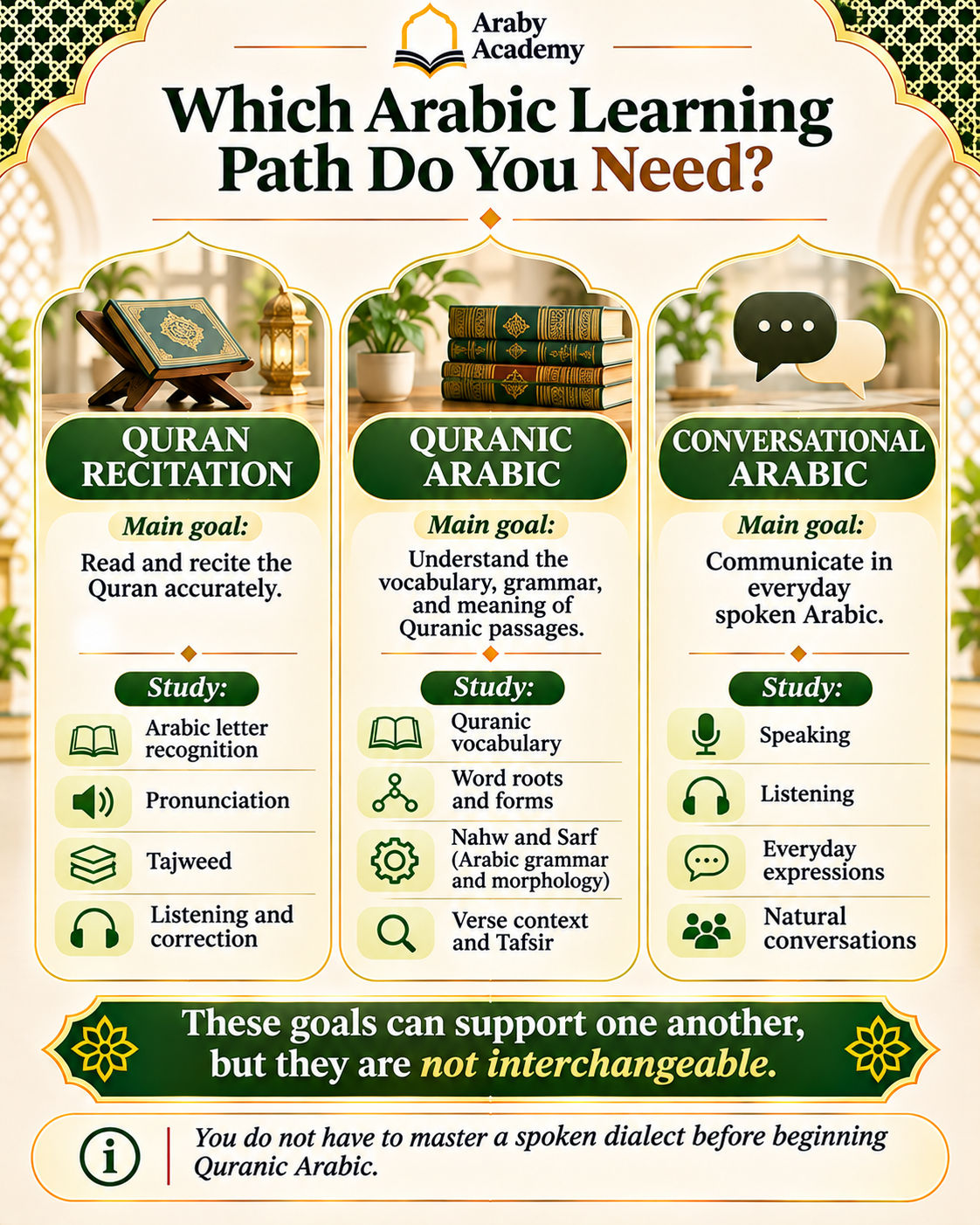
Yes. Many contemporary Arabic speakers use regional varieties in daily life, such as Egyptian, Levantine, Gulf, or Maghrebi Arabic. These are living languages with their own rules, not defective Arabic. Learning a dialect and studying the Quran serve different primary goals. A beginner can start with the alphabet, pronunciation, basic grammar, high-value Quranic words, and short Surahs without conversational fluency. Spoken Arabic is valuable for talking with Arabic speakers or living in an Arabic-speaking country, but it is not an absolute prerequisite.
The reverse is also true. A fluent Arabic speaker may still benefit from Tafsir, classical vocabulary, rhetorical analysis, and historical context. Native fluency does not automatically unlock every Quranic meaning. Learning rates differ for everyone, so measure progress against your own starting point.
Learning Goal | Main Focus | Typical Activities |
|---|---|---|
Quran recitation | Pronunciation and reading accuracy | Letter practice, Tajweed, listening, correction |
Quranic Arabic | Vocabulary, grammar, and meaning of Quranic passages | Word study, roots, grammar, short-verse analysis, Tafsir |
Conversational Arabic | Ordinary spoken communication | Listening, speaking, everyday vocabulary |
These goals can overlap, but each has a distinct main focus.
Why Is the Quran in Arabic?
The Quran describes itself as Arabic. Surah Yusuf 12:2 says: إِنَّا أَنزَلْنَاهُ قُرْآنًا عَرَبِيًّا لَّعَلَّكُمْ تَعْقِلُونَ, "Indeed, We have sent it down as an Arabic Quran so that you may understand." Surah Az-Zukhruf 43:3 uses closely similar wording, and Surah Ash-Shu'ara 26:195 describes the revelation as being in a clear Arabic tongue (بِلِسَانٍ عَرَبِيٍّ مُّبِينٍ). Commentators connect this with the language of the first audience, to whom the message was meant to be clear. None of this makes non-Arabic speakers spiritually lesser. It explains why the Arabic text rewards careful study, while translations remain valuable aids.
Reading, Recitation, Memorization, and Understanding: What's the Difference?
Four skills are often blended together:
Reading means recognizing and decoding Arabic letters and words.
Recitation with Tajweed means reciting according to transmitted rules of articulation, letter qualities, and lengthening, ideally learned from a qualified teacher. Tajweed does not teach vocabulary or grammar.
Memorization (Hifz) means retaining the text accurately.
Understanding means studying vocabulary, grammar, and context.
You can recite accurately without understanding every word, and recitation has its own religious and educational value. You can also understand a translation while still developing your recitation. Neither says anything about a person's sincerity. Memorization does not automatically produce grammatical understanding, and wanting comprehension does not make Tajweed unnecessary. Learning to read the Quran and learning to understand its language are related but different goals, and students can pursue both.
What Skills Do You Need to Learn Quranic Arabic?
Arabic Letters and Pronunciation
Reading the script is the first distinct skill. Beginners learn letter forms, how letters connect, the right-to-left direction, basic sounds, and vowel marks. Being able to pronounce a word is not the same as understanding it.
Arabic is conventionally taught with 28 letters; Hamzah (ء) is handled differently across courses, often as a separate sign written on alif, waw, or ya. Most letters change shape by position. For example, ب appears as بـ at the start, ـبـ in the middle, ـب at the end, and ب alone. Six letters (ا د ذ ر ز و) do not connect to the letter that follows.
Some sounds may be unfamiliar to English speakers, though experiences vary: ع ('Ayn), ح (Ha), خ (Kha), ق (Qaf), and the emphatic letters ص (Sad), ض (Dad), ط (Ta), and ظ (Za). Latin spelling only approximates them, so listening to qualified reciters is essential. The study of where sounds are articulated is called Makharij al-Huruf (مَخَارِجُ الْحُرُوفِ); it concerns pronunciation, not vocabulary. Before tackling advanced grammar, students may need to correct [IL-03: common Arabic letter pronunciation mistakes in Quran recitation] so that they can recognize and read words more reliably.
Harakat and Reading
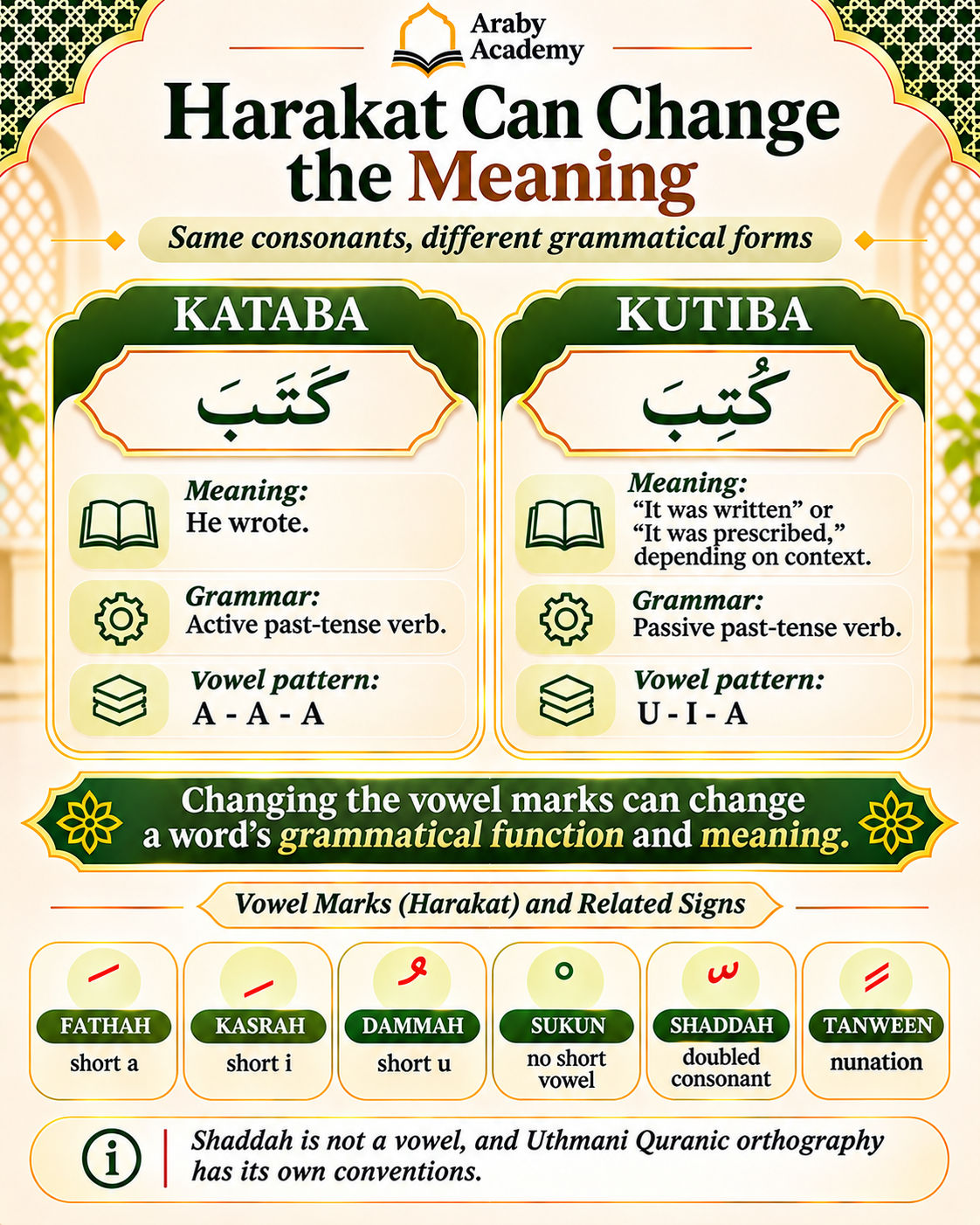
Harakat (الْحَرَكَات) are the small marks that guide how a word is read:
Fathah, Kasrah, and Dammah mark the short vowels "a," "i," and "u."
Sukun marks the absence of a short vowel on a consonant.
Shaddah marks a doubled consonant (gemination); it is not a vowel.
Tanween represents nunation, an added "-n" sound at the end of certain indefinite nouns, as in أَحَدٌ.
Vowel marks can distinguish word forms. The consonants of كَتَبَ (kataba, "he wrote") and كُتِبَ (kutiba, "was written"; in 2:183, "was prescribed") are the same, but the form and meaning differ. Printed Qurans also follow Uthmani orthography (rasm), a script tradition with its own conventions that differ in places from everyday modern spelling. These are conventions, not errors. Understanding [IL-04: Fathah, Kasrah, Dammah, Sukun, Shaddah, and Tanween] gives beginners an essential foundation before exploring how Arabic word forms affect Quranic meaning.
Quranic Vocabulary and Root Words
Certain words recur throughout the Quran, and recognizing them helps enormously. But dictionary-style memorization is not enough. Words such as taqwa, sabr, rahmah, and din are often rendered by a single English word, while their Quranic usage is richer and depends on context.
Many Arabic words are built from a root (jidhr, جَذْر), often of three consonants, combined with a pattern. Not every word follows an identical three-consonant formula. Take ر-ح-م (R-H-M): رَحْمَة (rahmah, mercy) is a noun, while الرَّحْمَٰن (Ar-Rahman) and الرَّحِيم (Ar-Rahim) are Divine Names with different forms, and they are not interchangeable. A root offers clues, but patterns, grammar, and context decide the meaning. Not every possible derivative appears in the Quran, and a root alone can never settle a verse's theological meaning. Once students recognize basic vocabulary, [IL-05: twelve Arabic roots that unlock connected Quranic words] can help them notice meaningful relationships between different word forms.
Nahw and Sarf
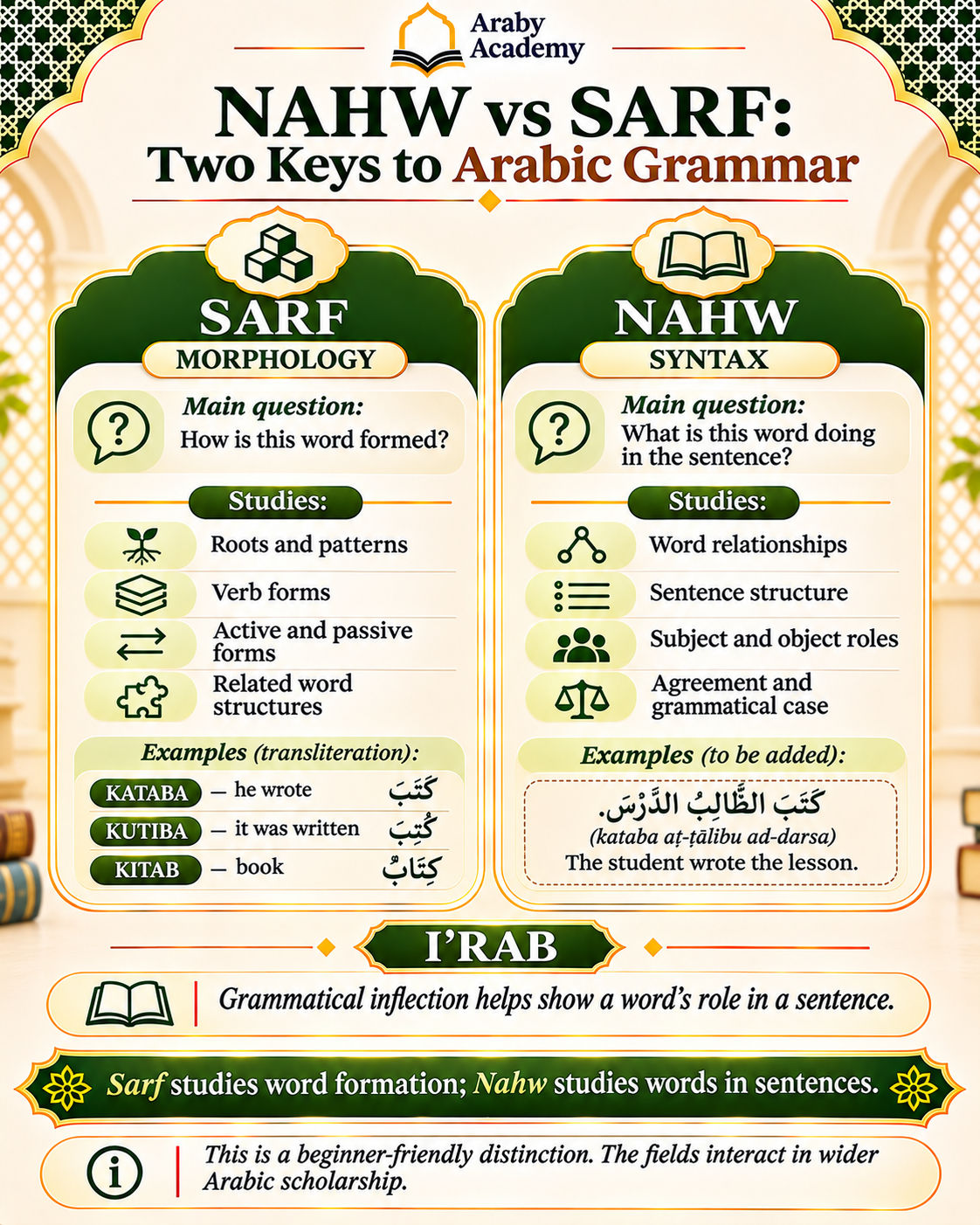
Sarf (الصَّرْف) is Arabic morphology: how words are formed from roots and patterns. The root ك-ت-ب gives كَتَبَ (kataba), كُتِبَ (kutiba), and كِتَاب (kitab, "book"). Nahw (النَّحْو) is syntax: sentence structure, grammatical roles, agreement, case, and the relationships among words.
A simple summary is that Sarf asks, "How is this word formed?" while Nahw asks, "What is this word doing in this sentence?" This is a helpful beginner summary, not an exhaustive definition, and the two fields overlap in wider scholarship. For beginners, [IL-06: understanding the difference between Nahw and Sarf] makes Arabic grammar less intimidating because word formation and sentence structure become separate learning tasks.
Related is I'rab (الإِعْرَاب), the system of grammatical inflection that signals a word's role. No beginner should expect to master it in one lesson.
Particles, Pronouns, and Sentence Structure
Traditional grammar divides words into ism (a broad nominal category, wider than the English "noun"), fi'l (verb), and harf (particle). Verbs carry information through their forms, including past/perfect, present/imperfect, and imperative, which do not map perfectly onto English tenses. Pronouns are often attached or built into the verb: na- in na'budu means "we," and -kum in la'allakum means "you (plural)."
Small particles matter. Words such as wa (and), fa, inna, illa, and min shape relationships between parts of a sentence and can signal emphasis, negation, restriction, or conditions. None has one fixed English equivalent in every context. The definite article al- generally marks definiteness, though English "the" is not an exact match everywhere. Arabic nouns also have grammatical gender, which does not always reflect biological sex, and distinguish singular, dual, and plural. Finally, word order can contribute to emphasis and interpretation, though no rule says that moving a word always creates exclusivity.
Quranic Arabic in Practice: Four Short Examples
1. Quran 1:2: الْحَمْدُ لِلَّهِ رَبِّ الْعَالَمِينَ. Al-hamd is "the praise," with the definite article. Li-llah combines the preposition li ("for" or "belonging to") with Allah. Rabb ("Lord") and al-'Alamin ("the worlds," a plural) form a possessive-type phrase called idafah. Together: "All praise is for Allah, Lord of the worlds."
2. Quran 1:5: إِيَّاكَ نَعْبُدُ وَإِيَّاكَ نَسْتَعِينُ. Iyyaka is an object pronoun, "You," placed before the verb. Na'budu ("we worship") and nasta'inu ("we seek help") are present-tense verbs whose prefix na- means "we," and wa means "and." Many classical grammarians and commentators explain the fronted "You" as conveying emphasis, often expressed as "You alone." That conclusion rests on grammar together with Tafsir, not on word order alone.
3. Quran 112:1: قُلْ هُوَ اللَّهُ أَحَدٌ. Qul is an imperative verb, "Say." Huwa is the pronoun "He." Ahad, "One," carries tanween. The depth of this verse is explained through Tafsir, not by a grammar exercise.
4. Quran 2:183: لَعَلَّكُمْ تَتَّقُونَ. La'alla is a particle often rendered "so that" or "perhaps," and -kum means "you (plural)." Tattaqun is a present-tense verb from the root و-ق-ي, related to taqwa, commonly translated "you may become mindful." La'alla should be read in context rather than assumed to work identically everywhere.
Verse | Arabic Feature | What a Beginner Can Notice | Why Context Still Matters |
|---|---|---|---|
1:2 | Preposition li, idafah | Words link into phrases | Tafsir explains the depth of praise and lordship |
1:5 | Fronted object pronoun | "You" comes first; na- marks "we" | Emphasis is explained through grammar and Tafsir together |
112:1 | Imperative, pronoun, tanween | Verb vs pronoun vs noun | Meaning is drawn from Tafsir and wider Quranic context |
2:183 | Particle, attached pronoun, root | la'alla, -kum, and a verb linked to taqwa | The particle's sense depends on context |
These are accurate beginner observations, not complete interpretations. A word-by-word note is never the whole of a verse's meaning.
Why Short Surahs Are a Good Place to Start
Short passages are manageable units for recognizing vocabulary, noticing repeated forms, memorizing, practicing grammar, and checking Tafsir. That does not make every short Surah easier than every long one. Useful candidates include Al-Fatihah, Al-Ikhlas, Al-Falaq, An-Nas, Al-'Asr, Al-Kawthar, and Al-Ma'un. A manageable way to begin is to study [IL-07: seven short Surahs word by word], using each passage to practice vocabulary, grammar, and verified context.
A simple method for one ayah:
Read or listen to it correctly.
Identify the words.
Check unfamiliar vocabulary.
Notice attached prefixes and suffixes.
Observe the basic sentence structure.
Read a trustworthy translation.
Consult reliable Tafsir.
Review it later.
This is a study method, not a religious ritual; adapt it to your level.
Why Translation and Tafsir Still Matter
English translations are valuable, and many people first meet the Quran's meanings through them. But a translation cannot show word order, grammatical endings, particles, morphological patterns, or points where the Arabic allows more than one reading. Translations differ because words have several senses, grammar can allow different analyses, idiom resists literal rendering, translators make Tafsir-informed choices, and styles vary. These differences are not necessarily contradictions. A word-by-word Quran helps with recognition, but cannot fully convey syntax, idiom, rhetoric, or Tafsir. Root dictionaries list possible senses, so use them at a later stage with guidance, since a dictionary entry is not automatically a Quranic translation.
Tafsir (التَّفْسِير) is the scholarly explanation of the Quran. It draws on the Quran itself, authentic Prophetic explanation, the Arabic language, context, and recognized methodology. It includes Asbab al-Nuzul (أَسْبَابُ النُّزُول), the circumstances associated with the revelation of certain passages, though not every verse has a specific reported occasion.
Knowing Arabic does not make someone a mufassir, because Tafsir also requires training in Hadith, Qira'at, and Islamic legal methodology. Ordinary learners can still reflect responsibly on the Quran's guidance. Even when a student understands a verse's individual words, [IL-08: the difference between Tafsir and translation] remains essential for avoiding incomplete or misleading interpretations.
What Are the Qira'at, and Do Beginners Need Them?
The Qira'at (الْقِرَاءَات) are canonical readings of the Quran transmitted through recognized chains. Each reading has its own transmissions, called riwayat; Hafs from 'Asim and Warsh from Nafi' are well-known examples. They are not regional accents, and they are not different Qurans. The differences are limited, remain within the Uthmani script, and sometimes affect pronunciation and sometimes wording. Qira'at are also distinct from Tajweed rules and from differences between translations.
Beginners normally start grammar study with the reading in their own Mushaf and their teacher's instruction. More advanced students can later explore [IL-09: the Quran's canonical Qira'at and how they differ from ordinary pronunciation variations] without confusing this science with basic vocabulary study.
How to Start Learning Quranic Arabic Step by Step
A sensible sequence is:
Arabic letters and sound recognition.
Short vowels and reading accuracy.
High-value Quranic vocabulary.
Basic word classes.
Basic roots and word forms.
Simple grammatical structures.
Short verse analysis.
Translation comparison.
Reliable Tafsir.
Guided continued study.
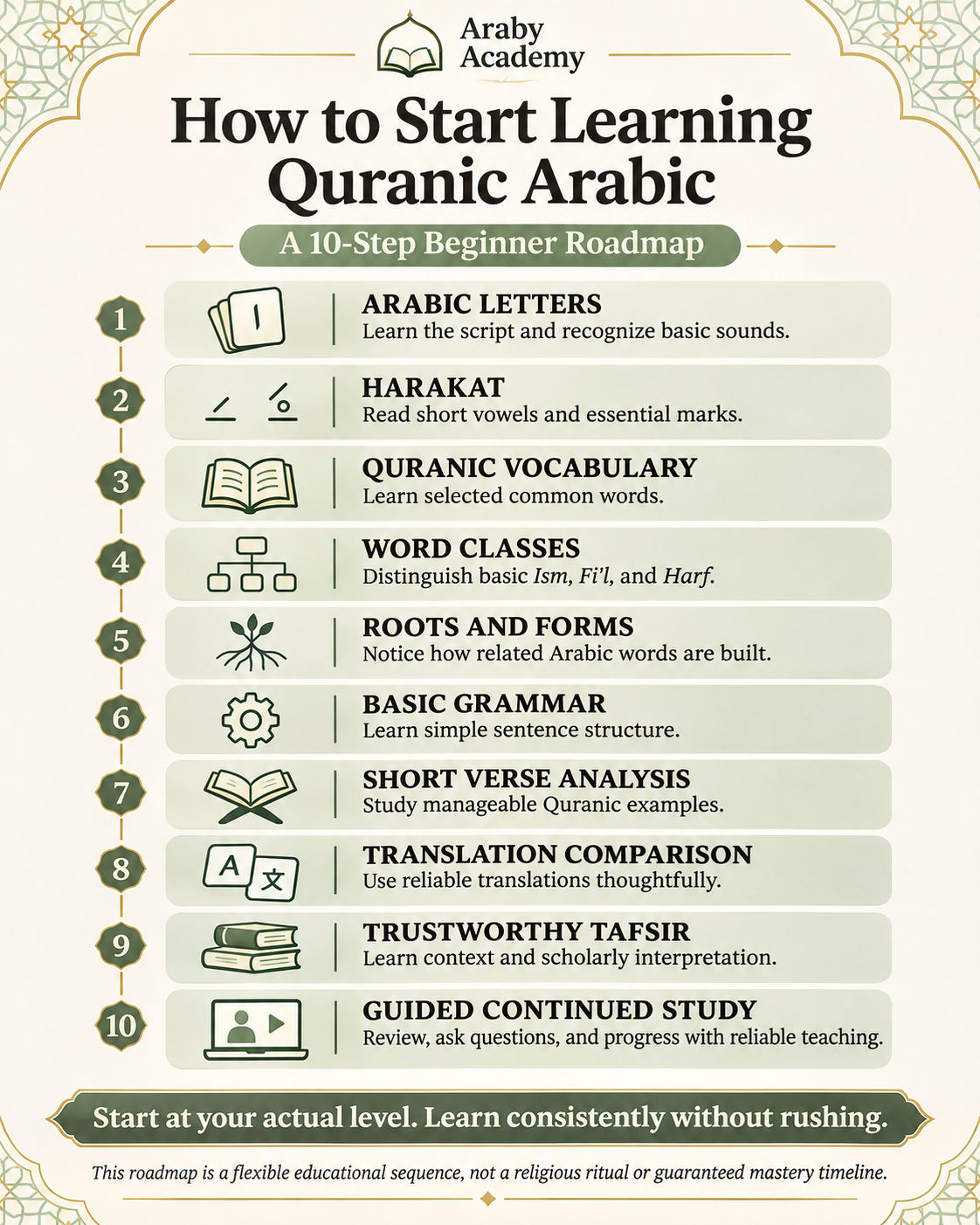
Students who already recite well can join at a later stage.
Materials. A reliable Mushaf, a verified translation, a basic reading resource, introductory grammar material, a trustworthy Tafsir, a vocabulary notebook, recordings of qualified reciters, and teacher guidance where possible. Treat unverified apps with caution.
Teacher or self-study? Self-study offers flexibility, access to resources, and independent review. A qualified teacher adds pronunciation correction, structured explanation, feedback, sensible sequencing, and source verification, and helps prevent unsupported conclusions. Neither guarantees fluency, and both can help. When choosing a course, ask whether it assesses your level, clarifies whether it emphasizes recitation, vocabulary, grammar, or Tafsir, uses verified Quranic examples, and offers correction and review.
Different learners. Adults can learn in stages with support; time, prior education, and language background vary, and slow progress is never a sign of weak faith. Children do best with age-appropriate steps: letters, pronunciation games, basic vocabulary, short Surahs, and simple meaning discussions before gradual grammar. New Muslims can read translations while learning Arabic gradually; Arabic fluency is not a condition of belonging.
A Realistic Six-Week Starter Plan
This is an illustration, not a promise of mastery. Adjust it if you cannot yet read Arabic.
Week 1: Identify your current reading level.
Week 2: Work on vowel marks and reading.
Week 3: Learn selected recurring Quranic words.
Week 4: Recognize basic nouns, verbs, and particles.
Week 5: Study simple word forms and short verse structures.
Week 6: Review a short Surah with vocabulary, translation, and Tafsir.
Short regular sessions, weekly revision, and one short passage at a time work better than occasional marathons. Available time varies, and no number of minutes guarantees fluency. How long learning takes depends on your starting level, reading fluency, teaching quality, consistency, goals, and review. Recognizing selected words, following a short Surah with support, understanding more complex passages, and independent linguistic analysis are different stages, and no honest teacher promises mastery in 30 or 90 days.
Early progress looks like recognizing letters, reading vowelled words, spotting frequent vocabulary and a few roots, telling verbs from nouns in simple examples, explaining a short phrase's basic structure with support, and noticing when Tafsir is needed.
Common Mistakes Quranic Arabic Beginners Should Avoid
Assuming accurate pronunciation means comprehension. Reading and understanding are separate skills.
Assuming memorization means grammatical understanding. Hifz does not automatically teach grammar.
Trying to learn all grammar before reading one verse. Learn grammar through short passages.
Memorizing roots without word forms. Roots are useful only alongside real forms.
Ignoring small particles. They often shape the meaning.
Treating translations as word-for-word replicas. They convey meaning, not structure.
Using a dictionary without Tafsir. Possible senses need context and guidance.
Assuming every modern expression appears in the Quran. Modern usage and Quranic usage overlap but differ.
Jumping into advanced Qira'at before basic grammar. Build foundations first.
Expecting fluency within weeks. Steady, realistic progress lasts longer.
Frequently Asked Questions
What is Quranic Arabic? It is the Arabic of the Quran, studied through its vocabulary, roots, grammar, context, and Tafsir within the Classical Arabic tradition.
Is Quranic Arabic a different language from Arabic? No. It is Arabic. The term describes the Quran's language and an educational focus, not an unrelated language or separate alphabet.
Is Quranic Arabic the same as Classical Arabic? They are closely related. Classical Arabic is the broader historical literary and scholarly tradition, and the Quran is its most studied text, though later Classical writing differs in places.
What is the difference between Quranic Arabic and Modern Standard Arabic? They share script, much grammar, and much vocabulary. They differ in historical context, word usage, idiom, style, modern terminology, and specialized religious meanings.
Is Quranic Arabic still spoken today? It is not an everyday mother tongue. Arabic continues as a living language, and the Quran's Arabic is recited, studied, and understood through the Classical tradition.
Can I learn Quranic Arabic without speaking Arabic? Yes. Beginners can study letters, vocabulary, grammar, and short Surahs directly, without first learning a spoken dialect.
Do I need to know the Arabic alphabet first? Yes, basic reading is the starting point. If you cannot read yet, begin with letters and vowel marks before grammar.
Is Tajweed the same as Quranic Arabic? No. Tajweed governs accurate recitation, while Quranic Arabic study focuses on vocabulary, grammar, and meaning. Each supports the other.
Can I recite correctly without understanding the words? Yes. Decoding and recitation are distinct from comprehension, and recitation has its own value. Understanding can be added gradually.
Does memorizing the Quran mean I understand its Arabic? Not automatically. Memorization retains the text, while comprehension requires vocabulary, grammar, and context study.
What are Arabic roots, and why are they important? A root is a core set of consonants from which related words are formed. Roots reveal connections between words, but patterns and context determine meaning.
What is the difference between Nahw and Sarf? Sarf studies how words are formed; Nahw studies how words function and relate within sentences. Quran students benefit from both.
Can I understand Quranic Arabic with vocabulary alone? No. Vocabulary is essential, but grammar, word forms, context, and Tafsir are also needed.
Do I still need Tafsir after learning Arabic grammar? Yes. Grammar clarifies how a sentence works, while Tafsir draws on broader evidence to explain meaning reliably.
What are the Qira'at? They are canonical, transmitted readings of the Quran, taught through a specialized tradition. They are not accents or different Qurans.
How long does it take to learn Quranic Arabic? It varies with starting level, instruction, consistency, and goals. Selected words come first, then short Surahs with support, and later more complex passages.
What should I study first? Check your reading level, then learn letters, vowel marks, common vocabulary, basic word classes, and simple grammar through short Surahs.
Conclusion: Start with the Arabic You Can Understand Today
A person may recite the Quran beautifully and still have much to learn about its language. That is not a failure. Reading, pronunciation, memorization, vocabulary, grammar, and Tafsir can grow together, and no one needs instant mastery. What helps most is a realistic starting point, reliable sources, patient study, and good guidance.
Quranic Arabic is not a hidden code reserved for experts. It is a language that beginners can start learning step by step. Each new word, grammatical pattern, and carefully studied verse can help you move from recognizing the Quran's sounds toward understanding more of its meaning. If you would like structured guidance, you are welcome to study Quranic Arabic with qualified teachers at Araby Academy.