
You are reading the Quran in English. One verse says, “He is Allah, One.” Another says, “Indeed, We have sent down the Reminder.” Another says, “Indeed, I am Allah.” Who is speaking? Does “We” imply more than one? Is the translation hiding something in the Arabic?
These are serious, understandable questions, and nobody should feel foolish for asking them. Below are seven researched answers drawn from Quranic Arabic, examples, rhetoric, and Tafsir. The English renderings here are explanatory paraphrases, not quotations from a named translation.
The Short Answer: Why Quranic Pronouns Change
The Quran uses “He,” “We,” and “I” in different grammatical and rhetorical contexts. “He” is Arabic third-person reference to Allah, “I” appears in direct first-person divine speech, and divine “We” can express majesty without implying multiple gods. Some passages also shift perspective through an Arabic rhetorical feature called Iltifat. Still, the actual speaker and context must be identified before interpreting any pronoun, and reliable Tafsir remains essential.
The discussion begins with [ the meaning of Tawhid and Allah’s oneness in Islam], because different grammatical pronouns do not override the Quran’s teaching about God. The Quran says: قُلْ هُوَ اللَّهُ أَحَدٌ, “Say: He is Allah, One” (112:1). It also says: لَا إِلَٰهَ إِلَّا هُوَ, “There is no god but Him” (2:163).
A Quick Guide to Quranic Arabic Pronouns
Grammatical person describes who speaks (first person: I, we), who is addressed (second person: you), and who is discussed (third person: he, she, they). It is not a statement about the number of gods or about biological nature.
Four beginner terms help: ضَمِير (damir), pronoun; مُتَكَلِّم (mutakallim), speaker or first person; مُخَاطَب (mukhatab), addressee or second person; and غَائِب (gha’ib), absent or third person. Arabic grammar is more detailed than these glosses.
Person can appear in three ways. An independent pronoun is a separate word: هُوَ (huwa, he), أَنَا (ana, I), نَحْنُ (nahnu, we). An attached pronoun joins another word: إِنَّا (inna, “indeed” plus attached -na, “we”) and إِنِّي (inni, inna plus an attached first-person singular pronoun). A verb can also carry person itself: نَعْبُدُ (na‘budu) uses the prefix na- for “we worship,” while نَزَّلْنَا (nazzalna) uses the suffix -na as its subject. These are different structures, and the -na in inna does not play the same role as the -na in nazzalna.
Readers who are unfamiliar with Arabic grammar may benefit from [ understanding what Quranic Arabic is and how its sentence structure works] before examining the rhetorical effect of changing perspectives.
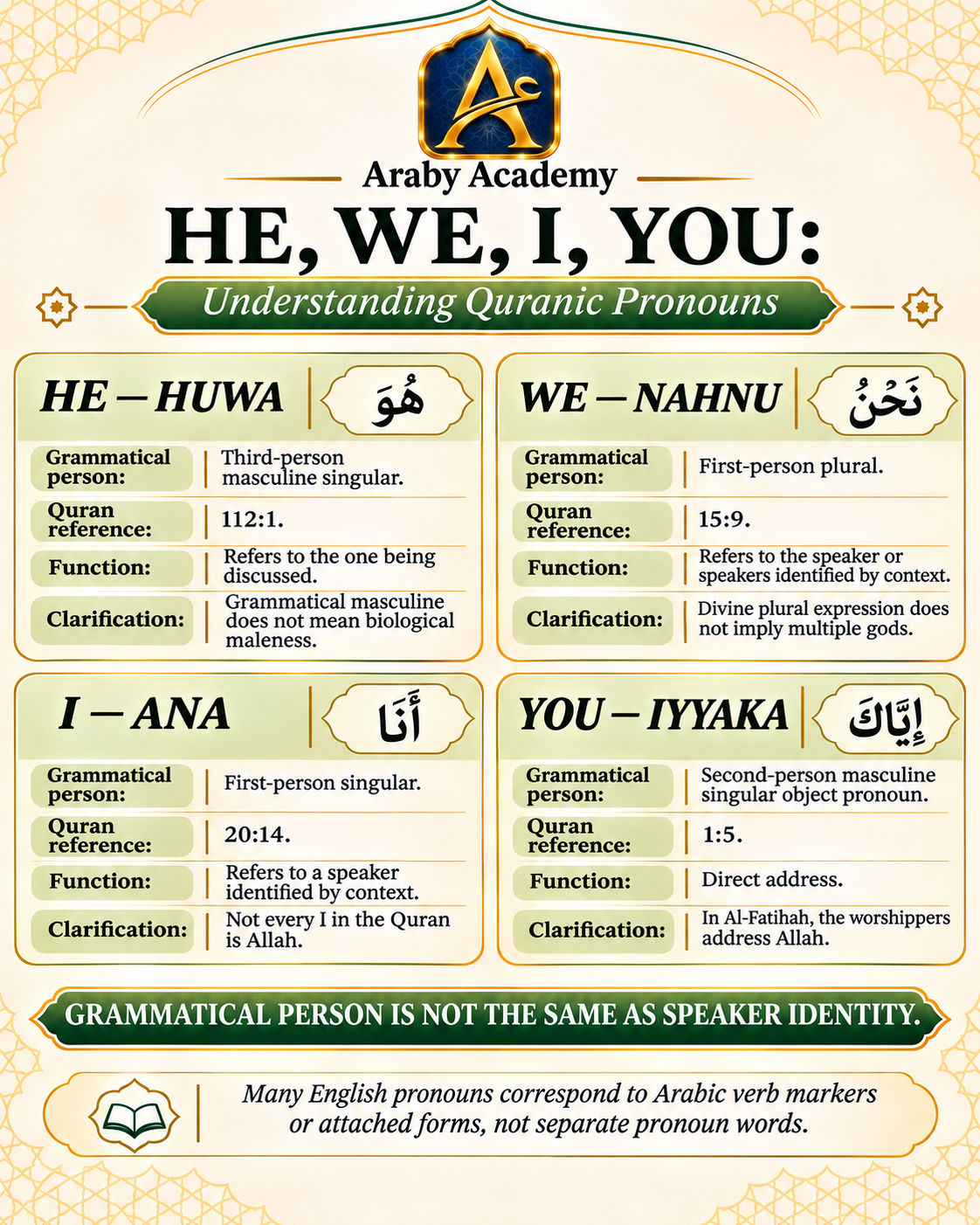
He, We, I, and You at a Glance
Four forms appear most often in these discussions.
Many English “he,” “we,” and “I” words translate verb endings or attached forms, not separate pronoun words.
English | Arabic | Grammatical person | What it may indicate | Example |
|---|---|---|---|---|
He | هُوَ (huwa) | Third, masculine singular | Who is being discussed | 112:1 |
We | نَحْنُ (nahnu) | First, plural | Speaker identified by context | 15:9 |
I | أَنَا (ana) | First, singular | Speaker identified by context | 20:14 |
You | إِيَّاكَ (iyyaka) | Second, masculine singular, object pronoun | Direct address | 1:5 |
1. Why Does the Quran Refer to Allah as “He”?
Arabic has grammatical gender: nouns, pronouns, verbs, and adjectives are masculine or feminine, with no neuter category. The independent third-person masculine singular pronoun is هُوَ (huwa), and Quranic reference to Allah uses it.
Consider قُلْ هُوَ اللَّهُ أَحَدٌ (112:1): qul, “say”; huwa, “He”; Allah; and ahad, “One,” a word often explained as stressing absolute uniqueness. Huwa points to the One being named. It is not a declaration of sex.
Grammatical masculine is not biological maleness.
The Quran itself says لَيْسَ كَمِثْلِهِ شَيْءٌ, “Nothing is like Him” (42:11), so no pronoun can describe Allah as a body. Likewise, 2:163 speaks of Allah in the third person, yet no change of speaker occurs: third-person language simply tells us who is being discussed.
English capital letters in He, Him, and His are an editorial convention. Arabic script has no capitals, and not every translation capitalizes these pronouns the same way, so theology should not be read from capitalization.
Even a familiar English word such as “He” shows why [ Quranic expressions can carry more linguistic detail than a simple English rendering] when grammatical form and context are taken into account.
Takeaway: “He” reflects grammatical third-person reference; it implies no body or sex, and the surrounding verse fixes its referent.
2. Why Does Allah Say “We” if Allah Is One?
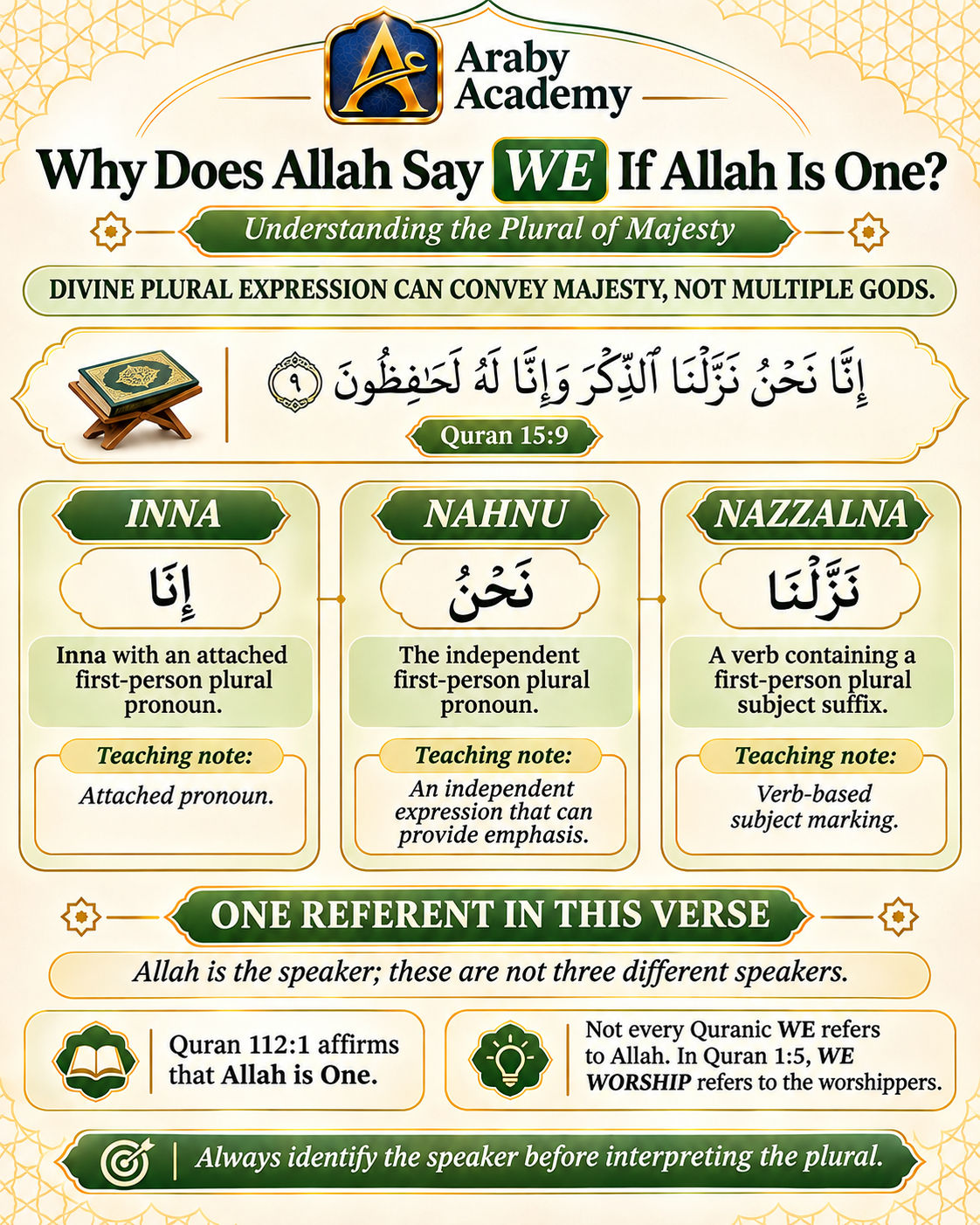
Because the Quran’s own teaching is oneness, divine first-person plural speech cannot mean several gods. Classical Arabic usage recognizes a plural for one speaker that conveys grandeur, exaltation, or majesty, often called the plural of majesty. Scholars did not all use identical terminology, but the idea is established.
Take 15:9: إِنَّا نَحْنُ نَزَّلْنَا الذِّكْرَ وَإِنَّا لَهُ لَحَافِظُونَ, roughly “Indeed, We sent down the Reminder, and indeed We are its guardians.” Three forms work together: إِنَّا, inna plus attached -na; نَحْنُ, the independent pronoun nahnu, commonly analyzed as adding emphasis; and نَزَّلْنَا, a verb whose suffix marks a first-person plural subject. They are not three speakers. They are one divine voice expressed through three grammatical layers.
The Arabic word is الذِّكْرَ (al-Dhikr), “the Reminder.” Commentators commonly explain it as the Quran, but the verse’s own wording is al-Dhikr, so the English “Quran” is an explanation of the referent.
English speakers sometimes meet this idea through the phrase “royal We.” It is only an analogy: Quranic Arabic should be understood through classical Arabic usage and Quranic context, not by comparison to European monarchs.
Recognizing the difference between an independent pronoun and a verb ending is part of understanding Quranic Arabic grammar clues that affect an Ayah’s meaning, especially when English translations use the same word for different Arabic structures.
Not every “We” is divine. In Al-Fatihah, نَعْبُدُ (na‘budu), “we worship,” is the worshippers’ voice. In 19:64, وَمَا نَتَنَزَّلُ إِلَّا بِأَمْرِ رَبِّكَ, “We descend only by your Lord’s command,” the speakers refer to “your Lord,” so they are not Allah. Nor does divine “We” always mean Allah plus angels; where a verse involves angels or other agents, consult Tafsir rather than assuming.
3. Why Does Allah Sometimes Say “I” Instead of “We”?
First-person singular speech appears in direct address, and it does not contradict divine plural expression. In 20:11–13 Musa is called at the fire, and 20:14 follows: إِنَّنِي أَنَا اللَّهُ لَا إِلَٰهَ إِلَّا أَنَا فَاعْبُدْنِي, roughly “Indeed, I am Allah; there is no god but Me, so worship Me.”
The forms are إِنَّنِي (inna plus attached -ni), أَنَا (independent ana, twice), and فَاعْبُدْنِي (fa-‘budni, a command verb with attached object pronoun -ni). Here “I” stands beside the declaration of oneness, within the story of Musa; it should not be read as a free-floating line.
Another example is 2:186, فَإِنِّي قَرِيبٌ, “I am near,” within a passage about supplication. Classical commentators commonly explain this nearness in terms of Allah’s hearing and answering, not bodily location, which fits 42:11.
Do not turn this into a formula. It is unsound to say “I” always means mercy, “We” always means power, or “He” always means distance. A scholar may propose an emphasis in a particular passage, but context controls. “Allah says ‘I’ in the Quran” is true; “every English ‘I’ is Allah” is false.
The difference between “I,” “me,” and the forms attached to Arabic verbs becomes clearer when readers study small Arabic words and particles that shape Quranic sentence meaning rather than relying on English pronouns alone.
4. Why Does a Verse Sometimes Shift From “He” to “We”?
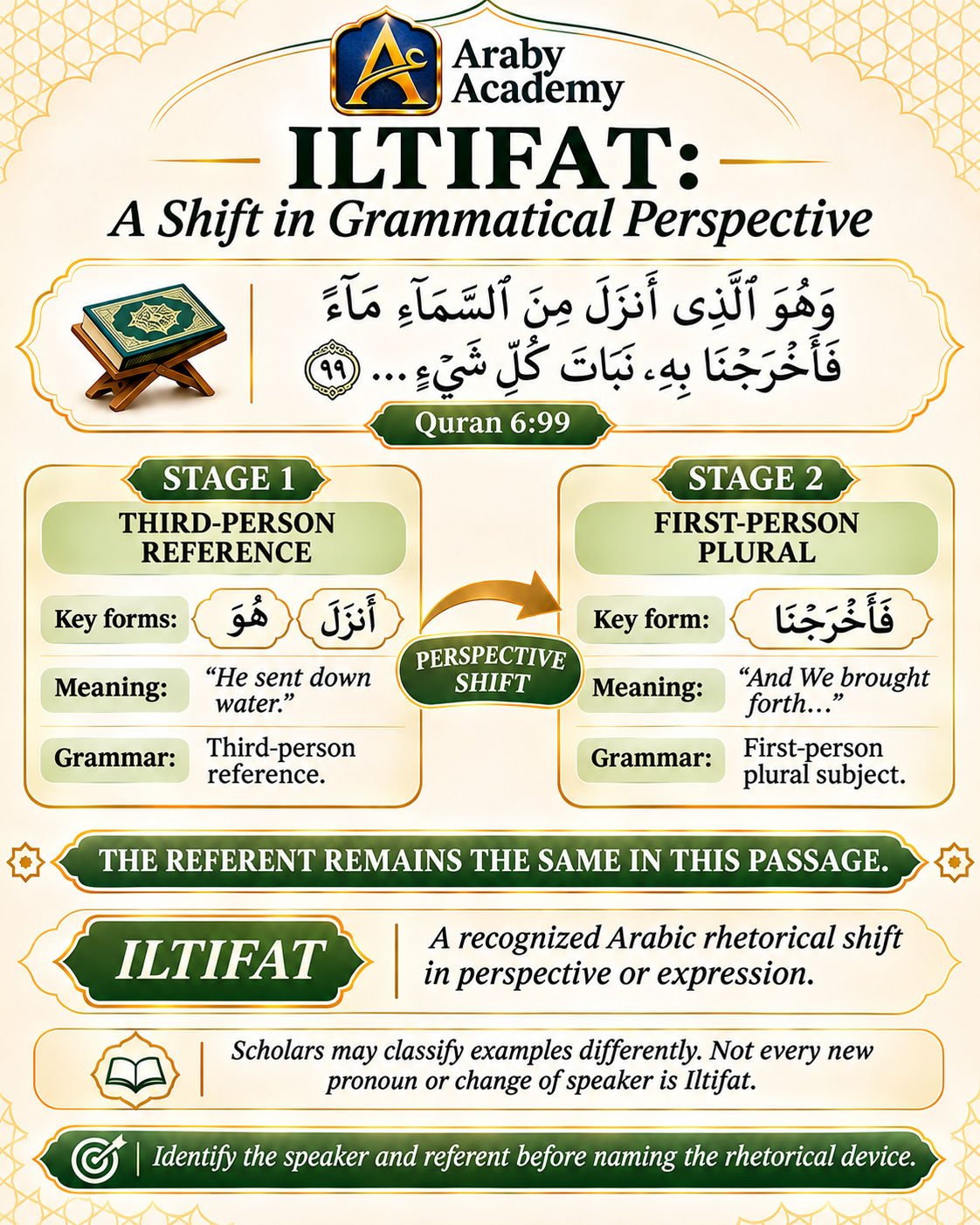
In 6:99, وَهُوَ الَّذِي أَنزَلَ مِنَ السَّمَاءِ مَاءً فَأَخْرَجْنَا بِهِ نَبَاتَ كُلِّ شَيْءٍ, “It is He who sent down water from the sky, and We brought forth with it the growth of everything.” The opening uses the independent pronoun huwa and a third-person verb, anzala. Then فَأَخْرَجْنَا (fa-akhrajna) uses a first-person plural subject.
The referent stays the same; the grammatical perspective changes.
In 35:27, أَلَمْ تَرَ أَنَّ اللَّهَ أَنزَلَ مِنَ السَّمَاءِ مَاءً فَأَخْرَجْنَا بِهِ ثَمَرَاتٍ, “Do you not see that Allah sent down water from the sky, and We brought forth fruits with it,” third-person reference comes through the noun Allah, not huwa. The syntax is similar, not identical.
Arabic rhetoric calls such movement الِالْتِفَات (al-Iltifat), literally “turning”: a shift in manner of expression, including a change of person. Scholars defined its scope differently and did not all count the same examples. It is a recognized rhetorical feature, not an error.
M. A. S. Abdel Haleem’s 1992 study, “Grammatical Shift for Rhetorical Purposes: Iltifat and Related Features in the Qur’an” (BSOAS 55/3), examines such shifts as rhetorical devices, and classical works by al-Zamakhshari, al-Zarkashi, and al-Suyuti discuss the subject. Proposed effects include renewed attention, emphasis, variation in perspective, or a change in address, but these are interpretations tied to particular passages, not one universal purpose.
Not every pronoun difference is Iltifat. If a new character speaks, the change may simply be a change of speaker.
Pronoun shifts are one aspect of Quranic rhetoric, while [ Quranic examples where word order changes emphasis] show another way Arabic structure can direct the reader’s attention.
5. Why Does Surah Al-Fatihah Move From Speaking About Allah to Saying “You”?
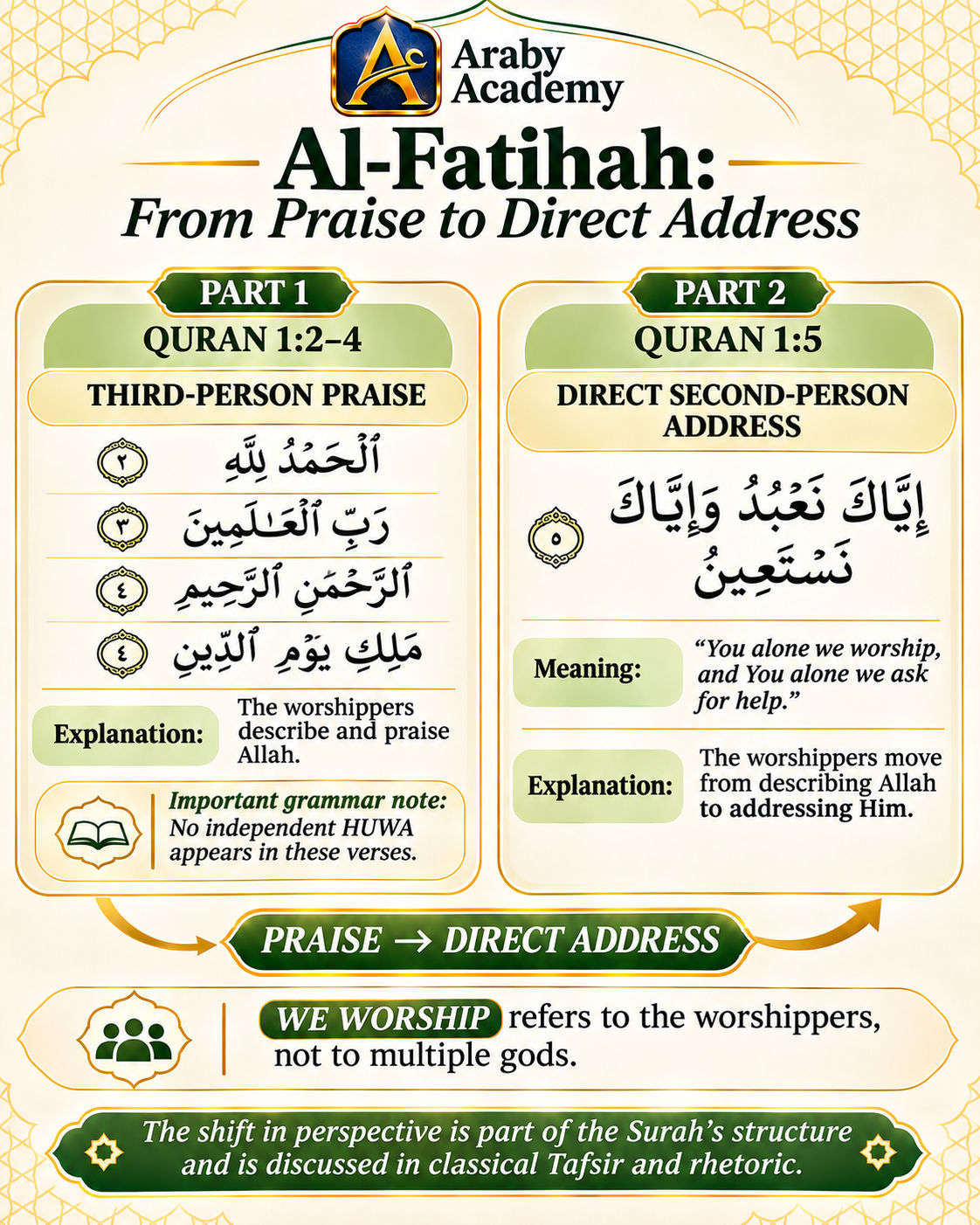
Verses 1:2–4 praise Allah using names and attributes: الْحَمْدُ لِلَّهِ رَبِّ الْعَالَمِينَ, الرَّحْمَٰنِ الرَّحِيمِ, مَالِكِ يَوْمِ الدِّينِ. No independent huwa appears; third-person reference comes through Allah, Lord, and the other descriptions.
Then 1:5 says إِيَّاكَ نَعْبُدُ وَإِيَّاكَ نَسْتَعِينُ, “You alone we worship, and You alone we ask for help.” The speech is now direct address: Allah is no longer described but spoken to.
The word إِيَّاكَ (iyyaka) is generally analyzed as a second-person masculine singular object pronoun, placed before the verb. Classical grammarians and commentators commonly connect that fronting with exclusivity: worship and help are directed to Allah alone.
Who is “we”? The worshippers reciting. نَعْبُدُ (na‘budu) and نَسْتَعِينُ (nasta‘inu) carry first-person plural subject marking for the worshippers, so this “we” has nothing to do with multiple gods.
Al-Zamakhshari is among classical authors who discuss this transition as Iltifat, and commentators describe it as a movement from praise into prayer. This is a literary-devotional reading, not a claim about every worshipper’s experience.
The shift into direct address is especially meaningful when studied alongside [ the meaning and structure of Surah Al-Fatihah], where praise leads into the worshipper’s prayer.
6. How Can You Tell Who Is Speaking When the Quran Says “I” or “We”?
The Quran contains divine speech, narrative, prophetic dialogue, human statements, and quoted speech by other beings, so not every “I” or “We” belongs to Allah.
In 20:11–14, the call to Musa establishes the “I” of 20:14 as Allah’s. In 7:12, Allah asks Iblis, مَا مَنَعَكَ أَلَّا تَسْجُدَ إِذْ أَمَرْتُكَ, “What prevented you from prostrating when I commanded you?”; here أَمَرْتُكَ (amartuka) carries Allah’s “I.” Then comes قَالَ أَنَا خَيْرٌ مِنْهُ, “He said: I am better than him.” Qala marks the change, and ana is Iblis, not Allah.
In 7:143 Musa says رَبِّ أَرِنِي أَنظُرْ إِلَيْكَ, “My Lord, show me, that I may look at You.” Arini contains the attached “me,” and anzur carries first-person singular marking; the speaker is Musa and the one addressed is his Lord. Later in the verse he says وَأَنَا أَوَّلُ الْمُؤْمِنِينَ, again with Musa as the speaker.
The command قُلْ (qul), “say,” introduces speech the Prophet ﷺ is told to deliver, but not every quotation needs qul, and not every sentence after qul has the same voice. In 39:53, قُلْ يَا عِبَادِيَ الَّذِينَ أَسْرَفُوا عَلَىٰ أَنفُسِهِمْ … إِنَّهُ هُوَ الْغَفُورُ الرَّحِيمُ, the command is addressed to the Prophet ﷺ; the quoted address says “My servants”; then forgiveness is described with third-person reference to Allah. Commentators treat such layers carefully, so a simple “I-to-He” label would flatten them.
So separate dialogue from Iltifat. If a new speaker begins, pronouns may reflect that; if the same discourse shifts perspective, Iltifat may be relevant. I
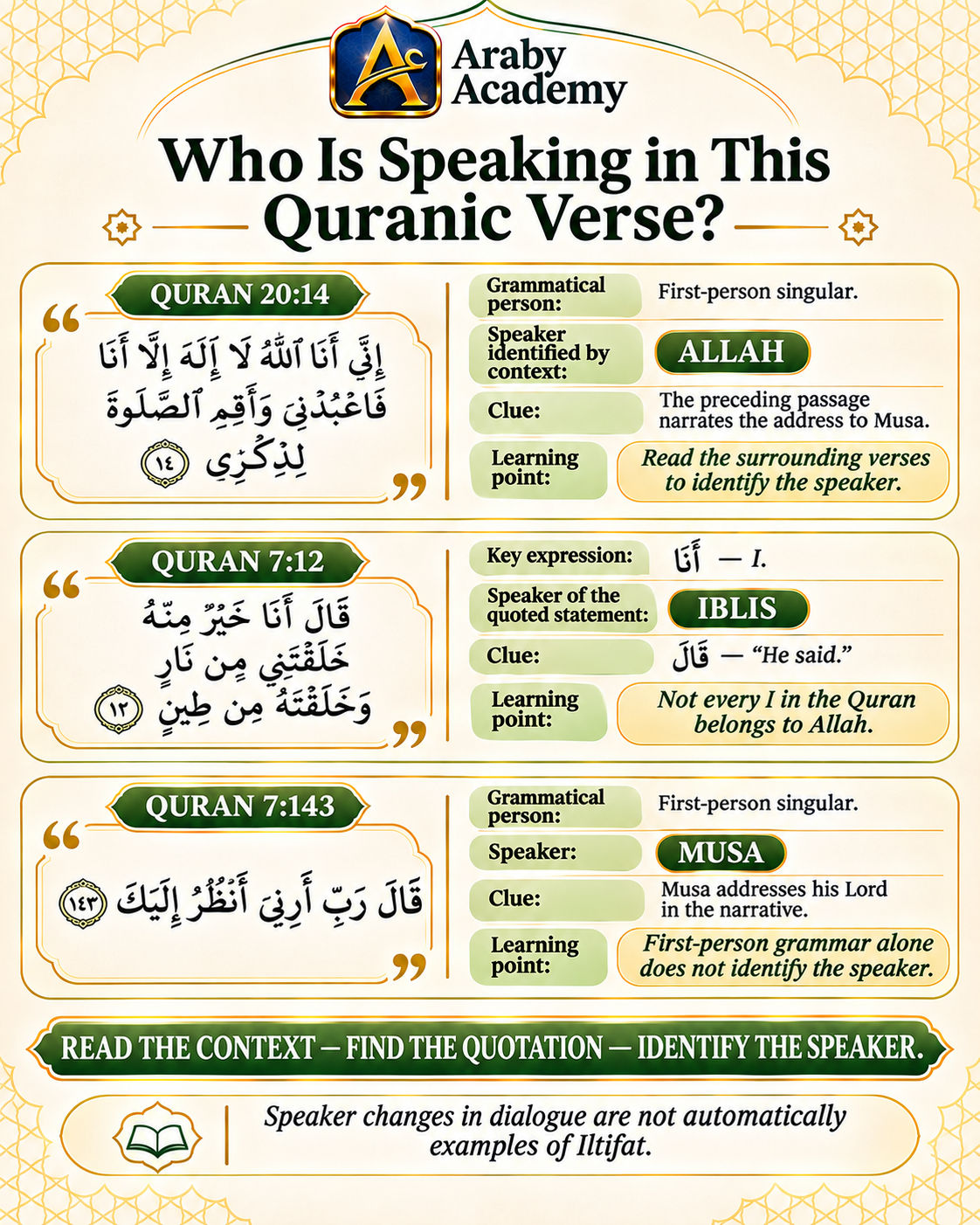
l. Quick check: read the preceding verse, look for qala or qul, identify who is quoted, and notice whether the pronoun is independent, attached, or verb-based.
The identity of the speaker becomes easier to follow when readers study [ why the Quran tells familiar stories in different ways], especially where narration moves between description, dialogue, and direct address.
7. Why Do English Quran Translations Sometimes Handle Pronoun Shifts Differently?
Arabic expresses pronouns through separate words, verb prefixes and suffixes, attached possessive or object markers, and implied subjects; English usually needs a separate pronoun. A translator must therefore decide how visibly to reflect each distinction.
Possible choices include keeping “He,” “We,” or “I”; adding “Allah” where a referent is hard to follow; adding bracketed clarification; using punctuation to mark a speaker change; or splitting long Arabic sentences. These are choices about expressing the meaning, not licence to alter it.
Take 6:99. A translator may keep the shift and render فَأَخْرَجْنَا as “We brought forth,” or smooth it into a third-person phrase for readability. The first keeps the Arabic perspective change visible; the second may clarify the sentence but conceal the shift. Compare printed translations yourself and quote them exactly.
A word-for-word gloss helps beginners see components, but it may not convey speaker identity, grammatical relationships, rhetorical shifts, or full-clause meaning. Differences between translations can reflect style, clarity, sentence division, referent identification, or genuine exegetical questions, so they are neither automatically contradictions nor mere preferences.
Comparing these passages also helps explain [ why Quran translations sometimes use different English wording], particularly when Arabic grammar leaves a choice between preserving a pronoun and clarifying its referent.
What Do These Seven Pronoun Questions Teach Us?
“He” is third-person reference. “We” is a first-person plural form whose referent must be established; divine usage may express majesty. “I” is first-person singular speech, with the speaker fixed by context. “You” is direct address. Iltifat is a rhetorical shift within a continuing discourse. Quoted speech requires identifying who is speaking, and translation may clarify or obscure distinctions present in the Arabic.
Seven Quranic Pronoun Examples at a Glance
Question | Reference | Key Arabic form | Speaker/Referent | What it teaches |
|---|---|---|---|---|
1 | 112:1 | هُوَ | Allah is referred to | Grammatical third person, not sex |
2 | 15:9 | إِنَّا نَحْنُ نَزَّلْنَا | Allah speaking | Divine plural; Tawhid intact |
3 | 20:14 | أَنَا / فَاعْبُدْنِي | Allah to Musa | Direct singular speech in context |
4 | 6:99 | وَهُوَ … فَأَخْرَجْنَا | Same referent, Allah | Candidate perspective shift |
5 | 1:2–5 | رَبِّ الْعَالَمِينَ → إِيَّاكَ | Worshippers speak about, then to, Allah | Description becomes address; no huwa |
6 | 7:12 | أَنَا خَيْرٌ مِنْهُ | Iblis | “I” is not always Allah |
7 | 39:53 | قُلْ يَا عِبَادِيَ | Prophet ﷺ commanded; message delivered | Layered address |
Pronoun reference worksheet
Arabic form | Person | Speaker or referent | Verse | Context note |
|---|---|---|---|---|
هُوَ | Third, masculine singular | Allah | 112:1 | Independent pronoun |
نَزَّلْنَا | First, plural | Allah | 15:9 | Verb suffix |
نَعْبُدُ | First, plural | Worshippers | 1:5 | Verb prefix |
أَنَا | First, singular | Iblis | 7:12 | Quoted speaker |
How to Read Quranic Pronoun Shifts Step by Step
A five-step routine turns these ideas into a habit.
Identify the exact Arabic expression.
Determine its grammatical person and number.
Identify the speaker, listener, and referent.
Read the surrounding verses and consider the rhetorical structure.
Check reliable Tafsir and translations before interpreting.
Do not infer the speaker from the English word alone; “I” or “We” may correspond to different Arabic structures. A reputable resource such as the Quranic Arabic Corpus can show person, number, gender, attached markers, and verb subjects, but it does not by itself establish rhetorical or theological interpretation. Identifying huwa, ana, nahnu, or a first-person verb also does not qualify a beginner for independent religious judgments; those need wider Quranic context, authentic Sunnah, classical Arabic usage, recognized Tafsir, and qualified scholars.
Understanding the Arabic pronoun is an important first step, but knowing what Tafsir explains beyond an English Quran translation helps readers avoid confusing grammatical recognition with complete interpretation. Read the full verse and its neighbors, use a verified Arabic text, and when two translations differ, return to the Arabic and a reputable explanation.
Common Misconceptions
Myth | Correction |
|---|---|
“We” proves multiple gods. | Divine plural expression does not contradict Tawhid. |
“He” means Allah is male. | Grammatical gender is not biological identity. |
Arabic has no grammatical gender. | It has an established gender system. |
“I” and “We” are different divine beings. | Different forms can share one referent. |
Every “We” is Allah. | Identify the speaker first. |
Every “I” is Allah. | The Quran quotes many speakers. |
Iltifat is a mistake. | It is a recognized rhetorical phenomenon. |
Every speaker change is Iltifat. | Dialogue and rhetorical shifts differ. |
Every Iltifat has one purpose. | The passage and scholarship decide. |
English “We” needs a separate Arabic pronoun. | Verbs can encode it. |
Capitalization is in the Arabic Quran. | It is a translation convention. |
One pronoun gives the whole meaning. | Context and Tafsir remain necessary. |
Can You Identify Who Is Speaking?
Exercise 1. For each, name the grammatical person, the speaker or referent, and the clue: (a) 112:1; (b) 20:14; (c) 15:9; (d) 7:12.
Exercise 2 (6:99). Which form refers to Allah in the third person? Which verb has first-person plural marking? Is the same entity discussed? Why is this a candidate for Iltifat?
Exercise 3 (1:2–5). Where is Allah praised or described? Where does direct address begin? Who says “we worship”? Why is it inaccurate to say this “we” means multiple gods?
Answer key.
(a) Third person; Allah is referred to by huwa. (b) First singular; Allah, identified by the call to Musa in 20:11–13. (c) First plural; Allah, in inna nahnu nazzalna. (d) First singular; Iblis, introduced by qala.
Huwa with anzala; fa-akhrajna; yes. The perspective shifts mid-verse, so scholars may classify it as Iltifat, though classifications can vary.
Verses 1:2–4; at 1:5 with iyyaka; the worshippers. It is their verb marking, not divine speech.
Frequently Asked Questions
1. Why does Allah say “We” in the Quran?
Arabic first-person plural can express majesty and exaltation when one speaker is meant. In 15:9, inna nahnu nazzalna is one divine voice, consistent with the Quran’s clear teaching that Allah is One.
2. Does “We” in the Quran mean multiple gods?
No. The Quran affirms oneness in 112:1 and 2:163, and 20:14 uses “I” beside “there is no god but Me.” Plural grammar is not a claim of plural deities.
3. What is the plural of majesty?
It is a plural form used by one speaker to convey grandeur or authority. Classical Arabic recognizes the usage, though scholars have not always used identical terminology.
4. Is the “royal We” a good explanation?
It is a helpful but approximate analogy. Quranic usage should be read through classical Arabic, context, and Tafsir rather than through European royal practice.
5. Why does Allah sometimes say “I”?
First-person singular appears in direct divine address, such as 20:14 and 2:186. Context, not a fixed formula, shapes interpretation, so “I” does not always signal mercy, nor “We” power.
6. Does “He” mean Allah is male?
No. Huwa is a grammatical masculine form, and Arabic assigns gender to all nouns and pronouns. Quran 42:11 says nothing is like Allah.
7. What does Huwa mean?
Huwa is the independent third-person masculine singular pronoun, “he.” In 112:1 it points to Allah, the One being discussed.
8. What does Nahnu mean?
Nahnu is the independent first-person plural pronoun, “we.” Its referent depends on the speaker and context.
9. What does Ana mean?
Ana is the independent first-person singular pronoun, “I.” It appears in Allah’s speech in 20:14 and Iblis’s in 7:12, so the speaker must be identified.
10. Can “We” refer to people?
Yes. In Al-Fatihah, na‘budu, “we worship,” is the worshippers’ voice. In 19:64, the speakers refer to “your Lord,” so they are not Allah.
11. What is Iltifat?
Iltifat is a recognized Arabic rhetorical feature involving a shift in perspective or grammatical expression, including change of person. Scholars defined its scope differently.
12. Why does the Quran switch from “He” to “We” in one verse?
Verses such as 6:99 shift from third-person reference to first-person plural while the referent stays the same. Scholars discuss possible effects passage by passage, not one universal reason.
13. Is Iltifat a grammatical mistake?
No. It is a recognized rhetorical device discussed by classical rhetoricians and modern scholars. Interpreting it depends on speaker reference, context, and rhetorical function.
14. Why does Al-Fatihah change to “You”?
Verses 1:2–4 praise Allah in the third person; 1:5 addresses Allah directly with iyyaka. The worshippers move from describing Allah to speaking to Him.
15. How can I tell who is speaking?
Read the preceding verses, look for qala or qul, identify who is quoted, note whether the pronoun is independent, attached, or verbal, and consult Tafsir when unclear.
16. Are all first-person pronouns in the Quran divine speech?
No. First-person forms also belong to Musa, Iblis, believers, angels, and others. Identify the speaker from the surrounding narrative.
17. Do translations sometimes hide pronoun changes?
They can. Translators may smooth a shift, add “Allah,” or split sentences for readability. Compare translations and return to the Arabic.
18. Do I need Tafsir to understand Quranic pronouns?
Grammar identifies forms, but Tafsir explains context, referents, and meaning. Beginners should not make independent religious judgments from pronoun recognition alone.
Understand the Speaker, Grammar, and Context
You began with “He,” “We,” and “I,” and wondered why they share one Quran. The answer is not found by treating English pronouns as isolated theological statements. It requires Tawhid, Arabic grammar, speaker identification, rhetorical context, and reliable Tafsir.
When the Quran says “He,” “We,” or “I,” the most helpful question is not simply which English pronoun appears. It is who is speaking, which Arabic grammatical form is being used, and how that expression fits into the passage. Learning to recognize these differences can help you read the Quran more attentively, without confusing rhetorical language with a change in the Quran’s teaching about Allah. If you would like guided study, Araby Academy offers Quranic Arabic and Tafsir learning with qualified teachers.