
"You alone we worship." Those familiar English words render إِيَّاكَ نَعْبُدُ (Quran 1:5). A beginner might expect Arabic to say the equivalent of "We worship You," with the verb leading. Instead, the Quran places the object pronoun first. This is a meaningful first example of how Arabic structure can communicate emphasis.
That raises a fair question: can any Arabic word be moved to the front to mean "only"? No. This article studies ten examples, each built on a different grammatical construction, and it does not invent a universal rule.
Short answer: Word order in the Quran can influence how a sentence highlights an object, subject, prepositional phrase or idea. In Quran 1:5, the object pronoun precedes the verb, which in context supports the emphasis on worshiping Allah alone. Other verses use fronted predicates, case endings or parallel constructions, and these do not all produce the same effect. English translations often convey the meaning while changing the sequence. Grammar, context and Tafsir explain each case.
Why Word Order Matters in Quranic Arabic
English depends heavily on position: "the dog bit the man" differs from "the man bit the dog." Arabic marks many roles with word endings, so it can arrange words in more ways. Verb–subject–object is very common, but subject-first sentences, fronted objects, fronted prepositional phrases and nominal sentences also occur, each under grammatical conditions. VSO is not a universal default, and subject-first order does not automatically signal extra emphasis. Before analyzing unusual sentence arrangements, beginners can explore [what Quranic Arabic is and how its grammatical structures work] to understand why Arabic does not always follow English word order.
Three disciplines work together. Nahw (grammar) identifies relationships between words. I'rab analyzes each word's function and ending: nominative (usually -u), accusative (-a) and genitive (-i). Balaghah (rhetoric) studies why an expression is effective. A useful foundation for understanding these examples is the difference between Nahw and Sarf in Quranic Arabic, because identifying word forms is not the same as identifying their roles within a sentence.
What Is Taqdim wa Ta'khir?
التَّقْدِيمُ وَالتَّأْخِيرُ (Taqdim wa Ta'khir) means placing an element earlier or later in a structure, and it is studied especially when an arrangement is marked and has rhetorical effect. It is not "putting words in the wrong order." Keep four things apart: the attested Quranic text; a conventional or expected order; a hypothetical alternative, which this article labels Illustrative Arabic, NOT Quran; and the explanations scholars offer.
Four related ideas overlap. Emphasis gives prominence. Focus directs attention to one element. Contrast sets elements against each other. Restriction (Hasr or Qasr) limits a statement to one element. Sometimes grammar itself requires an order, so "fronted" does not always mean "chosen for effect."
10 Quranic Word-Order Examples at a Glance
Reference | Arabic phrase | Appears first | Grammatical feature | Learning point |
|---|---|---|---|---|
1:5 | إِيَّاكَ نَعْبُدُ | Object pronoun | Fronted object | Context supports restriction |
74:3 | وَرَبَّكَ فَكَبِّرْ | Object | Object before imperative | Prominence of the one glorified |
3:122 | وَعَلَى اللَّهِ فَلْيَتَوَكَّلِ الْمُؤْمِنُونَ | Prepositional phrase | Fronted phrase | Focus of reliance |
35:28 | إِنَّمَا يَخْشَى اللَّهَ مِنْ عِبَادِهِ الْعُلَمَاءُ | Object | Object before subject | Case endings decide roles |
109:6 | لَكُمْ دِينُكُمْ وَلِيَ دِينِ | Predicate | Fronted predicates | Parallel contrast |
45:36 | فَلِلَّهِ الْحَمْدُ | Predicate | Fronted predicate | Compare with 1:2 |
88:25–26 | إِنَّ إِلَيْنَا إِيَابَهُمْ | Predicate | Predicate after Inna | Parallel structure |
93:9–10 | فَأَمَّا الْيَتِيمَ فَلَا تَقْهَرْ | Object | Amma construction | Topic plus command |
12:76 | وَفَوْقَ كُلِّ ذِي عِلْمٍ عَلِيمٌ | Adverbial predicate | Fronted locative | Order conditioned by grammar |
11:88 | عَلَيْهِ تَوَكَّلْتُ وَإِلَيْهِ أُنِيبُ | Prepositional phrases | Two fronted phrases | Parallelism; speaker is Shu'ayb |
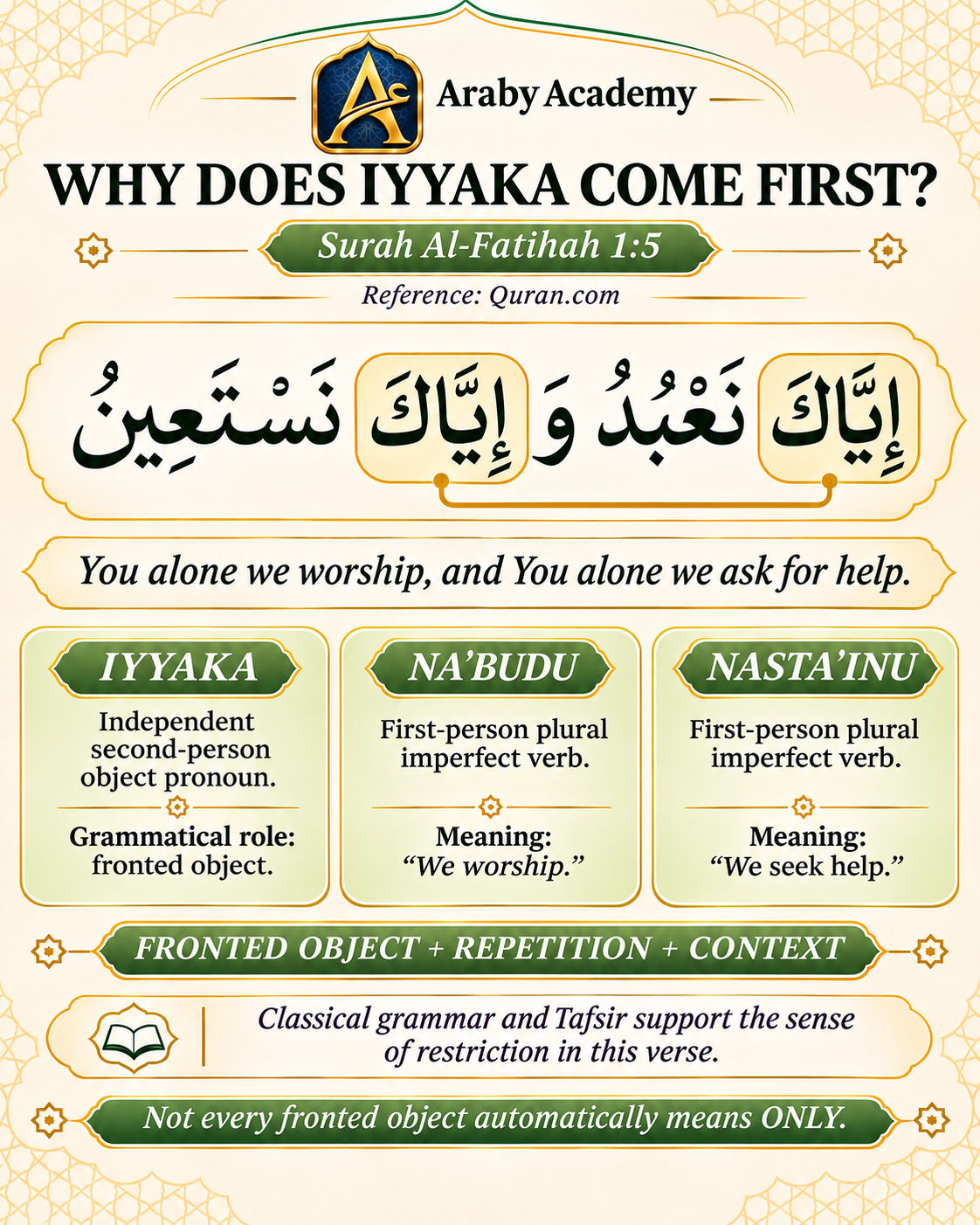
1. Iyyaka Na'budu: Why "You Alone" Comes First
إِيَّاكَ نَعْبُدُ وَإِيَّاكَ نَسْتَعِينُ (Quran 1:5)
Teaching translation: "You alone we worship, and You alone we ask for help."
Grammar: إِيَّاكَ (Iyyaka) is an independent second-person object pronoun, accusative in function, and the object of نَعْبُدُ (na'budu), a first-person plural imperfect verb. It is not the subject, and it is not the attached pronoun of a form like na'buduka. The pattern repeats with نَسْتَعِينُ (nasta'in), "we seek help."
Alternative: نَعْبُدُكَ is grammatical and means "we worship You." Illustrative Arabic, NOT Quran. It does not reproduce every nuance of the actual verse.
Effect: Classical grammarians and commentators such as Al-Zamakhshari and Ibn Kathir explain the fronted object here as conveying restriction: worship and seeking help are directed to Allah alone. The repetition of Iyyaka and the verse's place in Al-Fatihah support that reading. The fronted pronoun in Al-Fatihah is one example of [ Quranic expressions whose Arabic structure carries more detail than a short English translation], especially when word order and repetition work together. This is a conclusion about this construction, not a rule that every fronted object means "only."
English: Sahih International reads "It is You we worship and You we ask for help," while Pickthall adds "(alone)" in parentheses. Each communicates focus by a different English device.
Avoid: calling Iyyaka the subject because it comes first.
Try it: Which word is the object? Where does it appear? Why is it repeated? Which English word conveys the recognized emphasis?
Takeaway: Position plus context, not position alone, supports the sense of "alone."
2. Wa Rabbaka Fakabbir: The Object Before the Command
وَرَبَّكَ فَكَبِّرْ (Quran 74:3)
Teaching translation: "And your Lord, magnify."
Grammar: رَبَّكَ (Rabbaka) is the direct object of كَبِّرْ (kabbir), an imperative meaning "declare great." It is accusative, with the pronoun -ka attached, and it is not a nominative subject; the addressee is the understood subject. وَ links this command to the previous one. فَ is a connective whose function grammarians discuss, and Al-Zamakhshari reads it as carrying a conditional-like sense: whatever happens, do not neglect glorifying your Lord.
Context: Quran 74:1–7 is a chain of commands: arise and warn, glorify your Lord, purify your garments, avoid the filth, and be patient for your Lord's sake. Several clauses place the object or phrase first and join it with فَ, so the pattern belongs to the passage, not to this phrase alone.
Alternative: كَبِّرْ رَبَّكَ is grammatical. Illustrative Arabic, NOT Quran.
Effect: Fronting gives prominence to the Lord as the one to be glorified. Some commentators discuss specification, but word order is not the sole source of the verse's message.
English: A structurally close rendering sounds stiff, so translators usually write "glorify your Lord," moving the object after the verb.
Avoid: reading the verse apart from 74:1–7.
Try it: Which word is fronted? What is the imperative? Which commands appear nearby?
Takeaway: A fronted object inside a command sequence highlights what the command targets.
3. 'Ala Allah Falyatawakkal: A Fronted Phrase About Reliance
وَعَلَى اللَّهِ فَلْيَتَوَكَّلِ الْمُؤْمِنُونَ (Quran 3:122)
Teaching translation: "And upon Allah let the believers rely."
Grammar: وَعَلَى اللَّهِ is a prepositional phrase, not a direct object, because the verb تَوَكَّلَ takes عَلَى. فَلْيَتَوَكَّلِ is a third-person jussive verb with the command-lam (lam al-amr), and الْمُؤْمِنُونَ (al-mu'minun) is its subject, nominative with -un.
Context: The verse follows mention of two groups among the believers who nearly lost heart, "while Allah was their ally." Classical commentators connect the passage to the Battle of Uhud.
Alternative: وَلْيَتَوَكَّلِ الْمُؤْمِنُونَ عَلَى اللَّهِ is grammatical. Illustrative Arabic, NOT Quran. The two orders should not automatically be treated as interchangeable in every context.
Effect: Fronting directs attention to Allah as the object of reliance. Some classical explanations discuss exclusivity here; that claim belongs to those commentators, not to a general rule. The role of the fronted phrase and its connecting particles becomes clearer after studying small Arabic words and particles that shape Quranic sentence meaning, since these elements affect how a clause is organized.
English: "Upon Allah let the believers rely" keeps the order; "let the believers put their trust in Allah" does not, yet the meaning survives.
Avoid: generalizing that every fronted prepositional phrase signals exclusivity.
Try it: What is the fronted phrase? Which verb follows? Who is instructed to rely?
Takeaway: Fronting can spotlight the referent; exclusivity must be argued from context.
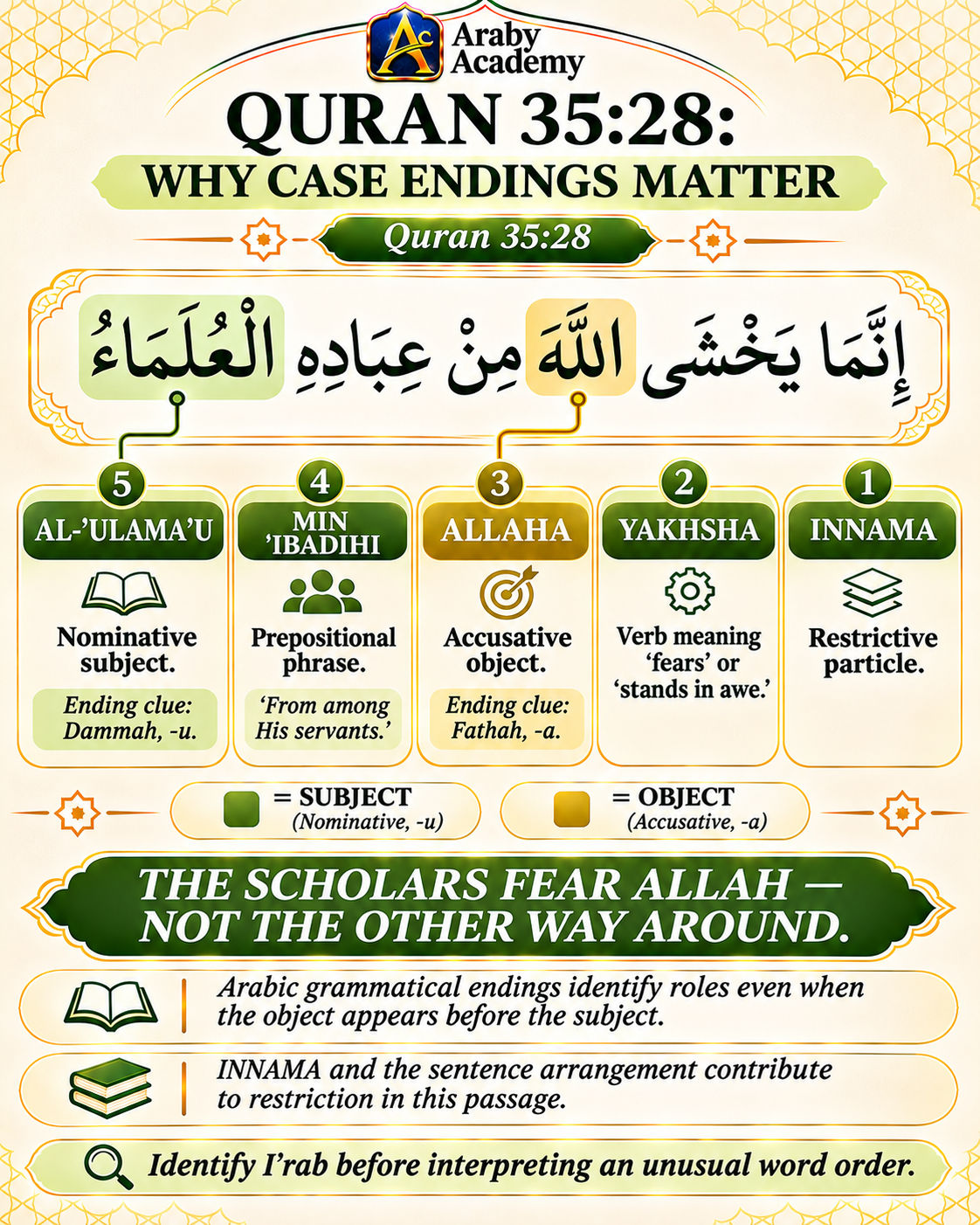
4. Innama Yakhsha Allaha: Why I'rab Matters
إِنَّمَا يَخْشَى اللَّهَ مِنْ عِبَادِهِ الْعُلَمَاءُ (Quran 35:28)
Teaching translation: "Only those of His servants who have knowledge truly fear Allah."
Word | Role | Ending clue |
|---|---|---|
اللَّهَ (Allaha) | Object | Accusative, -a |
الْعُلَمَاءُ (al-'ulama'u) | Subject | Nominative, -u |
مِنْ عِبَادِهِ | Prepositional phrase, "from among His servants" | Genitive, -i |
Grammar: The verb يَخْشَى (yakhsha) comes with its object اللَّهَ first and its subject الْعُلَمَاءُ last, with مِنْ عِبَادِهِ in between. The scholars, those who have knowledge, are the ones who fear; Allah is the one feared. The phrase مِنْ عِبَادِهِ is not the subject.
Warning: "The Quran literally says Allah fears the scholars" is a serious misreading. English readers who judge roles by position get it backwards; the endings correct them. This verse demonstrates why understanding I'rab and Arabic case endings is essential for reading Quranic sentences, because word position alone does not always identify the subject and object.
Effect: إِنَّمَا (Innama) is a restrictive particle, and grammarians explain that it limits the statement to the element placed last. So keeping الْعُلَمَاءُ last matters. The restriction comes from Innama and this arrangement together, not from the object's position alone. Commentators explain "knowledge" here as knowing Allah's power and majesty, in light of the preceding verses on creation's signs.
Alternative: إِنَّمَا يَخْشَى الْعُلَمَاءُ اللَّهَ is grammatical but shifts the focus. Illustrative Arabic, NOT Quran.
English: Translators commonly put the subject first. Sahih International has "Only those fear Allah, from among His servants, who have knowledge"; Pickthall has "The erudite among His bondmen fear Allah alone." Rearranging English here is normal, not a mistranslation.
Try it: Which noun is accusative? Which is nominative? Who performs the verb? What does Innama do?
Takeaway: Read the endings first, then the order.
5. Lakum Dinukum Wa Liya Din: Parallel Contrast
لَكُمْ دِينُكُمْ وَلِيَ دِينِ (Quran 109:6)
Teaching translation: "For you is your religion, and for me is my religion."
Grammar: لَكُمْ (lakum) is a prepositional phrase that serves as the fronted predicate, and دِينُكُمْ (dinukum) is the delayed subject, nominative with an attached pronoun. وَلِيَ (wa-liya) opens the matching clause, and دِينِ (dini) is its subject, with the final ya dropped in writing and a kasra as the sign of "my." These are nominal sentences with no written verb. Grammarians treat the phrase itself as the predicate, so no verb should be mechanically assigned.
Effect: The two clauses mirror each other: to you, your din; to me, my din. The repeated organization makes the distinction clear. Some scholars discuss specification in لَكُمْ, but it is an overstatement to say fronting alone creates exclusive possession; the contrast comes from the parallelism and the Surah's repeated disavowals in worship.
Context: Reading all of Surah Al-Kafirun, the verse closes a refusal to share worship. Tafsir does not treat it as a modern slogan that all religions are doctrinally identical or equally true. The balanced construction of Lakum Dinukum also helps explain how nominal and verbal sentences work differently in Quranic Arabic, because Arabic can express complete statements without an explicit verb equivalent to the English word "is."
English: Pickthall's "Unto you your religion, and unto me my religion" keeps the order; Sahih International adds "is": "For you is your religion, and for me is my religion."
Avoid: claiming every fronted prepositional predicate means exclusive possession.
Try it: Which phrases come first? Which nouns follow? How are the clauses parallel?
Takeaway: Grammar gives the parallel frame; context gives its meaning.
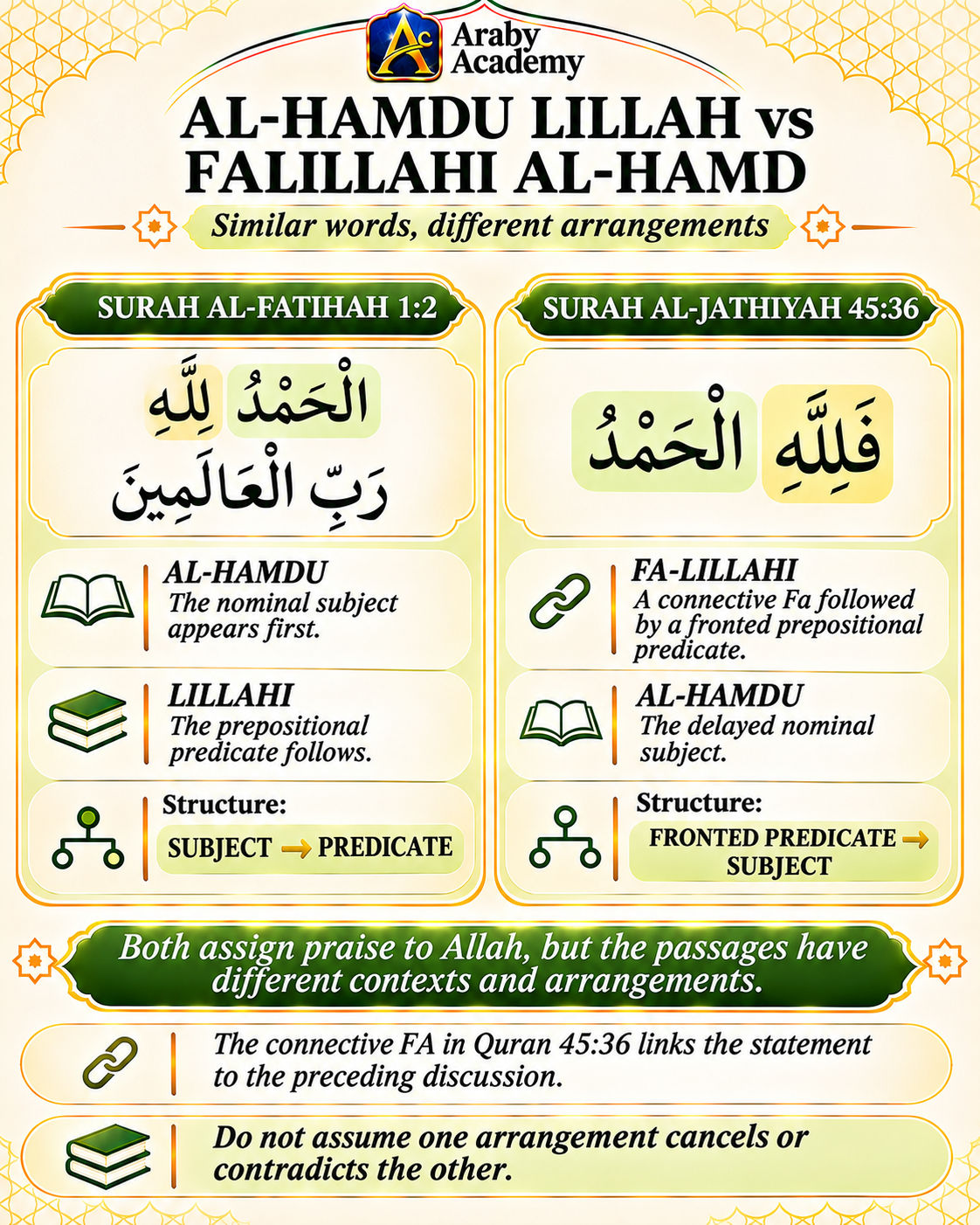
6. Falillahi Al-Hamd: Comparing Two Quranic Arrangements
Quran 1:2: الْحَمْدُ لِلَّهِ رَبِّ الْعَالَمِينَ
Quran 45:36: فَلِلَّهِ الْحَمْدُ
Grammar: In 1:2, الْحَمْدُ (al-hamdu) comes first as the subject, with the prepositional phrase لِلَّهِ (lillahi) as predicate. In 45:36, the prepositional phrase comes first as a fronted predicate, and الْحَمْدُ is the delayed subject.
The connective: The verse in Surah Al-Jathiyah begins with فَ, which ties it to the preceding discussion of the Day of Judgment and the fate of the deniers. The two verses are not identical sentences with two words swapped; the contexts and the additional wording differ.
Effect: Scholars of tafsir and balaghah discuss how the 45:36 arrangement, after that discourse, gives prominence to whom praise belongs, with a continuing series of "Lord of the heavens, Lord of the earth, Lord of the worlds." This does not mean 1:2 lacks that sense; the arrangements do not contradict each other. Comparing Falillahi Al-Hamd with Al-Hamdu Lillah becomes more useful when readers study [ the meaning and grammatical structure of Surah Al-Fatihah], where the familiar opening praise appears in its full context.
Avoid: comparing the phrases without their surrounding verses.
Try it: Which phrase comes first in 1:2? In 45:36? How does the latter begin?
Takeaway: Similar vocabulary, different arrangements and contexts.
7. Inna Ilayna Iyabahum: Fronted Predicates and Parallelism
إِنَّ إِلَيْنَا إِيَابَهُمْ (Quran 88:25)
ثُمَّ إِنَّ عَلَيْنَا حِسَابَهُمْ (Quran 88:26)
Teaching translation: "Indeed, to Us is their return. Then indeed, upon Us is their reckoning."
Grammar: إِنَّ (Inna) takes a noun in the accusative and a predicate. Here إِلَيْنَا (ilayna) is the fronted prepositional predicate, and إِيَابَهُمْ (iyabahum) is the postponed noun of Inna, accusative, not a nominative subject. ثُمَّ (thumma) connects the second statement, whose predicate عَلَيْنَا ('alayna) and noun حِسَابَهُمْ (hisabahum) mirror the first. The order is not forced here, unlike some constructions where a pronoun in the noun refers back to the predicate.
Context: In 88:21–26, the Messenger is told to remind, since he is not a controller over them, and the passage closes with their return and accounting being with Allah. Do not detach the verses from it.
Effect: إِلَى points to destination, "to Us," and عَلَى here expresses responsibility, "upon Us." The two are related but not interchangeable, and return and reckoning are not identical events.
Divine plural: The "Us" refers to Allah in divine speech and does not imply multiple gods. The first-person plural forms in these verses also connect with [ why the Quran sometimes refers to Allah as 'He,' 'We,' or 'I'], although pronoun choice and fronted word order are different grammatical subjects.
Try it: What follows Inna? Which nouns come later? How do Ilayna and 'Alayna differ?
Takeaway: Fronted predicates after Inna can build parallel emphasis within the passage.
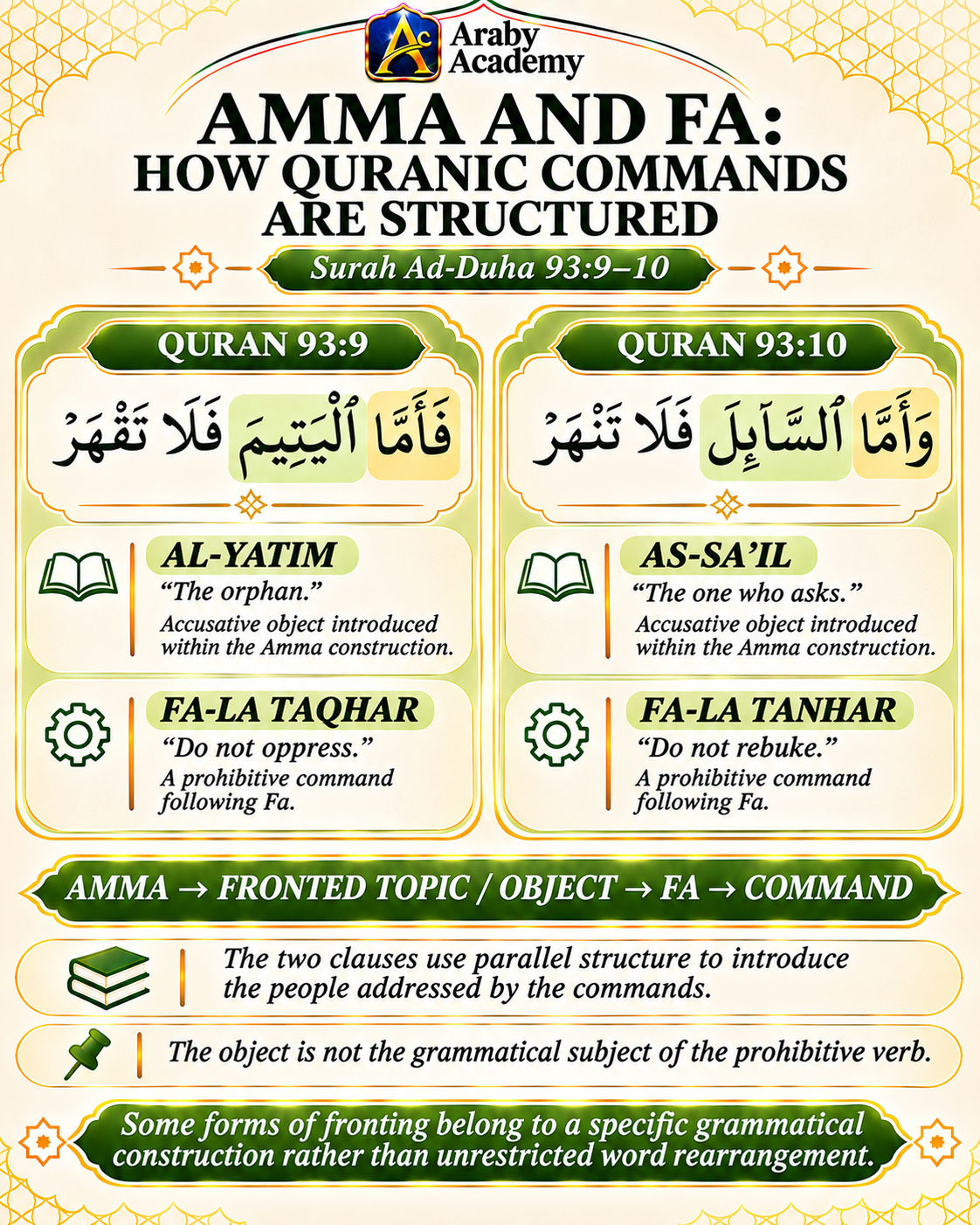
8. Fa-Amma Al-Yatima: Topics and Commands
فَأَمَّا الْيَتِيمَ فَلَا تَقْهَرْ
وَأَمَّا السَّائِلَ فَلَا تَنْهَرْ (Quran 93:9–10)
Teaching translation: "As for the orphan, do not oppress. And as for the one who asks, do not rebuke." ("As for" is a teaching device, not a quoted translation.)
Grammar: أَمَّا (Amma) introduces a topic and is normally answered by فَ, with something placed between them. Here that something is الْيَتِيمَ (al-yatima), the accusative object of the prohibitive verb تَقْهَرْ (taqhar). Likewise السَّائِلَ (al-sa'ila) is the object of تَنْهَرْ (tanhar). The subject of both verbs is the addressee, not the orphan or the questioner. This is a grammatical construction, not unrestricted free rearrangement.
Alternative: لَا تَقْهَرِ الْيَتِيمَ is grammatical and means "do not oppress the orphan." Illustrative Arabic, NOT Quran. It lacks the topic-setting force of Amma.
Context: In Quran 93:6–11, the commands follow earlier reminders of Allah's care. Commentators link the commands to gratitude for that care. No specific anecdote or legal ruling should be built from word order alone.
Effect: The parallel clauses set two categories of people before the command and mirror each other, giving a balanced instruction.
English: Many translators drop "as for" and write "do not be harsh with the orphan."
Avoid: treating Amma as a decoration.
Try it: What does Amma introduce? Which noun comes first? What is prohibited?
Takeaway: A fronted word can be required by its construction.
9. Wa Fawqa Kulli Dhi 'Ilmin 'Alim: A Fronted Locative Expression
وَفَوْقَ كُلِّ ذِي عِلْمٍ عَلِيمٌ (Quran 12:76)
Teaching translation: "And above every possessor of knowledge is One more knowing."
Grammar: فَوْقَ (fawqa) is a locative adverb functioning as the fronted predicate. كُلِّ ذِي عِلْمٍ ("every possessor of knowledge") is a genitive chain, and عَلِيمٌ ('alimun) is the delayed subject, nominative and indefinite. Grammarians note that an indefinite subject with an adverbial predicate normally requires the predicate first, so this order is conditioned by grammar. The structure of this phrase becomes easier to analyze when students recognize Quranic Arabic grammar clues that identify subjects, predicates, and relationships, rather than deciding grammatical roles from English word order alone.
Context: The verse falls in the narrative of Yusuf, after the stratagem by which his brother was kept, with Allah saying that He raises in degrees whom He wills. This is part of the story, not an abstract maxim.
Effect and Tafsir: Commentators discuss that above each knower is one who knows more, with knowledge ultimately belonging to Allah. Whether عَلِيمٌ here is a Divine Name or a general adjective is a matter of commentary, so it should not be read identically to every occurrence of "Al-'Alim." A word-order observation cannot supply the full Tafsir.
Alternative: Placing عَلِيمٌ before the locative would be unnatural for an indefinite subject. We compare it conceptually: in English, "One more knowing is above every knower" is possible but shifts attention.
English: Translators may keep "above" first or move it, since English has no equivalent requirement.
Try it: What is the opening locative expression? Which noun comes later? Why does context matter?
Takeaway: Some fronting is simply how this construction works.
10. 'Alayhi Tawakkaltu Wa Ilayhi Unib: Parallel Fronting
عَلَيْهِ تَوَكَّلْتُ وَإِلَيْهِ أُنِيبُ (Quran 11:88)
Teaching translation: "Upon Him I rely, and to Him I turn."
Speaker: The words belong to Prophet Shu'ayb in the Quranic narrative, as he addresses his people. They are not Allah speaking of Himself.
Grammar: عَلَيْهِ ('alayhi) is a preposition with an attached pronoun, fronted before تَوَكَّلْتُ (tawakkaltu), a first-person perfect verb. وَإِلَيْهِ (wa-ilayhi) is a second fronted phrase before أُنِيبُ (unibu), a first-person imperfect verb meaning "I turn in repentance and return." Neither phrase is a direct object.
Context: The verse also says وَمَا تَوْفِيقِي إِلَّا بِاللَّهِ ("my success is only through Allah"). That clause uses negation and exception, a different grammatical means of restriction. It is a comparison, not an eleventh example, and it helps explain the statement that follows.
Effect: Two parallel fronted phrases give prominence to the one relied upon and the one turned to. The meaning is not reducible to English word order alone.
Avoid: attributing the first-person verbs to Allah.
Try it: Which phrases precede the verbs? Who speaks? What do the pronouns refer to?
Takeaway: Identify the speaker before interpreting the emphasis.
The 10 Examples at a Glance: Master Table
Verse | Fronted or delayed | Construction | Supported effect | Caution |
|---|---|---|---|---|
1:5 | Object pronoun | Fronted object | Restriction in context | Not every fronted object means "only" |
74:3 | Object | Object before imperative | Prominence | Read with 74:1–7 |
3:122 | Prepositional phrase | Fronted phrase | Focus of reliance | Exclusivity must be argued |
35:28 | Object before subject | Innama plus case endings | Restriction | Do not reverse roles |
109:6 | Predicates | Nominal parallel | Contrast | Not doctrinal equivalence |
45:36 | Predicate | Fa plus fronted predicate | Prominence of praise | Not identical to 1:2 |
88:25–26 | Predicates | Inna plus predicate | Parallel emphasis | "Us" is not plural gods |
93:9–10 | Object | Amma plus command | Topic plus parallel | Required construction |
12:76 | Locative predicate | Indefinite subject | Conditioned order | Do not derive Tafsir from order |
11:88 | Prepositional phrases | Two fronted phrases | Parallelism | Speaker is Shu'ayb |
Does Fronting Always Mean Exclusivity?
No. The ten examples fall into three teaching groups, not a complete taxonomy of Arabic syntax. Fronted objects: 1:5 and 74:3. Fronted prepositional or predicative phrases: 3:122, 109:6, 45:36, 88:25–26 and 11:88. Other marked structures: 35:28 (object–subject order with I'rab and Innama), 93:9–10 (Amma) and 12:76 (locative predicate).
Not every unusual order is an optional rearrangement. Some constructions require or favor a particular order, such as Amma clauses and indefinite subjects with adverbial predicates, so "unusual compared with English" does not mean "optional in Arabic."
Taqdim wa Ta'khir concerns structural order, while Iltifat concerns shifts in perspective or address, so they should not be confused. Finally, grammar shows that something is fronted, rhetoric asks why that may matter, and Tafsir uses wider evidence. Fronting alone does not authorize a doctrinal conclusion.
Why English Translations Change Arabic Word Order
English relies on subject–verb–object order, so translators naturally rearrange. That is a legitimate decision, not automatically a mistranslation. Four levels of rendering can be distinguished, using 1:5 as an example: a gloss ("You-alone we-worship"), a structurally close translation ("You alone we worship"), a natural one ("We worship You alone"), and a Tafsir explanation of restriction. These are teaching renderings, not quotations.
English can still communicate focus with words like "alone," "only," punctuation or a footnote. The word "almost" in the title reflects differences between languages and translation goals, not deliberate concealment.
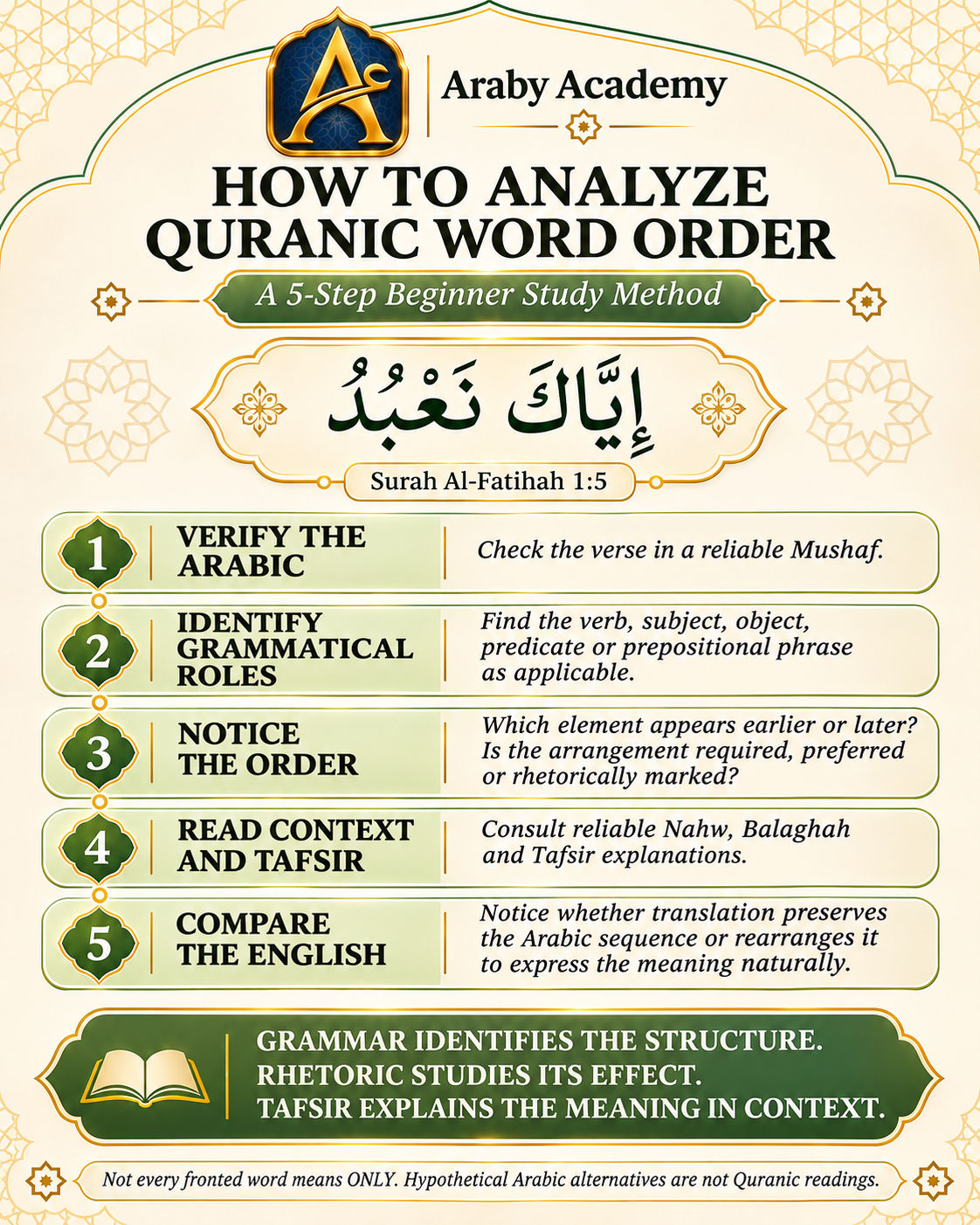
How to Analyze Quranic Word Order Step by Step
Verify the wording against a reliable Mushaf.
Identify the grammatical roles of each word.
Look for fronted, delayed or specially arranged elements.
Read the full verse and consult reliable grammar and Tafsir.
Compare a trustworthy English translation and write one evidence-based observation.
After identifying the Arabic structure, students can explore [ why English Quran translations sometimes use different wording] to understand why a translator may preserve the meaning without copying the original sentence order.
Worked check, 35:28: the verb is يَخْشَى, the object is اللَّهَ, the subject is الْعُلَمَاءُ, the intervening phrase is مِنْ عِبَادِهِ, and Innama restricts. 109:6: لَكُمْ and وَلِيَ are the fronted prepositional phrases, دِينُكُمْ and دِينِ follow, and the whole Surah supplies context. 88:25–26: Inna is followed by إِلَيْنَا and عَلَيْنَا, then by إِيَابَهُمْ and حِسَابَهُمْ, and the passage on reminding and accountability gives context.
Notebook: record verse, phrase, fronted word, role, sourced note, English handling, caution and review date. Example: 35:28 / Allaha / accusative object / Innama restriction / subject-first English / do not reverse roles.
A seven-day plan (no mastery promised): day 1, 1:5; day 2, 74:3 and 3:122; day 3, 35:28; day 4, 109:6 and 45:36; day 5, 88:25–26; day 6, 93:9–10 and 12:76; day 7, 11:88 and review. A ten-minute session might give two minutes each to reading, roles, order, context and comparison, as a suggestion only.
Common Word-Order Mistakes and Myths
Arabic must follow English order. It does not.
The first noun is the subject. Roles come from grammar and endings.
Every fronted phrase is a direct object or means "only." Fronting has different functions.
Innama or Amma is decoration. Each shapes the sentence.
Arabic always uses VSO, or can be rearranged freely. Neither is true.
Every word-order choice is a miracle. Scholars may differ on effects.
A hypothetical rearrangement is another Qira'ah. It is not; it is a teaching device.
Word order alone yields legal or theological conclusions. Tafsir is required.

Frequently Asked Questions
Why does word order matter in the Quran? It can affect emphasis, focus or contrast, though the effect must be shown from grammar and context.
What is Taqdim wa Ta'khir in Arabic? It is the placement of an element earlier or later in a structure, studied for grammatical and rhetorical reasons.
Does Arabic normally use SVO or VSO order? Both occur, along with other constructions. VSO is very common in verbal sentences, but no single order is universal.
Can word order change the meaning of a Quranic verse? It can change emphasis or information structure, but a different order is not automatically a different doctrine.
Does putting a word first always mean "only"? No. Restriction depends on the construction and context.
Why does Quran 1:5 begin with Iyyaka? The fronted object pronoun, with its repetition, is explained by classical scholars as conveying that worship and help are for Allah alone.
Why does Quran 74:3 put Rabbaka before the command? It foregrounds the Lord as the one to be glorified, within the chain of commands in 74:1–7.
What does 'Ala Allah Falyatawakkal mean? "And upon Allah let the believers rely." The fronted phrase directs attention to the one relied upon.
Who fears Allah in Quran 35:28? Those of His servants who have knowledge. Al-'Ulama'u is nominative, the subject; Allaha is accusative, the object.
How do Arabic case endings identify the subject? Endings such as nominative -u and accusative -a mark roles, so position alone does not decide.
Why does Surah Al-Kafirun say Lakum Dinukum first? Lakum is a fronted predicate in a nominal sentence, creating a parallel with Wa-liya Din.
What is the difference between Al-Hamdu Lillah and Falillahi Al-Hamd? Both assign praise to Allah. The second fronts the predicate and begins with Fa, in a different context.
What is a fronted predicate in Arabic? It is a predicate placed before its subject, by choice or by grammatical requirement.
Why does Quran 88:25 begin with Inna Ilayna? Inna is followed by a fronted prepositional predicate, with the noun Iyabahum delayed, in parallel with 88:26.
What does Amma do in Quran 93:9? It introduces a topic and is answered by Fa, with the fronted noun standing between them.
Why does Quran 12:76 begin with Fawqa? Fawqa is a fronted adverbial predicate; the indefinite subject 'Alimun conditions the order.
Do English Quran translations preserve Arabic emphasis? Often, through words like "alone," punctuation or notes, even when the sequence changes.
Do I need Tafsir to understand Quranic word order? Yes. Grammar identifies the arrangement, while Tafsir and context help explain its significance.
Notice the Order, Check the Grammar, Read the Context
We began with إِيَّاكَ نَعْبُدُ, and the position of Iyyaka now makes grammatical sense. We have also learned that no universal rule says every fronted word means "only." Quranic Arabic word order becomes easier to appreciate when you stop treating the Arabic sentence as an English sentence with its words rearranged. Each example deserves careful attention to grammar, context and reliable Tafsir. Begin by recognizing the structure, then investigate its effect, without assuming every unusual arrangement carries the same meaning. Araby Academy's qualified teachers are glad to help you study Quranic Arabic and Tafsir step by step.