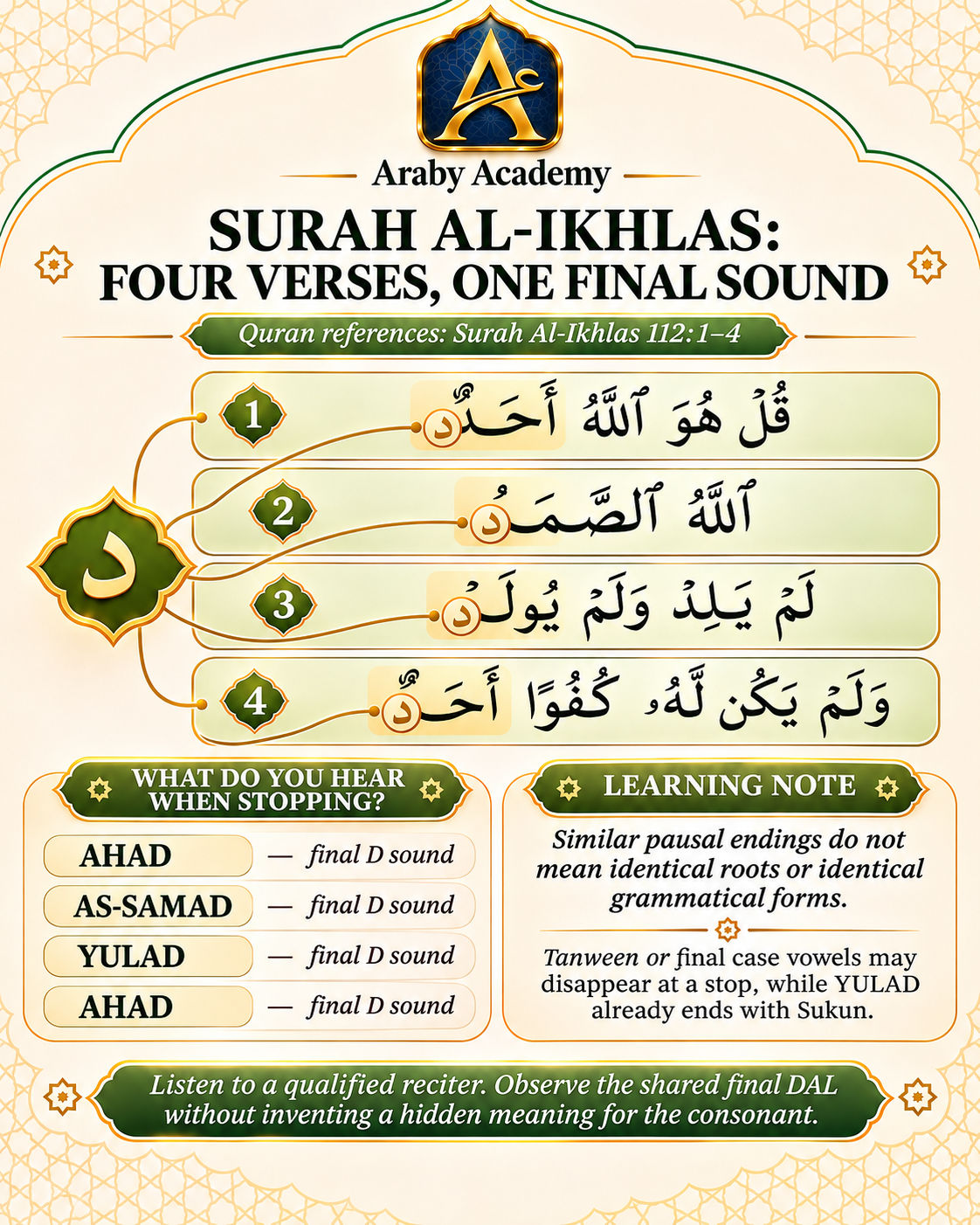
Listen to Surah Al-Ikhlas (Quran 112:1–4). Its four short verses close with Ahad, Al-Samad, Yulad, and Ahad, and when the reciter pauses, the endings share a recognizable final consonant. A beginner may wonder: Why do these endings sound related? Does every Surah do this? Is it rhyme? What does the word Fawasil mean? Does stopping change what I hear? This article answers through ten Quranic examples, each teaching something different.
The Short Answer: What Are Fawasil in the Quran?
Many Quranic verses have similar-sounding endings because their final words form recognizable phonetic and rhetorical patterns. Quranic scholarship studies these endings through the concept of Fawasil (فَوَاصِل), the plural of Fasilah (فَاصِلَة). Such patterns may involve similar consonants, long vowels, parallel grammatical forms, or repeated refrains. However, not every verse rhymes, and Quranic verse endings are not simply poetic rhyme. Their sound and structure should be studied together with Arabic grammar, recitation, context, and reliable Tafsir.
Why Do Quranic Verse Endings Sometimes Sound Similar?
A Fasilah marks where one stretch of Quranic discourse closes and the next begins. Classical definitions vary: some identify it with the final word of an Ayah, comparing it to the qafiyah of poetry and the qarinah of Saj’, while scholars also discussed its relationship to ra’s al-ayah, the “head” of the verse. Ilm al-Fawasil (عِلْمُ الْفَوَاصِل) studies these endings within Quranic Sciences. It overlaps with, but is not identical to, verse counting and Waqf wa Ibtida, the rules for stopping and resuming.
An ending may share consonants or vowels with its neighbours, repeat grammatical forms or a whole phrase, contrast with nearby endings, conclude a sentence, or resemble its neighbours only partially. Perfect English-style rhyme is not required, and no verse must match its neighbours.
Before exploring these sound patterns, beginners can study [what Quranic Arabic involves beyond learning isolated words] to understand how pronunciation, grammar, and meaning work together.
Ayah boundaries belong to the transmitted Quranic tradition, not to modern punctuation. A grammatical clause need not end at a printed verse marker, and an English sentence break does not necessarily match an Arabic one. Several recognized counting traditions exist; this article follows the Hafs ʿan ʿĀsim numbering of most printed Mushafs.
A Quranic word can have a written form, a fully inflected form, a connected-recitation form, and a different pausal form. For example, أَحَدٌ is written with Tanween but heard as Ahad when the reciter stops. The difference between a written ending and its pronunciation at a pause becomes easier to recognize after learning [how Arabic Harakat affect vowels and word forms], especially when reading a fully vocalized Mushaf.
Students listening for similar verse endings should also review [common Arabic letter-pronunciation mistakes in Quran reading], because confusing two Arabic consonants can make distinct endings sound artificially similar.
Is Fawasil the Same as Poetry or Saj’?
Classical Arabic poetry follows a metre (wazn) and a qafiyah (قَافِيَة), the rhyme element recurring at the end of each line. The Quran does not simply follow that structure. It says it is not the speech of a poet (69:41, وَمَا هُوَ بِقَوْلِ شَاعِرٍ) and that the Prophet ﷺ was not taught poetry (36:69). Similar-sounding endings do not make the Quran a poem.
Saj’ (سَجْع), often described as rhymed prose, is more contested. Al-Rummani is commonly cited as distinguishing Quranic Fawasil from Saj’, and al-Baqillani among those who avoided the label, while Ibn Sinan al-Khafaji is commonly cited as accepting it in an eloquent sense. Surveys such as al-Zarkashi’s al-Burhan and al-Suyuti’s al-Itqan record the debate rather than closing it. Since terminology varied, no unanimous verdict can be claimed.
Recognizing formal similarity does not reduce the Quran to ordinary prose. Nor is recitation music: it is devotional and governed by established rules. Words like cadence and refrain describe audible features, not a composition.
10 Quranic Verse-Ending Examples at a Glance
All English renderings here are original paraphrases, not quotations from a published translation.
Surah | References | Observable sound feature | Distinctive learning point |
|---|---|---|---|
Al-Ikhlas | 112:1–4 | Shared final -d when pausing | Different grammar, related ending |
Ad-Duha | 93:1–11 | Long -ā endings, then -har and -th | Pattern shifts with the instructions |
At-Takwir | 81:1–14 | Repeated Idha; endings in -t | Repeated openings differ from endings |
Al-Qari’ah | 101:1–11 | Repeated word; changing endings | Repetition and questions |
Al-‘Adiyat | 100:1–11 | Fathatan heard as -ā at a stop | Pausal pronunciation |
Al-Ghashiyah | 88:1–16 | Many -ah endings | Similar sound, different grammar |
Al-Qamar | 54:17, 22, 32, 40 | Full sentence repeated | Refrain links narrative sections |
Ar-Rahman | 55:13 and later | Repeated question | Dual address |
Al-Mursalat | 77:15 and later | Repeated warning | Warning differs from question |
An-Najm | 53:1–18 | Long -ā across eighteen verses | Same sound, varied grammar |
1. Surah Al-Ikhlas: How Four Short Verses Create a Recognizable Sound Pattern
Quran 112:1–4. The final words are أَحَدٌ (1), الصَّمَدُ (2), يُولَدْ (3), and أَحَدٌ (4). Paraphrase: God is One; God is the Eternal Refuge; He neither begets nor was begotten; none is comparable to Him.
At a pause, Tanween and case vowels drop, so the endings are heard as Ahad, Al-Samad, Yulad, Ahad, each closing on a dāl after a short a. The written forms differ: Ahad is an indefinite noun with Tanween, Al-Samad a definite noun with Damma, Yulad a passive verb already written with Sukun, and the final Ahad plays a different grammatical role from the first. Shared sound does not mean shared root. Because the dāl receives Qalqalah, Tajweed applies here, but noticing the pattern is not itself a Tajweed rule. Tafsir explains the Surah’s affirmation of God’s uniqueness; the consonant carries no extra theological message.
Surah Al-Ikhlas is an excellent starting point for studying short Surahs word by word in Quranic Arabic, because its brief verses make both grammar and verse endings easier to notice.
Try this: Which final consonant recurs? Which words change vowels in connected recitation? How does the pause sound? What does the whole Surah say?
2. Surah Ad-Duha: Why the Verse-Ending Sound Pattern Changes
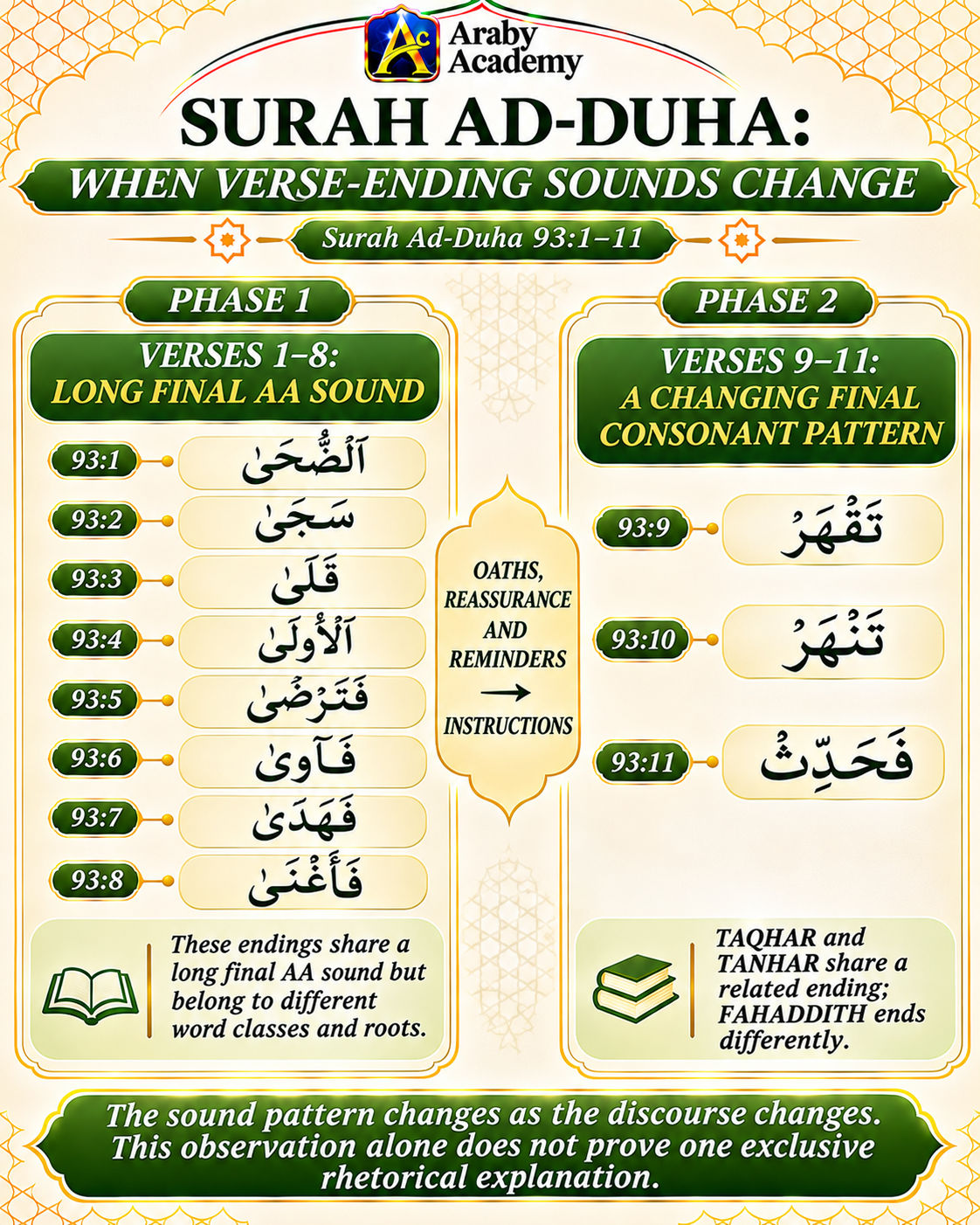
Quran 93:1–11. Verses 1–8 end with الضُّحَىٰ، سَجَىٰ، قَلَىٰ، الْأُولَىٰ، فَتَرْضَىٰ، فَآوَىٰ، فَهَدَىٰ، فَأَغْنَىٰ. Verses 9–11 end with تَقْهَرْ، تَنْهَرْ، فَحَدِّثْ. Paraphrase: By the morning light and the stilled night, your Lord has not forsaken you; you will be satisfied; He sheltered, guided, and enriched you, so do not oppress the orphan or rebuke the one who asks, and speak of your Lord’s blessing.
The first eight endings share a long final ā, written with alif maqsura. The words differ: nouns (Al-Duha, Al-Ula) and verbs (saja, qala, fa-awa, fa-hada, fa-aghna), so this is a vowel relationship, not one root or one pattern. Verses 9–10 change: Taqhar and Tanhar share a final -har, while Fahaddith ends in a different consonant.
The Surah moves from oaths and reassurance to reminders of care, then instructions. The sound change coincides with that shift, and commentators relate the commands to the favours just mentioned. That is an observable pattern plus an interpretation; no single rhetorical cause is universally established. Reports about the occasion of revelation exist in hadith collections, but this article does not rely on them.
The change in Surah Ad-Duha’s sound pattern also encourages readers to study [Quranic expressions whose grammar and context reveal more than a short English translation], rather than treating verse endings as sound alone.
Try this: What pattern fills verses 1–8? What changes in 9–11? Where does the theme shift? Does noticing this prove one rhetorical explanation?
3. Surah At-Takwir: How Repeated Openings and Endings Build a Sequence
Quran 81:1–14. Excerpts: إِذَا الشَّمْسُ كُوِّرَتْ، وَإِذَا النُّجُومُ انكَدَرَتْ، وَإِذَا الْجِبَالُ سُيِّرَتْ، وَإِذَا الْعِشَارُ عُطِّلَتْ. Paraphrase: When the sun is wrapped up, the stars scatter, the mountains are set moving, and pregnant camels are left unattended.
Twelve clauses open with إِذَا (Idha, “when”): 81:1–8 and 81:10–13. This repeated opening organizes a sequence of events, and it is a different feature from verse-final sound. The endings كُوِّرَتْ، انكَدَرَتْ، سُيِّرَتْ، عُطِّلَتْ all close on ت, yet the verbs differ: most are passive, while انكَدَرَتْ is a Form VII verb with an intransitive sense. Each agrees with a feminine subject, which helps explain the shared ending without making them identical. Since the ta is written with Sukun, little changes at a pause.
Verse 14, عَلِمَتْ نَفْسٌ مَّا أَحْضَرَتْ, completes the sequence: a soul will know what it has brought. Tafsir treats the preceding clauses as conditions answered here; it offers no literal visual account, and neither should we.
Studying the repeated structure in At-Takwir becomes even more useful alongside [Quranic word-order examples that show how Arabic organizes emphasis], because repeated openings and sentence arrangement can work together.
Try this: Which word introduces the clauses? Which final consonant recurs? How are the events connected grammatically? What changes at the conclusion?
4. Surah Al-Qari’ah: Repeated Questions, Strong Openings, and Changing Endings
Quran 101:1–11. Verses 1–3: الْقَارِعَةُ، مَا الْقَارِعَةُ، وَمَا أَدْرَاكَ مَا الْقَارِعَةُ. Later endings include الْمَبْثُوثِ، الْمَنفُوشِ، رَاضِيَةٍ، هَاوِيَةٌ، حَامِيَةٌ. Paraphrase: The Striking Calamity! What is the Striking Calamity? And what will make you know what it is?
This is repeated wording, not different words sharing a vowel: Al-Qari’ah recurs three times, first as an opening noun, then inside two questions that commentators often explain as magnifying the matter’s gravity. The endings then change. Al-Mabthuth and Al-Manfush (4–5) share a long ū and a final fricative, but not an identical consonant. Verses 6 and 8 end with the same word, مَوَازِينُهُ, set against ثَقُلَتْ and خَفَّتْ. Rāḍiyah, Hāwiyah, and Ḥāmiyah (7, 9, 11) close with a related -iyah sound, the Ta Marbutah being heard as h at a pause. An opening noun, a rhetorical question, and a descriptive statement are related but distinct. Read the imagery through Tafsir, not imagination or scientific analogy.
The descriptions in Al-Qari’ah also invite readers to explore how Quranic metaphors and imagery are explained through Tafsir, because sound patterns should be considered alongside the actual images and meanings in the verses.
Try this: Which word repeats at the start? What questions follow? How do endings vary later? Why consider the argument, not just the sound?
5. Surah Al-‘Adiyat: How an Opening Cluster of Endings Leads into a New Theme
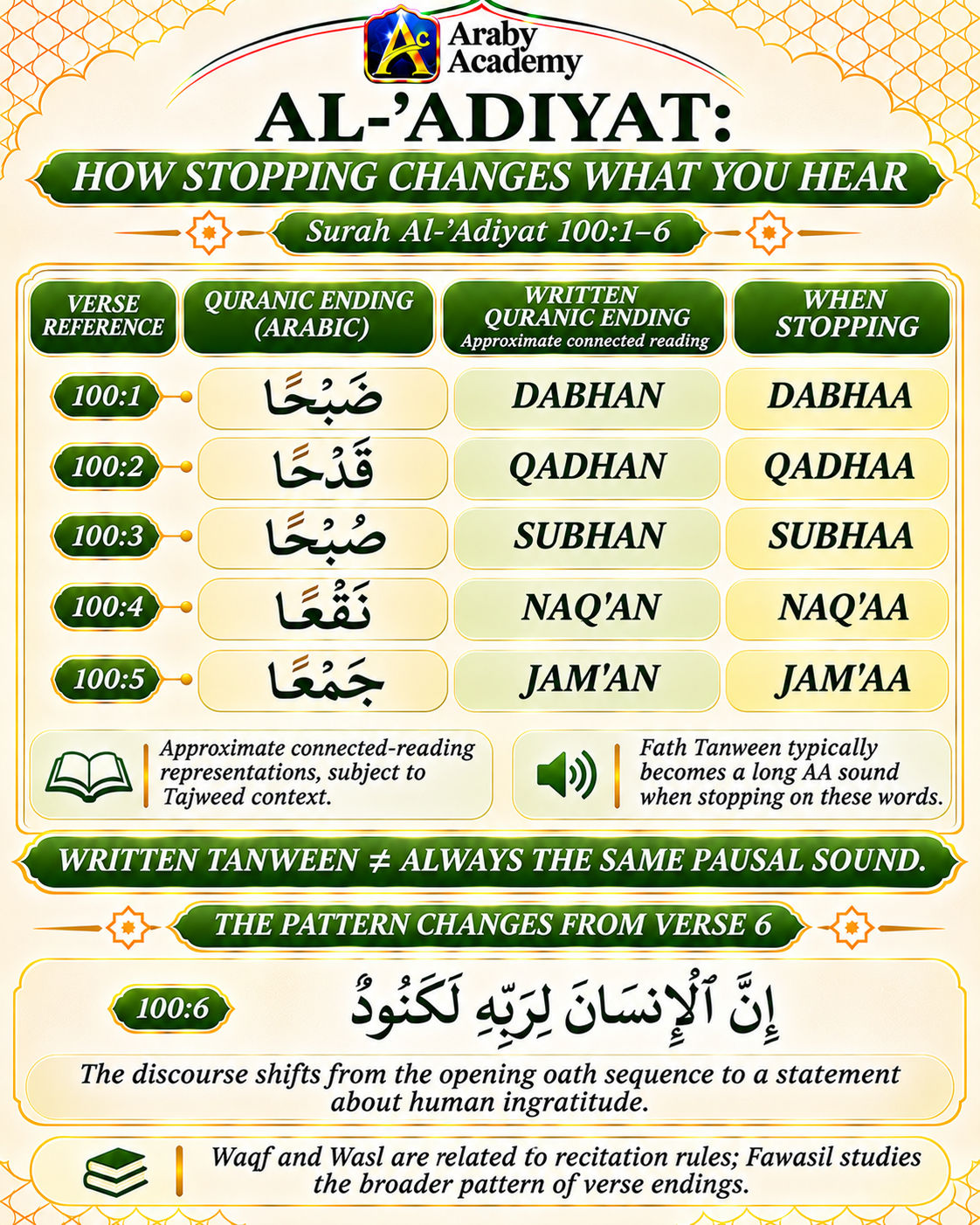
Quran 100:1–6. Verses 1–5 end with ضَبْحًا، قَدْحًا، صُبْحًا، نَقْعًا، جَمْعًا; verse 6 begins إِنَّ الْإِنسَانَ لِرَبِّهِ لَكَنُودٌ. Paraphrase: Indeed, man is ungrateful to his Lord.
Each opening ending carries Fathatan. When the reciter stops, Fathatan becomes a long ā, so the five are heard as roughly -ḥā, -ḥā, -ḥā, -ʿā, -ʿā, while connected recitation keeps the n sound. All five are accusative, but their roles differ: grammarians analyze the first two as cognate or manner accusatives, the third as time, the last two as objects. The verses form an oath sequence; commentators differ over what is sworn by, with war horses widely reported and other views recorded.
At verse 6 the pattern shifts. Verses 6–8 end with -ūd or -īd, and 9–11 with -ūr or -īr. The move from oath imagery to a statement about human behaviour is a discourse transition that can be studied alongside the changing endings, without claiming a particular emotional effect.
Try this: Which five endings sound related? What happens to Tanween at a pause? What changes in verse 6? How does the oath relate to the statement?
6. Surah Al-Ghashiyah: How Related Endings Accompany Contrasting Descriptions
Quran 88:1–16. Verse 2: وُجُوهٌ يَوْمَئِذٍ خَاشِعَةٌ. Verse 8: وُجُوهٌ يَوْمَئِذٍ نَّاعِمَةٌ. Other endings include نَاصِبَةٌ، حَامِيَةً، آنِيَةٍ، رَاضِيَةٌ، عَالِيَةٍ، لَاغِيَةً. Paraphrase: Faces that Day will be humbled; faces that Day will be joyful.
The two verses share a structure but not a meaning: Khashi’ah (humbled) and Na’imah (joyful) are contrasting descriptions, not synonyms. Commentators place the first group in suffering and the second in a lofty garden. Many endings are active-participle forms on the pattern fā’ilah, which partly explains their similarity, while the last four verses (مَرْفُوعَةٌ، مَوْضُوعَةٌ، مَصْفُوفَةٌ، مَبْثُوثَةٌ) are passive participles. Cases differ too: nominative (Khashi’ah), accusative (Hamiyatan, Laghiyatan), genitive (Aniyatin, ‘Aliyatin). The Ta Marbutah is heard as h at a pause but as t with its case vowel in connection, so it is not always a plain English “a.” Visual resemblance is not phonetic identity, and verses 6–7 break the pattern, ending in Dari’ and Ju’.
Try this: Which descriptions concern each group? Which endings sound alike? Which similar-looking words have different grammatical forms?
7. Surah Al-Qamar: Why the Quran Repeats “Is There Anyone Who Will Take Heed?”
Quran 54:17, 22, 32, 40. وَلَقَدْ يَسَّرْنَا الْقُرْآنَ لِلذِّكْرِ فَهَلْ مِن مُّدَّكِرٍ. Paraphrase: We have made the Quran easy for remembrance; is there anyone who will take heed?
This complete sentence returns four times, each after a different narrative section: the people of Nuh (54:9–16), ‘Ad, Thamud, and the people of Lut. The closing question Fahal min muddakir also ends 54:15 and 54:51 with different preceding clauses. That is repetition, not independent words that happen to rhyme.
Muddakir (مُدَّكِر) is an active participle of Form VIII from the root dh-k-r, the root of Dhikr just before it; the infixed ta assimilates, producing the doubled dāl. Its dictionary meaning need not change at each recurrence. A refrain may recall an earlier message, connect sections, reinforce an invitation, and create a recognizable structure, but each function needs contextual support.
The repeated reminder in Al-Qamar becomes clearer when readers consider [how Quranic stories are presented with different emphases and lessons], because the refrain connects distinct narrative sections without making them identical.
Try this: Which verses contain the full refrain? What occurs between them? Does the surrounding material stay identical? Why is this more than a matching final syllable?
8. Surah Ar-Rahman: Why the Same Question Returns Again and Again
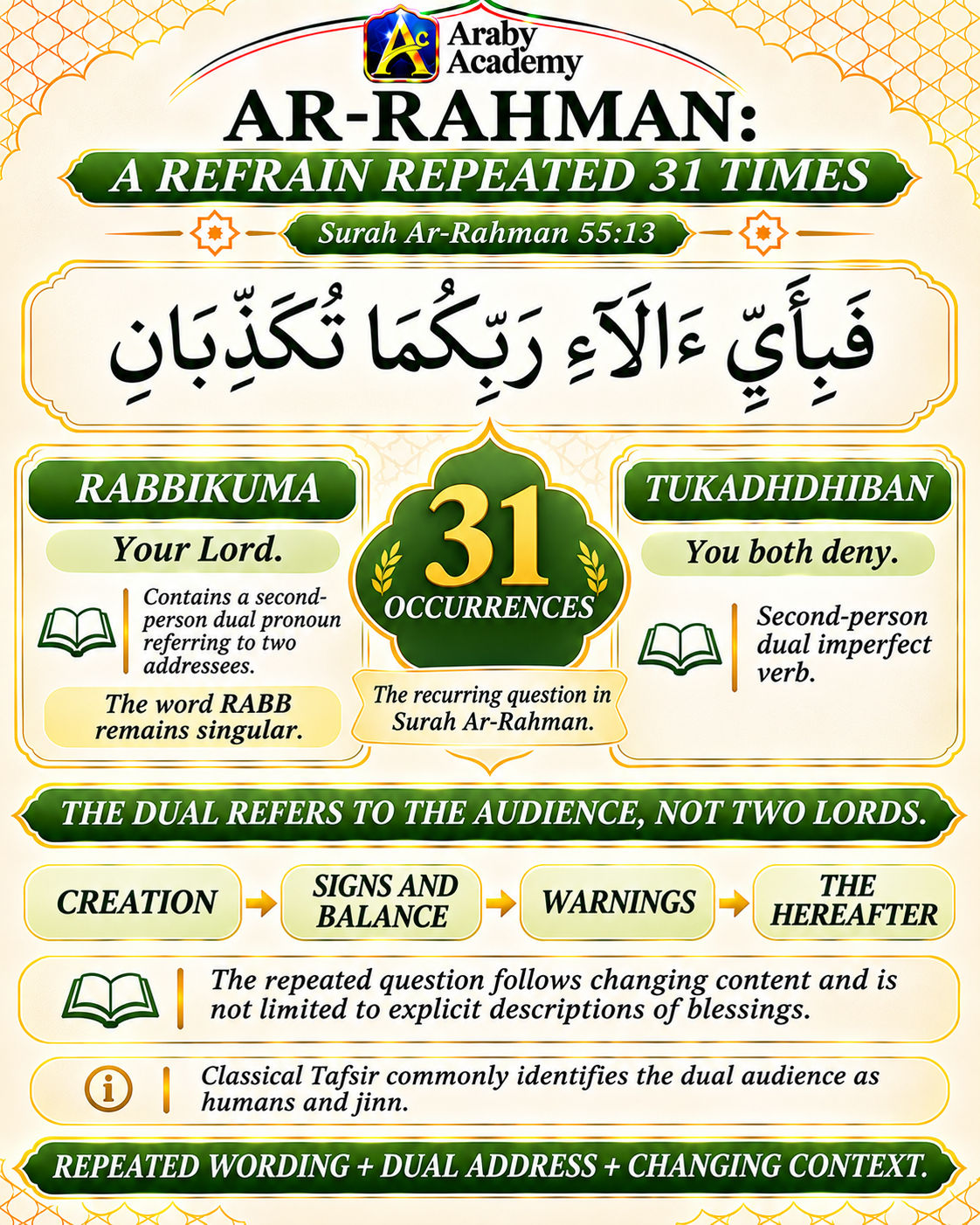
Quran 55:13. فَبِأَيِّ آلَاءِ رَبِّكُمَا تُكَذِّبَانِ. Paraphrase: So which of your Lord’s favours will you two deny?
Counting verse by verse in the Hafs numbering, this question occurs thirty-one times, from 55:13 to 55:77. Both رَبِّكُمَا and تُكَذِّبَانِ are dual: the pronoun kumā and the verb ending -ān address two parties. Commentators commonly identify them as humans and jinn, noting the address to al-thaqalan in 55:31. The dual belongs to the addressees; the Lord is not dual.
The question follows different material: creation and the cosmic balance, the two seas, the perishing of all that is on earth (after 55:26–27, at 55:28), and the punishment of the criminals (after 55:41–44, at 55:45), then the gardens. So it does not always follow an explicit blessing. Identical wording, a repeated construction, a repeated ending, and changing context work together, which is different from unrelated words sharing a final consonant.
The dual forms in Ar-Rahman’s refrain are also a useful introduction to Quranic pronouns and changes in grammatical perspective, because accurate pronoun recognition is essential to understanding who is being addressed.
Try this: Which sentence repeats? Which elements are dual? How does the surrounding passage change? Why does a refrain need more analysis than “it rhymes”?
9. Surah Al-Mursalat: How a Repeated Warning Divides a Passage into Sections
Quran 77:15, 19, 24. وَيْلٌ يَوْمَئِذٍ لِّلْمُكَذِّبِينَ. Paraphrase: Woe, on that Day, to the deniers.
Ten occurrences appear in this Surah: 77:15, 19, 24, 28, 34, 37, 40, 45, 47, and 49. Verse 15 follows the sky’s signs, 19 follows earlier destroyed generations, and 24 follows creation from a despised fluid; later occurrences follow other segments. Without claiming a universally accepted scheme, one can see the refrain marking breaks between argument and description.
Unlike Ar-Rahman’s question, this is a statement, a nominal sentence: Wayl is an indefinite noun, Yawma’idhin a time phrase, and Al-Mukadhdhibin a plural participle. Both repeat, but the grammar and rhetorical contexts differ. The final nun is written with Fatha yet heard with Sukun at a pause, giving -īn; that sound need not match every other verse’s ending.
Try this: Which sentence repeats? What warning does it convey? What changes before each recurrence? How does the refrain organize your reading?
10. Surah An-Najm: How Related Long-Vowel Endings Extend Across a Passage
Quran 53:1–18. Verses 1–5 end with هَوَىٰ، غَوَىٰ، الْهَوَىٰ، يُوحَىٰ، الْقُوَىٰ. Later endings include فَاسْتَوَىٰ، الْأَعْلَىٰ، أَدْنَىٰ، الْكُبْرَىٰ. Paraphrase: By the star when it falls, your companion has neither strayed nor erred, nor speaks from desire.
Reading verses 1–18, every ending carries a long ā, written with alif maqsura. The words, however, differ: verbs (Hawa, Ghawa, Istawa), a passive verb (Yuha), nouns (Al-Hawa, Al-Quwa), and comparative or superlative forms (Al-A’la, Adna, Al-Kubra). Hawa in verse 1 and Al-Hawa in verse 3 look alike but are different grammatical items.
So an extended vowel cluster can occur without shared roots, shared categories, one repeated phrase, or one sentence type, which helps distinguish phonetic patterning from grammatical parallelism. Commentators read the passage as concerning revelation and what the Prophet ﷺ was shown, and differ on some details; claims about unseen matters need Tafsir, not inference from sound.
Try this: Which endings in verses 1–5 share a long vowel? Do their meanings match? What happens in the surrounding discourse? What source would you need before claiming more?
All 10 Verse-Ending Patterns at a Glance
Surah | Type of pattern | What to listen for | Caution |
|---|---|---|---|
Al-Ikhlas | Pausal consonantal similarity | Final -d | Grammar differs |
Ad-Duha | Long vowel, then change | -ā, then -har, -th | No single cause proven |
At-Takwir | Grammatical repetition | Idha; -t | Not rhyme alone |
Al-Qari’ah | Repetition and change | Repeated noun; -iyah | Check Tafsir |
Al-‘Adiyat | Long vowel, then transition | Pausal -ā | Pausing differs from connecting |
Al-Ghashiyah | Contrast | -ah endings | Not synonyms |
Al-Qamar | Full refrain | Same sentence | Context varies |
Ar-Rahman | Full refrain | Dual question | Count by verse |
Al-Mursalat | Full refrain | Same warning | Not Ar-Rahman’s device |
An-Najm | Long-vowel pattern | -ā | Forms differ |
The Difference Between Rhyme, Refrain, and Parallelism
Related sound means different words share audible ending features, as in Al-Ikhlas or An-Najm. A refrain means the same phrase returns, as in Al-Qamar, Ar-Rahman, and Al-Mursalat. Parallelism means similar grammatical organization recurs, as with At-Takwir’s Idha clauses. They can overlap but are not synonyms.
Sound is not morphology: words that end alike can belong to different roots, patterns, cases, or word classes, so shared endings never prove shared meaning, nor that grammar was altered for rhyme.
As teaching groups, not a classical taxonomy, notice five patterns: similar final consonants (Al-Ikhlas); similar long vowels (Ad-Duha, An-Najm); repeated grammatical openings and endings (At-Takwir, Al-‘Adiyat); complete refrains (Al-Qamar, Ar-Rahman, Al-Mursalat); and changing sounds in a developing passage (Ad-Duha, Al-Qari’ah, Al-Ghashiyah). A sound change may coincide with a new topic or scene, but coincidence alone does not prove one intended cause. The responsible statement is: the pattern changes as the discourse shifts.
How Waqf and Wasl Affect What You Hear
Waqf (وَقْف) means stopping; Wasl (وَصْل) means connected recitation. At a stop, Damma and Kasra Tanween become Sukun (أَحَدٌ becomes Ahad), Fathatan usually becomes a long ā (ضَبْحًا becomes Dabha), and Ta Marbutah is heard as h (حَامِيَةٌ becomes Hamiyah). In connected recitation, Tanween and case vowels are heard according to the relevant rules. These are common patterns, not a universal rule for every environment.
Tajweed concerns articulating Quranic sounds correctly: Makharij, Sifat, Madd, Ghunnah, the rules of Nun Sakinah, Tanween, and Mim Sakinah. Fawasil studies verse-ending patterns instead. Noticing a shared ending is not performing a Tajweed rule, though accurate Tajweed helps you hear endings accurately.
Does a Quranic Verse Ending Always Mean You Must Stop?
A marked verse ending and the rules for stopping are related but separate questions. Many scholars regard stopping at verse ends as recommended, citing a report from Umm Salamah that the Prophet ﷺ recited verse by verse. Waqf wa Ibtida scholarship also grades stops by meaning (complete, sufficient, acceptable, or poor) and warns against stops that distort meaning. Neither “always stop” nor “never stop” is a safe slogan; follow a qualified teacher.
Qira’at and Verse Counting: Related but Different
Canonical Qira’at are transmitted readings, not translations, personal accents, or regional dialects. They differ in recognized details of pronunciation, vowelling, or wording; some treat alif-maqsura endings, as in Ad-Duha, with imalah or taqlil. They do not always affect a Fasilah. Verse-counting traditions differ separately, for example over whether the Basmala is counted as an Ayah of Al-Fatihah. Readings, verse numbering, orthography, and recitation are distinct fields, and none changes the Quran’s message.
Readers who want to understand how transmitted Quranic readings relate to pronunciation can continue with an introduction to the Quran’s canonical Qira’at, while keeping the science of readings distinct from the study of verse endings.
Why English Quran Translations Cannot Always Reproduce Arabic Verse Endings
English and Arabic differ in phonology, word forms, and syntax, so a faithful translation often rearranges phrases and cannot keep end sounds. Some translators choose rhythmic English; that is an editorial choice. A translation is not inaccurate because it does not rhyme, and a smooth one is not necessarily more accurate.
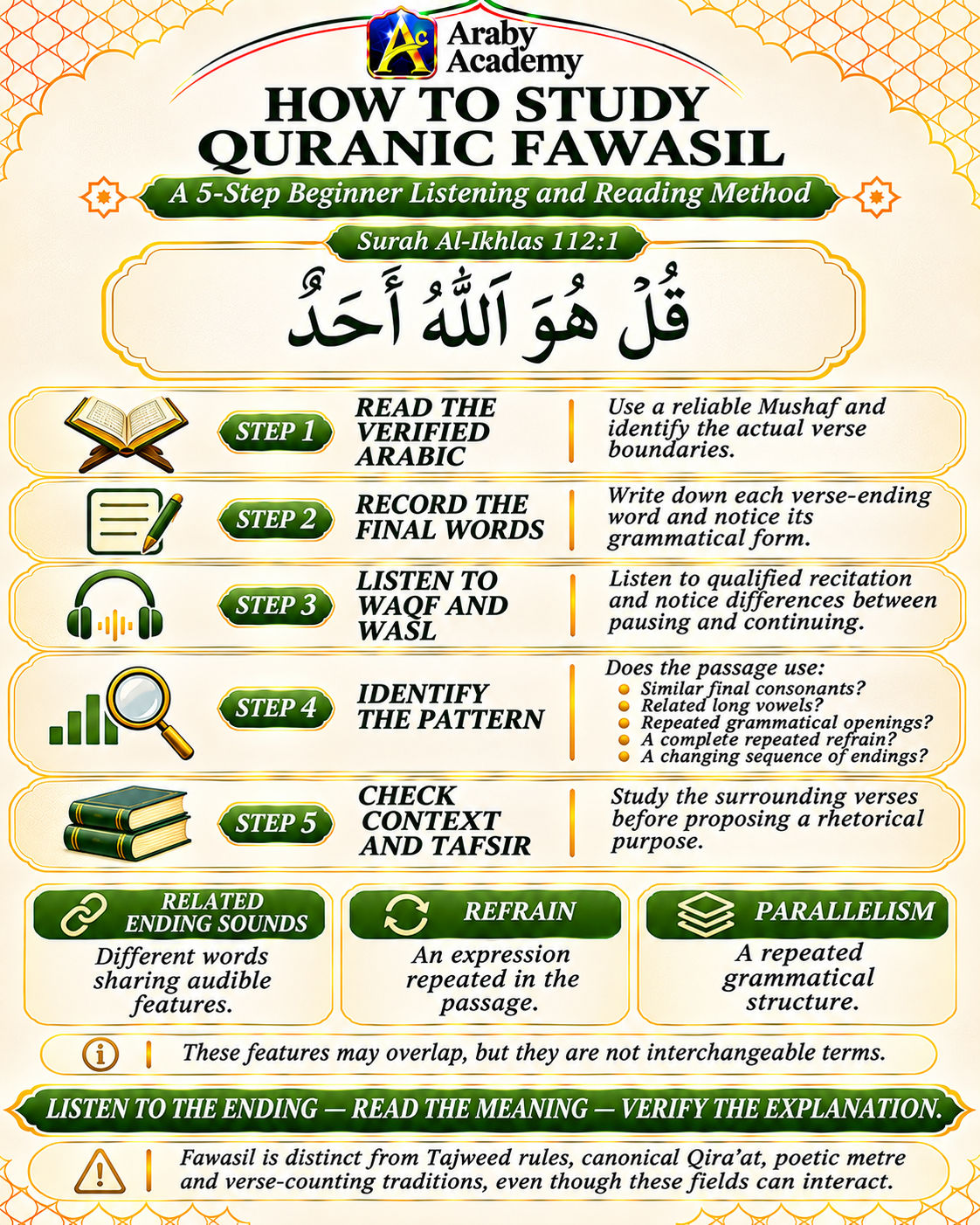
How to Study Fawasil in Five Steps
Read the verified Arabic in an authentic Mushaf and identify the actual Ayah endings.
Record the final words and note their grammatical forms.
Listen to a qualified reciter, noticing Waqf and Wasl; pause only where appropriate.
Look for repeated sounds, phrases, or grammatical structures.
Read the surrounding passage and consult reliable Tafsir before claiming a rhetorical purpose.
Worked notebook row:
Surah and Ayat | Final words | Sound when pausing | Similarity or difference | Pattern type | Contextual observation | Source to check |
|---|---|---|---|---|---|---|
Ad-Duha 93:1–8 | Al-Duha, Saja, Qala, Al-Ula | Long -ā | Related vowel, different words | Long vowel | Oaths and reassurance | Mushaf, Tafsir, reciter |
For a ten-minute session, spend two minutes each reading the passage, identifying final words, listening to pausal recitation, reading Tafsir notes, and writing one supported observation and one question. A seven-day plan: Al-Ikhlas; Ad-Duha; At-Takwir and Al-Qari’ah; Al-‘Adiyat and Al-Ghashiyah; Al-Qamar; Ar-Rahman and Al-Mursalat; An-Najm and review. It is an introduction, not a promise of mastery.
Common Mistakes About Quranic Verse Endings
Calling every similar ending perfect rhyme.
Assuming every verse must rhyme; patterns differ across passages.
Treating refrains and shared consonants as one phenomenon.
Ignoring the difference between pausing and continuing.
Confusing Fawasil with Tajweed or with Qira’at.
Claiming all scholars define Saj’ alike, or that the Quran follows poetic meter.
Inventing a hidden meaning for every ending.
Ignoring the surrounding Surah.
Treating numerical coincidence as proof of a miracle.
Judging translations only by rhyme.
Frequently Asked Questions
What does Fawasil mean in the Quran?
It is the plural of Fasilah, the term for verse-closing elements and the patterns they form.
What is a Fasilah?
A word or sound that closes a verse and marks a division in discourse; classical definitions vary slightly.
What is Ilm al-Fawasil?
The study of Quranic verse endings, their sounds, and their relation to structure and meaning.
Why do many verses end with similar sounds?
Final words often share consonants, vowels, grammatical forms, or whole phrases, forming audible patterns.
Does every verse rhyme?
No. Endings vary, and some passages change pattern.
Is the Quran considered poetry?
No. It does not follow poetic structure, and it states that it is not the speech of a poet.
How do Fawasil, Saj’, and Qafiyah differ?
Qafiyah is poetry’s rhyme; Saj’ is rhymed prose, debated by classical scholars; Fawasil is the Quranic term.
Why do Al-Ikhlas endings sound similar?
They share a final dāl when pausing, despite different grammatical forms.
Why does Ad-Duha change its endings?
Verses 1–8 share long ā; 9–11 change as instructions begin. No single cause is proven.
Why does At-Takwir repeat Idha?
It opens parallel clauses that build a sequence concluded in verse 14.
Why does Al-Qari’ah repeat its opening word?
Repetition within questions emphasizes the subject before descriptions follow.
What is special about Al-‘Adiyat’s endings?
Verses 1–5 end in Fathatan, heard as long ā at a stop, before the pattern shifts.
Why does Al-Qamar repeat its reminder?
It follows different narrative sections, recalling the invitation to reflect without making them identical.
Why does Ar-Rahman repeat its question?
It structures the Surah, addressing two parties through dual forms amid changing material.
Why does Al-Mursalat repeat its warning?
It follows different segments, marking recurring warnings to deniers.
Does stopping change pronunciation?
Often yes: Tanween and final vowels may change at a pause.
Is Fawasil part of Tajweed?
No. They are related but distinct disciplines.
Do Qira’at affect Quranic sound?
Sometimes, in recognized details, though not necessarily at every verse ending.
How can a beginner recognize patterns?
Follow the five steps: read, record, listen, compare, and check Tafsir.
Conclusion — Listen to the Ending, Read the Meaning
We began with a familiar ending in Surah Al-Ikhlas. A careful explanation may require Arabic grammar, pausal pronunciation, verse boundaries, consonants and long vowels, repetition, Surah structure, reliable Tafsir, and Quranic Sciences scholarship.
When you listen carefully to Quranic recitation, the endings of its verses may reveal patterns you had not noticed before. Some share consonants or long vowels; others repeat entire phrases, while still others change their sound as a passage develops. The science of Fawasil helps students examine these features responsibly. Rather than assigning a hidden message to every matching sound, begin by reading the authentic Arabic, listening to a qualified reciter, understanding the surrounding verses, and checking reliable scholarly explanations.
If you would like guidance, Araby Academy’s qualified teachers offer Quranic Arabic, Tajweed, and Quran recitation courses for adults and children.