Imagine meeting this verse for the first time:
مَثَلُ الَّذِينَ اتَّخَذُوا مِنْ دُونِ اللَّهِ أَوْلِيَاءَ كَمَثَلِ الْعَنْكَبُوتِ اتَّخَذَتْ بَيْتًا (Quran 29:41)
Why a spider’s house? What exactly is being compared? Is the Quran making a claim about spider silk? What does the Arabic say, and how do classical commentators explain it? This article studies that image and nine others through the original Arabic, the surrounding verses, and recognized Tafsir.
Short answer: The Quran uses parables, comparisons, and vivid imagery to communicate important ideas through familiar scenes. A growing seed illustrates multiplied reward, a fragile spider’s home illustrates misplaced reliance, and changing vegetation illustrates the temporary attraction of worldly life. Arabic rhetoric distinguishes devices such as Mathal, Tashbih, and Isti’arah, so not every example is technically the same kind of metaphor. Understanding these images requires attention to the Arabic, the surrounding verses, and reliable Tafsir.
Why Does the Quran Use Metaphors and Parables?
“Metaphors” in our title is a reader-friendly umbrella term. Arabic rhetoric (Balaghah) classifies comparisons more precisely, as the next section shows.
A concrete scene can help the mind grasp something abstract: appearance versus reality, the temporary versus the enduring, growth and benefit, consequences, guidance versus confusion, moral revulsion, the weight of knowledge, and the value of relationships. No single image does all of this. Each does what its own verses show. The Quran itself mentions the practice: وَتِلْكَ الْأَمْثَالُ نَضْرِبُهَا لِلنَّاسِ (29:43), “These are the examples We present to people.”
Before analyzing these comparisons, readers can explore [what Quranic Arabic is and how its words and structures convey meaning] to understand why the original language matters.
Tafsir matters because an image may depend on theological context, history, grammar, word choice, cross-references, and sometimes more than one scholarly explanation. A short translation cannot show all of that. An important companion to this discussion is what Tafsir explains beyond reading only an English Quran translation, because figurative comparisons often need context and scholarly explanation.
Every image has two levels. The first is the scene the verse describes, and the second is the subject it illuminates. In 2:261 the scene is one grain producing many grains, and the subject is the reward of spending for Allah’s sake. Our method for each study is simple:
What scene does the verse describe?
What is it compared to?
What does reliable Tafsir say is the point?
English renderings below are my own labeled paraphrases, not a published translation.
Mathal, Tashbih, Isti’arah, and Majaz: What’s the Difference?
Ilm al-Bayan is one branch of Balaghah, concerned with ways of expressing a meaning. It is not simply “the study of metaphors,” and classical authors did not all classify alike. The key terms:
مَثَل (Mathal): a parable, likeness, or example, depending on context.
تَشْبِيه (Tashbih): a comparison or simile, with a subject, an object, and a point of similarity.
اِسْتِعَارَة (Isti’arah): metaphor in the narrower sense, a word used beyond its usual referent, as in وَاشْتَعَلَ الرَّأْسُ شَيْبًا (19:4), “the head blazed with white.”
كِنَايَة (Kinayah): indirect expression or implication.
مَجَاز (Majaz): a historic label for nonliteral or transferred expression, whose scope is debated.
On Majaz, early works such as Abu ‘Ubaydah’s Majaz al-Quran used the word broadly for ways of expression. Later rhetoricians such as al-Jurjani and al-Zamakhshari analyzed Quranic expressions through isti’arah and majaz. Other scholars, including Ibn Taymiyyah, objected to the literal/majaz division as a theory, while the Quran’s explicit comparisons are not in dispute. We use these labels cautiously and do not settle that debate.
As teaching approximations, a simile is an explicit comparison, often with كَـ (“like”). A metaphor is a transferred expression. A parable is a developed example. Useful clues include كَـ, كَأَنَّ, and مَثَل, but clues are not guarantees, and syntax decides. Most examples below are explicit mathal or tashbih rather than isti’arah.
10 Powerful Quranic Images at a Glance
Reference | Image | Illustrates | Caution |
|---|---|---|---|
2:17–20 | Fire; storm | Hypocrisy’s instability | Not everyday doubt |
2:261 | Grain, seven ears | Multiplied reward | Not a financial return |
13:17 | Water, foam, heated metal | Truth vs. falsehood | No modern-industry claims |
14:24–26 | Good and bad trees | Good and bad word | No invented symbols |
24:35 | Niche, lamp, glass | Light and guidance | Not a depiction of Allah |
29:41 | Spider’s house | Misplaced reliance | Not spider science |
49:12 | Dead brother’s flesh | Revulsion at backbiting | Not literal |
62:5 | Donkey with books | Knowledge without action | No blanket judgment |
57:20 | Rain, fading plants | Worldly life | Not “all dunya is evil” |
2:187 | Garments | Spousal closeness | Not isolated from context |
1. Fire and Storm: Why the Quran Uses Two Images for Hypocrisy
مَثَلُهُمْ كَمَثَلِ الَّذِي اسْتَوْقَدَ نَارًا (2:17)
أَوْ كَصَيِّبٍ مِنَ السَّمَاءِ فِيهِ ظُلُمَاتٌ وَرَعْدٌ وَبَرْقٌ (2:19)
Paraphrase: “Their likeness is that of one who kindled a fire… or like a rainstorm from the sky, with darkness, thunder, and lightning.”
The first scene is a fire kindled to light the surroundings, after which the light is taken away. The second is a rainstorm where people walk when it flashes and halt when it darkens (2:20). Both belong to the discussion of the hypocrites (2:8–20), those who professed belief without inward conviction. The markers are ka-mathal and aw ka-sayyib, so these are explicit tashbih-based parables, not isti’arah. This is a specific Quranic category, not a label for anyone who feels doubt or anxiety.
Al-Tabari and Ibn Kathir connect the kindled light to the outward profession of faith, whose benefit is lost when conviction is absent. Some commentators, discussing the connective aw, treat the scenes as different conditions of hypocrisy, while others see complementary views of one group. The verses do not require identical details. Sayyib is a heavy downpour. These two parables show [why English Quran translations sometimes express the same Arabic image in different ways], especially when a developed comparison contains several connected details.
A translation must carry a whole scene, not swap one noun for another. The misreading to avoid is treating the two scenes as identical, or as accusations against contemporary individuals. The takeaway is that a concrete scene can make an unstable inward condition visible.
Try it: What do the scenes share? How do they differ? Who is discussed in 2:8–20?
2. A Grain That Multiplies: The Quran’s Powerful Image of Charitable Spending
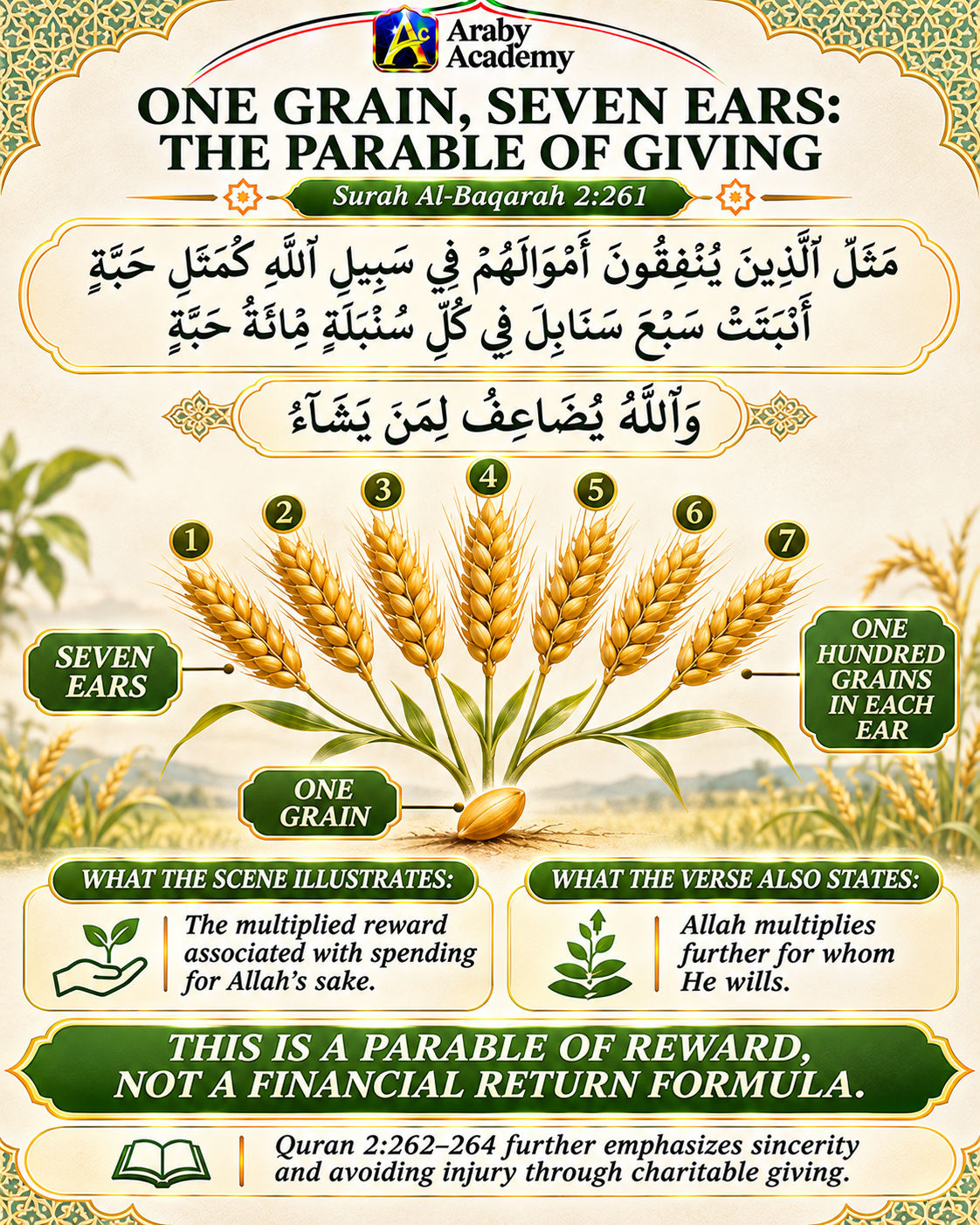
مَثَلُ الَّذِينَ يُنْفِقُونَ أَمْوَالَهُمْ فِي سَبِيلِ اللَّهِ كَمَثَلِ حَبَّةٍ أَنْبَتَتْ سَبْعَ سَنَابِلَ (2:261)
فِي كُلِّ سُنْبُلَةٍ مِائَةُ حَبَّةٍ ۗ وَاللَّهُ يُضَاعِفُ لِمَنْ يَشَاءُ
Paraphrase: “The likeness of those who spend their wealth in Allah’s cause is that of a grain that grows seven ears, each with a hundred grains. Allah multiplies for whom He wills.”
One grain grows seven ears, each with a hundred grains, and the subject is spending in Allah’s cause. The marker is ka-mathal, an explicit parable built on comparison. The figure of seven hundred is the verse’s own scene, not a ceiling on reward, since the closing clause says Allah multiplies for whom He wills.
Al-Tabari and Ibn Kathir read the parable as illustrating multiplied reward for sincere spending. The context (2:262–264) warns that reminders of generosity and hurtful words spoil charity, so sincerity frames the image. Sanabil is the plural of sunbulah (ear of grain), and yudaʿif comes from a root of multiplication. “Spending in Allah’s cause” is broader than obligatory Zakat. Although this parable addresses spending in Allah’s cause broadly, learners can also study [what Zakat is and how obligatory charity works in Islam] to distinguish this particular obligation from the wider subject of generosity.
The misreading to avoid is “700% investment return.” The verse promises no market formula and no botanical guarantee. The takeaway is that generosity grows in reward when it is sincere and free of harm.
Try it: What is the starting object? What does multiplication stand for? Why is this not a financial promise?
3. Water and Foam: Why Quran 13:17 Uses a Layered Parable for Truth and Falsehood
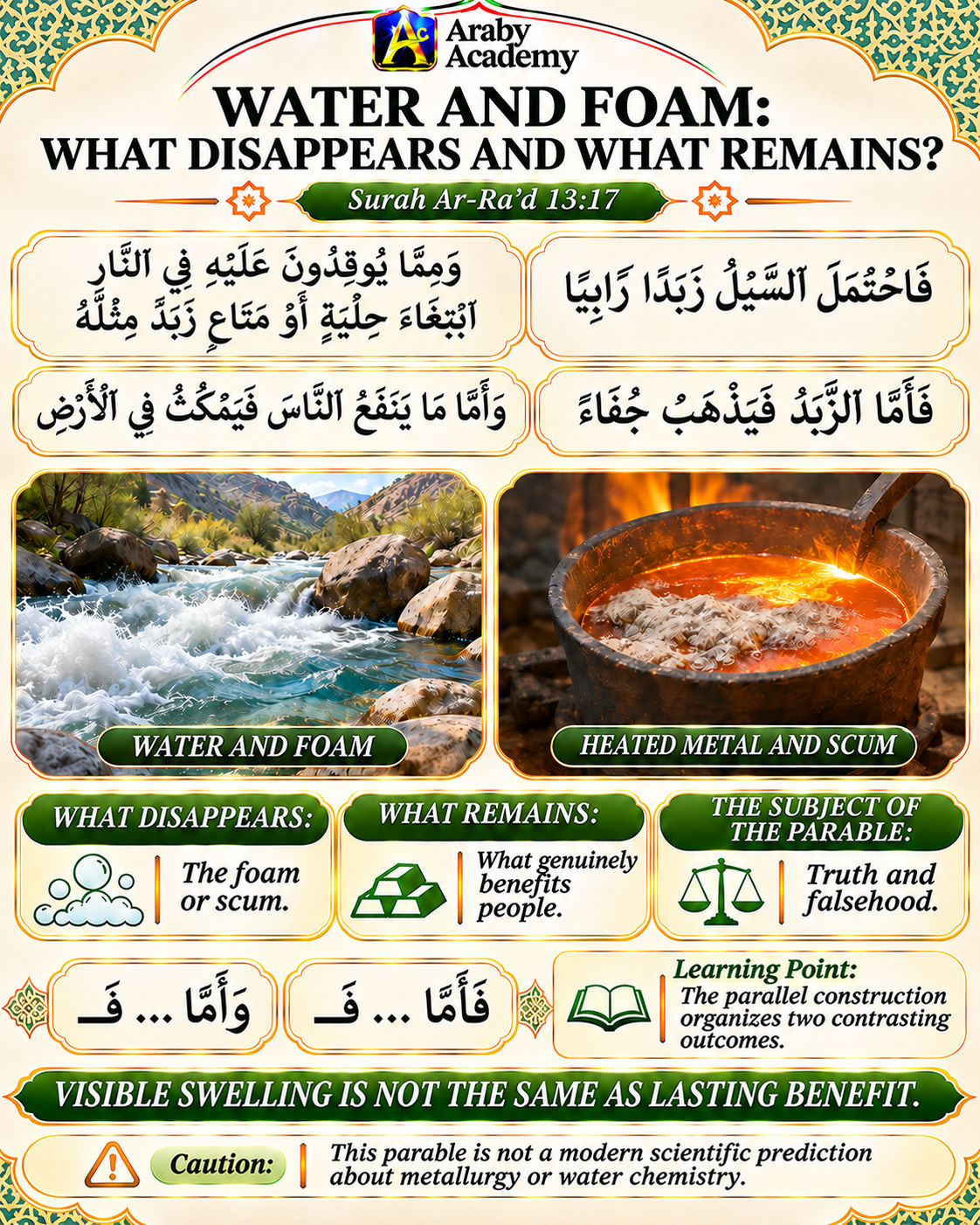
فَاحْتَمَلَ السَّيْلُ زَبَدًا رَابِيًا
كَذَٰلِكَ يَضْرِبُ اللَّهُ الْحَقَّ وَالْبَاطِلَ
فَأَمَّا الزَّبَدُ فَيَذْهَبُ جُفَاءً
وَأَمَّا مَا يَنْفَعُ النَّاسَ فَيَمْكُثُ فِي الْأَرْضِ (13:17)
Paraphrase: “The torrent carries swelling foam… thus Allah presents truth and falsehood. As for the foam, it goes away as scum; as for what benefits people, it remains in the earth.”
Rain fills valleys and the flood carries swelling foam. A second scene follows: from what people heat in fire to make ornaments or tools, a similar scum rises (زَبَدٌ مِثْلُهُ). The verse itself connects both scenes to truth and falsehood.
Al-Tabari and Ibn Kathir explain that the foam passes while the useful water and metal remain, just as falsehood may appear to swell yet does not last. Some early reports also read the valleys “according to their measure” as hearts receiving guidance in different capacities. That is a further layer attributed to those sources, not stated outright in the verse. The grammar organizes the contrast. Fa-amma al-zabad… fa and wa-amma ma yanfa’u… fa set two outcomes side by side, with jufa’ meaning cast-off scum. The contrast between what disappears and what remains also demonstrates Quranic Arabic grammar clues that shape the meaning of a sentence, because the repeated Amma construction helps organize the two sides of the comparison.
The whole verse is a layered parable, not a one-word isti’arah. Avoid claims that each bubble represents a type of sinner, or that the heated metal predicts modern industry. The takeaway is that visible swelling is not lasting benefit.
Try it: Name both physical scenes. What disappears, what remains, and how does amma mark the contrast?
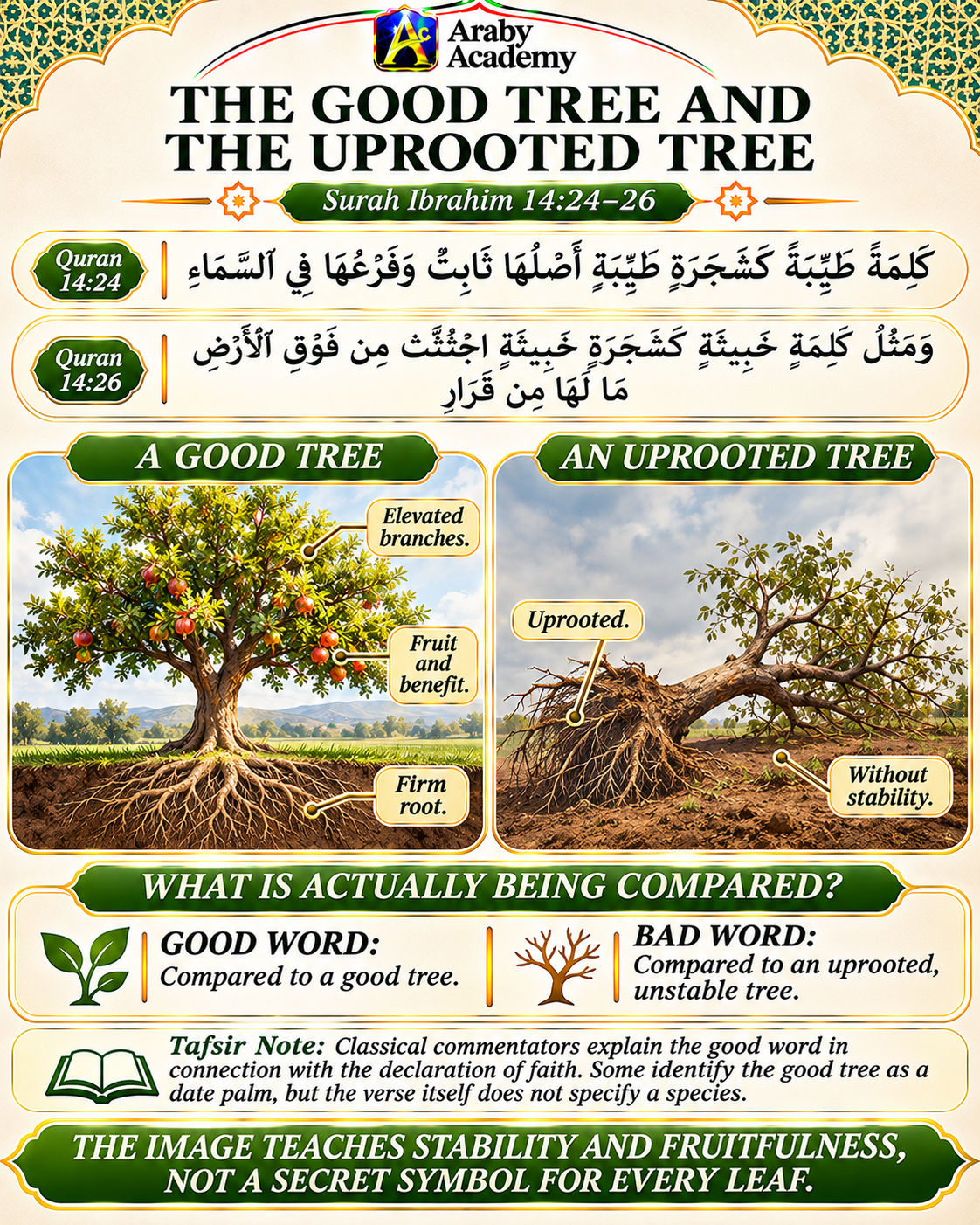
4. The Good Tree and the Uprooted Tree: How the Quran Makes Words Visible
كَلِمَةً طَيِّبَةً كَشَجَرَةٍ طَيِّبَةٍ أَصْلُهَا ثَابِتٌ وَفَرْعُهَا فِي السَّمَاءِ (14:24)
وَمَثَلُ كَلِمَةٍ خَبِيثَةٍ كَشَجَرَةٍ خَبِيثَةٍ اجْتُثَّتْ مِنْ فَوْقِ الْأَرْضِ مَا لَهَا مِنْ قَرَارٍ (14:26)
Paraphrase: “A good word is like a good tree, its root firm and its branches in the sky… a bad word is like a bad tree, uprooted from the surface of the earth, with no stability.”
The good tree has a firm root, branches reaching upward, and fruit in every season by its Lord’s permission (14:25). The bad tree is uprooted and unstable. The comparison marker is the prefix ka- in kashajaratin, which makes this an explicit simile inside a larger mathal rather than an isti’arah.
Al-Tabari and Ibn Kathir report explanations that the good word is the declaration of faith. Some reports identify the tree as a date palm, though the verse names no species and commentators vary in their formulations. The bad word is explained by many as disbelief or falsehood. The next verse (14:27) speaks of Allah making believers firm “with the firm word,” which supports the theme of stability. Ijtuththat means uprooted, qarar means stability, and ukul means fruit. The phrase Kalimah Tayyibah is a useful example of [Quranic expressions whose Arabic meaning extends beyond a simple English gloss], because the tree comparison helps explain its significance within the passage.
Avoid saying every leaf is a virtue or every branch a person. The verse states roots, branches, fruit, and instability, and further equivalents need evidence. The takeaway is that words are judged by rootedness and fruit.
Try it: What is compared to the tree? Which qualities are stated? Which details need Tafsir?
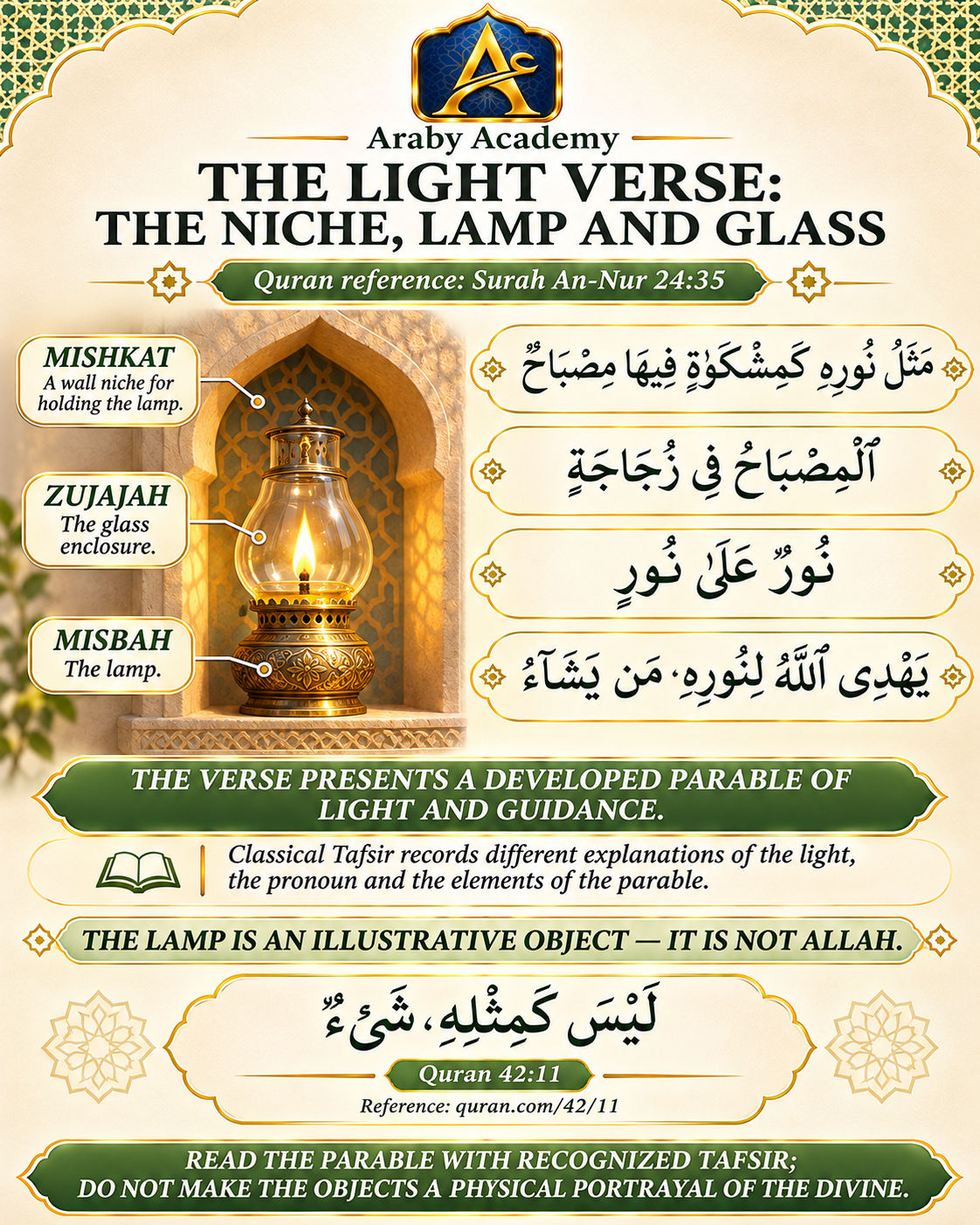
5. The Light Verse: What the Niche, Lamp, and Glass Mean in Quran 24:35
اللَّهُ نُورُ السَّمَاوَاتِ وَالْأَرْضِ ۚ مَثَلُ نُورِهِ كَمِشْكَاةٍ فِيهَا مِصْبَاحٌ ۖ الْمِصْبَاحُ فِي زُجَاجَةٍ… نُورٌ عَلَىٰ نُورٍ ۗ يَهْدِي اللَّهُ لِنُورِهِ مَنْ يَشَاءُ (24:35)
Paraphrase: “Allah is the light of the heavens and the earth. The likeness of His light is like a niche with a lamp; the lamp in glass… light upon light. Allah guides to His light whom He wills.”
Three objects need glossing. A mishkat is a wall niche that holds a lamp, a misbah is the lamp itself, and a zujajah is a glass enclosure, described as like a brilliant star (kawkab durriyy). The oil comes from a blessed olive tree, “neither eastern nor western.” The verse then says “light upon light.” The verse introduces the likeness with mathalu nurihi ka-mishkatin, a developed parable. Because the verse is a developed parable, it should not be reduced to a one-to-one code.
Al-Tabari, Ibn Kathir, and al-Qurtubi record several explanations of the light and its parable. Reports attributed to Ibn ‘Abbas explain “light of the heavens and earth” as Allah being their guide. Ibn Kathir also notes explanations that “His light” refers to the guidance or faith Allah places in the believer’s heart. These scholars differ on what the pronoun refers to and what each component represents, and that difference should be reported, not erased.
Theological care is essential. The lamp is the illustrative object and not Allah, and the Quran states لَيْسَ كَمِثْلِهِ شَيْءٌ (42:11), “nothing is like Him.” Read 24:34–36 together: the verse follows a reminder of clarifying signs (24:34) and leads to houses where Allah is glorified (24:36). Because the Light Verse includes an expression about Allah, it is especially important to read it alongside [what Islam teaches about Allah and His attributes], rather than imagining the illustrated lamp as a physical depiction of God.
The misreading to avoid is a physical or electrical description of God. Arabic study alone does not resolve every theological question. The takeaway is that guidance is likened to layered, protected light.
Try it: List the physical objects. Which phrase introduces the likeness? Which literal claims must be avoided?
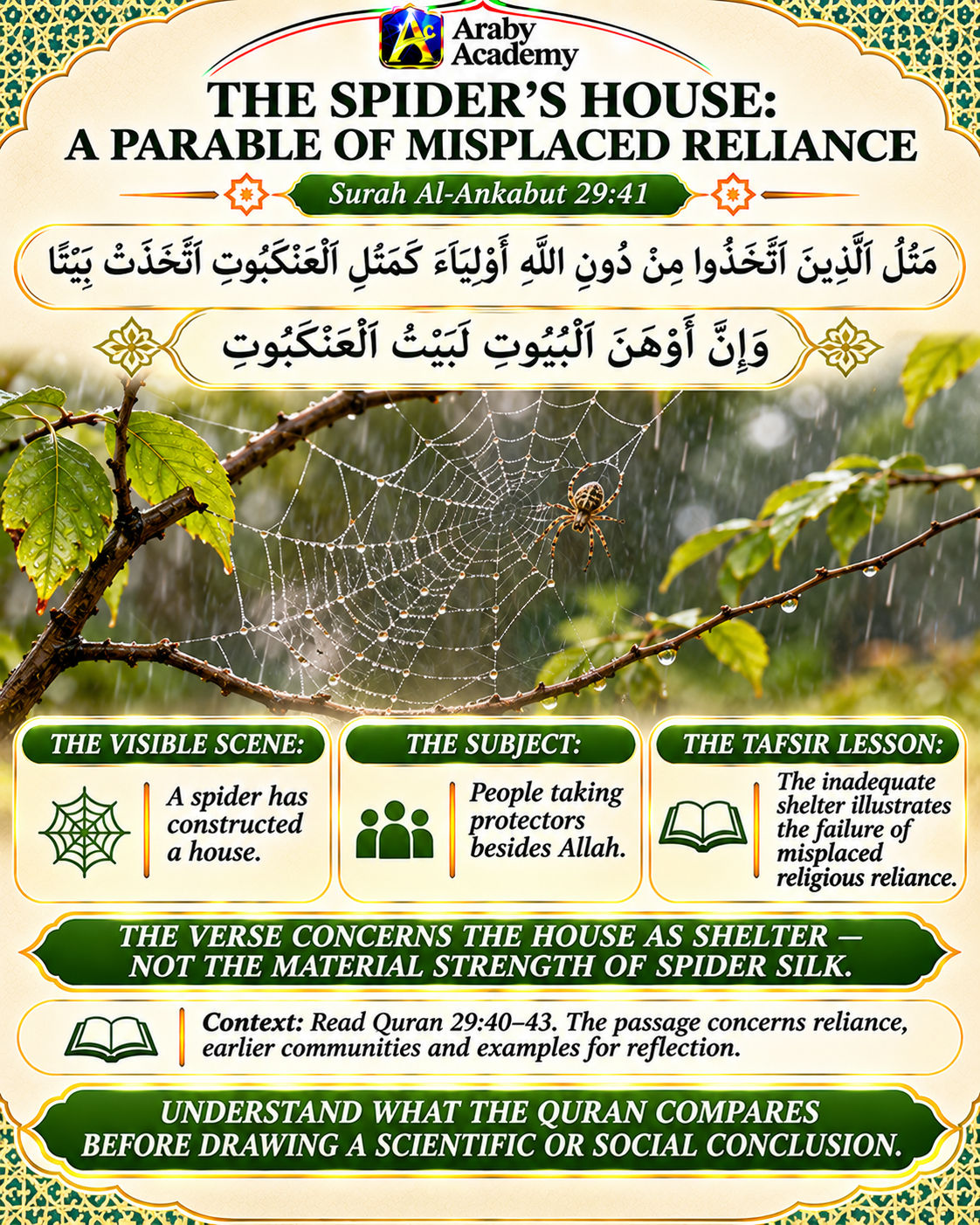
6. The Spider’s House: What Quran 29:41 Says About Misplaced Reliance
مَثَلُ الَّذِينَ اتَّخَذُوا مِنْ دُونِ اللَّهِ أَوْلِيَاءَ كَمَثَلِ الْعَنْكَبُوتِ اتَّخَذَتْ بَيْتًا ۖ وَإِنَّ أَوْهَنَ الْبُيُوتِ لَبَيْتُ الْعَنْكَبُوتِ (29:41)
Paraphrase: “The likeness of those who take protectors besides Allah is like the spider that took a house; the weakest of houses is surely the spider’s house.”
The subject is people who take protectors (awliya’) besides Allah. The scene is a spider’s house, said to be the weakest (awhan, a superlative). The marker is ka-mathal, a tashbih-based parable. The point is the house’s inadequacy as shelter. Nothing in the verse concerns silk strength or spider behavior.
Ibn Kathir and other commentators explain that a web offers no real shelter, just as those relied upon besides Allah cannot truly protect. Awliya’, plural of wali, here means those taken as protectors or patrons in place of Allah, and it should not be glossed identically in every Quranic occurrence. The context (29:40–43) concerns religious reliance and earlier peoples, and 29:43 adds that such examples are for people to reflect on. The spider parable becomes clearer when readers understand [what Shirk means in Islam and how it relates to Tawhid], because the passage concerns misplaced religious reliance rather than the ordinary usefulness of human cooperation.
Avoid claims that the verse ranks natural fibers, reveals spider family structure, or forbids friendship and ordinary help. The takeaway is that reliance has value only if the thing relied upon can actually shelter.
Try it: What is the house compared to? Why is the silk argument beside the point? Which context must stay?
7. Backbiting and the Dead Brother: Why Quran 49:12 Uses Such a Shocking Image
وَلَا يَغْتَبْ بَعْضُكُمْ بَعْضًا ۚ أَيُحِبُّ أَحَدُكُمْ أَنْ يَأْكُلَ لَحْمَ أَخِيهِ مَيْتًا فَكَرِهْتُمُوهُ (49:12)
Paraphrase: “Do not backbite one another. Would any of you like to eat the flesh of his dead brother? You would hate it.”
The prohibition comes first, then a question that links backbiting with a loathsome scene. The question form (istifham) is often analyzed as an implied comparison rather than a ka-simile. Maytan is accusative and is usually parsed as a state (hal). The rhetorical question draws revulsion rather than issuing a literal command.
The surrounding verses, 49:11 to 49:13, forbid ridicule, offensive nicknames, suspicion, and spying before ending with human dignity and Taqwa. Ghibah is defined in a hadith in Sahih Muslim (no. 2589, Abu Hurayrah) as mentioning your brother in a way he would dislike. Scholars discuss exceptions, such as testimony or seeking justice, and those belong to Fiqh with qualified teachers, not to this article.
Fa-karihtumuhu, “you would hate it,” shows the verse itself naming the intended response. English can preserve the shock, but it cannot show how the verb chain builds it. Avoid treating the image as a command or as a ruling on every conversation about an absent person. The takeaway is that the Quran uses moral revulsion to protect dignity.
Try it: What conduct is prohibited? What image follows? Why a question? Which adjacent verses help?
8. A Donkey Carrying Books: The Difference Between Possessing Knowledge and Living by It
مَثَلُ الَّذِينَ حُمِّلُوا التَّوْرَاةَ ثُمَّ لَمْ يَحْمِلُوهَا كَمَثَلِ الْحِمَارِ يَحْمِلُ أَسْفَارًا (62:5)
Paraphrase: “The likeness of those charged with the Torah and then did not bear it is like a donkey carrying large books.”
The scene is a donkey loaded with large books it cannot benefit from. The subject is people entrusted with the Torah who did not fulfill that trust, introduced by ka-mathal in a tashbih-based parable. The donkey is simply part of the image and carries no moral blame.
Commentators such as al-Tabari and Ibn Kathir identify the addressees as those entrusted with the Torah who did not act on it. The criticism concerns conduct, not an ethnicity, and elsewhere the Quran distinguishes within the People of the Book (3:113: لَيْسُوا سَوَاءً). It must not be turned against Jewish people today or against any group.
Hummilu is the passive of Form II (hammala, “to charge with a load”), while yahmilu is Form I active, “carries.” The verbs differ in form and voice, so the wordplay should not be called identical repetition. Asfar is the plural of sifr, a large book or volume. As a reflective application, memorization and knowledge should lead to understanding and practice. That is a personal study lesson, distinct from the verse’s original referent. The image is also no basis for mocking people with little formal education.
Try it: What conduct does the verse discuss? What is carried? How do the two verb forms relate? Why not generalize?
9. Rain and Fading Plants: Why Quran 57:20 Compares Worldly Life to Vegetation
كَمَثَلِ غَيْثٍ أَعْجَبَ الْكُفَّارَ نَبَاتُهُ ثُمَّ يَهِيجُ فَتَرَاهُ مُصْفَرًّا ثُمَّ يَكُونُ حُطَامًا (57:20)
Paraphrase: “Like rain whose growth pleases the cultivators, then it dries, and you see it yellow, then it becomes debris.”
The stages run in the verse’s own order: rain, delightful growth, drying, yellowing, and crumbled debris. The verse gives the sequence in this order and no agricultural timetable. The marker is ka-mathal, a tashbih-based parable, and the subject is worldly life.
The surrounding verse lists play, amusement, adornment, boasting, and rivalry in wealth and children, then turns to the Hereafter and ends by calling worldly life the “enjoyment of delusion.” The verse does not say that all worldly things are evil.
Al-Kuffar needs care. Al-Tabari, al-Qurtubi, and Ibn Kathir explain it here as cultivators, since kafir originally denotes one who covers, and the farmer covers seed with soil. Some commentators also mention the reading “disbelievers,” on the reasoning that they are most captivated by worldly things. It should not be translated automatically as “disbelievers” without explaining the sense. Yahij means to dry and wither, and hutam means crumbled debris. The comparison introduced by Ka-mathal is easier to notice after studying [small Arabic words and particles that shape Quranic sentence meaning], because a short prefix can introduce an important rhetorical relationship.
Avoid reading the verse as a coded timeline of history. The takeaway is that attractive growth is real but fleeting.
Try it: List the stages. What aspect of life is compared? What does al-kuffar mean here? Why read the whole verse?
10. Spouses as Garments: Why Quran 2:187 Uses the Image of Clothing
هُنَّ لِبَاسٌ لَكُمْ وَأَنْتُمْ لِبَاسٌ لَهُنَّ (2:187)
Paraphrase: “They are a garment for you, and you are a garment for them.”
The verse opens by permitting marital relations on the nights of fasting (أُحِلَّ لَكُمْ لَيْلَةَ الصِّيَامِ الرَّفَثُ إِلَىٰ نِسَائِكُمْ). The context is the permission of marital relations on the nights of Ramadan. This is not an isolated slogan about modern relationships, and it is not a source of personal rulings.
The grammar is reciprocal. Hunna (“they,” feminine plural) is the subject and libasun (“a garment,” a nominative noun, not a verb) is the predicate, with lakum (“for you”) completing it. The sentence then mirrors itself: wa-antum libasun lahunna. The two clauses are verbless statements of relationship.
Al-Tabari and Ibn Kathir report early explanations, including from Ibn ‘Abbas and Mujahid, that each spouse is a rest and covering for the other. Commentators also discuss closeness, covering, and protection. These explanations are not all spelled out by the single word libas, which dictionary-wise means a garment. The distinction between lexical meaning and commentary should stay visible. Avoid “every thread is a marital duty.”
The verse ends with لَعَلَّهُمْ يَتَّقُونَ, “so that they may become mindful,” placing the image within the wider aim of guidance without making the garment a definition of Taqwa. Because Quran 2:187 closes by directing readers toward Taqwa, this passage also connects with [ the Quranic meaning of Taqwa beyond a simple translation as fear], showing why imagery and the larger verse belong together.
Try it: What are spouses compared to? How is it reciprocal? What context surrounds it?
The 10 Quranic Images and Their Lessons at a Glance
Ref. | Image | Subject | Form (qualified) | Tafsir lesson | Avoid |
|---|---|---|---|---|---|
2:17–20 | Fire; storm | Hypocrisy | Paired tashbih-based mathal | Profession without conviction fails | Everyday doubt |
2:261 | Grain | Spending | Mathal | Multiplied reward | Finance formula |
13:17 | Foam, metal | Truth/falsehood | Layered mathal | Benefit remains | Industry claims |
14:24–26 | Two trees | Words | Simile in mathal | Rootedness, fruit | Symbol per leaf |
24:35 | Niche, lamp | His light | Developed mathal | Guidance; views differ | Divine depiction |
29:41 | Spider’s house | Reliance | Mathal | No real shelter | Silk claims |
49:12 | Dead brother | Backbiting | Implied comparison via question | Revulsion, dignity | Literal reading |
62:5 | Donkey, books | Unfulfilled trust | Mathal | Knowledge needs action | Blanket judgment |
57:20 | Rain, debris | Worldly life | Mathal | Fleeting growth | “All dunya is evil” |
2:187 | Garments | Spouses | Compact image | Closeness, covering | Detached slogan |
Five Ways Quranic Imagery Makes Meaning Clearer
These are teaching groups, not a classical taxonomy. Imagery can make an abstract condition concrete (fire and storm), illustrate growth (the grain), show contrast through paired images (foam and metal; two trees), create a moral response (backbiting), and make relational or temporal ideas tangible (garments, fading vegetation).
Why Quranic Imagery Can Be Difficult to Translate
Arabic words have broad ranges, and English may make implicit relations explicit. Words like mathal and libas may be rendered differently, and translators weigh readability against literalness. A translation is not wrong because it lacks a linguist’s terminology, and Tafsir supplies what a translation cannot.
A literal reading is also not always a correct one. The scene is part of the text, but the people or ideas compared do not become the object: the donkey image does not turn anyone into an animal, and spouses are not clothing. And a poetic reader could imagine hundreds of connections, but disciplined interpretation stays with what the verse identifies, what grammar supports, what context explains, and what recognized Tafsir establishes.
How to Understand a Quranic Metaphor in Five Steps
Read the authentic Arabic and identify the complete image.
Identify the subject and the comparison construction.
Read the surrounding verses.
Consult reliable Tafsir and grammar.
Summarize what the image illustrates and what the verse does not justify.
Verse | Image | Subject | Arabic clue | Tafsir | Avoid |
|---|---|---|---|---|---|
14:24 | Good tree | Good word | كَشَجَرَةٍ | Declaration of faith (reported) | A named person per branch |
29:41 | Spider’s house | Reliance on other protectors | كَمَثَلِ | A web gives no real shelter | Silk-strength claims |
___ | ___ | ___ | ___ | ___ | ___ |
Study plan (seven days, not mastery): Day 1: 2:17–20. Day 2: 2:261 and 13:17. Day 3: 14:24–26. Day 4: 24:35. Day 5: 29:41 and 49:12. Day 6: 62:5 and 57:20. Day 7: 2:187 and review. Each day, spend 2 minutes on the Arabic, 2 on the image and marker, 2 on the surrounding verses, 2 on Tafsir, and 2 writing one supported insight and one question.
Common Mistakes About Quranic Imagery
Calling every comparison isti’arah, or assuming mathal and isti’arah mean the same.
Treating all scholars as agreeing on Majaz.
Ignoring the Arabic, the context, or the comparison marker.
Assigning a hidden symbol to every detail.
Treating a parable as a scientific prediction, or 2:261 as “700% returns.”
Imagining Allah physically from the Light Verse.
Generalizing 62:5 to an entire people, or reading al-kuffar in 57:20 without its agricultural sense.
Assuming figurative means fictional, or that a translation carries every nuance.
Believing ten images qualify anyone to interpret all Quranic rhetoric.
Frequently Asked Questions
1. Why does the Quran use metaphors and parables? Concrete scenes make abstract ideas clearer. The Quran says it presents examples for people to reflect on (29:43).
2. What is a Mathal? A parable, likeness, or example whose meaning depends on context.
3. Tashbih versus Isti’arah? Tashbih is an explicit comparison. Isti’arah is a narrower transferred expression.
4. What does Majaz mean? A historic label for nonliteral expression whose scope is debated.
5. Do all scholars agree about figurative language? No. Some analyze expressions through majaz, others object to the theory, and the explicit comparisons are not disputed.
6. Are all parables metaphors? No. Many are explicit mathal or tashbih.
7. What do fire and storm mean? They illustrate the hypocrites’ unstable condition in 2:8–20.
8. What does the seed represent? Multiplied reward for sincere spending, not a financial formula.
9. What does the foam teach? Visible swelling passes while lasting benefit remains.
10. What does the good tree symbolize? A good word, explained by commentators as the declaration of faith among other formulations.
11. What is the Light Verse about? A parable of Allah’s light and guidance, interpreted differently in details by commentators.
12. Is Allah a physical lamp? No. The lamp is an illustrative object, and nothing is like Him (42:11).
13. What is the spider’s house? An image of inadequate shelter for misplaced reliance.
14. Why compare backbiting to eating flesh? To evoke revulsion and protect dignity, not as a literal command.
15. Why a donkey carrying books? To illustrate carrying scripture without fulfilling its responsibility.
16. What does the vegetation mean? The temporary attraction of worldly life.
17. Why are spouses garments? Commentators explain closeness, covering, and mutual rest, within the fasting context.
18. Does every detail have a hidden meaning? No. Details matter only where the text, context, or Tafsir supports them.
19. Why is Tafsir important? It supplies context, grammar, and scholarly explanation that a translation lacks.
20. How can beginners recognize imagery? Use the five steps: Arabic, subject, context, Tafsir, and limits.
See the Image, Understand the Message
The Quran’s vivid images invite readers to think carefully about meanings that may be difficult to express through abstract definitions alone. A seed can illustrate multiplied reward, a tree can show stability, and a spider’s house can make misplaced reliance easier to picture. Yet appreciating these comparisons requires more than imagination. Begin with the authentic Arabic, identify what the image is actually comparing, read the full passage, and consult reliable Tafsir. That is how powerful Quranic imagery becomes a source of understanding rather than speculation.
If you would like to study Quranic Arabic and Tafsir with qualified teachers, Araby Academy welcomes you to explore its courses.