You have worked for several years. There is money in a checking account, some savings, perhaps a little gold, and maybe an investment account. You know Zakat is one of the Five Pillars of Islam, yet practical questions keep arising. Do I owe Zakat on my salary? Is my bank balance above Nisab? Should I take 2.5% of everything I own? Does my mortgage reduce what I owe? Who can actually receive the payment?
These are good questions, not signs of negligence. Zakat is a defined religious obligation with real financial rules: conditions of liability, a minimum threshold, a time requirement, different rates for different assets, and specified recipients. This guide explains each in plain English for beginners, new Muslims, and families in Western countries. It is educational, not a personal fatwa. Where qualified scholars differ, we say so, and for complicated finances you should consult a trusted scholar and an accountant.
What Is Zakat in Islam?
Zakat is an obligatory form of charity and one of the Five Pillars of Islam. Muslims who meet its conditions give a prescribed portion of qualifying wealth to eligible recipients. For common monetary assets such as cash and savings, the standard rate is 2.5% after the applicable Nisab and lunar-year conditions are satisfied. Other asset categories can follow different rules. It is a duty owed to Allah and a right of those in need, not a favor.
Zakat in One Minute
What: an obligatory charitable payment and act of worship.
Who: Muslims who own qualifying wealth above the threshold; details vary by school (madhhab).
When: usually after one lunar year for common monetary assets; some categories, such as crops, differ.
How much: typically 2.5% of qualifying monetary wealth, not of every asset.
To whom: the eight categories named in Quran 9:60.
What Does “Zakat” Mean in Arabic?
The Arabic word is الزَّكَاة (az-zakah), usually traced to the root ز ك و (z-k-w). Scholars connect it with three related ideas: purification, growth, and blessing. Linguistically, it describes something that makes a person or wealth cleaner and more blessed. Technically, in Islamic law, it means giving a defined share of specified wealth to specified recipients when the conditions are met.
The lexical meaning explains the spirit; the legal definition governs practice. “Growth” and “blessing” are spiritual meanings, not a promise that a bank balance will rise.
Zakat vs Ordinary Charity
English speakers often translate Zakat as “charity,” which is useful but incomplete. Voluntary charity can be given anytime, in any amount, to nearly anyone. Zakat is obligatory, has conditions, a threshold, a calculation, and defined recipients. Treating it like a general donation is the most common beginner error.
Why Is Zakat One of the Five Pillars?
Ibn ʿUmar reported that the Prophet ﷺ said Islam is built on five: testifying that none has the right to be worshipped but Allah and that Muhammad is His Messenger, establishing prayer, giving Zakat, Hajj, and fasting Ramadan (Sahih al-Bukhari 8; Sahih Muslim 16).
Zakat belongs to the same foundational structure of Islam as [ the five daily prayers], showing how worship includes both personal devotion and responsibility. Prayer is the believer’s duty toward Allah in the body; Zakat is a duty toward Allah through wealth, and it reaches other people. In the narration of the Prophet’s instructions to Muʿadh when sending him to Yemen, Zakat is described as taken from the wealthy among them and returned to their poor (Sahih al-Bukhari 1395; Sahih Muslim 19). After the Prophet’s ﷺ death, Abu Bakr insisted on fighting those who refused to pay it, showing that the Companions treated it as a firm obligation (Sahih al-Bukhari 1399; Sahih Muslim 20).
What Does the Quran Say About Zakat?
The Quran repeatedly joins Zakat with prayer. These are renderings of meaning:
Quran 2:43: “Establish prayer, give Zakat, and bow with those who bow.”
Quran 24:56: “Establish prayer, give Zakat, and obey the Messenger, that you may be shown mercy.”
Quran 73:20 repeats the command to establish prayer and give Zakat, together with “a good loan to Allah,” meaning generous giving for His sake.
Quran 9:103: “Take from their wealth a charity by which you purify them and cause them to grow, and pray for them. Indeed, your prayer is a source of tranquility for them.”
Quran 9:103 links giving with purification and growth. Classical commentators explain that giving cleanses the giver from miserliness and sins and nurtures the community. It does not turn unlawfully earned money into halal money; wealth gained unlawfully must be disposed of as scholars direct, not “purified” through Zakat.
Note that the Quran uses sadaqah in more than one way. Not every verse mentioning it automatically describes today’s Zakat; commentary (tafsir) matters. Quran 9:60, discussed below, is the key verse naming where Zakat is spent.
Who Must Pay Zakat?
In general, a person must meet these conditions:
Being a Muslim.
Owning qualifying wealth in full ownership, with access and control.
Reaching the Nisab, after basic needs and liabilities as the applicable school treats them.
Completing a Hawl (lunar year) for assets that require it.
Schools differ on details, including how debts are treated and what happens if wealth dips below Nisab during the year.
Children’s wealth. Scholars differ. Many jurists (Maliki, Shafi’i, and Hanbali) hold that Zakat is due on the qualifying property of a minor, paid by the guardian. The Hanafi position, associated with Abu Hanifa, is that it is not due on a minor’s money, though some crop-related duties apply. So neither “children never owe Zakat” nor “every child must pay” is accurate. Ask a qualified scholar if a child holds substantial savings.
Zakat is for those who actually have qualifying wealth. A person without it is not sinful, and a person who is struggling is not morally deficient.
What Is Nisab? Gold and Silver Thresholds
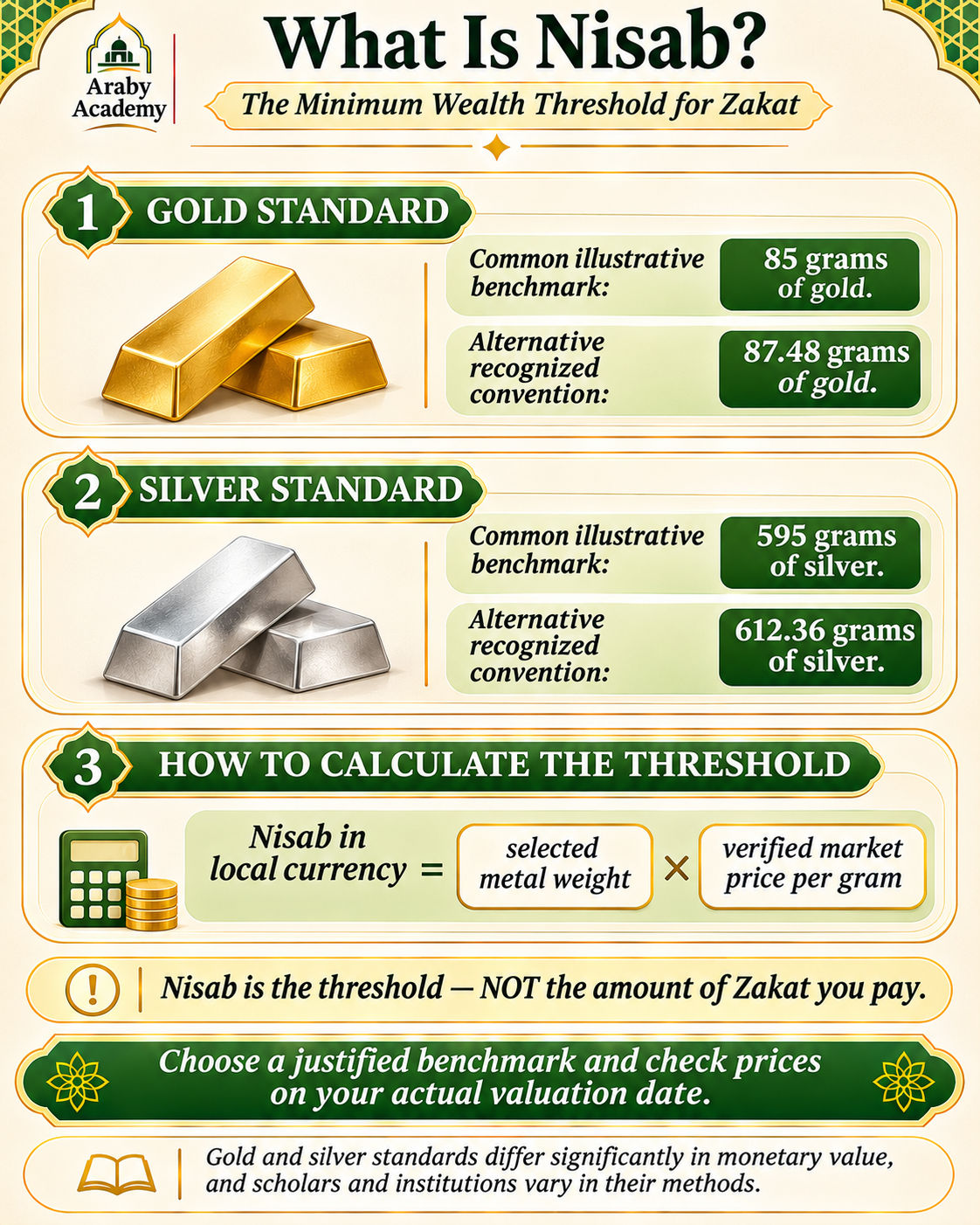
Nisab (النِّصَاب, an-nisab) is the minimum amount of wealth at which Zakat becomes due. Being above Nisab means you may owe Zakat; it is not the amount you pay.
The Prophet ﷺ said there is no Zakat on less than five awaq of silver (Sahih al-Bukhari 1447; Sahih Muslim 979). Five awaq equal 200 dirhams. For gold, jurists rely on reports setting the threshold at twenty dinars (mithqals), found in Abu Dawud and elsewhere. Converting these old weights into grams involves historical-weight methodology, so modern sources differ:
Metal | Common modern approximation | Another recognized convention |
|---|---|---|
Gold (20 mithqal) | about 85 g | about 87.48 g |
Silver (200 dirhams) | about 595 g | about 612.36 g |
This guide uses 85 g of gold and 595 g of silver for illustrations; follow the standard your scholar or local institution uses.
Gold or silver? Today a gram of silver is worth far less than a gram of gold, so the silver-based Nisab is much lower and brings more people into the obligation. Many contemporary scholars favor the silver standard for cash because it benefits more recipients and is the more cautious approach; others use gold. Institutions and scholars differ, so pick a benchmark with a justified methodology and use it consistently.
Do not rely on a fixed number. Nisab changes with metal prices. The formula is:
Nisab in local currency = selected metal weight × verified market price per gram on your valuation date
Hypothetical example (not a current price): if the gold standard is 85 g and a gram is illustratively $80, then 85 × $80 = $6,800. Under the 87.48 g convention, 87.48 × $80 = $6,998.40. If silver were illustratively $1 per gram, 595 × $1 = $595. Look up real prices from a reliable source on your own date.
What Is Hawl? When Does Zakat Become Due?
Hawl (الحَوْل, al-hawl) means “year” in Zakat law: a full lunar year during which qualifying wealth is held. The Hawl condition is reported in narrations and Companion practice and is applied to monetary wealth, trade goods, and certain livestock. It does not apply to everything: crops are due at harvest, and found treasure (rikaz) is due when found.
A Hijri year has about 354–355 days, roughly eleven days shorter than a Gregorian year, so your Zakat date moves earlier each year on the Gregorian calendar. Some scholars and institutions adjust the percentage slightly (to about 2.577%) when assessing on a solar-year basis. Ask your scholar before using such an adjustment.
Generally, the year begins when you first hold wealth at or above Nisab. Schools differ on edge cases:
Dipping below Nisab. Many jurists treat falling below Nisab during the year as interrupting it. The Hanafi school looks at Nisab at the beginning and end of the year, unless the wealth is entirely lost.
Added wealth. Many scholars treat money added during the year as part of one pool of monetary wealth, so it shares the same Zakat date. Others follow other treatments for newly received wealth.
Choose a consistent Zakat date, and ask a scholar if your finances fluctuate. Recording your Zakat anniversary can fit into [ a sustainable daily Islamic routine], especially if you already use a calendar for Salah and other acts of worship.
How Much Zakat Do You Pay?
For cash, savings, and trade wealth, the rate is 2.5%, or one-fortieth. This comes from Abu Bakr’s written regulations on Zakat, preserved in Sahih al-Bukhari 1454, which state a quarter-tenth (one-fortieth) on silver.
Zakat = net Zakatable wealth × 0.025
$1,000 × 0.025 = $25
$10,000 × 0.025 = $250
$20,000 × 0.025 = $500
These are mathematical examples only; they assume Nisab and Hawl are already met. The 2.5% rate is not universal; see the correction table below.
How to Calculate Zakat Step by Step
This ten-step checklist is an editorial teaching tool, not a Prophetic list:
Choose your Zakat valuation date.
Identify your Nisab standard (gold or silver) and current metal price.
List cash and savings.
Add other qualifying assets (gold, silver, trade stock, investments, receivables).
Identify liabilities that are deductible under the approach you follow.
Subtract them to find net Zakatable wealth.
Confirm Nisab and Hawl are met.
Apply the right rate for each asset category.
Identify eligible recipients.
Pay with the intention of Zakat and keep records.
A Worked Example
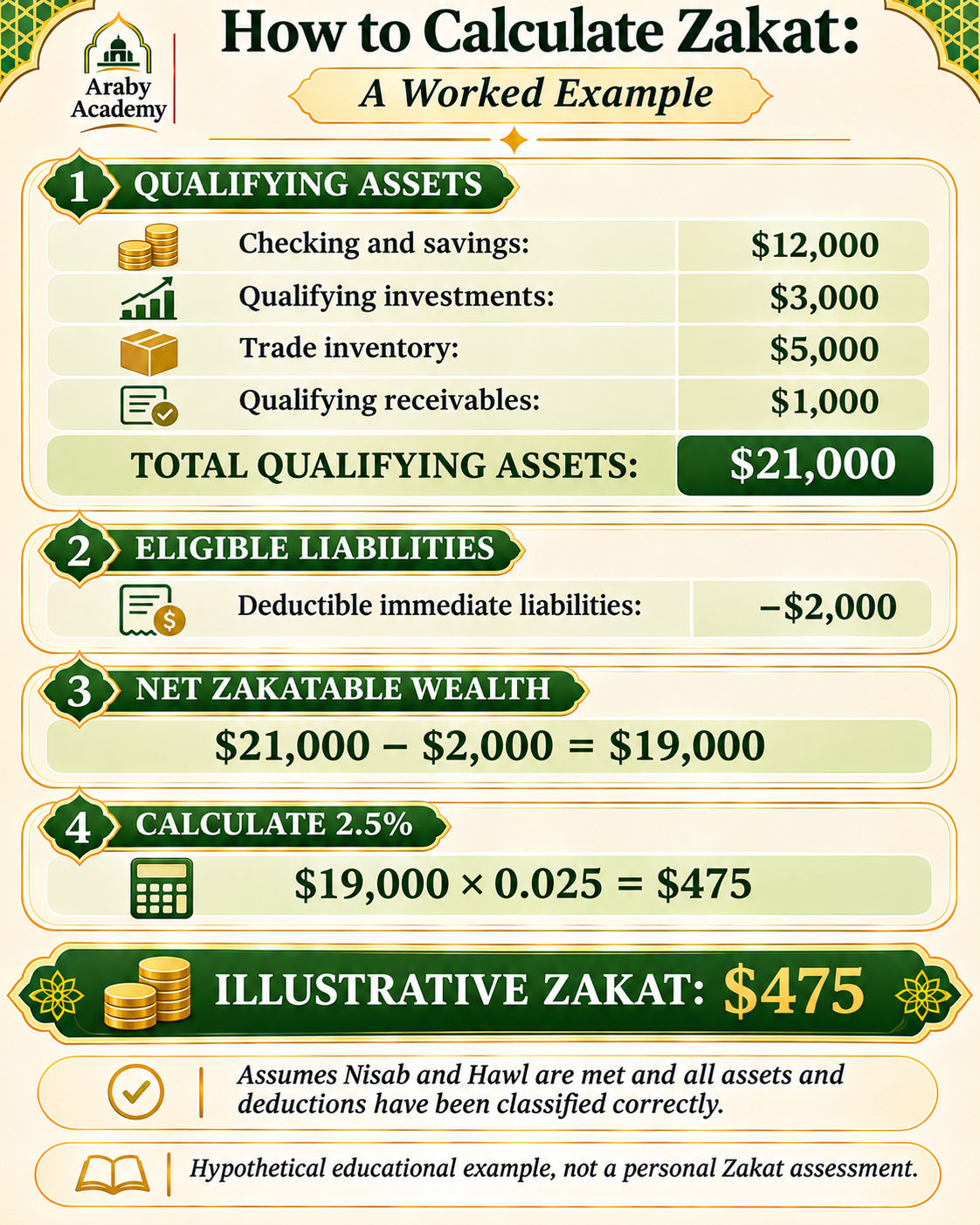
This example is hypothetical. Assume Nisab is met, Hawl is complete, the assets are valued and classified correctly, and the $2,000 liability is a genuine debt due now that is deductible under the scholarly approach followed.
Item | Amount |
|---|---|
Checking and savings | $12,000 |
Qualifying investments | $3,000 |
Trade inventory | $5,000 |
Qualifying receivables | $1,000 |
Total qualifying assets | $21,000 |
Less allowable immediate liabilities | −$2,000 |
Net Zakatable wealth | $19,000 |
Zakat at 2.5% ($19,000 × 0.025) | $475 |
Not every investment, receivable, or liability is treated the same way. This is a template for understanding the method, not a verdict on any real portfolio. Use a blank worksheet like this:
Asset | Estimated value | Zakatable? | Notes |
|---|---|---|---|
Cash and bank balances | ____ | Yes | Include accessible accounts |
Gold/silver (non-jewelry) | ____ | Yes | Weight, purity, market value |
Business inventory | ____ | Yes | Valued for resale |
Investments | ____ | Depends | Check intention and structure |
Receivables | ____ | Depends | Recoverable only |
Total assets − eligible deductions = net base | ____ | × 0.025 = Zakat |
Which Assets Are Subject to Zakat?
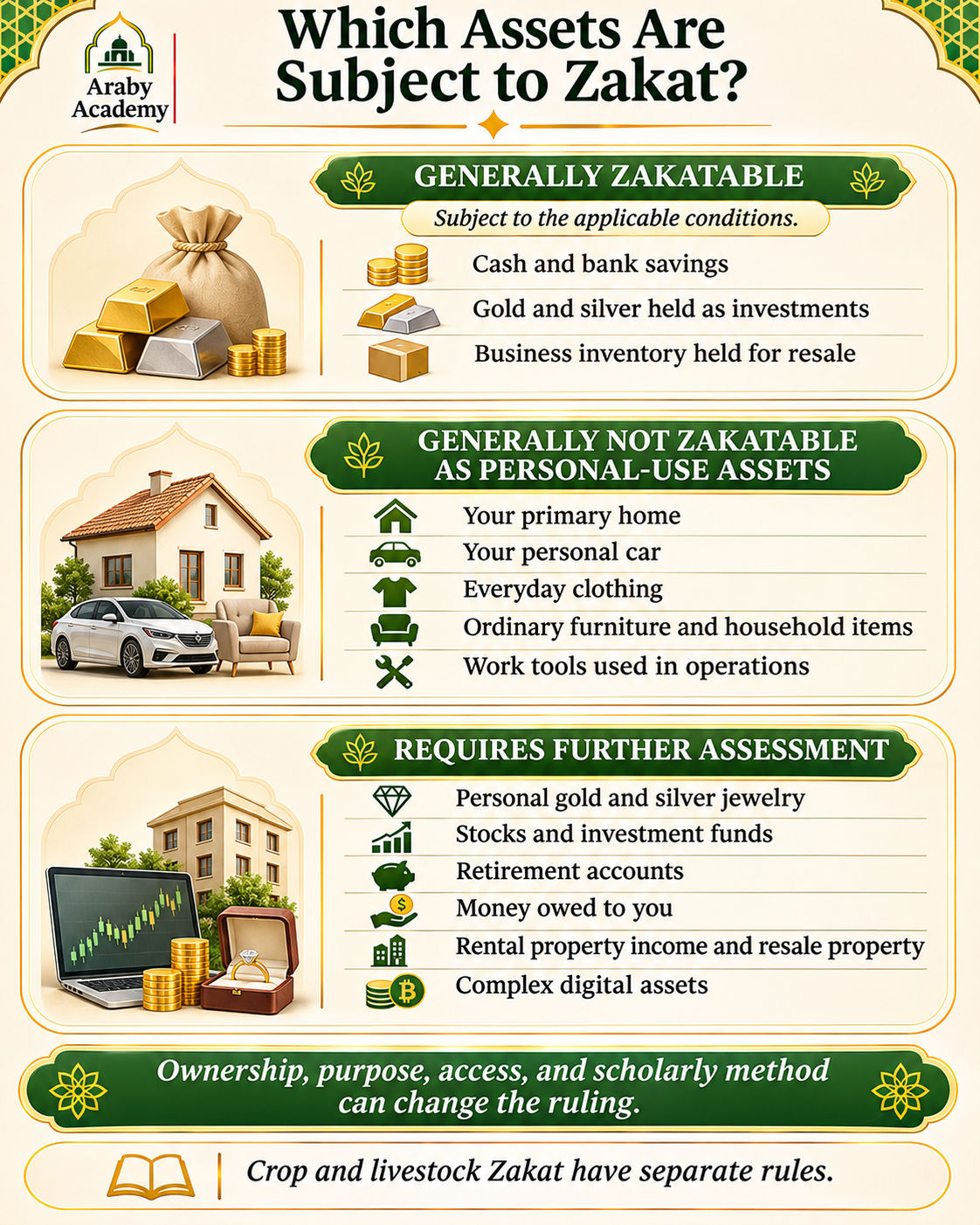
Asset | Typical treatment |
|---|---|
Cash and bank savings | Zakatable |
Gold and silver bars, coins, investment metal | Zakatable by weight and purity |
Personal gold/silver jewelry | Depends on the school |
Business inventory (trade goods) | Zakatable at market value |
Money owed to you | Depends on recoverability |
Shares and funds | Depends on intention and structure |
Crops and livestock | Special rules and rates |
Home lived in, personal car, clothes, furniture, appliances, ordinary work tools | Generally not Zakatable (personal use) |
Intended use and ownership can change a ruling, so treat the table as a starting point.
Cash and Savings
Cash at home, checking accounts, and savings accounts all count. Salary is not multiplied by 2.5% every month as a universal rule, and Zakat is not an income tax. What counts is money you still own as qualifying wealth on your Zakat date. Scholars discuss how income received during an established Hawl is treated.
Money saved for a house, wedding, or university is not automatically exempt. Planning to spend it later does not remove it from your wealth. Genuine debts that are due now may be deductible, which is a separate question.
Gold and Silver
Bars, coins, and investment gold are valued by weight, purity, and market value. Personal jewelry is where schools differ. The Hanafi school requires Zakat on gold and silver jewelry even when worn. The Maliki, Shafi’i, and Hanbali schools generally exempt jewelry owned for lawful, moderate personal use, while still requiring Zakat on jewelry kept as investment or beyond reasonable use. Follow a scholar you trust.
For purity, pure gold is roughly karat ÷ 24. For example, 40 g of 18k jewelry is 18 ÷ 24 = 75%, or about 30 g of pure gold. Gemstones are not counted as gold weight, and a professional valuation may be needed. Silver bars, coins, and jewelry are assessed against the silver Nisab in the same way.
Business Inventory and Investments
For trade, Zakat generally applies to inventory at resale value, trade cash, and collectible receivables, less deductible liabilities, at 2.5% of that net base. It is not 2.5% of revenue or of a company’s total valuation. Machinery, office furniture, and business vehicles used to operate are generally not counted themselves.
Property depends on purpose. A home you live in is not Zakatable. Rental property’s market value is generally not Zakatable, though rent you keep as cash is. Property bought for resale is trade stock.
For shares, treatment depends on intention (trading versus long-term holding), the company’s underlying assets, and the valuation method; shares held for trading are commonly valued at market value. Funds and ETFs raise further questions, and some scholars use underlying assets or fund-provided Zakat data. Retirement accounts (401(k), IRA, pensions) vary with access, vesting, penalties, and taxes, and scholars differ on whether to assess annually or on withdrawal. Contemporary scholars also differ on cryptocurrencies. Ask a qualified scholar and an accountant about these.
For Muslims managing salaries, business income, and investments abroad, understanding [ practical Halal financial living in the West] can help place Zakat within wider everyday decisions.
Debts and Liabilities
Schools differ. Broadly, Hanafi and Hanbali scholars allow deducting debts that are due from Zakatable wealth, the Malikis allow it in more limited ways, and the Shafi’i school’s relied-upon view is that debt does not prevent Zakat. Many contemporary scholars deduct only what is payable soon, such as bills, a credit-card balance due, and installments due within the coming year, not the entire principal of a mortgage or student loan. Whether the loan involves interest is a separate religious question.
Money owed to you counts when you can reasonably expect repayment. Doubtful debts are treated differently, and some scholars wait until collection.
Is Zakat Always 2.5%?
No. The 2.5% figure fits money and trade wealth, not everything.
Category | Common rule | Important qualification |
|---|---|---|
Cash and savings | 2.5% | After Nisab and Hawl |
Trade wealth | 2.5% of net trade base | Valuation and debts matter |
Crops | One-tenth if naturally watered; one-twentieth if irrigated with effort or cost (Sahih al-Bukhari 1483) | Due at harvest; threshold and details differ by school |
Livestock | Category-specific amounts; thresholds begin around 5 camels, 30 cattle, 40 sheep/goats | Grazing and age conditions apply |
Rikaz (buried treasure) | One-fifth (Sahih al-Bukhari 1499) | Mined minerals are treated differently |
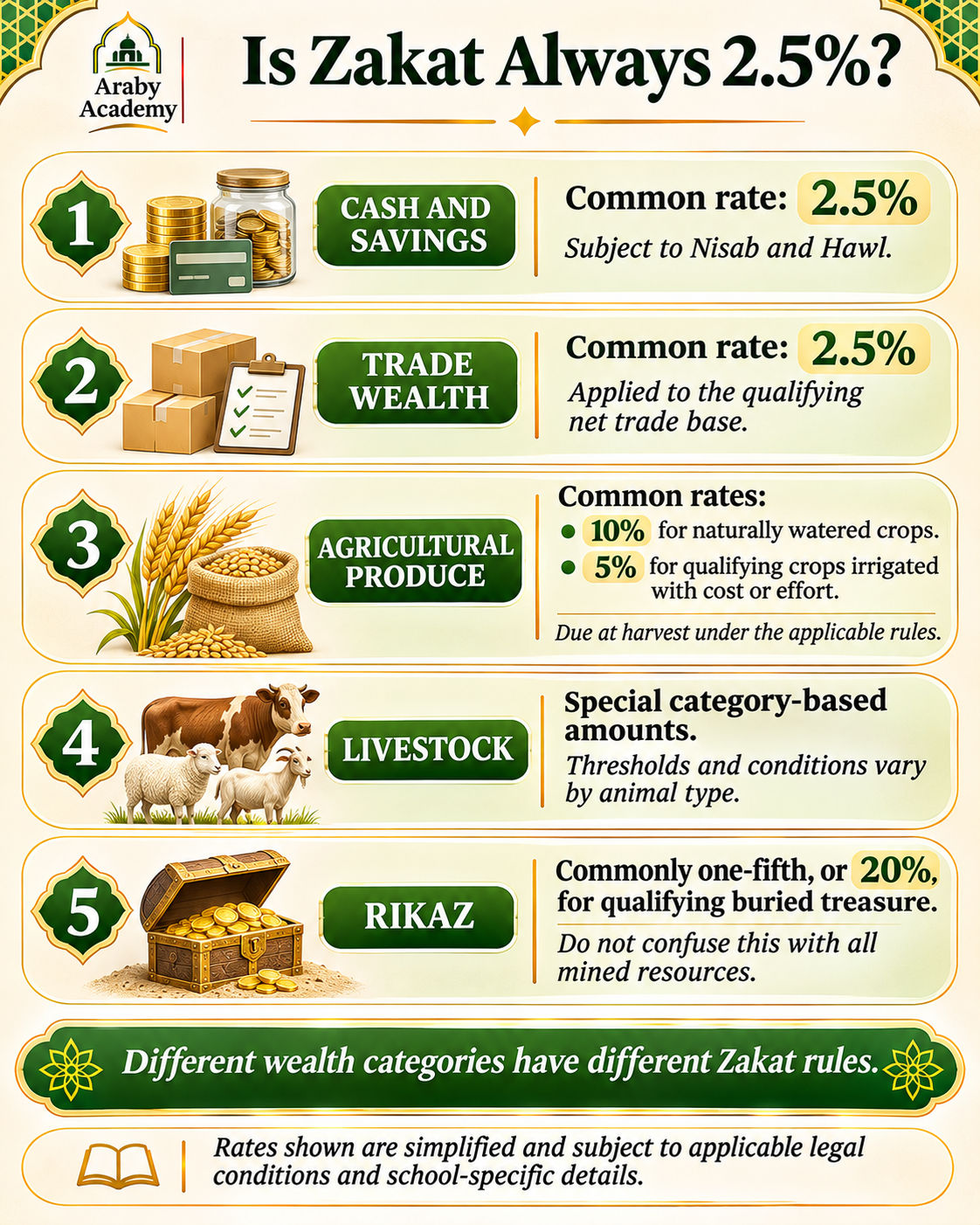
Livestock and complex agricultural cases should be referred to a specialist resource.
When Should Zakat Be Paid?
Zakat is due when the conditions are complete, and it should be paid without unnecessary delay. Ramadan is not a universal due date. Many people choose it for the added reward, which is fine if it is also when the Zakat falls due. Although many families associate charitable giving with [ practicing Ramadan while living in the West], the actual Zakat due date depends on the relevant conditions, not simply the calendar month. Do not postpone overdue Zakat until next Ramadan without a valid reason.
Monthly payments. You can organize installments as advance payments toward the Zakat you expect to owe, with a clear intention and a running record. Twelve casual donations with no intention or accounting may not settle it.
Advance payment. Many jurists permit paying early once Nisab is reached; the Maliki school is more restrictive.
Missed Zakat. Unpaid Zakat remains owed. Reconstruct your due dates, estimate your assets using bank statements and records, calculate liabilities, and pay what remains. There is no invented penalty rate. If records are incomplete, a scholar can guide reasonable estimates.
If you cannot pay right now. Cash may be short while assets are not, or you may face real hardship. Seek qualified guidance and do not borrow at interest to pay Zakat.
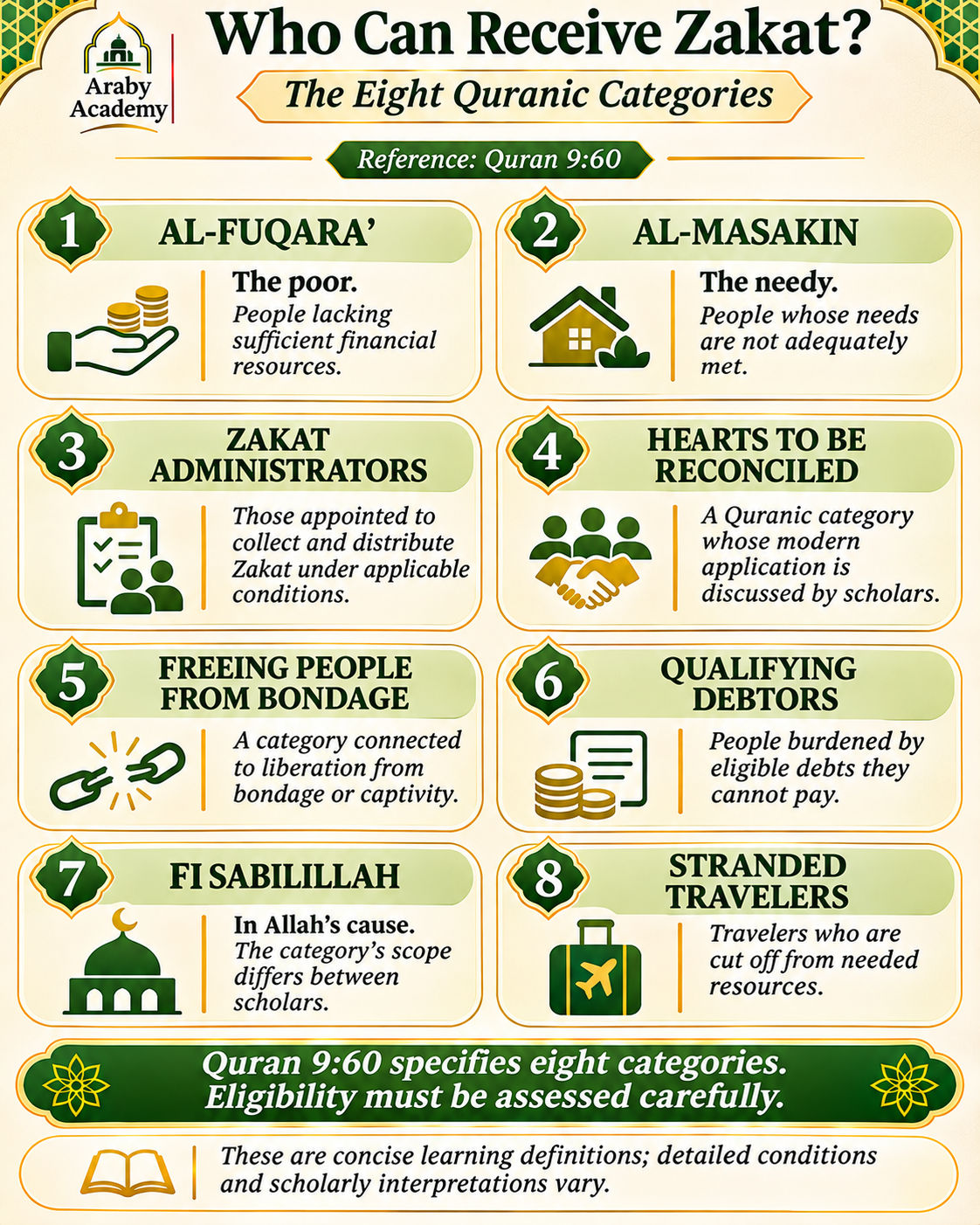
Who Can Receive Zakat? The Eight Quranic Categories
Quran 9:60 says, in meaning: Zakat is only for the poor, the needy, those who work to administer it, those whose hearts are to be reconciled, freeing captives, those in debt, in the cause of Allah, and the stranded traveler, an obligation from Allah, who is All-Knowing and Wise.
# | Arabic | Transliteration | Meaning and caution |
|---|---|---|---|
1 | الْفُقَرَاء | al-fuqara’ | The poor; schools differ on where poor and needy are separated. |
2 | الْمَسَاكِين | al-masakin | The needy; schools differ on which is worse off. |
3 | الْعَامِلِينَ عَلَيْهَا | al-‘amilina ‘alayha | Those appointed to collect and distribute Zakat; this does not make all charity overhead eligible. |
4 | الْمُؤَلَّفَةِ قُلُوبُهُمْ | al-mu’allafati qulubuhum | Those whose hearts are to be reconciled; scholars differ on its present-day application, and it is never for coercion. |
5 | فِي الرِّقَابِ | fi ar-riqab | Freeing people from bondage or captivity; modern uses need credible scholarly support. |
6 | الْغَارِمِينَ | al-gharimin | People burdened by qualifying debts they cannot pay; conditions apply. |
7 | فِي سَبِيلِ اللَّهِ | fi sabilillah | In Allah’s cause; classical and contemporary scholars differ on its scope. It does not simply mean “any good cause.” |
8 | ابْنِ السَّبِيلِ | ibn as-sabil | A traveler cut off from resources; not any tourist. |
The verse names categories, not modern advertising labels. Schools differ on whether each payment must be spread across all categories: the Shafi’i school leans toward distributing among those present, while Hanafi, Maliki, and Hanbali scholars generally allow giving to one category. Descendants of the Prophet’s clan, Banu Hashim, are traditionally not recipients of Zakat (Sahih Muslim 1072).
Can You Give Zakat to Family Members or Charities?
Relatives. A relative can receive Zakat if eligible and not someone you are obliged to support. Siblings in need are often valid recipients, and giving to relatives carries the added reward of keeping family ties.
Parents and children. Scholars have long held that you may not give Zakat to parents or grandparents, or to children and grandchildren, whom you are obliged to maintain. Special cases exist, so ask a scholar.
Spouses. A husband cannot give Zakat to his wife for matters he must maintain. Many scholars allow a wife to give to her husband if he is eligible; the Hanafi school’s Abu Hanifa differed, while his students allowed it.
Non-Muslims. The majority view limits Zakat al-Mal to Muslims, with some discussion about the “hearts reconciled” category. Voluntary Sadaqah may be given to non-Muslims in need.
Mosques and schools. Most classical jurists do not count building a mosque or running a school as a Zakat recipient, and some contemporary scholars allow certain educational causes under fi sabilillah. Eligible students in need can qualify individually.
Refugees. Refugees in need may qualify as poor, needy, or travelers, but each case should be assessed.
Charities. Ask whether the organization has a separate Zakat fund, who receives it, how administrative costs are handled, and whether it publishes accountability reports. An “Islamic” label alone is not proof of eligibility.
Direct giving. You may give directly to an eligible person. Intend the payment as Zakat, transfer real ownership, and protect the person’s dignity and privacy. Telling the recipient “this is Zakat” is not always required. Local giving is generally preferred, while overseas transfer is often permitted for greater need.
Intention. Zakat requires the intention (النِّيَّة, an-niyyah) that the payment is Zakat; no special spoken formula is required. Past donations made as plain charity cannot simply be relabeled as Zakat without conditions.
Zakat vs Sadaqah vs Zakat al-Fitr
Zakat al-Mal | Sadaqah | Zakat al-Fitr | |
|---|---|---|---|
Nature | Obligation on qualifying wealth | Voluntary charity in common usage | Obligation at the end of Ramadan |
Timing | When conditions are met | Anytime | Before the Eid prayer, with early payment permitted |
Amount | 2.5% for money; other rates by category | Any amount | One sa’ of staple food per person; some allow its monetary value |
Recipients | Eight categories | Anyone, including non-Muslims in need | Mainly the poor and needy |
Ibn ʿUmar reported that the Prophet ﷺ prescribed a saʿ of dates or barley for each Muslim at the end of Ramadan (Sahih al-Bukhari 1503; Sahih Muslim 984). Scholars differ on paying cash value. Check local figures yearly.
Zakat versus taxes. Government taxes and Zakat are separate obligations. Paying income tax does not automatically settle Zakat, and tax treatment of donations varies by country.
The Spiritual and Social Purpose of Zakat
Zakat is financial worship. It expresses gratitude, restrains greed, and recognizes that others hold rights in what Allah has entrusted to you. It supports vulnerable people without treating them as props for the giver’s moral growth, and it should be done discreetly.
Zakat can also strengthen awareness of Allah, complementing everyday practices such as [ remembering Allah through Dhikr]. Careful budgeting, lawful earnings, and giving what is due are consistent with [ trusting Allah without becoming passive] in financial matters. Zakat reminds believers that financial choices belong to a broader understanding of [ accountability in the Hereafter], rather than being purely private economic decisions.
Muslims who want to accompany their charitable giving with supplication can also learn [how to make Dua according to Islamic teachings] without treating any invented wording as obligatory.
Zakat is a community responsibility, but it is no guaranteed cure for poverty or a promise of wealth. Its benefits are for Allah to grant. Low-income Muslims who do not meet the conditions should never be shamed.
Common Zakat Calculation Mistakes
Treating Zakat as optional. It is an obligation; learn its conditions.
Using an outdated Nisab price. Check metal prices on your valuation date.
Confusing gold and silver thresholds. Choose one standard with a reason.
Applying 2.5% to every asset. Crops, livestock, and treasure differ.
Ignoring investment or trade assets. Review them every year.
Deducting whole long-term debts. Check which debts your scholar allows.
Waiting for Ramadan regardless of the due date. Pay when due.
Giving to an unverified cause. Confirm Zakat eligibility.
Keeping no records. Note dates, amounts, and recipients.
Annual checklist: ☐ valuation date ☐ Nisab standard and prices ☐ cash and savings ☐ gold and silver ☐ investments, inventory, receivables ☐ eligible liabilities ☐ Hawl ☐ calculation ☐ eligible recipients ☐ intention ☐ payment record. Complex cases need additional analysis.
How to Teach Children About Zakat
Children can learn gratitude, sharing, dignity, and responsibility without being told that pocket money is Zakatable. Explain 2.5% with simple numbers, read Quran 9:60 together, learn the Arabic terms, and review a family giving calendar. Teaching children to understand generosity and responsibility can support [ raising Muslim children with a strong Islamic identity] without reducing charity to a public performance.
15 Important Arabic Words About Zakat
Nisab, Hawl, and Niyyah are later legal terms or concepts, not words of Quran 9:60. The recipient terms are Quranic.
Arabic | Transliteration | Meaning and note |
|---|---|---|
الزَّكَاة | az-zakah | Obligatory charity; root z-k-w, purification and growth |
الصَّدَقَة | as-sadaqah | Charity; meaning depends on context |
النِّصَاب | an-nisab | Minimum threshold (legal term) |
الحَوْل | al-hawl | Year, lunar year in Zakat law (legal term) |
المَال | al-mal | Wealth, property |
الفُقَرَاء | al-fuqara’ | The poor |
المَسَاكِين | al-masakin | The needy |
الْعَامِلُونَ عَلَيْهَا | al-‘amilun ‘alayha | Zakat administrators |
الْمُؤَلَّفَةُ قُلُوبُهُمْ | al-mu’allafatu qulubuhum | Hearts to be reconciled |
الرِّقَاب | ar-riqab | Bondage or captivity |
الْغَارِمُونَ | al-gharimun | Those in qualifying debt |
فِي سَبِيلِ اللَّهِ | fi sabilillah | In Allah’s cause; scope debated |
ابْنُ السَّبِيلِ | ibn as-sabil | Stranded traveler |
النِّيَّة | an-niyyah | Intention |
الْبَرَكَة | al-barakah | Blessing |
Frequently Asked Questions
What is Zakat in Islam? An obligatory act of worship: giving a prescribed portion of qualifying wealth to eligible recipients.
Why is Zakat obligatory? The Quran commands it alongside prayer, and it is one of the Five Pillars.
Who has to pay Zakat? Muslims who own qualifying wealth above Nisab, subject to conditions that vary by school.
What is Nisab? The minimum wealth threshold, based on a gold or silver weight valued at current prices.
Should I use gold or silver Nisab? Scholars differ. Choose a justified standard, often silver for cash, and apply it consistently.
What does Hawl mean? A full lunar year of ownership, required for many asset types but not all.
How do I calculate 2.5% Zakat? Multiply net Zakatable wealth by 0.025 once Nisab and Hawl are met.
Is Zakat always 2.5%? No. Crops, livestock, and treasure follow other rules.
Do I pay Zakat on my salary? Not as 2.5% of each paycheck. Retained money is counted on your Zakat date.
Do I pay Zakat on gold jewelry? Schools differ: Hanafis require it; the other three generally exempt lawful personal-use jewelry.
Do I pay Zakat on my house? Not on a home you live in. Rental and resale property are treated differently.
Do debts reduce my Zakat? Often debts due soon, but not always the whole loan. Follow a qualified opinion.
Must Zakat be paid during Ramadan? No. It is due when its conditions are met.
Who are the eight recipients? The poor, the needy, administrators, hearts reconciled, captives, debtors, fi sabilillah, and stranded travelers (Quran 9:60).
Can I give Zakat to relatives? Yes, if eligible and not someone you must support.
Can Zakat fund a mosque or school? Most classical scholars say no; some contemporary scholars allow limited cases.
Zakat versus Sadaqah or Zakat al-Fitr? Zakat is obligatory on wealth; Sadaqah is voluntary; Zakat al-Fitr is due at Ramadan’s end.
Conclusion — Understanding and Fulfilling Your Zakat
Back to the person with a checking account, some savings, and many questions: you now know what Zakat is, why it is obligatory, how Nisab and Hawl work, how a typical 2.5% cash calculation runs, why other assets differ, and who may receive it. Zakat is worship, and it involves others’ rights, so calculating it carefully is part of fulfilling the duty. Do not feel ashamed to ask for guidance when your situation is complicated.
Zakat turns the question “How much wealth do I own?” into a wider responsibility: “What portion of my qualifying wealth has Allah required me to give, and how can I fulfill that duty correctly?” If you would like to deepen your understanding of the Quran, Islamic Studies, and Arabic, you are welcome to learn with qualified teachers at Araby Academy.