Introduction: Raising Muslim Children Between Two Worlds
Picture a fairly ordinary Tuesday. A Muslim child finishes school, does homework, scrolls through a few minutes of video content, chats with friends about a show everyone is watching, and maybe fits in a twenty-minute Quran lesson before bed. Multiply that day by the thousands of days that make up a childhood, and a quiet question starts to form in many parents' minds: is Islam getting enough space in my child's life to actually take root?
This worry is one of the most common threads among Muslim parents raising Muslim children in the West. It isn't paranoia — it's a reasonable response to a real situation. Children growing up in the United States, the United Kingdom, Canada, Australia, and across Europe spend the overwhelming majority of their waking hours in environments that were not built with Islamic values in mind. School, entertainment, advertising, and social media all compete, often unintentionally, for the same hearts and attention that parents are trying to shape around faith.
But here is the reassurance that deserves to come before anything else: growing up in a non-Muslim-majority society does not automatically mean losing one's Islamic identity. Millions of Muslim children raised in the West grow into adults who are confident in their faith, comfortable in their own skin, spiritually connected to Allah, capable of navigating wider society with grace, and genuinely knowledgeable about their religion. It happens. It is happening right now, in ordinary homes, through ordinary effort.
What makes the difference is rarely a single dramatic decision. It is the accumulation of everyday choices — how Islam is talked about at home, how questions are answered, how worship is modeled, how love and correction are balanced. The goal of Islamic parenting in the West is not to control a child's religious behavior for eighteen years and hope it sticks. The goal is to help a child understand, love, and eventually choose Islam consciously, so that their faith belongs to them and not only to their parents.
This article walks through ten practical strategies for building that kind of lasting Islamic identity, along with dedicated guidance on Quran education, different age stages, school life, and what to do if a child seems to be drifting. Every strategy is meant to be realistic — something a tired parent with a full-time job and a house to run can actually begin this week.
What Does a Strong Islamic Identity Actually Mean?
Before getting into strategies, it helps to be honest about what "Islamic identity" really means, because the surface markers are often mistaken for the whole picture.
A child can wear Islamic clothing, carry a Muslim name, attend an Islamic school, memorize a respectable portion of the Quran, avoid clearly prohibited things, and celebrate Eid enthusiastically — and still feel disconnected from the meaning of any of it. None of these things are unimportant. But identity lives at a deeper level than appearance and routine.
A strong Islamic identity tends to include several layers working together:
Belief. The child gradually comes to understand who Allah is, not as an abstract rule-giver, but as the Creator who is deserving of love, gratitude, and worship.
Worship. Salah, Quran, dua, and dhikr start to feel meaningful rather than purely compulsory. The child begins to sense why these acts exist, not just that they are required.
Knowledge. The child understands Islam rather than simply inheriting it. They can explain, at an age-appropriate level, what they believe and why.
Belonging. Being Muslim feels like a natural, positive part of who they are — not a burden, not an embarrassment, not something to hide.
Character. Islam shows up in honesty, kindness, patience, responsibility, modesty, and justice — not only in ritual observance.
Confidence. The child can live among people who believe differently without feeling ashamed of their own faith or needing to be defensive about it.
Personal conviction. As children mature, their relationship with Islam increasingly becomes their own — sustained by their own understanding and love, rather than maintained only because a parent is watching.
Allah describes this kind of intentional, protective investment in family in the Quran:
"O you who have believed, protect yourselves and your families from a Fire whose fuel is people and stones..." (Surah At-Tahrim, 66:6)
Classical scholars have long understood this verse to mean far more than personal piety — it is a command to actively teach, guide, and nurture one's household in faith. That is the real project of raising Muslim children in the West: not managing behavior, but building the inner architecture of belief, understanding, and belonging that a child can carry with them long after they've left home.
The 10 Core Strategies for Raising Muslim Children in the West
1. Make Islam Visible and Positive at Home
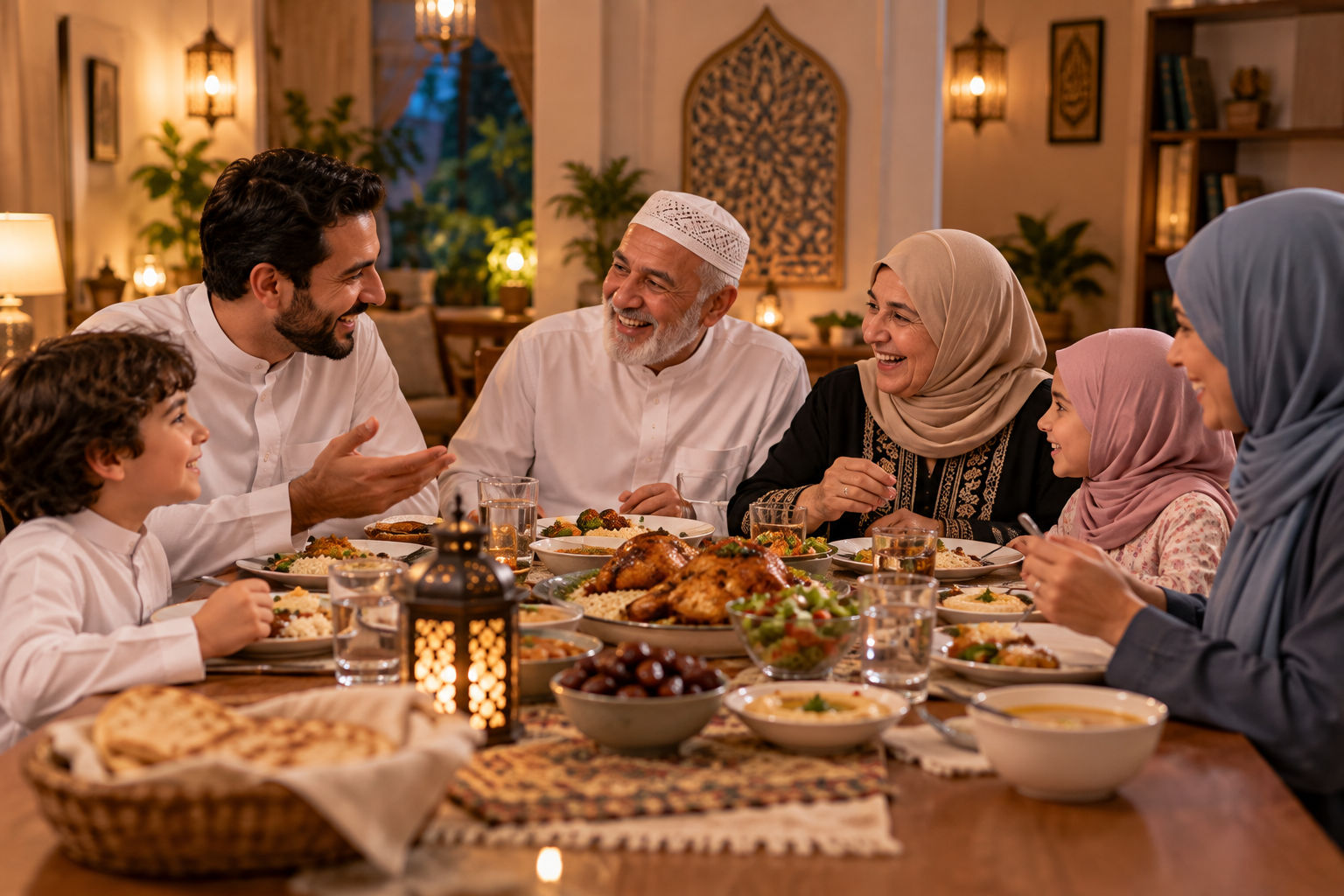
The home is a child's first Islamic environment, long before any classroom or mosque. What a child associates with Islam in their earliest years often shapes their emotional relationship with the religion for decades.
If Islam mostly shows up in a child's life as correction — "that's haram," "stop that," "you shouldn't say that" — the child may unconsciously begin to associate religion with restriction, tension, and disapproval, even if no one intended that. The remedy isn't to abandon correction; it's to make sure Islam also shows up as warmth, celebration, and shared joy.
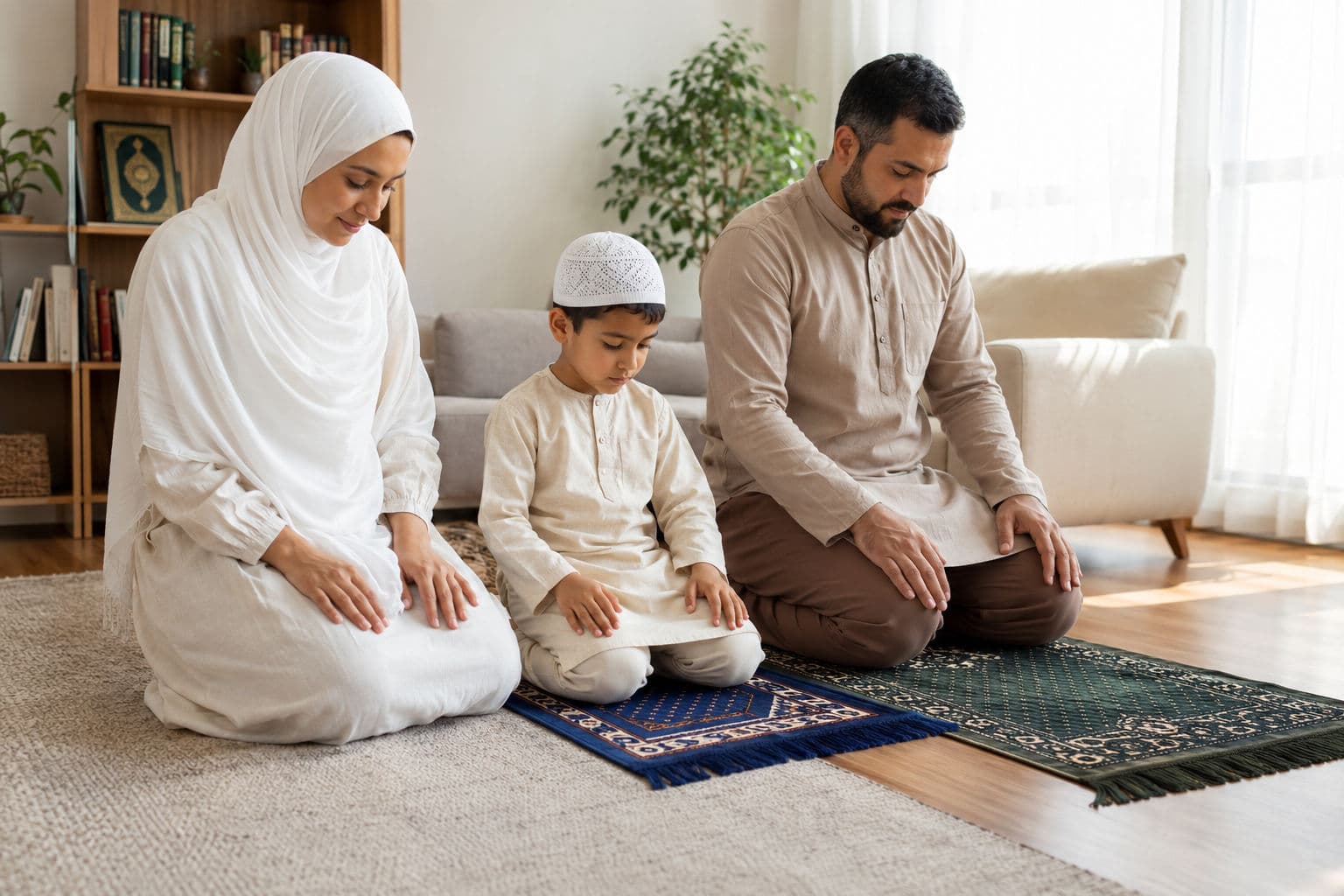
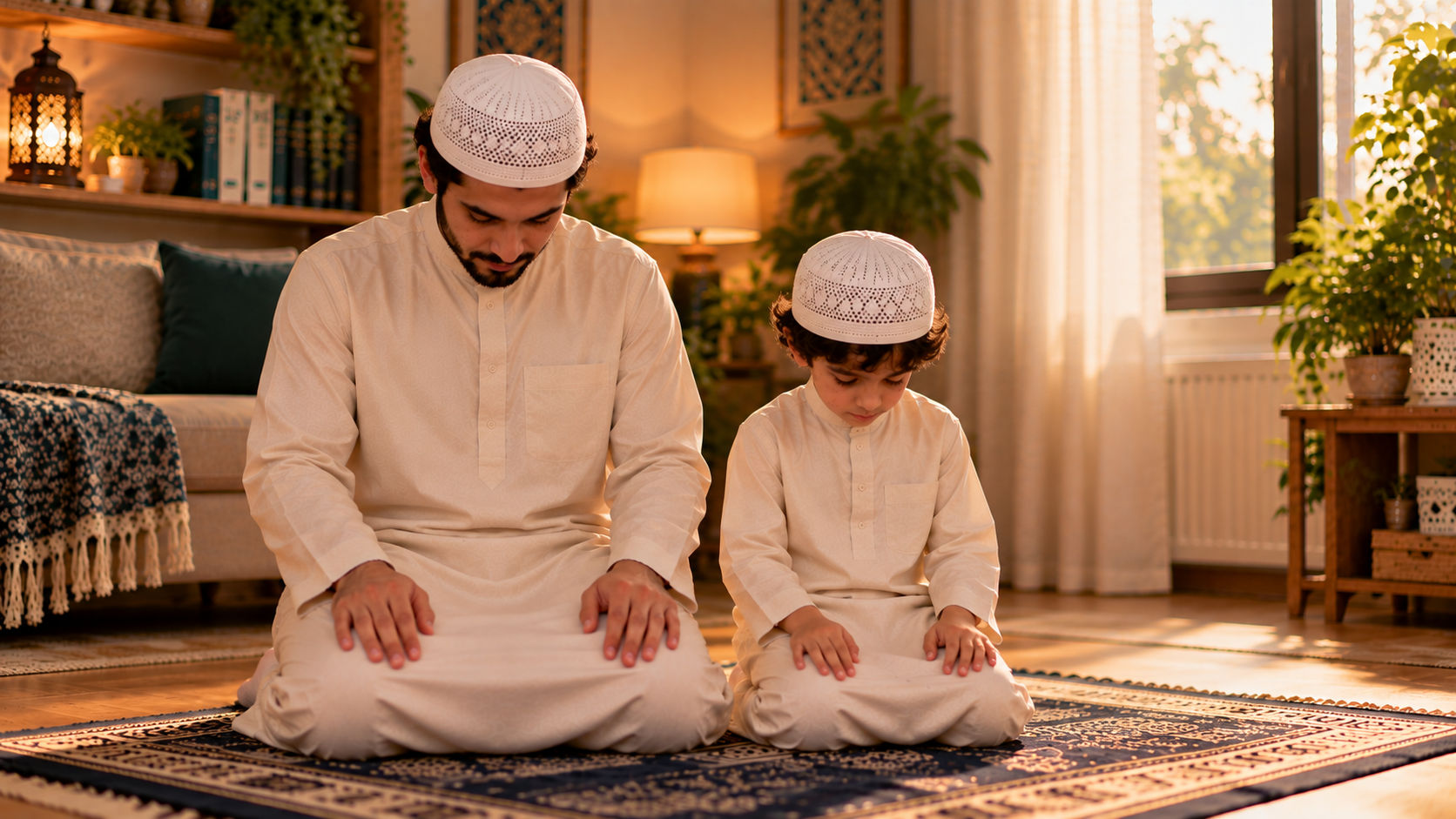
This can look like praying together as a family rather than only individually, playing Quran recitation during a car ride, saying "insha'Allah" and "alhamdulillah" naturally in daily conversation, keeping Ramadan and Eid preparation genuinely festive, and involving children in small acts of charity so giving feels like something Muslims do, not just something they're told about.
A common mistake is treating Islamic practice as background noise that only becomes visible when something goes wrong. A simple starting action: choose one positive Islamic ritual — a Friday family breakfast, a bedtime dua said together, a short reflection after Maghrib — and protect it consistently, even on busy weeks.
2. Be the Muslim You Want Your Child to Become
Children are remarkably perceptive about the gap between what parents say and what parents do. A child who hears "always pray on time" from a parent who regularly delays Salah, or "never lie" from a parent who tells small daily lies, is absorbing a different lesson than the one being spoken aloud.
This isn't about guilt or perfection — no parent models Islam flawlessly, and children don't need flawless parents. What they need is visible, ongoing effort: a parent who prays, even imperfectly; who opens the Quran sometimes, even if just a page; who apologizes after losing their temper; who treats a difficult relative or a rude stranger with the same patience they ask their child to show.
A common mistake is assuming Islamic parenting is something separate from personal practice — as if children can be "given" Islam through instruction alone. In reality, the most persuasive Islamic education a child receives is watching a parent quietly try to live the faith. A practical starting point: pick one area of personal practice — punctual Salah, reduced anger, more consistent Quran reading — and work on it visibly, without turning it into a lecture.
3. Build a Relationship With the Quran Early
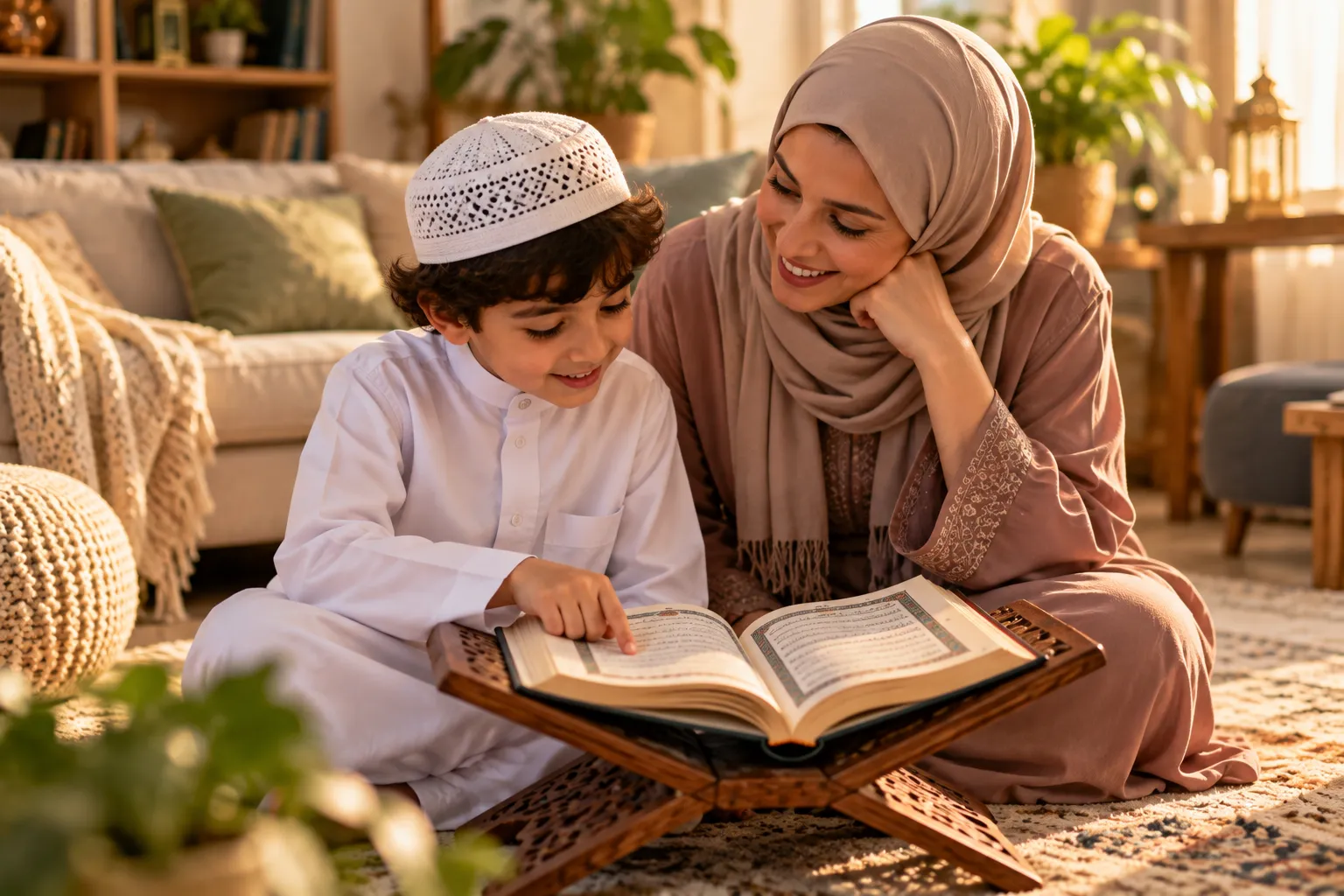
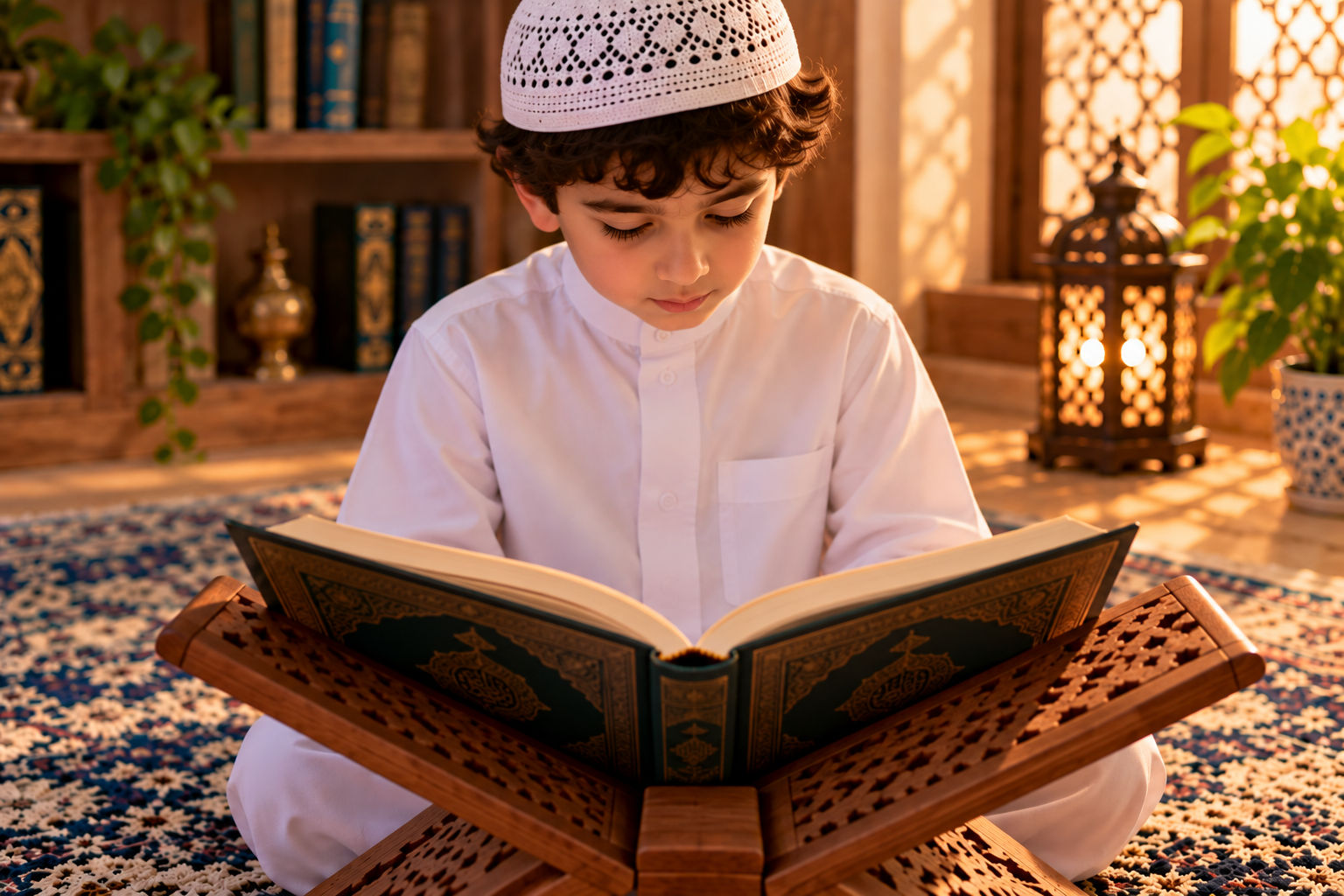
The Quran deserves a category of its own in Islamic parenting, because it is meant to be far more than a memorization project. A child can complete impressive amounts of memorization while understanding very little of what they're actually reciting — and that gap matters.
A more complete approach combines several elements together rather than isolating one: correct pronunciation and Tajweed, steady memorization at a pace suited to the child, age-appropriate explanation of meaning, listening to recitation for its own sake, and regular, gentle review rather than one-time learning followed by forgetting.
Qualified teachers make a real difference here — particularly teachers experienced in working patiently with children, who can adjust pace, celebrate small wins, and avoid turning lessons into pressure. This is one reason many families choose structured, one-to-one online Quran classes for kids: a child gets focused attention and a teacher who can pace lessons to their actual ability rather than a rigid schedule. Articles like How to Read the Quran in Arabic or Teaching Quran to Children can offer further detail on building this foundation step by step.
A common mistake is chasing volume — more Surahs, faster — at the expense of connection. A practical starting action: after any short memorization session, spend even two minutes asking, "Do you know what this ayah means?" and share one simple point together.
4. Help Children Understand the Arabic They Encounter in Islam
Muslim children in the West often recite Arabic dozens of times a day — through Salah, dua, and Quran — without necessarily understanding a word of it. This isn't a failure on anyone's part; it's simply what happens when a child is raised in an English-speaking (or non-Arabic-speaking) environment while practicing a faith whose primary language is Arabic.
Parents don't need to expect fluency, and shouldn't feel discouraged if Arabic feels distant to their family. Progress can be gradual and still be meaningful: learning the meaning of common Salah phrases, picking up frequently repeated Quranic vocabulary, and slowly building basic grammar as a child grows older. Even knowing what "Subhana rabbiyal 'Adheem" or "Alhamdulillahi rabbil 'aalameen" actually means can transform how a child experiences prayer.
Structured Arabic instruction designed specifically for non-native speakers — the kind covered in resources like Arabic for Beginners or Quranic Arabic — can make this process far less intimidating than trying to piece it together informally. The point isn't turning children into Arabic scholars; it's closing the gap between reciting words and understanding them.
5. Give Children Safe Space to Ask Difficult Questions
This may be the single most important strategy in this list. Sooner or later, most children will ask something like: Why do we pray five times a day? Why can't I do what my friends do? How do we know Islam is true? Why does Allah allow suffering?
These questions are not automatically signs of weak faith or rebellion. Often, they're the opposite — a child taking their religion seriously enough to want it to make sense. How a parent responds in that moment shapes whether the child keeps bringing questions home, or starts taking them elsewhere.
Responses like "don't ask that," "because I said so," or "you shouldn't think like that" tend to shut the conversation down rather than resolve the question — and the question doesn't disappear, it just goes underground, often toward unreliable sources online. A more effective approach: listen fully before responding, try to understand what's really being asked, stay calm even if the question feels uncomfortable, admit honestly when you don't know an answer, and follow up later with something researched rather than improvised.
The Prophet ﷺ modeled this spirit of accessibility and patience rather than harshness in teaching: "Make things easy and do not make things difficult. Make people calm and do not repulse them" (Sahih al-Bukhari 69; Sahih Muslim 1734). A child who knows their questions are welcome at home is far less likely to seek "answers" from a stranger on the internet.
6. Help Your Child Feel Proud — Not Embarrassed — About Being Muslim
Muslim children in the West regularly face small, unscripted moments where their faith becomes visible: explaining why they're fasting, asking for a place to pray, wearing hijab, declining a drink at a party, or answering a classmate's blunt question about Islam. How prepared a child feels for these moments strongly affects whether they feel proud or self-conscious.
Preparation helps enormously. Rehearsing simple, confident explanations in advance — "I'm fasting for Ramadan, it's like our version of a spiritual challenge," or "I don't eat pork, it's part of my religion, no big deal" — gives children language they can reach for instead of freezing or over-apologizing. Talking through these scenarios before they happen, rather than only after an uncomfortable one occurs, builds real confidence.
The goal here is not encouraging defensiveness or hostility toward classmates or teachers. It's helping children participate fully and confidently in wider society while holding onto their religious identity without shrinking it. A related resource worth exploring with older children is Raising Confident Muslim Children, which expands further on building this kind of everyday resilience.
7. Build Strong Muslim Friendships and Community Connections
Children need to see that being Muslim isn't something that only happens inside their own house. Mosque involvement, Islamic youth groups, Quran classes, family friendships with other Muslim families, camps, and community volunteering all give children a sense that their faith is shared and lived by real people their own age — not just something practiced in isolation.
This becomes especially important during the teenage years, when peer influence intensifies and identity questions grow more complex. A teenager with even one or two grounded Muslim friends often navigates social pressure differently than one who feels entirely alone in their practice.
It's worth being honest, though, that simply placing a child around other Muslims doesn't automatically guarantee a positive influence — character and environment still matter, and not every Muslim peer group models the values a family hopes to reinforce. The goal is thoughtful connection, not blanket assumption.
8. Teach Islamic Values, Not Just Islamic Rules
There's a meaningful difference between "don't do this because it's haram" and helping a child understand the value or purpose behind a guideline. Both have their place, but a child who only ever hears the rule, without the reasoning, often struggles to internalize it once a parent isn't around to enforce it.
Everyday moments offer constant openings for this kind of teaching without turning every interaction into a formal lecture. A sibling conflict becomes a chance to talk about mercy and fairness. A found wallet becomes a conversation about honesty and returning trusts (amanah). A hard day at school becomes an opportunity to talk about patience (sabr) as something Allah rewards, not just something to endure.
Luqman's advice to his son, recorded in the Quran, is often cited as a model for exactly this kind of values-based teaching — gentle, direct, and rooted in reasoning rather than fear:
"O my son, establish prayer, enjoin what is right, forbid what is wrong, and be patient over what befalls you. Indeed, that is of the matters requiring resolve." (Surah Luqman, 31:17)
Notice that the advice doesn't stop at instruction — it explains the underlying values of righteousness, responsibility, and patience. That's the model worth following at home.
9. Navigate Screens, Social Media, and Popular Culture Wisely
For most families, this is the single hardest modern parenting challenge — Islamic or otherwise. Smartphones, YouTube, TikTok, gaming, influencers, and algorithm-driven content compete constantly for a child's time and attention, often shaping ideas about beauty, relationships, consumerism, and identity that sit uneasily alongside Islamic values.
Total isolation from technology isn't realistic for most families, and attempting it often backfires once children reach an age where they can access these platforms independently anyway. A more sustainable approach combines age-appropriate boundaries, real parental involvement (knowing what your child watches and plays, not just restricting it), ongoing media literacy conversations, protected screen-free family time, and gradually increasing responsibility as children demonstrate maturity.
Simply banning something without ever explaining the reasoning tends to lose effectiveness as children grow older and gain more independent access. A more durable approach is teaching children how to evaluate content critically through an Islamic lens — asking questions like "does this encourage something Allah loves or dislikes?" — so the skill travels with them even when a parent isn't there to filter.
10. Build Connection Before Correction
This final strategy underlies all the others. Children are simply more receptive to guidance — religious or otherwise — from adults they feel genuinely connected to. A child who feels distant from a parent is far less likely to internalize that parent's religious teaching, no matter how correct the content of that teaching is.
Connection is built through ordinary things: individual time together, affection, humor, shared meals, genuine interest in a child's daily life and friendships, and a parent's willingness to apologize when they've made a mistake. When correction is needed, it lands better when it's private rather than public, and when it clearly separates the child's mistake from the child's worth — "that choice wasn't wise" rather than "you're a bad kid."
Islamic discipline and warmth are not opposites. A household can hold firm boundaries while still being a place a child feels safe, loved, and unconditionally valued. In fact, that combination — clear expectations delivered with real warmth — tends to produce more lasting results than either strict rules alone or unlimited permissiveness.
Quran Education Without Creating Pressure
Quran education deserves special attention, because it's one of the areas where good intentions can accidentally cause harm. Some children come to associate Quran learning with shouting, comparison to siblings or classmates, unrealistic memorization targets, embarrassment over mistakes, or overly long, exhausting sessions.
Discipline and consistency in Quran learning are genuinely necessary — but humiliation is not, and the two are often confused. A child who is shamed for forgetting a verse doesn't usually try harder; they often start avoiding the subject altogether.
Some practical adjustments make a meaningful difference: keeping daily sessions short and consistent rather than long and irregular, reviewing previously learned material regularly instead of only pushing forward, celebrating genuine progress rather than only pointing out mistakes, choosing teachers known for patience with children, and setting goals based on the individual child's pace rather than a rigid, one-size-fits-all timeline. Children learn at different speeds, and that variation is normal, not a warning sign.
It's worth holding two goals at once. The first is familiar: my child finished the Quran, or memorized a meaningful portion of it. The second is just as important, though less often stated: my child still wants the Quran to remain part of their life as an adult. An approach that achieves the first goal while damaging the second isn't really succeeding.
When Your Child Says, "I Don't Want to Learn Quran"
This is a moment many parents dread, and the instinct is often to assume laziness or early rebellion. It's usually worth pausing and investigating instead, because the real cause is frequently something fixable.
Common underlying reasons include lessons that have become too difficult too quickly, a weak relationship or personality mismatch with the current teacher, sessions that run too long for the child's age and attention span, unrealistic memorization expectations that make the child feel like they're constantly failing, genuine confusion about what they're even reciting, an association between Quran learning and past criticism, ongoing struggle with Arabic pronunciation that hasn't been addressed, or simply more stimulating entertainment competing for the same time slot.
Rather than abandoning Quran education at the first sign of resistance, it helps to have an honest, low-pressure conversation with the child about what specifically feels difficult or unpleasant. Sometimes the fix is as simple as switching teachers, shortening sessions, slowing the pace, or reintroducing meaning and reflection alongside memorization so the material feels less mechanical. The underlying goal — a lasting, positive relationship with the Quran — is worth protecting even if it means adjusting the method.
Different Ages Need Different Approaches
Islamic parenting isn't one-size-fits-all across childhood. What works beautifully for a five-year-old will likely fall flat with a fifteen-year-old, and vice versa. These stages are meant as general guidance rather than rigid rules — every child develops at their own pace.
Ages 3–6
Focus on love, imitation, and simple positive experiences: short Surahs, listening to Quran recitation, simple duas, and warm associations with Islamic celebrations. At this stage, children absorb far more from emotional tone than from content.
Ages 7–10
This is typically when structured learning begins in earnest: establishing regular Salah, more formal Quran study, basic Tajweed, Islamic manners, simple Arabic vocabulary, and an introduction to core beliefs in age-appropriate language.
Ages 11–14
Expect deeper questions, the onset of puberty, intensifying friendships and social pressure, growing internet exposure, and a need for more substantial Quranic understanding alongside greater personal responsibility. This is often when the "safe space for questions" strategy discussed earlier becomes most critical.
Ages 15+
At this stage, the goal shifts toward ownership of faith rather than management of behavior — supporting independent worship, engaging seriously with intellectual questions, navigating relationships and future plans (university, work), and encouraging deeper, more mature Quranic and Islamic study that the young adult increasingly pursues for themselves.
Muslim Children at Non-Muslim Schools
School is where Muslim children in the West spend the largest share of their waking hours, which makes it a natural site of both opportunity and friction. Salah times, Ramadan and fasting, halal food, Eid absences, Islamic clothing, sports participation, and religious celebrations at school all require some degree of navigation.
Respectful, proactive communication with schools tends to work far better than confrontation or silent avoidance. Many schools are willing to accommodate prayer breaks, fasting arrangements, or excused absences for Eid when parents raise the request early, clearly, and courteously. Preparing children with simple, confident language for questions from classmates and teachers — building on the confidence strategies discussed earlier — also reduces awkwardness considerably.
It's worth resisting the temptation to frame schools, teachers, or classmates as adversaries. The goal is to help children hold onto their Islamic principles while engaging respectfully and confidently with the wider society they're growing up in — not to raise children who feel at war with their own environment.
What If My Child Is Already Drifting Away From Islam?
Some parents reading this are past the prevention stage and are watching a child pull away from prayer, modesty, Quran, or Muslim identity altogether. This is a painful place to be, and it deserves to be handled with care rather than panic.
Responses like shouting, threats, humiliation, constant surveillance, comparisons to other children, or emotional blackmail tend to accelerate distance rather than close it — even when they come from a place of genuine love and fear for the child's wellbeing.
What tends to help more, though slower, is rebuilding the relationship itself: restoring open communication, re-establishing trust, engaging seriously and non-defensively with the child's actual doubts or frustrations, reconnecting them with positive Muslim peers or mentors they respect, and returning to worship and Quran gently rather than as an ultimatum. In more serious situations — ongoing mental health struggles, self-destructive behavior, or a family relationship that has broken down significantly — seeking support from a qualified counselor, imam, or family therapist experienced with these dynamics is a wise and often necessary step, not a sign of failure.
A Practical Weekly Muslim Family Routine
Rather than an idealized schedule no family could sustain, here's a realistic starting framework that can be adjusted to your family's age range and circumstances.
Daily: Salah as a family where possible, ten to fifteen minutes of Quran reading or review, one meaningful conversation (even five minutes in the car counts), and a short dua or dhikr together.
Weekly: A Quran lesson, an Arabic lesson, a intentional Friday/Jumu'ah routine, one family Islamic discussion or story, and some contact with Muslim friends or community.
Monthly: A charity activity the whole family takes part in, a brief family check-in on Islamic goals and challenges, and a mosque or community event.
None of this needs to happen perfectly every week. Consistency over time matters far more than intensity in any single week.
Islamic Identity Checklist for Muslim Parents
Use this not as a scorecard for guilt, but as a gentle prompt for reflection every few months.
Does my child associate Islam mostly with love, or mostly with correction?
Does my child understand why Muslims worship Allah, beyond simply being told to?
Can my child bring me a difficult religious question without fear of being shut down?
Does my child have positive Muslim role models beyond their immediate family?
Does my child have genuine Muslim friendships?
Is Quran learning happening consistently, even if modestly?
Does my child understand at least some of what they recite?
Are we learning and practicing Islam together as a family, not just individually?
Does my own behavior model the values I expect from my child?
Can my child explain basic Islamic practices to a curious classmate with confidence?
If several answers give you pause, that's simply useful information — not evidence of failure.
Frequently Asked Questions
1. How can I raise my child with a strong Islamic identity?
Focus on making Islam feel positive and natural at home, model the practice yourself, build a genuine relationship with the Quran, welcome hard questions, and prioritize connection with your child alongside correction.
2. How do I teach Islam to my children in a non-Muslim country?
Combine consistent home practice with structured learning — Quran, Arabic, and Islamic studies — plus community involvement through the mosque or Muslim friendships, so faith isn't confined to one hour a week.
3. At what age should children start learning Quran?
Many families begin gentle introduction around ages 3–5 through listening and short Surahs, moving into more structured Quran and Tajweed learning around age 6 or 7, though every child's pace differs.
4. How much Quran should my child study each day?
Short, consistent sessions — often 10 to 20 minutes for younger children — tend to work better long-term than infrequent long sessions. Consistency matters more than duration.
5. What should I do if my child doesn't like Quran lessons?
Investigate the actual cause rather than assuming laziness — it's often the pace, the teacher relationship, or session length rather than the subject itself — and adjust accordingly.
6. How can Muslim children deal with peer pressure?
Preparation helps significantly: rehearsing confident explanations in advance, maintaining Muslim friendships, and having an open relationship at home where social pressures can be discussed honestly.
7. Should Muslim children learn Arabic?
Arabic isn't required for a child to be a good Muslim, but understanding even basic Quranic and Salah vocabulary meaningfully deepens their connection to worship they already perform daily.
8. How can I make Islam enjoyable for my child?
Emphasize positive rituals, celebrations, and shared family worship over correction alone, and connect religious learning to warmth and belonging rather than obligation.
9. How can I help my teenager stay connected to Islam?
Prioritize open, judgment-free conversation, respect their growing need for intellectual answers rather than simple compliance, and support Muslim friendships and mentors they genuinely respect.
10. Are online Quran classes effective for children?
One-to-one online Quran classes can work very well, particularly with teachers experienced in pacing lessons to a child's individual ability and maintaining patience and encouragement throughout.
Conclusion: Hope, Not Fear
No parent can control every idea, image, or influence their child will encounter growing up in the West — and trying to build an airtight bubble around a child usually isn't realistic or even healthy. The deeper goal isn't preventing every exposure to different ideas. It's equipping children with enough knowledge, faith, Quran, confidence, critical thinking, good character, and genuine Muslim belonging that they can meet those ideas from a place of security rather than confusion.
That kind of identity isn't built in a single dramatic parenting decision. It's built in thousands of ordinary moments: a prayer said together, a Quran lesson patiently repeated, a hard question answered honestly instead of dismissed, a mistake corrected gently rather than harshly, a conversation in the car on the way home from school, a Ramadan memory that becomes a family tradition, a parent who admits when they were wrong, or the quiet moment a child finally understands the meaning of a verse they've recited for years without realizing what it said.
Parents raising Muslim children in the West don't have to carry every part of this alone. A knowledgeable, patient teacher can support the Quran and Arabic foundation being built at home, working alongside parents rather than replacing their role. This is the kind of structured, one-to-one support Araby Academy offers for Quran, Tajweed, and Arabic learning — for children being raised, one ordinary day at a time, into confident, knowledgeable, practicing Muslims.