
Some regrets are loud, like harm done to someone we love. Others are quiet: a private habit, prayers neglected for years, a broken promise, a long season of distance from Allah. Whatever form it takes, the same questions tend to arrive in the stillness: Have I gone too far? Will Allah forgive me? What if I fail again?
The Quran answers with one of its most tender verses:
قُلْ يَا عِبَادِيَ الَّذِينَ أَسْرَفُوا عَلَىٰ أَنفُسِهِمْ لَا تَقْنَطُوا مِن رَّحْمَةِ اللَّهِ ۚ إِنَّ اللَّهَ يَغْفِرُ الذُّنُوبَ جَمِيعًا ۚ إِنَّهُ هُوَ الْغَفُورُ الرَّحِيمُ “Say, ‘O My servants who have transgressed against themselves, do not despair of the mercy of Allah. Indeed, Allah forgives all sins. Indeed, it is He who is the Forgiving, the Merciful.’” (Quran 39:53)
This verse is an open door, not a loophole. The very next verse tells believers to turn back to their Lord and submit to Him (39:54). No sin should make a living person believe Allah’s mercy is beyond their reach, but sincere repentance is more than repeating words while deliberately continuing injustice. Hope in Allah’s mercy, honesty about our actions, and responsibility toward others belong together. Nobody can claim knowledge of an individual’s unseen standing with Allah; what we can learn is what revelation teaches about how to return.
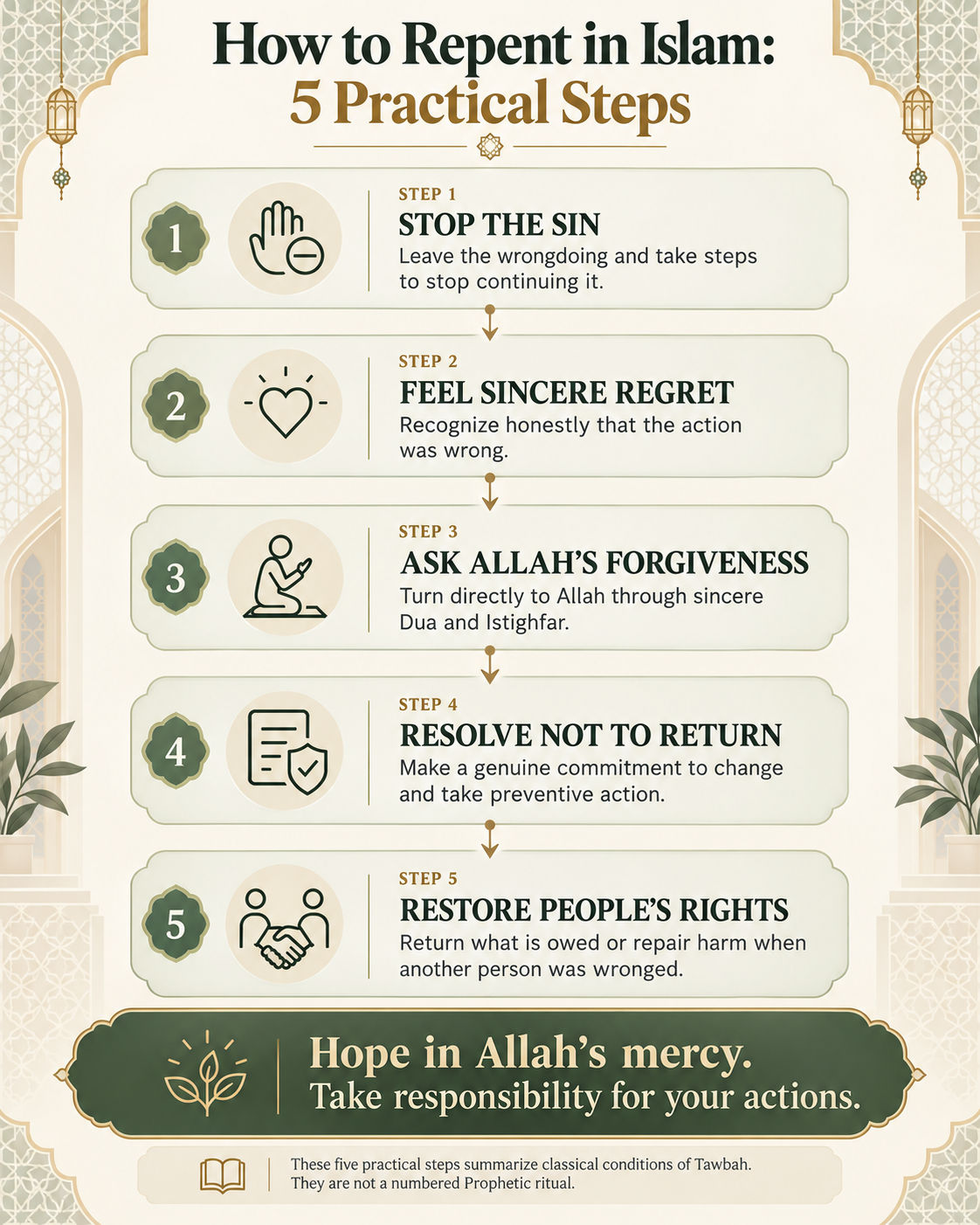
Quick answer: how to repent in Islam in 5 practical steps
Stop the sinful action.
Feel sincere regret.
Turn to Allah and ask His forgiveness.
Resolve not to return to the sin.
Restore other people’s rights or repair harm, when someone else was affected.
A note on method: scholars classically describe three core conditions of Tawbah, with a fourth when another person’s rights are involved. The five steps above are an editorial, practical presentation of those principles, not a numbered list spoken by the Prophet ﷺ.
What Is Tawbah in Islam?
Before learning how to repent, we need to understand what Tawbah actually means. In Arabic, التَّوْبَة (at-tawbah) comes from the root ت-و-ب, whose core sense is returning. The verb tāba means to return, and in Islamic usage it means to return to Allah from disobedience. Tawbah in Islam is repentance understood as return: recognizing wrongdoing, turning away from it, seeking Allah’s forgiveness, renewing obedience, and taking responsibility.
The same root describes Allah’s response. Of three believers who had fallen short, the Quran says Allah turned to them “so that they might repent” (9:118: ثُمَّ تَابَ عَلَيْهِمْ لِيَتُوبُوا). One of His Names is At-Tawwab (التَّوَّاب), the One who accepts repentance and turns to His servants again and again. Tawbah is a movement of mercy on both sides. Returning needs no journey, no ceremony, and no intermediary; Allah hears a believer directly.
How to Repent to Allah: A Simple Step-by-Step Guide
If you need to repent now, here is what it can look like tonight, in plain terms. Stop the action, or step away from the situation that feeds it. Name it honestly to Allah, without minimizing it. Ask forgiveness in any language you speak; you do not need to master Arabic first. Intend not to return, and decide on one practical thing that makes returning harder. Repair what you can: if a person was harmed, ask what is owed to them. Then pray your next obligatory prayer and continue your day trusting Allah rather than rehearsing your guilt.
A supplication in your own words might be: “O Allah, I did wrong and I regret it. I am stopping, I intend not to return, and I ask You to forgive me and help me repair what I harmed.” That is an example of sincerity, not a prescribed formula, and the sections below explain each element.
What Are the Conditions of Sincere Repentance?
The Quran’s promise of mercy does not remove responsibility. It makes sincere return possible. This is why classical scholars describe conditions of repentance, not as obstacles to Allah’s mercy, but as explanations of what it means to truly turn away from wrongdoing. Imam al-Nawawi, in Riyad al-Salihin, summarizes the scholarly position: when a sin concerns only the servant and Allah, repentance has three conditions (leave the sin, regret it, resolve not to return); when it involves another person’s right, there is a fourth. These conditions are drawn from the Quran and Sunnah as a whole, not from a single numbered Hadith.
Stop the Sin
A person should stop the sinful act when able. There is a real difference between someone who is genuinely trying to stop, even if struggling, and someone who plans to continue while using verbal Istighfar as cover. The Quran describes the believers as those who “do not persist in what they did while they know” (3:135). Persisting knowingly contradicts the act of turning back.
If the sin has become a habit, stopping may be gradual and may need triggers identified, environments changed, and trustworthy support. Willpower alone is not always enough, and seeking help is not a failure of faith.
Feel Genuine Regret
Regret, النَّدَم (an-nadam), is the recognition that what you did was wrong and the wish that it had not happened. The Prophet ﷺ said: النَّدَمُ تَوْبَةٌ, “Regret is repentance” (Ibn Majah 4252; Ahmad). Hadith scholars such as al-Hakim and al-Albani graded it authentic, and it is understood to mean that regret is the heart of repentance, not its only element.
Do you have to cry? No. Neither the Quran nor the Sunnah makes tears a condition. Some people weep; others feel quiet resolve, heaviness, or very little. Emotional intensity is not the measure of validity. Honesty and change are.
Resolve Not to Return
This condition is a sincere intention not to repeat the wrong. It is not a supernatural guarantee that you will never stumble. Two people may both fear relapse, yet differ completely: one says, “I want to stop, but I know I am weak,” while the other says, “I will do it once more, then repent.” The first is not automatically insincere; the answer is practical preventive steps and asking Allah for help. The second is using repentance as a shield, and that does not fit the conditions.
Restore Other People’s Rights
Not every sin affects only the sinner. When another person was wronged, repentance includes repairing what can be repaired. We return to this below.
Does Allah Forgive All Sins?
The verse of 39:53 says so, but its context matters. In Sahih al-Bukhari, Ibn ‘Abbas reports that some people who had killed and committed illicit relations extensively asked whether there was any expiation, and verses of mercy were revealed (Bukhari 4810). Classical commentators such as Ibn Kathir explain that the forgiveness of “all sins” is for those who repent, which is why the next verse calls believers to turn back to their Lord.
This also resolves an apparent tension with Quran 4:48: “Indeed, Allah does not forgive association with Him, but He forgives what is less than that for whom He wills.” That verse addresses dying upon Shirk without repentance. Verse 39:53 addresses the living who turn back. A narration in al-Tirmidhi (3540) conveys the same balance: Allah would meet a servant who comes with sins as large as the earth with comparable forgiveness, provided he met Him without associating anything with Him. The promise is wide, and it is a promise to those who return; it is not a guarantee for someone who refuses to turn back.
Can Major Sins Be Forgiven?
Yes, through sincere repentance before death. Quran 25:68–71 describes people who worshipped other than Allah, killed unjustly, and committed illicit relations, then says: “except those who repent, believe, and do righteous work.” Scholars distinguish major sins (al-kaba’ir, الكَبَائِر) from minor ones (as-sagha’ir, الصَّغَائِر), citing Quran 4:31 and the hadith that the five daily prayers expiate what is between them when major sins are avoided (Muslim 233). Definitions and classifications differ, and there is no single agreed list with a fixed number, so avoid sources that claim one. Whether major or minor, the path to forgiveness is repentance, and wrongs involving people also require repair.
The famous narration of the man who killed ninety-nine people shows the breadth of mercy (Bukhari 3470; Muslim 2766). He asked a monk if he could repent, the monk said no, and he killed him too, making one hundred. A knowledgeable person then told him that nothing stands between him and repentance, and advised him to leave his environment for a land where people worship Allah. He set out, died on the way, and the angels of mercy and punishment disputed over him; he was found closer to the righteous land, and he was forgiven. Its lessons are Allah’s mercy, the value of seeking knowledge, and the importance of changing one’s surroundings.
It does not mean that killing is minor, that victims’ rights vanish, that legal accountability is irrelevant, or that anyone may plan harm and rely on repenting later. Mercy never cancels justice owed to others.
Can Shirk Be Forgiven?
A living person who sincerely repents from Shirk and returns to Tawhid can be forgiven. Quran 8:38 says that if those who disbelieved cease, what has already passed will be forgiven them, and the Prophet ﷺ said that Islam wipes out what came before it (Muslim 121). Verses 4:48 and 4:116 warn about dying upon Shirk without repentance; they never tell a living, repentant person that Allah cannot forgive them. The same hope applies to someone who has left Islam: Quran 3:89 promises forgiveness for those who repent and make amends. Returning is done through sincere repentance and affirming the Shahada; there is no need to repeat it after every intrusive thought, and no need for anyone to make amateur judgments of excommunication. See our guides on What Is Tawhid? and What Is the Shahada?.
What If You Repent and Sin Again?
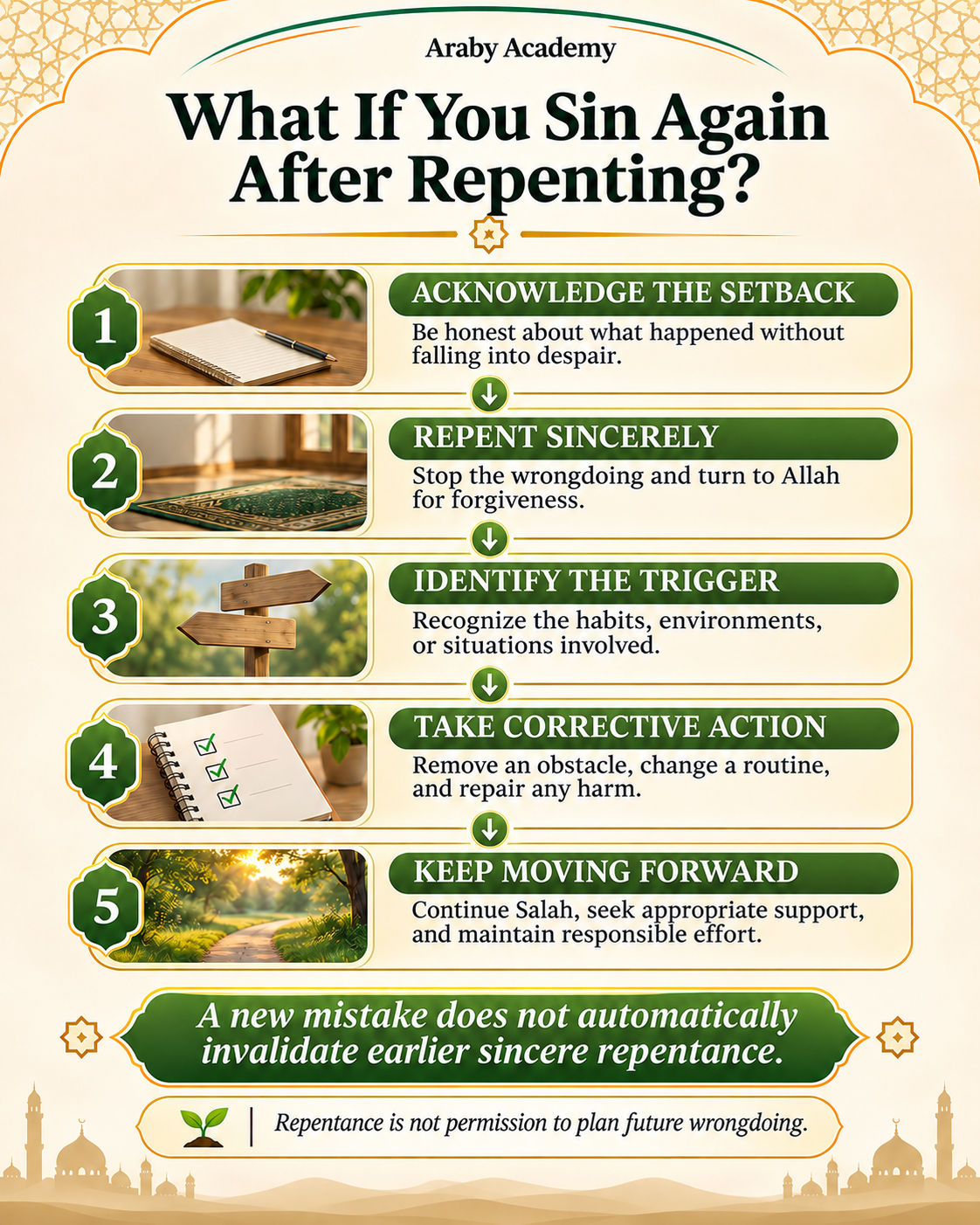
One of the most painful questions arises when someone sincerely repents but later falls into the same mistake. In a hadith reported by Abu Hurayrah, a servant sins and says, “My Lord, I have sinned, so forgive me,” and Allah says that His servant knows he has a Lord who forgives sin and takes to account, and He has forgiven him. This happens a second and a third time, after which Allah says: “Do as you wish; I have forgiven you” (Bukhari 7507; Muslim 2758). Elsewhere the Prophet ﷺ said that every son of Adam sins, and the best of sinners are those who repent often (Tirmidhi 2499; Ibn Majah 4251).
Imam al-Nawawi and other commentators explain the phrase “Do as you wish” as a sign of the breadth of mercy for one who keeps returning with sincere repentance each time, not a license to sin. A new sin does not automatically prove that the earlier repentance was fraudulent, because sincerity is measured at the time of repentance. The person should repent again.
What about a hundred relapses? No authentic text gives a number, and we should not invent one. The principle is that repeated failure must not become despair, while sincerity, concrete effort, and correction continue to matter. If you fall the next day, repent, notice the trigger, change the circumstances, seek support, keep your obligatory worship, and refuse to conclude that you are finished. See also the seven-step framework below.
Is It Ever Too Late to Repent?
Repentance is open throughout life until specific closing conditions. Quran 4:17–18 says that accepting repentance is for those who do wrong out of ignorance and then repent soon after, and that repentance is not accepted from those who continue doing evil until death arrives and then say, “Now I repent.” The Prophet ﷺ said that Allah accepts the repentance of a servant until the death rattle (Tirmidhi 3537). Another sign is the sun rising from the west, after which repentance will no longer benefit (Muslim 2703 and 158). We do not speculate on dates or current events, and nobody can determine exactly whose repentance is accepted at the end of life.
The practical lesson is to avoid delay. Nobody knows how long they will live, so repentance should be made as soon as wrongdoing is recognized. This is a reason for urgency, not for terror.
How to Repent After Hurting Another Person
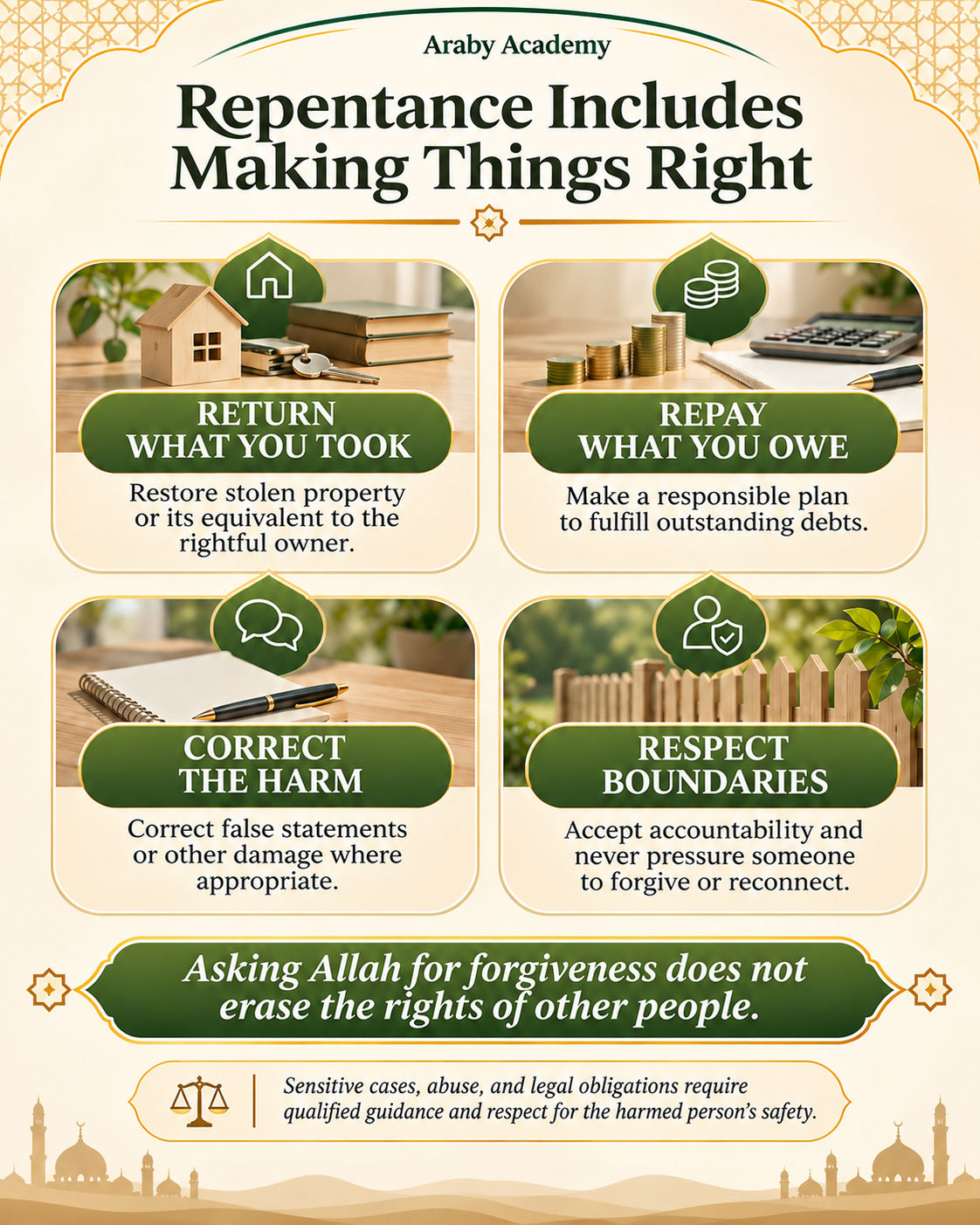
But not every sin affects only the person who committed it. Sometimes repentance must include repairing another person’s rights. The Prophet ﷺ warned that whoever has wronged his brother in his honor or anything else should seek his forgiveness before a day when there will be no dinar or dirham, only good deeds (Bukhari 2449). Seeking Allah’s forgiveness does not erase another person’s rights.
Stolen property. Return it, or its equivalent, to the owner or their heirs. If the owner is known, donating an equal amount to charity does not replace returning what is theirs. If the victim does not know, scholars discuss ways to restore the right without needlessly exposing the past, such as returning through a trustworthy intermediary; seek qualified advice, and never use deception or fraud. If the owner cannot be found, make reasonable efforts to find them or their heirs; many jurists permit options such as entrusting the property to a trusted authority or giving it in charity on the owner’s behalf, but the details differ, so there is no universal shortcut.
Debts. Repentance does not erase a debt. The Prophet ﷺ said even a martyr is forgiven everything except debt (Muslim 1886). Make a responsible plan, communicate with the creditor, and repay as able.
Backbiting and slander. Ghibah (الغِيبَة) is mentioning something true about a person that they would dislike, and the Quran compares it to eating the flesh of one’s dead brother (49:12). The Prophet ﷺ distinguished it from buhtan, false accusation, which is worse (Muslim 2589). Scholars differ on whether the person must be told. Some say to seek their pardon if they know and it would not cause harm; others, including Ibn Taymiyya, say that informing may only add harm, so it is enough to repent, ask forgiveness for them, and speak well of them where you criticized them. For slander, correct the falsehood where it spread. For legally serious allegations, seek qualified advice.
Emotional harm. Offer a sincere apology, change the behavior, accept accountability, and respect boundaries. Do not contact a person who was abused or frightened just to relieve your own guilt. Restitution never gives permission to violate someone’s safety. Where crimes are involved, accountability may include legal responsibility, and a trusted scholar together with relevant professionals can guide you.
If you are the one who was harmed. You are not responsible for what was done to you. Forgiveness is not proof of faith, you keep your rights and your safety boundaries, and you do not have to restore contact because someone claims Tawbah. Likewise, “Allah forgave me” can never be leverage to demand trust, access, or freedom from consequences. If you were forced into an act, Quran 16:106 and a report in Ibn Majah (2043) about what people are compelled to do show that coercion is treated differently; victims of coercion or assault should not be burdened with guilt.
Do You Have to Confess Your Sins to an Imam or Your Family?
No. Islam has no sacramental confession, and Allah hears the repentant person directly. A qualified Imam or scholar can advise you, but is not a required intermediary. The Prophet ﷺ taught that Allah conceals a servant’s sin and that those who publicize their sins are excluded from the forgiveness granted to others (Bukhari 6069; Muslim 2990). Another hadith describes Allah bringing a believer close, reminding him of his sins, then saying that He concealed them in the world and forgives them today (Bukhari 2441).
The exceptions are facts that affect someone’s rights, safety, consent, or ongoing obligations, which should not be concealed. New Muslims need not recount their past either; Islam wipes out what came before it, but worldly obligations to others, such as debts, remain.
Tawbah vs Istighfar vs Kaffarah
Astaghfirullah (أَسْتَغْفِرُ اللَّهَ) means “I seek Allah’s forgiveness.” It is a Form X Arabic verb: the -sta- pattern means seeking something, from the root غ-ف-ر, which is associated with covering and protecting. So astaghfiru is “I ask for ghufran.” Istighfar (الِاسْتِغْفَار) is asking for forgiveness; Tawbah is turning back from wrongdoing. Some scholars note that when mentioned together, as in Quran 11:3, Istighfar relates to seeking forgiveness for what has passed and Tawbah to returning and resolving for the future; when mentioned alone, each can include the other.
Concept | Arabic | Core meaning | Applies when |
|---|---|---|---|
Tawbah | التَّوْبَة | Turning away from wrongdoing toward Allah | Every sin |
Istighfar | الِاسْتِغْفَار | Asking Allah for forgiveness | Any time; part of Tawbah |
Kaffarah | الكَفَّارَة | A prescribed expiation | Only where the texts specify it |
Restitution | رَدُّ الحُقُوق | Restoring another person’s rights | When someone was wronged |
These concepts can intersect, but they are not identical. Kaffarah applies to specific cases, such as breaking an oath (5:89), and not every sin has one.
Missed obligations need care. Repentance is essential for neglecting prayer, but most scholars also require making up missed prayers, while a minority hold that deliberately abandoned prayers cannot be made up and should be met with repentance and more voluntary prayer. For missed Ramadan fasts, repentance is distinct from qada (making up), fidya, and Kaffarah, and schools differ on when each applies. Unpaid Zakat should be calculated and paid. Tawbah does not automatically cancel every unfulfilled obligation, so ask a qualified scholar for your case.
Is Salat al-Tawbah Necessary?
No. There is no universal rule that two Rak’ahs must come before repentance is valid, and Wudu is not a prerequisite for seeking forgiveness. But Salat al-Tawbah (صَلَاةُ التَّوْبَة) has a Prophetic basis: Abu Bakr reported that the Prophet ﷺ said that any man who commits a sin, then performs Wudu well, prays two Rak’ahs, and seeks Allah’s forgiveness, Allah forgives him; then he recited Quran 3:135 (Abu Dawud 1521; Tirmidhi 406; Ibn Majah 1395; Ahmad). Al-Tirmidhi graded it hasan and al-Albani sahih, while some scholars discuss one narrator in the chain.
To pray it: make Wudu, pray two voluntary Rak’ahs, then sincerely ask Allah for forgiveness. The reports do not prescribe a special Surah, a fixed night, a number of repetitions, or a guaranteed outcome, so avoid internet methods that add these. Because it is voluntary, schools differ over praying cause-based prayers during disliked times; the simplest course is to pray outside them. Tawbah is repentance; Salat al-Tawbah is an additional act of devotion, and sincere repentance remains valid if you cannot pray it.
7 Authentic Duas and Quranic Supplications for Forgiveness
You can ask in your own words, and Arabic fluency is not required. These supplications come from the Quran or authentic Sunnah.
1. Sayyid al-Istighfar (سَيِّدُ الِاسْتِغْفَار), the master supplication of forgiveness (Bukhari 6306, narrated by Shaddad ibn Aws):
اللَّهُمَّ أَنْتَ رَبِّي لَا إِلَهَ إِلَّا أَنْتَ، خَلَقْتَنِي وَأَنَا عَبْدُكَ، وَأَنَا عَلَىٰ عَهْدِكَ وَوَعْدِكَ مَا اسْتَطَعْتُ، أَعُوذُ بِكَ مِنْ شَرِّ مَا صَنَعْتُ، أَبُوءُ لَكَ بِنِعْمَتِكَ عَلَيَّ، وَأَبُوءُ بِذَنْبِي فَاغْفِرْ لِي، فَإِنَّهُ لَا يَغْفِرُ الذُّنُوبَ إِلَّا أَنْتَ
Allahumma anta Rabbi, la ilaha illa ant. Khalaqtani wa ana ‘abduk, wa ana ‘ala ‘ahdika wa wa‘dika mastata‘t. A‘udhu bika min sharri ma sana‘t. Abu’u laka bi-ni‘matika ‘alayya, wa abu’u bi-dhanbi, faghfir li, fa-innahu la yaghfirudh-dhunuba illa ant.
“O Allah, You are my Lord; there is no god but You. You created me and I am Your servant, and I keep Your covenant and promise as best I can. I seek refuge in You from the evil of what I have done. I acknowledge Your favor upon me and I acknowledge my sin, so forgive me, for none forgives sins but You.”
The Prophet ﷺ said that whoever says it during the day with firm faith in it and dies that day before evening is among the people of Paradise, and likewise for the night. The reward is tied to saying it with conviction and understanding, with the transmitted wording. It is not a substitute for repentance or for restoring people’s rights.
Arabic | Transliteration | Meaning and lesson |
|---|---|---|
اللَّهُمَّ أَنْتَ رَبِّي | Allahumma anta Rabbi | Allah is my Lord: dependence |
لَا إِلَهَ إِلَّا أَنْتَ | La ilaha illa ant | Tawhid before the request |
خَلَقْتَنِي وَأَنَا عَبْدُكَ | Khalaqtani wa ana ‘abduk | You made me; I am Your servant: humility |
أَبُوءُ لَكَ بِنِعْمَتِكَ عَلَيَّ | Abu’u laka bi-ni‘matika ‘alayya | I admit Your favor: gratitude |
وَأَبُوءُ بِذَنْبِي | Wa abu’u bi-dhanbi | I admit my sin: honesty |
فَاغْفِرْ لِي | Faghfir li | Forgive me: the request |
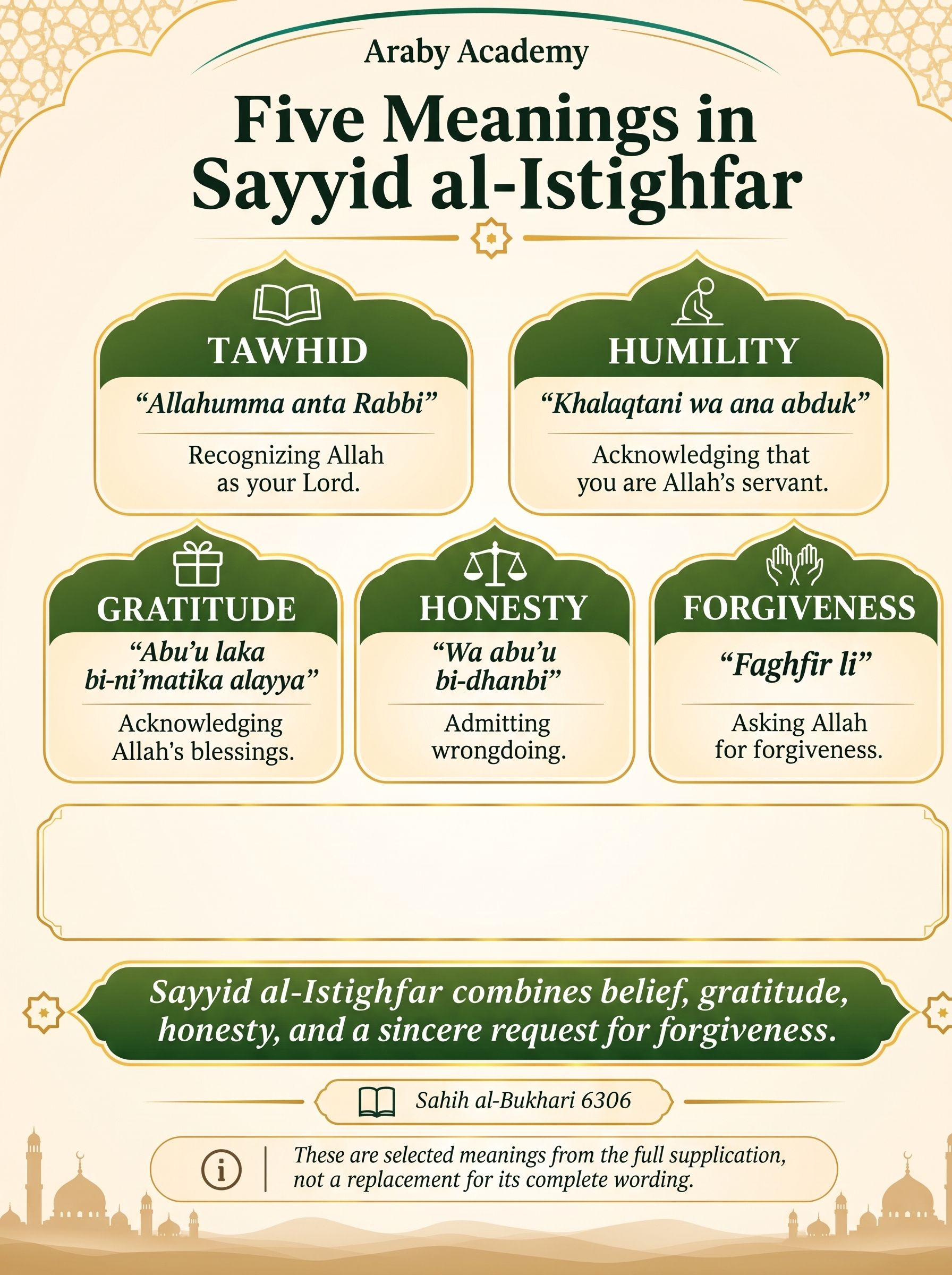
The verb abu’u (أَبُوءُ) carries the sense of acknowledging and returning with something; here, with both a favor and a fault.
2. Adam and Hawwa (Quran 7:23): رَبَّنَا ظَلَمْنَا أَنفُسَنَا وَإِن لَّمْ تَغْفِرْ لَنَا وَتَرْحَمْنَا لَنَكُونَنَّ مِنَ الْخَاسِرِينَ. Rabbana zalamna anfusana wa in lam taghfir lana wa tarhamna lanakunanna minal-khasirin. “Our Lord, we have wronged ourselves, and if You do not forgive us and have mercy upon us, we will surely be among the losers.” After Adam received words from his Lord, Allah accepted his repentance (2:37). The Quran gives no further invented details of dates or dialogues; it teaches admission, return, and mercy.
3. Yunus (Quran 21:87): لَا إِلَٰهَ إِلَّا أَنتَ سُبْحَانَكَ إِنِّي كُنتُ مِنَ الظَّالِمِينَ. La ilaha illa anta subhanaka inni kuntu minaz-zalimin. “There is no god but You; glory be to You; indeed, I have been among the wrongdoers.” It combines Tawhid, glorification, and admission of wrongdoing. Al-Tirmidhi (3505) records its virtue, that Allah responds to a Muslim who supplicates with it; it does not guarantee any particular worldly wish on demand.
4. Musa (Quran 28:16): رَبِّ إِنِّي ظَلَمْتُ نَفْسِي فَاغْفِرْ لِي. Rabbi inni zalamtu nafsi faghfir li. “My Lord, I have wronged myself, so forgive me.” The verse continues: “So He forgave him.”
5. Rabbighfir (Quran 23:118): رَبِّ اغْفِرْ وَارْحَمْ وَأَنتَ خَيْرُ الرَّاحِمِينَ. Rabbighfir warham wa anta khayrur-rahimin. “My Lord, forgive and have mercy, and You are the best of the merciful.”
6. Rabbi ighfir li wa tub ‘alayya (Abu Dawud 1516; Tirmidhi 3434): رَبِّ اغْفِرْ لِي وَتُبْ عَلَيَّ إِنَّكَ أَنْتَ التَّوَّابُ الرَّحِيمُ. “My Lord, forgive me and accept my repentance; You are the Accepting of repentance, the Merciful.” Ibn ‘Umar reported that the Companions would count the Prophet ﷺ saying it a hundred times in one sitting; the closing Names vary slightly between narrations.
7. The Dua of pardon (Tirmidhi 3513; Ibn Majah 3850, from ‘A’ishah): اللَّهُمَّ إِنَّكَ عَفُوٌّ تُحِبُّ الْعَفْوَ فَاعْفُ عَنِّي. Allahumma innaka ‘afuwwun tuhibbul-‘afwa fa‘fu ‘anni. “O Allah, You are Pardoning and love pardon, so pardon me.” The Prophet ﷺ taught it to ‘A’ishah for Laylat al-Qadr. It is a beautiful supplication, not a uniquely mandatory formula for repentance.
The Prophet ﷺ himself sought forgiveness constantly. Abu Hurayrah heard him say that he sought Allah’s forgiveness and repented to Him more than seventy times a day (Bukhari 6307), and al-Agharr al-Muzani reported him saying that he repented to Allah a hundred times a day (Muslim 2702). These are separate narrations and should not be merged into one count. His frequent Istighfar reflects worship and servanthood, and is consistent with the Prophetic protection from sin (‘ismah) that Muslims believe in. Muslims learn from his example that Istighfar is a regular practice.
10 Quran Verses About Allah’s Mercy and Repentance
39:53 — “Do not despair of the mercy of Allah. Indeed, Allah forgives all sins.” Teaching: mercy is open to those who turn back. Takeaway: despair is never the answer.
4:110 — “Whoever does a wrong or wrongs himself but then seeks forgiveness of Allah will find Allah Forgiving and Merciful.” Teaching: forgiveness is tied to seeking it. Takeaway: ask, and don’t delay.
3:135 — Believers remember Allah, seek forgiveness, and “do not persist in what they did while they know.” Teaching: repentance is the opposite of knowing persistence. Takeaway: distinguish a stumble from a plan.
66:8 — “O you who believe, repent to Allah with sincere repentance (tawbatan nasuha).” Teaching: sincerity is required. Takeaway: honest repentance, not a formula.
25:70 — those who repent, believe, and do righteous work will have their evil deeds replaced with good. Teaching: classical commentators have two main views, that the deeds themselves are replaced in the record, or that the person’s character is transformed from bad to good; there is no mechanical numerical conversion. Takeaway: repentance with righteous action carries real hope.
2:222 — “Indeed, Allah loves those who repent and loves those who purify themselves.” The verse appears in the context of rulings on menstruation, and the pairing includes physical purity as well as the broader sense of cleansing from wrongdoing. Takeaway: repenting is not only an escape from punishment but a path to Allah’s love.
7:23 — the supplication of Adam and Hawwa. Takeaway: name the wrong and ask.
20:82 — “And indeed, I am the Perpetual Forgiver of whoever repents, believes, does righteousness, and then continues in guidance.” Takeaway: repentance leads to a life of guidance.
11:3 — “Seek forgiveness of your Lord and then repent to Him.” Takeaway: seeking forgiveness and turning back go together.
24:31 — “Turn to Allah in repentance all together, O believers, that you may succeed.” Takeaway: every believer needs Tawbah.
The Prophet ﷺ also said that Allah is more pleased with the repentance of His servant than a traveler who finds his lost camel in the desert (Bukhari 6308; Muslim 2744). Repentance is an act of worship and return, not only a desperate escape.
How to Stop Repeating the Same Sin
This is a practical behavioral framework, not a prescribed Prophetic ritual. Seven steps help break a cycle and make repentance last:
Identify triggers. Notice the time, place, feeling, or person that precedes the sin.
Remove easy access where possible. Block, delete, or avoid the setup.
Replace harmful routines. Fill the empty slot with a walk, a call, or a prayer.
Seek trustworthy support. A friend, family member, or qualified counselor.
Maintain Salah. Do not skip prayer out of shame; it is a way back.
Make Dua and Istighfar. Ask Allah for help as well as forgiveness.
Keep returning to responsible action after setbacks. A relapse is a reason to repent again, not to give up.
Some behaviors are compulsive or addictive. Prayer and Dua are meaningful, but serious cases may also need professional treatment, environmental changes, and a relapse-prevention plan. Relapse is not automatic proof of hypocrisy or insincerity.
On Qadr: Divine Decree does not excuse deliberate wrongdoing. The Quran rebuts those who said that if Allah had willed they would not have done wrong (6:148; 16:35). We accept Allah’s decree after events with patience, but we do not use it to justify our choices. Our guide What Is Qadr in Islam? explores this further.
The 24-hour repentance reset. Today: stop the action; make sincere Tawbah; pray your next required Salah; repair one concrete harm; remove one trigger; make sincere Dua; plan one sustainable change. This is a practical self-improvement plan, not a prescribed religious ceremony or a guaranteed forgiveness formula.
How to Deal With Guilt, Shame, and Waswas
Yet a healthy understanding of Tawbah also requires knowing the difference between sincere remorse and endless self-punishment. As an editorial framework (not Quranic terminology), guilt is recognizing that an action was wrong, which can motivate repair. Toxic shame is believing you are permanently beyond improvement or mercy, which leads to hiding, avoiding prayer, and giving up.
Hope and fear belong together. Reverent fear can motivate responsibility, but despair of Allah’s mercy is condemned: “Who despairs of the mercy of his Lord except those astray?” (15:56). The opposite error is presumption, assuming forgiveness while refusing to change. Hope acts; presumption stalls.
How do I know my Tawbah was accepted? We have no direct access to the unseen. Revelation gives strong reasons for hope when repentance is sincere, but there is no dream, tear, or feeling that guarantees acceptance. Signs of sincere change, such as leaving the wrong, fulfilling obligations, repairing harm, and building accountability, are practical indicators, not supernatural proof.
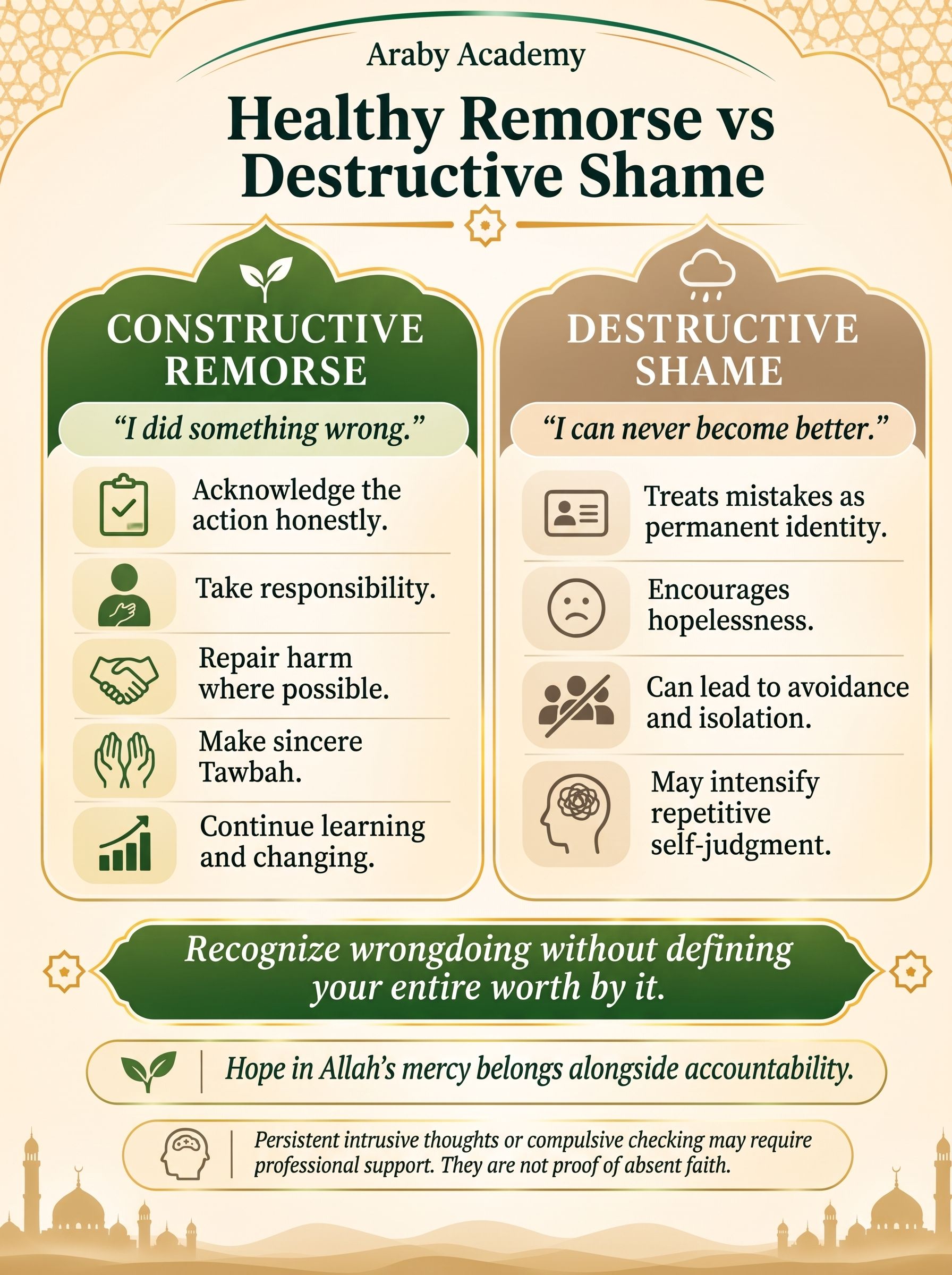
Mental health. Depression, anxiety, trauma, compulsions, and addiction are not signs that you have not repented enough, and counseling and treatment are compatible with faith. Our guide What Does Islam Say About Anxiety, Worry, and Trusting Allah? may help.
Religious OCD and Waswas. Some people repeatedly ask, “Was my intention sincere? Did I repent enough? Should I repeat the Dua? Did an intrusive thought cancel my Tawbah?” The Prophet ﷺ said that Allah has forgiven his Ummah for what crosses their minds so long as they do not act or speak on it (Bukhari; Muslim 127). When the Companions complained of thoughts too grave to voice, he said that this is clear faith (Muslim 132). Unwanted thoughts are not belief or action, and compulsive repetition is not the goal of repentance. Complete your Dua once reasonably, continue normal worship, avoid repeated self-testing, and if the doubt is severe, seek a trusted scholar and a mental-health professional. Do not set an endless recitation count.
Teaching Teenagers and Children About Allah’s Mercy
Teenagers need a compassionate, age-appropriate message: mistakes happen, responsibility matters, apologize, pray, repair harm, and learn. Younger children can learn that Allah loves those who repent, that we tell the truth, say sorry, fix what we broke, and ask Allah for forgiveness. Do not present every childish mistake as an unforgivable major sin, and never frighten children with graphic punishment or make them confess private thoughts.
Five mistakes parents make when teaching repentance
Making children fear Allah without teaching mercy. Pair every mention of accountability with Allah’s love for those who return.
Demanding public confession of harmless private mistakes. Offer a calm private conversation instead.
Confusing ordinary childhood mistakes with major sins. Match the response to the age and the act.
Ignoring the rights of those harmed. Help the child apologize and repair what was broken or hurt.
Teaching only verbal Astaghfirullah without behavioral repair. Pair the words with a concrete act of making things right.
How to Make Istighfar a Daily Habit
Islam does not leave the believer with only abstract hope. The Quran and authentic Sunnah teach words of forgiveness that Muslims can learn and use. Several individual practices are authentic:
After obligatory prayer, the Prophet ﷺ would say Astaghfirullah three times (Muslim 591).
Throughout the day, he said Astaghfirullah wa atubu ilayh (أَسْتَغْفِرُ اللَّهَ وَأَتُوبُ إِلَيْهِ), “I seek Allah’s forgiveness and repent to Him,” as in Bukhari 6307.
Morning and evening, Sayyid al-Istighfar is reported for both day and night (Bukhari 6306).
Before dawn, the Quran praises those who seek forgiveness in the hours before dawn (51:18), and Bukhari 1145 and Muslim 758 report the Prophet ﷺ encouraging Dua and Istighfar in the last third of the night. Scholars in the Sunni tradition understand the wording of this report in different ways, always affirming that Allah is unlike His creation.
An optional editorial routine built from these might be: Istighfar after prayer, the morning and evening Adhkar, immediate repentance when wrongdoing occurs, and a brief self-review and Dua before sleep. This is a learning routine, not a fixed Prophetic ritual in this exact format. Do not invent counts, a special Friday or Thursday formula, or a special Surah that supposedly erases every sin in one recitation. Ramadan and Laylat al-Qadr are excellent opportunities, and Hajj brings spiritual renewal (Bukhari 1521), but repentance is never restricted to them, and Hajj does not automatically cancel what is owed to people. Reading and understanding the Quran also helps a person reflect on Allah’s guidance. See our guides What Is Dhikr?, How to Make Dua, What Is Tawakkul? and How to Build a Daily Quran Habit That Actually Lasts.
Common Misconceptions About Repentance
Seven myths about Allah’s forgiveness
“Allah cannot forgive my past.” Quran 39:53 addresses those who have transgressed against themselves.
“If I sin again, all earlier Tawbah was fake.” The hadith of the servant who sins and seeks forgiveness repeatedly shows otherwise (Bukhari 7507; Muslim 2758).
“I must cry.” No text requires tears.
“I must confess to an Imam.” Allah hears you directly; concealment of private sin is encouraged.
“A verbal Dua replaces returning stolen property.” Others’ rights remain.
“Repentance requires a special ceremony.” Sincerity, not ceremony, is the key.
“If I feel guilty afterward, I must repeat my Tawbah.” Feelings are not a verdict, and compulsive repetition is not the goal.
Thirteen more quick corrections:
Myth: Allah will not forgive major sins. Reality: sincere repentance before death is possible.
Myth: Shirk can never be forgiven even if one repents before death. Reality: the Quran distinguishes repentance in life from dying upon unrepented Shirk.
Myth: Tawbah is just saying Astaghfirullah once. Reality: sincere repentance involves turning away.
Myth: two Rak’ahs are required. Reality: Salat al-Tawbah is a devotional practice, not a prerequisite.
Myth: every sin has its own fixed Dua. Reality: do not invent ritual formulas.
Myth: Tawbah erases debts. Reality: financial rights remain.
Myth: an intrusive thought cancels Tawbah. Reality: unwanted thoughts are not belief or action.
Myth: repeating a Dua exactly 313 times guarantees forgiveness. Reality: numbers and guarantees need evidence.
Myth: Tawbah works only in Ramadan. Reality: it is open throughout life until the closing conditions.
Myth: Tawbah can be delayed indefinitely. Reality: life is uncertain.
Myth: Qadr removes responsibility. Reality: Islam holds people accountable.
Myth: an apology gives a wrongdoer a right to renewed contact. Reality: victims’ safety and boundaries still matter.
Myth: good deeds always replace restitution, and a sinner is beyond Allah’s love. Reality: rights require repair, and Allah loves those who sincerely repent (2:222).
15 Quranic Arabic Words Related to Forgiveness
Learning these words deepens how you hear the Quran. Not every term appears in the Quran in exactly this form.
Arabic | Transliteration | Root | Meaning and link to repentance |
|---|---|---|---|
التَّوْبَة | At-Tawbah | ت-و-ب | Return; the core act |
الِاسْتِغْفَار | Al-Istighfar | غ-ف-ر | Seeking forgiveness |
المَغْفِرَة | Al-Maghfirah | غ-ف-ر | Forgiveness; covering of sin |
الرَّحْمَة | Ar-Rahmah | ر-ح-م | Mercy; why we hope |
الذَّنْب | Adh-Dhanb | ذ-ن-ب | Sin, with its consequences |
الإِثْم | Al-Ithm | أ-ث-م | Wrongdoing |
المَعْصِيَة | Al-Ma’siyah | ع-ص-ي | Disobedience |
النَّدَم | An-Nadam | ن-د-م | Regret |
الإِخْلَاص | Al-Ikhlas | خ-ل-ص | Sincerity |
العَفْو | Al-‘Afw | ع-ف-و | Pardon; effacing |
التَّقْوَى | At-Taqwa | و-ق-ي | God-consciousness |
الكَفَّارَة | Al-Kaffarah | ك-ف-ر | Prescribed expiation |
الحُقُوق | Al-Huquq | ح-ق-ق | Rights owed to others |
الدُّعَاء | Ad-Dua | د-ع-و | Supplication |
الِاسْتِقَامَة | Al-Istiqamah | ق-و-م | Steadfastness after returning |
Tawbah, Maghfirah, and ‘Afw overlap in everyday use. Lexicons link maghfirah with covering and protecting, and ‘afw with effacing and pardon, but viral claims that one always hides and the other always erases every trace go beyond what the sources support. Allah’s Names connected with forgiveness include At-Tawwab (التَّوَّاب, 2:37), Al-Ghafur (الغَفُور) and Al-Ghaffar (الغَفَّار, 20:82), Al-‘Afuww (العَفُوّ, 4:99), and Ar-Rahim (الرَّحِيم). Al-Ghafur’s forgiveness does not mean actions have no consequences.

Frequently Asked Questions
1. What is Tawbah in Islam? Tawbah (التَّوْبَة) means returning to Allah from wrongdoing through regret, abandoning the sin, resolving not to return, and repairing others’ rights where relevant. It is also an act of worship that Allah loves (2:222).
2. How do you repent to Allah? Stop the wrong, regret it, ask Allah’s forgiveness in your own words, resolve not to return, and restore anyone’s rights if they were affected. No ceremony or intermediary is required.
3. What are the conditions of sincere repentance? Scholars describe three core conditions: leaving the sin, regretting it, and resolving not to repeat it. When another person’s rights are involved, restoring them is a further condition.
4. What is the difference between Tawbah and Istighfar? Tawbah is turning back from wrongdoing; Istighfar is asking Allah for forgiveness. They are closely connected, and some scholars distinguish them when mentioned together, as in 11:3.
5. Does Allah forgive all sins? Quran 39:53 says Allah forgives all sins for those who turn to Him. Dying upon unrepented Shirk is the exception stated in 4:48 and 4:116.
6. Can Allah forgive major sins? Yes, through sincere repentance before death (25:68–71). Where people were harmed, their rights must also be repaired.
7. Can Allah forgive Shirk? A living person can repent from Shirk and return to Tawhid; Islam wipes out what came before (Muslim 121). The warning in 4:48 concerns dying upon Shirk without repentance.
8. What if I repent and sin again? Repent again. A later sin does not automatically prove earlier repentance was insincere (Bukhari 7507; Muslim 2758). Do not plan to relapse, and take practical steps to prevent it.
9. Does repeating a sin mean my Tawbah was not accepted? Not automatically. Acceptance is Allah’s knowledge, and sincerity is judged at the time of repentance. Continue returning, seek support, and avoid despair.
10. Do I have to cry to repent? No. Neither the Quran nor the Sunnah requires tears. Honest regret and change matter more than emotional intensity.
11. Do I need to perform Wudu? Not to seek forgiveness. Wudu is part of Salat al-Tawbah, a voluntary prayer, but is not a prerequisite for Tawbah itself.
12. Do I have to pray Salat al-Tawbah? No. It has a Prophetic basis (Abu Dawud 1521; Tirmidhi 406) and is recommended by many scholars, but repentance is valid without it.
13. What is the best Dua for forgiveness? Sayyid al-Istighfar (Bukhari 6306) is called the master of Istighfar. Quranic supplications such as 7:23 and 21:87 are also excellent, and you may ask in your own language.
14. What is Sayyid al-Istighfar? It is the supplication beginning “Allahumma anta Rabbi, la ilaha illa ant,” reported by Shaddad ibn Aws in Sahih al-Bukhari, combining Tawhid, servanthood, gratitude, admission of sin, and a request for forgiveness.
15. Do I have to confess my sins to an Imam? No. Islam has no required confession to a religious leader, and concealing private sins is encouraged (Bukhari 6069). An Imam can advise you if you wish.
16. Should I tell other people about my past sins? Generally no, unless it affects another person’s rights, safety, consent, or ongoing obligations. Never conceal ongoing harm.
17. How do I repent after hurting someone? Stop the harm, regret it, ask Allah’s forgiveness, and repair what you can through apology, correction, or restitution, while respecting their safety and boundaries.
18. How do I repent after stealing? Return the property or its equivalent to the owner or heirs, in addition to repentance. If you cannot find them, seek qualified guidance rather than assuming charity alone suffices.
19. Can I repent if I cannot contact the person I harmed? Yes. Repent sincerely, make reasonable efforts where possible, and ask a qualified scholar how to discharge any financial right. You can also make Dua for them.
20. What if I owe missed Salah or fasts? Repent, and resume your obligations. Most scholars require making up missed prayers and fasts; opinions differ on some cases, so consult a qualified scholar.
21. How do I know Allah accepted my repentance? We cannot know the unseen. Revelation gives reason for hope, and practical change is encouraging, but no feeling, tear, or dream is a guaranteed sign.
22. When does the opportunity for Tawbah end? Repentance is accepted while a person lives until the final moment (Tirmidhi 3537), and before the sun rises from the west (Muslim 2703). Do not delay.
23. Can someone with intrusive thoughts still repent sincerely? Yes. Unwanted thoughts are not belief or action (Muslim 132). Do not repeat Dua compulsively; consider seeking a mental-health professional.
24. How can I make Istighfar a daily habit? Say Istighfar after each prayer, learn Sayyid al-Istighfar, repent promptly when you err, and review your day briefly before sleep.
Never Despair of Allah’s Mercy, and Never Stop Returning to Him
Return once more to the verse where we began: “Do not despair of the mercy of Allah” (39:53). A person may have a long past, serious regrets, broken habits, unrepaired mistakes, or fears about being forgiven. The Quran teaches that despair is not the answer. But neither is pretending wrongdoing never happened.
Sincere repentance asks a person to recognize, stop, regret, resolve, repair, and return. Change does not always happen instantly, and a believer keeps striving through setbacks.
Tawbah is not proof that you never fell. It is the sincere decision to return to Allah rather than make wrongdoing your permanent direction.
Allah’s mercy gives believers reason to hope. The conditions of repentance remind them to act. And the habit of returning to Allah helps transform regret into responsibility, worship, and gradual change. May your study of the Quran, your understanding of Allah’s Names, and your learning of authentic supplications bring you closer to Him.
Quran translations in this article are adapted from commonly used English renderings. For fiqh rulings on restitution, missed worship, or personal situations, consult a qualified scholar.