You finish Fajr and feel a quiet wish to remember Allah more. Then you open your phone. One video says to repeat a phrase 1,000 times. A post offers a 45-minute morning routine. Another says that if you say a Divine Name 313 times, your problem will disappear.
You might wonder whether this is what Dhikr really is, and how you can remember Allah every day when you barely know Arabic.
What is Dhikr? It is both simpler and richer than social-media formulas. Dhikr means remembering Allah, and Islam gives us beautiful, authentic ways to do it: when we wake, pray, eat, leave home, travel, give thanks, repent, and sleep. This guide won’t give you the longest routine. It will help you understand Dhikr and begin with authentic, sustainable remembrance.
What Is Dhikr? A Clear Definition
The word and its root
ذِكْر (dhikr) is an Arabic word meaning remembrance or mention. Its plural, أَذْكَار (adhkār), usually refers to the specific words and formulas of remembrance. Classical Arabic dictionaries link the root ذ-ك-ر to remembering and mentioning, whether in the heart or on the tongue, and it is the opposite of forgetting. The root helps us understand the word, but it doesn’t define the religious ruling. What counts as Dhikr in Islam comes from the Quran and Sunnah.
Dhikr as remembrance, and Adhkar as forms
Dhikr is remembrance of Allah.
Adhkar are the forms and formulas through which we remember Him.
Scholars such as Ibn Hajar and al-Nawawi describe Dhikr in a narrower and a broader sense. In the narrower sense, it means the legislated words of remembrance: glorifying Allah (tasbih), praising Him (tahmid), declaring His greatness (takbir) and His Oneness (tahlil), and seeking forgiveness (istighfar). In the broader sense, it includes reciting the Quran, prescribed morning and evening words, and words connected to daily actions. Some scholars also extend the term to acts of obedience done with awareness of Allah. We won’t call every good deed “Dhikr,” but remembrance is clearly wider than a counter or a set of beads.
Dhikr, then, is best understood as a life of remembering Allah, with specific words and acts that give that remembrance shape.
Why Does Remembering Allah Matter?
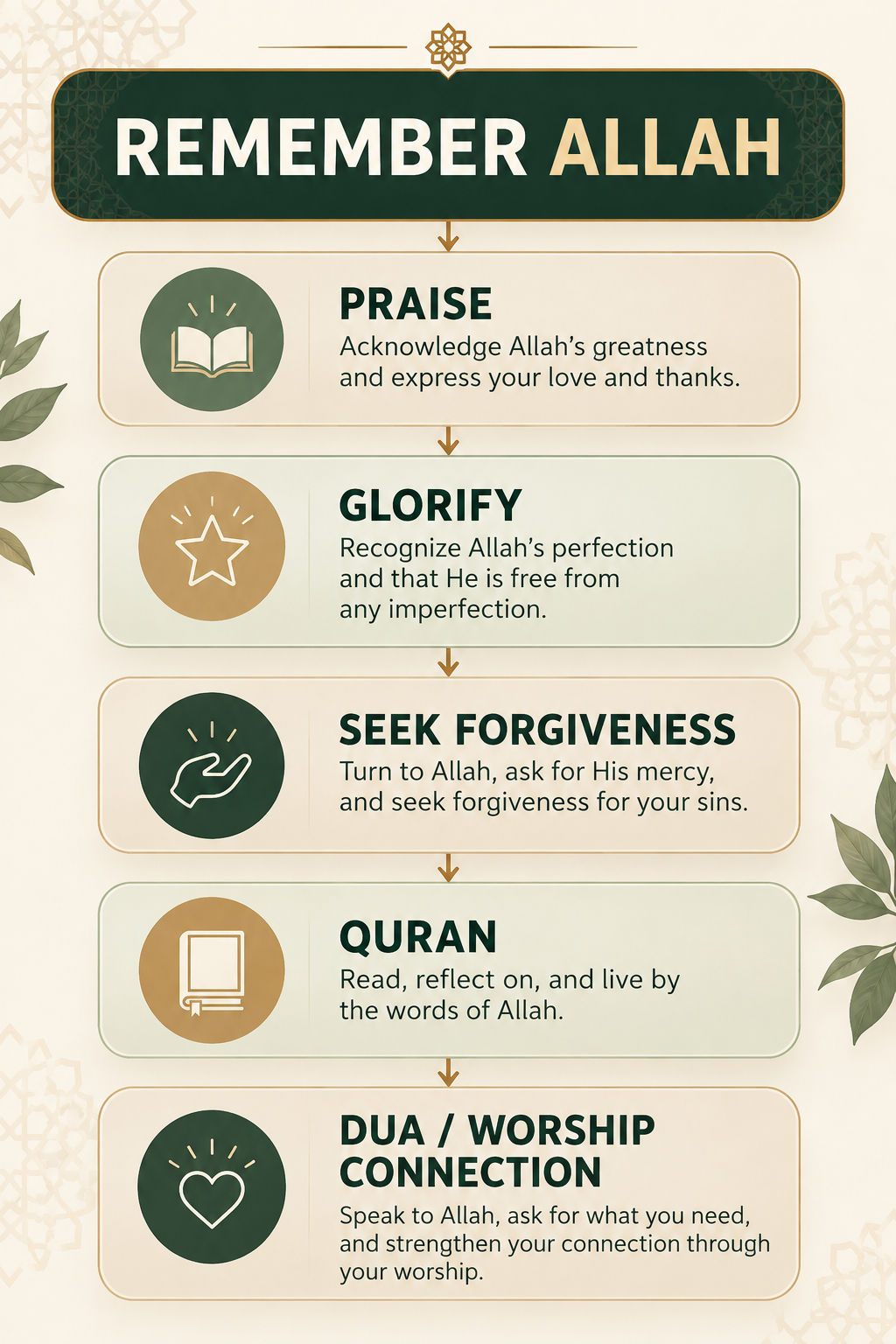
The Quran repeatedly calls believers to remember Allah.
Quran 2:152: “So remember Me; I will remember you. Be grateful to Me and do not deny Me.” (فَاذْكُرُونِي أَذْكُرْكُمْ وَاشْكُرُوا لِي وَلَا تَكْفُرُونِ)
Quran 33:41–42: “O believers, remember Allah often, and glorify Him morning and evening.” (يَا أَيُّهَا الَّذِينَ آمَنُوا اذْكُرُوا اللَّهَ ذِكْرًا كَثِيرًا وَسَبِّحُوهُ بُكْرَةً وَأَصِيلًا)
Quran 62:10 also tells believers to remember Allah often, so that they may succeed.
Quran 13:28: “Those who believe, and whose hearts find rest in the remembrance of Allah. Truly, in the remembrance of Allah do hearts find rest.” (أَلَا بِذِكْرِ اللَّهِ تَطْمَئِنُّ الْقُلُوبُ)
Some commentators connect this rest to remembrance in general, and some especially to the Quran. The verse describes the heart’s spiritual tranquility and connection with Allah. It is not a clinical promise, and we return to this below.
The Prophet ﷺ compared the one who remembers his Lord with the one who doesn’t to the living and the dead (Bukhari). He also advised a man to keep his tongue “moist with the remembrance of Allah” (Tirmidhi, Ibn Majah).
What does “Allah remembers you” mean?
Without asking “how,” we accept what Allah says about Himself in a way that suits His majesty. He is not like His creation. Classical commentators (as recorded in Tabari and Ibn Kathir) explained the verse in terms of Allah’s mercy, forgiveness, reward, and praise of His servant among the angels. A Hadith Qudsi says: “If he remembers Me within himself, I remember him within Myself; if he remembers Me in a gathering, I remember him in a better gathering” (Bukhari, Muslim).
Is Dhikr Only Something You Say With Your Tongue?
No, but the tongue matters. Saying the words Allah and His Messenger ﷺ established is real worship with real reward, whether or not you are fully focused. The heart, meanwhile, is where remembrance becomes awareness, sincerity, and consciousness of Allah. Scholars such as Ibn al-Qayyim describe these levels, and the fullest Dhikr is when tongue and heart work together and then shape how a person lives.
This does not mean distracted Dhikr is worthless. It means we aim, gradually, to bring our hearts into what our tongues are saying. We’ll return to that in the section on wandering thoughts.
The Core Expressions Every Beginner Should Know
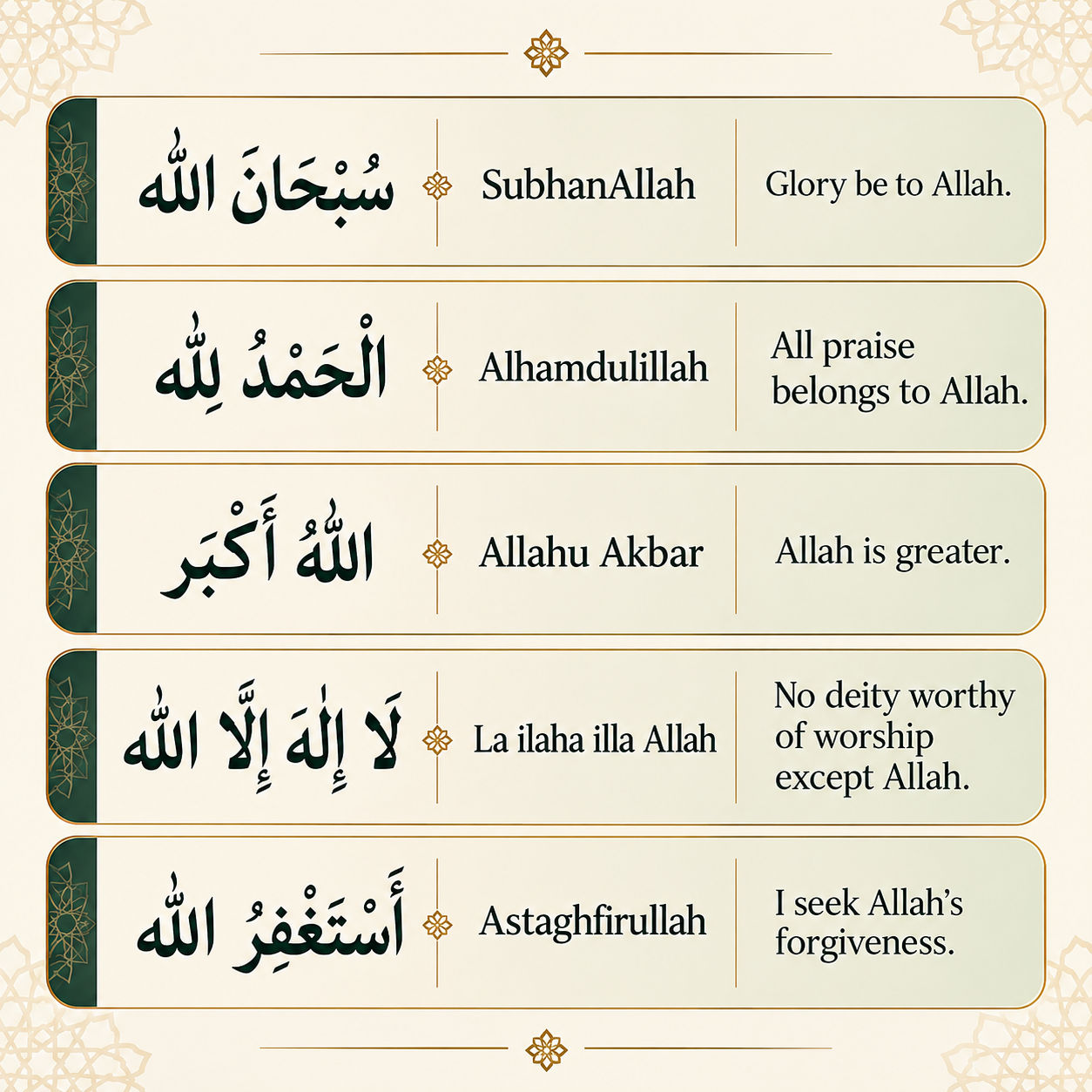
SubhanAllah — سُبْحَانَ اللَّه
Subḥān Allāh means declaring Allah free of every flaw, deficiency, and unfitting attribute. This is tasbih. It is far more than “wow.” It is a statement about who Allah is. (See also our article Why Do Muslims Say Insha’Allah, Alhamdulillah, and SubhanAllah?)
Alhamdulillah — الْحَمْدُ لِلَّه
Al-ḥamdu lillāh means “all praise belongs to Allah.” Hamd is praise for His perfect attributes and His favors, offered with love and reverence. That is why it includes gratitude but is bigger than “thank you.” It opens Surah Al-Fatihah and is said in good times and hard times alike.
Allahu Akbar — اللهُ أَكْبَر
Allāhu akbar means “Allah is greater,” greater than everything and greater than anything we can describe or fear. It begins the adhan and the Salah and is repeated within Salah itself.
La ilaha illa Allah — لَا إِلَٰهَ إِلَّا اللَّه
A sound translation is “There is no deity worthy of worship except Allah.” This is tahlil, the heart of Tawhid. It denies worship to anything other than Allah and affirms it for Him alone.
Astaghfirullah — أَسْتَغْفِرُ اللَّه
Astaghfiru Allāh means “I seek Allah’s forgiveness.” This is istighfar. It is closely related to tawbah (repentance), but the two are not always identical. Tawbah involves stopping the wrong, regretting it, and resolving not to return. The Prophet ﷺ said he sought forgiveness more than seventy times a day (Bukhari), and in another narration, a hundred times (Muslim).
Two more phrases worth knowing
لَا حَوْلَ وَلَا قُوَّةَ إِلَّا بِاللَّه (lā ḥawla wa lā quwwata illā billāh): “There is no power and no strength except through Allah.” The Prophet ﷺ called it a treasure from the treasures of Paradise (Bukhari, Muslim). It is an expression of reliance, not a formula for guaranteed results.
سُبْحَانَ اللَّهِ وَبِحَمْدِهِ (subḥān Allāhi wa bi-ḥamdih): “Glory be to Allah and praise be to Him.” Whoever says it 100 times in a day has his sins forgiven, even if they are like the foam of the sea (Bukhari, Muslim). The number is part of that narration, so keep it with that narration. In another Hadith, “SubhanAllahi wa bihamdihi, SubhanAllahil-‘Azim” are two words light on the tongue, heavy on the scale, and beloved to the Most Merciful (Bukhari, Muslim).
The four beloved words
The Prophet ﷺ said that the most beloved words to Allah are four: SubhanAllah, Alhamdulillah, La ilaha illa Allah, Allahu Akbar. In the narration in Sahih Muslim, he added that it does not matter which you begin with, so you do not need to worry about the order in which you begin.
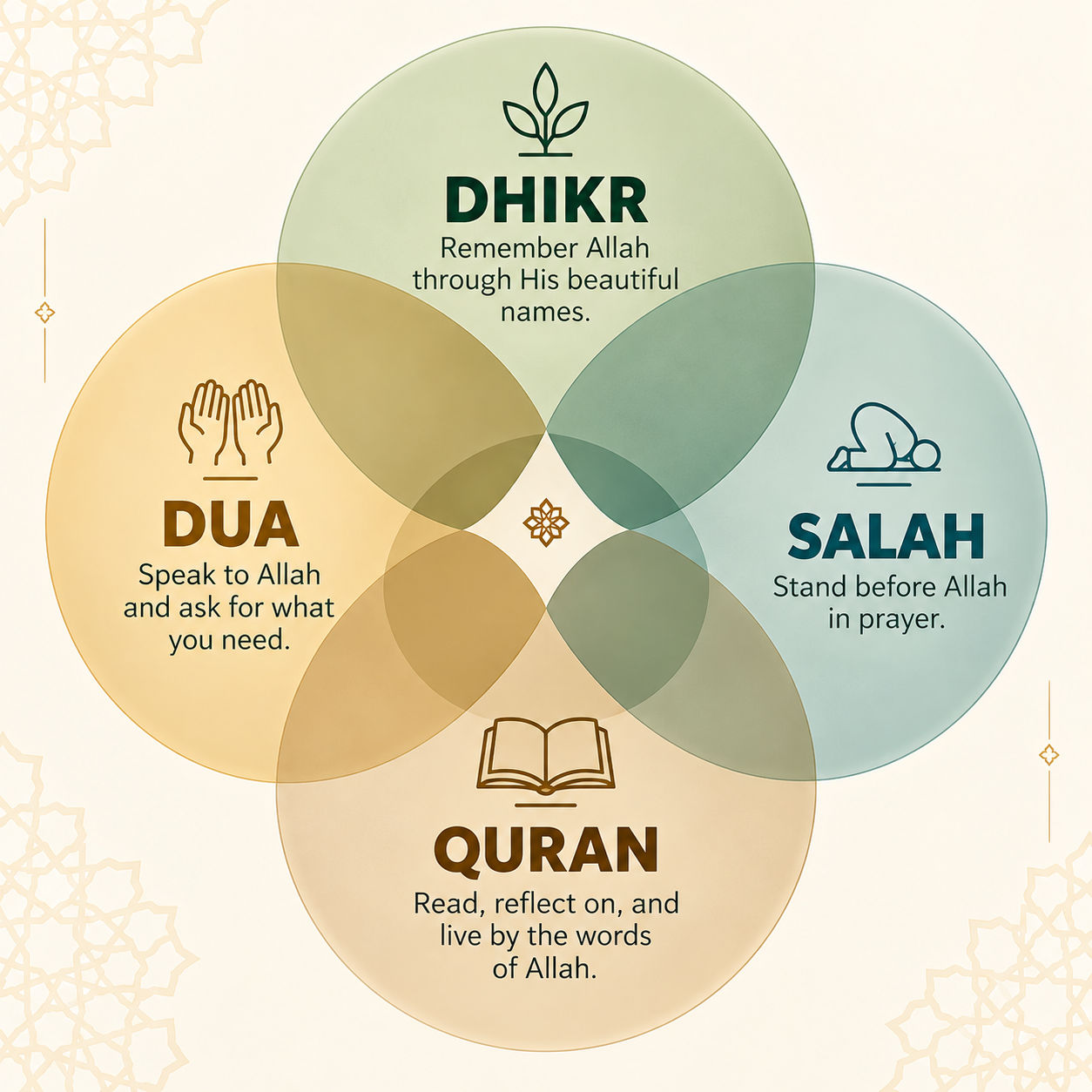
Dhikr, Dua, Salah, and Quran: How They Relate
Is reading Quran Dhikr?
Yes. The Quran itself is called Dhikr (for example in 15:9), and reciting it is among the greatest forms of remembrance. There is no competition between “Quran” and “Dhikr.” The Quran is revelation to be recited, understood, and lived, and reciting it is also remembrance.
Is Salah Dhikr?
Yes. Allah says: “Establish the prayer for My remembrance” (20:14, وَأَقِمِ الصَّلَاةَ لِذِكْرِي). Salah contains Quran, takbir, tasbih, praise, and dua. Allah also says that the remembrance of Allah is greater (29:45), which commentators explain in several ways, including that remembering Allah is the greatest of acts and that remembrance is what the prayer is meant to accomplish.
Dhikr vs Dua
Dhikr is primarily remembrance, praise, glorification, and declaration. Dua is calling upon Allah and asking Him. The two overlap. A Prophetic supplication often begins with praise (Dhikr) before it asks (Dua). The Prophet ﷺ said the best Dua is Alhamdulillah and the best Dhikr is La ilaha illa Allah (Tirmidhi, hasan), which shows how closely they are tied. (See: How to Make Dua: A Beginner’s Guide to Asking Allah.)
Practice | Main Idea | Example | Can Categories Overlap? |
|---|---|---|---|
Dhikr | Remembering, praising, glorifying Allah | SubhanAllah, Alhamdulillah | Yes, with Dua, Quran, and Salah |
Dua | Calling upon Allah and asking Him | “Rabbi zidni ‘ilma” | Yes, often begins with Dhikr |
Quran recitation | Reciting Allah’s revelation | Reading Surah Al-Fatiha | Yes, it is itself called Dhikr |
Salah | Formal ritual prayer | Fajr, Dhuhr, etc. | Yes, contains Quran, Dhikr, and Dua |
The point is not to rank these practices against each other but to see how they support one another.
Dhikr Through the Day: Authentic Anchors
Morning and evening Adhkar
أذكار الصباح والمساء are based on both Quran (for example 33:42, 7:205) and Sunnah. A manageable set of well-established examples:
Surah Al-Ikhlas, Al-Falaq, and An-Nas, three times each, in the morning and evening (Abu Dawud, Tirmidhi; hasan).
SubhanAllahi wa bihamdihi, 100 times (Muslim).
Sayyid al-Istighfar, once (Bukhari).
“Asbahna wa asbahal-mulku lillah…” in the morning and “Amsayna wa amsal-mulku lillah…” in the evening (Muslim).
These fit within a few minutes. For the full wording of others, use a reliable collection that cites its sources and gradings.
When is “morning” and “evening”?
Scholars differ slightly. Many take morning as from Fajr until sunrise, and evening from after Asr until sunset. Some extend the morning period into the forenoon and the evening period into the early night, and some say it can be made up if missed. For a beginner, the safe approach is to do the morning Adhkar after Fajr and the evening Adhkar after Asr, then be flexible if life interrupts.
After Salah
This is one of the most practical anchors. The authentic reports include:
Istighfar three times, then “Allahumma anta as-salam wa minka as-salam, tabarakta ya dhal-jalali wal-ikram” (Muslim).
Tasbih, tahmid, and takbir, in several authentic forms (below).
Ayat al-Kursi. A narration reported by al-Nasa’i and others says nothing stands between the one who recites it after each obligatory prayer and Paradise except death; a number of scholars grade it authentic.
Al-Ikhlas, Al-Falaq, and An-Nas after each prayer (Abu Dawud, Tirmidhi).
33, 33, 34: what do the numbers mean?
The best-known pattern is 33 SubhanAllah, 33 Alhamdulillah, 34 Allahu Akbar (Muslim). The authentic variants include:
33 + 33 + 33, then completing 100 with La ilaha illa Allah wahdahu la sharika lah, lahu al-mulk wa lahu al-hamd wa huwa ‘ala kulli shay’in qadir (Muslim).
10 + 10 + 10 after each prayer (Abu Dawud, Tirmidhi, al-Nasa’i).
25 each, with La ilaha illa Allah added (al-Nasa’i).
These are separate narrations, not one system. Choose one form and keep its numbers. When the Sunnah specifies a number, preserve the number.
Before sleep
A practical beginner version:
Ayat al-Kursi. The Prophet ﷺ confirmed that whoever recites it at night has a guardian from Allah until morning (Bukhari).
Al-Ikhlas, Al-Falaq, An-Nas: the Prophet ﷺ would cup his hands, blow into them, recite the three Surahs, and wipe over his body, three times (Bukhari, from Aisha).
Tasbih Fatimah: when Fatimah (رضي الله عنها) asked for a servant, the Prophet ﷺ taught her and Ali (رضي الله عنه) to say 33 SubhanAllah, 33 Alhamdulillah, and 34 Allahu Akbar when going to bed, and told them it was better for them than a servant (Bukhari, Muslim). No other promises are attached to it, and we shouldn’t add any.
“Bismika Allahumma amutu wa ahya” (Bukhari).
Ordinary moments
Islam attaches remembrance to ordinary life:
Waking: Alhamdulillahi alladhi ahyana ba’da ma amatana wa ilayhin-nushur (Bukhari).
Eating: Bismillah before (Muslim) and Alhamdulillahi alladhi at’amani hadha wa razaqanihi min ghayri hawlin minni wa la quwwa after (Abu Dawud, Tirmidhi; hasan).
Leaving home: Bismillah, tawakkaltu ‘ala Allah, wa la hawla wa la quwwata illa billah (Abu Dawud, Tirmidhi).
Entering/leaving the mosque: Allahumma iftah li abwaba rahmatik / Allahumma inni as’aluka min fadlik (Muslim).
Travel: the travel dua based on Quran 43:13–14 (Muslim).
Sneezing: Alhamdulillah (Bukhari).
Islam connects remembrance to ordinary life, so there is almost no part of your day left without an anchor.
A Day of Dhikr: A Practical Timeline
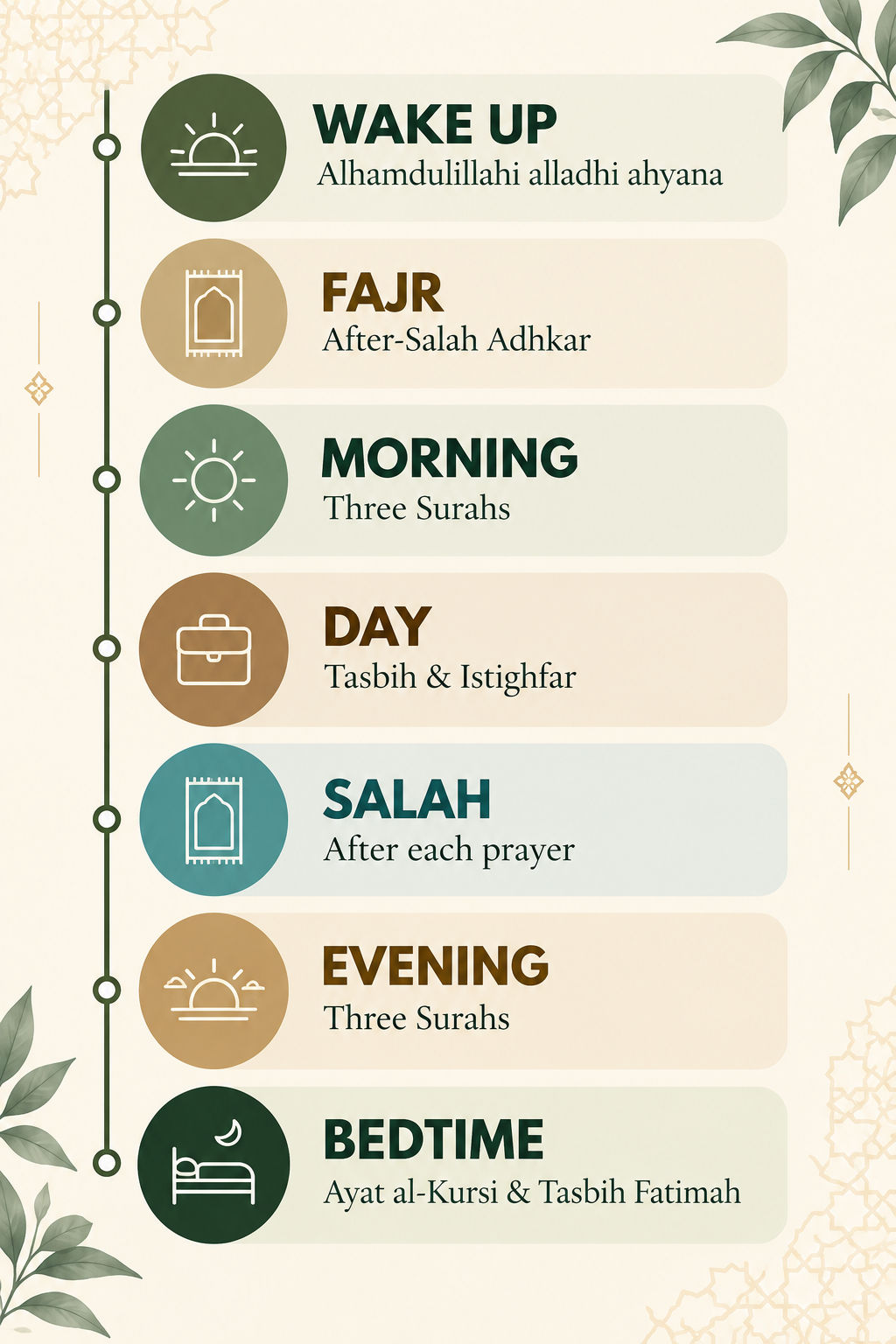
This timeline shows where remembrance can fit into a normal day. Treat it as a map for learning, not as a fixed ritual handed down in this exact form.
Wake up: Alhamdulillahi alladhi ahyana…
Fajr: post-Salah Adhkar (istighfar ×3, Allahumma anta as-salam…, your chosen tasbih form)
Morning: the three Surahs ×3, SubhanAllahi wa bihamdihi (100 if you can)
Daily activities: Bismillah before eating, La hawla wa la quwwata illa billah, general tasbih and istighfar while you walk, commute, cook, or wait
Obligatory prayers: istighfar ×3 and your chosen post-Salah form
Evening: the three Surahs ×3, Amsayna wa amsal-mulku lillah…
Bedtime: Ayat al-Kursi, the three Surahs with blowing, Tasbih Fatimah
Common Questions About How to Do Dhikr
Can I do Dhikr while walking, driving, cooking, or working?
Yes. Most general Dhikr (tasbih, tahmid, istighfar) can be done while walking, commuting, cooking, cleaning, or waiting. It is different for Salah, and different for Quran recitation if it requires focused attention. When driving, safety comes first. Never read from a phone or mushaf while driving. Use short phrases you know by heart, and stop if you need your full attention.
Does Dhikr have to be in Arabic?
It depends on the type:
Prescribed formulas from Quran and Sunnah: these are best learned and said in their transmitted Arabic wording when you reasonably can.
General remembrance and praise: you can praise and remember Allah in any language.
Quran recitation: this is in Arabic.
Personal Dua: you can ask Allah in your own language.
A new Muslim should never think, “If I can’t pronounce Arabic yet, I can’t remember Allah.” Begin with what you can say, including in English, while gradually learning the authentic Arabic.
Do I need Wudu for Dhikr?
No. Aisha (رضي الله عنها) said the Prophet ﷺ remembered Allah at all times (Muslim). There is a report that he once delayed returning a greeting until he had purified himself, which scholars take to mean purity is preferable, not required. Wudu questions apply more to touching the mushaf. Lacking Wudu should not stop you from remembering Allah.
Does Dhikr have to be out loud?
No. Allah says to remember Him within yourself, humbly and without loudness of speech, morning and evening (7:205). The Prophet ﷺ also told people to be gentle with themselves because they were not calling upon one who is deaf or absent (Bukhari, Muslim). Ibn Abbas also reported that raising the voice with Dhikr after obligatory prayers was practiced in the Prophet’s time (Bukhari, Muslim). For beginners, quiet verbal Dhikr is perfectly fine.
Fingers, prayer beads, and digital counters
The Prophet ﷺ counted tasbih on his right hand (Abu Dawud, Tirmidhi), and women of the Companions were told to count on their fingers because they will be questioned and made to speak (Abu Dawud, Tirmidhi; hasan). So fingers are firmly established. Prayer beads are not required. Scholars differ on beads: many permit them as a counting tool, while others consider fingers better and discourage beads. Digital counters are a modern tool; treat them as a counting aid, not a Sunnah. The tool is not the purpose. Remembering Allah is the purpose. If counting becomes anxious or compulsive, let it go.
Numbers, Viral Formulas, and Manifestation
Do fixed numbers matter?
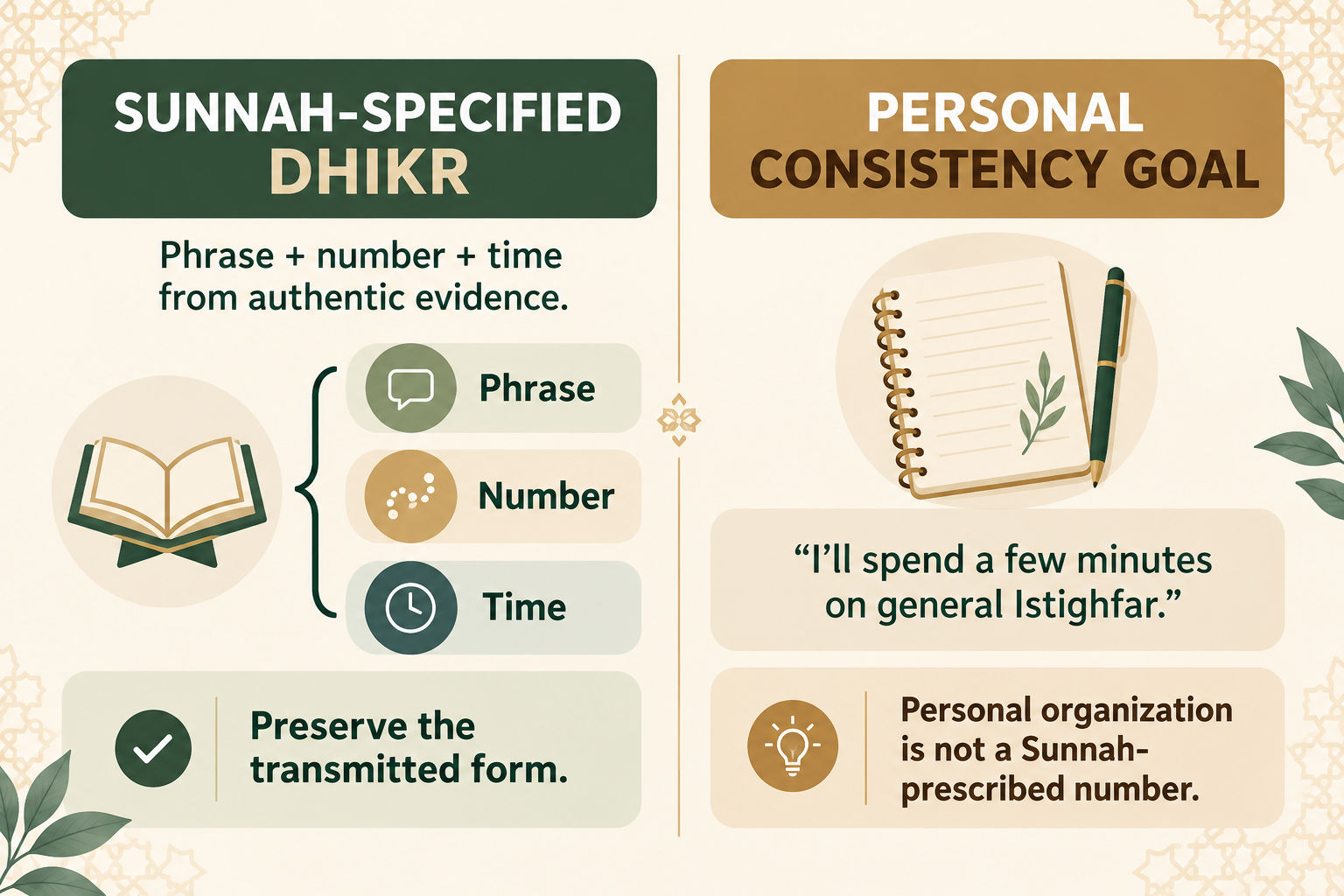
When Quran or Sunnah specifies a phrase, a number, and a time, keep that form. But not every Dhikr has a fixed count. Compare:
Prescribed: “SubhanAllahi wa bihamdihi 100 times” is a transmitted number.
Personal goal: “I’ll say Astaghfirullah 50 times to build consistency” is an organizational target.
The second is fine as long as you don’t present your number as Sunnah or attach special religious virtue to it. The first is following the Sunnah; the second is organizing your own effort, and both are acceptable when kept in their place.
Viral Dhikr formulas
You may have seen claims such as “Say Ya Razzaq 308 times and money will arrive,” “Repeat this 313 times to get married,” or “Say this 1,000 times and your wish must happen.” Don’t mock the people who share these. Many sincerely mean well. But if someone attributes a specific number, time, reward, or guaranteed result to Islam, evidence is required. Calling upon Allah by His Names is encouraged (7:180), but specific counts and promised outcomes need authentic sources.
Dhikr is not manifestation
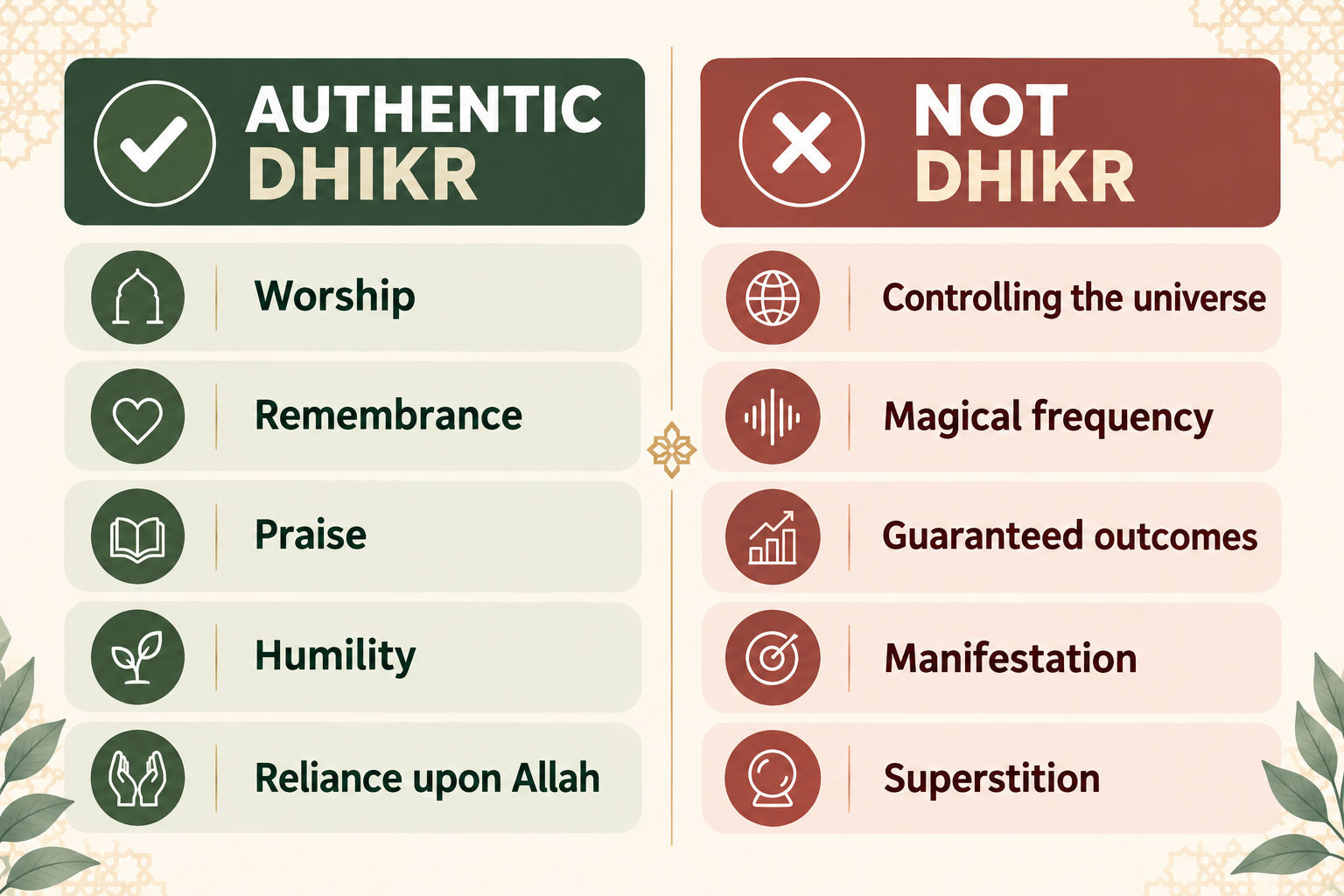
Dhikr is not the law of attraction, vibration-raising, or controlling reality through repeated words. It is worship and remembrance of Allah. A servant remembers, praises, asks, and relies on Allah; a servant does not control the universe.
Dhikr, Anxiety, Rizq, and Hardship
Does Dhikr remove anxiety?
Quran 13:28 speaks about the heart finding rest in remembrance, and many believers experience real comfort through it. But we should not say that enough Dhikr will make an anxiety disorder disappear. Distinguish ordinary worry, which Dhikr and Tawakkul can ease, from clinical conditions, which may need therapy, counseling, or medication. Dhikr can sit alongside treatment, and never stop professional care because of anything you read here. (See: What Does Islam Say About Anxiety, Worry, and Trusting Allah?)
Does Dhikr guarantee wealth?
No. In Surah Nuh, the Prophet Nuh (عليه السلام) tells his people to seek forgiveness from their Lord, who is Ever-Forgiving, and promises rain, wealth, and children (71:10–12). Commentators read this as a principle that repentance and obedience open the doors of blessing for the people he addressed. It is not a number-based formula. There is a Hadith promising relief from every worry for whoever clings to istighfar, but it is graded weak, so we don’t rely on it.
Dhikr during hardship
Hasbunallahu wa ni’mal-wakil (“Allah is enough for us, and He is the best disposer of affairs”): said by Ibrahim (عليه السلام) (Bukhari) and by the believers in 3:173.
La hawla wa la quwwata illa billah: acknowledging that all power belongs to Allah.
Inna lillahi wa inna ilayhi raji’un: said at calamity (2:156). Umm Salamah narrated a dua the Prophet ﷺ taught for it (Muslim).
They are not interchangeable emergency spells. Each has its own meaning and context.
Dhikr, gratitude, Tawakkul, and Qadr
Alhamdulillah shifts attention to blessings without denying hardship. A Muslim can grieve, seek help, and pursue justice while remembering Allah. And Dhikr does not replace action:
Exam worry: Dhikr + Dua + study + Tawakkul.
Financial difficulty: Dhikr + Dua + lawful effort + budgeting and support + Tawakkul.
Illness: Dhikr + Dua + appropriate treatment + Tawakkul.
Remembering Allah also helps us place events within faith in Qadr, but it is not a technique for manipulating Qadr. (See: What Is Tawakkul? and What Is Qadr in Islam?)
When Your Mind Wanders
It will. Don’t wait for perfect concentration before you begin. Try to:
Slow down.
Learn the meaning, then connect each phrase to it.
Use shorter authentic phrases.
Remove distractions where you can.
Vary the authentic forms.
Keep going consistently.
Quality and quantity are not enemies. The texts prescribe some quantities, so numbers matter where transmitted. Sincerity, attention, consistency, and understanding all matter too. And there is no universal daily quota. Start with established anchors (after Salah, morning, evening, before sleep) and add general remembrance naturally.
A Beginner’s Routine
This is a practical learning routine, not a newly prescribed Sunnah package.
The 2-minute starting point: after each obligatory prayer, say istighfar three times, Allahumma anta as-salam…, and one tasbih form. At bedtime, say Ayat al-Kursi. If a long routine makes you quit, begin here and grow.
Educational levels (these levels are not from revelation):
Level 1, Start Here: the 2-minute version above.
Level 2, Build Consistency: add morning and evening Adhkar (three Surahs ×3, SubhanAllahi wa bihamdihi) and the bedtime set.
Level 3, Expand: add daily-life Adhkar (eating, leaving home, travel), Sayyid al-Istighfar, and general Dhikr throughout your day.
Common Dhikr Mistakes
Thinking Dhikr requires prayer beads. Fingers are established, and beads are optional.
Repeating Arabic without ever trying to learn its meaning.
Believing only very high counts have value.
Inventing religious significance for unsupported numbers.
Treating Dhikr as manifestation.
Expecting guaranteed worldly outcomes.
Sharing weak or fabricated viral reward claims.
Abandoning authentic Adhkar for trendy formulas.
Starting an enormous routine and quitting after three days.
Thinking wandering thoughts make all Dhikr worthless.
Believing Wudu is always required.
Treating Dhikr as a replacement for Salah or other obligations.
How to Check a Dhikr Before Sharing It
Ask:
Is the wording from the Quran or Hadith?
If Hadith, is it authentic?
Is the number authentic?
Is the specified time authentic?
Is the claimed reward authentic?
Is the claimed worldly outcome authentic?
Is this just someone’s personal routine presented as Sunnah?
If you can’t answer these, ask a trusted teacher before you share it.
Dhikr for New Muslims and Children
New Muslims don’t need dozens of Adhkar right away. Begin with SubhanAllah, Alhamdulillah, Allahu Akbar, La ilaha illa Allah, and Astaghfirullah. Then add post-Salah Adhkar, simple morning and evening Adhkar, and bedtime Adhkar. Meaning before overload. (See our New Muslim Guide and How to Learn Salah When You Don’t Speak Arabic.)
Children learn best from short phrases, meanings, daily context, and parents who model it: Alhamdulillah after something good, SubhanAllah in wonder, Astaghfirullah after a mistake. Gentle repetition works better than reward charts and rote repetition alone.
Quranic Arabic and Dhikr
Words that open the Quran
Familiar Dhikr phrases are gateways into Quranic Arabic:
ذِكْر (dhikr): remembrance.
سُبْحَان (subḥān): glorification, the concept behind tasbih (it appears in verses such as 17:1).
حَمْد (ḥamd): praise (1:2, al-ḥamdu lillāh).
أَكْبَر / كَبِير (akbar / kabīr): greater / great (29:45).
غَفَرَ / مَغْفِرَة (ghafara / maghfirah): forgiveness vocabulary (71:10, ghaffār).
تَوْحِيد (tawḥīd): affirming Allah’s Oneness, the theme behind La ilaha illa Allah.
Morphology is more detailed than this list suggests, but these roots will keep appearing as you read. (See 100 Most Common Words in the Quran and Learn Arabic Through the Quran.)
A method for learning Dhikr with meaning
A Muslim may say سبحان الله hundreds of times over years without knowing what it means. Understanding can deepen attentiveness, though Dhikr without full comprehension is not invalid. Try this:
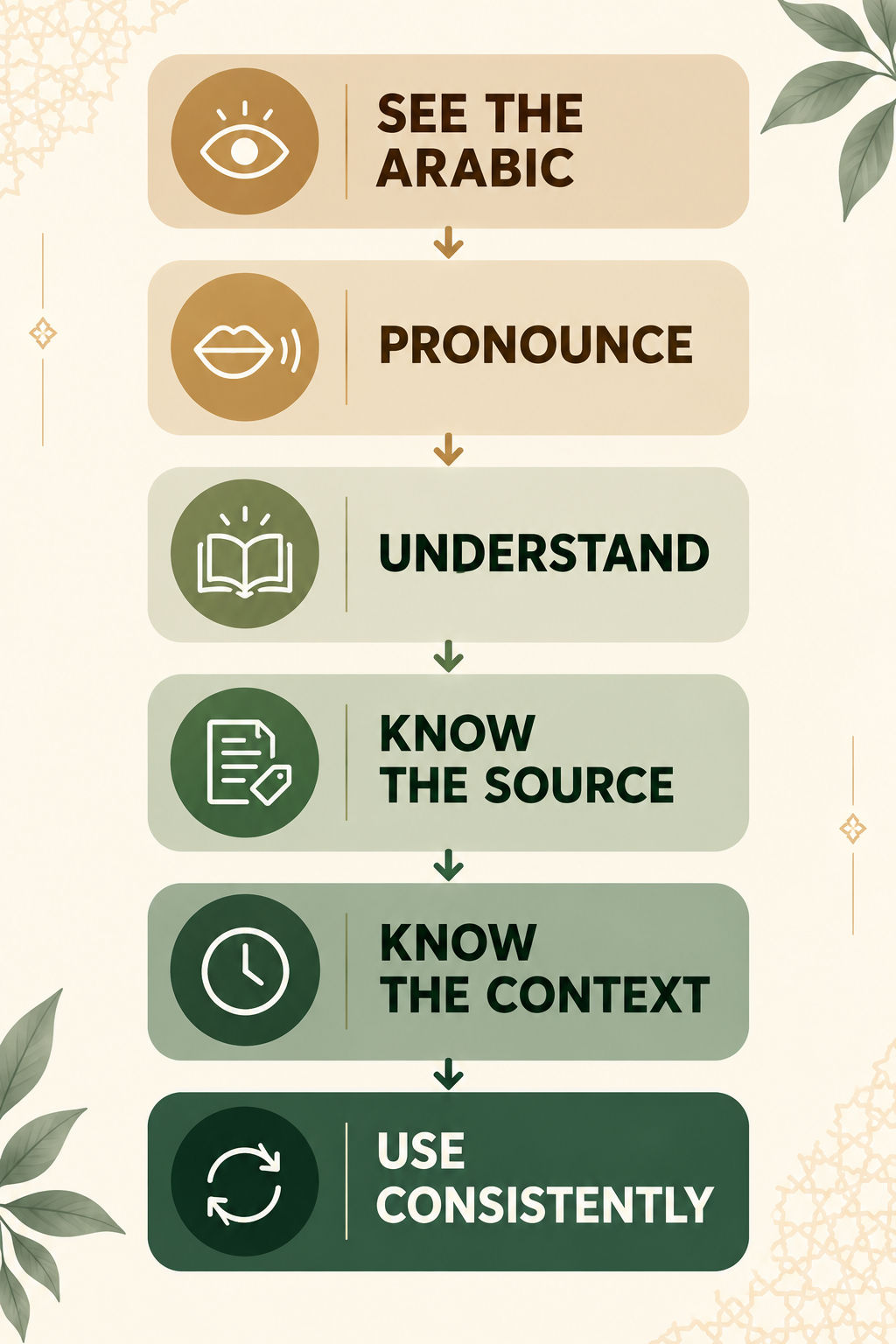
See the Arabic → Pronounce it → Learn the meaning → Learn the source → Learn when it is used → Use it consistently.
Over time, a phrase that was once only a sound becomes a doorway into the language of the Quran.
Remembering Allah Does Not Have to Begin With a Huge Routine
Back to that beginner holding a phone after Fajr: you don’t need to memorize 50 supplications tonight, repeat thousands of times, buy a counter, or master advanced Arabic first.
Learn one authentic phrase. Understand what it means. Know why and when it is said. Use it consistently. Then add another. Gradually let remembrance of Allah connect with your Salah, mornings, evenings, gratitude, repentance, decisions, difficulty, and ordinary life.
The goal of Dhikr is not only to move the tongue, which has its own established virtue, but to become a person who remembers Allah more often.
A learner may begin by memorizing SubhanAllah, Alhamdulillah, Allahu Akbar, and Astaghfirullah. Understanding the Arabic can turn them from familiar sounds into meaningful worship. At Araby Academy, we help non-Arabic-speaking Muslims study Quran reading, Tajweed, memorization, Quranic Arabic, Islamic Studies, and Islamic vocabulary through one-to-one online lessons, if you would like guidance as you go. (See also: Why Does Allah Test Us? and How to Understand the Quran Without Speaking Fluent Arabic.)
Start small, start authentically, learn what you are saying, and keep remembering Allah.
FAQ
1. What is Dhikr in Islam? The remembrance of Allah, through the heart and tongue, including praise, glorification, Tawhid, istighfar, Quran, and prescribed Adhkar.
2. What does Dhikr mean? Remembrance or mention. Adhkar are its forms and formulas.
3. How do beginners do Dhikr? Start with established anchors: after Salah, morning, evening, and bedtime, and learn the meaning of each phrase.
4. What is the best Dhikr? Scholars point to La ilaha illa Allah and the four beloved words, and the Quran is among the greatest. Choose authentic forms you can keep up.
5. Can I do Dhikr in English? General remembrance, yes. Prescribed formulas are best said in their Arabic wording as you learn them.
6. Do I need Wudu? No, not for general Dhikr. Wudu questions mainly concern touching the mushaf.
7. Can I do Dhikr without prayer beads? Yes. Beads are not required.
8. Can I count on my fingers? Yes. The Prophet ﷺ counted tasbih on his right hand.
9. Can I use a digital counter? It’s a modern tool, not a Sunnah. Use it only as a counting aid, and don’t let it become the goal.
10. Can I do Dhikr while walking or working? Yes, for general Dhikr. Safety comes first when driving.
11. What Dhikr should I say after Salah? Istighfar ×3, Allahumma anta as-salam…, one authentic tasbih form (33/33/34 or a variant), and optionally Ayat al-Kursi and the three Surahs.
12. What are morning and evening Adhkar? Authentic remembrances said at those times, such as the three Surahs ×3 and SubhanAllahi wa bihamdihi ×100.
13. How many times should I repeat Dhikr? Where the Sunnah specifies a number, keep it. Otherwise, it’s your own flexible goal.
14. What is the difference between Dhikr and Dua? Dhikr is remembrance and praise; Dua is asking Allah. They often overlap.
15. Does Dhikr help with anxiety? It can bring spiritual comfort (13:28), but it doesn’t replace therapy or medical care for clinical conditions.