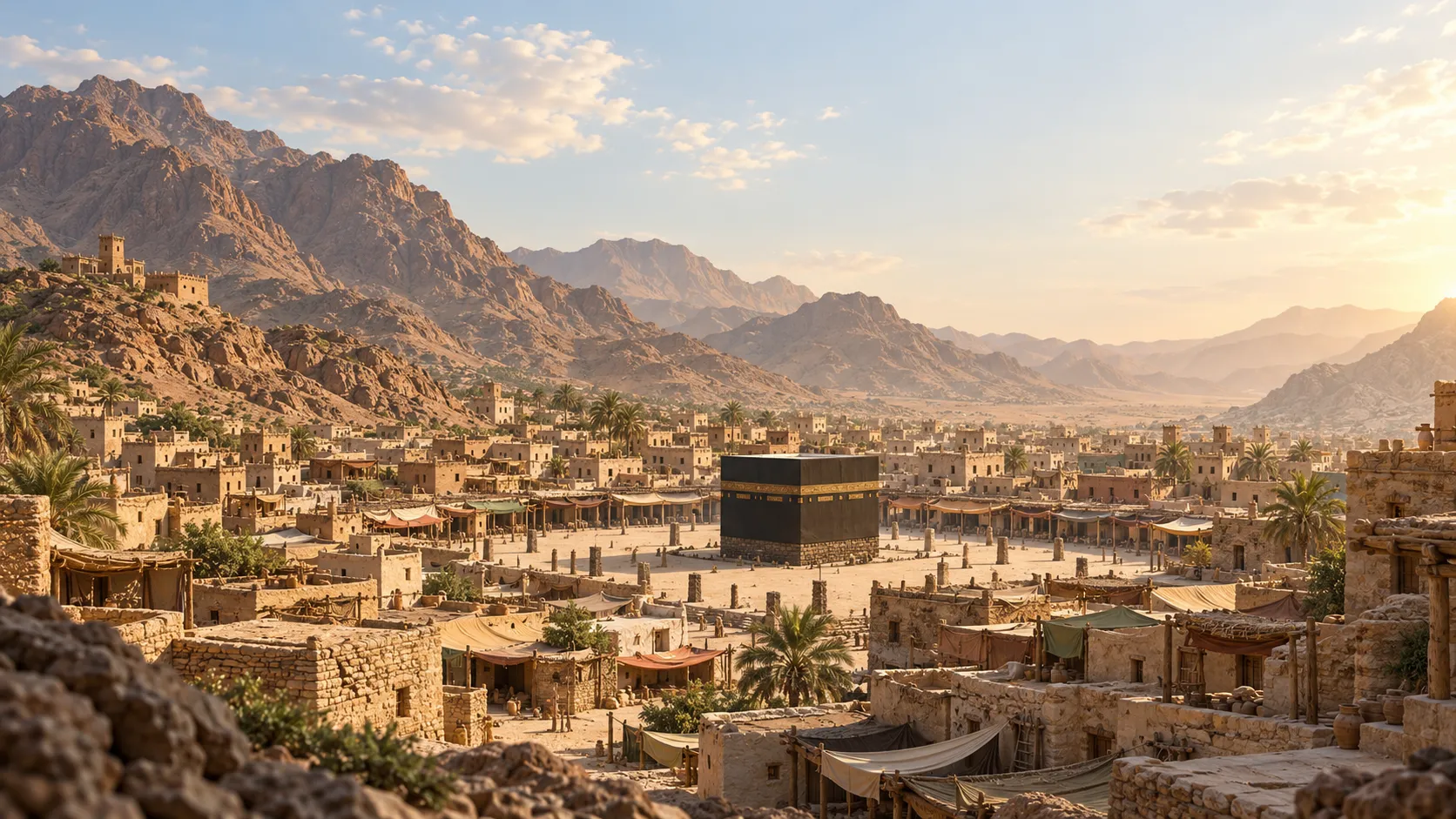
Surah Al-Mujadilah opens with a striking statement. Allah has heard the words of the woman who was disputing with the Prophet ﷺ about her husband and complaining to Allah. Who was she? What was she complaining about? And how do we know the story told about her is reliable?
Those questions are the doorway into Asbab al-Nuzul. This article walks through ten carefully sourced cases. In each one we separate what the Quran says, what a report adds, and what neither proves.
The Short Answer: What Is Asbab al-Nuzul?
Asbab al-Nuzul (أَسْبَابُ النُّزُولِ; singular sabab al-nuzul) means the circumstances or occasions connected to the revelation of particular Quranic passages. Reliable reports can show who was addressed, what problem was being discussed, or why an expression appears, as with Safa and Marwah in Quran 2:158 and the exception in Quran 4:95. Not every verse has an established specific occasion, and scholars examine each report before accepting it.
The discipline is not the date or place of revelation, the whole biography of the Prophet ﷺ, or a dictionary definition. It overlaps with Tafsir (interpretation), Seerah (the Prophet’s life), and Hadith studies (the transmission and evaluation of reports), but it is not identical to any of them. Calling a Surah Makki or Madani classifies it broadly; it does not tell you the cause of every verse inside it. Nor does the Quran consist of separate answers to separate questions.
How Do Scholars Know Why an Ayah Was Revealed?
Mostly through reports from those who witnessed the events, mainly Companions, preserved in Hadith and Tafsir works. Scholars ask who narrated the report, whether the chain is connected, what the wording actually says, and whether another report conflicts with it.
Understanding [ the major Quranic Sciences and how they help explain revelation] provides a useful foundation before examining specific reports about why an Ayah was revealed.
Wording matters. The phrase nazalat fi (نَزَلَتْ فِي, “this was revealed concerning...”) may introduce a specific occasion, or it may name an example that falls under the verse’s meaning. The surrounding narration usually shows which.
Reports also differ in strength, so this article labels its evidence plainly:
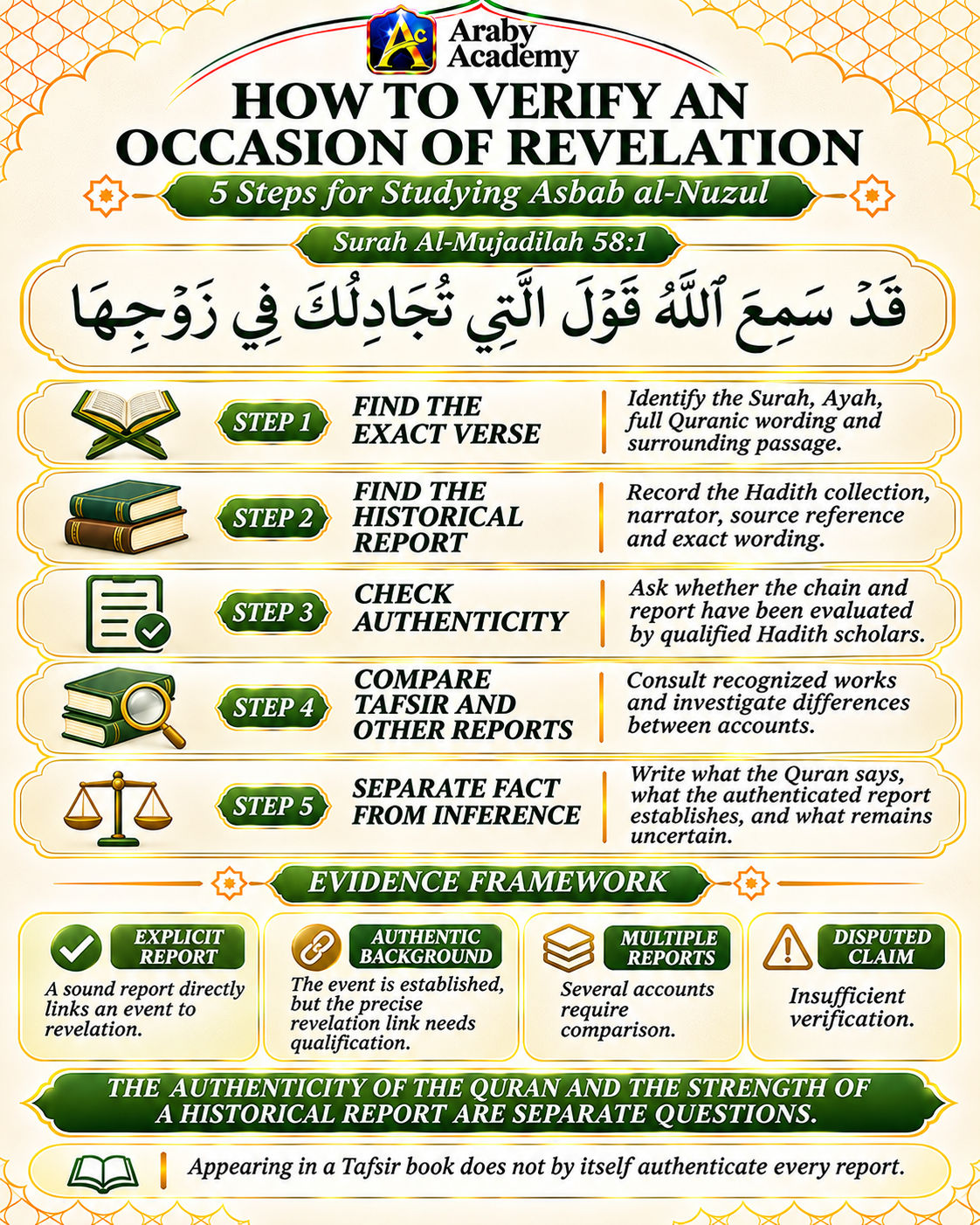
Explicit report: an authentic narration directly links an incident to revelation.
Authentic background: the setting is established, but the direct occasion is uncertain.
Multiple reports: several accounts require scholarly comparison.
Disputed claim: insufficiently verified.
These labels simplify; real Hadith evaluation takes more explanation.
10 Quranic Revelation Stories at a Glance
Passage | Reported incident | What context clarifies | Primary evidence |
|---|---|---|---|
58:1–4 | A woman’s complaint about Zihar | Who spoke; what was addressed | Ibn Majah; parallels |
24:11–20 | False accusation against ‘A’ishah | Who is referred to | Bukhari, Muslim |
2:158 | Hesitation about Sa’y | Why “no blame” appears | Bukhari, Muslim |
2:189 | Entering houses from behind | A concrete custom | Bukhari |
2:196 | Ka’b ibn ‘Ujrah’s affliction | The practical setting | Bukhari |
4:95 | Ibn Umm Maktum’s concern | The exception | Bukhari |
49:2–3 | Voices raised before a delegation | The setting of the command | Bukhari |
60:1 | Hatib’s letter | The real circumstances | Bukhari; sub-narrator note |
24:6–9 | Spousal accusation and Li’an | Why the procedure exists | Bukhari; multiple reports |
9:118 | Three left behind after Tabuk | Truthfulness and deferral | Ka’b’s account |
1. The Woman Whose Complaint Was Heard: Why Quran 58:1 Was Revealed
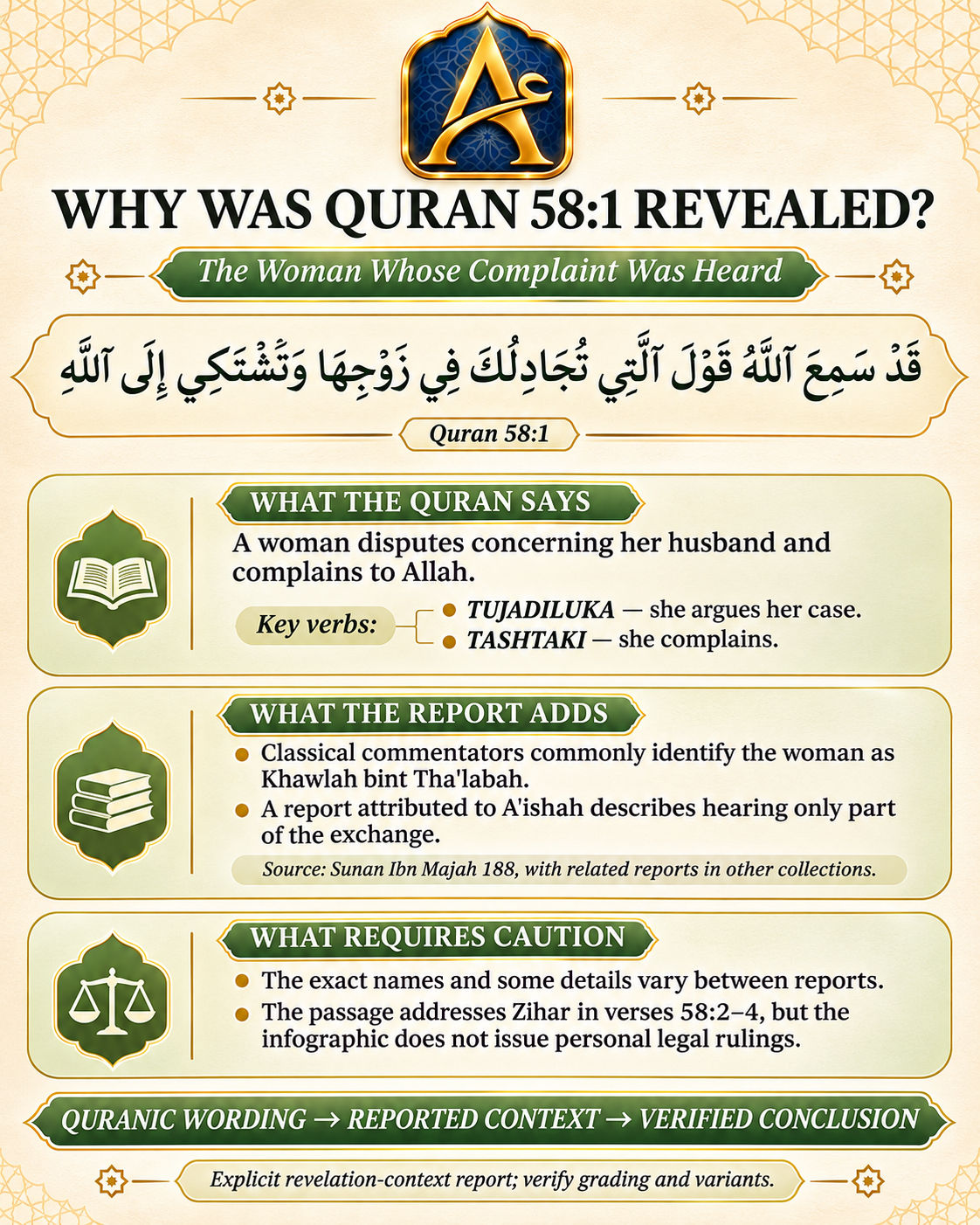
Passage: 58:1–4. قَدْ سَمِعَ اللَّهُ قَوْلَ الَّتِي تُجَادِلُكَ فِي زَوْجِهَا وَتَشْتَكِي إِلَى اللَّهِ
Working rendering: “Allah has heard the speech of the one who disputes with you about her husband and complains to Allah.”
The report. In Sunan Ibn Majah (no. 188), ‘A’ishah is reported to have said she was in the house and could not hear all that the woman said, yet Allah heard her, and the verses were revealed. Commentators identify the woman as Khawlah bint Tha’labah. Her husband is usually named Aws ibn al-Samit, though names and details vary across sources, so we stay with what is firm. Parallel reports appear in al-Nasa’i and Musnad Ahmad.
Evidence: an explicit report; check its grading and the wording differences between versions.
Without context, the opening may sound like a general sentence about being heard. The context shows a real complaint about Zihar, a pre-Islamic pronouncement likening a wife to a forbidden woman, which verses 2–4 then address as a ruling. It does not prove details of her private life or give a personal Fiqh ruling.
The verse uses two verbs: tujadiluka (she disputes, argues her case) and tashtaki (she complains). The second adds that her grievance was directed to Allah.
The opening of Surah Al-Mujadilah is also an example of [ short Quranic expressions whose Arabic wording deserves closer study], because the historical account clarifies who is speaking and what is being discussed.
Takeaway: the passage moves from hearing a complaint to legislating, so do not reduce it to a slogan. Ask yourself: which details are in the verse, and which come only from a report?
2. The Incident of al-Ifk: Why Quran 24:11–20 Matters
Passage: 24:11–20. إِنَّ الَّذِينَ جَاءُوا بِالْإِفْكِ عُصْبَةٌ مِّنكُمْ
Working rendering: “Indeed, those who brought forth the lie are a group among you.”
The report. ‘A’ishah’s long first-person account is in Sahih al-Bukhari (including the numbers 4690 and 7500 listed in your brief; verify them, since numbering varies by edition) and Sahih Muslim. In brief: she was separated from the army on a return journey, was brought back by a Companion, and a rumor spread about her. The narration says the revelation of her innocence came after a period of anxious waiting, and that the passage comprised ten verses. We will not repeat the accusations or imagine anyone’s feelings.
Evidence: an explicit, extensively narrated report. Quran 24:22, on Abu Bakr and Mistah, is related but is not a separate case here, and the Surah’s verses were not all revealed together.
Without context, “those who brought forth the lie” has no clear referent. The context shows that the passage answers a specific rumor, and why it stresses responsible speech and the need for proof. It does not prove details beyond the narration.
The Incident of al-Ifk also shows why [ Quranic storytelling and the way different passages emphasize different details] must be studied with attention to sources rather than reconstructed from imagination.
Takeaway: the Quran declares her innocence; Hadith supplies the narrative. Ask yourself: which details are Quranic, and which are Hadith?
3. Safa and Marwah: Why Does Quran 2:158 Say “There Is No Blame”?
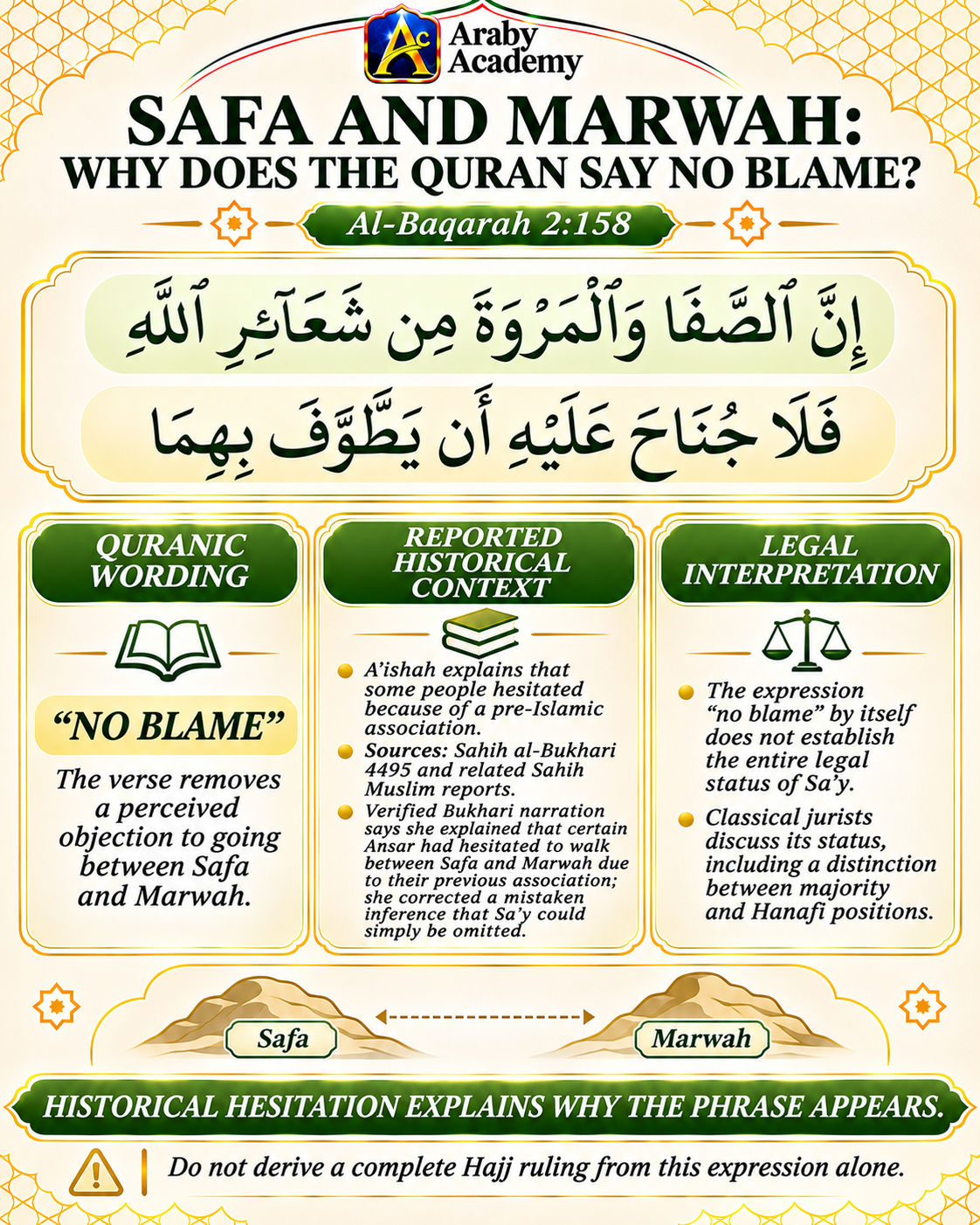
Passage: 2:158. إِنَّ الصَّفَا وَالْمَرْوَةَ مِن شَعَائِرِ اللَّهِ ... فَلَا جُنَاحَ عَلَيْهِ أَن يَطَّوَّفَ بِهِمَا
Working rendering: “Safa and Marwah are among the symbols of Allah... there is no blame upon him in walking between them.”
The report. In Sahih al-Bukhari (4495) and Sahih Muslim, ‘Urwah asks ‘A’ishah whether the phrase means walking is optional. She explains that the Ansar had previously assumed Ihram for an idol named in the narration, Manat, and felt reluctant about Safa and Marwah. The verse was revealed, and she says the Prophet ﷺ established the walking between them. A related report from Anas mentions the dislike of a pre-Islamic association.
Evidence: an explicit report in the two Sahih collections.
Without context, “no blame” seems to make Sa’y optional. The context shows the phrase answers hesitation: it removes a perceived fault. Junah (جُنَاح) means blame or sin, and this construction alone does not decide the ritual’s legal status. Scholars differ on that status: the majority treat it as a pillar of Hajj, while the Hanafi school holds it obligatory.
Takeaway: a phrase of permission may answer anxiety, not state a ruling. Ask yourself: why would someone be hesitant?
4. Why Did the Quran Mention Entering Houses Through Their Doors?
Passage: 2:189. وَلَيْسَ الْبِرُّ بِأَن تَأْتُوا الْبُيُوتَ مِن ظُهُورِهَا ... وَأْتُوا الْبُيُوتَ مِنْ أَبْوَابِهَا
Working rendering: “Righteousness is not that you enter houses from their backs... but enter houses through their doors.”
The report. Sahih al-Bukhari (4512) reports from al-Bara’ ibn ‘Azib that in the pre-Islamic period, people in Ihram entered houses from the back, and the verse was revealed. The narration goes no further, and we should not extend it to every tribe.
Evidence: an explicit report.
Without context, the verse could pass for architectural advice or a metaphor. The context shows a concrete religious custom. Commentators may draw wider moral lessons, but those do not erase the literal custom. Al-Birr (الْبِرّ) means righteousness and goodness broadly; the verse corrects a mistaken idea of where it lies and points to taqwa.
It does not prove that the verse has only this meaning, or anything about the custom beyond what the report states.
Takeaway: a metaphorical application is fine only if the original event is kept. Ask yourself: what mistaken idea of righteousness does the custom reflect?
5. Ka’b ibn ‘Ujrah: Why Quran 2:196 Mentions an Ailment of the Head
Passage: 2:196. أَوْ بِهِ أَذًى مِّن رَّأْسِهِ فَفِدْيَةٌ مِّن صِيَامٍ أَوْ صَدَقَةٍ أَوْ نُسُكٍ
Working rendering: “...or has an ailment of the head, then a compensation of fasting, charity, or sacrifice.”
The report. In Sahih al-Bukhari (4517), Ka’b ibn ‘Ujrah describes being in Ihram when the Prophet ﷺ saw his condition, which the report ties to lice in his hair. The Prophet ﷺ told him to shave and specified fasting, feeding poor people, or a sacrifice. The Quran gives the three categories; the Hadith supplies the measures. In a version of the report Ka’b says the verse was revealed about him specifically and applies generally; verify the exact wording.
Evidence: an explicit report.
This is a clear case of a specific occasion with a wider application. Scholars treat the ruling under recognized conditions. We do not give personal Hajj or Fidyah rulings; consult a qualified scholar.
This pilgrimage-related example is easier to place in context after studying [ the Five Pillars of Islam and the place of Hajj in Muslim worship], while leaving detailed pilgrimage rulings to qualified scholarship.
Takeaway: one person’s case need not limit the verse to that person. Ask yourself: what comes from the Quran, and what extra detail from Hadith?
6. Ibn Umm Maktum: Why Quran 4:95 Includes an Exception
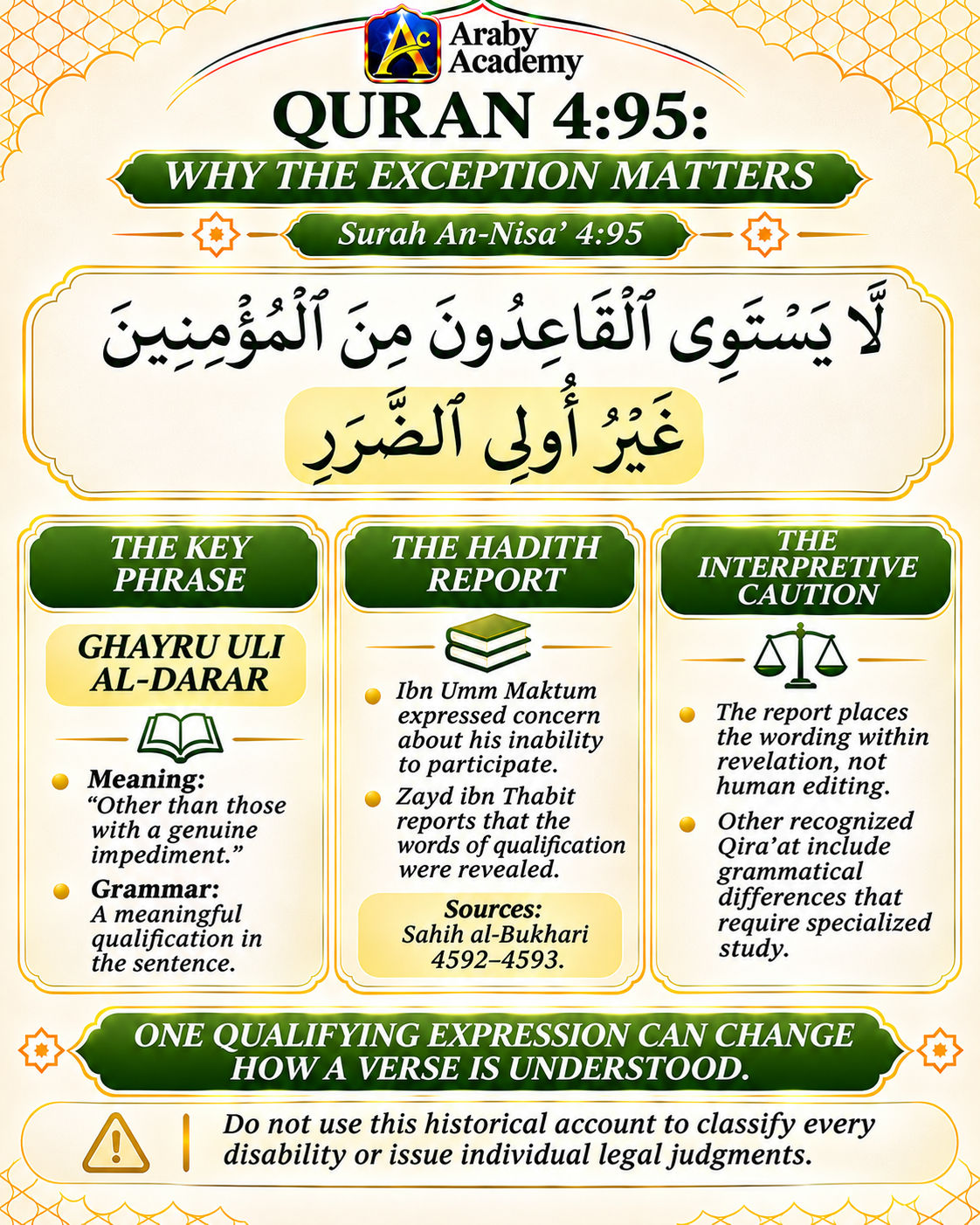
Passage: 4:95. لَّا يَسْتَوِي الْقَاعِدُونَ مِنَ الْمُؤْمِنِينَ غَيْرُ أُولِي الضَّرَرِ
Working rendering: “Not equal are those who sit among the believers, other than those with a genuine impediment...”
The report. In Sahih al-Bukhari (4592–4593), Zayd ibn Thabit says the Prophet ﷺ dictated the verse, and Ibn Umm Maktum, who was blind, voiced his concern that he could not take part. Revelation then came, and the words of exception were revealed. The narration places this within the process of revelation. It was not a human edit or a correction by the Companions, and we do not add detail beyond the report.
Evidence: an explicit report.
Without context, a reader may not see why the exception matters. The context shows who raised the concern and why the qualification belongs. Ghayru uli al-darar (غَيْرُ أُولِي الضَّرَرِ) qualifies the statement about those who sit. Hafs ‘an ‘Asim reads ghayru in the nominative; other recognized readings differ.
It does not prove that every disabled Muslim is in the same legal situation, and it never implies weak faith.
Takeaway: grammar and history work together. Ask yourself: what did the exception change?
7. Abu Bakr and ‘Umar: Why Quran 49:2 Warns Against Raising Voices
Passage: 49:2–3. يَا أَيُّهَا الَّذِينَ آمَنُوا لَا تَرْفَعُوا أَصْوَاتَكُمْ فَوْقَ صَوْتِ النَّبِيِّ
Working rendering: “O you who believe, do not raise your voices above the voice of the Prophet.”
The report. Sahih al-Bukhari (4845; related at 7302) reports, from Ibn Abi Mulaykah and Ibn al-Zubayr, that when a delegation of Banu Tamim came, Abu Bakr and ‘Umar disagreed over whom to appoint as their leader. Their voices rose, and the verse was revealed. The narration adds that ‘Umar afterward spoke so quietly in the Prophet’s presence that he was hard to hear. A different report ties 49:2 to Thabit ibn Qays, so this verse also calls for report comparison.
Evidence: an explicit report, with a parallel.
Without context, the verse seems a bare rule about volume. The context shows a concrete setting and why it mattered. The point is reverence in the Prophet’s presence, not modern etiquette rules, and it is not an attack on two honored Companions.
It does not prove that they habitually behaved badly.
Takeaway: read the full wording of 49:2–3. Ask yourself: what exactly does the verse prohibit?
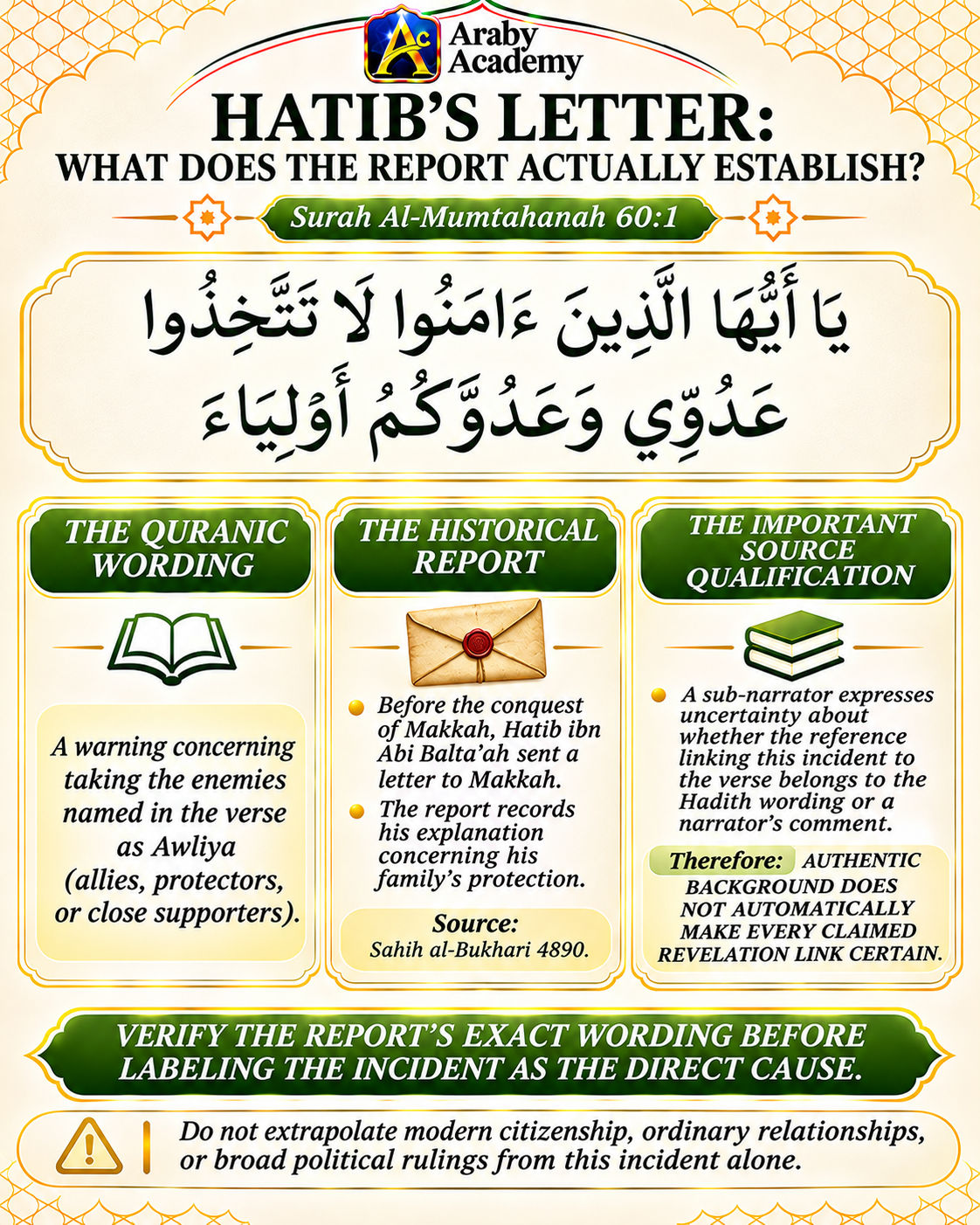
8. Hatib’s Letter: Why the Background of Quran 60:1 Matters
Passage: 60:1. يَا أَيُّهَا الَّذِينَ آمَنُوا لَا تَتَّخِذُوا عَدُوِّي وَعَدُوَّكُمْ أَوْلِيَاءَ
Working rendering: “O you who believe, do not take My enemy and your enemy as allies.”
The report. Sahih al-Bukhari (4890) reports that, before the conquest of Makkah, Hatib ibn Abi Balta’ah sent a letter to Makkah. It was intercepted. Hatib explained that he had not apostatized and had family there with no tribe to protect them. The Prophet ﷺ accepted that he had spoken truthfully and, when ‘Umar asked for action, pointed to Hatib’s presence at Badr. A sub-narrator in the chain says he does not know whether the mention of the verse belongs to the Hadith itself or to a narrator’s comment, so this is background with a qualification on the link.
The background to Hatib’s letter is easier to understand within [ the life of Prophet Muhammad and the major events of the Seerah], because revelation-context reports often depend on accurately identifying the historical setting.
Without context, awliya’ (“allies, protectors”) becomes a slogan. The context shows an actual episode. It does not prove anything about modern Muslims, citizenship, or ordinary relations with non-Muslims; the surrounding verses and Tafsir must be read.
Takeaway: do not generalize a specific event. Ask yourself: what did Hatib actually do, and what explanation is recorded?
9. The Verses of Li’an: What Happened Before Quran 24:6–9?
Passage: 24:6–9. وَالَّذِينَ يَرْمُونَ أَزْوَاجَهُمْ
Working rendering: “And those who accuse their spouses...”
Li’an (لِعَان) is the Quranic procedure of sworn testimony when a husband accuses his wife and lacks witnesses.
The reports. Sahih al-Bukhari (4747), from Ibn ‘Abbas, concerns Hilal ibn Umayyah. Other reports in al-Bukhari and Muslim concern ‘Uwaymir al-‘Ajlani. They are different individuals. Scholars discuss whether these describe one event, separate incidents, or one being the occasion and the other an implementation. Commentators propose possibilities, but we do not present an invented reconciliation.
Evidence: multiple reports requiring scholarly comparison.
Without context, the passage’s special procedure may seem odd beside the general rules of accusation. The context shows a concrete problem the verses address. We avoid graphic detail and do not repeat allegations as fact.
It does not prove a clean chronology. This is not a guide to initiating Li’an; legal questions belong with qualified scholars.
Takeaway: more than one report can attach to one passage. Ask yourself: which report speaks of revelation, and which of implementation?
10. The Three Left Behind: Why Quran 9:118 Was Revealed
Passage: 9:118. وَعَلَى الثَّلَاثَةِ الَّذِينَ خُلِّفُوا
Working rendering: “And [He turned in mercy] to the three who were left behind.”
The report. Ka’b ibn Malik’s first-person account (Sahih al-Bukhari 4676 and 4678, with other versions and Sahih Muslim) says that he, Murarah ibn al-Rabi’, and Hilal ibn Umayyah stayed back from the expedition to Tabuk. They told the Prophet ﷺ the truth rather than offering excuses, and their matter was left undecided for a period the narration measures in nights. Then the verses accepting their repentance came. They were not hypocrites; the account sets their honesty against the excuses of others.
Evidence: an explicit, detailed report.
In Ka’b’s account, khullifu (“left behind”) refers to their case being deferred, not only to staying home. Verses 9:117–119 belong together, and 9:119 enjoins being with the truthful. That wider instruction goes beyond the incident.
The account of Ka’b ibn Malik also connects naturally with [ how repentance and Allah’s forgiveness are understood in Islam], although the historical story should not be converted into a rigid formula for every person’s experience.
Takeaway: truthfulness and repentance, with no universal timeline. Ask yourself: how does 9:119 relate to the incident?
What These 10 Cases Teach Us About Revelation
Together the cases show five uses of Asbab al-Nuzul. It explains why an expression appears (2:158, 2:189). It identifies real people (58:1, 24:11). It clarifies exceptions (4:95, 2:196). It prevents decontextualized readings (60:1). And it ties a passage to Seerah and Hadith (9:118).
Reference | Event | Source | Clarifies | Caution |
|---|---|---|---|---|
58:1–4 | Khawlah’s complaint | Ibn Majah 188 | Speaker, Zihar | Names vary |
24:11–20 | Al-Ifk | Bukhari, Muslim | Referents | No details invented |
2:158 | Sa’y hesitation | Bukhari 4495 | “No blame” | Not a full ruling |
2:189 | Back-door custom | Bukhari 4512 | Literal custom | Not only a metaphor |
2:196 | Ka’b ibn ‘Ujrah | Bukhari 4517 | Setting | No personal fatwa |
4:95 | Ibn Umm Maktum | Bukhari 4592–4593 | The exception | Not human editing |
49:2–3 | Delegation | Bukhari 4845, 7302 | Setting | Not an accusation |
60:1 | Hatib | Bukhari 4890 | Real circumstances | Sub-narrator note |
24:6–9 | Li’an | Bukhari 4747 | Procedure | Multiple reports |
9:118 | Tabuk | Bukhari 4676, 4678 | Deferral | Not hypocrites |
Does Every Ayah Have a Specific Reason for Revelation?
No. Many verses have no securely established occasion. One incident can relate to several passages, and one passage to several situations. Do not invent a story to fill a gap.
The principle al-‘ibratu bi-‘umum al-lafz la bi-khusus al-sabab (الْعِبْرَةُ بِعُمُومِ اللَّفْظِ لَا بِخُصُوصِ السَّبَبِ), roughly “consideration is given to the generality of the wording, not merely the specificity of the occasion,” helps here. It does not make the occasion irrelevant, and it does not settle every legal question; context and wording are weighed together, as with 2:196.
How to Check a Claimed Occasion of Revelation
Find the exact Surah and Ayah.
Identify the incident and its earliest accessible source, noting the collection, narrator, and number. Numbers can differ between editions.
Check authenticity and the exact wording that links the report to revelation.
Compare with recognized Tafsir (al-Tabari, Ibn Kathir, al-Qurtubi, al-Baghawi, Ibn ‘Ashur) and other reports. Appearing in Tafsir does not authenticate a report. Al-Wahidi’s Asbab al-Nuzul and al-Suyuti’s Lubab al-Nuqul fi Asbab al-Nuzul are important works, but not every report in them is sound.
Separate what the report establishes from what is only possible interpretation.
If a story proves weak, that does not affect the Quran’s authenticity; the verse’s status and the report’s strength are separate questions.
Common Misconceptions About Asbab al-Nuzul
Myth: every verse has a known occasion. Reality: many do not.
Myth: every Tafsir story is authentic. Reality: reports vary in strength.
Myth: “revealed concerning” always means the immediate cause. Reality: it may describe an application.
Myth: a translation makes context unnecessary. Reality: context can explain why a phrase appears.
Myth: the event gives the full meaning. Reality: Arabic and Tafsir remain necessary.
Myth: a verse about one person applies to no one else. Reality: generality and application follow recognized principles.
Myth: two reports must contradict. Reality: they may describe different events or aspects.
Myth: “no blame” in 2:158 makes Sa’y optional. Reality: the historical hesitation matters.
Myth: 2:189 is architectural advice. Reality: a documented custom is central.
Myth: the 4:95 exception was human editing. Reality: the report places it within revelation.
Myth: the three of 9:118 were hypocrites. Reality: the authenticated account distinguishes them.
Myth: a weak report weakens the Quran. Reality: they are separate questions.
Frequently Asked Questions
1. What does Asbab al-Nuzul mean? The circumstances or occasions connected to the revelation of particular Quranic passages.
2. Why is it important? It can clarify who is addressed, what problem is discussed, and why a phrase appears.
3. Does every Ayah have a specific reason? No. Many verses have no securely established occasion.
4. How do scholars know why a verse was revealed? Through reports from the Companions, assessed for chain, wording, and comparison with other evidence.
5. Can a verse have more than one reported occasion? Yes. Scholars compare authenticity, wording, and timing, and avoid inventing a reconciliation.
6. Are all Asbab al-Nuzul stories authentic? No. Reports differ in strength and must be checked.
7. How does it differ from Tafsir? It studies revelation occasions; Tafsir is the wider discipline of interpretation.
8. How does it differ from Seerah? Seerah studies the Prophet’s life; Asbab studies particular links between events and verses.
9. Who was the woman in Quran 58:1? Commentators name her Khawlah bint Tha’labah; some details vary.
10. Why were the verses about ‘A’ishah revealed? To address the rumor in the Incident of al-Ifk and declare her innocence.
11. Why does 2:158 say “no blame”? Because, per ‘A’ishah’s report, some were hesitant about Safa and Marwah.
12. Why does 2:189 mention doors? Al-Bara’s report describes a custom of entering houses from the back while in Ihram.
13. Who was Ka’b ibn ‘Ujrah? A Companion whose affliction during Ihram is linked to 2:196.
14. Why does 4:95 mention disability? Zayd ibn Thabit reports that Ibn Umm Maktum raised his inability, and the exception was revealed.
15. Why not raise voices in 49:2? A Bukhari report links it to raised voices before a Banu Tamim delegation; the point is reverence.
16. What was Hatib’s letter? A letter sent to Makkah before the conquest, intercepted, with Hatib’s explanation recorded in Bukhari.
17. What is Li’an? The Quranic sworn-testimony procedure for a spousal accusation without witnesses; consult scholars for rulings.
18. Who were the three in 9:118? Ka’b ibn Malik, Murarah ibn al-Rabi’, and Hilal ibn Umayyah.
19. Can a verse apply beyond its event? Yes, under recognized principles that weigh wording and context.
20. How can beginners verify a claimed reason? Use the five steps above and consult a teacher.
Read the Verse, Verify the Report, Understand the Context
A woman brought a complaint, and the Quran refers to it. A later reader meets the opening of Surah Al-Mujadilah and wonders what happened; verified context answers that. Across ten cases we saw Asbab al-Nuzul clarify expressions, identify participants, explain customs and exceptions, and connect passages to documented Seerah.
The question “Why was this Ayah revealed?” can open the door to a deeper understanding of the Quran, but only when the answer rests on reliable evidence. Some verses are connected to well-documented incidents, while others do not have a known specific occasion. By checking authentic reports, reading the surrounding passage, and consulting recognized Tafsir, you can appreciate how Quranic revelation addressed real circumstances without reducing its message to a collection of historical anecdotes.
If you would like to study Quranic Arabic and Tafsir step by step, Araby Academy’s qualified teachers are happy to guide you.