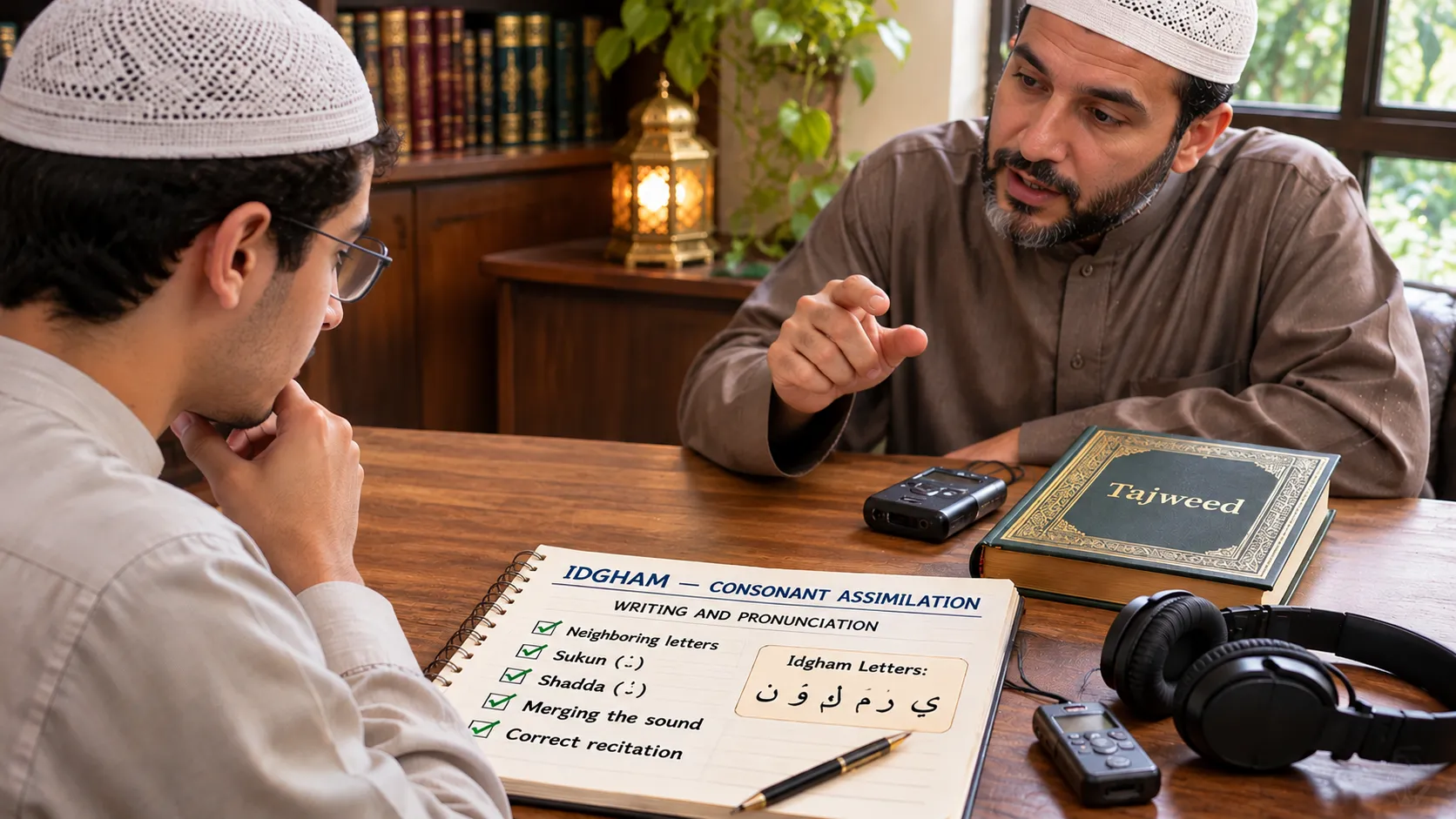
Open a Mushaf to Quran 99:7 and you will see فَمَن يَعْمَلْ: a Noon, then a Ya, written side by side. Yet a trained reciter does not pronounce the Noon as a separate, clear sound before the Ya. The two letters are connected in a way your eye does not predict. Now look at Quran 2:256: قَد تَّبَيَّنَ. Here the meeting letters are Dal and Ta, not Noon and Ya.
Are these the same rule? No. Both involve assimilation, but the triggers and pronunciation details differ. This guide teaches seven transmitted lessons you can learn to recognize by sight and by ear.
Quick answer: Idgham (إِدْغَام) is a Tajweed process in which one Arabic consonant merges into a following consonant under specific recitational conditions. Some forms keep a nasal Ghunnah; others do not. Examples include Noon Sakinah or Tanween before certain letters, Mim Sakinah before Mim, the Lam of the definite article before a sun letter, and selected identical or closely related consonants. The rule depends on the letters, their pronunciation, and the transmitted reading. Ikhfa and Iqlab also change connected pronunciation, but they are different processes.
What Is Idgham in Tajweed?
Idgham means merging: a letter is incorporated into the following letter so that the following letter is pronounced in the recognized assimilated manner. Think of two neighboring sounds becoming one correctly formed, stronger sound, but only where the transmitted rules allow it. Different types keep different features, so they must not be taught as identical.
"Merge" is an explanatory analogy, not a license. Each correct Idgham has a trigger, a defined letter environment, a transmitted pronunciation, and sometimes exceptions. Idgham is not swallowing letters for speed or smoothness, and rushing your recitation is not Idgham.
Sound is also different from spelling. The written text of the Quran does not change, no letters are erased, and no reciter may delete letters at will. The rule describes how authentic recitation pronounces the written words, which is different from casual colloquial speech.
Before You Listen: Sukun, Shadda, and Ghunnah
Sukun (سُكُون, ْ) marks a consonant with no vowel; the letter is called Sakin. A Sakin letter meeting a vowelled letter is where many merging rules begin, but a written Sukun does not automatically trigger Idgham.
Shadda (شَدَّة, ّ) marks a doubled, strengthened consonant, called Mushaddad. In many Mushaf prints a Shadda on the second letter reflects an assimilation. But not every Shadda comes from Idgham: a word such as رَبِّ carries its doubled consonant for morphological reasons.
Ghunnah (غُنَّة) is nasal resonance associated with Noon and Mim. Both letters always have some natural nasal quality, but certain rules require a more noticeable Ghunnah, commonly taught as about two counts. Counts are a teaching guide, not a stopwatch, and an exaggerated hum is a mistake. "Without Ghunnah" means the special held nasalization is not prescribed, not that every physical resonance vanishes.
Before practicing merged sounds, students should recognize common pronunciation mistakes involving Arabic letters in the Quran, because Idgham depends on identifying the correct consonants and their articulation.
Makharij al-Huruf (مَخَارِجُ الْحُرُوف) are the articulation points: the lips for Mim, the tongue for Lam, Ra, Dal, and Ta, with the nasal passage contributing to Noon and Mim. Sifat al-Huruf (صِفَاتُ الْحُرُوف) are the characteristics of letters, such as voicing and strength. Sharing a point of articulation never guarantees a merger, and English /n/, /m/, /l/, /r/, /d/, and /t/ are only rough approximations.
The difference between a Sakin letter and a Mushaddad letter becomes easier to understand through [ Arabic Harakat, Sukun, Shadda, and Tanween], all of which are important visual clues when learning Tajweed.
Three Relationships
Tajweed describes two meeting letters as Mutamathilayn (identical), Mutajanisayn (sharing an articulation point but differing in characteristics), or Mutaqaribayn (close in articulation or features). These labels describe relationships, not automatic outcomes. Works also speak of Saghir (small: the first letter is Sakin, the second vowelled) and Kabir (large: both vowelled). Large Idgham belongs to specialized discussions in certain Qira'at, so this guide uses only Hafs examples of the small kind.
Which Recitation Are We Following?
Our standard is Hafs 'an 'Asim through Al-Shatibiyyah, read from a verified Madinah Mushaf. A Qira'ah is a recognized canonical reading, a Riwayah is a transmission of it, and a Tariq is a specific route of transmission. Hafs is one valid recitation, not the only one. Because these pronunciation rules belong to transmitted recitation traditions, learning how the Quran's canonical Qira'at and their narrations work helps students avoid treating an individual reading habit as a universal Tajweed rule.
Two more terms matter. Wasl (وَصْل) is connected recitation, and most across-word merging happens only there. Waqf (وَقْف) is stopping; if you stop on the first word, the merger across that boundary is not performed. Choosing where to stop is a matter of meaning, never a way to dodge a difficult rule.
The 7 Tajweed Merging Rules at a Glance
These are seven teaching lessons, not seven mutually exclusive categories. Some overlap, as the clarification after Rule 7 explains.
Rule | Arabic Name | Letter Environment | What to Hear | Quranic Example |
|---|---|---|---|---|
1. Idgham with Ghunnah | إِدْغَامٌ بِغُنَّةٍ | Noon Sakinah or Tanween + ي ن م و | Merged, with nasal resonance | 99:7 فَمَن يَعْمَلْ |
2. Idgham without Ghunnah | إِدْغَامٌ بِغَيْرِ غُنَّةٍ | Noon Sakinah or Tanween + ل ر | Merged, no held nasal | 2:5 مِن رَّبِّهِمْ |
3. Idgham Shafawi | إِدْغَامٌ شَفَوِيٌّ | Mim Sakinah + Mim | Doubled Mim with Ghunnah | 2:29 لَكُم مَّا |
4. Lam Shamsiyyah | اللَّامُ الشَّمْسِيَّةُ | Article Lam + sun letter | No separate Lam; letter doubled | 91:1 الشَّمْسِ |
5. Mutamathilayn | إِدْغَامُ الْمُتَمَاثِلَيْنِ الصَّغِيرِ | Identical letters, first Sakin | One doubled consonant | 5:61 وَقَد دَّخَلُوا |
6. Mutajanisayn | إِدْغَامُ الْمُتَجَانِسَيْنِ الصَّغِيرِ | Same articulation point, different features | Dal into Ta | 2:256 قَد تَّبَيَّنَ |
7. Mutaqaribayn | إِدْغَامُ الْمُتَقَارِبَيْنِ الصَّغِيرِ | Close consonants, e.g. Lam + Ra | Lam into Ra | 17:24 وَقُل رَّبِّ |
1. Idgham With Ghunnah: When Noon Merges but Nasal Resonance Remains
إِدْغَامٌ بِغُنَّةٍ (Idgham bi-Ghunnah). When a Noon Sakinah or Tanween ends one word and the next word begins with ي ن م or و, the Noon merges into that letter with Ghunnah. A common memory aid for these four letters is يَنْمُو (Yanmu); the other two letters of Yarmalun (ي ر م ل و ن) are Lam and Ra, covered in Rule 2. This rule applies across two connected words.
Example: Quran 99:7, فَمَن يَعْمَلْ. The underlying letters are the Noon Sakinah of man and the Ya of ya'mal. In connected recitation the Noon is not pronounced as a separate clear Noon; it is incorporated into the Ya, keeping its nasal resonance. Noon articulates with the tongue tip plus the nasal passage. Many Mushaf prints do not place a Shadda on this Ya, which fits the incomplete merging described below.
Recognizing the two words in an example such as Faman Ya'mal also reinforces the foundations of Quranic Arabic word structure, because correct recitation begins with identifying the actual words before applying their connecting sounds.
Second example: Quran 97:3, خَيْرٌ مِّنْ أَلْفِ شَهْرٍ. The Tanween of khayrun meets the Mim of min. Its nasal sound merges into the Mim, printed with a Shadda, with Ghunnah. The Noon of min before the Alif is a separate environment, read clearly.
Complete and incomplete. Before Noon and Mim the merger is commonly taught as complete (Idgham Kamil, إِدْغَامٌ كَامِل). Before Ya and Waw it is incomplete (Idgham Naqis, إِدْغَامٌ نَاقِص), where a trace of the nasal quality stays with the following letter. So the four letters are not identical in degree, and teachers may describe the details differently.
Ghunnah. Required, commonly taught as about two counts. Do not hum independently of the following letter; imitate a qualified reciter.
Common mistake: pronouncing a clear Noon in 99:7, or an exaggerated hum.
Exceptions. Four words contain Noon Sakinah followed by Ya or Waw inside one word: الدُّنْيَا (2:85), بُنْيَانٌ (61:4), قِنْوَانٌ (6:99), and صِنْوَانٌ (13:4). The Noon is read clearly (Izhar Mutlaq). This does not forbid other types of Idgham. Also, the letter-name endings in Ya Sin 36:1–2 and Al-Qalam 68:1–2 have a transmitted clear reading; they are letter names, not ordinary words, so ask your teacher rather than applying the rule mechanically.
Listening exercise. Find the Noon, name the next letter, and listen for the nasal resonance carried into it. Then compare with a clear Noon in الدُّنْيَا as recited by a qualified Hafs reciter at the cited verse.
2. Idgham Without Ghunnah: When Noon Merges Into Lam or Ra
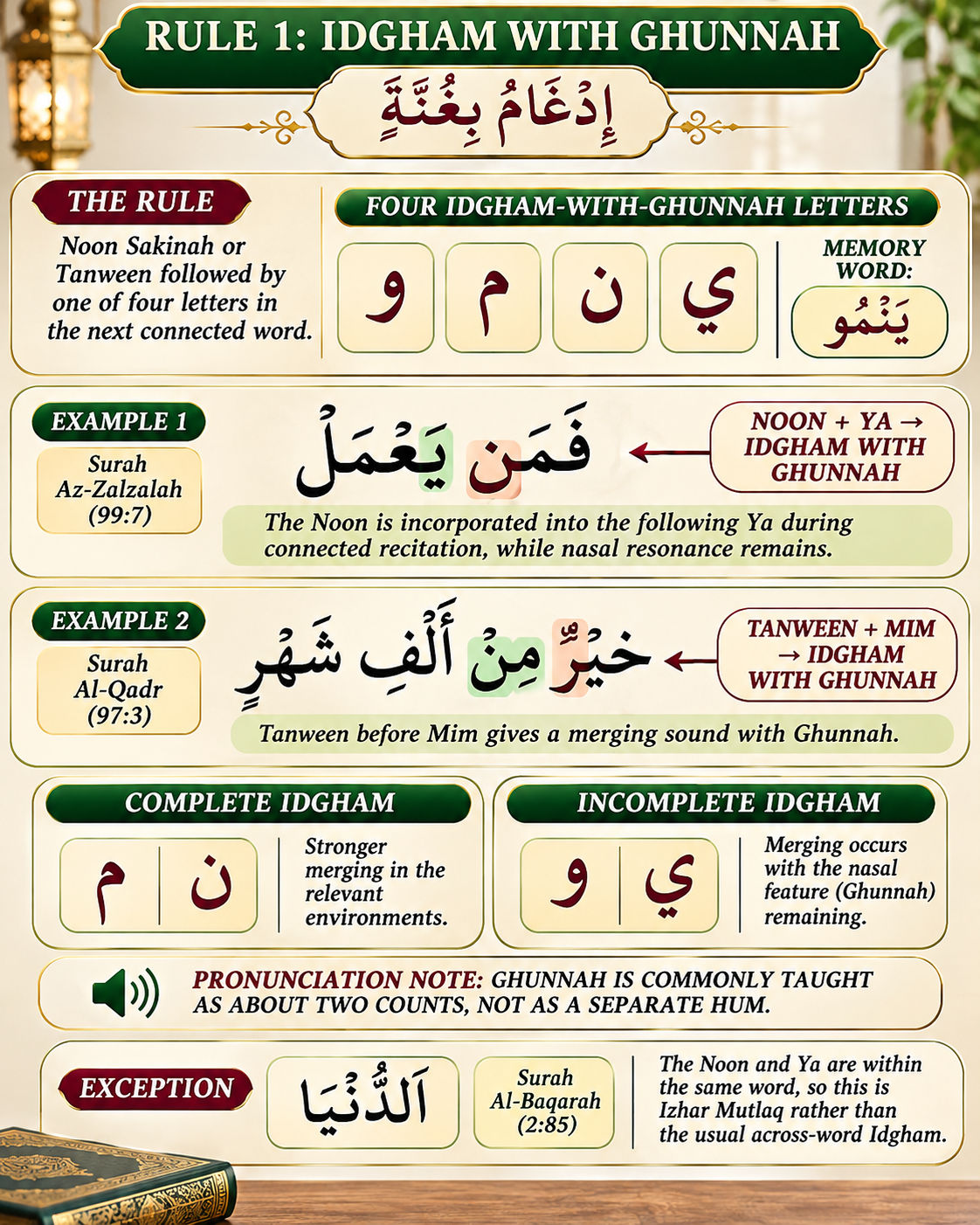
إِدْغَامٌ بِغَيْرِ غُنَّةٍ. When a Noon Sakinah or Tanween is followed in the next word by ل or ر, it merges fully into that letter. The merged Lam or Ra is doubled, and the special held nasal sound is not applied. This is an across-word rule.
Example: Quran 2:5, هُدًى مِّن رَّبِّهِمْ. This phrase holds two rules in close succession. The Tanween of hudan before the Mim of min is Rule 1, with Ghunnah. The Noon of min before the Ra of rabbihim is Rule 2. Listen for a held nasal in the first and none in the second; the two Ghunnah conditions are not the same. Ra is a tongue letter, and its Shadda marks the doubling.
Second example: Quran 104:1, وَيْلٌ لِّكُلِّ هُمَزَةٍ لُّمَزَةٍ. The Tanween of waylun meets Lam, and so does the Tanween of humazatin before lumazah. Each is its own occurrence with its own grammar, but the same rule applies.
Do not add a nasal hold. An artificial hum before the Lam or Ra turns this rule into Rule 1.
Exception: Quran 75:27, مَنْ رَاقٍ. A beginner expects Noon-to-Ra Idgham here. In Hafs through Al-Shatibiyyah, a transmitted Sakt (سَكْت), a brief silence without a new breath, separates the two, and the Noon is not merged. Sakt is not an ordinary breath-taking stop.
Listening exercise. Compare the Tanween before Mim with the Noon before Ra in 2:5, listening for held versus absent nasalization. Then identify why Man Raq needs separate attention.
3. Idgham Shafawi: When Two Meems Meet at the Lips
إِدْغَامٌ شَفَوِيٌّ. When a Mim Sakinah is followed by a Mim, the two merge into a doubled Mim with Ghunnah. Some teaching materials call this Idgham Mithlayn Saghir, because it is also a case of identical letters (see Rule 5). These are two descriptions of one phenomenon, not unrelated rules.
Example: Quran 2:29, خَلَقَ لَكُم مَّا فِي الْأَرْضِ. The underlying letters are the Mim Sakinah of lakum and the Mim of ma. The result is one Mushaddad Mim, with Ghunnah. Both Meems are bilabial, formed by the lips, with the nasal passage important. The Mim is not the following Alif.
Do not insert a vowel between the Meems, delete the first Mim, or exaggerate the lip movement. Ghunnah is held according to the transmitted rule.
Rule | Environment | Example |
|---|---|---|
Idgham Shafawi | Mim Sakinah + Mim | 2:29 لَكُم مَّا |
Ikhfa Shafawi | Mim Sakinah + Ba | 105:4 تَرْمِيهِم بِحِجَارَةٍ |
Izhar Shafawi | Mim Sakinah + other letters | Clear Mim |
In 105:4 the Mim Sakinah before Ba is Ikhfa Shafawi, a concealed Mim, not Idgham.
Listening exercise. Compare لَكُم مَّا (2:29) with تَرْمِيهِم بِحِجَارَةٍ (105:4). Is the next consonant Mim or Ba? Can you hear a merged, doubled Mim versus a concealed one?
4. Lam Shamsiyyah: Why the Lam Disappears from the Sound of Al-Shams
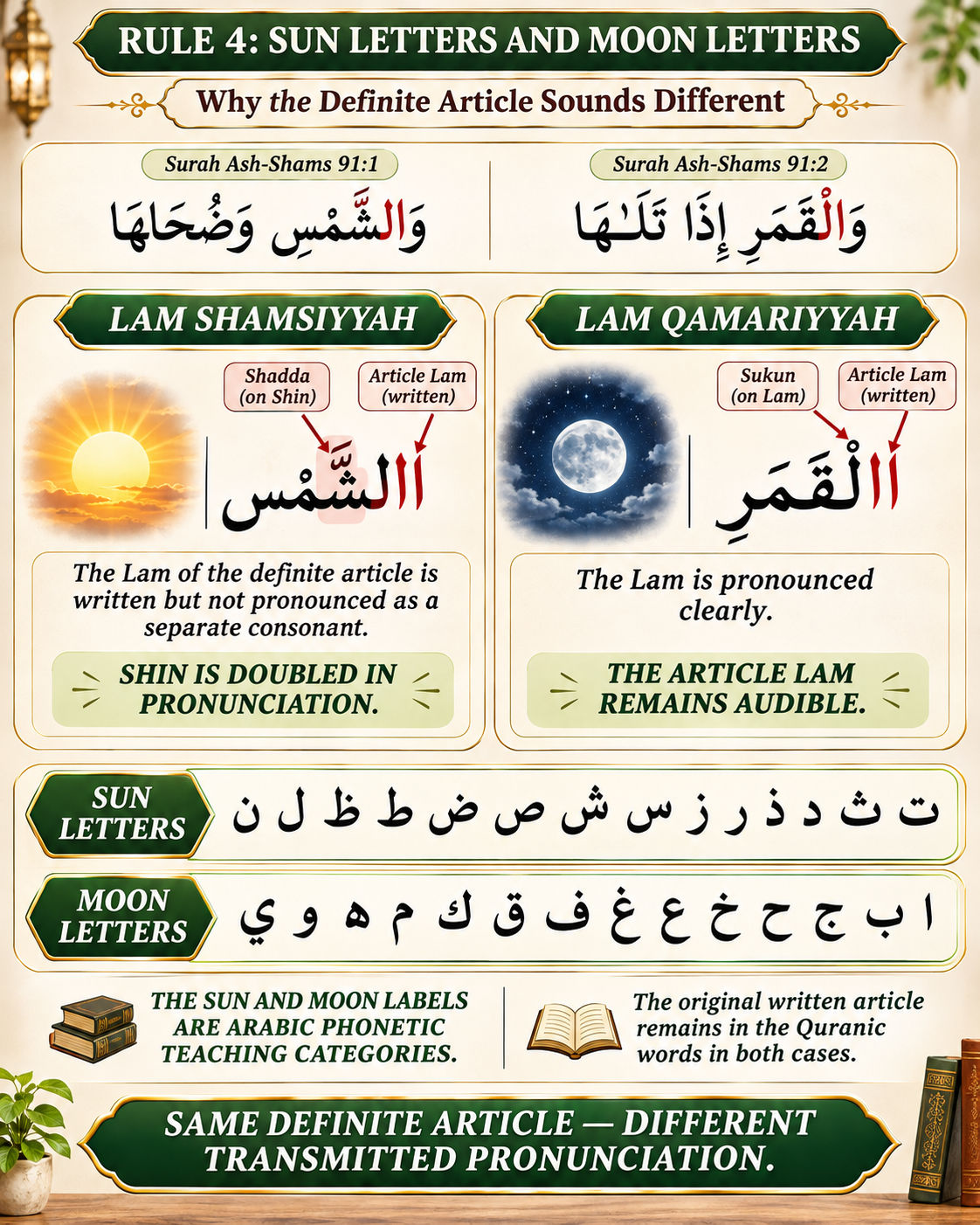
اللَّامُ الشَّمْسِيَّةُ. The definite article is ال. Before a sun letter its Lam is assimilated into the following consonant, which is pronounced doubled. The Lam is not deleted from the written word. This rule works inside the word, between the article and its noun.
Examples: Quran 91:1–2, وَالشَّمْسِ وَضُحَاهَا and وَالْقَمَرِ إِذَا تَلَاهَا. In الشَّمْس the Lam is assimilated and the Shin is doubled, shown by the Shadda. In الْقَمَر the Lam is pronounced clearly, shown by its Sukun. Do not pronounce a separate Lam followed by a single Sh.
The fourteen sun letters: ت ث د ذ ر ز س ش ص ض ط ظ ل ن. The fourteen moon letters, before which the Lam is clear: ا ب ج ح خ ع غ ف ق ك م ه و ي. These are teaching categories, not claims about the sun or moon changing phonetics.
Hamzat al-Wasl (هَمْزَةُ الْوَصْل) is the opening Alif of the article. Beginning a recitation with it, you pronounce it; connecting from a preceding word, it drops, as after wa here. This is related to, but distinct from, Lam Shamsiyyah.
The contrast between Al-Shams and Al-Qamar shows why students should notice places where a single Arabic letter changes a Quranic word or its pronunciation, rather than assuming similarly written beginnings must always sound alike.
Ghunnah: none required. Qualification: the rule concerns the definite article, not every sun letter in every context.
Listening exercise. Can you hear a separate Lam in الْقَمَر? In الشَّمْس? Which letter is doubled? Why must the written Arabic stay exactly as printed?
5. Idgham Mutamathilayn: When Two Identical Consonants Become One Doubled Sound
إِدْغَامُ الْمُتَمَاثِلَيْنِ الصَّغِيرِ. Two identical consonants meet; the first is Sakin and the second is vowelled. In a permitted connected-recitation environment they merge into one doubled consonant. Not every pair of identical written letters is handled the same way.
Example: Quran 5:61, وَقَد دَّخَلُوا. The underlying letters are the Dal Sakinah of qad and the Dal of dakhalu. The result is one Mushaddad Dal. Dal is a tongue-tip letter, formed against the base of the upper front teeth; reproduce the Arabic Dal under teacher supervision, not an English "d". The Shadda marks the doubling; it does not create a new word, and the word boundary remains.
In Qad Dakhalu, the connected sound changes while the words retain their grammatical roles, reminding readers that Quranic Arabic grammar clues reveal relationships that pronunciation alone cannot explain.
Second example: Quran 2:60, اضْرِب بِّعَصَاكَ. A Ba Sakinah meets a Ba, both formed with the lips.
Overlap. Mim Sakinah before Mim (Rule 3) is also an identical-letter case. It is taught separately because Ghunnah and the lips matter so much there. Dal and Ba carry no special Ghunnah.
Common mistake: separating the two letters with a vowel. Listening exercise: What is the last consonant of Qad? The first of Dakhalu? Why is the result doubled? As a purely phonetic comparison, would the connection be heard if the reader stopped after Qad? Never actually pause there to avoid the rule.
6. Idgham Mutajanisayn: When Different Consonants Share an Articulation Point
إِدْغَامُ الْمُتَجَانِسَيْنِ الصَّغِيرِ. Two consonants share a Makhraj but differ in Sifat. Certain transmitted combinations merge; it is wrong to assume that every pair with the same articulation point does.
Example: Quran 2:256, قَد تَّبَيَّنَ الرُّشْدُ مِنَ الْغَيِّ. The underlying letters are the Dal Sakinah of qad and the Ta of tabayyana. Both are formed with the tongue tip at the base of the upper front teeth, but Dal is voiced and Ta is not, so they are not identical. In Hafs the Dal is incorporated into the Ta, shown by the Shadda.
Versus Rule 5. Rule 5 is Dal + Dal; Rule 6 is Dal + Ta. Identify the two written consonants first, then compare recitation.
Second example: Quran 11:42, ارْكَب مَّعَنَا. A Ba Sakinah meets a Mim; both are lip letters. It is commonly taught as Mutajanisayn. It is not Mim Sakinah before Mim, so it is not Idgham Shafawi. Some such cases retain particular letter features, so follow your teacher's detail rather than a blanket "letters disappear" statement.
Listening exercise. In Qad Tabayyana, which two different consonants meet? How does connected reading differ from pronouncing each separately? How does it differ from Qad Dakhalu?
7. Idgham Mutaqaribayn: When Two Closely Related Consonants Merge
إِدْغَامُ الْمُتَقَارِبَيْنِ الصَّغِيرِ. Two consonants are close in articulation or characteristics under the established classification. Certain transmitted combinations merge; nearby pairs do not merge automatically.
Example: Quran 17:24, وَقُل رَّبِّ ارْحَمْهُمَا. The underlying letters are the Lam Sakinah of qul and the Ra of rabbi. Both are tongue letters, and the Lam is incorporated into the Ra, which is doubled. The verse concerns a supplication for one's parents. The words remain قُل and رَبِّ with their meanings and grammatical identity intact; merging does not make them one word.
Exception: Quran 83:14, بَلْ رَانَ. In Hafs through Al-Shatibiyyah, a transmitted Sakt prevents the ordinary Lam-to-Ra assimilation a beginner would expect. Observe a brief silence, take no new breath, and continue. Do not invent a pronunciation, and do not treat Sakt as a full Waqf.
Listening exercise. What letter ends Qul? What begins Rabbi? What happens in correct connected recitation? Why does Bal Ran need special treatment, and do you hear a Sakt or an ordinary breath stop?
How These Seven Lessons Overlap
These lessons are pedagogical groupings, not one exclusive taxonomy. Noon assimilation is taught by Ghunnah category, Mim assimilation through Mim Sakinah rules, and Lam Shamsiyyah through the definite article. Mutamathilayn, Mutajanisayn, and Mutaqaribayn classify letter relationships. A case can sit in more than one framework: Mim + Mim is both Idgham Shafawi and an identical-letter case.
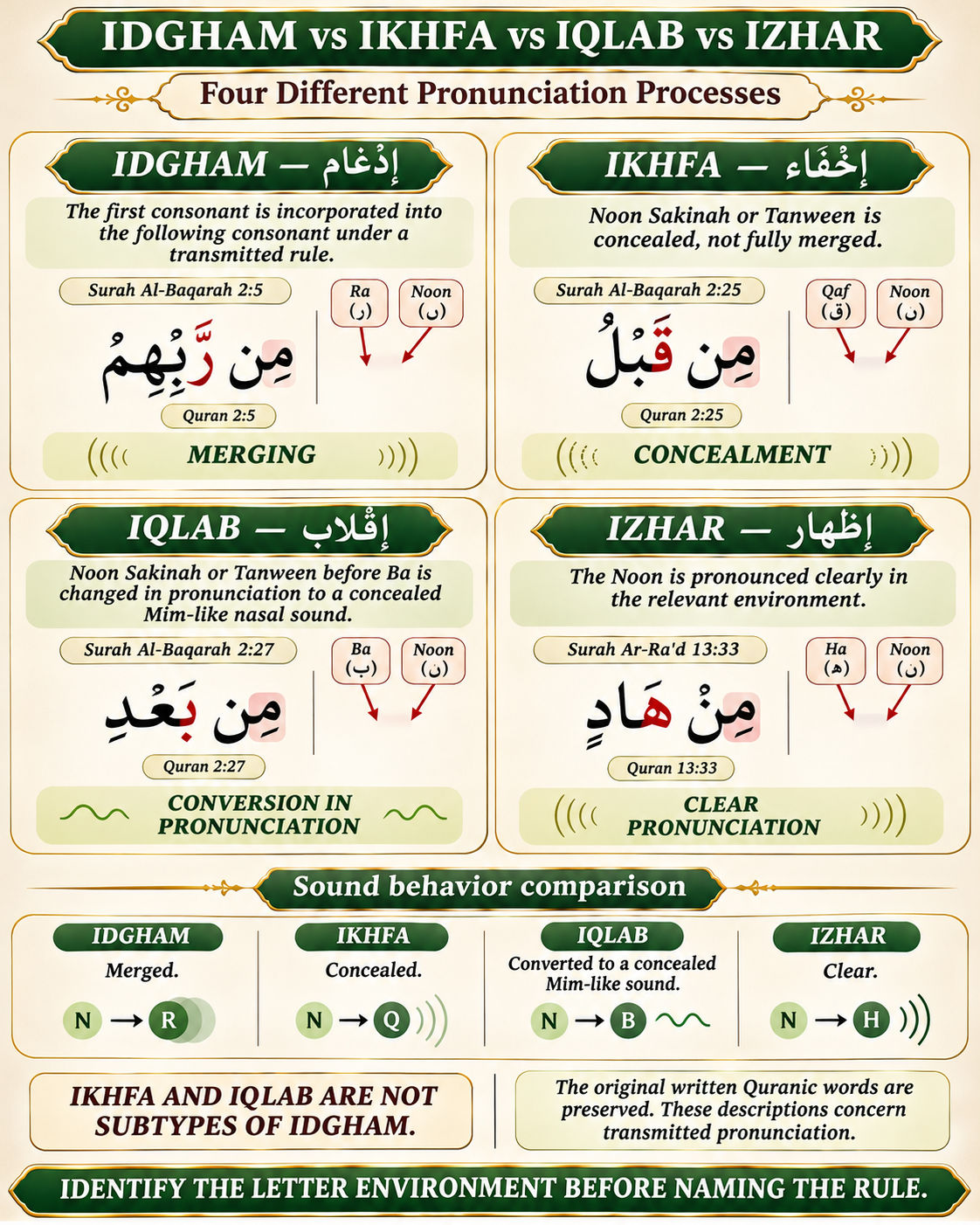
Idgham vs Ikhfa vs Iqlab vs Izhar
Rule | What Happens to the First Sound? | Typical Trigger | What to Listen For | Quranic Example |
|---|---|---|---|---|
Idgham | Merges into the next letter | Noon Sakinah/Tanween + ي ر م ل و ن | A doubled following letter | 2:5 مِن رَّبِّهِمْ |
Ikhfa | Concealed, not fully merged | Noon Sakinah/Tanween + fifteen letters, e.g. Qaf | Nasal concealment | 2:25 مِن قَبْلُ |
Iqlab | Becomes a concealed Mim with Ghunnah | Noon Sakinah/Tanween + Ba | Mim-like nasal sound | 2:27 مِن بَعْدِ |
Izhar | Pronounced clearly | Noon Sakinah/Tanween + throat letters | A clear Noon | 13:33 مِنْ هَادٍ |
Iqlab (Noon/Tanween before Ba) and Ikhfa Shafawi (Mim Sakinah before Ba) may both sound nasal and concealed, but their first consonants differ. Izhar Halqi (throat letters, as in مِنْ هَادٍ) is also distinct from Izhar Mutlaq (Dunya and its three companions).
When Idgham Does Not Happen: Exceptions and Sakt
Beyond the same-word Noon exceptions above, Hafs through Al-Shatibiyyah has four commonly taught Sakt locations: Al-Kahf 18:1–2, Ya Sin 36:52, Al-Qiyamah 75:27, and Al-Mutaffifin 83:14. The last two are the ones where expected assimilation is not applied. They are not extra rules.
Verse | Written Letters | Merging a Beginner Might Expect | Transmitted Hafs Treatment | Why It Matters |
|---|---|---|---|---|
75:27 | مَنْ رَاقٍ | Noon into Ra | Sakt; no merging | Prevents a false Rule 2 |
83:14 | بَلْ رَانَ | Lam into Ra | Sakt; no merging | Prevents a false Rule 7 |
The Sakt examples Man Raq and Bal Ran are a useful bridge to [ Waqf and Ibtida rules for stopping and restarting Quranic recitation], because a transmitted brief silence is not the same as an ordinary pause for breath. Sakt has no fixed duration in this guide; learn it from a teacher. Mushaf editions may mark Sakt differently.
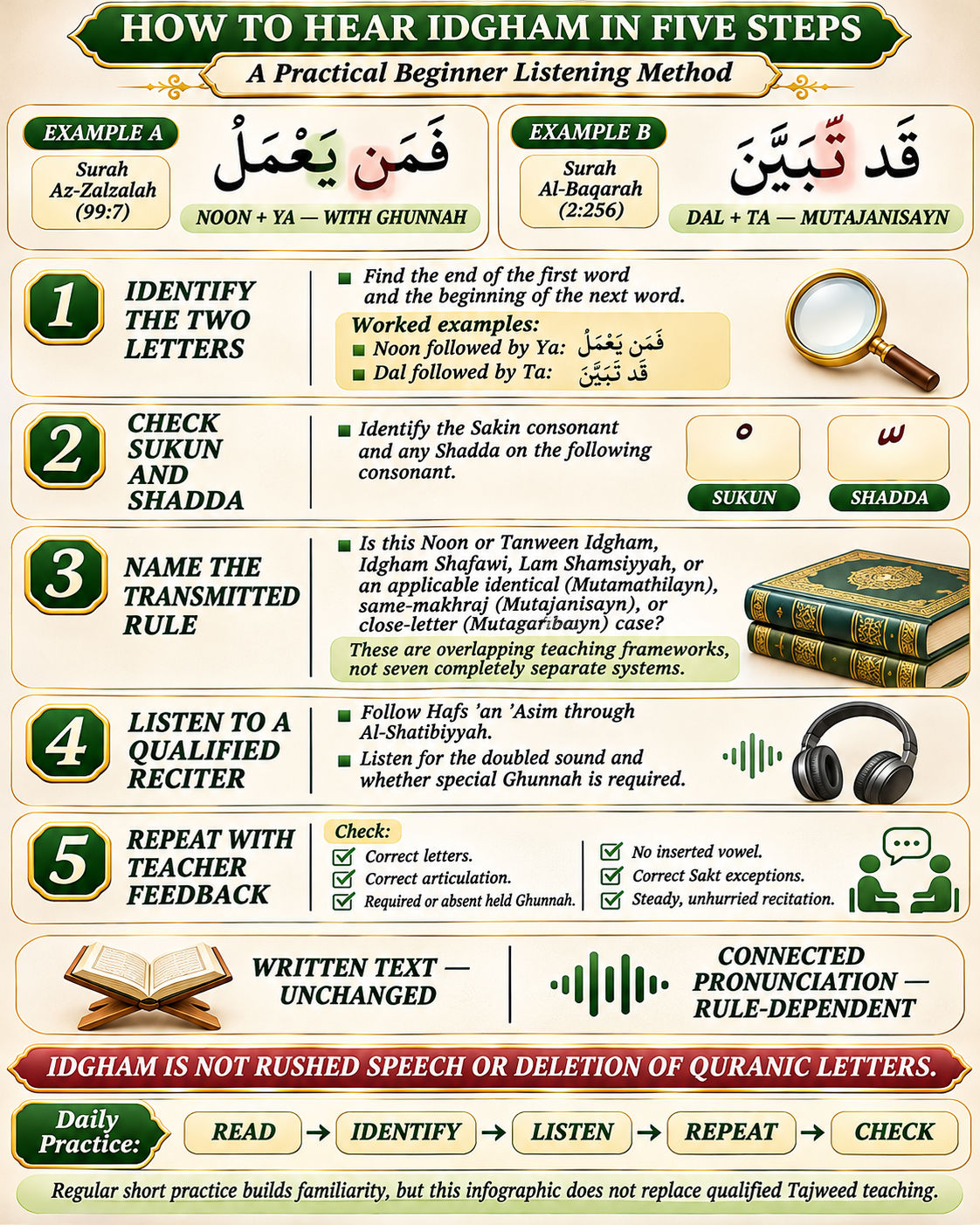
How to Hear Idgham in Five Steps
Identify the two underlying letters in the written text.
Check whether the first is Sakin and the next letter is a recognized trigger.
Name the rule category and whether Ghunnah is required.
Listen to a qualified Hafs reciter pronounce the phrase in context.
Repeat with teacher feedback, watching for Sakt and exceptions.
Verse | First Letter | Following Letter | Rule | Ghunnah? | What to Listen For |
|---|---|---|---|---|---|
99:7 | Noon | Ya | With Ghunnah | Yes | Nasal carried into Ya |
2:5 | Noon | Ra | Without Ghunnah | No | No held nasal |
2:29 | Mim | Mim | Shafawi | Yes | Doubled Mim |
91:1 | Lam | Shin | Shamsiyyah | No | No separate Lam |
5:61 | Dal | Dal | Mutamathilayn | No | Doubled Dal |
2:256 | Dal | Ta | Mutajanisayn | No | Dal into Ta |
17:24 | Lam | Ra | Mutaqaribayn | No | Lam into Ra |
Can you tell which rule you hear? Match each with a rule: (1) 91:1 الشَّمْسِ, (2) 2:256, (3) 99:7, (4) 2:29, (5) 17:24, (6) 5:61, (7) 2:5 مِن رَّبِّهِمْ. Key: Shamsiyyah, Mutajanisayn, With Ghunnah, Shafawi, Mutaqaribayn, Mutamathilayn, Without Ghunnah.
Spot the non-Idgham. Which are not ordinary Idgham: 2:25 مِن قَبْلُ, 2:27 مِن بَعْدِ, 13:33 مِنْ هَادٍ, 75:27 مَنْ رَاقٍ? Key: none; they are Ikhfa, Iqlab, Izhar, and Sakt.
Students who enjoy listening to connected Arabic sounds may also explore [ the science of Fawasil and the sounds of Quranic verse endings], while remembering that verse-ending patterns and Idgham are different subjects. Because English translations usually communicate meaning rather than the full sound of recitation, [ the reasons Quran translations sometimes use different wording] are worth studying separately from Tajweed pronunciation rules. Likewise, Tajweed concerns accurate recitation, not interpretation, and a merging rule does not rewrite an Ayah's meaning.
Practice Without Inventing Pronunciations
Ten minutes daily: read the examples slowly (2), identify the letters (2), listen to a qualified reciter (2), repeat (2), and check one mistake with your teacher (2). This is an introduction, not mastery. Study one rule a day: Ghunnah, no Ghunnah, Shafawi, Shamsiyyah, Mutamathilayn, Mutajanisayn, then Mutaqaribayn with Sakt review.
To connect pronunciation practice with vocabulary and grammar, learners can follow [ a step-by-step roadmap for studying Quranic Arabic from the beginning], using Tajweed lessons alongside regular reading and teacher feedback.
A teacher's checklist: correct letters, Sukun versus Shadda, Ghunnah applied or avoided as required, correct following letter, no inserted vowel, Sakt recognized, no invented word, steady pace. This is educational guidance, not a ruling on anyone's prayer.
Common Tajweed Merging Mistakes
Common mistakes: merging every neighboring pair; adding Ghunnah to Rule 2; omitting it from Rule 1; calling Mim before Ba Idgham Shafawi; pronouncing the article Lam before sun letters; treating every Shadda as cross-word merging; confusing Mutamathilayn with Mutajanisayn; merging Bal Ran; merging the Noon in Dunya or Bunyan; relying on transliteration alone.
Myths and realities: Idgham is not faster speech. Not every merger has Ghunnah. Noon Sakinah does not always merge. Yanmu letters are not identical in degree. Not every Noon before Ya merges. Mim before Ba differs from Mim before Mim. Not every Al- keeps a clear Lam. The three relationship labels differ. Close consonants do not automatically merge. Man Raq and Bal Ran keep Sakt. Some Shaddas are morphological. Qira'at differ in details.

Frequently Asked Questions
1. What is Idgham in Tajweed? A transmitted process in which one consonant merges into the following one under specific conditions, producing one strengthened sound.
2. What does merging mean in Quranic recitation? The first sound is incorporated into the next in pronunciation. The written words are unchanged and nothing is deleted from the text.
3. What are the seven Tajweed merging rules in this guide? Idgham with Ghunnah, without Ghunnah, Idgham Shafawi, Lam Shamsiyyah, and Idgham Mutamathilayn, Mutajanisayn, and Mutaqaribayn. They overlap in classification.
4. What is Ghunnah? Nasal resonance linked to Noon and Mim, held in specified rules and commonly taught as about two counts.
5. What is the difference between Idgham with and without Ghunnah? With Ghunnah keeps a held nasal resonance; without Ghunnah adds none. They are not interchangeable.
6. What are the letters of Idgham with Ghunnah? ي ن م و, remembered as Yanmu.
7. What do Yanmu and Yarmalun mean? Yanmu names the four Ghunnah letters. Yarmalun names all six Idgham letters, adding ر and ل, which merge without Ghunnah.
8. Why does Noon Sakinah sometimes merge and sometimes remain clear? The following letter decides: Idgham, Iqlab, Ikhfa, or Izhar, plus special cases like same-word Noon.
9. Why is there no Idgham inside the word Dunya? Its Noon and Ya are in the same word, and the standard rule is across words. It is read clearly, as are Bunyan, Qinwan, and Sinwan.
10. What is Idgham Shafawi? Mim Sakinah followed by Mim, merged into a doubled Mim with Ghunnah, as in لَكُم مَّا.
11. What is the difference between Idgham Shafawi and Ikhfa Shafawi? Idgham Shafawi is Mim + Mim and merges; Ikhfa Shafawi is Mim Sakinah + Ba and conceals.
12. Why is the Lam not pronounced separately in Al-Shams? Shin is a sun letter, so the article's Lam is assimilated into it and the Shin is doubled. The Lam remains in the writing.
13. What is the difference between sun letters and moon letters? Before the fourteen sun letters the article Lam assimilates; before the fourteen moon letters it is pronounced clearly.
14. What is Idgham Mutamathilayn? Two identical consonants, the first Sakin, merging into one doubled sound, as in قَد دَّخَلُوا.
15. What is Idgham Mutajanisayn? Different consonants sharing an articulation point and merging in transmitted cases, such as Dal into Ta in قَد تَّبَيَّنَ.
16. What is Idgham Mutaqaribayn? Close consonants merging in transmitted cases, such as Lam into Ra in قُل رَّبِّ. Not every nearby pair merges.
17. What is the difference between Idgham, Ikhfa, Iqlab, and Izhar? Idgham merges, Ikhfa conceals, Iqlab turns Noon before Ba into a concealed Mim, and Izhar pronounces clearly.
18. Why does Man Raq have a Sakt in Hafs? It is transmitted in Hafs through Al-Shatibiyyah: a brief silence without a new breath keeps Noon and Ra from merging.
19. Does stopping between words change whether Idgham is heard? Yes. Across-word merging needs connection, but stop where meaning allows, never merely to avoid a rule.
20. How can a beginner practice Idgham correctly? Identify the letters, check the rule, listen to a qualified Hafs reciter, repeat, and seek teacher feedback instead of relying on transliteration.
Conclusion: Hear the Letters, Apply the Rule
Return to فَمَن يَعْمَلْ (99:7) and قَد تَّبَيَّنَ (2:256). Both involve assimilation, but one concerns Noon with Ghunnah and the other Dal and Ta. The next time two Quranic letters sound like one, look at the Arabic first: identify the letters, check the Sukun, notice the Shadda and any Ghunnah, and listen to a qualified reciter. With careful listening and teacher feedback, these patterns become easier to recognize while preserving the Quran's words. You are welcome to study Tajweed, Quran reading, and Quranic Arabic with qualified Araby Academy teachers.