
You want to understand what you recite in Salah. You search for Quranic Arabic lessons and find alphabet courses, Tajweed classes, vocabulary lists, verb charts, root dictionaries, Nahw, Sarf, Tafsir and word-by-word apps. Everything looks important, yet nobody explains what comes first.
This roadmap answers that question. It gives you a structured, realistic sequence, shows you where to enter it, and explains how to recognize progress.
How do you learn Quranic Arabic from scratch? To learn Quranic Arabic from scratch, first check whether you can read Arabic letters and vowel marks. Then build common Quranic vocabulary, roots, basic verb forms, pronouns, particles and sentence structure, practicing on short Quranic passages with reliable translation and Tafsir. Review consistently and, when possible, learn with a qualified teacher. Your starting point, whether you are a complete beginner or already read the Quran fluently, decides your first step, and progress is gradual rather than guaranteed.
Can You Learn Quranic Arabic from Scratch?
Yes, with realistic expectations. You do not need to speak an Arabic dialect, and you do not need to master grammar before touching a verse. Quranic vocabulary and structures recur, so careful study of a limited, well-chosen core pays off. No honest roadmap can promise fluency in a fixed number of days, so this guide focuses on observable progress.
What Does Learning Quranic Arabic Actually Involve?
Before building a study plan, it helps to understand [ what Quranic Arabic is and how it differs from recitation alone]. In practice, it means understanding the Quran’s vocabulary, word formation (morphology), sentence structure (syntax) and meaning in context. It is related to, but different from, several other goals:
Reading: Someone can read الْحَمْدُ لِلَّهِ (1:2) correctly without knowing how its words relate. Someone else may know the English meaning but struggle to pronounce it. Both are partway along; neither deserves shame.
Tajweed: the transmitted rules of accurate recitation. It does not replace language study, and language study does not replace it. Many students pursue both.
Hifz: memorization builds familiarity with the text but does not automatically teach grammar.
Conversation and independent Tafsir: Quranic Arabic study is not spoken fluency, and it does not make a beginner a qualified interpreter.
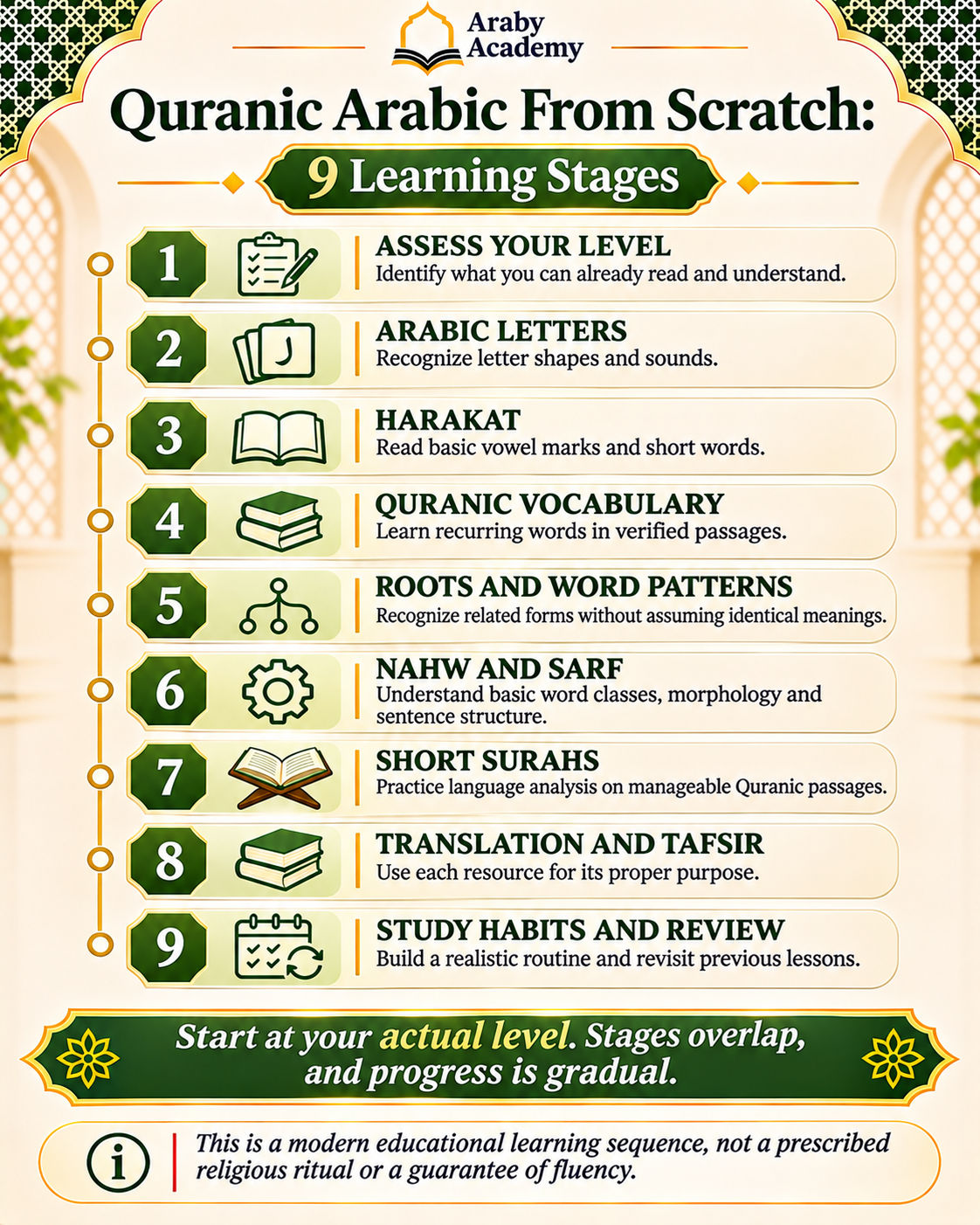
The Quranic Arabic Beginner Roadmap at a Glance
Stage | What you learn | What you practice | Ready to move on when |
|---|---|---|---|
1. Starting level | Your profile and goal | Five-minute self-check | You can name your entry point |
2. Letters | 28 letters, shapes, sounds | Spotting letters in connected words | You recognize most letters in any position |
3. Harakat | Vowel signs, Sukun, Shaddah, Tanween | Reading short vowelled words | You read simple words slowly but accurately |
4. Vocabulary | Recurring Quranic words | Notebook and self-testing | You spot studied words in new verses |
5. Roots | Root and word-form idea | Finding related forms | You can tell a root from a derived word |
6. Nahw and Sarf | Nouns, verbs, particles, pronouns | Labeling words in short phrases | You can explain a simple phrase with support |
7. Short Surahs | Passage analysis | Five-pass method | You can follow a short passage with support |
8. Translation and Tafsir | Each tool’s role | Comparing translations, checking Tafsir | You know when to consult Tafsir |
9. Study habits | Routine and review | Error log, spaced review | Your routine survives a busy week |
Stages overlap in real learning, and completing this table once is a beginning, not mastery.
Step 1: Assess Your Starting Level and Choose Your Goal
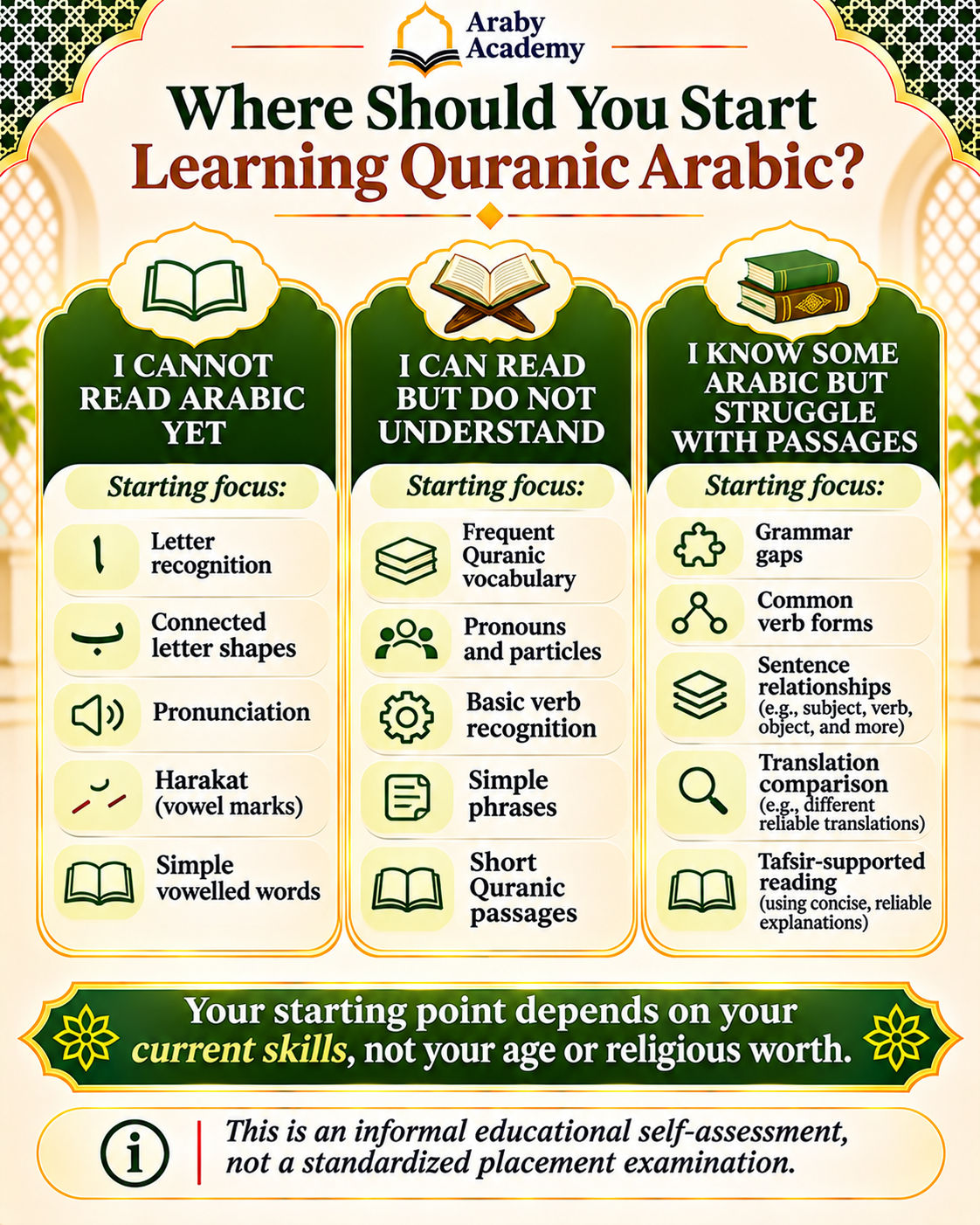
Three Starting Profiles
Profile A: you cannot yet read Arabic letters reliably. Begin with Step 2: letters, connected forms, Harakat, simple vowelled words and corrected reading. Postpone verb patterns and advanced grammar.
Profile B: you can read the Quran but do not understand it. You need not repeat the alphabet. Start at Step 4 with common vocabulary, short particles, pronouns, simple verb recognition and short verse analysis supported by Tafsir.
Profile C: you know some Arabic but struggle with whole passages. Identify grammar gaps, recurring verb forms and sentence relationships, then read short passages with support and compare translations. Earlier Arabic study does not automatically make advanced interpretation safe.
A Five-Minute Self-Check
This is an educational self-check, not a standardized exam. Ask yourself: Can I identify Arabic letters in connected words? Can I read a simple vowelled word? Do I recognize a few common Quranic words? Can I tell a verb from a noun in an easy example? Can I understand a short Quranic phrase with a teacher’s help? Can I explain why a translation alone may not reveal grammatical structure? Mostly “no” to the first two questions suggests Profile A; “yes” to those but “no” to the next suggests Profile B; “yes” to most suggests Profile C.
Set a Measurable Goal and Choose a Track
“I want to understand all Arabic” is too vague. Better goals are “I want to recognize selected recurring Quranic words,” “I want to identify simple verb forms,” or “I want to follow the basic structure of Surah Al-Ikhlas.” Reaching one small goal does not mean you understand the whole Quran, but it gives you something observable to work toward.
Also decide your track. Quranic Arabic focuses on Quranic vocabulary and linguistic structure, Modern Standard Arabic on reading and writing modern formal Arabic, and spoken Arabic on daily communication in a particular variety. They overlap, but your primary goal should lead. If your main goal is Quran comprehension rather than everyday communication, understanding [ the differences between Quranic Arabic and Modern Standard Arabic] can help you choose the most relevant course.
Step 2: Learn the Arabic Alphabet and Basic Pronunciation
The Arabic alphabet is conventionally taught as 28 letters. Hamzah (ء) is usually taught as a letter in its own right, but it also appears on carriers such as alif, waw and ya, so some counts differ. Most letters change shape by position: isolated, initial, medial and final. For example, ب appears as ب, بـ, ـبـ and ـب. Six letters (ا د ذ ر ز و) connect only to the letter before them, so not all Arabic letters connect in both directions.
Recognizing a written letter and producing its sound are separate abilities. Some learners recognize a letter but need pronunciation correction; others imitate a sound before they can identify its shape. Both skills can grow together. Pairs that often need attention include ح/ه, ق/ك, س/ص, ت/ط and ع/ء, and the difficulty varies with your first language. Transliteration alone cannot teach correct articulation, so listen to qualified reciters and seek correction when possible. Listening helps, but passive listening alone does not create reading fluency.
Practice exercise: choose three or four letters, find them in isolated and connected positions, listen to their pronunciation, read short vowelled examples, and check your accuracy. Move on when recognition is reasonably reliable; there is no universal number of letters per day.
Progress check: you recognize familiar letters in different positions, distinguish several commonly confused ones, read basic connected shapes, and know where you need correction. A perfect score is not required before the next stage.
Beginners who struggle to distinguish similar sounds can benefit from studying [ common Arabic letter pronunciation mistakes in Quran recitation] before building longer reading exercises.
Step 3: Learn Harakat and Read Your First Arabic Words
Harakat guide vowels and pronunciation, but they do not all do the same job. Fathah, kasrah and dammah are the three short-vowel signs (a, i, u): on the letter ب they give بَ, بِ and بُ. Sukun marks a consonant with no short vowel after it; in الْحَمْدُ both the lām and the mīm carry sukun. Shaddah marks a doubled consonant (gemination) and does not lengthen a vowel; in اللَّهُ it doubles the lām. Tanween (nunation) adds a final -an, -in or -un sound to nouns; in أَحَدٌ the final sign is dammatan. Rules for stopping and merging sounds belong to Tajweed.
Alif, waw and ya can represent long vowels in suitable contexts. In الْعَالَمِينَ (1:2) the alif gives a long ā and the ya a long ī. They are not always long-vowel letters: the waw in وَ (“and”) is a consonant. Printed Mushafs can also differ slightly in typographic conventions.
Practice in stages: letter, letter with short vowel, short syllable, simple connected word, then a short Quranic phrase such as قُلْ هُوَ اللَّهُ أَحَدٌ. Drills such as بَ and بِ are practice sounds, not Quranic words.
Progress check: you recognize the short-vowel signs, distinguish Sukun from Shaddah, read simple vowelled words, begin spotting long-vowel patterns, and can follow a short vowelled phrase with guidance.
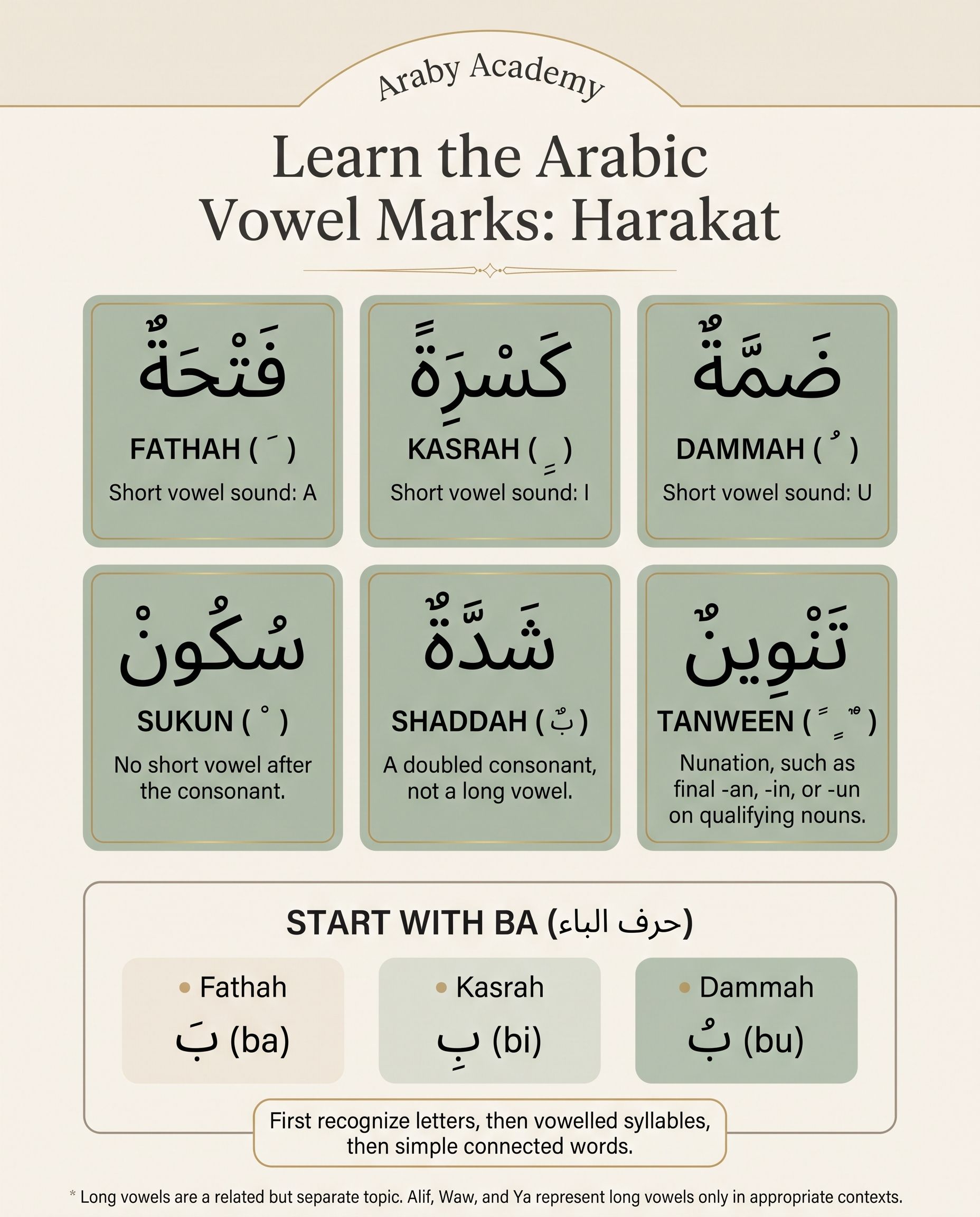
Learning [ Fathah, Kasrah, Dammah, Sukun, Shaddah, and Tanween] makes the transition from identifying Arabic letters to reading complete Quranic words much easier.
Step 4: Build Quranic Vocabulary in Context
Prioritize recurring, useful words: pronouns, common verbs, frequent nouns, short particles, prepositions and core religious vocabulary. Frequency helps, but it is not the only measure of value, so learn words from the passages you are studying. Treat exact frequency rankings with caution unless the source states whether it counts tokens, lemmas or roots.
Context matters because words such as taqwa, raḥmah, ṣabr, dīn and āyah do not map neatly onto one English word. Vocabulary study becomes more meaningful when learners explore [ ten Quranic Arabic words whose meanings go beyond a single English translation] instead of assuming that every word has one permanent English equivalent.
A dictionary headword is also not always the exact form in the verse. You may meet a singular noun, a plural, a verb, a derived noun, or a word with a prefix or attached pronoun. For example, نَعْبُدُ in 1:5 is an inflected verb whose dictionary entry is under عَبَدَ.
Try it on قُلْ هُوَ اللَّهُ أَحَدٌ (112:1): qul is a verb meaning “say,” huwa a pronoun meaning “he,” Allāh the name of God, and aḥad means “one.”
Keep a vocabulary notebook with columns for the Arabic form, transliteration if needed, English gloss, Quran reference, part of speech, root when useful, a context note and a review date. For instance: نَعْبُدُ | na‘budu | we worship | 1:5 | verb | ع ب د. This is an optional learning method, not a religious practice.
Progress check: you recognize selected recurring words, find the same word or a related form in another verse, explain why a gloss depends on context, and distinguish a memorized translation from a full Tafsir.
Step 5: Understand Arabic Roots and Word Patterns
Many Arabic words are built from a root (جَذْر, jidhr), a set of consonants, often three but not always, combined with patterns. A root is an abstract skeleton, not a pronounceable word. The root ك ت ب underlies كَتَبَ (kataba, “he wrote”), كِتَاب (kitāb, “book”) and مَكْتُوب (maktūb, “written”); forms of it occur throughout the Quran, such as مَكْتُوبًا in 7:157.
Now look at كُتِبَ عَلَيْكُمُ الصِّيَامُ (2:183). Kutiba is a passive verb from the same root, and here it means “has been prescribed”: “Fasting has been prescribed for you.” It does not mean “a book,” even though kitāb shares the root. The root links the words, while the pattern, the sentence and the context decide the meaning.
Roots are clues, not complete interpretations. Tafsir still matters, and a root alone cannot reveal every theological implication or establish a ruling.
Progress check: you recognize a few studied roots, distinguish a root from a derived word, identify a familiar related form, and explain why derivatives do not all share one English meaning.
Students who understand the basic idea can continue with [ twelve Arabic roots that connect many Quranic words] and practice identifying the actual word forms that appear in specific verses.
Step 6: Learn the Basics of Nahw and Sarf
You do not need advanced traditional grammar before reading short passages; you need enough to read simple sentences. Sarf (الصَّرْف) is morphology, which asks, “How is this word built?” It covers prefixes, suffixes, verb forms and how nouns and verbs relate. Nahw (النَّحْو) is syntax, which asks, “What role does this word play in this sentence?” It covers subjects, objects and relationships between words. These are teaching summaries, not exhaustive traditional definitions.
Arabic words fall into three broad classes: ism (اسْم), fi‘l (فِعْل) and ḥarf (حَرْف). Ism is broader than the English “noun”; classical grammar places pronouns and adjectives under it, for example. Fi‘l is a verb. Ḥarf here means a grammatical particle, not an alphabet letter.
Start by recognizing verb types: past (قَالَ), present (نَعْبُدُ) and imperative (قُلْ). Arabic verbs cannot always be mapped mechanically onto English tenses. Notice attached pronouns too: in عَلَيْكُمْ (2:183), the ending كُمْ means “you” (plural) attached to the preposition عَلَى.
Learn a few particles with their contexts: وَ, فَ, مِنْ, إِلَى, فِي, عَلَى, إِنَّ, لَا and إِلَّا. None always means the same English word; وَ is “and” in 1:5 but an oath particle in وَالْعَصْرِ (103:1). Case endings (I‘rāb) can signal grammatical relationships. Nouns take rafʿ, naṣb or jarr, while verbs take rafʿ, naṣb or jazm; jazm belongs to verbs, not nouns. Leave detailed I‘rāb until you are ready.
Progress check: you identify simple nouns, verbs and particles, recognize a studied verb form, notice some attached pronouns, explain a basic sentence relationship with support, and separate word formation from sentence structure.
Step 7: Study Short Surahs Word by Word
Short Surahs offer manageable vocabulary, repeated exposure, easier review and a clear link to recitation. They are not always grammatically simple. Good starting points include Al-Fātiḥah, Al-Ikhlāṣ, Al-‘Aṣr, Al-Kawthar, Al-Falaq and An-Nās, chosen to match your level.
Example: Surah Al-Ikhlas (112:1). قُلْ هُوَ اللَّهُ أَحَدٌ. Grammatically, قُلْ is an imperative verb, هُوَ a third-person pronoun and أَحَدٌ the word “one.” Grammarians discuss exactly how هُوَ functions here, so leave that analysis to a teacher; the verse’s emphasis on God’s oneness is explained in classical Tafsir.
Example: Surah Al-‘Asr (103:1–3). Notice وَالْعَصْرِ, where وَ is an oath particle; إِنَّ الْإِنسَانَ لَفِي خُسْرٍ, where إِنَّ adds emphasis; and إِلَّا الَّذِينَ آمَنُوا, where إِلَّا introduces an exception. Three small particles shape how the passage flows.
A five-pass method (a modern study method, not a prescribed ritual): (1) listen or read accurately; (2) identify familiar words; (3) notice a root, particle, pronoun or pattern; (4) read a reliable translation and Tafsir; (5) summarize what you learned and review it later.
Worked mini-lesson: Surah Al-Fatihah (1:5).
Phrase: إِيَّاكَ نَعْبُدُ وَإِيَّاكَ نَسْتَعِينُ
Words: iyyāka, “You (alone)”; na‘budu, “we worship”; wa, “and”; iyyāka again; nasta‘īnu, “we seek help.”
Morphology: both verbs are present-tense, first-person plural. Na‘budu comes from the root ع ب د; nasta‘īnu from ع و ن.
Grammar: iyyāka is a separate object pronoun placed before its verb, and wa joins the two clauses.
Meaning: “You alone we worship, and You alone we ask for help.”
Tafsir note: classical commentators such as Ibn Kathir explain the fronted object as expressing exclusivity.
Student question: “Is ‘alone’ really in the Arabic?” The word is not separate; the emphasis comes from the word order.
Takeaway: a translation can hide structure, so word order is worth noticing.
Language analysis supports understanding, but interpretation also draws on other Quranic passages, authentic Sunnah, historical context and established scholarship. Never issue religious rulings from a dictionary.
Progress check: you identify several words in a short passage, recognize one grammatical pattern, explain a simple phrase with support, compare a translation with the Arabic structure, and spot questions that need Tafsir or a teacher.
Step 8: Use Translation and Tafsir Correctly
These resources are connected but not interchangeable. The Arabic text is the source. Word-by-word glosses teach recognition and basic vocabulary, but a short gloss may miss syntax, idiom or emphasis. English translations convey meaning, and they differ because of semantic range, grammar, idiom, word order, Tafsir choices and translator style; differences are not always contradictions. Tafsir (التَّفْسِير) is scholarly explanation of meaning, context and links to other passages, and a teacher gives feedback on your own work.
Check Tafsir when a word has several contextual meanings, a verse has historical context, a structure looks unusual, a translation is hard to follow, a ruling is being inferred, or a passage refers to another Quranic teaching. Recognizing a root is a language-learning achievement, not a license to invent theology or legal obligations.
Step 9: Build a Study and Review Routine
Here is an illustrative 20-minute session: 3 minutes reviewing old words, 5 minutes learning one small concept, 7 minutes applying it to a short Quranic phrase, 3 minutes checking a translation or Tafsir note, and 2 minutes recording what needs review. It is a template, not a religious requirement or guaranteed optimum. Shorter blocks are valid, and steady practice matters more than occasional marathons.
Recall practice. Recognizing an answer after seeing it is different from remembering a word before checking. Try flashcards or self-testing, though flashcards alone do not create comprehension.
Spaced review. Returning to material over time can support retention. Revisit words after a day, a few days and a week, adjusting to your life; no interval is universally optimal. Mix old and new: review familiar words while learning a new pattern, or reread an old verse to spot a newly learned particle.
Error log. Note mistakes such as confusing two letters, misreading Shaddah, mixing two pronouns or labeling a verb as a noun. Treat it as a guide, not a punishment.
Forgetting a word is normal, so retrieve and review it. If you miss a week, restart with a short review rather than abandoning the plan; a missed session does not undo previous worship. If grammar feels overwhelming, return to one simple verse, one feature and one verified example.
Skill | Early indicator | Next improvement |
|---|---|---|
Letter recognition | Recognizes letters in most positions | Reads unfamiliar connected words |
Reading with Harakat | Reads simple vowelled words | Reads short passages smoothly |
Vocabulary | Recognizes studied words | Spots them in new verses |
Roots | Names a few studied roots | Separates root, pattern and meaning |
Word classes | Labels ism, fi‘l and ḥarf in easy phrases | Labels them in whole verses |
Sentence analysis | Explains simple phrases with support | Explains with less help |
Short passages | Follows a short Surah with notes | Compares translation with Arabic structure |
Use of Tafsir | Knows where reliable Tafsir is | Knows which questions need it |
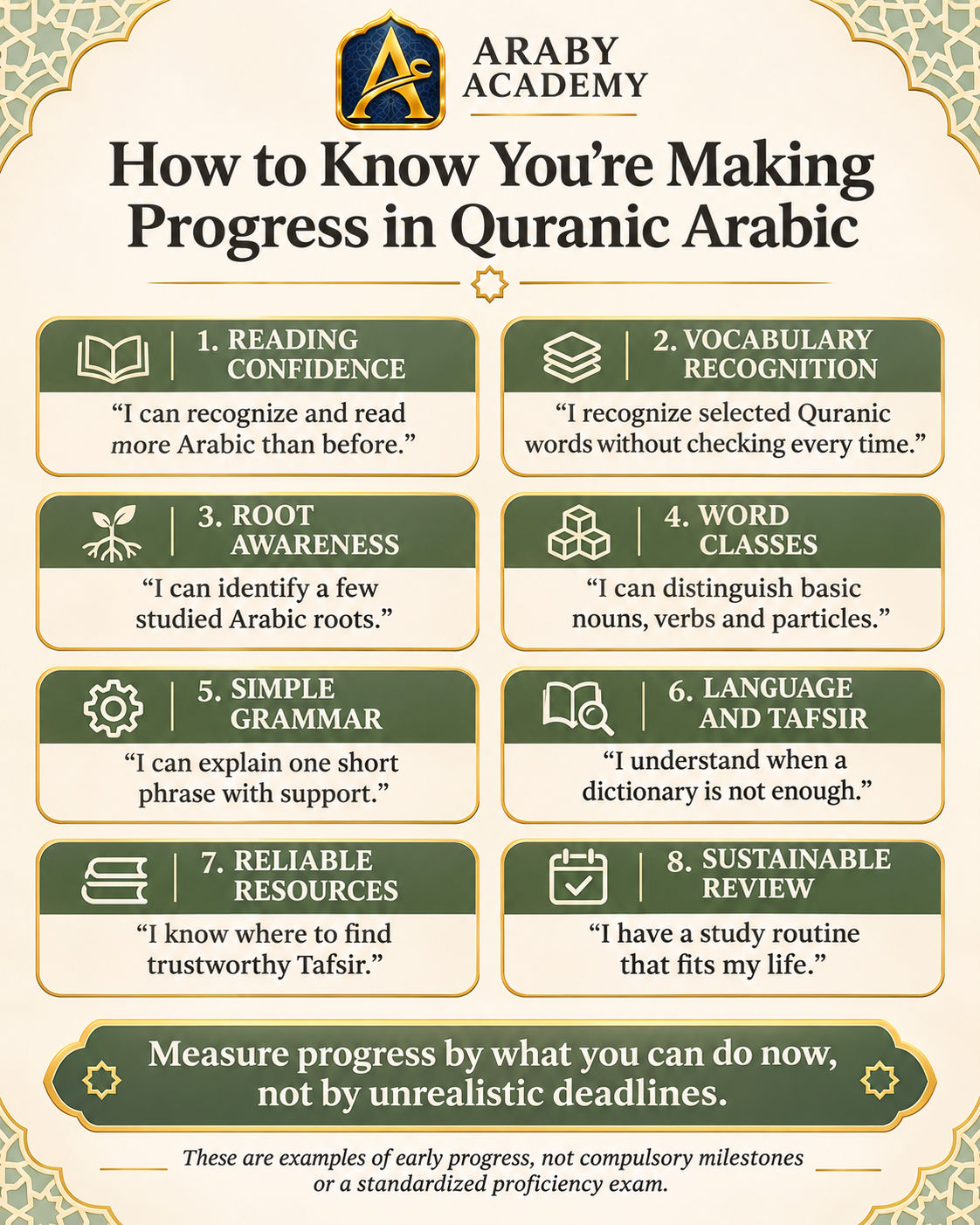
How to Know You’re Making Progress
I can read more confidently than before.
I recognize some Quranic words without checking a translation.
I can identify a few studied roots.
I can distinguish basic word classes.
I can analyze one short phrase with support.
I know when a dictionary is not enough.
I know where to find reliable Tafsir.
I have a review routine that fits my schedule.
None of these is mandatory before your next lesson.
A Realistic Four-Week Starter Plan
Week one: assess your level and set a goal. Week two: practice the next foundational skill for your level. Week three: add word classes, recurring vocabulary or roots. Week four: study one short passage with translation and reliable Tafsir. A nonreader may spend the whole month on letters and Harakat, while a fluent reader may spend it on vocabulary and simple grammar, so results will differ. After choosing the right starting level, learners who want a more structured schedule can use [ a 90-day Quranic Arabic study plan for beginners] to organize lessons, review, and realistic milestones.
How Long Does It Take to Learn Quranic Arabic?
There is no universal timeline. Progress depends on reading ability, previous language knowledge, study frequency, instruction quality, review consistency and the complexity of your goals. Recognizing letters, reading basic words, recognizing recurring vocabulary, analyzing short phrases with help, and reading complex passages with linguistic and interpretive awareness take very different amounts of time. “Understand the entire Quran in 30 days” confuses an introduction with advanced understanding; a month can start a foundation, nothing more.
Can You Learn Quranic Arabic Without a Teacher?
Self-study offers flexibility, independent revision, vocabulary resources and repeated practice. Guided instruction adds pronunciation correction, grammar feedback, progress assessment, explanations of confusion and a responsible link to Tafsir. Self-study is not worthless, and no teacher guarantees fluency. Ask a teacher when you repeat pronunciation mistakes, confuse similar verb forms, feel unsure about sentence structure, cannot follow a grammar explanation, or want to draw a theological or legal conclusion from a language observation.
When choosing a course, ask whether it assesses your reading level, teaches actual Quranic vocabulary, includes Nahw and Sarf at your level, verifies its examples, separates language from Tafsir, corrects you, offers review and matches your goal. Useful resources include a verified Mushaf, a reliable translation, a trustworthy Tafsir, a beginner textbook, a vocabulary notebook, a word-by-word tool, a credible dictionary and audio from qualified reciters.
Common Mistakes Beginners Should Avoid
Mastering everything first. Fix: follow a manageable sequence.
Treating Tajweed and comprehension as identical. Fix: recognize separate goals.
Starting advanced grammar before reading. Fix: build script literacy first.
Memorizing context-free word lists. Fix: use Quranic examples.
Assuming a root gives the full meaning. Fix: learn forms, syntax and context.
Ignoring small particles. Fix: notice their functions.
Learning rules without verses. Fix: apply them to short verified examples.
Using dictionaries without Tafsir. Fix: separate lexical meaning from interpretation.
Skipping review. Fix: retrieve and revise regularly.
Expecting fluency by a deadline. Fix: track observable progress.
Common myths, corrected:
Myth: you must speak a dialect first. Fact: direct Quranic Arabic study is possible.
Myth: you must master all grammar before a verse. Fact: begin with a few selected structures.
Myth: fluent reading means full understanding. Fact: recitation and comprehension differ.
Myth: memorization teaches morphology. Fact: analysis needs extra learning.
Myth: roots reveal a verse’s full meaning. Fact: patterns, grammar and context matter.
Myth: every word has one English equivalent. Fact: meaning depends on usage.
Myth: short Surahs are always simple. Fact: shortness does not remove complexity.
Myth: you must abandon translations. Fact: they remain helpful.
Myth: everyone needs the same schedule. Fact: levels and circumstances vary.
Myth: teachers only fix pronunciation. Fact: they also support grammar and responsible interpretation.
Myth: forgetting means you cannot learn Arabic. Fact: review is normal.
Myth: grammar alone makes a Mufassir. Fact: Tafsir requires further evidence and methodology.
Frequently Asked Questions
How do I start learning Quranic Arabic from scratch? Check whether you can read letters and Harakat, then follow the sequence above: vocabulary, roots, basic Nahw and Sarf, and short Surahs with translation and Tafsir.
Can I learn Quranic Arabic if I cannot read Arabic? Yes. Begin with letters and Harakat, ideally with correction from a teacher, before moving to vocabulary and grammar.
What should I learn first? It depends on your level: letters and Harakat for nonreaders; common vocabulary, pronouns and particles for readers who do not yet understand.
Do I need Tajweed before Quranic Arabic? No. Tajweed governs recitation, while language study covers vocabulary and grammar. They can be learned together, but neither replaces the other.
Can I learn it without spoken Arabic? Yes. Quranic Arabic study focuses on the Quran’s vocabulary and structure; speaking a dialect is not a prerequisite.
Quranic Arabic or Modern Standard Arabic first? Choose by goal. For Quran comprehension, start with Quranic Arabic; Modern Standard Arabic shares foundations and can be added later.
How long does it take? There is no universal timeline. It depends on reading ability, study frequency, instruction and goals, and different outcomes take different lengths of time.
Can I learn Quranic Arabic in 30 days? A month can begin a foundation, such as letters, Harakat or basic vocabulary, but it cannot deliver comprehensive understanding of the Quran.
Are Arabic roots important? Yes, as clues to related words, but read them together with word pattern, grammar, context and Tafsir.
Should I learn Nahw or Sarf first? Learn the basics of both together: Sarf shows how a word is built, and Nahw shows its role in the sentence. A teacher can adjust the order.
What are the best short Surahs for beginners? Al-Fatihah, Al-Ikhlas, Al-‘Asr, Al-Kawthar, Al-Falaq and An-Nas are common choices; select according to your level.
How can I study a verse word by word? Identify each word, its gloss and form, notice roots, particles or pronouns, read a translation and Tafsir, then review later.
Do I need Tafsir if I am learning grammar? Yes. Grammar explains language, while Tafsir draws on other verses, Sunnah, context and scholarship.
Can I study on my own? Yes, for vocabulary and practice, but a qualified teacher adds pronunciation correction, grammar feedback and responsible guidance.
Conclusion — Start Where You Are and Build One Skill at a Time
Quranic Arabic feels overwhelming when letters, pronunciation, vocabulary, roots, Nahw, Sarf and Tafsir arrive all at once. You do not need to master them simultaneously. Nonreaders can begin with letters and Harakat, reciters with vocabulary and basic grammar, and learners with some Arabic can analyze short passages more carefully. The goal is gradual comprehension, not instant fluency.
Learning Quranic Arabic does not begin with understanding every verse. It begins with the next skill you are ready to learn. Whether that means recognizing your first Arabic letters or discovering how a familiar Quranic sentence is structured, each carefully studied step can bring greater understanding of the language of the Quran.
If you would like guidance, Araby Academy’s qualified teachers offer one-to-one Quranic Arabic, Tajweed and Quran reading lessons for adults and children.