
Imagine you begin learning Arabic to understand the Quran. You find two beginner courses. “Modern Standard Arabic for Beginners” promises reading, writing, and formal communication. “Quranic Arabic for Beginners” focuses on Quranic vocabulary, grammar, and verse comprehension. You wonder: Are these different languages? Will I waste time on the wrong one? Can one course help with both goals? The answer is nuanced, but approachable.
Quranic Arabic vs Modern Standard Arabic: The Short Answer
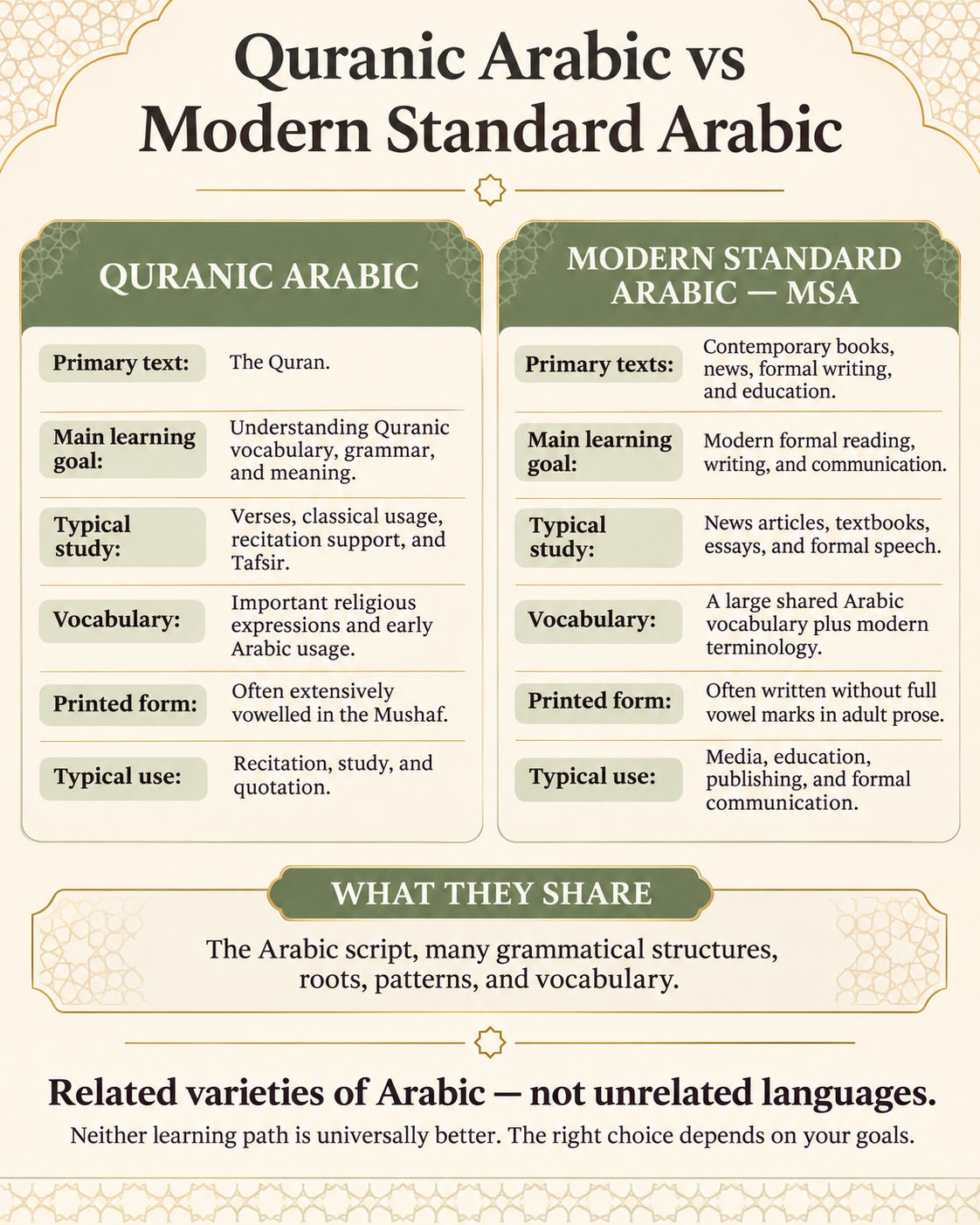
Quranic Arabic is the Arabic of the Quran, while Modern Standard Arabic (MSA) is the formal variety widely used today in writing, education, and media. They share the Arabic script, much of their vocabulary, and core grammatical structure, but differ in historical setting, genre, vocabulary usage, style, and some conventions. They are related varieties, not unrelated languages. Quranic Arabic study aims at understanding Quranic passages; MSA study usually emphasizes contemporary reading, writing, and formal communication.
Quranic Arabic vs Modern Standard Arabic at a Glance
Feature | Quranic Arabic | Modern Standard Arabic |
|---|---|---|
Primary texts | The Quran, studied with recitation and Tafsir | News, books, textbooks, official documents |
Historical setting | Early Arabic text with a transmitted reading tradition | Modern standardized formal usage, continuing earlier written Arabic |
Common learning goals | Understanding verses; deepening recitation | Reading, writing, formal communication, study, work |
Writing system | Arabic script | Arabic script |
Core grammar | Shared framework: roots, patterns, case, verb forms | Same broad framework, with modern usage preferences |
Vocabulary | Key religious terms and early usage | Large shared stock plus modern terminology |
Typical style | Commands, narrative, oaths, parables, rhetorical devices | Varies by genre: news, reports, essays, fiction |
Vowel marks in printed texts | Usually extensive in printed Mushafs | Often omitted in adult prose; common in children’s and teaching books |
Pronunciation instruction | Tajweed and recitation traditions | Formal pronunciation, with regional variation |
Everyday conversation | Recited and quoted, not usual daily speech | Formal speech; daily talk is usually dialect |
Need for Tafsir | Important for reliable meaning | Not normally needed for ordinary texts |
Modern technical vocabulary | Not the purpose of the text | Regularly developed and used |
Neither column is “better.” Each describes a different purpose.
What Is Quranic Arabic?
Quranic Arabic means the Arabic of the Quran: its words, word forms, grammar, sentence structures, rhetoric, and vocabulary as understood in context. It is not a separate alphabet or an unrelated language. The Quran itself describes its language as Arabic, as in the phrase قُرْآنًا عَرَبِيًّا (12:2). Teaching usually blends Arabic grammar, recitation, religious meaning, and Tafsir (scholarly explanation of the Quran).
Before comparing the two forms of Arabic, readers may benefit from understanding [IL-01: what Quranic Arabic is and how beginners study it] as a distinct educational goal.
Its historical status deserves caution. The Quran is an early Arabic text with a distinctive religious, literary, and transmitted reading tradition. Traditional scholars and modern historical linguists describe its linguistic position with different emphases, so no one-line classification is universally accepted.
What Is Modern Standard Arabic?
MSA is the modern standardized formal variety of Arabic. It is used in journalism, books, education, news reports, professional communication, public announcements, and academic prose. It developed through the modern period as literary, educational, and media needs changed. It did not appear from nowhere: it continues earlier written Arabic while adapting vocabulary and style to contemporary life. MSA is formal Arabic, and not everyone uses it in ordinary conversation.
Spoken Dialects and Diglossia
Egyptian, Levantine, Gulf, and Moroccan Arabic are real language varieties with their own systematic patterns. They are not corrupted or defective forms of Arabic. Linguists use diglossia for the coexistence of formal and colloquial varieties with different social uses; speakers vary in how they combine them.
Do Arabs Speak Quranic Arabic Every Day?
No. The Quran is recited, memorized, studied, and quoted today, but its language is not the default conversational variety of most Arabic-speaking communities. Three things differ: Quran recitation, formal language use (lectures, news, writing), and daily dialect communication.
How Does Classical Arabic Fit Into the Picture?
Classical Arabic is a broader historical literary and scholarly tradition; its definition varies across scholarship. The Quran is foundational to the history of Arabic linguistic scholarship, since grammarians studied it closely. Still, modern academics may distinguish the precise features of the Quranic text and its transmitted readings from later descriptions and standardizations of Classical Arabic. Specialists such as Marijn van Putten study these questions, and not every linguist defines the relationship identically.
The term Fusha (فُصْحَى) is commonly used for formal or eloquent Arabic. Speakers often use it broadly for formal Arabic as opposed to dialect, without separating every historical period.
The three categories overlap; they are not three languages:
Quranic Arabic: Arabic as used in the Quran.
Classical Arabic: a broader historical literary and grammatical tradition.
Modern Standard Arabic: the modern standardized formal variety.
What Do Quranic Arabic and Modern Standard Arabic Have in Common?
A great deal. Both use:
the Arabic writing system, read right to left;
a large shared vocabulary;
consonantal roots and morphological patterns;
nouns, verbs, pronouns, and particles;
definiteness (the prefix al-), grammatical gender, and singular, dual, and plural forms;
many recognizable sentence patterns.
This does not mean every feature occurs equally often in both bodies of text.
Do They Use the Same Alphabet?
Yes. Both use the same Arabic letters; the standard count is 28. The Quran uses no separate writing system. Printed Quranic orthography and vocalization conventions can differ from everyday modern spelling, but a student reading a Mushaf, a newspaper, a textbook, or a formal announcement meets the same core script. Reading goals and text conventions differ.
Pronunciation is where learners should separate three things: Arabic’s sounds in general; Tajweed, the transmitted discipline of Quran recitation (articulation points, vowel lengthening, assimilation, and other rules, depending on the reading tradition); and the pronunciation of formal modern speech, which varies by region and teaching convention. Tajweed is not simply another name for Classical Arabic phonology. It is also not a different language. Learning Tajweed does not automatically teach Quranic vocabulary or syntax, and studying MSA grammar does not automatically teach recitation.
Because both learning paths use Arabic script, mastering [IL-02: common Arabic letter pronunciation challenges in Quran recitation] can help students build a stronger foundation for reading.
Why Does the Quran Use More Vowel Marks?
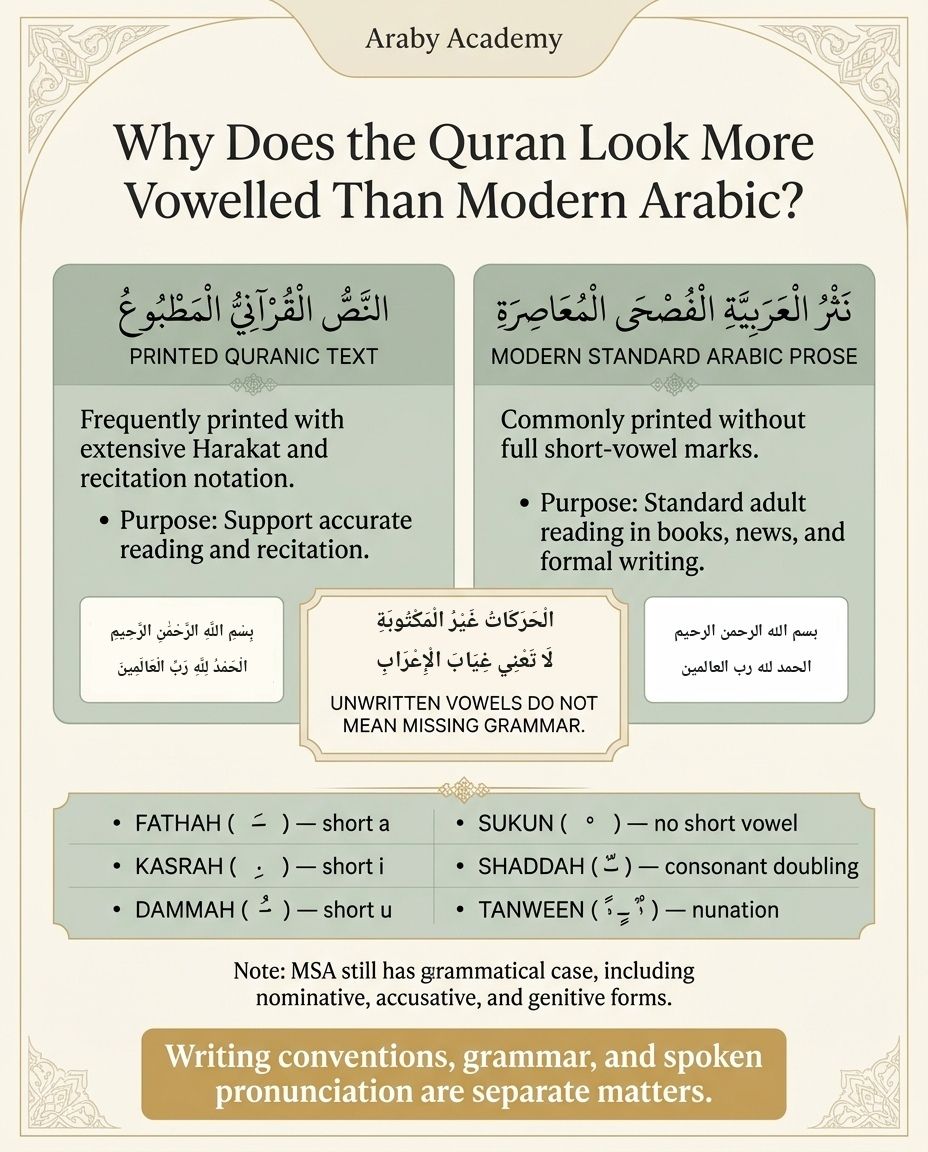
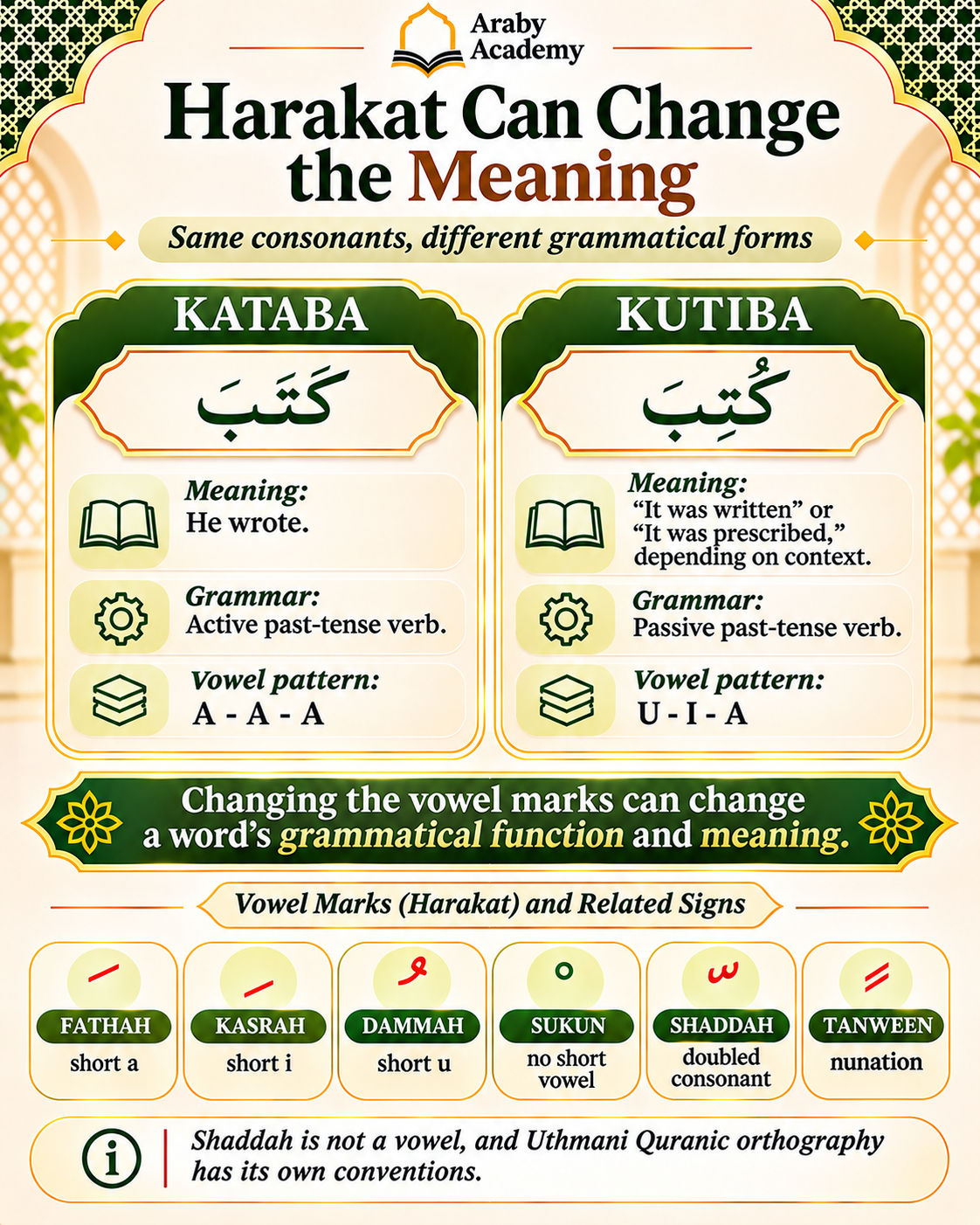
Arabic’s harakat are not interchangeable “vowel marks.” Fathah, kasrah, and dammah mark the short vowels a, i, and u. Sukun marks the absence of a vowel. Shaddah marks consonant doubling (gemination). Tanween marks a final -n sound (nunation) on indefinite nouns.
Commonly used Mushafs print these signs extensively, along with recitation notation, to support accurate reading. Adult newspapers and ordinary formal prose are usually printed without complete vowel marks, though children’s books and textbooks often include them. This is a publishing convention, not a statement that one variety “has vowels” and the other does not.
One practical difference in the printed texts becomes clearer when students study [IL-03: Fathah, Kasrah, Dammah, Sukun, Shaddah, and Tanween] and understand why ordinary modern writing often omits some pronunciation marks.
MSA Still Has Case Grammar
MSA is not “case-free.” Its grammar still distinguishes nouns as raf’ (nominative), nasb (accusative), and jarr (genitive). Jazm is different: it belongs to verbal mood (the jussive), not noun case. In unvowelled writing, many short case vowels simply are not written, and in formal speech full case endings are not always pronounced. Grammar, written notation, and spoken practice are three separate matters. Together, these systems are called i’rab.
Rasm Uthmani, Imla’i Spelling, and Qira’at
Rasm Uthmani is the orthographic tradition of the written Quranic text. Ordinary contemporary spelling is often called Imla’i orthography. Differences concern conventional representation of certain letters and vowel-related forms; readers who want specific side-by-side spellings should check them in a reliable Mushaf with an orthographic reference. Do not confuse rasm with Qira’at: rasm concerns the written form, while Qira’at are canonical transmitted readings. Script differences are not different Quranic readings.
How Does Vocabulary Differ?
The two share a great many words. Differences arise through usage frequency, historical context, religious terminology, modern inventions, specialized registers, idiom, and semantic emphasis. It would be wrong to claim Quranic vocabulary is absent from contemporary Arabic.
Word | Meaning | Quranic occurrence | Modern use |
|---|---|---|---|
كِتَاب | book | الْكِتَابُ (2:2) | a book; also a letter or document |
عِلْم | knowledge | عِلْمَ (2:32) | knowledge; also “science,” as in علوم الحاسوب |
إِنْسَان | human being | الْإِنسَانَ (55:3) | person; as in حقوق الإنسان (human rights) |
قَلَم | pen | بِالْقَلَمِ (96:4) | pen |
Shared vocabulary can still carry contextual differences. Religious terms such as taqwa (God-consciousness), rahmah (mercy), sabr (patient perseverance), ayah (sign or verse), din (religion, way of life), and salat (prayer) remain in MSA. But their Quranic senses are best studied through Quranic and classical context.
MSA regularly discusses computers, universities, transportation, telecommunications, modern institutions, and scientific disciplines. Some terms are coined from older roots (for example, حاسوب “computer,” from the root ح-س-ب, associated with counting and calculating); others are borrowings, such as تلفزيون. Keep four things apart: a new concept, a new lexical sense, a different register, and a completely different word. A word can keep an older core meaning while serving a newer context.
Prefer careful wording such as “more typical of” or “important in” over claims that a word “never” appears in one variety, since only a verified corpus study can justify that.
Studying [IL-04: Arabic roots that connect hundreds of Quranic word forms] helps learners recognize vocabulary shared across historical and modern Arabic without assuming every related word has the same meaning.
Is the Grammar Different?
Largely, no. Both share extensive grammatical structures. Differences lie in historical usage, text genre, stylistic preference, and some specific constructions, which must be examined individually. There is no separate universal grammar for each.
Traditional grammar divides words into ism, fi’l, and harf. An ism is broader than the English “noun”: it includes adjectives and pronouns as well. A fi’l is a verb; a harf is a particle. These categories analyze Arabic across its formal varieties.
Roots and patterns matter in both. The root ك-ت-ب yields كَتَبَ (he wrote), كِتَاب (book), كَاتِب (writer), and مَكْتُوب (written). Not every root supports every pattern, and patterns do not guarantee predictable meanings.
The verb system also shows broad continuity: perfect, imperfect, and imperative forms, with person, number, and gender. These do not map one-to-one onto English past, present, and future. Meaning also depends on particles, syntax, aspect, and the wider sentence. Both varieties keep masculine and feminine forms, singular, dual, and plural, and agreement. MSA did not eliminate the dual. Grammatical gender does not always match biological sex.
Learners must also identify subject, object, predicate, and genitive relation instead of trusting English word order. In the Quranic phrase خَلَقَ الْإِنسَانَ (55:3, “He created the human being”), the verb is followed by an accusative object. In this constructed MSA teaching example, the endings show roles even if the order changes: فَتَحَ الْمُعَلِّمُ الْبَابَ and فَتَحَ الْبَابَ الْمُعَلِّمُ both mean “The teacher opened the door.”
One reason word-for-word translation can mislead beginners is the importance of [IL-05: small Arabic particles that change a Quranic sentence’s meaning] through emphasis, negation, restriction, or connection. Particles such as wa, fa, thumma, inna, qad, illa, and la’alla matter in both varieties, but none has one fixed English equivalent; function depends on syntax and context.
Sarf studies word formation (morphology). Nahw studies sentence structure and relationships. Both apply to Quranic Arabic and MSA. (Later grammatical terminology was not all standardized when the Quran was first revealed.) Consider كُتِبَ عَلَيْكُمُ الصِّيَامُ (2:183). Sarf identifies كُتِبَ as a passive perfect verb from the root ك-ت-ب. Nahw identifies الصِّيَامُ as the nominative deputy subject. Either piece alone leaves something missing.
Students comparing both forms of Arabic will benefit from [IL-06: understanding Nahw and Sarf through real Quranic examples], because shared grammatical foundations do not remove the need to study word forms and sentence roles.
How Do Style and Word Order Differ?
The Quran contains commands, questions, narrative, dialogue, oaths, arguments, parables, and rhythmic and rhetorical features. It should not be described as merely poetry; its literary and religious character is unique. MSA appears in news, reports, educational texts, modern fiction, and professional documents, and it is fully capable of expressive, artistic, and rhetorical writing. So compare typical genres, not fixed abilities of a language variety.
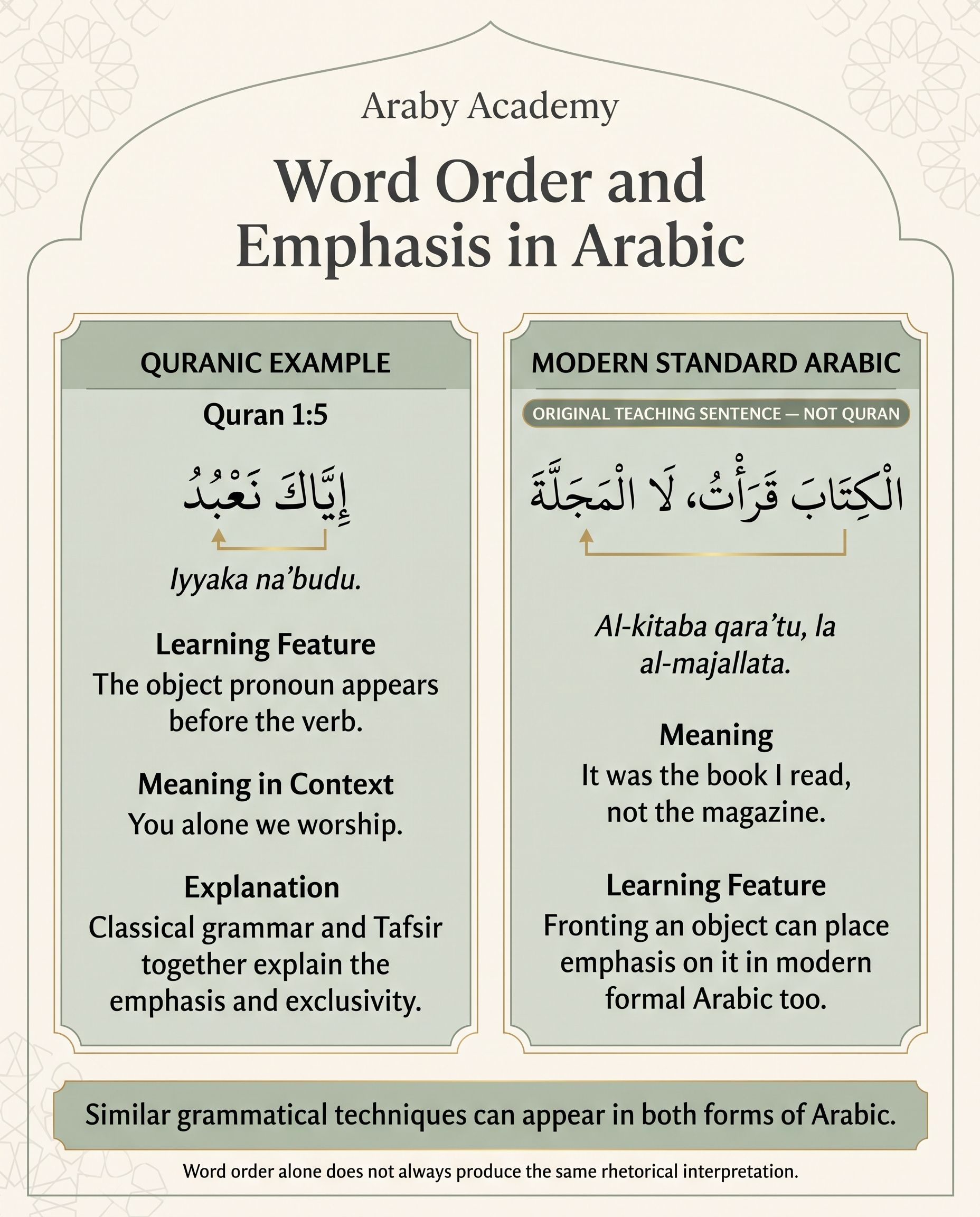
The opening of Surah al-Fatihah gives a classic example of word order: إِيَّاكَ نَعْبُدُ (1:5). The object pronoun iyyāka (“You”) comes before the verb na’budu (“we worship”). Classical commentators and rhetoricians explain this fronting as conveying focus or exclusivity: “You alone do we worship.” Not every fronted word always signals the same meaning, and context decides.
Modern formal Arabic also uses order for effect. ORIGINAL MODERN STANDARD ARABIC EXAMPLE — NOT QURANIC TEXT: الْكِتَابَ قَرَأْتُ، لَا الْمَجَلَّةَ (“It was the book I read, not the magazine”).
The Quran’s rhetorical use of structure becomes easier to appreciate through [IL-07: examples where Quranic word order changes emphasis], especially when a literal English sentence hides the original arrangement.
8 Practical Examples: Quranic Arabic and Modern Standard Arabic Compared
Every modern sentence below is Modern Standard Arabic example — constructed for teaching. None is Quranic text or a quotation from a real author.
1. Shared Arabic Script
Quran (12:2): قُرْآنًا عَرَبِيًّا — “an Arabic Quran.”
MSA example — constructed for teaching: يقرأ الطالب كتابا عربيا جديدا — “The student reads a new Arabic book.”
Shared: letters, connection rules, right-to-left writing, spelling principles. Differs: the Quranic phrase is vocalized and follows Mushaf conventions; the sentences are not equivalent in meaning.
Takeaway: you learn the alphabet once.
2. Shared Core Vocabulary
Quran (2:164): وَالْأَرْضِ — “and the earth.”
MSA example — constructed for teaching: تدور الأرض حول الشمس — “The earth revolves around the sun.”
Shared: the same word, root, and basic meaning. Differs: the verse places “earth” among signs for reflection, while the MSA sentence is a scientific statement; the Quranic word is genitive, the MSA word nominative.
Takeaway: shared words are bridges, but genre shapes use.
3. Vowel Marks
Quran (23:1): قَدْ أَفْلَحَ الْمُؤْمِنُونَ — “Successful indeed are the believers.”
MSA example — constructed for teaching: يدرس الطلاب اللغة العربية في الجامعة — “The students study the Arabic language at the university.” Fully vowelled for instruction: يَدْرُسُ الطُّلَّابُ اللُّغَةَ الْعَرَبِيَّةَ فِي الْجَامِعَةِ.
Shared: the grammar, including case (الطُّلَّابُ nominative, اللُّغَةَ accusative), is present either way. Differs: the Mushaf prints the signs; ordinary prose usually leaves them out.
Takeaway: missing marks do not mean missing grammar. Readers use context to supply short vowels, and unvowelled MSA can be read accurately.
4. Verbs and Morphology
Quran (2:183): كُتِبَ عَلَيْكُمُ الصِّيَامُ — “Fasting is prescribed for you.”
MSA example — constructed for teaching: كَتَبَ الطَّالِبُ رِسَالَةً — “The student wrote a letter.”
Shared: the root ك-ت-ب and the perfect pattern. Differs: kutiba is passive, while kataba is active; the Quranic sense is “prescribed,” as Tafsir explains, not simply “was written.” MSA also has passive forms.
Takeaway: the root gives a clue, not the full translation.
5. Pronouns
Quran (43:3): إِنَّا جَعَلْنَاهُ قُرْآنًا عَرَبِيًّا — “Indeed, We have made it an Arabic Quran.”
MSA example — constructed for teaching: شَاهَدْنَاهُ فِي الْمَتْحَفِ — “We saw it in the museum.”
Shared: the verb carries attached -nā (“we,” subject) and -hu (“it,” object). Differs: in the verse, “We” is understood in Tafsir as the divine majestic plural, so the reference comes from context.
Takeaway: learn to separate attached pronouns, but check what they refer to.
6. Word Order
Quran (1:5): إِيَّاكَ نَعْبُدُ — “You alone we worship.”
MSA example — constructed for teaching: الْكِتَابَ قَرَأْتُ، لَا الْمَجَلَّةَ — “It was the book I read, not the magazine.”
Shared: fronting the object puts focus on it. Differs: object-fronting is not exclusive to Quranic Arabic; the worship context gives 1:5 its particular significance.
Takeaway: ask why a word comes first.
7. Religious and Contemporary Vocabulary
Quran (2:2): لِلْمُتَّقِينَ — “for the God-conscious” (the taqwa family, root و-ق-ي).
MSA example — constructed for teaching: تقدم الجامعة دورات في علوم الحاسوب — “The university offers courses in computer science.”
Shared: both build vocabulary from roots and patterns. Differs: the Quranic term needs religious and Tafsir context, while the MSA phrase names a modern institution and field.
Takeaway: both varieties can express each other’s concepts; context teaches the sense.
8. Sentence Genre
Quran (1:2): الْحَمْدُ لِلَّهِ رَبِّ الْعَالَمِينَ — “All praise is for Allah, Lord of the worlds.”
MSA example — constructed for teaching: أعلنت وزارة التعليم عن موعد الامتحانات — “The Ministry of Education announced the date of the exams.”
Shared: both use standard Arabic sentence structure (a nominal sentence versus a verbal sentence). Differs: devotional praise versus informational reporting.
Takeaway: purpose shapes style. Quranic sentences do not all share one structure, and neither do MSA sentences.
Summary of the Eight Comparisons
# | Feature | Quran Ref. | MSA Example (constructed) | Similarity | Difference |
|---|---|---|---|---|---|
1 | Script | 12:2 | Student reads Arabic book | Same letters | Vocalization, genre |
2 | Vocabulary | 2:164 | The earth revolves | Same word | Context, case |
3 | Vowel marks | 23:1 | Students study Arabic | Same grammar | Notation printed or omitted |
4 | Verbs | 2:183 | Student wrote letter | Root ك-ت-ب | Passive vs active |
5 | Pronouns | 43:3 | We saw it | -nā, -hu | Reference of “We” |
6 | Word order | 1:5 | Book I read | Fronting for focus | Quranic context |
7 | Specialized terms | 2:2 | University courses | Root patterns | Religious vs modern context |
8 | Genre | 1:2 | Ministry announcement | Arabic syntax | Praise vs report |
Do Quran Translations Make the Differences Easier to Understand?
Partly. MSA can support your grasp of Arabic vocabulary and grammar, but translating a Quranic expression requires Quranic context and reliable interpretation. An MSA dictionary definition is not automatically the best English gloss for a verse. Translations also differ because of polysemy (one word with several related meanings), grammar, idiom, rhetoric, Tafsir choices, and translator approach. Not every difference comes from gaps between MSA and Quranic Arabic.
Readers who encounter different English renderings of the same verse can explore [IL-08: why Quran translations sometimes use different wording] without assuming that every variation represents a contradiction.
Why Is Tafsir Still Necessary?
Three activities are related but not identical. Translation renders meaning in another language. Tafsir is scholarly explanation of Quranic meaning. Arabic grammar analyzes linguistic structure. Reliable Tafsir may draw on other Quranic passages, authenticated Sunnah, recognized Arabic usage, historical context (asbab al-nuzul, the circumstances of revelation), and scholarly methods. Knowing Arabic does not by itself qualify anyone to issue legal or theological rulings.
Even strong Modern Standard Arabic skills do not replace [IL-09: understanding the difference between Tafsir and Quran translation], particularly when a verse depends on historical context or specialized interpretation. Native speakers recognize many Quranic words and constructions, yet they too benefit from scholarship, though not every native speaker knows all Quranic vocabulary.
Qira’at are canonical Quranic readings transmitted through established chains. They can affect pronunciation, morphology, and sometimes interpretation. They are not regional accents or dialects, and they are separate from MSA writing conventions.
Finally, comparing a religious text with a news article compares genres as well as historical varieties. A feature may appear more often because of genre, not because MSA lost the construction.
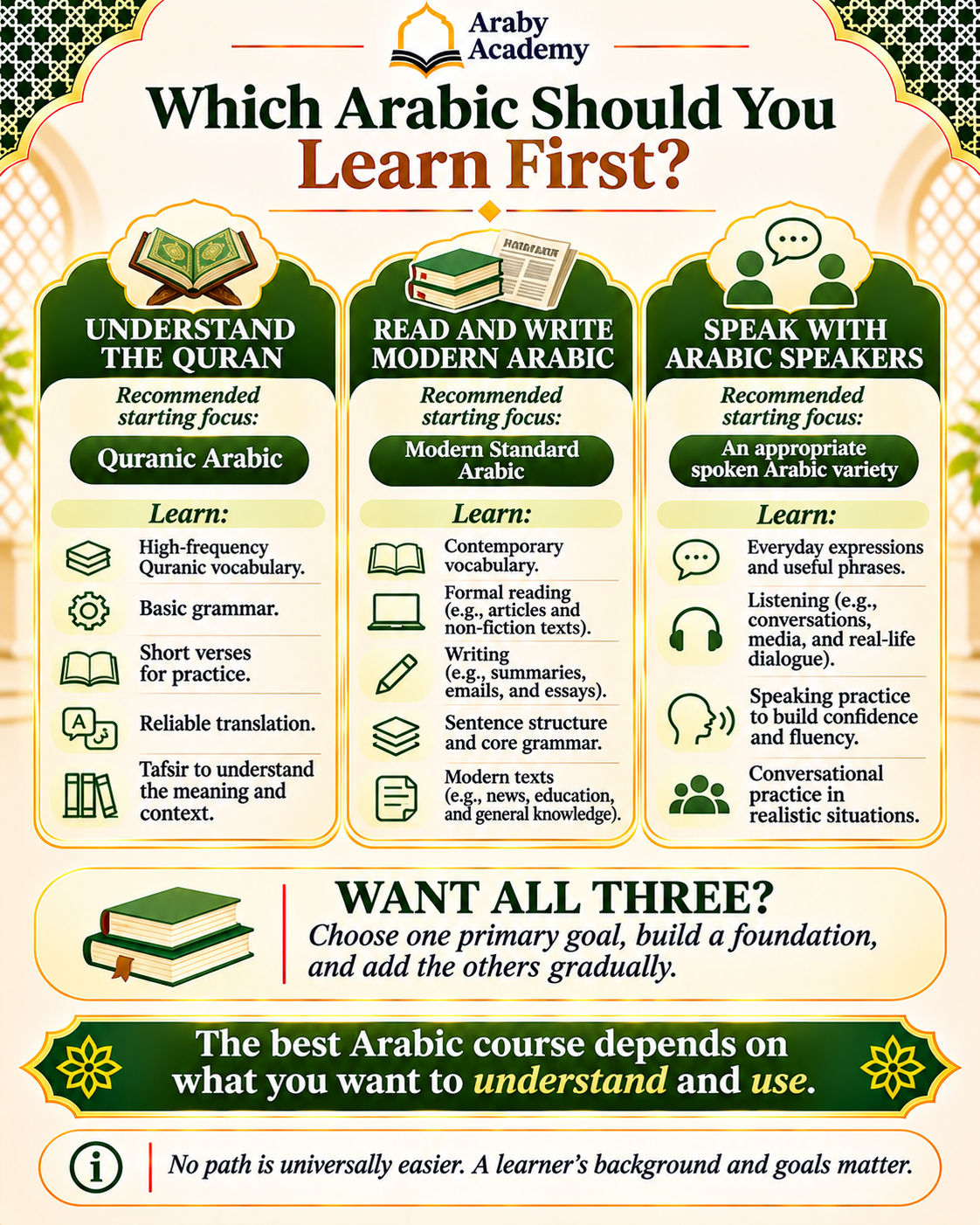
Should You Learn Quranic Arabic or MSA First?
Neither is universally easier. Difficulty depends on your first language, prior Arabic, reading fluency, goals, curriculum, and how specialized the material becomes. Basic courses differ in focus more than in rank.
Understanding the Quran: prioritize Quranic vocabulary, grammar, recitation support, and Tafsir.
Modern formal reading and writing: prioritize MSA.
Everyday conversation: choose an appropriate spoken variety, with MSA as formal support.
All three: use an integrated sequence instead of expecting one course to do everything.
You can study more than one. The shared script, structures, and vocabulary reinforce each other, though you may need separate resources for Quran comprehension, formal writing, and conversation. But letters, Tajweed, conjugation, formal writing, dialect, and Tafsir all at once overwhelms beginners, so pick a primary goal and add others gradually.
Students who decide to prioritize Quran comprehension can follow [IL-10: a step-by-step Quranic Arabic roadmap for beginners] instead of attempting to master every Arabic variety simultaneously.
Your Main Goal | Best Starting Focus | Additional Helpful Study | Common Mistake |
|---|---|---|---|
Understand Quran vocabulary | Quranic vocabulary, basic grammar | Tajweed, translation, Tafsir | Treating a dictionary gloss as final |
Read Islamic classical texts | Quranic and Classical Arabic grammar | MSA, guided reading | Expecting an intro course to suffice |
Read Arabic news and books | MSA | Vowelled texts, broad reading | Skipping grammar because vowels are absent |
Write formal Arabic | MSA | Feedback, varied models | Writing the way one speaks |
Speak with friends or relatives | The relevant spoken variety | MSA basics | Assuming MSA alone brings fluency |
Combine Quranic and modern Arabic | One primary goal, then additions | Teacher-guided sequence | Studying everything at once |
Some starting points:
Already know MSA: you may recognize letters, roots, verb patterns, and terminology, but still need Quranic vocabulary, religious idiom, rhetoric, Tafsir, and recitation conventions.
Speak a dialect: you have a useful foundation, but formal reading and Quranic language still need explicit study; dialect competence is not MSA literacy.
Cannot read Arabic: begin with letters, sounds, vowel marks, simple connected words, and qualified correction, not advanced grammar.
Recite without understanding: your recitation was not wasted. Add high-frequency Quranic vocabulary, basic morphology, short-surah analysis, verified translation, and Tafsir.
Learning for university or work: MSA is especially relevant, though oral interaction may require a dialect.
Learning for Islamic Studies: Quranic and Classical Arabic matter for traditional Tafsir, Hadith, and Fiqh. An introductory course will not allow independent scholarly interpretation.
Switching tracks is possible because foundations transfer, but you may need to fill gaps: a MSA student moving to Quranic study, for example, will still need Quranic vocabulary and Tafsir.
A Simple First-Month Learning Plan
This is an illustrative modern suggestion, not a religious practice; adjust it to your level.
Week 1: identify your reading level and choose a primary goal.
Week 2: review high-frequency shared vocabulary.
Week 3: study one basic sentence pattern or morphological form.
Week 4: compare one short Quranic passage with an original MSA sentence, and consult Tafsir for the Quranic meaning.
Useful materials include a reliable Mushaf, a verified translation, an introductory grammar, a Quranic vocabulary guide, an MSA textbook where relevant, a trustworthy Tafsir, recordings by qualified reciters, and a teacher. Before enrolling, ask whether a course teaches recitation, Tajweed, Quranic vocabulary, Classical grammar, MSA, or a dialect; whether it explains word-by-word meaning and Tafsir; and whether it assesses your level, corrects you, and states its goals.
No honest course can promise the whole Quran in thirty days or fluency in a fixed time. Progress depends on background, consistency, teaching, and practice, and milestones differ: recognizing common vocabulary, understanding a short passage with guidance, reading MSA prose, conversing, and analyzing texts independently.
Common Misconceptions
“They use different alphabets.” They share Arabic script; text conventions differ.
“They are unrelated languages.” They share extensive structure and vocabulary.
“They are identical.” Setting, genre, and usage differ.
“MSA has no case endings.” It has case; ordinary writing omits short vowels.
“Dialects are incorrect Arabic.” They are systematic varieties.
“Tajweed teaches meaning.” It governs recitation, not vocabulary or Tafsir.
“An MSA dictionary replaces Tafsir.” Interpretation requires scholarship.
“Modern Arabic has no rhetoric.” Modern formal Arabic also uses sophisticated techniques.
“Qira’at are accents.” They are canonical transmitted readings.
“One course teaches Quran, writing, and conversation equally.” Goals need different resources.
“I can’t access the Quran until I read Arabic.” Reliable translations and guided learning give meaningful access meanwhile.
Fifteen Useful Arabic Terms
Arabic | Transliteration | Meaning and relevance |
|---|---|---|
الْعَرَبِيَّة | al-‘Arabiyyah | Arabic; the shared language |
الْفُصْحَى | al-Fuṣḥā | Formal or eloquent Arabic |
الْقُرْآن | al-Qur’ān | The Quran; central text |
لغَة | lughah | Language |
لَهْجَة | lahjah | Dialect; spoken variety |
حَرَكَة | ḥarakah | Vowel or diacritic mark, by context |
تَشْكِيل | tashkīl | Vocalization notation |
جَذْر | jidhr | Root; links vocabulary |
صَرْف | ṣarf | Morphology |
نَحْو | naḥw | Syntax and grammar |
إِعْرَاب | i‘rāb | Inflection and grammatical analysis |
مُفْرَدَات | mufradāt | Vocabulary |
تَجْوِيد | tajwīd | Quranic recitation discipline |
تَفْسِير | tafsīr | Quranic exegesis |
قِرَاءَات | qirā’āt | Canonical readings |
Not every technical term here appears in the Quran.
Frequently Asked Questions
What is the difference between Quranic Arabic and Modern Standard Arabic? Quranic Arabic is the Arabic of the Quran, studied with Tafsir. MSA is today’s formal Arabic. They share script, roots, and grammar but differ in setting, genre, and usage.
Are they the same language? They are closely related varieties of Arabic, not separate languages.
Is Quranic Arabic the same as Classical Arabic? Closely connected but not identical. Classical Arabic is a broader literary and grammatical tradition, and scholars define the relationship with different emphases.
What does Fusha mean? Fusha commonly means formal or eloquent Arabic as opposed to dialect, often covering Classical and Modern Standard Arabic.
Is MSA based on Classical Arabic? MSA continues earlier written Arabic and shares its grammatical foundations, while adapting vocabulary and style to modern needs.
Does MSA have the same grammar as Quranic Arabic? Largely, yes: roots, patterns, case, and verb forms. Usage preferences and some constructions differ, and genre affects frequency.
Does MSA have case endings? Yes. Its grammar has case, though ordinary writing omits short vowels and speech does not always pronounce endings.
Why is the Quran printed with more vowel marks? Mushafs print vowel and recitation signs to support accurate reading. Adult prose usually omits them by publishing convention.
Do Arabs speak Quranic Arabic every day? No. Daily speech is usually dialect; the Quran is recited, studied, and quoted.
Can Arabic speakers understand the Quran without Tafsir? They may grasp much, but specialized religious, historical, and legal meaning benefits from Tafsir.
Can I understand the Quran if I learn MSA? MSA helps with script, roots, and grammar, but you also need Quranic vocabulary, context, and Tafsir.
Should I learn Quranic Arabic or MSA first? Let your goal decide: Quran comprehension suggests Quranic Arabic with Tafsir; formal modern use suggests MSA; conversation suggests a spoken variety.
Can I study both together? Yes, with a primary goal and gradual additions, using resources suited to each purpose.
Is Tajweed the same as learning Quranic Arabic? No. Tajweed governs recitation; it does not by itself teach vocabulary or grammar.
Which Arabic is best for traditional Islamic books? Quranic and Classical Arabic study is especially relevant; MSA supports modern scholarship.
How long does it take? There is no fixed time. It depends on background, consistency, goals, and the milestone you mean.
Conclusion — Choose the Arabic That Fits Your Goals
Is Quranic Arabic different from Modern Standard Arabic? Yes, in historical, stylistic, and contextual ways, but they share extensive linguistic foundations and are not unrelated languages. Learning them is not a competition; they serve different purposes. If you want to understand the Quran, begin with its vocabulary, grammar, and reliable Tafsir. If you want modern communication, build MSA skills and consider the spoken variety you need. The best course matches what you want to understand and use. If you would like guidance, Araby Academy’s qualified teachers offer Quranic Arabic and Arabic for non-native speakers.