
One reader opens an English Quran and finds the word "patience." Another translation says "perseverance." A third says "steadfastness." Are the translators disagreeing? Not necessarily. They are reaching for different English words to express one Arabic term, sabr (الصبر), whose range does not sit neatly inside any single English word.
Short answer: Some Quranic Arabic words cannot be captured by one English equivalent across every context. Terms such as Taqwa, Rahmah, Fitnah, Sabr, and Din carry meanings shaped by word form, Quranic usage, and classical Tafsir. English translations convey important aspects of them, but studying the original Arabic helps readers notice distinctions that a short gloss may hide.
Why Quranic Arabic Is Hard to Capture in One English Word
The title needs a clear disclaimer. "English can never fully translate" means that no single English word can reliably carry the whole contextual and interpretive range of these terms in every verse. It does not mean that accurate English translation is impossible. Often one English word is excellent for a particular verse; sometimes a short explanation serves better than swapping one word for another.
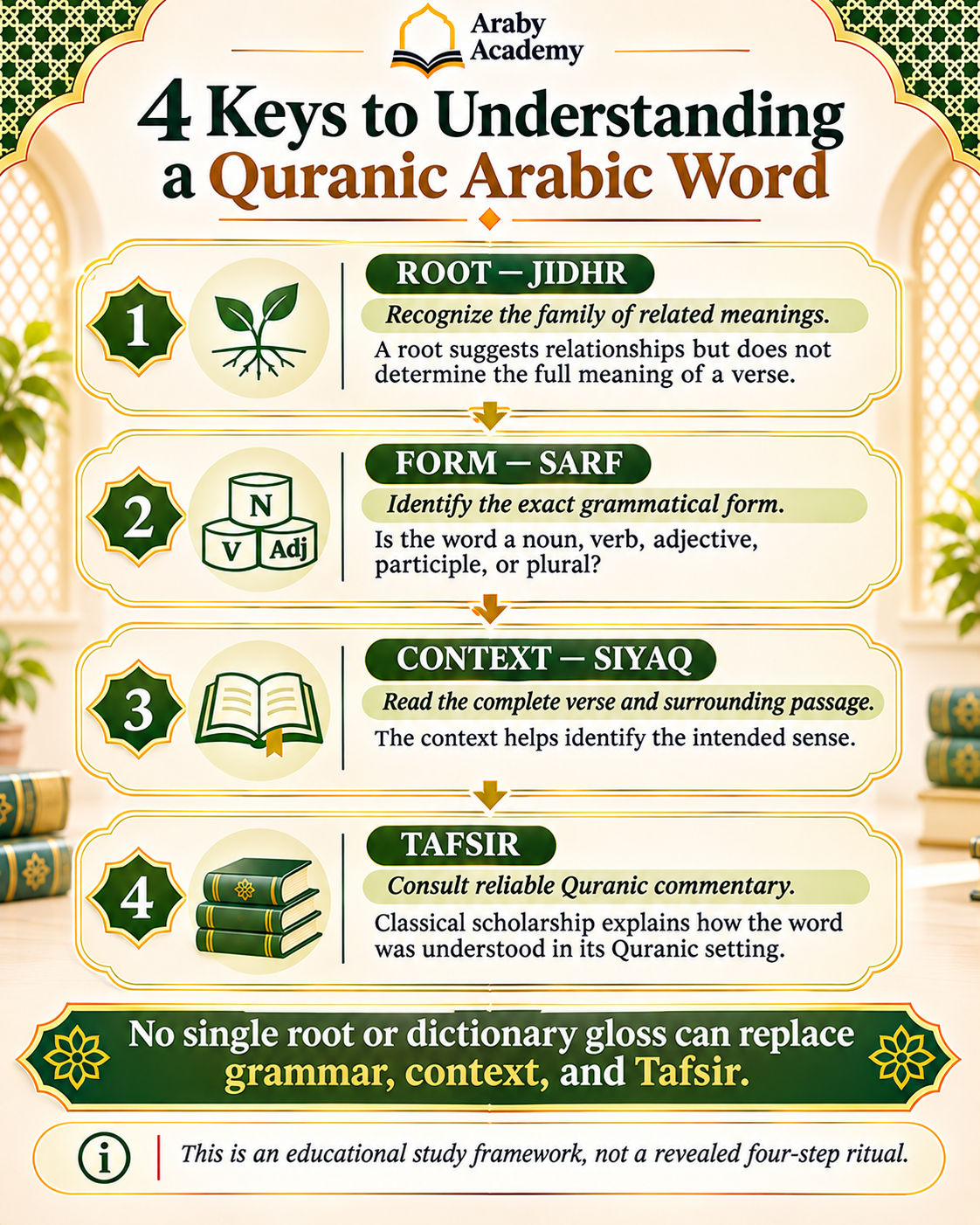
Four ideas explain the difficulty, and we will meet each in the ten examples:
Root (jidhr): a core of usually three consonants that gives a family of related meanings. It shows relationships between words; it does not hand you the meaning of a verse.
Form (sarf, morphology): the same root can appear as a verb, a noun, an adjective, or a plural, and each form works differently.
Context: the surrounding verses decide which sense of a word with several related meanings (called polysemy) is intended.
Tafsir: classical Quranic commentary records how early scholars understood a word in its setting.
This is not a claim that Arabic is superior to English; every pair of languages loses and gains something in translation. The point is that the Quran was revealed in Arabic, so careful readers benefit from understanding its words closely. Translations remain valuable, and are the doorway through which most of us first meet the Quran.
One more caution: a familiar teaching label such as "Falah" does not always appear in a verse in that exact form. Often the verse contains a verb, adjective, or plural from the same root. For each word below, we identify the form actually found in the Quran.
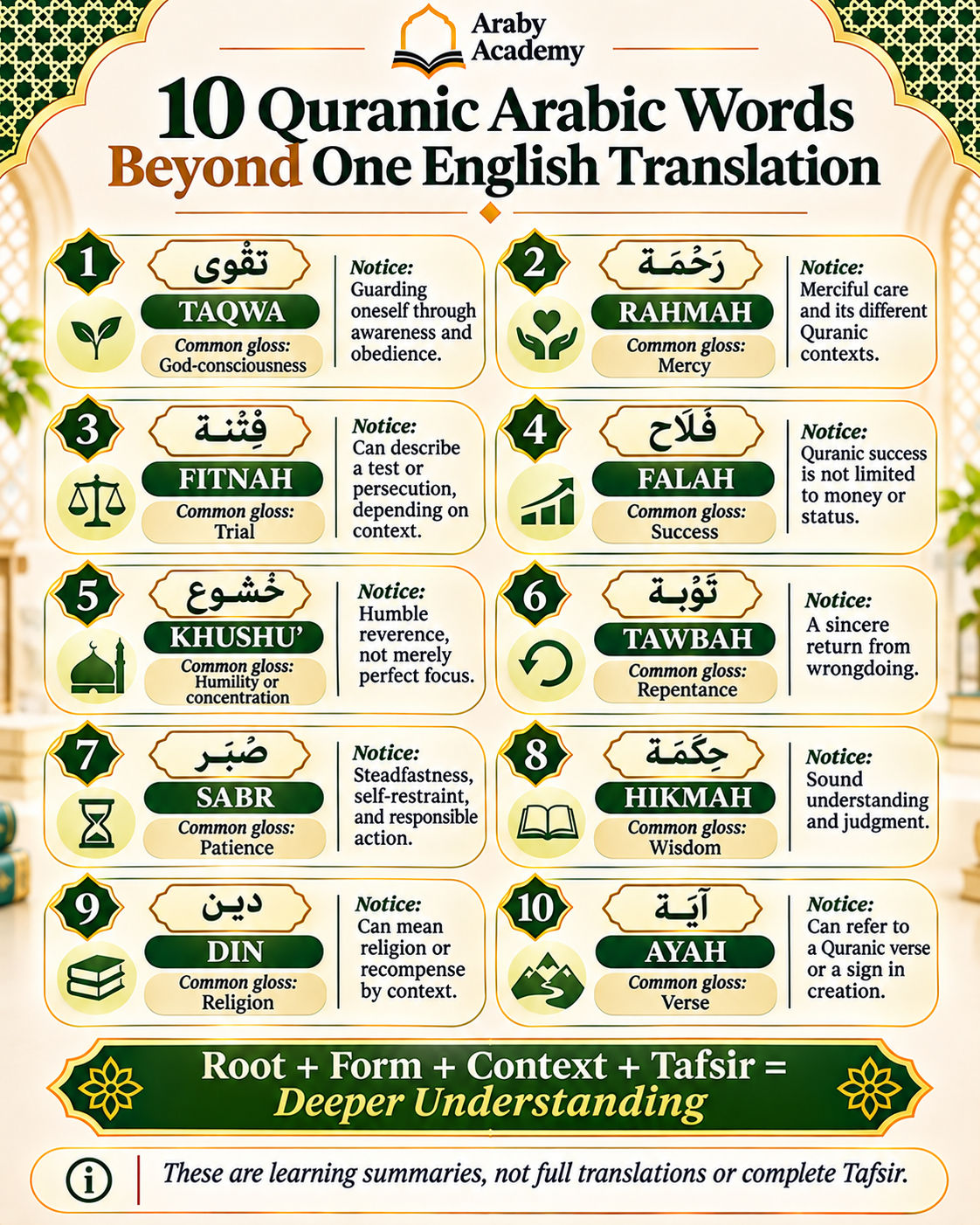
10 Arabic Words in the Quran at a Glance
Arabic Word | Transliteration | Common English Gloss | What Else Readers Should Notice |
|---|---|---|---|
التقوى | Taqwa | God-consciousness, piety | Root idea is guarding or protecting oneself |
الرحمة | Rahmah | Mercy | Shares a root with the Divine Names Ar-Rahman and Ar-Rahim |
الفتنة | Fitnah | Trial, temptation | Meaning shifts sharply with context |
الفلاح | Falah | Success | Quran uses related forms such as aflaha and al-muflihun |
الخشوع | Khushu' | Humility, concentration | Verse 23:2 uses the adjective khashi'un |
التوبة | Tawbah | Repentance | Root idea is returning |
الصبر | Sabr | Patience | Includes steadfastness and restraint, not only waiting |
الحكمة | Hikmah | Wisdom | Linked to sound judgment, not mere cleverness |
الدين | Din | Religion | Also judgment or recompense, as in Yawm ad-Din |
آية | Ayah | Verse | Also a sign in creation |
1. Taqwa — More Than "Fear of Allah"
Root: و ق ي (w-q-y). Common glosses: God-consciousness, reverent fear, piety, mindfulness of Allah.
Lexicons connect this root with guarding and protection; a wiqayah is a shield. Taqwa is a verbal noun from ittaqa, "to guard oneself." The first root letter has merged into the t of the pattern, so the spelling t-q-w hides the root from beginners. The root does not mean "fear" in every use; fear is one way commentators explain what guarding oneself involves.
Verse 2:197 says: فَإِنَّ خَيْرَ ٱلزَّادِ ٱلتَّقْوَىٰ, "the best provision is Taqwa," using the definite noun at-taqwa. The same verse ends with وَٱتَّقُونِ (wattaquni), a verb command: "and be mindful of Me." In 49:13 the form is different again: أَتْقَىٰكُمْ (atqakum), a comparative adjective with an attached pronoun, "the most Taqwa-possessing among you." One root gives a noun, a command, and a comparative.
Al-Tabari and Ibn Kathir explain 2:197 in the setting of pilgrimage: pilgrims should carry real provisions, yet the provision that truly benefits is Taqwa, avoiding what Allah forbade and doing what He commanded. For 49:13 they stress that honour with Allah is not by lineage.
"Fear of Allah" captures reverence and accountability, but the root speaks of protection. "God-consciousness" captures awareness but needs the added element of moral obedience. "Piety" is useful but can sound generic. None is wrong; each fits some contexts better.
Common misconception: Taqwa does not mean being terrified all the time, yet fear and Taqwa are not unrelated either. Context decides how much awe, caution, or obedience a verse highlights.
Readers who want to go beyond the vocabulary can explore [ the Quranic meaning of Taqwa beyond simple fear], including how the concept shapes everyday conduct.
Student takeaway: Taqwa is best learned as "guarding yourself with awareness of Allah," then checked against each verse.
2. Rahmah — More Than "Mercy"
Root: ر ح م (r-h-m). Common glosses: mercy, compassion, merciful care.
Classical lexicons associate this root with tenderness and with the womb (rahim), and the Arabic term for kinship ties comes from it as well. We should be careful about applying human emotional comparisons to Allah. Sunni scholars affirm that Allah's mercy is real and perfect while rejecting any human-like weakness or need in it.
In 7:156 Allah says: وَرَحْمَتِى وَسِعَتْ كُلَّ شَىْءٍ, "My mercy encompasses all things." The form is rahmati, the noun with an attached "my." The verse continues by saying He will decree it specially for those who have Taqwa, give zakat, and believe in His signs. In 21:107 the form is رَحْمَةً (rahmatan), an indefinite accusative noun: "We sent you only as a mercy to the worlds." Here the Prophet ﷺ is described as mercy, and commentators generally connect this with the guidance he brought, noting different views on how it reaches believers and others.
In 7:156 the emphasis is the breadth of Divine mercy; in 21:107 it is mercy expressed through revelation. Rahmah does not literally mean "guidance" in every verse; "mercy" is an excellent translation, and context shows how a verse presents it.
Related forms need care. Ar-Rahman follows the pattern fa'lan, which scholars explain as expressing fullness and breadth; Ar-Rahim follows fa'il, and many commentators, including Ibn Kathir, connect it with mercy that is especially for believers. Sharing a root does not make these forms identical in grammar or theology.
Exploring Rahmah also provides a natural introduction to [ the beautiful Names of Allah and their meanings], especially the names Ar-Rahman and Ar-Rahim.
Common misconception: Rahmah is not softness or sentiment in the human sense.
Student takeaway: Translate Rahmah as "mercy," then ask what the verse says that mercy does.
3. Fitnah — A Word Defined by Context
Root: ف ت ن (f-t-n). Common glosses: trial, test, temptation, persecution, turmoil.
Lexicons explain that the root described testing metal in fire to separate pure from impure. From that image come senses of testing, temptation, and affliction. These senses are related, but not every occurrence means the same thing.
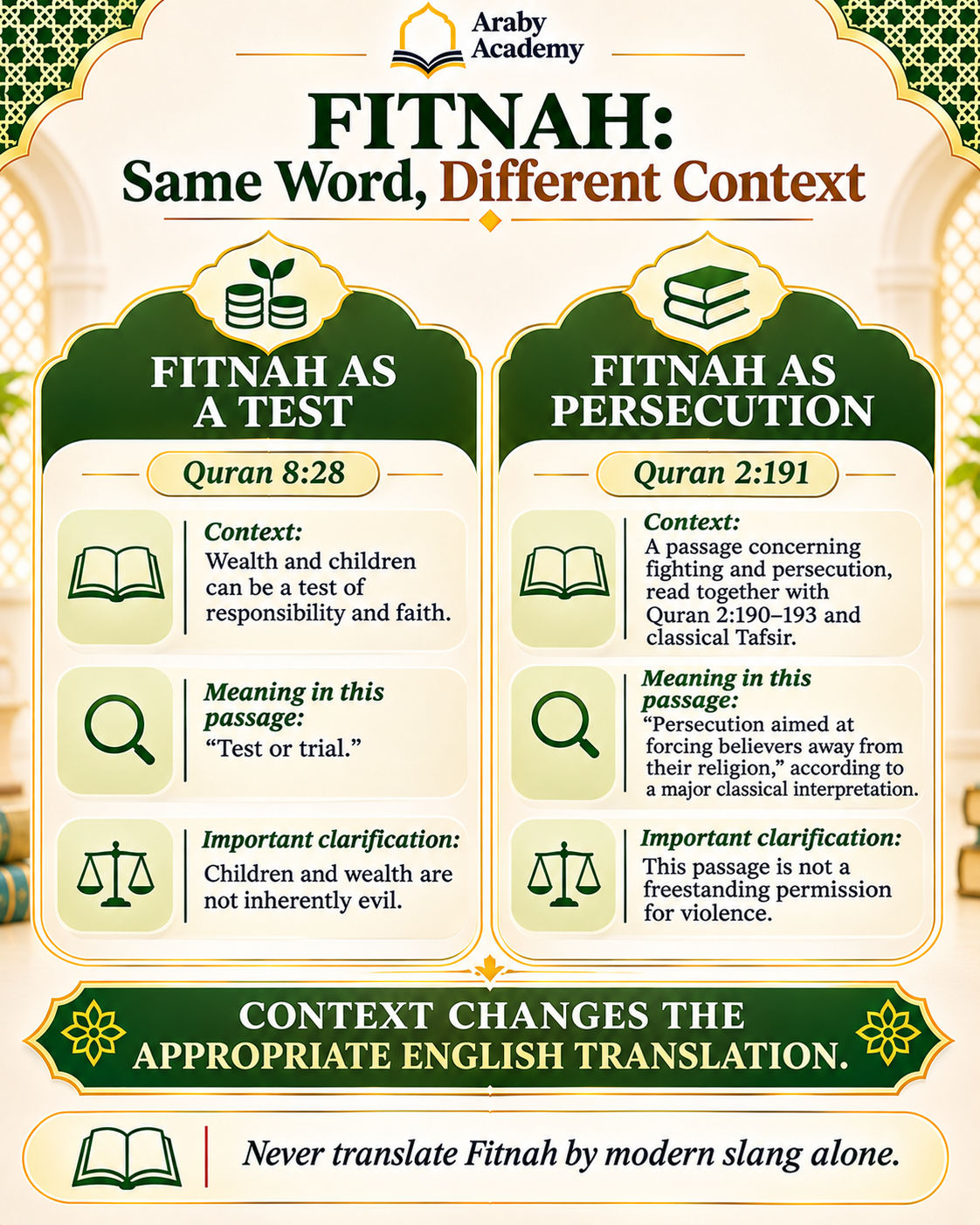
In 8:28 we read: أَنَّمَآ أَمْوَٰلُكُمْ وَأَوْلَـٰدُكُمْ فِتْنَةٌ, "your wealth and your children are a fitnah." The form is the indefinite noun fitnatun. Here "test" fits well: blessings can test whether a person stays faithful. The verse does not call children or wealth evil; it warns that they can become occasions of failing a test.
Compare 2:191: وَٱلْفِتْنَةُ أَشَدُّ مِنَ ٱلْقَتْلِ, where the definite noun al-fitnatu appears. This sentence sits inside the passage 2:190–193, which concerns the Muslims of Makkah and fighting only those who fight them. Classical commentators, including al-Tabari, commonly explain fitnah here as persecution aimed at forcing believers away from their religion. This verse is not a freestanding slogan and not a blanket permission for violence; its wording must be read with its setting and with Tafsir.
So the same root gives "test" in one verse and "persecution" in another. One English word fails because the situations differ: a trial through blessings, religious coercion, and other severe tribulation are different realities.
Common misconception: Modern slang uses "fitnah" for gossip, drama, or an attractive person. Those uses may be real in everyday speech but are not a safe key to a Quranic verse.
The changing contexts of Fitnah become easier to appreciate when studying [ the trials faced by Prophet Yusuf], where betrayal, temptation, injustice, and perseverance appear in one Quranic narrative.
Student takeaway: For Fitnah, never memorise one gloss; always ask what situation the verse describes.
4. Falah — More Than "Success"
Root: ف ل ح (f-l-h). Common glosses: success, prosperity, flourishing, attaining a good outcome.
Classical lexicons use this root for attaining what one seeks and for lasting good. The Quran does not need the noun in every place; it often uses related forms. Verse 23:1 says: قَدْ أَفْلَحَ ٱلْمُؤْمِنُونَ, "the believers have succeeded." The form is the past-tense verb aflaha (with qad for emphasis). Verse 2:5 says: وَأُو۟لَـٰٓئِكَ هُمُ ٱلْمُفْلِحُونَ, using al-muflihun, an active participle in plural: "those who are successful." Neither verse contains the standalone noun falah, but both come from the same root. A verb describes an event, while a participle describes people characterised by the quality. They are not interchangeable words.
In English, "success" often suggests salary, grades, status, or fame. Material success is not automatically sinful, but the Quranic contexts tie success to faith, guidance, and the final outcome. Verse 2:5 follows a description of those on guidance from their Lord. Verses 23:1–11 describe the successful believers: humble in prayer, turning away from idle talk, giving zakat, guarding chastity, honouring trusts and promises, and protecting their prayers. The passage ends with their inheriting Paradise.
Comparing the two: in 23:1 success is announced for believers with specific qualities; in 2:5 it is the outcome of following guidance. Ibn Kathir explains it as attaining what one hopes for and being saved from what one fears.
Common misconception: English "success" and Quranic falah can overlap but do not share one cultural frame.
The Quranic idea of success also connects to [ the purpose of life in Islam], which is not limited to wealth, recognition, or achievement.
Student takeaway: Learn aflaha and al-muflihun as related forms of one root, and read "success" with the verse's own definition.
5. Khushu' — More Than "Concentration"
Root: خ ش ع (kh-sh-'). Common glosses: humility, reverence, humble attentiveness, submissive stillness in some contexts.
Classical lexical explanations connect this root with lowering oneself, a quiet voice, and a lowered gaze. Verse 23:2 says: ٱلَّذِينَ هُمْ فِى صَلَاتِهِمْ خَـٰشِعُونَ, "those who are humbly attentive in their prayers." The actual form is khashi'un, an active participle in the masculine plural, not the noun khushu'. The noun and this participle are related, but they are different forms.
Verse 57:16 asks: أَن تَخْشَعَ قُلُوبُهُمْ لِذِكْرِ ٱللَّهِ, "that their hearts should become humbly responsive to the remembrance of Allah." Here the verb takhsha'a is used and the subject is the hearts, in the setting of Allah's reminder, not a single posture in Salah. So Khushu' is not limited to prayer, even though 23:2 gives prayer as an important setting.
Concentration may be part of prayer, but Khushu' should not be reduced to having no thoughts, never being distracted, or a guaranteed emotional feeling. Early commentators are reported to explain it through humility, reverence, stillness, and lowering the gaze, so inner state and outward composure both appear.
Three layers should be separated: the linguistic meaning (lowering oneself in humility), the Quranic context (believers in prayer, hearts responding to remembrance), and later scholarly advice about improving prayer. Such advice is valuable, but it is not a command explicitly revealed in Quran 23:2.
Understanding [ the meaning of Surah Al-Fatihah] can help readers reflect more thoughtfully during prayer, although Khushu' is not simply a test of vocabulary knowledge.
Common misconception: A distracted thought does not mean your prayer has no value.
Student takeaway: Think of Khushu' as humble reverence, with concentration as one possible part.
6. Tawbah — More Than "Repentance"
Root: ت و ب (t-w-b). Common glosses: repentance, turning back, returning.
The root carries the sense of returning. In Quranic usage the servant "returns" from disobedience to obedience, and Allah is described as turning toward the servant with acceptance, a meaning often marked by the preposition 'ala in forms such as tab 'alayhim. This does not describe physical movement by Allah; sound Sunni commentary explains it as His acceptance and mercy.
In 66:8 believers are told: تُوبُوٓا۟ إِلَى ٱللَّهِ تَوْبَةً نَّصُوحًا, "Turn to Allah in sincere repentance." Tubu is an imperative verb; tawbatan is a noun used for emphasis; nasuhan is an adjective, "sincere, sound." Verse 9:104 says: أَنَّ ٱللَّهَ هُوَ يَقْبَلُ ٱلتَّوْبَةَ عَنْ عِبَادِهِۦ, "Allah accepts repentance from His servants," and ends with ٱلتَّوَّابُ, at-Tawwab. This is an intensive form, commonly explained as the One who accepts repentance repeatedly. So in 66:8 the servant is the doer; in 9:104 Allah is the One who accepts.
Tawbah is more than saying "sorry." Scholars commonly describe elements such as leaving the wrongdoing, remorse, sincere resolve not to return, and returning rights to people when that applies. The Arabic word itself expresses returning; the detailed conditions come from wider religious discussion. Early commentators are reported to explain nasuh as repentance not followed by returning to the sin, an explanation that stresses sincerity.
Nothing here makes repentance impossible for someone who has made serious mistakes; the verses present an open door.
The full religious meaning of this word is easier to understand through [the Islamic steps of sincere Tawbah and seeking Allah's forgiveness].
Common misconception: Tawbah is not a one-word apology.
Student takeaway: Notice who is the subject: the servant returns, and Allah accepts.
7. Sabr — More Than "Patience"
Root: ص ب ر (s-b-r). Common glosses: patience, steadfastness, perseverance, self-restraint.
Lexicons connect this root with holding back or restraining oneself, which is why "waiting silently" is too narrow.
Verse 2:153 says: ٱسْتَعِينُوا۟ بِٱلصَّبْرِ وَٱلصَّلَوٰةِ ۚ إِنَّ ٱللَّهَ مَعَ ٱلصَّـٰبِرِينَ. Here as-sabr is the noun, and as-sabirin is the active participle in the genitive plural: "those who are steadfast." The verse links Sabr with Salah, and tells believers to seek help through both. Seeking help is an action. Verse 39:10 says: إِنَّمَا يُوَفَّى ٱلصَّـٰبِرُونَ أَجْرَهُم بِغَيْرِ حِسَابٍ, "the steadfast will be given their reward without measure," where as-sabirun is the same participle in the nominative.
"Patience" can be a good translation, but English readers may hear passive waiting. Scholars have long described Sabr in three recognised categories: remaining steadfast in obedience, holding back from disobedience, and responding to hardship properly. This is a scholarly classification, not a numbered Hadith.
We should avoid several harmful misunderstandings. A patient person may cry. Sabr does not mean refusing medical care, tolerating abuse, being silent about harm, or giving up the pursuit of justice. It also does not promise worldly success; 39:10 speaks of reward.
Readers who want practical examples of perseverance can continue with [ the Quranic meaning of Sabr beyond waiting quietly].
Student takeaway: Sabr is holding firm and holding back, with action included.
8. Hikmah — More Than "Wisdom"
Root: ح ك م (h-k-m). Common glosses: wisdom, sound judgment, wise understanding.
The root also gives hukm (judgment, ruling) and hakim (wise, a Name of Allah). Classical lexical explanations connect it with restraint from error, so the idea of sound judgment is close to the root's flavour. Derived forms are not interchangeable, however; hukm and hikmah are different words.
Verse 2:269 says: يُؤْتِى ٱلْحِكْمَةَ مَن يَشَآءُ, "He grants wisdom to whom He wills." The form is al-hikmata, the definite noun in the accusative, as the object of the verb. Verse 31:12 says: وَلَقَدْ ءَاتَيْنَا لُقْمَـٰنَ ٱلْحِكْمَةَ, "We gave Luqman wisdom," with the same noun. In both, Hikmah is something Allah gives, not just something a person achieves through effort.
"Wisdom" is often an excellent translation. But the Quranic idea is not necessarily high IQ, large amounts of information, academic qualifications, or winning arguments. Classical Tafsir such as al-Tabari's discusses right understanding and correct judgment in speech and action, and Ibn Kathir explains that the verse refers to understanding rather than prophethood. Commentators on Luqman generally describe his Hikmah as understanding and sound judgment.
Scholars discuss Hikmah differently by context: sound understanding, knowledge joined to right application, and, where it appears beside "the Book," sometimes Prophetic guidance. It does not always and exclusively mean "Sunnah."
Readers interested in examples of wise religious teaching can explore [ the life and teachings of Prophet Muhammad ﷺ], while remembering that Hikmah must be understood in each Quranic context.
Common misconception: Cleverness and Hikmah are not the same.
Student takeaway: Translate Hikmah as "wisdom," then ask what judgment or understanding the verse describes.
9. Din — More Than "Religion"
Root: د ي ن (d-y-n). Common glosses: religion, way of devotion, judgment, recompense.
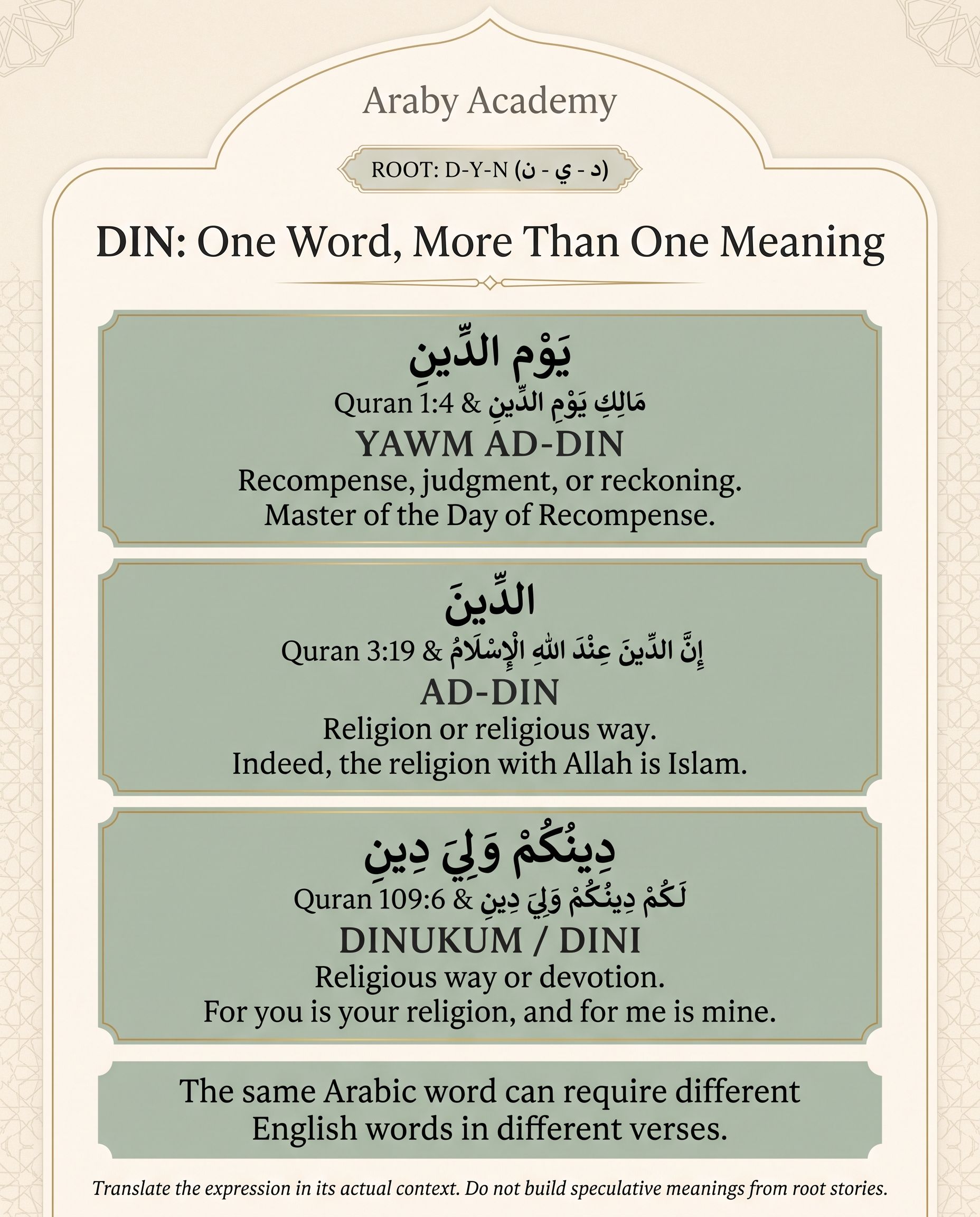
Verse 1:4 says: مَـٰلِكِ يَوْمِ ٱلدِّينِ, "Master of the Day of Din." The form is ad-Din, a definite noun in a construct phrase, yawm ad-Din. Classical commentators, including al-Tabari, explain it here as the Day of recompense and reckoning. In this phrase, "organised religion" would not be the usual understanding.
Verse 3:19 says: إِنَّ ٱلدِّينَ عِندَ ٱللَّهِ ٱلْإِسْلَـٰمُ, where ad-Din is understood as the religion or way of life accepted by Allah, with Islam named as that way. Verse 109:6 says: لَكُمْ دِينُكُمْ وَلِىَ دِينِ, "You have your religion, and I have mine." There dinukum has an attached pronoun, and dini a first-person pronoun, both pointing to a religious way.
Compare 1:4 and 3:19: the same Arabic word (written the same in the first two) appears in contexts of recompense and religion. Translators render it differently because the context changes. That contrast is one of the clearest lessons in this article.
Popular accounts sometimes link Din, debt, habit, and law through sweeping root stories. We should not repeat them without reliable classical linguistic support; attested meanings are one thing, creative modern reflection another.
"Religion" can be correct in 3:19 and 109:6; in Yawm ad-Din, judgment or recompense points to accountability.
The term Din can describe religion in a broad sense, while [ the Five Pillars of Islam] explain some of the foundational practices through which Muslims live their faith.
Common misconception: Din is not "religion" in every verse.
Student takeaway: Decide the meaning of Din from its phrase, not from a single gloss.
10. Ayah — More Than "Verse"
Common glosses: sign, verse, evidence or indication.
Etymology: the origin of ayah is discussed among lexicographers and linguists in more than one way, so beginners should not be handed a simple three-letter root story. What is clear is how the Quran uses the word: for signs that point to something, and for the verses of the revealed text.
Verse 2:164 lists the heavens and earth, the alternation of night and day, ships at sea, rain, and winds, and says: لَـَٔايَـٰتٍ لِّقَوْمٍ يَعْقِلُونَ, "are signs for a people who use reason." The form is ayat, the indefinite plural in the genitive, with an emphatic la-. Here "signs" in creation is the natural rendering. Verse 3:7 says: مِنْهُ ءَايَـٰتٌ مُّحْكَمَـٰتٌ, "from it are verses that are clear in meaning." The same plural, now in the nominative, refers to units of the Book. Verse 41:53 also speaks of showing signs "in the horizons and within themselves," using ayatina, with an attached pronoun.
So "verse" suits a Quranic passage, "sign" suits creation and Divine indications, and "evidence" may help in some explanations. They are not unrestricted substitutes. An ayah is not always a numbered unit in a printed Mushaf, nor does every use mean "miracle," nor every occurrence refer to a written verse.
Al-Tabari and Ibn Kathir read 2:164 as creation pointing to Allah's power and oneness.
Quranic references to signs in creation can also lead readers toward [ the meaning of Tawhid and Allah's oneness], while the word Ayah itself must still be understood in its particular context.
Common misconception: Ayah does not always mean "miracle."
Student takeaway: When you see "signs" or "verses," check whether the context is creation or the text.
What These 10 Words Teach Us About Quranic Arabic
Lesson one: the dictionary meaning is a starting point. Taqwa as "piety" is a start, not a verdict.
Lesson two: forms change function. Aflaha is a verb, al-muflihun is a participle; tubu is a command, at-Tawwab an intensive form; sabr is a noun and sabirun names people.
Lesson three: context decides. Fitnah in 8:28 and 2:191 and Din in 1:4 and 3:19 show this plainly. This is polysemy: one word with several related meanings, with the surrounding sentence choosing among them. It is different from unrelated words that merely sound alike.
Lesson four: Tafsir completes the picture. The dictionary gives possibilities; commentary records how the meaning was understood in a verse.
A root is no substitute for morphology, syntax, context, Tafsir, or recognised usage. Knowing that hukm and hikmah share a root does not tell you what 2:269 means, and the root of Din does not decide between "religion" and "recompense." Roots show links; they do not let anyone derive religious rulings alone.
Grammar matters too: singular and plural (ayah, ayat), definite and indefinite (al-fitnah, fitnah), and attached pronouns (rahmati, dinukum) all shape what a reader understands.
Translators make real choices: a familiar word, a descriptive phrase, a literal expression, or an explanation. Both "patience" and "steadfastness" can be reasonable for sabr, depending on the verse, though not every choice is equally defensible. A reliable translation renders meaning rather than replacing the Arabic Quran, and it remains very valuable.
Arabic Word | Common English Gloss | A More Context-Sensitive Explanation | Quran Reference |
|---|---|---|---|
Taqwa | Piety | Guarding oneself through awareness of Allah | 2:197; 49:13 |
Rahmah | Mercy | Mercy that encompasses all things; mercy through revelation | 7:156; 21:107 |
Fitnah | Trial | A test through blessings, or persecution, by context | 8:28; 2:191 |
Falah | Success | Attaining the lasting good Allah describes | 23:1; 2:5 |
Khushu' | Concentration | Humble reverence; heart and body responsive | 23:2; 57:16 |
Tawbah | Repentance | Sincere return to Allah, with Allah accepting | 66:8; 9:104 |
Sabr | Patience | Steadfastness and restraint with action | 2:153; 39:10 |
Hikmah | Wisdom | Sound understanding and judgment | 2:269; 31:12 |
Din | Religion | Religion or recompense, by phrase | 1:4; 3:19 |
Ayah | Verse | Verse of the Book or sign in creation | 2:164; 3:7 |
These are teaching aids, not exact replacements.
How to Learn Quranic Words Without Relying on One-Word Definitions
This is a modern study method, not a Prophetic ritual:
Read the word in Arabic.
Identify the exact Quranic form.
Record its common English gloss.
Read the whole verse and its surrounding context.
Consult a trustworthy Tafsir.
Compare the word in another verified verse.
A simple notebook helps: Arabic form, root, verse, English gloss, contextual meaning, Tafsir note, and a question for your teacher. You need not memorise every derivation before reading the Quran.
The one-word method says "Sabr = patience." The contextual method notes that Sabr appears in passages about seeking help through prayer, steadfastness, and responding to hardship. The simple definition helps beginners but is not a complete Tafsir. Learning builds gradually; no one should feel ashamed of reading only English or learning slowly.

Frequently Asked Questions
1. Can the Quran be accurately translated into English? Translations can convey much of the meaning accurately, but they are renderings of meaning, not the Arabic Quran itself. They involve interpretive choices, so Tafsir and Arabic study add depth.
2. Why do some Arabic words have several English meanings? A word may have several related senses, called polysemy. The surrounding sentence determines which sense is intended, and English may need different words for different contexts.
3. What is the deeper meaning of Taqwa? The root w-q-y suggests guarding or protection. In the Quran, Taqwa means guarding oneself from Allah's displeasure through awareness and obedience. "Fear" captures part of it, not all.
4. What does Fitnah mean in the Quran? It depends on context: a test through wealth and children in 8:28, persecution in many explanations of 2:191. Everyday slang uses should not be assumed in the Quran.
5. Does Falah mean worldly success? Not by itself. Quranic contexts connect Falah with faith, guidance, and the final outcome. Material success is not automatically wrong, but it is not the Quran's defining measure.
6. What does Khushu' mean in prayer? It is humble reverence, often with stillness. It is not simply having no distracting thoughts. Verse 23:2 uses the adjective khashi'un, a related form.
7. Is Sabr the same as patience? "Patience" is a good starting translation, but Sabr includes steadfastness, restraint, and responsible action. It does not mean silence about harm or accepting abuse.
8. What does Hikmah mean in Quranic Arabic? Often "wisdom": sound understanding and judgment. Tafsir shows that it is not mere intelligence, and scholars explain its sense by context.
9. Why does Din sometimes mean judgment and sometimes religion? The Arabic word has several attested senses. In Yawm ad-Din (1:4) it points to recompense; in 3:19 it refers to a religious way. Context decides.
10. Does Ayah mean a Quranic verse or a sign? Both, depending on context. In 3:7 it refers to verses of the Book, and in 2:164 to signs in creation. Not every Ayah means "miracle."
11. What is an Arabic root, and does it tell you everything about a word? A root is a core of usually three consonants linking related words, such as s-b-r in sabr and sabirun. It is a starting clue; form, grammar, context, and Tafsir complete the meaning.
12. Can two Quran translations use different words and both be reasonable? Yes, often. "Patience" and "steadfastness" can both fit sabr in a given verse. Not every choice is equally defensible, so compare them with context and Tafsir.
13. Do beginners need to learn Arabic before reading Quran translations? No. Reliable translations are a valuable starting point. Learning Arabic and reading Tafsir can deepen understanding gradually.
14. How can I start learning Quranic Arabic words? Begin with a few words and follow the six steps above: identify the exact form, read the verse in context, and consult Tafsir. A qualified teacher can help.
Conclusion — Translation Opens the Door, Arabic Adds Depth
Why can one English word feel insufficient? Because word forms, grammar, and Quranic context add dimensions a brief gloss cannot carry alone. Taqwa is more than fear, Fitnah needs its context, Din does not always carry one English sense, and Ayah can be a verse or a sign.
Learning Quranic Arabic does not mean rejecting the English translations that first helped you understand the Quran. It means using those translations as a starting point and discovering how much more becomes visible when you study the original words in their proper context. If you would like to study with qualified teachers, Araby Academy welcomes you to begin at your own pace.