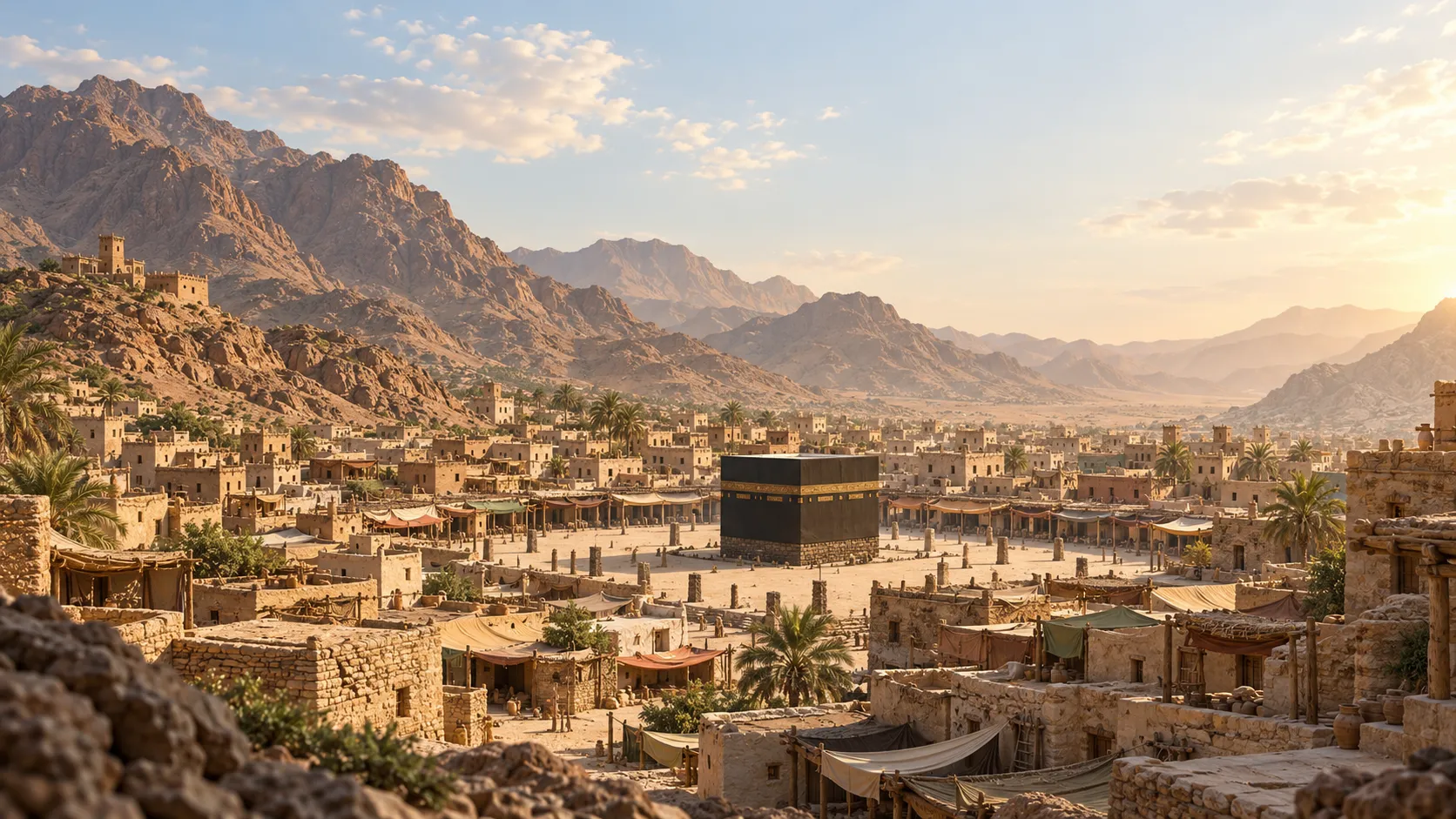
What Is Taqwa in Islam?
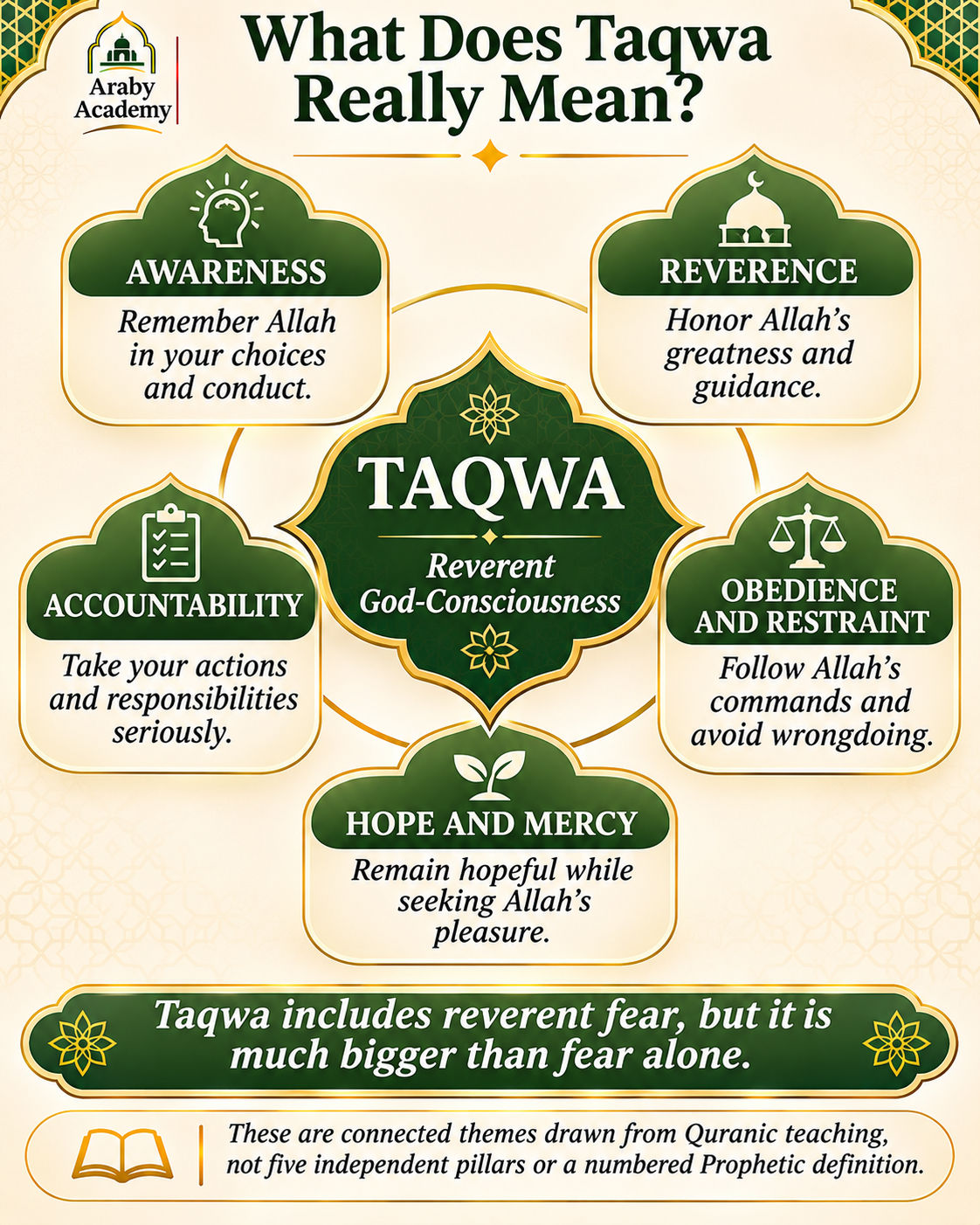
Taqwa (التَّقْوَى) is a Quranic concept commonly translated as God-consciousness, piety, or reverent fear of Allah. Its Arabic root relates to guarding or protecting oneself. In Islamic teaching, Taqwa is awareness of Allah that shapes belief, worship, and everyday decisions, seeking His pleasure and avoiding wrongdoing. It includes reverence and accountability, but it is broader than simply feeling afraid.
A person marked by Taqwa is called a muttaqi (plural: muttaqun or muttaqin), and the command Ittaqillah (اتَّقِ اللَّهَ) is often translated "Fear Allah." That translation is not wrong. Reverent fear of Allah is real and Quranic. But it is incomplete, and treating it as the whole meaning can leave people anxious instead of attentive. This article avoids two opposite mistakes: saying Taqwa is only fear, and saying fear plays no part in it. We rely on the Quran, authentic Hadith, classical Tafsir (Quranic commentary), and Arabic lexicons, and we will be careful to separate what revelation states from modern reflections.
What Does Taqwa Mean in Arabic?
The Root W-Q-Y
The word التَّقْوَى (at-taqwa) comes from the Arabic root و-ق-ي (W-Q-Y), whose core idea is to guard, protect, preserve, or shield. Classical lexicographers such as Ibn Manzur (Lisan al-Arab) and al-Raghib al-Isfahani (al-Mufradat) describe Taqwa in this protective sense: a person places something between themselves and what could harm them. In religious usage, what protects is obedience to Allah, and what one is guarded from is wrongdoing and its consequences.
Several related forms help the picture:
وَقَى (waqa): he protected or guarded. Quran 66:6 says qu anfusakum, "protect yourselves," using the command form of this verb.
اتَّقَى (ittaqa): a Form VIII verb meaning to guard oneself. It began as iwtaqa, and the waw merged into the following ta, producing the doubled tt.
تَقْوَى (taqwa): the verbal noun, in which the original waw became ta.
مُتَّقٍ (muttaqin, indefinite singular): the active participle, "one who practices Taqwa." The plurals are المُتَّقُون (al-muttaqun) and المُتَّقِين (al-muttaqin), depending on grammatical case.
These words are related but not interchangeable: waqa describes protecting someone or something, while ittaqa and taqwa describe a person actively guarding themselves.
Why "Fear Allah" Is an Incomplete Translation
Fear is a real part of reverence and accountability in Islam, and the Quran praises those who fear their Lord (for example, 67:12). So "fear Allah" can be an accurate rendering in many verses. The difficulty is that in English, "fear" usually suggests dread and a wish to flee, while Taqwa moves a believer toward Allah: toward His commands, His pleasure, and His mercy. It also includes recognizing what Allah has commanded, staying morally attentive, avoiding wrongdoing, and obeying responsibly.
Each common English rendering captures a part. "Fear Allah" preserves accountability but can sound like terror. "Be mindful" or "be conscious of Allah" preserves awareness but can sound merely mental. "Have reverence for Allah" preserves awe but loses the protective idea. "Guard yourselves against wrongdoing" preserves the root meaning but can sound legalistic. No single phrase is universally best, which is why many teachers simply keep the Arabic word.
What Does the Quran Say About Taqwa?
Forms of this root appear many times in the Quran, and the verses reveal a concept tied to guidance, honor, justice, worship, and responsibility. (Translations below are the author's renderings; compare reputable published translations.)
Guidance for the Muttaqin
The Quran opens by describing itself as "guidance for the muttaqin" (هُدًى لِلْمُتَّقِينَ, 2:2). The next verses (2:3–5) describe them as those who believe in the unseen, establish prayer, spend from what Allah has provided, believe in the revelation sent to the Prophet ﷺ and earlier messengers, and are certain of the Hereafter. Commentators such as al-Tabari and Ibn Kathir treat these as characteristics of the Muttaqin, not a closed checklist: Quran 2:177 and 3:133–135 add keeping promises, patience, and seeking forgiveness. Tafsir also notes that the Quran is guidance for all people (2:185); the Muttaqin are singled out because they are the ones who truly benefit from it. A person still growing in Taqwa can certainly learn from the Quran.
Taqwa and Human Honor
In 49:13 Allah addresses all of humanity: He created people from a male and a female and made them nations and tribes "to know one another." Then comes the statement: إِنَّ أَكْرَمَكُمْ عِنْدَ اللَّهِ أَتْقَاكُمْ, "Indeed, the most honored of you in the sight of Allah is the most mindful of Him (atqakum)." The verse rejects superiority based on race, tribe, lineage, or wealth. Honor before Allah is not inherited, purchased, or displayed. It also carries a caution: since Allah knows hearts, we cannot declare that a particular living person has the highest Taqwa. The equality here is about dignity and moral worth, not identical roles or circumstances.
Taqwa and Justice
Quran 5:8 says: "O you who believe, be steadfast for Allah, witnesses in justice, and let not hatred of a people lead you to injustice. Be just; that is nearer to Taqwa (huwa aqrabu lil-taqwa)." Taqwa therefore is not only a private feeling. It can require fairness toward people we dislike, whether in testimony, business, family disputes, or online arguments.
How Much Is Asked of Us?
Quran 3:102 says: اتَّقُوا اللَّهَ حَقَّ تُقَاتِهِ, "Have Taqwa of Allah as it is due." Quran 64:16 says: فَاتَّقُوا اللَّهَ مَا اسْتَطَعْتُمْ, "Have Taqwa of Allah as much as you are able." Ibn Mas'ud explained the first as Allah being obeyed and not disobeyed, remembered and not forgotten, thanked and not denied (reported by al-Tabari and Ibn Kathir). Some early authorities held that 64:16 abrogated 3:102, while many others saw it as clarifying it: the full due is sincere obedience within human capacity. The verses do not contradict each other. Together they remove both complacency and perfectionism. Obligations remain obligations; capacity shapes what a person can be held to in a given situation.
More Verses, More Dimensions
Quran 59:18 tells believers to have Taqwa and "let every soul look to what it has sent ahead for tomorrow," calling for honest self-reflection (it does not prescribe a particular journaling ritual). Quran 22:37 says the meat and blood of sacrifice do not reach Allah, "but Taqwa from you reaches Him," stressing sincerity without cancelling the sacrifice's rules. Quran 7:26 calls "the garment of Taqwa" best; commentators connect it with inner righteousness and modesty, not one contemporary clothing style. Quran 2:197 calls Taqwa the best provision in the Hajj context, alongside, not instead of, practical preparation.
Allah's Promises to the Muttaqin
The Quran links Taqwa with guidance (2:2), discernment, or furqan, and forgiveness (8:29), Allah's support (16:128, "Allah is with those who have Taqwa," which Tafsir explains as His aid and knowledge, not human-like companionship), and Paradise in the Hereafter (3:133).
Quran 65:2–3 deserves special care: "Whoever has Taqwa of Allah, He will make for him a way out, and provide for him from where he does not expect. And whoever relies on Allah, He is sufficient for him." The context is divorce and the waiting period, where spouses are told to part or remain together with fairness and honesty (65:1–2). Commentators also apply the promise more broadly: relief from difficulty and provision (rizq) that is not restricted to money. It is not a wealth formula. It does not promise a promotion next month, an easy life, or immunity from poverty, illness, or loss, and hardship is never proof that someone lacks Taqwa. The passage pairs Taqwa with trust and ends by saying Allah has set a measure for everything (65:3). Believers should hold the promise with hope and humility, leaving its form and timing to Allah.
What Does the Prophet ﷺ Teach About Taqwa?
Abu Hurayrah reported (Sahih Muslim 2564) that the Prophet ﷺ forbade envy, hatred, and abandoning one another, said a Muslim does not wrong, betray, or look down on his brother, and then pointed to his chest three times: التَّقْوَى هَاهُنَا, "Taqwa is here." He added that it is enough evil for a person to look down on a fellow Muslim. Scholars such as al-Nawawi explain that Taqwa is rooted in the heart, which is why only Allah fully knows it and why contempt for others is serious. It does not mean outward behavior is irrelevant: the same narration calls every Muslim's blood, property, and honor sacred.
Abu Dharr and Mu'adh ibn Jabal reported that the Prophet ﷺ said: اتَّقِ اللَّهَ حَيْثُمَا كُنْتَ, "Have Taqwa of Allah wherever you are; follow a bad deed with a good deed and it will wipe it out; and treat people with good character" (Jami' al-Tirmidhi; graded hasan, with some manuscripts giving hasan sahih; included in al-Nawawi's Forty Hadith). Notice the three parts: private conduct, repair after mistakes, and treatment of people. "Wherever you are" includes being alone, at work, or online, yet the hadith itself contains the remedy for slipping, so it cannot mean living in panic.
Taqwa vs Fear, Khashyah, Ihsan, and Wara'
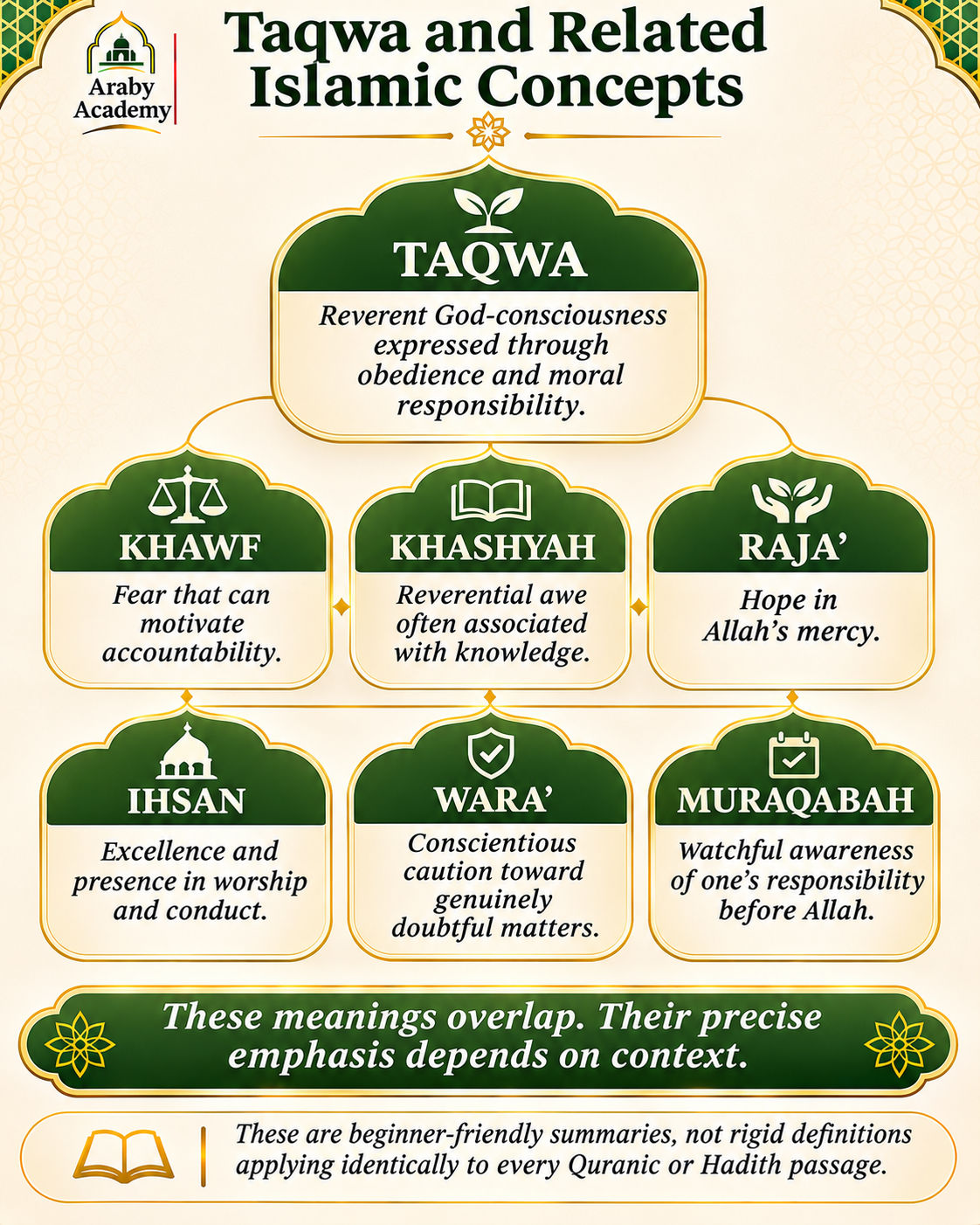
These terms overlap, and scholars define them by context rather than as rigidly separate boxes.
Khawf (الخَوْف), fear: an emotion that can be worldly or religious. Fear of Allah's displeasure is praised, as in 32:16: "they call upon their Lord in fear and hope." Khawf can motivate Taqwa, but Taqwa is wider: a stance of guarding oneself, expressed in conduct.
Khashyah (الْخَشْيَة), reverential awe: often connected with knowledge of Allah's greatness, as in 35:28: "Only those of His servants who have knowledge truly fear Allah." Scholars describe it as deeper, knowledge-based awe, but usage varies and no rigid distinction holds in every verse.
Raja' (الرَّجَاء), hope: hope in Allah's mercy. Fear and hope are meant to be held together; hope is never permission to neglect responsibilities.
Ihsan (الإِحْسَان), excellence: the Hadith of Jibril (Sahih al-Bukhari and Sahih Muslim) defines it as worshipping Allah as though you see Him, and if you do not see Him, knowing that He sees you. Ihsan stresses the quality and presence of worship and conduct; Taqwa stresses guarding oneself. They overlap, and Quran 16:128 mentions both together.
Wara' (الْوَرَع), conscientious restraint: caution about doubtful matters, according to recognized scholarship. The Hadith of al-Nu'man ibn Bashir (Sahih al-Bukhari and Sahih Muslim) says the lawful is clear, the unlawful is clear, and between them are doubtful matters; whoever guards against them protects his religion and honor, and the heart is the key to the whole body. A "doubtful matter" means a genuinely unresolved question, not every passing worry or personal preference.
Muraqabah (الْمُرَاقَبَة), watchfulness: staying aware that Allah knows and that we are accountable. It is closely tied to Ihsan, and it is a healthy awareness, not paranoia or surveillance.
In short, khawf and khashyah describe inner states, raja' balances them, ihsan describes the quality of worship, wara' describes caution, and Taqwa is the wider posture that gathers these into a life guarded by obedience.
Is Taqwa in the Heart or in Our Actions?
Both. Taqwa is located in the heart (Sahih Muslim 2564), and it shows in worship, truthfulness, justice, and self-restraint. The Quran's descriptions of the Muttaqin, such as 2:177, blend belief, prayer, spending, keeping promises, and patience. So Taqwa is neither an emotion alone nor a performance alone.
This also guards us against judging others. Clothing, wealth, and social status are not reliable measures of Taqwa, and only Allah knows sincerity fully. Yet that does not erase accountability for visible harm: people may reasonably judge conduct for practical, legal, or safety purposes. Nor is Taqwa the same as strictness. Sincere obedience, sound knowledge, and appropriate caution are one thing; harshness, invented restrictions, and condemning others without evidence are another. Personal caution is admirable; imposing it on others as an obligation without evidence is not.
How Does Taqwa Shape Everyday Decisions?
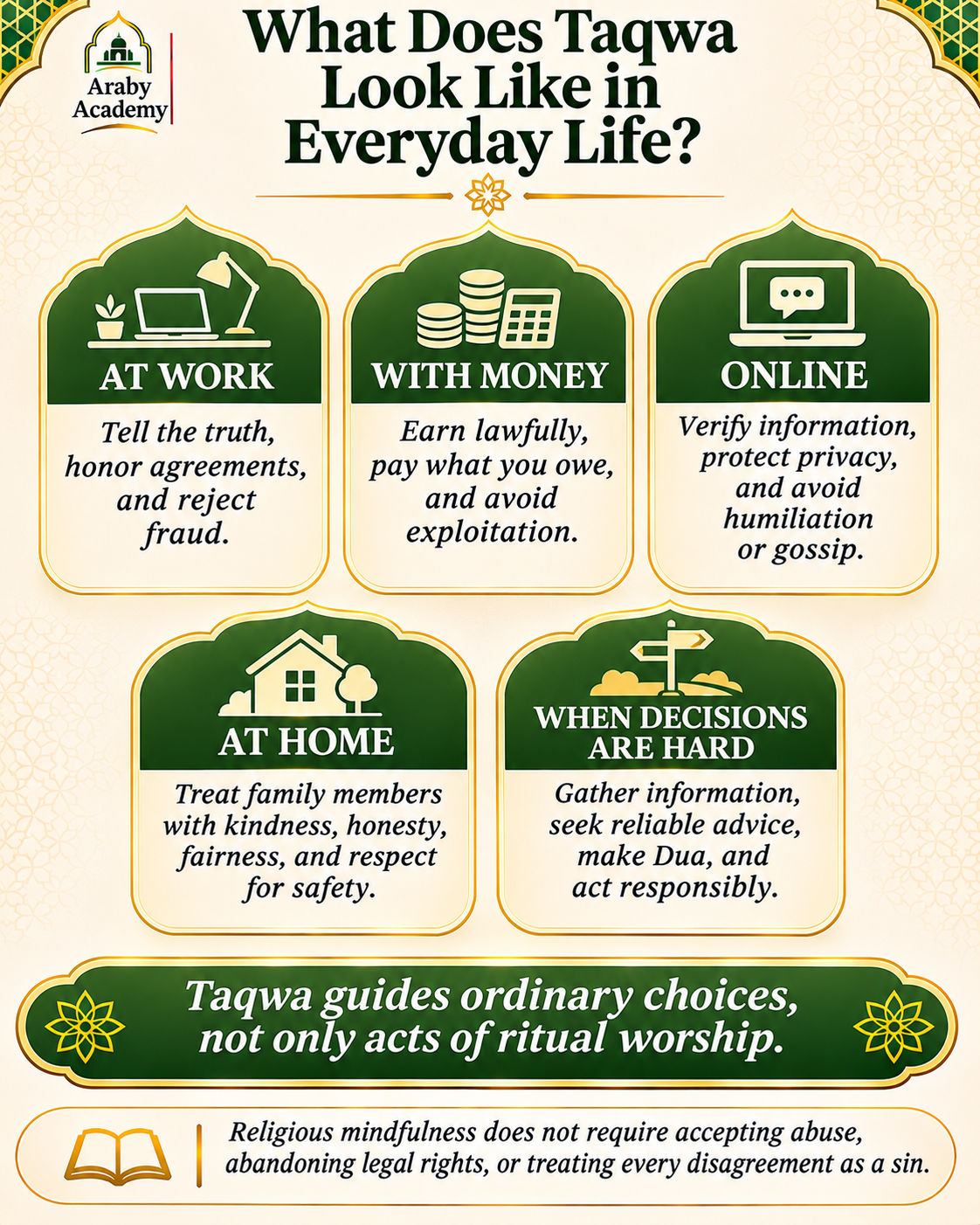
Taqwa becomes visible in ordinary choices, not only in ritual.
At work. Honest reporting, respecting agreements, not misusing company resources, refusing fraud, and treating colleagues fairly all reflect Taqwa. Not every workplace disagreement is a religious sin, though; sometimes it is simply a disagreement.
With money. Earning lawfully, keeping contracts honest, paying what is owed, and not exploiting others are basic expressions of Taqwa.
Integrity in spending, earning, and everyday responsibilities is part of [: practicing Halal living in the West] without separating religious belief from ordinary decisions.
For specific financial rulings, consult a qualified scholar rather than relying on general articles.
Online. Not spreading rumors, verifying news before sharing (49:6), not mocking or humiliating others (49:11), and respecting privacy are Quran-based habits. Ordinary social media use is not inherently forbidden. Behavior when no one is watching can reflect sincerity, but this should not become compulsive self-monitoring.
At home. Respect, fairness, honesty, fulfilling duties, and avoiding verbal cruelty reflect Taqwa, and the Quran commands living with spouses in kindness (4:19). "Fear Allah" must never be used as a tool of coercion between spouses, and Taqwa never requires tolerating abuse or hiding it. Patience, forgiveness, boundaries, and protection are different things: a person need not forgive before they are ready and safe, and need not abandon lawful justice. Children learn Taqwa from example more than from warnings.
Under pressure. A teenager is asked to pass around exam answers. An employee is asked to backdate a document. A person fears losing status by speaking honestly. Taqwa here means choosing responsibly, seeking advice, and asking Allah for steadfastness, without moral panic about being imperfect.
Difficult decisions. Taqwa does not remove the need to think. It means gathering information, avoiding clearly prohibited options, consulting knowledgeable people, making sincere Dua, and then acting responsibly.
Making responsible choices while accepting uncertain outcomes also connects Taqwa with [ Divine Decree and human responsibility] in Islamic belief.
Taqwa does not give anyone control over the future; it asks for responsible effort, honest intention, and trust.
How Do Salah, Quran, Dhikr, and Dua Develop Taqwa?
One of the most consistent ways Muslims practice religious awareness is through [ the five daily prayers], which create recurring moments of worship throughout the day. Allah says to establish prayer for His remembrance (20:14), and prayer is described as restraining from immorality and wrongdoing (29:45). Prayer builds discipline and humility, and a person who struggles with concentration has not lost Taqwa; striving to return attention is part of the effort.
Studying Taqwa becomes more meaningful when a Muslim builds [ a daily Quran reading habit that actually lasts] and reflects on the guidance being recited. The Quran asks believers to reflect on it (47:24). Understanding its commands, warnings, mercy, and ethics should accompany recitation, which is one reason Quranic Arabic study is so valuable.
Brief moments of [ remembering Allah through daily Dhikr] can help a believer reconnect ordinary decisions with the awareness that faith should shape their behavior. The Quran says hearts find rest in remembrance (13:28). Dhikr includes gratitude and istighfar (seeking forgiveness). There is no authenticated fixed number of repetitions specifically for gaining Taqwa.
A believer who wants to grow in Taqwa can begin by learning [ how to make sincere Dua and ask Allah for guidance] using authentic supplications. Two are reported in Sahih Muslim. From Zayd ibn Arqam (excerpt): اللَّهُمَّ آتِ نَفْسِي تَقْوَاهَا، وَزَكِّهَا أَنْتَ خَيْرُ مَنْ زَكَّاهَا, "O Allah, grant my soul its Taqwa and purify it; You are the best to purify it." From Ibn Mas'ud: اللَّهُمَّ إِنِّي أَسْأَلُكَ الْهُدَى وَالتُّقَى وَالْعَفَافَ وَالْغِنَى, "O Allah, I ask You for guidance, Taqwa, chastity (self-restraint), and sufficiency." Supplication is worship and asks for what a person needs, but it does not promise an immediate worldly result.
Why Is Ramadan Connected to Taqwa?
Quran 2:183 states: "O you who believe, fasting is prescribed for you as it was prescribed for those before you, so that you may attain Taqwa" (la'allakum tattaqun, لَعَلَّكُمْ تَتَّقُونَ). A short Arabic lesson: la'alla is a particle often rendered "perhaps" or "so that." Scholars explain that when it speaks of Allah's purposes, it expresses expectation or purpose, and it does not carry one rigid meaning in every verse. Tattaqun is a Form VIII present-tense verb in the second-person plural, from ittaqa: "you guard yourselves." The verse presents fasting as a path toward Taqwa, not an automatic result.
Why might fasting help? It trains restraint even from lawful things, which supports restraint from unlawful ones. It is a hidden act of sincerity known to Allah. It nurtures gratitude and encourages more worship. But fasting is not only hunger. In Sahih al-Bukhari, the Prophet ﷺ said that whoever does not give up false speech and acting upon it, Allah has no need of his giving up food and drink. Scholars distinguish between a fast being legally valid and its spiritual reward being diminished. In daily life, Ramadan Taqwa looks like honesty, patience when provoked, good speech, fairness, generosity, and responsibility. Ramadan is a training season, but Taqwa is meant for the other eleven months too.
Taqwa, Tawakkul, and Sabr
Taqwa shapes the choices a believer makes, while [ trusting Allah without becoming passive] helps them act responsibly when outcomes remain uncertain. Tawakkul (reliance on Allah) means relying on Him while taking lawful means. The two overlap and strengthen one another, as 65:2–3 shows by pairing them. Asking people for ordinary lawful help is fully compatible with trusting Allah.
Sabr (patience, perseverance, and restraint) often appears with Taqwa, as in 3:125 and 12:90. It is not silent suffering and not passivity in unsafe situations; it includes responsible action, prayer, and moral restraint.
Understanding Taqwa also helps readers think more carefully about [ why Allah tests people through hardship], without claiming that every painful event reveals someone's spiritual rank. Taqwa does not prevent grief either. When the Prophet ﷺ lost his son Ibrahim, he said that the eyes shed tears and the heart grieves, and we say only what pleases our Lord (Sahih al-Bukhari and Sahih Muslim). Sadness, uncertainty, and loss are ordinary human experiences, not proof of weak Taqwa.
Does Having Taqwa Mean You Never Sin?
No. Quran 3:133–135 describes the Muttaqin as those who spend in ease and hardship, restrain anger, and pardon people, and who, "when they commit an indecency or wrong themselves, remember Allah and seek forgiveness for their sins (and who forgives sins except Allah?) and do not knowingly persist in what they did." Taqwa is not sinlessness; it is recognizing wrongdoing, seeking forgiveness, not knowingly persisting, and returning to obedience. The Prophet ﷺ said that every son of Adam sins, and the best of sinners are those who repent (Jami' al-Tirmidhi and Sunan Ibn Majah; graded hasan by many scholars).
Scholars generally describe sincere repentance (tawbah) as stopping the sin, regretting it, and resolving not to return. When another person was wronged, their rights must also be restored; repentance does not automatically erase them. Sin also differs from pretending wrongdoing is acceptable. Taqwa combines hope in Allah's mercy with respect for His commands, responsibility for harm done, and freedom from arrogance, so fear-only preaching misses half the picture. And since we cannot see hearts, we cannot rank one another's inner piety.
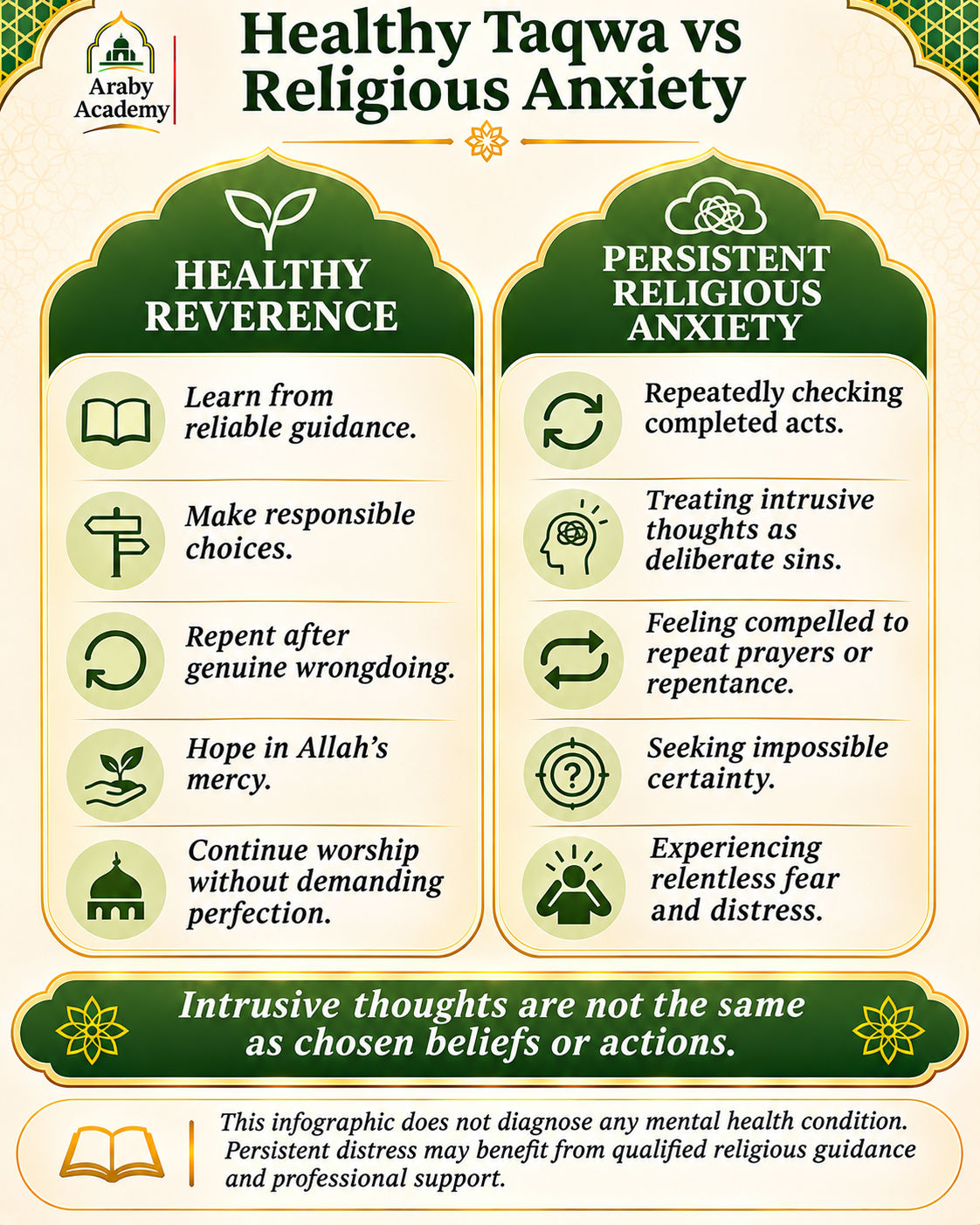
Taqwa Is Not the Same as Religious Anxiety
Healthy reverence looks like learning, making responsible choices, repenting when wrong, and trusting Allah's mercy. Persistent obsessive fear, repeated checking, compulsive repentance rituals, constant uncertainty about faith, and intrusive thoughts treated as deliberate sins are something else. In Islamic discussions, waswas (الْوَسْوَاس, whispering) refers to insinuating thoughts, and later scholars also use it for repetitive, uncontrollable doubts, especially around purity and prayer. In Sahih Muslim, Companions told the Prophet ﷺ about thoughts too terrible to speak, and he said that this is clear faith. In Sahih al-Bukhari and Sahih Muslim, he said Allah has overlooked for his community what crosses their minds, so long as they do not act on it or speak it. Intrusive thoughts are not the same as deliberate disbelief or sin. Scholars advise people troubled by severe waswas not to yield to it. This article does not diagnose, and mental health struggles are not a sign of weak faith.
Healthy reverence should not be confused with relentless panic; readers experiencing persistent distress may benefit from guidance about [anxiety, worry, and trust in Allah] alongside appropriate professional support.
Allah does not burden a soul beyond its capacity (2:286), so Taqwa never demands self-punishment or flawless performance.
7 Practical Ways to Increase Taqwa
These are educational suggestions drawn from broader teachings, not a numbered list from the Prophet ﷺ or a prescribed ritual.
Learn Allah's commands through reliable teachers and sources.
Protect the obligatory prayers, and improve attention gradually.
Read and understand the Quran regularly.
Remember Allah through authentic Dhikr.
Make sincere Dua, including the supplications above.
Examine everyday decisions with honesty and fairness.
Repent after wrongdoing and keep learning.
A short optional reflection routine, offered as a modern educational tool and not a fixed Sunnah ritual: in the morning, recall one Quranic teaching; during the day, pause before an ethically important decision; after prayer, make a brief Dua; in the evening, note one good choice and one area to improve, in keeping with the spirit of 59:18.
Rather than attempting an overwhelming spiritual transformation overnight, begin with [a daily Islamic routine that fits a busy life] and improve one consistent habit at a time.
How to Teach Taqwa to Children
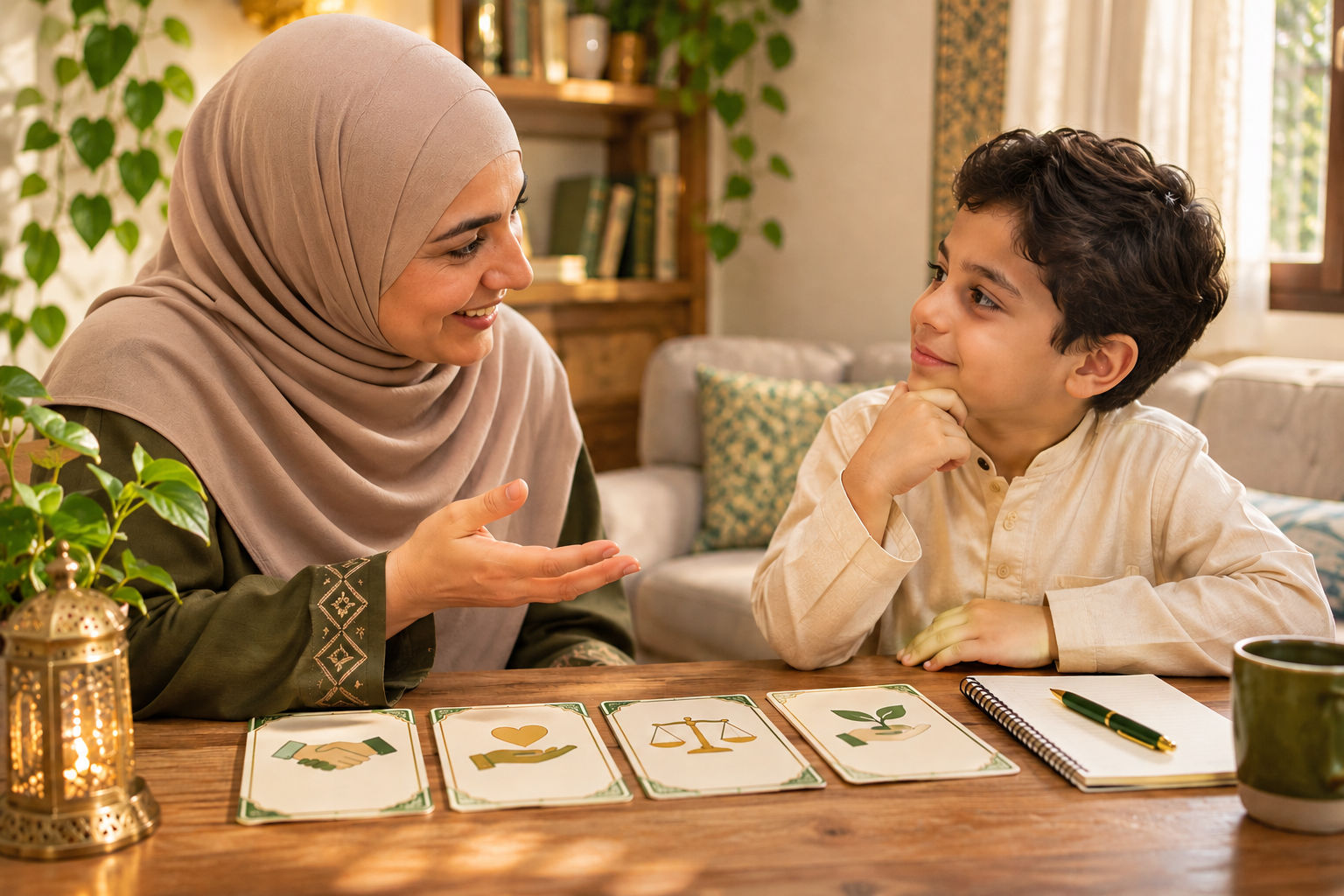
Children absorb Taqwa through example, warmth, and stories more than threats. Gently teach that Allah knows us, we try to do what is right, we tell the truth, we treat others fairly, we ask Allah for help, and we can apologize and improve after mistakes. Avoid threatening young children with constant punishment. Helpful activities, offered as educational tools rather than religious requirements, include Quran vocabulary cards, stories about honesty, small decision scenarios, gratitude journals, family conversation after prayer, and short authentic Duas.
For Teens and New Muslims
Teenagers face real tests of integrity: school honesty, peer pressure, online behavior, and self-control. Meet these with guidance, not moral panic. New Muslims do not need to master every fiqh topic at once, and Taqwa is not a perfection test for entering Islam. A sensible start is Tawhid, prayer, basic Quran reading, learning obligations, Dua, and growth in character.
15 Arabic Words Related to Taqwa
Some of these are Quranic words; others, such as muraqabah, wara', and niyyah, became technical terms in later scholarship. They do not all appear together in one verse.
Arabic | Transliteration | Meaning | Root and context | Learning note |
|---|---|---|---|---|
التَّقْوَى | at-taqwa | God-consciousness, reverent piety | W-Q-Y; Quran 49:13 | Notice the ta replacing a waw. |
الْمُتَّقُون | al-muttaqun | Those characterized by Taqwa | W-Q-Y; Quran 2:2 | Form VIII active participle. |
اتَّقُوا | ittaqu | Have Taqwa; guard yourselves | W-Q-Y; Quran 3:102 | A command to a group. |
الْخَوْف | al-khawf | Fear | Kh-W-F; Quran 32:16 | Often paired with hope. |
الْخَشْيَة | al-khashyah | Reverential awe | Kh-Sh-Y; Quran 35:28 | Linked with knowledge. |
الرَّجَاء | ar-raja' | Hope | R-J-W; Quran 39:9 | Hope motivates action. |
الإِحْسَان | al-ihsan | Excellence in worship and conduct | H-S-N; Hadith of Jibril | Related to muhsin. |
الْوَرَع | al-wara' | Conscientious restraint | W-R-': later technical term | Caution, not obsession. |
الْمُرَاقَبَة | al-muraqabah | Watchful awareness | R-Q-B; later technical term | Healthy attentiveness. |
الإِخْلَاص | al-ikhlas | Sincerity | Kh-L-S; Quran 98:5 | Purifying worship for Allah. |
النِّيَّة | an-niyyah | Intention | N-W-Y; Hadith of intentions | Technical term from Hadith. |
الصَّبْر | as-sabr | Patience, steadfastness | S-B-R; Quran 3:125 | Includes action, not only waiting. |
التَّوْبَة | at-tawbah | Repentance | T-W-B; Quran 3:135 | Literally "returning." |
الْعَدْل | al-'adl | Justice | '-D-L; Quran 5:8 | Appears in the verse linking justice to Taqwa. |
الذِّكْر | adh-dhikr | Remembrance | Dh-K-R; Quran 13:28 | Includes the heart and tongue. |
Learning Arabic does not automatically make someone more pious, but roots, word forms, context, and Tafsir make the Quran's vocabulary richer.
Common Misconceptions About Taqwa
Taqwa means constant terror. It includes reverence and accountability but is broader than panic.
Taqwa is only an emotion. It shapes belief, worship, and conduct.
Taqwa means never sinning. The Quran describes believers repenting (3:135).
Sadness means I lack Taqwa. Grief is not automatic spiritual failure.
A person with Taqwa never faces hardship. Righteous people can be tested.
Quran 65:2–3 guarantees quick wealth. Read it through Tafsir and context, not as a commercial formula.
Clothing measures Taqwa. Conduct matters, but inner sincerity is known fully by Allah.
Taqwa means never asking people for help. Lawful assistance is compatible with reliance on Allah.
More anxiety means more Taqwa. Obsessive doubt is not a reliable measure of piety.
Only scholars can have Taqwa. It is a goal for all believers.
Taqwa matters only in Ramadan. It is for all of life.
Taqwa is only avoiding Haram. Quran 5:8 connects justice to it.
Taqwa means accepting abuse silently. It never erases safety, justice, or rights.
Repeating the word "Taqwa" a set number of times guarantees reward. Such prescriptions need authenticated evidence.
Each of these corrections points the same way: Taqwa is sincere, informed, and humane.
Frequently Asked Questions
1. What is Taqwa in Islam? A Quranic concept of reverent God-consciousness that leads a person to guard themselves from wrongdoing through obedience to Allah, expressed in belief, worship, and conduct.
2. What does Taqwa mean in Arabic? From the root W-Q-Y, the idea is guarding or protecting. Religiously, it means protecting oneself from wrongdoing by following Allah's guidance.
3. Does Taqwa simply mean fear of Allah? Fear is part of it, but not all. Taqwa also includes awareness, obedience, moral attentiveness, hope, and responsibility.
4. What is the root of the word Taqwa? The triliteral root و-ق-ي (W-Q-Y), meaning to protect or guard.
5. What does Ittaqillah mean? It means "Have Taqwa of Allah": revere Him, follow His guidance, and guard yourself from wrongdoing. It is more than "be terrified of Allah."
6. Who are the Muttaqin? People characterized by Taqwa, such as those described in Quran 2:2–5, 2:177, and 3:133–135. They are not sinless.
7. Why is Taqwa important in the Quran? The Quran links it with guidance, discernment, forgiveness, justice, honor before Allah, and reward in the Hereafter.
8. What does Quran 49:13 say about Taqwa? The most honored before Allah is the one with the most Taqwa, not the one with the most wealth, lineage, or status.
9. How does fasting increase Taqwa? Quran 2:183 presents fasting as a path toward Taqwa by training self-restraint, sincerity, gratitude, and attention to worship.
10. What is the difference between Taqwa and Ihsan? Taqwa stresses guarding oneself through obedience; Ihsan stresses excellence and presence in worship. They overlap.
11. What is the difference between Taqwa and Khawf? Khawf is fear, an emotion; Taqwa is a wider stance of guarding oneself that fear may help motivate.
12. What is the difference between Taqwa and Tawakkul? Taqwa concerns reverent obedience; Tawakkul is relying on Allah while taking lawful means. They support each other.
13. Can a person have Taqwa and still commit sins? Yes. Muslims can struggle and sincerely repent; Quran 3:135 praises those who seek forgiveness and do not knowingly persist.
14. Is Taqwa only in the heart? Its root is the heart, but it shows in prayer, honesty, justice, and restraint.
15. How can Muslims increase Taqwa? Learn the commands, keep prayer, read and understand the Quran, remember Allah, make Dua, act fairly, and repent after mistakes.
16. Does Taqwa guarantee wealth or an easy life? No. Quran 65:2–3 promises a way out and provision in Allah's way and timing, not guaranteed wealth or freedom from hardship.
17. Does Taqwa mean feeling anxious all the time? No. Healthy reverence is not relentless panic. Persistent distress deserves support, including professional help.
18. What Dua can Muslims make for Taqwa? One authentic Dua from Sahih Muslim asks Allah to grant the soul its Taqwa and purify it (see the excerpt above).
Conclusion: Taqwa Is Awareness of Allah That Changes How We Live
Is Taqwa just fear? Reverence for Allah is part of it. But Taqwa also appears in worship, honesty, justice, self-restraint, humility, repentance, responsibility, and trust. It is not a demand to become emotionally numb or sinless. It is an ongoing commitment to live with awareness of Allah and to seek His guidance when choices become difficult.
Taqwa is not measured by how frightened a person feels, but understood through the Quranic call to revere Allah, follow His guidance, avoid wrongdoing, and keep returning to Him with sincerity. If you want to read the Quran's words as they were revealed, studying Quranic Arabic and Islamic Studies with qualified teachers at Araby Academy is a gentle place to begin.