I Want to Do More, But I Don't Have More Time
The alarm rings. Fajr is waiting, and so are the children, breakfast, the school run and the commute. Then work: meetings, deadlines, and Dhuhr squeezed between them. Asr arrives before you notice. After work come groceries, dinner, homework, Maghrib and family time, then Isha, and then exhaustion, usually with a phone in your hand.
Somewhere inside that day you also want Quran, Dhikr and Dua. You want to learn your religion, maybe study Arabic, exercise, sleep properly and be present with the people you love. Then you open social media and see someone who wakes at 4 a.m., prays Tahajjud, reads Quran for an hour, works out, and starts work at eight with a colour-coded planner. You close the app feeling like you are failing.
Often the problem is not a lack of sincerity. The problem is that we design a daily Islamic routine for an imaginary life instead of the one we actually live.
This guide takes a different approach: build your Islamic routine around your real responsibilities, not around an idealized internet schedule. You will find a simple framework, sample routines for professionals, students, parents, shift workers and new Muslims, and ways to keep going on bad days.
One note on honesty before we begin. In this article we separate three things: what Islam makes obligatory, what is authentically recommended, and what is simply a practical suggestion from us. Time blocks such as "10 minutes", frameworks such as "Anchor → Add → Expand", and challenges such as a 7-day reset are editorial habit-building tools. They are not Quran or Sunnah. We will remind you of this where it matters.
There Is No Single "Islamic Routine"
A nurse on rotating shifts, a university student with a changing timetable, a mother with a newborn, a business owner, a retiree and a teenager cannot all follow the same schedule, and Islam does not ask them to. Allah says: "Allah does not burden a soul beyond its capacity" (Quran 2:286, لَا يُكَلِّفُ اللَّهُ نَفْسًا إِلَّا وُسْعَهَا).
What is universal is the set of obligations: the five daily prayers, fasting in Ramadan, and the other duties of a Muslim. These are authoritative. A personal productivity schedule is not. When someone presents their morning as "the Muslim routine", they are sharing what works for their life, which may be useful to you or may not fit at all.
So the question is not "What does the ideal Muslim do from 4 a.m. to 9 a.m.?" It is "What does my life contain, and how do I place worship at its centre?"
Start With the Obligatory, Not the Optimal
Before asking, "How do I fit Tahajjud, one Juz, a thousand Dhikr repetitions, Arabic lessons and a lecture into my day?", ask a more basic question: How are my five obligatory prayers?
Allah says that prayer is "prescribed for the believers at specified times" (Quran 4:103, إِنَّ الصَّلَاةَ كَانَتْ عَلَى الْمُؤْمِنِينَ كِتَابًا مَّوْقُوتًا). The Prophet ﷺ also taught that, in a Hadith Qudsi, Allah says: "My servant does not draw near to Me with anything more beloved to Me than what I have made obligatory upon him, and My servant continues to draw near to Me with voluntary acts until I love him" (Sahih al-Bukhari 6502, paraphrased).
The order matters. Voluntary worship is valuable and the Hadith itself encourages it, but it is built on top of the obligations, not in place of them. A person who builds an elaborate optional morning routine while regularly missing Fajr, or delaying prayers without a valid reason, has the structure upside down.
This is not meant to discourage you from voluntary worship. It is meant to give you a stable base, because additional worship tends to last longer when it rests on a protected foundation. If prayer is currently a struggle, that is the project to start with, and nothing else on this page is more urgent.
Let the Five Prayers Be the Structure of Your Day
Most people try to squeeze prayer into their schedule. Try the reverse:
Let the five prayers become the recurring anchors around which the day is organized.
The day then looks like this:
Fajr → the start of the day
Morning block
Dhuhr → a midday pause
Midday block
Asr → the afternoon transition
Late-afternoon block
Maghrib → the evening transition
Evening block
Isha → closing the day
Night and sleep
This is practical framing. We are not claiming that each prayer time has a revealed "meaning" such as "Dhuhr is for resetting." Many people simply find it helpful to treat prayer times as natural pauses, so the day is divided into manageable blocks rather than one long stretch.
Prayer also has a built-in advantage as an anchor: it happens at the same events every day, regardless of mood. A habit attached to "after Isha" is much more reliable than a habit attached to "when I have time."
The prayer times are sacred and fixed by Allah. What goes between them is where your flexibility lives.
Prayer Times Change, So Your Routine Must Flex
Prayer times shift by location, season and date. In the UK, Canada, Northern Europe and much of the United States, Fajr can be very early in summer and Maghrib very late, while in winter several prayers fall inside working or school hours. At very high latitudes, communities rely on scholarly guidance for determining times, so follow your local mosque or recognized fiqh authority there.
For this reason we never give a universal clock-based schedule. Instead:
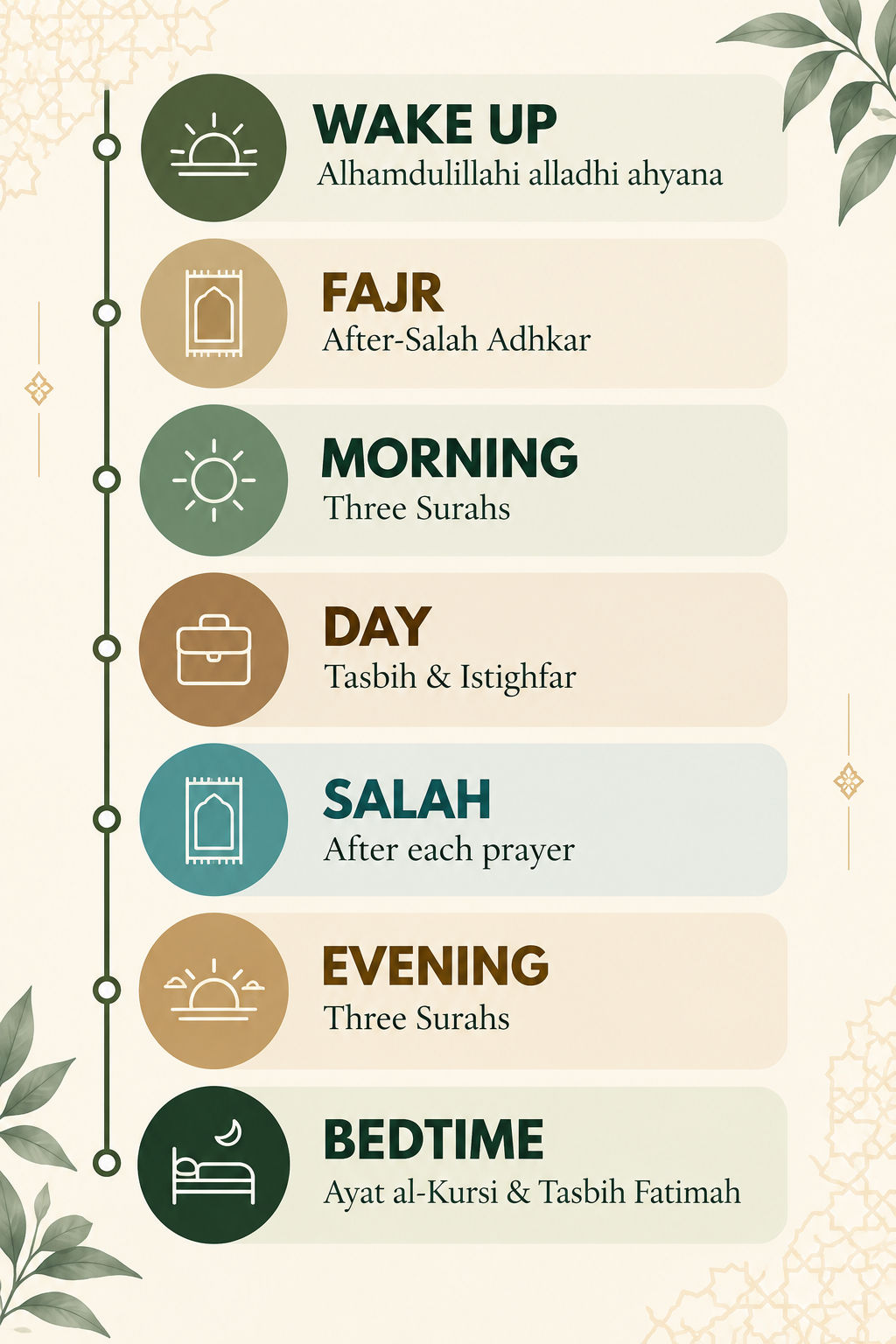
Build routines around prayer events and flexible blocks, not only fixed clock times.
Instead of "Read Quran every day at 6:00 a.m.", try "Read Quran for 10 minutes after Fajr, where realistically possible." The first breaks in June, in December and when your shift changes. The second adapts automatically.
Clock times are not wrong. If you have a fixed 9-to-5 and a stable timetable, a 7:30 p.m. study slot can work well. The point is to choose anchors that survive change.
Do Not Build Your Routine Around a "Perfect Morning"
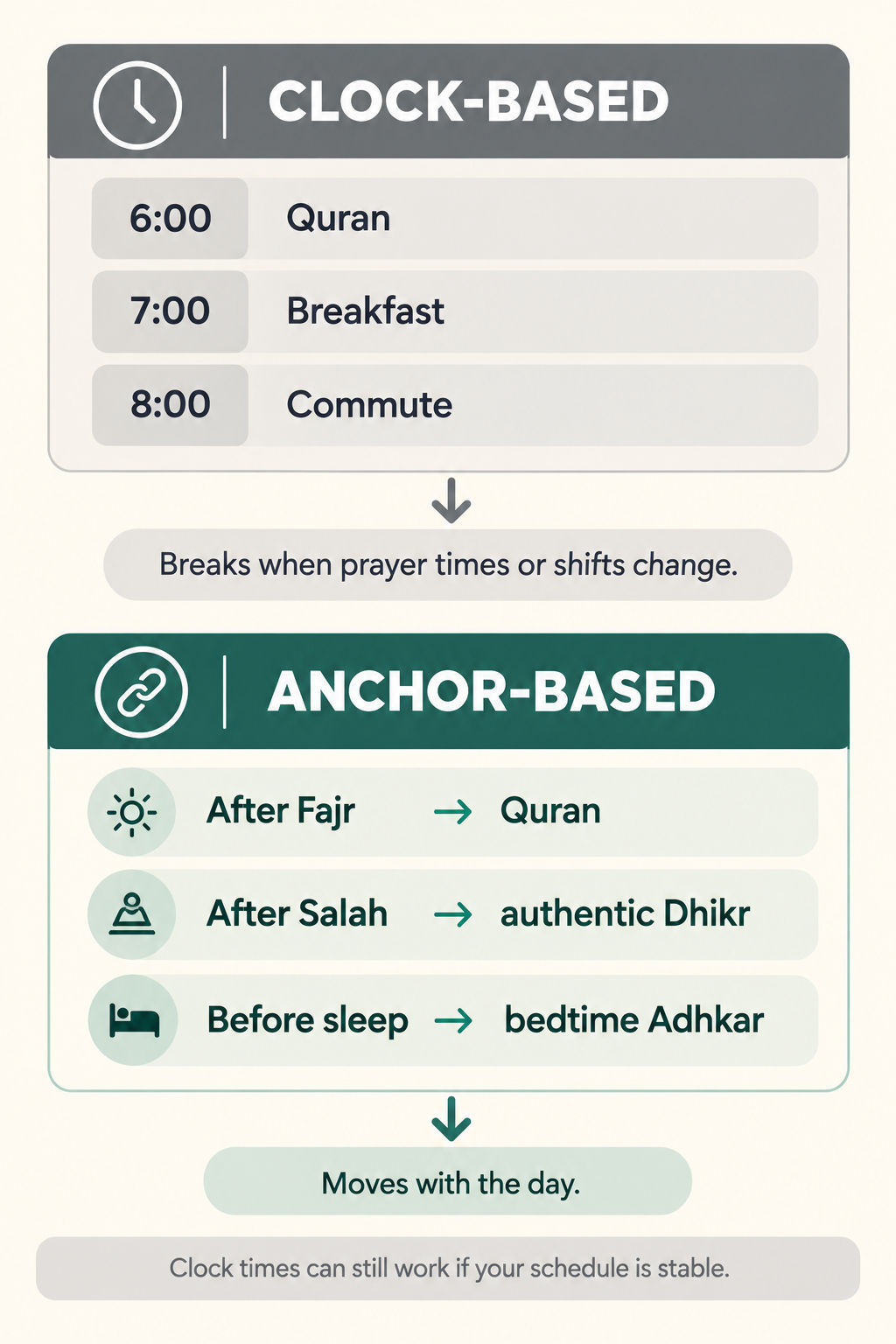
Early rising is wonderful and nothing here criticizes it. But a good practice can become impractical when it is copied without considering circumstances. Not everyone works 9 to 5, sleeps at the same time, has no children, lives at the same latitude, or has the same health and energy.
If waking early suits your life, make use of it. If it does not, you are not behind. You are simply living a different life.
Anchor → Add → Expand
Here is the practical framework this article is built on.
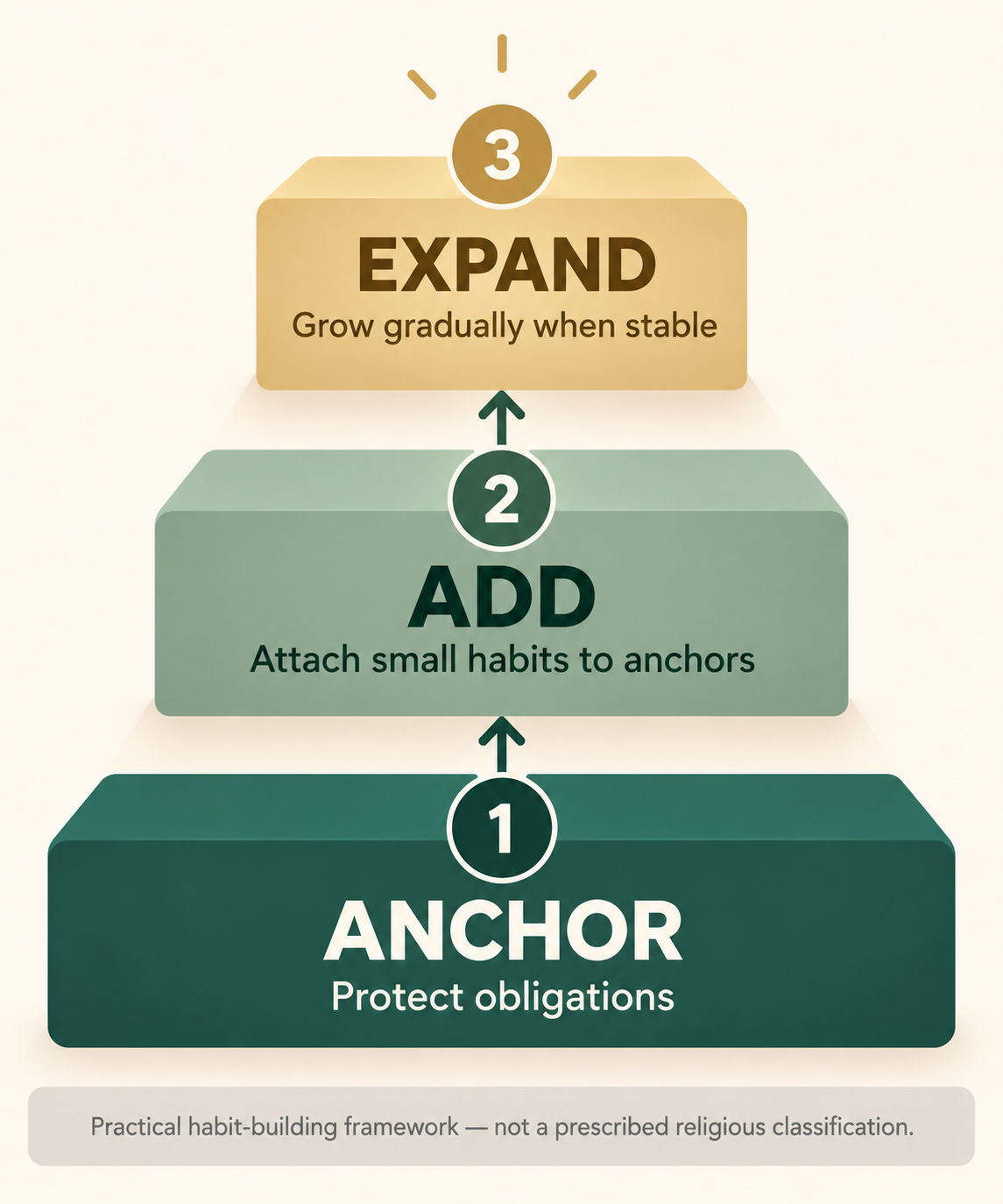
Important: Anchor → Add → Expand is an educational, habit-building framework created for this article. It is not terminology from the Quran or Sunnah, and it is not a revealed classification.
1. ANCHOR: protect the essentials. Establish and protect your obligations and basic daily anchors, such as the five prayers, your necessary Islamic responsibilities, and the basic authentic remembrance you can manage.
2. ADD: attach small acts to anchors that already exist. For example, a little Quran after Fajr, the authentic Dhikr after Salah, a Dua before sleep, or a safe Islamic audio lesson during a commute.
3. EXPAND: grow gradually once you are consistent. Only then add more Quran, extra voluntary prayers, Arabic study, Islamic Studies, memorization, longer reflection or additional authentic Adhkar.
The rule that holds it together is this: do not expand a routine that has no stable foundation. Most abandoned routines fail because someone started at stage three.
Consistency Over Unsustainable Intensity
Aisha (may Allah be pleased with her) reported that the Prophet ﷺ said that the most beloved deeds to Allah are the most consistent, even if they are small (Sahih al-Bukhari 6464, Sahih Muslim 783).
Be careful how you use this Hadith. It does not say that small deeds are always better than large ones. It teaches that consistency matters, and that a deed you can keep up is valued. The Prophet ﷺ also discouraged people from overburdening themselves, saying that the religion is ease and that whoever tries to overpower it will be overcome (Sahih al-Bukhari 39).
So 10 minutes of Quran that you actually do most days may be more sustainable than an hour that you attempt for three days and then abandon. We cannot rank rewards mathematically; that is Allah's knowledge. We can say that sustainable habits are easier to keep.
There is a related Quranic ease worth remembering. Allah says in the context of night prayer: "So recite what is easy for you of the Quran" (73:20).
How Small Should You Start?
Here are realistic starting points.
These durations are practical suggestions, not Sunnah-prescribed amounts.
Quran: 5–10 minutes of reading or listening on most days
Arabic: about 10 minutes, several times a week
Dhikr: the authentic remembrance after Salah
Dua: a few focused minutes in your own words
Islamic Studies: one structured lesson per week
If these feel too ambitious right now, shrink them. A habit you can complete on your worst day is the one that survives.
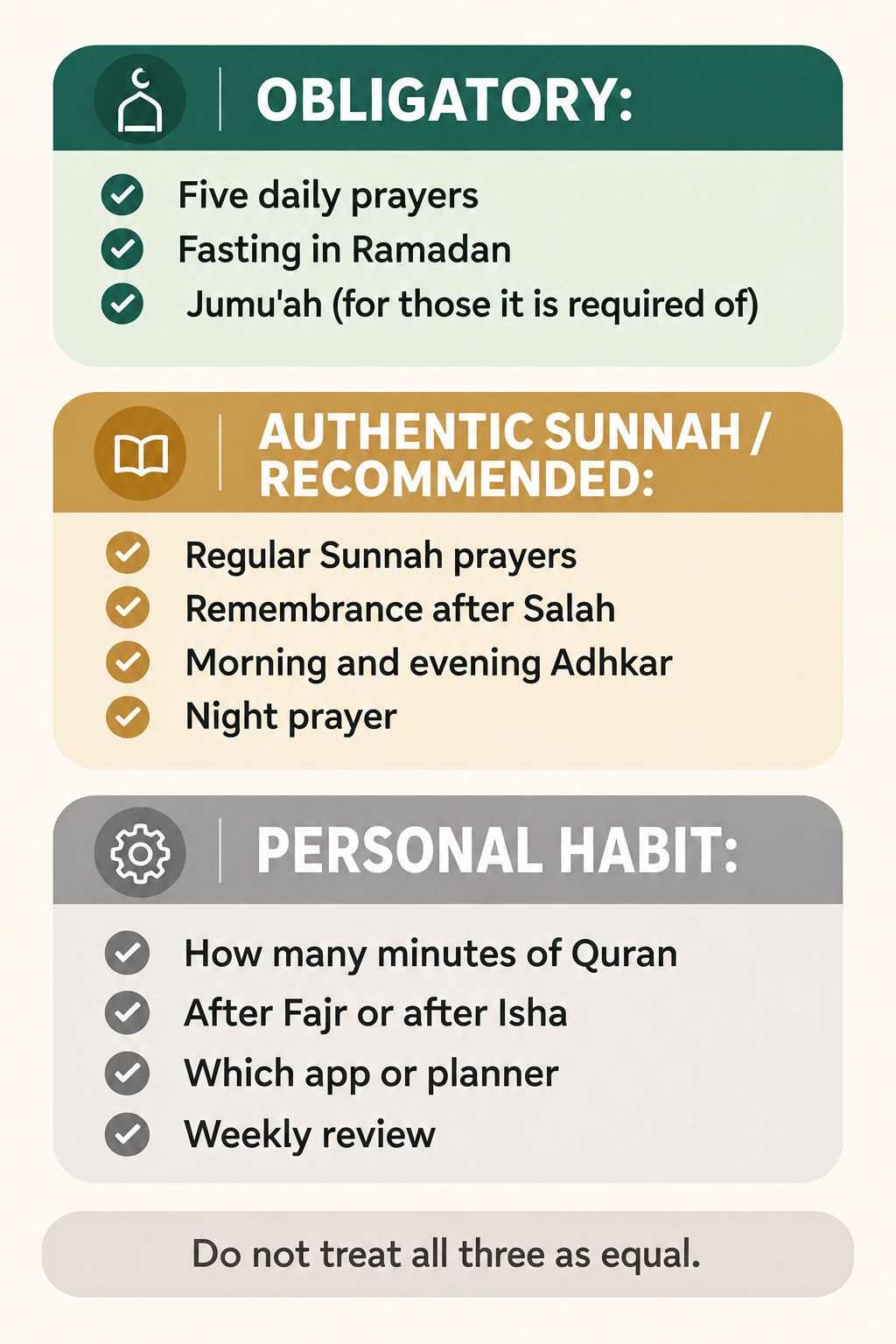
What Is Obligatory, What Is Recommended, and What Is Personal Habit?
Online routines often mix everything together, so every item looks equally required. Separating the categories reduces guilt and sharpens priorities.
Obligatory (fard): the five daily prayers, and for those who are required, Jumu'ah for men and fasting in Ramadan, among other duties.
Authentic Sunnah or recommended: the regular Sunnah prayers, remembrance after Salah, morning and evening Adhkar, bedtime Adhkar, regular Quran recitation, and night prayer.
Personal habit: how many minutes you read, whether you read after Fajr or after Isha, which app you use, the colour of your planner, and your weekly review.
A person who misses a personal habit has missed a plan. A person who misses an obligation has a different matter to address, and should seek proper guidance on making it up. Keeping these categories separate is what lets you be both compassionate and serious.
Building a Muslim Morning Routine
A realistic morning might include:
Waking for Fajr (obligatory)
Praying Fajr (obligatory) and its two Sunnah rak'ahs (recommended)
Authentic post-Salah Adhkar (recommended)
Morning Adhkar (recommended)
A small Quran block (recommended, with the amount a personal choice)
Preparing for your responsibilities
Breakfast or exercise, depending on your needs (personal)
None of these personal items is mandatory, and no one should do all of them every day.
The 10-minute morning
For a very busy morning, a minimal version could be Fajr, the established remembrance after Salah, and a short Quran reading or learning block where feasible. The "10 minutes" is not religious. The point is that a small routine you keep is better than abandoning every extra act because an elaborate schedule feels impossible.
After the prayer, the Prophet ﷺ would seek forgiveness three times and say a short supplication (Sahih Muslim 591). He also taught saying SubhanAllah, Alhamdulillah and Allahu Akbar thirty-three times each (Sahih Muslim 595 and 597 for the completion). For the full authentic details, see our guide to Dhikr.
A longer morning
If your life allows more time, such as on weekends or during school holidays, you may expand to include full morning Adhkar, more Quran, memorization, Arabic, reflection, exercise and planning. A longer morning is not automatically spiritually better for everyone. It is simply a different capacity.
How to Make Time for Quran Every Day
"I want to read Quran, but I never have time" is one of the most common statements we hear. The Prophet ﷺ also warned about two blessings in which many people are deceived, health and free time (Sahih al-Bukhari 6412), which is a reminder that time is easy to lose. Here are some strategies:
Connect Quran to an anchor. After Fajr, after Isha, or before bed.
Choose a realistic minimum. Five minutes counts.
Keep your Mushaf or app visible. Reduce the steps needed.
Separate reading from deeper study. See the next section.
Use a teacher for accountability. A scheduled lesson holds you to your plan.
Listen on your commute, safely. Audio only, and never while handling a phone on the road.
Review memorization in small pockets. A few minutes here and there.
The Prophet ﷺ said the best of you are those who learn the Quran and teach it (Sahih al-Bukhari 5027). And for those who struggle: he said that the one who recites with difficulty will have a double reward (Sahih al-Bukhari 4937, Sahih Muslim 798). Difficulty is not a sign you should stop.
Reading the Quran vs. studying the Quran
These are different activities. Recitation is reading or reciting. Study includes Tafsir, vocabulary, Arabic, reflection and structured learning. A busy Muslim does not need to do both every day. For example, a small daily recitation and a longer Tafsir or Arabic session on the weekend. That is a practical organization, not a religious rule.
What if I cannot read Arabic yet?
Do not wait for fluency before engaging with the Quran. You can learn the Arabic letters, take Quran-reading lessons, listen to recitation, read a trusted translation of the meanings, learn Al-Fatihah and the other recitations required for prayer, and move gradually towards Quranic Arabic. Remember that the Quran itself is the Arabic revelation, and a translation is an explanation of its meanings. Both have their place, but one does not replace the other. Our guide on [how to learn Salah when you don't speak Arabic] is a good place to begin.
Daily Dhikr Without Making It Complicated
Authentic remembrance already has natural anchors: after Salah, morning and evening, before sleep, and during everyday acts such as eating, leaving home and travelling. You do not need to invent large repetition schedules. Dhikr also never replaces Salah; it grows around it.
Allah says: "Remember Allah with much remembrance" (Quran 33:41). A short authentic Dhikr that you keep is better than a long, unauthenticated one you abandon. For a starting guide, read [What Is Dhikr? A Beginner's Guide to Remembering Allah Every Day].
Dua in a Busy Day
Dua does not always require a 30-minute session. Allah says: "Call upon Me; I will respond to you" (Quran 40:60), and He is near to those who ask (2:186). You can make Dua in prostration, after the final tashahhud before the salam, during difficulty, in quiet moments, before sleep, and in your own language outside the formal prayer. Note that the prayer's recitation itself remains in the form taught; personal Dua in your own language is a matter where scholars have specific guidance for inside the prayer, so ask your teacher.
The Prophet ﷺ also said that our Lord descends to the lowest heaven in the last third of the night, asking who is calling upon Him that He may answer (Sahih al-Bukhari 1145). That is a virtuous time, not a requirement. For more, see [How to Make Dua: A Beginner's Guide to Asking Allah].
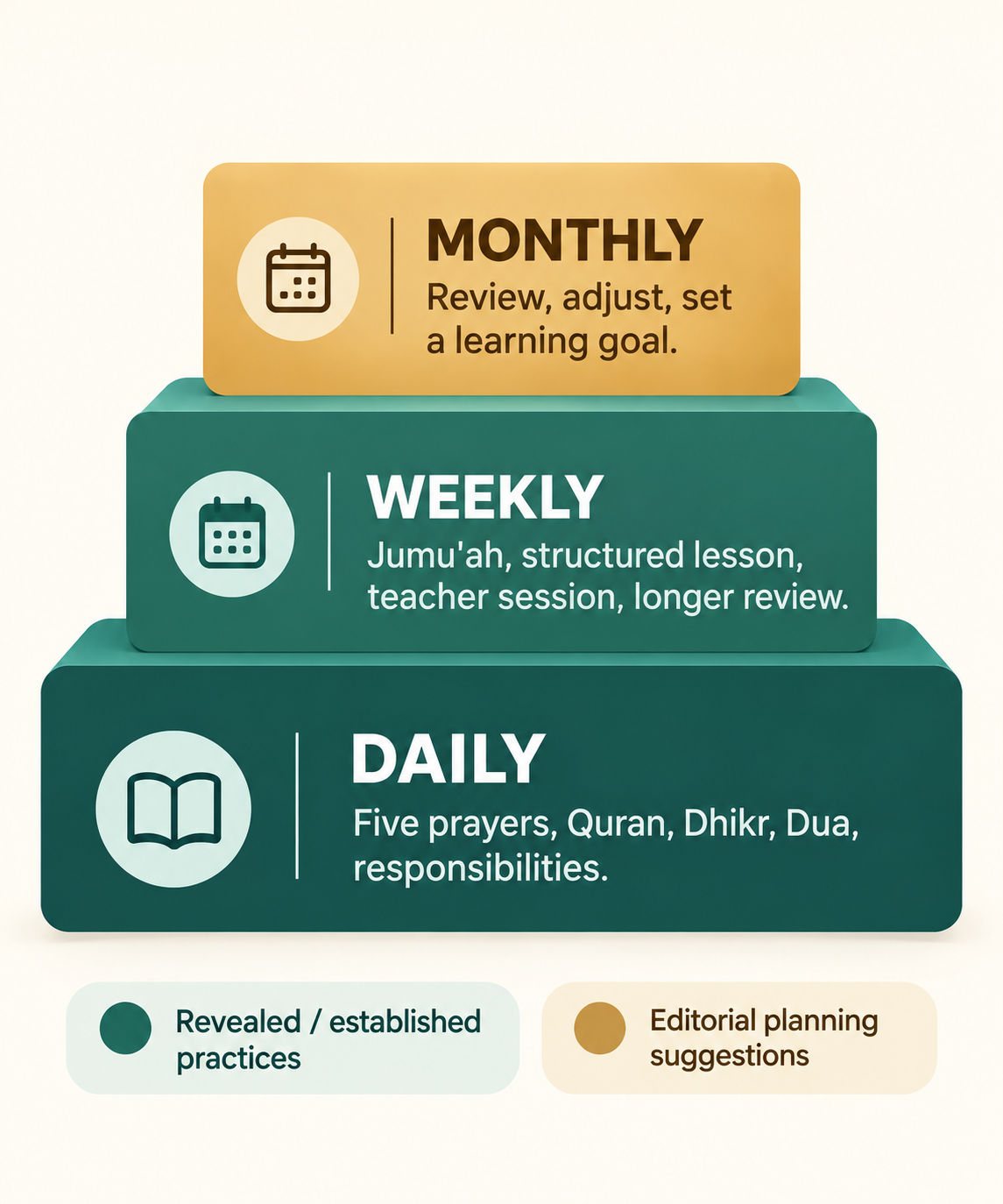
Think in Daily, Weekly, and Monthly Rhythms
A sustainable Islamic life cannot be judged from one day alone. Some good things fit better into a week.
Daily: the five prayers, a small Quran habit, Dhikr, Dua, and your responsibilities.
Weekly: Jumu'ah, a structured Islamic lesson, a Quran or Arabic teacher session, family learning, longer Quran review, and charity planning.
Monthly: a brief review of what is working, an adjusted schedule, a learning goal, and a check on Quran and Arabic progress.
A realistic example: Quran daily, Arabic three times a week, one Islamic Studies lesson a week, and longer Tafsir on the weekend. These are editorial examples, not religious prescriptions. You do not need to study Islam every day, and Arabic does not have to be a daily habit to be effective. Likewise, a monthly review is not Sunnah. It is a planning tool, nothing more.
Friday as a weekly anchor
Friday is a natural weekly anchor, with several well-established elements. Jumu'ah is obligatory for men who meet the conditions (Quran 62:9). Women are not required to attend; if a woman does attend, scholars consider it valid, and if she prays at home she prays Dhuhr.
The Prophet ﷺ also spoke of an hour on Friday in which a Muslim who is praying and asks Allah for good will be given it (Sahih al-Bukhari 935, Sahih Muslim 852), though scholars differ on exactly when that hour falls. Reciting Surah al-Kahf on Friday and increasing Salah upon the Prophet ﷺ on that day are reported in hadiths that many scholars consider authentic, although some differ on the details of the chains, so rely on a trusted scholar if you want the specifics. Other popular Friday routines should be checked before you adopt them. For example, the Prophet ﷺ discouraged singling out the night of Friday for prayer or the day of Friday for fasting (Sahih Muslim 1144).
Building Your Routine Around Work, Study, and Family
At work
Know your prayer times in advance and look for a quiet, clean space. Plan realistic wudu arrangements, and if you need an accommodation, ask professionally and early. Lunch breaks can help, but avoid delaying prayers unnecessarily. Also plan around your commute and travel days. Employment rights differ in every country, so we do not give legal advice here; check your local rules or a community organization.
At university or school
Put prayer times on your timetable, locate a prayer room on campus in the first week, and use short gaps for Quran review. During exams, aim for steadiness over perfection: your academic duties also matter, and Islam does not ask you to neglect them. Keep voluntary extras modest, and keep the prayers.
As a parent
Parents live with interruptions: a baby who wakes, school runs, illness, meals and homework. Caring for your family is not a distraction from your religion. The Prophet ﷺ said that when a Muslim spends on his family seeking Allah's reward, it counts as charity for him (Sahih al-Bukhari 55, Sahih Muslim 1002), and Aisha reported that he used to be engaged in the service of his family and would go out to prayer when it was time (Sahih al-Bukhari 676). Roles and capacities differ between mothers and fathers and between households, so adapt this to your situation.
Rather than seeing children only as interruptions to worship, bring worship into family life: pray at home with them present, read a few verses together, and keep a simple bedtime Dua. Keep it light. A home does not need to be a rigid classroom.
For shift workers
Prayer remains tied to its actual time windows, but your work schedule may rotate. So use prayer-time anchors instead of clock-time habits. Each week, write down your prayer windows against your shifts. When you cannot step away from duties, or when you work in medical, travel or emergency settings, ask a qualified scholar rather than improvising rulings.
For night shifts, do not copy a daytime worker's plan. Protect the prayers, protect adequate sleep and health, fulfil your responsibilities, and only then add voluntary habits that suit your hours.
For new Muslims
If you are new to Islam, do not try to adopt dozens of optional practices at once. A sensible order is: learn how to pray; learn the essential beliefs and practices; gradually learn Al-Fatihah and the required Arabic; start with a little Quran, with translation of the meanings alongside; learn basic Dhikr and Dua; and then follow a structured path of learning. Our [New Muslim Guide] and [How to Learn Salah When You Don't Speak Arabic] can help.
Sleep Is Not the Enemy of Worship
Some people believe that sleeping less automatically makes someone more religious. That is not what the Sunnah teaches. When Salman al-Farisi visited his brother Abu al-Darda, who was fasting and praying through the night, he reminded him that "your Lord has a right over you, your soul has a right over you, and your family has a right over you, so give each its due." The Prophet ﷺ confirmed: "Salman has spoken the truth" (Sahih al-Bukhari 1968). A similar narration says that your body has a right over you.
Quran 78:9 also describes sleep as rest: وَجَعَلْنَا نَوْمَكُمْ سُبَاتًا. Chronic sleep deprivation can make Fajr, concentration, work, parenting, health and Quran learning harder. We will not offer a universal number of hours here; sleep needs vary, so consult a health professional for personalized advice, and keep that separate from Islamic rulings.
Tahajjud without destroying your routine
Night prayer is highly praised. Allah mentions it in the Quran (17:79), and the Prophet ﷺ said the best prayer after the obligatory prayers is the prayer in the night (Sahih Muslim 1163). It is voluntary, though. If Fajr is a struggle, protect Fajr first. If you are stable, you can add a short night prayer according to your capacity, and the Sunnah itself warns against overburdening yourself: the Prophet ﷺ told those who were tired to rest instead of forcing themselves (Sahih al-Bukhari 1150). If you do not wake at 3 a.m., your routine is not weak.
Rest, health and exercise
Rest is not laziness; recovery is part of sustainability. That said, not every entertainment activity is spiritually beneficial, so aim for balance. Caring for health is a responsibility, and the Prophet ﷺ said that a strong believer is better and more beloved to Allah than a weak one, while there is good in both (Sahih Muslim 2664). We will not claim that a gym membership is Sunnah. Exercise is a lawful way of looking after the body, and it belongs in your life as one responsibility among others.
Intention, Family, and Whether Work Can Be Worship
The Prophet ﷺ said, "Actions are by intentions" (إِنَّمَا الأَعْمَالُ بِالنِّيَّات, Sahih al-Bukhari 1, Sahih Muslim 1907). Scholars have long explained that lawful, ordinary acts such as earning halal income, caring for family, studying beneficial knowledge and maintaining health can be rewarded when done sincerely for Allah's sake and within His limits.
This needs nuance. Not every neutral act becomes worship simply because someone has a religious thought, and work is not equivalent to Salah or other formal worship. The Prophet ﷺ said that no one has eaten better food than what he earns by the work of his own hands (Sahih al-Bukhari 2072), and Allah directs believers to seek His bounty after Jumu'ah (62:10). Honest work, supporting your dependents and avoiding the haram are all ways lawful work can carry reward. The cliché "work is worship" is better replaced with: lawful work, done honestly and with good intention, can be rewarded.
Your Phone, Social Media, and the Productivity Trap
Your phone can help: prayer-time apps, a Quran app, online classes, a reliable Adhkar source and calendar reminders. It can also quietly take over: endless scrolling, notifications interrupting your Quran, and dozens of Islamic clips watched without any structure. Consuming Islamic content is not automatically the same as learning Islam. One structured course usually teaches more than fifty disconnected videos. Also keep the apps modest; they are tools, not the centre of the routine.
Social media is also a trap for comparison. An edited morning video does not show the person's responsibilities, the help they receive, the days they missed, their health or their family situation. We are not criticizing Muslim creators, many of whom offer real benefit. We are suggesting that you measure your routine against Islamic priorities and your own responsibilities, not someone else's content.
Productivity is not piety
Allah says, "The most noble of you in the sight of Allah is the most righteous of you" (49:13, إِنَّ أَكْرَمَكُمْ عِندَ اللَّهِ أَتْقَاكُمْ). A Muslim's worth is not measured by books finished, habits tracked, 4 a.m. wake-ups, a perfect planner, number of courses or Quran pages posted online. What counts is sincerity, obedience, character and fulfilling responsibilities, and only Allah knows how any of us stands before Him.
Checklists can help. Worship also involves intention, understanding, humility and a relationship with Allah, so do not let a checklist become the whole purpose. Structure and spirituality are not opposites; structure simply supports the worship.
Build a Routine That Survives Bad Days
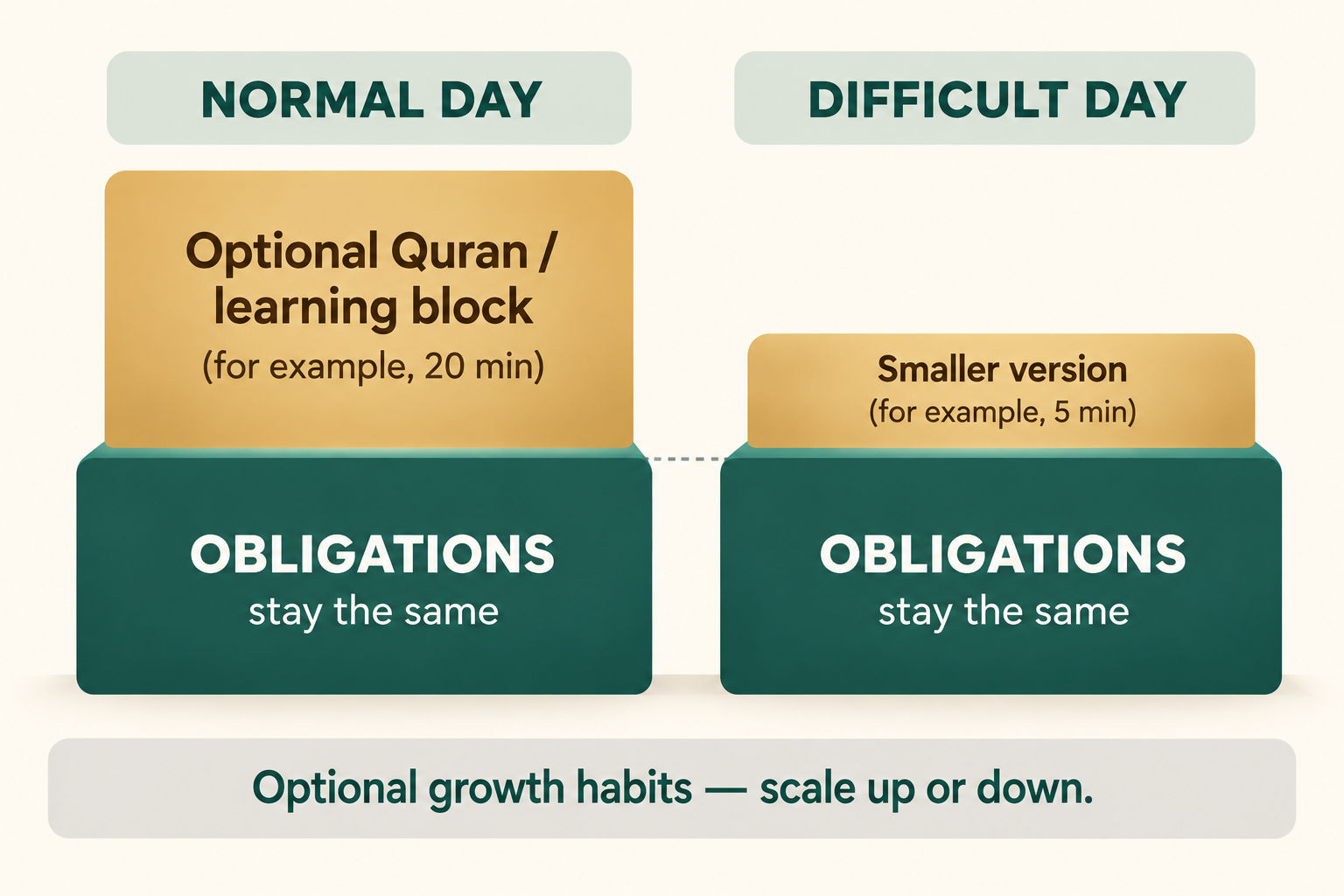
A routine is not sustainable if it only works when your energy is high, the children cooperate and nothing unexpected happens. Create two versions of each optional habit:
Normal day: 20 minutes of Quran. Difficult day: five minutes or a few verses.
Normal day: a 30-minute class review. Difficult day: review one concept.
Normal day: full morning Adhkar. Difficult day: the shorter authentic ones you know.
The scaling applies to optional growth habits only; obligations stay obligations.
What If I Miss a Day?
Avoid the thought "I ruined my streak." A habit streak has no religious value. If an optional routine slips because of a chaotic day, travel, a sick child or exams, restart, and adapt the routine to the season you are in. You may have heard the modern habit advice "never miss twice." That is not Quran or Hadith; it is a productivity slogan, and we mention it only as such.
For missed obligatory prayers, habit language does not apply. The Prophet ﷺ said that whoever forgets a prayer or sleeps through it should pray it when he remembers it (Sahih al-Bukhari 597, Sahih Muslim 684). If you have missed prayers deliberately, speak with a qualified scholar about repentance and making them up.
Stop thinking all-or-nothing
"I cannot read a Juz, so I will read nothing." "I missed morning Adhkar, so the day is ruined." "I cannot study Arabic daily, so I quit." "I missed Tahajjud, so I failed." These thoughts turn small gaps into total collapse. Correct them with: what is the smallest version I can do today? Anti-perfectionism is not an excuse to neglect obligations; it is a way to keep doing the optional.
What if I feel guilty for not doing enough?
Useful conscience motivates repentance and correction. Destructive perfectionism creates hopelessness and paralysis. Allah says: "Do not despair of the mercy of Allah" (39:53, لَا تَقْنَطُوا مِن رَّحْمَةِ اللَّهِ), and the Prophet ﷺ said that every son of Adam makes mistakes, and the best of those who err are those who repent often (Sunan al-Tirmidhi 2499, graded hasan). Guilt itself is not proof of strong faith, and if heavy worry or low mood persists, speaking to a trusted person or a qualified professional is wise.
Restarting after you have fallen off
Return to the obligations.
Choose one additional anchor.
Maintain it.
Add another.
Review after several weeks.
The timing is practical advice, not religious law.
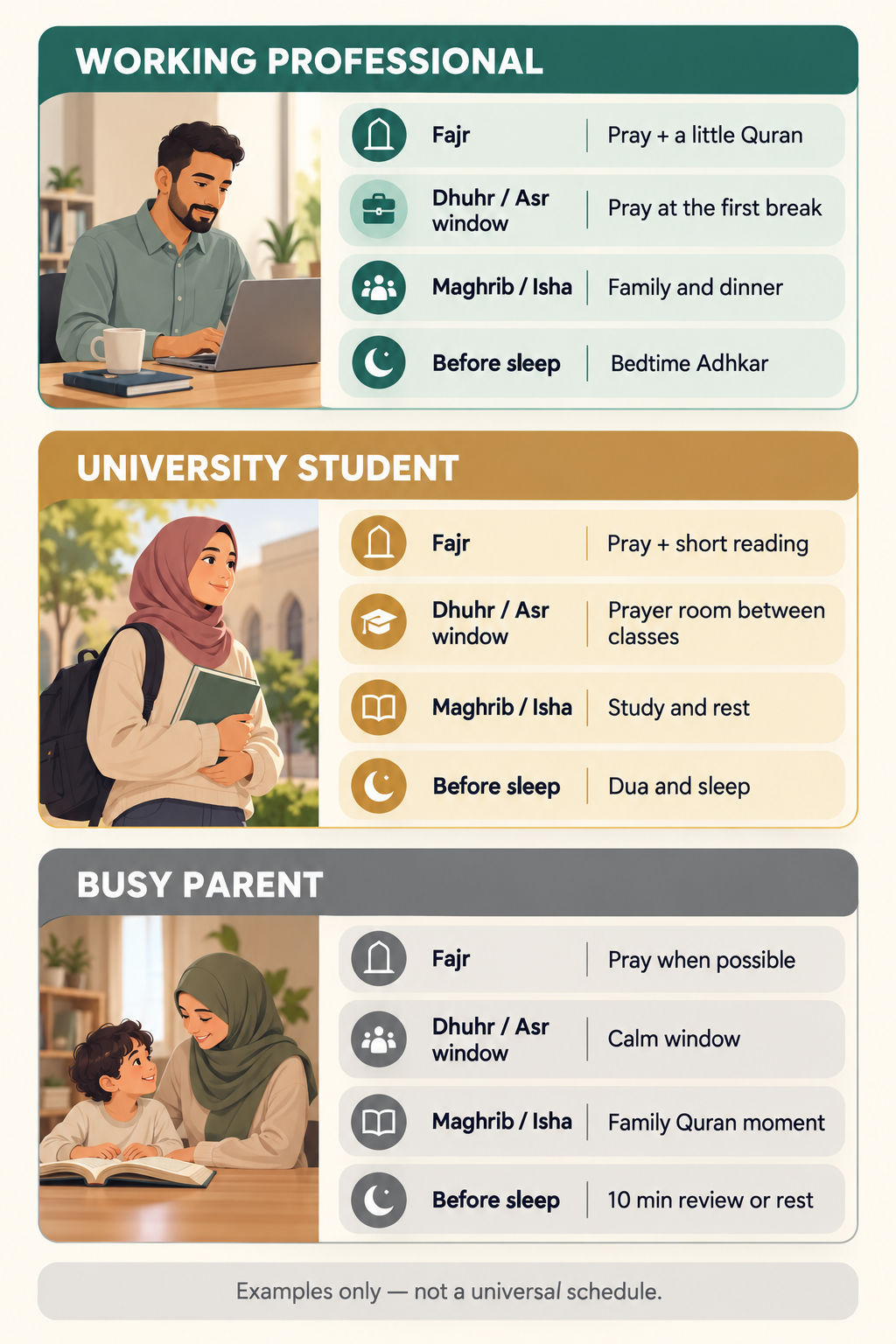
Three Realistic Example Routines
Examples only, not a universal Islamic schedule. We avoid clock times because prayer times vary.
A working professional
After waking / Fajr: pray, post-Salah Adhkar, a few minutes of Quran.
Morning: commute with Quran or an Islamic lesson on audio (if you are driving, audio only).
Dhuhr window: pray at the first practical break.
Asr window: pray before the day's end rush.
After work: a short walk or rest; time with family.
Maghrib and Isha: pray, dinner, family.
Before sleep: bedtime Adhkar and Dua; sleep.
A university student
Fajr: pray; a short Quran reading if the day starts late.
Between classes: check the timetable and pray Dhuhr or Asr in a prayer room.
Study blocks: include one weekly Arabic or Islamic Studies block.
Evening: Maghrib and Isha, social time, assignments.
Exam weeks: keep the prayers and one small anchor only.
A busy parent
Fajr: pray when possible; a few verses if the baby sleeps.
School run: short Dhikr on the way.
Midday: pray in whatever window is calm.
Evening: a short family Quran moment, homework, dinner.
After the children sleep: 10 minutes of Arabic review, or rest.
Interruptions are normal. Flexibility is the plan, not a departure from it.
Practical Frameworks: Growth Block, Three Tiers, Seasonal Shifts
The 15-minute growth block
One option is five minutes of Quran, five of Arabic and five of Islamic Studies, or rotating one a day (Monday Quran, Tuesday Arabic, Wednesday Islamic Studies). "15 minutes" is a practical planning suggestion, not a Sunnah-prescribed amount.
Minimum, standard, expanded
Minimum foundation: protect obligations and basic essentials. Standard growth: add small Quran, Dhikr and learning habits. Expanded: add voluntary prayer, longer Quran, Arabic, study and memorization. This is an editorial planning model. "Minimum" here is not a legal definition of the minimum obligations in Islam.
Seasons, Ramadan and overwhelming times
Routines change with Ramadan, Dhul Hijjah, exams, travel, illness, a new baby, job changes and the summer-winter shift. Adapting is not failure. Ramadan in particular is not the template for the other eleven months; preserve the sustainable gains instead of expecting the same intensity.
When life is overwhelming, use this practical decision order: obligations; essential responsibilities; health and safety; sustainable voluntary worship; additional learning. This is a practical framework, not a universal fiqh ranking for every circumstance.
Optional Challenges: A 7-Day Reset and a 30-Day Builder
These are practical habit-building exercises, not a prescribed Sunnah program, and no special reward attaches to completing them.
7-day reset: Day 1, audit the five prayers. Day 2, add the authentic post-Salah Dhikr. Day 3, choose a small Quran anchor. Day 4, add a personal Dua. Day 5, reduce one recurring distraction. Day 6, choose one structured Islamic learning block. Day 7, review and design next week.
30-day builder: Week 1, prayer anchors. Week 2, Quran. Week 3, Dhikr and Dua. Week 4, Islamic learning and refinement.
12 Common Routine Mistakes
Starting with too many habits. Begin with one.
Prioritizing voluntary worship while neglecting obligations. The foundation comes first.
Copying another person's schedule. Their life is not yours.
Building everything around exact clock times rather than prayer windows.
Ignoring sleep. Fatigue undermines everything else.
Treating missed optional habits as total failure. Restart.
Making every beneficial activity daily. Some fit weekly.
Confusing content consumption with learning. Study systematically.
Adding practices without checking authenticity.
Tracking numbers more than meaning.
Building a routine that only works on perfect days.
Comparing productivity with piety.
Authenticity Matters Even in Routines
Be wary of online routines containing invented Dhikr counts, unsupported Duas, unverified reward claims, a special Surah assigned to each weekday without evidence, "read this X times for wealth", manifestation, numerology or "Islamic frequency" claims. A beautiful planner does not make an invented practice authentic.
This is also where the distinction about bid'ah needs care. Organizing a permissible or authentic act for personal consistency, such as reading Quran after Fajr or reviewing Arabic on Tuesdays, is an ordinary personal arrangement. Attributing a special virtue, number, time or fixed form to Islam without evidence is a different matter, and the Prophet ﷺ warned against introducing into the religion what is not from it (Sahih al-Bukhari 2697, Sahih Muslim 1718). Scholars discuss the details of fixed practices, so ask a trusted teacher about any specific case rather than relying on a quick label.
Your Daily Checklist and Weekly Review
Foundation: ☐ Five obligatory prayers
Growth: ☐ Quran ☐ Dhikr ☐ Dua ☐ Islamic or Arabic learning
Life responsibilities: ☐ Family ☐ Work or study ☐ Health and rest
This checklist is an organizational tool. It is not a measure of anyone's worth or complete religious standing.
Weekly review questions:
Did I protect my prayers?
Which additional habit was consistent?
What repeatedly failed? Is it too large, or does it need a better anchor?
Am I sleeping enough?
Am I neglecting family or work responsibilities?
Am I learning Islam systematically?
What should I remove or simplify next week?
Building a routine is not only about adding more.
Making Learning Rhythms Work With Araby Academy
Instead of "I'll study Arabic when I have time", a learner can decide that Tuesday and Thursday are lesson and review blocks. This is an example, not a universal prescription. At Araby Academy, one-to-one lessons in Quran, Tajweed, memorization, Quranic Arabic, Arabic and Islamic Studies give you a scheduled slot, a teacher to be accountable to and a clear path.
You do not need unlimited free time to make meaningful progress. You need a realistic learning rhythm that can survive ordinary life. Related reading: [How to Memorize the Quran and Never Forget It], [How Long Does It Take to Learn Arabic?], [What Is Tawakkul?]and [Raising Muslim Children in the West].
Frequently Asked Questions
What should a Muslim do every day? Pray the five obligatory prayers on time, then add authentic remembrance, some Quran, Dua, and fulfil family, work and study responsibilities.
How do I build a daily Islamic routine? Anchor the five prayers, add one small habit to an existing anchor, and expand gradually once it is stable.
How can a busy Muslim make time for worship? Use prayer times as anchors, shrink habits to a minimum, and keep tools visible.
How can I make time for Quran every day? Attach five to ten minutes to Fajr, Isha or bedtime, and listen safely on your commute.
What is a good Muslim morning routine? Fajr, post-Salah Adhkar, morning Adhkar and a little Quran, scaled to your time.
What is a good Muslim night routine? Pray Isha, make bedtime Adhkar and Dua, and sleep with enough rest to protect Fajr.
How can I balance Islam and work? Know prayer times, find a prayer space, communicate needs respectfully, and work honestly.
How can students balance Salah and university? Put prayer times on the timetable and use campus prayer rooms; do not neglect either your religious or academic duties.
How can parents maintain an Islamic routine? Build worship into family life, accept interruptions, and keep optional habits short.
How much Quran should I read every day? No fixed amount is required for everyone. Choose a sustainable amount and keep it consistent.
Do I need to study Islam every day? Not necessarily. A weekly structured lesson is a realistic pattern for many people.
How can I become consistent in worship? Start small, use anchors, reduce friction and restart quickly after gaps.
What should I do if I keep failing my Islamic routine? The routine is probably too big. Return to obligations, shrink the habit, and review.
Is sleeping less better for worship? No. The Prophet ﷺ confirmed that your body has a right over you.
How do I avoid feeling overwhelmed by Islamic goals? Choose one anchor, ask what to remove, and add slowly.
You Do Not Need a Perfect Islamic Routine—You Need One You Can Keep Returning To
The goal is not to become the person with the most complicated planner, imitate someone else's 4 a.m. routine, or fill every free minute with an activity.
Protect what Allah has made obligatory. Build around Salah. Add Quran. Remember Allah. Make Dua. Learn your religion. Fulfil your responsibilities. Protect appropriate rest and health. Add voluntary worship gradually. When life changes, adapt. When an optional habit collapses, rebuild it. When you have more capacity, expand. When you have less capacity, protect the foundation.
Anchor what matters. Add what you can sustain. Expand when you are ready.
As a reminder, this is an editorial habit-building framework, not revealed wording.
Consistent Quran, Arabic and Islamic Studies learning does not require unlimited free time. Structured teaching and realistic learning rhythms can help a busy Muslim continue progressing week after week.