
"Trust Allah" — But What Does That Actually Mean?
You tell someone: "I'm worried about my future."
They reply: "Have Tawakkul."
"I don't know whether I'll get this job." "Trust Allah."
"I don't know if this marriage will work." "Trust Allah."
"My plans are falling apart." "Allah has a plan."
These statements can be true. But for someone standing in uncertainty, they raise a harder question: what does trusting Allah actually require me to do?
Does Tawakkul mean waiting? Making Dua? Taking action? Accepting whatever happens? Feeling calm? Never worrying? Stopping all planning?
Tawakkul (التوكل) is the Arabic word usually translated as trust in Allah, reliance on Allah, or entrusting one's affairs to Allah. It is far richer than a motivational phrase. It is a spiritual orientation that joins reliance upon Allah with responsible human action.
Behind most confusion about Tawakkul sits one question:
"If Allah controls the outcome, what am I supposed to do?"
If provision (Rizq, رزق) is already written, why work? If marriage is written, why search? If Allah controls health, why seek treatment? If Allah knows the future, why plan or decide at all?
This article answers that question using the Quran, the Sunnah, and the explanations of recognized scholars. It also dismantles a false choice many Muslims feel they must make: trusting Allah or taking action. Islam does not ask you to choose.
A simple way to hold the idea together:
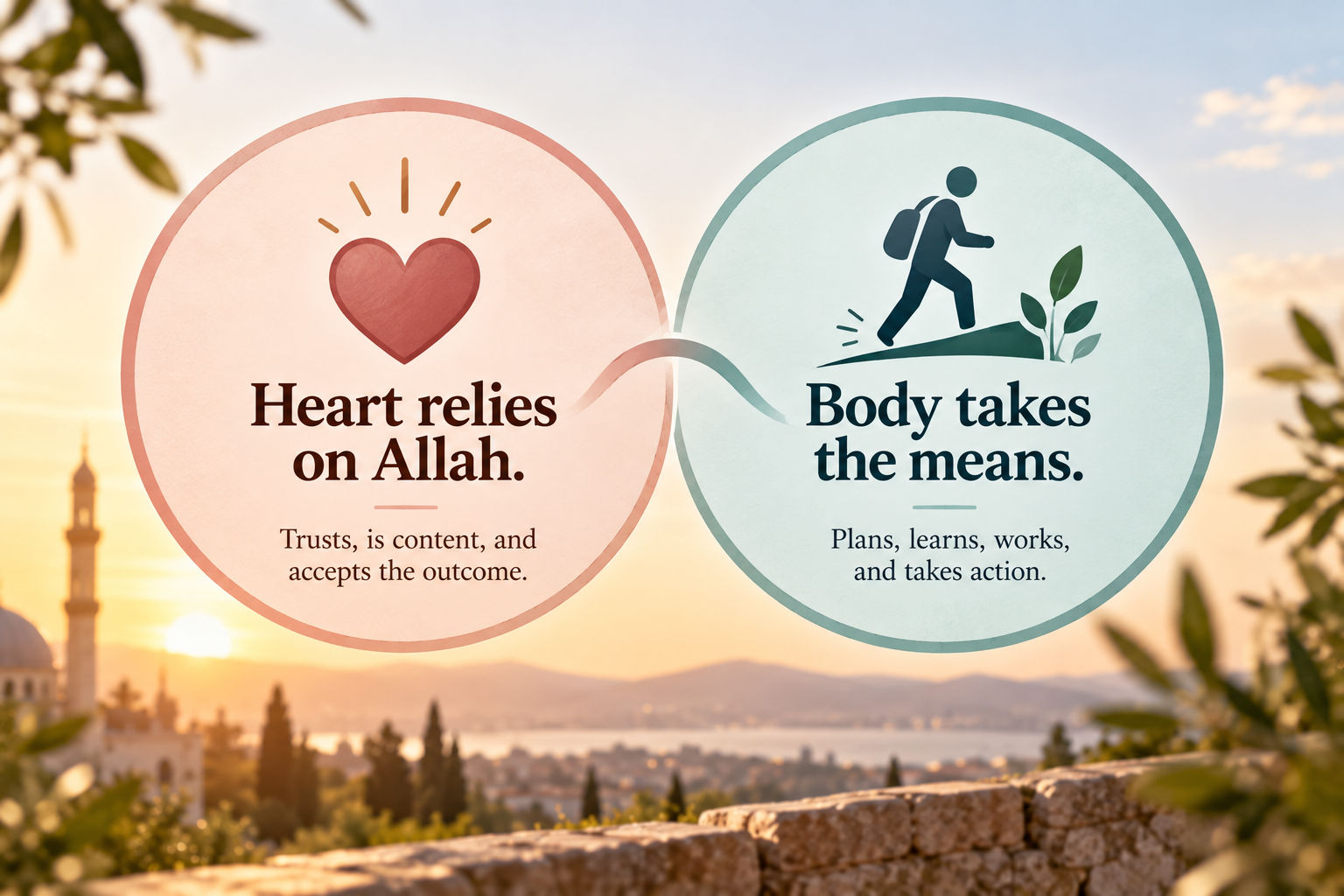
The heart relies upon Allah. The body takes the means. The outcome belongs to Allah.
(This is a teaching framework in our own words. It is not a hadith or a classical definition.)
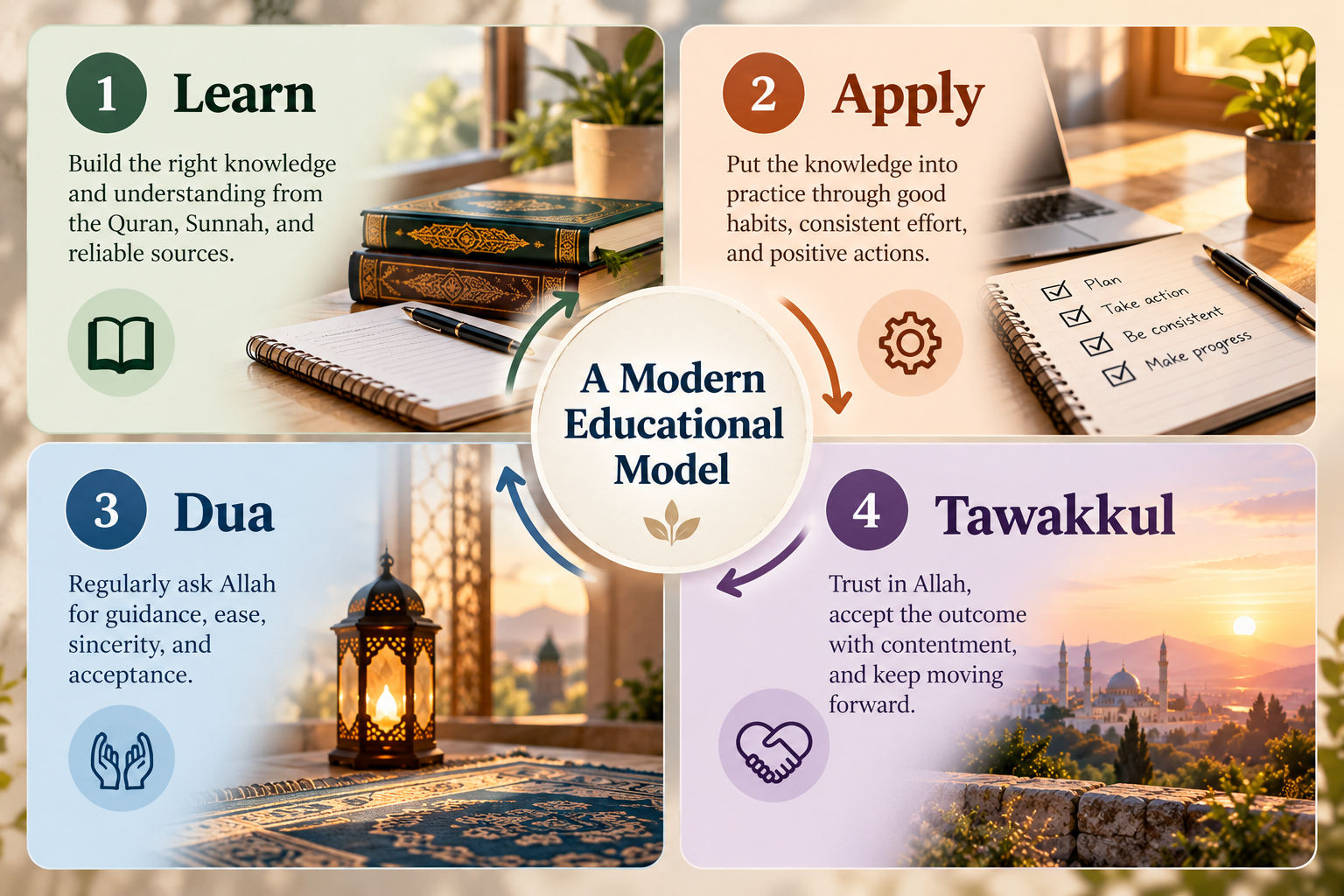
Throughout the article we return to four elements: Trust + Action + Dua + Acceptance.
A note on terms: Araby Academy serves many readers who do not speak Arabic, so every Arabic word is explained when it first appears.
What Does Tawakkul Mean?
The language
Tawakkul comes from the Arabic root و ك ل (w-k-l). In Arabic lexicons, words from this root revolve around entrusting a matter to someone, appointing someone to handle it for you, and relying on them to do so. A wakeel (وكيل) is someone you appoint to act on your behalf, such as a lawyer or an agent. Tawakkul is the reflexive form of this idea: a person entrusts and relies.
The Islamic meaning
Scholars have defined Tawakkul in slightly different words, but the core is consistent. Ibn Rajab al-Hanbali (d. 795 AH), in his commentary on the hadith about the birds discussed below, explains it in substance as the sincere reliance of the heart upon Allah to bring benefit and avert harm, together with full certainty that all affairs are in His hands, while still taking the means. Ibn al-Qayyim (d. 751 AH), in Madarij al-Salikin, likewise treats Tawakkul as a station of the heart that coexists with, and is not cancelled by, using the means Allah has made available.
These are paraphrases of their ideas, not word-for-word quotations, and no single modern sentence is the classical definition. A simple beginner definition is:
Tawakkul is the believer's reliance upon Allah while using the lawful means Allah has made available.
Three ideas unpack this:
Reliance is in the heart. Tawakkul is first of all an inner state: where you place your ultimate dependence.
Action is carried out through the means. The Arabic term is al-akhdh bil-asbab (الأخذ بالأسباب), "taking the means." An asbab (أسباب, singular sabab) is a cause or means: food for hunger, medicine for illness, study for an exam, a job application for work.
Success does not come from the means independently of Allah. Islam does not teach that human effort controls reality on its own. Study, money, skill, and medicine are real causes, but they work only by Allah's permission.
Tawakkul Is an Act of the Heart
Two people can do exactly the same outward work. One works while quietly believing, "My intelligence guarantees success." Another works while knowing, "I am doing my part, and everything depends on Allah." The outward actions look identical; the inward positions differ completely.
Similarly, a person may think:
"My money protects me."
"My doctor controls my recovery."
"My employer controls my provision."
Islam does not reject intelligence, money, medicine, employment, or planning. It rejects treating created means as independent, ultimate sources of power. A Muslim uses the means fully while recognizing that Allah is the One who gives them their effect.
Tawakkul Does Not Mean Abandoning the Means
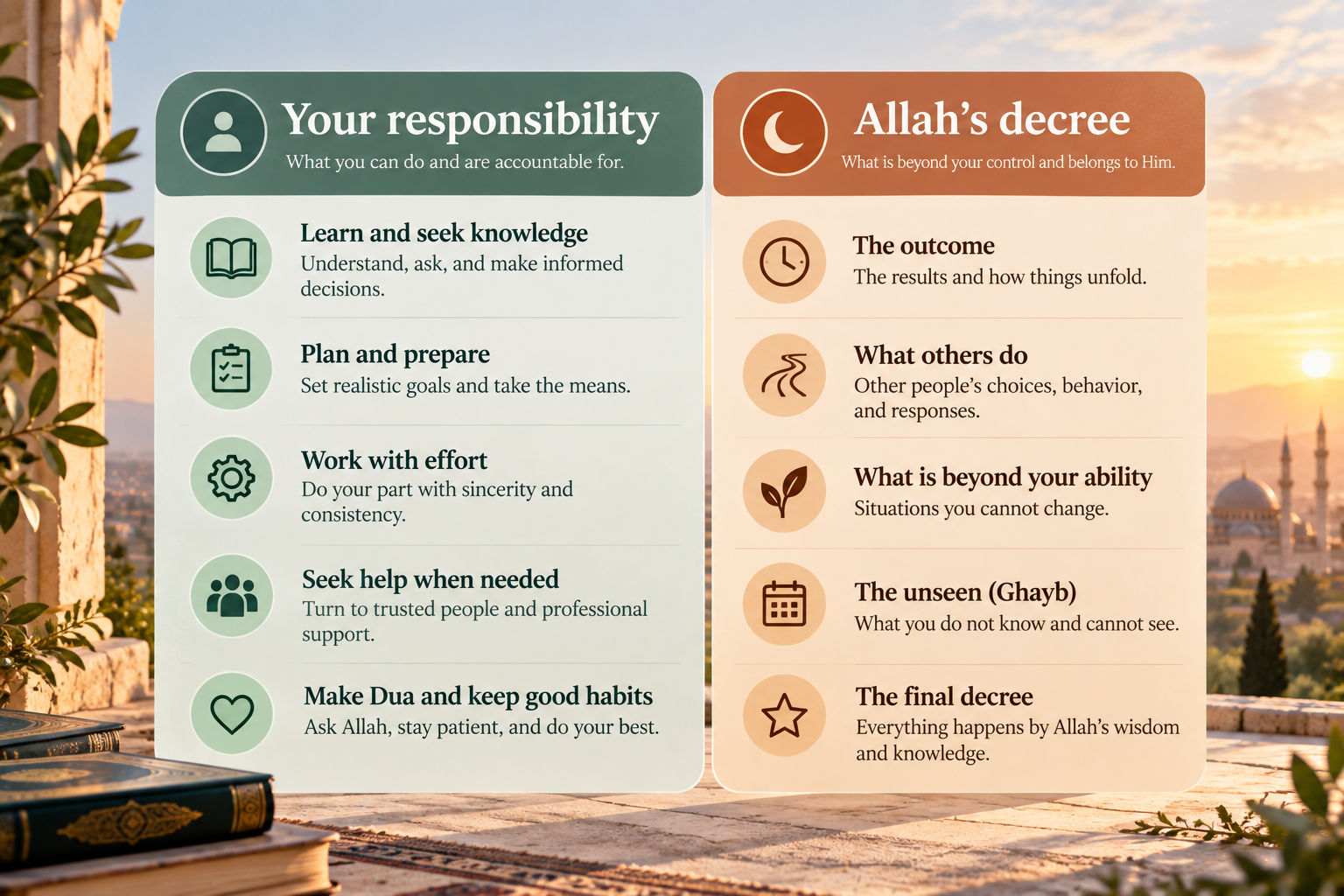
This is the heart of the topic. Taking the means is not opposed to Tawakkul. It is often a part of responsible Tawakkul.
Situation | Taking the means | + Tawakkul |
|---|---|---|
Hungry | Eat | Trust Allah |
Ill | Seek appropriate treatment | Trust Allah |
Exam | Study | Trust Allah |
Job search | Apply, build skills | Trust Allah |
Marriage | Take appropriate halal steps, seek advice | Trust Allah |
Business | Plan, work, manage risk | Trust Allah |
Finances | Budget, seek lawful income, make Dua | Trust Allah |
The Quran itself pairs the two. Allah commands preparation ("And prepare against them whatever you are able of power," 8:60) and caution even in the middle of prayer during danger ("take your precautions," 4:102), while repeatedly commanding reliance upon Him.
The hadith about the birds makes the point beautifully. The Prophet ﷺ said that if people truly relied upon Allah as He should be relied upon, He would provide for them as He provides for the birds: they go out in the morning hungry and return in the evening full (narrated by Umar ibn al-Khattab; Tirmidhi no. 2344, who graded it hasan sahih; also Ahmad and Ibn Majah). Notice the verb: the birds go out. They do not stay in the nest. Scholars like Ibn Rajab pointed out that the hadith itself mentions movement and seeking.
The Prophet ﷺ Took Practical Means
If anyone had perfect Tawakkul, it was the Prophet Muhammad ﷺ. Yet his life shows planning and preparation at every stage.
The Hijrah (migration to Madinah). According to the narration of Aisha (Sahih al-Bukhari no. 3905), the Prophet ﷺ and Abu Bakr did not simply walk out and hope. They hired a guide, Abdullah ibn Urayqit, who knew desert routes; they hid in the cave of Thawr; Abdullah, Abu Bakr's son, gathered news in Makkah and brought it to them at night; Amir ibn Fuhayra grazed sheep over their tracks; and provisions were prepared beforehand. And when pursuers came near the cave, Abu Bakr was afraid, and the Prophet ﷺ answered with calm reliance: "Do not grieve; indeed Allah is with us" (Quran 9:40). Detailed planning and deep reliance appear in the very same journey.
Protection in battle. Reports state that at Uhud the Prophet ﷺ wore two coats of mail (Abu Dawud no. 2590 and Tirmidhi no. 1692, among others; scholars have discussed the chains, and the practice of armor in battle is well supported more broadly).
Seeking treatment. He taught that Allah did not send down a disease except that He sent down a cure for it (Sahih al-Bukhari no. 5678, from Abu Hurayra). Elsewhere he told people to seek treatment, "servants of Allah" (Abu Dawud no. 4. 3855; Tirmidhi no. 2038, from Usama ibn Sharik).
Provision for the family. He used to set aside provisions for his household for the year (Sahih al-Bukhari no. 5357; Sahih Muslim no. 1757, from Umar).
The lesson is not a Seerah lecture. It is simply: the Prophet ﷺ had the strongest Tawakkul, and he still planned and took practical means.
"Tie Your Camel and Trust Allah" — Is This Hadith Authentic?
This famous phrase is often quoted as a Prophetic proof for combining effort and trust. Responsible Hadith use means checking it first.
The narration. Anas ibn Malik reported that a man asked the Prophet ﷺ whether he should tie his camel and rely on Allah, or leave it untied and rely on Allah. The Prophet ﷺ replied, in the commonly cited Arabic, "اعْقِلْهَا وَتَوَكَّلْ" (i'qilha wa tawakkal): "Tie it and trust (in Allah)." It is recorded by al-Tirmidhi (no. 2517) and Ibn Hibban, among others.
The grading. Al-Tirmidhi himself described this route as gharib (reported through a single line), and the chain has been criticized by some hadith scholars. Other scholars, including Shaykh al-Albani in some of his works, have graded it hasan (acceptable) taking into account supporting routes. So the accurate statement is: it is recorded in reputable collections, its grading is discussed among scholars, and we should not casually call it "Sahih."
Why it still matters. Even a reader who prefers caution about this particular narration loses nothing, because the principle is firmly established elsewhere: in the Quran (8:60, 4:102, 12:67), in the hadith of the birds, in the Hijrah narration above, and in the Prophet's guidance to seek treatment. The camel narration is best treated as a well-known illustration of a principle already established by stronger evidence.
Quran Verses About Tawakkul
The Quran mentions Tawakkul in many contexts. Here are eight passages, chosen for context and relevance rather than keyword. (Translations are meaning-based renderings.)
1. Quran 3:159 — Consult, decide, then rely
فَإِذَا عَزَمْتَ فَتَوَكَّلْ عَلَى اللَّهِ إِنَّ اللَّهَ يُحِبُّ الْمُتَوَكِّلِينَ
"And when you have decided, then put your trust in Allah. Indeed, Allah loves those who put their trust [in Him]."
Context: Revealed after the setback at Uhud, in a passage where Allah tells the Prophet ﷺ to be gentle with the believers and to consult them in the matter.
What it teaches: The sequence is consultation → decision → Tawakkul. Reliance comes after responsible decision-making, not instead of it. It is also not endless indecision.
Takeaway: Gather advice and information, make the decision, then entrust the result to Allah.
2. Quran 65:3 — Allah is sufficient
وَمَن يَتَوَكَّلْ عَلَى اللَّهِ فَهُوَ حَسْبُهُ ۚ إِنَّ اللَّهَ بَالِغُ أَمْرِهِ ۚ قَدْ جَعَلَ اللَّهُ لِكُلِّ شَيْءٍ قَدْرًا
"And whoever relies upon Allah, then He is sufficient for him. Indeed, Allah will accomplish His purpose. Allah has already set for everything a [decreed] measure."
Context: Surah at-Talaq, discussing divorce and God-consciousness (Taqwa), right after the promise of a way out and provision for the one who fears Allah.
What it teaches: Allah suffices the one who relies on Him. But note the verse's own ending: Allah's purpose is accomplished, and everything has a measure. It is not a promise that every desired worldly outcome will occur exactly as we hoped. Being "sufficient" can include strength, relief, replacement, patience, or reward that we do not foresee.
Takeaway: Reliance on Allah is never wasted, even when the result differs from our plan.
3. Quran 8:2 — Reliance as a mark of faith
إِنَّمَا الْمُؤْمِنُونَ الَّذِينَ إِذَا ذُكِرَ اللَّهُ وَجِلَتْ قُلُوبُهُمْ وَإِذَا تُلِيَتْ عَلَيْهِمْ آيَاتُهُ زَادَتْهُمْ إِيمَانًا وَعَلَىٰ رَبِّهِمْ يَتَوَكَّلُونَ
"The believers are only those who, when Allah is mentioned, their hearts tremble, and when His verses are recited to them, it increases them in faith; and upon their Lord they rely."
Context: Surah al-Anfal, after Badr, describing true believers.
What it teaches: Tawakkul is presented alongside reverence for Allah and growth in faith through the Quran. It is a feature of a living relationship with Allah, not an isolated slogan.
Takeaway: Tawakkul grows with Quran, remembrance, and reverence.
4. Quran 14:12 — Patience and reliance together
وَمَا لَنَا أَلَّا نَتَوَكَّلَ عَلَى اللَّهِ وَقَدْ هَدَانَا سُبُلَنَا ۚ وَلَنَصْبِرَنَّ عَلَىٰ مَا آذَيْتُمُونَا ۚ وَعَلَى اللَّهِ فَلْيَتَوَكَّلِ الْمُتَوَكِّلُونَ
"And why should we not rely upon Allah when He has guided us to our ways? And we will surely be patient against whatever harm you cause us. And upon Allah let those who would rely [indeed] rely."
Context: The Messengers speaking to their peoples who threatened them.
What it teaches: Reliance is linked to guidance received ("He has guided us") and to Sabr, patience under harm. The Messengers did not stop calling to the truth; they persisted and relied.
Takeaway: Tawakkul and patience travel together through hardship.
5. Quran 9:51 — Decree and reliance
قُل لَّن يُصِيبَنَا إِلَّا مَا كَتَبَ اللَّهُ لَنَا هُوَ مَوْلَانَا ۚ وَعَلَى اللَّهِ فَلْيَتَوَكَّلِ الْمُؤْمِنُونَ
"Say, 'Never will we be struck except by what Allah has decreed for us; He is our Protector.' And upon Allah let the believers rely."
Context: Surah at-Tawbah, said to those who rejoiced at believers' hardships.
What it teaches: Belief in Allah's decree produces steadiness, not passivity. The same passage is delivered by believers who were actively fighting for a cause.
Takeaway: Qadr is a source of calm, not an excuse to stop trying.
6. Quran 5:23 — Enter the gate, then rely
ادْخُلُوا عَلَيْهِمُ الْبَابَ فَإِذَا دَخَلْتُمُوهُ فَإِنَّكُمْ غَالِبُونَ ۚ وَعَلَى اللَّهِ فَتَوَكَّلُوا إِن كُنتُم مُّؤْمِنِينَ
"Enter upon them through the gate, for when you have entered it, you will be predominant. And upon Allah rely, if you are [truly] believers."
Context: Two God-fearing men urged the Children of Israel to move forward into the land.
What it teaches: Reliance is paired with a concrete action: enter the gate. Their people refused to act and said they would sit still. The verse shows that Tawakkul asks for movement.
Takeaway: Take the step that is yours, then rely upon Allah.
7. Quran 12:67 — Prophet Yaqub (Jacob) and precaution
وَقَالَ يَا بَنِيَّ لَا تَدْخُلُوا مِن بَابٍ وَاحِدٍ وَادْخُلُوا مِنْ أَبْوَابٍ مُّتَفَرِّقَةٍ ۖ وَمَا أُغْنِي عَنكُم مِّنَ اللَّهِ مِن شَيْءٍ ۖ إِنِ الْحُكْمُ إِلَّا لِلَّهِ ۖ عَلَيْهِ تَوَكَّلْتُ ۖ وَعَلَيْهِ فَلْيَتَوَكَّلِ الْمُتَوَكِّلُونَ
"And he said, 'O my sons, do not enter from one gate but enter from different gates; and I cannot avail you against Allah at all. Decision is only for Allah; upon Him I have relied, and upon Him let those who would rely [indeed] rely.'"
What it teaches: Yaqub advised a practical precaution, then immediately clarified that the precaution does not overrule Allah's decision. This is an almost perfect picture of a backup plan held with Tawakkul.
Takeaway: Take precautions without believing the precaution is your guarantor.
8. Quran 3:173 — "Allah is sufficient for us"
الَّذِينَ قَالَ لَهُمُ النَّاسُ إِنَّ النَّاسَ قَدْ جَمَعُوا لَكُمْ فَاخْشَوْهُمْ فَزَادَهُمْ إِيمَانًا وَقَالُوا حَسْبُنَا اللَّهُ وَنِعْمَ الْوَكِيلُ
"Those to whom people said, 'Indeed, the people have gathered against you, so fear them,' but it increased them in faith, and they said, 'Sufficient for us is Allah, and [He is] the best Disposer of affairs.'"
Context: After Uhud, as believers responded to the call to pursue the enemy at Hamra al-Asad, despite being wounded.
What it teaches: They marched out (action) and said Hasbunallah (reliance). We return to this phrase later.
Tawakkul and Qadr — How Are They Different?
Qadr (القدر) means Allah's decree and measure: the Islamic belief that Allah knows all things, has written them, and that nothing happens outside His knowledge and will.
Tawakkul is how the believer lives within that reality: relying on Allah while acting.
The two do not contradict. A Muslim believes in Qadr and still chooses, plans, acts, obeys, avoids sin, makes Dua, seeks knowledge, and takes precautions. Belief in Qadr is not fatalism. Qadr is a reason for steadiness and humility, never a reason to abandon responsibility. (This article is not a full discussion of Aqidah. A dedicated article on Qadr is the right place for the deeper details.)
A beautiful hadith ties these together. The Prophet ﷺ said: "The strong believer is better and more beloved to Allah than the weak believer, though there is good in both. Be keen on what benefits you, seek help from Allah, and do not feel helpless. If something afflicts you, do not say, 'If only I had done such-and-such,' but say, 'Qadar Allah wa ma sha'a fa'al' (Allah decreed, and what He willed He did), for 'if only' opens the door to Satan's work." (Sahih Muslim no. 2664, from Abu Hurayra.)
In one hadith you find action (be keen on what benefits you), Dua (seek help from Allah), persistence (do not feel helpless), and acceptance (Qadar Allah) after the outcome.
"If Everything Is Written, Why Should I Try?"
This may be the most common objection, and it has a clear answer.
When the Companions asked a similar question, whether they should rely on what was already written and stop working, the Prophet ﷺ replied: "Act, for everyone is made easy for that for which he was created." (Sahih al-Bukhari no. 4949; Sahih Muslim no. 2647, from Ali ibn Abi Talib.)
Three points follow:
We do not know the unseen decree. We are not given access to what is written for us. We are only given revelation and circumstances.
We are commanded to act on what we have. Responsibility rests on revealed commands and the choices before us, not on guessing the hidden outcome.
Effort is part of the decree. The means you take are themselves within Allah's knowledge. The student who studies and the student who doesn't are not living the same story.
If you cannot see the decree, the only responsible response is to do what is in front of you.
Tawakkul vs. Tawaakul — Is There a Difference?
In modern Arabic discussion you will often see a contrast between التوكل (Tawakkul) and التواكل (Tawaakul), the latter used for passive dependence: pretending to rely on Allah while neglecting effort.
A careful note on terminology: in classical Arabic lexicons, tawaakul has a plain sense of people leaving a matter to one another, each assuming someone else will handle it. The sharper contrast with Tawakkul is widely used by modern preachers and writers, and it expresses a real and valid idea. But we should not present it as an official classical technical term.
The difference, simply:
Tawakkul: trusting Allah while fulfilling responsibility.
Passive dependence: using "trust Allah" as an excuse to neglect responsibility.
Tawakkul Is Not Laziness
Area | Passive misunderstanding | Tawakkul |
|---|---|---|
Job | "I trust Allah to provide, so I won't apply." | "I apply, improve my skills, seek halal opportunities, make Dua, and trust Allah with the result." |
Exam | "If Allah wants me to pass, I'll pass." | "I study responsibly and entrust the outcome to Allah." |
Health | "I don't need medical care because Allah heals." | "I seek appropriate treatment, knowing healing ultimately comes from Allah." |
Marriage | "If it's written, someone will appear without me doing anything." | "I pursue appropriate halal avenues, seek advice, make Istikhara, and trust Allah." |
Parenting | "Allah guides whom He wills, so my parenting doesn't matter." | "I teach, model, communicate, make Dua, and recognize that ultimate guidance belongs to Allah." |
Tawakkul and Dua
Dua (دعاء) means supplication: asking Allah directly. Dua is not the opposite of action. It is itself an act of worship and one of the means Allah has permitted.
Allah says: "Call upon Me; I will respond to you" (Quran 40:60), and "I am near; I respond to the call of the caller when he calls upon Me" (Quran 2:186). The Prophet ﷺ said that no Muslim asks Allah for something, free of sin or cutting family ties, except that Allah either gives it to him, or averts from him an equivalent harm, or stores it up for him (Tirmidhi no. 3573 and, in a similar wording, Ahmad).
That narration is important for Tawakkul. Dua is not a mechanism for forcing a specific outcome. Allah responds in ways that are wise even when they differ from the exact request. A believer can therefore combine them:
Ask Allah + take action + trust Allah.
Tawakkul and Istikhara
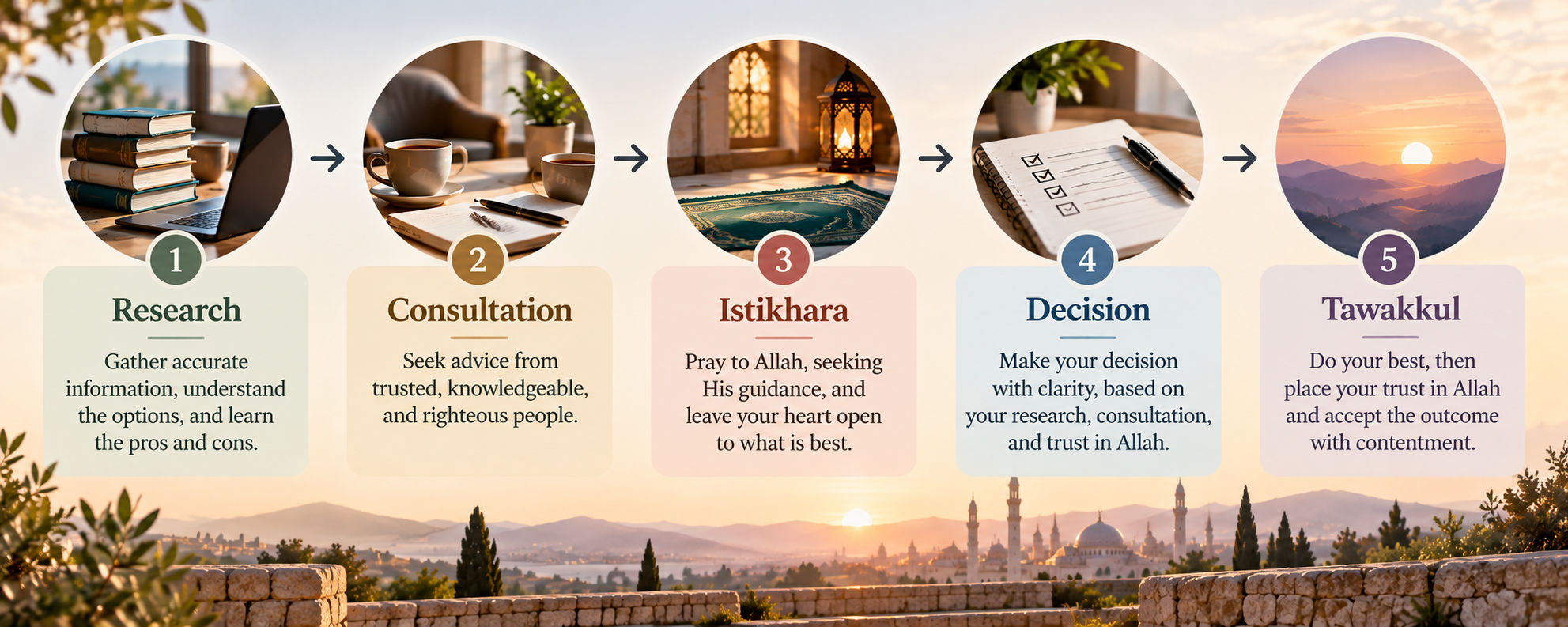
Istikhara (استخارة) means asking Allah for what is best, and it is one of the clearest applications of Tawakkul in decision-making. Jabir ibn Abdullah reported that the Prophet ﷺ used to teach the Companions Istikhara in all matters, as he taught them a Surah of the Quran (Sahih al-Bukhari no. 1162). One prays two non-obligatory rak'ahs, then makes the Dua, which includes the meaning: "O Allah, I ask You for the best by Your knowledge and I ask You for ability by Your power, and I ask You from Your great bounty. You are capable and I am not; You know and I do not; You know the unseen..."
Some common misunderstandings:
Istikhara does not necessarily produce a dream. The hadith does not mention dreams or any sign.
It does not replace research. You still investigate.
It does not replace consultation. The Quran pairs decision-making with Shura.
It does not mean waiting indefinitely for a supernatural sign. Many scholars explain that after Istikhara you proceed with the option that seems sensible, and see whether Allah makes it easy or turns it away.
A practical framework:
Research → Consultation → Istikhara → Decision → Tawakkul
(Details of the prayer's method and timing are best learned from a qualified teacher; a dedicated Araby Academy article on Istikhara would be the right place for this.)
Tawakkul and Shura — Ask People Before You Decide
Shura (الشورى) means consultation. Allah describes believers as those "whose affair is [determined by] consultation among themselves" (Quran 42:38), and in 3:159 commands the Prophet ﷺ to consult before deciding.
Trusting Allah does not mean deciding everything alone. Depending on the matter you may consult knowledgeable people, family, professionals, scholars, and experienced mentors. But consultation should move you toward a responsible decision. If you keep asking and asking only to avoid the discomfort of choosing, the process has stopped serving Tawakkul. At some point comes the command of 3:159: when you have decided, rely upon Allah.
Tawakkul and Sabr
Sabr (الصبر) is usually translated as patience, but the word is wider than "waiting quietly." Ibn al-Qayyim and other scholars describe three broad areas: patience in obedience (staying consistent in worship), patience against disobedience (restraining yourself from what Allah forbids), and patience with painful decrees (not collapsing into despair or complaint against Allah).
The relationship:
Tawakkul entrusts the matter to Allah.
Sabr keeps you steadfast and principled while living through what follows.
The Quran joins them in 16:42 and 29:59, describing those who "were patient and upon their Lord relied." Sabr is active: perseverance, restraint, continued obedience, and remaining principled under difficulty.
Tawakkul Before, During, and After a Decision
Tawakkul is not only something you practice before an outcome. It shapes how you respond after it.
Before
Gather information.
Seek advice.
Make Dua.
Consider halal options.
During
Choose responsibly.
Take the appropriate means.
Avoid paralysis.
Ask Allah for help.
After
Continue responsible action.
Avoid obsessive regret.
Accept what cannot be changed.
Learn from mistakes.
Trust Allah with the outcome.
Tawakkul When the Outcome Is Good
Success has its own spiritual test. A person may say, "I succeeded because I'm talented." Tawakkul teaches gratitude, humility, and recognition of Allah's favor, while continuing responsible effort.
This does not deny human effort. It completes the sentence: you worked, and Allah enabled the work and its result.
Tawakkul When the Outcome Is Not What You Wanted
This is where Tawakkul is truly tested.
You studied and failed. You applied and were rejected. You pursued marriage and it ended. You built a business and it struggled. You made Dua and the situation did not change as you hoped. You sought treatment and recovery is slower than expected.
Tawakkul does not mean: "If I trust Allah enough, I will receive the outcome I want." That would turn Tawakkul into a transaction. It means trusting Allah even when the outcome differs from your plan.
The hadith of the strong believer (Sahih Muslim no. 2664) gives the response: after doing your part, if something afflicts you, avoid the endless "if only," and say Qadar Allah wa ma sha'a fa'al.
We should also be careful about clichés. We cannot claim to know Allah's specific wisdom behind an individual hardship. Muslims believe that Allah is Al-Hakeem, the All-Wise (الحكيم), while acknowledging that the particular wisdom behind a particular event may be unknown to us in this life. Without false certainty, we can still hold the believer's confidence that Allah does not wrong anyone and that patience and reliance are never wasted (see also Quran 2:155–157).
Does Tawakkul Mean You Should Never Feel Worried?
No. Human feelings do not automatically measure the strength of Tawakkul. A person may feel fear, uncertainty, sadness, or nervousness while still relying upon Allah.
The Quran itself describes Musa (Moses) عليه السلام feeling apprehension (Quran 20:67). At the Red Sea, when his people said, "We are going to be overtaken," he replied, "No! Indeed, with me is my Lord; He will guide me" (26:61–62). Then came the command to strike the sea with his staff (26:63). Notice again: reliance, then an action to take.
Tawakkul concerns where the heart ultimately turns. It is not a promise that the nervous system never feels fear.
Tawakkul and Mental Health
Seeking therapy, medical care, psychological assessment, or counseling when appropriate does not inherently contradict Tawakkul. These can be among the means a person takes. Salah, Quran, Dhikr (remembrance of Allah), and Dua remain valuable acts of worship and sources of strength. The choice is not "faith or treatment."
This article cannot offer medical advice. Please do not start, stop, or change any medication without your doctor. If you are struggling, speaking to a qualified professional and a trusted person in your life is a responsible step.
Tawakkul and Rizq
Rizq (الرزق) means provision: income, food, health, family, opportunities, and everything beneficial Allah gives. The Quran says: "There is no creature on earth but that upon Allah is its provision" (11:6).
Believing that Allah provides does not mean refusing to seek provision. The Quran says: "It is He who made the earth tame for you, so walk among its slopes and eat of His provision" (67:15), and "Disperse within the land and seek the bounty of Allah" (62:10). Employment, business, education, skills, financial planning, lawful earning, and Dua all belong together.
There is no authentic "Rizq hack" in which repeating a phrase a set number of times guarantees wealth. Be cautious of anyone promising that.
Tawakkul in Marriage
A Muslim seeking marriage may clarify values, involve appropriate trusted people, use halal avenues, ask questions, investigate compatibility, consult, make Istikhara, and make Dua. Then trust Allah.
Be careful with the saying, "If the person is written for you, nothing can stop it." It can be misused to justify obsession, crossing boundaries, or refusing to accept a no. Healthy Tawakkul does the opposite: it helps a person respect outcomes and other people's agency.
Tawakkul in Parenting
Parents can teach Islam, model good character, provide Quran education, communicate, create a healthy home, make Dua, and seek advice. But parents cannot directly control another person's heart. Even the Prophet ﷺ wished for his uncle Abu Talib to accept Islam, and Allah told him: "Indeed, you do not guide whom you like, but Allah guides whom He wills" (Quran 28:56). Nuh's (Noah's) son also did not follow his father (11:42–46).
This can be consoling for parents raising children in non-Muslim-majority societies: your responsibility is faithful effort, loving example, and Dua. The final guidance belongs to Allah.
Tawakkul in Work and Study
Whether it is an exam, a university application, an interview, or a business venture:
Prepare as though preparation matters, because Islam commands responsible action. Trust Allah as though the outcome was never yours to command, because it wasn't.
(This is editorial wording, not a hadith.)
Tawakkul During Illness
A Muslim may seek qualified medical care, follow appropriate treatment, ask questions, seek a second opinion where appropriate, make Dua, keep up worship according to ability, and trust Allah. The Prophet ﷺ encouraged seeking treatment, as quoted above.
It is important to add: the speed of someone's recovery does not measure their faith. Illness may also be a means of expiation and reward for the believer, as the Prophet ﷺ taught (Sahih al-Bukhari no. 5641). We cannot promise healing from a specific religious practice unless authentic evidence supports the exact claim, and this article offers no medical recommendations.
Tawakkul When You Cannot Control the Outcome
When the situation feels bigger than you, ask yourself six questions:
What is my responsibility?
What means are available?
Have I sought appropriate advice?
Have I made Dua?
Have I made a responsible decision?
What part of this outcome was never mine to control?
The sixth question is the one that brings peace.
The Tawakkul Matrix
Here is a simple modern educational model (not a classical Islamic framework) for understanding the concept:
Low action | Responsible action | |
|---|---|---|
Low reliance on Allah | Helplessness; dependence on circumstances | Self-reliance without recognizing Allah |
Reliance on Allah | Passive misunderstanding of Tawakkul | Healthy Tawakkul |
The goal is the bottom-right box: reliance on Allah + responsible action. Each of the other three leaves out something Islam asks of us: either the means, or the heart's turning to Allah, or both.
Signs You May Be Misunderstanding Tawakkul
These are not accusations. Most of us slip into some of them at times, and noticing is the first step.
You avoid decisions indefinitely. Delay can feel like humility, but it may be fear of getting it wrong.
You neglect obvious responsibilities. Bills, applications, appointments, and studying are not "worldly distractions" from faith.
You refuse appropriate help. Seeking help from qualified people is a means, not a lack of trust.
You use Qadr to justify preventable mistakes. Qadr is for consolation after effort, not an excuse before it.
You call lack of preparation "faith."
You expect Dua to replace action.
You believe planning shows weak faith. The Prophet ﷺ planned.
You depend entirely on created means and forget Allah. The opposite error is just as real.
You believe one unsuccessful outcome proves Allah abandoned you. A hard outcome is not a verdict on your faith or on Allah's care.
7 Practical Ways to Build Tawakkul
1. Know Allah better. Reliance grows with knowledge of Allah's Names and attributes. Al-Wakeel (الوكيل) is one of His Names, meaning the One in whom affairs are entrusted and who is sufficient to manage them (Quran 3:173, 39:62: "Allah is the Disposer of all things"). Learn the Names from authentic teaching; do not invent special formulas around them.
2. Protect your Salah. Five times a day you turn your whole self toward Allah and say, "You alone we worship and You alone we ask for help" (Quran 1:5). It is a repeated reorientation of the heart.
3. Make Dua before and during action, not only after plans fail.
4. Take the best means available. Do not intentionally neglect responsibility.
5. Limit your obsession with outcomes. Focus on your responsibility, which you can control, rather than the result, which you cannot.
6. Practice gratitude after success. Recognize Allah's favor in every result.
7. Practice acceptance after responsible effort. Learn, adjust, and continue.
Authentic Duas and Dhikr Connected to Reliance on Allah
Dhikr (ذكر) means remembrance of Allah. Two well-known expressions connect directly to this theme. Neither is a magical formula for obtaining a specific outcome; they are expressions of dependence on Allah.
Hasbunallahu wa ni'mal-wakeel
حَسْبُنَا اللَّهُ وَنِعْمَ الْوَكِيلُ
Transliteration: Hasbunallahu wa ni'mal-wakeel. Meaning: "Allah is sufficient for us, and [He is] the best Disposer of affairs."
Source: Quran 3:173 (in the context of Hamra al-Asad, above). Ibn Abbas reported that Ibrahim (Abraham) عليه السلام said it when thrown into the fire, and that Muhammad ﷺ said it when told the people had gathered against them (Sahih al-Bukhari no. 4563). Notice that in both situations, the speakers had done what they could and faced something beyond their control.
La hawla wa la quwwata illa billah
لَا حَوْلَ وَلَا قُوَّةَ إِلَّا بِاللَّهِ
Meaning: There is no change of condition and no power except through Allah.
The Prophet ﷺ told Abu Musa al-Ash'ari that it is "a treasure from the treasures of Paradise" (Sahih al-Bukhari no. 4205; Sahih Muslim no. 2704). Scholars explain that it is an admission of our complete dependence: even our ability to make an effort is given by Allah.
These are enough for this article. We avoid long lists of Duas that mix authentic and weak reports.
Can I Trust Allah and Still Make a Backup Plan?
Yes. Appropriate planning and precaution do not inherently contradict Tawakkul. Yaqub's advice in 12:67 and the Prophet's provisioning for his family (above) show this. Examples: emergency savings, alternative university applications, travel planning, backup childcare, health precautions, and (where Shariah considerations are properly addressed with a qualified scholar) insurance questions. This article does not issue specific financial or fiqh rulings.
The key principle:
Precaution becomes spiritually problematic when the heart treats the precaution itself as the ultimate guarantor.
Tawakkul vs. Trying to Control Everything
Human beings crave certainty. We want to know exactly what will happen, when, why, whether our decision will work, and whether we will regret it. But much of the future belongs to the unseen (ghayb, الغيب).
Here is a key insight: Tawakkul does not give you advance access to the unseen. It gives you a way to move forward responsibly without possessing certainty about the outcome.
Waiting for impossible certainty is not caution. It is often fear in disguise. Tawakkul lets us act on the knowledge we have.
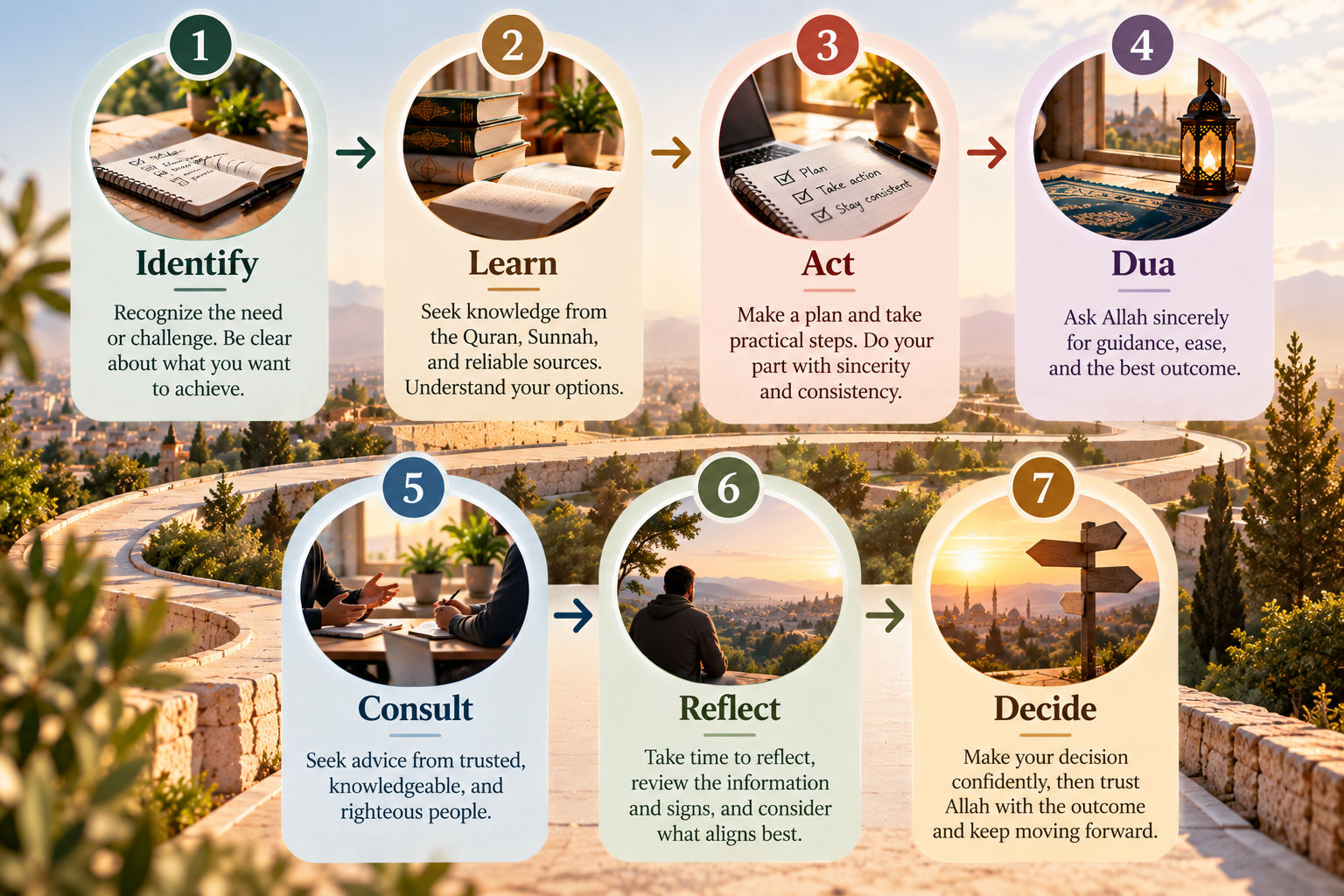
A 7-Day Tawakkul Practice
Here is an optional educational exercise. This is a practical reflection framework, not a Sunnah seven-day ritual.
Day 1: Identify what you are trying to control. Write down a situation and what part of it you cannot control.
Day 2: Learn one Quran verse about Tawakkul. Read its translation and context; perhaps start with 3:159.
Day 3: Take one delayed practical action. Send the email, book the appointment, begin the application.
Day 4: Make focused Dua. Ask Allah for help with this specific matter.
Day 5: Seek consultation. Speak to someone knowledgeable and trustworthy.
Day 6: Reflect on a past outcome you could not control. What did you learn? How did you grow?
Day 7: Make a responsible decision and entrust the outcome to Allah.
Tawakkul Checklist for a Difficult Decision
□ Is this option halal? □ Have I gathered enough reliable information? □ Have I consulted appropriate people? □ Have I considered the consequences? □ Have I made Dua? □ Is Istikhara appropriate here? □ Am I delaying because I need more information, or because I want impossible certainty? □ Have I taken the reasonable means available? □ Am I willing to accept that the outcome remains with Allah?
Common Tawakkul Mistakes
1. Confusing Tawakkul with laziness. Example: skipping revision because "Allah will decide." Revise, then entrust.
2. Thinking planning shows weak faith. Example: feeling guilty for making a budget. Planning is a means Allah has permitted, and the Prophet ﷺ planned.
3. Believing Dua replaces action. Example: making Dua for a job but never applying.
4. Treating created means as independent causes of success. Example: feeling that your degree alone guarantees employment.
5. Using Qadr to avoid responsibility. Example: "It was written that I'd be late," after oversleeping.
6. Expecting Tawakkul to guarantee your preferred outcome. Example: feeling betrayed by Allah after a rejection. Tawakkul is a relationship, not a vending machine.
7. Believing fear automatically means weak Tawakkul. Example: feeling anxious before surgery and concluding you lack faith. Feeling and relying can coexist.
8. Waiting for a dream before every decision. Example: delaying a job offer for weeks waiting for a sign. Istikhara does not require one.
9. Refusing professional help in the name of Tawakkul. Example: avoiding a doctor, counselor, or financial advisor. Seeking help is a means.
10. Trusting Allah only after every other option fails. Example: turning to Dua only as a last resort. Reliance belongs at the start, middle, and end.
Tawakkul for New Muslims
If you are new to Islam, you may hear Tawakkul, insha'Allah ("if Allah wills"), Qadr, Sabr, and Istikhara all at once without anyone explaining how they connect. Here is a simple model:
Learn what Allah asks of you.
Do what you reasonably can.
Ask Allah for help.
Trust Him with what happens next.
You do not need to master the terminology first. This model is already Tawakkul. Over time, the vocabulary will come.
Understanding Tawakkul Through Arabic
Learning key Quranic vocabulary helps you notice recurring ideas in the Quran. A few terms from this article:
توكل (tawakkul): to rely, to entrust one's affairs.
وكيل (wakeel): one entrusted with affairs; Disposer of affairs / Trustee, translated according to context.
حسب (hasb): sufficiency, as in hasbunallah.
صبر (sabr): patience, steadfastness.
قدر (qadar): decree, measure, depending on context.
Translations are helpful but cannot capture every nuance. Gradually learning Quranic Arabic can help you recognize these words directly when they appear in Salah and recitation. Arabic study does not replace Tafsir (Quranic explanation); it complements it.
Learning Tawakkul Alongside the Language of the Quran
Understanding concepts like Tawakkul becomes richer when you can gradually understand Quranic vocabulary, the words of Salah, authentic Duas, and the expressions of Dhikr. At Araby Academy, one-to-one lessons support learners worldwide in Quran reading, Tajweed, Quran memorization, Quranic Arabic, Arabic for non-native speakers, and Islamic Studies, for adults and children alike.
Related reading from Araby Academy (suggested topics; link to the live pages when published):
What Does Islam Say About Anxiety, Worry, and Trusting Allah?
Why Does Allah Test Us?
What Is Qadr in Islam?
How to Make Dua
What Is Dhikr?
How to Learn Salah When You Don't Speak Arabic
How to Understand the Quran Without Speaking Fluent Arabic
100 Most Common Words in the Quran
Learn Arabic Through the Quran
New Muslim Guide
Raising Muslim Children in the West
Frequently Asked Questions About Tawakkul
1. What does Tawakkul mean in Islam? Tawakkul is relying on Allah with the heart while taking the lawful means He has made available, and accepting that the outcome belongs to Him.
2. How do you practice Tawakkul? Prepare, consult, make Dua, decide responsibly, then entrust the result to Allah. Keep worshipping and acting afterward.
3. Does Tawakkul mean doing nothing? No. The Quran and Sunnah pair reliance with action: the birds go out in the morning (Tirmidhi no. 2344), and 5:23 says to enter the gate and then rely on Allah.
4. What is the difference between Tawakkul and Qadr? Qadr is Allah's decree. Tawakkul is the believer's reliance on Allah while acting within that reality. Belief in Qadr does not erase human responsibility.
5. Can I plan and still have Tawakkul? Yes. The Prophet ﷺ planned the Hijrah carefully, and Yaqub took precautions in 12:67 while relying on Allah.
6. What does the Quran say about Tawakkul? It commands reliance in many places, such as 3:159 ("when you have decided, put your trust in Allah") and 65:3 ("whoever relies upon Allah, He is sufficient for him").
7. Is "tie your camel and trust Allah" an authentic hadith? It is recorded by al-Tirmidhi (no. 2517) and others, but its grading is discussed among scholars. The principle it teaches is established by other, stronger evidence.
8. How do Tawakkul and Dua work together? Dua is an act of worship and a means Allah has permitted. You ask Allah, take action, and trust Him, without assuming Dua will force a specific outcome.
9. Does worrying mean I don't trust Allah? Not necessarily. Feelings of worry can coexist with reliance on Allah. Musa عليه السلام felt apprehension and still relied on his Lord (20:67; 26:62).
10. How do I have Tawakkul when making a decision? Research, consult, make Dua (and Istikhara where appropriate), decide, then entrust the outcome to Allah.
11. What is the relationship between Tawakkul and Istikhara? Istikhara asks Allah for what is best, and is one way of practicing Tawakkul. It does not replace research or consultation, and does not require a dream.
12. Can seeking therapy or medical treatment coexist with Tawakkul? Yes. The Prophet ﷺ encouraged seeking treatment (Sahih al-Bukhari no. 5678), and treatment is a means, not a contradiction of reliance.
Conclusion: Do Your Part — Then Entrust the Outcome to Allah
We began with the question: "If Allah controls the outcome, what am I supposed to do?"
Do what Allah has made your responsibility. Learn. Ask. Plan. Consult. Work. Seek treatment when needed. Study. Apply. Make Dua. Take the appropriate means.
Then recognize something deeply liberating: you were never commanded to control the outcome.
Tawakkul is not sitting still because Allah controls the future. It is moving responsibly because Allah controls the future.
Take the means. Ask Allah for help. Rely upon Him rather than the means. Accept that the final outcome belongs to Him.
Tawakkul is not waiting for Allah to do what you were responsible for doing. It is doing what Allah has made your responsibility while knowing that the result was never yours to command.
May Allah make us among those who rely upon Him, and grant us ease in our affairs. If you would like to keep growing in understanding of the Quran, its words, and its Duas, Araby Academy is here to help.