
Someone loses a job. Someone waits for medical results. A parent runs a tired household on little sleep, a student spends years on a skill that will not click, and someone is treated unfairly at work or at home. Often the advice they hear is just two words: "Have Sabr."
But what does that actually ask of a person? Does Islam expect silence, a face that never shows sadness, and a willingness to wait while circumstances sort themselves out?
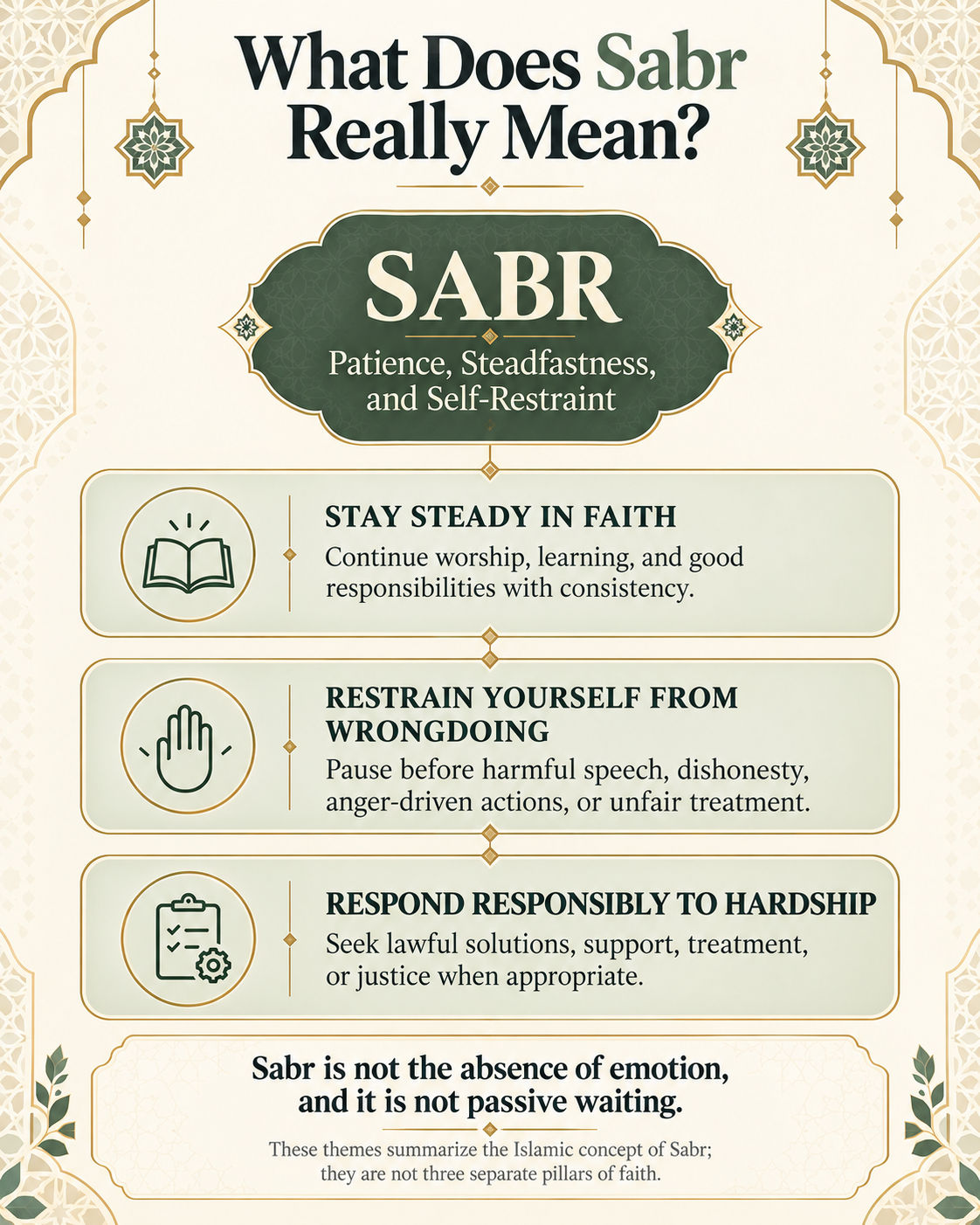
What is Sabr? Sabr is an Arabic Quranic concept commonly translated as patience, steadfastness, or perseverance. In Islam, it means staying faithful to Allah's guidance, continuing good actions, resisting wrongdoing, and responding to hardship with self-restraint and responsibility. It does not mean never feeling sadness or doing nothing about a problem. Muslims are encouraged to seek Allah's help while taking appropriate, lawful action.
Patience is often presented as something passive, but the Quran's teaching is more demanding and more meaningful. This guide explains the Arabic word, the key Quranic verses, authentic Prophetic teachings, the lives of the Prophets, and the practical ways Sabr works in real life.
Sabr at a Glance
Question | Short answer |
|---|---|
What is Sabr? | Steadfastness and restraint according to Islamic teaching |
Does Sabr mean silence? | Not necessarily |
Does Sabr allow grief? | Yes, with important nuance |
Can patient people take action? | Yes |
Common scholarly categories? | Patience in obedience, away from wrongdoing, and through hardship |
What helps develop Sabr? | Knowledge, worship, Dua, support, and responsible choices |
This table is an editorial summary, not a Prophetic definition.
What Is Sabr in Islam?
Three threads run through the Islamic idea of Sabr: staying steady in faith and worship, holding yourself back from what is wrong, and keeping your moral footing when life is hard. Notice that none of these is "waiting." Each one is something a person does.
So Sabr does not automatically mean never crying, never asking questions, never seeking treatment, never reporting abuse, never seeking legal justice, never changing jobs, or never asking for help. Religious patience and passivity are different things, and confusing them has caused real harm.
What Does Sabr Mean in Arabic?
The Arabic word is الصَّبْر (as-Sabr), built on the three-letter root ص ب ر (S-B-R). Classical lexicons such as Lisan al-'Arab connect the root with restraining and holding something in place. Al-Raghib al-Isfahani, in his dictionary of Quranic vocabulary, describes Sabr as holding oneself to what reason and the Shari'ah require. The Quran uses this sense literally in 18:28, where the Prophet ﷺ is told to keep himself (wasbir nafsaka) with those who call upon their Lord morning and evening.
That is why steadfastness, endurance, and perseverance all sit inside the word.
Arabic | Transliteration | Grammatical role |
|---|---|---|
صَبَرَ | Sabara | Past verb: he was patient, held firm |
يَصْبِرُ | Yasbiru | Present verb: he is patient |
صَبْر | Sabr | Verbal noun: patience, steadfastness |
صَابِر | Sabir | Active participle: one who is patient |
الصَّابِرُون | As-Sabirun | Plural, nominative case |
الصَّابِرِينَ | As-Sabirin | Plural, accusative or genitive case |
These forms share a root but not an identical function. The last two differ mainly by grammatical case, which is why the Quran shows both depending on the sentence. English "patience" can suggest calmly waiting, while Sabr can also mean self-control, persistence, and staying committed under difficulty. No single English word fits every occurrence, so context decides the best translation.
What Does the Quran Say About Patience?
Sabr and its derivatives appear throughout the Quran, in contexts of worship, battle, hardship, justice, and daily conduct. A few passages form its foundation.
Allah Is With the Patient
يَا أَيُّهَا الَّذِينَ آمَنُوا اسْتَعِينُوا بِالصَّبْرِ وَالصَّلَاةِ ۚ إِنَّ اللَّهَ مَعَ الصَّابِرِينَ
"O you who believe, seek help through patience and prayer. Indeed, Allah is with the patient." (Quran 2:153)
Notice what the verse pairs: patience and prayer are means of seeking help. They are active resources, not a substitute for medical, legal, or practical help. A similar instruction appears in 2:45.
Commentators such as al-Tabari and Ibn Kathir explain "Allah is with the patient" as Allah's special companionship of support, aid, and care for the patient. It does not mean physical, human-like closeness. Nor does the verse promise that a reader's preferred outcome will arrive quickly.
Mini-lesson in the Arabic. إِنَّ (inna) means "indeed," adding emphasis. اللَّهَ (Allah) is the noun of inna, which is why it takes the accusative ending. مَعَ (ma'a) means "with." الصَّابِرِينَ (as-Sabirin) means "the patient ones." The sentence is a statement of assurance, not a command.
The next verses address hardship directly:
"And We will surely test you with something of fear and hunger and a loss of wealth, lives, and fruits, but give good tidings to the patient: those who, when disaster strikes them, say, 'Indeed we belong to Allah, and indeed to Him we will return.' Those are the ones upon whom are blessings from their Lord and mercy, and it is those who are rightly guided." (Quran 2:155–157)
The phrase إِنَّا لِلَّهِ وَإِنَّا إِلَيْهِ رَاجِعُونَ (Inna lillahi wa inna ilayhi raji'un) places loss in perspective: everything belongs to Allah, and every person returns to Him. It does not require a person to stop grieving. The passage also says nothing about why a particular person suffers. It teaches how to respond, and the hidden reasons for any individual loss remain unknown to us.
The Reward of Sabr
إِنَّمَا يُوَفَّى الصَّابِرُونَ أَجْرَهُم بِغَيْرِ حِسَابٍ
"Indeed, the patient will be given their reward without account." (Quran 39:10)
Commentators understand "without account" as reward beyond ordinary measure. It is a sign of Allah's generosity, not a number to calculate. Elsewhere the Quran says, "And Allah loves the patient" (3:146), linking patience with Divine love. This does not mean that suffering itself proves special favor. Surah Al-'Asr (103:3) lists mutual advice to patience beside advice to truth, which describes a community encouraging one another. It is never a license to pressure vulnerable people into silence.
Beautiful Patience
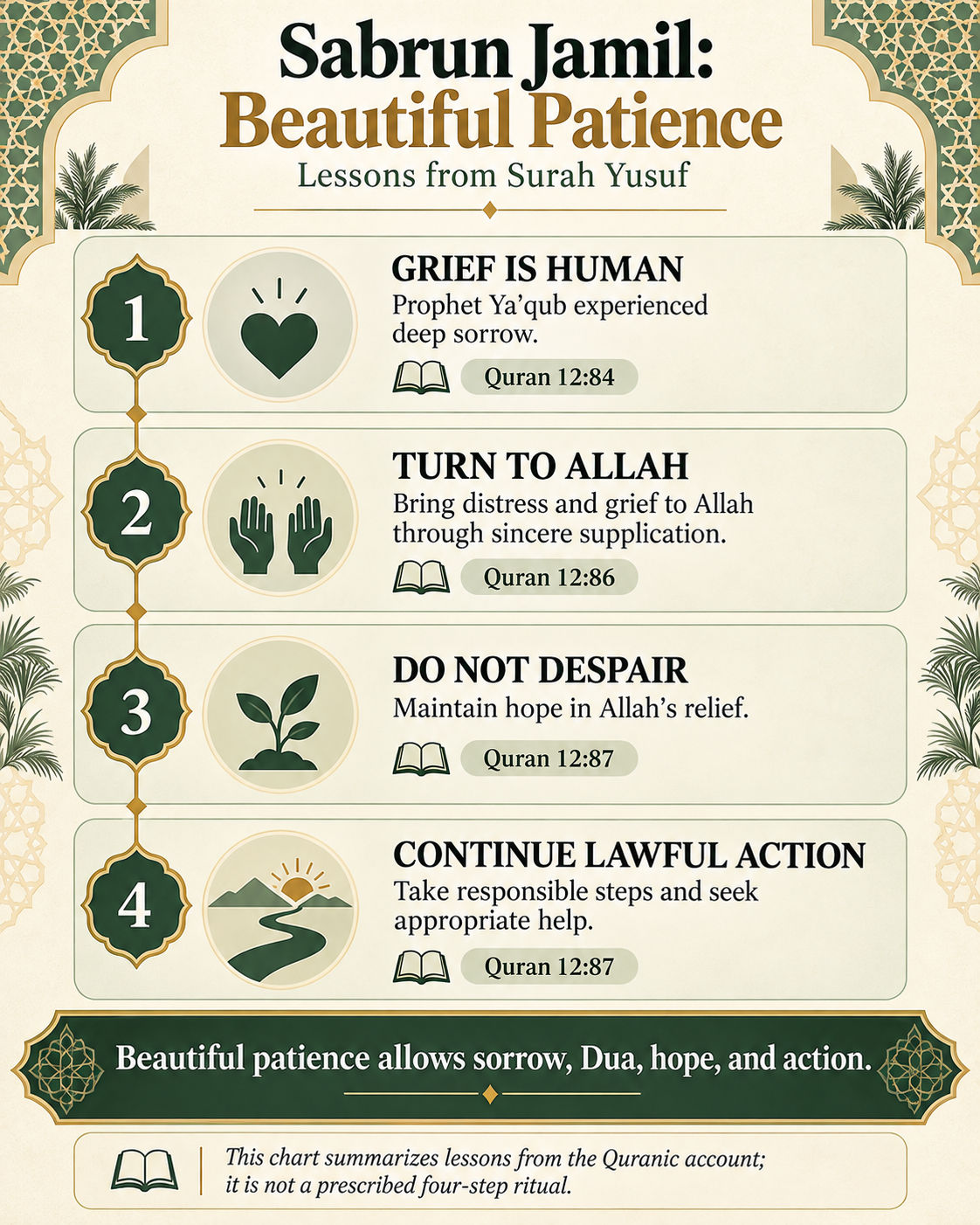
Sabrun Jamil (صَبْرٌ جَمِيل), "beautiful patience," appears in Surah Yusuf. Ya'qub (Jacob) says it twice about the loss of his son:
فَصَبْرٌ جَمِيلٌ ۖ وَاللَّهُ الْمُسْتَعَانُ عَلَىٰ مَا تَصِفُونَ
"So patience is beautiful, and Allah is the One whose help is sought against what you describe." (Quran 12:18)
Mini-lesson in the Arabic. صَبْرٌ (sabr) is a noun, and جَمِيلٌ (jamil) is the adjective "beautiful." Together they form a phrase usually understood as "[mine is] beautiful patience" or "beautiful patience is fitting." Classical commentators generally explain "beautiful" as patience free from despair and from grumbling against Allah's decree. No single English phrase captures every shade.
Yet the Quran says plainly that Ya'qub grieved. His eyes turned white with sorrow (12:84), and he said, "I only complain of my suffering and my grief to Allah" (12:86). Then, in 12:87, he told his sons to go and search and not to despair of Allah's relief. So beautiful patience is not emotional numbness. It combines honest sorrow, turning to Allah, hope, and continued effort.
What Are the Three Types of Sabr?
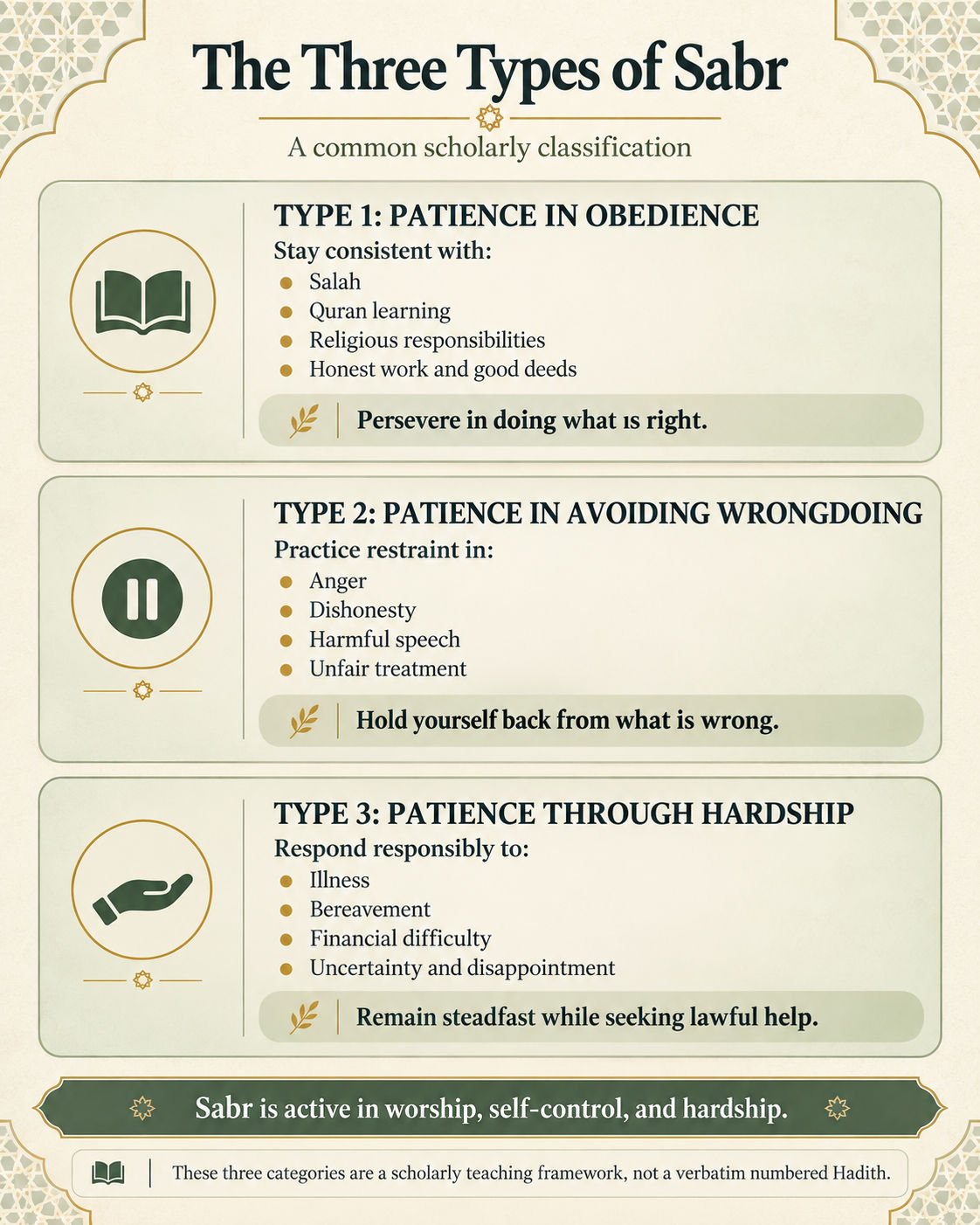
Scholars such as Ibn al-Qayyim, in works like 'Uddat al-Sabirin, and many others describe Sabr in three broad categories. This is a recognized scholarly classification for teaching. It is not a numbered three-part Hadith from the Prophet ﷺ.
Patience in Obedience
الصَّبْرُ عَلَى الطَّاعَة (as-sabr 'ala at-ta'ah) means persevering in worship and duty, such as Salah, fasting, Quran recitation, honest work, kindness, and seeking knowledge. One everyday example of Sabr is remaining consistent with [: the five daily prayers], even when routines become demanding. Struggling to concentrate in prayer does not by itself mean you lack patience or that your prayer is invalid. Improving attentiveness is part of the work.
Learning the Quran is another arena. Slow progress, repeated pronunciation practice, memorization, revision, and mistakes are all part of the path. For students who find progress slow, [ building a daily Quran habit that actually lasts] can be a practical exercise in patient consistency. A good teacher corrects with care, because harshness can teach a student to fear the Quran rather than love it. Patience here does not mean exhausting yourself with every optional act, and the Prophetic emphasis is on steady, sustainable deeds.
Patience in Avoiding Wrongdoing
الصَّبْرُ عَنِ الْمَعْصِيَة (as-sabr 'an al-ma'siyah) is self-restraint in the face of temptation: refusing dishonest gain, avoiding harmful speech, not spreading rumors, and not treating others unfairly. Having a temptation or an unwanted thought is not itself a sin. Sabr is what you choose to do next.
Anger shows the difference. The Prophet ﷺ said, in a narration of Abu Hurayrah in Sahih al-Bukhari and Sahih Muslim, that the strong person is not the one who overpowers others but the one who controls himself when angry. Anger is a human feeling, and the guidance concerns what we do with it. Online life offers constant practice: pausing before sending a harsh message, not posting insults, not sharing unverified claims, and respecting privacy.
Patience During Hardship
الصَّبْرُ عَلَى الْبَلَاء (as-sabr 'ala al-bala') covers illness, bereavement, job loss, uncertainty, and disappointment. Islam teaches that life includes tests, but we cannot confidently name the exact Divine reason behind any individual's tragedy. Understanding patience during difficult circumstances becomes clearer when readers explore [why Allah tests people through hardship] without assuming that every loss is a punishment.
Hardship alone does not reveal a person's standing with Allah, and nobody should tell a survivor that their pain was sent to teach them patience.
What Did the Prophet Muhammad ﷺ Teach About Patience?
Patience at the first shock. Anas ibn Malik reported (Sahih al-Bukhari and Sahih Muslim) that the Prophet ﷺ passed a woman weeping at a grave and told her to fear Allah and be patient. She did not recognize him and replied sharply that he had not suffered her loss. When she learned who he was, she came to his door apologizing. He said: إِنَّمَا الصَّبْرُ عِنْدَ الصَّدْمَةِ الْأُولَى, "Patience is at the first shock." The Prophet ﷺ did not shame her for her tears or her words. The lesson is about steadiness in the first moment of pain, and later waves of grief are not proof of failure.
The Prophet's own tears. When his young son Ibrahim was dying, the Prophet's eyes filled with tears. 'Abd al-Rahman ibn 'Awf asked in surprise, and the Prophet ﷺ answered that this was mercy. He then said, in meaning, that the eye weeps and the heart grieves, and we say only what pleases our Lord (Bukhari and Muslim, from Anas). Human grief is not the opposite of Sabr. What matters is avoiding words and actions that violate Islamic guidance.
The believer's affair. Suhayb reported in Sahih Muslim that the Prophet ﷺ said the believer's affair is wondrous: if ease comes, he is grateful and that is good for him, and if harm comes, he is patient and that is good for him. It describes a pattern of faith, and no one responds perfectly in every situation.
Patience can be cultivated. Abu Sa'id al-Khudri reported (Bukhari and Muslim) that whoever strives to be patient, Allah will help him to be patient, and that no one has been given a gift better or more expansive than patience. Sabr grows through effort and Allah's help, not instantly.
Effort, not helplessness. In Sahih Muslim, Abu Hurayrah reported that the Prophet ﷺ said, in meaning: be keen on what benefits you, seek Allah's help, and do not feel helpless. This hadith is not specifically about Sabr, but it shows the Islamic balance between effort, reliance on Allah, and refusing to surrender to despair.
Examples of Sabr in the Lives of the Prophets
The Quran does not tell these stories as formulas for guaranteed outcomes. Each prophet faced a specific situation with revelation and a specific result. We learn from the character they show without promising a reader the same ending.
Ayyub and Suffering
The Quran says: "And [mention] Ayyub, when he called to his Lord, 'Indeed, adversity has touched me, and You are the Most Merciful of the merciful.'" (21:83). Allah answered and removed the harm (21:84), and elsewhere calls him "patient, an excellent servant" (38:44). Ayyub made Dua for relief and is still described as patient. Asking Allah to lift suffering is compatible with Sabr. Beyond the Quran, detailed accounts of his illness, family, and the length of his trial rely on weaker sources, so we leave them aside.
Ya'qub and Grief
Ya'qub's story, discussed above, shows grief, hope, Dua, and continued action together. No parent who loses a child should feel pressure to recover on a set timeline.
Yusuf and Injustice
Yusuf faced betrayal by his brothers, temptation, false accusation, and prison. The Quran shows him refusing wrongdoing (12:23), teaching about Allah in prison, asking that his case be investigated (12:50), and later serving responsibly during famine (12:55). Later he forgave his brothers (12:92). His reward is summed up in 12:90: whoever fears Allah and is patient, Allah does not waste the reward of those who do good. Remember that Yusuf's rise reflects his own unique story, and not every victim of injustice will gain power or recognition.
Ibrahim and Faith
When Ibrahim shared the command to sacrifice his son, the son replied, "O my father, do as you are commanded. You will find me, if Allah wills, among the steadfast" (37:102). Prophet Ibrahim's example offers another perspective on [faith, sacrifice, and trust in Allah] during difficult moments of obedience. The Quran also says he fulfilled the words with which Allah tested him (2:124). We should not invent dialogue beyond what the Quran states.
Musa and Perseverance
Musa carried a heavy mission and asked Allah to expand his chest and ease his task (20:25–26), which shows that prophets, too, asked for help. Readers can explore further lessons about perseverance and responsibility through [the Quranic story of Prophet Musa], while recognizing the distinct circumstances of each event.
In Surah Al-Kahf (18:60–82), Musa meets a servant of Allah, traditionally identified as al-Khidr, who says Musa will not be able to bear patience with what he does not understand. The lesson is humility toward knowledge we lack. It does not authorize anyone today to commit apparent harm on the claim of hidden wisdom, because that story has a specific revealed context.
Does Sabr Mean Accepting Injustice or Staying Silent?
No. The Quran recognizes justice and praises restraint, and the two are not opposites.
"And if you punish, punish with the equivalent of that with which you were harmed. But if you are patient, it is better for those who are patient." (Quran 16:126)
Similarly, 42:40 teaches that the recompense for a wrong is a proportionate wrong, but whoever pardons and makes things right has their reward with Allah. Verse 42:41 adds that there is no blame on one who defends himself after being wronged. So a person may hold a lawful right, pursue it lawfully, or choose pardon, but nothing here obliges a person to return to harm. Luqman's advice joins prayer, enjoining good, forbidding wrong, and patience (31:17). Sabr and moral action travel together.
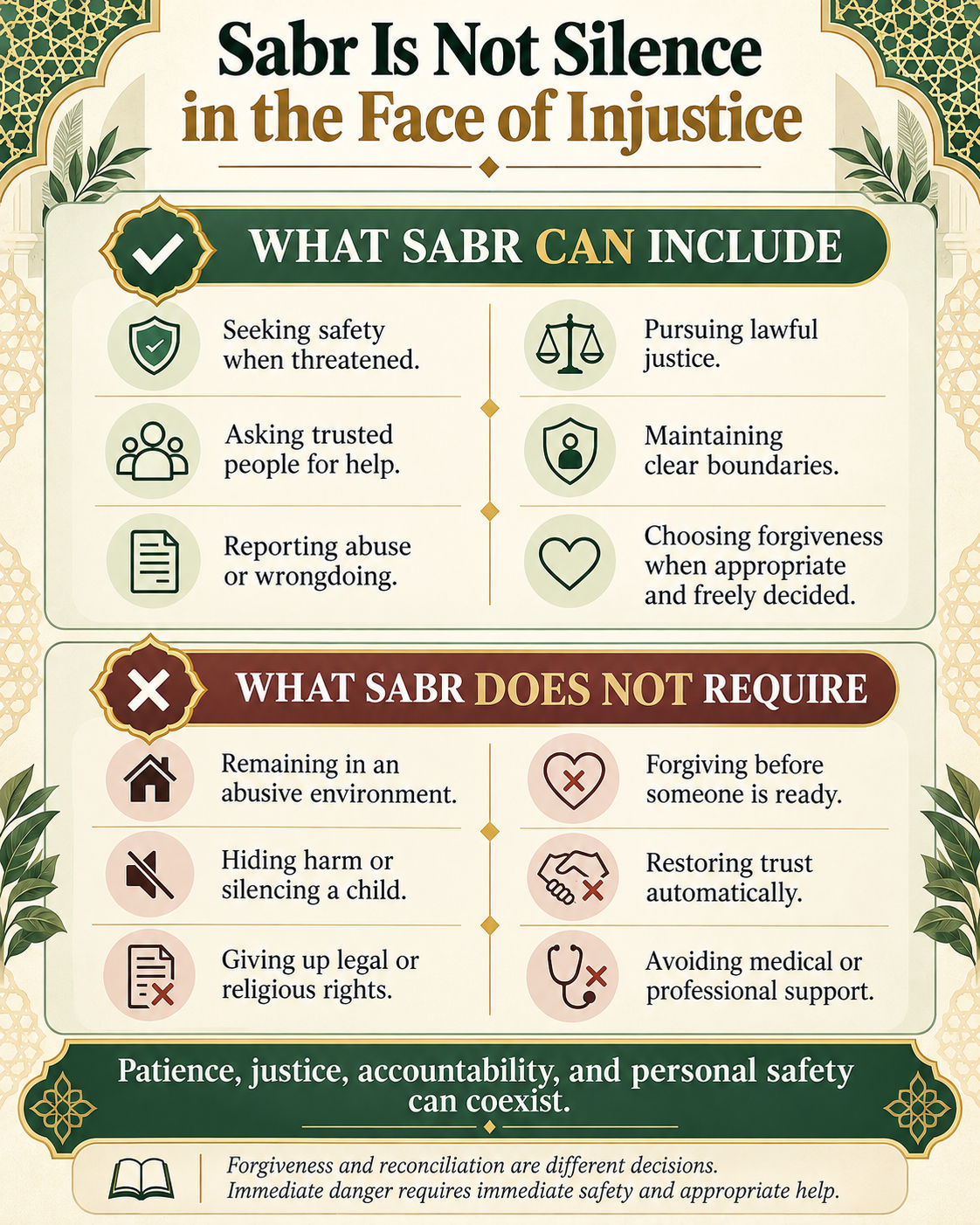
If someone is being abused: Sabr does not mean staying in an abusive or dangerous environment. Seeking safety, trusted support, legal help, and professional assistance can be appropriate and even necessary. The Prophet ﷺ taught that there is to be no harm and no reciprocating harm (reported in Ibn Majah and the Muwatta, and graded hasan by many scholars). A child should never be told to keep abuse secret, and nobody's faith is questioned for reporting wrongdoing.
Forgiveness is not reconciliation. Forgiveness releases a grievance. Reconciliation restores a relationship. Accountability and safety are separate again. Yusuf forgave his brothers, but this is no instruction that every victim must reconnect with those who harmed them, and nobody should be hurried into a decision. A person can forgive, hold firm boundaries, and still seek justice.
Can You Be Patient and Still Feel Sad or Angry?
Yes. Ya'qub wept. The Prophet ﷺ wept. Feelings are human, and Sabr concerns conduct. A patient person can honestly say, "This is painful," "I need help," "I am exhausted," or "I want this situation to change." These are modern examples of honest speech, not quotations from revelation.
Does Sabr mean never complaining? Complaining to Allah, asking for help, reporting wrongdoing, and expressing grief are different from unjust speech or rejecting religious duties. Ya'qub's words in 12:86 show the first kind. Remaining calm outwardly is not itself proof of piety, and it is not a requirement either.
Sabr vs Tawakkul, Shukr, Rida, and Qadr
Several related concepts overlap with Sabr without being identical.
Tawakkul (التَّوَكُّل) is relying on Allah while taking lawful means. Sabr is perseverance and restraint. Patience becomes more purposeful when paired with [trusting Allah without becoming passive], especially when responsible action is possible but outcomes remain uncertain.
Shukr (الشُّكْر) is gratitude. The "wondrous affair" hadith pairs gratitude in ease with patience in difficulty. It does not ask anyone to feel happy about suffering itself.
Rida (الرِّضَا) is contentment or acceptance of Allah's decree. Scholars have discussed the exact relationship between Rida and Sabr differently, so no single technical ranking should be presented as universally agreed.
Hilm (الْحِلْم) is forbearance and calm self-control, especially with people. Istiqamah (الاسْتِقَامَة) is consistent uprightness, which Sabr supports. Taqwa (التَّقْوَى) is reverent God-consciousness, and it reinforces Sabr, as 3:200 pairs them.
Qadr is belief in Divine Decree. Understanding [Divine Decree and human responsibility] helps explain why a Muslim can accept uncertainty while continuing to make meaningful choices. Qadr is never permission to do nothing.
How to Practice Sabr During Real-Life Challenges
Sabr rarely looks the same twice, so the following situations are examples, not rulings. A simple map for responsible action helps: if someone is in immediate danger, seek safety and urgent help first. If not, name the problem, ask what lawful step could help, and if nothing is clear, seek advice, make Dua, and keep up your responsibilities. This is an educational guide and not individual legal, medical, or psychological advice.
Unemployment. Keep applying, improve skills, ask for support, avoid dishonest opportunities, make Dua, and give yourself room to be disappointed. Patience does not promise a better-paying job.
Illness. Follow appropriate treatment, accept emotional support, pray, and use religious concessions where they apply. Never skip prescribed medication or delay urgent care in the name of patience. Dua is encouraged, but it does not replace medical care or guarantee a particular healing.
Bereavement. Grief takes the time it takes. Remembrance of Allah, community, and time can help, and there is no fixed deadline for recovery.
Mental health. Religious patience is not the same as clinical depression, trauma, anxiety disorders, or burnout. These conditions are not signs of weak faith, and more Sabr does not automatically cure them. Readers who feel overwhelmed by ongoing distress may find additional guidance in [ the Islamic understanding of anxiety, worry, and trusting Allah], alongside appropriate professional care. Sabr also should not become religious anxiety, where a person keeps doubting whether they are patient enough.
Family and learning. In family life, patience means listening, avoiding harshness, sharing responsibilities, admitting mistakes, and never excusing mistreatment. Students of Quran, Tajweed, and Arabic face unfamiliar sounds, grammar, and vocabulary. Patient learning is active and measurable: regular practice, revision, questions, and qualified instruction, with no promised timeline for memorization.
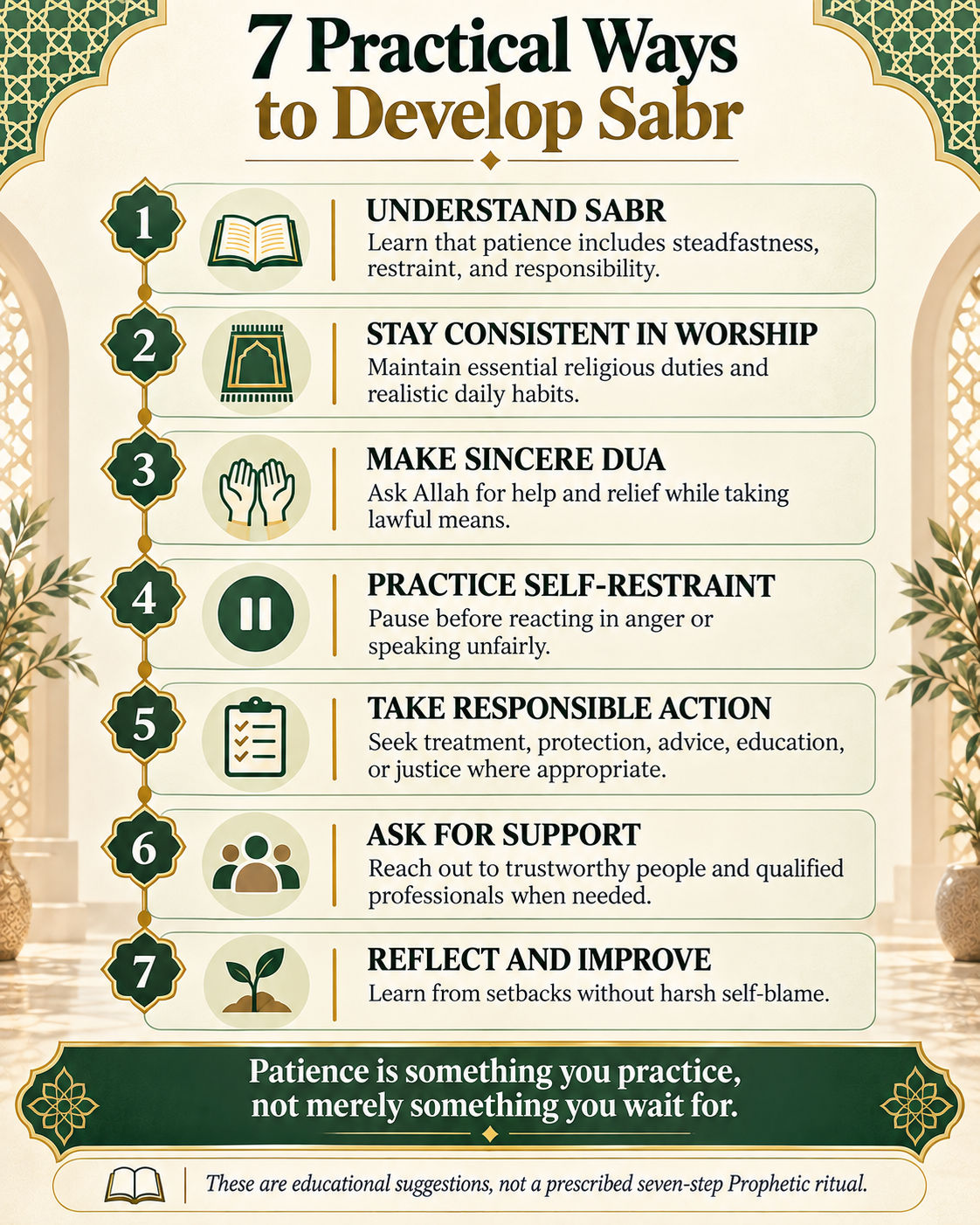
7 Practical Ways to Develop Sabr
This seven-step list is an editorial teaching framework, not a Prophetic instruction. Sabr grows through habit, knowledge, and Allah's help.
Understand what Sabr requires. Learn that it is steadfastness and responsibility, not silence.
Keep essential worship consistent. Small steady habits beat dramatic bursts. Many acts of patience become easier to maintain through [a daily Islamic routine that fits a busy life], rather than unrealistic expectations of constant productivity.
Make sincere Dua. Patience does not mean refusing to ask for relief; believers can learn [ how to make sincere Dua and ask Allah for help] while taking appropriate practical steps. No one can promise the exact worldly outcome.
Practice restraint before responding in anger. Pause, avoid retaliating unjustly, and look for a safe, fair solution.
Take lawful practical steps. Change jobs, seek treatment, report injustice, or get tutoring when that is what the situation needs.
Seek help and support. Not every problem must be carried privately.
Reflect and learn. Return to Quranic examples and learn from setbacks without harsh self-blame.
An optional daily practice (a modern suggestion, not a Sunnah ritual): in the morning, reflect on one relevant verse. During the day, pause before an important response. When struggling, ask Allah for help and identify one practical step. In the evening, note what you handled well and what could improve.
Five reflection questions (prompts, not verdicts): What part of this can I influence? What religious responsibility still applies? Is there a harmful action I should avoid? What help or information could I seek? Am I confusing patience with avoiding necessary action?
How to Teach Sabr to Muslim Children
Teach by example and by age. Young children practice waiting a turn, trying a hard skill again, using kind words when frustrated, and asking an adult for help. Teenagers face academic pressure, friendships, online conflict, and disappointment, and they need guidance, not lectures about ordinary developmental struggles. Expect reasonable things at each age, avoid intimidation, and never use "have Sabr" to silence a child's pain or a report of harm.
15 Arabic Words Related to Sabr
Arabic | Transliteration | Meaning |
|---|---|---|
الصَّبْر | As-Sabr | Patience, steadfastness |
صَابِر | Sabir | A patient person |
الصَّابِرُون | As-Sabirun | Those who are patient |
صَبْرٌ جَمِيل | Sabrun Jamil | Beautiful patience |
الْبَلَاء | Al-Bala' | Trial, affliction |
الْمُصِيبَة | Al-Musibah | Calamity, misfortune |
التَّوَكُّل | At-Tawakkul | Reliance upon Allah |
التَّقْوَى | At-Taqwa | God-consciousness |
الرِّضَا | Ar-Rida | Contentment, acceptance |
الشُّكْر | Ash-Shukr | Gratitude |
الْحِلْم | Al-Hilm | Forbearance |
الاسْتِقَامَة | Al-Istiqamah | Steadfast uprightness |
الدُّعَاء | Ad-Dua | Supplication |
الْفَرَج | Al-Faraj | Relief |
الأَجْر | Al-Ajr | Reward |
Not every term appears in the verses discussed here. Several are scholarly vocabulary built around the idea of Sabr.
Common Misconceptions About Patience in Islam
Myth | Reality |
|---|---|
Sabr means sitting still. | It can involve responsible action. |
Patient people never cry. | The Quran and Sunnah show grief. |
Sabr means pretending all is fine. | Honest recognition of hardship is not impatience. |
Seeking treatment shows weak patience. | Appropriate care is compatible with faith. |
Patient people never ask for relief. | Ayyub and others made Dua. |
Patient people cannot feel anger. | Feeling differs from acting unjustly. |
Sabr requires staying in abuse. | Patience does not cancel safety and justice. |
Forgiveness restores trust instantly. | Forgiveness and reconciliation differ. |
Changing a painful situation contradicts Sabr. | Lawful effort can be steadfastness. |
Sabr guarantees worldly success. | No universal outcome is promised. |
Every hardship is punishment. | Individual causes cannot be assumed. |
The three types are a verbatim Hadith. | It is a scholarly classification. |
Sabr and Tawakkul are identical. | They overlap but differ. |
Strong faith eliminates depression or trauma. | These are not measures of Iman. |
Only tragedy needs patience. | Daily worship and restraint also do. |
Frequently Asked Questions
What is Sabr in Islam? Sabr is steadfastness: staying faithful to Allah's guidance, continuing good deeds, resisting wrongdoing, and responding to hardship with restraint and responsibility.
What does Sabr mean in Arabic? From the root ص ب ر, it carries the sense of holding oneself back and staying firm, which is why it includes endurance, persistence, and self-control.
What are the three types of Sabr? Scholars commonly describe patience in obedience, patience in avoiding wrongdoing, and patience through hardship. This is a scholarly classification, not a verbatim Hadith.
What does the Quran say about patience? It links patience with prayer (2:153), Divine love (3:146), unmeasured reward (39:10), and truthful community life (103:3).
What does "Allah is with the patient" mean? Commentators explain it as Allah's special support and aid for the patient. It does not mean human-like closeness or a guaranteed outcome.
What is the reward for patience? Quran 39:10 says the patient receive their reward without account, which commentators understand as beyond measure.
What does Sabrun Jamil mean? It means beautiful patience, as Ya'qub said in Surah Yusuf: patience free from despair and complaint against Allah, though not from sorrow.
Does Sabr mean never crying? No. Ya'qub wept, and the Prophet ﷺ wept at the death of his son Ibrahim.
Can a patient person feel angry or sad? Yes. Emotions are human. Sabr concerns what we do with them.
Does patience mean doing nothing? No. It includes continuing duties, avoiding wrongdoing, asking Allah for help, and taking lawful action.
Does Sabr mean accepting injustice? No. Islam recognizes justice, and patience never requires staying in harm's way.
Can a Muslim seek justice and still have Sabr? Yes. The Quran affirms lawful redress (42:41) and also praises pardon where appropriate (42:40).
What is the difference between Sabr and Tawakkul? Sabr is steadfastness and restraint. Tawakkul is relying on Allah while taking lawful means. They overlap.
What is the difference between Sabr and Rida? Rida is contentment with Allah's decree. Scholars discuss their relationship differently, so avoid presenting one hierarchy as settled.
What is the difference between Sabr and Shukr? Shukr is gratitude, and Sabr is steadfastness in hardship. The believer shows gratitude in ease and patience in difficulty.
What can we learn from Prophet Ayyub? That asking Allah for relief and being patient go together, as the Quran records his Dua and praises him as patient.
Can someone have Sabr and still seek medical treatment? Yes. Appropriate treatment and counseling are compatible with faith, and prescribed care should never be skipped.
Does Sabr guarantee an easier life? No. Allah promises reward and support, but no particular worldly outcome is guaranteed to every person.
How can Muslims develop patience? Through knowledge, steady worship, Dua, restraint, lawful action, and support. The Prophet ﷺ taught that Allah helps the one who strives to be patient.
How can parents teach children Sabr? By modeling it, setting age-appropriate expectations, practicing small waits and skills, and never using "have Sabr" to silence a child.
Conclusion: Sabr Is Steadfast Faith in Action
So, does patience mean waiting quietly? Not in the Quran's sense. Sabr can mean continuing worship when life feels hard. It can mean holding yourself back from wrongdoing. It can mean meeting hardship without losing your moral responsibility. It may involve crying, seeking support, asking Allah for relief, and taking practical steps. It should never become a religious excuse for abuse, inaction, or ignoring real danger.
Patience in Islam is not the absence of pain or the refusal to act. It is the steadfast effort to remain faithful to Allah's guidance while facing difficulties, making responsible choices, and seeking His help.
If you would like to study the Quran, Quranic Arabic, and Islamic Studies with qualified teachers, Araby Academy welcomes you to begin whenever you feel ready.