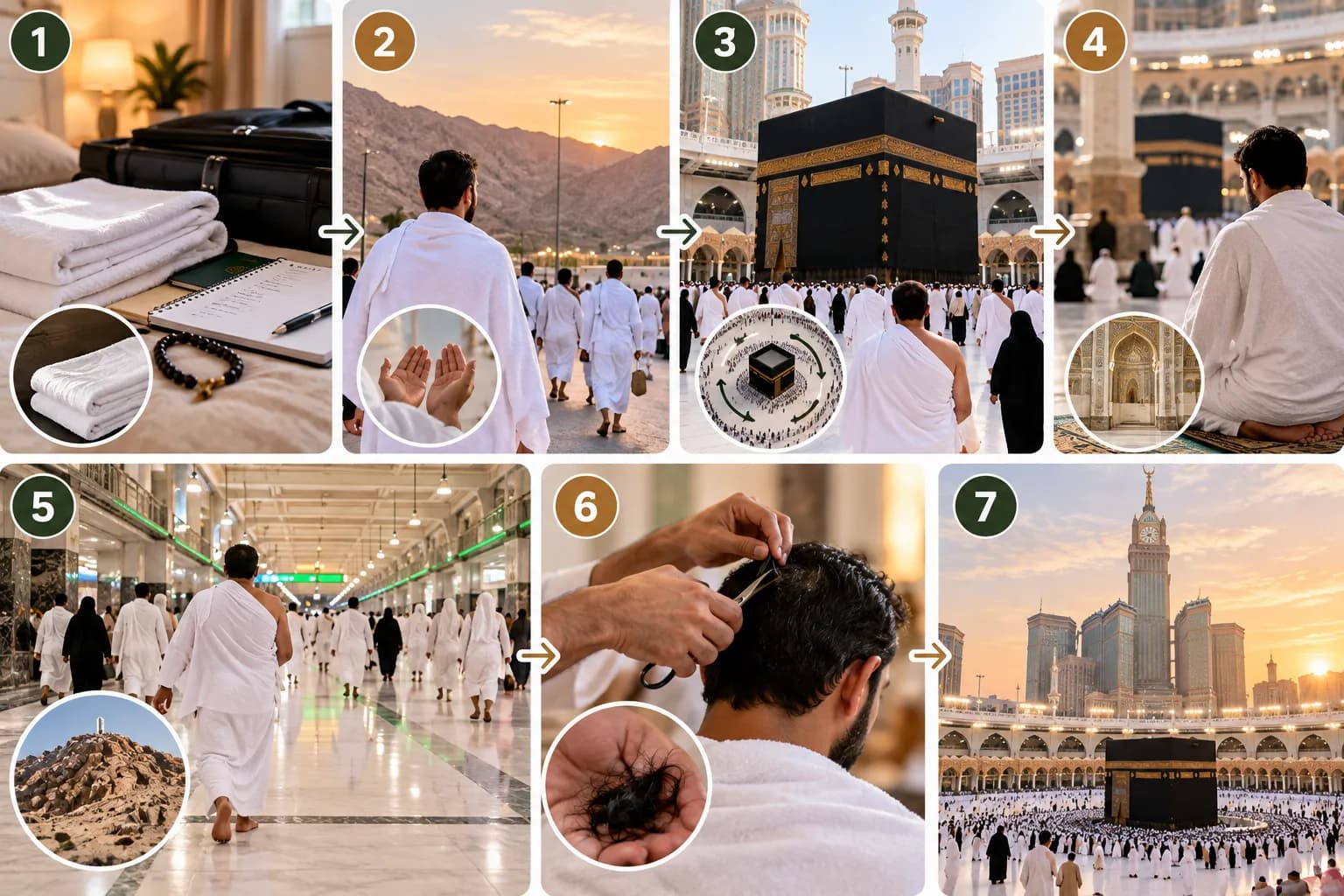
A young man looks at a society filled with idols. His own family does not share his faith, and the people around him defend what their ancestors worshipped. Authority will eventually turn against him, but fire will not make him surrender. Migration will not end his trust, and old age will not make Allah’s promise impossible. Fatherhood will not make obedience optional. Then, in a valley with no crops, he raises the foundations of a House and says: “Our Lord, accept this from us.”
This is Ibrahim (إِبْرَاهِيم, عليه السلام), one of the most important human beings in the Quran. His legacy connects Tawhid, Makkah, the Ka’bah, Hajj, Eid al-Adha, Prophet Muhammad ﷺ, and the daily Salah of Muslims around the world.
His story has also gathered many popular details over the centuries. Some are Quranic, some come from authentic Sunnah, and some come from Tafsir. Others come from earlier traditions, and some are repeated without reliable evidence. This article separates them, following one principle: tell the story only as far as reliable revelation and responsible scholarship allow.
The central idea is this: Ibrahim’s story is the story of Tawhid tested again and again, against society, family pressure, fear, migration, parenthood, sacrifice, and an uncertain future. His trust was revealed precisely because obedience repeatedly required him to surrender what human beings naturally cling to.
Who Was Prophet Ibrahim in Islam?
Ibrahim corresponds to Abraham in English-language Biblical terminology. In Islam he is a Prophet of Allah (the Quran calls him nabi and siddiq, 19:41) and a central figure in the Quran. Many scholars also count him among the great Messengers. He is the father of two honored Prophets, Isma’il and Ishaq. Through Ishaq and Ya’qub he is connected to many later Prophets. Through Isma’il he is connected, according to established Islamic genealogy, to the Prophet Muhammad ﷺ. We will not draw a full family tree, because reliable sources do not support one.
His name appears dozens of times in the Quran. Concordance counts commonly give 69 mentions across about 25 Surahs. His story is not told in one chapter. It is spread across Surahs including al-Baqarah, Al ‘Imran, al-An’am, Ibrahim, Maryam, al-Anbiya, al-Hajj, al-Shu’ara, al-‘Ankabut, al-Saffat, al-Dhariyat, and al-Mumtahanah. Each passage looks at him from a different angle: argument, family, Dua, hospitality, sacrifice, the Sacred House. The Quran is not writing a modern year-by-year biography. It is teaching what Ibrahim’s life means.
How Do We Know His Story? Quran, Sunnah, Tafsir, and Later Reports
Not every detail you have heard has the same weight. A useful way to sort them:
Quran: the highest evidence, including its exact wording and what it leaves unsaid.
Authentic Sunnah: the Prophet’s ﷺ explanations and narrations. Hajar’s story comes mainly through this route.
Tafsir and scholarly interpretation: the explanations of Companions, Successors, and later scholars. These range from strong to weak, and different scholars weigh them differently.
Historical or traditional reports: the later stories, some of which came from earlier Jewish and Christian traditions.
A detail in a Tafsir book is not automatically what the Quran says. Tafsir works contain interpretation, Hadith, Companion reports, language analysis, legal reasoning, historical reports, and sometimes weak narrations or Isra’iliyyat, reports that came from earlier Jewish and Christian sources.
Scholars generally handle Isra’iliyyat with a three-part rule, based on the Prophet’s ﷺ guidance not to affirm or deny the People of the Book outright (Sahih al-Bukhari). What revelation confirms may be accepted. What it contradicts is rejected. What it neither confirms nor denies is not asserted as Islamic fact, and may be mentioned only with caution. This explains why you will meet several versions of Ibrahim’s story online. We will use the rule throughout.
Why Ibrahim Matters: Khalil, Imam, Ummah, Hanif
The Quran gives Ibrahim titles given to few others.
Khalil (خَلِيل): “Allah took Ibrahim as a khalil” (4:125). Khullah is understood as an intense, intimate degree of love. Scholars explain it without likening Allah to creation. The Prophet ﷺ said Allah had also taken him as a khalil (Sahih Muslim), so the honor is not exclusive.
Imam (إِمَام): after Ibrahim fulfilled the commands with which Allah tested him, Allah said, “I will make you a leader (imam) for the people” (2:124).
Ummah (أُمَّة): “Ibrahim was an ummah, devoutly obedient to Allah, a hanif” (16:120). Here commentators understand ummah as an exemplary leader who gathers goodness in himself, not simply “a nation.” A report attributed to Ibn Mas’ud explains it as one who teaches people good.
Hanif (حَنِيف): see below.
Neither Jew Nor Christian: Hanif and Millat Ibrahim
In 3:65–68 the Quran answers later communal arguments over Ibrahim. “Ibrahim was neither a Jew nor a Christian, but a hanif, a Muslim, and he was not of the polytheists” (3:67). The point is theological, not an insult to anyone. Ibrahim’s defining identity was pure monotheism and submission to Allah, which came before the later historical forms of those communities.
Hanif comes from a root associated with inclining or turning. In Quranic usage it describes one who turns away from false worship toward pure devotion to Allah. Muslim here means one who submits to Allah. Scholars note that the Arabic label did not function socially in every era as it does today. The Quranic emphasis is on the theology of submission. The Quran calls Muslims to millat Ibrahim, “the way of Ibrahim” (for example 2:130, 3:95, 16:123).
Chapter One: A Young Man Among Idols
The Quran establishes that Ibrahim lived among people devoted to idols, with some sources of worship also drawn from the sky. It does not tell us his birthplace, date, kingdom, or age. Historians propose settings in the ancient Near East, such as Mesopotamia, but those are historical reconstructions and not revelation. The sections below separate the two.
His Father, and the Name Azar
“When Ibrahim said to his father Azar, ‘Do you take idols as gods?’” (6:74). Scholars have discussed who Azar was. Many commentators take it as the actual name of his father. Others read it as a title or description, or think the person was an uncle, since Arabic ab (“father”) can also be used for an uncle, as in 2:133, where Ya’qub’s sons mention “your fathers, Ibrahim, Isma’il and Ishaq.” Both views are recorded in classical works.
What is certain is that the Quran shows Ibrahim’s father taking part in idol worship. It does not say he was a professional idol-maker, so we do not claim that.
“O My Dear Father”
Surah Maryam 19:41–48 may be the most emotionally revealing conversation in the story. Ibrahim says “Ya abati”, “O my dear father,” again and again: Why worship what cannot hear or see or help you? Knowledge has come to me that has not come to you, so follow me. Do not worship Shaytan. He does not insult his father. The father answers harshly and threatens him: Are you turning from my gods, Ibrahim? If you do not stop, I will stone you. Leave me for a long time. Ibrahim replies, “Peace be upon you. I will ask my Lord to forgive you,” and withdraws.
Truth without arrogance, disagreement without disrespect, Tawhid without compromise: this is what Ibrahim models. His example is especially relevant for converts and for Muslims whose relatives object to their faith. It does not mean tolerating abuse or danger. Ibrahim himself withdrew when his father threatened him. Later, the Quran says he disassociated from his father once it became clear that he was an enemy of Allah (9:114).
The Star, the Moon, and the Sun
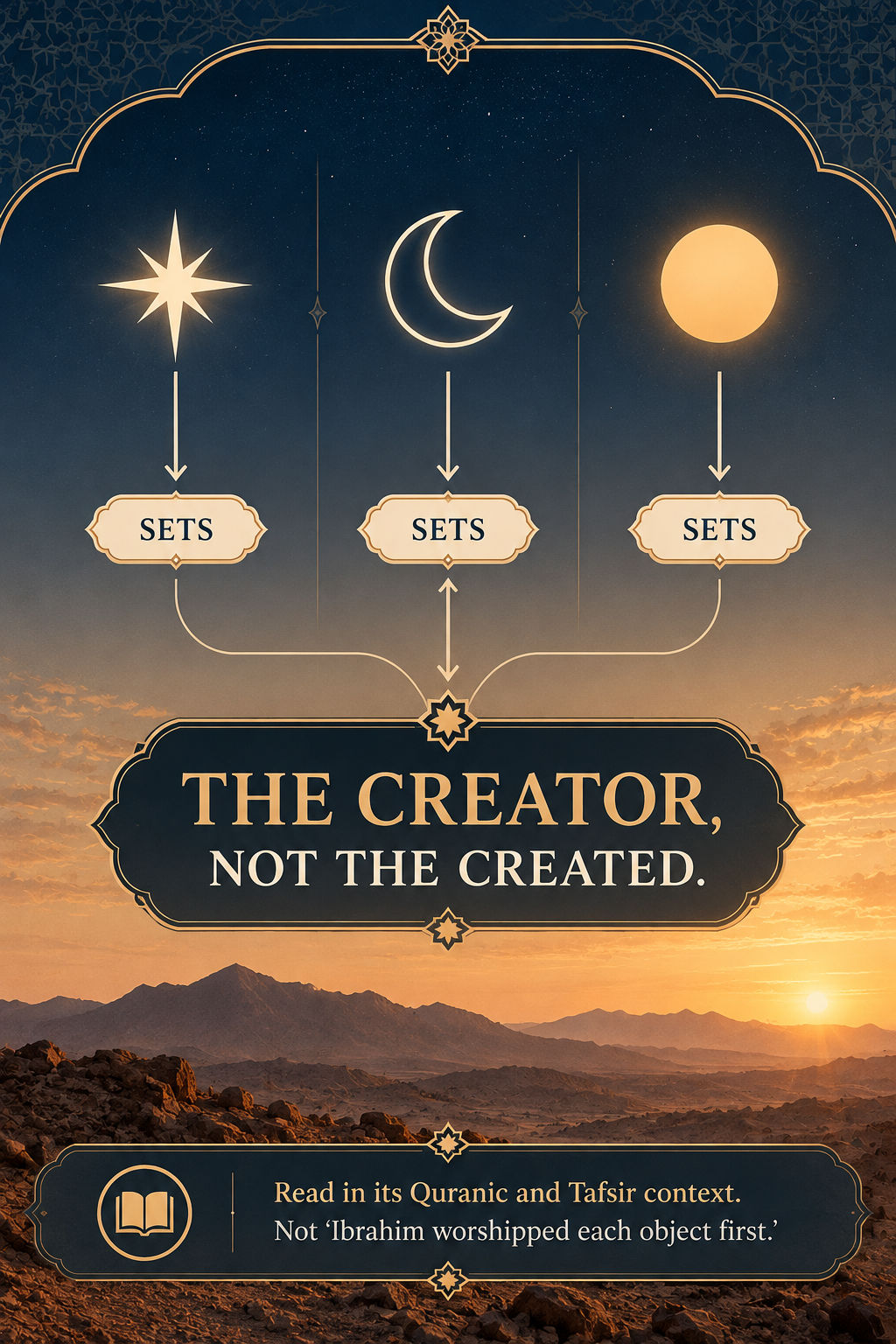
In 6:75–79 Ibrahim sees a star and says, “This is my lord.” When it sets he says, “I do not love those that set.” The same happens with the moon and then the sun. Finally he declares: “I have turned my face toward the One who created the heavens and the earth, as a hanif, and I am not one of the polytheists.”
Some readers take this as Ibrahim searching for God and passing through stages of worship. Many recognized commentators, including Ibn Kathir, instead read it as an argument or demonstration aimed at his people’s celestial worship, within the context of the Prophets being protected from Shirk. Others report other readings. Either way, we should not say “Ibrahim used to worship stars before becoming Muslim.” That oversimplification conflicts with how the Quran describes his fitrah and his call to his people.
The reasoning is clear in all readings. What rises and sets, changes, and depends on something else cannot be the Lord of the heavens and the earth.
Chapter Two: The Idols, the Fire, and the King
The Idols and the Largest One
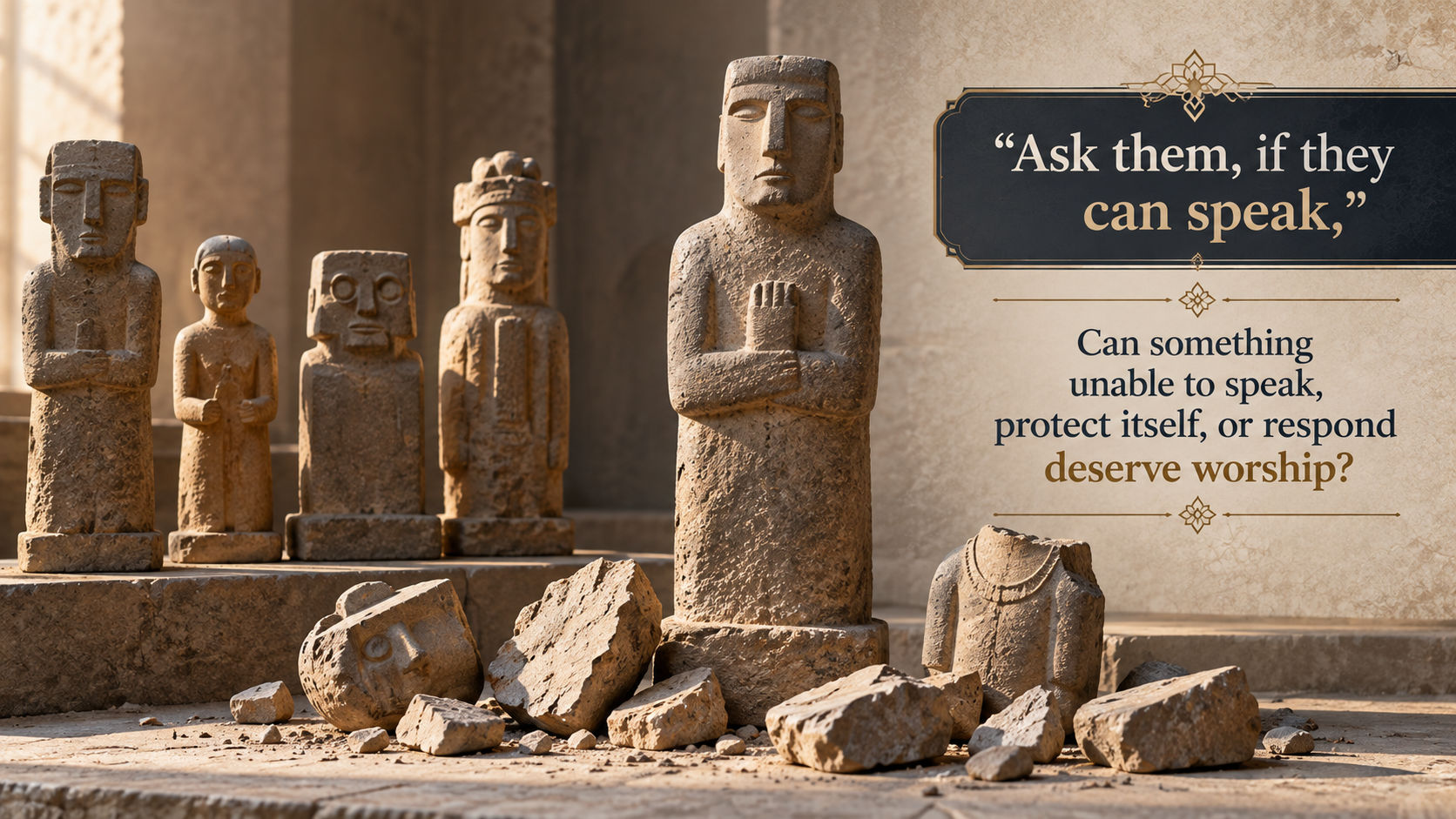
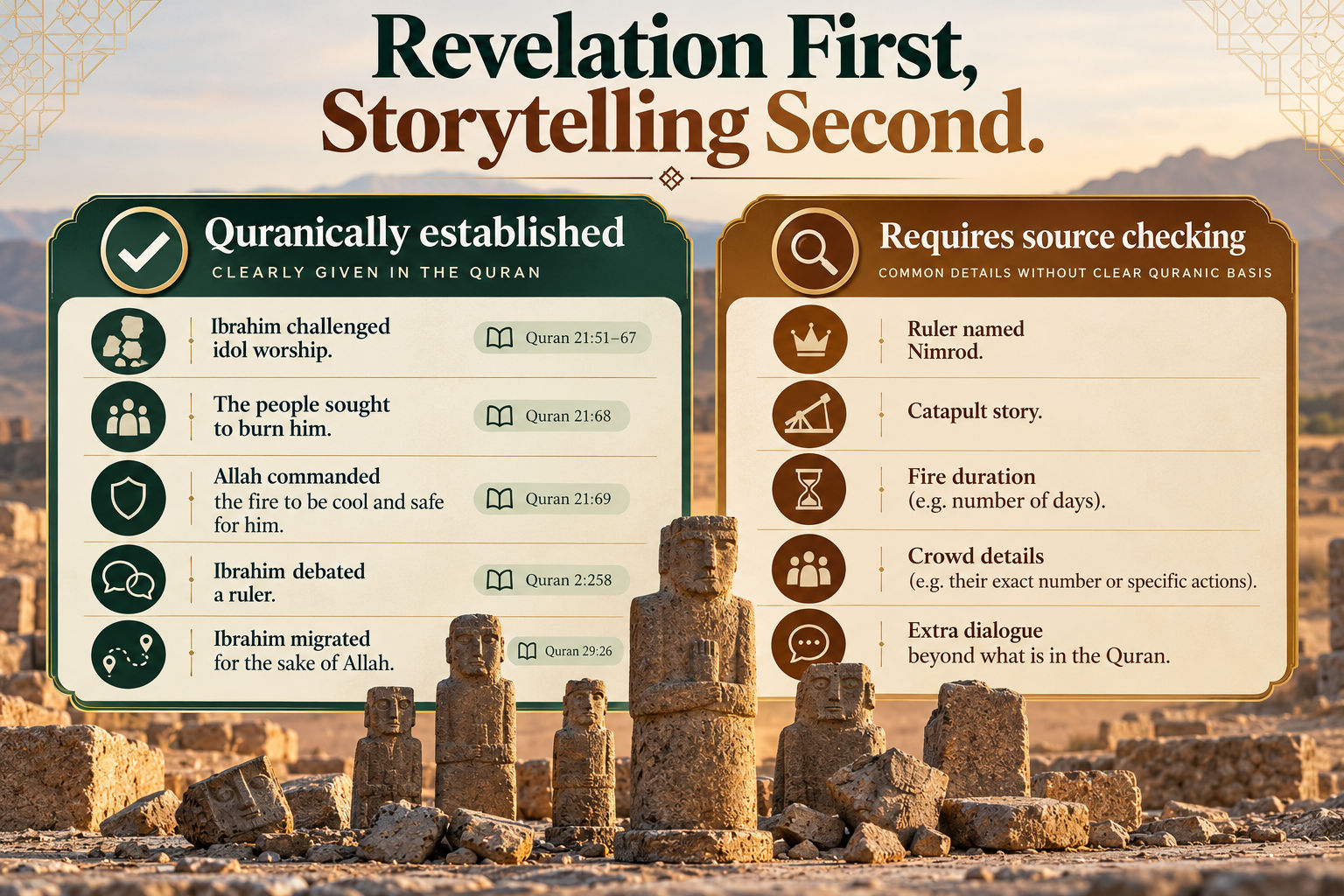
In 21:51–67 Ibrahim asks his people, “What are these statues to which you are devoted?” They answer, “We found our fathers worshipping them.” He says, “You and your fathers have been in clear error.” Here the Quran critiques inherited belief when inheritance replaces evidence and truth.
Then Ibrahim says, “By Allah, I will plan against your idols after you leave” (21:57). The Quran says he made them judhadhan (pieces) except the largest, “so that they might return to it.” We are not told how many idols there were, what they looked like, or what time of day it was. Those details appear in later retellings, not in the verses.
When the people asked, “Did you do this to our gods, Ibrahim?”, he said, “Rather, this, the largest of them, did it. Ask them, if they can speak” (21:62–63). The Quran then says, “They returned to themselves” (faraja’u ila anfusihim), meaning they were forced to face their own reasoning, and they said, “Indeed, you are the wrongdoers.” But the reasoning did not last: “Then they were turned upside down in confusion” and said, “You know these do not speak” (21:64–65). Ibrahim answered: “Do you worship instead of Allah what cannot benefit or harm you?” The idols could not even speak in their own defence.
The Hadith of the Three Statements
Sahih al-Bukhari and Sahih Muslim report that Ibrahim never “lied” except three times, and two of them concern the idols episode. Scholars explain that these were not lies in the ordinary harmful sense. They were indirect or ambiguous speech (ta’rid or tawriyah) used to make a point or to avoid harm. In the idols episode, the rhetorical purpose is clear from the Quran itself: Ibrahim wanted them to see that the idols could not speak. This should not be reduced to “Ibrahim lied and blamed the big idol.”
The Fire
The people said, “Burn him and support your gods, if you are to act” (21:68). Then Allah said, “O fire, be coolness and safety upon Ibrahim” (21:69). They wanted to harm him, “but We made them the greatest losers” (21:70).
We will not add what the Quran does not say: how long the fire burned, how it was built, or Ibrahim’s age. A separate Hadith in the Sahihayn mentions a lizard that used to blow on Ibrahim’s fire, but it is not part of the Quranic narrative and is not needed to understand the verses.
Sahih al-Bukhari also records Ibn ‘Abbas’s report that “Hasbunallahu wa ni’mal wakil” (حَسْبُنَا اللَّهُ وَنِعْمَ الْوَكِيلُ, “Allah is enough for us, and the best Disposer of affairs”) was said by Ibrahim when he was thrown into the fire, and by Muhammad ﷺ when people said that enemies had gathered against them (3:173). We use it here from that Hadith. The Quran does not quote this phrase in Ibrahim’s fire passage.
What the Fire Teaches About Tawakkul
Tawakkul does not mean you will never be hurt. Ibrahim’s trust meant obedience when the visible situation was terrifying, and the outcome was in Allah’s hands. Allah chose how the rescue came. Believers cannot assume the same form of rescue will come in their lives. We trust Allah’s wisdom with the outcome.
Was the Ruler Nimrod?
Popular storytelling says Nimrod (Namrud) threw Ibrahim into the fire and also debated him. Here the sources must be separated.
In 2:258 a ruler argues with Ibrahim about life and death: “My Lord is the One who gives life and causes death.” The ruler says, “I give life and cause death.” Ibrahim answers, “Allah brings the sun from the east, so bring it from the west.” “So the disbeliever was dumbfounded.” The Quran does not name this ruler. Many classical commentators identify him as Nimrod, so it is accurate to say, “Classical reports often identify him as Nimrod.” It would not be accurate to say, “The Quran says Nimrod.”
In the fire episode, the Quran speaks of “they”, his people. Later reports often link the two episodes to a single king, but the Quran does not tie them together explicitly, and the Quran does not name the ruler in either episode.
Chapter Three: Migration for Allah
“And Lut believed him. He said, ‘I will emigrate to my Lord’” (29:26). Most commentators take the speaker as Ibrahim, and 37:99 repeats the idea: “I am going to my Lord; He will guide me.” The Quran also says Allah rescued Ibrahim and Lut “to the land that We blessed for the worlds” (21:71), which many take to mean greater Syria, though the verse does not name it. We will not say more about Lut’s kinship to Ibrahim than the sources do. Many commentators call him Ibrahim’s nephew, but the Quran does not state that relationship.
Here Hijrah means leaving for Allah, not just changing location. Sometimes faith requires leaving familiar places, social acceptance, security, or inherited expectations.
Sarah. The Quran does not name Ibrahim’s wife in the verses about glad tidings of Ishaq. It says “his wife” (imra’atuhu). Her name, Sarah, comes from Hadith and historical tradition. A Hadith in Sahih al-Bukhari also describes an encounter with a tyrannical ruler during a journey, in which Ibrahim says she is his “sister,” meaning sister in faith, to protect them. It includes difficult details and is not needed here. We mention it only because it is the source for her name.
Chapter Four: Hajar, Isma’il, and the Valley of Makkah
Hajar (هاجر) is not named in the Quran. Her story comes mainly through the long authentic Hadith narrated by Ibn ‘Abbas in Sahih al-Bukhari. This teaches something valuable: not every authentic Islamic story must appear in the Quran, because authentic Sunnah is also revelation-based evidence.
“Then He Will Not Neglect Us”
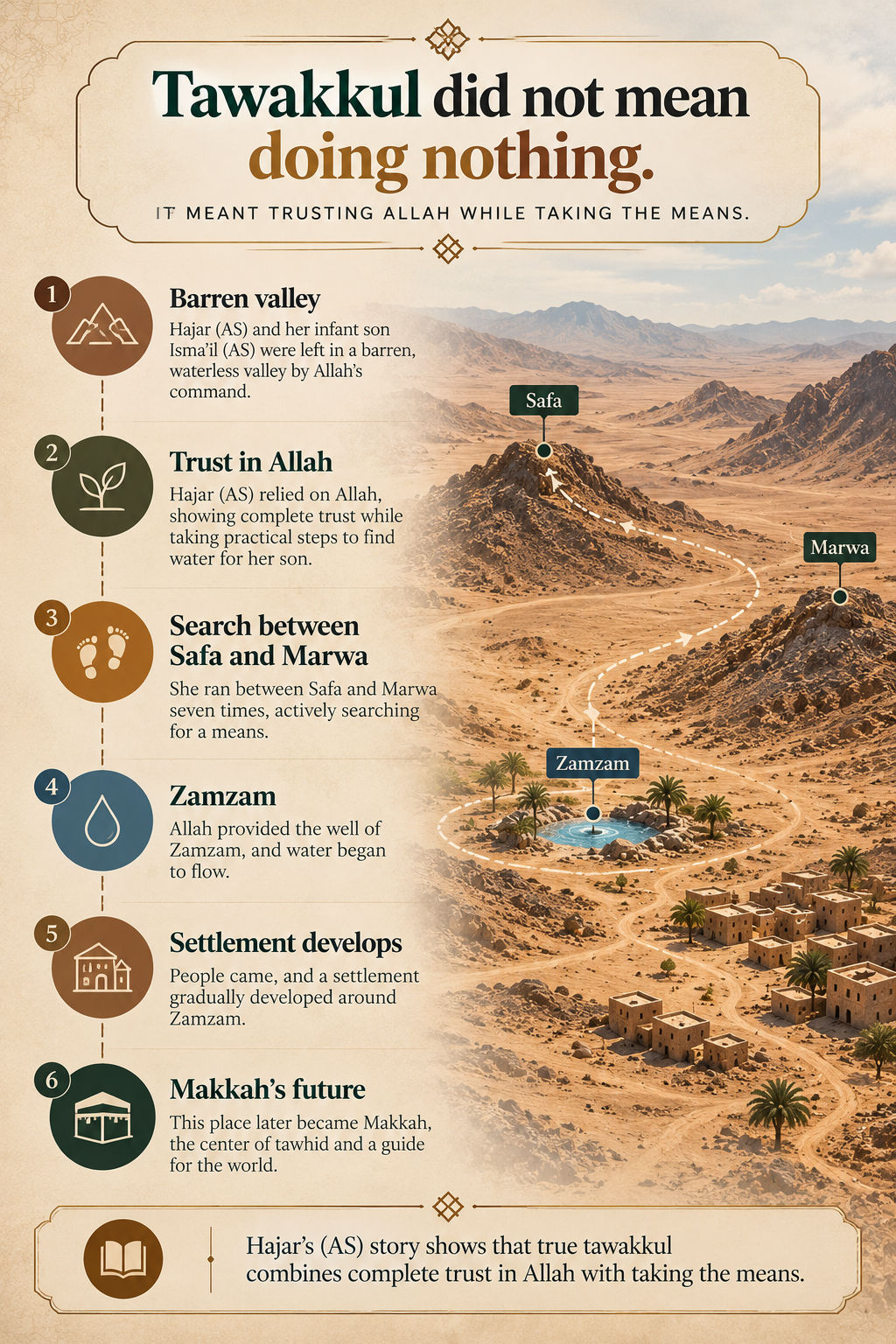
According to the narration, Ibrahim brought Hajar and her infant son Isma’il to the valley near the future Ka’bah. There was little or no habitation and no water. He left them with some dates and a water skin, and turned to go. Hajar followed him and called out, “O Ibrahim, where are you going, leaving us in a valley with no one and nothing?” She repeated it, but he did not answer. Then she asked, “Did Allah command you to do this?” He said yes. She replied, “Then He will not neglect us.” (In the Arabic, idhan la yudayyi’una.)
We do not add dialogue beyond this. It shows Hajar’s Tawakkul as much as Ibrahim’s. She did not argue with the command once she knew it came from Allah, and she did not become passive.
Safa, Marwa, and Zamzam
When the water ran out, Hajar went to the nearest hill, Safa, to look. Then she ran across the valley to Marwa. According to the narration she did this seven times. Then she heard a voice and saw an angel (the narration describes “an angel”, without naming him) at the place of Zamzam, where water appeared. She began to contain it, saying words understood as “stay, stay.” The Prophet ﷺ said, “May Allah have mercy on the mother of Isma’il. Had she left Zamzam alone, it would have been a flowing spring.” The narration continues that the Jurhum tribe later settled nearby with her permission.
Ibn ‘Abbas’s narration connects her running with the practice of people running between the two hills, which is the origin of sa’i in Hajj and Umrah. The details of how sa’i is performed today come from Fiqh and the Prophet’s ﷺ own practice, not from this Hadith alone.
Tawakkul did not keep Hajar sitting still. She trusted Allah and searched for water. A city began to form around a spring in a valley that had no crops.
Ibrahim’s Dua for the Valley
According to the narration, when Ibrahim was out of sight he made Dua. The Quran preserves it (14:37): “Our Lord, I have settled some of my descendants in a valley without crops, near Your Sacred House, our Lord, so that they may establish prayer. So make hearts incline toward them and provide them with fruits, that they may be grateful.”
A related Dua (2:126) asks, “My Lord, make this a secure land (baladan aminan).” In 14:35 it is “this land” (al-balad) with the definite article. Some commentators explain that the first was asked before the place was settled and the second after it became a city. We mention this as a reading some scholars have offered, not a settled rule.
Chapter Five: The Guests, the Good News, and a Question
The Quran tells in 11:69–73, 15:51–56, and 51:24–30 how guests came to Ibrahim. Each telling emphasizes different details, so we do not merge them into one quotation. Ibrahim greeted them, then quickly brought a roasted calf (11:69), or a fat calf (51:26). The guests did not eat, and he felt fear. They said, “Do not fear,” and gave him good news of a knowledgeable son. Ibrahim’s wife was astonished: “Shall I give birth when I am old and barren?” The messengers also said they were sent to the people of Lut. We do not know how many guests there were, so we do not say.
Ibrahim then “began to plead with Us concerning the people of Lut” (11:74). The Quran describes him as halim (forbearing), awwah (tender-hearted), and munib (turning back to Allah). The answer was: “O Ibrahim, turn away from this. The decree of your Lord has come” (11:76). His compassion did not mean approval of their wrongdoing.
Ishaq and Isma’il. Both are honored Prophets in the Quran. Isma’il is especially connected to Makkah, the Ka’bah, and the Prophet’s ﷺ ancestry. Ishaq is connected to Ya’qub and many later Prophets. Neither is lesser, and the question of the sacrifice should never become a rivalry between them.
“My Lord, Show Me How You Give Life to the Dead”
In 2:260 Ibrahim asks to see how Allah revives the dead. Allah asks, “Do you not believe?” He answers, “Yes, but to put my heart at ease.” This was not disbelief. He believed and asked for greater reassurance. Allah told him to take four birds (the Quran does not name the species), and they came to him in haste after he called them. The command fa-surhunna ilayka is understood by commentators either as “incline them to yourself” or “cut them up.” The core meaning is the same.
Sincere questions are different from arrogant rejection. Islamic education should make room for them, especially for converts, young Muslims, and students of Aqidah.
Chapter Six: The Sacrifice
What the Quran Says
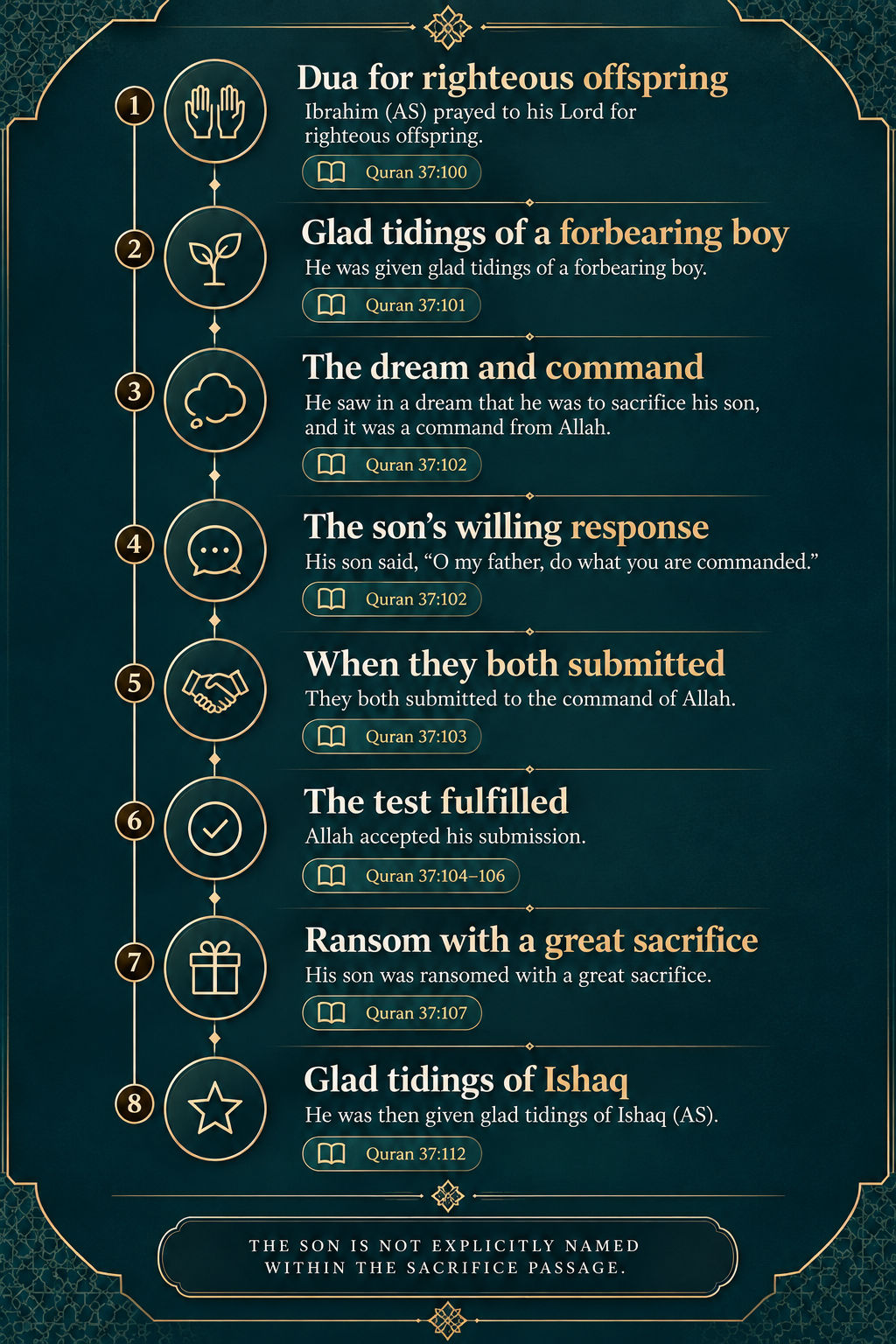
Surah al-Saffat 37:100–111 is the central text. Ibrahim prayed, “My Lord, grant me a righteous child” (37:100). “So We gave him good news of a forbearing boy” (37:101). When the boy reached the age to walk or work with him (balagha ma’ahu as-sa’y), Ibrahim said, “My son, I see in a dream that I am slaughtering you, so see what you think.” The son replied, “O my father, do as you are commanded. You will find me, if Allah wills, among the patient” (37:102).
Dreams of Prophets are revelation. This does not extend to the dreams of ordinary people. The son is not a passive object. He consciously submits to Allah.
Then: “When they both submitted” (falamma aslama, 37:103), and he laid him down on his brow, “We called to him, ‘O Ibrahim, you have fulfilled the vision. This is how We reward the doers of good. This was truly a clear test.’ And We ransomed him with a great sacrifice” (37:104–107).
Aslama shares its root with Islam. It reflects the meaning of the whole story: shared submission. After the ransom, the Quran announces glad tidings of Ishaq as a prophet from among the righteous (37:112), and the story moves on to Ishaq.
Which Son?
The Quran does not name the son in the sacrifice passage. Early scholars were divided. Reports attributed to some early authorities favor Ishaq, and Ibn Jarir al-Tabari is among the scholars who preferred that view. Other reports favor Isma’il, and the later dominant position, supported by Ibn Kathir, identifies the son as Isma’il.
The main arguments for Isma’il are:
The passage describes the “forbearing boy” after the Dua for a child, and then Ishaq is announced separately and by name in 37:112, which suggests a different child came first.
Ishaq’s birth is promised together with Ya’qub’s (11:71), which fits poorly with a command to sacrifice Ishaq as a boy.
The rites of Hajj and the sacrifice at Mina are associated with Makkah and Isma’il.
Some scholars question the reports that favor Ishaq, since some may trace back to Isra’iliyyat. A Hadith, “I am the son of the two sacrificed ones,” is known but is generally considered weak, so we do not rely on it. This is an evidence question and not a polemic against Jews or Christians. Both honored sons are servants of Allah.
What We Do Not Add
We do not invent Sarah discovering the plan, a knife that refused to cut, blindfolds, a request to sharpen the blade, or dramatic dialogue. If such details appear in Tafsir or athar, they are classified as reports from later sources, not Quranic narrative.
The Jamarat. A report attributed to Ibn ‘Abbas describes Shaytan appearing to Ibrahim at the sites of Mina and Ibrahim throwing pebbles at him. Scholars differ on the report’s status and details, and the Quran does not mention it. Pilgrims do not literally stone a physical Shaytan standing at the pillars. The rami is an act of worship performed in obedience to Allah, following the Prophet’s ﷺ practice.
The ram. The Quran says dhibhin ‘azim, “a great sacrifice.” Reports that it was a ram, or a ram from Jannah with certain features, come from Tafsir traditions. They are not stated in the verse, and we do not assert them.
What It Means
This was a divine test, and its aim was obedience and submission. Allah prevented the sacrifice and provided the ransom. Allah did not want a child killed. The Quran says of sacrificial animals, “Neither their meat nor their blood reaches Allah, but your taqwa reaches Him” (22:37). Eid al-Adha and Udhiyah commemorate themes connected to Ibrahim’s submission. Some customs of Eid are cultural, and not every one traces to Ibrahim.
This story is not a model for parental abuse. Ibrahim was a Prophet receiving revelation. Ordinary parents cannot use “Ibrahim obeyed Allah” to justify harming children based on dreams, visions, feelings, or religious claims. The story teaches obedience to genuine divine revelation, and not uncontrolled parental power.
Chapter Seven: Raising the House
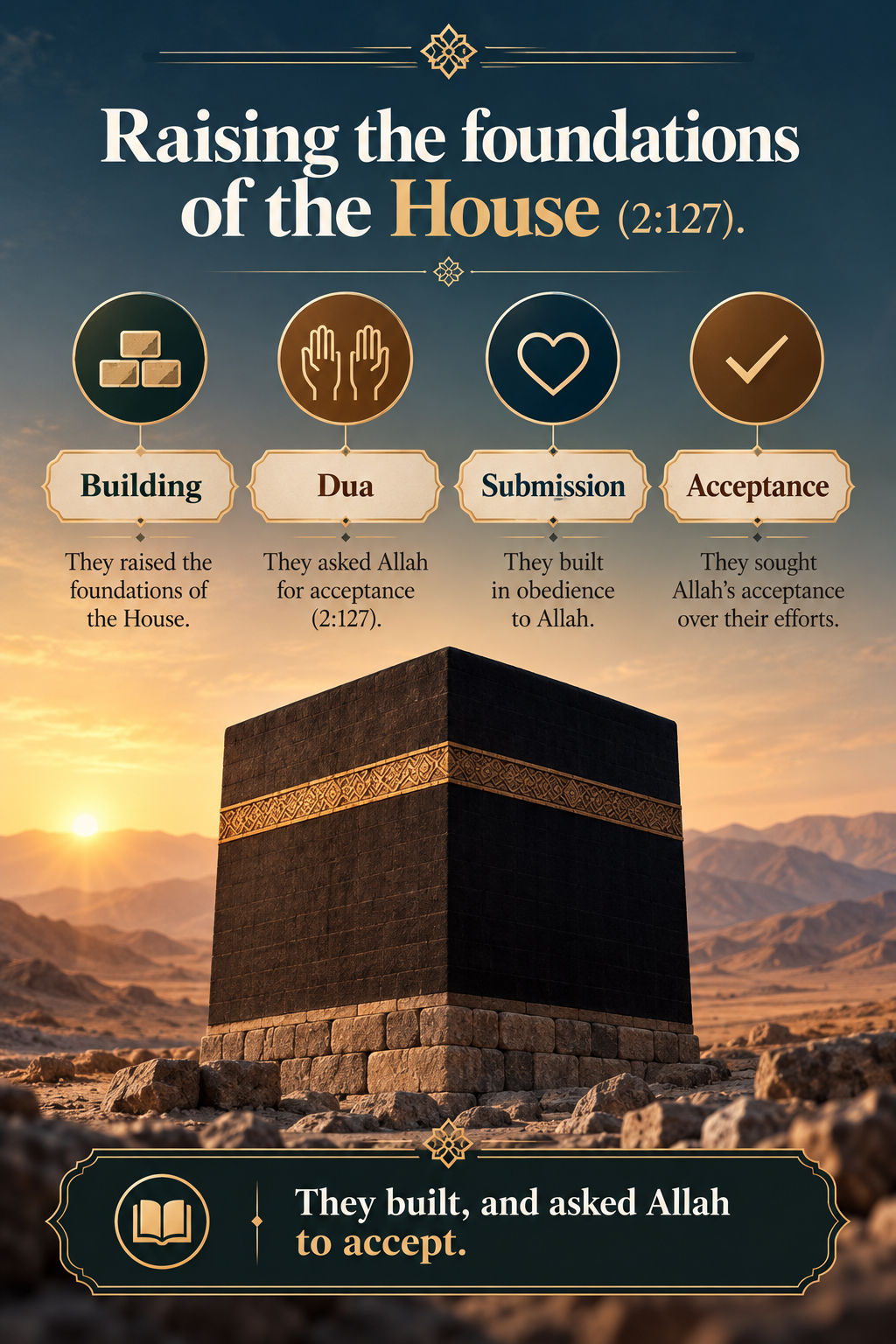
“And when Ibrahim was raising the foundations (al-qawa’id) of the House, along with Isma’il” (2:127). The Quran says they raised the foundations. Classical scholars discuss earlier foundations and history, and revelation does not give a complete architectural account, so we do not say that Ibrahim built the first-ever structure from nothing. Ibn ‘Abbas’s long narration in Sahih al-Bukhari also mentions a stone on which Ibrahim stood as the walls rose.
“Our Lord, Accept This From Us”
“Our Lord, accept this from us. You are the All-Hearing, the All-Knowing” (2:127). They were performing one of the greatest acts in Islamic history, and they asked for acceptance. Great deeds do not make sincere believers feel entitled to acceptance. They built, and then they asked.
The Dua for a Muslim Community and a Messenger
They continued: “Our Lord, make us Muslims (submitting) to You, and from our descendants a Muslim community (ummatan muslimah) to You” (2:128). They asked to remain submitted themselves before asking for their descendants. Then: “Our Lord, send among them a messenger from themselves who will recite Your verses to them, teach them the Book and wisdom, and purify them” (2:129).
The traditional understanding links this Dua to Prophet Muhammad ﷺ. A report in Musnad Ahmad has the Prophet ﷺ saying he is the answer to the Dua of Ibrahim. A number of scholars grade it sound through its combined routes, though its grading is discussed, so we state it with that care.
The Call to Hajj and Maqam Ibrahim
“And proclaim to the people the Hajj; they will come to you on foot and on every lean camel, from every distant path” (22:27). The command itself is clear. A report attributed to Ibn ‘Abbas describes how the call reached people, but its details go beyond the Quran, and we do not assert them.
“Take the Maqam of Ibrahim as a place of prayer” (2:125). The Maqam is the place near the Ka’bah associated with the stone on which Ibrahim stood. Reports mention footprints in the stone that wore away over time, and we treat these as traditional reports without making archaeological claims. We also do not suggest that the entire modern Hajj manual is narrated in Ibrahim’s story. The rites are established through the Prophet’s ﷺ teaching.
The Duas of Ibrahim in the Quran
Ibrahim’s Duas show what he valued. He did not only ask for successful children. He asked for submission, prayer, righteousness, and protection from Shirk. Each Dua below is given with its reference so you can check it in your own Mushaf. (Arabic to be proofread against a Mushaf before publishing.)
2:126, security and provision. رَبِّ ٱجْعَلْ هَـٰذَا بَلَدًا ءَامِنًا وَٱرْزُقْ أَهْلَهُۥ مِنَ ٱلثَّمَرَٰتِ. Rabbi ij’al hadha baladan aminan warzuq ahlahu minath-thamarat. “My Lord, make this a secure land and provide its people with fruits.” Lesson: ask for safety and provision for the community, not only yourself.
2:127, acceptance. رَبَّنَا تَقَبَّلْ مِنَّا ۖ إِنَّكَ أَنتَ ٱلسَّمِيعُ ٱلْعَلِيمُ. Rabbana taqabbal minna innaka antas-Sami’ul-‘Alim. “Our Lord, accept from us. You are the All-Hearing, the All-Knowing.” Lesson: humility after worship.
2:128, submission. رَبَّنَا وَٱجْعَلْنَا مُسْلِمَيْنِ لَكَ وَمِن ذُرِّيَّتِنَآ أُمَّةً مُّسْلِمَةً لَّكَ. Rabbana waj’alna muslimayni laka wa min dhurriyyatina ummatan muslimatan laka. “Our Lord, make us submitted to You, and from our descendants a community submitted to You.” Lesson: ask first for your own steadfastness.
2:129, a Messenger. رَبَّنَا وَٱبْعَثْ فِيهِمْ رَسُولًا مِّنْهُمْ. Rabbana wab’ath fihim rasulan minhum. “Our Lord, send among them a messenger from themselves.” Lesson: pray for guidance for people you will never meet.
14:35, protection from idols. وَٱجْنُبْنِى وَبَنِىَّ أَن نَّعْبُدَ ٱلْأَصْنَامَ. Wajnubni wa baniyya an na’budal-asnam. “Keep me and my children away from worshipping idols.” Lesson: even the destroyer of idols asked to be protected from Shirk, so no believer should feel safe from it.
14:37, family, Salah, provision. رَّبَّنَآ إِنِّىٓ أَسْكَنتُ مِن ذُرِّيَّتِى بِوَادٍ غَيْرِ ذِى زَرْعٍ. Rabbana inni askantu min dhurriyyati biwadin ghayri dhi zar’. “Our Lord, I have settled some of my descendants in a valley without crops.” Lesson: act on Allah’s command, then pray for what you cannot provide.
14:40, establishing prayer. رَبِّ ٱجْعَلْنِى مُقِيمَ ٱلصَّلَوٰةِ وَمِن ذُرِّيَّتِى ۚ رَبَّنَا وَتَقَبَّلْ دُعَآءِ. Rabbij’alni muqimas-salati wa min dhurriyyati, Rabbana wa taqabbal du’a. “My Lord, make me an establisher of prayer, and from my descendants. Our Lord, accept my prayer.” Lesson: parents ask Allah and model worship themselves.
14:41, forgiveness. رَبَّنَا ٱغْفِرْ لِى وَلِوَٰلِدَىَّ وَلِلْمُؤْمِنِينَ يَوْمَ يَقُومُ ٱلْحِسَابُ. Rabbana-ghfir li wa liwalidayya wa lil-mu’minina yawma yaqumul-hisab. “Our Lord, forgive me, my parents, and the believers on the Day of Reckoning.” Lesson: this Dua was made before Ibrahim disassociated from his father (9:114), so the context matters.
26:83–85, wisdom and legacy. رَبِّ هَبْ لِى حُكْمًا وَأَلْحِقْنِى بِٱلصَّـٰلِحِينَ. Rabbi hab li hukman wa alhiqni bis-salihin. “My Lord, grant me wisdom and join me with the righteous.” Lesson: ask for a good name and legacy among later generations.
37:100, righteous offspring. رَبِّ هَبْ لِى مِنَ ٱلصَّـٰلِحِينَ. Rabbi hab li minas-salihin. “My Lord, grant me one of the righteous.” Lesson: ask for righteousness, not only children.
Ibrahim and Muhammad ﷺ: Why Muslims Mention Him in Every Salah
The Prophet’s ﷺ link to Ibrahim runs through lineage from Isma’il, the Ka’bah and Makkah, Hajj, and millat Ibrahim. On genealogy, Sahih Muslim reports the Prophet ﷺ saying Allah chose Kinanah from the descendants of Isma’il, Quraysh from Kinanah, Banu Hashim from Quraysh, and him from Banu Hashim. We will not list exact generations beyond what is supported.
In the final Tashahhud, Muslims recite the Salat Ibrahimiyyah. One authentic wording, in Sahih al-Bukhari from Ka’b ibn ‘Ujrah:
اللَّهُمَّ صَلِّ عَلَى مُحَمَّدٍ وَعَلَى آلِ مُحَمَّدٍ كَمَا صَلَّيْتَ عَلَى إِبْرَاهِيمَ وَعَلَى آلِ إِبْرَاهِيمَ إِنَّكَ حَمِيدٌ مَجِيدٌ، اللَّهُمَّ بَارِكْ عَلَى مُحَمَّدٍ وَعَلَى آلِ مُحَمَّدٍ كَمَا بَارَكْتَ عَلَى إِبْرَاهِيمَ وَعَلَى آلِ إِبْرَاهِيمَ إِنَّكَ حَمِيدٌ مَجِيدٌ
Allahumma salli ‘ala Muhammad wa ‘ala ali Muhammad kama sallayta ‘ala Ibrahim wa ‘ala ali Ibrahim innaka Hamidun Majid. Allahumma barik ‘ala Muhammad wa ‘ala ali Muhammad kama barakta ‘ala Ibrahim wa ‘ala ali Ibrahim innaka Hamidun Majid.
“O Allah, send prayers upon Muhammad and the family of Muhammad as You sent prayers upon Ibrahim and the family of Ibrahim. You are Praiseworthy, Glorious. O Allah, bless Muhammad and the family of Muhammad as You blessed Ibrahim and the family of Ibrahim. You are Praiseworthy, Glorious.”
There are several authentic versions. Sahih Muslim, for example, has a version from Abu Mas’ud with “among the worlds” (fil-‘alamin). No single wording is the only valid one.
His legacy appears daily in Salah, annually in Eid al-Adha and Udhiyah, in Hajj and Umrah through the Ka’bah, Maqam Ibrahim, and Hajar’s Safa and Marwa, and in the Quran through his story and Duas. Ibrahim is not a distant figure. He is woven into the rhythm of Muslim life.
 عليه السلام" />
A Safe Timeline
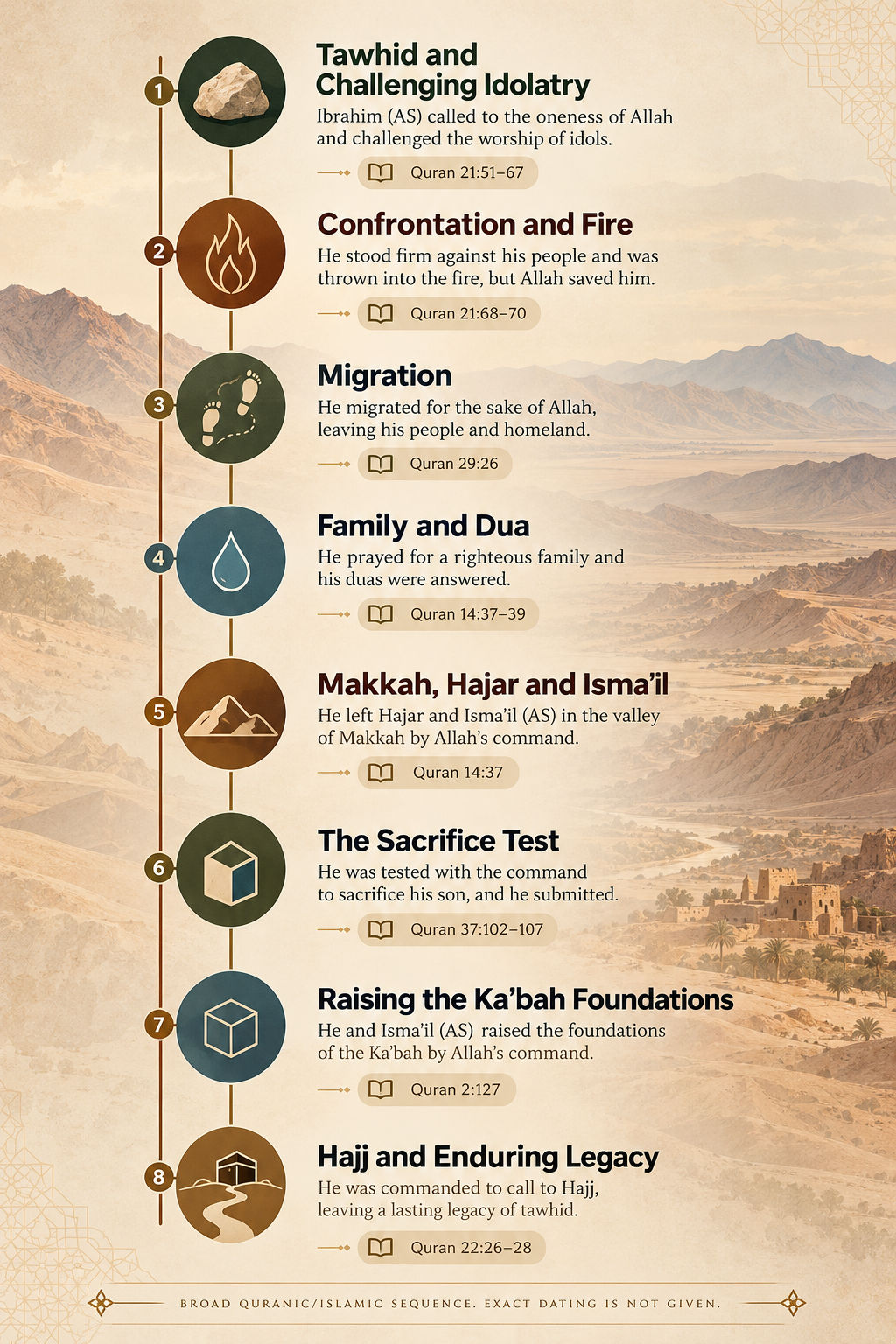
The Quran does not give a modern chronology, and we only use sequence that survives scrutiny. This is an editorial synthesis, not a revealed list of “ten tests.” The pattern of tests runs through family opposition, social opposition, fire, migration, waiting for children, barren Makkah, separation, sacrifice, building the Ka’bah, and leadership. The timeline below uses only three labels: clear sequence, probable sequence, and exact timing not given.
Ibrahim among an idolatrous people, arguments against false worship, the idol confrontation, then the fire. (Clear sequence within the Quranic account.)
Migration. (Follows the fire in the Quranic presentation. Exact timing not given.)
Children arrive after Dua and old age. (Probable sequence. Ages not given.)
Hajar and Isma’il in Makkah, then Zamzam. (Clear from the Hadith. Exact timing not given.)
The sacrifice test. (After Isma’il reaches the age of “walking with him.” Exact timing not given.)
Raising the Ka’bah foundations with Isma’il. (Isma’il is old enough to help. Exact timing relative to the sacrifice is not given.)
The call to Hajj and its legacy.
Myths and Claims, Checked
“Ibrahim’s father definitely made idols for a living.” The Quran establishes his father’s idol worship, not his profession.
“Ibrahim worshipped the sun and moon.” Recognized Tafsir reads 6:75–79 as an argument, or in any case does not support worship by a Prophet.
“The Quran names Nimrod as Ibrahim’s enemy.” It does not. Classical reports often identify him.
“The Quran says Nimrod threw Ibrahim into the fire.” It says “they.” The link to one king comes from later reports.
“The Quran says the sacrificial son was Isma’il.” The passage does not name him. The Isma’il identification is the dominant scholarly position.
“There was never any Muslim disagreement about the son.” Early reports show discussion.
“The Quran names Hajar.” It does not. Authentic Sunnah gives her story.
“The Quran names Sarah.” It says “his wife.” Her name comes from Hadith and tradition.
“Ibrahim built the Ka’bah from scratch.” The Quran says he and Isma’il raised its foundations.
“The Jamarat pillars contain Shaytan.” The rami is an act of worship, and pilgrims do not stone a physical Shaytan.
“The ram came from Jannah with specific features.” The Quran says “a great sacrifice.” Further details come from Tafsir reports.
“Ordinary Muslims can follow Ibrahim by obeying commands received in dreams.” Prophetic dreams are revelation. Ordinary dreams create no Shariah obligations.
Twelve Lessons From Prophet Ibrahim
Truth is not decided by majority. Ibrahim stood against a whole society (21:51–56).
Inherited belief must be measured against revelation. “We found our fathers…” was not a proof.
Tawhid requires courage. The fire (21:68–70).
Respect does not require theological compromise. “Ya abati” (19:41–48).
Tawakkul includes action. Hajar’s running between Safa and Marwa.
Hardship does not mean Allah abandoned you. “Then He will not neglect us.”
Migration can be an act of faith. “I am going to my Lord” (37:99).
Make Dua for descendants. 14:40, 2:128.
Worship requires humility even after great deeds. “Accept from us” (2:127).
Faith is tested through what we love. The sacrifice (37:102–107).
Ask Allah for protection from Shirk. 14:35.
Think beyond your own lifetime. Ibrahim prayed for a Messenger and a community he would never see.
For parents: make Dua before problems appear, care about your children’s faith and not only their worldly success, and model submission by worshipping alongside them. Do not assume righteous ancestry guarantees righteous descendants. Allah told Ibrahim His covenant does not include wrongdoers (2:124). Noble ancestry does not replace personal righteousness.
For converts and Muslims facing family opposition: disagreement with family can be painful. Keep respectful speech where possible, do not compromise Tawhid, and remember that guidance belongs to Allah. Patience does not mean accepting abuse, and separation may sometimes become necessary. Islam also emphasizes family ties, so do not assume you must cut off non-Muslim parents. Keep making Dua and keep good character.
On trusting Allah: Ibrahim’s example does not license an ordinary believer to say “Allah told me to abandon my family” based on feelings or dreams. Prophetic revelation cannot be replicated by personal intuition. Success is also not seeing every result yourself. Ibrahim raised foundations and made Dua. Centuries later, according to Islamic tradition, Muhammad ﷺ emerged from Isma’il’s descendants, and millions perform Hajj. That is not a guaranteed personal-success formula. It shows that a believer may plant something whose fruit appears after their lifetime.
Quranic Arabic From Ibrahim’s Story
Use roots as help for memory, not as a source of theology.
Arabic | Transliteration | Meaning in context | Reference |
|---|---|---|---|
حَنِيف | Hanif | one who inclines away from false worship toward pure monotheism | 3:67 |
خَلِيل | Khalil | intimate, beloved friend | 4:125 |
أُمَّة | Ummah | here, an exemplary leader or model | 16:120 |
إِمَام | Imam | leader, model | 2:124 |
أَسْلَمَا | Aslama | they both submitted | 37:103 |
تَقَبَّلْ | Taqabbal | accept | 2:127 |
ذُرِّيَّة | Dhurriyyah | descendants | 2:128 |
الأَصْنَام | Al-Asnam | the idols | 14:35 |
الْقَوَاعِد | Al-Qawa’id | the foundations | 2:127 |
الْبَيْت | Al-Bayt | the House | 2:127 |
مَقَام إِبْرَاهِيم | Maqam Ibrahim | the place associated with Ibrahim’s standing | 2:125 |
ابْتَلَى | Ibtala | tested | 2:124 |
Aslama matters most: it is the same root as Islam, and it describes father and son together.
The Ibrahim Framework (Editorial, Not Revealed)
This is an editorial framework drawn from themes in Ibrahim’s story, not a Quranic or Prophetic formula, and it is not a guarantee of outcomes.
Know: establish what Allah actually commands.
Submit: do not make personal desire the highest authority.
Act: take the responsible means.
Trust: leave the outcome to Allah.
Pray: ask for guidance and acceptance.
Build: think beyond yourself and your lifetime.
Frequently Asked Questions
1. Who was Prophet Ibrahim in Islam? A Prophet of Allah, a central model of Tawhid, father of Isma’il and Ishaq, and the one who, with Isma’il, raised the foundations of the Ka’bah.
2. Is Ibrahim the same person as Abraham? Yes, Ibrahim corresponds to Abraham in English-language Biblical terminology. Islamic and Biblical accounts share some themes and differ in others.
3. Why is Ibrahim important in Islam? The Quran calls him Khalil, Imam, Ummah, and Hanif. His legacy is tied to the Ka’bah, Hajj, Eid al-Adha, and the daily Salah.
4. Who was Ibrahim’s father? The Quran calls him Azar (6:74). Scholars discuss whether this was his father’s name or a title, or whether it refers to an uncle.
5. Did Ibrahim worship the sun, moon, and stars? Recognized Tafsir reads 6:75–79 as an argument against celestial worship.
6. Why did Ibrahim destroy the idols? To show his people that what cannot speak or defend itself does not deserve worship (21:51–67).
7. Who threw Ibrahim into the fire? The Quran says “they,” his people. Later reports name a king.
8. Was the king Nimrod? The Quran names no ruler. Classical reports often identify the ruler of 2:258 as Nimrod.
9. Who were Ibrahim’s wives? Hadith names Sarah and Hajar. The Quran does not name either.
10. Who were Ibrahim’s sons? Isma’il and Ishaq, both honored Prophets in the Quran.
11. Why did Ibrahim leave Hajar and Isma’il in Makkah? According to the Hadith in Sahih al-Bukhari, by Allah’s command. Hajar’s response was, “Then He will not neglect us.”
12. How is Ibrahim connected to Zamzam? Zamzam appeared for Hajar and Isma’il after she ran between Safa and Marwa, according to the Hadith.
13. Did Ibrahim build the Ka’bah? The Quran says he and Isma’il raised its foundations (2:127). It does not give a full architectural history.
14. Which son did Ibrahim prepare to sacrifice? The Quran does not name him. The dominant scholarly view is Isma’il, though some early scholars said Ishaq.
15. Why do Muslims believe it was Isma’il? The sequence in al-Saffat, with Ishaq announced after the story, the link of Ishaq’s birth to Ya’qub’s, and the Makkah and Mina associations.
16. How is Ibrahim connected to Eid al-Adha and Hajj? Eid al-Adha commemorates themes from his submission. Hajj includes the Ka’bah, Maqam Ibrahim, sa’i connected to Hajar, and sacrifice.
17. What does Khalil Allah mean? One taken by Allah as a special, intimate friend (4:125). The Prophet Muhammad ﷺ was also described this way.
18. What can Muslims learn from Prophet Ibrahim today? To worship Allah alone, act responsibly, make Dua, stay humble after good deeds, and trust Allah with outcomes we cannot control.
Conclusion: The Man Who Built for a Future He Could Not See
Ibrahim stood against idols. He spoke truth to his father and his people, faced fire, migrated, and waited. He became a father, left family in a barren valley by Allah’s command, made Dua, and was tested through his son. He raised the foundations of the Ka’bah and kept asking Allah: accept from us.
The physical world around him repeatedly suggested impossible. But his life was built around a deeper question: what has Allah commanded? Tawakkul means obeying Allah and trusting His wisdom with the outcome.
Ibrahim did not become the father of an extraordinary legacy by controlling the future. He became an extraordinary example because, whenever the future was outside his control, he kept returning to Allah.
Millions now face the Ka’bah and walk between Safa and Marwa. Millions sacrifice at Eid and invoke blessings connected to Ibrahim in their Salah. Millions read the Duas he made thousands of years ago. Sincere obedience can leave a legacy far beyond one person’s lifetime. This is why Allah says: وَاتَّخَذَ اللَّهُ إِبْرَاهِيمَ خَلِيلًا.