Most people who know a little about Islam know what Muslims do. They pray five times a day, fast in Ramadan, give Zakat, and, if able, perform Hajj. But a deeper question sits beneath those practices: what do Muslims believe about God, angels, revelation, the Prophets, death, the Hereafter, and destiny?
Islam answers this clearly. In one of its most important authentic narrations, a man asked the Prophet Muhammad ﷺ, “What is Iman?” His reply gave us the framework known as the Six Articles of Faith, or the six pillars of Iman. This guide explains each one with evidence from the Quran and authentic Sunnah, shows how they connect, and offers practical ways to learn and teach them. It stays within what revelation tells us and does not fill the gaps with imagination.
What Are the Six Articles of Faith in Islam?
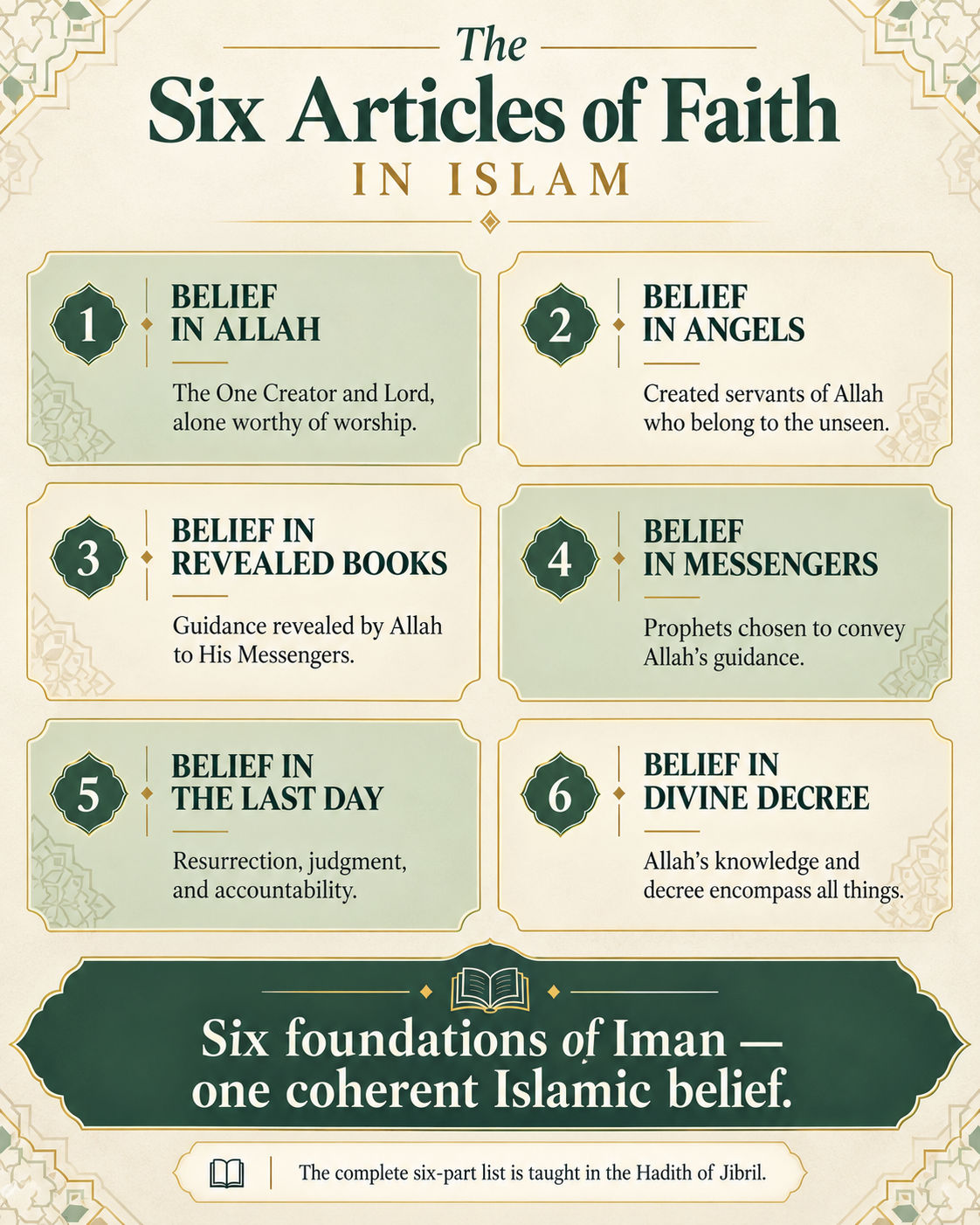
The Six Articles of Faith, also called the six pillars of Iman, are belief in Allah, His angels, His revealed Books, His Messengers, the Last Day, and Divine Decree (Qadr). They are set out in the authentic Hadith of Jibril, recorded in Sahih Muslim, and each is supported by the Quran.
Belief in Allah
Belief in His angels
Belief in His revealed Books
Belief in His Messengers
Belief in the Last Day
Belief in Divine Decree, its good and its bad
In Sahih Muslim the Prophet ﷺ said that Iman is:
أَنْ تُؤْمِنَ بِاللَّهِ وَمَلَائِكَتِهِ وَكُتُبِهِ وَرُسُلِهِ وَالْيَوْمِ الْآخِرِ، وَتُؤْمِنَ بِالْقَدَرِ خَيْرِهِ وَشَرِّهِ
“That you believe in Allah, His angels, His Books, His Messengers, and the Last Day, and that you believe in the Decree, its good and its bad.”
The phrase “good and bad” (khayrihi wa sharrihi) does not mean Allah is unjust or morally evil. It describes how people experience events: some feel beneficial and pleasant, others harmful and painful. Allah’s knowledge and decree encompass all of it. The Prophet ﷺ himself taught the supplication, “and evil is not attributed to You” (Sahih Muslim).
The Six Articles at a Glance
Article | Arabic term | What Muslims believe | Why it matters |
|---|---|---|---|
Allah | الله / التوحيد | He is the One Creator and Lord, alone worthy of worship | It grounds all worship |
Angels | الملائكة | They are created servants of Allah in the unseen world | It reminds us the unseen is real |
Books | الكتب | Allah revealed guidance; the Quran is the final revelation | It tells us where guidance comes from |
Messengers | الرسل | Allah sent Prophets to every people; Muhammad ﷺ is the last | It shows how guidance reaches us |
Last Day | اليوم الآخر | Resurrection, judgment, and eternal outcome | It gives life accountability and hope |
Qadr | القدر | Allah’s knowledge and decree encompass all things | It teaches humility and trust |
Where Do They Come From?
The complete six-part list appears most clearly in the Hadith of Jibril. The Quran teaches each belief repeatedly, and sometimes lists several together, as we will see. Understanding the Hadith first makes everything else easier.
What Does Iman Mean?
Iman (الإِيمَان) comes from the Arabic root أ-م-ن (a-m-n). The root carries ideas of safety, security, and trustworthiness. It gives us amina (to be safe), aman (safety), amin (trustworthy), and amanah (a trust). Classical Arabic usage connects Iman with affirming something as true (tasdiq) and placing trust in it. That is why Iman is more than a passing feeling of security. It is conviction, affirmation, and trust in what Allah has told us.
In Islamic usage, Iman means affirming the truths Allah revealed about Himself, the unseen, and the Hereafter. It also shapes how a person lives. The Prophet ﷺ said, “Whoever believes in Allah and the Last Day, let him speak good or remain silent” (Bukhari and Muslim). Faith touches speech, character, and worship.
Scholars have discussed the precise technical definition. Many hadith scholars define Iman as belief of the heart, statement of the tongue, and action of the limbs. Many Maturidi and Ash’ari scholars define its essence as heartfelt affirmation (with verbal declaration), while treating actions as its necessary fruit and perfection. Beginners do not need to resolve this debate. All agree that Iman is real conviction and that it should be visible in a believer’s life.
Can Iman Increase and Decrease?
The Quran speaks of faith increasing: “When His verses are recited to them, it increases them in faith” (8:2), and Allah sent down tranquility “so that they would increase in faith along with their faith” (48:4). Many scholars take this literally, so Iman rises with obedience and remembrance and falls with neglect and sin. Others distinguish the essential affirmation from its strength, certainty, and perfection. Either way, the practical lesson is the same: faith can be nurtured through learning, worship, remembrance, and good deeds.
The Hadith of Jibril: Islam, Iman, and Ihsan
The Context
Umar ibn al-Khattab رضي الله عنه narrated that the Companions were sitting with the Messenger of Allah ﷺ when a man came whom none of them knew. He sat before the Prophet ﷺ and asked about Islam, Iman, Ihsan, the Hour, and its signs. After he left, the Prophet ﷺ told Umar that the questioner was Jibril, who “came to teach you your religion” (Sahih Muslim, in the Book of Iman). A related narration from Abu Hurayrah is in Sahih al-Bukhari, with slightly different wording. For example, it mentions “meeting Him” and resurrection in place of Qadr. The six-part list above is the Umar narration in Muslim.
Islam, Iman, and Ihsan
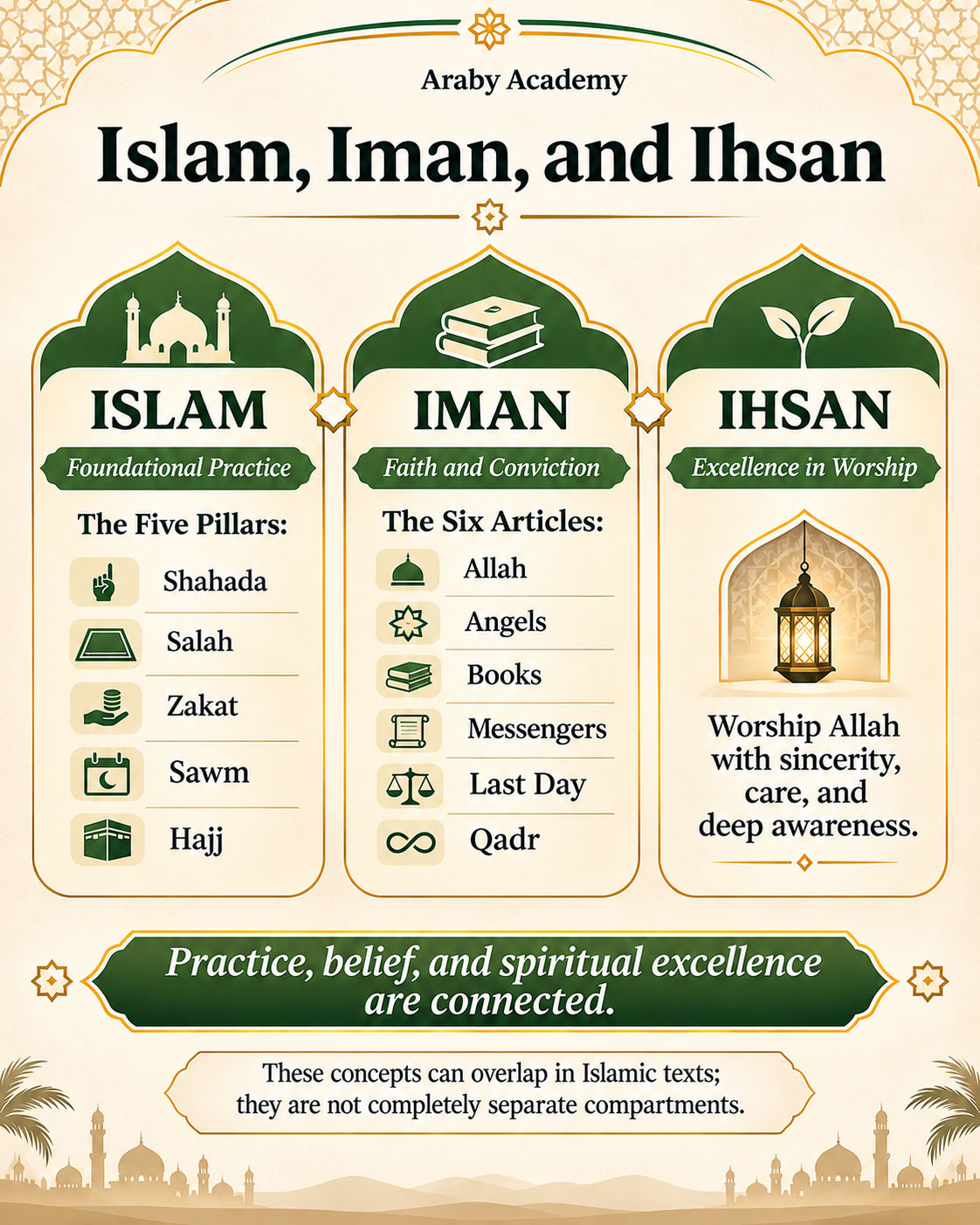
The Hadith presents three levels of religion:
Islam (الإِسْلَام): submission to Allah, expressed in the Five Pillars. The Prophet ﷺ listed the Shahada, prayer, Zakat, fasting Ramadan, and Hajj for those able.
Iman (الإِيمَان): faith, expressed in the six articles.
Ihsan (الإِحْسَان): excellence. The Prophet ﷺ defined it as:
أَنْ تَعْبُدَ اللَّهَ كَأَنَّكَ تَرَاهُ، فَإِنْ لَمْ تَكُنْ تَرَاهُ فَإِنَّهُ يَرَاكَ
“To worship Allah as though you see Him; and if you do not see Him, He sees you.”
This does not mean ordinary worshippers see Allah in this world. It means worshipping with deep awareness that Allah is fully aware of us. Ihsan is worship offered with awareness, sincerity, and care.
Are Islam and Iman completely separate? Not in a simple way. In some texts they are distinguished, as in this Hadith, and in others they overlap. It would be too simple to say “Islam is only actions and Iman is only thoughts.” Treat the Hadith as a map of religion’s outer practice, inner conviction, and spiritual excellence.
Are the Six Articles in the Quran?
The Quran teaches all six beliefs, but no single verse gives the exact numbered list. The complete formulation is clearest in the Hadith of Jibril. Three verses show how the Quran groups these beliefs:
Quran 2:285: “The Messenger believes in what was revealed to him from his Lord, and so do the believers. All believe in Allah, His angels, His Books, and His Messengers.” It covers four articles.
Quran 4:136 calls believers to believe in Allah, His Messenger, the Book revealed to him, and the Books revealed before, and warns that whoever disbelieves in Allah, His angels, His Books, His Messengers, and the Last Day has gone far astray. It covers five articles.
Quran 2:177 says righteousness is to believe in Allah, the Last Day, the angels, the Book, and the Prophets, and then continues with charity, prayer, Zakat, keeping promises, and patience. Faith and action belong together.
1. Belief in Allah: The One Creator and Lord
Allah (الله) is the Arabic name for God. Arabic-speaking Jews and Christians also use the word, though their theology differs from Islam’s. Muslims believe Allah is the Creator and Sustainer of everything, not a tribal or ethnic deity but the Lord of all humanity and all worlds.
Belief in Allah means affirming His existence, His Lordship (that He alone creates, owns, and sustains), His exclusive right to be worshipped, and His perfection. Allah says, “Indeed, I am Allah. There is no god but Me, so worship Me and establish prayer for My remembrance” (20:14). This is Tawhid (التَّوْحِيد), the oneness of Allah. Our dedicated guide, What Is Tawhid? A Beginner’s Guide to Believing in One God in Islam, goes deeper, and What Is the Shahada? explains the declaration that expresses it.
Surah al-Ikhlas (112:1–4) summarizes this belief: “Say: He is Allah, One. Allah is As-Samad. He neither begets nor is born, and there is none comparable to Him.” Classical commentators explain As-Samad as the One everything depends on while He depends on nothing. Then comes Quran 42:11: “There is nothing like Him” (لَيْسَ كَمِثْلِهِ شَيْءٌ). Nothing resembles Allah, so Muslims describe Allah only as revelation describes Him and do not picture or imagine Him.
Allah’s Names and Attributes
“To Allah belong the Most Beautiful Names, so call upon Him by them” (7:180). Examples include Ar-Rahman (the Most Compassionate), Ar-Rahim (the Especially Merciful), Al-‘Alim (the All-Knowing), Al-Hakim (the All-Wise), and Al-Ghafur (the Most Forgiving). A Hadith in Bukhari and Muslim mentions ninety-nine names; it does not say Allah’s names are limited to that number.
Sunni scholarly traditions (Ash’ari, Maturidi, and Athari) explain some divine attributes using different methods. For beginners, the shared foundation is enough. Allah is perfect, incomparable, and has told us about Himself truthfully, and He is not like any created being.
How Belief in Allah Shapes Life
This belief becomes salah (prayer), dua (supplication), dhikr (remembrance), fasting, gratitude, repentance, and trust. It does not remove fear, grief, or anxiety. A believer can trust Allah and still feel stress and sorrow. The Prophet ﷺ wept at the death of his son Ibrahim and said, “The eye weeps and the heart grieves” (Bukhari). Distress does not prove absent faith.
Faith also pairs trust with responsible action. A student studies and makes dua, a patient seeks treatment and relies on Allah, and a parent protects children while asking Allah to guide them.
2. Belief in Angels: Allah’s Unseen Servants
Angels (الْمَلَائِكَة, al-mala’ikah) are created beings who serve Allah. They are not divine, not Allah’s partners, and not independent gods. They belong to al-Ghayb (الغَيْب), the unseen, which we know only through revelation.
Sahih Muslim narrates from Aisha رضي الله عنها that angels were created from light. Revelation does not give us anatomical detail, so we do not add any. The Quran describes angels as those who “do not disobey Allah in what He commands them and do what they are commanded” (66:6). Scholars discuss the nature of angelic choice with care, so it is inaccurate to call angels “robots.” The safe summary is that they are honored servants who obey Allah.
Named Angels and Their Roles
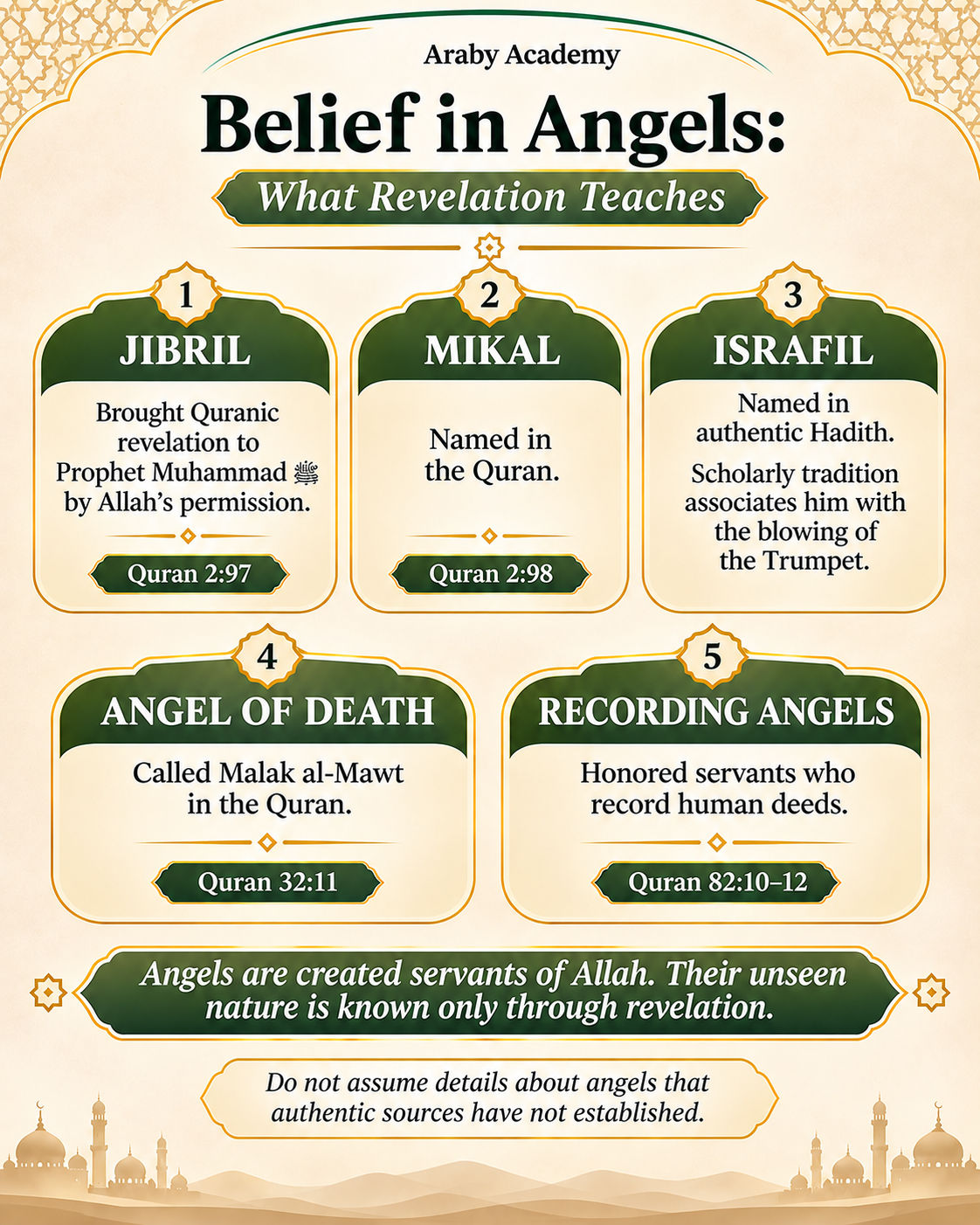
Jibril (جِبْرِيل) brought the Quran to the Prophet’s ﷺ heart by Allah’s permission (2:97). He is also called ar-Ruh al-Amin, the trustworthy spirit (26:193).
Mikal (مِيكَال, also spelled Mika’il) is named in the Quran (2:98). Beyond his name, we avoid attaching duties that lack strong sources.
Israfil (إِسْرَافِيل) is named in authentic Hadith, such as the night-prayer supplication in Sahih Muslim, but not in the Quran. The Quran mentions the blowing of the Trumpet (39:68), and scholarly tradition identifies the angel who blows it as Israfil.
Malak al-Mawt (مَلَك الْمَوْت), the Angel of Death, appears in Quran 32:11 by that title only. The popular name “Azrael” is not found in the Quran or in authentic Hadith.
Recording angels: “Indeed, over you are guardians, noble scribes who know what you do” (82:10–12; see also 50:17–18). Some commentators treat the words raqib and ‘atid as descriptions (“watcher” and “ready”) rather than proper names. Their purpose is to remind us that actions matter, not to frighten us.
Angels and Daily Life
Belief in angels reminds us that reality is larger than what we see and that our choices matter. It should not turn into anxiety about invisible observers, especially for children or anyone prone to worry. Humans do not become angels after death, and Muslims do not worship angels. Prayer, worship, and supplication are for Allah alone. For more, see Who Are the Angels in Islam?
3. Belief in Allah’s Books: Guidance Through Revelation
Al-Kutub (الكُتُب) is the plural of kitab (كِتَاب), “book” or “writing.” Muslims believe Allah revealed guidance to His Messengers, and that the Quran is the final revelation, given to Muhammad ﷺ. Muslims also affirm the revelation given to earlier Prophets.
The Quran names:
Tawrah (التَّوْرَاة), given to Musa عليه السلام (3:3; 5:44).
Zabur (الزَّبُور), given to Dawud عليه السلام (4:163; 17:55).
Injil (الإِنجِيل), given to Isa عليه السلام (5:46). In Islamic theology it is understood as the revelation given to Isa, not simply identical to the four canonical Gospels.
Quran (القُرْآن), the speech of Allah revealed to Muhammad ﷺ.
Beyond these, the Quran also mentions the Scrolls (Suhuf) of Ibrahim and Musa (53:36–37; 87:18–19).
Earlier Scriptures, the Bible, and Tahrif
Muslims affirm that earlier Books originated in divine revelation, and they respect Jews and Christians as People of the Book. The Bible is not the Quran. “Bible” itself covers different collections across traditions. Whether and how earlier texts changed is a nuanced topic called tahrif. Classical scholars discussed textual alteration, distorted interpretation, and concealment of truth, and no single sentence settles that debate. For beginners, the principle is enough: the Quran confirms earlier revelation and stands as the final criterion (5:48). Respect for Jews and Christians remains part of Islamic ethics.
Is the Quran the Final Revelation?
Mainstream Islamic belief says yes. Muhammad ﷺ is “the Seal of the Prophets” (33:40), and Allah promised to guard the Quran: “Indeed, We sent down the Reminder, and indeed, We will guard it” (15:9). In brief, the Quran was revealed over about twenty-three years, memorized and written down during the Prophet’s ﷺ lifetime, compiled into one volume after his death under Abu Bakr, and copied in a standard form under Uthman. The full story is in How Was the Quran Preserved?
Revealed Books matter because humans need guidance, and revelation teaches worship, moral responsibility, and the continuity of the Prophets’ message.
Why Quranic Arabic Helps Here
Words like kitab (book, also “decree” or “writing”), ayah (sign or verse), wahy (revelation, an inspired communication), huda (guidance), and furqan (criterion that separates truth from falsehood) carry shades of meaning that a single English word compresses. Learning even basic Quranic Arabic opens those layers, and starting with 100 Most Common Words in the Quran is a practical first step.
4. Belief in the Messengers: Guidance Through the Prophets
Ar-Rusul (الرُّسُل, Messengers) and al-Anbiya (الأَنْبِيَاء, Prophets) are those chosen by Allah to receive and convey revelation. Allah says, “We sent into every nation a messenger: Worship Allah and avoid false gods” (16:36), and, “We sent no messenger before you except that We revealed to him: There is no god but Me, so worship Me” (21:25). Their roles include calling people to worship Allah, conveying revelation, teaching guidance, and giving warnings and glad tidings.
A nabi (نَبِيّ) is a Prophet and a rasul (رَسُول) a Messenger (“sent one”). Classical scholars differ over the technical distinction. A common view says every Messenger is a Prophet, and some scholars say a Messenger brought a new law or was sent to a people. We do not present one view as consensus. Both are honored in Islam.
How Many Prophets Are There?
The Quran names 25 Prophets according to the widely accepted enumeration, but it does not limit Prophethood to those names. Allah says, “Among them are those We have told you about and among them are those We have not told you about” (40:78; also 4:164). Numbers sometimes quoted for all Prophets come from reports whose grading is disputed, so Muslims do not need to fix a number. We affirm those named and believe in whoever else Allah sent, without inventing details.
The 25 Prophets named in the Quran (listed alphabetically, not chronologically)
Adam | Al-Yasa’ | Ayyub | Dawud | Dhul-Kifl |
Harun | Hud | Ibrahim | Idris | Ilyas |
Isa | Ishaq | Isma’il | Lut | Muhammad ﷺ |
Musa | Nuh | Salih | Shu’ayb | Sulayman |
Yahya | Ya’qub | Yunus | Yusuf | Zakariyya |
Some scholars have discussed the prophethood of Dhul-Kifl, and the table follows the commonly taught list of 25.
Some Prophets deserve a few words. Adam is, in Islamic belief, the first human being and a Prophet. Nuh called his people to worship Allah and warned them (71:1–4). Ibrahim is a model of Tawhid, trust, and obedience, and his story is in The Story of Prophet Ibrahim. Musa is the most mentioned Prophet in the Quran, and The Story of Prophet Musa covers his life. Isa ibn Maryam is the Messiah and a Messenger of Allah, born miraculously to Maryam, and Islam does not teach that he is divine (4:171; 19:30). See Who Is Jesus in Islam?. Muhammad ﷺ is the final Prophet and Messenger (33:40). Muslims love and follow him but never worship him.
Do all Prophets teach Tawhid? Yes, that is their common call (21:25). This does not mean they brought identical detailed laws. Are all Prophets equal in rank? The Quran says Allah favored some over others (2:253; 17:55), but we never deny or belittle any Prophet (2:285). We do not invent ranking lists. And do Muslims worship Prophets? No, they guide us to Allah, and only Allah is worshipped.
Belief in Messengers teaches obedience, patience, truthfulness, moral courage, and trust in Allah.
5. Belief in the Last Day: Accountability and the Hereafter
Al-Yawm al-Akhir (اليَوْم الآخِر, the Last Day) is the Day when this world ends and humanity returns to Allah. Al-Akhirah (الآخِرَة) is the life to come, a reality that includes both resurrection and judgment.
The Islamic outline is simple, and each stage is taught by the Quran and Sunnah:
Death, then Barzakh, the stage between death and resurrection (23:100). See What Happens After We Die?
Resurrection (al-Ba’th, الْبَعْث): Allah will raise humanity (22:7).
Judgment (Yawm al-Qiyamah, يَوْم القِيَامَة): accountability, deeds, justice, and mercy. See What Is the Day of Judgment in Islam?
Final outcome: Jannah (Paradise) or Jahannam (Hell).
These matters belong to al-Ghayb. Knowledge of them comes only through revelation. Details beyond what the Quran and authentic Sunnah state are simply unknown to us.
Justice, Mercy, and Responsibility
“Indeed, Allah does not wrong even by the weight of an atom” (4:40). “Whoever does an atom’s weight of good will see it, and whoever does an atom’s weight of evil will see it” (99:7–8). This gives small deeds weight, but it should not become obsessive fear. Not every injustice is visibly corrected in earthly life, and the Hereafter is where perfect justice is established.
Jannah is described as a place of mercy and reward, more than sensory pleasure. “No soul knows what has been hidden for them of comfort for the eyes” (32:17), and Allah’s pleasure is greater still (9:72). Jahannam is part of Islamic teaching about consequences, and Muslims do not assign named living people to it.
Mercy and accountability are held together. “Do not despair of the mercy of Allah. Indeed, Allah forgives all sins” (39:53) is a call to sincere repentance, not permission to neglect worship. Belief in the Hereafter should make a Muslim more responsible in this world, in work, family, justice, charity, education, and honesty, and never passive.
6. Belief in Qadr: Allah’s Knowledge and Decree
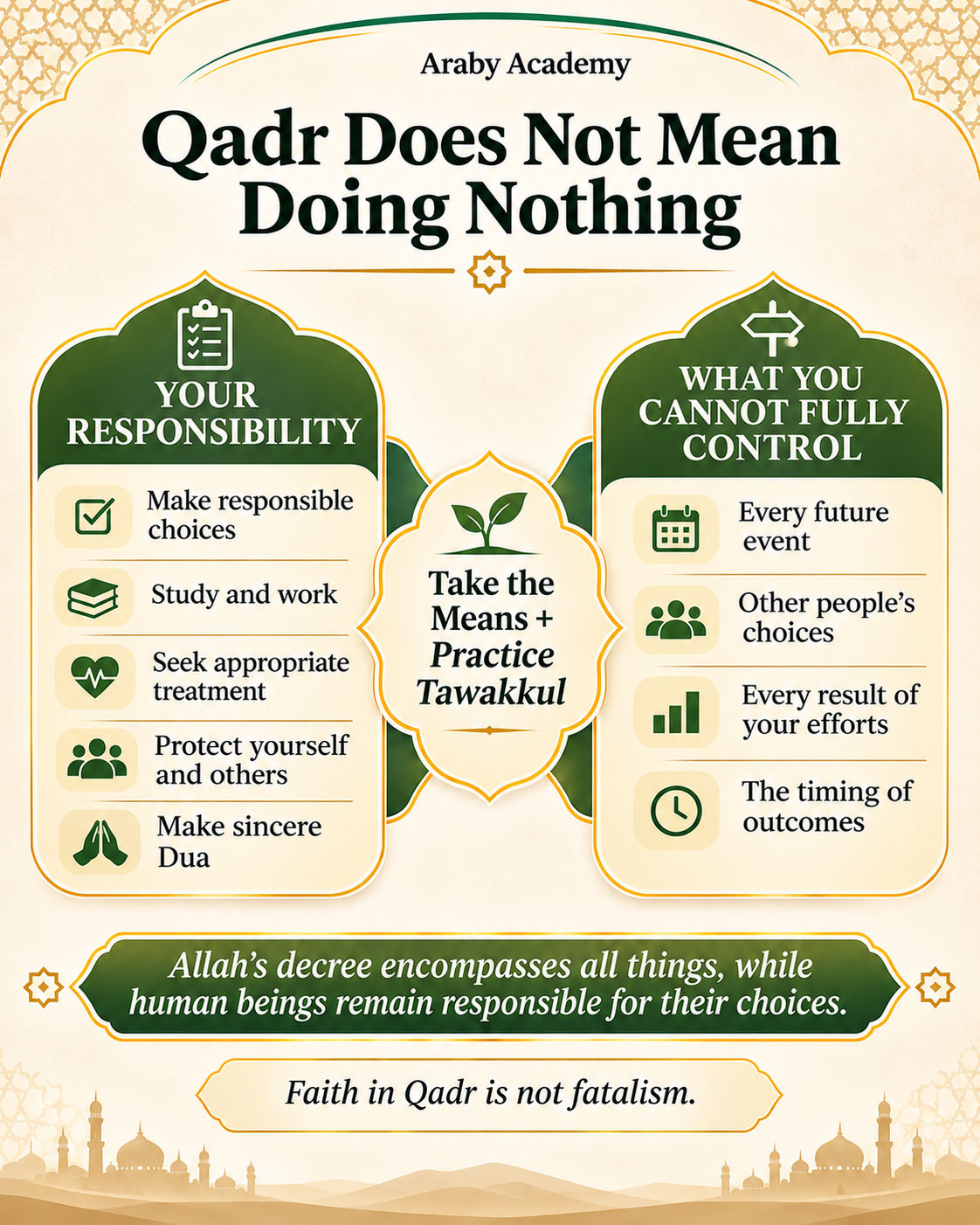
Al-Qadr (القَدَر) means Divine Decree. It affirms that Allah’s knowledge and sovereignty encompass all creation, while human beings remain responsible for their choices. “Indeed, all things We created with measure” (54:49). Qadr is not fatalism.
Scholars sometimes distinguish Qadr (the measuring or decree) from Qada (the final determination or execution), but the definitions vary among scholars, so we do not treat one distinction as fixed.
Many Sunni creed manuals explain Qadr through four aspects. This is a teaching framework drawn from the Quran and Sunnah, not a list found together in one Hadith:
Knowledge: Allah knows everything, past, present, and future (65:12).
Writing: it is recorded in al-Lawh al-Mahfuz, the Preserved Tablet (22:70; Sahih Muslim also reports that Allah recorded the decrees of creation before creating the heavens and earth). We do not describe its physical form.
Will: nothing occurs outside Allah’s knowledge and will.
Creation: Allah is the Creator of all things.
Does Qadr Remove Free Will?
No. The Quran holds people accountable (99:7–8), commands action, and addresses people as responsible agents. Scholars explain the metaphysics with different terminology, and we need not turn this guide into a debate between schools. Human beings are not independent of Allah’s power, yet they are not puppets either.
If Everything Is Decreed, Why Try?
Because we do not know what is decreed, we are commanded to act. A student studies, a worker works, a patient seeks treatment, a parent protects a child, and a believer makes dua. The Prophet ﷺ said, “Strive for what benefits you, seek help from Allah, and do not give up,” and if something goes wrong, do not say “if only,” but say “Allah has decreed, and what He willed He did” (Sahih Muslim). He also taught that if we relied on Allah as we should, He would provide for us as He provides for birds, who leave hungry and return full (Tirmidhi). Reliance (tawakkul) means trusting Allah with effort. See What Is Tawakkul?
Does Qadr Mean Allah Loves Every Event?
No. Scholars distinguish what Allah decrees to occur from what He commands and loves. Allah permits disbelief and injustice to occur in this world, yet He does not approve of them (39:7). Qadr never makes suffering or injustice morally good.
Why Do Bad Things Happen?
We do not claim to know the hidden divine reason behind any individual’s illness, loss, or trauma. Nor should we assume that everyone who suffers is being punished. Read Why Does Allah Test Us? for a fuller discussion.
Does Dua Change Qadr?
Allah’s knowledge is complete, and He does not learn anything new or change His mind. Scholars explain that dua is itself part of what Allah has decreed: He knows who will ask and decrees the response accordingly. A Hadith in Tirmidhi says that only dua averts the decree, and scholars discuss its grading and meaning, often explaining it in terms of conditional decrees. Keep asking.
Qadr and Anxiety
Belief in Qadr can bring real comfort, but “just believe in Qadr and anxiety will disappear” is poor advice. Faith can be a source of reassurance, and professional help may also be needed. See What Does Islam Say About Anxiety, Worry, and Trusting Allah? For the full treatment of this topic, read What Is Qadr in Islam?
How the Six Articles of Faith Fit Together
The six beliefs are connected, not six isolated facts. Belief in Allah gives revelation its meaning. He guides humanity, and angels carry out His commands, including the delivery of revelation through Jibril, though they have other roles too. The Books contain that guidance, and the Messengers convey and model it. The Last Day establishes ultimate accountability, and Qadr affirms Allah’s comprehensive knowledge and sovereignty throughout. This is a teaching sequence, not a literal timeline.
Together they answer life’s big questions in summary form. Where did we come from? Allah created us. How do we get guidance? Through revelation delivered by Messengers. Are we alone? The unseen includes angels. Do our actions matter? Yes, accountability awaits. Is anything outside Allah’s knowledge? No. These are teaching summaries, not exhaustive theological answers.
What the Six Articles Do Not Mean
Belief in Allah does not mean imagining His form.
Belief in angels does not mean obsessing over invisible beings.
Belief in revelation does not mean disrespecting other religions.
Belief in Messengers does not mean worshipping them.
Belief in the Hereafter does not mean abandoning worldly duties.
Belief in Qadr does not mean passivity.
Six Articles of Faith vs Five Pillars of Islam
Five Pillars (Islam) | Six Articles (Iman) | |
|---|---|---|
Focus | Practice and submission | Belief and conviction |
1 | Shahada | Allah |
2 | Salah | Angels |
3 | Zakat | Books |
4 | Sawm | Messengers |
5 | Hajj | Last Day |
6 | — | Qadr |
Both frameworks come from the Hadith of Jibril and are essential to Islamic learning. The Five Pillars are the acts by which faith is expressed, and the Six Articles are the convictions that give those acts meaning. For a full guide, see The Five Pillars of Islam Explained.
How the Six Articles Shape a Muslim’s Daily Life
Allah: worship and gratitude shape the day.
Angels: a sense of responsibility, not fear.
Books: regular study of the Quran and a search for guidance.
Messengers: learning the authentic example of the Prophet ﷺ.
Last Day: acting justly even when no one is watching. The Prophet ﷺ said none of you truly believes until he loves for his brother what he loves for himself (Bukhari and Muslim).
Qadr: acting diligently without imagining that outcomes are fully under human control.
Prayer even guards against wrongdoing: “Indeed, prayer prevents immorality and wrongdoing” (29:45). Knowing the six articles by heart is a starting point. Understanding, worship, character, and continued learning are what turn them into strong faith, and no one needs advanced scholarship for sincere faith.
10 Practical Ways to Strengthen Iman
These are practices, not a formula for guaranteed instant transformation.
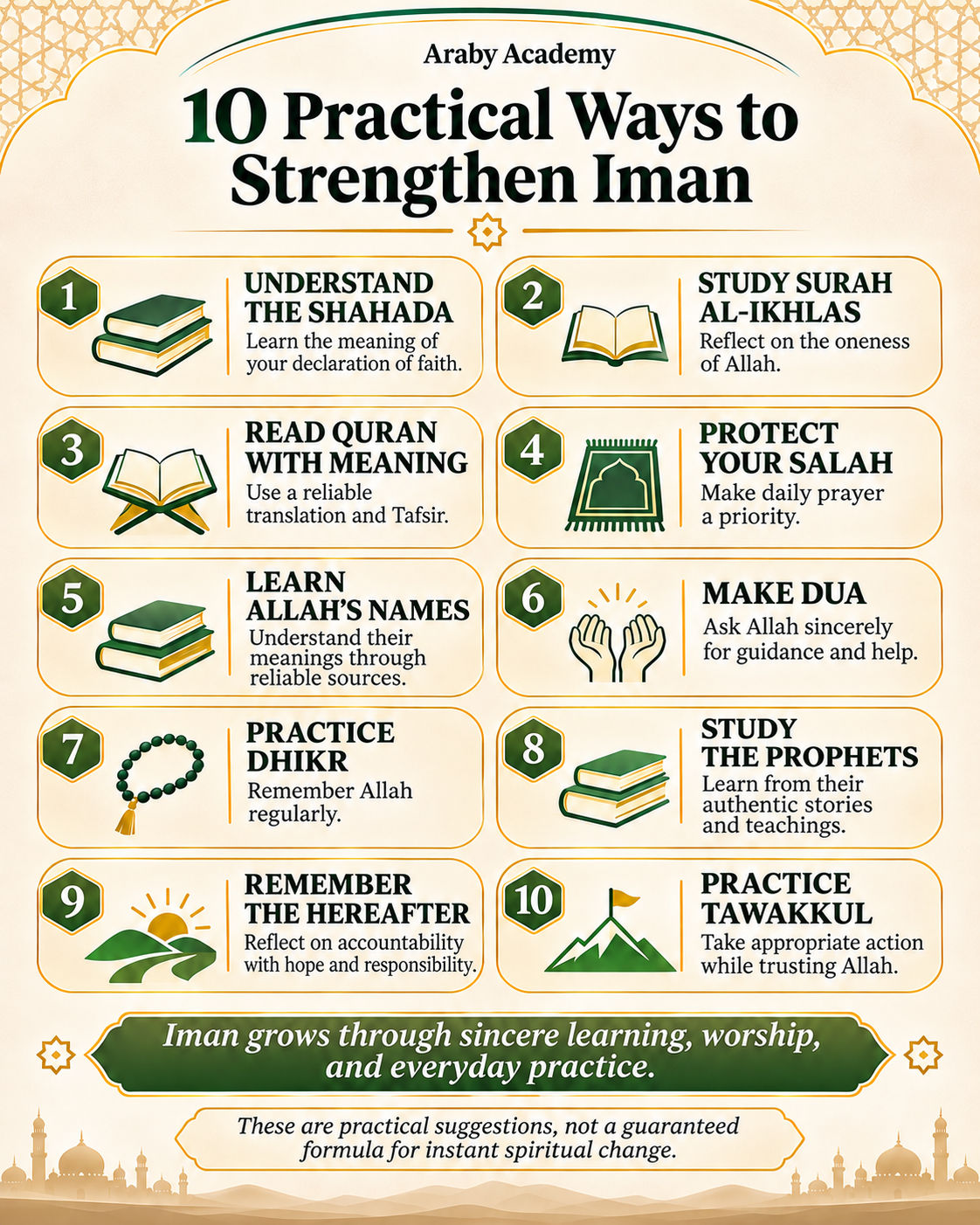
1. Learn the meaning of the Shahada. Understand what you are declaring: there is no god but Allah, and Muhammad ﷺ is His Messenger.
2. Study Surah al-Ikhlas. Four short verses summarize Tawhid. Learn them, then learn what each phrase means.
3. Read Quran with understanding. Even a few verses a day with a trusted translation and tafsir build lasting conviction.
4. Protect the five daily prayers. Salah is the regular meeting point between belief and action, and consistency matters more than intensity.
5. Learn Allah’s beautiful Names. Knowing Ar-Rahman, Al-Hakim, and Al-Ghafur changes how you ask and how you hope.
6. Make sincere dua. Speak to Allah in your own words about your real needs, with trust.
7. Practice dhikr. Short, regular remembrance keeps the heart connected throughout the day.
8. Study the stories of the Prophets. They show faith lived through hardship, patience, and trust.
9. Reflect on the Hereafter responsibly. Remember death and accountability to gain perspective and motivation, not paralyzing fear.
10. Practice tawakkul while taking lawful action. Do your part, then place the outcome with Allah.
Repentance, Doubts, and Intrusive Thoughts
Believers sin, and sincere tawbah (repentance) remains open. We do not say one sin automatically destroys faith, and we avoid casual accusations of disbelief.
Many people, especially beginners, experience unwanted thoughts about Allah or religion. A group of Companions once told the Prophet ﷺ they found thoughts in themselves too grave to speak of, and he said, “That is clear faith” (Sahih Muslim). Involuntary intrusive thoughts are not the same as chosen disbelief. If such thoughts are persistent or distressing, speak with a trusted teacher and a qualified mental-health professional, as religious scrupulosity is a recognized condition.
Sincere questions are part of learning. Even Ibrahim عليه السلام asked Allah to show him how He gives life to the dead, “so that my heart may be at ease” (2:260). Ask trustworthy teachers rather than shaming yourself or others for basic questions.
Teaching and Learning the Six Articles
With Children
Keep it simple and gentle: Allah created us, Allah is One, angels are His servants, Allah sent guidance, Prophets taught people, our actions matter, and Allah knows everything. Avoid graphic descriptions of Hell or death. Say “we do not know” when revelation does not tell us. Do not invent what Jibril looks like, what angels do in each room, the shape of Jannah, the timing of the Hour, or how Qadr is written. A children’s diagram is a teaching aid, not revealed doctrine.
Seven family activities (educational, not acts of worship): six-article matching cards, a Quran verse of the week, Prophet story time, an Islamic vocabulary journal, a gratitude reflection, a translation discussion, and a simple family quiz.
For New Muslims
You do not have to master every theological debate at once. Begin with Allah, the Shahada, Salah, basic Quran, the Six Articles, and the Five Pillars, and learn with reliable teachers. Faith grows with knowledge and practice.
For Students of Knowledge
A sensible roadmap: Quran, Tafsir, authentic Hadith, Arabic, Aqidah, Fiqh, and Seerah. Study difficult creed texts with qualified teachers rather than interpreting them alone, and avoid unnecessary sectarian disputes.
Seven Quranic Passages That Explain Islamic Faith
Reference | Belief illustrated | Takeaway |
|---|---|---|
2:177 | Faith with action | Righteousness joins belief and conduct |
2:285 | Allah, angels, Books, Messengers | Belief in all true Messengers |
4:136 | Five articles together | Faith includes the Last Day |
16:36 | Messengers | Every people received guidance |
21:25 | Common message | All Prophets taught worship of Allah alone |
42:11 | Allah’s uniqueness | Nothing resembles Him |
54:49 | Qadr | All things are created with measure |
No single verse here lists all six articles.
Misconceptions About Islamic Faith
“The Six Articles and Five Pillars are the same.” They are related frameworks, one of belief and one of practice.
“One verse numbers all six.” The Quran teaches them; the full list is clearest in Hadith Jibril.
“Iman only means believing God exists.” Islamic Iman has broader revealed content.
“Allah looks like a powerful human.” Nothing resembles Him (42:11).
“Muslims worship angels.” Angels are created servants of Allah.
“Angels are deceased humans.” Islam distinguishes angels from human souls.
“The Quran names the Angel of Death ‘Azrael.’” The Quran says Malak al-Mawt; “Azrael” lacks authentic sourcing.
“Only the Quran was ever revealed.” Muslims affirm earlier revelation.
“The Injil is just today’s four Gospels.” Islam understands the Injil as revelation given to Isa.
“Islam rejects Musa and Isa.” Muslims believe in both as Prophets.
“Only 25 Prophets existed.” The Quran names 25 and affirms others.
“Muslims worship Muhammad ﷺ.” They worship Allah and follow His Messenger.
“Believing in the Hereafter means ignoring this world.” Islam commands responsibility here.
“Everyone who suffers is being punished.” Hidden divine purposes cannot be assumed.
“Qadr means no real choices.” Islam affirms accountability alongside decree.
“Qadr means never planning.” Taking lawful means is part of faith.
“Strong Iman means never feeling anxious or sad.” Believers can experience real distress.
“Intrusive thoughts mean lost faith.” Unwanted thoughts are not chosen beliefs.
“Memorizing the six is the goal.” Understanding and living by them is.
Essential Arabic Vocabulary for Understanding Iman
Arabic | Transliteration | Root | Meaning | Context |
|---|---|---|---|---|
الإِيمَان | Al-Iman | أ-م-ن | Faith | Frequent in the Quran; the foundation of religion |
الإِسْلَام | Al-Islam | س-ل-م | Submission | 3:19; practice of faith |
الإِحْسَان | Al-Ihsan | ح-س-ن | Excellence | 16:90; defined in Hadith Jibril |
العَقِيدَة | Al-Aqidah | ع-ق-د | Creed | A later scholarly term, not a Quranic noun |
الغَيْب | Al-Ghayb | غ-ي-ب | The unseen | 2:3 |
التَّوْحِيد | At-Tawhid | و-ح-د | Oneness of Allah | A scholarly noun; the idea is central in the Quran |
المَلَائِكَة | Al-Mala’ikah | disputed | Angels | 2:285 |
الكُتُب | Al-Kutub | ك-ت-ب | Books | 2:285 |
الوَحْي | Al-Wahy | و-ح-ي | Revelation | 42:51 |
الرَّسُول | Ar-Rasul | ر-س-ل | Messenger | 2:285 |
النَّبِيّ | An-Nabi | ن-ب-أ | Prophet | 33:40 |
الآخِرَة | Al-Akhirah | أ-خ-ر | Hereafter | Frequent in the Quran |
القِيَامَة | Al-Qiyamah | ق-و-م | Resurrection/Standing | Yawm al-Qiyamah |
القَدَر | Al-Qadr | ق-د-ر | Divine Decree | 54:49 |
التَّوَكُّل | At-Tawakkul | و-ك-ل | Reliance on Allah | The Quran uses the verb: “Rely upon Allah” (3:159) |
Three Short Word Studies
Amanah, aman, amin. The root أ-م-ن links Iman with safety and trust. A reader who knows the root will notice that amin (trustworthy) and amanah (a trust) belong to the same family. Roots help, but meaning always depends on usage in context.
Ghayb. Ghayb means what is hidden. In 2:3, “who believe in the unseen,” it refers especially to what we know only through revelation. In general Arabic, the word also covers things hidden from us simply by absence or distance, so not every ghayb is supernatural.
Rasul. From ر-س-ل, “to send.” In ordinary Arabic it can mean a messenger or envoy; in theology, a Messenger of Allah.
Why Learning Arabic Helps
Foundational Islamic words carry semantic depth, and translations sometimes compress them. Learning Quranic Arabic helps students understand verses, recitation, and classical explanations. It does not, on its own, qualify anyone to interpret difficult Aqidah questions without Tafsir and teachers.
Frequently Asked Questions
1. What are the Six Articles of Faith in Islam?
Belief in Allah, His angels, His revealed Books, His Messengers, the Last Day, and Divine Decree (Qadr). They are set out in the Hadith of Jibril in Sahih Muslim.
2. What are the six pillars of Iman in order?
Allah, angels, Books, Messengers, the Last Day, and Qadr, as in the Hadith of Jibril narrated by Umar رضي الله عنه.
3. What does Iman mean in Islam?
Iman is faith: heartfelt affirmation of what Allah and His Messenger ﷺ taught, with trust that shapes worship and character. Scholars differ on technical definitions but agree that it is real conviction.
4. Where do the Six Articles come from?
The complete list is in the Hadith of Jibril. The Quran teaches each belief and groups several together in verses such as 2:285 and 4:136.
5. Are the Six Articles mentioned in the Quran?
Each is taught in the Quran, but no single verse lists all six in that exact numbered form.
6. What is the Hadith of Jibril?
A narration in which Jibril, appearing as a man, asked the Prophet ﷺ about Islam, Iman, and Ihsan, and the Hour. The Prophet ﷺ then said he came to teach people their religion.
7. What is the difference between Islam and Iman?
In this Hadith, Islam refers to the outward pillars of practice and Iman to the inner beliefs. In other texts the terms overlap, so the distinction is not absolute.
8. What is Ihsan?
Excellence in worship: “to worship Allah as though you see Him; and if you do not see Him, He sees you.”
9. What is the difference between the Five Pillars and Six Articles?
The Five Pillars are acts of worship (Shahada, prayer, Zakat, fasting, Hajj). The Six Articles are beliefs. Both are essential and complement one another.
10. What does belief in Allah mean?
Affirming that He is the One Creator and Lord, alone worthy of worship, perfect, and unlike anything in creation.
11. Why do Muslims believe in angels?
Because Allah and His Messenger ﷺ informed us of them. They are created servants of Allah in the unseen world, not objects of worship.
12. What Books did Allah reveal?
The Quran names the Tawrah, Zabur, Injil, and Quran, and mentions the Scrolls of Ibrahim and Musa.
13. Do Muslims believe in the Bible?
Muslims believe in the revelation Allah gave earlier Prophets, such as the Tawrah and Injil. The Bible is a collection that differs across traditions, and Muslims judge present texts by the Quran.
14. Do Muslims believe in Jesus and Moses?
Yes. Isa and Musa are honored Prophets in Islam. Muslims do not believe Isa is divine.
15. Why is Muhammad ﷺ the final Prophet?
The Quran calls him “the Seal of the Prophets” (33:40). Muslims therefore believe no prophet comes after him.
16. What is the Last Day?
The Day when Allah resurrects humanity for judgment, followed by Jannah or Jahannam.
17. What happens after death in Islam?
A person enters Barzakh until resurrection. Details beyond what the Quran and authentic Sunnah state are unknown, and a fuller overview is in our guide on death and the Hereafter.
18. What is Qadr?
Divine Decree: Allah’s knowledge, writing, will, and creation encompass all things.
19. Does Qadr mean humans have no free will?
No. Islam holds people responsible for their choices while affirming that nothing is outside Allah’s knowledge and power.
20. How can Muslims strengthen their Iman?
Through learning, prayer, Quran, dua, dhikr, studying the Prophets, reflecting on the Hereafter, and tawakkul with lawful action.
Six Foundations of Faith, One Coherent Belief
At first, the six articles may look like separate statements: Allah, angels, Books, Messengers, the Last Day, and Qadr. Together they explain a coherent understanding of existence. Allah is the Creator and Lord. He sends guidance, angels fulfill His commands, Books convey revelation, and Messengers guide humanity. The Last Day brings accountability, and Divine Decree reminds us that nothing falls outside Allah’s knowledge and sovereignty.
But faith is not meant to remain a memorized list. It should inspire salah, dua, honesty, gratitude, patience, learning, justice, repentance, and trust in Allah.
The Six Articles of Faith do more than explain what Muslims believe. They explain how Muslims understand their Creator, their purpose, their responsibilities, and their ultimate return to Allah.
Learning these beliefs is the beginning. Understanding them through the Quran, authentic Sunnah, and trustworthy scholarship helps turn memorized knowledge into sincere conviction and meaningful worship. If you wish to go further, study Quran and Quranic Arabic with qualified teachers, one verse and one word at a time.