"I Trust Allah — So Why Am I Still Worried?"
You believe in Allah. You pray. You know, in your mind, that He is in control.
And still, at 2 a.m., your thoughts circle around money, a marriage proposal, your children, an exam, a diagnosis, a visa, a family conflict, or a mistake from years ago. Then a second thought arrives, heavier than the first:
"If my Tawakkul were stronger, would I still feel this way?"
Now there are two burdens: the worry itself, and the guilt of being worried.
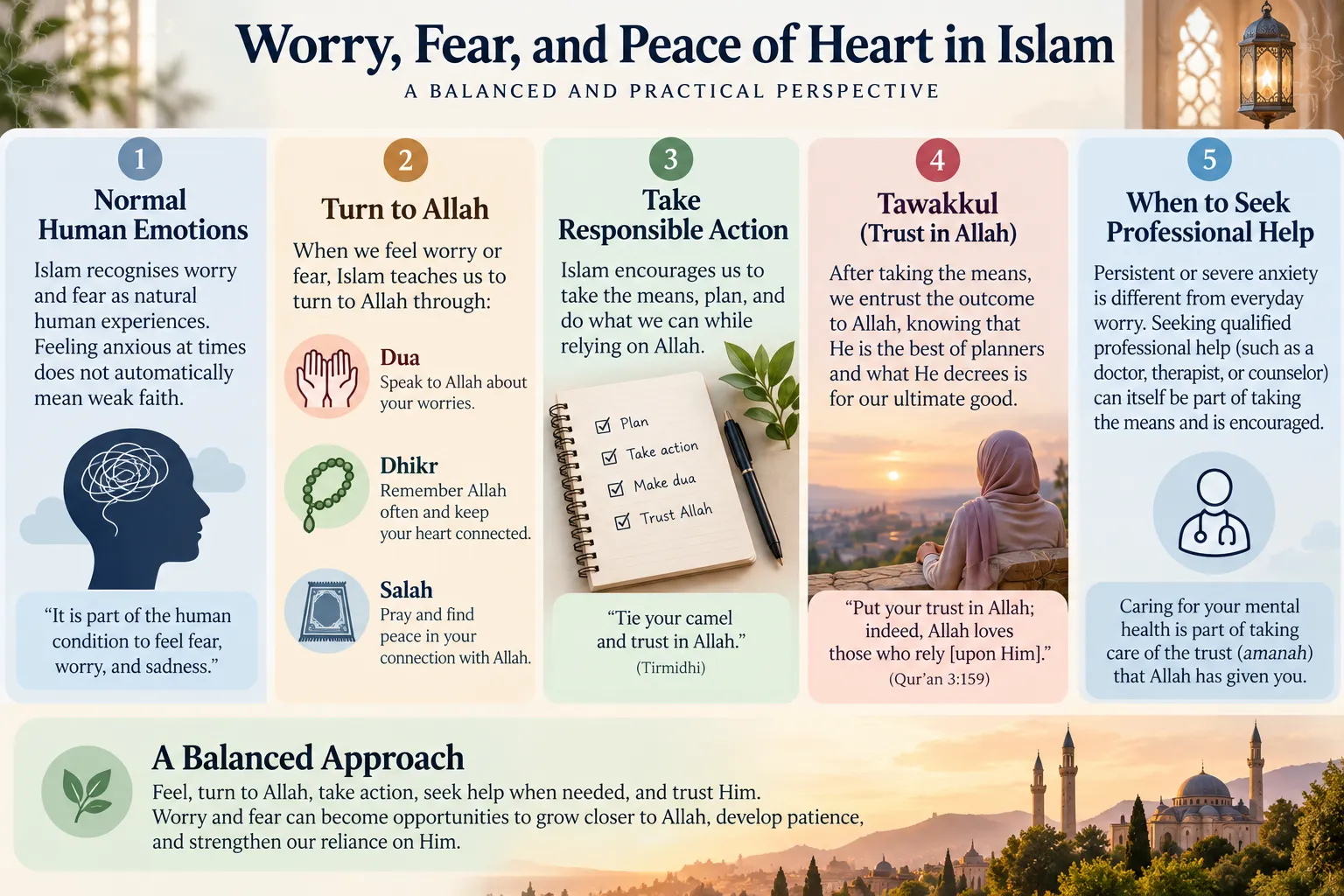
If that is where you are, begin here: experiencing fear, sadness, worry, or uncertainty does not automatically mean you lack faith. These are human experiences. The Quran describes them in the lives of Prophets and righteous people, and Islam never asks you to pretend they do not exist.
The Islamic question is not "Do I ever feel afraid?" It is:
"Where do I turn when I am afraid, and how do I respond?"
This article explores anxiety in Islam and the wider Islamic perspective on worry and fear, using the Quran, authentic Sunnah, and recognised scholarship. Its central idea is simple:
Tawakkul does not mean never feeling afraid. It means learning where to place your heart while still taking responsible action.
A note on scope. This article is about the Islamic understanding of everyday worry, fear, uncertainty, and spiritual coping. It is not a diagnostic guide and does not replace care from a qualified professional. We will return to this clearly below.
Key terms (explained in full as we go): Tawakkul (reliance on Allah), Sabr (patient perseverance), Dhikr (remembrance of Allah), Dua (supplication), Qadr (Divine decree), Rizq (provision), Tawbah (repentance).
Does Feeling Anxious Mean You Have Weak Iman?
Not necessarily.
Iman (faith) is belief, speech, and action, and it rises and falls. But a feeling that arrives without your choosing, such as a racing heart before an exam or dread before bad news, is not in itself a spiritual failure. Islam holds people accountable for what is within their capacity: their beliefs, choices, and responses.
The Quran itself describes fear, grief, and distress among the best of humankind. A careful point on method: the Quran describes fear, grief, or distress in these situations. We do not retroactively attach modern psychiatric labels to Prophets or righteous figures. That would be disrespectful and inaccurate. What we can say is what the text says.
Musa (Moses) عليه السلام. In Surah Ta-Ha, as the sorcerers' display unfolded, Allah says Musa "sensed fear within himself" (20:67). Earlier, Musa and Harun said, "Our Lord, we fear that he will hasten against us or transgress," and Allah replied, "Do not fear. Indeed I am with you both; I hear and I see" (20:45–46). Fear was named, and Allah answered it with His presence.
Ya'qub (Jacob) عليه السلام. After losing Yusuf, the Quran says his eyes turned white from sorrow and he suppressed his grief (12:84). He also said: "I only complain of my suffering and my grief to Allah" (12:86). He grieved and he turned to Allah, both at once.
Maryam عليها السلام. In labor and alone, she said, "I wish I had died before this and been forgotten" (19:23). Allah did not rebuke her; He comforted her, told her not to grieve, and pointed to provision (19:24–26).
The Prophet Muhammad ﷺ. Allah says, "We know that your chest is tightened by what they say" (15:97). When his young son Ibrahim died, he wept and said, "The eyes shed tears and the heart grieves, and we say only what pleases our Lord" (Sahih al-Bukhari 1303; Sahih Muslim 2315).
If the best of creation felt grief and fear, a believer today feeling them is not evidence of spiritual collapse. The measure is in the response.
Islam Does Not Ask You to Pretend You Feel Nothing
Islamic strength is not emotional numbness. A believer may cry, feel frightened, feel uncertain, need support, or feel overwhelmed, and still turn toward Allah. The Prophet ﷺ cried, and the same hadith that records his tears records his words of submission.
What Islamic spirituality changes is the direction of the response:
Fear becomes a reason to seek refuge in Allah rather than a reason to shut down.
Grief becomes an occasion for honest Dua rather than silent suppression.
Uncertainty becomes a place to practise reliance rather than a reason to freeze.
This is not romanticising suffering. Pain is not a prize, and we are never told to seek hardship. We are taught to ask Allah for well-being and to respond well when hardship arrives.
What Is Tawakkul?
التوكل — Tawakkul
Tawakkul comes from an Arabic root related to entrusting a matter to someone. In English it is often translated "trust" or "reliance on Allah."
A useful working definition:
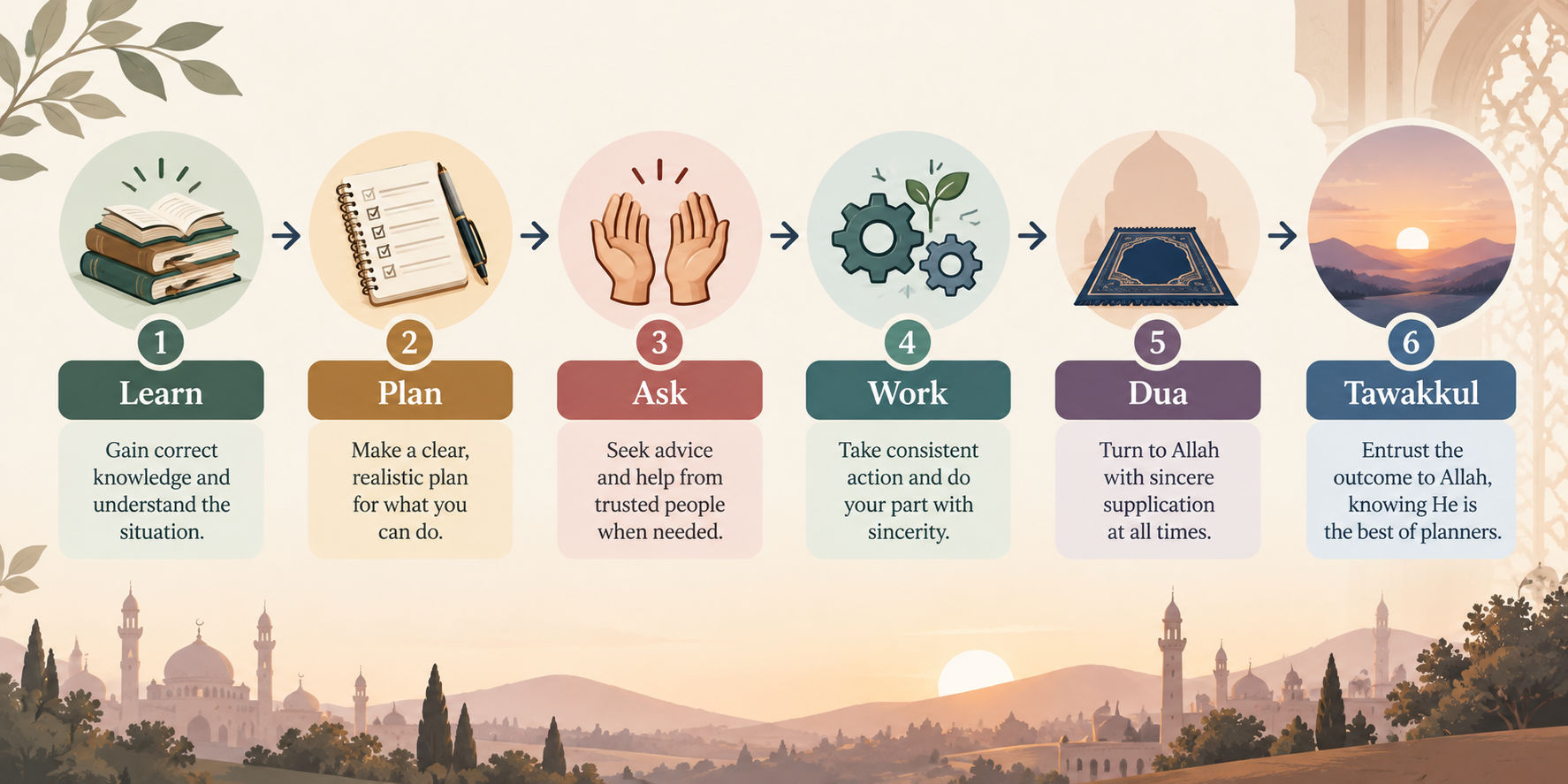
Tawakkul is relying upon Allah with the heart while taking the appropriate means available to you.
Classical scholars describe it along these lines. Ibn Rajab al-Hanbali, in his commentary on the hadith of Ibn Abbas, describes it as the sincere reliance of the heart upon Allah to bring benefit and repel harm, in matters of this world and the next. Ibn al-Qayyim writes at length that Tawakkul is a matter of the heart that does not contradict taking lawful means, and that abandoning means is a flaw in understanding, not a higher level of trust.
Tawakkul includes recognising that:
Allah is ultimately in control
outcomes belong to Allah
human beings still carry responsibilities
we take lawful means, make decisions, work, plan, and seek help
we make Dua
and then we entrust to Allah what we cannot control
The Quran puts the sequence precisely in the context of decision-making: "…and consult them in the matter. Then when you have decided, rely upon Allah" (3:159). Consult, decide, then rely.
Tawakkul Does NOT Mean Doing Nothing
A common misunderstanding goes: "If I truly trusted Allah, I would simply wait for Him to solve this." The Quran and Sunnah do not teach this.
The Hijrah. The Prophet ﷺ, the most reliant of people on Allah, planned his migration carefully. According to the narration of Aisha رضي الله عنها in Sahih al-Bukhari (3905), he arranged a guide, prepared riding animals, hid in a cave, had Abdullah ibn Abu Bakr gather news and Amir ibn Fuhayra erase tracks and supply milk. And in that very cave, he told Abu Bakr, "Do not grieve; indeed Allah is with us" (9:40). Planning and trust were not rivals.
The birds. The Prophet ﷺ said: "If you relied upon Allah as He should be relied upon, He would provide for you as He provides for the birds: they go out hungry in the morning and return full" (Sunan al-Tirmidhi 2344; Sunan Ibn Majah 4164; graded authentic by hadith scholars). Note the verbs: the birds go out. They move.
Seeking treatment. The Prophet ﷺ said, "Allah has not sent down a disease except that He has sent down a cure for it" (Sahih al-Bukhari 5678), and he told people, "Seek treatment, servants of Allah" (Sunan Abi Dawud 3855; Sunan al-Tirmidhi 2038; graded sahih).
Umar and the plague. When Umar ibn al-Khattab رضي الله عنه learned of a plague in Sham, he turned back with his companions. When asked, "Are you fleeing from the decree of Allah?" he replied, "We are fleeing from the decree of Allah to the decree of Allah" (Sahih al-Bukhari 5729; Sahih Muslim 2219).
About the "tie your camel" narration. You may have heard: a man asked whether he should tie his camel or leave it and rely on Allah, and the Prophet ﷺ said, "Tie it and rely on Allah." It appears in Sunan al-Tirmidhi (2517) from Anas ibn Malik, where al-Tirmidhi himself notes it is gharib (reported through a single route), and scholars have differed over its chain: some, such as al-Albani, graded it hasan through supporting reports, while others have criticised the chain. Because the meaning is fully supported by stronger evidence above, we have built this article on the Hijrah, the birds hadith, and the treatment hadiths, and mention the camel narration only as a widely quoted report with differing gradings.
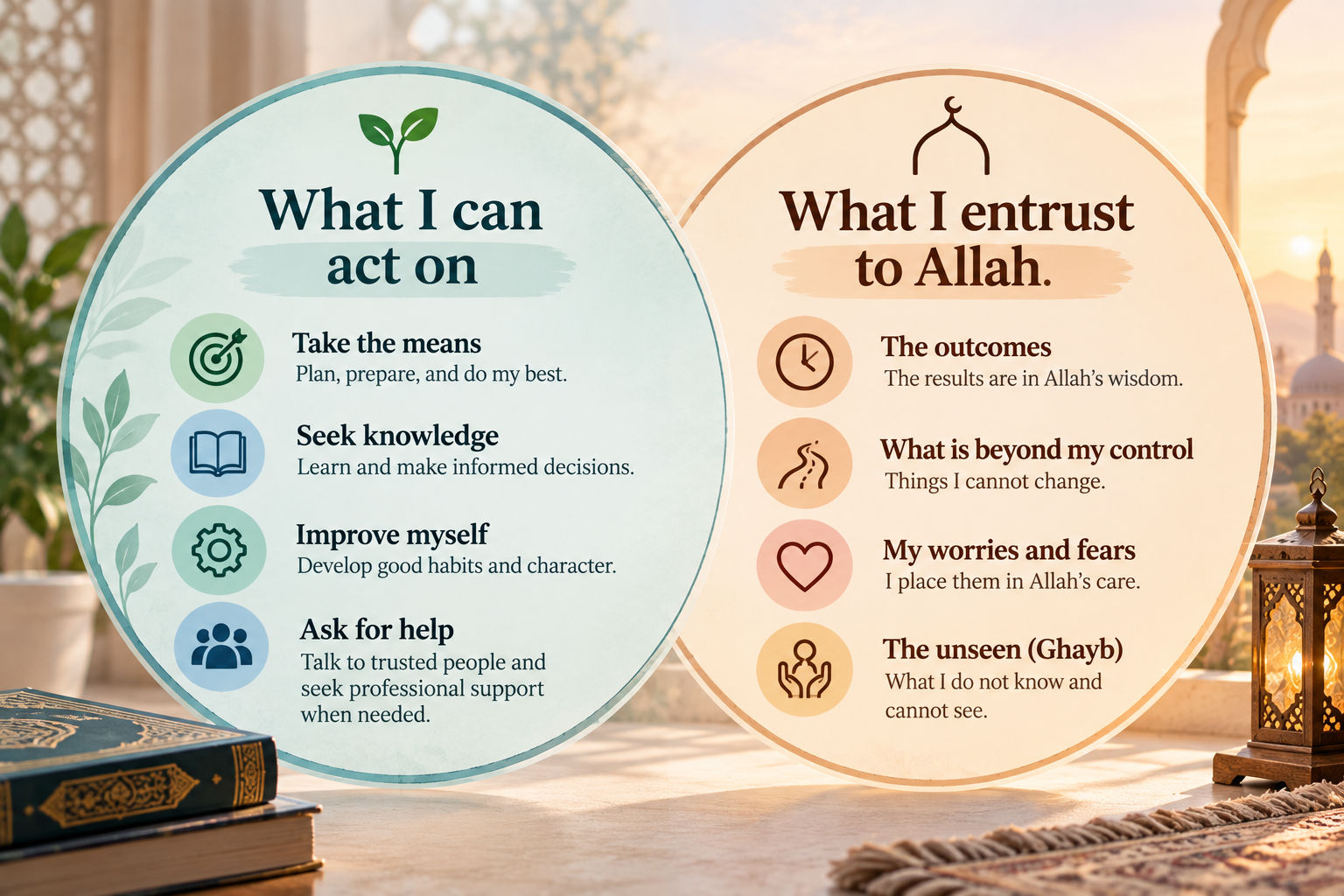
The Circle of Control: An Islamic Way to Think About Worry
This is a practical framework informed by Islamic principles. It is not classical Islamic terminology.
Draw two circles.
What I can act on
preparing for an exam
applying for jobs
making a budget
seeking treatment
apologising to someone I wronged
asking for advice
improving a skill
making a decision
setting appropriate boundaries
What I cannot ultimately control
whether someone accepts me
the final outcome of an application
what another person thinks of me
what will happen years from now
events that have already happened
the unseen future
Action belongs in the first circle. Tawakkul becomes especially important around the second.
An important clarification: this is a diagram of human responsibility, not a claim that Allah rules only one circle. Allah is sovereign over both our means and our outcomes. Even our effort and our abilities are gifts from Him. The framework simply sorts what is ours to do from what is ours to entrust.
The Prophet ﷺ gave this principle in one hadith: "The strong believer is better and more beloved to Allah than the weak believer, though there is good in both. Strive for what benefits you, seek help from Allah, and do not feel helpless. If something afflicts you, do not say, 'If only I had done such-and-such,' but say, 'Allah decreed, and what He willed He did,' for 'if only' opens the door to Shaytan's work" (Sahih Muslim 2664). Effort, seeking Allah's help, and acceptance of what has passed are all in one teaching.
Tawakkul and Qadr: What Is the Difference?
القدر — Qadr (Divine Decree)
Qadr is the Islamic belief that Allah knows all things, has written them, wills them, and creates them. It is one of the six pillars of faith in the hadith of Jibril (Sahih Muslim 8).
At a beginner level:
Qadr concerns Allah's knowledge and decree.
Tawakkul concerns how the believer relies on Allah, given that He is in control.
Qadr is not an excuse for passivity. A Muslim does not say, "If my provision is already written, I don't need to work," or "If my health is already decreed, I don't need a doctor." Umar's reply about the plague shows how the early Muslims understood it: taking means is itself part of responding to Allah's decree. The Quran also reminds us that no calamity occurs except by Allah's decree, "so that you do not despair over what you have missed" (57:22–23). That teaching is meant to console, not to paralyse.
Questions about divine decree, human choice, and causality have been discussed for centuries. We do not try to settle them here. For deeper questions, consult qualified scholarship. (See: "What Is Qadr in Islam?")
Quran Verses for Worry, Fear, and Trust
Rather than a long list, here are eight passages, each read in its context. (Translations are meaning-based renderings; consult a trusted printed translation for study.)
1. In the remembrance of Allah, hearts find rest — Quran 13:28
الَّذِينَ آمَنُوا وَتَطْمَئِنُّ قُلُوبُهُم بِذِكْرِ اللَّهِ ۗ أَلَا بِذِكْرِ اللَّهِ تَطْمَئِنُّ الْقُلُوبُ
"Those who believe, and whose hearts find rest in the remembrance of Allah. Surely in the remembrance of Allah do hearts find rest."
Context. The surrounding verses speak of people who believe and whose hearts are reassured, in contrast to those who demanded miraculous signs. What it teaches. True, deep reassurance is anchored in remembering Allah: His names, His promises, His mercy, His revelation. Careful reading. This verse describes where the heart's rest ultimately lies. It is not a promise that one act of Dhikr will instantly end every difficult feeling or treat every condition. Reflection. Choose one short remembrance to say slowly today, understanding what you say.
2. Allah does not burden a soul beyond its capacity — Quran 2:286
لَا يُكَلِّفُ اللَّهُ نَفْسًا إِلَّا وُسْعَهَا
"Allah does not burden a soul beyond its capacity."
Context. This is part of the closing verses of Surah al-Baqarah, which include a Dua: "Our Lord, do not burden us with what we have no ability to bear." What it teaches. Classical commentators such as al-Tabari and Ibn Kathir explain that Allah's legal obligations are within human capacity, and that His rulings include ease. The verse is also an invitation: it is followed by supplication, and a hadith in Sahih Muslim (126) reports that Allah answered these requests. Careful reading. This verse should never be used to say, "Allah says you can handle it, so stop complaining." The Quran itself teaches us to ask Allah for ease, which shows that feeling overwhelmed is acknowledged, not condemned. Seeking help is not a failure of the verse. Reflection. Make the Dua at the end of the verse in your own words if needed.
3. Whoever relies on Allah, He is sufficient for them — Quran 65:3
وَمَن يَتَوَكَّلْ عَلَى اللَّهِ فَهُوَ حَسْبُهُ ۚ إِنَّ اللَّهَ بَالِغُ أَمْرِهِ ۚ قَدْ جَعَلَ اللَّهُ لِكُلِّ شَيْءٍ قَدْرًا
"And whoever relies upon Allah, He is sufficient for him. Indeed, Allah will accomplish His purpose. Allah has set a measure for everything."
Context. Revealed in Surah al-Talaq, the verse follows the promise that whoever is mindful of Allah will have a way out and provision from unexpected places (65:2–3). What it teaches. Allah is enough for the one who relies on Him, and He fulfils His purpose in His timing and measure. Careful reading. "Sufficient" is not a guarantee of a specific worldly result in a specific form; it is a promise that Allah is enough as Protector and Sustainer. Reflection. After taking your step today, say: "I have done what I could; Allah is enough."
4. With hardship comes ease — Quran 94:5–6
فَإِنَّ مَعَ الْعُسْرِ يُسْرًا إِنَّ مَعَ الْعُسْرِ يُسْرًا
"Indeed, with hardship comes ease. Indeed, with hardship comes ease."
Context. A Makkan surah that opens by reminding the Prophet ﷺ of Allah's favours, including relieving his burden, at a time of real difficulty. What it teaches. Ease is not only after hardship, but with it, and the repetition emphasises certainty. Some commentators have noted how the Arabic repeats "hardship" with the definite article and "ease" without it, and drawn out reflections from this; such points belong to tafsir discussion rather than formal rulings. Careful reading. The verse does not promise that every worldly difficulty will vanish immediately. It affirms that hardship is never without Allah's mercy accompanying it. Reflection. Name one small ease that exists in your situation today.
5. "Do not grieve; Allah is with us" — Quran 9:40
لَا تَحْزَنْ إِنَّ اللَّهَ مَعَنَا
"Do not grieve; indeed Allah is with us."
Context. The Prophet ﷺ and Abu Bakr were hiding in the cave of Thawr during the Hijrah, with pursuers nearby. In the narration in Sahih al-Bukhari (3653) and Sahih Muslim (2381), Abu Bakr said that if any of them looked down they would see them; the Prophet ﷺ replied, "What do you think, Abu Bakr, of two whose third is Allah?" What it teaches. Real danger, real planning, real fear, and real reassurance coexisted in one moment. Reflection. Reassurance can be spoken to a worried friend, but not to dismiss the danger.
6. "Allah is sufficient for us, and the best Disposer of affairs" — Quran 3:173
حَسْبُنَا اللَّهُ وَنِعْمَ الْوَكِيلُ
"Allah is sufficient for us, and He is the best Disposer of affairs."
Context. Said when the believers were told that people had gathered against them. Ibn Abbas reported that Ibrahim عليه السلام said it when thrown into the fire and Muhammad ﷺ said it when this warning came (Sahih al-Bukhari 4563). What it teaches. In the face of frightening news, the believers' faith increased, and they responded with reliance, not denial of the danger. Reflection. Say Hasbunallahu wa ni'mal-wakil when you receive news you cannot change, and then ask what you can do.
7. "Do not fear; I am with you both, I hear and I see" — Quran 20:45–46
قَالَا رَبَّنَا إِنَّنَا نَخَافُ أَن يَفْرُطَ عَلَيْنَا أَوْ أَن يَطْغَىٰ قَالَ لَا تَخَافَا ۖ إِنَّنِي مَعَكُمَا أَسْمَعُ وَأَرَىٰ
"They said, 'Our Lord, we fear he may hasten against us or transgress.' He said, 'Do not fear. Indeed I am with you both; I hear and I see.'"
Context. Musa and Harun were sent to Pharaoh. What it teaches. Allah does not shame them for naming their fear; He answers it. Notice also: they are still sent. The task remains. Reflection. Tell Allah exactly what you fear, in specific words.
8. "I only complain of my suffering and grief to Allah" — Quran 12:86
إِنَّمَا أَشْكُو بَثِّي وَحُزْنِي إِلَى اللَّهِ
"I only complain of my suffering and my grief to Allah."
Context. Said by Ya'qub عليه السلام after the loss of Yusuf and Binyamin's detention, in the passage where he also says fa-sabrun jamil, "beautiful patience" (12:83). What it teaches. Sabr jamil is not silence. Ya'qub grieved openly, and his complaint was directed to Allah alone, not against Him. Reflection. Pouring your heart out to Allah is a form of worship, not weakness.
Dhikr and the Anxious Heart
ذكر — Dhikr
Dhikr means remembrance of Allah, whether by the tongue, the heart, or through actions like prayer and Quran recitation.
Dhikr can:
redirect attention toward Allah when the mind is spinning
reinforce Tawhid (the oneness of Allah)
remind us of Allah's mercy and control
build gentle spiritual routines
strengthen awareness of Allah throughout the day
Authentic, simple forms include:
SubhanAllah — Glory be to Allah
Alhamdulillah — All praise belongs to Allah
Allahu Akbar — Allah is the Greatest
La ilaha illa Allah — There is no god but Allah
Astaghfirullah — I seek Allah's forgiveness
La hawla wa la quwwata illa billah — There is no power or might except with Allah (described by the Prophet ﷺ as a treasure from the treasures of Paradise: Sahih al-Bukhari 6384; Sahih Muslim 2704)
The Prophet ﷺ said two phrases are light on the tongue, heavy on the scale, and beloved to the Most Merciful: SubhanAllahi wa bihamdihi, SubhanAllahil-Azim (Sahih al-Bukhari 6406; Sahih Muslim 2694).
Separate two things clearly:
Authentically established reward: the virtues the Prophet ﷺ himself mentioned.
Unsupported therapeutic guarantees: claims like "say this 100 times and your anxiety will disappear."
Be cautious of viral formulas. For example, a narration often quoted that "whoever persistently seeks forgiveness, Allah will make a way out of every distress" (Sunan Abi Dawud 1518; Ibn Majah 3819) is considered weak by many hadith scholars, so we do not build on it. Dhikr is worship. Its worth does not depend on producing a particular feeling within a particular time. (See: "What Is Dhikr?")
Authentic Duas for Worry and Distress
The Dua against Hamm and Hazan
اللَّهُمَّ إِنِّي أَعُوذُ بِكَ مِنَ الْهَمِّ وَالْحَزَنِ، وَالْعَجْزِ وَالْكَسَلِ، وَالْبُخْلِ وَالْجُبْنِ، وَضَلَعِ الدَّيْنِ وَغَلَبَةِ الرِّجَالِ
Allahumma inni a'udhu bika minal-hammi wal-hazan, wal-'ajzi wal-kasal, wal-bukhli wal-jubn, wa dala'id-dayni wa ghalabatir-rijal.
"O Allah, I seek refuge in You from worry and grief, from incapacity and laziness, from miserliness and cowardice, from the burden of debt and from being overpowered by people."
Source: Reported from Anas ibn Malik رضي الله عنه in Sahih al-Bukhari (e.g. 6369), who said the Prophet ﷺ frequently made this Dua. Authenticity: Sahih.
Key vocabulary:
Hamm (همّ): worry, preoccupation, anxious concern. Scholars and commentators commonly explain it as distress about something anticipated, a matter that is ahead of you.
Hazan (حزن): grief, sorrow. Commonly explained as sadness about something that has already happened. (These distinctions come from classical commentary and Arabic usage; the wording itself covers both broadly.)
'Ajz (عجز): incapacity, being unable to do what you could have done.
Kasal (كسل): laziness, reluctance to act when able.
Dala' al-dayn: the weight of debt. Ghalabat al-rijal: being overpowered by others.
Notice what this Dua pairs with worry: incapacity and laziness. The Prophet ﷺ asked for refuge from emotional heaviness and from failing to act. Dua and effort sit together.
The Dua of Distress (Dua al-Karb)
لَا إِلَهَ إِلَّا اللَّهُ الْعَظِيمُ الْحَلِيمُ، لَا إِلَهَ إِلَّا اللَّهُ رَبُّ الْعَرْشِ الْعَظِيمِ، لَا إِلَهَ إِلَّا اللَّهُ رَبُّ السَّمَاوَاتِ وَرَبُّ الْأَرْضِ وَرَبُّ الْعَرْشِ الْكَرِيمِ
La ilaha illa Allah al-'Azimul-Halim, la ilaha illa Allah rabbul-'arshil-'azim, la ilaha illa Allah rabbus-samawati wa rabbul-ardi wa rabbul-'arshil-karim.
"There is no god but Allah, the Mighty, the Forbearing. There is no god but Allah, Lord of the Mighty Throne. There is no god but Allah, Lord of the heavens, Lord of the earth, and Lord of the Noble Throne."
Source: Ibn Abbas, Sahih al-Bukhari 6345; Sahih Muslim 2730, which the Prophet ﷺ would say in times of distress. Authenticity: Sahih.
The Dua of Yunus عليه السلام
لَا إِلَٰهَ إِلَّا أَنتَ سُبْحَانَكَ إِنِّي كُنتُ مِنَ الظَّالِمِينَ
La ilaha illa anta, subhanaka, inni kuntu minaz-zalimin.
"There is no god but You; glory be to You. Indeed, I have been among the wrongdoers." (Quran 21:87)
Source: The Prophet ﷺ taught that no Muslim calls upon Allah with it for any matter except that Allah responds (Sunan al-Tirmidhi 3505; graded authentic by scholars such as al-Albani). The wording of this report's grading has been discussed; verify before citing in print. It models humility, Tawhid, and turning to Allah from the lowest place.
We have kept this list short deliberately. A few authentic Duas understood and repeated are better than a long list of unverified ones.

Can I Make Dua in English?
Yes, in your personal supplications. You do not need to compose your own Dua in Arabic. Allah understands every language and every unspoken thought. You can speak sincerely about fear, money, loneliness, decisions, marriage, health, and hopes in the language you understand best.
At the same time, we encourage learning the authentic Prophetic Duas gradually and understanding their Arabic meanings. They are precise, beautiful, and carry the Prophet's own wording.
A caution about formal prayer. The question of using non-Arabic Dua or recitation inside the formal Salah has scholarly distinctions between the schools (for example, between the Hanafi position and the majority view), and the answer depends on the type of recitation. We do not give a universal ruling here. Ask a qualified teacher. (See: "How to Make Dua: A Beginner's Guide")

Salah When Your Mind Is Full of Worry
Allah says, "Seek help through patience and prayer" (2:45). A narration in Sunan Abi Dawud (1319) reports that when something distressed the Prophet ﷺ he would turn to prayer (graded hasan by some scholars).
Salah can be an anchor because it interrupts the day, returns attention to Allah, brings Quran onto the tongue, places the forehead on the ground in Sujud (a moment closest to Allah in which the Prophet ﷺ encouraged making Dua), and rebuilds routine.
It may not bring immediate calm every time. That does not make the prayer pointless. Struggling to concentrate does not cancel its worth.
Practical suggestions:
Slow down; do not rush into Takbir.
Learn the meaning of Al-Fatihah and the common phrases of Salah.
Reduce distractions: phone away, a clean quiet spot.
Pause before beginning and bring to mind that you are standing before Allah.
Make a sincere personal Dua after the prayer (and, as scholarship permits, in Sujud).
(See: "How to Learn Salah When You Don't Speak Arabic")
Understanding Al-Fatihah During Difficult Times
You recite Al-Fatihah at least seventeen times each day in the obligatory prayers. What does it say to a worried heart?
Praise: "All praise is for Allah, Lord of all worlds." You begin by remembering that you are held by a Lord who nurtures everything.
Mercy: "The Most Merciful, the Especially Merciful." Allah's mercy is named before anything else is requested.
Accountability: "Master of the Day of Judgment." Ultimate justice belongs to Him.
Worship and seeking help:
إِيَّاكَ نَعْبُدُ وَإِيَّاكَ نَسْتَعِينُ
"You alone we worship, and You alone we ask for help." (1:5)
Guidance: "Guide us to the straight path."
The fifth verse holds the balance of this article: worship and reliance together. In a hadith qudsi (Sahih Muslim 395), Allah says the prayer is divided between Him and His servant, and when the servant says this verse, Allah says, "This is between Me and My servant, and My servant shall have what he asks."
Understanding what you recite can turn memorised sounds into conscious conversation with Allah.
Sabr Is Not "Just Put Up With It"
الصبر — Sabr
Sabr is often translated as "patience," but it is wider than waiting calmly. It includes perseverance, steadfastness, self-restraint, continuing in obedience, and enduring difficulty in a way that does not abandon Allah. Ibn al-Qayyim, for instance, speaks of three kinds: patience in obedience, patience in avoiding disobedience, and patience in enduring trials (Madarij al-Salikin).
The Prophet ﷺ said, "Patience is at the first strike of calamity" (Sahih al-Bukhari 1283; Sahih Muslim 926), and "Whoever seeks to be patient, Allah will make him patient" (Sahih al-Bukhari 1469; Sahih Muslim 1053). He also said, "Wondrous is the affair of the believer, all of it is good… if hardship strikes, he is patient, and that is good for him" (Sahih Muslim 2999).
What Sabr is not:
staying passively in abuse
remaining in preventable danger
avoiding treatment for illness
accepting injustice when lawful remedies exist
The Prophet ﷺ said, "There should be neither harm nor reciprocating harm" (Sunan Ibn Majah 2341; graded authentic by many scholars). Patience and responsible action coexist. The Quran pairs sabr with perseverance and readiness (3:200). Protecting yourself or seeking help is not a failure of patience.
Tawakkul vs Avoidance
Tawakkul | Avoidance dressed as trust |
|---|---|
"I'm worried about my exam, so I study, make Dua, sleep properly, sit the exam, and trust Allah with the result." | "I trust Allah, so I don't need to study." |
"I'm struggling financially, so I budget, look for lawful work, ask for advice, make Dua, and trust Allah for provision." | "My Rizq is already written, so I'll do nothing." |
"I'm experiencing persistent, severe anxiety, so I make Dua, keep up my worship, seek appropriate professional support, and trust Allah through the process." | "If I see a therapist, my Iman must be weak." |
The test is simple: does my "trust" lead me toward responsibility or away from it?
Seeking Therapy or Medical Help Does Not Automatically Mean Weak Tawakkul
Given the hadiths above, seeking treatment is a means Islam encourages. Taking medicine, consulting a doctor, or speaking to a qualified counsellor is not a statement against Allah's power. It is an act of using the means He created while relying on Him for the outcome.
Mental-health care can involve qualified physicians, psychologists, psychiatrists, and licensed therapists or counsellors, ideally with cultural and religious sensitivity where available. Which professional is appropriate depends on the situation and the country.
A trustworthy Imam or Islamic teacher can support spiritual questions and be a source of comfort and prayer, but should not automatically replace a qualified clinician for clinical problems. Likewise, a clinician is not a substitute for scholarship on Islamic rulings. These sources of support are complementary.
If you are on prescribed medication, do not stop or change it without speaking to your prescribing clinician.
When Should Someone Consider Professional Help?
Worry is part of life. But consider speaking with a qualified professional if worry or anxiety is:
persistent
overwhelming
significantly interfering with daily life
disrupting your work or studies
seriously affecting sleep or eating
preventing you from meeting normal responsibilities
causing frequent panic-like episodes
accompanied by thoughts of self-harm or feeling unable to stay safe
A qualified mental-health professional can assess persistent or severe symptoms. This article cannot, and does not try to.
If you or someone else may be in immediate danger, contact your local emergency services or local crisis support straight away.
Why "Just Have More Iman" Can Hurt
Statements such as:
"Your faith is weak."
"Just pray more."
"A real believer wouldn't feel anxious."
"You wouldn't need therapy if you trusted Allah."
"Stop thinking negatively."
may be said with good intentions, but they often add religious guilt on top of distress. The person starts doubting their relationship with Allah at the exact moment they most need it.
A more Islamic response draws on the Prophet's teaching: "The believers, in their mutual love, mercy, and compassion, are like one body; when one part suffers, the whole body responds with sleeplessness and fever" (Sahih al-Bukhari 6011; Sahih Muslim 2586).
Instead:
listen first
remind gently, not harshly
make Dua for them
encourage worship without pressure
help with practical needs
encourage professional support where appropriate
avoid amateur diagnosis
Worry About the Future
Will I marry? Will I have children? Will I find work? What if I fail? What if I lose someone?
A practical framework:
Plan what you can.
Ask Allah for guidance.
Take lawful action.
Make Istikhara when making an appropriate decision.
Accept that knowledge of the unseen belongs to Allah. The Quran says the keys of the unseen are with Him alone (6:59).
Refuse to live through every possible disaster in advance. You can only live through what actually arrives, and Allah gives help with what actually arrives.
Istikhara: What It Actually Means
الاستخارة — Istikhara
Istikhara means asking Allah for what is best. The Prophet ﷺ taught his companions to do this as he taught them a Surah of the Quran (Sahih al-Bukhari 1162, from Jabir رضي الله عنه): pray two voluntary rak'ahs, then make the Dua beginning Allahumma inni astakhiruka bi'ilmika… ("O Allah, I seek the best from You by Your knowledge…"), mentioning your matter.
Common misconceptions:
"You must see a dream." There is no such requirement in the hadith.
"The answer will be a supernatural sign." Not necessarily; it is a request for Allah to facilitate what is good and turn away what is not.
"It replaces research and consultation." It does not. Consult people of knowledge and experience, gather information, and then decide (3:159).
"Wait indefinitely for a feeling." The sequence is: information, consultation, Istikhara, decision, then Tawakkul. Some scholars differ on whether the Dua is made before or after the closing salam; ask a trusted teacher.
Worry About Rizq
الرزق — Rizq
Rizq means provision: money, but also health, time, family, knowledge, and opportunity. Allah says, "There is no creature on earth but that its provision is upon Allah" (11:6). He also says, "It is He who made the earth tame for you, so walk in its tracts and eat of His provision" (67:15), and, "When the prayer is concluded, disperse in the land and seek the bounty of Allah" (62:10).
Both are true: provision comes from Allah, and Muslims are commanded to pursue lawful means. Employment, business, budgeting, avoiding debt where possible, and asking for advice are all part of this. We avoid "Rizq formulas" such as "read this Surah every night and wealth is guaranteed." Where an act of worship has authentic virtue, it is a virtue of worship, not a financial contract.
Worry About Past Mistakes
التوبة — Tawbah
There is a difference between productive regret, which moves you to change, and despair, which tells you that change is pointless.
Tawbah (repentance) usually involves:
acknowledging the wrong
stopping it
sincere regret
seeking Allah's forgiveness
resolving not to return
restoring people's rights where applicable
The Prophet ﷺ said, "Every son of Adam sins, and the best of those who sin are those who repent" (Sunan al-Tirmidhi 2499; Sunan Ibn Majah 4251; graded hasan).
And Allah says:
قُلْ يَا عِبَادِيَ الَّذِينَ أَسْرَفُوا عَلَىٰ أَنفُسِهِمْ لَا تَقْنَطُوا مِن رَّحْمَةِ اللَّهِ ۚ إِنَّ اللَّهَ يَغْفِرُ الذُّنُوبَ جَمِيعًا ۚ إِنَّهُ هُوَ الْغَفُورُ الرَّحِيمُ
"Say, 'O My servants who have transgressed against themselves, do not despair of the mercy of Allah. Indeed, Allah forgives all sins. Indeed, it is He who is the Forgiving, the Merciful.'" (39:53)
Notice how Allah addresses the sinner: "O My servants." The door is opened with the word of closeness. Repentance does not erase every worldly consequence; you may still need to repair, apologise, or accept results. But the belief that Allah cannot forgive you is itself a trap the Quran warns against.
Fear of "What If?"
What if I fail? What if I get sick? What if they leave? What if Allah doesn't give me what I want?
The "what if" loop tries to guarantee an outcome in advance. The Islamic reframe is to shift from:
"How do I guarantee the outcome?"
to:
"What is my responsibility before Allah right now?"
Right now, that might be a phone call, an hour of study, a Dua, or going to sleep. The Prophet ﷺ taught that the strong believer strives, seeks Allah's help, and when things pass beyond his control, does not drown in "if only" (Sahih Muslim 2664). Do your part today; leave the rest in Allah's hands.
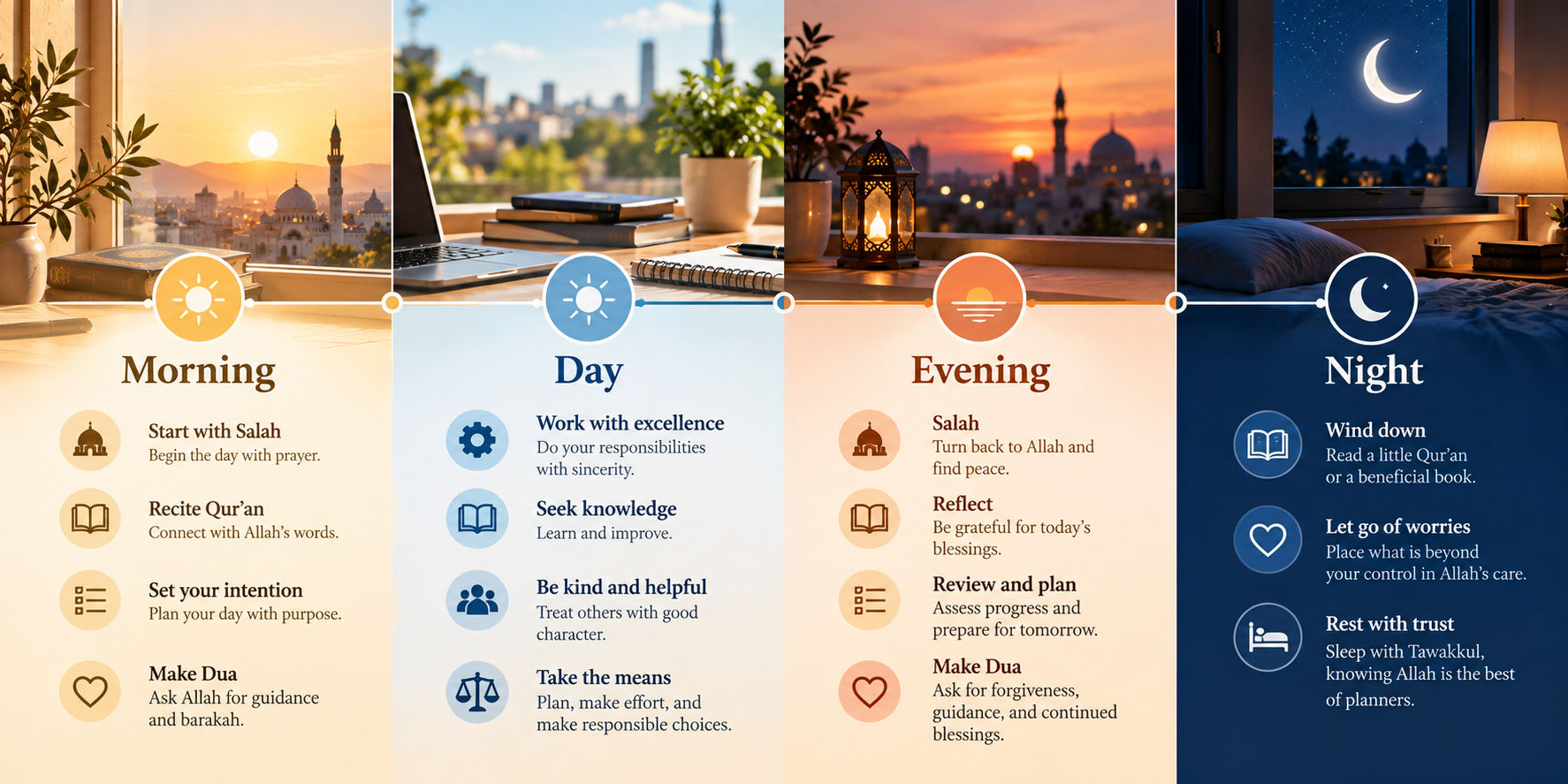
A Practical Islamic Routine for a Difficult Day
This is a realistic suggestion, not a prescribed Sunnah sequence. Items marked ◆ are established worship; the rest are general suggestions.
Morning
◆ Fajr, on time if possible
◆ Morning remembrance from authentic Adhkar, such as reciting Surat al-Ikhlas, al-Falaq, and an-Nas three times (Sunan Abi Dawud 5082; Sunan al-Tirmidhi 3575; hasan)
Identify today's real responsibilities
◆ A short personal Dua
Avoid starting the day with doom-scrolling
During the day
Take practical action on what you can
◆ Protect your obligatory prayers
◆ Short Dhikr breaks (SubhanAllah, Astaghfirullah)
Ask for help when needed
Return attention to the task in front of you
Evening
◆ Maghrib and Isha
◆ Some Quran, even a page
Review: what is within my control, and what is not?
◆ Dua for the unresolved matters
Before sleep
◆ Authentic bedtime Adhkar: Ayat al-Kursi (Sahih al-Bukhari 5010) and the bedtime Dua Bismika Allahumma amutu wa ahya
Release unfinished outcomes to Allah
Write tomorrow's first practical step
A 5-Minute Spiritual Reset for Moments of Worry
This is an editorial practical exercise, not a prescribed Islamic ritual.
Minute 1: Pause. Name what you are worried about, in one sentence.
Minute 2: Breathe and reorient. Slow your breathing. This is a general grounding practice, not a Sunnah.
Minute 3: Dhikr. Use an authentic remembrance, slowly, aware of its meaning. For example: Hasbunallahu wa ni'mal-wakil.
Minute 4: Dua. Ask Allah directly, in any language. You may add the Dua of distress above.
Minute 5: Action. Ask: "What is the next responsible thing I can actually do?" Then do it, or schedule it.
7 Questions to Ask Yourself When You Are Worried
What exactly am I afraid of?
Is there something responsible I can do about it today?
Am I trying to control something only Allah controls?
Have I made Dua about it?
Have I sought appropriate advice?
Am I neglecting a practical means while calling it Tawakkul?
Do I need additional emotional, professional, or spiritual support?
What If Dua Doesn't Change the Situation?
Dua is worship, and not merely a request. The Prophet ﷺ taught that no Muslim makes a Dua free of sin or severing family ties except that Allah gives him one of three things: He grants it, stores something better for him in the Hereafter, or turns away an equivalent harm (Musnad Ahmad; see also Sunan al-Tirmidhi 3573 for a similar report). Allah also says, "I am near; I respond to the call of the caller when he calls upon Me" (2:186), and that you may dislike something that is good for you (2:216).
So the situation sometimes remains hard while the relationship with Allah deepens. This does not prove weak faith, too little Dua, hidden sin, or Allah's rejection. The Prophet ﷺ warned against giving up: "The Dua of one of you is answered as long as he is not hasty, saying, 'I made Dua and was not answered'" (Sahih al-Bukhari 6340; Sahih Muslim 2735). Keep asking, and trust that Allah's response is wiser than the form of your request.
What If I Don't Feel Peace After Quran or Salah?
You read "in the remembrance of Allah hearts find rest," you do Dhikr, and still feel anxious. The thought arrives: "Something must be wrong with my faith."
Gently: acts of worship are worship, not buttons that force an immediate emotional state. You can benefit spiritually from Quran, Salah, Dhikr, and Dua, in reward, in nearness, and in steadiness, while still feeling difficult emotions or needing professional care. No one can say how quickly feelings will shift. Keep the worship, keep the means, and do not read a difficult feeling as a verdict on your Iman.
Helping a Muslim Friend Who Is Struggling
Do:
listen without rushing to fix
show compassion
ask what support they need
encourage worship without lecturing
offer practical help (meals, rides, company)
encourage professional support when appropriate
keep what they share confidential
Avoid:
diagnosing them
telling them to stop medication
attributing everything to Jinn, Sihr (magic), the evil eye, or weak Iman without evidence
recommending random supplements
turning every conversation into a sermon
Ruqyah, Jinn, and the evil eye are part of orthodox Islamic belief as established in the texts, but they should not be used to automatically explain mental-health symptoms. The Prophet ﷺ said, "Whoever relieves a believer of a distress of this world, Allah will relieve him of a distress on the Day of Resurrection" (Sahih Muslim 2699).
Common Misconceptions About Anxiety and Islam
"If you have Tawakkul, you will never feel worried." Tawakkul is where the heart rests its reliance, not the removal of human feeling.
"Anxiety always means weak Iman." No. The Quran describes fear and grief in the best of people.
"Therapy means you don't trust Allah." No. Seeking treatment is a means Islam encourages.
"Medication and Tawakkul cannot coexist." False as a blanket statement. Medicine is a means. Never stop prescribed medication without clinical advice.
"Dhikr should instantly remove every difficult feeling." Not established. Dhikr is worship with real benefit, not a guarantee of instant relief.
"Sabr means doing nothing." No. Sabr includes perseverance and appropriate action.
"Qadr means there is no point planning." Umar's response to the plague shows the opposite.
"If Dua hasn't changed my situation, Allah is ignoring me." Not the Islamic understanding; see above.
"Every distressing thought is a spiritual sign." Not every thought or feeling carries spiritual meaning. Avoid superstition.
"A strong Muslim handles everything alone." The Prophet ﷺ sought help from others, and the Quran repeatedly encourages cooperation and support.
10 Islamic Principles to Remember When You Feel Overwhelmed
Feeling fear does not automatically mean faithlessness.
Allah knows what you are carrying.
Make Dua honestly, in words you understand.
Protect your obligatory Salah.
Take appropriate means.
Practise Tawakkul after action.
Remember Allah often.
Do not confuse Sabr with passivity.
Seek help when you need it.
You are responsible for your actions, not for controlling every outcome.
Understanding What You Say: A Bridge to Quran and Arabic
Many Muslims say phrases like Hasbunallahu wa ni'mal-wakil or La hawla wa la quwwata illa billah many times a day. Understanding them changes how they feel on the tongue:
Hasbunallah — Allah is sufficient for us; ni'mal-wakil — the best Disposer of affairs (the one to whom matters are entrusted; the same root as Tawakkul).
La hawla wa la quwwata illa billah — There is no change of state and no power except through Allah: an admission of our limits and a statement of reliance on Him.
Understanding what you recite can help transform memorised religious language into conscious worship.
If you want to move beyond reading Quranic words in translation and begin understanding more of the Arabic you recite in Salah, Dua, and Dhikr, structured Quran and Arabic study can help make those acts of worship increasingly meaningful. Araby Academy offers one-to-one learning in Quran reading, Tajweed, memorisation, Quranic Arabic, and Islamic Studies for students at different levels. (See: "How to Understand the Quran Without Speaking Fluent Arabic"; "100 Most Common Words in the Quran"; "Learn Arabic Through the Quran.")
Frequently Asked Questions
1. What does Islam say about anxiety? Islam recognises fear, worry, and grief as part of human experience and teaches a response: turn to Allah, take responsible action, seek help when needed, and entrust outcomes to Him. Everyday worry is distinct from clinical anxiety, which a qualified professional can assess.
2. Does anxiety mean weak Iman? Not necessarily. Involuntary feelings are not a spiritual failure. The Quran describes fear and grief in Prophets and righteous people. What matters is how a person responds.
3. What is Tawakkul? Tawakkul is relying on Allah with the heart while taking the appropriate means. It combines action, Dua, and entrusting what you cannot control to Allah.
4. How can I trust Allah when I am worried? Do what is within your responsibility, make Dua, remember Allah, seek advice, and then consciously entrust the outcome to Him. Trust is practised repeatedly, not achieved once.
5. What Quran verses help with worry? Passages often turned to include 13:28, 2:286, 65:3, 94:5–6, 9:40, 3:173, 20:45–46, and 12:86. Each should be read in its context, not as a magic formula.
6. What Dua did the Prophet ﷺ teach for worry and grief? Allahumma inni a'udhu bika minal-hammi wal-hazan… ("O Allah, I seek refuge in You from worry and grief…"), reported in Sahih al-Bukhari. There is also the Dua of distress reported in Bukhari and Muslim.
7. Can I make Dua for anxiety in English? Yes, in your personal supplications you can speak to Allah in any language. For recitation within formal Salah, scholars have distinctions; ask a qualified teacher.
8. Is seeking therapy allowed in Islam? Seeking treatment is encouraged in authentic hadith. Mental-health care from qualified professionals can be part of taking the means while relying on Allah.
9. Does taking medication mean I lack Tawakkul? No. Medicine is a lawful means. Do not start or stop medication without consulting your clinician.
10. What is the difference between Sabr and Tawakkul? Sabr is steadfast perseverance, including through hardship and in obedience. Tawakkul is relying on Allah with the heart while taking means. They work together.
11. Why do I still feel anxious after making Dua? Dua is worship and Allah responds in His wisdom; it is not a switch for a specific feeling or result. Persistent or severe anxiety is worth discussing with a qualified professional.
12. Can Dhikr help when I feel worried? Dhikr is worship that can redirect the heart toward Allah and build steadiness. It has established spiritual virtue, but it is not a guaranteed treatment or an instant cure.
Conclusion: Tawakkul Is Not the Absence of Fear
Return to the person at 2 a.m., asking, "If I trust Allah, why am I still worried?"
You may still feel fear. You may still dislike uncertainty. You may still need advice, treatment, support, time, planning, rest, and Dua. Tawakkul does not require you to pretend uncertainty is comfortable.
It means that after taking the means available to you, you recognise that the final outcome was never yours to control.
You do what Allah has placed within your responsibility, and you entrust to Allah what was never within your control.
Turning toward Allah is not a one-time emotional trick. It is a relationship, built through Salah, Quran, Dua, Dhikr, knowledge, action, patience, repentance, and returning again and again to Him.
Islam does not promise that every problem will disappear. It promises that you are never facing them alone, and that the One you turn to hears and sees.