
What if there were a day when every hidden act became known, every forgotten kindness returned, every injustice was answered, and every lie lost its power? A day when every private intention mattered, and nobody could buy, manipulate, intimidate, or escape the Judge?
Muslims believe that day is real. It is called Yawm al-Qiyamah (يَوْمُ الْقِيَامَةِ), the Day of Resurrection, or the Day of Judgment. Islam does not see history as a story that drifts on forever without accountability. Life has a beginning, a purpose, a moral test, an end, a resurrection, and an accounting.
One thing needs to be clear from the start. This is not a story Muslims are free to embellish. The Day of Judgment belongs to al-Ghayb (الْغَيْب), the unseen, and we know it only through revelation. So this guide follows a simple discipline: describe what the Quran and authentic Sunnah describe, say clearly where scholars differ, and never turn silence into storytelling.
It also follows a purpose. We do not learn about Judgment to satisfy curiosity about the future. We learn about it to become ready to meet Allah.
What Does Yawm al-Qiyamah Mean?
Yawm means “day.” Qiyamah comes from the Arabic root ق و م (q-w-m), whose core sense is standing, rising, and establishing. From the same root we get qama (he stood) and qa’im (one who stands). The Quran uses this standing language directly when it says people will “stand before the Lord of the worlds” (83:6). The name points to the rising of the dead and the standing of humanity before Allah. It is a meaning taken from the Arabic and the verses themselves, not a theory built on top of the root.
Many names, many dimensions
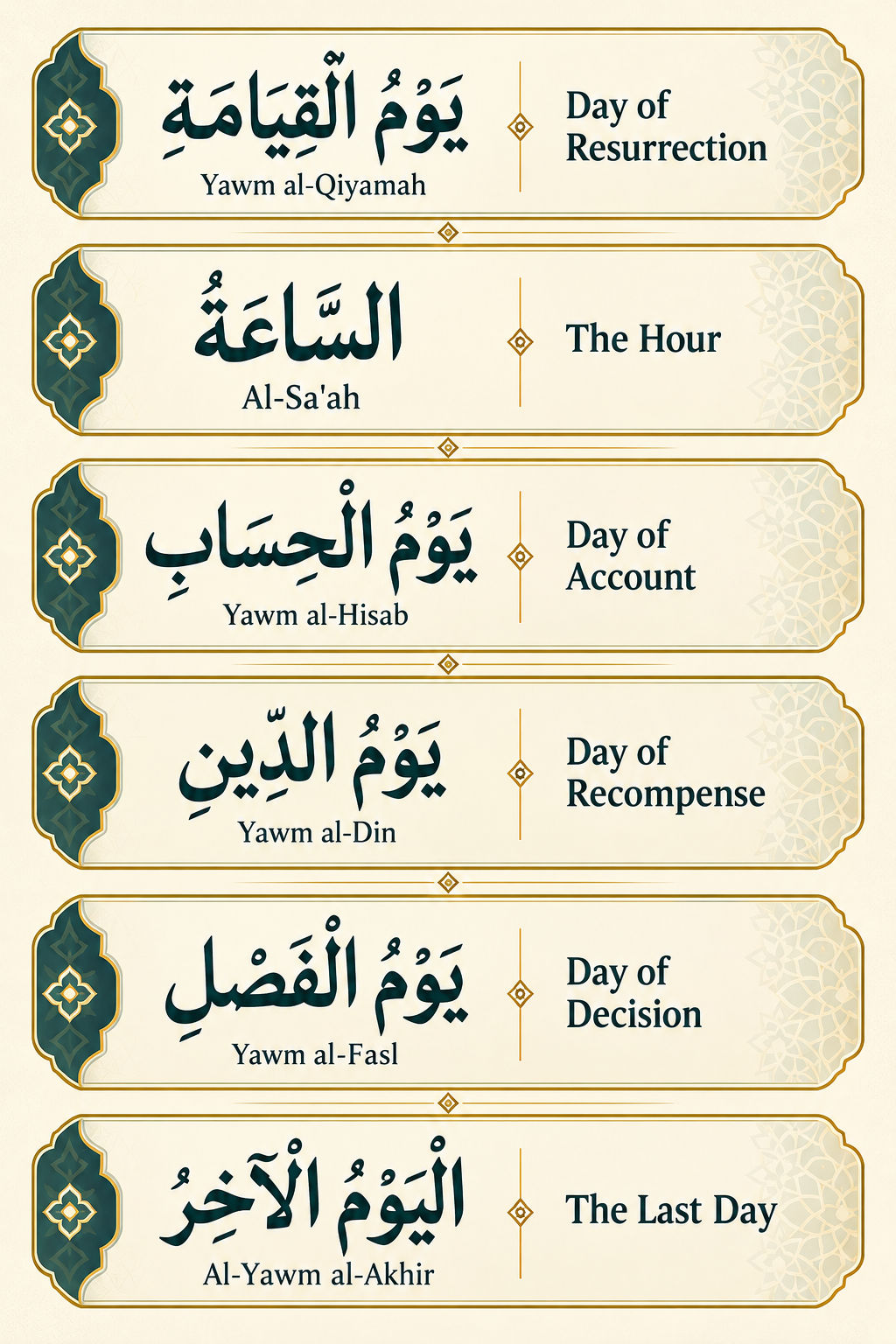
The Quran rarely uses just one name for this Day. Each name highlights a different dimension of it. They are not identical synonyms; each has its own emphasis.
Al-Sa’ah (السَّاعَة), “the Hour,” stresses its sudden arrival (7:187).
Yawm al-Ba’th (يَوْمُ الْبَعْث), the Day of Resurrection, stresses the raising of the dead (30:56).
Yawm al-Hashr (يَوْمُ الْحَشْر), the gathering, stresses humanity being assembled.
Yawm al-Hisab (يَوْمُ الْحِسَاب), the Day of Account, stresses reckoning (40:27).
Yawm al-Din (يَوْمُ الدِّين), the Day of Recompense, is the Day we mention in every unit of prayer (1:4).
Yawm al-Fasl (يَوْمُ الْفَصْل), the Day of Decision, stresses separation between truth and falsehood (77:13).
Al-Yawm al-Akhir (الْيَوْمُ الْآخِر), the Last Day, is the name used when listing the pillars of faith.
Al-Qari’ah, Al-Haqqah, Al-Tammah al-Kubra (الْقَارِعَة، الْحَاقَّة، الطَّامَّةُ الْكُبْرَى) are vivid titles for its overwhelming certainty and severity (101:1, 69:1, 79:34).
Together these names tell us the Day is certain, sudden, decisive, and just.
Belief in the Last Day Is Part of Iman
In the famous Hadith of Jibril (Sahih Muslim 8), the Prophet ﷺ defined iman as belief in Allah, His angels, His books, His messengers, the Last Day, and divine decree. The Quran repeatedly pairs belief in Allah with belief in the Last Day, as in 2:177 and 4:136. The pairing is deliberate. If you believe your Creator sees you but not that you will return to Him, faith has no weight. Belief in the Last Day is what turns belief in Allah into a way of living.
Why Must There Be a Day of Judgment?
The Quran gives several connected answers.
Creation has a purpose. “Did you think We created you without purpose and that you would not be returned to Us?” (23:115). A little later it asks whether humanity thinks it will be left aimless (75:36).
Moral choices must matter. Allah says the doers of evil and the believers will not be treated as equal, because the heavens and earth were created with truth and every soul will be repaid for what it earned (45:21–22).
Justice is not always finished in this world. Some oppressors die comfortable. Some victims die unheard. If death ended the story, those facts would be final. Islam says they are not.
Death does not erase the record. “Every soul will taste death, and you will only be given your full compensation on the Day of Resurrection” (3:185).
Justice with no mistakes
Allah “does not wrong even the weight of an atom” (4:40). The Arabic is mithqala dharrah (مِثْقَالَ ذَرَّةٍ). Mithqal means a weight, and dharrah in classical Arabic refers to something tiny, such as a small ant or a mote of dust. It is a picture of the smallest weight imaginable, not a statement about modern atomic physics, and we should not force it to be one. Similarly, 21:47 says Allah sets up “scales of justice” so that no soul is wronged at all, even for something the size of a mustard seed.
The meaning is plain. Nobody will be wrongly convicted, forgotten, under-rewarded, or judged from incomplete knowledge.
No soul carries another’s burden
“No bearer of burdens bears the burden of another” (wa la taziru waziratun wizra ukhra, 6:164; also 17:15, 35:18, 53:38). Moral responsibility is personal. This does not conflict with 16:25 and 29:13, which say that those who misled others carry their own burdens plus a share of the burdens of those they misled. They carry the weight of their own act of misleading, not someone else’s independent choice.
When Will It Happen? Prepare, Do Not Predict
No human being knows. The Quran says knowledge of the Hour is with Allah (7:187, 31:34, 33:63). In the Hadith of Jibril, when asked about the Hour, the Prophet ﷺ replied that the one being asked knows no more than the one asking. If the Prophet ﷺ did not know the date, nobody else does.
That rules out countdowns, numerology, eclipse calculations, “Quran code” date-setting, and viral claims that Judgment Day will arrive in a specific year. The signs of the Hour are warnings and reminders, not a license to calculate a date Allah has deliberately concealed.
Authentic revelation does mention signs, and scholars often divide them into minor and major signs. Among the major signs reported in authentic Hadith are the Dajjal, the descent of Isa ibn Maryam, Ya’juj and Ma’juj, the smoke, the Beast, and the sun rising from the west. This article is not a catalogue of those signs, and it does not offer an exact order for them, because the texts do not give one. Muslims believe Isa returns before the Hour; you can read more in Who Is Jesus in Islam? A Beginner’s Guide to Isa ibn Maryam.
The Quran does not tell us when the Hour will come. But it tells us repeatedly that it will come. That difference matters: the date is hidden, while the responsibility to prepare is not.
From This World to the Last Day: A Simplified Map
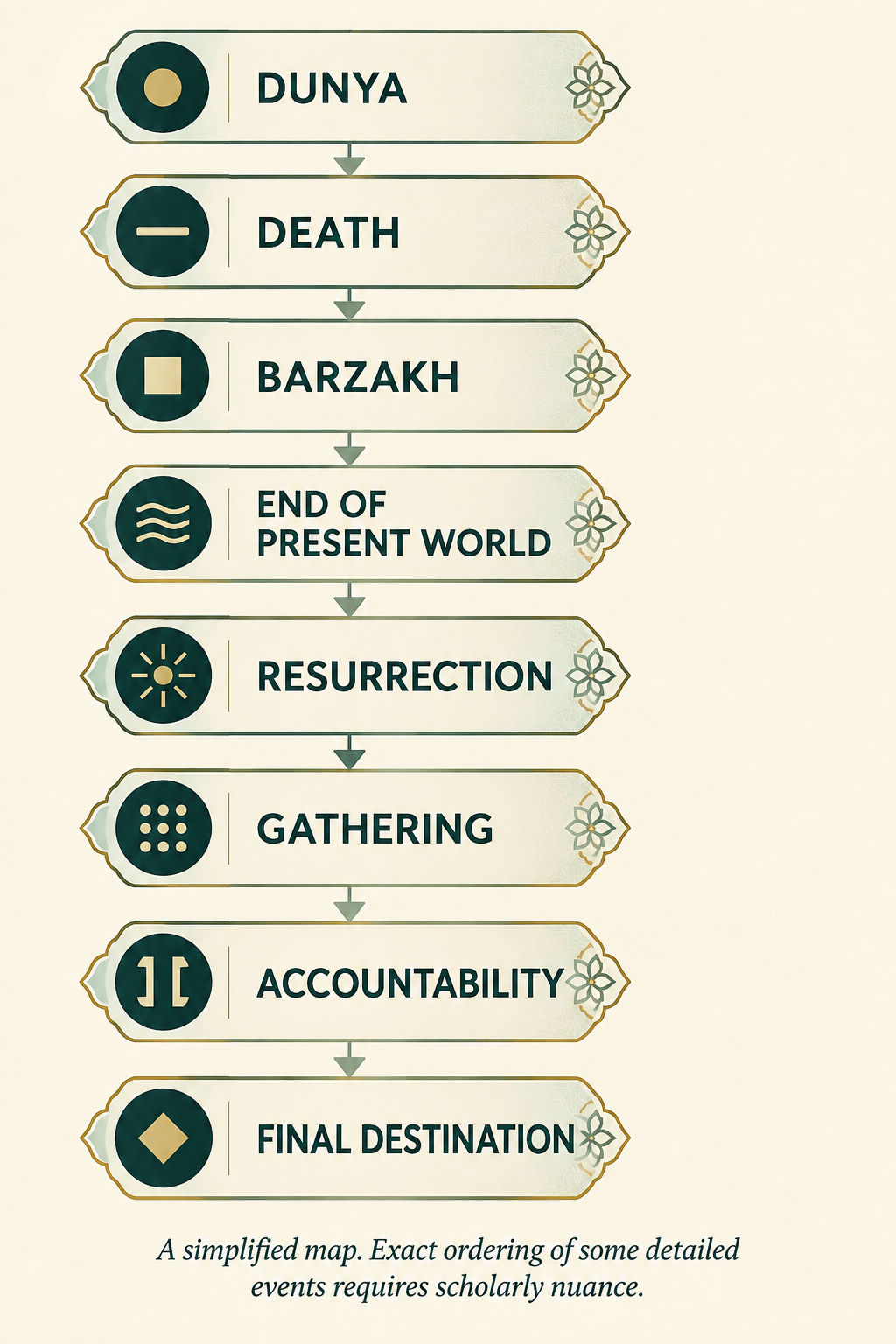
Here is a simplified sequence:
Dunya (this life) → Death → Barzakh (the stage between death and resurrection) → End of the present world / the Trumpet → Resurrection → Gathering → Accountability → Final destination
This is a teaching map. Some detailed events inside it have more than one scholarly arrangement, as we will see. Death and Barzakh are covered in What Happens After We Die? The Islamic Journey from Death to the Hereafter. This article begins where the present world ends and focuses on resurrection and judgment.
The Trumpet and the End of the Present World
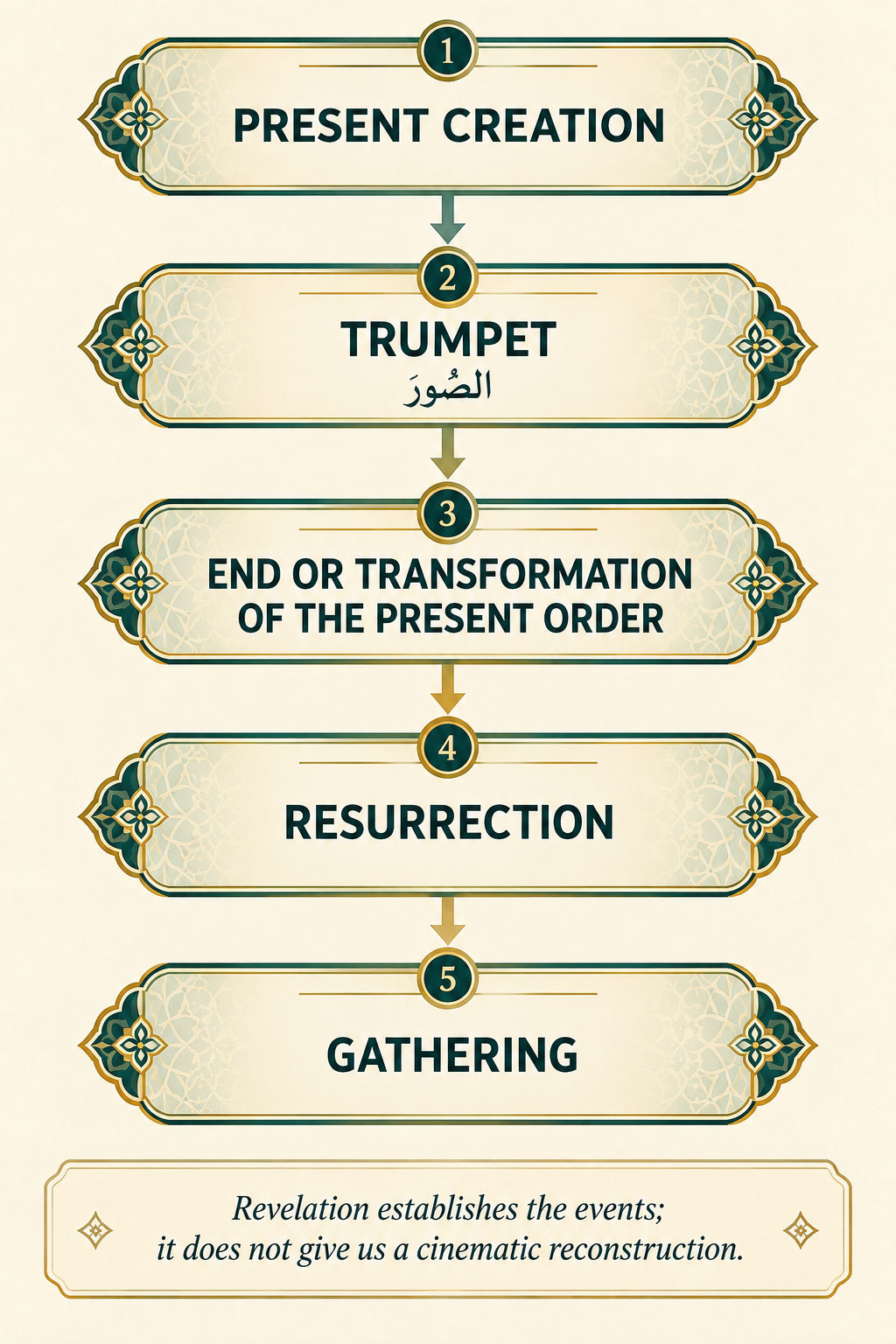
The Quran speaks of the Trumpet, al-Sur (الصُّور). “The Trumpet will be blown, and whoever is in the heavens and on the earth will fall dead, except whom Allah wills. Then it will be blown again, and at once they will be standing, looking on” (39:68). See also 36:51 and 69:13.
Who blows it? Muslims commonly say it is the angel Israfil, and many scholars, including Ibn Hajar, note that this is widely known. But the Quran does not name him in these verses. The name Israfil appears in an authentic supplication of the Prophet ﷺ (Sahih Muslim 770), and the association with the Trumpet comes through reports of varying strength and through long-standing scholarly agreement. A careful way to say it is: the Quran mentions the Trumpet and its blowing; the angel is identified in the tradition as Israfil.
How many blasts? Surah 39:68 describes two: one after which creatures fall dead, and one after which they stand. Many scholars, including Ibn Baz, hold that two is the correct reading. Others speak of three (alarm, death, resurrection), relying partly on the long Hadith of the Trumpet, whose chain scholars have criticized. So it would be wrong to present one model as unanimous.
“Except whom Allah wills.” Who is excepted? Commentators list different possibilities, and no single answer is established with certainty. In an authentic narration (Sahih Bukhari 2411), the Prophet ﷺ said he did not know whether Musa ﷺ would be among those Allah exempted. If that was left unknown, we should not claim to know.
Other passages describe the transformation of the cosmos: the sun wrapped up and the stars falling (Surah al-Takwir), the heavens splitting (al-Infitar, al-Inshiqaq), the earth shaken violently (al-Zalzalah), and mountains like carded wool (al-Qari’ah). The theological point is that the created order will end or change by Allah’s command. These verses are not an astrophysics lesson, and we should not attach modern theories to them.
Revelation establishes these events; it does not give us a cinematic reconstruction.
Resurrection: Al-Ba’th
Al-Ba’th (الْبَعْث) means being raised or sent forth. Muslims believe in the real resurrection of human beings, body and soul together. It is not merely that “our memory lives on” or that the soul continues in some symbolic way. The Quran answers those who ask “Who will give life to bones when they have decayed?” with: “The One who produced them the first time” (36:78–79). In 36:81 it adds that the One who created the heavens and the earth is able to create the like of them.
The Quran also points to the dead earth coming to life with rain (22:5–7, 30:50, 41:39), asking us to see resurrection as a sign of the same power we witness every spring.
The fingertips
“Does man think We will not assemble his bones? Yes, We are able to restore even his fingertips” (75:3–4). The point is that Allah’s power covers every part of the human being, down to the finest detail. It is not a claim of a prophecy about fingerprint identification, and it is better not to use it that way.
What authentic Hadith tell us
Every part of the human body wears away except the tailbone (‘ajb al-dhanab, عَجْبُ الذَّنَب), from which a person was created and from which he will be reconstituted (Sahih Bukhari 4814, Sahih Muslim 2955). Another authentic narration (Sahih Muslim 2940) mentions Allah sending a rain before the second blast, after which people stand. In the Bukhari narration, between the two blasts there is a period of “forty,” and the narrator does not specify whether that means days, months, or years. We can report these texts as they are, without inventing biological mechanics.
The Gathering: Al-Hashr
Al-Hashr (الْحَشْر) means gathering. The Quran says people will be gathered and none left behind (18:47). Authentic Hadith adds that humanity will be gathered barefoot, naked, and uncircumcised (Sahih Bukhari 6527, Sahih Muslim 2859). Aisha, may Allah be pleased with her, asked whether men and women would look at one another. The Prophet ﷺ answered that the matter would be too severe for them to care about that. The point is the severity of the Day, not its details.
The ground itself will change. “The Day the earth is replaced by another earth, and the heavens” (14:48). An authentic Hadith says people will be gathered on a white, reddish-white land like a pure loaf, with no landmark in it for anyone (Sahih Bukhari 6521, Sahih Muslim 2790). We can say what the texts say, without drawing a map.
How long is the Day?
Surah al-Ma’arij 70:4 speaks of a Day whose measure is fifty thousand years, and 32:5 speaks of a day measured as a thousand years. These verses speak in different contexts: 70:4 describes the Day of Judgment, while 32:5 describes the ascent of affairs to Allah. Commentators discuss several ways to understand the numbers, so we do not need to see a contradiction. Reports and commentary also suggest that the same Day will not feel the same for everyone: it will feel lighter for believers. We cannot say more than that without inventing it.
The sun, the sweat, and the shade
An authentic Hadith says the sun will be brought near, and people will be in sweat according to their deeds, some to the ankles, some to the knees, some to the waist, and some bridled by it (Sahih Muslim 2864). Another says that on a Day when there is no shade but His shade, Allah will shade seven (Sahih Bukhari 660, Sahih Muslim 1031):
a just ruler,
a young person who grew up worshipping Allah,
a person whose heart is attached to mosques,
two who loved each other for Allah’s sake and met and parted on that basis,
a person who refused an invitation to sin from a person of status and beauty, saying “I fear Allah,”
a person who gave charity so secretly that the left hand did not know what the right had given,
a person who remembered Allah in solitude, and his eyes flowed with tears.
What does “His shade” mean? Some narrations specify “the shade of His Throne.” Scholars understand it as honor and protection granted by Allah, and they avoid picturing it as a physical object or comparing Allah to creation.
Standing Before the Lord of the Worlds
“Do they not think that they will be resurrected for a Mighty Day, the Day when people will stand before the Lord of the worlds?” (83:4–6)
This is not a human courtroom. Allah already knows everything, so judgment is not an investigation to discover facts. Records and witnesses exist for a different reason: to establish the proof and display the perfect justice of the verdict. Allah does not learn anything from them. Scholars may mention further wisdoms, but this much is stated in revelation.
An authentic Hadith says each person will be spoken to by his Lord with no interpreter between them (Sahih Bukhari 7512). Accountability is personal. We do not speculate about how divine speech takes place.
The record of deeds
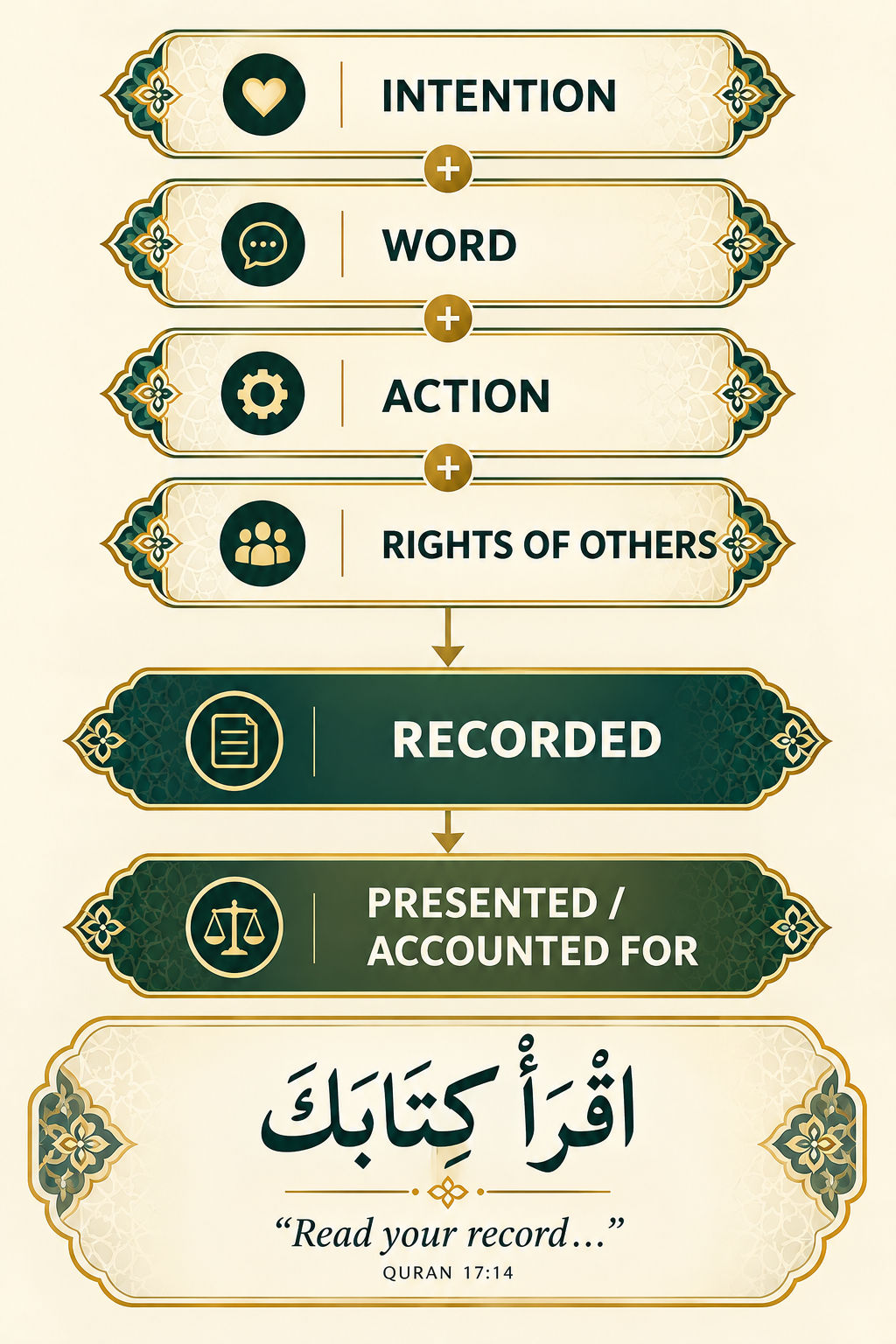
“We have fastened every person’s deed to his neck, and on the Day of Resurrection We will bring out for him a record he will find spread open. ‘Read your record. Today your own self is sufficient as an accountant against you’” (17:13–14). The Arabic is kitab (كِتَاب), a record. We do not know whether it resembles paper, a screen, or anything in our experience, and we should not guess.
Another verse says the record will be placed, and people will say with dread, “What kind of record is this that leaves nothing small or great unaccounted for?” and they will find what they did present before them (18:49).
Receiving the record in the right hand is described as success: “Come, read my record! I knew I would meet my account” (69:19–24; 84:7–9). Receiving it in the left hand or behind the back is described with regret (69:25 onward; 84:10 onward). The Quran uses two descriptions, and commentators have offered different ways to relate them. We do not need to build an unsupported sequence of physical choreography.
The recording angels
“Indeed, over you are guardians, noble scribes who know what you do” (82:10–12). Surah Qaf (50:17–18) mentions two who receive and record, one on each side, and says no word is uttered without “a watcher ready” (raqibun ‘atid). In those verses raqib and ‘atid are descriptions, “watcher” and “ready.” The popular practice of treating them as the two angels’ proper names comes from later tradition, so it is more accurate to say the Quran calls them kiraman katibin, noble scribes.
Intentions and deeds
Actions are judged by intentions (Sahih Bukhari 1, Sahih Muslim 1907). But a good intention does not make a forbidden act permissible. Actions and intentions both matter.
An authentic Hadith Qudsi shows divine generosity (Sahih Bukhari 6491, Sahih Muslim 131). Whoever intends a good deed and does not do it, Allah records a complete good deed for him. If he does it, it is recorded ten times, up to seven hundred times or more. Whoever intends an evil deed and then refrains for Allah’s sake, it is recorded as a complete good deed. If he does it, a single evil deed is recorded. The Quran says the same about proportions: a good deed is multiplied tenfold while an evil deed is paid back only by its equivalent (6:160).
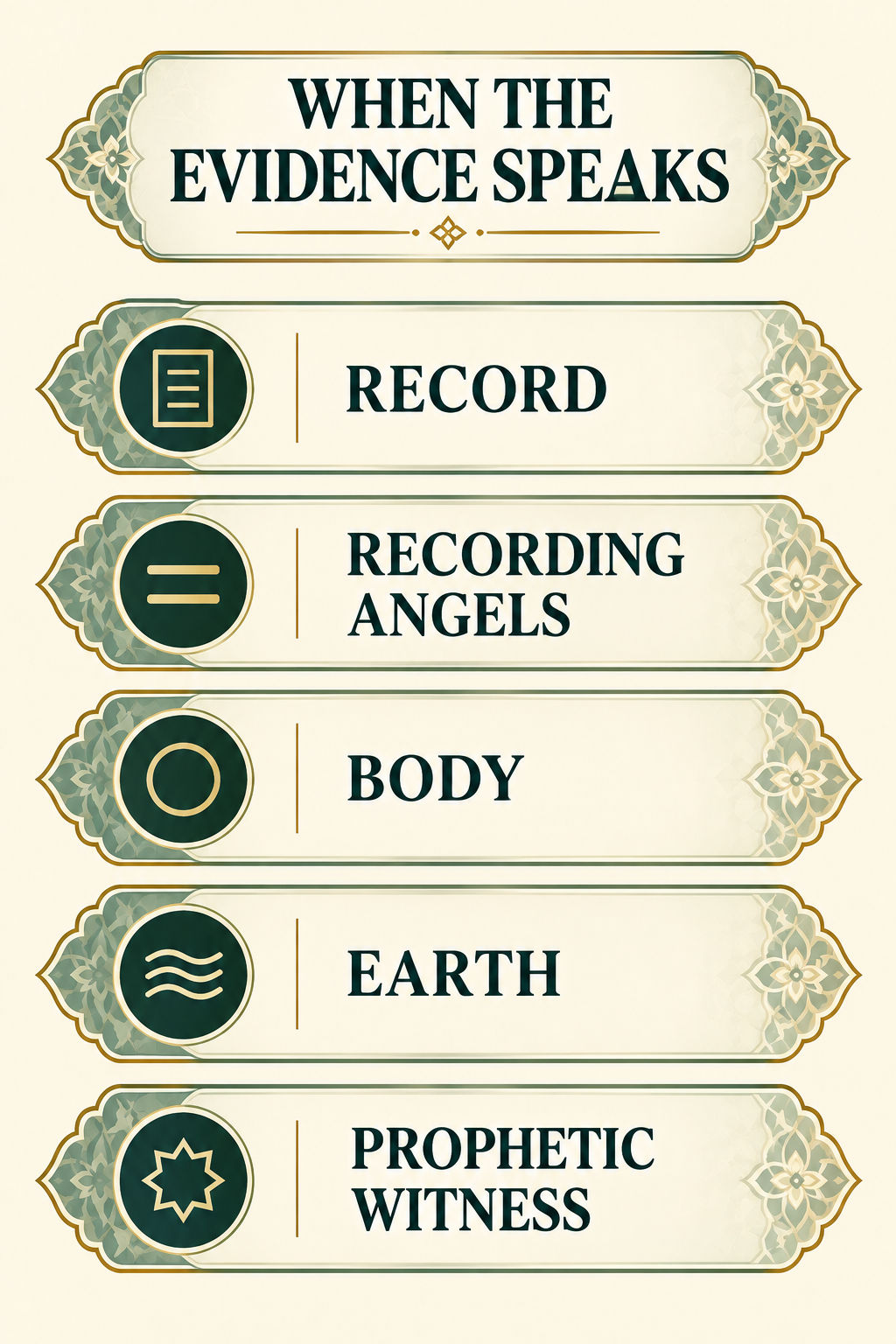
When the Evidence Speaks
Even though Allah knows all, the Quran describes evidence being presented.
The record. As above (17:14, 18:49).
The recording angels (82:10–12).
The body. “That Day We will seal their mouths, and their hands will speak to Us and their feet will testify to what they used to earn” (36:65). In 41:20–21 skins testify, and the people ask, “Why did you testify against us?” and the reply is that Allah made everything speak. We do not need to explain how.
The Earth. “That Day it will tell its news” (99:4). A narration in Jami’ at-Tirmidhi explains this as the earth testifying to what every servant did on its back. Tirmidhi graded it acceptable, but later graders differ, so it is mentioned with that caution.
The Prophets. “How will it be when We bring a witness from every nation and bring you as a witness against these?” (4:41). We do not add dialogue beyond what the Quran says.
The inclusion of the body is notable. Nothing is hidden even by a closed mouth.
Al-Hisab: The Account
Al-Hisab (الحِسَاب) means reckoning. Not every person’s account is the same. Aisha asked about the verse “he will be given an easy account” (84:8). The Prophet ﷺ said that is the ‘ard, the mere presentation of the deeds, but whoever is examined in detail is ruined (Sahih Bukhari 103, Sahih Muslim 2876). That is a profound teaching: if Allah questioned each of us exhaustively, none of us could stand. We depend on His mercy.
Another authentic narration says Allah will bring the believer close, cover him, and remind him of his sins until he thinks he is ruined. Then Allah says: “I concealed them for you in the world, and today I forgive them for you” (Sahih Bukhari 2441, Sahih Muslim 2768). We do not picture this scene. We hold on to its meaning: sins that a believer repented from or that Allah concealed in this life are not exposed to the world.
What is questioned first?
Two authentic reports sometimes look like they conflict, but they speak about different categories. Regarding a servant’s deeds, the first thing he will be held to account for is his prayer (Tirmidhi 413, Abu Dawud 864, Nasa’i 465, graded sahih by al-Albani). Regarding disputes between people, the first cases judged will concern bloodshed (Sahih Bukhari 6533, Sahih Muslim 1678). The first is about duty toward Allah; the second is about rights between people. Learn more in The 5 Daily Prayers Explained.
Rights Between People
Perhaps nowhere does the seriousness of accountability become more practical than in the rights of other people. The Arabic word is zulm (ظلم), injustice or wrongdoing. On that Day, money cannot settle moral debts.
In Sahih Muslim 2581, the Prophet ﷺ asked the Companions who they thought the bankrupt person was. They said: someone with no money or goods. He said the bankrupt of my community is the one who comes on the Day of Resurrection with prayer, fasting, and charity, but who also insulted this person, slandered that one, consumed another’s wealth, shed another’s blood, and struck another. These people will each be given from his good deeds. If his good deeds run out before the debts are settled, some of their sins will be taken and thrown onto him, and then he will be cast into the Fire.
The lesson is not that worship is worthless. It is that worship does not give permission to wrong people. Prayer and fasting do not erase harm done to a human being.
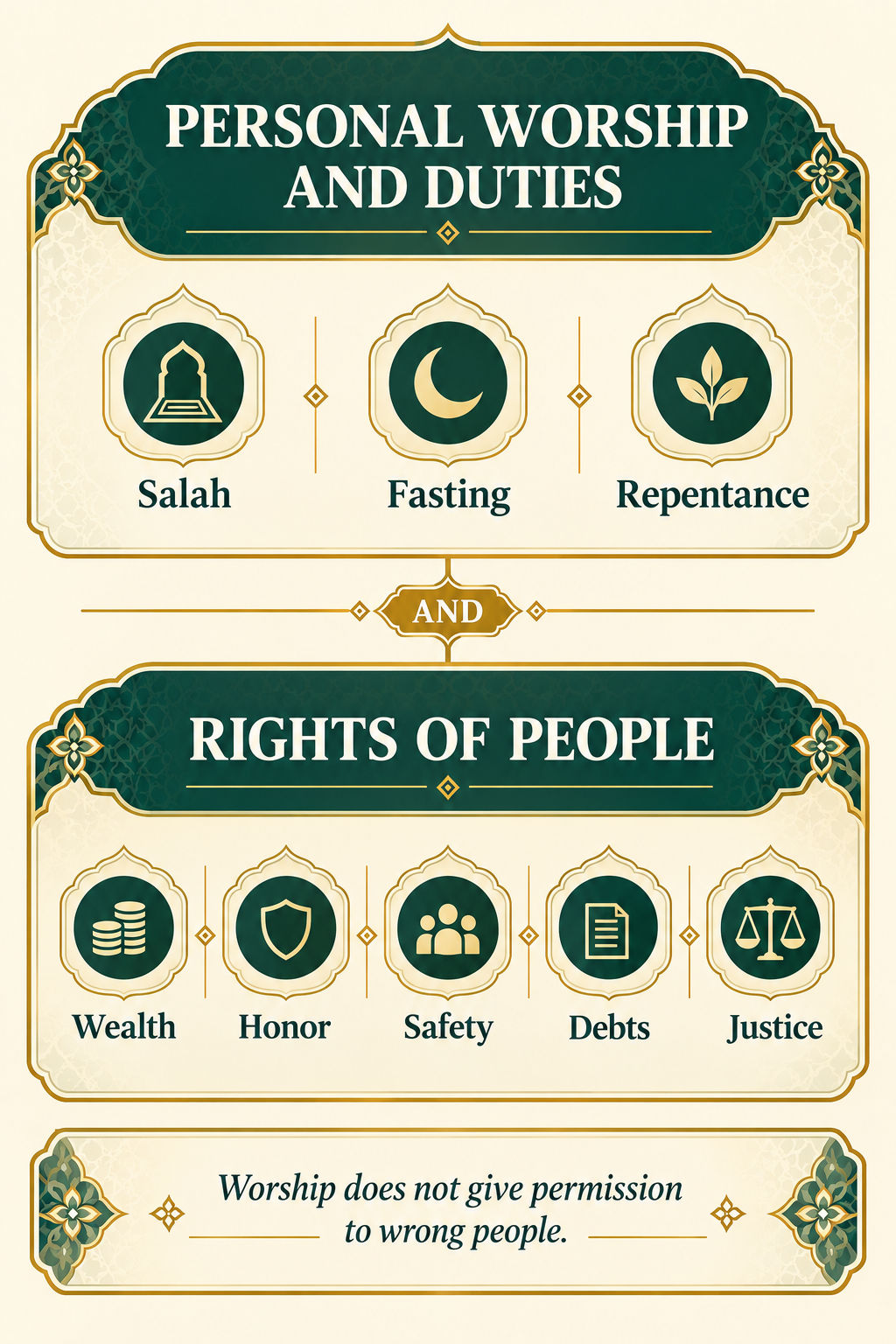
Debts. An authentic narration says that even a martyr is forgiven everything except debt (Sahih Muslim 1886), and another says a believer’s soul is held back by his debt until it is paid (Tirmidhi 1078, graded hasan). But the same Sunnah distinguishes between honesty and fraud: whoever takes people’s wealth intending to repay, Allah will help him repay it, and whoever takes it intending to waste it, Allah will destroy him (Sahih Bukhari 2387). Someone who is truly unable to pay and is working toward it is in a different situation from someone who is refusing or defrauding.
Backbiting and harm. We should not invent formulas, such as exactly how many good deeds transfer for each sentence. The established principle is enough: rights and injustices matter.
Seeking release. The Prophet ﷺ said that whoever has wronged his brother concerning his honor or anything else should seek release from him today, before the Day when there will be no dinar or dirham (Sahih Bukhari 2449). Scholars add nuance in cases like backbiting, where telling the victim directly may cause greater harm. Some recommend asking forgiveness for them and speaking well of them instead. There is no single simplistic rule, so seek knowledgeable advice when the situation is delicate.
The Mizan: The Scale
Al-Mizan (الْمِيزَان) is the Scale. “We will set up the scales of justice for the Day of Resurrection” (21:47). See also 7:8–9, 23:102–103, and 101:6–9. Mainstream Sunni belief is that the Scale is real, not merely a metaphor for fairness, though its physical design is unknown.
What is weighed? The texts point to more than one thing. The Quran speaks of deeds. Hadith also speaks of records (the Card Hadith below) and of people themselves: a huge man will come who does not weigh as much as a mosquito’s wing with Allah (Sahih Bukhari 4729, Sahih Muslim 2785). Rather than force one exclusive answer, scholars hold that revelation affirms different forms of weighing.
The Hadith of the Card
A man will be brought before all creation with ninety-nine scrolls of sins, each as far as the eye can see. Allah will say he has not been wronged. Then He will say he has a good deed with Him, and a card will be brought out bearing the testimony of faith: there is no god but Allah and Muhammad is His servant and messenger. The scrolls will be placed on one side and the card on the other, and the scrolls will be light while the card is heavy; nothing is heavier than the Name of Allah (Tirmidhi 2639, Ibn Majah 4300, graded hasan by Tirmidhi and sahih by al-Albani and Ibn Hibban).
It does not mean “just say La ilaha illa Allah and actions no longer matter.” It shows the weight of sincere tawhid, the justice of Allah, and His mercy. It is not permission for deliberate sin or hypocrisy.
Other things that are heavy on the Scale
The Prophet ﷺ said there are two words light on the tongue, heavy on the Scale, and beloved to the Most Merciful: Subhan Allahi wa bihamdihi, Subhan Allahil-‘Adhim (سُبْحَانَ اللَّهِ وَبِحَمْدِهِ، سُبْحَانَ اللَّهِ الْعَظِيمِ) (Sahih Bukhari 6406, Sahih Muslim 2694). He also said nothing is heavier on the believer’s Scale than good character (Tirmidhi 2002, Abu Dawud 4799, graded sahih). Explore this in What Is Dhikr?.
Justice among animals
Divine justice is wider than human disputes. “You will surely return rights to those they are owed on the Day of Resurrection, until the hornless sheep is given retaliation from the horned sheep” (Sahih Muslim 2582). What happens afterward? Surah 78:40 says the disbeliever will wish, “If only I were dust.” Some early commentators connect this to a report that animals will become dust after justice is done. That connection comes from commentary and Companion reports, not from the verse itself, and not from an authentic Prophetic Hadith. We mention it as tafsir and not as established detail.
Intercession: Al-Shafa’ah
Al-Shafa’ah (الشَّفَاعَة) means intercession, asking on behalf of another. Islam affirms it, but with a condition. “Who is there that can intercede with Him except by His permission?” (2:255). Also see 20:109, 34:23, and 53:26. No one intercedes independently, and no one can force Allah to change His decision. Intercession happens by His permission, for those with whom He is pleased. That is a manifestation of His sovereignty, not a limit on it.
The Prophet’s ﷺ great intercession
An authentic Hadith (Sahih Bukhari 4712, Sahih Muslim 194) describes people seeking someone to intercede for them to relieve the waiting. They go to Adam, then Nuh, then Ibrahim, then Musa, then Isa, each of whom mentions a reason he cannot do it and refers them onward. Finally they come to Muhammad ﷺ, who says, “I am for it.” He prostrates beneath the Throne, is inspired with praise, and is told to raise his head, ask, and he will be granted it. This is closely linked by scholars to the Maqam Mahmud (مَقَامًا مَّحْمُودًا, “a praised station”) of 17:79. The Quran gives the phrase, and Hadith and classical tafsir identify it with this intercession.
Hadith also describes other intercessions: for believers to be taken out of the Fire, for some to be raised in rank, and others. We should keep these claims modest. Angels and righteous believers can intercede only with Allah’s permission (21:28). An authentic Hadith says the Quran will come on the Day of Resurrection as an intercessor for those who lived with it (Sahih Muslim 804), and a report in Musnad Ahmad says fasting and the Quran will intercede for the servant (graded sahih or hasan by contemporary scholars). We should not make claims such as fixed numbers of relatives for martyrs without authentic evidence.
The Hawd: The Prophet’s ﷺ Basin
Al-Hawd (الحَوْض) is a basin or pool. The Prophet ﷺ said his basin is a month’s journey across; its water is whiter than milk and sweeter than honey, and its cups are like the stars of the sky. Whoever drinks from it will never be thirsty again (Sahih Bukhari 6579, Sahih Muslim 2292). The Hawd is distinct from Al-Kawthar (the river granted to him in Paradise, 108:1; Sahih Bukhari 4964), though authentic narrations say the Hawd is fed from it (Sahih Muslim 2300).
Some people will be driven away from the Hawd. The Prophet ﷺ will say, “My companions!” and be told, “You do not know what they introduced after you” (Sahih Bukhari 6582). This is a general warning about fidelity to his guidance. It should never be used as a sectarian weapon against other Muslims.
The Sirat and the Qantarah
A note on order: for teaching purposes we can discuss these events in a logical sequence, but revelation does not necessarily give us a single exhaustive timeline resolving every ordering question.
Al-Sirat (الصِّرَاط) is, in mainstream Sunni belief, a bridge or path over Jahannam that people will cross. It is established through authentic Hadith (Sahih Bukhari 7439, Sahih Muslim 183). Beware of citing 1:6, “Guide us to the straight path,” as if it directly described this bridge. In that verse, sirat means the path of guidance in this life. Verse 19:71–72 (“There is none of you but will come to it”) is also discussed, and commentators differ on whether wurud means passing over it, entering it, or approaching it. We should not present one view as unquestioned.
The famous phrase. “Thinner than a hair and sharper than a sword” is repeated everywhere. In Sahih Muslim 183, it appears as a statement attributed to Abu Sa’id al-Khudri, who said it reached him. There are other reports of similar wording from the Prophet ﷺ with differing chains and strength, and scholars discuss them. So it is better to say “it has been reported” than to say flatly that the Prophet ﷺ described it exactly that way.
Authentic details. Authentic narrations say the Sirat is slippery, with hooks, and people cross according to their deeds: some like the blink of an eye, some like lightning, some like wind, some like fast horses, some running, some walking, some crawling, and some are snatched and fall (Sahih Muslim 195 and 183). The believers’ supplication there is “Allahumma sallim, sallim,” O Allah, grant safety, grant safety (Sahih Bukhari 806; Sahih Muslim 182).
The Qantarah. Those who pass are not necessarily taken straight into Paradise. Sahih Bukhari 6535 and 2440 say the believers who are saved from the Fire are held at a qantarah (قَنْطَرَة) between Paradise and Hell, where grievances between them are settled. When they are purified, they are admitted into Paradise, and each knows his dwelling there better than his home in this world. Some scholars take this to be part of the same bridge, and some to be a distinct place. We do not invent its architecture. We learn its meaning: even relations between believers are cleansed before Paradise.
Deeds, Mercy, and Paradise
Paradise and Hell are the outcome of Judgment. Details of Jannah are covered in What Is Jannah Like? A Quranic Guide to Paradise in Islam.
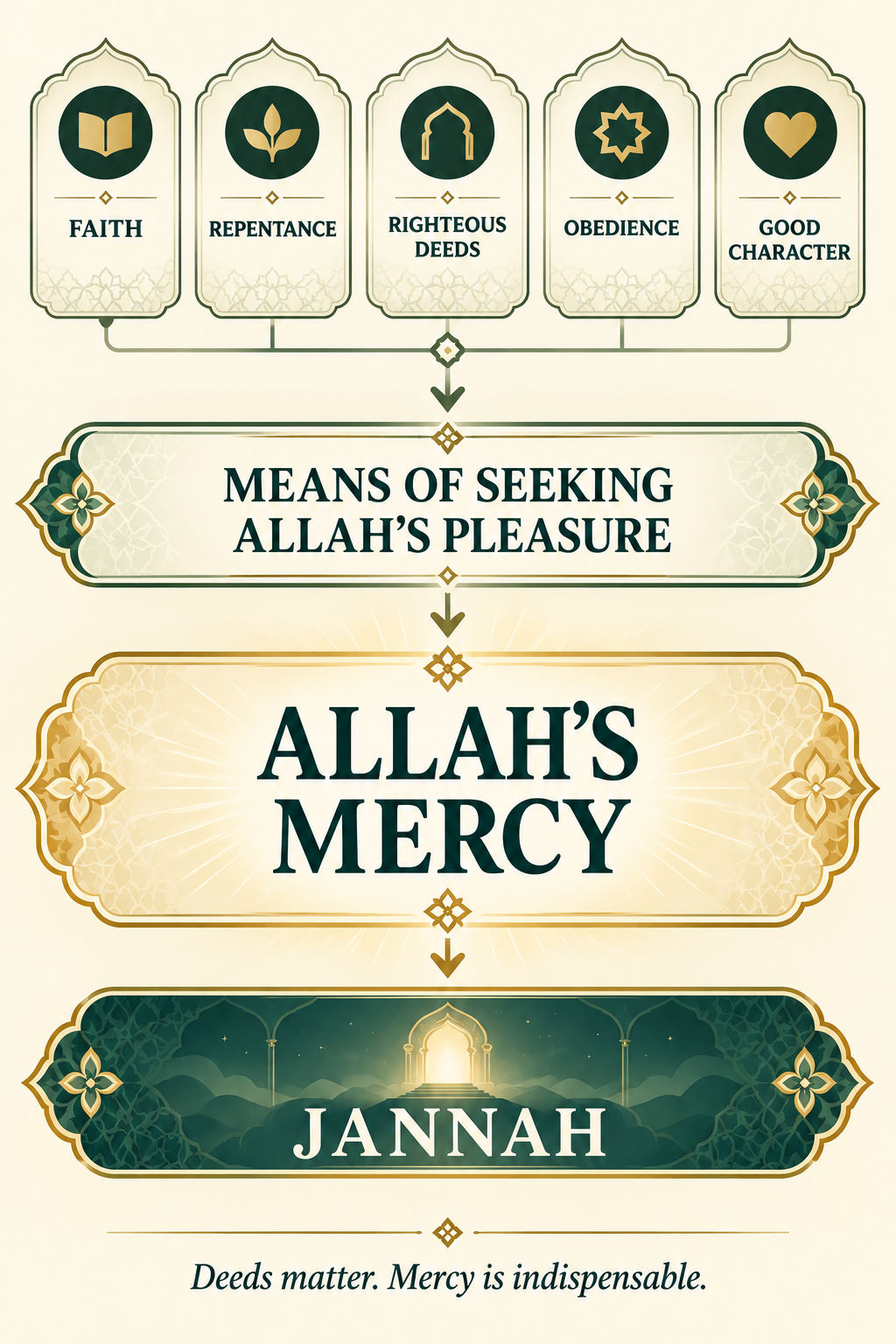
Do good deeds buy Paradise? No. The Prophet ﷺ said that no one’s deeds will admit him into Paradise. “Not even you, Messenger of Allah?” they asked. He said: “Not even me, unless Allah covers me with His mercy” (Sahih Bukhari 5673, Sahih Muslim 2816).
Yet the Quran repeatedly says, “Enter Paradise for what you used to do” (16:32). The mainstream reconciliation is this: deeds are causes and means, and they affect a person’s ranks, but they do not create a claim over Allah. Entry ultimately depends on Allah’s mercy and favor. Even the ability to do good is a gift from Him.
This does not make deeds meaningless. The same revelation commands prayer, repentance, justice, charity, and good character. Mercy does not cancel responsibility. Responsibility does not replace mercy. Deeds matter. Mercy is indispensable.
The extent of mercy
The Prophet ﷺ said that Allah created mercy in one hundred parts, kept ninety-nine with Him, and sent down one part to all creation. By it, creatures show mercy to one another, even a horse that lifts its hoof away from its foal (Sahih Bukhari 6000, Sahih Muslim 2752). Another authentic narration says that when Allah decreed creation, He wrote that His mercy prevails over His wrath (Sahih Bukhari 3194, Sahih Muslim 2751).
But hope should not become false security. The Quran warns against despair in Allah’s mercy (39:53) and against being deceived about Allah (31:33). The believer lives between fear and hope.
Repentance belongs to this life
Do not delay thinking that repentance can be made on Judgment Day. Allah accepts repentance until the soul reaches the throat (Tirmidhi 3537, graded hasan; see also 4:17–18). There is also a cosmic limit: when the sun rises from the west, belief and repentance that were previously deferred will no longer benefit (6:158; Sahih Muslim 157). One is each person’s individual deadline; the other is tied to a major sign.
Major sins and shirk
Mainstream Sunni teaching is that a Muslim who dies with major sins short of shirk is under Allah’s will: He may forgive, or He may punish. If punished, a true believer in tawhid will not remain in Hell forever. Allah does not forgive dying upon unrepented shirk (4:48, 4:116), but that is no reason to tell any living person they can never be forgiven. Allah says, “Do not despair of the mercy of Allah. Indeed Allah forgives all sins” (39:53) for those who turn back to Him in repentance.
Individuals, children, and those who never heard
We should not declare that a particular celebrity or ordinary deceased person is in Hell, or definitely in Paradise, unless revelation specifically says so. That is humility, not uncertainty about the principles.
Accountability depends on capacity. “The pen is lifted from three: the sleeper until he wakes, the child until he reaches puberty, and the one who has lost his reason until he regains it” (Abu Dawud 4403, graded sahih). Today we would say this includes people whose mental capacity is affected.
Scholars discuss children and those who never received the message in detail. Children of Muslims who die young are in Paradise according to the strongest views. For children of non-Muslims and for people who never received a clear message (ahl al-fatrah), scholars have more than one view, and some narrations describe a test. The Quran says Allah does not punish until He sends a messenger (17:15). Allah judges with perfect knowledge and justice.
What about non-Muslims? Islam teaches that salvation is tied to truth, faith, and the response to revelation, and that the final judgment belongs to Allah. General theological principles are one thing. Declaring the fate of a specific individual is another.
For Those Who Were Wronged
If you have experienced abuse, theft, betrayal, slander, or injustice, hear this: Islam does not teach that injustice disappears because the perpetrator escaped worldly consequences. No wrong is lost with Allah.
But belief in Judgment is never a reason to tolerate ongoing harm. It does not prohibit seeking safety, legal help, medical care, justice, or support. Forgiveness is encouraged in many situations, yet forgiving is not the same as staying in danger, rebuilding trust automatically, dropping lawful consequences, or denying that the harm happened. No one should be pressured to reconcile with an abuser.
Hope, Secret Goodness, and Healthy Fear
Judgment is not only about hidden sins. It is also about hidden good. Allah knows private charity, silent tears, patient endurance, unseen service, sincere repentance, and the good that nobody praised. Whoever does an atom’s weight of good will see it, and whoever does an atom’s weight of evil will see it (99:7–8).
Small things count. “Protect yourselves from the Fire, even with half a date” (Sahih Bukhari 1417, Sahih Muslim 1016). A man who removed a thorny branch from a path was forgiven (Sahih Muslim 1914).
Riya (الرِّيَاء), showing off, can ruin a deed. A Hadith in Sahih Muslim 1905 describes a martyr, a scholar-reciter, and a generous giver whose deeds were done for reputation and who were punished. The lesson is that a spectacular deed without sincerity can become evidence against a person. But not every happiness in being praised is riya. When the Companions asked about someone praised for doing good, the Prophet ﷺ called it the believer’s early glad tidings (Sahih Muslim 2642).
If fear becomes obsession. Accountability does not mean every intrusive thought is a sin. Allah overlooks what the soul whispers unless a person acts or speaks (Sahih Bukhari 2528, Sahih Muslim 127). When the Companions complained of horrifying thoughts, the Prophet ﷺ said that is clear faith (Sahih Muslim 133). If you experience severe religious anxiety or obsessive symptoms, seek a qualified mental-health professional along with knowledgeable religious guidance. This article does not diagnose anyone.
For parents. Do not teach children that Allah is waiting to throw them into Hell for a mistake. Teach that Allah sees us, our choices matter, Allah is perfectly just and loves repentance, good deeds matter, and we ask Allah for mercy. Keep it age-appropriate.
Family and friendship will also be affected by that Day. “On that Day a person will flee from his brother, his mother and father, his wife and children” (80:34–37), because each will be consumed by his own matter. This does not make family meaningless; the Quran also speaks of righteous families reunited in Paradise (13:23). Similarly, close friends that Day will be enemies to one another except the righteous (43:67), so friendships built on righteousness have enduring value. Wealth, status, and followers cannot bribe Allah, though wealth used rightly can become a source of reward. And knowledge is a responsibility, not an automatic salvation.
There is no second earthly test after judgment. The Quran describes people asking to be sent back, and it is not granted (23:99–100).
How Belief in Judgment Should Change Daily Life
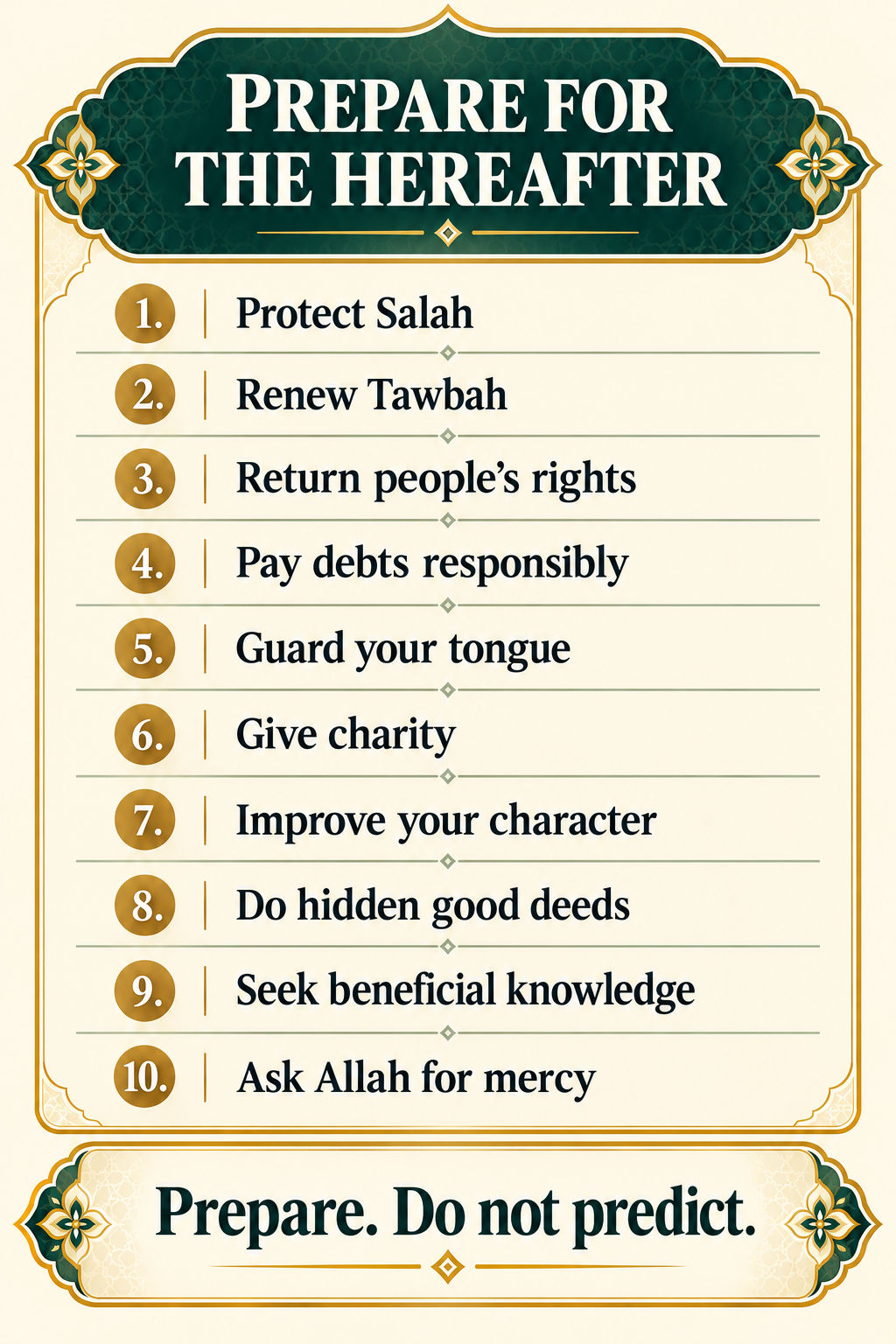
You do not prepare by solving an end-times puzzle. You prepare through how you live.
Protect your prayer. It is the first deed to be examined.
Repent quickly. Do not postpone tawbah.
Return people’s rights. Money, trust, honor, and time.
Pay debts responsibly and be honest in contracts. Do not withhold wages.
Guard your tongue, including online. Messages, comments, posts, rumors, and anonymous accounts do not create moral invisibility.
Avoid oppression and practice honesty.
Give charity, even if small.
Improve your character.
Do hidden good deeds.
Seek beneficial knowledge. Ignorance should push us to learn, whether through Quran, Arabic, or Islamic studies, without everyone needing to become a scholar.
Forgive where appropriate, and seek safety where needed.
Ask Allah for mercy.
The Islamic response to the Day of Judgment is not “Can I calculate when it will happen?” but “Am I ready if my own opportunity to prepare ends today?” Personal death can precede the Hour itself, so we do not say that the Hour is happening today.
Authentic duas
1. Quran 2:201
Arabic: رَبَّنَا آتِنَا فِي الدُّنْيَا حَسَنَةً وَفِي الْآخِرَةِ حَسَنَةً وَقِنَا عَذَابَ النَّارِ
Transliteration: Rabbana atina fid-dunya hasanatan wa fil-akhirati hasanatan wa qina ‘adhaban-nar.
Meaning: Our Lord, give us good in this world and good in the Hereafter, and protect us from the punishment of the Fire.
Authenticity: Quranic. Context: a comprehensive dua often recited by the Prophet ﷺ.
2. Quran 14:41
Arabic: رَبَّنَا اغْفِرْ لِي وَلِوَالِدَيَّ وَلِلْمُؤْمِنِينَ يَوْمَ يَقُومُ الْحِسَابُ
Transliteration: Rabbana-ghfir li wa li-walidayya wa lil-mu’minina yawma yaqumul-hisab.
Meaning: Our Lord, forgive me, my parents, and the believers on the Day the account is established.
Authenticity: Quranic (the dua of Ibrahim ﷺ). Context: asking for forgiveness for the Day of reckoning.
3. “Allahumma hasibni hisaban yasira”
Arabic: اللَّهُمَّ حَاسِبْنِي حِسَابًا يَسِيرًا
Transliteration: Allahumma hasibni hisaban yasira.
Meaning: O Allah, take me to account with an easy account.
Source: Musnad Ahmad and al-Hakim, from Aisha. Authenticity: graded sahih by a number of hadith scholars. Context: a supplication the Prophet ﷺ made in prayer.
4. Asking for Paradise and refuge from the Fire
Arabic: اللَّهُمَّ إِنِّي أَسْأَلُكَ الْجَنَّةَ وَأَعُوذُ بِكَ مِنَ النَّارِ
Transliteration: Allahumma inni as’alukal-jannah wa a’udhu bika minan-nar.
Meaning: O Allah, I ask You for Paradise and seek refuge in You from the Fire.
Source: Sunan Abi Dawud 792, Sunan Ibn Majah 910. Authenticity: graded sahih. Context: the Prophet ﷺ taught this as the essence of what he asked for in prayer.
5. For steadfastness
Arabic: يَا مُقَلِّبَ الْقُلُوبِ ثَبِّتْ قَلْبِي عَلَى دِينِكَ
Transliteration: Ya muqallibal-qulub, thabbit qalbi ‘ala dinik.
Meaning: O Turner of hearts, make my heart firm on Your religion.
Source: Jami’ at-Tirmidhi 2140. Authenticity: graded hasan by Tirmidhi. Context: the Prophet ﷺ often made this dua. Learn how in How to Make Dua.
Quranic Arabic Vocabulary for the Hereafter
Knowing a few recurring terms helps you recognize them every time you recite.
Arabic | Transliteration | Root | Core meaning and what it teaches |
|---|---|---|---|
الآخِرَة | Al-Akhirah | أ خ ر | The Hereafter, “the later,” the final stage of existence. |
الْقِيَامَة | Al-Qiyamah | ق و م | Standing and rising; the Day of Resurrection. |
السَّاعَة | Al-Sa’ah | س و ع | The Hour; a precise moment whose time is hidden. |
الْبَعْث | Al-Ba’th | ب ع ث | To raise or send forth; resurrection. |
الْحَشْر | Al-Hashr | ح ش ر | To gather or assemble; the gathering. |
الْحِسَاب | Al-Hisab | ح س ب | To count or reckon; the account. |
الْمِيزَان | Al-Mizan | و ز ن | To weigh; the Scale of justice. |
الْكِتَاب | Al-Kitab | ك ت ب | To write; the written record of deeds (also scripture). |
الشَّفَاعَة | Al-Shafa’ah | ش ف ع | To join or pair; intercession, only by permission. |
الحَوْض | Al-Hawd | ح و ض | Basin; the Prophet’s ﷺ basin. |
الصِّرَاط | Al-Sirat | ص ر ط | Path; in this context, the bridge over Hell from authentic Hadith. |
الجَنَّة / جَهَنَّم | Al-Jannah / Jahannam | ج ن ن / — | Paradise (a garden concealed by foliage) / the Fire. |
If you would like to read these words directly in the Quran, learning Quranic Arabic opens a layer of the text that translation cannot fully carry.
Common Myths
Myth: Islam gives a date for Judgment Day. Reality: Only Allah knows the Hour.
Myth: Every viral sign-of-the-Hour story is authentic. Reality: Reports need verification.
Myth: The Quran names Israfil as the Trumpet blower. Reality: The Quran does not name him; the identification comes through the Sunnah and scholarly tradition.
Myth: Everyone agrees on exactly three blasts. Reality: 39:68 describes two; scholars discuss how other texts are reconciled.
Myth: Resurrection is only spiritual. Reality: Islam teaches the resurrection of human beings.
Myth: The fingertip verse is a fingerprint prophecy. Reality: Its point is Allah’s ability to reconstruct the entire person.
Myth: Allah needs records to know what we did. Reality: He already knows; records and witnesses establish justice.
Myth: Good intentions make any action acceptable. Reality: Intentions and lawful actions both matter.
Myth: Good deeds automatically purchase Paradise. Reality: Entry is ultimately through Allah’s mercy.
Myth: Mercy means actions do not matter. Reality: Revelation teaches both mercy and accountability.
Myth: The Prophet ﷺ definitely said the Sirat is thinner than a hair and sharper than a sword. Reality: Verify the attribution; the Sahih Muslim wording is Abu Sa’id’s report.
Myth: Intercession means saints can override Allah. Reality: None intercedes without His permission.
Myth: Rituals erase obligations to people. Reality: See the Hadith of the bankrupt person.
Myth: If someone escaped justice in this world, they escaped permanently. Reality: Ultimate justice belongs to Allah.
What We Know and What We Should Not Invent
What revelation establishes | What we should not invent |
|---|---|
The Hour will come | Its exact date or a countdown |
Its time is hidden | A complete minute-by-minute timeline |
The present creation will end or change | The physics of the end |
The Trumpet will be blown | The Trumpet’s physical details |
Resurrection will occur | The mechanics of resurrection |
Humanity will be gathered | The exact appearance of the place of gathering |
Deeds are recorded and people are accountable | The visual design of the records |
Witnesses will testify | How each witness speaks |
The Scale is real | Its physical dimensions |
Perfect justice will occur | Specific ordinary individuals’ final destinations |
Intercession occurs only with Allah’s permission | Intercession as independent power |
Authentic Sunnah establishes the Hawd and Sirat | Details beyond the evidence, or an exact order where scholars differ |
Final destinations are real | Cinematic scenes of Allah’s judgment |
Revelation gives us enough to prepare, not permission to invent.
Frequently Asked Questions
1. What is the Day of Judgment in Islam? It is the Day when Allah resurrects all creation, gathers humanity, and holds every soul accountable with perfect justice and mercy. It is also called Yawm al-Qiyamah, the Day of Resurrection.
2. What does Yawm al-Qiyamah mean? Yawm means day, and qiyamah comes from the root q-w-m, meaning to stand or rise. It refers to the rising of the dead and the standing of humanity before Allah.
3. When will Judgment Day happen? Only Allah knows. The Quran says knowledge of the Hour is with Him (7:187, 31:34). Islam teaches us to prepare, not to predict.
4. Does anyone know the date of Judgment Day? No. Not even the angels or the Prophet ﷺ were given its date. Date predictions, numerology, and countdowns have no basis in Islam.
5. What happens when the Trumpet is blown? Surah 39:68 describes a blowing after which creatures fall dead except those Allah wills, and then a second blowing after which people stand, looking on.
6. Who blows the Trumpet in Islam? The Quran does not name the angel. Muslim scholars identify him as Israfil, a name found in an authentic supplication of the Prophet ﷺ (Sahih Muslim 770) and in later tradition.
7. Will everyone be resurrected? Yes. Islam teaches the real resurrection of all human beings, as in 36:78–79: the One who created them the first time will bring them back.
8. What happens at the Gathering? Humanity will be gathered, accountable before Allah, on an earth that has been changed. Authentic Hadith describes the severity of the Day and mentions the sun brought near.
9. What is the book of deeds? It is the record of what each person did, mentioned in 17:13–14 and 18:49. Receiving it in the right hand is a sign of success. Its form is unknown.
10. What is the Mizan? The Scale (21:47). It is real, according to mainstream Sunni belief. Deeds and other things are weighed, and no one will be wronged. Its physical form is not described.
11. What is intercession in Islam? Intercession means asking on behalf of someone else. It exists only with Allah’s permission and for those with whom He is pleased (2:255, 21:28).
12. What is the Hawd? It is the Prophet’s ﷺ basin, described in authentic Hadith as having water whiter than milk and sweeter than honey, with cups like the stars.
13. What is the Sirat? It is the bridge or path over Hell, established through authentic Hadith. People cross according to their deeds. Its description should be limited to what is reliably reported.
14. Do good deeds guarantee Jannah? No. Good deeds are means and affect ranks, but entry is ultimately by Allah’s mercy, as the Prophet ﷺ said (Sahih Bukhari 5673, Sahih Muslim 2816).
15. Does Allah forgive people on Judgment Day? Yes, according to authentic Hadith, Allah forgives whom He wills, including some believers whose sins He concealed. But repentance should be made before death.
16. What happens to people who wronged others? Rights between people will be settled, as in the Hadith of the bankrupt person. Money cannot pay; good deeds and sins are transferred.
17. What happens to animals on Judgment Day? An authentic Hadith says even a hornless sheep will receive justice from a horned one (Sahih Muslim 2582). What follows is discussed in tafsir, not established by that Hadith.
18. How should Muslims prepare for Judgment Day? Through faith, prayer, quick repentance, returning rights, honesty, charity, good character, hidden good deeds, beneficial knowledge, and hope in Allah’s mercy.
The Day We Prepare for by How We Live Today
We began with a day when nothing is hidden. For an oppressor, that is a frightening thought. For someone who was wronged, it is a promise of justice. For someone who secretly did good, it is a promise that nothing was forgotten. For someone who sincerely repented, it is a reason for hope. For every believer, it is a reason to live deliberately.
You do not prepare for Yawm al-Qiyamah by solving an end-times puzzle. You prepare through iman, prayer, repentance, justice, honesty, charity, good character, returning rights, Quran, dhikr, dua, and hope in Allah’s mercy.
The Hour has been hidden from us, but the path of preparation has not.
Islam does not teach us about the Day of Judgment so that we can predict tomorrow. It teaches us about that Day so that we know how to live today.
May Allah grant us an easy account, forgive us, protect us from the Fire, and admit us into Jannah through His mercy.