Try to Imagine a Place With No Goodbye
Think of the happiest day you can remember. Now notice the quiet shadow inside it: it was going to end.
Every pleasure in this world is temporary. A beautiful day closes. Health changes. Youth fades. People we love move away, grow old, or die. Even the best moments carry a faint awareness that they cannot stay.
Now try to imagine a life without death, illness, anxiety, exhaustion, grief, regret, loneliness, injustice, resentment, or goodbye. This is the beginning of what Islam teaches about Jannah (الجَنَّة), the Paradise Allah has promised to those He admits to it.
But there is a caution to make at the very start. Jannah is not simply "this world with everything improved." It belongs to ʿālam al-ghayb (عالم الغيب), the unseen. We cannot visit it, photograph it, or work it out by reasoning. We know it only through what Allah and His Messenger ﷺ have told us.
That is the method of this article:
Describe Jannah as revelation describes it. Do not fill the unseen with imagination.
Revelation tells us enough about Jannah to long for it, but not enough to reduce it to our worldly imagination. That balance of hope, evidence, awe, and restraint is what we will follow.
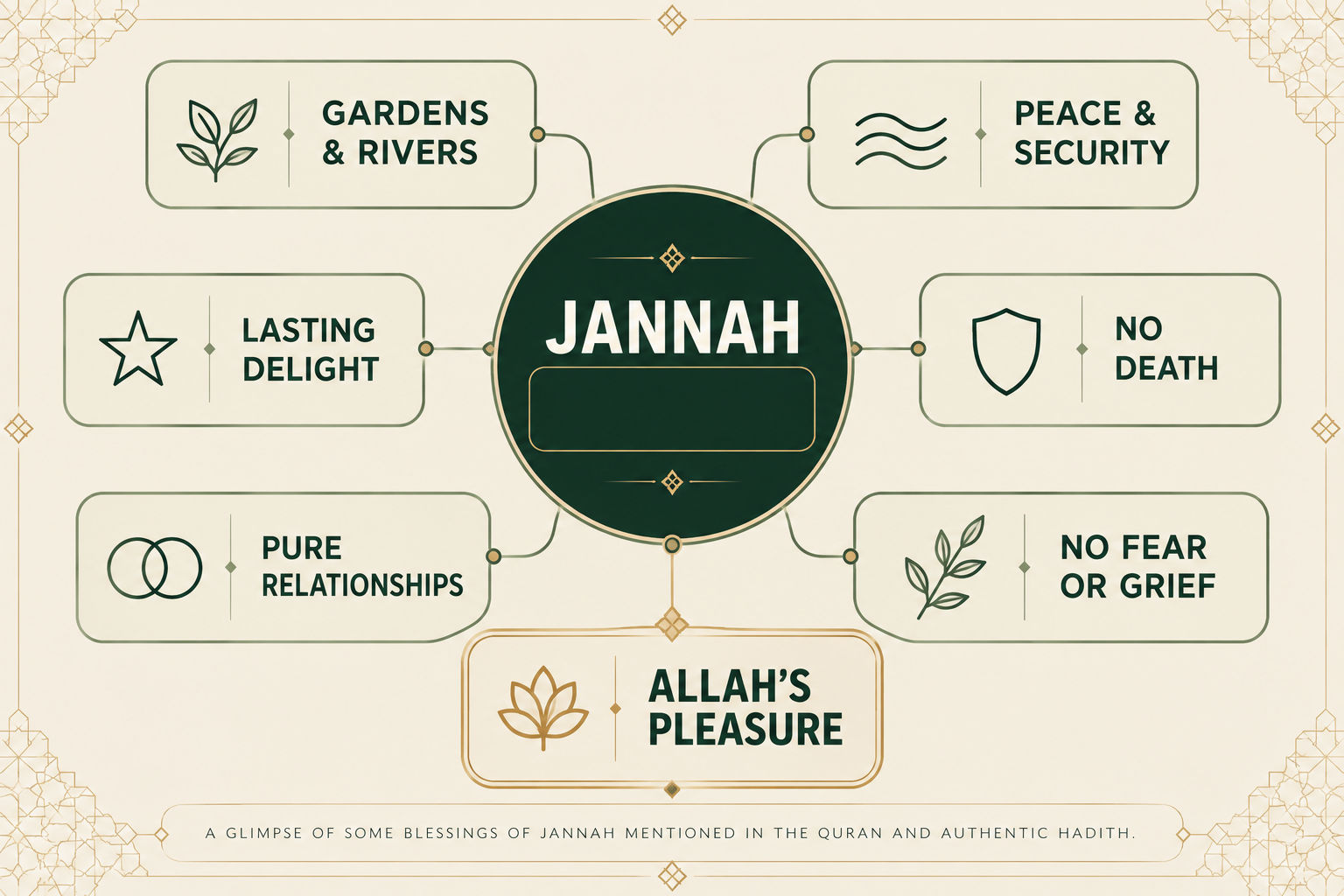
What Does "Jannah" Mean?
The Arabic word al-Jannah (الجَنَّة) comes from the root ج-ن-ن (j-n-n), whose basic sense in Arabic lexicons is covering or concealing. The same root gives us jinn (beings hidden from sight), janīn (an unborn child, hidden in the womb), and mijann (a shield that covers). A jannah in everyday Arabic can therefore mean a garden so dense with trees that its vegetation covers the ground.
The Quran itself uses the word this way for ordinary earthly gardens. It speaks of a man who owned two jannatayn of grapevines surrounded by date palms (18:32), and of "a garden of date palms and grapevines" in the parable at 2:266. These are worldly orchards.
But in the Quran's wider usage, al-Jannah becomes the name of the eternal abode prepared for the believers. A word that began as "a covered garden" now carries the entire promise of the Hereafter. It is important to be careful here: the root helps us understand the word, but we do not build theology from roots. What Jannah is comes from what revelation says about it.
Is "Heaven" the Same as Jannah?
English speakers often translate Jannah as "Paradise" or "Heaven." Both work, but "heaven" can also mean the sky or the heavens, which Arabic expresses with as-samāʾ (السماء) and as-samāwāt. To avoid confusion, this article mostly uses Paradise and Jannah for the eternal abode.
Jannah Belongs to the Hereafter
Belief in the Last Day (al-īmān bil-yawm al-ākhir) is one of the foundations of faith in Islam. Jannah is not an isolated fantasy reward; it is the final destination in a larger story: life, death, the barzakh (the period between death and resurrection), resurrection, judgment, and then Paradise or Hell. If you would like that journey explained step by step, see our article What Happens After We Die? The Islamic Journey from Death to the Hereafter.
Does Jannah Already Exist?
According to mainstream Sunni teaching, yes. The Quran describes Paradise as something "prepared" (uʿiddat, in the past tense) for the righteous (3:133). The Prophet ﷺ also reported being shown Paradise and the Fire, for example during the eclipse prayer, as recorded in the two Sahih collections.
We are not told where it is, and we should not speculate about coordinates. The Quran says only that its breadth is "like the breadth of the heavens and the earth" (3:133), a way of pointing to vastness.
Gardens Beneath Which Rivers Flow
The most repeated phrase in the Quran's description of Paradise is jannātun tajrī min taḥtihā al-anhār (جَنَّاتٌ تَجْرِي مِن تَحْتِهَا الْأَنْهَارُ), "gardens beneath which rivers flow."
For people living in the desert world of revelation's first audience, this image spoke of abundance, life, beauty, refreshment, flourishing, and security. These are the very things a dry land lacks. The picture still speaks to us today, wherever we live, because every human heart knows what it is to long for water, green, and rest.
It would be a mistake to say these descriptions are "merely symbols." Mainstream Islamic teaching affirms that Jannah is real, with real gardens and rivers as Allah describes them. It would be just as much a mistake to claim we understand how they work. We affirm what is said and stop where the text stops.
The Names the Quran Uses for Paradise
The Quran speaks of Paradise with many descriptions:
Jannāt ʿAdn (جنات عدن), "Gardens of ʿAdn," the root meaning to stay or reside (for example 9:72)
Al-Firdaws (الفردوس) (18:107; 23:11)
Dār as-Salām (دار السلام), "the Home of Peace" (6:127; 10:25)
Dār al-Muqāmah (دار المقامة), "the Home of Permanent Residence" (35:35)
Jannāt an-Naʿīm (جنات النعيم), "Gardens of Bliss" (for example 31:8)
Maqʿad ṣidq (مقعد صدق), "a seat of truth/honor" (54:55), which commentators understand as a place of true honor in the presence of a Sovereign who does not fail His promise
Al-Ghurfah / al-Ghuraf (الغرفة / الغرف), "the elevated chambers" (25:75; 39:20)
These are best understood as names and descriptions of the one promised abode. The Quran does not tell us that each is a separate, numbered Paradise, and we will return to that point.
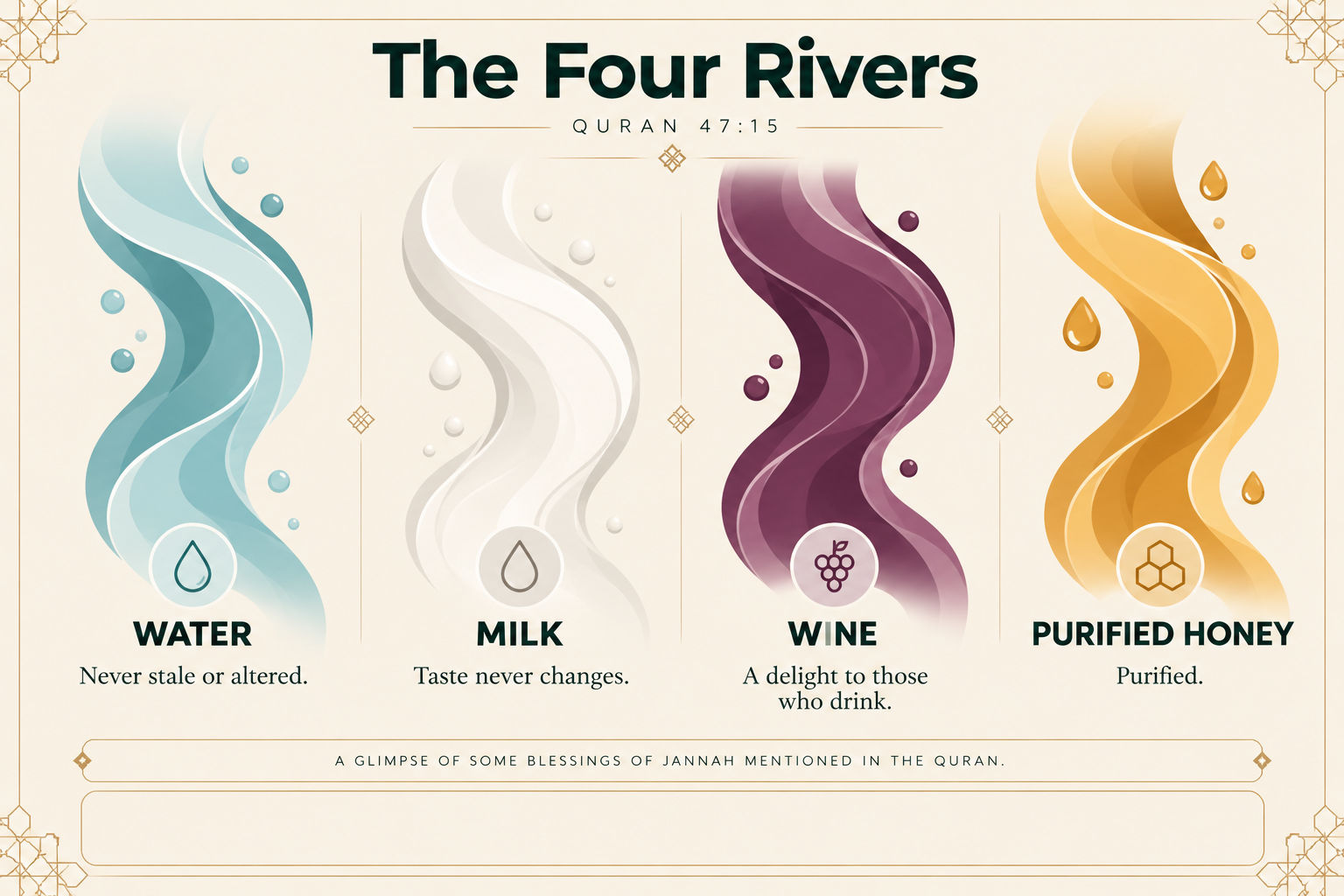
The Four Rivers of Quran 47:15
Surah Muhammad gives one of the most precise descriptions in the Quran. In my own rendering, it describes Paradise as having:
rivers of water that never becomes stale or altered,
rivers of milk whose taste never changes,
rivers of wine that is a delight for those who drink,
rivers of purified honey.
The wine of Jannah is not the wine of this world. The Quran says elsewhere that it brings "no headache" and no loss of reason (37:47; 56:19). What makes worldly intoxicants harmful is simply absent. We are told what is there and what is not, and we do not need to add a single detail to it.
Food, Clothing, and Homes in Jannah
Food and drink. The Quran mentions fruit "of every kind" (55:52), fruit "of what they choose" and the meat of birds "of what they desire" (56:20–21), and drinks served in vessels of silver and cups (76:15–17). The people of Paradise are told: "Eat and drink with enjoyment for what you used to do" (77:43).
Notice the difference: eating in Jannah is not shaped by scarcity or the worry about tomorrow. As for the body's processes, an authentic report in Sahih Muslim says the people of Paradise will eat and drink without the waste of worldly digestion. Beyond that, we do not need to build a physiology of Paradise. Revelation tells us they eat and enjoy; it does not tell us the biological machinery works as it does here.
Clothing and adornment. The Quran mentions garments of green silk and brocade and bracelets of gold (18:31; 22:23; 35:33; 76:21). Materials that signal luxury in this world appear in the description of the next. But we should not project our economies onto them. Gold in Jannah does not mean wealth inequality, status anxiety, or competition. It is part of an honoring in a place where those things have no place.
Homes. The Quran speaks of "good dwellings in the Gardens of ʿAdn" (61:12) and of upper chambers built one above another (39:20). A Sahih report describes a tent made of a single hollowed pearl (Bukhari and Muslim). We will not repeat viral claims of exact palace dimensions, because we do not find authentic support for them.
None of this is the center of the story. If you remember only the furniture of Paradise, you have missed what it is about.
What Disappears in Jannah
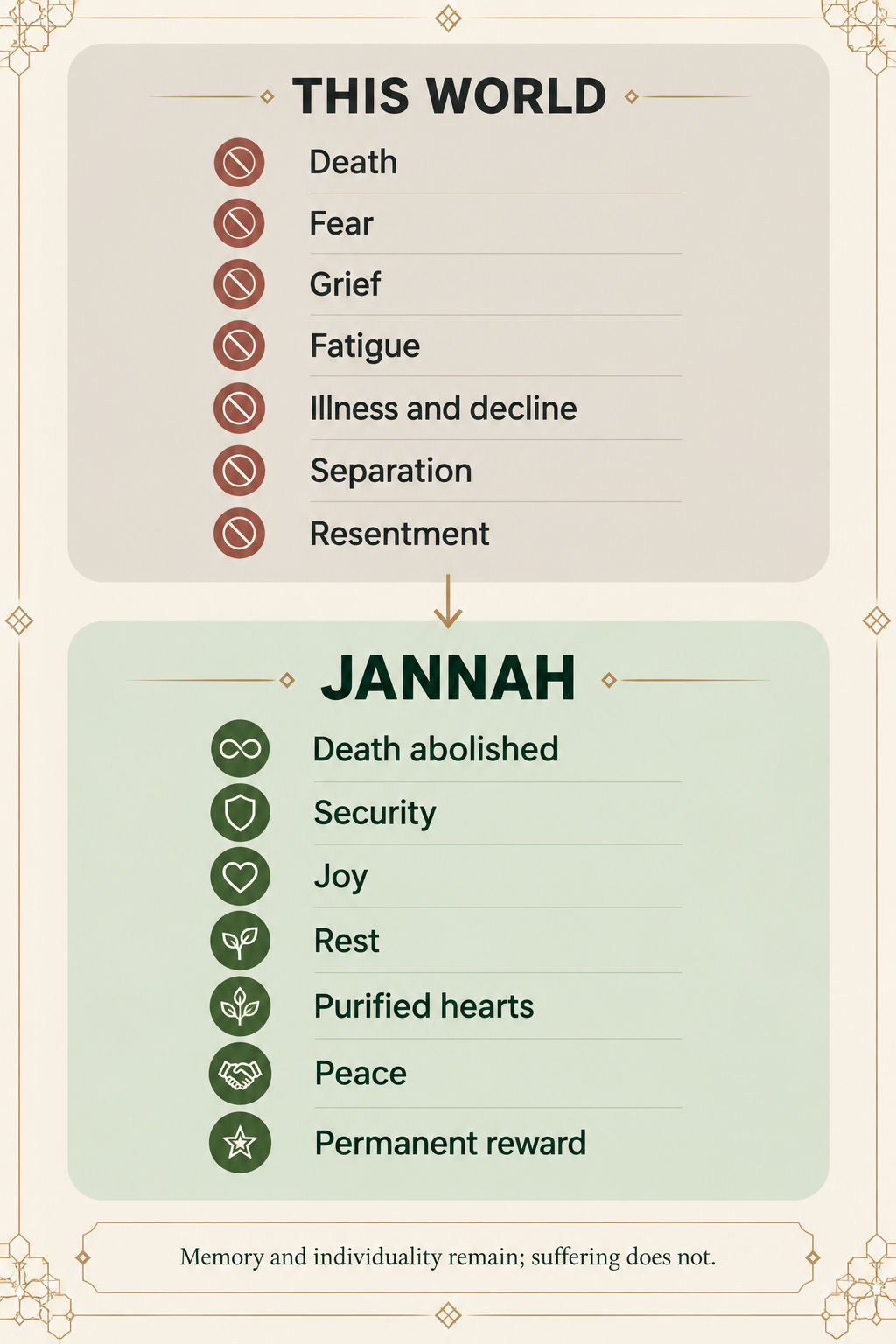
In many ways the most beautiful descriptions of Jannah are about what is taken away.
No death
In an authentic report agreed upon by al-Bukhari (6548) and Muslim, when the people of Paradise and the people of the Fire have settled in their destinations, death is brought forth and then done away with. A caller announces to the people of Paradise: no more death. The Quran also says "they will not taste death therein except the first death" (44:56).
This is what separates Jannah from every worldly pleasure: its joy is not shadowed by mortality.
No illness, aging, or want
Sahih Muslim (2837) records a call to the people of Paradise: that they will be healthy and never fall ill, will live and never die, will be young and never grow old, and will be in ease and never in misery. This is the strongest basis for saying Paradise is free from sickness and decline.
You may have seen the claim "everyone in Jannah will be 33." A narration in Tirmidhi (2545) describes the people of Paradise as entering "thirty or thirty-three years" of age; Tirmidhi graded it hasan gharib. The wording itself shows some variation, and it is not a pillar of belief. What is firmly established is more important: Paradise is free of worldly decline and death.
No toil, weariness, or distress
In Quran 35:34–35, the people of Paradise say: "Praise be to Allah, who has removed grief from us... who, out of His bounty, has settled us in the Home of Permanence, in which no toil touches us and no weariness touches us."
No fear and no grief
Throughout the Quran we find the phrase lā khawfun ʿalayhim wa lā hum yaḥzanūn (لَا خَوْفٌ عَلَيْهِمْ وَلَا هُمْ يَحْزَنُونَ), "no fear upon them, nor will they grieve." We must be careful: not every occurrence is about the moment of entering Paradise. Some address believers in the world or at death, and commentators discuss each context. But the people of Paradise themselves say they have been relieved of grief (35:34).
Jannah is therefore not just a place of pleasures. It is a state in which the conditions that make happiness fragile have been removed.
No rancor
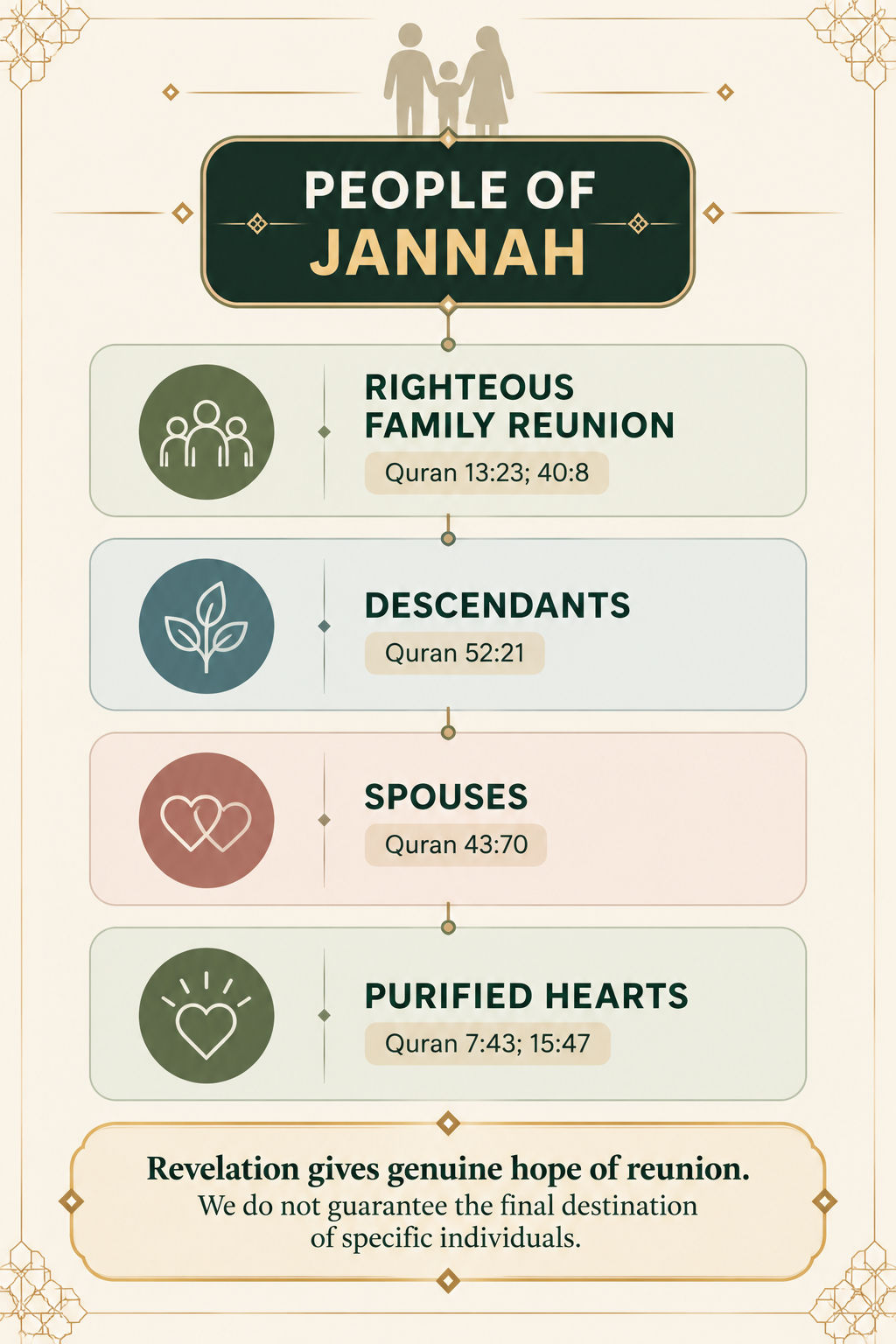
The Quran says: "We will remove whatever rancor (ghill, غِلّ) is in their hearts, as brothers on couches facing one another" (15:47; also 7:43). This matters. Our worldly relationships are strained by jealousy, resentment, and old wounds. We should not imagine Jannah by simply carrying our damaged emotions into it. The hearts of its people are purified.
What about sleep?
You will find a narration online that "sleep is the brother of death, and the people of Paradise do not sleep." It is reported by al-Bazzar, al-Tabarani, and al-Bayhaqi, and scholars have differed over its chains and how firmly it can be relied on. The Quran and the strongest texts do not require us to construct a detailed sleep schedule for Paradise, and we should not claim certainty either way.
Will People Remember? Will They Talk?
Yes. The Quran shows the people of Paradise remembering and speaking.
In Surah at-Tur (52:25–28), they turn to one another and say that they used to be fearful among their families, "but Allah has favored us and protected us from the punishment of the Scorching Wind." In Surah as-Saffat (37:50–57), one speaker recalls a companion in the world who doubted the Resurrection and says that, but for his Lord's favor, he would have been among those brought forward for punishment.
So memory remains where revelation indicates it. Suffering, however, is no longer experienced as it was. Notice what the remembering is for: gratitude for Allah's favor. We should not claim that Allah erases every memory, because the Quran shows otherwise.
The conversation of Paradise is also marked by peace. There they hear no vain or sinful talk, "only the saying: Peace, peace" (56:25–26). The greeting from the Lord Himself is salām (36:58).
What language will they speak?
Many people say Arabic will be the language of Jannah, citing "Love the Arabs for three reasons...". Hadith scholars classify that narration as extremely weak, and some, such as Ibn al-Jawzi, regarded it as fabricated. Ibn Taymiyyah is also reported to have said that it is not established that Arabic is the language of Paradise. This is a cultural assumption, not Aqidah. We simply do not know.
Family, Spouses, and Women in Jannah
Will families be together?
The Quran gives genuine hope. Believers enter the Gardens of ʿAdn "together with those who were righteous among their fathers, their spouses, and their descendants" (13:23; also 40:8). And in 52:21: "Those who believed and whose descendants followed them in faith, We will join their descendants with them, and We will not diminish them of their deeds at all." Classical commentators, including those quoted by Ibn Kathir, understand this to mean that believing descendants may be raised to be with their parents.
This is a real hope. But it is a hope, not a guarantee about any particular individual. A Muslim may pray for reunion with those whom Allah admits to Paradise. We do not say, "You will definitely meet this specific person in Jannah," because that is not ours to say.
On children who die young, many scholars affirm hope for them on the basis of Islamic texts, and there are detailed discussions. We should hold to what is established and trust Allah's justice and mercy with the rest.
Husbands and wives
The Quran says: "Enter Paradise, you and your spouses, delighted" (43:70). Believing spouses may be together there. But there are painful questions people ask: What if a marriage was unhappy? What if someone had more than one spouse? What if one spouse does not enter Paradise? What if someone never married?
Here, revelation does not give us the full arrangement, and we should say so. What we can say, on the strength of the whole of revelation, is this: no one in Jannah will experience injustice, deprivation, resentment, or unwanted misery. Sahih Muslim (2834) also mentions that no one in Paradise will be unmarried. Scholars understand this as reassurance that no one will be left lonely or deprived. We should not invent matchmaking details beyond that.
The Hur al-ʿAyn, and the famous "72"
The Quran mentions ḥūr ʿīn (حُورٌ عِين) among the rewards (44:54; 52:20; 56:22), and describes them as companions who are chaste (55:56). We acknowledge this plainly, and we keep it in proportion. It is one reward among very many, and the Quran does not present Paradise as a reward for men alone.
As for "72": in Tirmidhi (1663), the Prophet ﷺ lists six honors for the martyr, including marriage to seventy-two wives from the Hur al-ʿAyn. Tirmidhi graded it hasan sahih gharib. But this is a specific narration about the martyr, scholars discuss details of its chains and wordings, and some wordings omit the number. It is not a general description of every Muslim's reward, and it is certainly not a "definition" of Paradise.
What about women?
Many Muslim women meet distressing and distorted claims online. The Quran is clear. Allah promises believing men and believing women alike:
"Whoever does righteous deeds, male or female, while a believer, We will surely cause him to live a good life, and We will surely give them their reward according to the best of what they used to do" (16:97).
"Whoever does righteous deeds, whether male or female, while being a believer, those will enter Paradise and will not be wronged even as much as a speck" (4:124; see also 40:40).
The long list of believing men and women in 33:35 ends with "Allah has prepared for them forgiveness and a great reward."
And 9:72 begins: "Allah has promised the believing men and the believing women gardens..."
No one is told, "Your only reward is your husband." We do not invent female equivalents of rewards where revelation is silent; we rely on the broad promise that there is "whatever the souls desire and whatever delights the eyes" (43:71).
"Whatever You Desire"
Three verses repeat this promise: "You will have therein whatever your souls desire, and you will have therein whatever you ask for" (41:31); "therein is whatever the souls desire and the eyes delight in, and you will abide therein forever" (43:71); and "they will have whatever they wish therein, and with Us is more" (50:35).
This is a magnificent promise, and it needs careful reading. It does not mean Paradise contains sin, cruelty, injustice, or the desires produced by damaged hearts. The people of Paradise are themselves purified. Nor should it be turned into a picture of a "magical manifestation machine." We use only what revelation says.
Questions people ask
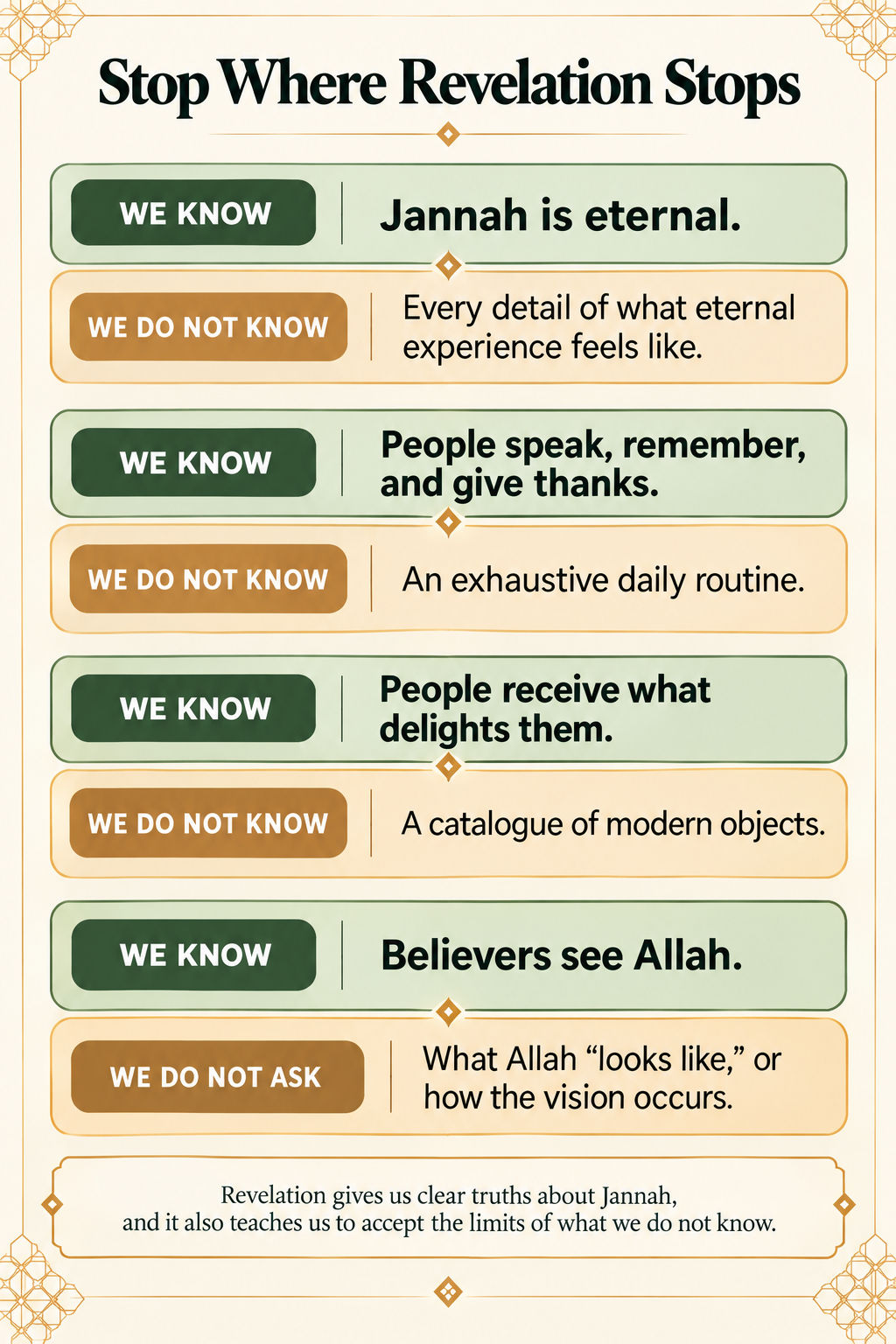
Modern things, technology, cars, games? Revelation does not give a catalog of modern products. Allah promises far beyond what we can presently imagine. So we do not confidently promise specific objects, and we do not confidently deny every possibility. A mature response is to stop where revelation stops.
Pets? This is a heartfelt question. The Quran says animals will be gathered (81:5), and an authentic report in Sahih Muslim (2582) says rights will be settled between creatures. Some later sources mention particular animals in Paradise, and others say animals are returned to dust after judgment; the reports I checked vary in strength, and scholars differ. We therefore cannot tell a grieving pet owner that a specific pet will definitely be there. We can say that Allah has promised the people of Paradise they will not be wronged or left deprived, and that Allah is the Most Merciful.
Work? In Sahih al-Bukhari (7519), the Prophet ﷺ tells of a man in Paradise who asks his Lord's permission to farm, though he already has all he wishes. Allah grants it, and the crop is ready almost at once. The point of the narration is the way desire and enjoyment are no longer tied to toil or necessity. We are not told to expect worldly employment.
Boredom? Revelation describes lasting delight and satisfaction; it does not present Jannah as an endless repetition that becomes tedious. The Quran says the people of Paradise "will not desire any change" (18:108). Our fear of boredom comes from a world where pleasures fade and bodies tire.
Will they want to return to Earth? A Sahih report (al-Bukhari 2817) says that no one who enters Paradise would wish to return, except the martyr, who would wish to return and be killed again because of the honor he has seen. That is a specific statement and we should not generalize it beyond its context.
Is Jannah Physical or Spiritual?
Both. Islamic revelation describes real bodily and spiritual rewards. The Resurrection itself is bodily and real. Jannah includes food, drink, clothing, dwellings, companionship, and bodily enjoyment, and also peace, security, purity, freedom from grief, spiritual joy, and Allah's pleasure. To say it is only "spiritual" ignores the texts, and to say it is only material consumption misses what the texts are pointing toward.
"No Soul Knows What Has Been Hidden"
Quran 32:17 may be the defining verse of this whole subject: "No soul knows what has been hidden for them of comfort for the eyes, as reward for what they used to do."
In an authentic Hadith Qudsi recorded by al-Bukhari (3244) and Muslim (2824), the Prophet ﷺ reports that Allah says He has prepared for His righteous servants what no eye has seen, no ear has heard, and no human heart has conceived. Abu Hurayrah رضي الله عنه then said: recite if you wish, 32:17.
This does not mean the descriptions are empty. It means they are given in language we can understand, while the full reality is beyond our present experience.
Levels, al-Firdaws, and the Eight Gates
Are there levels?
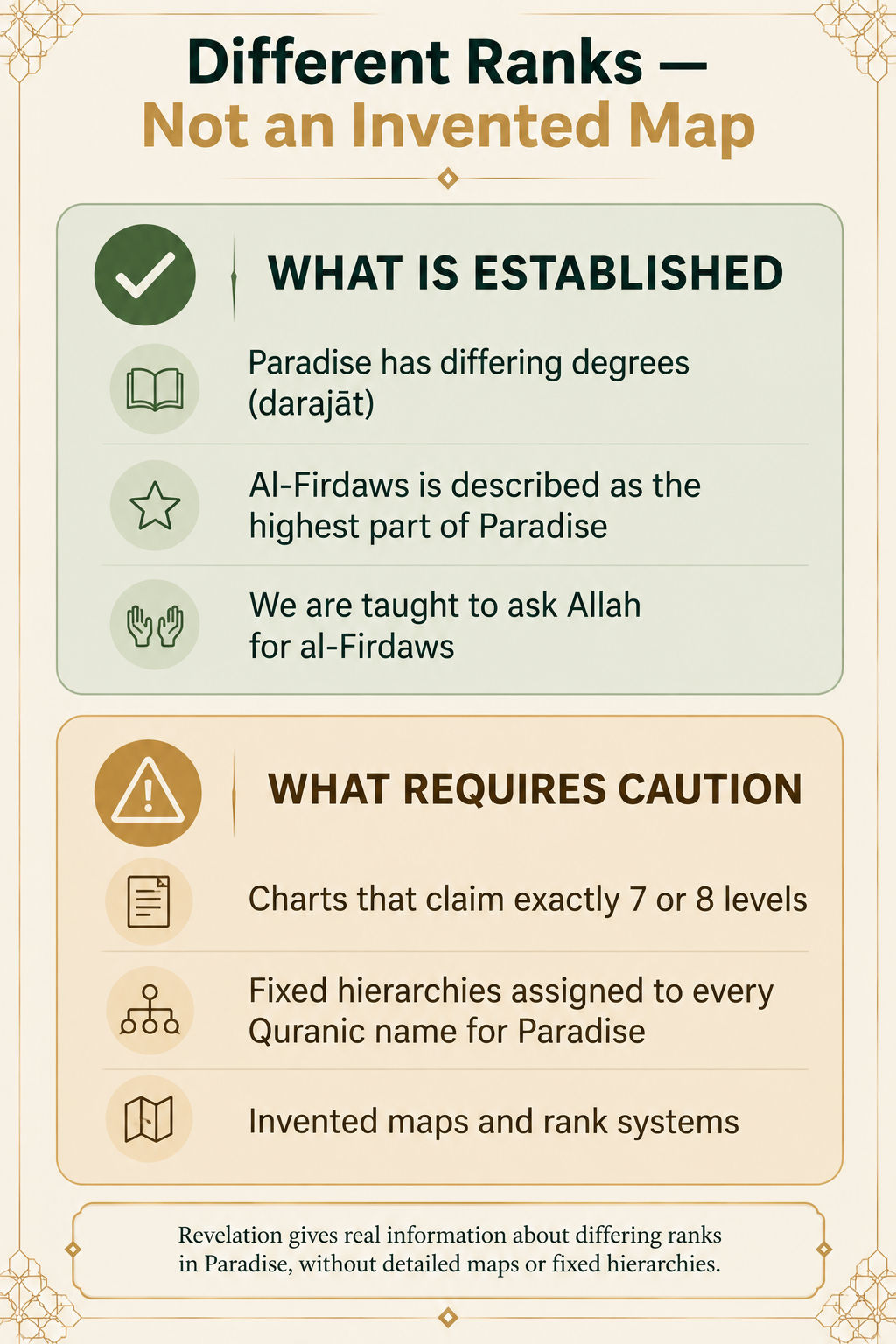
Yes, the texts speak of darajāt (درجات), degrees or ranks. "See how We have preferred some of them over others, and the Hereafter is greater in degrees and greater in favor" (17:21). The Quran also speaks of "high degrees" for those who come with faith and righteous deeds (20:75). So believers do not receive identical ranks.
But be careful with internet charts that list "the 8 levels of Jannah" and assign a fixed hierarchy to Firdaws, ʿAdn, Dar as-Salam, and the rest. We have distinguished between names and descriptions of Paradise and proven distinct hierarchical levels. The Quran does not establish those names as exactly eight stacked levels. A Sahih hadith (al-Bukhari 2790) mentions that Paradise has a hundred degrees, with a great distance between each; we can affirm that without drawing a map of the unseen.
What is al-Firdaws?
Al-Firdaws (الفِرْدَوْس) appears twice in the Quran: "those who believed and did righteous deeds, for them are the Gardens of al-Firdaws as a lodging" (18:107), and "those are the inheritors who will inherit al-Firdaws, abiding therein" (23:10–11).
In Sahih al-Bukhari (2790), the Prophet ﷺ taught that when you ask Allah, you should ask for al-Firdaws, for it is the middle of Paradise and the highest part of Paradise, above it is the Throne of the Most Merciful, and from it flow the rivers of Paradise. Notice the teaching: the Prophet ﷺ encouraged Muslims to ask for the highest. Do not shrink your hope.
How many gates?
An authentic report in al-Bukhari (3257) says Paradise has eight gates, one of which is called ar-Rayyān (الريان), through which only those who fast will enter. Another Sahih hadith (al-Bukhari 1897; Muslim 1027) adds that people will be called from the gate of prayer, the gate of jihad, the gate of charity, and the gate of fasting, according to the kind of good they excelled in.
Abu Bakr رضي الله عنه asked whether anyone would be called from all the gates. The Prophet ﷺ replied that yes, and he hoped Abu Bakr would be one of them. We do not have authentic names for all eight gates, so we do not invent a list. And we do not need to obsess over finding "our gate." The lesson is that goodness has many doors.
Who Enters Jannah?
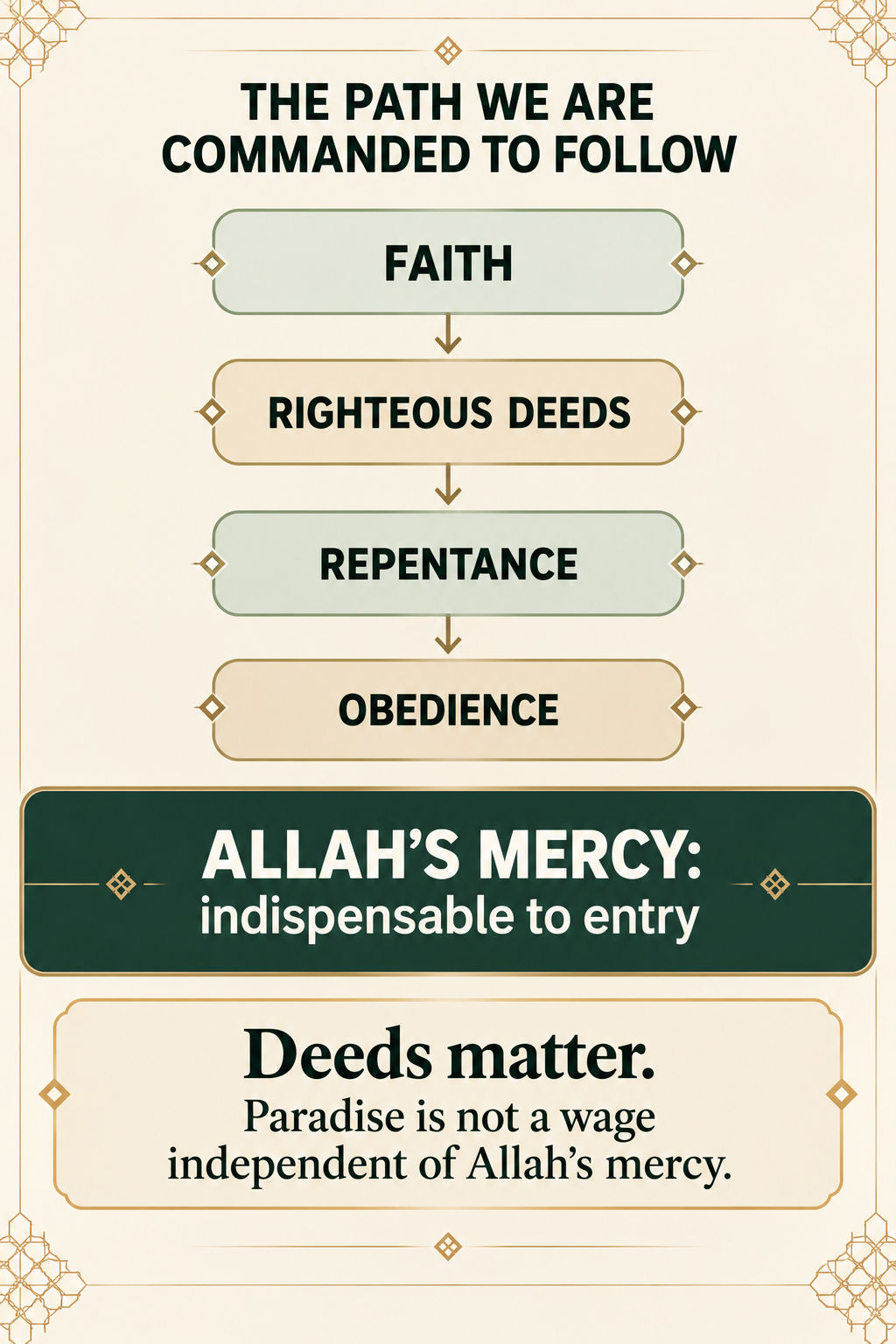
The Quran repeatedly joins faith (īmān) and righteous deeds (ʿamal ṣāliḥ), for example "Those who believe and do righteous deeds, they are the companions of Paradise, abiding therein" (2:82). Repentance (tawbah) opens the door for those who have slipped: Allah accepts repentance from His servants (42:25).
Do our deeds earn Paradise?
This is among the most important questions. In Sahih al-Bukhari (5673) and Muslim (2816), the Prophet ﷺ said that no one's deeds will, by themselves, cause him to enter Paradise. The Companions asked, "Not even you, O Messenger of Allah?" He said, "Not even me, unless Allah envelops me in mercy from Him and favor."
Yet the Quran also says, "This is Paradise which you have been made to inherit for what you used to do" (43:72), and "Enter Paradise for what you used to do" (16:32). How do these fit together?
Scholars have long explained that deeds are causes and means associated with entry and with ranks, which Allah in His generosity has linked to His reward. But Paradise is not a commercial wage equal to the value of our deeds. Even the ability to do a good deed is a gift from Allah. So we hold both truths:
Deeds matter. Paradise is not a wage independent of Allah's mercy.
We should not say "good behavior alone buys Paradise," and we should not say "deeds do not matter because Allah is Merciful." Both are mistakes.
Mercy, hope, and the sinner
Allah says: "Say, O My servants who have transgressed against themselves, do not despair of the mercy of Allah. Indeed, Allah forgives all sins" (39:53). That verse is an invitation, not a license.
Mainstream Sunni teaching holds that a Muslim should neither guarantee Paradise for himself simply because he is a Muslim, nor despair because of past sins. Allah says that He does not forgive associating partners with Him, but forgives what is less than that for whom He wills (4:48). A believer lives between hope (rajāʾ) and responsible obedience.
Can we say that a specific person is in Jannah?
Not without revelation. There are individuals and groups whom the Prophet ﷺ named in authentic reports, such as the ten Companions given glad tidings (Tirmidhi 3747). Otherwise we refrain from certainty about someone's final destination. In the account of ʿUthman ibn Maẓʿun (al-Bukhari 1243), the Prophet ﷺ taught the Companions not to declare certainty about a specific person's final destination.
This distinction between hoping for someone and being certain about their destination matters especially when we speak about those we have lost.
Is Jannah Eternal?
Yes. The Quran says again and again that its people are khālidīna fīhā abadan (خَالِدِينَ فِيهَا أَبَدًا), "abiding therein forever" (for example 98:8; 4:57; 65:11). That means no expiry, no eviction, no death, and no fear that happiness will end.
The Greater Reward: Allah's Pleasure, and Seeing Allah
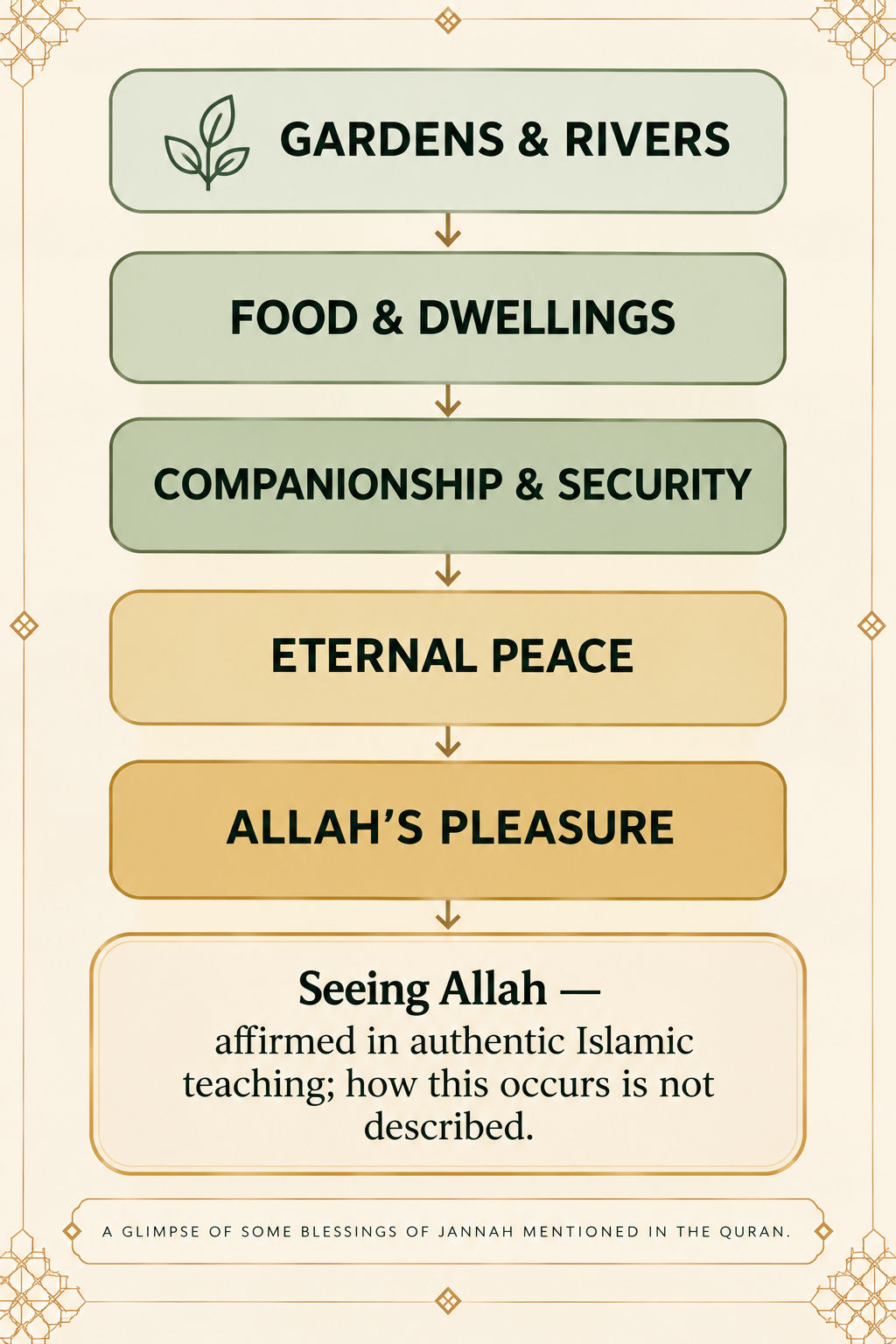
Here the article turns, and so does revelation, from gardens, rivers, food, homes, relationships, security, and eternity toward something greater.
Allah says: "Allah has promised the believing men and believing women gardens beneath which rivers flow, abiding therein eternally, and pleasant dwellings in the Gardens of ʿAdn. But approval from Allah (riḍwān, رِضْوَان) is greater. That is the great attainment" (9:72).
After all the rivers and palaces, the Quran says that Allah's pleasure is greater.
Will believers see Allah?
According to mainstream Sunni teaching, yes. The Quran says: "Faces that Day will be radiant, looking at their Lord" (75:22–23). In the Quran's discussion of those who do good, "for them is the best (al-ḥusnā) and more (ziyādah)" (10:26).
In Sahih Muslim (181), the Prophet ﷺ explained that when the people of Paradise have entered it, Allah asks if they want anything more, and they say that He has brightened their faces and admitted them to Paradise and saved them from the Fire. Then the veil is lifted, and they are given nothing more beloved to them than looking at their Lord. The Prophet ﷺ then recited 10:26. Another report (al-Bukhari 554; Muslim 633) says: "You will see your Lord as you see this moon," and the scholars explain that this likens the seeing (its clarity, with no crowding or difficulty) and never likens Allah to anything.
There is a firm boundary here. We affirm what revelation affirms, without asking how. We do not describe Allah's form, size, shape, direction, or the mechanism of seeing, and we do not compare Allah to His creation. As the Quran says, "There is nothing like Him, and He is the All-Hearing, the All-Seeing" (42:11).
The greatest joy
That is why Sunni scholars have long said the highest delight of Paradise is connected to the believer's relationship with their Lord: His pleasure, and the vision of Him. Jannah is not ultimately about luxury.
Allah describes the people of Paradise as those with whom He is pleased and who are pleased with Him (98:8).
What Will People Feel and Say?
When they enter, they are greeted: "Peace be upon you; you have done well, so enter, abiding therein" (39:73). They answer: "Praise be to Allah, who has fulfilled His promise to us" (39:74). They say: "Praise be to Allah, who guided us to this. We would never have been guided had Allah not guided us" (7:43). And: "Praise be to Allah, who has removed grief from us" (35:34).
Gratitude, peace, security, contentment, and praise: this is how revelation describes the inner life of Paradise. Notice that it is full of thanks, and none of it is boasting.
Common Myths About Jannah
Myth: Jannah is only a beautiful garden. The Quran's descriptions are much broader: rivers, dwellings, companionship, peace, and Allah's pleasure.
Myth: Jannah is purely spiritual. Revelation describes bodily resurrection and real physical as well as spiritual rewards.
Myth: Every man gets exactly 72 virgins. The "72" appears in a specific narration about the martyr, with scholarly discussion about its wording. It is not a general description.
Myth: Women receive fewer rewards. Allah promises believing men and women reward without injustice (4:124; 16:97; 33:35).
Myth: Everyone in Jannah is definitely 33 years old. The narration is graded hasan gharib and is not a pillar of belief.
Myth: Arabic is certainly the language of Jannah. The famous narration is extremely weak; the matter is unknown.
Myth: A righteous Muslim automatically knows he is guaranteed Jannah. Islam teaches hope, not self-guarantee.
Myth: Good deeds purchase Paradise. Deeds matter, but entry is through Allah's mercy.
Myth: Jannah is exactly whatever you can imagine. Its reality exceeds present imagination (32:17).
Myth: All people in Paradise have identical ranks. Authentic texts indicate differing degrees.
Myth: There are exactly eight named levels of Jannah. Names and descriptions are not the same as a proven hierarchy of levels.
Myth: Believing in Jannah means ignoring worldly suffering. Islam commands responsible action in this life.
What We Know, and What We Should Not Invent
Question | What revelation establishes | What we should not invent |
|---|---|---|
Food | People of Jannah eat, drink, and enjoy provision | Detailed biological mechanics |
Family | Revelation gives hope of righteous family reunion | Guaranteeing specific individuals |
Age | No worldly decline or death | Treating the "33" wording as a central doctrine |
Language | People speak and greet one another with peace | Certainty about one spoken language |
Desires | They receive what delights them | Modern fantasy catalogs |
Sleep | Debated narrations; no required schedule | A detailed sleep routine |
Levels | Differing degrees; special rank for al-Firdaws | A fixed "8 levels" map |
Allah | Believers see Allah according to authentic Sunni teaching | Describing how Allah looks, or how the vision occurs |
Eternity | Jannah is everlasting | Treating eternity like worldly boredom |
How Belief in Jannah Should Change Us Now
Learning about Jannah should move us from "What will I get?" to "What kind of person should I become if I truly hope to meet Allah?"
That might look like:
Praying with more presence, and seeking forgiveness quickly after mistakes
Patience when a hardship is long
Generosity and forgiving others, remembering that Paradise is a place without rancor
Refusing to lie, cheat, or wrong people for a short-term gain
Making time for the Quran and Islamic knowledge, including learning enough Arabic to hear the Quran directly
We do not want transactional spirituality of the "do X, get mansion Y" kind. We want hearts oriented toward Allah.
Jannah, grief, and hardship
Hope in the Hereafter is real comfort, but it does not require us to deny pain. A Muslim can grieve, seek help, make dua, take action, and hope in the Hereafter all at once. Paradise is never an excuse to ignore injustice, illness, poverty, abuse, or the need for mental-health care. And it is never a reason to tell an abused person to tolerate harm.
When we lose someone, we should say, "We ask Allah to forgive them and admit them into Jannah," rather than "They are definitely in Jannah now." A related distinction: the barzakh is not the same as final entry into Paradise after the Resurrection. The Prophet ﷺ taught that after death a believer is shown his place morning and evening (al-Bukhari 1379), but we should not imagine every deceased believer is already living the final post-Judgment experience.
If a child asks, "Will I see Grandma in Jannah?", a good answer is: "Allah has promised that the people of Jannah will be completely happy and will have wonderful things beyond what we can imagine. We pray that Allah brings us together there." We distinguish what Allah promised from what we hope.
Seeking the Hereafter does not mean abandoning this world
A Muslim still works, learns, raises children, treats illness, helps people, builds useful things, and opposes injustice. The Hereafter gives these actions direction rather than replacing them.
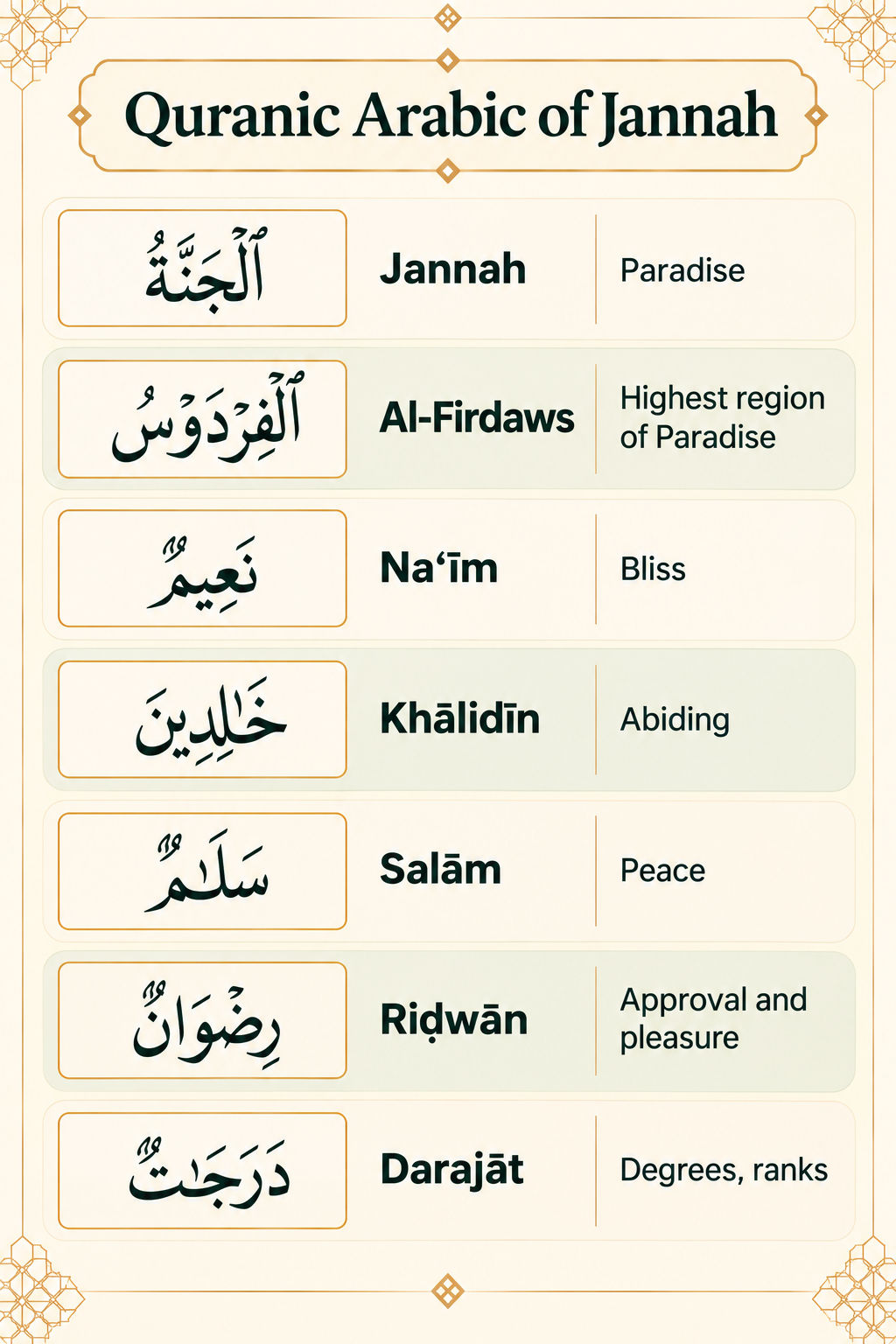
Quranic Arabic: Words That Open Paradise
Understanding even a few words transforms how we hear the Quran. Here are some key terms: Arabic, transliteration, core meaning, where you meet it, and what it teaches.
Arabic | Transliteration | Core meaning | Quranic context | What it teaches us |
|---|---|---|---|---|
جَنَّة | jannah | garden, Paradise | 18:32 (a garden); 3:133 (Paradise) | One word can hold both a garden and the whole promise of the Hereafter |
فِرْدَوْس | firdaws | Firdaws, the highest region of Paradise | 18:107; 23:11 | We are taught to aim high |
نَعِيم | naʿīm | bliss, delight | 31:8 | Paradise's pleasure is deep and secure |
خَالِدِينَ | khālidīn | abiding | 98:8 | No expiry, no eviction |
أَبَدًا | abadan | forever | 4:57 | The promise has no end |
سَلَام | salām | peace | 36:58; 56:26 | Peace is the atmosphere of Paradise |
رِضْوَان | riḍwān | approval, pleasure | 9:72 | Allah's pleasure is greater than everything else |
أَنْهَار | anhār | rivers | 47:15 | Abundance and life |
غِلّ | ghill | rancor | 7:43; 15:47 | Hearts are purified |
دَرَجَات | darajāt | degrees, ranks | 17:21 | Differing ranks exist |
Learning even this short list shows how Quranic Arabic deepens understanding. That is the heart of what we do at Araby Academy: helping students move from translation toward direct contact with the Quran's own words.
Duas for Jannah
Some Duas are the exact words of the Quran or the Prophet ﷺ, and some are personal. We separate them clearly.
1. A Quranic dua (2:201)
Arabic: رَبَّنَا آتِنَا فِي الدُّنْيَا حَسَنَةً وَفِي الْآخِرَةِ حَسَنَةً وَقِنَا عَذَابَ النَّارِ
Transliteration: Rabbanā ātinā fid-dunyā ḥasanatan wa fil-ākhirati ḥasanatan wa qinā ʿadhāban-nār.
Meaning: Our Lord, give us good in this world and good in the Hereafter, and protect us from the punishment of the Fire.
Source: Quran 2:201.
2. A Quranic dua of Ibrahim ﷺ (26:85)
Arabic: وَاجْعَلْنِي مِن وَرَثَةِ جَنَّةِ النَّعِيمِ
Transliteration: Wajʿalnī min warathati jannati-n-naʿīm.
Meaning: Make me among the inheritors of the Garden of Bliss.
Source: Quran 26:85.
3. A Prophetic dua to ask for Paradise
Arabic: أَسْأَلُ اللَّهَ الْجَنَّةَ وَأَعُوذُ بِهِ مِنَ النَّارِ
Transliteration: Asʾalullāha al-jannah wa aʿūdhu bihi minan-nār.
Meaning: I ask Allah for Paradise and seek refuge in Him from the Fire.
Source: Sunan Abi Dawud 792 (grading to be confirmed by editorial team before publication).
4. Asking for al-Firdaws The Prophet ﷺ instructed us to ask Allah for al-Firdaws (al-Bukhari 2790), but he did not give a fixed wording in that hadith. The following is a personal dua based on that instruction, not a quoted Hadith:
Arabic: اللَّهُمَّ إِنِّي أَسْأَلُكَ الْفِرْدَوْسَ الْأَعْلَى مِنَ الْجَنَّةِ
Transliteration: Allāhumma innī asʾaluka al-firdawsa al-aʿlā minal-jannah.
Meaning: O Allah, I ask You for the highest Firdaws of Paradise.
5. For a deceased believer
Arabic: اللَّهُمَّ اغْفِرْ لَهُ وَارْحَمْهُ وَعَافِهِ وَاعْفُ عَنْهُ
Transliteration: Allāhummaghfir lahu warḥamhu wa ʿāfihi waʿfu ʿanhu.
Meaning: O Allah, forgive him, have mercy on him, give him well-being, and pardon him.
Source: Sahih Muslim 963 (one portion of a longer funeral supplication).
Conclusion: A Home Where Nothing Good Ends
We began with the shadow inside every happy moment: it must end.
Jannah is described as the opposite. No death waits after happiness. No illness waits after health. No separation threatens companionship. No fear follows security. No grief interrupts joy.
But the Quran does not end with rivers and palaces. It ends with something greater: Allah's mercy, Allah's pleasure, and, according to authentic Islamic teaching, the believers seeing their Lord.
So the right response to learning about Jannah is not fantasy. It is faith, hope, repentance, worship, good character, responsible action, and dua.
Jannah is not given to us so that we can map every detail of the unseen. It is described so that we know what we are walking toward.
The Quran gives enough detail to awaken longing. The Sunnah gives further authentic glimpses. Beyond that, a Muslim learns to stop where revelation stops.
May Allah make us among the people of al-Firdaws, and forgive us, and admit us through His mercy.
Frequently Asked Questions
1. What is Jannah? Jannah is the eternal Paradise that Allah has prepared for believers, described in the Quran and authentic Sunnah, and part of the unseen.
2. What is Jannah like according to the Quran? The Quran describes gardens with rivers, dwellings, food and drink, silk and adornment, peace, companionship, purified hearts, freedom from fear and grief, and, above all, Allah's pleasure (9:72).
3. Is Jannah physical or spiritual? Both. Revelation describes real bodily and spiritual rewards, and the Resurrection itself is real.
4. Is Jannah eternal? Yes. The Quran describes its people as abiding there forever (98:8), and death is abolished (al-Bukhari 6548; Muslim 2850).
5. Are there different levels of Jannah? There are differing degrees (darajāt), but we do not rely on fixed "8 levels" charts, as these are not established as such.
6. What is al-Firdaws? The Prophet ﷺ described it as the middle and highest part of Paradise and taught us to ask Allah for it (al-Bukhari 2790).
7. How many gates does Jannah have? Eight, according to authentic Hadith. Only some are named in authentic reports, such as ar-Rayyān for those who fast.
8. Will people eat and drink in Jannah? Yes, the Quran says so in many places. We do not build a detailed physiology.
9. Will people die or age in Jannah? No. Death is abolished, and Sahih Muslim (2837) promises health, life, youth, and ease without end.
10. Will families be together in Jannah? Revelation gives real hope of reunion among the righteous (13:23; 52:21), though we do not guarantee any specific person's destination.
11. Will people remember their life on Earth? Yes, the Quran shows people of Paradise recalling their former life (52:25–28; 37:50–57), with gratitude.
12. Will women receive the same reward in Jannah? Allah promises believing men and women reward without injustice (4:124; 16:97; 33:35).
13. Will people have whatever they want? The Quran promises "whatever the souls desire" (43:71), by people whose hearts are purified.
14. Do good deeds earn Jannah, or do we enter through Allah's mercy? Both are true in the way scholars explain: deeds matter, but entry is by Allah's mercy (al-Bukhari 5673; Muslim 2816).
15. Will believers see Allah in Jannah? According to mainstream Sunni teaching, yes (75:22–23; Sahih Muslim 181), without asking how.
16. What language will people speak in Jannah? We do not know. The famous narration that it is Arabic is extremely weak.
17. Will pets be in Jannah? We cannot promise any specific pet. Allah has promised that the people of Paradise will not be wronged or left deprived.
18. Does Jannah already exist? Yes, according to mainstream Sunni teaching (3:133).
19. Can we know that a specific deceased person is in Jannah? Not without revelation. We hope and pray for them.