Imagine learning the Quran with no printed Mushaf in your home, no phone, no recitation app, no audio, and no video lessons. How would you know you were pronouncing a word correctly? How would a teacher catch your mistake? How would you remember what you had learned, and how would your children carry it on after your teacher was gone?
The title is a question meant to provoke curiosity, not a claim that early Muslims had no schools or books. Handwritten Mushafs, elementary schools called Kuttab and Maktab, madrasas, and libraries all existed long before mass printing. The real story is that Muslims learned the Quran before printed books through direct oral teaching, memorization, handwritten materials, organized instruction, and teacher-student transmission, all working together. None of these depended on modern technology, and the mix changed by region and century.
This article follows that learning experience: who taught, how correction worked, what students wrote on, and what survives in good teaching today. For the larger story of compilation and preservation, see Araby Academy's article on how the Quran was preserved.
Learning the Quran During the Prophet's Lifetime
The Quran was revealed gradually over about twenty-three years. It describes itself as revealed in portions so that the Prophet ﷺ might recite it to people "over a prolonged period" (17:106). Araby Academy's article on why the Quran was revealed over 23 years explores the wisdom of that pacing. For education, it meant the early community met the Quran in manageable pieces, heard it recited, and was asked to recite it back. The Quran also commands measured, deliberate recitation (tartil, 73:4).
Authentic reports show learning by ear and voice:
Ibn Mas'ud says in Sahih al-Bukhari that he learned some seventy-odd Surahs directly from the Prophet's mouth.
The Prophet ﷺ asked Ibn Mas'ud to recite to him and listened (Sahih al-Bukhari, no. 5050).
A report in Bukhari and Muslim says the Prophet ﷺ recited to Ubayy ibn Ka'b at Allah's command.
Another famous report has Umar bringing Hisham ibn Hakim to the Prophet ﷺ over a difference in recitation. The Prophet ﷺ had both recite and affirmed each.
The Prophet also named recognized teachers. In Sahih al-Bukhari he directs people to take the Quran from four Companions: Ibn Mas'ud, Salim (the freed slave of Abu Hudhayfah), Mu'adh ibn Jabal, and Ubayy ibn Ka'b. This marks recognized teachers, not a limit on how many knew the Quran.
The teaching ethic is summed up in a Hadith narrated by Uthman ibn Affan in Sahih al-Bukhari (no. 5027): "The best of you are those who learn the Quran and teach it." In the same narration, Abu Abd al-Rahman al-Sulami is said to have taught Quran in Kufah from Uthman's caliphate for decades.
You may have heard that Companions learned ten verses at a time and would not move on until they had learned their meaning and practice. That report is attributed to certain Companions, not stated as a universal rule, and I leave it aside because its attribution and status need separate verification.
Writing and memory coexisted from the start. Zayd ibn Thabit's report in Sahih al-Bukhari mentions the shoulder blade and the board (lawh) among the surfaces used when revelation was recorded, and the Prophet ﷺ had scribes of revelation. There was no single bound, standardized volume yet, but the Quran was not exclusively oral. It was recited, memorized, and written.
After the Prophet: Teachers Spread With the Community
When revelation ended, learning continued through Companions and the generation that learned from them, the Tabi'un. As Muslim communities grew, learning centers formed around teachers. The sources link recognized Quran teachers with major cities. Zayd ibn Thabit and Ubayy ibn Ka'b are associated with Madinah, Ibn Abbas with Makkah, Ibn Mas'ud with Kufah, Abu Musa al-Ash'ari with Basrah, and Abu al-Darda' with Damascus. These associations are well attested, but regions did not all teach identically, and I do not assume specific student-teacher pairings beyond what the sources establish.
Expansion created a practical need. People living far from the Prophet's city needed teachers, and different teachers had learned in different settings. That need is part of why the later standardization of codices and, eventually, systematic study of recitation traditions mattered. Teaching was local, personal, and dependent on who was available.
Writing Materials and the Handwritten Mushaf
Early literary reports name palm stalks, thin stones, shoulder blades, and pieces of parchment or leather. Papyrus was also used in the wider Islamic world. These reports are literary evidence. Surviving physical manuscripts, mostly parchment in the early period, are a separate body of evidence, and the two should not be confused. François Déroche's work on early Qur'ans, such as Qur'ans of the Umayyads (2014), shows how scholars study script, format, and production from surviving codices.
After papermaking reached the Islamic world, which Jonathan Bloom traces in Paper Before Print (2001), paper gradually became important for books, including Qur'ans, while parchment persisted in some places.
A manuscript was a physical object made by skilled labor: preparing the writing surface, writing, correcting, and binding. Access to a personal copy varied with period, place, wealth, and institution. I do not give production costs because I cannot support figures. It would be wrong to say all Muslims owned a Mushaf, and equally wrong to say copies were unavailable.
How Did Students Learn Accurate Pronunciation Without Recordings?
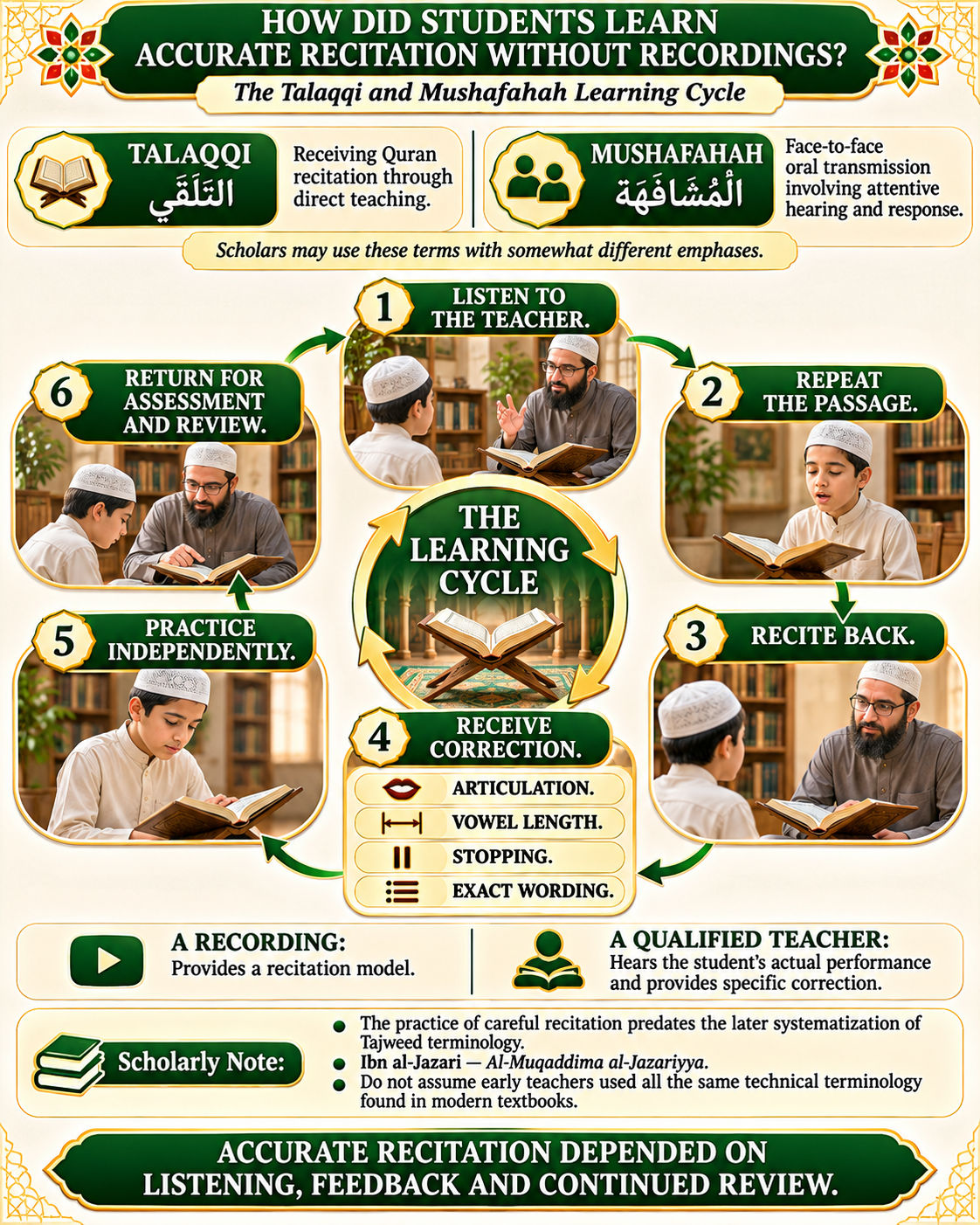
This was done by talaqqi, learning by direct reception from a teacher. The student heard the teacher, repeated, and recited back to be corrected. Mushafahah is a related term for face-to-face oral transmission: the student listens closely to the teacher's pronunciation and the teacher listens to the student's. Different scholars use these terms with slightly different emphases, so I treat them as describing the shared practice and not a fixed procedure.
A learning cycle would typically include:
Listening to the teacher recite a passage.
Repeating it.
Reciting it back from memory or from text.
Receiving correction on sounds, vowel lengths, stops, or wording.
Practicing alone.
Returning for assessment, then revising earlier material.
A recording gives you a model to hear. A teacher gives you a response: they hear what you actually did and fix it. The Prophet's regular review of the Quran with Jibril, reported in Sahih al-Bukhari, is the foundation for the idea of reciting to someone for confirmation.
Careful recitation existed long before the technical vocabulary of Tajweed was systematized. Early teachers attended to articulation and recitation quality without textbooks in today's sense. Later scholars organized the science, in works such as Ibn al-Jazari's al-Muqaddima al-Jazariyya, a poem on Tajweed rules that students still memorize. I do not claim early teachers used today's exact terminology. Oral teaching did not make mistakes impossible either. It reduced them through correction and review. For a modern introduction, see Araby Academy's beginner's guide to Tajweed.
What Was a Kuttab or Maktab?
Kuttab (plural katatib) and maktab both come from the root for writing, and the terms were used in different ways across regions and periods. They refer to elementary teaching settings where children typically learned to read and often to write, memorize Quran, and receive basic religious and Arabic instruction. Curriculum, organization, and the teacher's own training varied. I do not claim a universal enrollment age or that all children attended.
One reported episode shows the link between writing and teaching early on: some sources say captives at Badr could earn release by teaching Madinan children to write. Its details and chains are discussed by scholars, so I present it as reported.
Daily work might include reciting new portions, writing exercises, correction, and review. Regional practice differed. In his Muqaddimah, Ibn Khaldun describes different approaches: some regions concentrated on the Quran and its written form, while others combined Quran with poetry, Arabic, and arithmetic. Educational writers also discussed teaching ethics. Al-Qabisi of Kairouan wrote about teachers and students, and Ibn Khaldun criticized severity toward children. Harsh discipline existed, and I do not present it as a model. Good teaching today does not need it.
Later, institutions grew beyond elementary teaching. George Makdisi's The Rise of Colleges (1981) studies the madrasa, which is better known for higher learning such as law. Michael Chamberlain's Knowledge and Social Practice in Medieval Damascus (1994) shows how learning there depended on networks of teachers and students. Sources also mention specialized institutions for Quran teaching, called dar al-Qur'an. Not all educational institutions were free, and funding varied.
Why Did Some Students Write Verses on Wooden Boards?
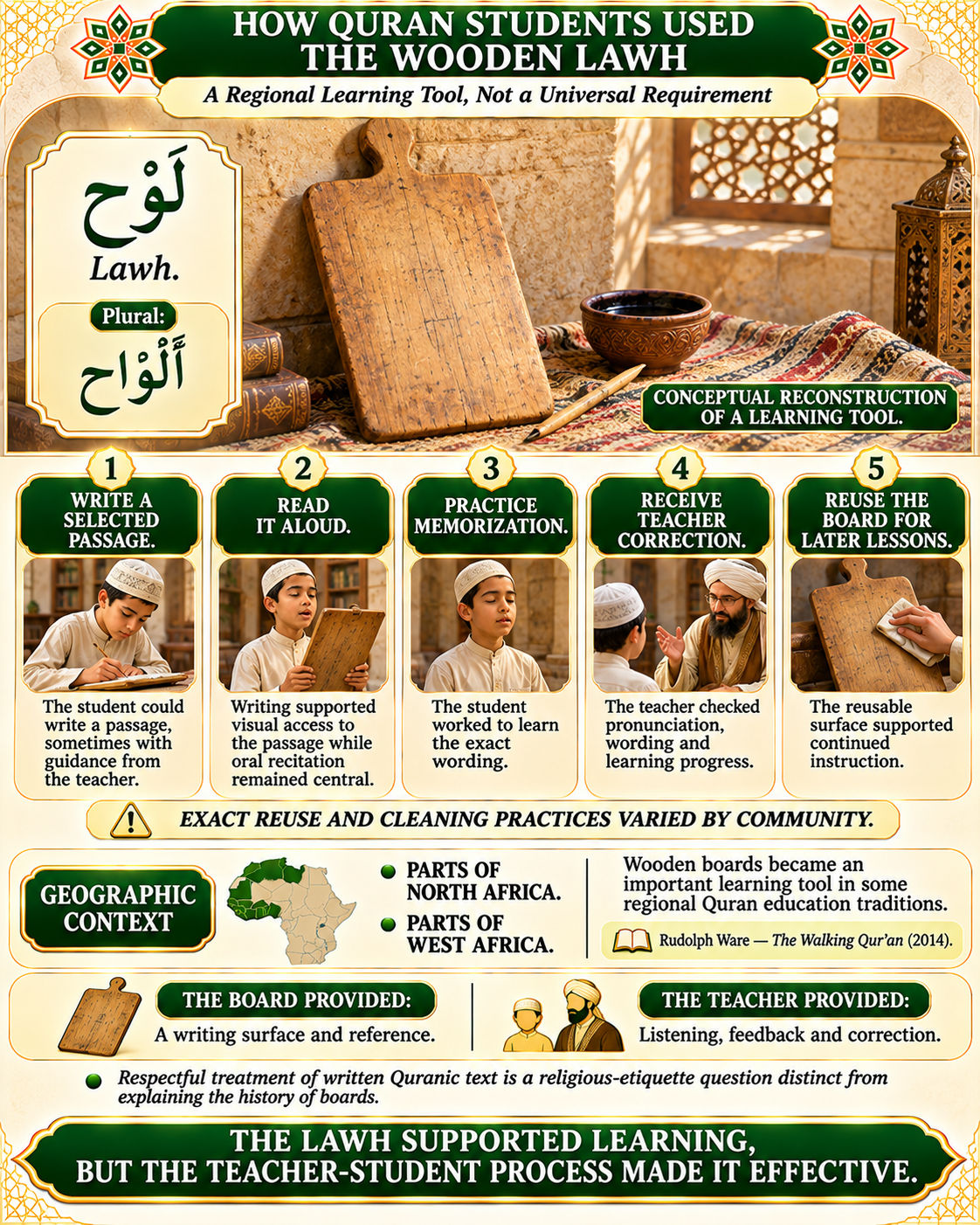
In parts of North and West Africa, students learned with a wooden board, a lawh (plural alwah), among other local names. The scholarly literature on West African Quranic education, such as Rudolph Ware's The Walking Qur'an (2014), shows boards as part of a wider system of teacher-student learning. This was a regional custom, not a universal Islamic requirement, and not every student in every century used one.
In general terms, a board could be used to:
Write a passage, often with the teacher's help.
Read it aloud.
Practice memorizing it.
Be checked and corrected by the teacher.
Be reused for later lessons.
I do not describe exact procedures for cleaning or reuse because practices varied and I cannot support a single account. Jurists have discussed respectful handling of written Quranic text, and that is a matter of religious etiquette distinct from the history of the practice. A board is a tool. It worked because a teacher listened and corrected, not because of any special virtue in the wood.
Mosques, Homes, and Study Circles
Quran education was never confined to one type of place. Learners might study with a parent or relative, a local teacher, a mosque reciter, a recognized scholar, or in an institution. The halaqah (study circle) is a common format: students sit around a teacher and recite in turn. It adapted easily to a mosque, a home, or a school.
Learning was social. Students heard others being corrected, and teacher and student built a relationship over months or years. Access was not equal. Geography, resources, social position, and gender shaped who could study and with whom. Rich traditions of learning existed, but they were not available equally to everyone.
Isnad and Ijazah
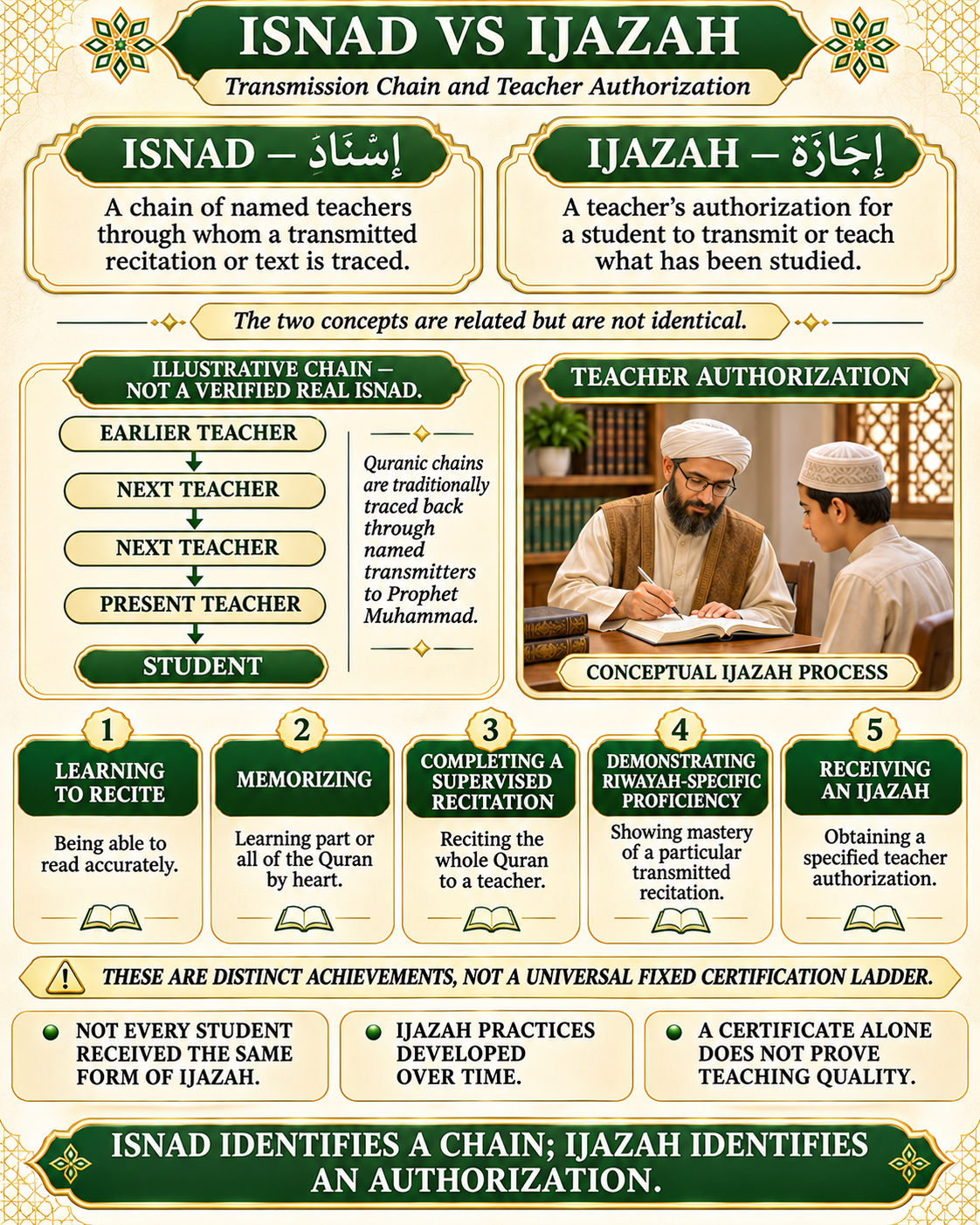
An isnad is a chain of transmission naming the teachers through whom a recitation or text reached a student, traced back to the Prophet ﷺ. An ijazah is a teacher's authorization to a student to transmit or teach what they have studied. They are related but different. An isnad is the chain, and an ijazah is the teacher's authorization within a chain.
Several things are easily blurred:
Stage | What it means |
|---|---|
Learning to recite | Being able to read the Quran correctly |
Memorizing | Holding all or part of the text in memory |
Completing a recitation under supervision | Reciting the whole Quran to a teacher |
Demonstrating proficiency in a recitation | Showing mastery of a particular riwayah |
Receiving an ijazah | Authorization, usually with a stated chain |
Not every student received the same kind of ijazah. Formal authorization developed over time, and conditions varied by tradition and teacher. Makdisi discusses ijazah in the context of the madrasa. I do not claim ijazah certificates existed in their present standardized form from the beginning of Islam. An ijazah is not a government license, and a certificate alone does not prove teaching quality. Not every teacher today necessarily holds a verified unbroken chain, so students are wise to ask what a teacher has actually studied and with whom.
How Did the Recitation Traditions Develop?
The recognized recitation traditions (Qira'at) are not arbitrary preferences, and they are not merely accents. They are transmitted readings tied to teachers, with accepted criteria such as fit with Arabic usage, fit with the Uthmanic rasm (the written consonantal form of the text), and sound transmission.
Three terms help:
Qira'ah: a reading attributed to a recognized reciter, such as Nafi' or 'Asim.
Riwayah: a transmission from that reciter through a student, such as Hafs from 'Asim or Warsh from Nafi'.
Tariq: a narrower route within a riwayah, through later teachers.
Ibn Mujahid (d. 324 AH/936 CE) wrote a book on seven readings. He compiled well-known readings that already existed. He did not invent them, and later scholars added to the number, including the ten. Not every claimed reading was accepted. Araby Academy covers this in how the Quran's Qira'at were preserved.
How Were Manuscripts Copied and Used?
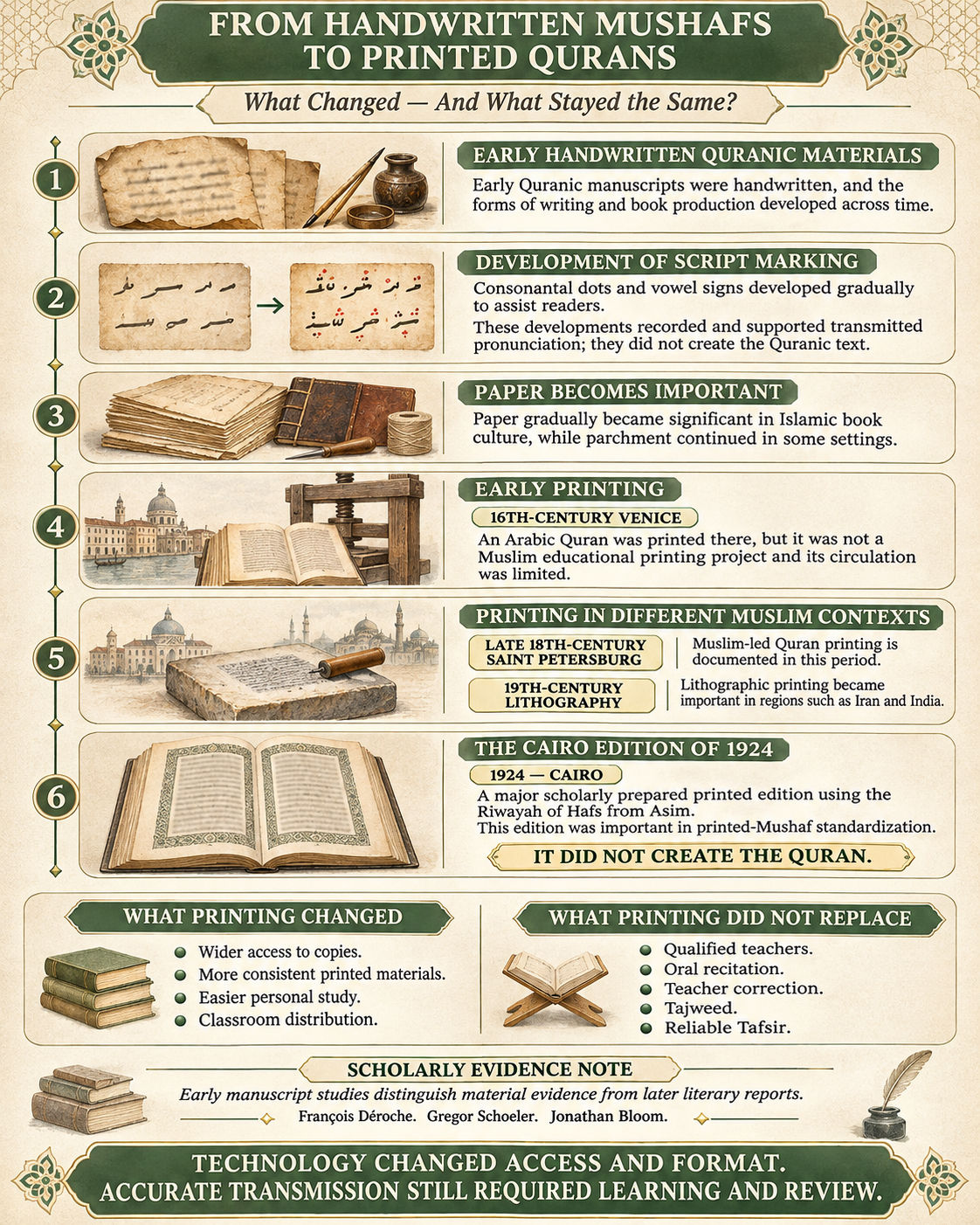
Manuscripts were copied by scribes and calligraphers, corrected, read, and studied in teaching. Early Arabic writing used few dots and vowel signs, and the means of marking letters and vowels developed gradually. Reports credit named early scholars with parts of this development, but the sequence was not tidy and the details are discussed. Dots and vowel signs recorded the pronunciation already transmitted and made reading easier. They do not mean the Quran was invented later.
Teachers and manuscripts worked together. A manuscript supported memory and study. A teacher supplied what a page cannot: sound, rhythm, and correction. Gregor Schoeler's The Oral and the Written in Early Islam (2006) describes how oral and written methods coexisted in early Islamic learning generally. Manuscripts alone do not explain transmission, and oral teaching alone does not either.
Oral learning | Written learning | |
|---|---|---|
Strength | Sound, rhythm, immediate correction | Reference, review, shared standard |
Limit | Depends on teacher availability | A page cannot hear you recite |
Typical use | Talaqqi, halaqah, review | Mushafs, boards, manuscripts |
What Changed When Printing Spread?
Quran printing has a complex history with no single starting date. An Arabic Quran was printed in Venice in the sixteenth century, but this was not a Muslim educational printing and its circulation was limited. Muslim-led printing appeared in Saint Petersburg in the late eighteenth century, and lithographic printing became important in the nineteenth century in places such as Iran and India. Adoption was uneven. Some communities hesitated for religious or technical reasons, such as concern for correctness and handling.
The Cairo edition of 1924, prepared by a committee of scholars under Egyptian state sponsorship in the riwayah of Hafs from 'Asim, followed classical works on rasm and recitation. It was an important event in standardizing printed Mushafs. It did not create the Quran, and not all printed Mushafs use the same conventions or riwayah.
Printing made copies cheaper and more widely available, supported consistent textbooks, personal study, and classroom teaching. It did not remove the need for accurate recitation, qualified teachers, correction, oral transmission, or understanding through Tafsir.
A Composite Day in a Premodern Learning Circle
What follows is an illustrative composite based on documented educational practices. It is not a diary, an eyewitness account, or a record of one real classroom, and real settings varied widely.
A student arrives at a local teacher's circle. The teacher asks him to recite what he learned the day before, and he does, stumbling once on a long vowel. The teacher repeats the word and has him repeat it until it is right. Next the teacher recites a new passage a few times. The student recites it back, and the teacher corrects a few sounds. The student sits aside to practice it quietly and then recites again. Before leaving, he is told what to review. At home he revises earlier passages alone, because tomorrow's lesson will begin with them.
What this shows: correction, repetition, new learning, and review in a loop. What it does not show: harmony. Some teachers were gifted and some were not, and some students had more support than others.
What Traditional Quran Education Can Teach Modern Learners
The enduring lessons are about method, not nostalgia:
Learn from a qualified teacher. Accuracy needs a listener.
Listen attentively before you recite.
Recite aloud, not only silently.
Welcome correction. It is the central benefit of a teacher.
Revise previous material constantly. Araby Academy's article on why people forget the Quran after memorizing it explains why.
Progress at a suitable pace for the student.
Combine oral and written materials.
Build a steady relationship with a teacher.
Learn meanings alongside recitation where appropriate.
Respect the Quran and the process of learning it.
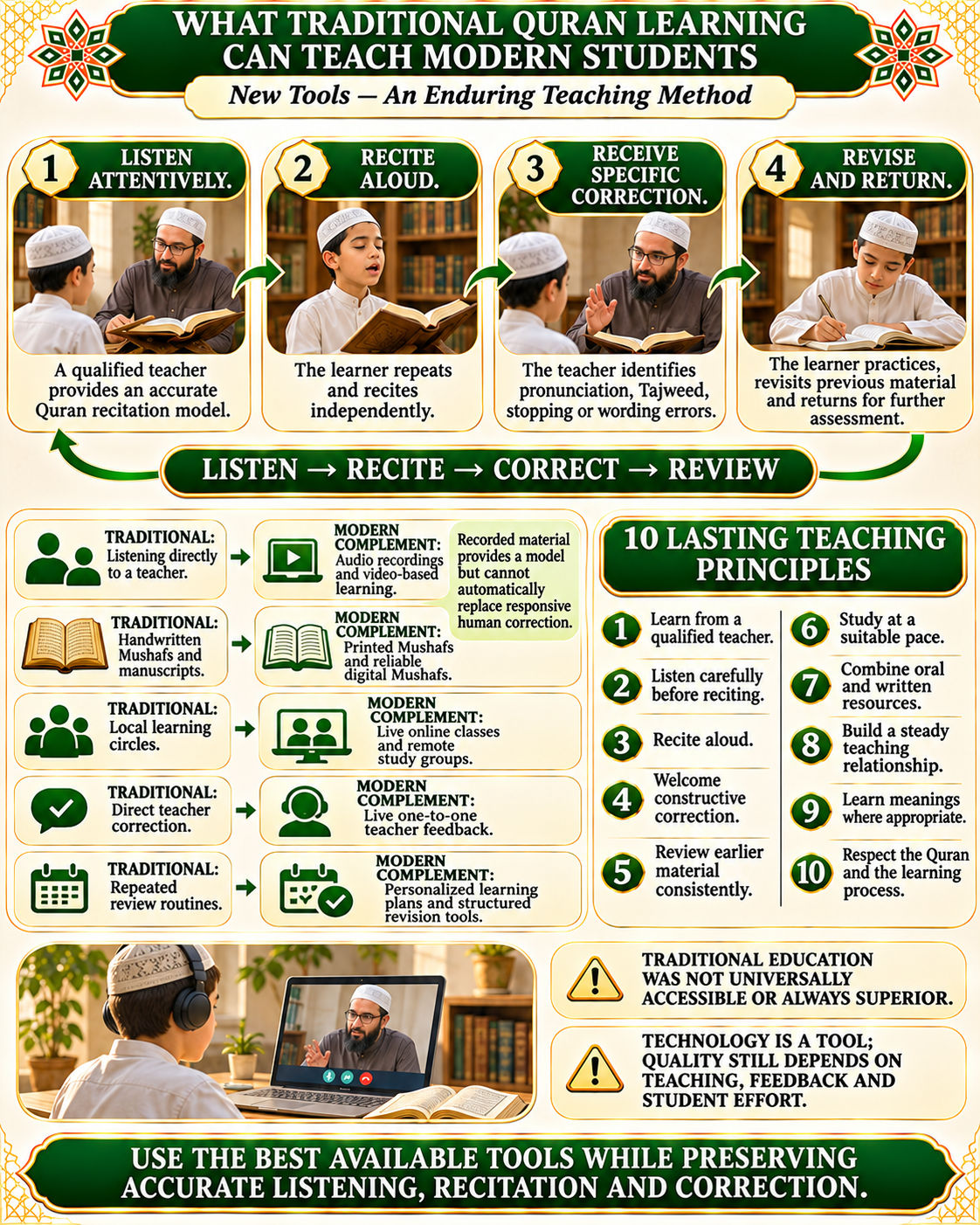
Traditional element | Modern complement |
|---|---|
Hearing the teacher | Audio recordings, video lessons |
Handwritten Mushaf | Digital Mushafs, printed Mushafs |
Circle of students | Online classes |
Teacher correction | Live one-to-one lessons |
Review routines | Personalized learning plans |
Tradition was not universally superior. Many students had no teacher nearby, and access was unequal. Technology cannot replace every function of a qualified teacher, but using it is not a departure from authentic learning. It is a new tool for an old goal. Live one-to-one online instruction keeps the central feature of talaqqi, a teacher hearing you and responding, while reaching students who live far from any qualified teacher. Araby Academy's lessons are built around this pattern of listening, reciting, correction, and review.
Frequently Asked Questions
How did Muslims memorize the Quran before printed books?
Mainly by listening to a teacher, repeating, reciting back, and reviewing regularly, supported by written materials where available.
Did early Muslims have written copies of the Quran?
Yes. Revelation was written during the Prophet's lifetime and later copied in Mushafs. Access to personal copies varied.
How did teachers correct pronunciation without recordings?
By listening to the student recite and responding directly. Correction depended on the teacher's ear and the student's repetition.
What was a Kuttab?
An elementary setting, with local variation, where children typically learned to read, write, and memorize Quran. It was not identical everywhere.
What is Talaqqi?
Learning by direct reception from a teacher: the student hears, repeats, and is corrected.
What is the difference between Isnad and Ijazah?
An isnad is the chain of transmission. An ijazah is a teacher's authorization to a student to teach or transmit.
Did all Muslims memorize the entire Quran?
No. Many memorized parts and some memorized all of it. Memorization was valued but was not universal.
Is online Quran learning similar to traditional Talaqqi?
Live one-to-one lessons can preserve its core: listening, reciting, and immediate correction by a teacher. Quality depends on the teacher and the student's effort.
Conclusion
Quran education has never depended on one technology. Across generations, Muslims learned through listening, recitation, memorization, written materials, qualified teachers, correction, revision, scholarly transmission, and community learning. Methods changed with manuscripts, institutions, printing, and modern tools, but the enduring principle is accurate learning and responsible transmission.
Appreciate the long history, and use the opportunities available today. If you would like personalized instruction with teacher feedback and structured learning, you are welcome to explore Araby Academy's live one-to-one Quran and Tajweed lessons.