
A learner spends an hour on one page of the Quran. She recites it a dozen times with the Mushaf closed, gets through it three times without a single hesitation, and goes to sleep satisfied. Three days later she sits down to recite and cannot recall how the page begins.
So what happened? Was the page ever memorized? Did the memory vanish? Or did she mistake a strong performance in that session for a lasting memory?
The short answer to “why do I forget the Quran after memorizing it” is that forgetting is a normal feature of human memory, and fluent recitation right after learning does not show that a passage can be retrieved reliably later. Repeating a page many times in one sitting makes it easy to access for a few hours. Lasting retention usually depends on what happens afterward: spaced revision, independent recall, accurate correction, and a workload you can sustain.
This article is about that gap. It is not a guide to planning your whole Hifz, which we cover in our complete guide to memorizing the Quran. Here we look at why forgetting happens, what the Prophet ﷺ taught about preserving the Quran, how to recover what has slipped, and how to build a revision routine that holds.
Did You Really Memorize It, or Could You Just Recite It at That Moment?
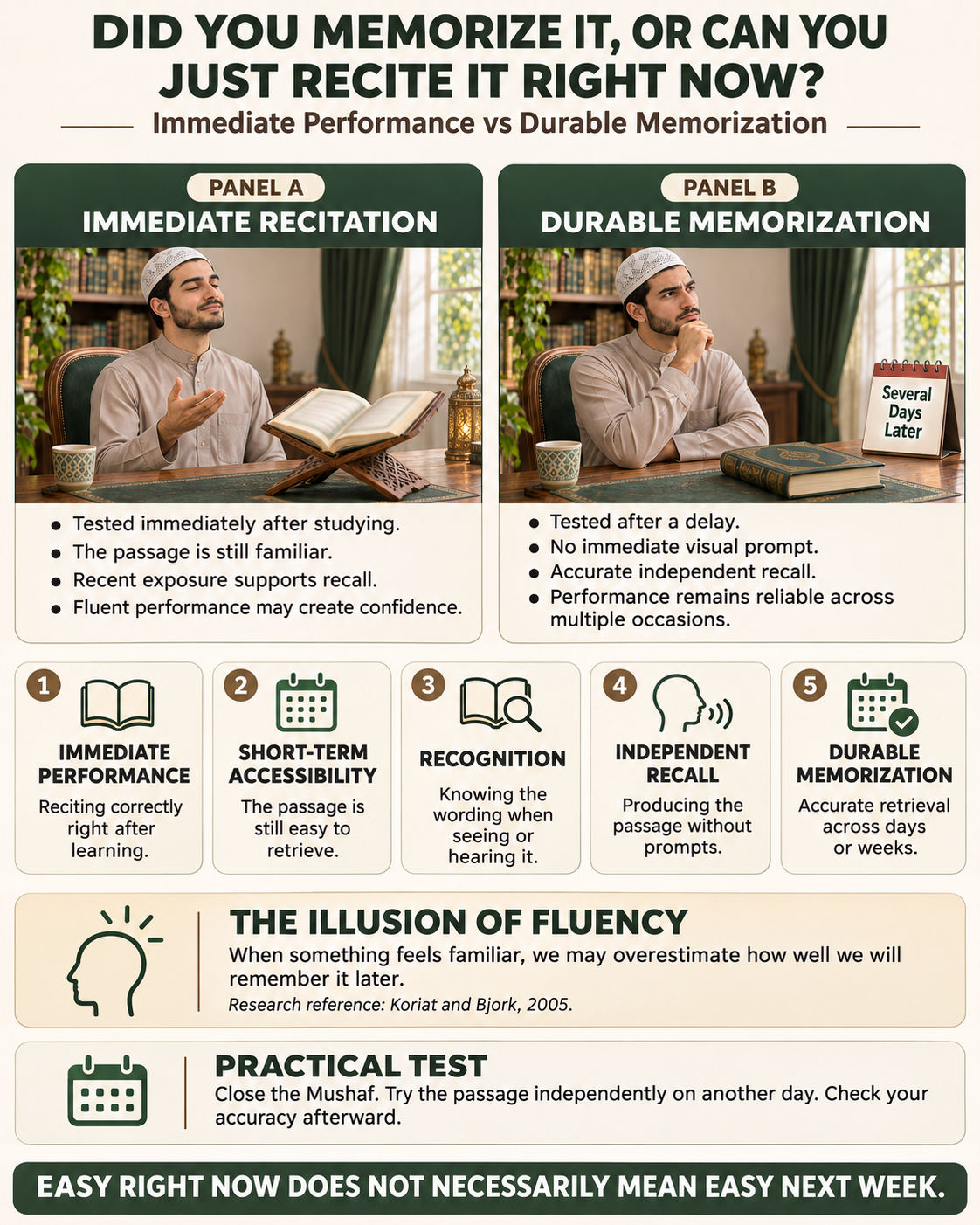
When we say someone memorized a page “perfectly,” we usually mean that their recitation was flawless at the time of learning. That is a real achievement, but it is not the same as permanent memory. Nothing in the science of memory establishes a state of “perfectly and permanently memorized.” The word “perfectly” in this article’s title describes how the recitation looked, not a guarantee about the future.
Several different things can look identical during a single session:
Immediate performance: reciting correctly right after studying.
Short-term accessibility: the text is still fresh and easy to reach.
Recognition: you know it is right when you see or hear it.
Independent recall: you produce it with no Mushaf, prompt, or reminder.
Durable memorization: you can produce it accurately, repeatedly, after days or weeks.
Immediate recitation | Durable memorization | |
|---|---|---|
When it is tested | Same session, minutes after study | Days or weeks later |
What it relies on | Fresh familiarity, short-term accessibility | Retrieval that has been practiced over time |
Can you start without a prompt? | Often yes, because you just saw it | Only if retrieval has been rehearsed independently |
What it tells you | The page is easy right now | The passage can be reached reliably later |
Psychologists call the trap here the illusion of fluency. When material feels easy and familiar in the moment, we judge it as learned. Research by Koriat and Bjork (2005) on “illusions of competence” shows that learners often misjudge how well they will remember something when the answer is in front of them or was just seen. Judging your Hifz only during the session in which you learned it is a bit like checking a bridge’s strength by looking at it on a sunny day.
Consider a realistic example. Yusuf, an adult learner, reads a page aloud from the Mushaf fifteen times, then fifteen more with glances at the text, and finishes by reciting it “from memory” with occasional peeks. By the end it flows. The next morning he cannot start it. He is not careless or unlucky. His practice trained him to recognize the page and follow it, not to produce it unprompted, and the next day required exactly that.
What the Prophet Muhammad ﷺ Taught About Maintaining Quran Memorization
The Prophet ﷺ spoke about this exact problem, and in practical, memorable terms. Two narrations are especially well known.
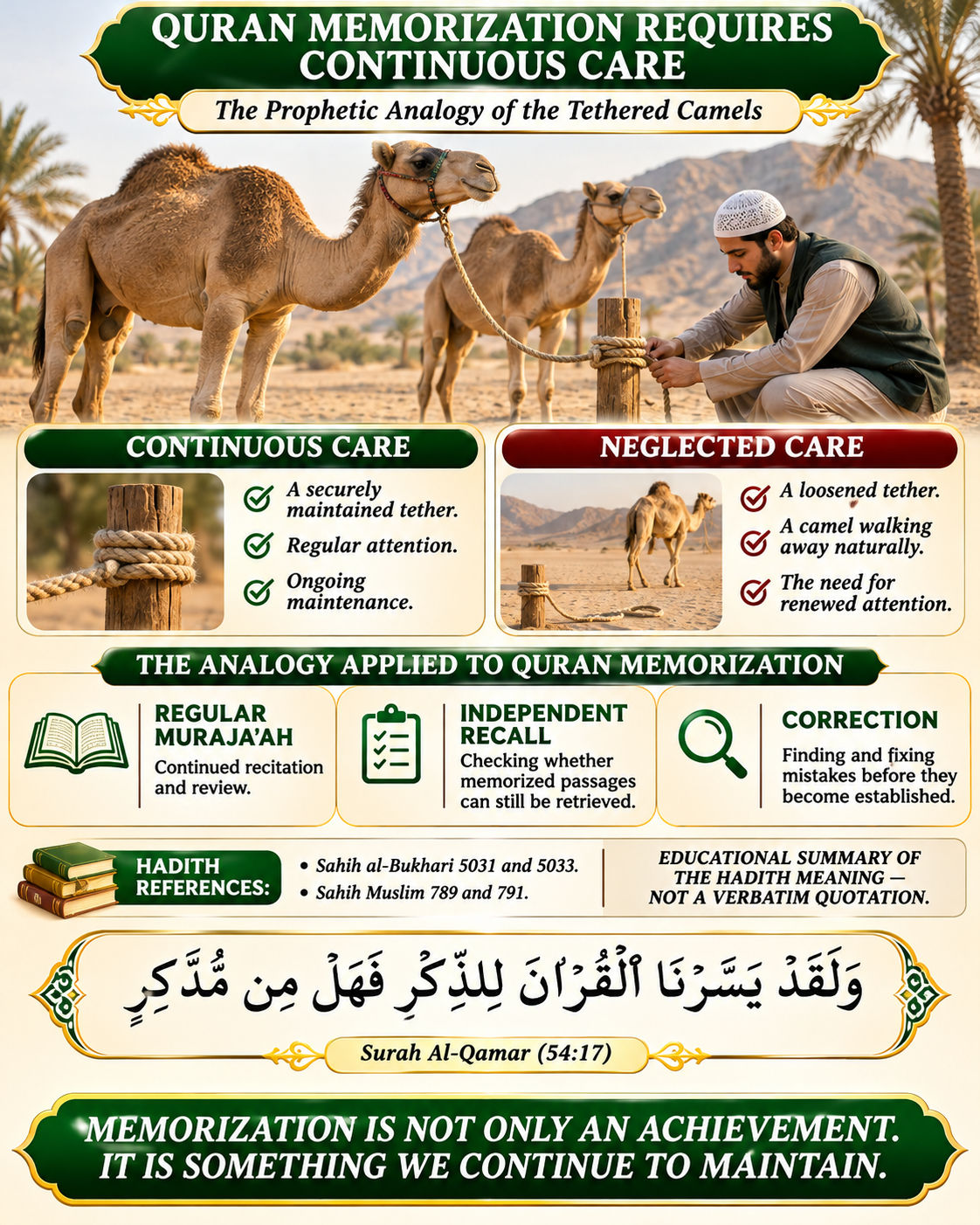
Ibn Umar (may Allah be pleased with him) reported that the Messenger of Allah ﷺ said, in meaning: the example of the one who has memorized the Quran is like the owner of hobbled camels. If he keeps tending to them, he keeps them, and if he lets them go, they go. (Sahih al-Bukhari 5031; Sahih Muslim 789)
Abu Musa al-Ash’ari (may Allah be pleased with him) reported that the Prophet ﷺ said, in meaning: keep refreshing your hold on the Quran, for by the One in whose hand is my soul, it escapes faster than camels from their ropes. (Sahih al-Bukhari 5033; Sahih Muslim 791)
Why the camel comparison is educationally rich
Camels that are tied do not stay secure by being tied once. The rope has to be checked, and the animal has to be tended. The image describes memorization as ongoing maintenance, not a one-time achievement. It also treats retention as something that responds to effort: tending keeps the camels, neglect loses them.
That fits what we now know about learning. The Prophet ﷺ did not say, “If you memorize it perfectly, it stays.” He said it needs attention, and he described the risk plainly so that people would build habits that protect their memorization.
The Quran itself also reminds us that its memorization is eased by Allah: “And We have certainly made the Quran easy for remembrance, so is there any who will remember?” (54:17).
وَلَقَدْ يَسَّرْنَا الْقُرْآنَ لِلذِّكْرِ فَهَلْ مِن مُّدَّكِرٍ
Forgetting is not always a failing
It is important to be precise about what these narrations do and do not say. Another authentic narration from Ibn Mas’ud (may Allah be pleased with him) discourages the phrasing “I forgot such and such verse,” and says that one is “made to forget,” while urging continued recitation (Sahih al-Bukhari 5032; Sahih Muslim 790). Scholars have explained this as guidance on how we speak about forgetting and as encouragement to keep engaging, not as a charge of guilt against everyone who forgets.
There is also a reminder that forgetting is part of the human condition. Aisha (may Allah be pleased with her) reported that the Prophet ﷺ heard a man reciting the Quran in the mosque and said that Allah had shown mercy to him, because he reminded him of verses he had been made to forget (Sahih al-Bukhari 5038; Sahih Muslim 788). If the Prophet ﷺ could need reminding of verses, we should not treat ordinary forgetting as a scandal.
It helps to separate several situations that are often blurred:
Unintentional forgetting: memory simply fades despite sincere effort.
Normal limits of memory: the expected result of a finite human memory and a heavy workload.
A temporary interruption: illness, travel, exams, a new baby, a difficult season of life.
Deliberate neglect: knowingly abandoning one’s relationship with the Quran without excuse.
Scholars have discussed the ruling on neglecting memorized Quran, and their views differ in strictness. Some narrations that warn sharply about forgetting the Quran are disputed in authenticity, and we do not rely on them here. A cautious and widely held position is that involuntary forgetting is not blameworthy, while deliberate and careless neglect is discouraged and should be repented from. If you have a specific concern, ask a qualified scholar.
Nothing in the authentic texts tells us that struggling to remember is, by itself, proof of weak faith, insincerity, or sin. Many sincere students and even huffaz struggle with revision. The Prophetic guidance is an invitation to a better system, not a verdict on your heart.
What Happens to a Memory After You Learn Something?
Cognitive psychologists usually describe memory in four broad stages. This is a simplified model, but it is useful.
Encoding: taking information in and forming an initial representation. For Quran learners, this is how you attend to the sounds, order, and meaning of an ayah.
Consolidation: the process by which a new memory becomes more stable over time, helped in part by sleep.
Storage: the information being retained in some form.
Retrieval: bringing it back when needed.
One idea matters especially for Hifz: failing to recall something does not necessarily mean it is entirely gone. Memory researchers distinguish between whether information is available in memory and whether it is accessible at a given moment (Tulving & Pearlstone, 1966). Many people have had the experience of being unable to recall a verse, then recognizing it instantly when someone says the first word. That does not prove the trace was fully intact, but it shows that missing recall can be a retrieval problem, not total loss.
This is why a small cue often unlocks a whole passage: the opening word, a teacher’s first syllable, or even picturing where the verse sits on the page. It is also why relearning something you once knew is often faster than learning something brand new.
Please do not picture memory as a file saved to a hard drive. Human memory is reconstructive and shaped by use. Each successful retrieval tends to strengthen a memory, while long disuse tends to make it harder to reach. We do not need detailed claims about brain regions to apply this. The practical lesson is simple: retrieval is a skill, and it has to be practiced.
The Main Reasons Quran Memorization Becomes Difficult to Retain
No single cause explains every learner’s experience. These are common patterns, and most people have a few of them at once.
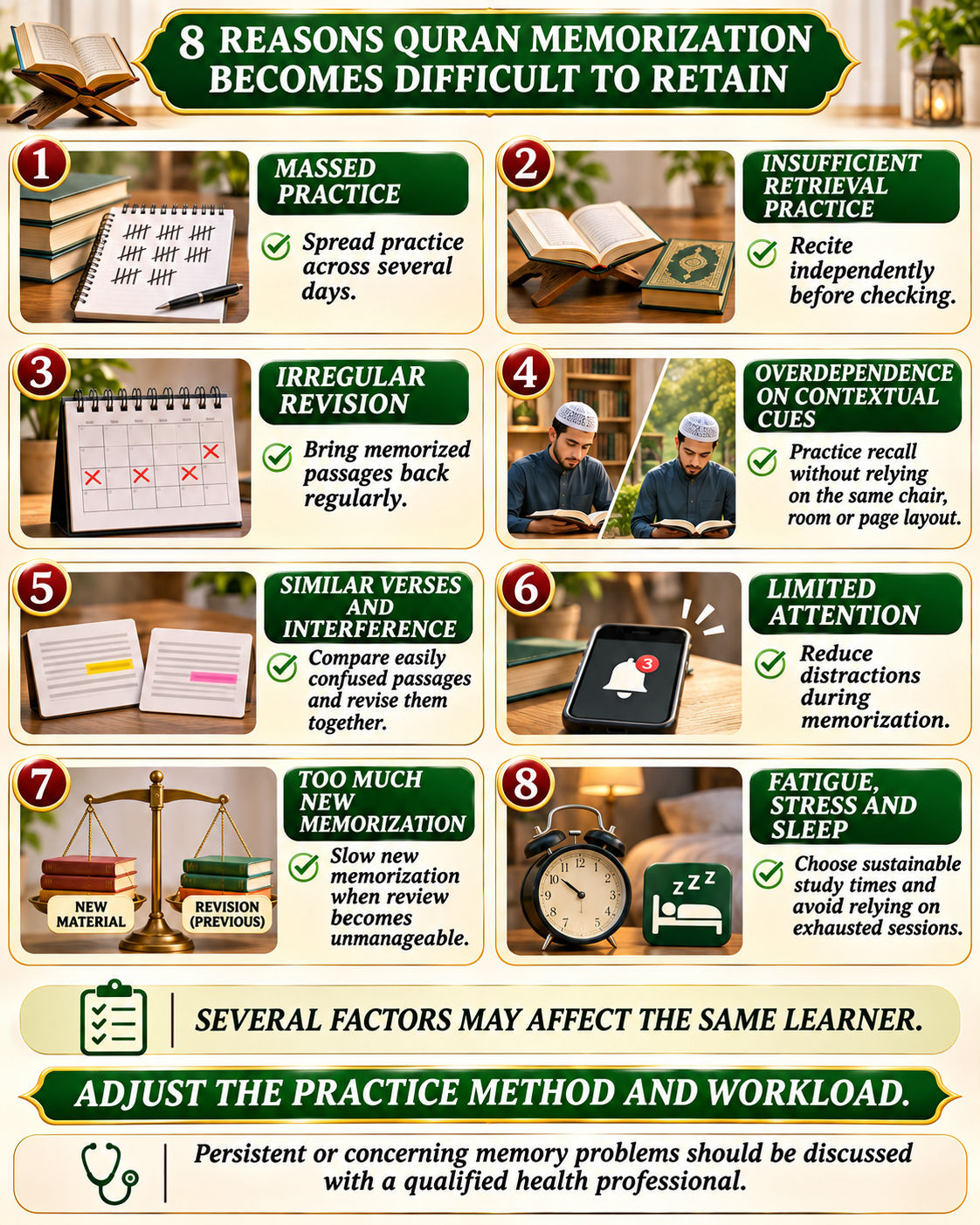
1. Massed practice
Repeating a passage many times in one sitting is called massed practice. It produces excellent performance in the moment, but research on distributed practice consistently finds that spreading study over time generally leads to better long-term retention than cramming (Cepeda et al., 2006). Twenty repetitions in one hour often does less for next week than five repetitions spread across several days.
2. Insufficient retrieval practice
Reading an ayah from the Mushaf is recognition: the text does the work for you. Trying to recite it with the Mushaf closed is retrieval: you do the work. Studies by Roediger and Karpicke (2006) found that testing yourself on material often leads to better later retention than simply re-reading it, even though re-reading feels more comfortable. If most of your revision is reading along, you may be building familiarity without building recall.
3. Irregular revision
Long gaps between meaningful encounters with a passage make retrieval harder. A portion revised only once a month, with no contact in between, is more exposed than one touched briefly every few days. Revision does not have to be long. It has to be regular enough that passages do not drift out of reach.
4. Overdependence on contextual cues
Many learners unconsciously rely on cues that are not part of the Quran itself: the shape of the page, the position of the ayah on the right or left side, the room where they study, the teacher’s voice, or the beginning of the surah. Context can help memory (Godden & Baddeley, 1975, showed that recall can be better in the environment where information was learned), which is exactly why overreliance can fail you. If you can only recite a page while holding your usual Mushaf in your usual chair, test yourself elsewhere: while walking, in prayer, or in a different room.
5. Similar verses and interference
When similar pieces of information compete in memory, they can interfere with each other. Quran learners meet this as Mutashabihat al-Alfaz, meaning verses with similar or identical wording but small differences. This is a technical term in Quranic sciences, and it is different from the theological discussion of mutashabih verses, which concerns verses whose meanings are not straightforward.
A familiar example is the description of the Children of Israel’s oppression. In Surat al-Baqarah (2:49) the text has yudhabbihuna abna’akum, while in Surat Ibrahim (14:6) it has wa yudhabbihuna abna’akum, with an added wa. Such small differences are easy to blur. Please verify any similar-verse pair in the Mushaf, and, ideally, with your teacher. A helpful habit is to study such verses side by side once, note the difference deliberately, and then revise them as a pair.
6. Limited attention during memorization
Passive repetition, where your lips move while your mind is elsewhere, produces weaker learning than focused effort. Phone notifications, noise, and mental multitasking all reduce the quality of encoding. Our article on digital distraction and brain rot discusses how constant stimulation can make sustained attention harder.
7. Too much new memorization without enough revision
This is one of the most common and least discussed problems. Every new page adds to the pile of material that needs maintaining. If you keep increasing what you learn while old portions are neglected, the revision burden grows until it cannot be managed, and older material begins to slip. Pausing or slowing new memorization is sometimes the most productive decision a student can make.
8. Fatigue, stress, and sleep
Sleep appears to play a role in consolidating newly learned material (Diekelmann & Born, 2010), and tiredness and stress can reduce attention and make recall harder. This does not mean that sleeping more will solve every memory difficulty, and this article cannot diagnose any condition. If memory problems are persistent or worrying, speak to a health professional. For most learners, the practical point is modest: do not rely on exhausted late-night sessions as your main learning time.
What the Forgetting Curve Can and Cannot Tell Us About Hifz
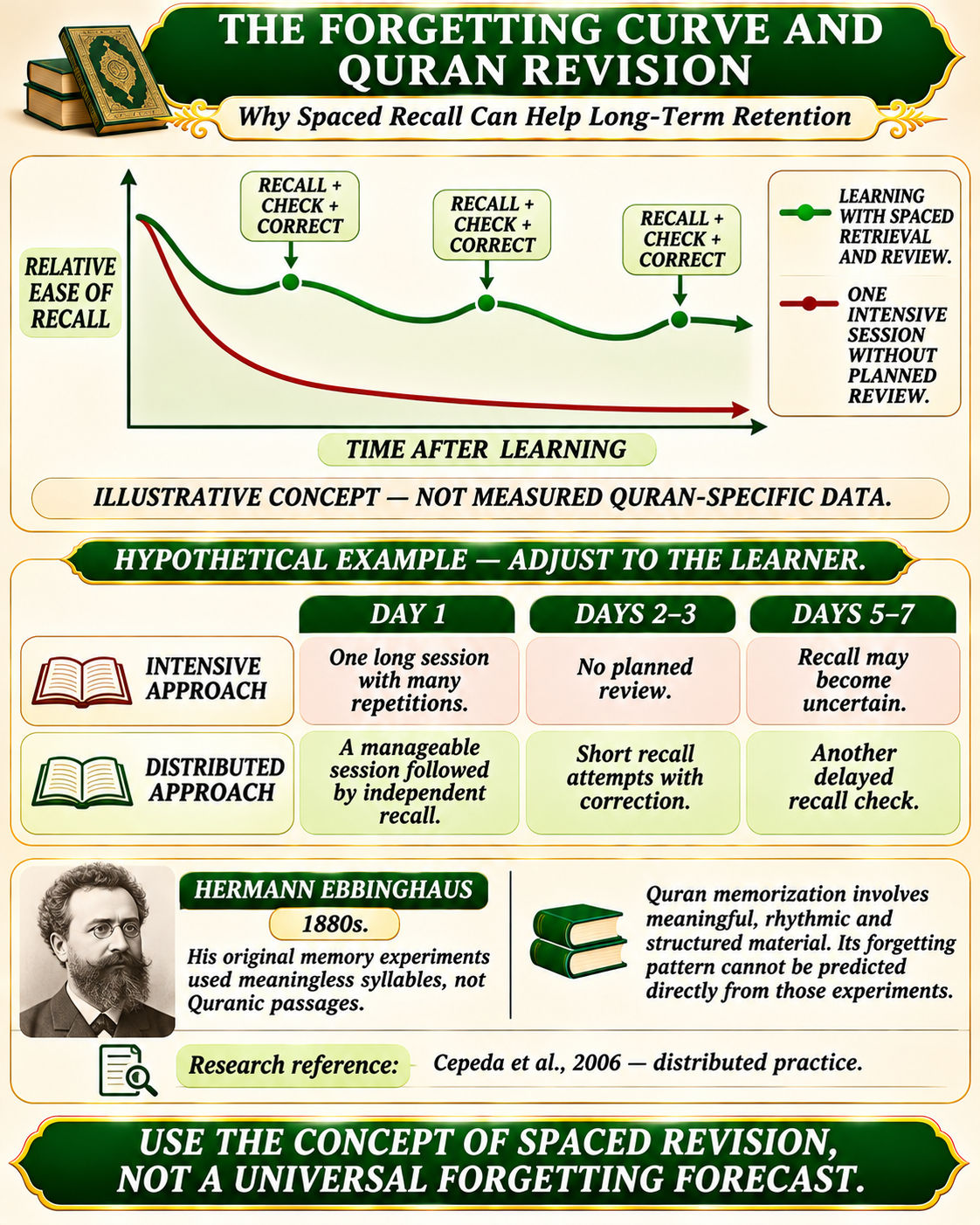
In the 1880s, the German psychologist Hermann Ebbinghaus studied his own memory using lists of meaningless syllables. He found that retention tended to drop over time after learning, and that relearning the material was easier than learning it the first time. This pattern is known as the forgetting curve.
The useful, broad takeaways are:
Newly learned information often becomes harder to retrieve as time passes without review.
Repeated, spaced learning opportunities tend to improve retention.
The rate of forgetting differs between people and depends on how the material was learned.
There are important limits. Ebbinghaus used nonsense syllables. The Quran is meaningful, rhythmic, structured, and recited with deep personal and spiritual engagement, so we should not assume it follows the same pattern. You will sometimes see claims like “you forget half of what you learn in an hour.” Those numbers are not universal facts, and no fixed schedule fits every learner. Treat the forgetting curve as a helpful concept, not a forecast.
Here is a purely illustrative comparison. These are hypothetical examples to show the idea, not measured Quran-specific results.
One-day intensive approach | Distributed approach | |
|---|---|---|
Day 1 | Many repetitions of the page in one long session | Moderate session with a few focused repetitions and a self-test |
Days 2 to 3 | No planned review | Short retrieval attempt each day, check with Mushaf, correct |
Days 5 to 7 | Page feels unfamiliar | Brief recall check, spaced further apart |
Likely feel | Strong early, then uncertain | Steadier, with errors found and fixed early |
The point is not the exact numbers or days. It is that the second pattern gives your memory repeated chances to be retrieved, and it catches errors while they are small.
Why Understanding the Quran May Support Memorization
First, a clear statement: you do not need to understand Arabic to memorize the Quran. Millions of non-Arabic speakers have memorized it, and Hifz does not require fluency in the language. Understanding also does not automatically prevent forgetting.
That said, meaning can offer additional retrieval cues. Compare three experiences:
Memorizing a sequence of unfamiliar sounds, where each word is only a sound that must follow the previous one.
Recognizing patterns, such as repeated roots, familiar word endings, and recurring phrases.
Understanding the progression of an ayah, where you know where the thought is heading.
If you know that an ayah moves from a command to its reason, or from a promise to a warning, that structure can help you reach the next phrase when the exact words slip. Knowing the story context of a passage, or its theme, can similarly offer a way back in.
You do not have to study everything at once. Even a few minutes of reading a trusted translation or short tafsir before memorizing can add helpful context. If you want to go further, our introduction to what Quranic Arabic is and our guide to learning Quranic Arabic from scratch explain how to begin. Think of Arabic and tafsir as complementary tools that may strengthen learning and deepen your relationship with the Quran, not as entry requirements.
How to Recover Quran You Have Already Forgotten
Returning to Hifz after months or years can feel discouraging. But previously learned material is often easier to relearn than brand-new material, because relearning builds on traces that still exist. The following approach is adaptable, and it does not promise a fixed recovery time.
Step 1: Assess before you restart. Do not rebuild everything from page one. Go through your previously memorized portions and see what you can actually recite today.
Step 2: Classify by recall strength.
Category | What it looks like |
|---|---|
Strong | Can recite independently with minimal errors |
Developing | Can recite with occasional prompts |
Weak | Needs frequent looking or substantial relearning |
Step 3: Pause or reduce new memorization. Temporarily slowing down new Hifz often frees up the time and attention that recovery needs.
Step 4: Rebuild weak passages in small portions. A few ayat or half a page at a time is more manageable than a whole page.
Step 5: Use active recall before checking the Mushaf. Try to recite first, even if you stumble, then check. The effort of trying is part of what strengthens the memory.
Step 6: Correct mistakes immediately. Pronunciation, wording, and verse order errors can become fixed if left alone. Use a qualified teacher or a reliable verification method such as a trusted Mushaf and recitation. Tajweed accuracy matters too, so our beginner’s guide to Tajweed may help.
Step 7: Revisit recovered portions across days and weeks. A passage you rebuilt today should be tested again in a few days, and again later, not only once.
Step 8: Gradually return to new memorization once revision feels manageable, not before.
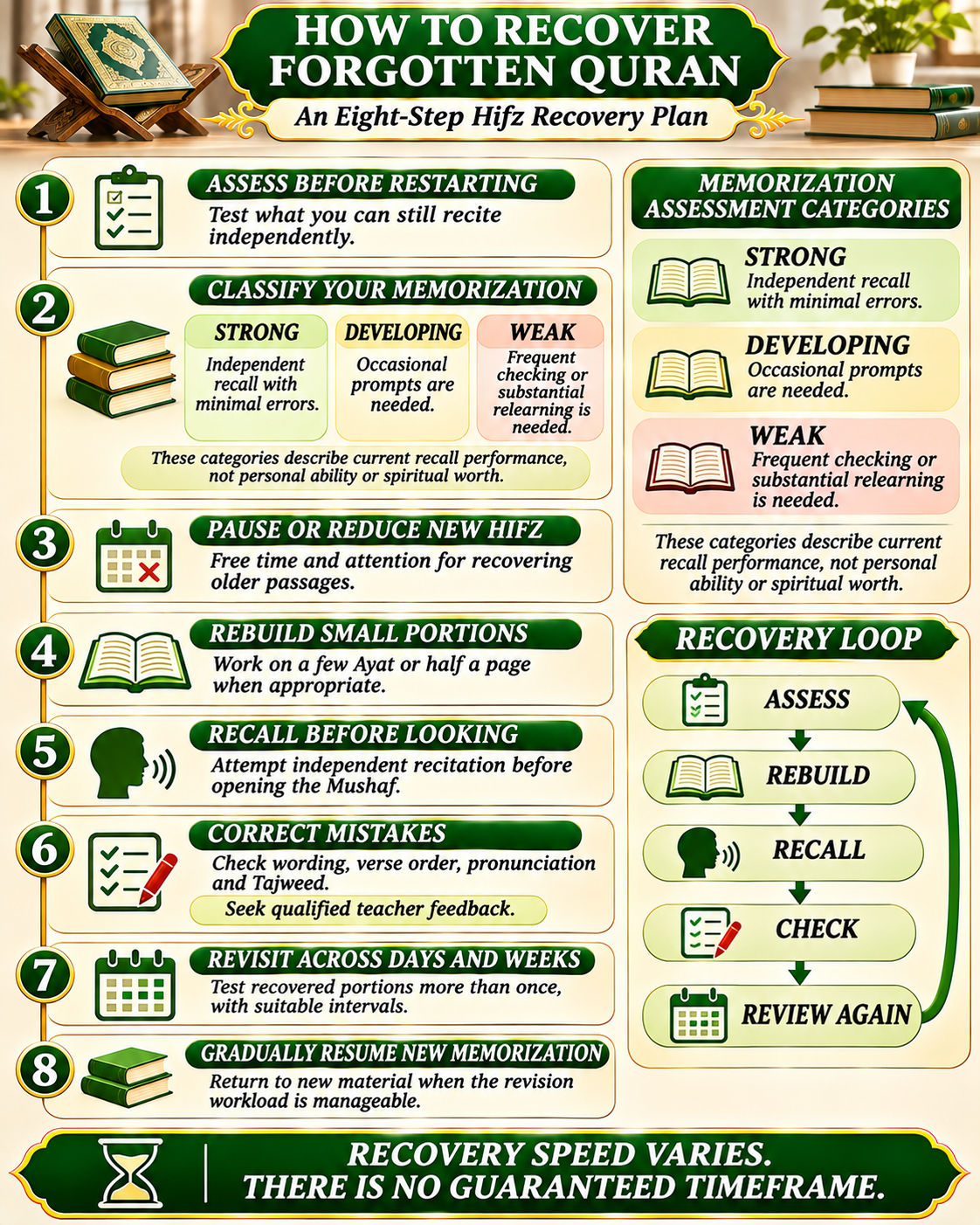
Recovery can be slow and uneven, and that is normal. Be patient with the process. If you find the emotional side hard, our reflection on sabr, or patience in Islam may be a helpful companion.
Build a Revision System That Makes Forgetting Less Likely
A good revision system rests on a few well-established principles:
Spaced practice: revisit material over time, not all at once.
Retrieval practice: try to recall before looking.
Corrective feedback: find and fix mistakes promptly.
Cumulative revision: older material keeps coming back.
Regular assessment: check what you can really do.
Sustainable workloads: a plan you can keep beats an ambitious one you abandon.
These principles are supported by broad reviews of learning research, including Dunlosky and colleagues (2013), which found practice testing and distributed practice to be among the more effective study techniques. That research was not conducted on Quran learners specifically, so we apply it as sensible general guidance and not as Quran-proven fact.
Traditional Hifz structures
Many Hifz programs use a three-part structure. Terms and implementation vary between teachers, institutions, and regions, so treat these as common usage:
Sabaq: new memorization.
Sabqi: recently memorized material, revised frequently.
Manzil or Muraja’ah: previously memorized material, revised on a rotating basis.
Three illustrative plans
These are adjustable examples, not universally optimal or scientifically guaranteed schedules.
Beginner (short surahs) | Adult with 20 to 30 minutes daily | Learner recovering several Juz | |
|---|---|---|---|
New material | A few lines at a time | Small, steady portion, or paused during busy weeks | Paused at first |
Recent revision | Review the last few days’ lines each day | Review recent portion daily | Short daily recall of the portions being rebuilt |
Older revision | Revisit completed surahs a few times a week | Rotate older portions across the week | Rotate recovered portions on a repeating cycle |
Self-test | Recite one short surah unprompted each day | Recite first, then check, in each session | Classify portions weekly as strong, developing, or weak |
Adjust by | Increase gaps when recall is easy | Shorten gaps for passages that wobble | Move portions between categories as they improve |
Let performance guide your schedule
If a portion is recited smoothly and accurately, you can space its revision further apart. If it wobbles, bring it back sooner. Quality of recall matters more than the number of repetitions. One accurate, independent recitation is often worth more than ten distracted ones.
For broader planning, including goals and long-term structure, see our full guide on how to memorize the Quran. To make revision part of your life, our article on building a daily Quran habit offers practical ideas.
How to Know Whether Your Quran Memorization Is Becoming Stronger
Because a single good recitation can be misleading, look for patterns across multiple occasions. Signs that your memorization is becoming more durable include:
Reciting without immediate preparation.
Remembering after several days without a review just beforehand.
Picking up smoothly after a short interruption.
Reciting without depending on your usual Mushaf, seat, or surroundings.
Noticing and correcting your own errors.
Maintaining older portions while learning new ones.
No single test settles it, and there are no rigid mastery criteria that apply equally to everyone. Some learners are naturally quicker, some have more time, and some are coming back after long breaks.
A qualified teacher helps here. Self-assessment can miss small mistakes in pronunciation, Tajweed, and wording, because we tend to hear what we expect. Regular feedback from a teacher is one of the most reliable ways to prevent errors from settling in. If you are looking for guidance, you can learn Quran online with structured support.
What Parents and Quran Teachers Should Understand About Forgetting
Children forget, and they often forget more visibly than adults because they are learning while growing, attending school, and managing busy lives. Here is how adults can help.
Avoid shame and harsh comparisons. Comparing a child with a sibling or classmate rarely helps and can damage their relationship with the Quran. Our article on why children lose their love for the Quran explores this in depth.
Tell forgetting from unwillingness. A child who stumbles on a page they learned last week may simply need a different revision pattern, not more pressure.
Adjust the amount of new material. If old portions are slipping, slow down the new ones.
Build achievable routines. Short, consistent sessions are more sustainable than long, tiring ones.
Give supportive, specific correction. “Let’s fix this word together” works better than “You forgot again.”
Celebrate real progress. Notice retained portions, improved accuracy, and consistent effort.
Protect the relationship. The aim is a child who loves and returns to the Quran for life.
A child who forgets does not necessarily lack ability, commitment, or intelligence. Before blaming the learner, evaluate the method: Is revision spaced? Is the workload realistic? Is the child recalling independently, or only reading along? Also avoid labeling a child as having a learning difficulty because of ordinary memorization challenges. If you have broader concerns about a child’s learning, consult a qualified professional.

Frequently Asked Questions
Is it normal to forget the Quran after memorizing it?
Yes. Forgetting is a normal part of human memory, and the Prophet ﷺ himself described the need to keep tending to the Quran, comparing it to camels that escape if left untended (Sahih al-Bukhari 5031; Sahih Muslim 789). Forgetting does not mean your earlier effort was wasted.
Why do I forget the Quran even when I revise regularly?
Regular revision does not always mean effective revision. Common causes include re-reading instead of recalling, relying on page layout or context cues, mixing up similar verses, adding too much new material, or revising while distracted. Try reciting from memory before checking the Mushaf, and ask a teacher to check for subtle errors.
Is forgetting memorized Quran a sin?
Scholars distinguish between situations. Involuntary forgetting despite effort is generally not considered blameworthy, while deliberate and careless neglect is discouraged, and scholars have differed on how strictly to rule on it. Struggling to remember is not itself proof of weak faith. If you are concerned about your own situation, consult a qualified scholar.
Can forgotten Quran memorization be recovered?
Often it can be rebuilt, and relearning material you once knew is frequently easier than learning something new. Recovery speed varies, and no timeframe can be guaranteed. Start by assessing what you retain, rebuild weak parts in small portions, and revisit them across days and weeks.
Should I stop memorizing new verses if I keep forgetting old ones?
It is often wise to slow down or pause new memorization temporarily while you stabilize older portions, especially if your revision load is unmanageable. Your teacher can help you decide how much to reduce and when to resume.
Does listening to the Quran count as effective revision?
Listening can support familiarity, correct pronunciation, and keep you in contact with the text, and it has its own reward. But it mostly trains recognition. For stronger retention, combine it with attempts to recite independently and then check your accuracy.
Conclusion
Forgetting the Quran after memorizing it does not mean your memorization was fake, your effort was wasted, or your sincerity is lacking. Fluent recitation during a study session shows that a passage is accessible right now. Reliable long-term retention depends on spaced revision, independent recall, accurate correction, and a workload that fits your life.
The Prophet ﷺ taught us to keep tending to the Quran, and the science of learning offers practical ways to do exactly that: test yourself before looking, space your review, fix errors early, and avoid carrying more new material than you can maintain. If you have forgotten portions, start with an honest assessment and rebuild in small steps.
If you would like structured support with memorization, revision, and Tajweed, you are welcome to explore the Quran programs at Araby Academy. No method can promise to eliminate forgetting permanently, but steady, accurate, compassionate practice keeps you close to the Quran.