
If Allah has unlimited knowledge and power, why was the Quran revealed gradually over about 23 years rather than delivered as a complete book in a single moment?
The Quran itself records that people asked this question during the Prophet’s lifetime, and it answers it. The short answer is that gradual revelation strengthened the Prophet Muhammad ﷺ, allowed the Quran to be recited and absorbed by people over time, let guidance respond to real questions and events, and allowed a community to be taught, trained, and transformed step by step. The Quran names the first two reasons directly. Scholars have drawn out the others from the text and the history of revelation.
This article separates what the Quran states explicitly from what scholars have inferred, and then asks what the pattern teaches about how guidance works. The starting point is a verse that addresses the objection head-on, Quran 25:32.
Translations of the Quran in this article follow Sahih International, with minor adjustments for clarity.
What Happened During the 23 Years of Quranic Revelation?
The beginning in the Cave of Hira
According to the report of Aisha (may Allah be pleased with her) in Sahih al-Bukhari, revelation began while the Prophet ﷺ was in retreat in the Cave of Hira near Makkah. The angel Jibril (Gabriel) came to him and told him to read. The first verses revealed were the opening of Surah Al-Alaq (96:1-5), beginning with “Recite in the name of your Lord who created.” The Prophet ﷺ was about forty years old.
Revelation did not stop after that moment. It continued, in portions of varying length, until near the end of his life. For the wider story, see our overview of the life of Prophet Muhammad ﷺ.
Roughly 13 years in Makkah and 10 in Madinah
The commonly cited division is about thirteen years in Makkah and about ten in Madinah after the Hijrah (the migration of the Prophet ﷺ and his companions to Madinah). A report from Ibn Abbas in Sahih al-Bukhari supports the thirteen-year Makkan figure, though some historians give slightly different numbers. “Twenty-three years” is therefore a traditional approximation, not a precise calendar count.
Period | Approximate duration | Community’s circumstances | Revelation’s emphasis |
|---|---|---|---|
Makkah | ~13 years | A small, often persecuted community among a society that largely rejected the message | Tawhid (the oneness of God), resurrection and accountability, character, patience |
Madinah | ~10 years | A growing community with social structures, treaties, conflict, and diverse neighbors | Worship details, family and social law, community ethics, responses to specific events |
Both periods included theology, ethics, worship, and guidance. The difference is one of emphasis, a point we return to below.
The Quran Directly Answers This Question
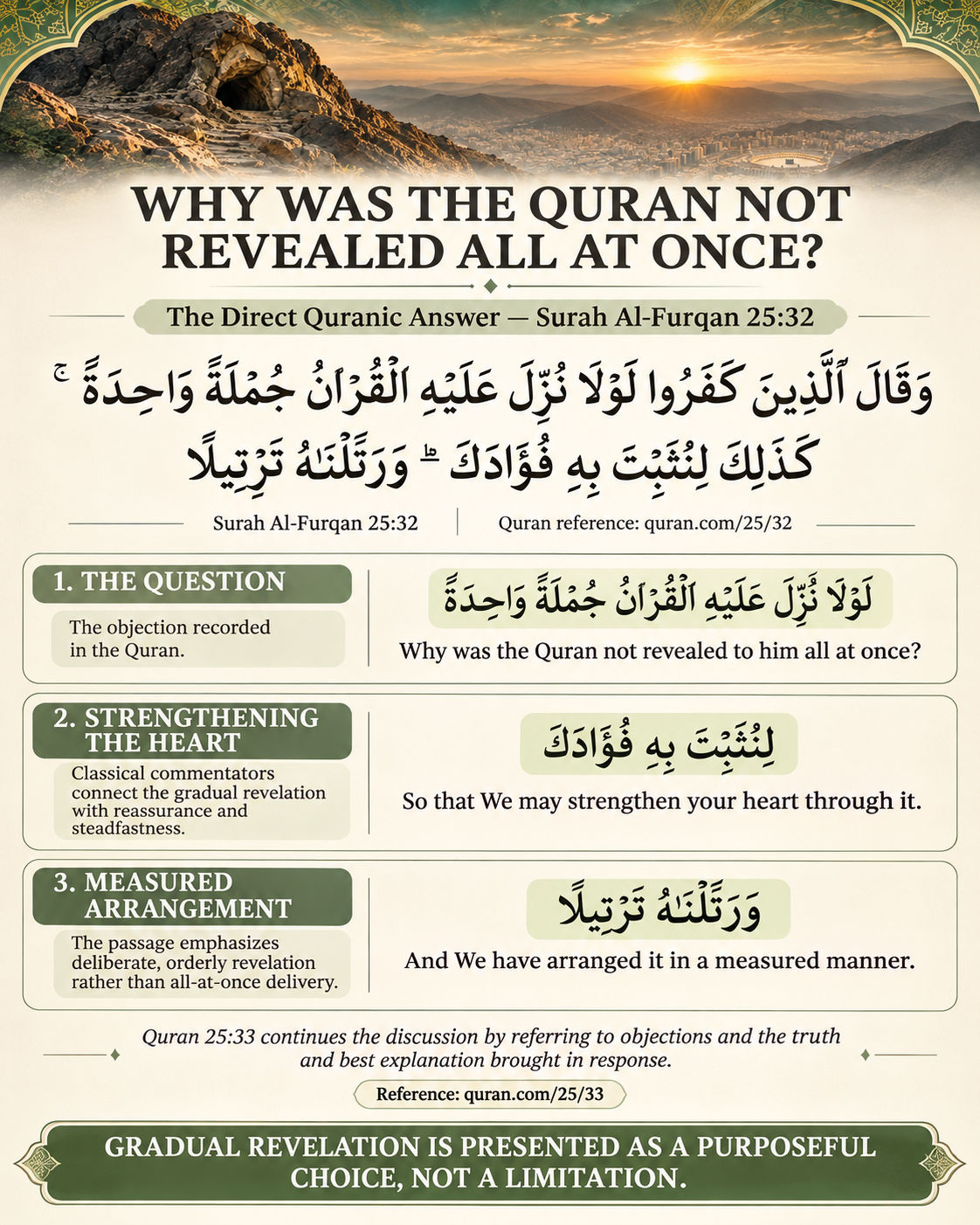
Quran 25:32
وَقَالَ الَّذِينَ كَفَرُوا لَوْلَا نُزِّلَ عَلَيْهِ الْقُرْآنُ جُمْلَةً وَاحِدَةً ۚ كَذَٰلِكَ لِنُثَبِّتَ بِهِ فُؤَادَكَ ۖ وَرَتَّلْنَاهُ تَرْتِيلًا
“And those who disbelieve say, ‘Why was the Quran not revealed to him all at once?’ Thus [it is] that We may strengthen thereby your heart. And We have spaced it distinctly.” (25:32)
The objection was raised by those who rejected the message, and the Quran answers it plainly. Two key ideas appear in the reply.
Strengthening the heart. The verb nuthabbit comes from a root meaning to make firm. Commentators such as al-Tabari and Ibn Kathir explain that each new revelation renewed the Prophet’s steadiness as he faced opposition, so that guidance arrived alongside the challenges it addressed. Al-Sa’di likewise stresses the repeated reassurance the Prophet ﷺ received through ongoing revelation.
Spacing it distinctly. Rattalnahu tartilan describes revelation arranged in measured, orderly stages. The word tartil is also used for deliberate, clear recitation, which fits the verse’s emphasis on a message delivered at a deliberate pace. Scholars differ somewhat on the finer shades of the word, but the broad sense of measured, well-arranged revelation is widely accepted.
The next verse (25:33) adds that whenever the disbelievers brought an objection, Allah brought the truth and the best explanation. Classical commentators, including Ibn Kathir, connect this to revelation responding to events as they occurred.
Quran 17:106
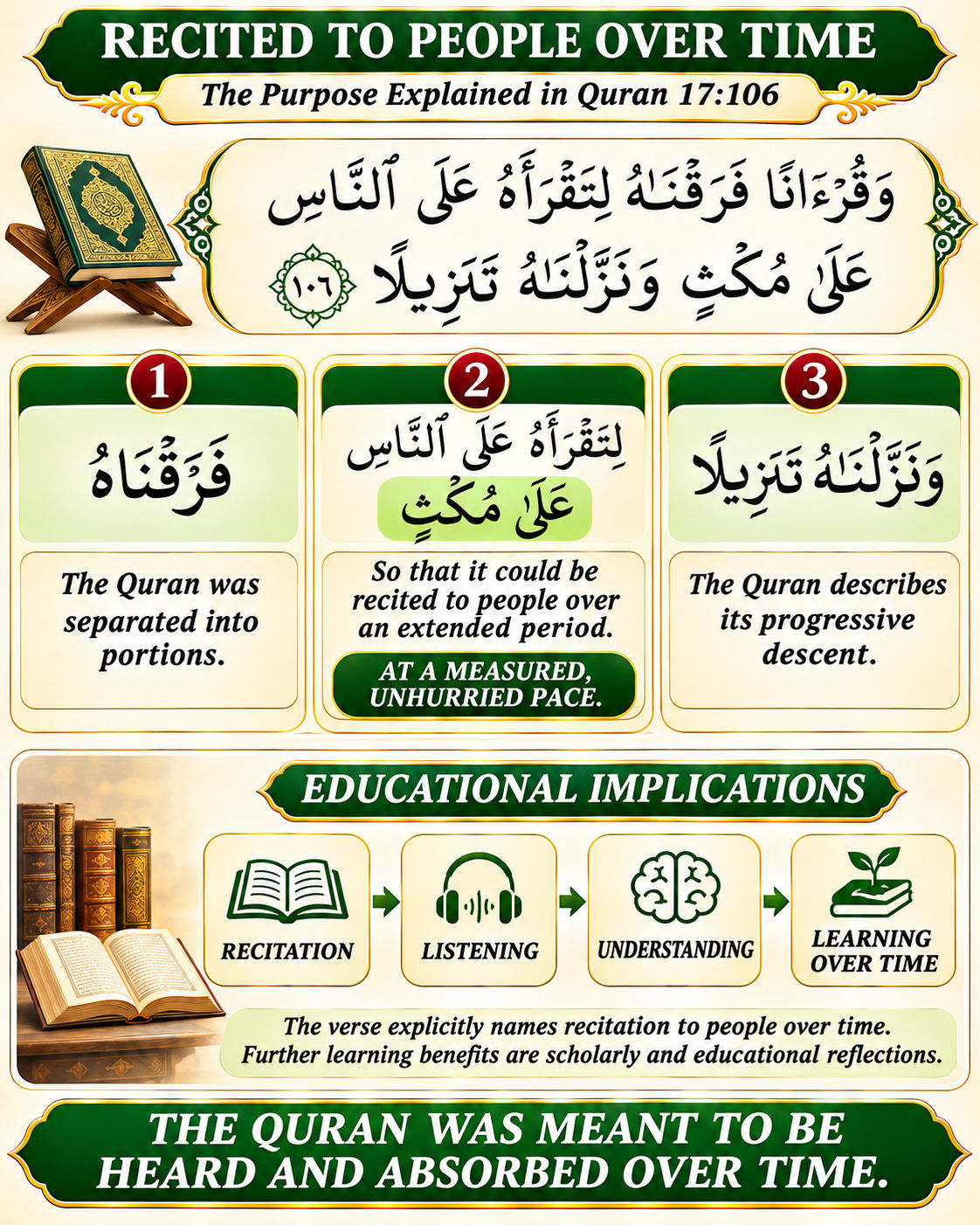
وَقُرْآنًا فَرَقْنَاهُ لِتَقْرَأَهُ عَلَى النَّاسِ عَلَىٰ مُكْثٍ وَنَزَّلْنَاهُ تَنزِيلًا
“And [it is] a Quran which We have separated [by intervals] that you might recite it to the people over a prolonged period. And We have sent it down progressively.” (17:106)
This verse names a second purpose: recitation to people ala mukth, meaning at a slow, unhurried pace. The Quran was meant to be received, heard, and absorbed, not simply delivered. The Prophet ﷺ was a teacher as well as a recipient, and teaching takes time.
What the text says and what scholars add
It helps to keep two categories apart.
Stated in the Quran: strengthening the Prophet’s heart (25:32), and reciting to people over time (17:106).
Drawn out by scholars: responding to questions and events, gradual legislation, ease of memorization and practice, and training a community in stages. These are well-grounded in the Quranic text and in authentic reports, but they are scholarly insights, not separate declarations of divine purpose.
Al-Suyuti’s Al-Itqan fi Ulum al-Quran and al-Zarkashi’s Al-Burhan fi Ulum al-Quran both discuss these wisdoms in their chapters on the descent of the Quran.
Revelation Strengthened the Prophet’s Heart
Reassurance when it was needed
Several Quranic passages show revelation arriving with reassurance at difficult moments. One example is Surah Ad-Duha. Sahih al-Bukhari and Sahih Muslim report from Jundub that the Prophet ﷺ had been unwell and missed his night prayer for a night or two, and a woman made a cruel remark about it. Surah Ad-Duha was then revealed. Its message is direct: “Your Lord has not taken leave of you, nor has He detested [you]” (93:3). Reports also describe a pause in revelation before this surah, but the reports differ in their details, so it is best to rely on the core point the sources agree on: the surah was revealed to reassure him.
Quran 11:120 states the strengthening purpose explicitly:
وَكُلًّا نَّقُصُّ عَلَيْكَ مِنْ أَنبَاءِ الرُّسُلِ مَا نُثَبِّتُ بِهِ فُؤَادَكَ ۚ وَجَاءَكَ فِي هَٰذِهِ الْحَقُّ وَمَوْعِظَةٌ وَذِكْرَىٰ لِلْمُؤْمِنِينَ
“And each [story] We relate to you from the news of the messengers is that by which We make firm your heart. And there has come to you, in this, the truth and an instruction and a reminder for the believers.” (11:120)
The stories of earlier prophets, retold at different points in the revelation, connected the Prophet’s own experience with a long line of messengers who faced rejection and remained patient. This is one reason the Quran returns to such narratives in different settings, a topic explored in why the Quran repeats stories.
Guidance after setbacks
Revelation also addressed hardship within the community. After the setback at Uhud, the Quran told the believers: “Do not weaken and do not grieve, for you [will be] superior if you are [true] believers” (3:139). The surrounding passage in Surah Ali Imran examines what happened, calls the community to reflection, and consoles them. Receiving this guidance in the aftermath of the event, not years earlier or in advance as an abstract text, gave it immediacy.
We should be careful not to add details the sources do not give. The Quran and the authentic reports tell us that reassurance was given and what it said. They do not give us a narrative of the Prophet’s inner emotional states beyond that, and it would be inappropriate to invent one.
The Quran Was Revealed to Real People Facing Real Situations
Asbab al-Nuzul
Asbab al-Nuzul means “the occasions of revelation”: the questions, events, or circumstances that accompanied the revelation of particular verses. Knowing them can clarify a verse’s original setting and meaning. For a broader collection, see Asbab al-Nuzul examples.
Some well-documented examples:
The question about the soul (17:85). Sahih al-Bukhari and Sahih Muslim report, from Abdullah ibn Mas’ud, that people asked the Prophet ﷺ about the ruh (soul or spirit), and the verse was revealed:
وَيَسْأَلُونَكَ عَنِ الرُّوحِ ۖ قُلِ الرُّوحُ مِنْ أَمْرِ رَبِّي وَمَا أُوتِيتُم مِّنَ الْعِلْمِ إِلَّا قَلِيلًا
“And they ask you about the soul. Say, ‘The soul is of the affair of my Lord. And mankind has not been given of knowledge except a little.’” (17:85)
The report places the question in Madinah, while Surah Al-Isra is generally classified as Makkan. Scholars have discussed how to reconcile this, and one common explanation is that a verse may have been revealed again on a later occasion or placed within an earlier surah. The occasion itself is firmly reported.
Questions about the crescent moon (2:189). The verse begins “They ask you about the new moons. Say, ‘They are measurements of time for the people and for Hajj.’” Reports in the tafsir tradition, including al-Tabari’s commentary, connect it with people asking why the moon changes shape. The answer is practical: the moon marks time for worship and daily life.
The Incident of the Slander (Surah An-Nur). In the episode known as al-ifk, false rumors were spread about Aisha (may Allah be pleased with her). Her own narration in Sahih al-Bukhari and Sahih Muslim describes the painful period of rumor and how Allah revealed her innocence. The relevant verses begin at 24:11. Beyond declaring her innocence, the passage establishes broader principles about guarding speech, giving others the benefit of the doubt, and demanding evidence before spreading accusations.
Abu Lahab and Surah Al-Masad. Sahih al-Bukhari and Sahih Muslim report, from Ibn Abbas, that the Prophet ﷺ climbed Mount Safa and called the tribes of Quraysh together to warn them. Abu Lahab, his uncle, answered harshly, and Surah Al-Masad (111) was revealed. It stands as one of the clearest examples of revelation responding to a specific confrontation.
Badr and Uhud. Revelation also engaged with the community’s military and political experiences. Surah Al-Anfal is closely tied to Badr and its aftermath, including the reminder in 8:9 of when the believers sought help from their Lord. A large portion of Surah Ali Imran addresses Uhud. These passages are valuable partly because they speak about real events while teaching enduring lessons about reliance on Allah, discipline, and sincerity.
Two important clarifications
Not every verse has a known occasion. Many verses, including those on creation, tawhid, and the Hereafter, were not revealed in response to a specific recorded event. Asbab al-Nuzul explains some verses, not all.
Guidance is not limited to its occasion. A well-known principle in Quranic studies holds that the lesson of a verse generally extends beyond the circumstances in which it was revealed. A verse about a specific question can still guide later generations.
Why Islamic Laws Were Sometimes Introduced Gradually
Aisha’s explanation in al-Bukhari
Sahih al-Bukhari preserves a statement by Aisha (may Allah be pleased with her) about the order of revelation. She explained that the earliest revelation dealt with Paradise and Hellfire, and only after hearts had settled into faith were rulings on what is permitted and forbidden revealed. She added that if the first command had been “do not drink wine,” people would have said they would never give it up. This report is often cited to explain the educational wisdom of gradual legislation.
The case of intoxicants
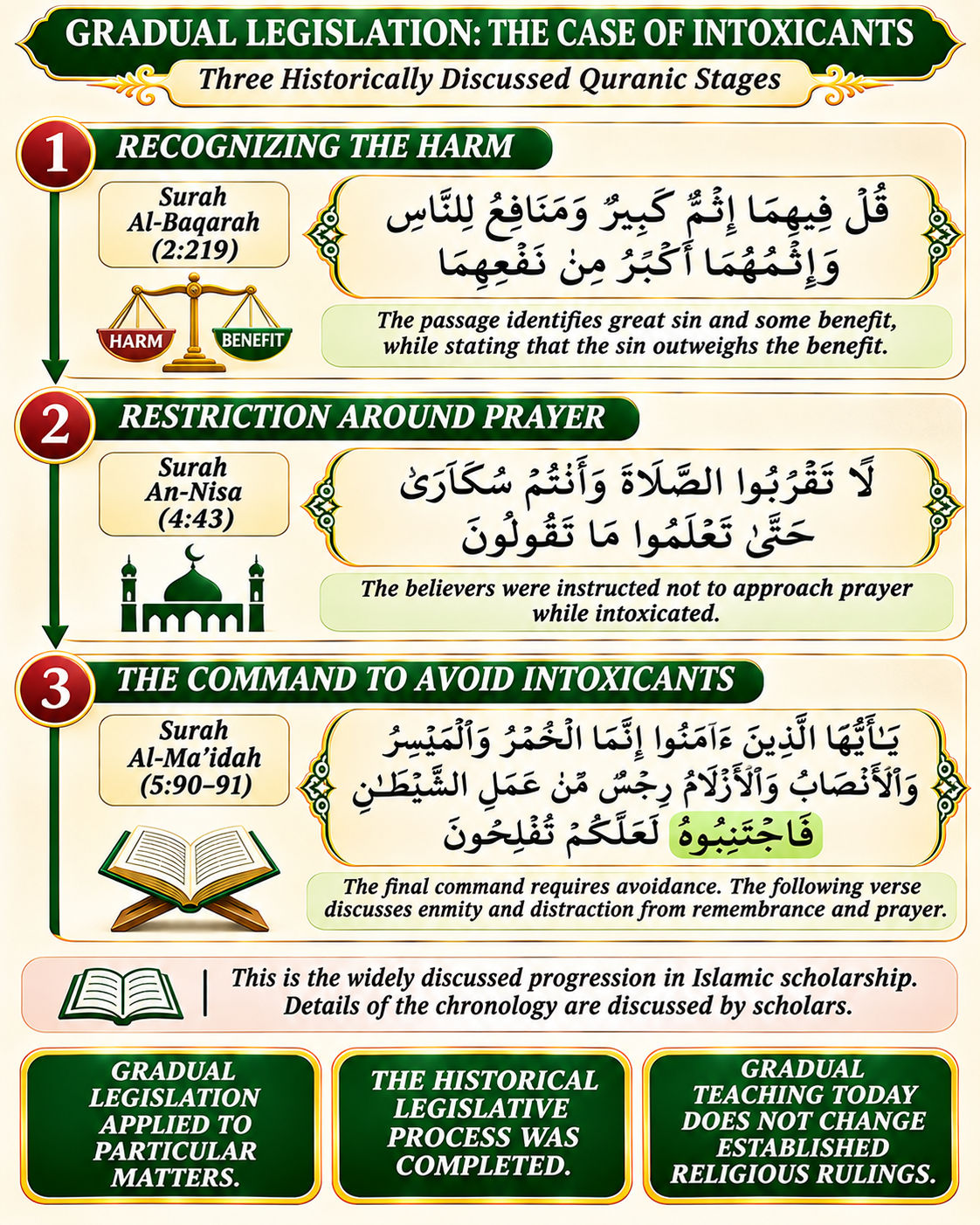
The Quranic treatment of intoxicants is the classic example. The three key passages are:
Quran 2:219. Asked about wine and gambling, the Quran replies that in them is great sin and some benefit, but their sin outweighs their benefit. This introduced moral doubt about a deeply embedded practice without yet issuing a full prohibition.
Quran 4:43. The believers were told not to approach prayer while intoxicated, until they know what they are saying. This restricted drinking around prayer times.
Quran 5:90-91. Intoxicants and gambling are declared “an defilement from the work of Satan” and the believers are told to avoid them, with explicit mention of the enmity and distraction they cause.
Commentators and historians generally treat this as a progression, though they have discussed the exact order of some of the passages. A report in Sunan Abi Dawud and Jami al-Tirmidhi describes Umar ibn al-Khattab asking Allah for a clear ruling on wine as each stage was revealed. Sahih al-Bukhari and Sahih Muslim also report from Anas that when the final prohibition came, wine was poured out in the streets of Madinah.
What this does and does not mean
This history should not be misread.
Not everything was gradual. Core obligations and prohibitions, including tawhid, were established from early on. Gradual legislation applied to particular matters, not to the whole of the religion.
It is not a loophole today. Because legislation was staged in the Prophet’s time does not mean Muslims today may delay or disregard rulings that are now fully established. The process was completed.
It is a historical reality, not a modern teaching method. Teachers today may use patience and gradual instruction, but that is an educational choice inspired by the example, not a continuation of the legislative process.
How Gradual Revelation Helped People Learn and Memorize the Quran
Learning in portions
Revelation in manageable portions made it possible for the Companions to memorize, understand, and practice what they received before the next portion arrived. Quran 17:106 points to this, as the Quran was recited to people over an extended period.
A report found in the introduction to al-Tabari’s tafsir describes how some early Companions learned ten verses at a time and did not move on until they understood them and applied them. Such reports show an early culture in which knowledge and action were meant to travel together. Another report in the Muwatta of Imam Malik relates that Abdullah ibn Umar spent years learning Surah Al-Baqarah. While these reports are more about the habits of the early community than about the reasons for revelation, they illustrate how seriously learning was taken.
Sahih al-Bukhari also reports that Jibril reviewed the Quran with the Prophet ﷺ every Ramadan, and in the final year reviewed it twice. Revision was built into the process.
Educational parallels
Modern research on learning offers interesting parallels, which should be understood as educational reflections and not as theological explanations for gradual revelation.
Distributed practice. A major review of verbal recall studies found that spacing study sessions over time generally improves long-term retention compared with massing practice together (Cepeda et al., 2006, Psychological Bulletin).
Retrieval practice. Studies have found that actively recalling information strengthens memory more than rereading alone (Roediger and Karpicke, 2006, Psychological Science).
Cognitive load. Cognitive load theory suggests that learners absorb new material more effectively when it is presented in amounts they can process (Sweller, 1988, Cognitive Science).
Overview of techniques. A widely cited review ranked distributed practice and practice testing among the more effective learning techniques (Dunlosky et al., 2013, Psychological Science in the Public Interest).
These findings come largely from studies of other kinds of learning, and their application to Quran learning is a reasonable analogy, not a proven mechanism. They do not establish the divine origin of the Quran, and they are not the explanation of gradual revelation. They simply show that the pace and structure of the Quran’s revelation align well with how people tend to learn.
For learners applying these ideas to memorization, see how to memorize the Quran and the question of how the text was safeguarded in how the Quran was preserved.
How Makkan and Madinan Revelation Addressed Different Stages of Community Development
The scholarly definition
Scholars have used several definitions of Makkan and Madinan revelation, as al-Suyuti discusses in Al-Itqan. The most widely used is based on time: Makkan revelation is that revealed before the Hijrah, and Madinan revelation is that revealed after it, regardless of where it was revealed. By this definition, verses revealed in or near Makkah after the Hijrah, such as during the Farewell Pilgrimage, are classified as Madinan.
Broad characteristics
Makkan revelation tends to focus on tawhid, resurrection, accountability, moral responsibility, and patience in the face of rejection. Its verses are often short, vivid, and urgent. Madinan revelation tends to address community life: worship in detail, family relations, social and economic ethics, legal matters, and relations with other groups.
This is a tendency, not a rule. Makkan revelation includes important ethical commands and acts of worship, and Madinan revelation continues to address belief, the Hereafter, and the character of the believer. Treating Makkah as “theology only” and Madinah as “law only” oversimplifies the Quran.
What the contrast shows is how the Quran’s content matched the needs of a community at different stages. A small, vulnerable community needed foundations of faith and endurance. A community with a state-like social structure needed guidance for governing relations, justice, and responsibilities.
Was the Quran Also Revealed on Laylat al-Qadr?
The apparent puzzle
If the Quran was revealed over twenty-three years, why does it say it was sent down in Ramadan and on a blessed night?
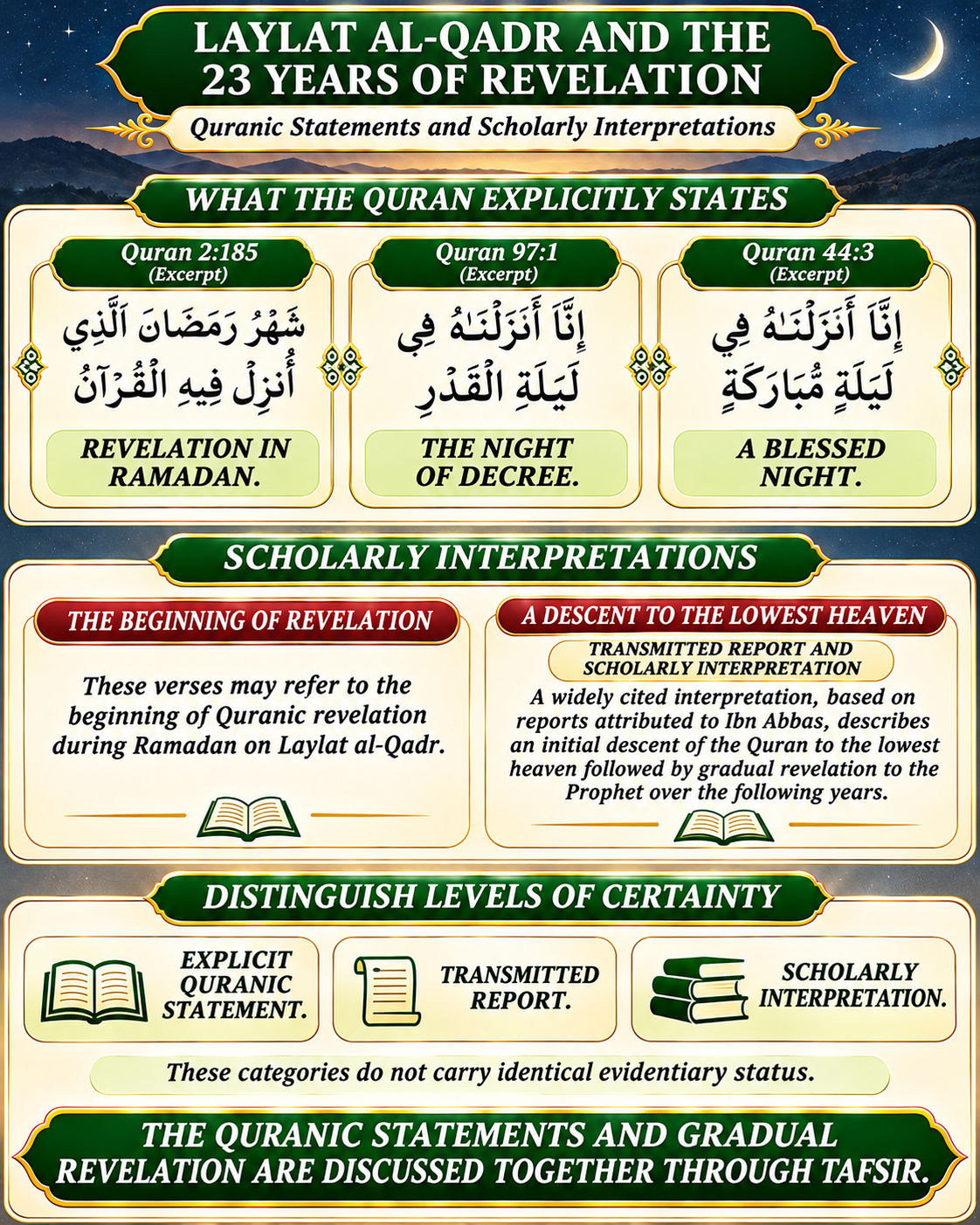
“The month of Ramadan [is that] in which was revealed the Quran, a guidance for the people...” (2:185)
“Indeed, We sent it [the Quran] down during the Night of Decree [Laylat al-Qadr].” (97:1)
“Indeed, We sent it down during a blessed night.” (44:3)
For background on the night itself, see what is Laylat al-Qadr, and for the month, what is Ramadan.
Scholarly interpretations
Scholars have offered several explanations.
The beginning of revelation. One view is that these verses refer to the start of revelation, which began in Ramadan on Laylat al-Qadr. Ibn Kathir and others mention this view.
A descent to the lowest heaven. A widely cited view, reported from Ibn Abbas, holds that the whole Quran was sent down at once to the lowest heaven on Laylat al-Qadr, and then revealed to the Prophet ﷺ gradually over the following years. Al-Suyuti discusses this in Al-Itqan, and many scholars accepted it.
Levels of certainty
These layers should be kept distinct.
Explicit Quranic statements: The Quran was sent down in Ramadan, on a blessed night, the Night of Decree.
Transmitted reports: Reports from Ibn Abbas describe a descent to the lowest heaven. These are reports attributed to a Companion about a matter of the unseen, and scholars have discussed their transmission and status.
Scholarly interpretation: The effort to harmonize the verses with the twenty-three-year timeline is interpretation, and it carries a different level of certainty from the Quranic text.
that the details of the unseen beyond what is stated are known to Allah.
What Gradual Revelation Teaches Us About Learning Today
The following are lessons inspired by the subject. They are not additional divine reasons established through revelation, but they draw on the same wisdom of patience, repetition, and application.
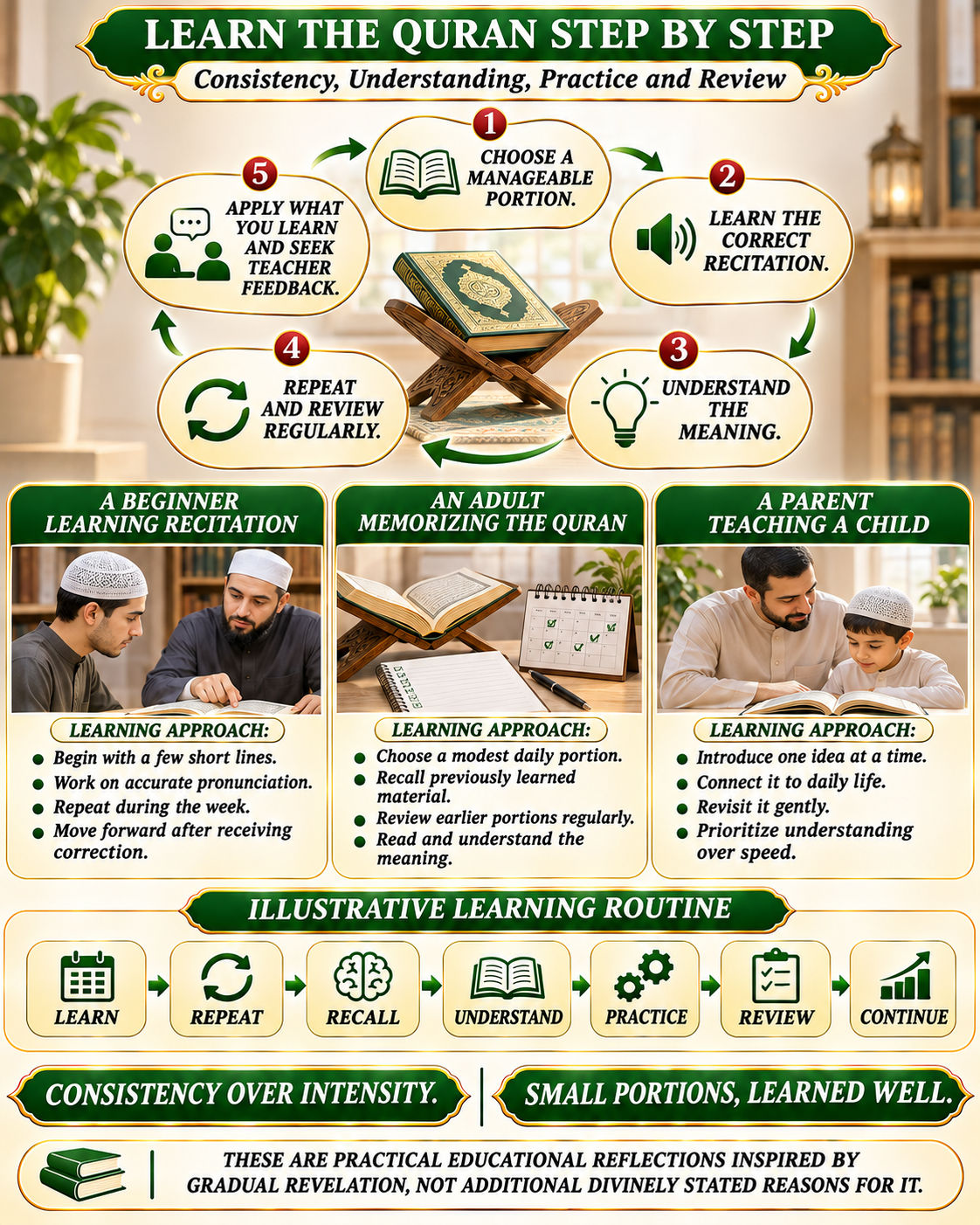
Consistency over intensity
The Quran was received steadily over many years. Short, regular sessions often serve a learner better than occasional long ones. Building a daily Quran habit reflects the same rhythm.
Small portions, done well
Learning a little thoroughly gives a stronger base than rushing through a lot. Pair understanding with memorization, and revise what you have learned regularly.
Practical examples
A beginner learning recitation: Start with a few short lines, practice correct pronunciation with a teacher, and repeat across the week before moving on. Spending time on accuracy early prevents habits that are hard to correct later.
An adult memorizing the Quran: Set a modest daily portion, revise earlier portions every day, and read the meaning of what you are memorizing. Many adults find a steady small portion more sustainable than ambitious targets that collapse after a few weeks.
A parent teaching values to a child: Introduce one idea at a time, connect it to daily life, and revisit it gently. Children need time to develop understanding, so patience matters more than speed.
Guidance from knowledgeable teachers
The Prophet ﷺ was himself the teacher of the Quran to his community, and learners today benefit from qualified teachers who can correct recitation and explain meaning. Araby Academy offers structured instruction for children and adults for those who want it, and you can learn more about learning the Quran online.
Frequently Asked Questions
Why was the Quran revealed over 23 years?
The Quran states two reasons: to strengthen the Prophet’s heart (25:32) and so that he could recite it to people over time (17:106). Scholars have also pointed to revelation responding to questions and events, the gradual introduction of some laws, and ease of learning and practice.
How many years was the Quran revealed in Makkah and Madinah?
The commonly cited figures are about thirteen years in Makkah and about ten in Madinah. These are approximations, and some historians give slightly different numbers.
Could Allah have revealed the entire Quran at once?
Yes. Allah is capable of all things. The Quran does not suggest that gradual revelation was a limitation, and it presents it as a choice with wisdom behind it.
Was the Quran revealed all at once on Laylat al-Qadr?
The Quran says it was sent down in Ramadan and on a blessed night. Scholars interpret this either as the beginning of revelation or, following reports from Ibn Abbas, as a descent to the lowest heaven before gradual revelation to the Prophet ﷺ. The Quranic statement is certain, while the interpretations differ in detail.
Were all Quranic verses revealed in response to specific events?
No. Some verses have documented occasions of revelation, but many do not. Even where an occasion is known, the guidance often extends beyond it.
What is the difference between Makkan and Madinan revelation?
By the most common definition, Makkan revelation came before the Hijrah and Madinan revelation after it, regardless of location. Makkan passages emphasize faith and accountability, and Madinan passages give more attention to community life and law, though both include a wide range of themes.
Conclusion
The Quran’s gradual revelation shows guidance arriving in step with human experience: reassuring a Prophet in hardship, answering real questions, addressing real events, teaching a community in stages, and giving people time to learn, apply, and revise. The Quran names its own reasons in 25:32 and 17:106, and scholars have drawn out further wisdom from the text and history, which we can value while recognizing the difference between what is stated and what is inferred.
For your own learning, the lesson is practical. Progress comes through steady steps, patient repetition, and applying what you learn. If you would like structured guidance on your own journey, Araby Academy offers Quran, Tajweed, and Arabic courses for learners of different ages and levels.