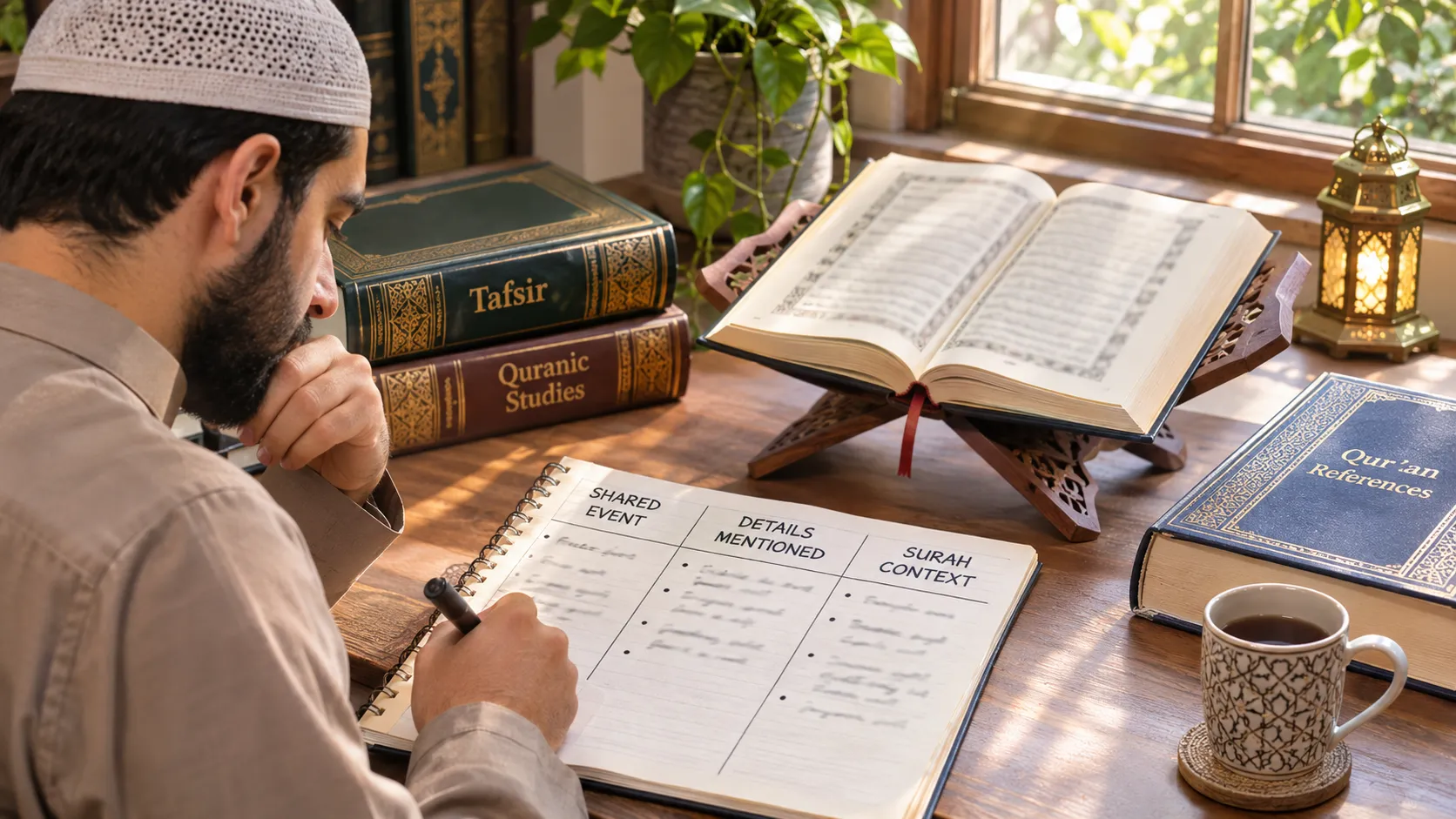
One account of Musa begins with a question: وَهَلْ أَتَاكَ حَدِيثُ مُوسَىٰ ("Has the story of Musa reached you?", Quran 20:9). In Surah Al-Qasas, the same encounter is preceded by a journey, because Musa is already travelling with his family when he sees a fire (28:29). Surah An-Naml enters the moment differently again (27:7).
A beginner may ask: Is the Quran telling three stories? Does one passage contradict another? Why does one Surah mention something another leaves out?
Short answer: The Quran returns to prophetic stories because each passage selects the details that serve its surrounding message: one may focus on a prophet's call, another on a conversation, another on a community's fate. An omitted detail is not a denial, and different wording is not automatically a contradiction. To study these passages responsibly, compare the Arabic text, identify what each verse actually states, read the Surah context, and consult reliable Tafsir.
This article teaches eight ways to compare Quranic narratives carefully. Unless a translator is named, English renderings are original paraphrases of the Arabic.
Why Does the Quran Repeat Stories?
Quranic narratives are called قَصَصُ الْقُرْآنِ (Qasas al-Quran). General repetition is called تَكْرَار (takrar). Recurring accounts can serve reminder, warning, reassurance, moral reflection and the contrast between belief and rejection. Not every passage does all of these, so each case below names only the function the text supports.
To understand how these narrative passages fit within the Quran, it helps to explore the Quranic Sciences that guide responsible interpretation, including Tafsir, revelation context, and the study of Quranic language.
"Repetition" also hides important differences. A refrain is word-for-word repetition. A recurring story is the same broad narrative told in several places. An allusion is a brief recall. Some passages add detail, some select different speeches, and some concern a different episode of the same prophet's life. Two passages about one prophet are not automatically parallel accounts of one incident.
Comparing two accounts also demonstrates what Tafsir explains beyond an English translation of the Quran, especially when a short rendering does not show the surrounding narrative context.
Consider a non-Quranic illustration. One report says a visitor arrived in the evening; another says the visitor arrived and spoke with the family. These do not conflict. But "he came by day" against "nobody came" would raise a real question. So we check exact wording, speaker, time, event identity, context, translation and scholarship. Likewise, a passage that omits an event does not deny it, and one that quotes part of a conversation does not claim nothing else was said. Equally, we must not invent the missing conversation.
Finally, do not merge passages into one seamless timeline. Keep four labels apart: what a verse states, what a reliable Hadith establishes, what classical Tafsir interprets, and what is mere storytelling embellishment (including Isra'iliyyat, reports from earlier religious traditions found in some exegetical literature, which are not automatically Quranic facts). Quranic accounts are also not modern novels or complete chronicles; they can be historically meaningful without narrating every event in biographical order.
Eight Quranic Stories Told from Different Angles
Story | Main references | What the passages share | What they emphasize |
|---|---|---|---|
1. Musa and the fire | 20:9–24; 27:7–12; 28:29–35 | Musa sees a fire and is addressed | Different openings and selected details |
2. Musa and Pharaoh | 7:103–137; 20:43–79; 26:10–68 | Mission, signs, magicians | Different dialogue and pacing |
3. Adam and Iblis | 2:30–39; 7:11–27; 15:26–44; 20:115–123 | Prostration command, Iblis's refusal | Names and guidance; temptation; creation; covenant |
4. Nuh | 11:25–49; 26:105–122; 71:1–28 | Warning to his people | Long event, sequence, preaching |
5. Ibrahim's guests | 11:69–76; 15:51–60; 51:24–37 | Visitors, greeting, good news | Hospitality, dialogue, mission |
6. Maryam and Isa | 3:35–51; 19:16–36 | Announcement of Isa | Family background versus lived episode |
7. Salih and Thamud | 7:73–79; 26:141–159; 54:23–31; 91:11–15 | Sign of the she-camel, rejection | Warning, conditions, consequence |
8. Yunus | 21:87–88; 37:139–148; 68:48–50 | The companion of the fish | Supplication, narrative, admonition |
Why Context Comes First
Quranic narratives sit inside passages about belief, guidance, patience, accountability and divine mercy. Before comparing, ask what comes before and after, who is addressed, whether the passage warns or reassures, and whether it belongs to a sequence of prophets. Do not derive a Surah's whole purpose from one verse.
1. Musa and the Fire: Different Entry Points
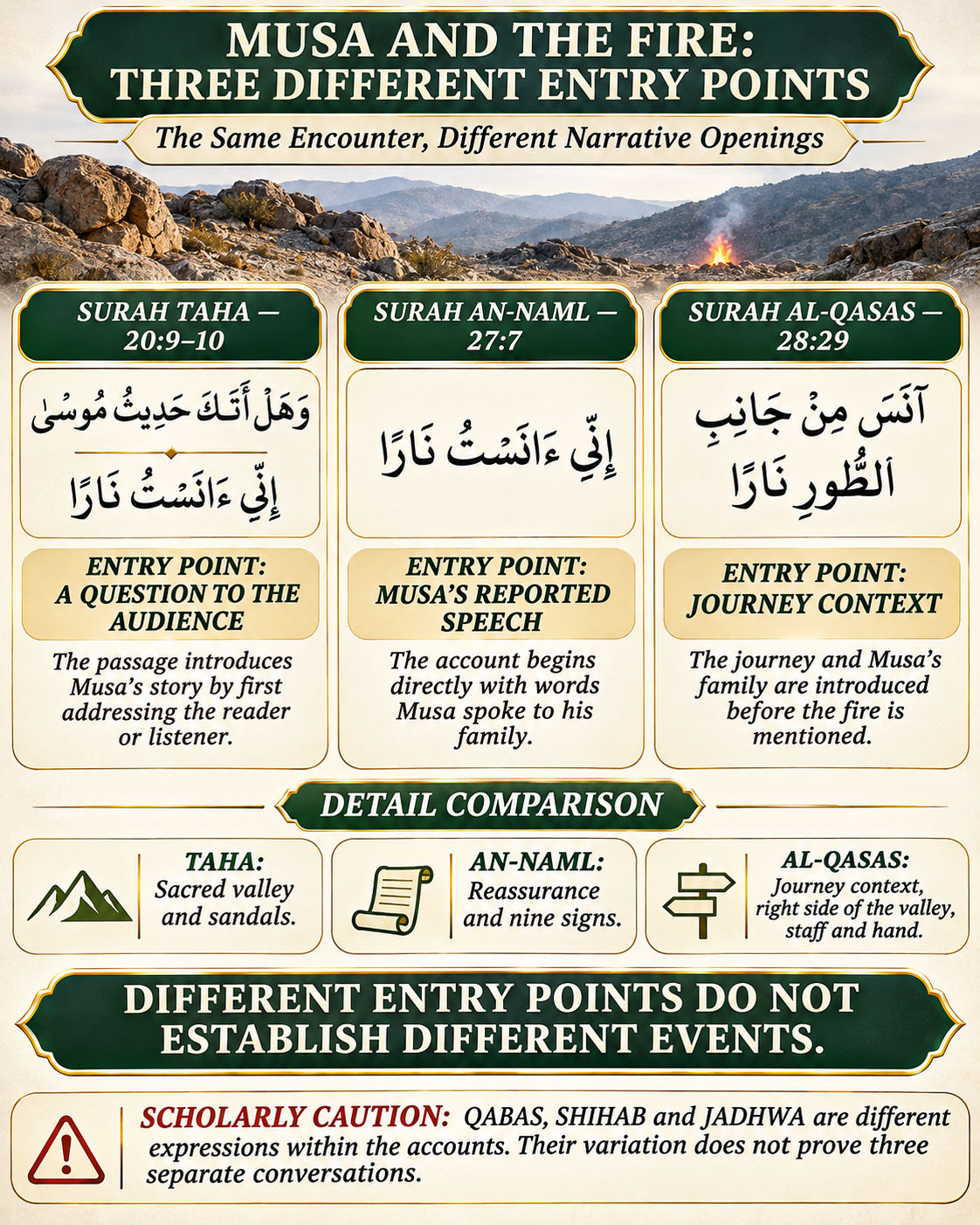
Quran 20:9–24, 27:7–12 and 28:29–35 concern the same scene, narrated in three ways.
Taha opens by addressing its audience (20:9) and moves straight to the fire. Al-Qasas begins earlier, after Musa has completed a term and set out with his family (28:29). An-Naml starts with Musa's words (27:7). All three share the phrase إِنِّي آنَسْتُ نَارًا ("I have perceived a fire"). What Musa hopes to bring differs: guidance at the fire and a brand (qabas) in Taha, news or a burning brand (shihab qabas) in An-Naml, and news or a firebrand (jadhwa) in Al-Qasas. Only An-Naml and Al-Qasas mention warming; only Taha and Al-Qasas record "wait here."
Passage | Opening | Details found there |
|---|---|---|
Taha | Question to the audience | Sacred valley and sandals (20:12), prayer (20:14), question about the staff (20:17) |
An-Naml | Musa's words | "Do not fear" (27:10), nine signs (27:12) |
Al-Qasas | The journey | The right side of the valley (28:30), staff and hand (28:31–32) |
Narrative technique: entry point. Commentators generally treat these as one event told three times. The verses do not say every sentence was spoken in one uninterrupted moment, and they give nothing about weather, time of day or who travelled with him.
Readers should also distinguish a story narrated about an earlier prophet from the historical occasions connected with the revelation of Quranic verses, because these are related but different areas of Quranic study.
Inference to avoid: that "qabas," "jadhwa" and "shihab" prove three separate conversations with his family. Reading question: which Surah mentions the journey, and does omitting it elsewhere deny it?
2. Musa and Pharaoh: Different Dialogue Selections
Quran 7:103–137, 20:43–79 and 26:10–68 share a core (Musa's mission, signs, the magicians, Pharaoh's end) but not an identical span.
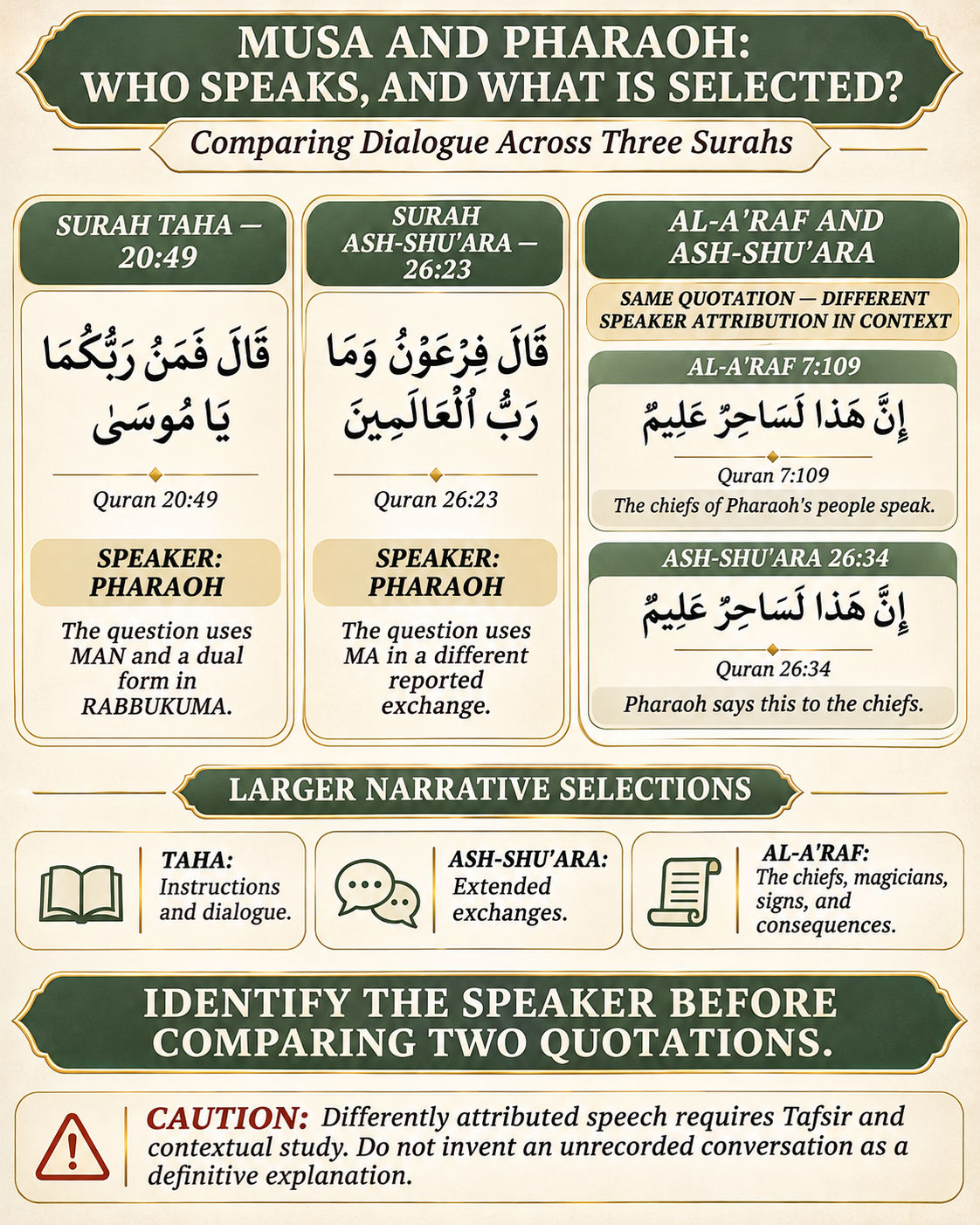
Taha begins with divine instructions to Musa and Harun (20:43–44) and their fear (20:45). Pharaoh asks, قَالَ فَمَن رَّبُّكُمَا يَا مُوسَىٰ ("Who is the Lord of you two, Musa?", 20:49). Ash-Shu'ara begins with the call to Musa (26:10) and gives Pharaoh's question as قَالَ فِرْعَوْنُ وَمَا رَبُّ الْعَالَمِينَ (26:23), with the threat of imprisonment (26:29). Al-A'raf starts with narration (7:103), moves quickly to the chiefs' counsel and the magicians (7:113–126), then to the signs and the sea (7:130–137).
Passage | Notable feature |
|---|---|
Taha | Divine instruction first; "your Lord" in the dual |
Ash-Shu'ara | Extended exchanges; "what is the Lord of the worlds?" |
Al-A'raf | Fast pace; consequences emphasized |
Narrative technique: selected direct speech. A genuine question appears here: "this is a learned sorcerer" is spoken by the chiefs in 7:109 but by Pharaoh to the chiefs in 26:34. Neither verse says only one person said it, and commentators have offered explanations, though readers should not treat any single reconstruction as certain.
Always identify the speaker. Divine instruction is not Musa's speech, and Pharaoh's words are reported, never endorsed. The dialogue becomes easier to follow when readers understand how changes in Quranic pronouns and grammatical perspective work, since the narrator, prophet, and opponent must not be confused.
Inference to avoid: that the question words "man" and "ma" reveal a hidden psychological state. Reading question: who speaks in 26:29, and who in 20:49?
3. Adam and Iblis: Different Theological and Ethical Emphases
Four passages (2:30–39, 7:11–27, 15:26–44, 20:115–123) concern one narrative, not four events, and Quran 18:50 adds that Iblis was of the jinn.
Passage | Distinct emphasis |
|---|---|
Al-Baqarah | A khalifah, the angels' question, teaching of the names, repentance and guidance (2:30–38) |
Al-A'raf | Iblis's reason, his vow, temptation, then clothing and the children of Adam (7:26–27) |
Al-Hijr | Creation from clay, Iblis's claim, respite, limits on his authority (15:26–42) |
Taha | An earlier covenant, a warning about the enemy, the "tree of eternity," then choosing and guidance (20:115–122) |
Narrative technique: thematic emphasis. Al-A'raf quotes Iblis: أَنَا خَيْرٌ مِّنْهُ خَلَقْتَنِي مِن نَّارٍ وَخَلَقْتَهُ مِن طِينٍ (7:12). Al-Hijr words his objection differently, around a human created from clay (15:33), and does not narrate the garden. Al-Baqarah says Iblis refused and was arrogant (2:34) without quoting a reason. None of this denies the other passages.
Iblis's claim in the narrative also illustrates why short Quranic expressions require attention to their exact Arabic wording and context, rather than being reduced to an isolated English quotation.
Inference to avoid: naming the tree's species, a serpent, a place or a duration. The Quran gives none. Reading question: which passage speaks to the children of Adam?
4. Nuh and His People: A Sermon vs a Longer Narrative
Quran 11:25–49, 26:105–122 and 71:1–28 concern Nuh's mission but have different scales.
Passage | Scale and focus |
|---|---|
Hud | Long narrative: warning, ridicule, the Ark, the flood, Nuh's son (11:42–46), a closing lesson |
Ash-Shu'ara | One in a sequence of prophet-and-people accounts, closing with a refrain (26:122) |
Nuh | Preaching and supplication, not a building narrative |
Surah Nuh concentrates on قَالَ رَبِّ إِنِّي دَعَوْتُ قَوْمِي لَيْلًا وَنَهَارًا ("My Lord, I have called my people night and day," 71:5), with calls made openly and privately (71:8–9). It does not describe the Ark. Surah Hud contains the account of the son, whom the text calls not "of your family" (11:46), a statement commentators generally read in terms of conduct and faith. Surah Nuh is not a shortened Hud, since its selection of material differs.
To compare these distributed narratives with a more sustained account, readers can examine the story of Prophet Yusuf and its themes of patience, betrayal, and forgiveness, which is presented extensively in Surah Yusuf, though Yusuf is mentioned elsewhere too.
Inference to avoid: giving the son a name or family background. Reading question: how does narrative length change what you notice?
5. Ibrahim's Guests: Different Details of One Encounter
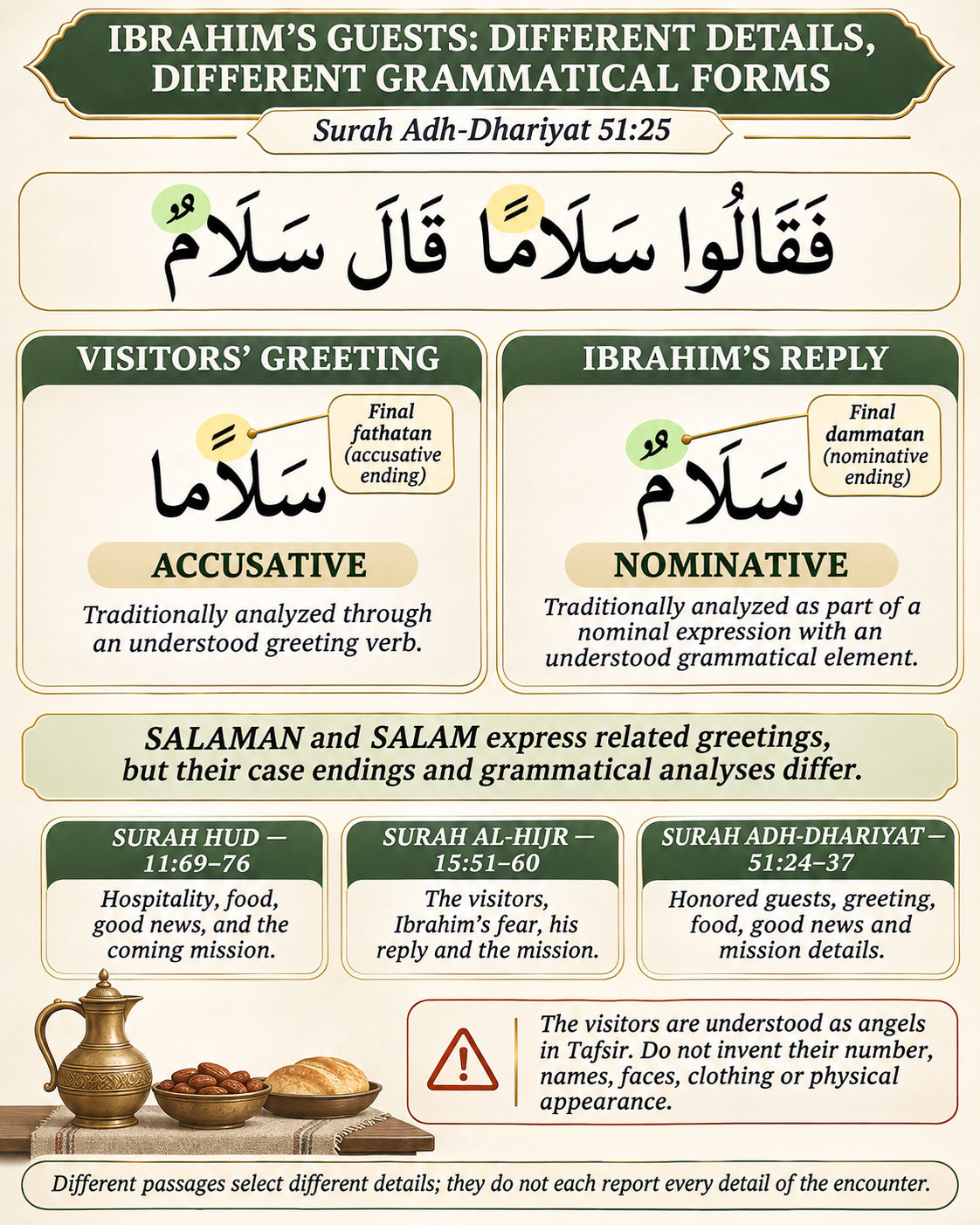
Quran 11:69–76, 15:51–60 and 51:24–37 concern the same encounter, with different moments foregrounded.
Adh-Dhariyat opens with هَلْ أَتَاكَ حَدِيثُ ضَيْفِ إِبْرَاهِيمَ الْمُكْرَمِينَ (51:24). Hud and Adh-Dhariyat mention a calf, roasted in Hud (11:69) and fat in Adh-Dhariyat (51:26); Al-Hijr mentions no food. Ibrahim's fear appears in all three. Al-Hijr records Ibrahim replying about old age (15:54), whereas Hud (11:71–72) and Adh-Dhariyat (51:29) report his wife's reaction. Only Adh-Dhariyat mentions stones of clay (51:33) and "one house of Muslims" (51:36).
Passage | Foregrounded |
|---|---|
Hud | Food, laughter, good news, Lut's people |
Al-Hijr | Ibrahim's fear and reply; the mission |
Adh-Dhariyat | Honored guests; fuller mission |
The grammar matters. Quran 51:25 reads فَقَالُوا سَلَامًا ۖ قَالَ سَلَامٌ. The guests' سَلَامًا is accusative, usually analyzed as standing for an omitted verb ("we greet you with peace"), while Ibrahim's سَلَامٌ is nominative, commonly analyzed as an omitted subject or predicate ("peace is yours"). Many commentators, Ibn Kathir among them, read his nominal reply as the fuller one, but not every scholar assigns a single rhetorical reason. The same pair occurs in 11:69. The two are not unrelated in meaning.
The different forms of Salam in Quran 51:25 also point readers toward Quranic Arabic grammar clues that affect how a sentence is understood, because narrative dialogue can carry grammatical details that short translations do not always show.
The Quran calls the visitors "our messengers" (11:69) and "messengers" (51:31), and commentators understand them as angels; the verses give no names, number or appearance. Inference to avoid: explaining the wife's laughter as a particular emotion. Reading question: which passage has both forms of Salam?
6. Maryam and Isa: Different Narrative Perspectives
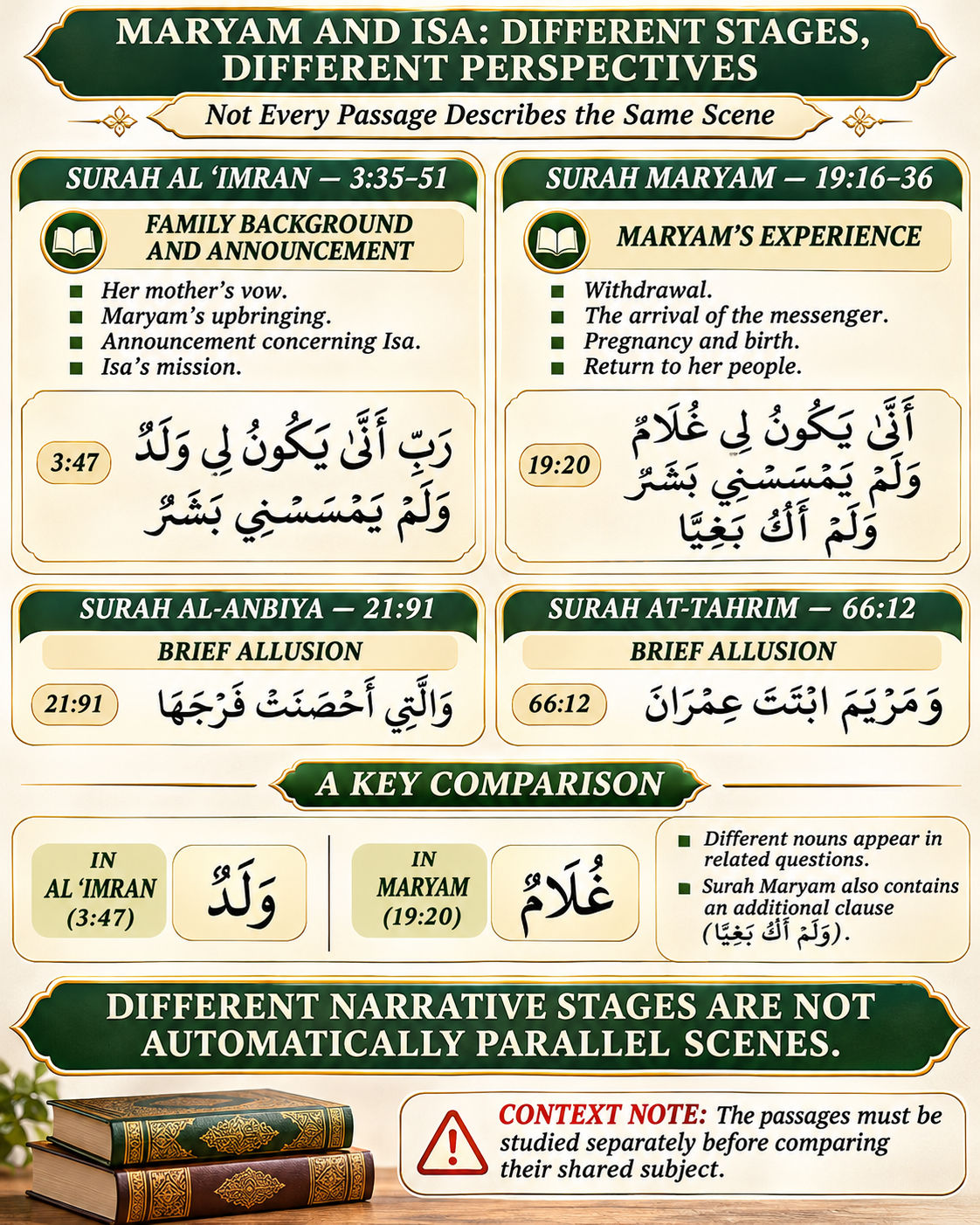
Quran 3:35–51 and 19:16–36 are not one scene retold: the first spans several stages, and the second centers on one episode.
Passage | Content |
|---|---|
Al 'Imran | Her mother's vow, her upbringing (3:35–37), the angels' announcement (3:42–47), Isa's mission (3:49–51) |
Maryam | Her withdrawal, the arrival of the spirit (19:17), the pregnancy and birth (19:22–26), her return (19:27–33) |
21:91; 66:12 | Short allusions, not scene retellings |
Narrative technique: perspective and allusion. Al 'Imran has the angels address her (3:45), while Surah Maryam narrates "We sent to her Our spirit" (19:17), which commentators generally identify as Jibril. Her question appears twice: رَبِّ أَنَّىٰ يَكُونُ لِي وَلَدٌ وَلَمْ يَمْسَسْنِي بَشَرٌ (3:47) and أَنَّىٰ يَكُونُ لِي غُلَامٌ وَلَمْ يَمْسَسْنِي بَشَرٌ وَلَمْ أَكُ بَغِيًّا (19:20). The nouns differ and 19:20 adds a clause, but the meaning is closely related; no hidden distinction need be invented. In Islamic theology Isa is a servant and messenger created by Allah's command, as 3:47 and 19:35 indicate.
The parallel accounts of Maryam also illustratewhy English Quran translations may use different expressions for related Arabic wording, particularly when a translator must clarify pronouns, speakers, and context.
Inference to avoid: adding private dialogue or bodily detail. Reading question: which verses are allusions rather than parallel scenes?
7. Salih and Thamud: Compression and Consequence
Quran 7:73–79, 26:141–159, 54:23–31 and 91:11–15 concern the same sign and rejection at different lengths.
Passage | Emphasis |
|---|---|
Al-A'raf | Salih's call, the sign, the chiefs' dispute, the hamstringing, the quake (7:77–78) |
Ash-Shu'ara | Longer warning; the water arrangement (26:155) |
Al-Qamar | The people's accusations; a trial; a "companion" acts (54:29) |
Ash-Shams | Compressed rejection and consequence (91:11–15) |
Narrative technique: compression. Ash-Shu'ara states هَٰذِهِ نَاقَةٌ لَّهَا شِرْبٌ وَلَكُمْ شِرْبُ يَوْمٍ مَّعْلُومٍ (26:155), and the verses state no quantity of water. Al-Qamar says فَنَادَوْا صَاحِبَهُمْ فَتَعَاطَىٰ فَعَقَرَ (54:29), Ash-Shams says "the most wretched of them rose up" (91:12), and Al-A'raf and Ash-Shu'ara use the plural "they hamstrung her." Commentators read this as individual action within collective responsibility; the grammar does not prove every person acted physically, and the verses name nobody. The punishment is also described variously (the quake, a shout, a crushing), which commentators discuss as aspects of one event, not as separate she-camels.
Inference to avoid: treating the she-camel as a metaphor or inventing a second camel. Reading question: how do grammatical subjects shift across the four passages?
8. Yunus: Supplication, Story, and Admonition
Quran 21:87–88, 37:139–148 and 68:48–50 refer to Yunus at three scales, and 10:98 concerns his people.
Passage | Kind |
|---|---|
Al-Anbiya | Supplication and response |
As-Saffat | Extended account: ship, lots, fish, shore, a gourd plant, a hundred thousand or more (37:140–148) |
Al-Qalam | Admonition to the Prophet ﷺ |
Al-Anbiya gives the supplication: لَّا إِلَٰهَ إِلَّا أَنتَ سُبْحَانَكَ إِنِّي كُنتُ مِنَ الظَّالِمِينَ (21:87). It says he left "angry," which commentators generally relate to his people, and that "We would not constrain him," which most commentators explain as not implying any limit on Allah's power. As-Saffat adds the ship and lots. Al-Qalam instructs the Prophet ﷺ: وَلَا تَكُن كَصَاحِبِ الْحُوتِ ("do not be like the companion of the fish," 68:48). Its addressee is the Prophet ﷺ, not Yunus.
Yunus's supplication also invites readers to study the Quranic meaning of Tawbah and how repentance is understood in Islam, while remembering that the full account requires its own Tafsir and context.
Quran 10:98 mentions the people of Yunus believing, so it is a related episode, not a retelling of the fish scene. Inference to avoid: stating the fish's species, the number of days or a coastline. Reading question: why are these not four identical retellings?
The Eight Storytelling Techniques at a Glance
Story | Key verses | Technique | What it helps you notice | Caution |
|---|---|---|---|---|
Musa and fire | 20:9; 27:7; 28:29 | Different entry points | A phrase shared across openings | Different openings ≠ different events |
Musa and Pharaoh | 20:49; 26:23; 7:109 | Selected dialogue | Who speaks | Reported speech is not endorsed |
Adam and Iblis | 2:34; 7:12; 15:33; 20:115 | Thematic emphasis | Which theme each passage foregrounds | No folklore additions |
Nuh | 11:46; 71:5 | Narrative length | Story versus sermon | Hud is not Nuh in miniature |
Ibrahim's guests | 11:69; 15:54; 51:25 | Selective detail | Grammar in dialogue | No invented angel details |
Maryam and Isa | 3:47; 19:20 | Perspective, allusion | Episode versus allusion | Do not merge scenes |
Salih and Thamud | 26:155; 54:29; 91:12 | Compression | Collective and individual wording | Do not invent identities |
Yunus | 21:87; 37:139–148; 68:48 | Supplication versus extended story | Different episodes | No invented chronology |
These are teaching categories, not a classical taxonomy, and techniques can overlap.
Why Dialogue Changes What We Notice
Quranic narrative moves between narration and direct speech, and quoted words may belong to a prophet, an opponent or a divine address. Pronouns such as "I," "we," "he" and "you" shift with the speaker, so translations often add bracketed explanations. Identify speaker and addressee before comparing two quotations. Differently worded quotations need not be verbatim transcripts of one uninterrupted utterance, and a reported accusation is not an endorsed statement. Grammar and word order can also affect who acts and what is emphasized, though not every narrative difference comes from word order.
Are Different Quranic Accounts Contradictions?
Different levels of detail, entry points and dialogue selections are not automatically contradictory, and one passage may concern a different episode. Yet some tensions, like the speaker of "learned sorcerer," need grammatical and exegetical analysis. When reading, separate textual observation, possible explanation, classical scholarly explanation and unresolved question. Neither dismiss a sincere question nor supply an invented harmonization.
How to Compare Quranic Stories in Five Steps
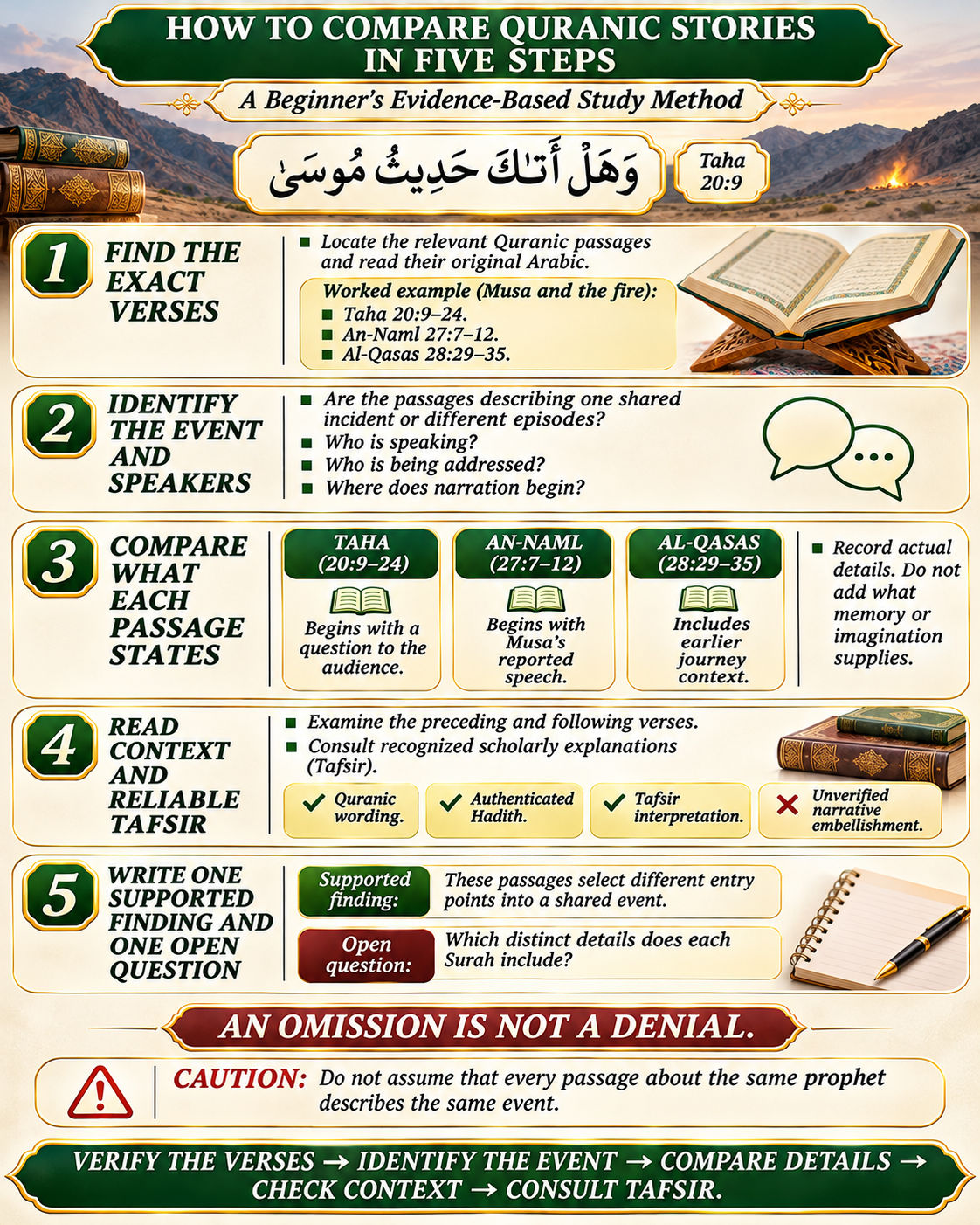
Find all relevant verses in an authoritative Quran text and quote them exactly.
Identify the shared event, speakers, audience and any separate episodes.
List what each passage includes, not what memory fills in.
Read the Surah context and consult recognized Tafsir.
State one supported difference and one uncertainty.
Students can practice the same careful reading habits with short Surahs studied word by word in Quranic Arabic, building the grammar and context skills needed for longer narrative comparisons.
A worked example uses Musa and the fire.
Passage | How it opens | Shared details | Distinct details | Note |
|---|---|---|---|---|
20:9–16 | A question to the audience (20:9) | A fire is seen; Musa is addressed | "Take off your sandals" (20:12) | The opening addresses the reader |
27:7–12 | Musa's words to his family (27:7) | The same fire and address | "Do not fear" (27:10); nine signs (27:12) | Signs are foregrounded |
28:29–35 | Musa travelling after a term (28:29) | The same fire and address | The right side of the valley (28:30); staff and hand (28:31–32) | Journey context appears only here |
A second exercise uses Yunus. Compare 21:87–88 with 37:139–148: which gives the supplication, which includes the ship and the fish, and what does each actually state? Do not reconstruct anything the verses do not say.
A Simple Seven-Day Plan for Studying Quranic Stories
Take one story a day: Musa and the fire, Musa and Pharaoh, Adam and Iblis, Nuh, Ibrahim's guests with Maryam, Salih and Thamud, then Yunus with a review of the eight techniques. This builds habits, not mastery. Each ten-minute session can be two minutes per task: read the first passage, read the second, mark shared and different details, consult a reliable Tafsir note, and write one evidence-supported observation. It will not settle difficult Tafsir questions in ten minutes.
Common Mistakes When Comparing Quranic Stories
Assuming repeated stories are copied word for word.
Calling different wording a contradiction.
Treating omission as denial.
Building one invented timeline.
Confusing separate episodes, such as Maryam's early life with the announcement.
Ignoring the speaker, or assuming all quoted speech is Allah's.
Assuming every popular detail is Quranic.
Claiming every difference has one certain rhetorical explanation.
Assuming Surah Nuh is a short copy of Hud.
Trusting translations without the Arabic and reliable Tafsir.
Common Myths
Myth: The Quran repeats stories because there is nothing new. Reality: Passages emphasize different aspects in different contexts.
Myth: Every repeated story has identical dialogue. Reality: Passages select or render different portions of speech.
Myth: Different details prove contradiction. Reality: Details can be complementary, though actual claims must be examined.
Myth: Omission equals denial. Reality: Omission is non-mention.
Myth: Every passage about one prophet describes the same moment. Reality: A prophet's life includes several episodes.
Myth: All Quranic stories follow one chronological order. Reality: Selected episodes appear in different contexts.
Myth: Surah Nuh is a shorter copy of Hud. Reality: Their material differs.
Myth: Every detail about Ibrahim's guests appears in every account. Reality: Passages select different details.
Myth: All references to Maryam concern one scene. Reality: They include distinct stages and brief allusions.
Myth: Different Salih accounts describe different she-camels. Reality: Different detail levels do not establish that.
Myth: The Yunus verses all describe one scene. Reality: They include supplication, narrative, admonition and a reference to his people.
Myth: Popular details about the Prophets are all Quranic. Reality: Many come from later reports and need verification.
Myth: English translations always preserve Arabic structure exactly. Reality: Natural translation may rearrange or explain words.

Frequently Asked Questions
1. Why does the Quran repeat the same stories? Different passages serve reminder, warning, reassurance and argument in different contexts, but each case must be judged by its own text.
2. Does the Quran tell the same story differently? It can select different details, speeches and emphases while concerning the same broad narrative.
3. Are the differences contradictions? Not automatically. Compare wording, speaker, event and context, then consult Tafsir.
4. What is Qasas al-Quran? It refers to the Quran's narratives, especially about prophets and earlier peoples.
5. What separates repetition from re-narration? Repetition recurs in wording, such as a refrain; re-narration relates the same event again with its own selection.
6. Why is Musa mentioned so often? His mission appears in many contexts, and commentators relate this to varied purposes, although each passage has distinct material.
7. What differs in Musa's fire accounts? Their openings and some details: a question (Taha), the journey (Al-Qasas), and Musa's words (An-Naml).
8. Why is the Musa and Pharaoh dialogue presented differently? Passages select different speeches and spans; the Quran does not claim any is a complete transcript.
9. Why is Adam and Iblis repeated? Each passage highlights different material, such as names, refusal, temptation or covenant.
10. Why does Surah Nuh focus on preaching? It concentrates on his appeal and supplication rather than on the Ark.
11. Why does Hud include Nuh's son? It tells a longer account that includes this episode; other passages do not deny it.
12. What differs in Ibrahim's guests? Food, Ibrahim's reply, his wife's reaction, the mission and the stones appear in different combinations.
13. Why is Maryam's story in different Surahs? One passage gives family background and announcement, another her experience, and two only allude.
14. Why is the she-camel repeated? It is central to the sign and rejection, and each passage selects warning, conditions or consequence.
15. Why is Yunus mentioned in different contexts? One is supplication, one narrative, one admonition, and one his people.
16. Does omission mean it did not happen? No. Omission is non-mention, not denial.
17. Can the stories be combined into one timeline? Only with labels showing what each verse states and what Tafsir or reports add.
18. How does Arabic grammar affect storytelling? It shows who acts, who speaks and what is emphasized, as in salaman and salam.
19. Why is Tafsir necessary? It supplies grammar, wider evidence and scholarly interpretation beyond a translation.
20. How can beginners start? Choose two passages, list shared and distinct details, read the context and note one uncertainty.
Read Each Story in Its Surah Context
Return to Musa seeing the fire. The Quran can mention one pivotal event in different Surahs without repeating the same words. Across the eight cases we met different entry points, selected dialogue, thematic emphasis, narrative lengths, selective details, perspectives, compression, and scales from supplication to extended account.
When you notice a story in more than one Surah, ask what each passage says, what it leaves unstated, and how it fits the surrounding verses. Compare the Arabic carefully and consult reliable Tafsir, without inventing missing scenes or ignoring genuine interpretive questions.
If you would like guided study of Quranic Arabic and Tafsir, Araby Academy's qualified teachers are glad to help.