The Mushaf in Your Hands Has a History
A Muslim opening a Mushaf in Cairo, London, Lagos, Kuala Lumpur, New York, Istanbul, Jakarta or Toronto finds the same Surahs in the same sequence, from al-Fātiḥah to al-Nās. Yet the question of how the Quran was preserved is not answered by pointing at the book. The book is the end of a journey of roughly fourteen centuries. How did it get here?
For Muslims, one answer is theological: Allah promised to guard His Reminder. That promise matters, and we will look at it shortly. But it is not the whole of this article. Here we ask a historical question: what means of preservation can we actually trace through the Quran itself, authentic Hadith, reports from the Companions, early Islamic history, recitation traditions, and manuscripts?
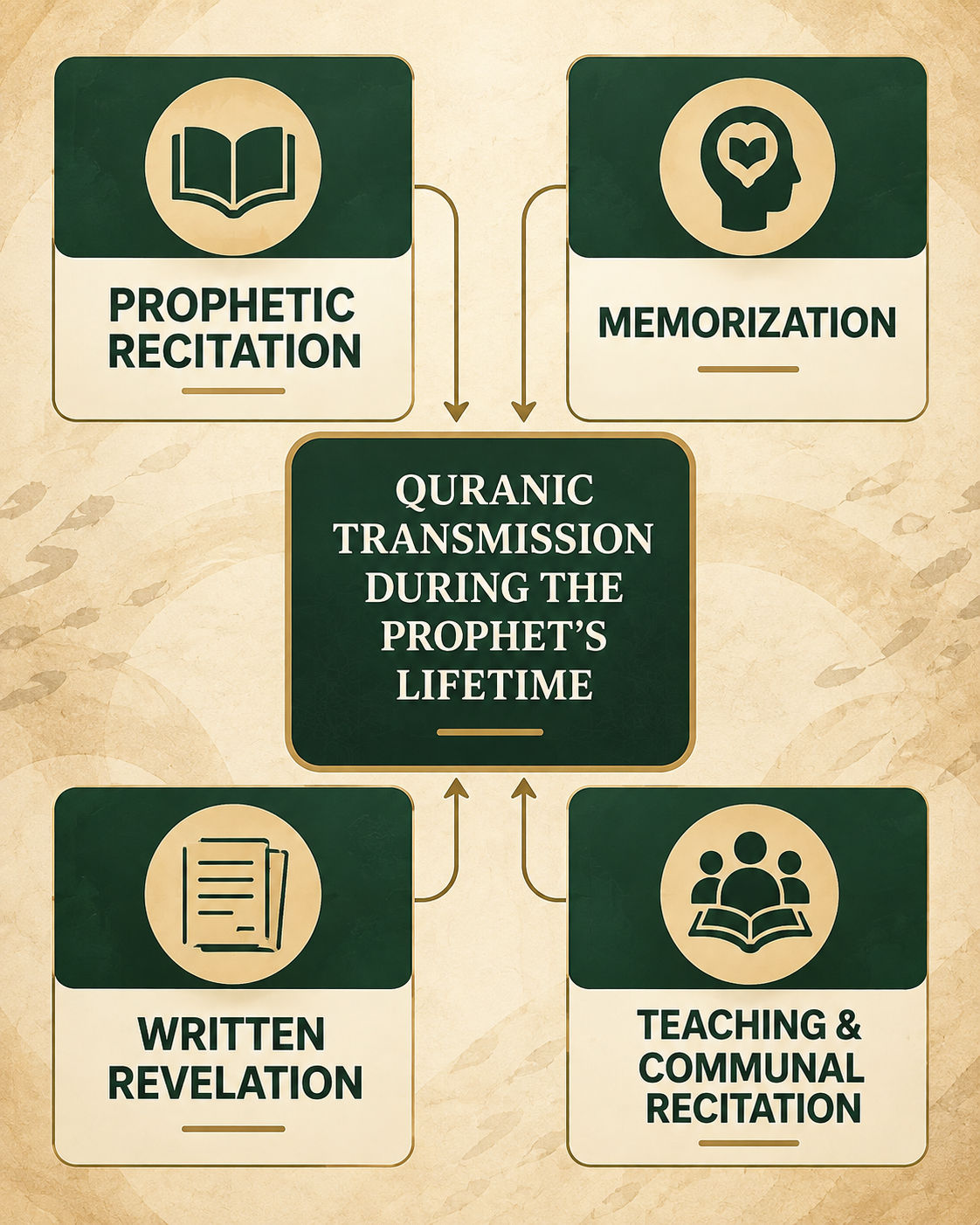
The answer is not one mechanism or one moment. It is overlapping layers: the Prophet’s ﷺ recitation and teaching, memorization by the community, writing during his lifetime, a careful compilation under Abu Bakr رضي الله عنه, standardized codices under Uthman رضي الله عنه, and unbroken teaching and copying ever since. We will walk through them in order, and we will say clearly where the evidence is strong, where scholars differ, and where popular stories go beyond the sources.
A Method First: Do Not Make the Case Stronger by Making the Evidence Weaker
Not every claim in this story carries the same weight. We will separate:
Quranic evidence (what the Quran says about itself);
Ṣaḥīḥ Prophetic Hadith (especially Ṣaḥīḥ al-Bukhārī and Ṣaḥīḥ Muslim);
reports from Companions and Tābiʿūn (named as such, not upgraded to Prophetic statements);
early historical and Quranic-sciences literature, read critically;
modern manuscript scholarship; and
popular claims that cannot be verified, which we omit or qualify.
This matters for a simple reason: a preservation case built on shaky stories can be toppled by one good counter-example. A case built on what the sources actually say cannot be embarrassed by precision. That is our rule throughout.
What Does Quran 15:9 Say, and What Does It Not Do?
إِنَّا نَحْنُ نَزَّلْنَا الذِّكْرَ وَإِنَّا لَهُ لَحَافِظُونَ “Indeed, it is We who sent down the Reminder, and indeed, We will be its guardian.” (Quran 15:9)
In context, the disbelievers address the Prophet ﷺ as the one “upon whom the Reminder has been sent down” (15:6), so classical commentators such as al-Ṭabarī and Ibn Kathīr understood al-Dhikr here as the Quran, and the guardianship as Allah’s protection of it from corruption.
This verse is foundational for belief. But it is not a substitute for history. Muslims believe Allah preserves the Quran through means, and the historical question is: which means do we see operating through the Prophet ﷺ, his Companions, and later generations? That is what the rest of this article traces. The theological claim and the historical investigation complement each other; they should not be confused.
Phase 1: Preservation During the Prophet’s Lifetime
Revelation over about twenty-three years
The Quran was revealed to Prophet Muhammad ﷺ gradually, over roughly twenty-three years: about thirteen in Makkah and about ten in Madinah, ending shortly before his death. The Quran itself addresses this gradualness. It describes a Quran “separated by intervals” so that he might recite it to people “over a prolonged period” (17:106), and it records the objection, “Why was the Quran not revealed to him all at once?”, answered with the explanation that gradual revelation strengthened his heart (25:32).
Not every verse has a known occasion of revelation (sabab al-nuzūl). Many were revealed with no reported specific incident, so we should not attach a story to every verse.
The role of Jibrīl
The Quran states that Jibrīl عليه السلام brought the revelation down “upon your heart, by Allah’s permission” (2:97). He is a messenger carrying Allah’s word; he is not its author. Authentic Hadith describe different ways revelation came to the Prophet ﷺ, for instance as described by ʿĀʾishah in Ṣaḥīḥ al-Bukhārī, but the sources do not give us a detailed mechanism, and we should not invent one.
The Prophet ﷺ received, memorized, recited, and taught
The Quran reassures the Prophet ﷺ about retention: “Move not your tongue with it to hasten it. Indeed, upon Us is its collection and its recitation. So when We have recited it, follow its recitation” (75:16–18). Ibn ʿAbbās reports in Ṣaḥīḥ al-Bukhārī that the Prophet ﷺ used to exert himself in repeating the words as revelation came, until this was revealed. Another verse promises, “We will make you recite, and you will not forget, except what Allah wills” (87:6–7).
The picture is of a Prophet who received the words, retained them, recited them to others, and taught them. The Quran was never primarily a private text. It was a recitation, which is what the word qurʾān itself suggests.
A recited and taught Quran
From the earliest years the Quran was recited in prayer, taught to new Muslims, recited back to the Prophet ﷺ, and passed from Companion to Companion. Authentic reports show him sending teachers such as Muṣʿab ibn ʿUmayr and later Muʿādh ibn Jabal to communities, and listening to Companions recite.
A well-known Hadith in Ṣaḥīḥ al-Bukhārī (narrated by ʿAbdullāh ibn ʿAmr) has the Prophet ﷺ saying to take the Quran from four: ʿAbdullāh ibn Masʿūd, Sālim (the freed slave of Abū Ḥudhayfah), Muʿādh ibn Jabal, and Ubayy ibn Kaʿb. Another narration from Anas ibn Mālik lists those who had gathered the Quran in the Prophet’s lifetime as Ubayy, Muʿādh, Zayd ibn Thābit, and Abū Zayd (in Ṣaḥīḥ al-Bukhārī).
What we should not claim: these lists do not mean only four Companions knew the Quran. They identify recognized teachers and reciters. Reports of exact numbers of memorizers should be treated cautiously unless a source establishes them. What the sources do show is that memorization was widespread, organized around teachers, and embedded in worship.
Preservation, from the beginning, lived inside a community rather than inside a vault.
Was the Quran written during the Prophet’s lifetime?
Yes. Revelation was written down during the Prophet’s ﷺ lifetime. The idea that the Quran was purely oral until Abu Bakr is not supported by the early sources.
The evidence is early and good. In Ṣaḥīḥ al-Bukhārī, al-Barāʾ ibn ʿĀzib reports that when a verse was revealed, the Prophet ﷺ asked for Zayd to bring the shoulder blade, and the verse was written. Zayd himself says in a report in al-Ḥākim’s Mustadrak (and elsewhere) that “we used to compile the Quran from riqāʿ in the presence of the Messenger of Allah ﷺ,” using a word for pieces of parchment or skin. And Zayd’s own account of the later compilation (below) takes for granted written material that existed from the Prophet’s time.
The Prophet ﷺ had designated people to write revelation: kuttāb al-waḥy, the scribes of revelation. Zayd ibn Thābit is the best attested. Others reported in the sources include ʿAlī ibn Abī Ṭālib, Ubayy ibn Kaʿb, and Muʿāwiyah ibn Abī Sufyān, though readers will find much longer lists online (sometimes of forty or more). Each name needs separate support, and “served the Prophet as a scribe” (perhaps of letters or treaties) is not automatically the same as “wrote Quranic revelation.” We therefore stay with the securely attested.
What did they write on?
Zayd’s own report on the later compilation in Ṣaḥīḥ al-Bukhārī names al-ʿusub (palm stalks or ribs of palm leaves) and al-likhāf (thin white stones). Other reports mention al-riqāʿ (parchment or skin pieces) and al-aktāf (shoulder blades of animals). These were the ordinary, available writing surfaces of seventh-century Arabia.
It would be a mistake to picture dozens of random scraps blown about the desert. These were materials held by Companions who had written revelation under the Prophet’s direction, and, as we will see, the later compilers treated them as evidence to be checked.
Did the Prophet ﷺ write the Quran himself?
The Quran describes him as al-nabī al-ummī (7:157–158), and tells him he did not recite any scripture before it nor write it with his right hand (29:48). Muslim scholarship has discussed what ummī means (unlettered, or of a people without a prior scripture), and the details of that debate need not detain us. The key point for preservation is clear and uncontested: he dictated, taught, and authorized scribes. The preservation process never depended on him personally penning a codex.
Who decided where each verse belonged? And what about the Surahs?
For the order of verses within Surahs, there is strong support that it was set by the Prophet ﷺ himself (tawqīfī). A Hadith narrated by ʿUthmān ibn ʿAffān, in the collections of Abū Dāwūd and al-Tirmidhī, says that when verses were revealed the Prophet ﷺ would call a scribe and tell him to place them in the Surah where a particular matter was mentioned. Scholars generally accept this tradition as supporting verse placement.
For the order of the Surahs, the discussion is more varied, and honesty requires saying so. Classical scholars took three broad positions: that the Surah order was also fixed by the Prophet ﷺ; that it was arranged by the Companions’ judgment; or that some of it was Prophetic and some Companion arrangement. There is real evidence of established groupings in his lifetime (for instance, Hadith mention reciting several long Surahs in a single prayer, and Ibn Masʿūd speaks of certain Meccan Surahs as among his earliest and most treasured), while early Companion codices differed in Surah order. The final canonical order is the one transmitted from the Uthmanic codices.
Jibrīl’s review, and the final review
Authentic Hadith report that Jibrīl met the Prophet ﷺ every Ramadan to review the Quran with him (muʿāraḍah), as narrated by Ibn ʿAbbās in Ṣaḥīḥ al-Bukhārī. In the year of his death, Fāṭimah and Abū Hurayrah report in Ṣaḥīḥ al-Bukhārī, the review happened twice. Later scholars call this final review al-ʿarḍah al-akhīrah.
What the report establishes is a regular, confirmatory review of the whole text, culminating in a doubled review at the end. It does not describe a ceremony in which a single master copy was sealed, and it should not be loaded with later theories about specific Qirāʾāt unless scholars have demonstrated that link.
Why was there no single bound Mushaf?
A muṣḥaf is a written volume bringing the Quran between two covers. None existed in the Prophet’s lifetime as an official codex. Reasons recognized by scholars include that revelation was still being sent and the text could still grow, that recitation and writing were already active, and that the community had direct access to the Prophet ﷺ to settle any question. (These are scholarly explanations, not Prophetic statements.)
Important distinction: “not yet gathered between two covers as one official codex” does not mean “not written.” The Quran was written; it was not yet bound as one volume.
Phase 2: Abu Bakr’s Compilation
Revelation had ended, but a new problem emerged
The Prophet ﷺ died in Rabīʿ al-Awwal of 11 AH (June 632 CE). Revelation had ended. No one could now receive new revelation, settle a recitation question directly, or teach in person. The Quran remained in the memories of the Companions, in written materials, and in the practice of the community.
Then came the Battle of Yamāmah (c. 11–12 AH / 632–633 CE), fought against the forces of Musaylimah during the wars following the Prophet’s death. We will not recount that campaign here. What matters is a report in Ṣaḥīḥ al-Bukhārī narrated by Zayd ibn Thābit.
Umar’s concern and Abu Bakr’s hesitation
Zayd says Abū Bakr summoned him after the heavy casualties at Yamāmah, with ʿUmar present. ʿUmar told Abū Bakr that many reciters (qurrāʾ) had been killed, and he feared that if more were lost in other battles, much of the Quran might be lost. He urged Abū Bakr to order its collection.
Abū Bakr hesitated: how could he do something the Messenger of Allah ﷺ had not done? ʿUmar replied that it was good, and kept urging until Abū Bakr’s chest was opened to it. We should not dramatize beyond this. The narration shows serious Companions weighing a new measure and concluding that preserving the Quran in an additional, formal way was beneficial and necessary. It is an example of responsible Companion judgment (ijtihād) after revelation had ended.
Why Zayd ibn Thābit?
Abū Bakr told Zayd, “You are a young and intelligent man, and we do not suspect you; and you used to write the revelation for the Messenger of Allah ﷺ. So seek out the Quran and collect it” (Ṣaḥīḥ al-Bukhārī). The qualifications named in the report are capability, trustworthiness, and prior experience writing revelation. Other reports add Zayd’s deep knowledge of the Quran and that he was among those who recited it to the Prophet ﷺ in his final year; these come from additional sources, not from this narration.
Zayd’s reaction shows the weight of the task: had they ordered him to move a mountain, he said, it would not have been heavier on him than this.
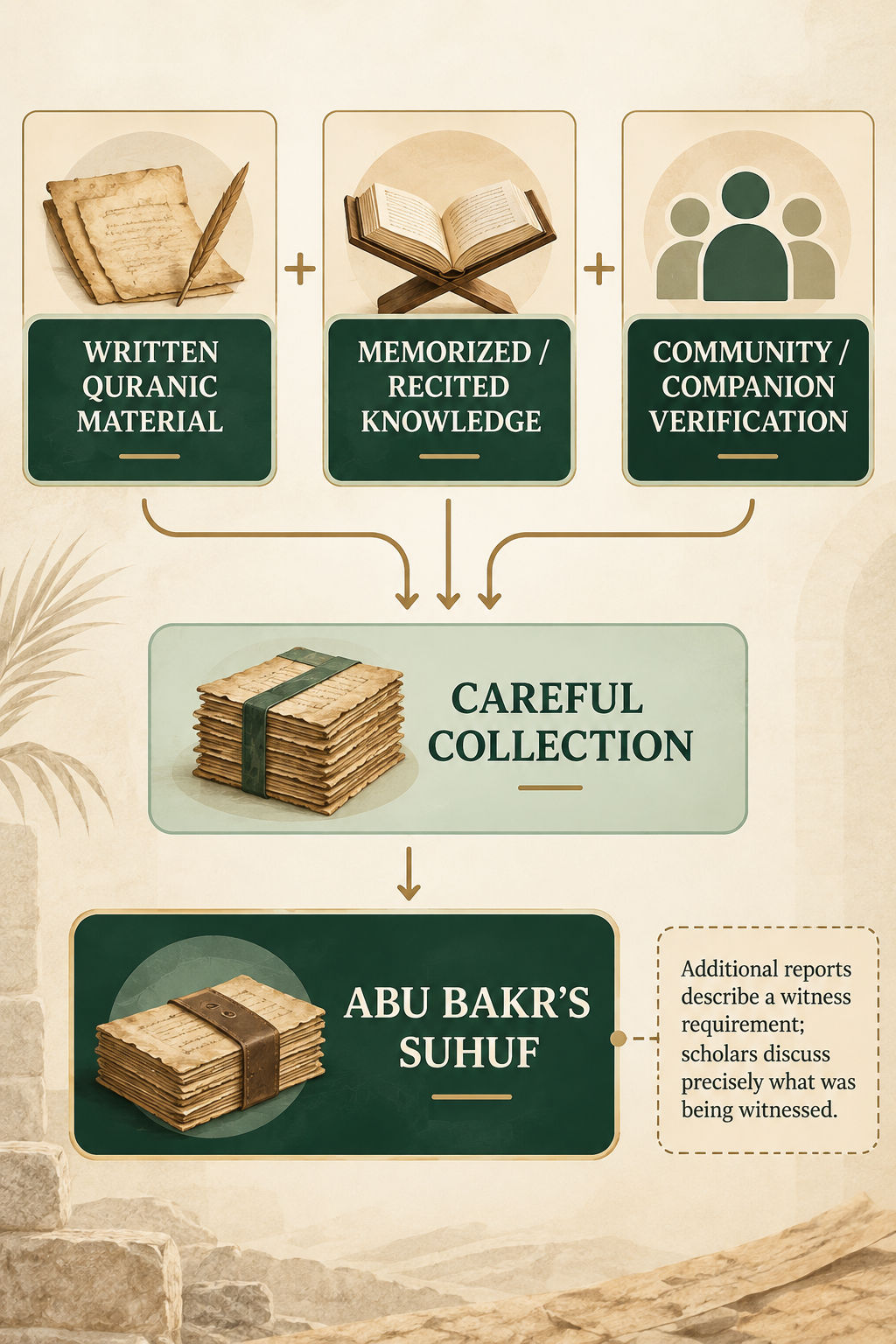
How did Zayd verify the Quran?
Zayd’s words in Ṣaḥīḥ al-Bukhārī are: he began seeking the Quran and collecting it from al-ʿusub, al-likhāf, and ṣudūr al-rijāl (“the hearts/chests of men”). Two mistakes are common.
The first is to imagine Zayd did not know the Quran and had to reconstruct it from fragments. He was a leading reciter and had himself written revelation. The second is to imagine that memory alone, or loose scraps alone, were simply accepted. The report describes a search across both written and memorized sources. Written material and living memory were checked against each other.
Evidence box: “Two witnesses”
The Bukhārī report does not mention two witnesses. It says Zayd collected from written materials and from men’s memories, and that for the end of Sūrat al-Tawbah he found it with Khuzaymah (or Abū Khuzaymah) al-Anṣārī and with no one else.
Additional reports (notably in Ibn Abī Dāwūd’s Kitāb al-Maṣāḥif) describe ʿUmar and Zayd sitting at the door of the mosque and requiring two witnesses for what was brought. The chains of these reports have been discussed by scholars.
Interpretations. Scholars such as Ibn Ḥajar and al-Suyūṭī discuss what the witnesses attested. A common reading is that they testified that the written piece had been written in the Prophet’s presence; another is that written and memorized evidence were both required. Because the Bukhārī narration does not specify this, we should not present any one formulation as its explicit wording.
What we should not claim: “every verse required exactly two memorizers” is not established.
Why require written evidence if the Quran was memorized? Because redundancy strengthens verification. A careful project does not have to depend on one person’s memory when written and memorized evidence both exist. (This is a historical interpretation of the process, not a reported statement of the Companions’ philosophy.)
The last verses of Sūrat al-Tawbah
Zayd reports finding the end of Sūrat al-Tawbah (9:128–129, “Indeed, there has come to you a Messenger from among yourselves…”) with Khuzaymah or Abū Khuzaymah al-Anṣārī, the wording varying between Bukhārī narrations, “which I did not find with anyone else.”
This does not mean no one else knew or had memorized those verses. Reports and scholars explain that Zayd himself knew them; the point is that he sought written material that had been recorded in the Prophet’s time, and found it with that Companion. It shows the method: a verse’s memorized status and its written attestation were both sought.
A separate report, from the Uthmanic project, is in Ṣaḥīḥ al-Bukhārī too: Zayd says he missed a verse from Sūrat al-Aḥzāb (33:23, “Among the believers are men true to what they promised Allah…”) which he had heard the Prophet ﷺ recite, and found it with Khuzaymah ibn Thābit. These are two different reports about two different projects, and they should not be merged.
What did the project produce?
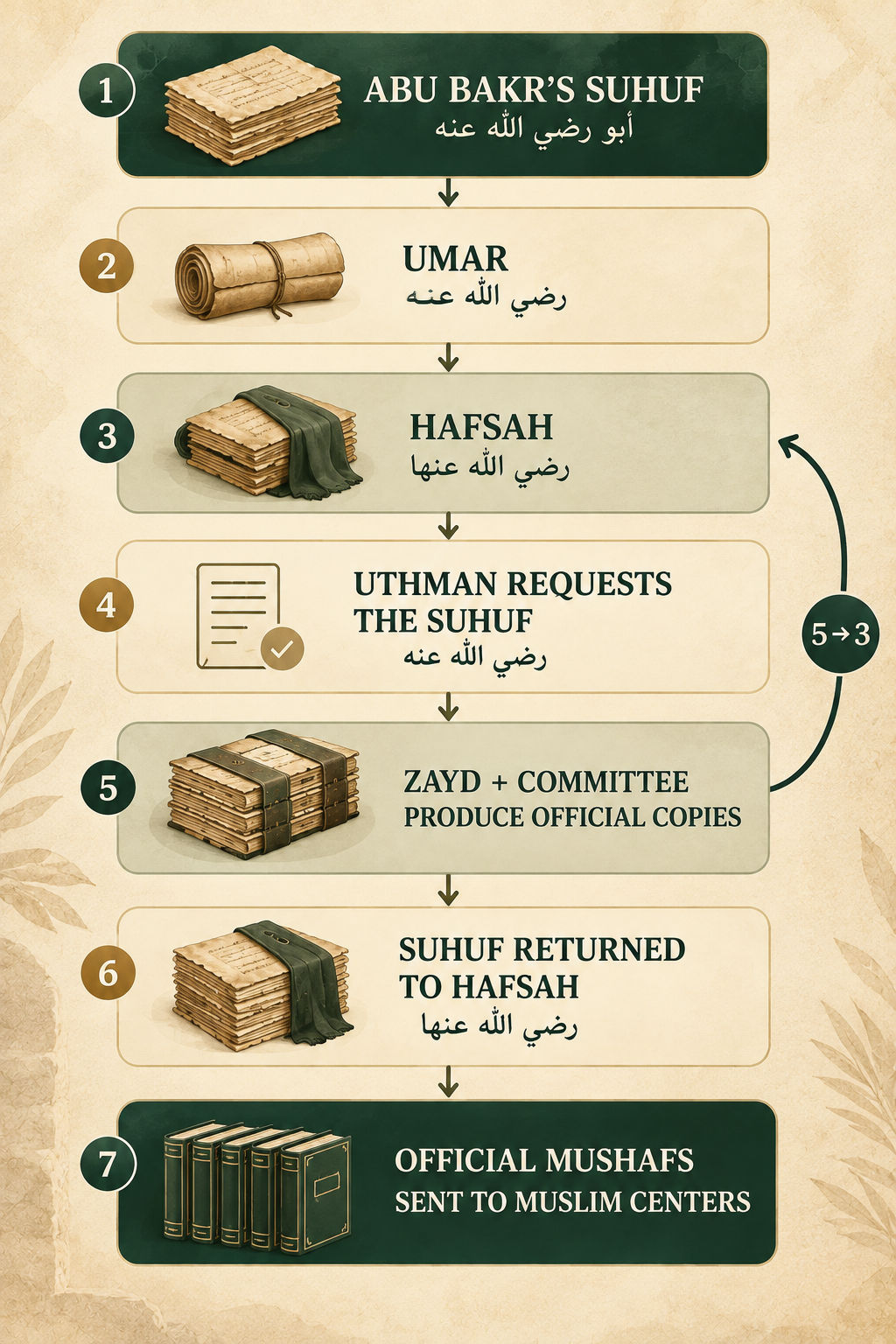
The result was a collected set of written sheets, al-ṣuḥuf. Abū Bakr should not be described as having “written” or “created” the Quran. A careful formulation: Abu Bakr commissioned the first official, post-Prophetic compilation of the Quran into a collected written corpus.
Custody is clear in Ṣaḥīḥ al-Bukhārī: the Suhuf remained with Abū Bakr until he died, then with ʿUmar for his life, then with Ḥafṣah bint ʿUmar رضي الله عنها, a widow of the Prophet ﷺ and ʿUmar’s daughter. Her place as a Companion, a wife of the Prophet ﷺ, and the daughter of the caliph who had held them makes this a natural custody, not a random one.
Why was the Quran still not a mass-produced book? Because seventh-century textual culture did not work that way. There was no printing. Texts were copied by hand, taught orally, and transmitted through teachers. Judging that world by modern publishing standards misleads.
Phase 3: Uthman’s Standardization
Why another project?
The first collection solved one problem. A generation later, the expansion of the Muslim world created another. Under ʿUthmān ibn ʿAffān (caliph c. 23–35 AH / 644–656 CE), Muslims lived across the Ḥijāz, Iraq, Syria and beyond, and had learned the Quran from different Companions.
Ṣaḥīḥ al-Bukhārī records that Ḥudhayfah ibn al-Yamān, who had been campaigning on the Armenian and Azerbaijani front with both Syrian and Iraqi troops, was alarmed at how they differed in recitation. He came to ʿUthmān and urged him to act before the community fell into disputing the Book as earlier communities had. The trigger was not a lost Quran. It was communal disagreement over how a known Quran was being read.
The precise date of the project is reported differently in later sources (roughly mid-640s CE), so we use approximate language.
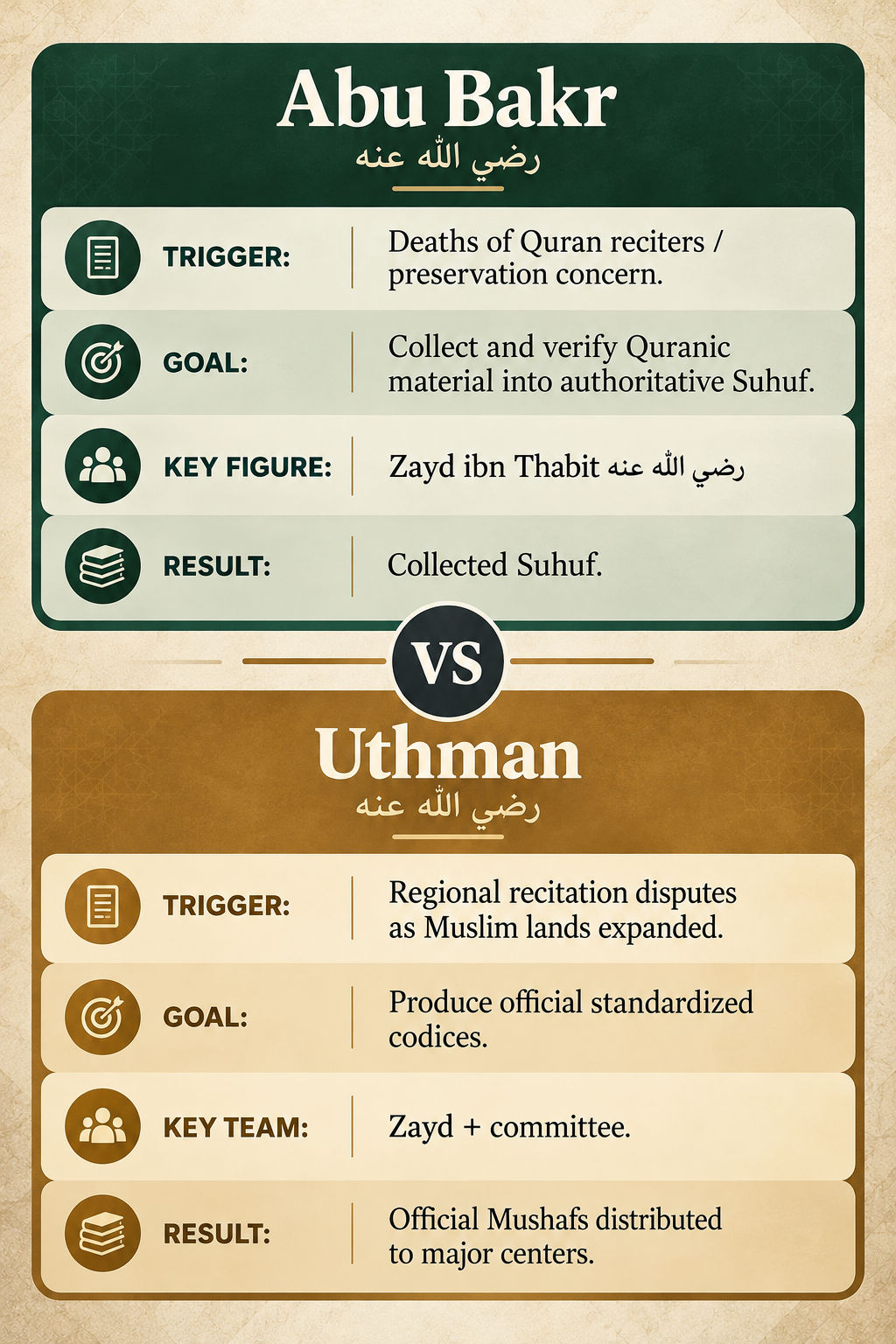
Abu Bakr’s project versus Uthman’s project
Question | Abu Bakr رضي الله عنه | Uthman رضي الله عنه |
|---|---|---|
Historical trigger | Fear of loss after the deaths of reciters at Yamāmah | Disputes over recitation as the Muslim lands expanded |
Main objective | Collect and verify the Quran into authoritative Suhuf | Produce official, standardized codices for the wider community |
Main figure | Zayd ibn Thābit | Zayd ibn Thābit with a committee |
Source | Written materials plus memorized transmission | The Suhuf held by Ḥafṣah, together with the established recitation and transmission |
Result | A collected set of Suhuf | Official Mushafs sent to major centers |
The table shows two different projects, not a failed first attempt and its repair.
The first compilation was a collecting and verifying project. The second was a copying and standardizing project that started from the first. Uthmān did not repeat Abū Bakr’s work because it had been unreliable; he relied on it.
Uthman’s committee and Hafsah’s Suhuf
According to Ṣaḥīḥ al-Bukhārī, ʿUthmān sent to Ḥafṣah asking for the Suhuf so that copies could be made, promising to return them. He then commissioned Zayd ibn Thābit, ʿAbdullāh ibn al-Zubayr, Saʿīd ibn al-ʿĀṣ, and ʿAbd al-Raḥmān ibn al-Ḥārith ibn Hishām to write out copies. The last three were Qurashi; Zayd was from the Anṣār. When the copying was done, ʿUthmān returned the Suhuf to Ḥafṣah, and a copy went out to each region.
This is the link that matters: the Abu Bakr compilation is the explicit source of the Uthmanic project.
“Write it in the language of Quraysh”
The report adds that ʿUthmān told the three Qurashi men that if they and Zayd disagreed over any part of the Quran, they should write it in the tongue of Quraysh, “for it was revealed in their tongue.” Those who did so followed this. This instruction concerns how disputed written forms were to be spelled, not a translation of the Quran into a new dialect, and it should not be stretched into a full answer to the Ahruf question, to which we return below.
What did Uthman actually standardize?
We should not say “Uthman chose one Quran from many competing Qurans.” The sources describe the production of official codices, copied from the established compilation, written in a consistent orthographic framework known as the Uthmanic Rasm (al-rasm al-ʿUthmānī). Think of the Rasm for now as the written consonantal skeleton and spelling conventions of those codices; we will define it more fully shortly.
How many codices, and where did they go?
Historical reports differ on how many official copies were made. Later sources give figures such as four, five, or seven. What is secure is that multiple copies were made and sent to major centers, with one kept in Madinah; the commonly named destinations are Makkah, Kufa, Basra, and Syria. Because the exact count and distribution come from later reports, we should not present a precise map as settled fact.
Why were other materials ordered destroyed?
The same Bukhārī report says ʿUthmān ordered that every other Quranic sheet or codex be burned (or, in some wording, destroyed). It is a real report, and an honest article does not hide it.
What it does not say is that “the Quran” was burned or that revelation was replaced. The official codices were themselves Quranic codices, produced from the established compilation. Scholars explain that the order targeted non-standard written materials: private sheets and personal copies that might include marginal explanations, spelling variants, or recitations associated with early transmission, all of which could fuel dispute among a community that now had an agreed written standard. Material that had already been memorized and taught by the community was not erased by destroying sheets of paper.
So: “Did Uthman burn the Quran?” No, in the sense of destroying revelation and installing a new text. Yes, in the narrower sense that non-standard written materials were ordered withdrawn. Precision serves better than either slogan.
Personal Companion codices, Ibn Masʿūd, and Ubayy
Some Companions kept personal written collections. These could differ in Surah order, in spelling conventions, in explanatory notes, and in recitations associated with early transmission. A personal codex is not automatically a different Quran.
Ibn Masʿūd was one of the Prophet’s ﷺ most respected Quran teachers (he is in the Hadith of four above). Reports say he resented not being chosen for the Uthmanic project and urged his students to keep their own copies; these appear in Musnad Aḥmad and other early sources, with differing chains that scholars assess differently. Reports that his codex lacked al-Fātiḥah and the Muʿawwidhatayn (Sūrat al-Falaq and al-Nās) are also found in early sources. Scholars such as Ibn Ḥajar discuss them at length. Explanations offered include that he regarded the two as protective supplications not to be written into the codex, that the reports of his denial are weak or misunderstood, and that he is also reported to have returned to the community’s position. What we can say responsibly: Ibn Masʿūd’s codex was not identical in every respect to the Uthmanic Mushaf; the reports must be examined, not waved away; and the Quran was transmitted through his students as well. For example, the reading of ʿAṣim, which comes to us through Kufan teachers, passes back through the Companions including Ibn Masʿūd and ʿAlī.
Ubayy ibn Kaʿb is the other major case. Reports say his codex had a different Surah order, and later sources mention two short supplications (al-khalaq and al-ḥafd) associated with the Qunut prayer, sometimes described as Surahs in later discussion. Their evidential status needs care. Scholars treat them as supplications that were recorded in his codex, not as a “lost Quran” established by strong evidence, and the claim should not be repeated without that qualification.
The acceptance of the Uthmanic Mushaf by the broad body of Companions and the community made it the standard written text, even while individual historical reports about individual figures are recorded. We should not project later terminology back, but we also should not say that nobody objected.
The Seven Ahruf, the Qiraʾat, and Hafs and Warsh
What are the Seven Ahruf?
In Ṣaḥīḥ al-Bukhārī and Ṣaḥīḥ Muslim, ʿUmar reports hearing Hishām ibn Ḥakīm recite Sūrat al-Furqān in a way ʿUmar did not recognize, and bringing him to the Prophet ﷺ. The Prophet ﷺ had Hishām recite, said it was revealed that way, then had ʿUmar recite and said the same, adding that the Quran was revealed upon seven aḥruf and they should recite what is easy of it. These Hadith are authentic.
Aḥruf (singular ḥarf) literally means edges or modes. What exactly the seven are has produced considerable scholarly discussion: seven dialects or ways of speech; seven categories of variation (in words, forms, order, and so on); seven kinds of meaning; and the possibility that “seven” signals plurality. Some classical scholars, including al-Ṭabarī, held that the Uthmanic codices preserved only one ḥarf; others hold that the Rasm accommodates multiple. We should not tell readers the seven Ahruf are simply seven dialects as an undisputed fact. The Hadith are secure; the technical meaning is debated. That is a useful lesson in itself: authentic evidence does not always mean every interpretive detail is simple.
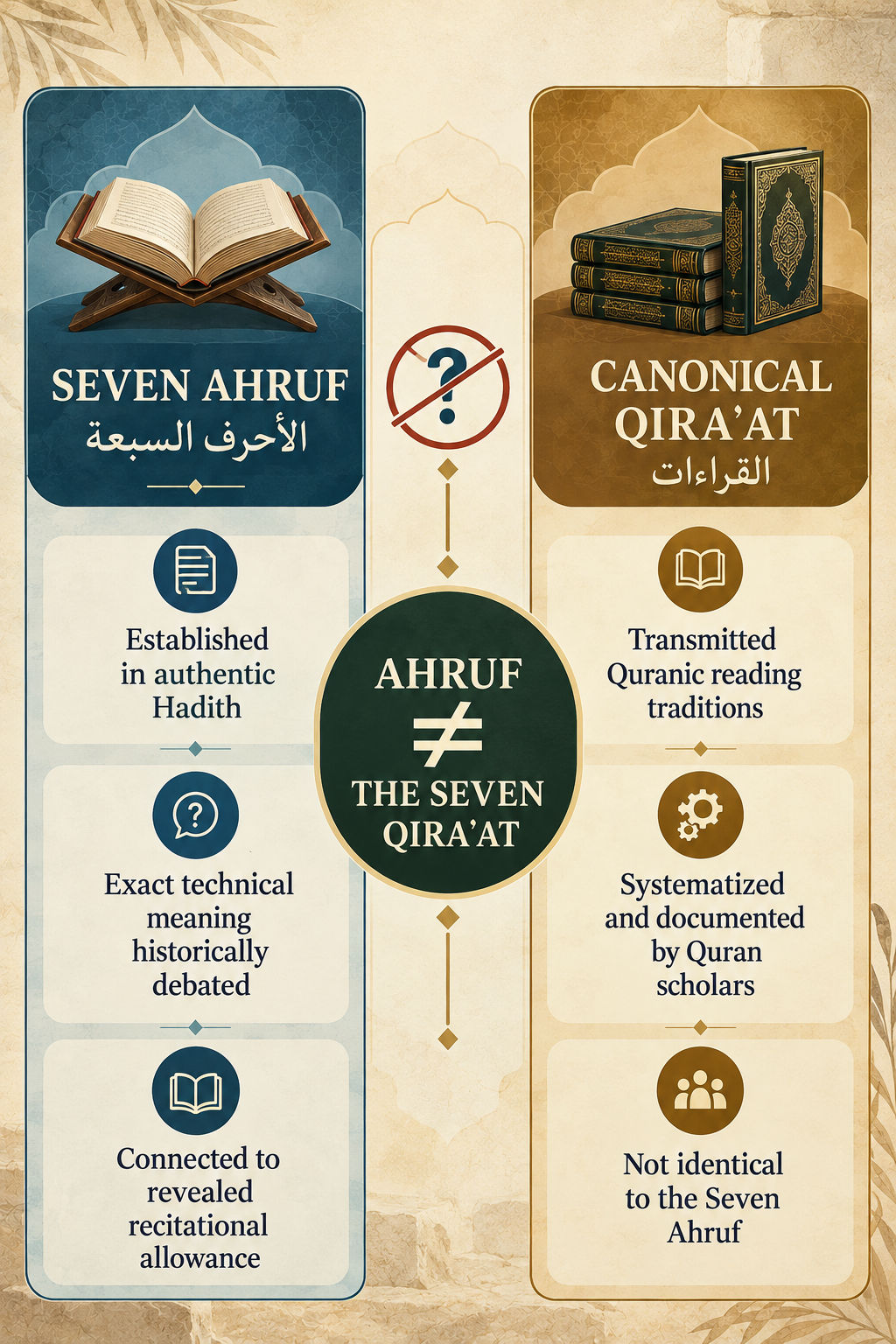
Are the seven Ahruf the seven Qiraʾat?
No. The famous “seven readings” were organized by Ibn Mujāhid (d. 324 AH / 936 CE) in his Kitāb al-Sabʿah fī al-Qirāʾāt, centuries after the Companions. He chose seven well-known readers from major centers; he did not invent the readings, which existed before him, and later scholars expanded the list to ten and beyond.
What are Qiraʾat?
A qirāʿah (plural qirāʾāt) is a transmitted way of reciting the Quran, attributed to a recognized reader and passed through teachers. A riwāyah is a transmission route from a reader, through his students. The classical criteria for a canonical reading are usually stated as: it fits Arabic usage, it fits the Uthmanic Rasm, and it has an authentic chain of transmission. Qiraʾat are not translations, not random dialects, and not scribal mistakes.
Hafs and Warsh
Ḥafṣ ʿan ʿĀṣim is the riwāyah of Ḥafṣ (d. 180 AH) from the reader ʿĀṣim (d. c. 127–128 AH). Warsh ʿan Nāfiʿ is the riwāyah of Warsh (d. 197 AH) from Nāfiʿ of Madinah (d. 169 AH). Ḥafṣ is the most widely used across much of the Muslim world today; Warsh is widely used in parts of North and West Africa. Geographic use shifts, so these are general descriptions only.
They are not different Qurans: same Surahs, same verses, same sequence, same Rasm tradition. But they are not identical in every pronunciation detail either. Differences include length of vowel sounds, pronunciation, vowelization, occasionally consonantal alternatives, and in a minority of places, word forms with related or complementary meanings.
Two verified examples
1. Quran 1:4. مَالِكِ يَوْمِ الدِّينِ (Māliki yawmi al-dīn, “Master of the Day of Judgment”), read by ʿĀṣim (hence Ḥafṣ), among others; and مَلِكِ يَوْمِ الدِّينِ (Maliki yawmi al-dīn, “Sovereign / King of the Day of Judgment”), read by Nāfiʿ (hence Warsh), among others. The difference is one vowel length; both meanings are about Allah’s authority on that Day, and the unpointed Rasm accommodates both.
2. Quran 2:132. Ḥafṣ reads wa-waṣṣā bihā (وَوَصَّى بِهَا), while Nāfiʿ (and so Warsh) reads wa-awṣā bihā (وَأَوْصَى بِهَا). Both mean that Ibrāhīm enjoined this upon his sons.
These readings are canonical and transmitted, not errors. They show why oral transmission and the Rasm worked together.
Rasm, Dots, and Vowel Marks
What was the Uthmanic Rasm?
The Rasm is the written form of the text in the Uthmanic codices: the letter-skeleton and its spelling conventions. It is not simply “Arabic without dots,” which is too simple. Early Arabic writing used a set of conventions in which some long vowels were not written, some letters shared the same basic shape, and dots and vowel signs were used sparingly or not at all.
This does not mean Arabs could not read their own script. Readers who knew the language, and, for the Quran, had learned it from teachers, could read it, as readers of a familiar text can today.
When were dots and vowel marks added?
We need two terms. Iʿjām means the dots that distinguish letters of the same shape (for example bāʾ, tāʾ, thāʾ). Tashkīl (or naqt) means the vowel and other reading marks.
Popular accounts offer a clean story: Abū al-Aswad al-Duʾālī (d. 69 AH) marked vowels with dots of different color; Naṣr ibn ʿĀṣim and Yaḥyā ibn Yaʿmar added letter-differentiating dots in the era of al-Ḥajjāj (governor of Iraq, late seventh century); and al-Khalīl ibn Aḥmad (d. c. 170 AH) developed the vowel signs we recognize today. These attributions are found in the sources, but the evidence for a neat linear sequence is not strong, and historical reports differ. Documents from the first Islamic century already show some dotting, so the development was gradual and plural.
The dots and signs recorded transmitted pronunciation and made it easier to read; they did not originate the words. They reflect the fact that the preservation system used both writing and oral teaching. And written notation was not irrelevant: it was an essential help to a growing, non-Arabic-speaking community.
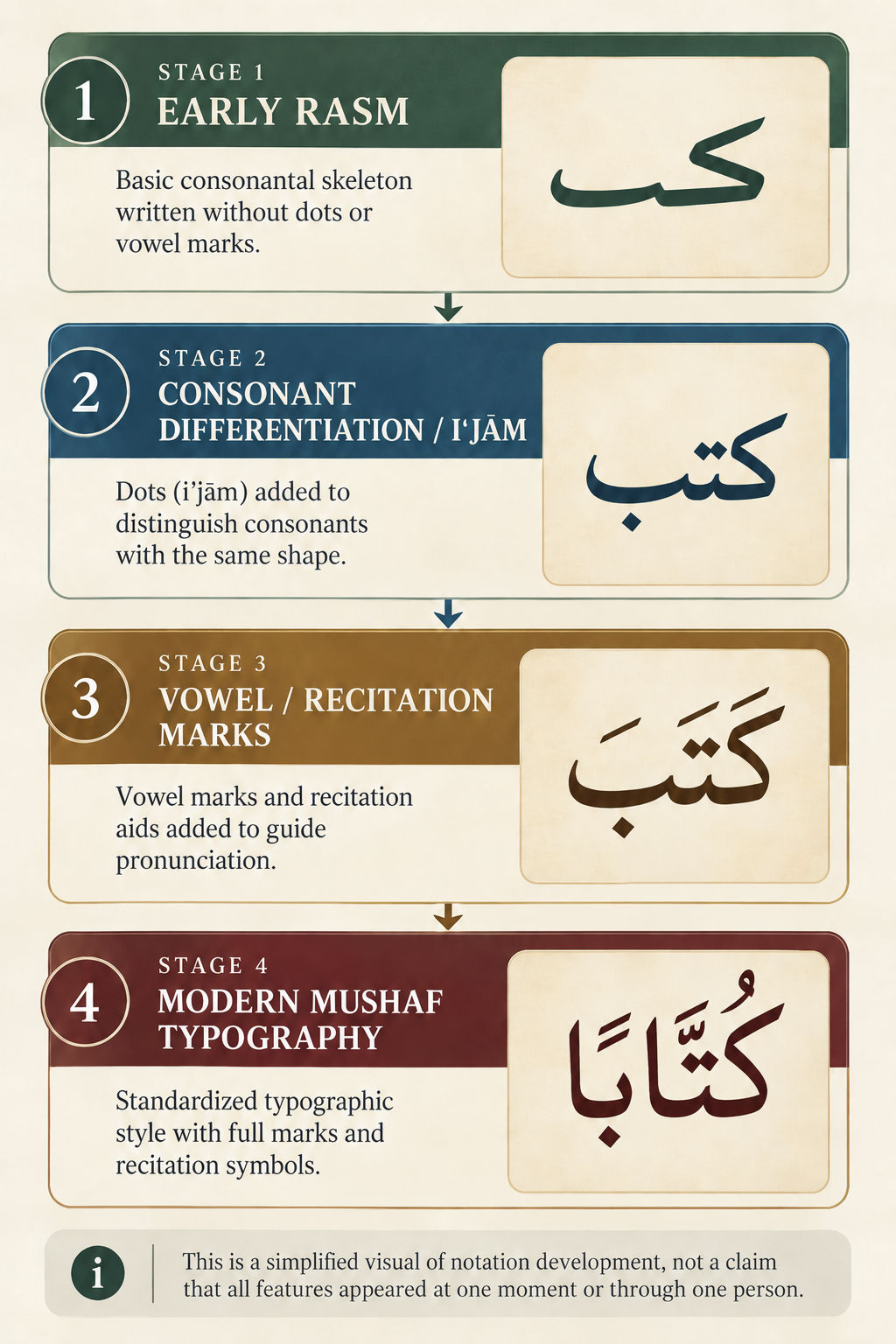
A modern Mushaf also carries things not part of the revealed wording: verse numerals, Surah headings, page numbers, Tajweed color-coding in some editions, and pause marks (waqf). Verse divisions have a transmitted basis, but numbering systems and printed numerals are editorial. Some Surah names go back to Prophetic usage, and some Surahs have more than one name. Waqf symbols are aids to recitation, not extra verses.
Oral and Written: A False Choice
The two lines of transmission are best understood together.
Oral: recitation, memorization, teacher correction, communal worship, Qiraʾat transmission.
Written: revelation writing, Suhuf, official codices, manuscript copying, an orthographic tradition.
The early Rasm can, in some places, accommodate more than one canonical reading. This is exactly why recitation traditions and writing reinforced each other. Memorization did not replace writing, and writing did not replace memorization. The historical Quranic tradition is better understood as oral and written, not oral or written.
The Tābiʿūn, Teachers, Isnad, and Ijazah
The Tābiʿūn are, by the standard definition, those who met and learned from Companions as believers. Through them, learning passed from Companion to Tābiʿī to the next generation.
Regional teaching centers grew: Madinah (the tradition of Ubayy and Zayd and later teachers such as Nāfiʿ), Makkah (Ibn ʿAbbās and his students), Kufa (Ibn Masʿūd, ʿAlī, and later teachers such as ʿĀṣim), Basra, and Syria. We should not force every later reading into a single clean lineage.
How did students learn? A teacher recites, the student listens, the student recites, the teacher corrects, and the reading passes on. Terms used in the later tradition include talaqqī (receiving directly from a teacher) and mushafahah (face-to-face learning). Learning the Quran was always more than silent reading from a page.
An isnād is a chain of transmission. Formal recitation chains are preserved through qualified teachers, but it would be an overstatement to say every Muslim today has a perfectly documented chain to the Prophet ﷺ. An ijāzah is a formal authorization from a teacher to teach or transmit a reading. It is a certification within the teacher-student tradition; it is not what makes the Quran authentic, and no single certificate “proves” the Quran.
Manuscripts: What Physical Evidence Survives?
Early manuscripts are material witnesses to the written tradition. They are important evidence, not the only evidence, and each discipline answers a different question: paleography studies script styles, codicology the book object, radiocarbon dating the age of organic material, and textual analysis the wording.
The Birmingham folios. Two leaves held in the University of Birmingham’s Cadbury Research Library were radiocarbon-tested in 2015, and their parchment gave a date range of roughly 568–645 CE (95.4% probability). They contain parts of Surahs 18–20 and belong with leaves in Paris. Three points: this is a part of the Quran, not the whole; radiocarbon dates the parchment (the animal), not the ink, and the writing could be later; and the date range does not prove the manuscript was written before the Prophet ﷺ, nor that it is “his own Quran.” Some scholars have urged caution about the earliest end of the range on paleographic grounds.
The Sanaʿa palimpsest. A palimpsest is a parchment whose first text was scraped away and overwritten. The Sanaʿa find, from the Great Mosque of Sanaʿa, Yemen, has a lower text of Quran that researchers have dated to the early period and studied for its variants in wording and Surah order. Scholars interpret those variants in different ways. It is not accurate to call it “a different Quran,” and it is not honest to ignore its variants. It is evidence about early textual history to be studied with the rest of the evidence.
Topkapi and Samarkand/Tashkent. These famous codices in Istanbul and Tashkent are traditionally associated with ʿUthmān. Manuscript scholars, relying especially on script style, generally date them later than his lifetime, so we cannot state that either is literally one of his original codices.
Do we have Uthman’s original Mushaf? We cannot confidently identify one. But preservation of a text does not depend on preservation of one autographed object. Manuscripts help scholars study early text, orthography, script and scribal practice, but a single manuscript cannot reconstruct the entire oral tradition, every Qiraʾah, or every historical event.
Printing and the Mushaf You Read Today
The sequence from hand-copied Mushafs to printed ones to modern editions and digital Qurans changed how texts are reproduced, not where the text came from.
The Cairo (Egyptian royal) edition of 1924 is a landmark: prepared by a committee of scholars, in the riwāyah of Ḥafṣ ʿan ʿĀṣim, drawing on classical works on Rasm and Qiraʾat, and a model for much later printing. It did not create the Quran, and Muslims did not lack a transmitted written standard before it. What it standardized was typography, notation, and editorial conventions for printing in one riwāyah.
So when we ask whether different printed Mushafs mean different Qurans, we should distinguish layout, notation, Tajweed colors, verse-number styles, the riwāyah, and translations. And a translation is not “the Quran”: the Arabic is the revealed text, and translations communicate meanings, which is why different translations phrase things differently without the Arabic text changing.
A Complete Chronology
The timeline below is simplified, and developments overlap rather than occurring as isolated stages. Dates are approximate where the sources are.
c. 610 CE: revelation begins.
c. 610–632 CE: about twenty-three years of revelation, recitation, memorization, writing, and teaching.
632 CE (11 AH): death of the Prophet ﷺ.
c. 632–633 CE: Yamāmah; Abū Bakr commissions the compilation.
Suhuf: Abū Bakr, then ʿUmar, then Ḥafṣah.
Mid-seventh century: Uthmanic standardization; official codices sent to major centers (the date is reported variously, roughly mid-640s CE).
Seventh–eighth centuries: Companion and Tābiʿūn teaching networks; gradual development of dots and vowel signs.
Eighth–tenth centuries: documentation and organization of the Qiraʾat, including Ibn Mujāhid (d. 936 CE).
Centuries of hand copying: manuscripts multiply.
Printing: including the Cairo edition of 1924.
Today: modern Mushafs and digital editions.
Preservation as a Layered System
It can help to organize the evidence into layers. This is an educational framework created for this article to organize the evidence; it is not a classical ten-stage doctrine.
Layer | What happened |
|---|---|
1. Prophetic transmission | Revelation received and taught |
2. Memorization | Companions learned and recited |
3. Writing | Revelation recorded in the Prophet’s lifetime |
4. Community recitation | The Quran embedded in worship and teaching |
5. Abu Bakr’s compilation | Written material collected and verified |
6. Uthmanic standardization | Official codices for the expanding community |
7. Teacher-student transmission | Recitation passed on through generations |
8. Manuscript tradition | Physical written witnesses multiplied |
9. Qiraʾat scholarship | Reading traditions documented and taught |
10. Print and digital | Later technologies widened access |
Several of these were running simultaneously. That is the point: preservation was layered, not dependent on one fragile chain.
Common Questions, Answered Briefly
If it was preserved, why are there Qiraʾat? Preservation does not require pretending that authentic, transmitted variation does not exist. The question is whether the readings are transmitted, regulated, historically connected to the early tradition, and compatible with the established criteria, not whether every canonical reading sounds identical.
Why did Uthman need to standardize anything? Expansion put Muslims taught by different Companions in contact. Disagreement among them is not proof that nobody knew the Quran; it is the reason a shared written standard was valuable.
If it was written, why did memorization matter? Early manuscripts lacked the reading aids of a modern Mushaf, and recitation was passed on through people. Writing and memory reinforced each other.
Was the Quran changed after the Prophet ﷺ? The evidence presented above points the other way: it was written in his lifetime, memorized and taught, collected under Abū Bakr from written and memorized sources, standardized under ʿUthmān from that compilation, and transmitted both orally and in manuscripts, with Qiraʾat documented. We should distinguish this textual preservation from later visual and editorial aids such as dots, vowel signs, page numbers, pause signs, and printing conventions.
Arabic Vocabulary at a Glance
Arabic | Transliteration | Meaning |
|---|---|---|
الوحي | al-Waḥy | Revelation |
القرآن | al-Qurʾān | The Quran; “recitation” |
المصحف | al-Muṣḥaf | A written codex containing the Quran |
الصحف | al-Ṣuḥuf | Sheets / written folios |
الحفظ | al-Ḥifẓ | Memorization |
الجمع | al-Jamʿ | Collection / compilation |
الرسم | al-Rasm | Written form (letter skeleton and spelling) |
الرسم العثماني | al-Rasm al-ʿUthmānī | Uthmanic orthography |
الأحرف السبعة | al-Aḥruf al-Sabʿah | The Seven Ahruf |
القراءات | al-Qirāʾāt | Recognized reading traditions |
الرواية | al-Riwāyah | Transmission route within a reading |
الإسناد | al-Isnād | Chain of transmission |
الإجازة | al-Ijāzah | Authorization to teach/transmit |
التابعون | al-Tābiʿūn | The generation after the Companions |
From Revelation to the Mushaf in Your Hands
The Quran did not suddenly appear as a printed book centuries after the Prophet ﷺ. Its history begins with revelation. He recited it. The Companions learned it. It was written in his lifetime and lived in worship and teaching. After his death, Abū Bakr commissioned a careful official compilation. Those Suhuf passed to ʿUmar and then Ḥafṣah. As Islam expanded, ʿUthmān used that established corpus and a qualified committee to produce standardized codices. Teaching continued through the Companions and Tābiʿūn, notation grew clearer, the Qiraʾat were documented, manuscripts multiplied, printing multiplied them further, and now the Mushaf sits on phones around the world.
But the story does not end with technology. It ends with a human chain: recite, listen, correct, memorize, write, teach, transmit. These processes overlapped rather than replacing one another.
And the methodological lesson is this: the history of Quran preservation becomes stronger, not weaker, when we tell it precisely. We do not need to pretend there were no Qiraʾat. We do not need to pretend every early manuscript looked like a modern Mushaf. We do not need to claim every museum manuscript belonged to ʿUthmān. We do not need to hide the burning order or erase Ibn Masʿūd and Ubayy from the discussion. We do not need weak stories to defend evidence that is already substantial. A careful Muslim account distinguishes what the Quran says, what authentic Hadith establishes, what the Companions reported, what later scholars concluded, what manuscripts physically demonstrate, and what remains uncertain.
For Muslims today this is not only history. A student who learns Al-Fātiḥah with a qualified teacher, listens, recites back, and is corrected is taking part, on a small personal scale, in a culture of Quranic recitation and teacher-student correction that reaches deep into Islamic history. At Araby Academy, our Quran, Tajweed, Hifz and Quranic Arabic lessons are built around that same pattern of careful learning.
Frequently Asked Questions
1. How was the Quran preserved? Through overlapping means: the Prophet’s ﷺ recitation and teaching, memorization, writing during his lifetime, Abū Bakr’s compilation, ʿUthmān’s standardized codices, and continuous oral and written transmission.
2. Was the Quran written during Prophet Muhammad’s lifetime? Yes. Authentic reports show revelation being written at his direction, though not bound as one official volume.
3. Who wrote down the Quran? The scribes of revelation, of whom Zayd ibn Thābit is the best attested; other names require individual verification.
4. Who compiled the Quran first? Abū Bakr commissioned the first official post-Prophetic compilation, carried out by Zayd ibn Thābit.
5. Why did Abu Bakr compile the Quran? After many reciters were killed at Yamāmah, ʿUmar feared loss of Quranic material, and Abū Bakr was convinced of the need.
6. Why was Zayd ibn Thabit chosen? Abū Bakr described him as young, capable, trustworthy, and a former scribe of revelation.
7. How did Zayd verify the Quran? By seeking both written materials and memorized recitation; further reports mention a witness requirement whose exact meaning scholars discuss.
8. What was Uthman’s role? He commissioned a committee to copy official codices from Ḥafṣah’s Suhuf and sent them to major centers.
9. Why did Uthman burn other manuscripts? To remove non-standard written materials and reduce communal dispute; it was not a destruction of revelation.
10. Did Uthman change the Quran? No source describes him writing a new Quran; the codices were copied from the established compilation.
11. What are the Seven Ahruf? Modes in which the Quran was revealed, established in authentic Hadith; their exact meaning is debated.
12. Are the Seven Ahruf the same as the Seven Qiraʾat? No. The “seven readings” were organized centuries later by Ibn Mujāhid.
13. What are Qiraʾat? Transmitted, regulated reading traditions of the Quran.
14. Are Hafs and Warsh different Qurans? No. They are riwāyāt of canonical readings, with differences in recitation details.
15. Why did early Qurans lack modern dots and vowel marks? Early writing conventions used them sparingly, relying on oral teaching; dots and signs developed gradually.
16. Do we still have Uthman’s original Quran? We cannot confidently identify one, but a text’s preservation does not depend on a single object.
17. What do early Quran manuscripts tell us? They are physical evidence of early script, spelling, and copying, studied alongside the other evidence.
18. How did the Quran reach the Mushaf Muslims read today? Through the layered process above, finally through printing and modern editions.