Imagine a Muslim in their forties. They have spent years working, raising children, building a family, or carrying the many responsibilities of adult life. One day they begin to think seriously about memorizing the Quran.
Then a question holds them back: "Isn't Hifz something people are supposed to begin as children?" They wonder whether their memory is still strong enough. They worry about forgetting. They picture the enormous commitment of memorizing the entire Quran and ask, quietly, "Can I really become a Hafiz if I start now?"
The short answer: starting after 40 does not automatically rule out memorizing the Quran. Many of the skills involved in successful Hifz, including focused learning, accurate recitation, consistent retrieval, and structured revision, remain trainable in adulthood. Progress depends on individual circumstances, learning methods, and sustained effort rather than age alone. At the same time, no one can promise that every adult will complete the entire Quran, and this guide will not make that promise. What it offers is an honest picture of what is possible, what is difficult, and how to begin well.
Is There an Age Limit for Becoming a Hafiz?
There is no universal Islamic rule that sets 40, or any other age, as a cutoff for beginning Quran memorization. People come to the Quran at different stages of life. Some memorize in childhood, some in youth, and some only when their circumstances finally allow it.
It helps to separate four ideas that are often blended together:
Religious encouragement. Islam encourages every Muslim to learn the Quran, whatever their age.
Practical ability. Whether you can memorize a given amount depends on your reading, health, time, and method.
Individual differences. Two adults of the same age can learn at very different speeds.
The goal. Complete Hifz is one worthwhile goal among several, and partial memorization has real value.
Beginning later does not guarantee any particular outcome, good or bad. It simply means your plan should fit the life you actually have.
What Does Islam Say About Learning the Quran Later in Life?
The sources do not give an age-specific ruling, but they do encourage learning the Quran and offer comfort to the learner who finds it hard.
The Quran's invitation to remember
Allah says:
وَلَقَدْ يَسَّرْنَا الْقُرْآنَ لِلذِّكْرِ فَهَلْ مِن مُّدَّكِرٍ
"And We have certainly made the Quran easy for remembrance, so is there any who will remember?" (Al-Qamar 54:17)
Classical commentators such as Ibn Kathir understand this as an invitation to recite, remember, and take heed of the Quran, noting its ease in comparison with the weight of what it carries. The verse is an encouragement. It is not a guarantee that every individual will memorize all of it at any given age.
Learning and teaching the Quran
The Prophet ﷺ said:
خَيْرُكُمْ مَنْ تَعَلَّمَ الْقُرْآنَ وَعَلَّمَهُ
"The best among you are those who learn the Quran and teach it." (Sahih al-Bukhari 5027)
This hadith honors learning and teaching the Quran. It does not set an age limit, and it does not define "learning" as only complete memorization.
The one who struggles
Aisha (may Allah be pleased with her) narrated that the Prophet ﷺ said:
الْمَاهِرُ بِالْقُرْآنِ مَعَ السَّفَرَةِ الْكِرَامِ الْبَرَرَةِ، وَالَّذِي يَقْرَأُ الْقُرْآنَ وَيَتَتَعْتَعُ فِيهِ، وَهُوَ عَلَيْهِ شَاقٌّ، لَهُ أَجْرَانِ
"The one who is skilled in the Quran will be with the noble and obedient angels, and the one who recites it with difficulty, stumbling over it, will have two rewards." (Sahih al-Bukhari 4937; Sahih Muslim 798)
The narration speaks about recitation, so we should not stretch it to promise a specific reward for completing Hifz after any age. What it does show is that effort in the face of difficulty is not dismissed in Islam. A learner who stumbles is not a learner who has failed.
Does Becoming a Hafiz Require Memorizing the Entire Quran?
The word حافظ (Hafiz) comes from the root meaning to guard or preserve. حفظ القرآن (Hifz al-Quran) means memorizing the Quran. In common usage, a Hafiz is someone who has memorized the entire Quran, although standards and formal requirements differ between teachers and institutions.
It is useful to distinguish between:
Memorizing individual Surahs.
Memorizing selected Juz (sections).
Completing memorization of the whole Quran.
Maintaining reliable long-term retention of what you have memorized.
Formal evaluation or certification by a qualified teacher.
Memorizing a few Surahs is not the same as completing the Quran, and it is honest to say so. But it is also honest to say that partial memorization carries real religious and educational value. Both statements are true together.
What Happens to Memory After 40?
Does memory automatically become too weak?
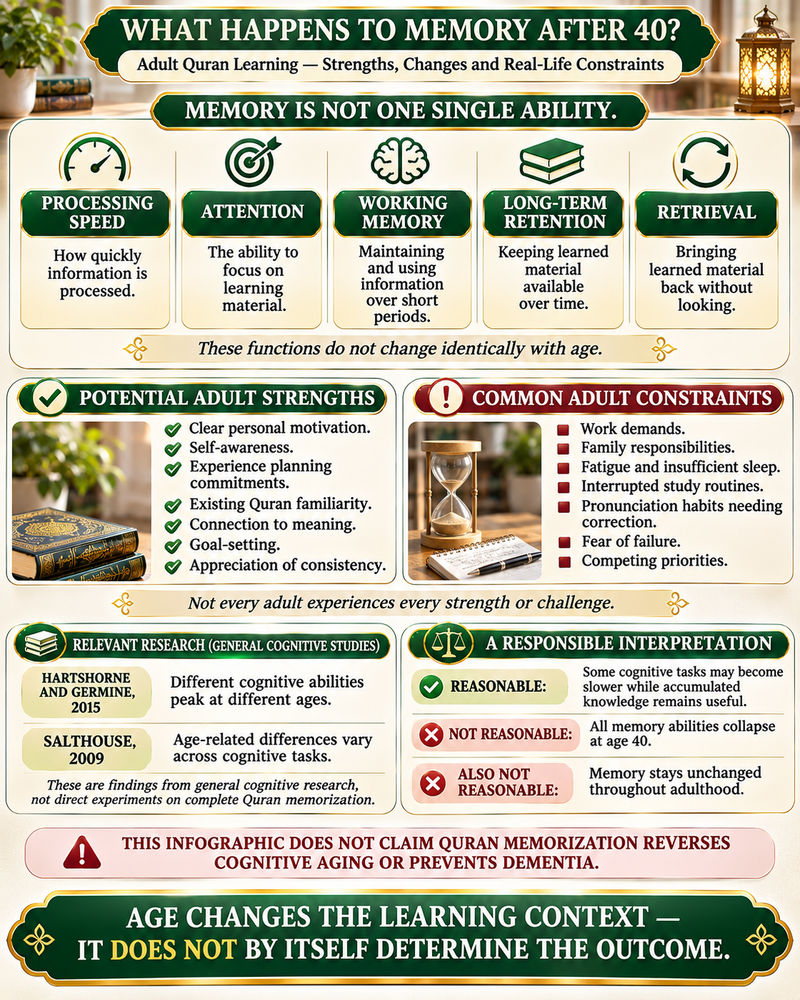
No single change happens to everyone at 40. "Memory" is not one thing. Researchers distinguish learning speed, attention, working memory, long-term retention, and retrieval, and these do not all change in the same way or at the same time. Research on when cognitive abilities peak, such as the work of Hartshorne and Germine (2015), found that different abilities reach their highest levels at different ages, and Salthouse (2009) showed that age-related differences vary by task and person.
Some processes, such as the speed of processing new information, can slow with age for many people. Others, including vocabulary and accumulated knowledge, often hold steady or grow. Individual variation is large. Motivation, prior knowledge, sleep, health, and how consistently you practice also shape results.
So it would be inaccurate to say memory stays the same throughout adulthood, and equally inaccurate to say it collapses at 40. Nor does this article claim that memorizing the Quran reverses cognitive aging or prevents dementia. Those are medical claims that Quran memorization is not offered to prove.
What advantages might adult learners have?
Mature learners often, though not always, bring real strengths:
Clear personal motivation. You know why you want this.
Self-awareness. You know when you are tired, distracted, or avoiding something.
Deliberate goal-setting. You can plan across months, not just days.
Experience managing responsibilities. You have kept long commitments before.
Existing Quran familiarity. Years of hearing the Quran in prayer can help.
Appreciation of consistency. Adults often understand that small steady effort compounds.
Connection to meaning. You can link verses to your own life and understanding.
These are potential advantages, not guarantees. Younger learners are not less disciplined by nature either. The point is simply that age brings a different mix of strengths and constraints, not only constraints.
What challenges do adults commonly face?
Adults often name some combination of these:
Limited time and demanding work.
Family responsibilities and interrupted schedules.
Fatigue and inconsistent sleep.
Difficulty keeping up revision.
Fear of failure and comparison with younger students.
Pronunciation habits that were never corrected.
Competing priorities.
Not every adult faces all of these, and not to the same degree. The answer is not a heroic daily target but a flexible learning system that survives ordinary weeks.
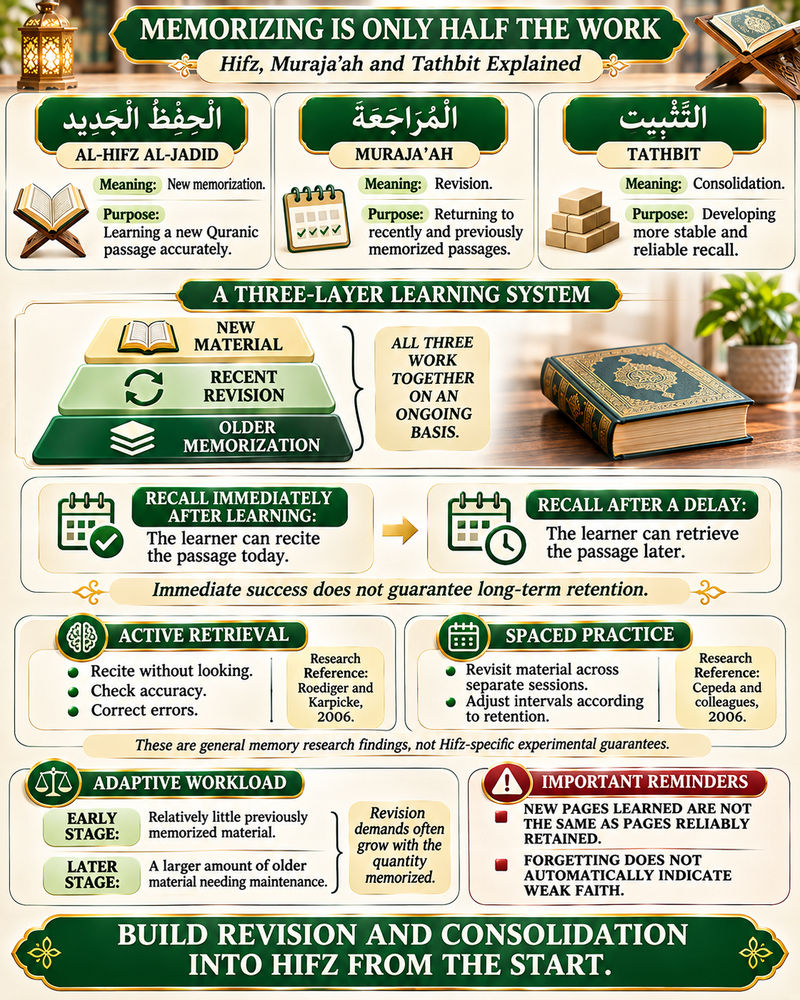
Memorizing Is Only Half the Work
Most adults who struggle with Hifz are not struggling to memorize. They are struggling to retain. Three Arabic terms help here:
الحفظ الجديد (al-hifz al-jadid): new memorization.
المراجعة (muraja'ah): revision.
التثبيت (tathbit): consolidation, or making memorization stable.
Reciting a passage correctly right after learning it does not guarantee you will recall it weeks or months later. Reliable memory involves initial encoding, retrieval, repetition, spaced practice, corrective feedback, and long-term maintenance.
General memory research supports parts of this. Studies on retrieval practice (Roediger and Karpicke, 2006) found that actively recalling material helps long-term retention more than re-reading it, and reviews of spaced practice (Cepeda et al., 2006) found that spreading study over time generally supports better retention than massing it together. These are findings about learning in general, not studies of Hifz, so they inform a method rather than prove one. Your teacher's judgment still matters.
Why do adults forget what they memorized?
Forgetting has many possible causes, and age is only one of them:
Too little revision.
Learning too much too quickly.
Weak initial memorization.
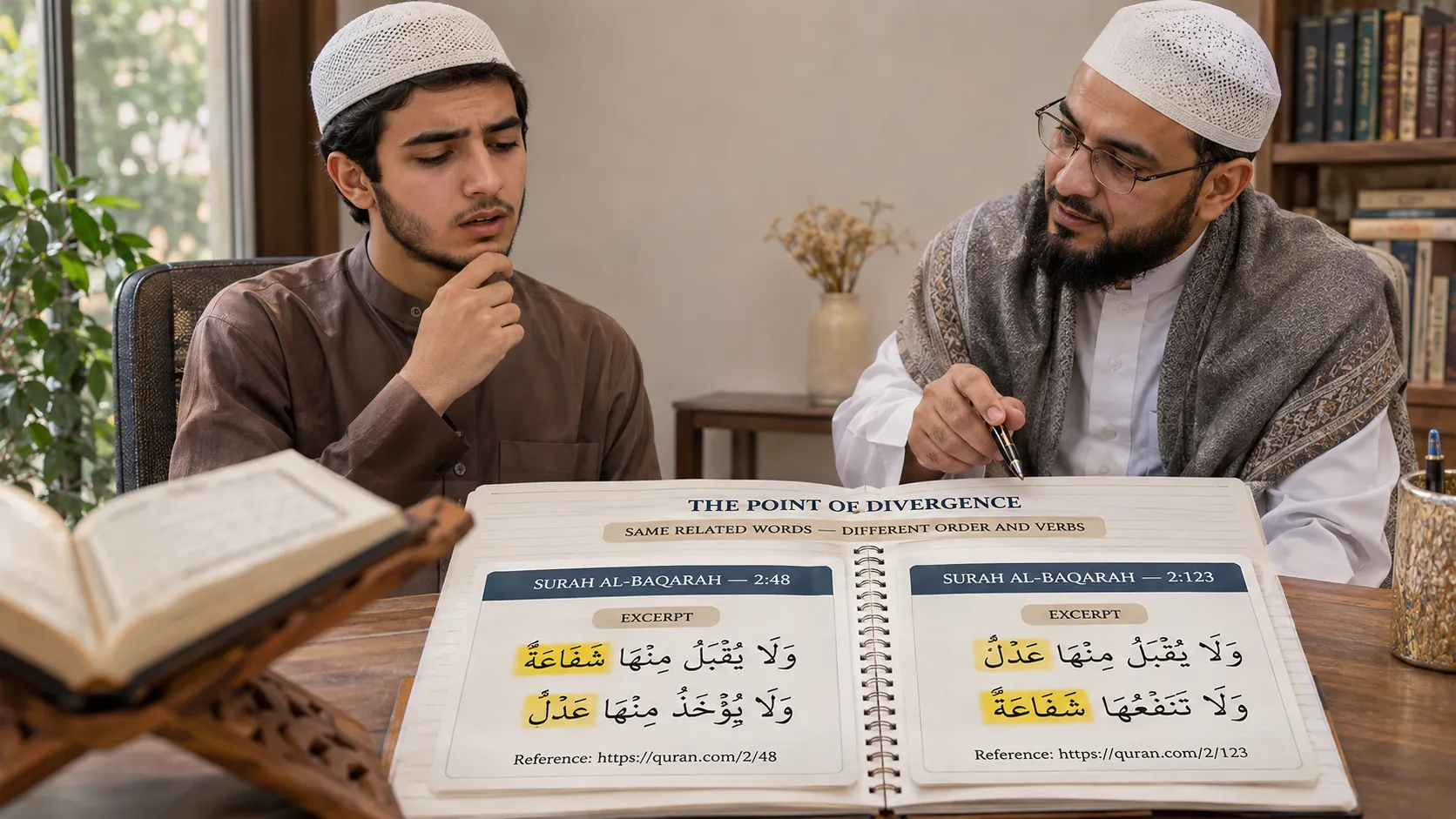
Similar passages that blur together.
Too little retrieval practice, such as reading but never reciting without looking.
Interruptions in the routine.
Inaccurate recitation habits.
No one checking your recitation.
Forgetting does not always signal a spiritual problem, and it is not always caused by age. The useful move is to find the actual cause rather than automatically adding more repetition. For a deeper look at building revision into a system, see Araby Academy's guide to a realistic Hifz system for memorizing and keeping the Quran.
Why revision must grow alongside memorization
As the amount you have memorized grows, so does the amount you must keep alive. A learner with five Surahs has little old material to maintain. A learner with ten Juz has a great deal. Teachers commonly think in layers: new memorization, recent revision, older revision, accuracy checks, and long-term maintenance.
There is no single ratio that suits everyone. A good teacher adjusts the balance as your progress and retention change, and it is normal for revision to take up a larger share of your session over time.
How to Begin Hifz After 40: Eight Steps
Step 1: Assess your current Quran reading
Begin with a qualified teacher's assessment. Useful areas to check include letter recognition, reading fluency, makharij (the points of articulation of Arabic letters), basic Tajweed (the rules of correct recitation), existing memorization, common errors, your ability to recall short passages, and your available practice time.
Some adults will need foundational reading or pronunciation work before substantial new memorization. That does not mean everyone must finish an advanced Tajweed course first. It means your starting point should be known, not guessed.
Step 2: Set a realistic goal
Your first goal does not have to be the whole Quran. Reasonable goals include:
Memorizing selected Surahs.
Memorizing Juz Amma (the final section).
Memorizing one additional Juz.
Building a reliable daily Hifz habit.
Working toward complete Hifz over several years.
Choose a goal that fits your current ability, time, health, responsibilities, support, and revision capacity. Complete Hifz is not the only worthwhile target, and you can revise your goal as you learn what your life allows.
Step 3: Choose a manageable starting amount
Start with an amount you can memorize accurately and still recall later. That might be one short verse, several short verses, a small passage, or part of a page. Verse lengths vary enormously, so one verse is not a fixed unit of material, and no universal daily page target fits every learner. New memorization should never crowd out revision.
Step 4: Learn with accurate recitation
Listen carefully to a teacher or reliable reciter, read from a verified Mushaf, and receive correction before you reinforce a mistake. Repeating an incorrect pronunciation many times can make it harder to fix later. This does not mean every small imperfection blocks memorization, only that early correction saves effort.
Step 5: Understand the general meaning
Understanding supports memorization in several ways. It can help you notice a passage's structure, see where one verse leads to the next, tell similar passages apart, connect words with meaning, and create extra cues for recall.
It complements verbal memorization rather than replacing it. Understanding does not automatically prevent forgetting, and you do not need Arabic fluency to begin Hifz. A reliable translation and a short explanation of each passage are a good start.
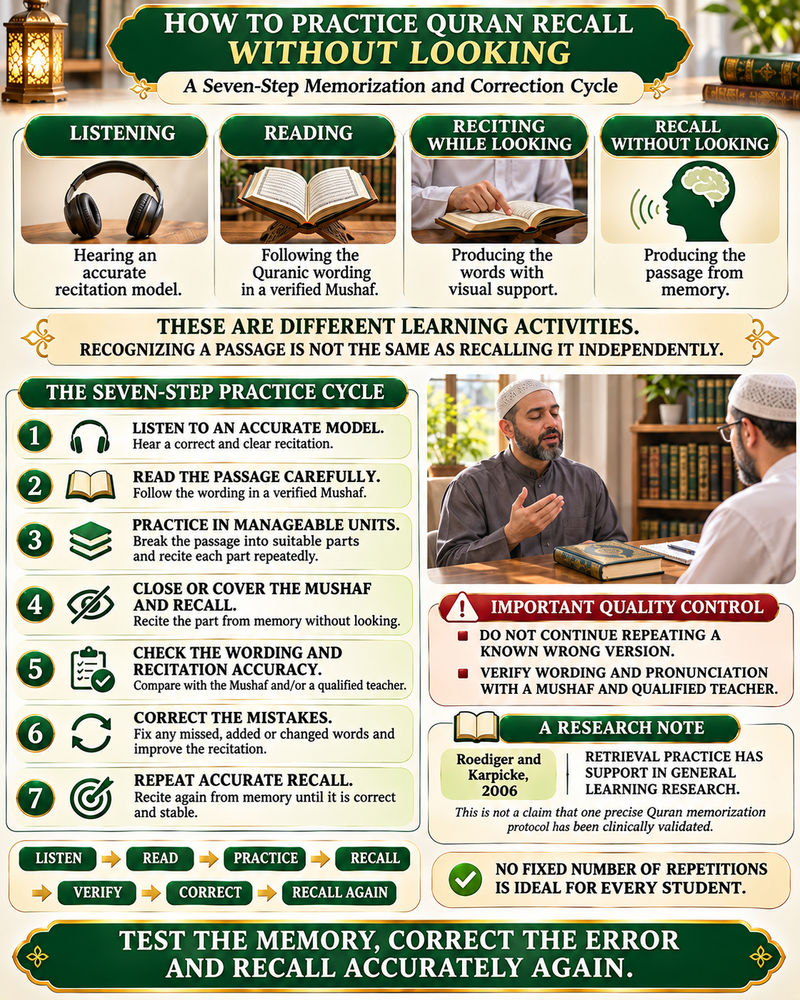
Step 6: Practice recall without looking
There is a real difference between reading repeatedly, listening repeatedly, reciting while looking, and recalling independently. The last one is where memory is tested and strengthened. A practical sequence:
Listen to an accurate model.
Read the passage carefully.
Practice in manageable units.
Try to recall without looking.
Check your accuracy.
Correct mistakes.
Repeat accurate recall.
No fixed repetition count works for everyone. Repeat until recall is accurate, not until you reach an arbitrary number.
Step 7: Build revision into the schedule
Plan time for recently memorized passages, older memorization, difficult passages, similar verses, and teacher-guided revision. Spaced practice simply means returning to material over increasing gaps instead of cramming it once. There is no universally optimal set of intervals, so let your teacher help you tune them to what you actually retain.
Step 8: Review progress with a teacher
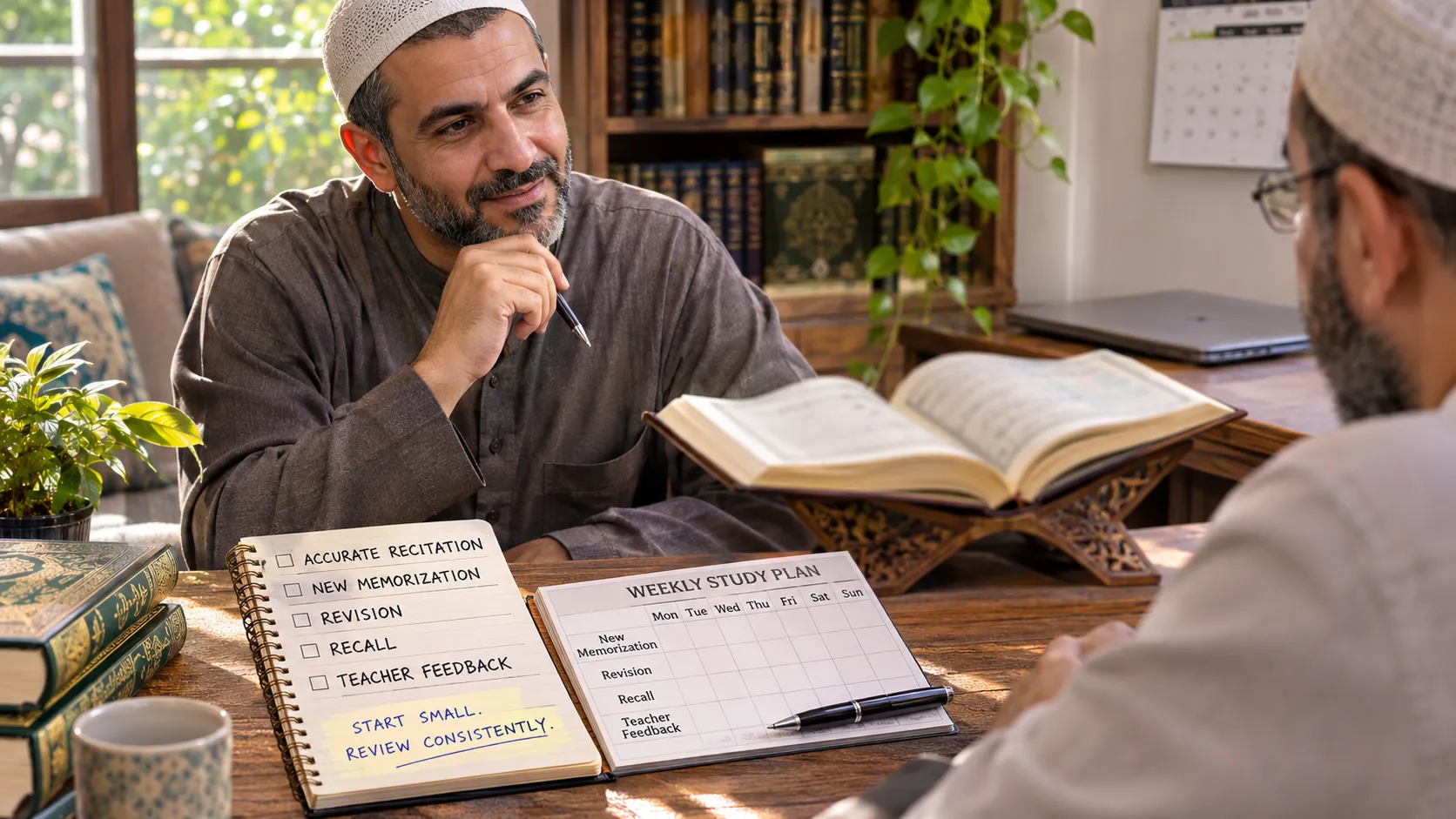
A teacher can check accuracy, give structured feedback, adjust targets, correct repeated errors, track progress, and provide accountability and encouragement. Not every learner needs the same schedule of lessons, but nearly every adult benefits from some regular external check.
A Flexible Daily Routine for Busy Adults
The durations below are examples, not evidence-based requirements. The right length depends on you.
Option | Example time | Example structure |
|---|---|---|
A: Limited time | 10 to 15 minutes | A small amount of new memorization or focused revision, followed by a short recall check |
B: Moderate time | 20 to 30 minutes | A separate block for new material, then a block reviewing older passages |
C: More available time | 40 to 60 minutes | Revision of older material, recent review, new memorization, a short break between blocks, and a closing recall test |
Consistency and accuracy matter more than an ambitious schedule you cannot sustain. For help turning a routine into a lasting habit, see Araby Academy's article on building a daily Quran habit that lasts.
Morning or night?
There is no scientifically proven best time of day for every adult. Many people value the quiet of the early morning, and Islamic tradition gives certain times spiritual significance, but that guidance is separate from empirical memory research. Think about alertness, work schedule, sleep, distractions, and what you can protect week after week. The best time is when you can practice attentively and consistently.
What if you miss several days?
Missing days does not erase your progress. A calm recovery looks like this:
Reassess what you still retain.
Review the passages that feel unstable.
Resume with a smaller goal.
Pause new memorization for a while if needed.
Share the gap with your teacher.
Treat the lapse as information about your schedule, not as a verdict on your sincerity.
How Long Could Complete Hifz Take After 40?
There is no universal timeline, and any source that promises full Hifz in a set number of years is promising more than it can know. The time involved depends on:
Your current Quran reading ability and any existing memorization.
The amount you learn per session and how much revision you need.
Teacher support and consistency.
Available time, individual learning differences, and interruptions.
The standard Madinah Mushaf commonly has 604 pages, though pagination varies between editions. Dividing 604 by a daily target gives a number, but not a prediction. The arithmetic ignores revision, consolidation, time off, and relearning forgotten material, all of which are normal parts of Hifz.
Is one page a week enough?
Small, steady progress accumulates. As a transparent illustration only: one new page per week, sustained for 52 weeks, is about 52 pages of initial memorization. That figure says nothing about how many of those pages are retained or mastered. Complete Hifz requires sustained revision, not just a first pass through the Mushaf, so please do not treat the arithmetic as a guaranteed schedule.
What if it takes much longer than expected?
This happens, and it is not failure. You can adjust your goal, revisit foundational skills, reduce new material, improve the quality of revision, ask your teacher for guidance, and recognize the progress you have already made. Choosing a smaller, stable memorization goal is a legitimate decision, not a defeat.
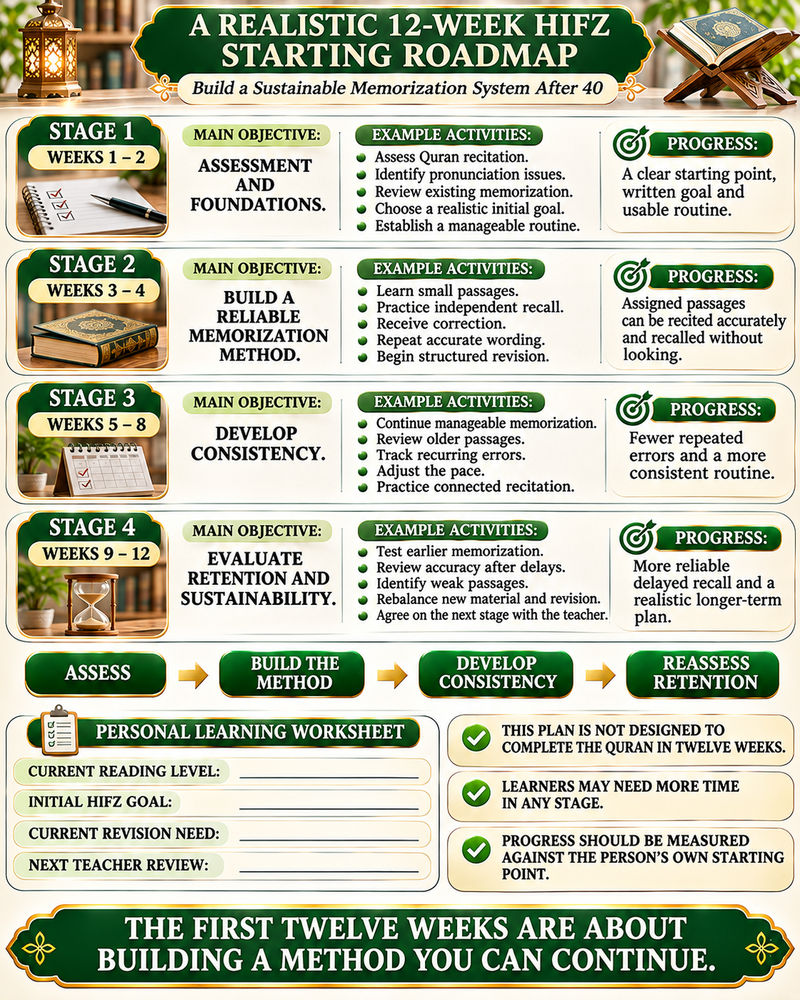
A Twelve-Week Starting Roadmap
This plan is for building a sustainable learning system, not for completing Hifz. Adjust it with your teacher.
Period | Main objective | Example activities | Progress indicator |
|---|---|---|---|
Weeks 1 to 2 | Assessment and foundations | Evaluate recitation, identify pronunciation issues, review existing memorization, choose an initial goal, set a realistic routine | You have a clear starting point, a written goal, and a routine you can follow |
Weeks 3 to 4 | Build a reliable method | Learn small passages, practice recall, receive feedback, correct mistakes, begin structured revision | Assigned passages are recited accurately, and you can recall them without looking |
Weeks 5 to 8 | Develop consistency | Continue manageable memorization, review older passages, track recurring errors, adjust pace, practice connected recitation | Fewer repeated mistakes and consistent completion of manageable sessions |
Weeks 9 to 12 | Evaluate retention and sustainability | Test earlier material, review accuracy, identify weak areas, rebalance new memorization and revision, plan the next stage | Reliable recall after a delay, and a longer-term plan agreed with your teacher |
Not every learner will reach the same milestone at the same time, and that is expected.
Eight Mistakes to Avoid When Starting Hifz After 40
Starting with unrealistic daily targets. Overambitious plans collapse within weeks. Correction: begin below your limit and increase only when revision stays strong.
Memorizing too much without revision. Older passages weaken quietly. Correction: protect revision time first, then add new material.
Ignoring pronunciation errors. Errors become habits. Correction: have a teacher listen early and often.
Relying entirely on passive listening. Listening builds familiarity, but it does not test recall. Correction: add recitation without looking.
Comparing progress with children. Children and adults study under different conditions. Correction: measure yourself against your own starting point.
Measuring success only by new pages. Pages added are not pages retained. Correction: track retention, accuracy, and consistency too.
Abandoning the routine after interruptions. One bad week can become a lost month. Correction: return with a smaller target and rebuild.
Treating complete Hifz as the only meaningful achievement. This turns every pause into failure. Correction: value each stable portion for what it is.
Sleep, Attention, and Lifestyle
General learning research suggests that several everyday factors affect how well we learn and keep information: sleep, fatigue, attention, stress, regular practice, cognitive load, and breaks. A review by Diekelmann and Born (2010), for example, describes the role of sleep in memory consolidation. This is general research, not Hifz-specific, but it supports a simple practical point: a tired, overloaded learner will find retention harder.
A few sensible habits follow: protect your sleep where you can, study in shorter focused blocks, take breaks, and avoid stacking too much new material on a stressful day. This article does not recommend any supplement or unregulated memory product for Quran memorization.
If you notice sudden or substantial memory difficulties, do not assume it is ordinary aging. A healthcare professional can assess it properly. Quran memorization is not a substitute for medical care.
Can Someone Start After 50, 60, or 70?
There is no single chronological age at which learning the Quran becomes impossible. There is, however, wide individual variation. Realistic goals may differ depending on health, prior knowledge, available time, support, learning preferences, and memory and attention.
No one can honestly promise that every older adult will complete the whole Quran. But many older learners can make meaningful progress: learning to read accurately, memorizing Surahs they recite in prayer, deepening their understanding, or pursuing a larger goal at a gentler pace. Continued Quran learning at any stage of life is dignified and worthwhile.
What Should You Look for in a Hifz Teacher?
Useful qualities include:
Accurate Quran recitation and knowledge of Tajweed.
Experience teaching adults.
The ability to assess your current skills.
Structured memorization planning and realistic target setting.
Patient, respectful correction.
Regular revision testing and individualized feedback.
Strong recitation and effective teaching are related but not identical skills. A certification can be a useful sign, but it does not by itself guarantee teaching effectiveness, so a short trial lesson can tell you a great deal.
Can adults memorize the Quran through online lessons?
Live online instruction can work well for adults, though it has trade-offs.
Possible benefits: access to qualified teachers wherever you live, individualized pacing, direct correction, flexible scheduling, structured revision, and regular accountability.
Possible limitations: internet quality, audio clarity, scheduling difficulties, the need for independent practice between lessons, and differences in teacher quality.
Online lessons are effective when the teaching is accurate, the audio is reliable, feedback is consistent, and the learner practices regularly. They are not automatically better than in-person study, and no teacher can guarantee complete Hifz. Araby Academy offers live one-to-one Quran, Tajweed, and Arabic lessons, and you can read more about how remote study works in its guide to learning Quran online.
What If You Never Complete the Entire Quran?
Complete Hifz is a substantial goal. It is not the only valuable form of Quran learning, and a person who does not complete it has not failed religiously.
There is real worth in:
Memorizing selected Surahs you can recite with confidence.
Learning accurate recitation.
Understanding the meanings of what you recite.
Maintaining what you already know.
Building a regular relationship with the Quran.
Teaching what you know accurately to others.
Continuing to learn gradually, for as long as you are able.
The hadith we saw earlier honors the one who learns and teaches the Quran, and the one who struggles through recitation. Neither is conditioned on finishing the Mushaf. We should not invent a specific reward for a specific number of pages, but we can say that sincere, sustained engagement with the Quran is something Islam values.
How to measure success without comparing yourself to others
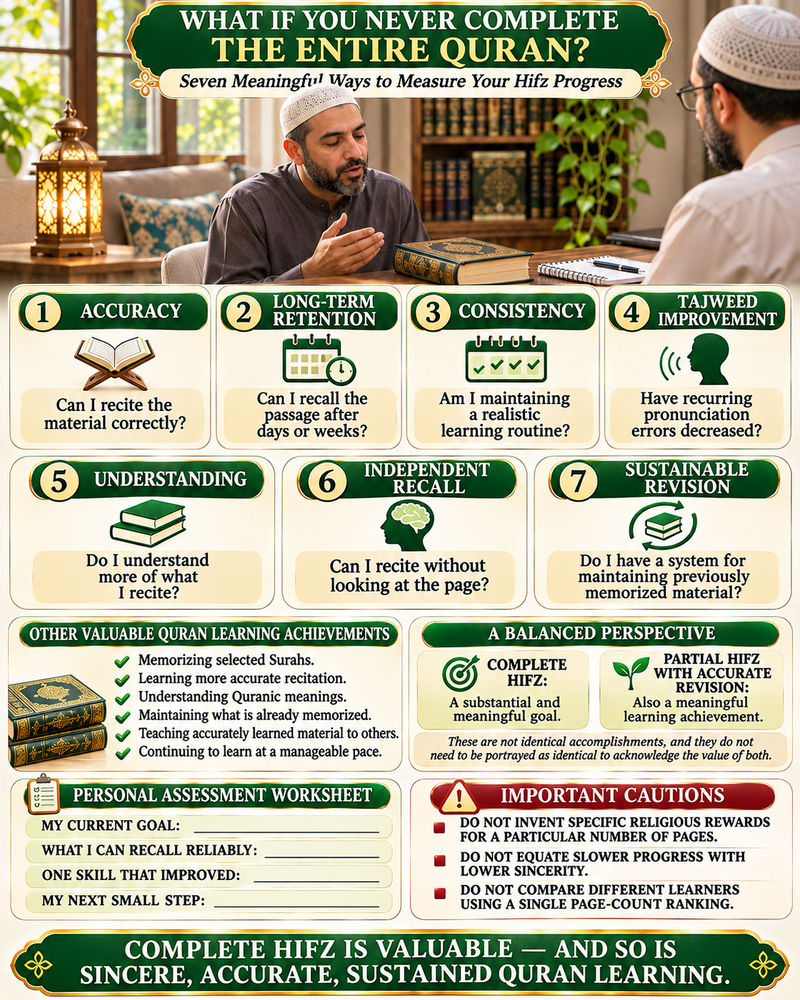
Useful indicators of progress include:
Accuracy in what you recite.
Retention over weeks and months.
Consistency of your routine.
Improved Tajweed and pronunciation.
Greater understanding of what you recite.
The ability to recite independently.
A stable revision cycle.
Sustainable habits you can keep.
Measure these against your own starting point and goals. Quran memorization is not a productivity contest.
Frequently Asked Questions
Can you become a Hafiz if you start after 40?
It is possible, but not guaranteed. Starting after 40 does not rule out complete Hifz. Outcomes depend on your reading ability, time, health, teacher support, revision, and consistency.
Is 40 too old to memorize the Quran?
No. There is no Islamic or scientific cutoff at 40. Cognitive abilities vary widely between individuals, and many of the skills involved in Hifz can be trained in adulthood.
Can I memorize the Quran after 50 or 60?
Many older adults make meaningful progress, though goals and pace vary with health, time, and support. Some aim for complete Hifz and others for selected Surahs, and both are worthwhile.
How long does it take to memorize the Quran as an adult?
There is no reliable universal answer. The time depends on existing memorization, daily amount, revision needs, teacher support, and interruptions. Be cautious about anyone promising a fixed timeline.
How much should a beginner memorize each day?
There is no standard amount. Start with something you can memorize accurately and still recall days later, such as a few short verses, and adjust with your teacher.
Do I need to know Arabic to memorize the Quran?
No. Many non-Arabic-speaking Muslims memorize substantial portions. Learning basic meanings helps, but it does not replace accurate recitation, repetition, and revision.
Should I learn Tajweed before starting Hifz?
You do not need to finish an advanced Tajweed curriculum first, but accurate pronunciation matters from the start. Many learners study Tajweed alongside early memorization with a teacher's guidance.
How can I stop forgetting what I memorized?
First find the cause: too little revision, memorizing too fast, similar verses, or uncorrected errors. Then adjust your revision schedule, practice recall without looking, and ask your teacher to test you.
Conclusion
Beginning Hifz after 40 is a meaningful and potentially achievable goal, but the path looks different for each person. Progress tends to rest on a few things working together: accurate Quran reading, manageable memorization, regular revision, reliable recall, qualified guidance, realistic scheduling, long-term consistency, and the willingness to adjust your goals when life requires it.
And if you never complete the entire Quran, sincere and sustained Quran learning remains valuable. You do not have to decide today how far you will go. Begin with a small, accurate, sustainable goal, and let the next step follow from the one before it.
If you would like guidance, you are welcome to explore Araby Academy's live one-to-one Quran memorization and Tajweed lessons for adults.