A student has memorized two passages from different Surahs. Each one is correct when practiced alone. Then, during revision, they reach a familiar phrase and their memory supplies the continuation from the other Surah. The words sound right and the rhythm feels right, but the ending belongs somewhere else.
"Why do I keep mixing up verses I already know?"
The short answer: similar Quranic passages share wording and structural patterns that can compete during recall. The solution is to identify the exact differences, learn each passage in its context, practice recalling the correct continuation, and review recurring errors systematically. This is a learning challenge, not a sign of weak faith or lack of dedication.
This guide explains why similar Quranic verses get mixed up, shows five verified examples, and gives a step-by-step correction system with a four-week starting plan.
What Are Mutashabihat al-Alfaz?
المتشابهات اللفظية (al-mutashabihat al-lafziyyah, or mutashabihat al-alfaz) are Quranic passages that resemble each other in wording. Students often call them simply "Mutashabihat." They include passages with:
Similar beginnings or endings.
Repeated expressions.
Related sentence structures.
One small word that differs.
The same words in a different order.
Added or omitted words.
Similar narratives in different Surahs.
Verbal similarity does not mean identical meaning or context. Two verses may share most of their words and still belong to different discussions.
A Terminological Note
This is a different matter from the Muhkam and Mutashabih verses mentioned in Quran 3:7, which concerns clear versus ambiguous verses and how they are interpreted. That discussion is about meaning and interpretation. This article is about verbal resemblance and its effect on memorization. The two should not be treated as the same technical category.
Why Does the Quran Contain Similar Expressions?
The Quran revisits themes, narratives, and expressions across many Surahs. Classical scholars wrote whole works on the wording differences between parallel passages. Two frequently cited examples are Durrat al-Tanzil wa Ghurrat al-Ta'wil by al-Khatib al-Iskafi and al-Burhan fi Tawjih Mutashabih al-Quran by al-Kirmani. Many Tafsir works, such as Ibn Ashur's al-Tahrir wa al-Tanwir, also comment on such differences where relevant.
Scholars point to factors such as context, emphasis, and thematic relationship. But no single rhetorical purpose applies to every repeated expression, and not every difference has one universally agreed explanation. Nothing here suggests an error in the text. The scholarly study of wording differences is one thing. A learner's memory difficulty is another. This article deals with the second.
Why Similar Verses Become Confused
Overlapping Memory Cues
Learning research offers several accessible ideas that help explain the experience:
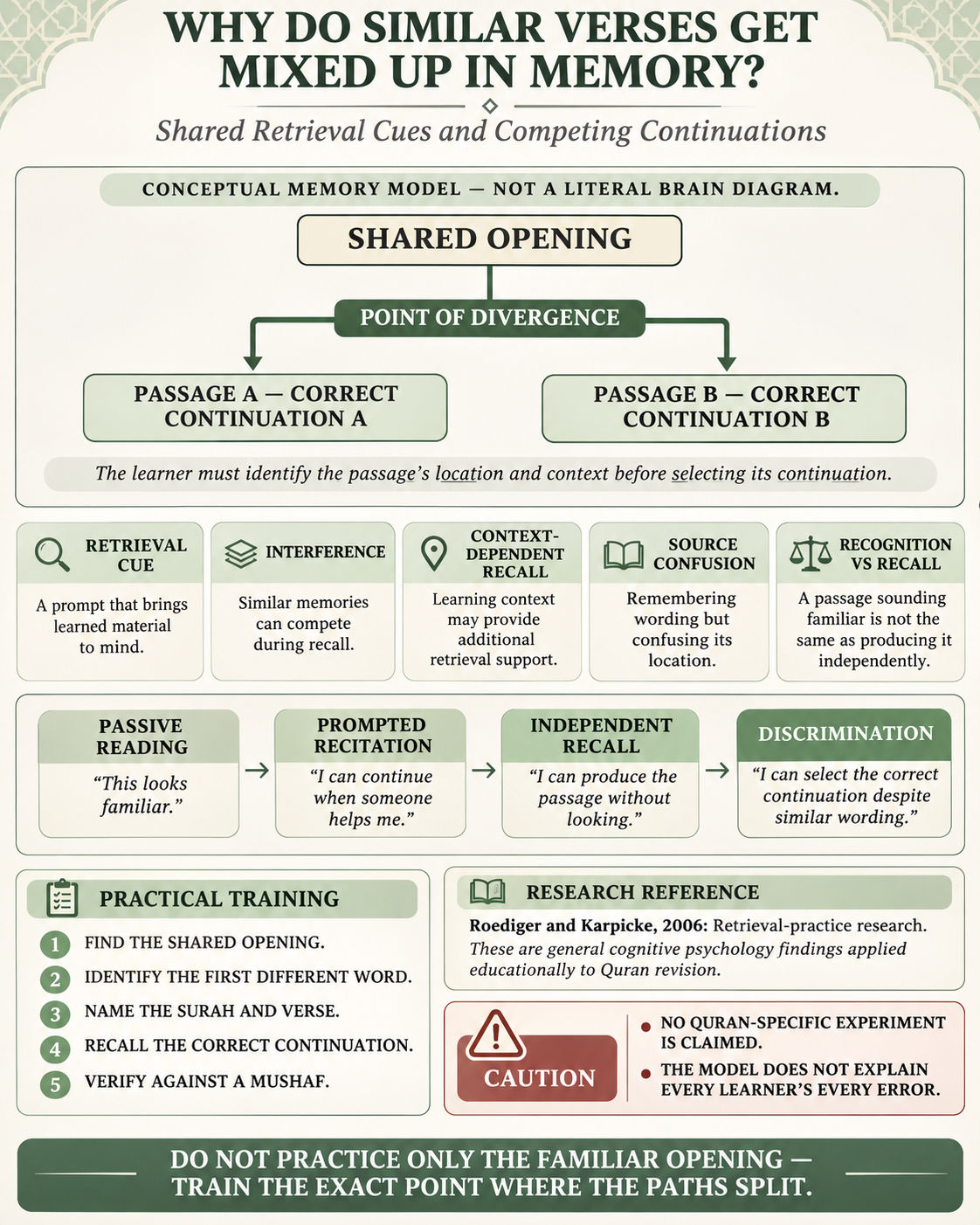
Retrieval cue: something that triggers a memory, such as the first words of a verse.
Interference: when similar memories compete, one can intrude on the other.
Context-dependent recall: memory is often easier when the recall situation resembles the learning situation.
Source confusion: remembering the words but not where they belong.
Recognition versus recall: feeling that something sounds familiar is easier than producing it independently.
A shared phrase is a cue attached to more than one memorized passage. When you recite, the phrase may bring up both continuations, and the stronger or more recently practiced one often wins. That is not always the correct one.
These are general findings from cognitive psychology. Applying them to Quran memorization is an educational interpretation, not a conclusion established by Quran-specific research. They also do not explain every student's every mistake.
Why Repetition Alone Is Not Always Enough
Repetition is valuable. It builds fluency and familiarity. But several different skills are involved in accurate recitation:
Recognizing a verse as familiar.
Reciting it after hearing a prompt.
Recalling it independently.
Choosing the correct continuation.
Distinguishing it from a similar passage.
Passively rereading a passage may mainly train recognition. Skill 5 needs practice of its own: you must be tested on the point where the passages diverge, and be corrected when you go wrong. Research on retrieval practice (for example Roediger and Karpicke, 2006) suggests that attempting recall, rather than only rereading, can strengthen later retention. That is general learning research, but it fits the demands of Mutashabihat well.
Why a Familiar Phrase Triggers the Wrong Continuation
Imagine two passages that start with the same three words. Your recitation of the opening has become automatic, and the opening itself offers no clue about which passage you are in. Then the paths split. If you have practiced the divergence point less than the opening, the more strongly rehearsed path can take over, especially when the rhythm is similar and the context is weakly anchored in your mind.
The confusion usually sits at one exact point. That is useful, because a specific problem can be targeted specifically.
Why Confusion Can Grow as You Memorize More
New memorization can introduce more passages that resemble earlier ones, so the need for structured review may increase. This does not mean memorizing more Quran inevitably causes more mistakes. Progress and error patterns vary widely between individuals, depending on revision habits, teacher feedback, and the passages themselves.
Memorizing Without Understanding
Hifz does not require full Arabic fluency, and many accurate huffaz do not speak Arabic. Still, knowing the general meaning and setting of a passage can give you additional retrieval cues: who is speaking, to whom, and about what. Understanding does not automatically eliminate confusion, and it complements verbal memorization rather than replacing it. A translation-based memory aid is also not the same as Tafsir. It is a study aid, not an interpretation.
Five Verified Examples of Similar Quranic Passages
All text below follows the Hafs 'an 'Asim reading. These are separate passages in the Mushaf, not Qira'at variants of one verse. Please check every quotation against a verified Mushaf with your teacher before using it in your own notes.
Example 1: A Shared Opening, Different Continuations
Quran 5:20 and 14:6
Both begin with the same words:
وَإِذْ قَالَ مُوسَىٰ لِقَوْمِهِ
5:20: يَا قَوْمِ اذْكُرُوا نِعْمَةَ اللَّهِ عَلَيْكُمْ إِذْ جَعَلَ فِيكُمْ أَنبِيَاءَ وَجَعَلَكُم مُّلُوكًا
14:6: اذْكُرُوا نِعْمَةَ اللَّهِ عَلَيْكُمْ إِذْ أَنجَاكُم مِّنْ آلِ فِرْعَوْنَ
Shared wording: the opening and "ذكروا نعمة الله عليكم إذ".
The difference: 5:20 has yā qawm and continues with prophets and kings. 14:6 goes straight to udhkuru and continues with rescue from Pharaoh's people.
Context: 5:20 sits within the narrative of Musa's people and the entry to the Holy Land. 14:6 sits in Surah Ibrahim, which gives Musa as an example of a messenger reminding his people of God's favors.
Memory cue: associate 5:20 with "prophets and kings," and 14:6 with "rescue from Pharaoh's people." This is a study aid, not a Tafsir explanation.
Test recall: say the opening and ask yourself which Surah you are in before you continue.
Example 2: A Small Word Difference Within a Similar Passage
Quran 2:58 and 7:161
2:58: وَإِذْ قُلْنَا ادْخُلُوا هَٰذِهِ الْقَرْيَةَ فَكُلُوا مِنْهَا حَيْثُ شِئْتُمْ رَغَدًا وَادْخُلُوا الْبَابَ سُجَّدًا وَقُولُوا حِطَّةٌ نَّغْفِرْ لَكُمْ خَطَايَاكُمْ ۚ وَسَنَزِيدُ الْمُحْسِنِينَ
7:161: وَإِذْ قِيلَ لَهُمُ اسْكُنُوا هَٰذِهِ الْقَرْيَةَ وَكُلُوا مِنْهَا حَيْثُ شِئْتُمْ وَقُولُوا حِطَّةٌ وَادْخُلُوا الْبَابَ سُجَّدًا نَّغْفِرْ لَكُمْ خَطِيئَاتِكُمْ ۚ سَنَزِيدُ الْمُحْسِنِينَ
Shared wording: a long portion of the middle of both verses.
Differences: qulnā versus qīla lahum; udkhulū versus uskunū; fa-kulū versus wa-kulū; raghadan only in 2:58; khaṭāyākum versus khaṭī'ātikum; wa-sanazīdu versus sanazīdu.
Memory cue: list the differences in a small note and rehearse them as pairs. The "extra" raghadan belongs to Al-Baqarah.
Test recall: given only "ادخلوا هذه القرية," continue; then do the same from "اسكنوا هذه القرية."
Example 3: The Same Elements in a Different Order
Quran 2:48 and 2:123
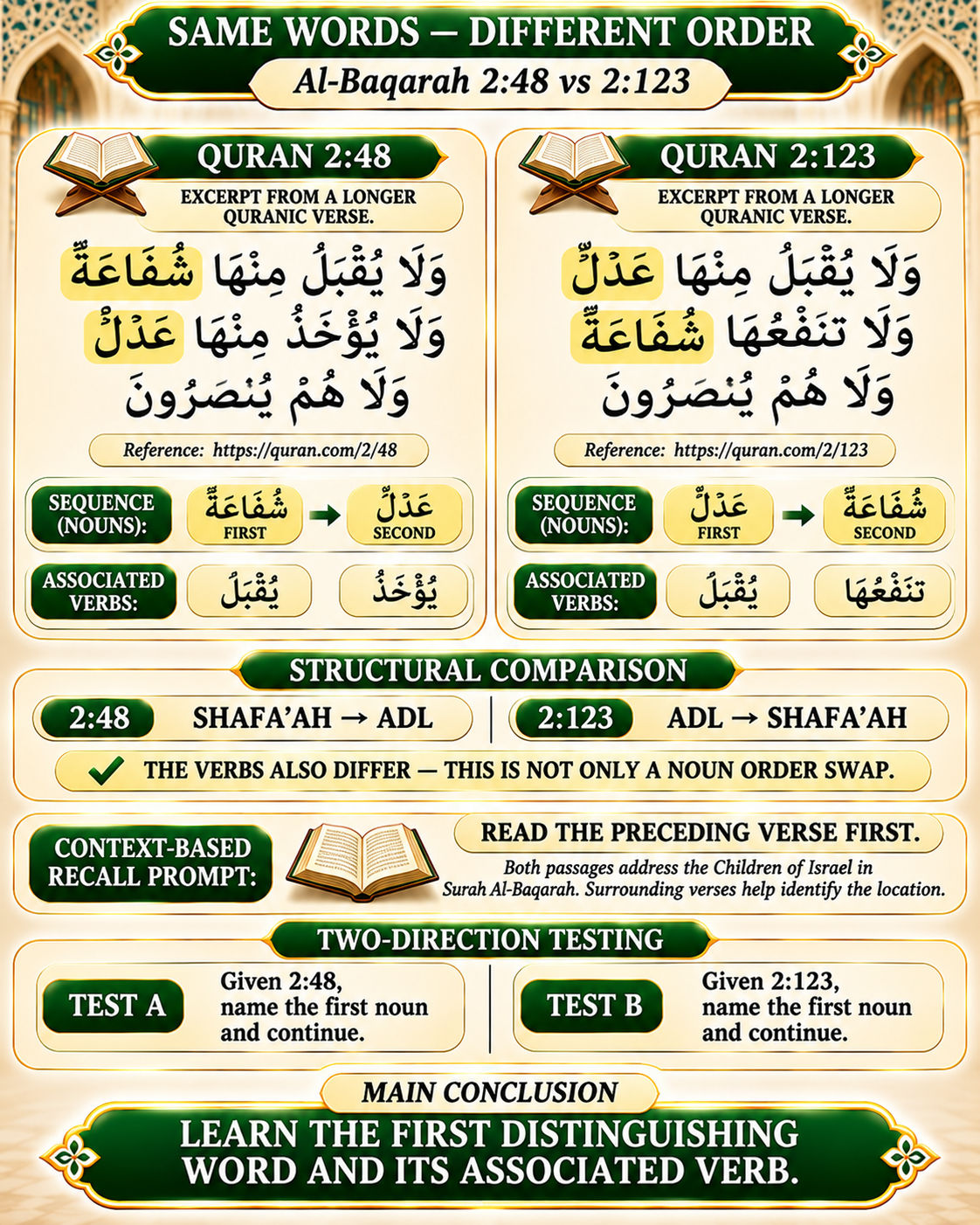
Both contain the sentence "وَاتَّقُوا يَوْمًا لَّا تَجْزِي نَفْسٌ عَن نَّفْسٍ شَيْئًا" followed by:
2:48: وَلَا يُقْبَلُ مِنْهَا شَفَاعَةٌ وَلَا يُؤْخَذُ مِنْهَا عَدْلٌ وَلَا هُمْ يُنصَرُونَ
2:123: وَلَا يُقْبَلُ مِنْهَا عَدْلٌ وَلَا تَنفَعُهَا شَفَاعَةٌ وَلَا هُمْ يُنصَرُونَ
Shared wording: the opening, the clause about no soul avails another, and the ending.
The difference: shafā'ah comes first in 2:48 and 'adl comes first in 2:123, and the verbs differ (yu'khadhu versus tanfa'uhā).
Context: both address the Children of Israel in Al-Baqarah. Check the surrounding verses in your Mushaf, because the preceding verse is what helps most here.
Memory cue: note the order of the first noun in each verse and write it beside the verse number in your study notes.
Test recall: begin at "ولا يقبل منها" and name both continuations aloud, then check against the Mushaf.
Example 4: A Repeated Expression in Different Contexts
Surah Ar-Rahman 55:13 and 55:16
فَبِأَيِّ آلَاءِ رَبِّكُمَا تُكَذِّبَانِ
This refrain recurs throughout the Surah (31 times in the Hafs reading). The wording is identical each time, so the verse itself cannot tell you where you are. What differs is the verse that comes before and after it:
After 55:13 comes 55:14: خَلَقَ الْإِنسَانَ مِن صَلْصَالٍ كَالْفَخَّارِ
After 55:16 comes 55:17: رَبُّ الْمَشْرِقَيْنِ وَرَبُّ الْمَغْرِبَيْنِ
Memory cue: the cue is not in the refrain at all but in what precedes it. Learn each refrain together with the verse immediately before it.
Test recall: have a teacher say a verse and ask you to continue past the refrain, then to name which refrain number it is.
Example 5: Similar Narratives With Distinct Details
Quran 2:49, 7:141, and 14:6 (the rescue from Pharaoh's people)
2:49: وَإِذْ نَجَّيْنَاكُم مِّنْ آلِ فِرْعَوْنَ يَسُومُونَكُمْ سُوءَ الْعَذَابِ يُذَبِّحُونَ أَبْنَاءَكُمْ وَيَسْتَحْيُونَ نِسَاءَكُمْ
7:141: وَإِذْ أَنجَيْنَاكُم مِّنْ آلِ فِرْعَوْنَ يَسُومُونَكُمْ سُوءَ الْعَذَابِ يُقَتِّلُونَ أَبْنَاءَكُمْ وَيَسْتَحْيُونَ نِسَاءَكُمْ
14:6: إِذْ أَنجَاكُم مِّنْ آلِ فِرْعَوْنَ يَسُومُونَكُمْ سُوءَ الْعَذَابِ وَيُذَبِّحُونَ أَبْنَاءَكُمْ
Differences: najjaynākum (2:49), anjaynākum (7:141), anjākum (14:6); yudhabbiḥūn (2:49), yuqattilūn (7:141), wa-yudhabbiḥūn with a wāw (14:6). In 14:6 .
Memory cue: attach one distinguishing word to each Surah in your confusion log: najjaynā with Al-Baqarah, yuqattilūn with Al-A'raf, and the wāw with Ibrahim.
Test recall: from "يسومونكم سوء العذاب," continue each version when prompted with the Surah name.
A caution: a memory cue is not an explanation of why the wording differs. Scholars have discussed such differences, but a cue is only a tool for recall.
How Context Helps Distinguish Similar Verses
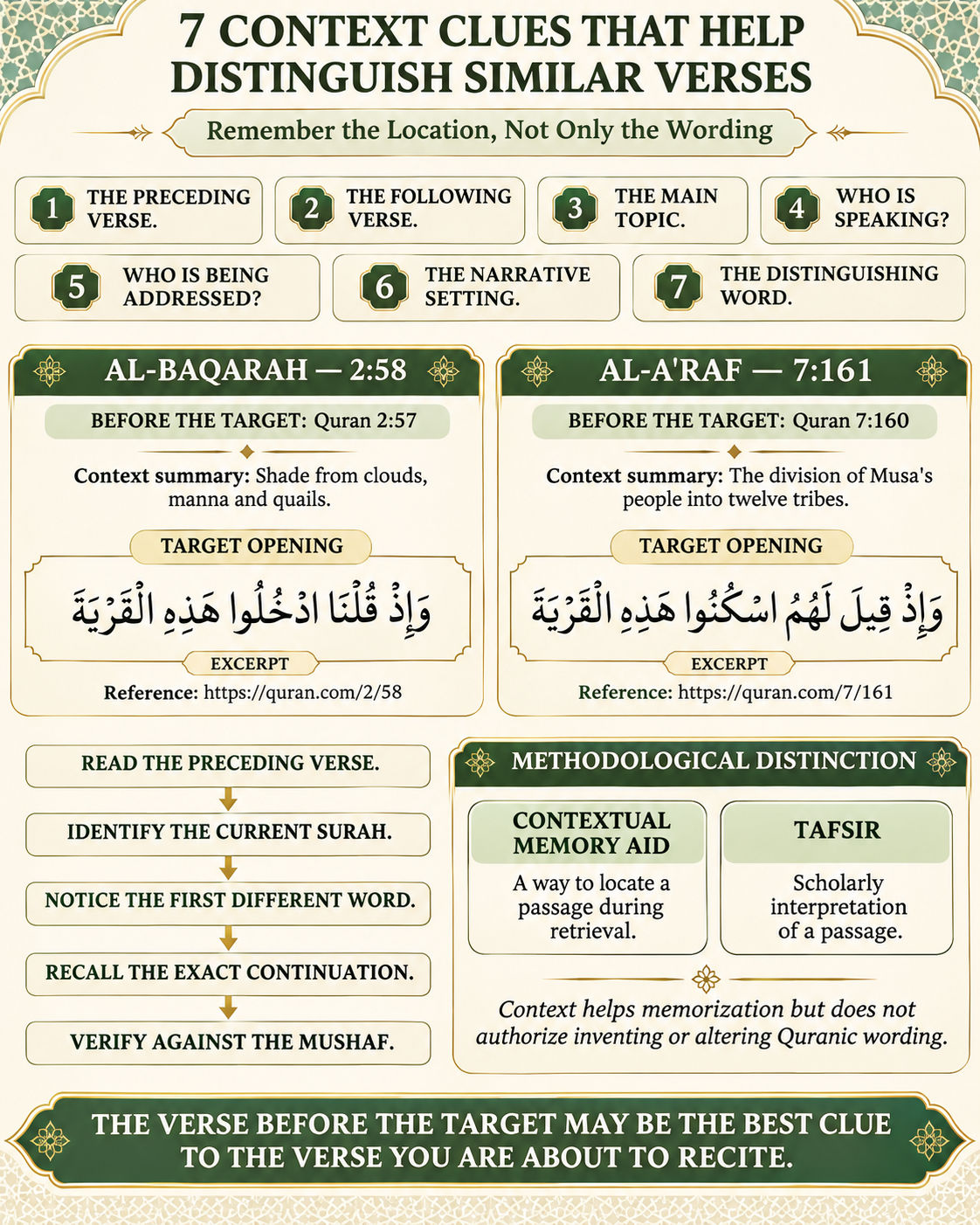
When two passages look alike, examine:
The verse before.
The verse after.
The topic.
The speaker.
The audience.
The narrative setting.
The key distinguishing word.
Worked example (2:58 and 7:161). Before 2:58, verse 2:57 speaks of shade from clouds and of manna and quails. Before 7:161, verse 7:160 speaks of Musa's people being divided into twelve tribes. These preceding verses give each passage a different entry point. If you can recall the verse before, you have a stronger cue for the correct opening and continuation.
Context is a learning aid. It never gives permission to alter, smooth, or substitute Quranic wording.
A Step-by-Step Correction System
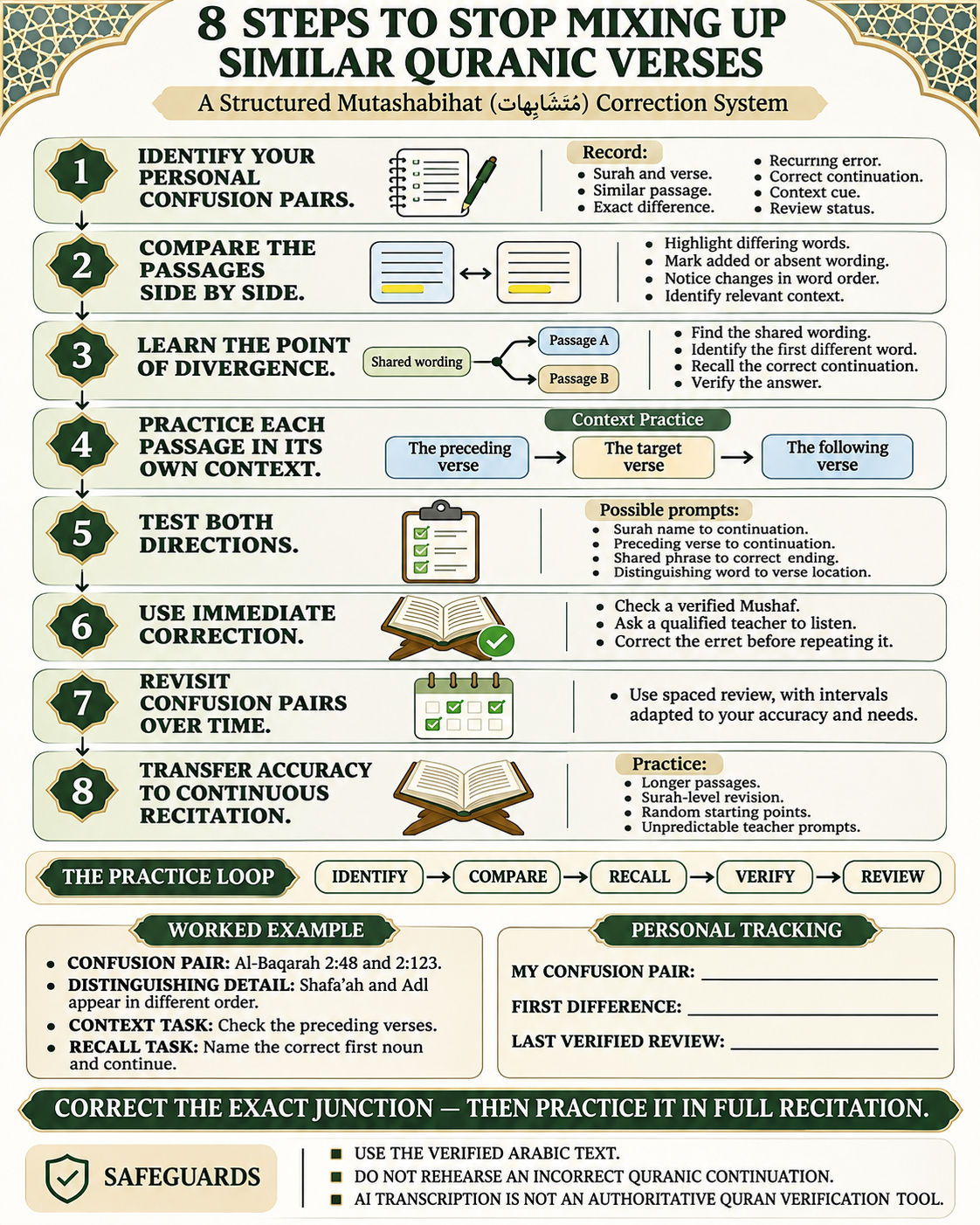
Step 1: Identify Your Personal Confusion Pairs
Keep a simple log of the pairs you actually confuse, rather than every similar passage in the Quran. Record:
Surah and verse.
The similar passage's location.
The exact difference.
Your common incorrect continuation.
The correct continuation.
A contextual cue.
Review status.
Sample entry:
Passage | Similar passage | Exact difference | My usual error | Context cue | Status |
|---|---|---|---|---|---|
2:48 | 2:123 | Order of shafā'ah and 'adl; verbs differ | Saying 2:123's order in 2:48 | Check the verse before | Under review |
Step 2: Compare the Passages Side by Side
Write or print the passages in separate study notes. Underline differing words, mark additions and omissions, and note word order and surrounding context. Do this in your own notes or in properly designed educational materials, not by changing the Mushaf text in a way that misrepresents it.
Step 3: Learn the Point of Divergence
Read both passages accurately with your teacher or against a verified Mushaf.
Identify the shared opening.
Identify the first distinguishing word.
Practice the correct continuation.
Recite without looking.
Verify the result.
Practicing the exact location of the error is often more useful than repeatedly reciting a long passage without targeted correction, because the problem is not the whole passage but one junction.
Step 4: Practice Each Passage in Its Own Context
Recite the preceding verse, the target verse, and the following verse as a unit. Surrounding verses can act as retrieval cues. This does not always eliminate confusion, but it often gives you a stronger starting point.
Step 5: Test Both Directions
Vary the prompt:
Given the Surah name, recite the target verse.
Given the preceding verse, continue accurately.
Given a shared phrase, identify the correct continuation.
Given the distinguishing word, identify where it occurs.
Avoid practicing incorrect versions repeatedly. If you make a mistake, stop, check, and restart from the correct text.
Step 6: Use Immediate Correction
Check recitation against a verified Mushaf and a qualified teacher. Correct errors promptly, before they are rehearsed again. Students cannot always detect their own errors, especially when the wrong version sounds natural. AI transcription tools are not authoritative verification systems for the Quran and should not replace a Mushaf or a teacher.
Step 7: Revisit Confusion Pairs Over Time
Spaced revision means returning to material at intervals instead of all at once. General research on spacing (for example Cepeda and colleagues, 2006) supports distributing practice over time. There is no universally optimal schedule. A teacher can lengthen the interval when recall becomes reliable and shorten it when confusion returns.
Step 8: Transfer Accuracy to Continuous Recitation
You might distinguish two verses in a side-by-side exercise and still confuse them in longer recitation. To transfer your accuracy, practice:
Connected passages.
Surah-level revision.
Random starting points.
Teacher-selected prompts.
Previously troublesome transitions.
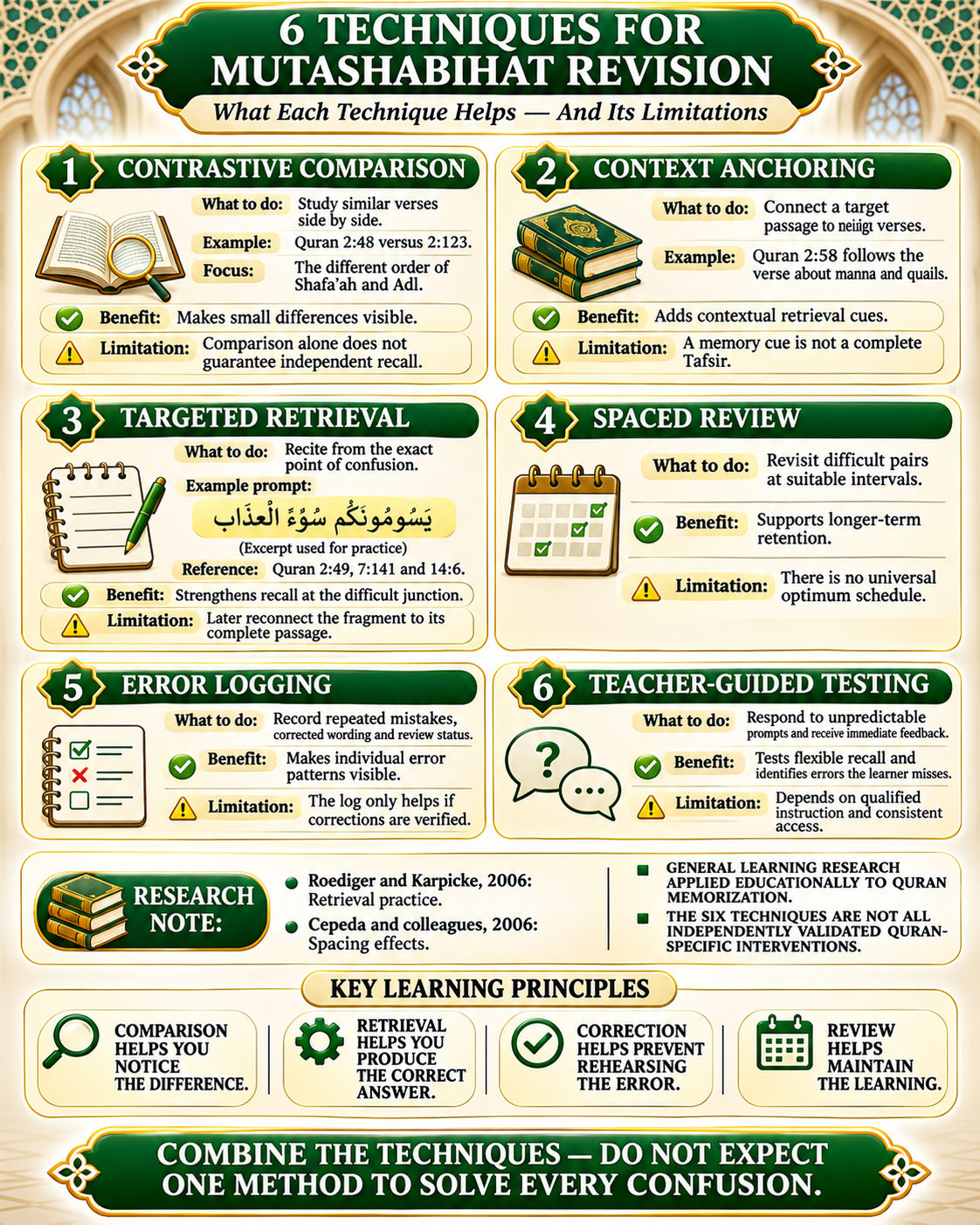
Six Techniques for Mutashabihat Revision
These are general learning techniques applied to Quran revision. Not each one has been specifically validated in Quran memorization research.
1. Contrastive Comparison. Study similar passages together to find differences. Example: place 2:48 and 2:123 side by side and mark the order of shafā'ah and 'adl. Purpose: it makes small differences visible. Limitation: comparison alone does not guarantee recall, so follow it with retrieval practice.
2. Context Anchoring. Link each passage to its surrounding meaning and structure. Example: connect 2:58 with the verse about manna and quails before it. Purpose: it adds cues beyond the words themselves. Limitation: context can be partial, and it must not be mistaken for a full interpretation.
3. Targeted Retrieval. Practice the exact point where confusion occurs. Example: recite only from "يسومونكم سوء العذاب" and complete the verse for each Surah. Purpose: it strengthens the weakest point. Limitation: isolated fragments should later be reconnected to full passages.
4. Spaced Review. Revisit difficult pairs over time. Example: test a pair after a day, then after a longer gap if accurate. Purpose: it helps durable recall. Limitation: intervals must adapt to the learner.
5. Error Logging. Track recurring mistakes and verify corrections. Example: the table in Step 1. Purpose: it reveals patterns. Limitation: it only helps if corrections are checked against a verified source.
6. Teacher-Guided Testing. The teacher uses unpredictable prompts and gives corrective feedback. Example: the teacher starts at a shared phrase and asks you to continue. Purpose: it tests flexible recall and catches errors you might not notice. Limitation: it depends on the teacher's qualifications and regular access.
Seven Mistakes That Can Reinforce Confusion
Repeating the wrong continuation without correction. Practice strengthens what you practice, whether it is right or wrong.
Practicing only from the beginning of a Surah. You may never train the middle transitions where confusion occurs.
Ignoring the exact distinguishing word. General familiarity does not tell you which path to take.
Reviewing similar passages only in isolation. Isolated review may not prepare you for the competing cue in continuous recitation.
Relying entirely on passive listening. Listening is valuable for hearing correct recitation, but alone it may not test your independent recall.
Memorizing more while neglecting unstable passages. This is not a rule to halt new memorization at every small error. A teacher can judge how much attention unstable passages need.
Measuring progress only by new verses memorized. Accuracy and retention of existing material are also progress.
A Four-Week Plan to Reduce Similar-Verse Confusion
This is a starting framework, not a promise. It can be extended or adapted, and it deliberately avoids fixed minutes or repetition counts.
Week | Main focus | Practice activity | Progress indicator |
|---|---|---|---|
1 | Identify and document | Find confusion pairs, record exact differences, note baseline accuracy | A clear log of your most frequent errors |
2 | Compare and correct | Study side by side, learn distinguishing words, practice correct continuations, get teacher feedback | You can name the first difference in each pair |
3 | Retrieve and reinforce | Recite without looking, use varied prompts, review context, revisit errors | Fewer wrong continuations under varied prompts |
4 | Test in continuous recitation | Recite longer passages, use random starting points, reassess pairs | Accuracy in connected recitation; a plan for ongoing revision |
Some pairs may need more than four weeks. That is normal.
Children, Adults, and Advanced Students
Helping Children
Use small comparison sets of two passages at a time.
Provide clear visual study aids.
Correct gently and avoid shaming or punishment.
Use short retrieval activities.
Offer simple meaning-based explanations.
Practice with teacher-guided repetition.
Encourage progress without comparison to others.
Confusion is part of learning longer Surahs, not misbehavior.
Helping Adults
Adults often bring existing memorization habits, limited revision time, varied language backgrounds, and varying confidence. Consistent, structured practice and individualized priorities can improve recall accuracy. Age is not a reason for pessimism.
If You Have Already Memorized Many Juz
You do not need to restart memorization. Instead, build a targeted Mutashabihat review system:
Identify repeated error families.
Group related passages.
Ask a teacher for random testing.
Revise with context.
Include older memorization in review.
Maintain a personal confusion log.
Can Tafsir Help Prevent Similar-Verse Confusion?
Tafsir can clarify narrative context, thematic differences, word choice, relationships between neighboring verses, and differences in audience or emphasis. Consulting recognized works such as al-Tabari, Ibn Kathir, al-Qurtubi, and Ibn Ashur, and working with a teacher, helps ensure explanations are reliable.
It helps to keep three things distinct:
A verified scholarly explanation.
A practical memory association.
A speculative interpretation.
A cue such as "this one has the extra word" can help you recall a verse even though it is not a scholarly explanation. Mnemonic associations are not authoritative Tafsir, and not every wording difference has a single agreed explanation.
Frequently Asked Questions
Why do I mix up similar Quranic verses?
Shared wording can cue more than one memorized passage, and the more strongly practiced path may take over at the point of divergence. It is a learning challenge, not a spiritual failing.
What are Mutashabihat in Quran memorization?
They are verbally similar passages, called mutashabihat al-alfaz, that are easy to confuse. This is different from the Muhkam/Mutashabih discussion in 3:7.
How can I remember the differences between similar verses?
Compare the passages side by side, identify the first distinguishing word, learn each passage in its context, and test the correct continuation without looking.
Should I memorize similar verses together?
Studying a pair together can make differences clear, but each passage should also be practiced in its own context. Your teacher can advise on timing.
Can listening to recitation help?
Yes, listening to accurate recitation is valuable. Combine it with independent recall and correction so you also test your own retrieval.
Does understanding Tafsir help with Mutashabihat?
It can provide context and cues, but it does not automatically eliminate confusion, and it does not replace verbal practice.
Should I stop memorizing new verses until I fix old mistakes?
Not necessarily. Minor errors do not always require stopping. A teacher can judge the balance between new memorization and revision.
Can a Quran teacher help with similar-verse confusion?
Yes. A qualified teacher can detect errors you may not notice, choose unpredictable prompts, and give immediate correction.
Conclusion
Similar Quranic verses can create real challenges during recall, because overlapping wording lets one passage cue another. The remedy is practical: identify your confusion pairs, compare the exact wording, understand the context, practice the point of divergence, test your recall, correct mistakes promptly, and revisit difficult passages over time, ideally with a qualified teacher.
Begin with one recurring confusion pair rather than trying to fix every mistake at once.
If you would like personalized correction, structured revision, and teacher-guided practice, you are welcome to explore Araby Academy's live one-to-one Quran memorization and revision lessons.