By Araby Academy
Allah is speaking to Musa (Moses) at the burning bush, in the middle of the most momentous encounter of his life, and He asks a simple question:
وَمَا تِلْكَ بِيَمِينِكَ يَا مُوسَىٰ
"And what is that in your right hand, O Moses?" (Quran 20:17)
Did Allah need Musa to tell Him what he was holding? Of course not. Which raises a natural question: if Allah knows everything, why does the Quran so often present His words as questions?
The short answer: not every question is asked to obtain information. In the Quran, a question can direct attention, prepare a listener for a lesson, draw out an acknowledgment, challenge a false assumption, or make a truth land with more force than a plain statement would. Allah's questions in the Quran do not imply any gap in His knowledge. They are a communicative tool, and Arabic rhetoric gives us precise language for understanding how that tool works.
A note on translations: English renderings in this article follow the wording of the Sahih International translation, lightly adapted for clarity. Tafsir references are to well-known commentaries, and where scholars differ, we say so rather than choose a single view for you.
Does Allah Already Know the Answers?
Before studying the questions, we should be clear about the foundation. The Quran affirms Allah's complete knowledge repeatedly and in different registers.
Knowledge of the unseen: "And with Him are the keys of the unseen; none knows them except Him" (6:59).
Knowledge of the hidden: "…then indeed, He knows the secret and what is even more hidden" (20:7).
Knowledge by creation: "Does He who created not know, while He is the Subtle, the All-Aware?" (67:14).
Knowledge before creation: when Allah announced a vicegerent on earth, He said, "Indeed, I know that which you do not know" (2:30).
Two points matter here. First, Allah's knowledge does not depend on learning from creation. Second, no human answer adds anything to it. Whatever a question in the Quran accomplishes, it does not accomplish by informing Allah.
It is also worth noticing that 67:14 is itself a question: "Does He who created not know?" The Quran uses a question to affirm divine knowledge. That small observation already shows that questions in the Quran cannot be reduced to a request for information.
Islamic scholarship generally avoids speculating about how divine knowledge operates. We affirm what revelation affirms and focus on what the text is doing with its words.
Why Humans Ask Questions They Already Know the Answers To
This is familiar from ordinary life, and a few everyday examples help, with one caution: they are limited analogies for communication, not comparisons between human knowledge or authority and Allah's attributes.
A teacher asks, "What happens when we divide ten by two?" She knows the answer. The question is designed to make students think and to bring their attention to the lesson.
A parent asks, "What did we agree about keeping promises?" The parent is not missing information. The question reminds the child of a commitment and invites the child to recognize it personally.
A judge asks a defendant, "Is this your signature?" The point is not the judge's ignorance, but establishing a formal acknowledgment on the record.
In each case, the question does something that a statement does not: it involves the listener. Human questions often arise from uncertainty, but they do not always. The Quran's questions must be understood through their own text, context, and reliable Tafsir, not through these analogies alone.
What Is Istifham in Arabic?
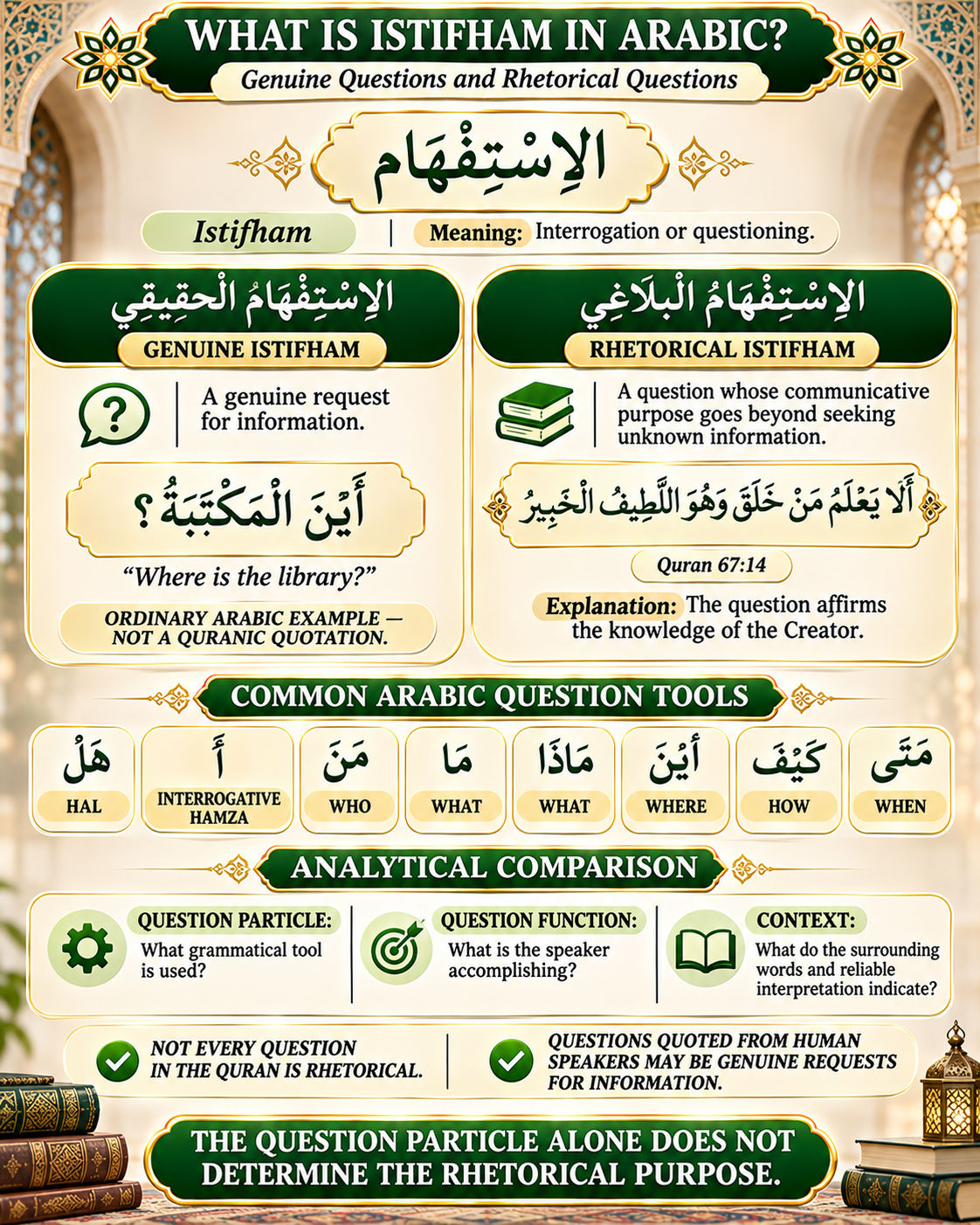
In Arabic, a question is called الاستفهام (istifham), literally a request for understanding. Classical grammarians and rhetoricians distinguish between two broad uses:
الاستفهام الحقيقي (genuine istifham): a real request for information, as in ordinary human speech, such as "Where is the library?"
الاستفهام البلاغي (rhetorical istifham, often called istifham balaghi): a question whose real purpose lies beyond seeking unknown information.
Arabic has many question words, including هل (hal), the particle أ (hamza), مَنْ (who), مَا and مَاذَا (what), أَيْنَ (where), كَيْفَ (how), and مَتَى (when). But the particle alone does not decide the function. A question beginning with hal can request information in one verse and deny a claim in another. A question beginning with the hamza can elicit acknowledgment, express rebuke, or convey wonder, depending on context.
The Common Rhetorical Purposes
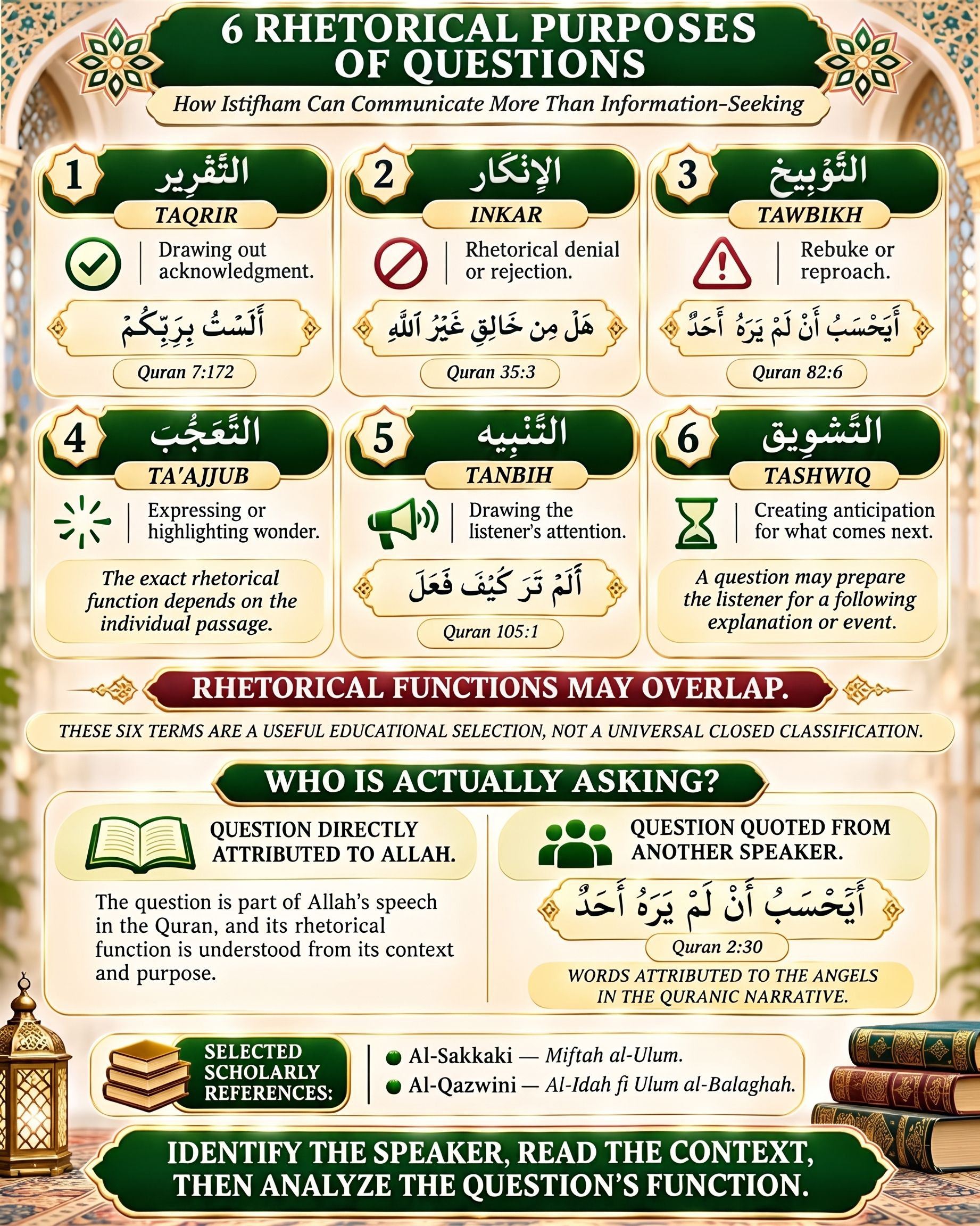
Arabic rhetoric (علم البلاغة, balaghah) describes several meanings that an interrogative can carry beyond a literal request. Among the terms most often discussed are:
التقرير (taqrir): drawing out an acknowledgment from the listener.
الإنكار (inkar): rhetorical denial or rejection, which classical works sometimes subdivide further.
التوبيخ (tawbikh): rebuke.
التعجب (ta'ajjub): expressing wonder or marking something as remarkable.
التنبيه (tanbih): drawing attention.
التشويق (tashwiq): arousing anticipation.
Two cautions. These are not a closed or universally identical list: rhetoric manuals such as al-Sakkaki's Miftah al-Ulum and al-Qazwini's al-Idah fi Ulum al-Balaghah organize and name the purposes of istifham in their own ways, and later teaching traditions vary. And not every Quranic question is rhetorical. The Quran contains genuine questions as well, for instance when people ask the Prophet ﷺ about matters they truly want to learn (2:189 and 2:219 are examples).
Who Is Actually Asking?
A further distinction is essential. Many questions in the Quran are quoted from other speakers: angels, prophets, believers, disbelievers, characters in a narrative. When the angels ask, "Will You place upon it one who causes corruption?" (2:30), that is the angels' question, reported by Allah. Allah is the narrator of the quotation, not the questioner. Identifying the speaker is the first step to interpreting any question correctly. This article concerns primarily the questions Allah Himself directs to His creation.
Seven Case Studies
1. Allah's Question to Musa (20:17–21)
Speaker: Allah. Addressee: Musa ﷺ.
The passage unfolds as a conversation:
وَمَا تِلْكَ بِيَمِينِكَ يَا مُوسَىٰ قَالَ هِيَ عَصَايَ أَتَوَكَّأُ عَلَيْهَا وَأَهُشُّ بِهَا عَلَىٰ غَنَمِي وَلِيَ فِيهَا مَآرِبُ أُخْرَىٰ
"And what is that in your right hand, O Moses?" He said, "It is my staff; I lean upon it, and I bring down leaves with it for my sheep, and for me it has other uses." (20:17–18)
Then Allah tells him to throw it down, and it becomes a moving serpent (20:19–20). Allah tells him to take it without fear, and that He will restore it to its former state (20:21).
The question does not seek information. Commentators such as al-Razi and Ibn Ashur observe several things. The question directs Musa's attention to a very ordinary object, so that he knows precisely what it is before it changes. This makes the coming sign unmistakable: it happens to something he knows intimately. Some commentators also note that the gentle, conversational form shows Allah's closeness in addressing Musa, and that Musa's lengthy answer, beyond what was strictly asked, reflects the nature of that conversation.
What is established is the narrative function: the question leads directly into the sign. Anything beyond that is the commentators' reflection on wisdom, offered with appropriate humility, and no single explanation excludes the others.
2. "Am I Not Your Lord?" (7:172)
Speaker: Allah. Addressee: the descendants of Adam.
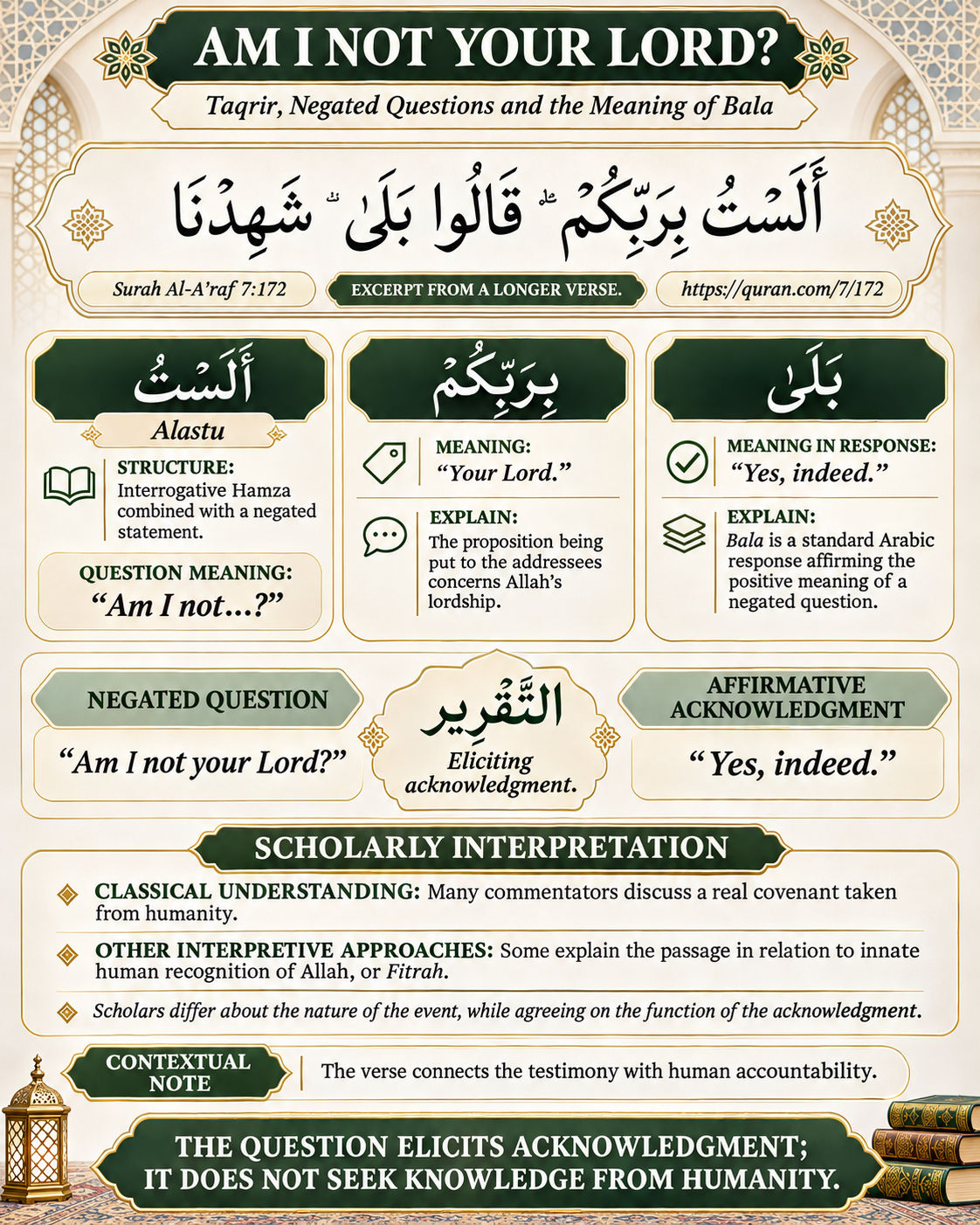
أَلَسْتُ بِرَبِّكُمْ ۖ قَالُوا بَلَىٰ ۛ شَهِدْنَا
"Am I not your Lord?" They said, "Yes, we have testified." (7:172)
The verse continues by stating the purpose: that they would not say on the Day of Resurrection, "Indeed, we were unaware of this." The question here is a clear case of taqrir. In Arabic, a negated question of this kind (alastu, "am I not…") typically draws out an affirmation, and the answer bala ("yes indeed") is the standard response to a negative question.
The interpretation of the event itself has been discussed by scholars across the centuries. Many classical commentators, as reflected in al-Tabari and Ibn Kathir, understood it as a real covenant taken from humanity, and Ibn Kathir also connects it to the natural disposition (fitrah) toward recognizing Allah. Others, including some who read the passage in a more figurative way, took it as a vivid description of that innate disposition, a testimony expressed in the constitution of human beings. Both groups agree on what the question does: it frames human accountability as grounded in a recognition that humans already hold, rather than in information Allah lacked. Detailed claims beyond the text should be left to reliable sources.
3. "Did We Not Expand Your Chest?" (94:1)
Speaker: Allah. Addressee: the Prophet ﷺ.
أَلَمْ نَشْرَحْ لَكَ صَدْرَكَ
"Did We not expand for you your breast?" (94:1)
The next verses continue the reminders of favor: relieving a burden that weighed on his back (94:2–3), and raising his renown (94:4), followed by the reassurance that "with hardship comes ease" (94:5). The opening question is a taqrir: the Prophet ﷺ is invited to acknowledge a blessing already given, and the sequence of reminders then supports the promise that follows.
Most commentators understand sharh al-sadr as an expansion of the heart with guidance, patience, and capacity to bear the message. Some commentators also connect the verse to the reported opening of the Prophet's chest in narrations about his life, while others read it primarily as a spiritual expansion. The verse itself does not describe a physical event, so these are different ways of relating the verse to other reports, and they should be presented as such.
4. "Have You Not Seen What Your Lord Did?" (105:1)
Speaker: Allah. Addressee: the Prophet ﷺ, and through him all listeners.
أَلَمْ تَرَ كَيْفَ فَعَلَ رَبُّكَ بِأَصْحَابِ الْفِيلِ
"Have you not considered how your Lord dealt with the companions of the elephant?" (105:1)
The verb tara ("see") does not necessarily mean literal eyewitness. In Arabic usage, it can mean knowing something so well established that it is as if one had seen it. The event was well known to the Quran's first audience in Makkah, and the question reminds them of what they already knew: that those who came against the Kaaba were frustrated (105:2). Tafsir works report that the event took place in the period around the Prophet's birth, and we need not add details beyond what those sources responsibly provide.
The question turns shared memory into a warning and a source of reflection on divine power. It is both reminder and reassurance, with tanbih (drawing attention) and taqrir working together.
5. "Is There Any Creator Other Than Allah?" (35:3)
Speaker: Allah. Addressee: humankind.
هَلْ مِنْ خَالِقٍ غَيْرُ اللَّهِ يَرْزُقُكُم مِّنَ السَّمَاءِ وَالْأَرْضِ ۚ لَا إِلَٰهَ إِلَّا هُوَ ۖ فَأَنَّىٰ تُؤْفَكُونَ
"Is there any creator other than Allah who provides for you from the heaven and earth? There is no deity except Him, so how are you deluded?" (35:3)
The verse begins with a call to remember Allah's favor ("O people, remember the favor of Allah upon you"). The question is an inkar, a rhetorical denial. It is not seeking a list of candidates. Its form invites the listener to look for a creator other than Allah and discover that no such creator exists, and the verse states the conclusion directly: there is no deity except Him. The closing question, fa-anna tu'fakun, carries rebuke and wonder at how people turn away.
This example shows how a question can challenge a false assumption more effectively than a statement: it asks the listener to find the counterexample themselves.
6. "What Has Deceived You Concerning Your Generous Lord?" (82:6)
Speaker: Allah. Addressee: the human being.
يَا أَيُّهَا الْإِنسَانُ مَا غَرَّكَ بِرَبِّكَ الْكَرِيمِ
"O mankind, what has deceived you concerning your Lord, the Generous?" (82:6)
The surrounding verses describe the cosmic upheaval of the Day of Judgment (82:1–5), then this question, then a reminder that the same Lord created you, proportioned you, and balanced you (82:7). The question works as tawbikh, a rebuke. It does not request a psychological explanation, and the Quran does not provide a single diagnosis of why each person is heedless. Commentators generally observe that the description of Allah as al-Karim (the Generous) is what makes heedlessness so striking: His generosity calls for gratitude, not complacency.
It would be a misreading to take divine generosity as permission for wrongdoing. The next verses speak of recording angels and of the final outcome (82:10–14).
7. "Where Are My Partners?" (28:62)
Speaker: Allah. Addressees: those who associated others with Him, on the Day of Judgment.
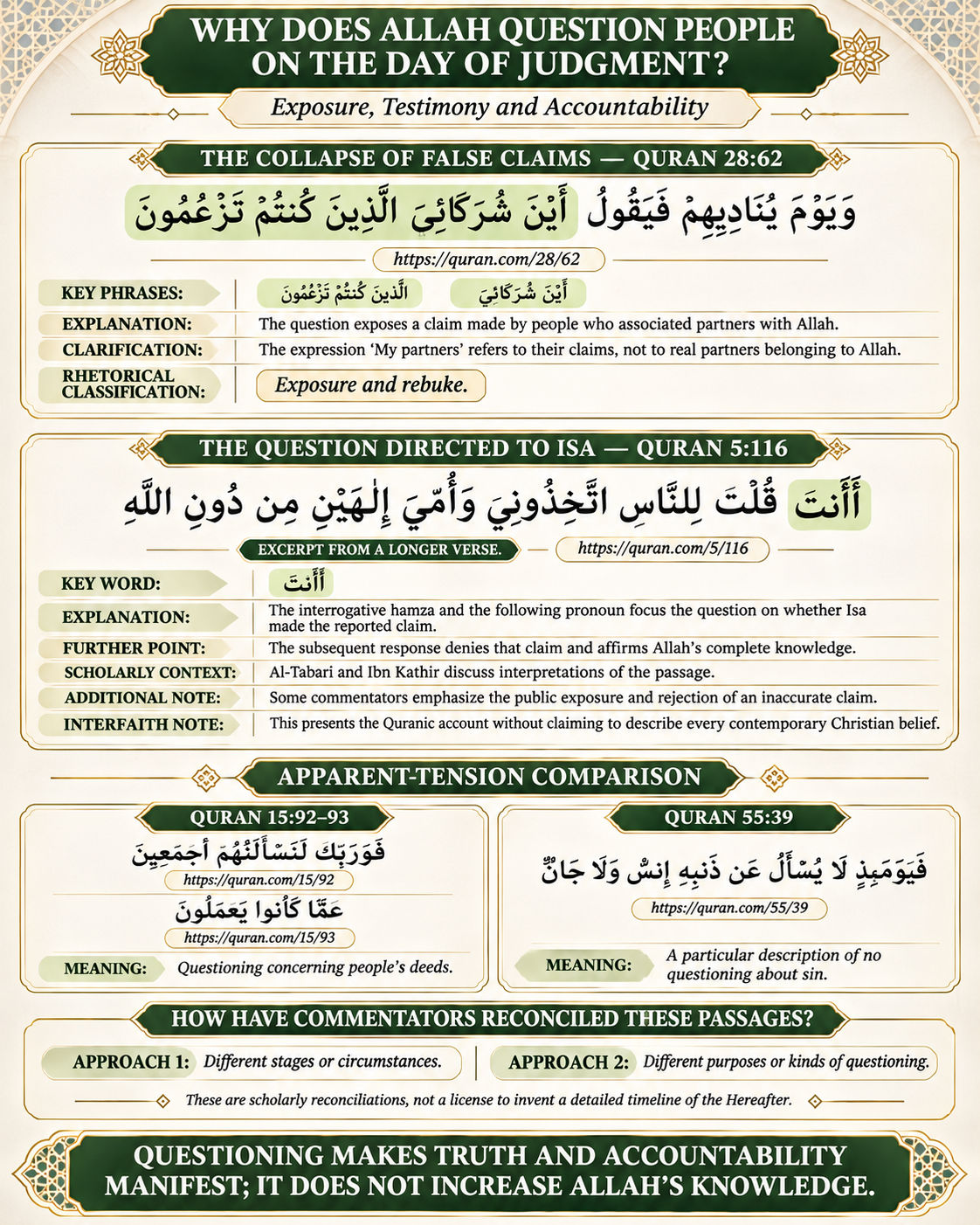
وَيَوْمَ يُنَادِيهِمْ فَيَقُولُ أَيْنَ شُرَكَائِيَ الَّذِينَ كُنتُمْ تَزْعُمُونَ
"And [mention] the Day He will call them and say, 'Where are My partners, those whom you used to claim?'" (28:62)
Here the question is not a search. It confronts claims that have collapsed, and the absence of any answer is the point. Classical commentators treat it as tawbikh and exposure: the false claims are made manifest at the moment when they were supposed to matter. Everything beyond what the verse and authentic reports state concerns the unseen, and we should not add to it.
Comparison at a Glance
Quranic example | Question | Main function | Main lesson |
|---|---|---|---|
20:17 | What is in your right hand? | Directs attention; introduces a sign | The sign happens to something familiar |
7:172 | Am I not your Lord? | Taqrir (elicits acknowledgment) | Accountability rests on recognition |
94:1 | Did We not expand your chest? | Taqrir (reminds of a blessing) | Past favor supports present hope |
105:1 | Have you not seen…? | Reminds; warns | Shared memory becomes reflection |
35:3 | Is there any creator other than Allah? | Inkar (rhetorical denial) | Let the listener find the answer |
82:6 | What deceived you? | Tawbikh (rebuke) | Generosity calls for gratitude |
28:62 | Where are My partners? | Exposes false claims | False claims have no support |
The functions listed are the most evident ones in these contexts. Scholars may emphasize other aspects of the same verse, and the table is not an exclusive classification.
Questions Raised by the Day of Judgment
If Allah Knows Everything, Why Question People?
The key is to distinguish between several things that questioning can accomplish:
Knowing what happened (Allah already knows).
Establishing testimony so that it is manifest and on the record.
Exposing false claims, as in 28:62.
Confronting wrongdoing.
Making accountability manifest to the people themselves, so that no one can say they were treated unjustly.
Questioning on the Day of Judgment, therefore, does not mean Allah gathers information. It means the person faces the reality of their own deeds.
Apparent Tension: Are They Questioned or Not?
Some verses affirm questioning: "By your Lord, We will surely question them all about what they used to do" (15:92–93). Another says that on a certain day "no human or jinn will be asked about his sin" (55:39).
Scholars have offered several reconciliations, and no single one is universally agreed upon. Among those commonly mentioned in Tafsir are:
Different stages or circumstances. The Day of Judgment includes multiple situations, and questioning applies in some and not others.
Different kinds of questions. A reading reported from Ibn Abbas, among others, distinguishes between a question seeking information ("Did you do this?"), which is not needed, and a question of accountability ("Why did you do this?").
We should avoid constructing detailed timelines of the Hereafter beyond what the Quran and authentic Sunnah state.
Why Question Prophets? The Case of Isa (5:116)
Speaker: Allah. Addressee: Isa ﷺ, as presented in the Quran.
أَأَنتَ قُلْتَ لِلنَّاسِ اتَّخِذُونِي وَأُمِّيَ إِلَٰهَيْنِ مِن دُونِ اللَّهِ
"Did you say to the people, 'Take me and my mother as deities besides Allah?'" (5:116)
Isa answers by glorifying Allah and denying that he could say what he had no right to say, adding that if he had said it, Allah would have known it (5:116). Al-Tabari and Ibn Kathir report that many scholars understood this as taking place on the Day of Judgment, and Ibn Kathir cites Qatada among those who saw the question as a rebuke directed at those who made the claim, not as a test of Isa's knowledge.
The form of the question is instructive. Placing anta ("you") right after the question particle focuses the question on whether it was he who said it. Al-Jurjani discusses this kind of hamza, which he describes as aiming at acknowledgment, and how word order shows what the question targets, in Dala'il al-I'jaz. The effect is to make the clarification public and complete.
This passage is best approached with respect for readers of other faiths: it describes a Quranic position on Isa's own teaching and does not characterize what any particular Christian community believes today.
Questions to prophets vary in function. Some introduce a sign (Musa), some establish testimony (Isa). None implies that Allah needed their answer.
Does Allah Ask Questions to Test People?
These ideas can overlap but should not be treated as identical:
A question may be part of a test, though not all Quranic questions are.
A question may expose a response that was already within a person.
A question may simply be a rhetorical device in revelation.
Worldly testing is a broader theological concept (for example 67:2).
In Islamic theology, testing does not mean Allah discovers unknown information. It makes manifest what people choose and do. Questions about dua and predestination are separate topics and not addressed here.
One More Case: "Do They Not Reflect Upon the Quran?" (4:82)
Speaker: Allah. Addressee: those who doubted or turned away, in context the hypocrites.
أَفَلَا يَتَدَبَّرُونَ الْقُرْآنَ ۚ وَلَوْ كَانَ مِنْ عِندِ غَيْرِ اللَّهِ لَوَجَدُوا فِيهِ اخْتِلَافًا كَثِيرًا
"Then do they not reflect upon the Quran? If it had been from other than Allah, they would have found within it much contradiction." (4:82)
The question works as a rebuke and a call to attention: the Quran invites careful consideration, and the verse states what that consideration should find. Tadabbur (reflection) is more than reading or recitation: it means considering the text, its context, and its implications. It does not replace qualified Tafsir. Personal reflection is encouraged, but it works alongside the knowledge of language, context, and the sources that scholars have preserved.
A Practical Method: Five Questions to Ask
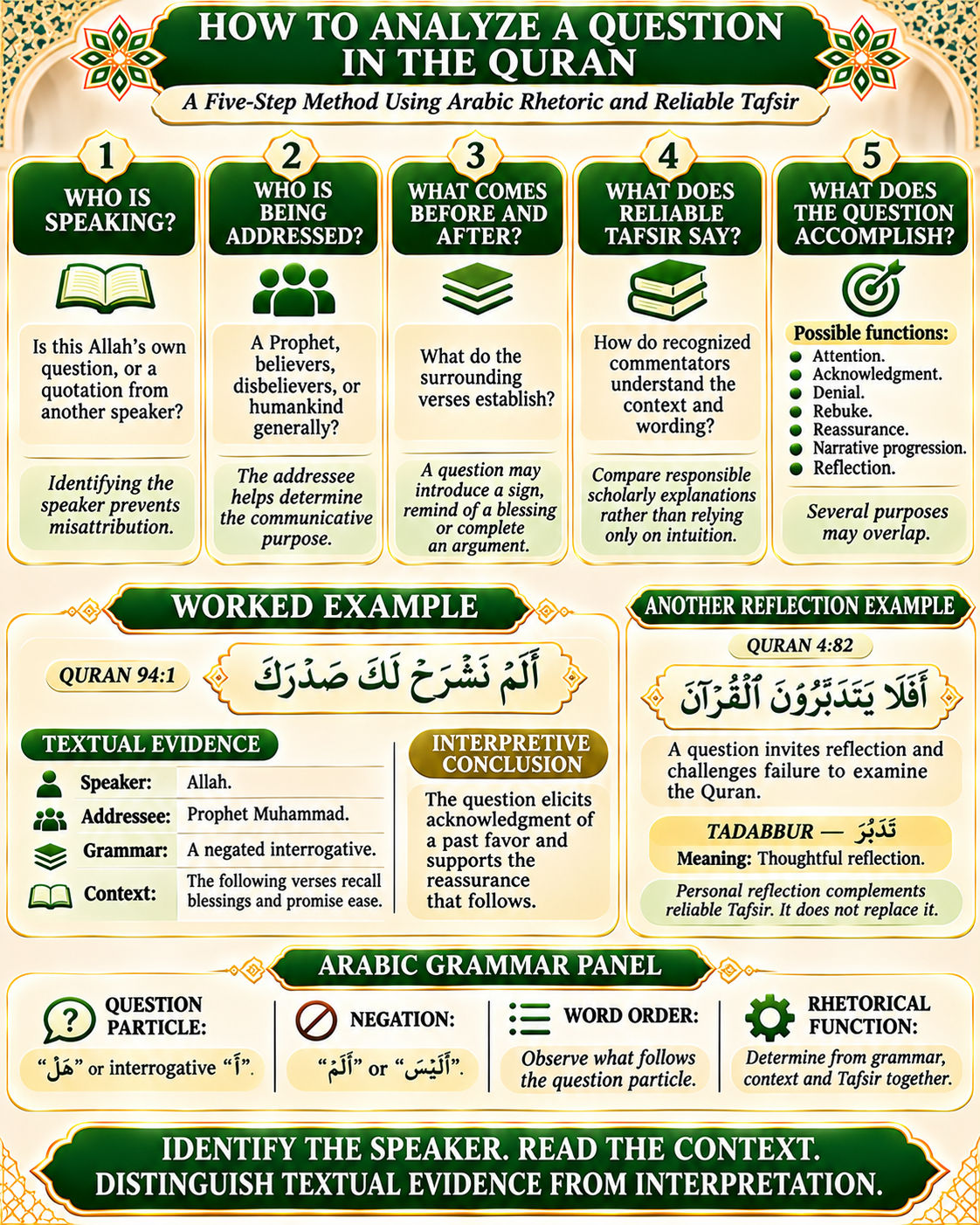
When you meet a question in the Quran, these steps help:
Who is speaking? Allah, or a quoted speaker?
Who is being addressed? Prophet, believers, disbelievers, all people?
What comes before and after? Read the surrounding verses.
What does reliable Tafsir say? Check recognized commentaries.
What does the question accomplish? Does it draw attention, elicit acknowledgment, challenge a claim, warn, reassure, advance the narrative, or invite reflection?
Worked example: 94:1.
Textual evidence: Allah speaks to the Prophet ﷺ. The question is negated (alam nashrah). The following verses list favors (94:2–4) and then promise ease (94:5–6).
Interpretive conclusion: A negated question of this kind typically elicits affirmation, and the context is one of reassurance, so the question is best understood as a reminder of an existing favor that supports the promise to come.
Keep the two separate. The first is what the text shows, the second is what the reading concludes. Do not attach a rhetorical label without checking the context.
Why Arabic Helps
Translations convey a great deal. A good one can communicate much of what a question is doing, and nothing here suggests the Quran is closed to those who read it in translation. But some nuances need a little more explanation, and Arabic helps in several ways:
Question particles: the difference between hal and the hamza.
Negation: how a negated question (alam, alaysa) typically affirms.
Word order: which word follows the particle signals what is being questioned (as in 5:116).
Emphasis and rhetorical purpose: tone, context, and implication.
Arabic grammar alone does not settle every case. Interpretation requires the combination of language, Tafsir, context, classical rhetoric, and qualified instruction. They work together.
Frequently Asked Questions
Why does Allah ask questions if He already knows everything?
Because not every question seeks information. Quranic questions can teach, remind, challenge, warn, reassure, or invite reflection. They communicate something to the listener without implying any limitation in Allah's knowledge.
What is a rhetorical question in the Quran?
It is a question (istifham balaghi) whose purpose goes beyond requesting unknown information, such as drawing out acknowledgment, rebuking, or denying a claim.
Why did Allah ask Musa what was in his hand?
The question leads into the sign of the staff. Commentators note that it focuses attention on a familiar object before it changes, and that it reflects the closeness of the conversation. Different commentators emphasize different aspects.
Why does Allah question people on the Day of Judgment?
To establish testimony, expose false claims, and make accountability manifest. It is not because Allah needs information.
Does Allah ask questions to test people?
Some questions may be part of a test, but this is not the only function, and divine testing does not mean discovering what was unknown.
What does "Am I not your Lord?" mean in 7:172?
It is a question that elicits acknowledgment. Scholars differ on the nature of the event described, but agree that the question grounds accountability in recognition.
Are all questions in the Quran rhetorical?
No. Some are genuine, such as people asking the Prophet ﷺ for guidance, and many are quoted from other speakers.
Can English translations communicate Quranic rhetorical questions?
Largely, yes. But some nuances of particles, negation, and word order benefit from explanation and from studying Arabic.
Conclusion
The questions of the Quran are not signs of any limitation. They teach, challenge, remind, reassure, establish accountability, and invite reflection. The question to Musa prepares him for a sign. The question in 7:172 grounds accountability in acknowledgment. The question in 94:1 turns a remembered blessing into hope. The question in 82:6 turns generosity into a call to gratitude.
The next time you meet a question in the Quran, ask who is speaking, who is being addressed, and what the surrounding verses reveal. Let Arabic rhetoric and reliable Tafsir help you hear what the question is doing.
If you would like to study the Quran in this way, Araby Academy offers live one-to-one Quran, Quranic Arabic, and Islamic studies lessons, with an emphasis on accurate learning, gradual understanding, and qualified instruction.