
Consider the opening of Surah An-Nahl (16:1):
أَتَىٰ أَمْرُ اللَّهِ فَلَا تَسْتَعْجِلُوهُ
Ata amru Llahi fa-la tasta’jiluh
“The command of Allah is at hand, so do not hasten it.” (The Clear Quran, Mustafa Khattab)
The first word, أَتَىٰ (ata), is a perfect-form verb, the form usually taught as “the past tense.” Yet the verse tells its audience not to hurry something that, grammatically, has already “come.” How can a thing have arrived and still be something people might rush?
The short answer is that the Arabic perfect form does not simply mean “before now.” It presents an action as a complete whole, and where that action falls on the timeline depends on the construction, the context, and the speaker’s purpose. Sometimes the perfect form is just how Arabic builds a future-oriented conditional. Sometimes classical commentators say it presents a coming event as so certain that it can be spoken of as done. Sometimes it places the listener inside a scene. These are different things, and good reading means telling them apart.
What Does the “Past Tense” Actually Mean in Arabic?
Arabic grammar traditionally describes three verb patterns:
Fi’l Madi (الفعل الماضي): the perfect form, such as kataba (“he wrote”).
Fi’l Mudari’ (الفعل المضارع): the imperfect form, such as yaktubu (“he writes / is writing / will write”). The name comes from a root meaning “to resemble,” because the form resembles a noun in some of its grammar.
Fi’l Amr (فعل الأمر): the imperative, such as uktub (“write!”).
Madi is conventionally called “past” and mudari’ “present or future.” That is a useful starting point, but it is a simplification.
Tense versus aspect
Tense locates an event relative to now. Aspect describes how the speaker views the event: as a complete whole (perfective) or as ongoing, repeated, or unfolding (imperfective).
Modern linguists describe Arabic differently. Some call it primarily aspectual, some call it a tense system, and some propose a mixed or relative-tense analysis. The classical grammarians’ madi/mudari’ labels carry a time notion, and they were also well aware of the exceptions. So it would be wrong to say Classical Arabic has no tense. It would equally be wrong to assume every perfect verb means “completed before now,” or that it works like the English simple past.
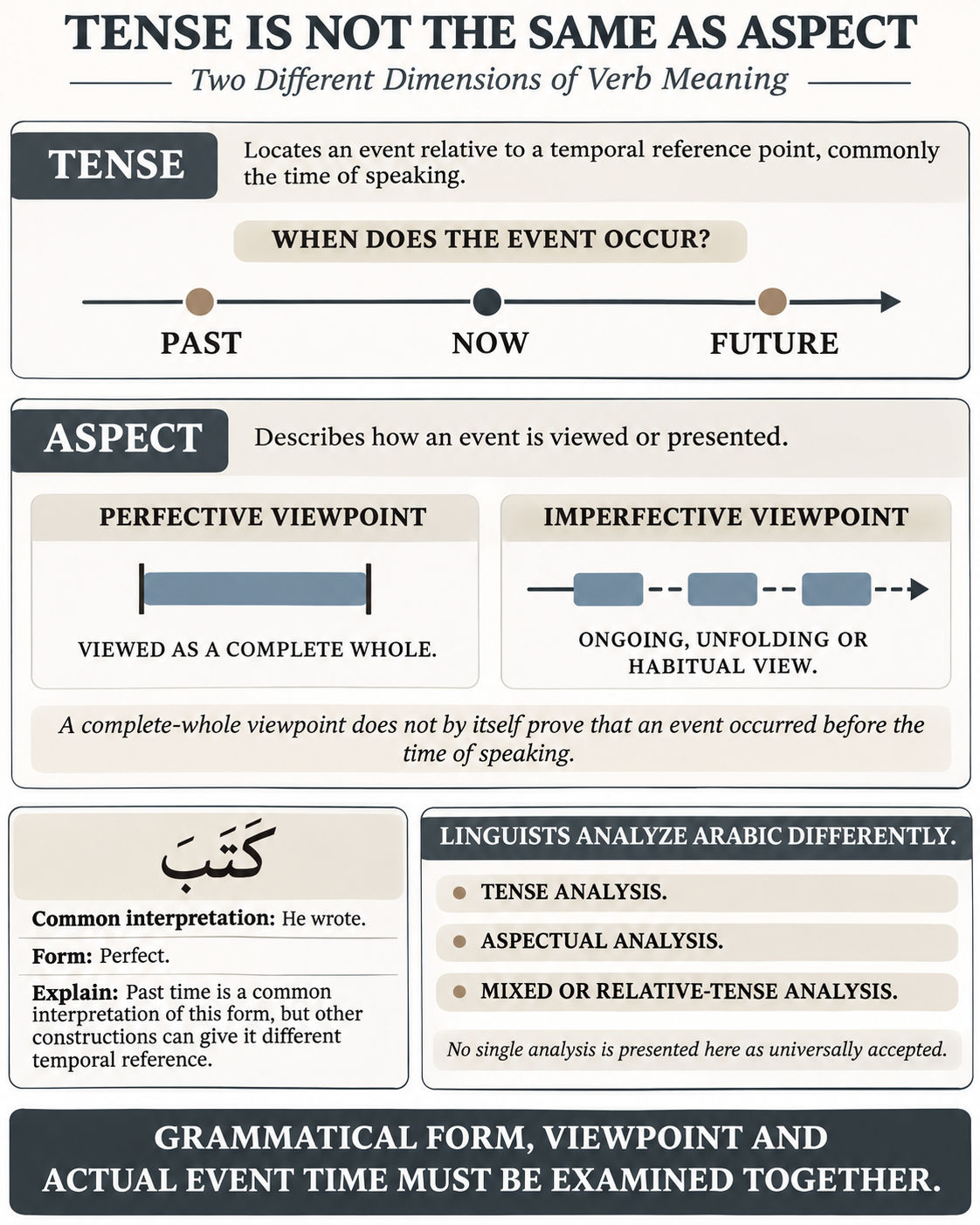
The form does not fix the time
Form | Common temporal reference | Other contextual uses | Example |
|---|---|---|---|
Madi (perfect) | Completed, past events | Future-oriented conditionals; wishes and supplications; rhetorical presentation of future events | رَحِمَهُ اللهُ, “May Allah have mercy on him” (a wish, not a report) |
Mudari’ (imperfect) | Present or future | Habitual or ongoing past after kana | كان يقرأ, “He used to read” |
Amr (imperative) | Command, oriented toward the future | Invitation, supplication | اكتب, “Write” |
Two everyday patterns show how construction shapes meaning.
Conditionals. The sentence إن جئتَني أكرمتُك uses two perfect verbs, literally “if you came to me, I honored you.” It means “If you come to me, I will honor you.” The perfect form is simply how Arabic builds this kind of conditional sentence. Nothing rhetorical is going on.
Temporal إِذَا. Take Quran 5:6, إِذَا قُمْتُمْ إِلَى الصَّلَاةِ فَاغْسِلُوا, “When you rise for prayer, wash.” Here qumtum (“you rose”) is perfect in form but refers to a repeated, hypothetical future occasion. The same applies to 110:1, إِذَا جَاءَ نَصْرُ اللَّهِ وَالْفَتْحُ, “When the help of Allah and the victory come.”
This is where a beginner can go wrong. Seeing a perfect verb after idha and calling it a “past tense for the future” is like pointing at English “When you arrive tomorrow” and calling it a present tense for the future.
Why Grammatical Form and Actual Time Are Not Always Identical
Verb forms carry more than a position on a timeline. Depending on the language and construction, they can also contribute completion, conditionality, expectation, certainty, narrative viewpoint, and vividness.
English offers modest parallels. “The train leaves at six tomorrow” uses the present form for a scheduled future event. “If he comes, I’ll tell him” uses a present form inside a future condition. A sports commentator who says “He shoots, he scores!” uses the present for immediacy. These are pedagogical analogies only. They show that form and time can separate, but they do not reproduce Arabic’s system or explain any particular Quranic verse.
Within Arabic, it helps to separate three levels:
Ordinary grammar. Conditionals and idha clauses regularly take perfect verbs with future reference. This is unremarkable.
Rhetorical choice. A speaker may choose the perfect form for a future event to convey certainty or vividness.
Discourse perspective. A passage may place its audience at a future vantage point and narrate from there.
A single verse can involve more than one of these, but they should not be treated as interchangeable.
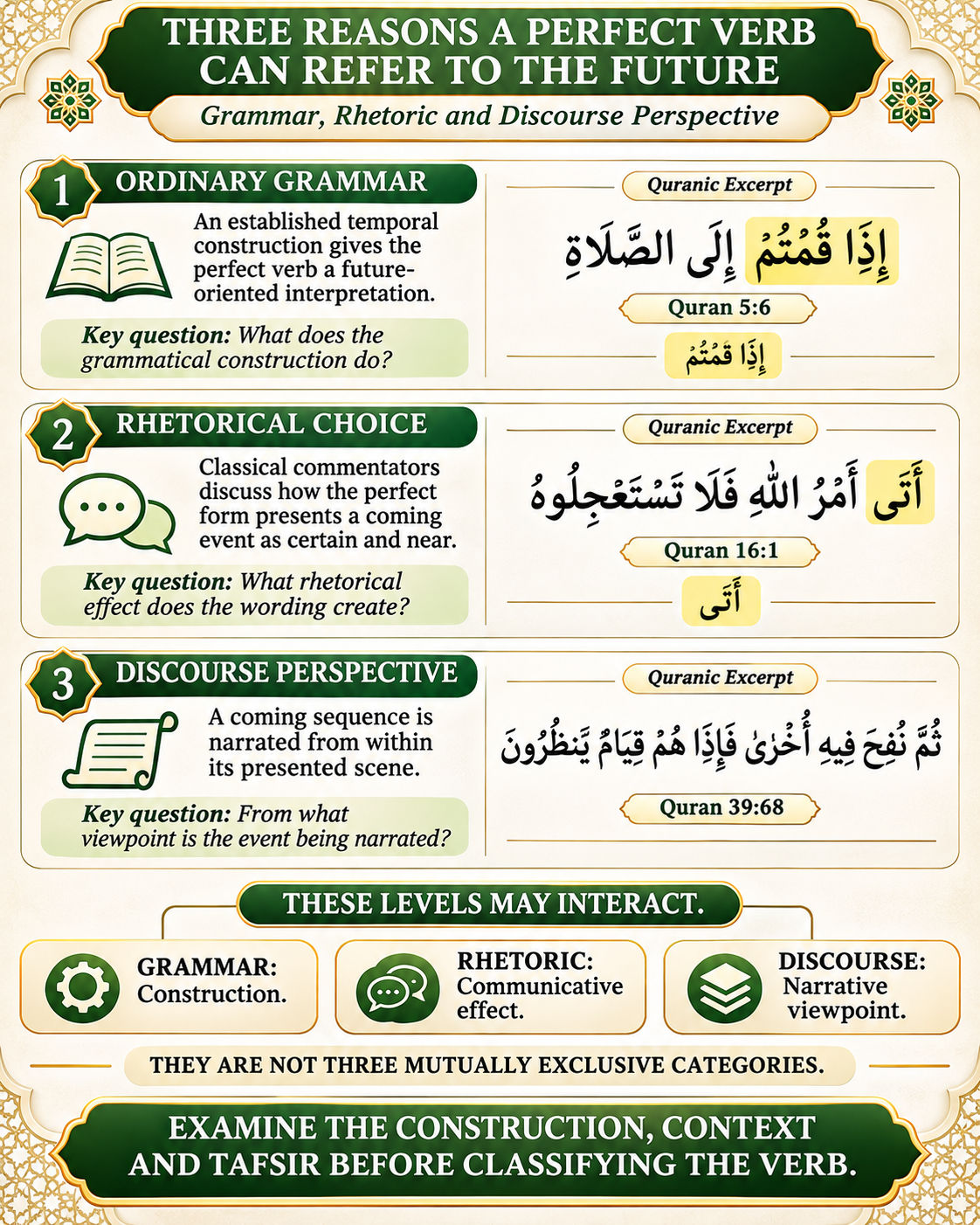
The Classical Rhetorical Principle: Future Meaning in a Past Form
Classical works on Quranic interpretation and rhetoric discuss this under headings such as al-ta’bir bil-madi ‘an al-mustaqbal (التعبير بالماضي عن المستقبل, “expressing the future with the past form”), often with the explanation li-tahaqquq al-wuqu’ (لتحقق الوقوع, “because of the certainty of occurrence”). The idea is that an event that is certain to happen may be presented as though it has already happened.
Three cautions apply.
The explanation is context-dependent. Commentators invoke certainty when the passage supports it, for example when an event is promised and the audience is skeptical or impatient. They do not invoke it for every perfect verb with future reference. A conditional sentence is explained by the conditional construction, not by rhetoric.
Terminology varies. You may see “prophetic perfect” in comparative discussions. The term originates in studies of Biblical Hebrew and is sometimes applied to Arabic. It is a descriptive label in modern scholarship, not an established classical Arabic rhetorical category, and it is not exactly equivalent to the classical expressions above.
Separate the layers. Grammatical necessity (the construction demands the form), conditional use, rhetorical certainty, narrative visualization, and perspective-taking can look alike on the surface. A careful reader asks which one the text and the commentators support.
Works on Quranic sciences and style, such as al-Zarkashi’s al-Burhan fi ‘Ulum al-Quran and al-Suyuti’s al-Itqan, are the natural places to read how scholars classified these phenomena.
Quran 16:1: Why Does Allah Say That His Command Has Come?
Return to the verse: أَتَىٰ أَمْرُ اللَّهِ فَلَا تَسْتَعْجِلُوهُ.
The grammar. Ata is a perfect verb (root أ-ت-ي) in the third-person masculine singular. Its subject is amru Llahi (“the command of Allah”). Fa-la tasta’jiluhu is a prohibition: la followed by the imperfect of Form X, istaf’ala, which often carries the sense of seeking or asking for something, here seeking to hasten it. So the phrase means “do not seek to hasten it.”
The tension. If the matter had literally already happened, there would be nothing left to hasten. The verse treats it as imminent and certain, and the audience is told to stop pushing for it.
What the command is. The verse does not name it, and commentators have not all read it identically. Many understand it as the promised judgment or punishment, and some tie it to the Hour. Ibn Kathir’s commentary explains the verse as meaning that what was far has become near, and links it to other verses that speak of the Hour and of mankind’s reckoning drawing near (21:1 and 54:1). The grammatical-rhetorical point, that the perfect form presents the event as certain, is discussed in linguistically oriented works such as al-Zamakhshari’s al-Kashshaf and Ibn Ashur’s al-Tahrir wa al-Tanwir. I have not quoted their exact wording here, so please read them directly.
The Tafsir tradition is therefore not uniform on the referent, but it is consistent about the effect: the event is certain and close enough to be spoken of as having arrived.
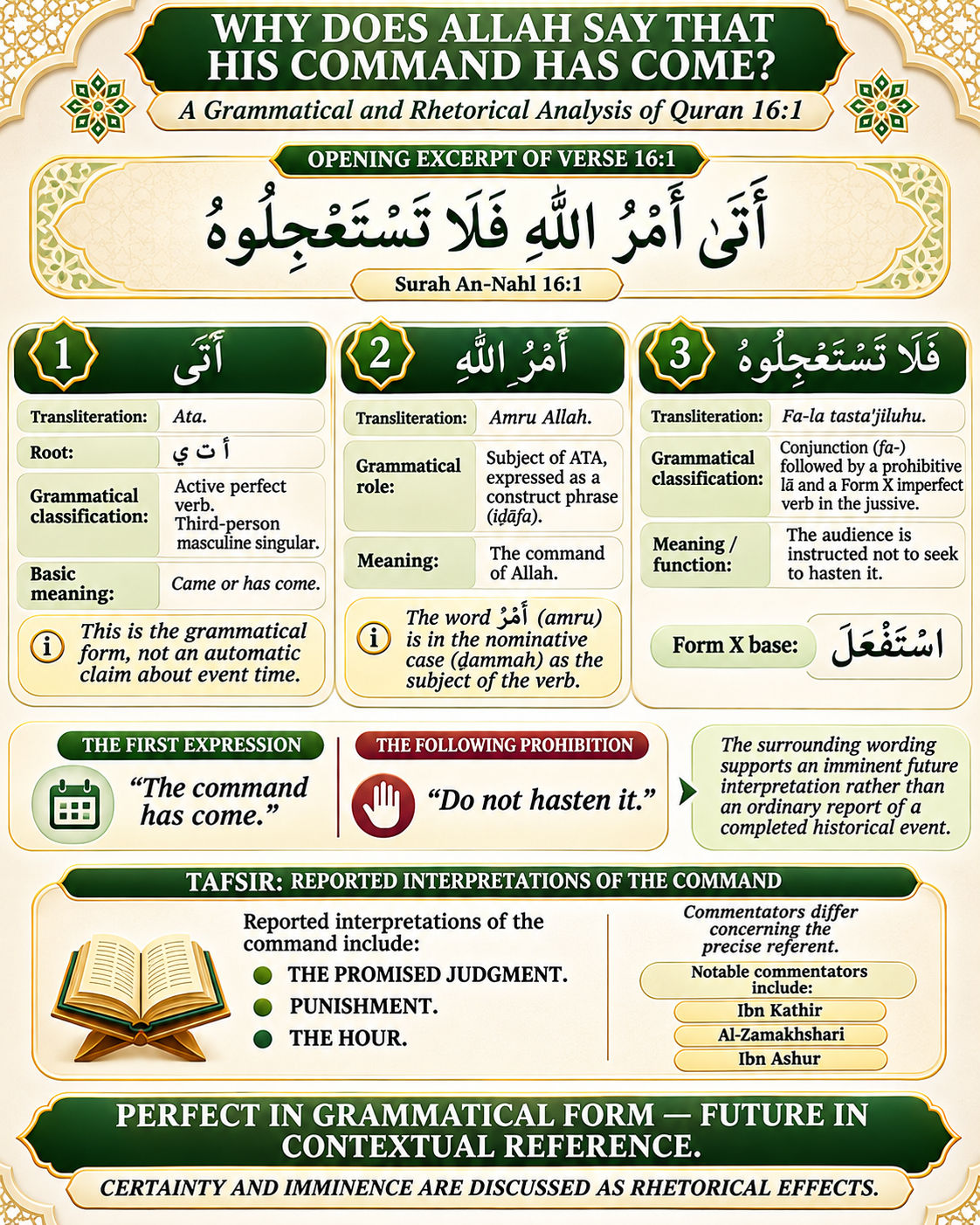
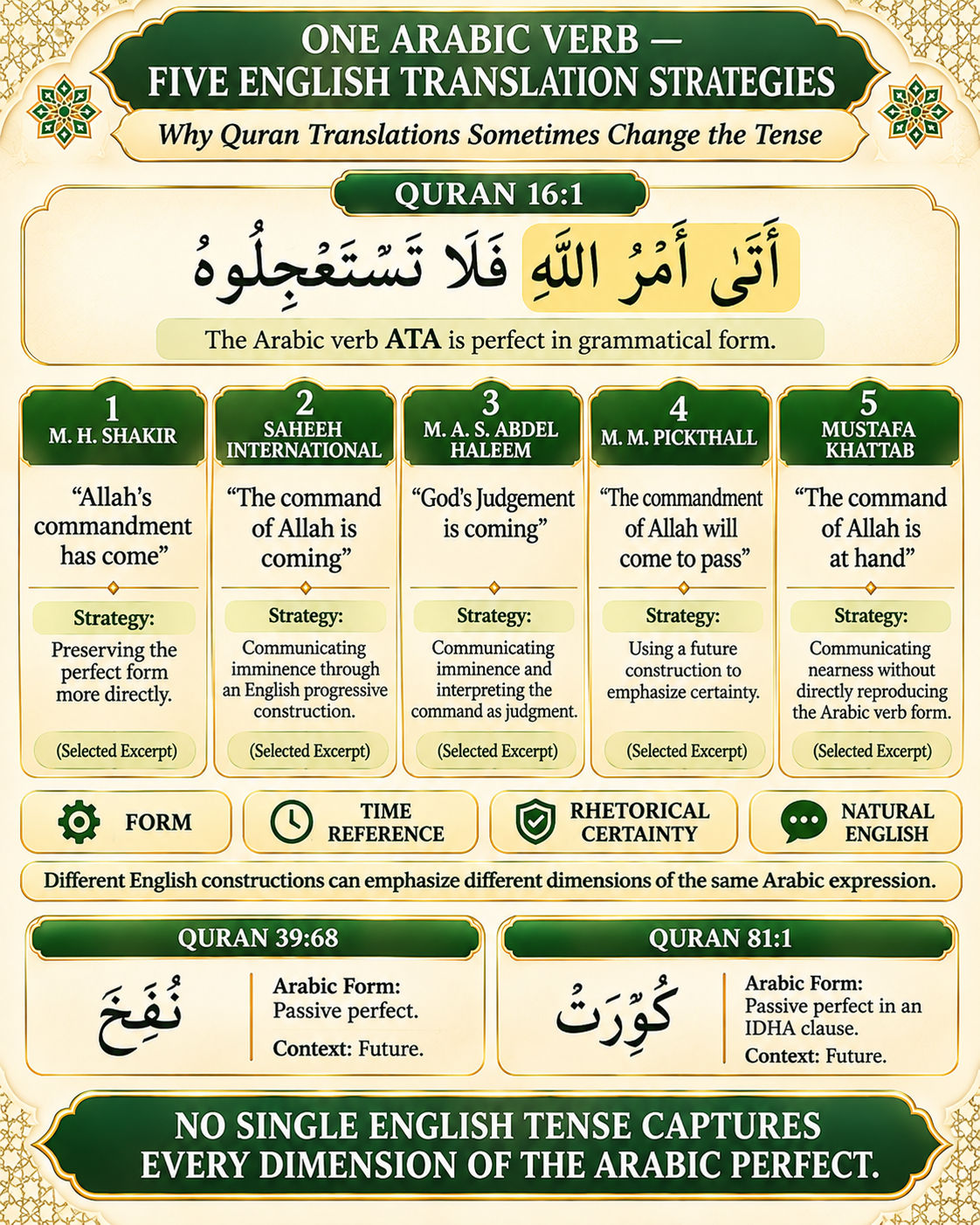
How translators handle the verb. The verified renderings below show different strategies for the same verb.
Translator | Rendering of ata amru Llah | Approach |
|---|---|---|
M. H. Shakir | “Allah’s commandment has come” | Preserves the perfect form |
Saheeh International | “The command of Allah is coming” | Progressive, stressing imminence |
M. A. S. Abdel Haleem | “God’s Judgement is coming” | Progressive, interprets the command as judgment |
M. M. Pickthall | “The commandment of Allah will come to pass” | Future, stressing certainty |
Mustafa Khattab (The Clear Quran) | “The command of Allah is at hand” | Describes nearness without a verb tense |
None of these is wrong. Each preserves a different dimension: form, imminence, certainty, or nearness. The next sections pursue the same pattern in other passages.
Quran 39:68: When Future Events Are Narrated as Completed
وَنُفِخَ فِي الصُّورِ فَصَعِقَ مَن فِي السَّمَاوَاتِ وَمَن فِي الْأَرْضِ إِلَّا مَن شَاءَ اللَّهُ ۖ ثُمَّ نُفِخَ فِيهِ أُخْرَىٰ فَإِذَا هُمْ قِيَامٌ يَنظُرُونَ
Wa-nufikha fi s-suri fa-sa’iqa man fi s-samawati wa-man fi l-ard, illa man sha’a Llah. Thumma nufikha fihi ukhra fa-idha hum qiyamun yanzurun.
My rendering: “And the Trumpet is blown, and whoever is in the heavens and the earth falls senseless, except whom Allah wills. Then it is blown a second time, and at once they are standing, looking on.”
Here is what the grammar shows.
Nufikha is a passive perfect (“was blown / is blown”). The verse does not name who blows the trumpet.
Fa-sa’iqa is a perfect verb, “fell senseless.”
Thumma nufikha repeats the passive perfect for the second blast.
Fa-idha hum qiyamun yanzurun shifts to a nominal sentence (“they are standing”) with an imperfect verb yanzurun (“looking on”), an ongoing state.
The effect is a sequence told in order. Completed events are narrated with perfects, and the final tableau, people standing and watching, is held in a more static, ongoing construction.
The reader’s position matters here. We are living before these events. The passage narrates from a future vantage point, as a scene unfolding. This is a statement about narrative perspective, not about history. It does not mean the Day of Judgment has already occurred, and it does not describe the sequence of eschatological events beyond what the verse itself says.
The Day of Judgment as a Vividly Presented Scene
Two more examples show that the pattern varies.
Quran 18:99. وَنُفِخَ فِي الصُّورِ فَجَمَعْنَاهُمْ جَمْعًا, “And the Trumpet is blown, and We gather them together.” After the passive nufikha, the verb fa-jama’nahum (“then We gathered them”) is an active perfect with Allah as the speaker. The time is signaled by the surrounding words, especially yawma’idhin (“on that day”) earlier in the verse. The perfect here narrates a coming gathering as part of a sequence.
Quran 39:71–73. وَسِيقَ الَّذِينَ كَفَرُوا إِلَىٰ جَهَنَّمَ زُمَرًا ۖ حَتَّىٰ إِذَا جَاءُوهَا فُتِحَتْ أَبْوَابُهَا, “And those who disbelieved are driven to Hell in groups; until, when they come to it, its gates are opened.” (My rendering.) The group of verses uses passive perfects (siqa, “were driven”; futihat, “were opened”) for the unfolding of the scene, and similar wording for the righteous in verse 73. Note again the idha clause (hatta idha ja’uha, “until when they come to it”), which is a regular future-oriented construction, alongside the narrative perfects. These are two layers in one passage, not one mechanism.
For each of these, the question to ask is the same: What is the actual time reference? Which construction produces the perfect? Do commentators identify certainty, vividness, or something else? Where they do not, a grammatical explanation is enough.
Why Surah At-Takwir Uses Past-Form Verbs for Future Events
The opening of Surah At-Takwir (81:1–3) is among the clearest examples for learners.
إِذَا الشَّمْسُ كُوِّرَتْ وَإِذَا النُّجُومُ انكَدَرَتْ وَإِذَا الْجِبَالُ سُيِّرَتْ
Idha sh-shamsu kuwwirat. Wa-idha n-nujumu nkadarat. Wa-idha l-jibalu suyyirat.
My rendering: “When the sun is wrapped up; and when the stars are scattered; and when the mountains are set in motion.”
Each clause begins with idha, which here introduces a future occurrence, and each continues with a perfect verb:
Kuwwirat is a passive perfect (from kawwara, to wrap or coil up).
Inkadarat is an active perfect, with “the stars” as its subject.
Suyyirat is a passive perfect (“were set in motion”).
Grammarians commonly analyze the noun after idha here (ash-shamsu) as the subject of an implied verb that the expressed verb then explains. You do not need that technical point to read the verse. The key idea is that idha plus a perfect verb is an established way to talk about a future occurrence. The grammar alone accounts for the form.
What the passage adds on top of grammar is rhetoric. The repeated wa-idha builds a cumulative sequence, each clause adding a new event, and the listener is placed in front of a scene that accumulates. Translating these verbs as ordinary historical past, “the sun was wrapped up,” would badly mislead English readers. Nothing here breaks Arabic grammar. Grammar and discourse context work together.
The same idha pattern opens Surah Al-Infitar (82:1–4), with perfects such as infatarat and intatharat.
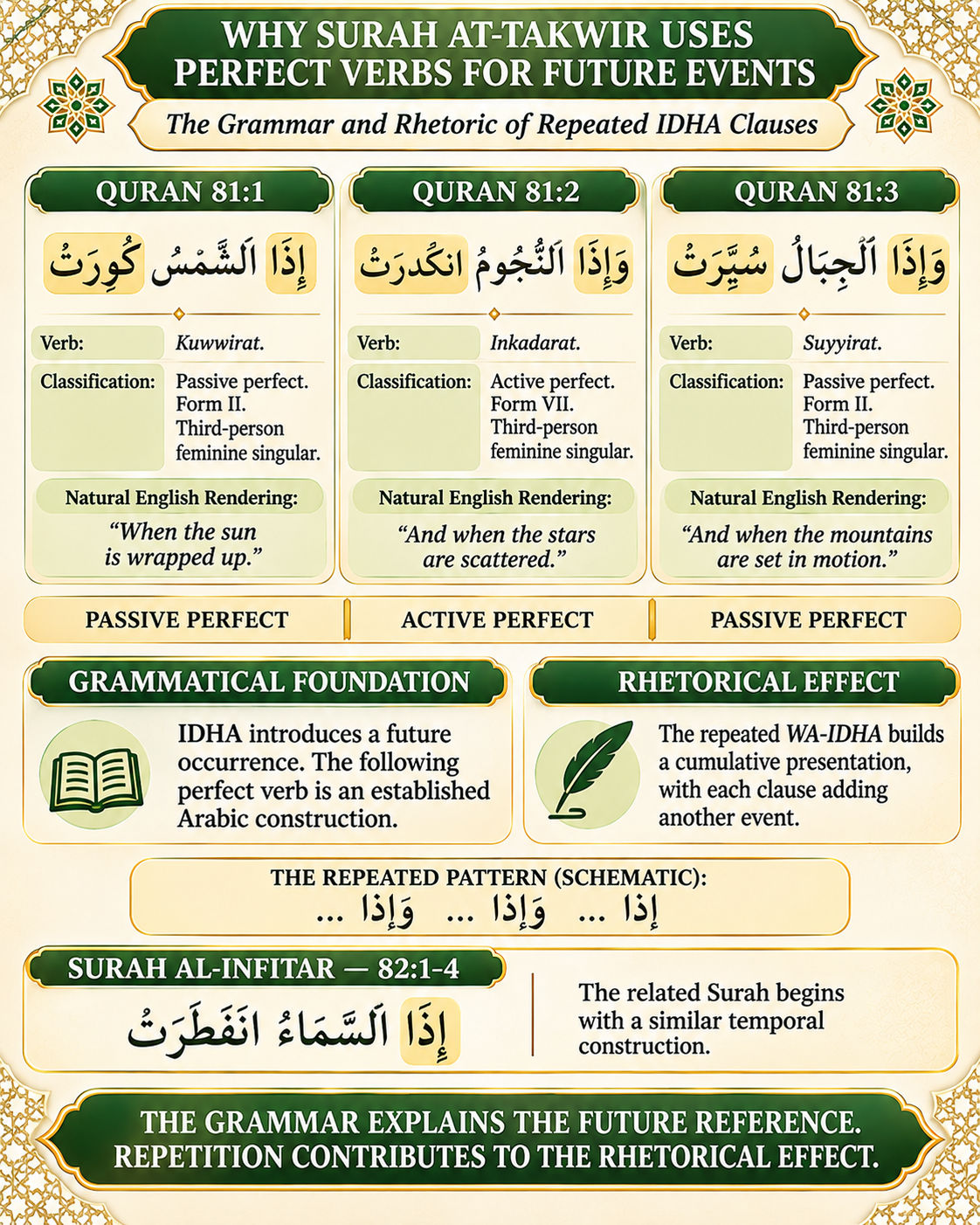
Why English Translations Sometimes Change the Tense
Translators must choose among the simple past, present perfect, present, future, or a construction like “is at hand.” Each choice captures part of the Arabic.
Verse | Verb | Form | Time reference | Typical approach |
|---|---|---|---|---|
16:1 | ata | Active perfect | Imminent future | “Has come” (form), “is coming” (imminence), “will come to pass” (certainty), “is at hand” (nearness) |
39:68 | nufikha | Passive perfect | Future | Present or future rendering is the natural English choice |
81:1 | kuwwirat | Passive perfect after idha | Future | “When the sun is wrapped up” is the natural English choice |
The tradeoffs are real:
Preserving form (Shakir’s “has come”) stays close to the Arabic but can suggest a past event.
Communicating time (“is coming”) reads naturally but loses the perfect’s sense of certainty.
Preserving rhetorical force (“will come to pass”) emphasizes inevitability but adds a future that the Arabic form does not state.
Natural English (“is at hand”) reads smoothly but may not reflect the verb’s grammar.
Two reliable translations can therefore differ without disagreeing about the meaning. A formally literal translation is not automatically more accurate, and a meaning-oriented one does not automatically capture every nuance. No single English tense reproduces every dimension of the Arabic perfect.
Does This Mean Allah Experiences Time Differently?
Readers often connect certainty with divine knowledge. The Islamic position is that Allah’s knowledge is complete and perfect. The Quran says that with Him are the keys of the unseen, which none knows but Him (6:59), and that no calamity strikes except that it is in a Book before it is brought into being (57:22). His promises are true.
These beliefs fit the certainty that commentators see in verses like 16:1. But that is a theological point, separate from the grammatical explanation. A perfect-form verb does not on its own prove any philosophical theory of time. It does not show that every future event has already physically occurred, that Allah experiences all moments simultaneously, or that the Quran teaches a particular model of spacetime. The Quran’s language here is about certainty and vivid presentation, and it should be read within the limits of authentic Islamic evidence.
Keep four things distinct: Allah’s knowledge, the certainty of His promises, our human experience of past, present, and future, and the grammar of a particular verse.
Is This Feature Unique to the Quran?
No, and it does not need to be. Classical Arabic generally allows perfect forms in conditionals, wishes (as in rahimahu Llah), and idha clauses. Other languages have comparable resources. Scholars of Biblical Hebrew, for example, use the label “prophetic perfect” for related phenomena.
That a construction exists elsewhere does not make its Quranic use ordinary. Rhetorical significance comes from how a construction is used in a particular passage. Appreciating the Quran’s use of these resources does not require claiming that nothing like them exists anywhere else.
How Learning Quranic Arabic Reveals What Translation Alone May Not
You do not need advanced training to notice these features. Here is a simple method using 16:1 or 81:1–3:
Read a reliable translation.
Find the Arabic verb (ata, or kuwwirat).
Learn its basic form: perfect or imperfect, active or passive.
Look at the surrounding particles: fa-, wa-, idha, thumma.
Consider the broader context: Who is speaking? To whom? About what?
Consult reliable Tafsir to see how scholars read the verse.
Compare translations to see which dimension each preserves.
Grammar supports understanding but does not replace qualified Tafsir. Beginners should build gradually and avoid drawing large theological conclusions from a single grammatical observation.
Araby Academy offers structured Quran and Arabic lessons for students who want to build these skills step by step, so that features like these become visible in the text rather than only in commentary.
Frequently Asked Questions
Why does the Quran use the past tense for future events?
Sometimes because the grammar requires it. Idha clauses and conditionals regularly take perfect verbs with future meaning. Sometimes because commentators see rhetorical certainty, as in 16:1, and sometimes because the passage narrates from a future vantage point. These are different explanations, and each depends on context.
Does the Arabic past tense always describe past events?
No. The perfect form presents an action as complete, but the time reference comes from the construction and context. It can also express wishes (rahimahu Llah) and future conditions.
What does Quran 16:1 mean when it says Allah’s command has come?
It presents the promised command as so near and certain that it is spoken of as arrived, while the audience is told not to hasten it. Commentators differ on exactly what the command refers to, with the promised judgment or the Hour among the views.
Why does idha appear before a past-form verb?
Idha introduces a time or condition, and Arabic idiom commonly uses a perfect verb after it, even for future events. In 81:1–3 and 5:6, the grammar alone explains the form.
Does this mean the future has already happened?
No. It is a point of grammar and narrative perspective, not a claim that the events have occurred in history.
Why do translations use different tenses?
Because no English tense reproduces every aspect of the Arabic perfect. Translators prioritize form, time, certainty, or natural English. Different choices do not mean any is wrong.
Conclusion
Arabic verb forms communicate more than chronology. A perfect verb can report the past, build a future conditional, voice a wish, or present a coming event as certain. Understanding the Quran’s use of these forms means paying attention to grammar, context, temporal relationships, rhetoric, narrative perspective, and established Tafsir.
Some future events are expressed with perfect verbs because their occurrence is presented as certain. Others are simply established grammatical constructions, and still others serve different discourse functions. Appreciating these distinctions reveals dimensions of the Quran’s expression that are hard to reproduce fully in translation. Keep exploring gradually and through reliable scholarship. If you would like structured guidance, Araby Academy offers Quranic Arabic and Quran lessons.