
Imagine a student who has learned Hafs 'an 'Asim hearing a qualified reciter use Warsh 'an Nafi'. Some vowels are held longer and a few words sound different. The questions arrive: Is one of them reading incorrectly? If the Quran is preserved, why can I hear differences? Who taught these readings?
Imagine a student who has learned Hafs 'an 'Asim hearing a qualified reciter use Warsh 'an Nafi'. Some vowels are held longer and a few words sound different. The questions arrive: Is one of them reading incorrectly? If the Quran is preserved, why can I hear differences? Who taught these readings?
How Were the Quran’s Qira’at Preserved? Their Origins, Transmission, and Differences Explained
Imagine a student who has learned Hafs 'an 'Asim hearing a qualified reciter use Warsh 'an Nafi'. Some vowels are held longer and a few words sound different. The questions arrive: Is one of them reading incorrectly? If the Quran is preserved, why can I hear differences? Who taught these readings?
The answer begins with a distinction. A random pronunciation error is a mistake. A canonical reading is a transmitted system, taught from teacher to student and checked against defined criteria.
Short answer: In the Islamic scholarly tradition, the Quran's canonical Qira'at are recognized reading systems transmitted through qualified reciters and documented chains of instruction. Their preservation has relied on oral teaching, memorization, written Mushafs, scholarly comparison, and works specifying accepted reading features. The ten canonical Qira'at are not ten unrelated Qurans: they share the vast majority of the text while preserving particular differences in pronunciation and, at some points, word forms or grammar. Understanding this history requires distinguishing the Seven Ahruf, the canonical readings, their narrations, and their transmission routes.
What Are the Qira'at, and Why Does Their Preservation Matter?
In everyday English, "reading" means looking at text and speaking it aloud. In Quranic scholarship, qira'ah (قِرَاءَة; plural qira'at, قِرَاءَات) is a technical term: a transmitted way of reciting the Quran, with defined features, attributed to a recognized authority.
A qari' (قَارِئ) is any reader or reciter. In the canonical system, ten famous qari's are the authoritative reader-Imams; a modern reciter is not an eleventh. A riwayah (رِوَايَة) is a named transmission of a qira'ah, such as Hafs from 'Asim. It carries the narrator's name because he transmitted it, not because he invented the wording.
A mushaf (مُصْحَف) is the written codex. The Quran as recited revelation, the written mushaf, the printed notation guiding one riwayah, and the transmitted reading rules are related but distinct.
Readers who need the basic terminology before exploring the transmission history can begin with an introduction to the Quran's ten canonical Qira'at, while this article examines how those reading traditions developed, were documented, and remain taught.
A Brief Timeline of Quranic Recitation and Transmission
How Quranic Recitation Reached Later Generations
Phase | Main activity | Evidence or scholarship | What was preserved | Caution |
|---|---|---|---|---|
Prophetic recitation | Listening, correction, memorization | Hadith reports | Recited Quran, permitted variation | Reports establish the concept; details are debated |
Companions | Teaching and writing | Hadith, biographical works | Recitation and written notes | Companions did not teach identical details |
Early collection | Gathering written materials | Hadith reports | A written record | Chronology is not precisely dated |
Uthmanic codices | Copying and distribution | Hadith; manuscripts | Shared written framework | Number of codices is discussed |
Regional schools | Teaching in major cities | Early biographical works | Reciters' traditions | Not every difference maps to one Imam |
Named Imams | Teacher-student transmission | Qira'at literature | Reading traditions | Names identify transmission, not authorship |
Documentation | Selection, books, poems | Ibn Mujahid, al-Dani, al-Shatibi | Standardized teaching | Documentation is not origin |
The ten | Ibn al-Jazari's synthesis | Al-Nashr, Tayyibat al-Nashr | Ten readings with routes | Tawatur terminology is discussed |
Today | Teachers, ijazah, print, audio | Mushafs, institutions | Living transmission | A certificate has a defined scope |
1. The Prophetic Foundation: Recitation and the Seven Ahruf
According to Islamic sources, the Quran was taught orally. The Prophet ﷺ recited, the Companions listened, repeated, were corrected, and memorized. Revelation and authorized recitation were inseparable.
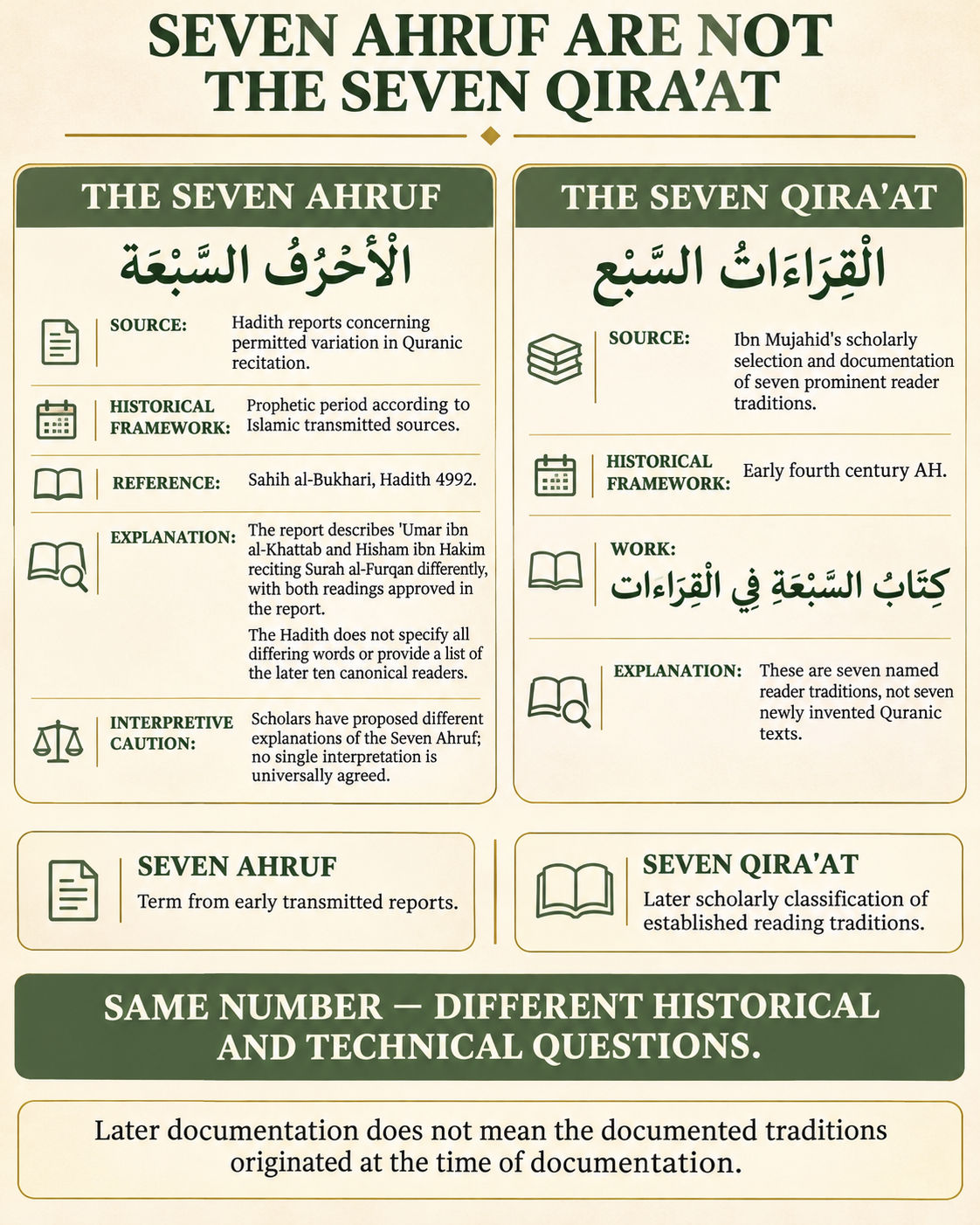
Sahih al-Bukhari 4992 reports that 'Umar ibn al-Khattab heard Hisham ibn Hakim reciting Surah al-Furqan in a manner he did not recognize. He brought Hisham to the Prophet ﷺ, who had each recite, approved both, and explained that the Quran was revealed in seven ahruf. The report does not say which words differed, and it does not list the later ten readers. Scholars cite it as evidence that recitational variation was recognized in the Prophetic period.
Al-Ahruf al-Sab'ah (الْأَحْرُفُ السَّبْعَة) has been explained in many ways: as Arabic dialectal accommodation, as categories of variation in wording or form, or as a figurative number. Al-Suyuti's al-Itqan surveys numerous views. No single modern explanation is universally agreed.
Seven Ahruf | Seven Qira'at | |
|---|---|---|
Source | Hadith reports | Ibn Mujahid's book |
Period | Prophetic era | Early 4th century AH |
Nature | Permitted variation, meaning debated | Seven named reader traditions |
Two questions must stay separate. What did the Prophet ﷺ teach or authorize, according to transmitted sources? And how did later scholars document and classify reading traditions? Later classification is a real historical development, but it does not mean the readings were invented then.
Takeaway: The term Seven Ahruf predates Ibn Mujahid's list; the two subjects must not be confused.
2. The Companions and the First Quran Teachers
Companions such as Ubayy ibn Ka'b, Zayd ibn Thabit, 'Abd Allah ibn Mas'ud, 'Uthman ibn 'Affan, and 'Ali ibn Abi Talib appear in classical sources as teachers or authorities of recitation. They did not all teach identical details.
Learning was oral and interactive. A student listened, repeated, was corrected, and recited back, absorbing pronunciation, word forms, and a whole method of reciting. Writing mattered too, yet a consonantal text could not specify every long vowel or assimilation, and oral teaching was never detached from written practice. Modern ijazah documents should not be projected onto the first generation.
As Muslims settled new cities, Quran teaching grew around respected readers in Madinah, Makkah, Kufa, Basra, and Damascus. Not every early regional difference belongs to a later canonical Imam.
A simplified structure shows the idea: Prophetic recitation, Companion teachers, Successors, regional reciters, named reader-Imams, narrators, later teachers, today's students. It is a model, not one chain; each tradition has its own lines. Classical sources trace 'Asim's reading through Successors such as Abu 'Abd al-Rahman al-Sulami and Zirr ibn Hubaysh to Companions including 'Ali and Ibn Mas'ud.
Takeaway: The Quran was not passed on as an isolated document. People taught and corrected people, generation after generation.
3. The Uthmanic Mushaf and Written Standardization
Reports distinguish two stages: the collection of written Quranic material associated with Abu Bakr and Zayd ibn Thabit, and the later copying and distribution associated with 'Uthman.
Sahih al-Bukhari 4987 reports that Hudhayfah ibn al-Yaman, troubled by disagreement over recitation, urged 'Uthman to act. 'Uthman obtained the pages kept with Hafsah and commissioned a committee including Zayd ibn Thabit to copy them into codices. Copies were sent to regions, and other materials were ordered withdrawn. The report gives no year, so none should be invented.
The aim, as reported, was to reduce destructive disputes and provide a shared written reference. It did not instantly end all recognized oral differences, and it did not make teachers unnecessary.
Traditional accounts mention codices sent to major regions, but their number and details vary, so certainty would be unwarranted. Some small documented spelling differences among regional codices matter in Qira'at discussions.
Did 'Uthman invent the readings? The traditional account does not say so. His role concerns written standardization; the canonization of named readers came centuries later. An accepted reading was traditionally required to fit the Uthmanic framework in a recognized way, not necessarily one identical skeleton letter for letter.
Takeaway: Written text and transmitted pronunciation are both essential; neither reduces to the other.
4. Early Quran Manuscripts, Rasm, Dots, and Vowels
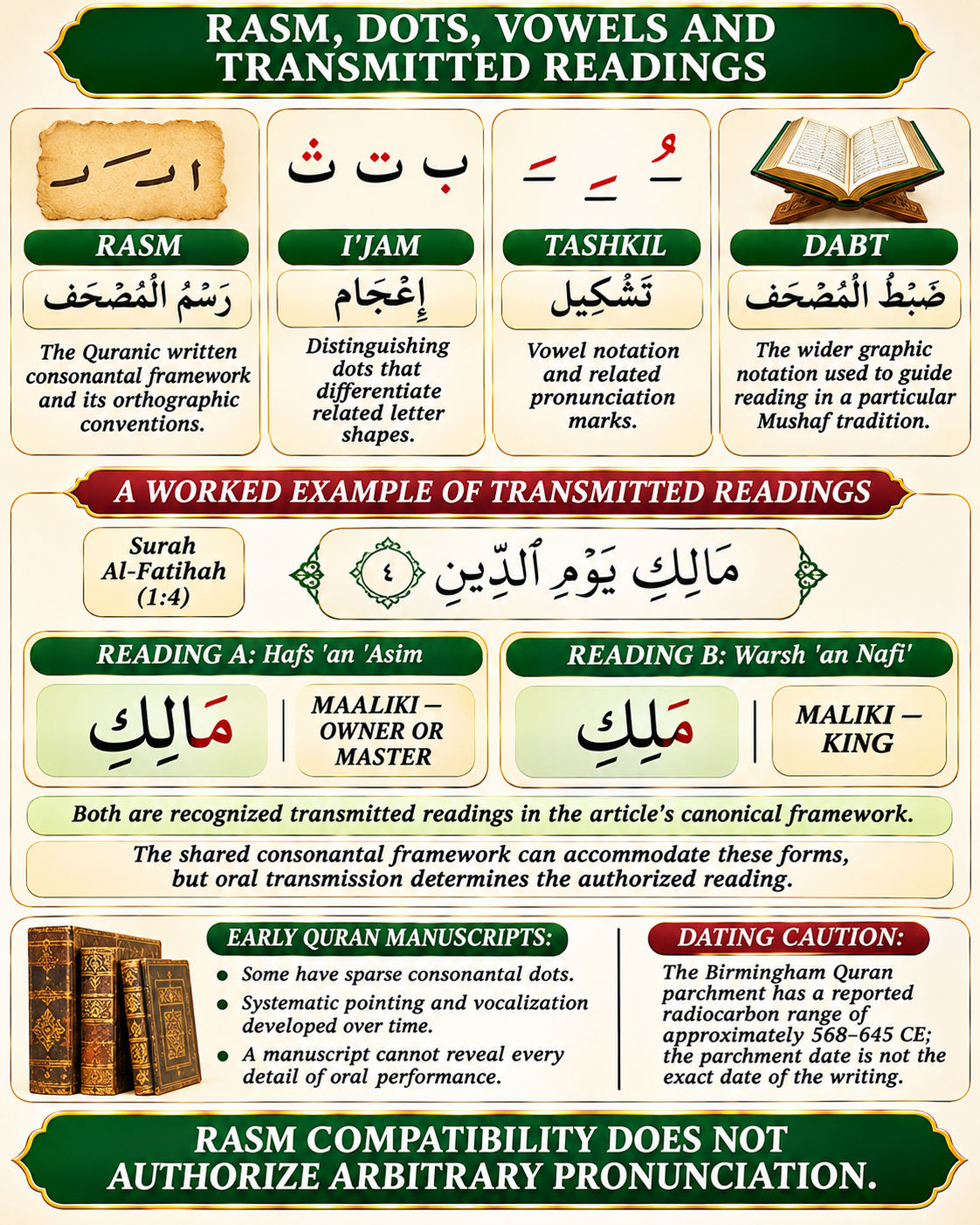
Rasm (رَسْمُ الْمُصْحَف) is the consonantal framework, with spelling conventions unlike ordinary modern Arabic. I'jam or naqt means dots distinguishing similar letter shapes; tashkil means vowel marks. Dabt (ضَبْطُ الْمُصْحَف) covers the graphic marks that help specify pronunciation, and conventions differ across editions and riwayat. These layers did not appear all at once.
It is inaccurate to say every first-century manuscript lacked dots. Research, including François Déroche's work on early scripts, shows some very early manuscripts with sporadic consonantal dots; systematic pointing and vowel marking developed over time.
Quran 1:4 shows why the Rasm alone is not enough. The consonants m-l-k are compatible with مَالِكِ and مَلِكِ. Yet not every variant arose from missing dots, and missing marks never authorize arbitrary reading. Oral transmission is essential.
A manuscript is evidence, not an audio recording. It can show written forms, conventions, verse divisions, and some pointing. It usually cannot reveal every detail of early performance, and no riwayah should be assigned to it without credible evidence.
The University of Birmingham's early manuscript contains portions of Surahs 18 to 20. It is a fragment, and radiocarbon dating of the parchment, which placed it roughly between 568 and 645 CE, is not identical to the date of writing. Academic historians continue to debate dating and the formation of reading traditions.
Understanding [how dots and vowel marks developed in the earliest Quran manuscripts] helps explain why the written Rasm and the orally transmitted reading rules must be studied together.
5. The Ten Canonical Readers and Their Twenty Narrators
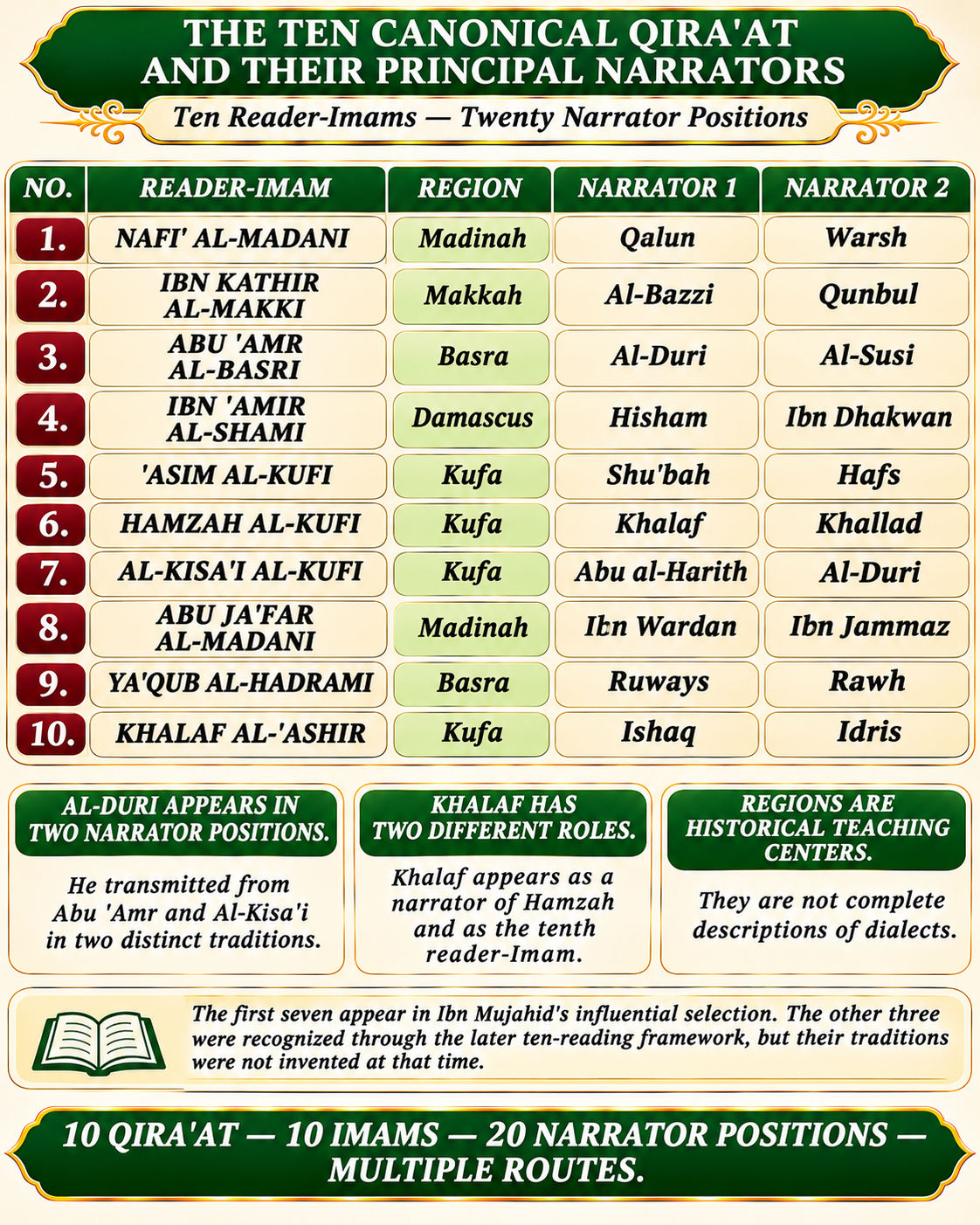
No. | Qira'ah Imam | Region | First narrator | Second narrator |
|---|---|---|---|---|
1 | Nafi' al-Madani | Madinah | Qalun | Warsh |
2 | Ibn Kathir al-Makki | Makkah | Al-Bazzi | Qunbul |
3 | Abu 'Amr al-Basri | Basra | Al-Duri | Al-Susi |
4 | Ibn 'Amir al-Shami | Damascus | Hisham | Ibn Dhakwan |
5 | 'Asim al-Kufi | Kufa | Shu'bah | Hafs |
6 | Hamzah al-Kufi | Kufa | Khalaf | Khallad |
7 | Al-Kisa'i al-Kufi | Kufa | Abu al-Harith | Al-Duri |
8 | Abu Ja'far al-Madani | Madinah | Ibn Wardan | Ibn Jammaz |
9 | Ya'qub al-Hadrami | Basra | Ruways | Rawh |
10 | Khalaf al-'Ashir | Kufa | Ishaq | Idris |
The table shows twenty narrator positions, not twenty necessarily different people. Al-Duri occupies positions under both Abu 'Amr and al-Kisa'i, yet these remain two distinct transmissions. Khalaf appears as a narrator of Hamzah and as the tenth reader, Khalaf al-'Ashir, who has his own qira'ah. That is not an error.
The first seven are those in Ibn Mujahid's influential selection. The additional three, Abu Ja'far, Ya'qub, and Khalaf al-'Ashir, were not invented later; their traditions predate the documentation.
Regions mark centers of instruction, not complete dialects. A qira'ah bears a scholar's name because he is its prominent authority or transmitter, not because it is his personal interpretation.
Takeaway: Ten qira'at, ten reader-Imams, twenty narrator positions, and many detailed routes are related but different categories.
6. How the Seven and Ten Readings Were Documented
Abu Bakr Ibn Mujahid (أَبُو بَكْرِ بْنُ مُجَاهِد, d. 324 AH/936 CE) wrote Kitab al-Sab'ah fi al-Qira'at (كِتَابُ السَّبْعَةِ فِي الْقِرَاءَات), identifying seven prominent reading traditions. He was not composing new wording; the question concerns his selection and documentation of existing traditions. Researchers such as Shady Nasser debate his intentions and the effects of his selection.
Why seven? The number fed confusion with the Seven Ahruf, but we cannot say he meant to equate them, nor that he identified seven tribal dialects. Scholars kept discussing other well-attested readings, so the ten-reader canon is not a sudden invention of three later scholars.
Abu 'Amr al-Dani (أَبُو عَمْرٍو الدَّانِي, d. 444 AH) wrote al-Taysir fi al-Qira'at al-Sab' (التَّيْسِيرُ فِي الْقِرَاءَاتِ السَّبْع). Al-Shatibi (d. 590 AH) composed the teaching poem Hirz al-Amani wa Wajh al-Tahani (حِرْزُ الْأَمَانِي وَوَجْهُ التَّهَانِي), known as al-Shatibiyyah, which is not Ibn Mujahid's book. Ibn al-Jazari (d. 833 AH/1429 CE) wrote al-Nashr fi al-Qira'at al-'Ashr (النَّشْرُ فِي الْقِرَاءَاتِ الْعَشْر), Tayyibat al-Nashr (طَيِّبَةُ النَّشْر), and al-Durrah al-Mudiyyah (الدُّرَّةُ الْمُضِيَّة). Al-Durrah addresses the three additional readings; Tayyibat al-Nashr teaches detailed routes. None of these poems is the origin of the readings.
"Canonization" means readings came to be recognized and taught as authoritative within a defined framework. It does not mean the Quran was first written then, that nobody knew the readings earlier, or that every candidate was accepted.
The Qira'at scholars' attention to established Arabic usage also connects with the history of Arabic dictionaries and the scholars who preserved linguistic evidence, although a lexicon alone cannot authorize a Quranic reading.
The distinction between Rasm, Qira'at, Tafsir, and transmission history shows why the wider Quranic Sciences must be studied as related but distinct disciplines, rather than reducing preservation to one manuscript or one memorization claim.
Takeaway: Later documentation belongs to the history of scholarship, not to the first revelation or first transmission.
7. Qira'ah, Riwayah, Tariq, Sanad, and Ijazah
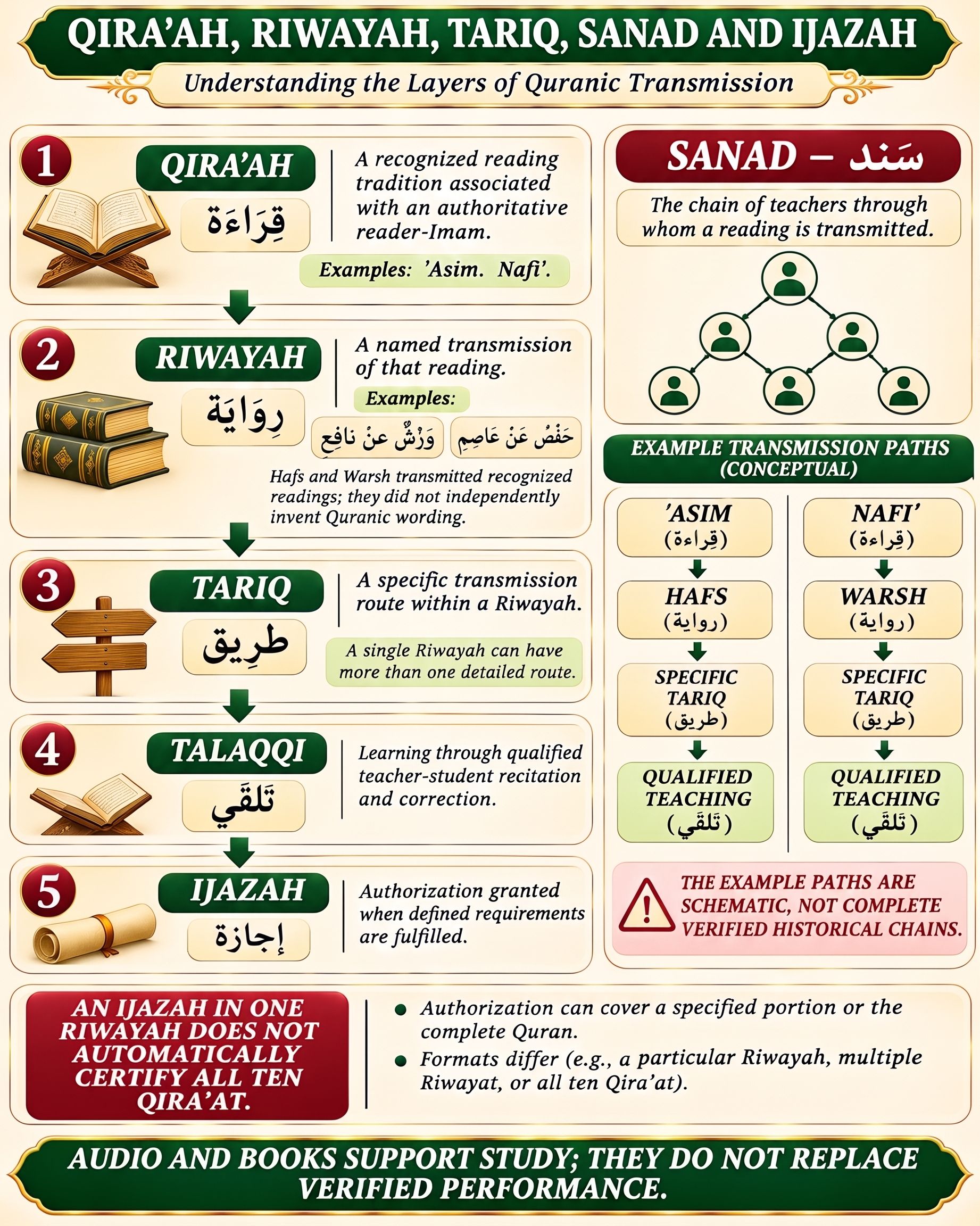
The hierarchy runs as follows: the qira'ah (e.g., 'Asim); the riwayah, a named narration (حَفْصٌ عَنْ عَاصِم, Hafs 'an 'Asim); the tariq (طَرِيق, plural طُرُق, turuq), a specific route within a narration; the teacher's performance; the student's verified recitation; and ijazah (إِجَازَة), authorization where awarded. Warsh 'an Nafi' (وَرْشٌ عَنْ نَافِع) is a principal narration of Nafi', not a different Quran, and it does not differ from Hafs in every word.
Sanad (سَنَد) and isnad (إِسْنَاد) denote the chain of teachers, though usage is not identical in every discipline. Talaqqi (تَلَقِّي) is learning directly from a qualified teacher; learners should not reconstruct a riwayah from spelling alone.
A teacher checks articulation, vowel lengths, hamzah, idgham, ghunnah, imalah or taqlil where relevant, and waqf. An ijazah may recognize that a student recited a specified portion or the whole Quran to a qualified teacher; formats vary. An ijazah in one riwayah does not certify all ten, every tariq, or expertise in Tafsir or Hadith.
A chain is not the only verification. Scholars also consider knowledge of the reading's features, correct performance, recognition by qualified teachers, written codification, and comparison with other routes. Hifz matters, but memory alone does not perfect a reading. Books such as al-Shatibiyyah and Tayyibat al-Nashr specify differences without replacing teachers.
Some differences among transmitted reading traditions involve pronunciation features that become easier to recognize through [ Tajweed rules explaining how Arabic sounds merge during Quranic recitation], though each Riwayah still has to be studied according to its own transmitted rules.
Pausing also affects what is heard: pausal forms and hamzah treatment can differ among readings, but not every waqf difference creates a new word meaning. Students comparing Quranic recitations also benefit from [I the science of Waqf and Ibtida and its effect on where reciters stop], because a pause choice and a canonical reading variant are not the same phenomenon.
Takeaway: Named readings, narrations, routes, teachers, correction, and specific authorization together form the system, not a chain copied from the internet.
8. The Criteria for Canonical Readings and Shadhdh Reports
Later Qira'at scholarship, notably Ibn al-Jazari's, is associated with three criteria: a sound transmission, conformity with acceptable Arabic, and conformity with the Uthmanic Rasm, even where a recognized orthographic convention allows a form. This article paraphrases rather than quotes. The criteria work together: grammatical plausibility alone is not enough, and neither is a form the written skeleton could hold.
Tawatur (تَوَاتُر) means transmission by so many independent narrators that coordinated fabrication is ordinarily excluded. Mainstream teaching describes the ten as accepted and mutawatir. Yet how tawatur applies to each tradition and each variant has been debated by classical and modern scholars, and Ibn al-Jazari is reported to have stressed sound transmission rather than a separate tawatur condition. Modern academics such as Shady Nasser also argue that the historical development was more complex. This debate does not automatically invalidate the tradition, and it should not be hidden.
A shadhdh reading (قِرَاءَة شَاذَّة) does not meet the conditions for canonical recitation. It is not automatically "fabricated"; it may be historically attested and valuable for linguistic or exegetical evidence. Under mainstream rules, however, it is not recited as Quran in prayer.
Other categories stay separate. A manuscript variation may reflect orthographic convention, a scribal lapse, correction, or regional practice, and must be evaluated before anyone calls it a qira'ah. A modern accent is not a qira'ah. A pronunciation does not become a valid riwayah because it sounds beautiful. Nor must anyone master all ten readings to recite correctly.
Takeaway: Scholars built methods to distinguish recognized readings from other variants, and technical terms must be used accurately.
9. What Differences Can the Qira'at Make to Pronunciation and Meaning?
This is a pedagogical classification, not a universally agreed classical taxonomy. Level one: sound variation without lexical meaning change. Level two: lexical or grammatical variation with related or complementary meanings. Level three: variation raising more complex exegetical or legal questions.
Usul (أُصُولُ الْقِرَاءَات) | Farsh (فَرْشُ الْحُرُوف) |
|---|---|
Recurring principles: madd, hamzah, imalah, taqlil, idgham | Variants at particular words |
Neither automatically changes meaning. A sound example: in words such as آمَنُوا, Hafs 'an 'Asim lengthens the vowel after the hamzah by two counts, while Warsh 'an Nafi' allows longer, route-dependent lengths. The word and meaning are unchanged; only the duration differs.
Maalik vs Malik — Quran 1:4
Hafs reads مَالِكِ (Maaliki, "Owner" or "Master"); Warsh reads مَلِكِ (Maliki, "King"). 'Asim, al-Kisa'i, Ya'qub, and Khalaf al-'Ashir read the long form; the other six read the short form. Both describe Allah in context, so this is not simply Hafs against everyone.
Fa-tabayyanu vs Fa-tathabbatu — Quran 49:6
فَتَبَيَّنُوا (root b-y-n, "clarify") is Hafs; فَتَثَبَّتُوا (root th-b-t, "verify, be sure") is read by Hamzah, al-Kisa'i, and Khalaf al-'Ashir. Both suit the command to take care when a wrongdoer brings news. This is a genuine consonantal and root difference, not a longer vowel.
Yakdhibun vs Yukadhdhibun — Quran 2:10
يَكْذِبُونَ (Hafs, "they lie") and يُكَذِّبُونَ (Warsh, "they deny"). The surrounding verses concern hypocrites. Commentators who record both readings relate them to false speech and rejection of the truth respectively, without claiming they are identical in every detail.
Nunshizuha vs Nunshiruha — Quran 2:259
نُنْشِزُهَا (Hafs; root n-sh-z, "raise and set in place") and نُنْشِرُهَا (Warsh; root n-sh-r, "revive"). The verse describes a sign of divine power in restoring life, speaking of bones and their clothing with flesh. The roots differ, and both verbs fit the scene of restoration.
Arjulakum vs Arjulikum — Quran 5:6
وَأَرْجُلَكُمْ (accusative; Hafs and Warsh) and وَأَرْجُلِكُمْ (genitive; Ibn Kathir, Abu 'Amr, Hamzah, and Shu'bah, among others). In the verse on purification before prayer, the case relates grammatically to washing or wiping. Classical jurists and commentators weigh the readings alongside syntax, the whole verse, Prophetic practice, and other evidence. One vowel alone does not settle the question, and this article gives no personal ruling.
Yathurna vs Yattahharna — Quran 2:222
يَطْهُرْنَ (Hafs and Warsh, "become pure") and يَطَّهَّرْنَ (Shu'bah, Hamzah, al-Kisa'i, and Khalaf al-'Ashir, "purify themselves"). The verse concerns marital intimacy and menstruation. Scholars discuss whether purity means the end of menstruation or the act of purification, reading the forms with the rest of the verse and juristic evidence. Schools do not derive positions from one reading alone.
Six Quranic Examples That Show Different Kinds of Qira'at Variation
Verse | Reading A | Reading B | Type | Effect | Caution |
|---|---|---|---|---|---|
1:4 | مَالِكِ (Hafs) | مَلِكِ (Warsh) | Vowel length, word | Owner vs King | Check all ten |
49:6 | فَتَبَيَّنُوا | فَتَثَبَّتُوا | Root, morphology | Clarify vs verify | Check named readers |
2:10 | يَكْذِبُونَ | يُكَذِّبُونَ | Verb pattern | Lie vs deny | Context matters |
2:259 | نُنْشِزُهَا | نُنْشِرُهَا | Different roots | Raise vs revive | Check named readers |
5:6 | وَأَرْجُلَكُمْ | وَأَرْجُلِكُمْ | I'rab | Case; fiqh discussion | No single-vowel ruling |
2:222 | يَطْهُرْنَ | يَطَّهَّرْنَ | Form, shaddah | Purity vs purification | Read with context |
Translation, Roots, and Tafsir
Do all qira'at sound identical? No. Do all differences alter lexical meaning? No. Can some influence interpretation? Yes. Does every difference create a contradiction? No; many are read as related or complementary, though that formula does not resolve every case.
Translations may follow a reading, footnote another, or explain further, and none need carry every variant in its main prose. Because a translator may follow or explain a particular canonical reading, [ the reasons English Quran translations sometimes express an Ayah differently] are especially relevant when a verified Qira'ah changes a word form or its grammatical interpretation.
Some variants involve distinct roots, others the same word with different recitational features, so they are neither wholly different meanings nor perfect synonyms. The examples involving different verb roots also show why [ Quranic Arabic word pairs and their contextual meanings] should be studied carefully, even though a Qira'ah variant is not the same subject as two ordinary synonyms.
Commentators may cite several readings, explain their grammar, compare meanings, and address legal issues, though methods vary. The relationship between canonical readings and interpretation makes the differences between Tafsir and a straightforward Quran translation essential, because some Qira'at raise grammatical or legal questions that a single English sentence cannot fully explain.
Takeaway: Some differences are phonetic, some lexical, some grammatical; every example must be examined in context.
10. How the Qira'at Are Preserved and Taught Today
Preservation continues through qualified teachers, formal and informal study, hifz, ijazah programs, specialist institutions, printed Mushafs for specified riwayat, verified audio, digital comparison tools, and research. The ten are not equally common in daily worship worldwide.
Hafs 'an 'Asim is widely used in education and publishing and is familiar to many Muslims, though not every Muslim recites only Hafs and it is not the only accepted reading. Warsh 'an Nafi' is well established in parts of North and West Africa; it is a narration of Nafi', not a separate Imam. Qalun 'an Nafi' remains another recognized narration, and Al-Duri 'an Abi 'Amr and Al-Duri 'an al-Kisa'i are among narrations preserved in specialist programs. No regional usage should be generalized to the whole Muslim world.
A Mushaf printed for one riwayah may include its own dabt, authorized word forms, and recitational guidance, but not every visual difference between editions is a difference in recited words. Audio helps listening and comparison but does not grant an ijazah. Online instruction helps when the teacher is qualified, and not every teacher can certify all ten.
Beginners usually benefit from learning one recognized riwayah first. Studying all ten requires advanced preparation and is not necessary for every Muslim, though serious students should not be discouraged. Khalt al-qira'at (خَلْطُ الْقِرَاءَات) or talfiq (تَلْفِيق) means mixing reading features; scholars distinguish intentional teaching arrangements from arbitrary mixing, so follow the riwayah and tariq your qualified instructor teaches.
For learners who want a foundation before advanced recitation specialization, [ a step-by-step roadmap for learning Quranic Arabic from scratch] can complement teacher-led Quran reading and a carefully chosen Riwayah.
Takeaway: Preservation is a living process involving people, institutions, rules, and written resources, not one manuscript or one memorizer.
Are the Canonical Qira'at Different Qurans or Unauthorized Changes?
Within the traditional Islamic classification, accepted readings are transmitted forms of recitation, not arbitrary alteration after revelation. That rests on teacher-student chains, performance, codification, and the criteria above, not on the word tawatur alone. Canonical variation, transmission error, scribal error, noncanonical reports, modern fabrication, and research debate are different categories.
Most wording is shared. Saying no individual differences exist is inaccurate; calling the ten unrelated Qurans is equally so. Manuscripts support early written history, spellings, and some variants, but cannot establish every riwayah's oral performance. Oral transmission preserves phonetic detail through continuous teaching, though reconstructing each past event is a separate academic question, and a modern certificate does not promise perfect verification.
How to Begin Studying Qira'at Correctly
How to Choose a Reliable Qira'at Learning Path
Identify the riwayah in your Mushaf or class.
Find a teacher credibly qualified in it.
Learn articulation and foundational Tajweed.
Recite and receive correction.
Study differences only with reliable references and guidance.
Pursue advanced Qira'at and ijazah if appropriate.
Requirements vary by country and institution.
Common Misconceptions About the Quran's Readings
Myth: The Seven Ahruf and Seven Qira'at are the same. Reality: They belong to different discussions.
Myth: Ibn Mujahid wrote seven new versions, or the ten Imams each wrote a Quran. Reality: Their names designate transmitted traditions he selected and documented.
Myth: No variation existed before Ibn Mujahid. Reality: Earlier diversity is documented.
Myth: Hafs and Warsh are separate revelations, or Warsh is a melody. Reality: They are named narrations.
Myth: Every difference is only Tajweed, or is caused by missing dots. Reality: Sound, orthography, oral transmission, and lexical differences all feature.
Myth: Every variant changes meaning; none does. Reality: Many are pronunciation alone; some are lexical or grammatical.
Myth: Early manuscripts had no dots, and Rasm tells exactly how to pronounce. Reality: Sporadic dots exist; Rasm cannot encode everything.
Myth: Every historical variant counts as Quran for recitation. Reality: Canonical and shadhdh readings are distinguished.
Myth: One ijazah covers all ten. Reality: Authorization has a defined scope.
Myth: An accent is another qira'ah. Reality: A qira'ah is a recognized transmitted system.
Myth: "Nothing changed" settles every question. Reality: Serious scholarship separates textual stability, authorized variation, manuscript history, and canonical classification.
Frequently Asked Questions
1. What are the Qira'at of the Quran? Transmitted, authorized ways of reciting the Quran, each with defined features and a documented chain back to recognized teachers, traditionally traced to the Prophet ﷺ.
2. How did the Qira'at originate? Islamic sources trace them to the Prophet's teaching and the Companions' learning, spread through regional teachers, and later documented and classified by scholars.
3. Were different readings known in the Prophet's lifetime? Sahih al-Bukhari 4992 reports 'Umar and Hisham reciting differently, both approved by the Prophet ﷺ, which scholars cite as evidence of recognized variation.
4. Are the Seven Ahruf the same as the Seven Qira'at? No. The ahruf come from Hadith and their meaning is debated; the seven qira'at are Ibn Mujahid's later selection of seven readers.
5. Why did 'Uthman standardize the written Mushaf? According to Sahih al-Bukhari 4987, to resolve harmful disagreement over recitation by preparing authoritative copies for the regions.
6. Did the Uthmanic Mushaf eliminate all recognized reading differences? No. It standardized the written framework, but recognized readings continued through oral teaching, and some documented differences relate to regional spelling.
7. How did Muslims transmit the Quran before printed Mushafs? Through memorization, teacher-student recitation and correction, handwritten copies, and scholarly records, with oral and written transmission supporting each other.
8. What are the ten canonical Qira'at? Those of Nafi', Ibn Kathir, Abu 'Amr, Ibn 'Amir, 'Asim, Hamzah, al-Kisa'i, Abu Ja'far, Ya'qub, and Khalaf al-'Ashir.
9. Who are the twenty principal narrators? Each Imam has two principal narrators, listed in Section 5; names such as al-Duri and Khalaf appear in more than one position.
10. What is the difference between Qira'ah, Riwayah, and Tariq? A qira'ah is a reader's tradition, a riwayah a named narration of it, and a tariq a specific transmission route within that narration.
11. What is the difference between Hafs and Warsh? They share most wording but differ in recited features such as vowel lengths and some word forms, for example Maaliki and Maliki in 1:4.
12. Why did Ibn Mujahid select seven readers? He selected seven prominent traditions and documented them; his reasons are discussed, and the number should not be equated with the Seven Ahruf.
13. What did Ibn al-Jazari contribute to the study of the ten readings? He documented the ten readings and their routes in al-Nashr and taught them through Tayyibat al-Nashr and al-Durrah al-Mudiyyah.
14. What makes a Qira'ah authentic in the traditional scholarly framework? Traditionally, a sound transmission, acceptable Arabic, and conformity with the Uthmanic Rasm, assessed within a developed scholarly tradition.
15. What is a Shadhdh or noncanonical reading? A reported reading not meeting canonical conditions. It may be historically informative, but under mainstream rules it is not recited as Quran in prayer.
16. Do the Qira'at change Quranic pronunciation? Yes. Some differ in vowel length, hamzah, assimilation, or imalah while the word itself remains the same.
17. Can the Qira'at affect a verse's meaning or grammatical interpretation? Sometimes. Some differ in word form or grammar, as in 49:6 and 5:6, and need Tafsir and Fiqh context.
18. Are the ten Qira'at ten different Qurans? No. They share most of the text and are recognized variants of one Quran within the traditional framework, not separate books.
19. How are the Qira'at preserved through Sanad, Talaqqi, and Ijazah today? Through qualified teachers, recitation and correction, a defined riwayah and tariq, and ijazah where awarded, with books and audio as supports.
20. Does a beginner need to learn all ten Qira'at to recite the Quran correctly? No. Most Muslims recite one correct riwayah; studying all ten is an advanced specialization.
Conclusion — One Quranic Tradition, Carefully Transmitted Readings
The Quran's canonical Qira'at are best understood through the history of the people who learned, transmitted, documented, and taught them. The early oral tradition, the Uthmanic written framework, the scholarly evaluation of readings, and the work of later teachers all played different roles. Some differences are audible without changing a word's meaning; others involve vocabulary or grammar that deserve careful Tafsir. Rather than treating every variation as an error or pretending none exists, students can approach the Qira'at through accurate scholarship, qualified teachers, and documented transmission.
If you wish to study Quran recitation, Tajweed, and Quranic Arabic, Araby Academy's qualified teachers can guide you step by step.