لَا تَقْرَبُوا الصَّلَاةَ
Read alone, those words mean “Do not approach prayer.” But they are only the opening of Quran 4:43, which continues “...while you are intoxicated, until you know what you are saying.” The qualification is essential. Allah is not forbidding prayer in general, and quoting only the fragment would leave a very wrong impression.
That small example opens the study of Waqf and Ibtida in the Quran: where we stop and where we begin again.
Quick answer: A poorly chosen stopping point can make a Quranic fragment sound incomplete or misleading, but it never changes the revealed text. Waqf is stopping, and Ibtida is beginning or resuming. Grammar and meaning show which stops suit a passage, while Tajweed and the transmitted recitation guide how it is read. An accidental pause can be corrected, and not every verse-ending pause is wrong.
This guide uses Hafs ‘an ‘Asim through al-Shatibiyyah and the stop symbols of the Madinah Mushaf (King Fahd Complex). Hafs is one of the canonical readings, not the only one. The ten lessons are not all “wrong stops.” Each shows a different way that stopping, joining, or Sakt relates to meaning. There is no need to be nervous. This is learned gradually, with a teacher.
What Are Waqf and Ibtida?
Waqf (وَقْف) is stopping the voice during recitation, usually with a breath, at positions recognized by recitation scholarship. A stop does not always mean a grammatical sentence has ended, and stopping is not the same as interpreting a whole passage.
Ibtida (ابْتِدَاء) is beginning or restarting from a suitable word or clause. Study the two together, because a reader may stop imperfectly and still resume well.
Wasl (وَصْل) is connected recitation without a full stop. Connected pronunciation can differ from pausal pronunciation, for example in how a final tanween sounds. Continuous reading is not automatically more correct.
Sakt (سَكْت) is a brief cut of the voice without a new breath, in readings that transmit it. It is not a normal stop, a dramatic pause, a breath, or a change of words.
Qat’ (قَطْع) means ending a recitation session, as opposed to pausing in order to continue.
Understanding why a pause matters begins with [ learning how Quranic Arabic sentences express meaning], because connected words and clauses often need to be understood together.
The whole field is ‘Ilm al-Waqf wa al-Ibtida (عِلْمُ الْوَقْفِ وَالِابْتِدَاءِ). It draws on grammar, Tafsir, recitation, clause boundaries, speaker identification, and the transmitted reading, so it is far more than memorizing signs.
Classical scholars also grade stops. Tamm is complete, with no grammatical or meaning link to what follows. Kafi is grammatically separate, but the meaning remains related. Hasan is good in itself but grammatically linked, so one restarts earlier. Qabih is meaningless or misleading. These are teaching categories, not printed symbols, and scholars sometimes grade a stop differently.
What Do the Stopping Signs in a Mushaf Mean?
Students should also review [common Arabic pronunciation mistakes in Quran reading], since correct stopping practice depends on recognizing the sounds and letters being recited.
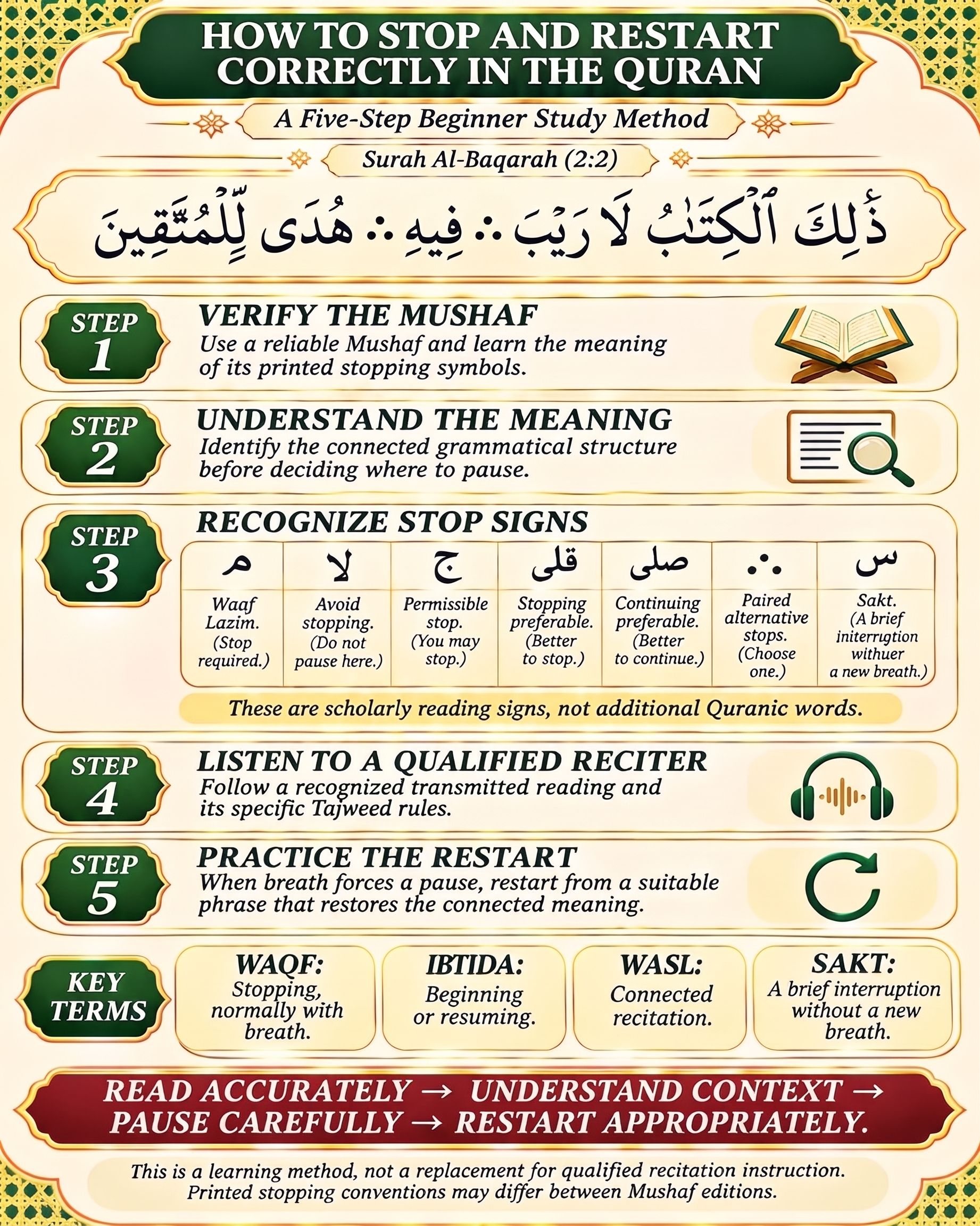
Printed signs are scholarly guidance, not Quranic words, and editions differ. Never mix systems. In the Madinah Mushaf legend:
Sign | Name | Meaning |
|---|---|---|
مـ | Waqf Lazim | Stopping strongly recommended to avoid a misleading link |
لا | La | Avoid stopping here |
ج | Waqf Ja’iz | Stopping and continuing both permitted |
قلى | Qila | Stopping preferable |
صلى | Sila | Continuing preferable |
∴ ∴ | Mu’anaqah | Stop at one of the pair, not both |
س | Sakt | Brief silence, no breath |
“Lazim” is an instructional label, not a legal ruling, and definitions vary across works and editions. Check your own copy’s legend.
An Ayah marker is an established verse division, yet grammar may continue past it. Many teachers treat stopping at Ayah ends as acceptable practice, citing a report that the Prophet ﷺ recited stopping at each verse. Sometimes one then resumes from an earlier phrase.
10 Quranic Pausing Lessons at a Glance
Lesson | Reference | Main issue | Remember |
|---|---|---|---|
1 | 4:43 | Qualification omitted | The condition belongs to the command |
2 | 107:4–6 | Description continues across Ayat | Context defines who is meant |
3 | 2:2 | Paired alternative stops | Stop at one, never both |
4 | 6:36 | Two separate statements | The stop marks a new assertion |
5 | 10:65 | Whose words? | Reported speech differs from the Quran’s statement |
6 | 3:7 | Scholarly analyses differ | Grammar, Tafsir, and meaning interact |
7 | 9:3 | Case endings | I’rab fixes relationships |
8 | 18:1–2 | Sakt across Ayat | Silence without breath |
9 | 36:52 | Sakt inside an Ayah | Transmission-specific |
10 | 75:27; 83:14 | Sakt keeps sounds distinct | Sakt prevents assimilation |
An understanding of [ Arabic Harakat and the marks used to represent vowels and consonant doubling] makes it easier to recognize why a word may sound different when recited continuously or at a pause.
1. Quran 4:43: Why Stopping Before the Qualification Can Mislead
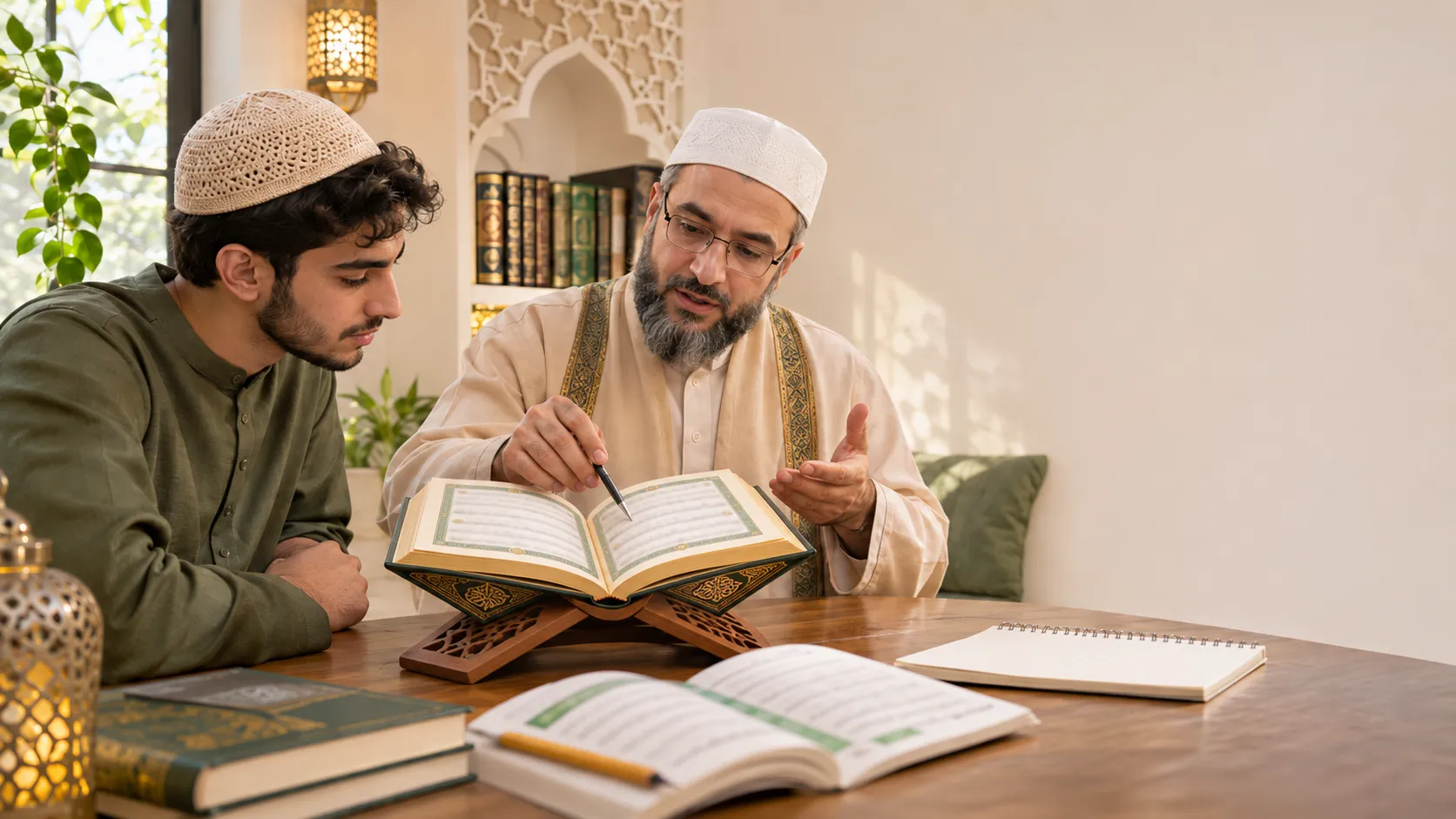
لَا تَقْرَبُوا الصَّلَاةَ وَأَنْتُمْ سُكَارَىٰ حَتَّىٰ تَعْلَمُوا مَا تَقُولُونَ
In plain English: do not approach prayer while intoxicated, until you know what you are saying.
The verse forbids approaching prayer in one stated condition, so the qualification belongs to the command. Grammatically, لَا تَقْرَبُوا is a negative command, وَأَنْتُمْ سُكَارَىٰ is a circumstantial clause (Hal) describing the condition, and حَتَّىٰ sets the limit. Tafsir such as Ibn Kathir’s places this verse in the gradual treatment of intoxicants, later fully prohibited (see 5:90–91). This article gives no ruling on anyone’s worship.
Quoting only لَا تَقْرَبُوا الصَّلَاةَ removes the clause that defines the command. Distinguish three situations: an intentionally misleading quotation, an accidental pause for breath or nerves, and the verse’s complete meaning. After an accidental pause, a teacher helps the learner choose a restart that restores the connection, perhaps from the start of the clause.
The qualification in Quran 4:43 demonstrates Quranic Arabic grammar clues that can change how an Ayah is understood, because a prohibition cannot be interpreted responsibly while ignoring the clause that follows it.
Try it: recite the fragment, then the full Ayah, and notice what the added clause supplies.
2. Surah Al-Ma’un: Why the Next Ayah Explains Who Is Being Criticized
فَوَيْلٌ لِّلْمُصَلِّينَ (4) الَّذِينَ هُمْ عَن صَلَاتِهِمْ سَاهُونَ (5) الَّذِينَ هُمْ يُرَاءُونَ (6)
In plain English: so woe to those who pray, who are heedless of their prayer, who make a show of it.
Verse 4 alone could sound like a condemnation of worshippers, but verses 5–6 define the people meant. الَّذِينَ is a relative pronoun, and its clause describes الْمُصَلِّينَ as a modifier. Verse 7 continues the description.
A verse-ending pause and withholding essential context are not the same. A reciter may follow established verse-end practice, because the next verses follow immediately in the recitation. A writer quoting only verse 4 can still mislead. Recitation, quotation, and interpretation are three different acts.
The continuation in Surah Al-Ma’un is a practical example of what Tafsir reveals beyond reading a short English Quran translation, because the next verses determine who is being criticized.
Try it: pause after verse 4, then resume with verse 5 and hear how the description lands.
3. Quran 2:2: What the Paired Three Dots Teach About Stopping
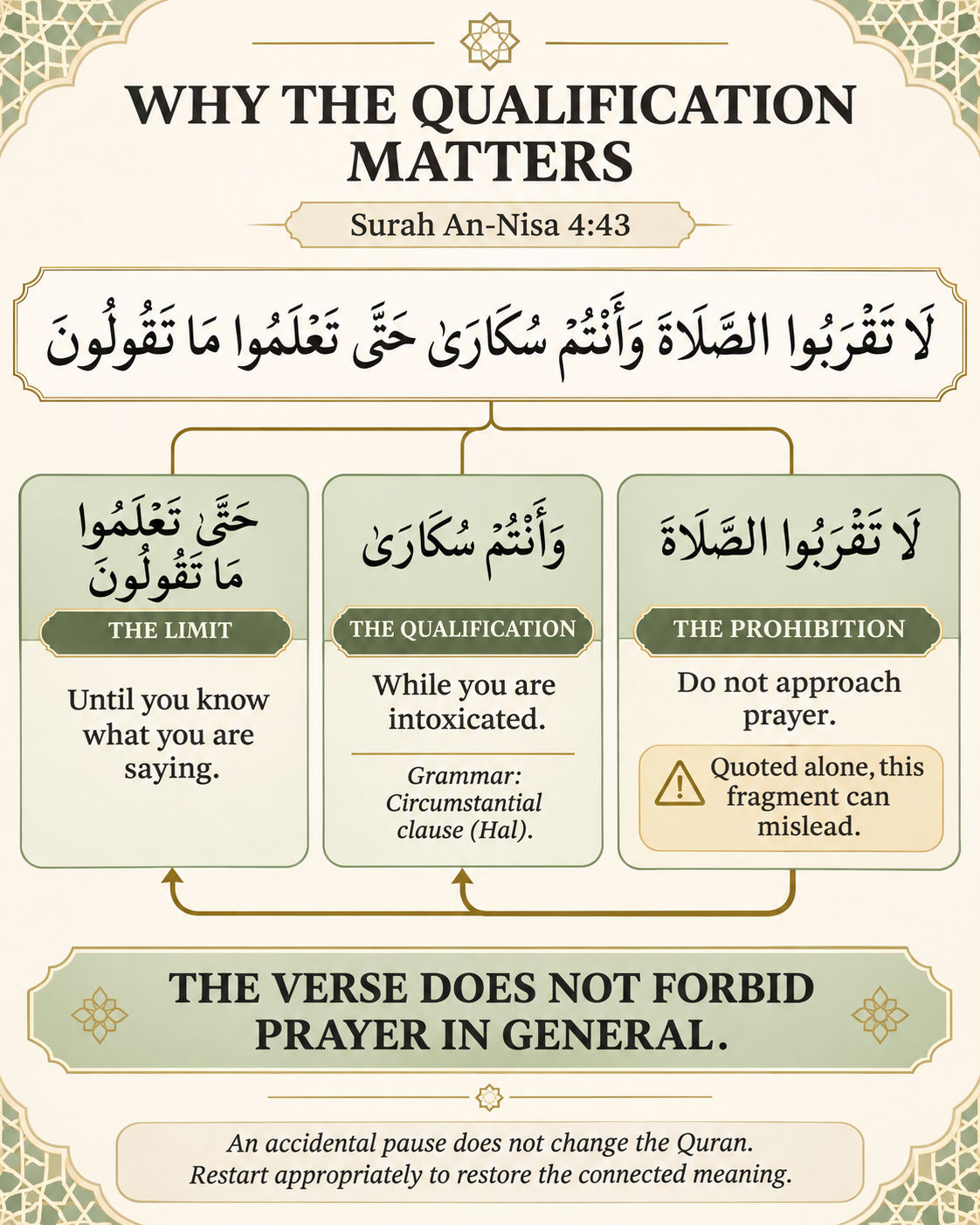
ذَٰلِكَ الْكِتَابُ لَا رَيْبَ ۛ فِيهِ ۛ هُدًى لِّلْمُتَّقِينَ
In plain English: that is the Book, in which there is no doubt, a guidance for the mindful.
This arrangement is called Waqf al-Mu’anaqah (وَقْفُ الْمُعَانَقَة). Two sets of dots mark two alternative stops, and the reader chooses one.
Stopping after لَا رَيْبَ yields “No doubt,” then “In it is guidance for the mindful.” Stopping after فِيهِ yields “No doubt in it,” then “Guidance for the mindful.” The Quranic words are identical, and these are not different texts. Under the paired system, do not stop at both places in one pass, since the two analyses are alternatives rather than successive stops. Confirm the dots and their positions in your own edition.
The two grammatical groupings of Quran 2:2 also help explain [ why Quran translations sometimes phrase the same Arabic passage differently], even when the underlying Quranic words are identical.
Try it: recite twice, each time stopping at only one position.
4. Quran 6:36: How a Stop Helps Separate Two Statements
إِنَّمَا يَسْتَجِيبُ الَّذِينَ يَسْمَعُونَ ۘ وَالْمَوْتَىٰ يَبْعَثُهُمُ اللَّهُ ثُمَّ إِلَيْهِ يُرْجَعُونَ
In plain English: only those who listen respond; as for the dead, Allah will raise them, and then to Him they will be returned.
The marked stop separates two statements: those who hear respond, and Allah raises the dead. The Madinah Mushaf prints a Lazim-type sign after يَسْمَعُونَ (verify in your copy). Linking وَالْمَوْتَىٰ directly onto the first clause could make a hearer take “the dead” as another group that responds. The Ayah instead makes a new assertion.
Consult reliable Tafsir on “hearing” and “the dead,” since commentators discuss both literal and figurative senses. There is no second reading here.
Ask four questions. Where does the first statement end? What does the next statement assert? What does my Mushaf mark? How could an unhelpful connection blur the structure?
Try it: stop after يَسْمَعُونَ, then begin with وَالْمَوْتَىٰ.
5. Quran 10:65: Why a Pause Can Clarify Whose Words Are Being Discussed
وَلَا يَحْزُنكَ قَوْلُهُمْ ۘ إِنَّ الْعِزَّةَ لِلَّهِ جَمِيعًا
In plain English: do not let their words grieve you; all honor and might belong to Allah, and He is the All-Hearing, All-Knowing.
The marked stop keeps their words separate from the statement that follows. In the Madinah Mushaf, a Lazim-type sign appears after قَوْلُهُمْ (verify in your copy).
قَوْلُهُمْ refers to what opponents say, without reporting a quotation in this Ayah. إِنَّ الْعِزَّةَ لِلَّهِ جَمِيعًا begins a fresh statement, made by the Quran about Allah’s might, and gives a reason for the reassurance. Careless joining might lead a listener to hear “honor belongs to Allah” as part of the opponents’ words.
Keep four things apart: a phrase referring to speech, the Quran’s own statement, a quotation, and a stop mark. Do not supply what the opponents said, because the Ayah does not report it.
Try it: stop after قَوْلُهُمْ, restart with إِنَّ, and say aloud who is speaking.
6. Quran 3:7: A Famous Stopping Point with Different Scholarly Analyses
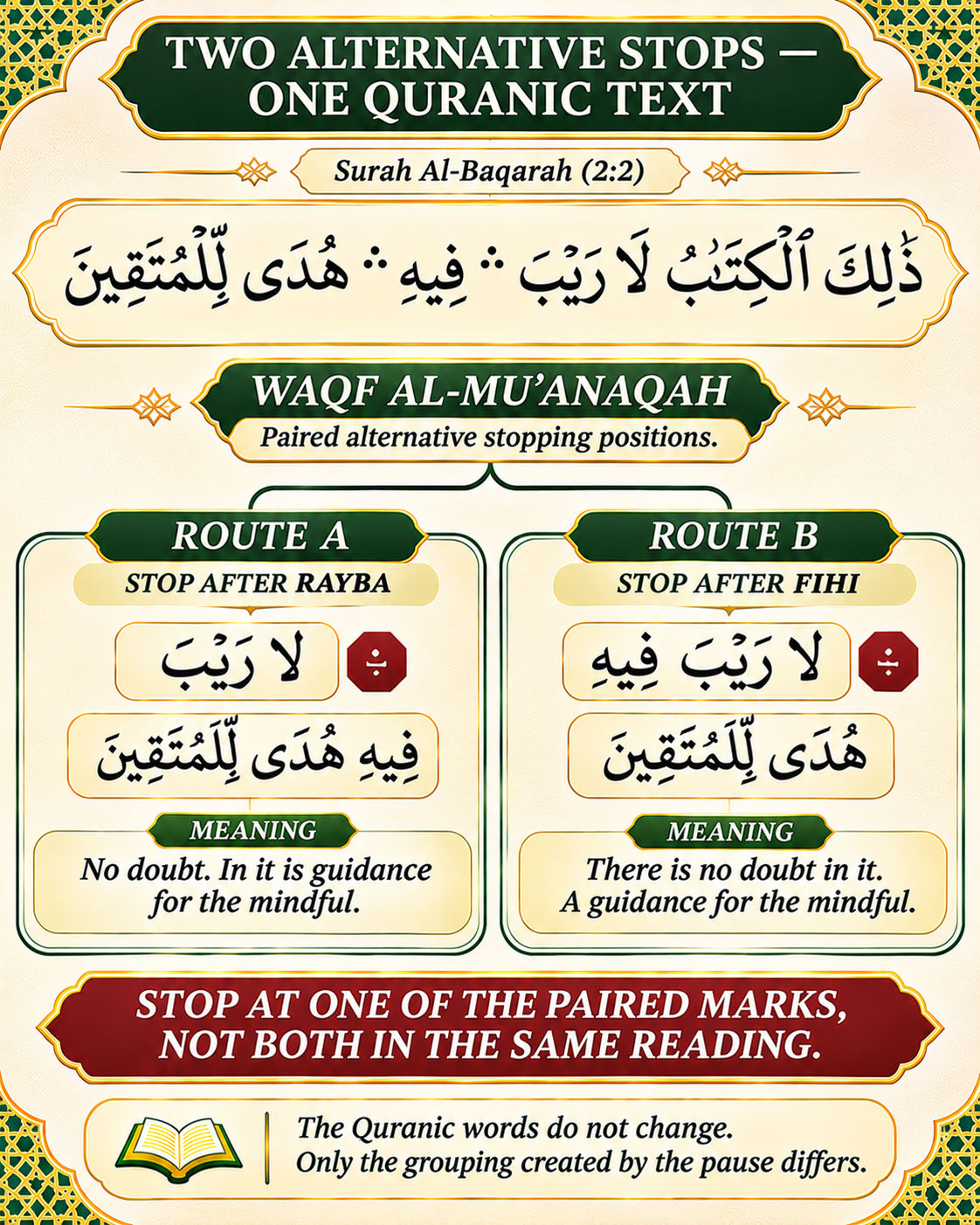
وَمَا يَعْلَمُ تَأْوِيلَهُ إِلَّا اللَّهُ وَالرَّاسِخُونَ فِي الْعِلْمِ يَقُولُونَ آمَنَّا بِهِ
In plain English, under one grouping: none knows its ta’wil except Allah, and those firmly grounded in knowledge say, “We believe in it.”
The question is whether the sentence stops after the word Allah and how the following conjunction should be analyzed. Read the complete Ayah first, and check the sign your Mushaf prints after اللَّهُ.
If one stops after اللَّهُ, the waw begins a new sentence and الرَّاسِخُونَ starts a statement of faith. If one does not, الرَّاسِخُونَ is joined to اللَّهُ, so the knowers share in knowing ta’wil. Much depends on the sense of ta’wil: the ultimate reality of what is described, or explanation of meaning. The Tafsir tradition discusses both senses.
Commentators including al-Tabari, Ibn Kathir, al-Qurtubi, and Ibn ‘Ashur discuss this at length, as do classical Waqf authorities. Read each directly rather than relying on summaries. There is no universal consensus to announce, and this is a scholarly discussion, not a sectarian one.
The discussion around Quran 3:7 demonstrates how I’rab and Arabic case relationships affect Quran understanding, because the possible sentence boundaries must be considered alongside grammar and Tafsir.
Try it: recite once stopping after اللَّهُ, and once joined, noticing how the sentence shape changes.
7. Quran 9:3: Why Arabic Case Endings Matter Alongside Stopping
أَنَّ اللَّهَ بَرِيءٌ مِّنَ الْمُشْرِكِينَ وَرَسُولُهُ
In plain English: Allah is free of obligation toward the polytheists, and so is His Messenger.
The final word is the key, because its case ending shows the Messenger is also free of obligation, not disavowed. اللَّهَ is accusative as the noun of أَنَّ. بَرِيءٌ is its nominative predicate. مِّنَ الْمُشْرِكِينَ is a prepositional phrase, with a genitive ending. وَرَسُولُهُ takes a damma, and classical analyses treat it as a coordinated or new subject whose predicate is understood.
So the Quran does not say Allah disavows His Messenger. A pause is not what establishes this, since the case ending and the whole sentence do. Changing that last vowel, for instance to a kasra, would be an incorrect recitation, not an authentic reading. It would wrongly link the Messenger to المُشْرِكِينَ.
Check your Mushaf’s printed sign at the break in this Ayah.
Try it: say the phrase slowly and listen for the damma on the last word.
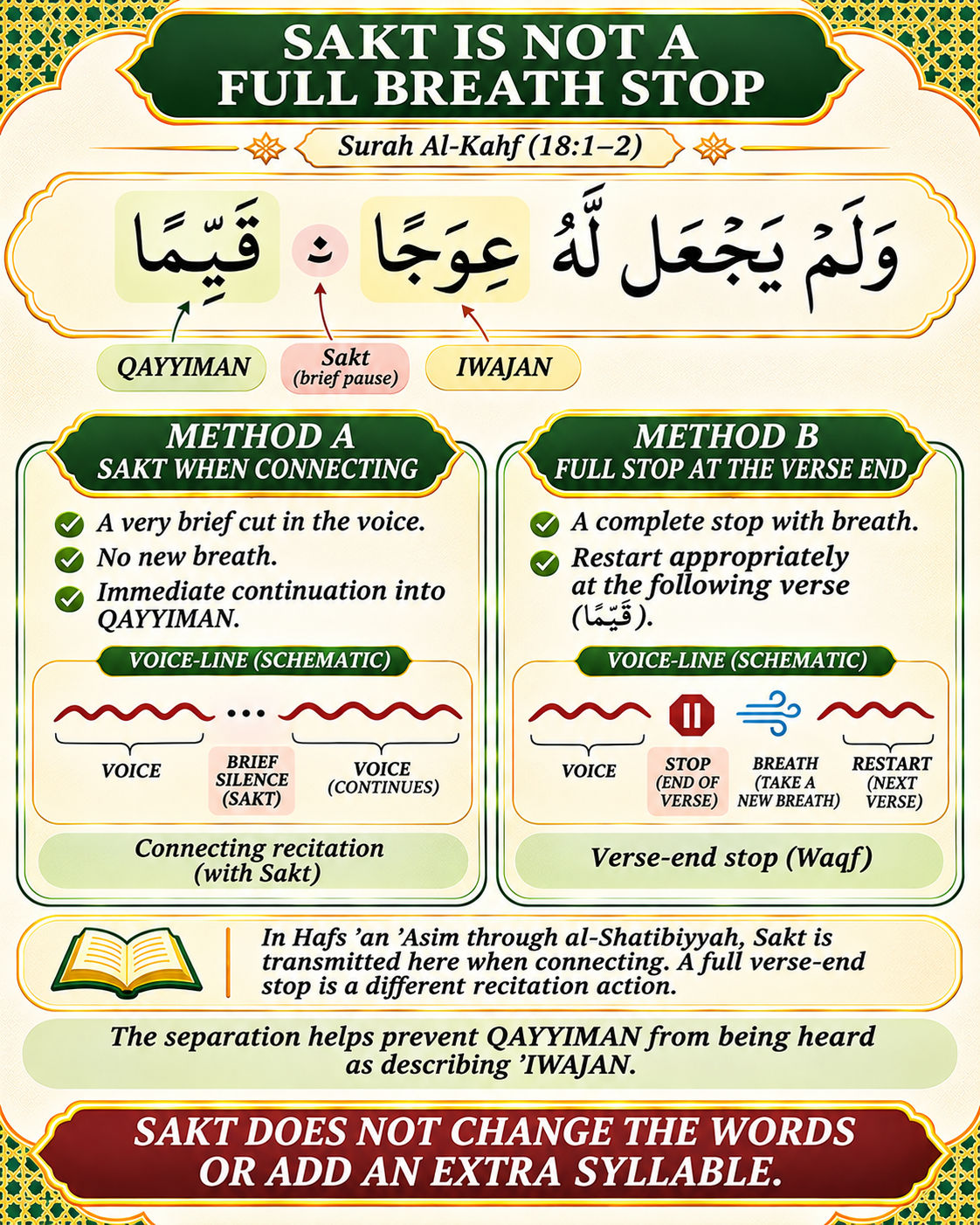
8. Al-Kahf 18:1–2: A Special Sakt Between ‘Iwajan and Qayyiman
وَلَمْ يَجْعَل لَّهُ عِوَجًا ۜ قَيِّمًا
In plain English: and He has placed no crookedness in it, but made it straight.
At the end of verse 1, Hafs through al-Shatibiyyah transmits a Sakt on the word ‘iwajan when it is connected to qayyiman. This is a brief silence without breath, shown by a small س in the Madinah Mushaf, after which the reader continues at once.
Distinguish three things. The Sakt is a brief silence without breath. A full stop at the verse end is a permitted alternative, which is ordinary stopping, not Sakt. Ordinary Wasl without Sakt is not the Hafs practice here. Not every Ayah boundary has a Sakt, and one should not take a breath-stop and then add one.
Qira’at scholars explain the Sakt as keeping قَيِّمًا from being heard as describing عِوَجًا. Grammatically, قَيِّمًا is commonly analyzed as a state (Hal) of الْكِتَاب or as linked to an understood verb.
The transition between Quran 18:1 and 18:2 is also a useful companion to [ the science of Fawasil and how Quranic verse endings work], because a verse boundary and the grammatical completion of a passage are related but distinct questions.
Try it: recite connected with Sakt, then with a full stop, and compare.
9. Ya Sin 36:52: Why There Is a Brief Pause After Marqadina
قَالُوا يَا وَيْلَنَا مَن بَعَثَنَا مِن مَّرْقَدِنَا ۜ هَٰذَا مَا وَعَدَ الرَّحْمَٰنُ وَصَدَقَ الْمُرْسَلُونَ
In plain English: woe to us, who raised us from our resting place? This is what the Most Merciful promised, and the messengers spoke the truth.
Hafs through al-Shatibiyyah makes a Sakt after the word marqadina, without a breath, before hadha. The Sakt keeps هَٰذَا from being heard as describing مَرْقَدِنَا.
Read the context in 36:51–53. Commentators record more than one view on who says the second phrase. Some take it as the same people now recognizing what they were told, and others as believers or angels answering them. The Sakt does not settle this, so consult reliable Tafsir. This article adds no dialogue and does not describe unseen scenes beyond the Ayah.
Keep the three actions distinct. Sakt is a brief silence without breath, a full stop would end the phrase, and Wasl without Sakt is not the Hafs practice at this spot.
Try it: listen to a qualified reciter at this verse and mark where the voice pauses without breathing.
10. Man Raq and Bal Ran: How Sakt Keeps Certain Sounds Distinct
مَنْ ۜ رَاقٍ (75:27) بَلْ ۜ رَانَ عَلَىٰ قُلُوبِهِم (83:14)
In plain English: who is the healer? (75:27); and rather, what they used to earn has covered their hearts (83:14).
Both phrases carry a Sakt because ordinary assimilation would otherwise merge the sounds. A nun sakinah or lam sakinah before ra normally assimilates into it. In Hafs through al-Shatibiyyah, the reader instead cuts the voice briefly, with no breath, so نْ and لْ stay audible before رَ. Removing the Sakt is not an alternative authentic reading. Different routes and books may describe further options at some locations, so learn the route with a teacher.
Do not confuse the passages merely because both contain a Sakt. Quran 75 concerns the experience surrounding death, while Quran 83 describes hearts affected by what their owners earned.
Because these Sakt examples belong to a specific transmitted recitation, they also illustrate why the Quran’s canonical Qira’at must be studied through reliable transmission, rather than by improvising new pronunciation rules.
Try it: compare the sound of رَاقٍ and رَانَ with and without the Sakt, with a teacher present.
The Four Famous Sakt Locations
Location | Paired words | Note |
|---|---|---|
18:1–2 | عِوَجًا / قَيِّمًا | Connected, no breath |
36:52 | مَرْقَدِنَا / هَٰذَا | Inside the Ayah |
75:27 | مَنْ / رَاقٍ | Before ra |
83:14 | بَلْ / رَانَ | Before ra |
These are four locations, not four extra lessons. All belong to Hafs ‘an ‘Asim through al-Shatibiyyah and should not be carried to every Qira’ah.
10 Waqf and Ibtida Lessons at a Glance
Lesson | Reference | Stopping issue | Grammar/Tajweed contribution | Key precaution |
|---|---|---|---|---|
1 | 4:43 | Qualification omitted | Hal clause | Do not quote the fragment alone |
2 | 107:4–6 | Description continues | Relative clause | Verse end ≠ finished context |
3 | 2:2 | Alternative stops | Two groupings | Stop at one only |
4 | 6:36 | Two statements | Clause boundary | Check the sign |
5 | 10:65 | Speaker clarity | New statement | Add no dialogue |
6 | 3:7 | Disputed boundary | Conjunction, ta’wil | No false consensus |
7 | 9:3 | Case endings | I’rab | Never alter vowels |
8 | 18:1–2 | Sakt across Ayat | No-breath silence | Not every Ayah |
9 | 36:52 | Sakt within Ayah | Hafs route | Do not add speakers |
10 | 75:27; 83:14 | Sakt vs assimilation | Idgham prevented | Route-specific |
Term | Meaning | Breath | Relevant when | Confusion |
|---|---|---|---|---|
Waqf | Stopping | Usually yes | Breath, Ayah end | Stop ≠ sentence end |
Ibtida | Restarting | Follows a stop | After stopping | Ignored |
Wasl | Connecting | No stop | Continuing | Not always better |
Sakt | Brief silence | No new breath | Transmitted spots | Not a breath-stop |
How to Stop and Restart Correctly in the Quran
Use a verified Mushaf and understand its symbol legend.
Read the connected meaning and identify clause boundaries.
Learn the common stopping signs.
Listen to a qualified reciter following the selected transmission.
Practice appropriate stopping and restarting with feedback.
Students who want to understand the wider scholarly foundations of these recitation decisions can explore the Quranic Sciences that support accurate reading and interpretation, including Tafsir, Arabic grammar, and the study of transmitted readings.
If you stop accidentally, avoid panic. Recognize the connected phrase, choose a suitable restart, and repeat the preceding words when necessary. Listen to a qualified reciter and ask a teacher about difficult passages. The right restart differs from Ayah to Ayah.
Exercise A (4:43). Find the prohibition, the qualification, and a misleading fragment, then state a restart principle. Guide: the prohibition is لَا تَقْرَبُوا الصَّلَاةَ and the qualification is the Hal clause. The fragment is the prohibition alone. Restart where the connection is restored.
Exercise B (2:2). Find the paired marks, the two groupings, and the stopping rule. Guide: the marks follow رَيْبَ and فِيهِ, and the groupings are as in Lesson 3. Stop at one, not both.
Verse | Issue | Arabic clue | Meaning to preserve | Note |
|---|---|---|---|---|
4:43 | Qualification | وَأَنْتُمْ سُكَارَىٰ | Conditional prohibition | Teacher/Tafsir |
2:2 | Paired dots | رَيْبَ / فِيهِ | Two groupings | One stop only |
6:36 | Two statements | يَسْمَعُونَ / وَالْمَوْتَىٰ | New assertion | Check sign |
Seven-day familiarization plan (not mastery). Day 1 covers Waqf and Ibtida, and Day 2 the Mushaf symbols. Day 3 takes 4:43 and 107:4–6, and Day 4 takes 2:2 and 6:36. Day 5 covers 10:65 and 3:7, Day 6 covers 9:3 and 18:1–2, and Day 7 covers 36:52 and the two final Sakt examples.
Ten-minute routine (no guarantee of mastery). Spend two minutes each on reading a short verified passage, identifying stop marks, examining grammar and meaning, listening to qualified recitation, and practicing stopping and restarting.
Common Mistakes
Stopping anywhere without checking meaning.
Ignoring a qualification.
Ignoring following Ayat.
Treating all Ayah ends as identical.
Neglecting Ibtida.
Misreading printed symbols.
Stopping at both paired-dot positions.
Confusing Sakt with a breath-stop.
Assuming every disputed stop has one unanimous answer.
Inventing a Qira’ah to explain a difficult grammar example.
Myths and Facts
“A pause always changes the Quran.” The text is unchanged. An unsuitable pause may only mislead a listener.
“All verse ends complete the meaning.” Grammar can continue across Ayat, as in 107:4–6.
“Every end-of-Ayah pause is forbidden when grammar continues.” Verse-end stopping is recognized, but resume wisely.
“Printed stop symbols are Quranic words.” They are scholarly guidance.
“All Mushaf editions use identical signs.” They differ.
“Breath-taking Waqf and Sakt are identical.” Sakt takes no new breath.
“Every Sakt applies in every reading.” Sakt is transmission-specific.
“Every stop after a negative particle is acceptable.” Stopping right after a negative command can leave its qualification unheard.
“All scholars agree on Quran 3:7.” They discuss it.
“Case endings can be changed freely.” They belong to the transmitted text.
“A wrong pause always invalidates Salah.” There is no blanket rule, so ask a qualified scholar.
“English punctuation determines Tajweed.” Translation punctuation does not govern Waqf.
Frequently Asked Questions
1. What does Waqf mean in Quran recitation?
Stopping the voice, normally with a breath, at a position recognized by recitation scholarship. It does not always mean a grammatical sentence has ended.
2. What is Ibtida?
Beginning or resuming recitation from a suitable word or clause. It is studied with stopping, since a good restart can repair an imperfect stop.
3. What is Wasl?
Connected recitation without a full stop. Pronunciation may differ from pausal pronunciation, and connecting is not automatically more correct.
4. What is Sakt?
A brief cut of the voice without a new breath, in readings that transmit it. Hafs has four well-known locations through al-Shatibiyyah.
5. Can stopping at the wrong word change a verse’s apparent meaning?
It can make what is heard sound incomplete or misleading, as with 4:43. The Quranic text remains unchanged, and an accidental stop can be corrected by restarting appropriately.
6. Can I stop at every Ayah ending?
Often yes. Many teachers regard Ayah-end stopping as recognized practice, but grammar may continue, so sometimes you resume from an earlier phrase. Follow your teacher and Mushaf.
7. What should I do when I run out of breath?
Stop at the nearest suitable place without panic, then resume from a phrase that restores the connected meaning. Practice breath control with a teacher.
8. What does the Meem stopping sign mean?
In the Madinah Mushaf, مـ marks Waqf Lazim, meaning stopping is strongly recommended to avoid a misleading link. It is an instructional label, not a legal ruling.
9. What does the La stopping sign mean?
لا advises against stopping there. If breath forces a stop, resume from an earlier suitable point instead of starting at the next word alone.
10. What does Jeem mean in a Mushaf?
ج marks Waqf Ja’iz: stopping and continuing are both permitted. Choose according to breath and your teacher’s guidance.
11. What do Qila and Sila mean?
قلى means stopping is preferable, and صلى means continuing is preferable. Each indicates a preference, not a prohibition of the other option.
12. What do the paired three dots mean?
Two sets of three dots mark alternative stops (Mu’anaqah). Stop at one of them, not both in the same reading, as in 2:2.
13. Why should Quran 4:43 be read with its qualification?
Because “while you are intoxicated, until you know what you are saying” defines the prohibition. Without it, the fragment sounds like a general ban on prayer.
14. Why does Surah Al-Ma’un continue the description into the next Ayah?
Verses 5–6 describe the people meant in verse 4. Stopping at the verse end is recognized, but the description continues across Ayat.
15. Why is Quran 3:7 discussed by scholars?
Scholars discuss whether the sentence stops after “except Allah” and what “ta’wil” means, which affects whether those grounded in knowledge are joined to Allah in knowing it.
16. What does I’rab contribute to Waqf?
I’rab shows how words relate through endings and function, which helps identify clause boundaries, as in 9:3, where the endings show who is free of obligation.
17. Where are the four famous Sakt locations in Hafs?
Through al-Shatibiyyah: 18:1–2 (‘iwajan/qayyiman), 36:52 (marqadina/hadha), 75:27 (man/raq), and 83:14 (bal/ran).
18. Why is there a Sakt between ‘Iwajan and Qayyiman?
It keeps qayyiman from being heard as describing ‘iwajan. It is a brief silence without breath when connecting, in Hafs through al-Shatibiyyah.
19. Do stopping signs differ between Mushaf editions?
Yes. Editions may use different symbols, sets, or conventions. Read your own Mushaf’s legend and avoid mixing systems.
20. Does an accidental incorrect stop invalidate Salah?
This article offers education, not personal rulings. Accidental stops are common among learners, so ask a qualified teacher or scholar about your specific situation.
Conclusion — Pause with Care, Continue with Meaning
Return to لَا تَقْرَبُوا الصَّلَاةَ. You now see why the qualification matters. Correct stopping, restarting, context, and grammar all matter. Some stopping questions carry real scholarly differences, a valid verse-end pause is not automatically a bad stop, and a Sakt is not an ordinary breath. Beginners can learn gradually with qualified instruction. If you would like guided practice, Araby Academy invites you to learn Tajweed and Quranic Arabic with us.