
Open three English translations of Quran 2:183, the verse that prescribes fasting, and its final clause reads three different ways. Pickthall has "that ye may ward off (evil)." Sahih International has "that you may become righteous." Abdel Haleem has "so that you may be mindful of God." Behind all three stands one Arabic clause: لَعَلَّكُمْ تَتَّقُونَ.
Naturally, readers ask: Which one is correct? Is the Arabic ambiguous? Am I missing something? This article gives seven reasons translations differ, using real verses and named translations, and ends with a practical method for comparing them.
The Short Answer: Why Quran Translations Differ
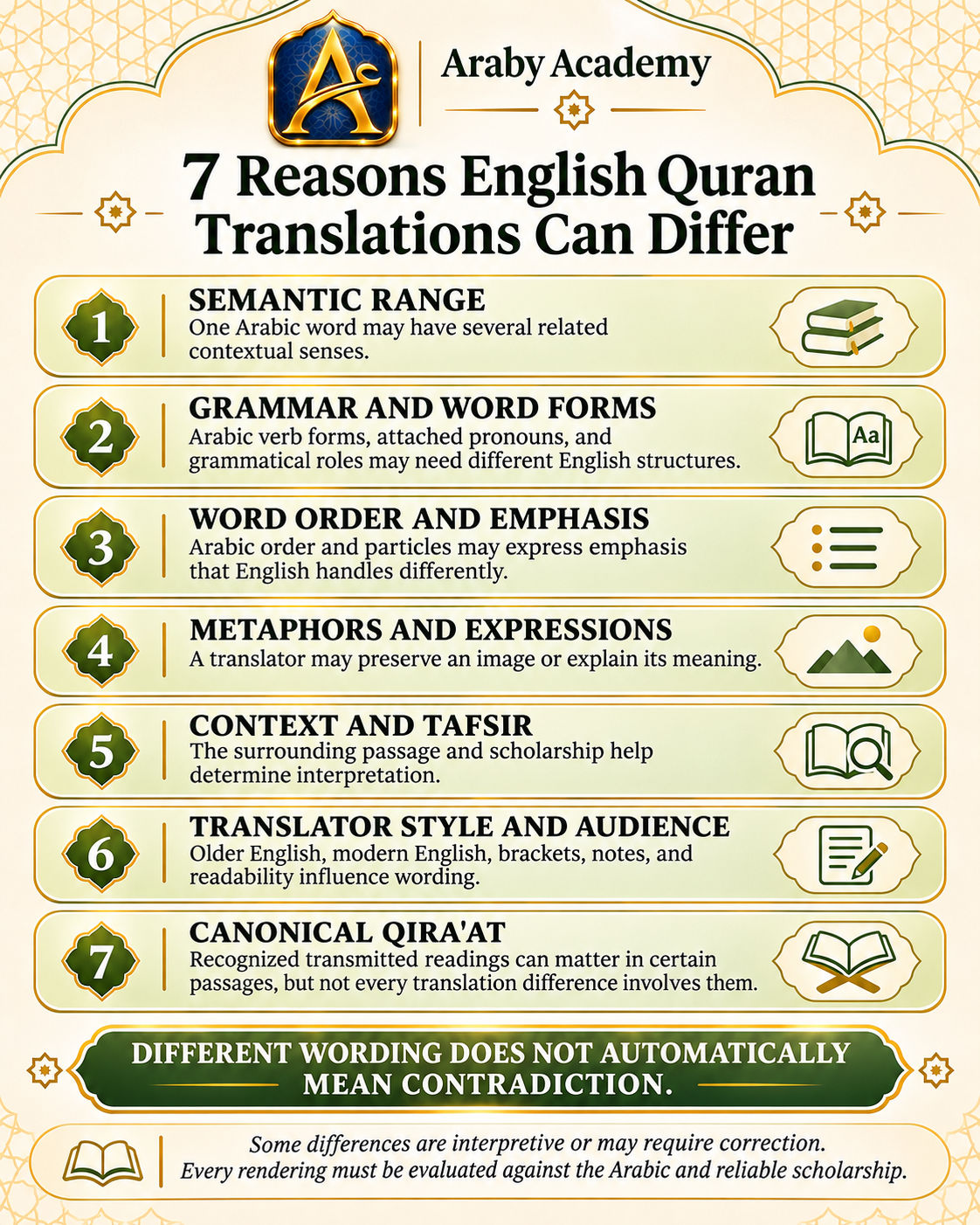
Quran translations sometimes differ because Arabic words can carry several related meanings, grammar and word order do not transfer neatly into English, and figurative language may need explanation. Translators also weigh context, established Tafsir (scholarly explanation of the Quran), their intended readers, and their style. In some passages, recognized Qira'at (canonical readings) are relevant. Different wording is not automatically contradiction, but meaningful differences should be checked against the Arabic and reliable scholarship.
The Quran in Arabic vs an English Translation
The Quran is the revealed Arabic text. An English translation is a human attempt to communicate its meaning in another language, so the English wording is the translator's rendering. Two careful translators can therefore produce different English sentences from the same Arabic. A translation does not replace the Arabic wording, the recitation, or scholarly Tafsir.
None of this makes translations unimportant. For readers who do not know Arabic, they are the doorway to the Quran's message and a sound place to begin study. Their limits are simply worth understanding. Learning [ what Quranic Arabic is and how it differs from an English translation] provides a foundation for understanding why two translators may choose different English expressions.
1. One Arabic Word Can Carry Several Related Meanings
Words have a semantic range: a set of related senses, only some of which fit a given context. The translator must choose an English expression suited to the verse. Not every dictionary gloss is valid everywhere, and Arabic words do not have unlimited meanings.
Example: Taqwa in Quran 2:183
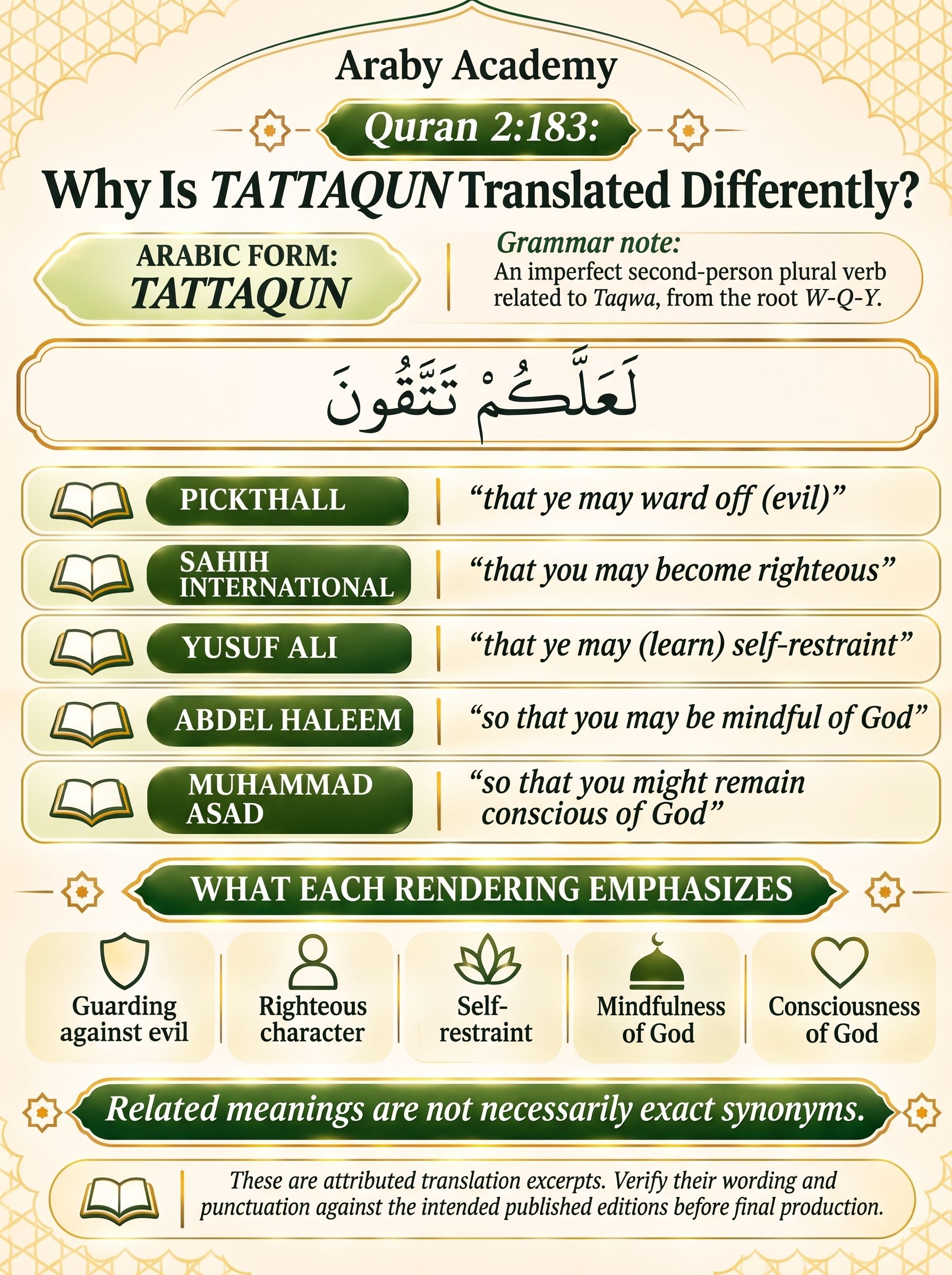
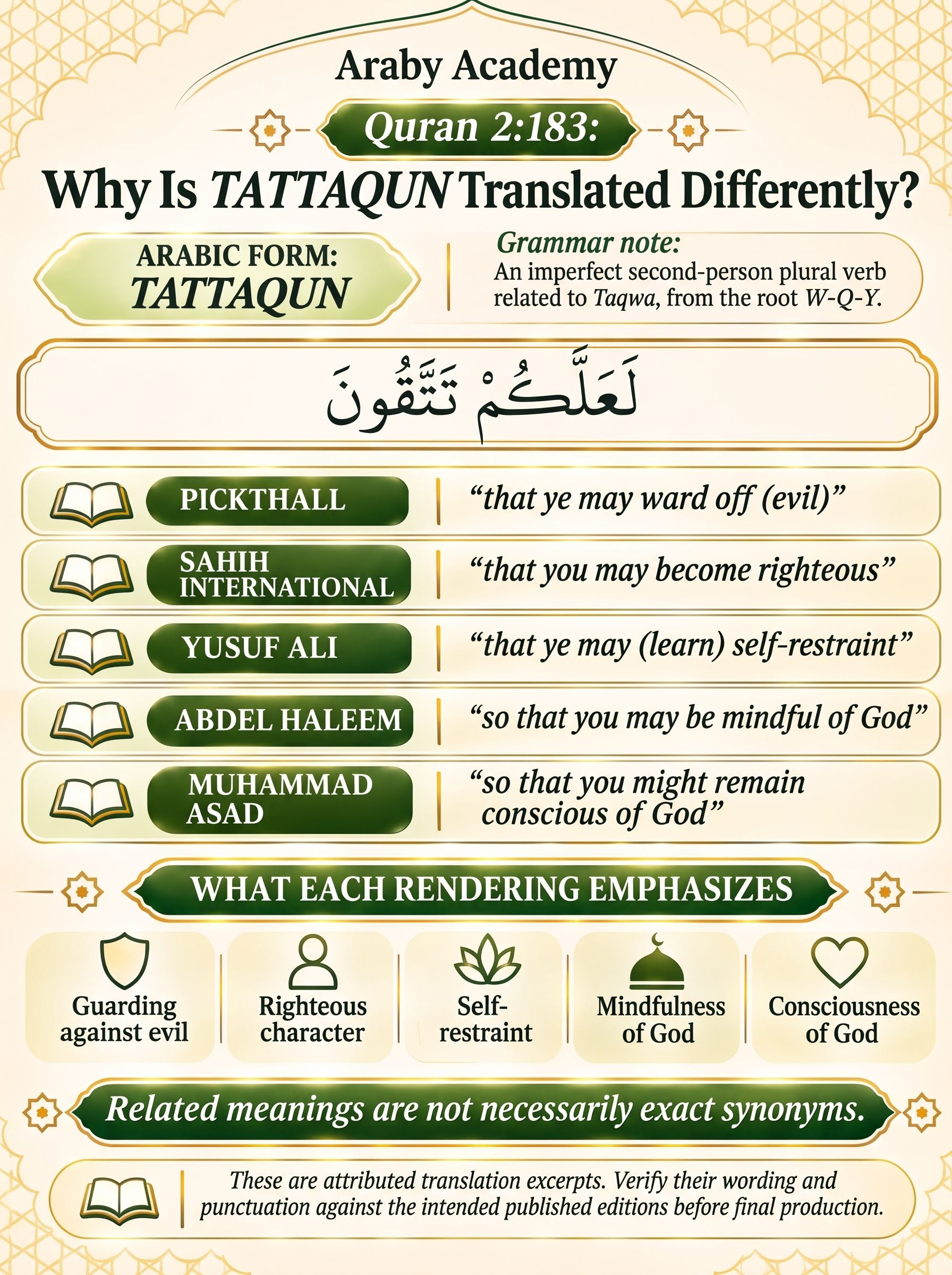
The key word is تَتَّقُونَ (tattaqūn). It is not the noun تَقْوَى (taqwā). Tattaqūn is a verb: the imperfect, second-person plural form of ittaqā, a Form VIII verb from the root و-ق-ي (w-q-y), associated with protecting or guarding. Taqwā is a noun from the same root. English must therefore express a verbal action with a phrase rather than a single noun.
Translator | Wording of the final clause |
|---|---|
Pickthall | "that ye may ward off (evil)" |
Sahih International | "that you may become righteous" |
Yusuf Ali | "that ye may (learn) self-restraint" |
Abdel Haleem | "so that you may be mindful of God" |
Muhammad Asad | "so that you might remain conscious of God" |
These five wordings are not exact synonyms. "Righteous" names a resulting character, "ward off (evil)" keeps the sense of guarding, "self-restraint" stresses discipline, and the two "God" renderings stress awareness. All five wordings are compatible, but they highlight different aspects of one Arabic clause.
Scholars often describe taqwā as awareness of Allah and accountability that leads a person to guard against what displeases Him. That description comes from Tafsir and lexicography rather than from root etymology alone. Words such as Taqwa demonstrate why [ ten Quranic Arabic words whose meanings go beyond a single English equivalent] deserve closer study rather than automatic one-word translation.
Type of difference: semantic, with differences of emphasis.
Example: Rabb in Quran 1:2
The phrase الْحَمْدُ لِلَّهِ رَبِّ الْعَالَمِينَ contains رَبِّ (rabbi, "Lord of"). Sahih International, Pickthall and Abdel Haleem use "Lord," while Muhammad Asad uses "Sustainer." "Lord" keeps a familiar, majestic tone. "Sustainer" foregrounds the nurturing and sustaining sense that lexicographers and commentators note in rabb. Both are compatible choices that differ in connotation. But a conceptual association does not automatically justify replacing "Lord" in every context, and the translator's aim decides how much to explain.
Two different problems should not be confused. Sometimes one Arabic word needs different English renderings in different contexts. At other times two different Arabic words are flattened into one English word. A related challenge appears when [ Quranic Arabic word pairs look similar in English but carry different meanings], showing that translation can conceal distinctions as well as create apparent differences.
Caution: a list of dictionary glosses does not mean every gloss fits every verse.
Takeaway: when translations differ, first identify the Arabic word, then ask whether both English choices are supported by its use in context. A dictionary list alone is not enough.
2. Arabic Grammar and Word Forms Do Not Always Fit English Neatly
Arabic carries grammatical information inside word forms: verb patterns, passive voice, attached pronouns, number, gender, case endings and definiteness. English often needs extra words or a reshaped sentence to express the same relationships. Some translators keep the Arabic structure visible, while others reformulate it for natural English.
Example: Kutiba in Quran 2:183
The verse begins كُتِبَ عَلَيْكُمُ الصِّيَامُ (kutiba ʿalaykumu ṣ-ṣiyām). Kutiba is the passive form of kataba, from the root ك-ت-ب (k-t-b). It is not كَتَبَ (kataba), the active "he wrote." The root's range includes writing and, by extension, ordaining or making binding, so in this verse the sense is fasting being prescribed, not a physical book.
Sahih International has "decreed upon you is fasting," while Pickthall and Abdel Haleem have "fasting is prescribed for you." "Decreed" sounds formal and mirrors the Arabic by placing the verb first. "Prescribed" is more familiar and follows English order. They are compatible, but not interchangeable in every context.
The passive also leaves the doer unnamed. English readers should not conclude that the Arabic lacks information: the address to believers and wider Quranic usage show that the obligation comes from Allah. Similarly, the ending of ʿalaykum ("upon you") packs a preposition and a pronoun into one word, which English spells out separately. The passive form is grammar, not a ruling; why and how fasting is required belongs to Tafsir and fiqh.
Root and form therefore work together: the root supplies a range of meaning, and the form and context select the sense.
Type of difference: grammatical and register.
Takeaway: ask what the grammatical form is, whether the verb is active or passive, whether a pronoun is attached, whether English has made an implicit relationship explicit, and whether literal word order would sound unnatural.
3. Word Order, Particles, and Emphasis Are Hard to Preserve
Arabic can signal focus through word order and small particles, and English often needs added words to preserve the relationship. Arabic word order is not arbitrary, but moving a word does not automatically mean "only"; each case needs grammatical and contextual analysis. Many translation choices become clearer when readers notice small Arabic particles that affect the meaning of Quranic sentences rather than concentrating only on the longer vocabulary words.
Example: Iyyaka Na'budu in Quran 1:5
In إِيَّاكَ نَعْبُدُ وَإِيَّاكَ نَسْتَعِينُ, the pronoun إِيَّاكَ (iyyāka, "You") comes before the verb نَعْبُدُ (naʿbudu, "we worship"). Here the object stands before the verb. Classical grammarians and commentators, such as Ibn Kathir, explain that in this construction the fronting expresses restriction: worship and appeal for help are directed to Allah alone. This is an analysis of this verse, not a rule that every fronted object means "only."
English handles this emphasis in several ways.
Translator | Wording | Strategy |
|---|---|---|
Sahih International | "It is You we worship" | Restructured sentence |
Pickthall | "Thee (alone) we worship" | Archaic inversion, with "alone" supplied in parentheses |
Yusuf Ali | "Thee do we worship" | Inversion that echoes the Arabic without stating exclusivity |
Khattab (The Clear Quran) | "You ˹alone˺ we worship" | Modern order, with "alone" supplied in marked brackets |
These are differences in emphasis strategy, not in doctrine, and none reflects a different Qira'ah. A rendering with more words is not automatically better; each must be judged against the Arabic and commentary. The emphatic structure of Al-Fatihah is a useful introduction to [ Quranic examples where Arabic word order changes the emphasis], even when translators produce natural English rather than following the Arabic sequence exactly.
Example: Particles in Quran 103:2
The verse is إِنَّ الْإِنسَانَ لَفِي خُسْرٍ. Inna is an emphatic particle at the start. The lām in لَفِي (lafī) is an emphatic lām attached to the predicate. Not every lām is the same: other lāms express purpose or command, for example. Sahih International has "Indeed, mankind is in loss," and Pickthall has "Lo! man is in a state of loss." Neither translates the lām separately, which is not an error; the emphasis is carried by one English word and the sentence's force. The following verse's illā ("except") then qualifies the statement, so the sentence cannot be understood by translating particles one by one. Particles such as wa, fa, lā and illā have functions that depend on grammatical context, not one fixed English word.
Type of difference: emphasis and grammar.
Caution: do not declare a translation better merely because it has more words.
Takeaway: ask whether English added "only" or "alone," whether the Arabic contains an emphatic particle, whether an object precedes its verb, and whether the translation makes the effect explicit.
4. Quranic Metaphors and Expressions Are Not Always Literal
Four things can look similar but differ: a literal lexical rendering, an idiomatic English expression, an explanatory translation, and a Tafsir-based paraphrase. Some Quranic images are vivid in Arabic, and English may either preserve the image or explain its intended meaning.
Example: Garments in Quran 2:187
The Arabic is هُنَّ لِبَاسٌ لَّكُمْ وَأَنتُمْ لِبَاسٌ لَّهُنَّ, describing the relationship between spouses.
Translator | Wording |
|---|---|
Sahih International | "They are clothing for you and you are clothing for them" |
Pickthall | "They are raiment for you and ye are raiment for them" |
Abdel Haleem | "They are like garments for you, as you are for them" |
All three preserve the clothing image. Haleem adds "like," which makes the metaphor an explicit comparison, a small choice of explanation the Arabic does not spell out. Pickthall's "raiment" is a more archaic word for the same image.
Classical commentary, such as that reported by Ibn Kathir, explains the image in terms of comfort, closeness and mutual covering or support. Those are Tafsir explanations of the image; the noun itself does not list every association at once. Explaining the image can help, but an explanation is not always a replacement for the original image.
Caution: the verse is not a literal statement about physical clothing, and creative reflection should be kept separate from supported explanation.
Expressions such as the garment imagery in Quran 2:187 show why seemingly simple Quranic expressions can carry more meaning than their English wording suggests and why Tafsir may be needed alongside translation.
Takeaway: ask whether one translation is preserving an image while another explains it, whether the explanation has support in Tafsir, and whether anything important was omitted. A more literal phrase is not always easier to understand.
5. Context and Tafsir Can Influence the Translation
An Arabic expression is understood within its passage. Context can show who is speaking, who is addressed, what is being discussed, and which sense of a multi-sense word fits. Classical Tafsir records how scholars understood these matters, including links with other Quranic passages.
Example: Khalifah in Quran 2:30
The verse includes إِنِّي جَاعِلٌ فِي الْأَرْضِ خَلِيفَةً ("I am placing on the earth a khalīfah"). Khalīfah is an indefinite singular noun, here the object of jāʿil, from khalafa, "to come after or stand in for."
Translator | Wording |
|---|---|
Sahih International | "a successor" |
Pickthall | "a viceroy" |
Yusuf Ali | "a vicegerent" |
"Successor" keeps the sense of coming after. "Viceroy" and "vicegerent" stress acting on behalf of a higher authority. The English words nudge readers toward different explanations, and neither settles the question by itself. Dictionary meaning alone may not settle an interpretive question.
Classical commentators, including al-Ṭabarī and al-Qurṭubī, discuss more than one understanding of the word, such as succeeding earlier inhabitants of the earth or acting as a deputy under Allah's command. These explanations are not identical in implication, and a reader should not choose one from the English alone. A translator may follow one supported view or choose wording that leaves room for others.
Type of difference: interpretive, not necessarily a contradiction.
Example: Al-Dhikr in Quran 15:9
The verse is إِنَّا نَحْنُ نَزَّلْنَا الذِّكْرَ وَإِنَّا لَهُ لَحَافِظُونَ. Sahih International has "the Qur'an," Pickthall has "the Reminder," and Yusuf Ali has "the Message." The Arabic word is al-dhikr, whose lexical sense is reminder or remembrance, and commentators identify its referent here as the Quran. Sahih International names that referent in English, but the Arabic word is not Qur'an. A word's lexical form and its contextual referent are different things.
Asbab al-Nuzul: Circumstances of Revelation
أَسْبَابُ النُّزُولِ (Asbab al-Nuzul) means the circumstances or occasions of revelation. Authentic reports can clarify why a passage addresses a particular situation. For example, a report in Sahih al-Bukhari from al-Barā' ibn ʿĀzib describes how some men found the early restrictions of Ramadan nights difficult, after which the ease of 2:187 was revealed; the wording and numbering should be checked in the source. However, not every verse has a securely established specific occasion, reports differ in authenticity, and a verse's meaning is not automatically limited to its occasion. Some wording choices become easier to evaluate after studying [ why the circumstances of revelation matter for understanding an Ayah], provided the historical reports are reliably established.
Tafsir Is Not Translation
A translation offers a rendering of meaning. Tafsir weighs interpretive questions, evidence and alternatives within a broader scholarly framework. A translator may follow one supported interpretation, while another preserves ambiguity. Some differences really are substantive: a disputed word, a pronoun's referent, a grammatical construction or a historical context. Readers should neither dismiss all differences as interchangeable nor immediately declare contradiction. This is why understanding the difference between Tafsir and English Quran translation is essential when two versions seem to disagree about more than style.
Takeaway: read the surrounding verses, identify the Arabic expression, check a reliable Tafsir, look for evidence for each interpretation, and seek qualified explanation if the matter affects theology or law.
6. Translators Have Different Styles and Audiences
Translators have different editorial priorities: relatively literal wording, idiomatic contemporary English, explanatory translation, literary style, classical English register, or translation with brackets and notes. A translator may also blend approaches rather than fit one rigid category.
Older translations use forms such as thou, thee, ye, lo and whilst, while contemporary translations use modern English. Compare Quran 2:183:
Translator | Wording |
|---|---|
Pickthall | "O ye who believe! Fasting is prescribed for you, even as it was prescribed for those before you, that ye may ward off (evil)." |
Abdel Haleem | "Believers, fasting is prescribed for you, as it was prescribed for those before you, so that you may be mindful of God." |
The differences are in reader familiarity, register, sentence structure and the explanatory choice of "ward off (evil)" versus "mindful of God." Archaic vocabulary does not indicate greater accuracy, and modern vocabulary does not indicate greater theological reliability.
Brackets and notes. Pickthall uses parentheses, Haleem uses square brackets, and Khattab uses marked half-brackets. They often signal supplied words, clarified referents or explanation, but editorial conventions vary by edition, so each translation's introduction should be checked.
The cost of explanation. An explanatory translation can make a passage easier to understand, yet it can also make an interpretation harder to tell apart from the Arabic wording. A relatively literal translation may preserve structure but require more explanation. Neither label alone establishes accuracy, and literal, modern, older or longer is never a ranking.
Takeaway: ask whether the difference is mainly English style, whether a translator added an explanation, whether it has a basis in Tafsir, whether another version preserved the literal image, and whether both communicate a meaning the Arabic supports.
7. Canonical Qira'at Can Matter in Certain Verses
الْقِرَاءَات (al-qirā'āt) are the recognized, transmitted ways of reciting the Quran, preserved through established chains of teaching. They are not invented by translators, they are not random pronunciation variants, and they are not personal interpretations. A translator who chooses "Lord" over another English word has not chosen a different reading. Translations can differ in English even when both translators work from the same reading, and only some differences are connected to recognized readings.
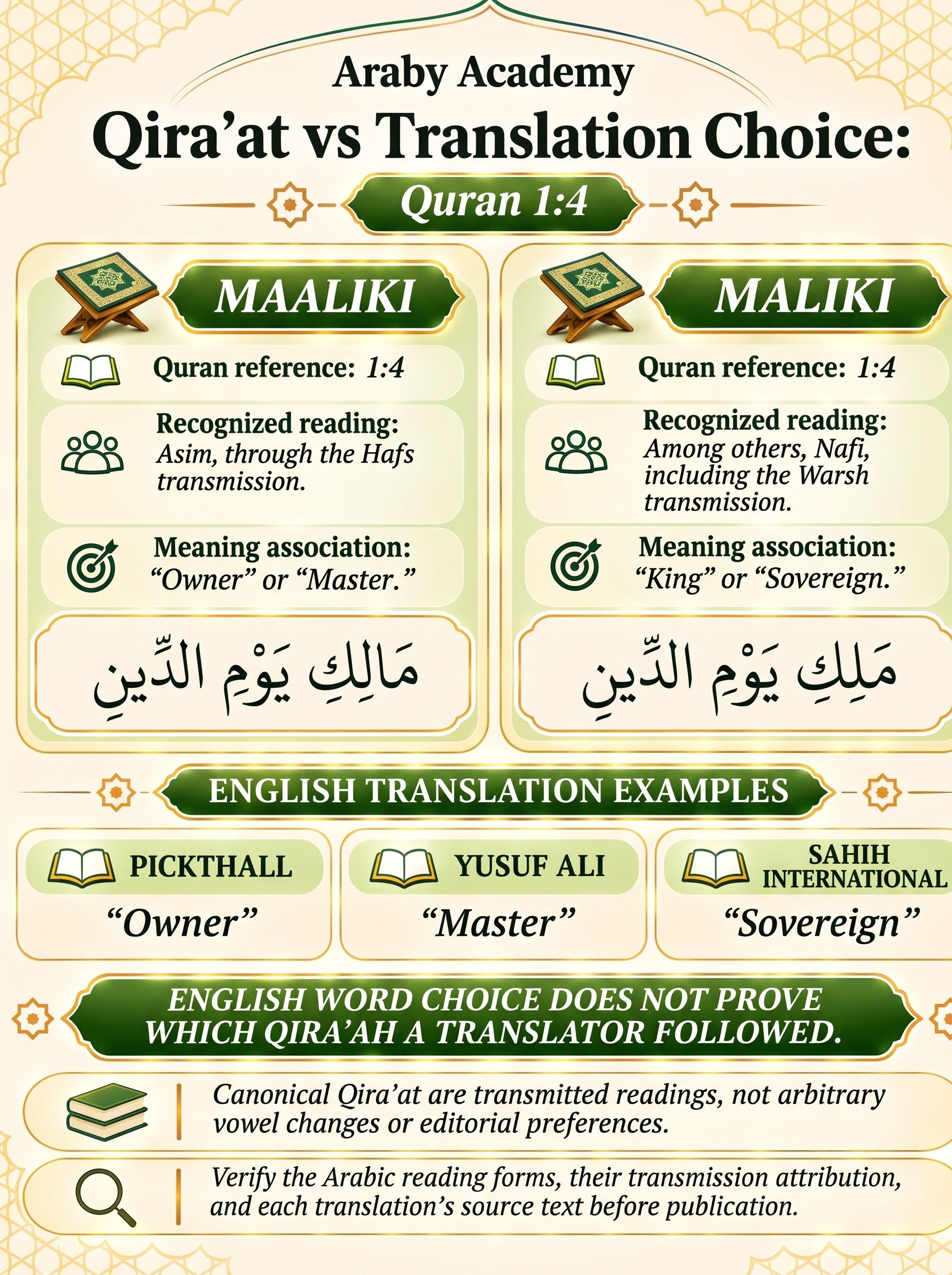
Example: Quran 1:4
Two recognized forms are مَالِكِ يَوْمِ الدِّينِ (Māliki) and مَلِكِ يَوْمِ الدِّينِ (Maliki). Māliki is the reading of ʿĀṣim in the Ḥafṣ transmission widely printed today. Maliki is read by others, including Nāfiʿ, whose transmission includes Warsh. Māliki is associated with owner or master, and Maliki with king or sovereign.
Pickthall uses "Owner," Yusuf Ali uses "Master," and Sahih International uses "Sovereign." These words cannot reveal which reading a translator followed. Most English translations are prepared alongside the Ḥafṣ text, so "Sovereign" there reflects a lexical choice, not a Warsh reading. Lexical choice and choice of reading are related questions, but they are not identical.
Classical commentators explain both readings within the recognized transmission tradition. The two senses are not identical in every respect, but they are understood as complementary and not contradictory to Allah's oneness. Recognized readings have evidence and limits, so the existence of Qira'at does not make any English interpretation acceptable. To understand why this example differs from ordinary translator word choice, study the canonical Qira'at and how their transmitted readings work before assuming every English variation comes from a different Quranic reading.
Takeaway: when a difference seems connected to a reading, identify the verse, the reading and narration involved, and the exact word form, and consult established Qira'at scholarship rather than guessing from English.
The Seven Reasons at a Glance
Reason | What changes in English | Quranic example | What to check |
|---|---|---|---|
1. Semantic range | Choice among related senses | 2:183, tattaqūn | The Arabic word and its contextual use |
2. Grammar and word forms | Passive, pronouns and structure reshaped | 2:183, kutiba | Verb form, voice and attached pronouns |
3. Word order and emphasis | "Alone" or "It is You" added | 1:5, iyyāka naʿbudu | Fronting and particles |
4. Metaphor and imagery | Image kept or explained | 2:187, libās | Whether the explanation has Tafsir support |
5. Context and Tafsir | Referent or interpretation chosen | 2:30, khalīfah | Surrounding verses and classical Tafsir |
6. Style and editorial choices | Register, brackets, explanation | 2:183, Pickthall and Haleem | The translator's method and edition |
7. Qira'at | Rare; only some verses | 1:4, Māliki and Maliki | The reading, narration and exact word form |
Verse 2:183 appears in three rows because it illustrates different aspects of translation, not three independent examples.
Do Different English Quran Translations Actually Contradict Each Other?
Most differences are not contradictions, but they are not all equally harmless. Four categories help:
A. Style difference. Different English wording, substantially similar meaning, such as "decreed" and "prescribed."
B. Difference in emphasis. Related meanings highlighting different aspects, such as "Lord" and "Sustainer" in 1:2.
C. Interpretive difference. Different readings of a context-sensitive expression that need scholarly evaluation, such as "successor" and "vicegerent" in 2:30.
D. Possible translation error. A wording that is unsupported, misleading or inaccurate when checked against the Arabic and reliable scholarship. Claims of this kind belong to specialists, and no named translation is accused here.
Two sentences can use different words without logical contradiction. Two translations can highlight different aspects of one passage. But some differences involve genuinely different interpretations, so a reader should not conclude that all translations are identical in meaning or that every difference proves contradiction. Before calling something a contradiction, ask whether the English sentences are logically incompatible, whether they discuss the same referent, and whether one is simply preserving an image or adding a bracketed explanation.
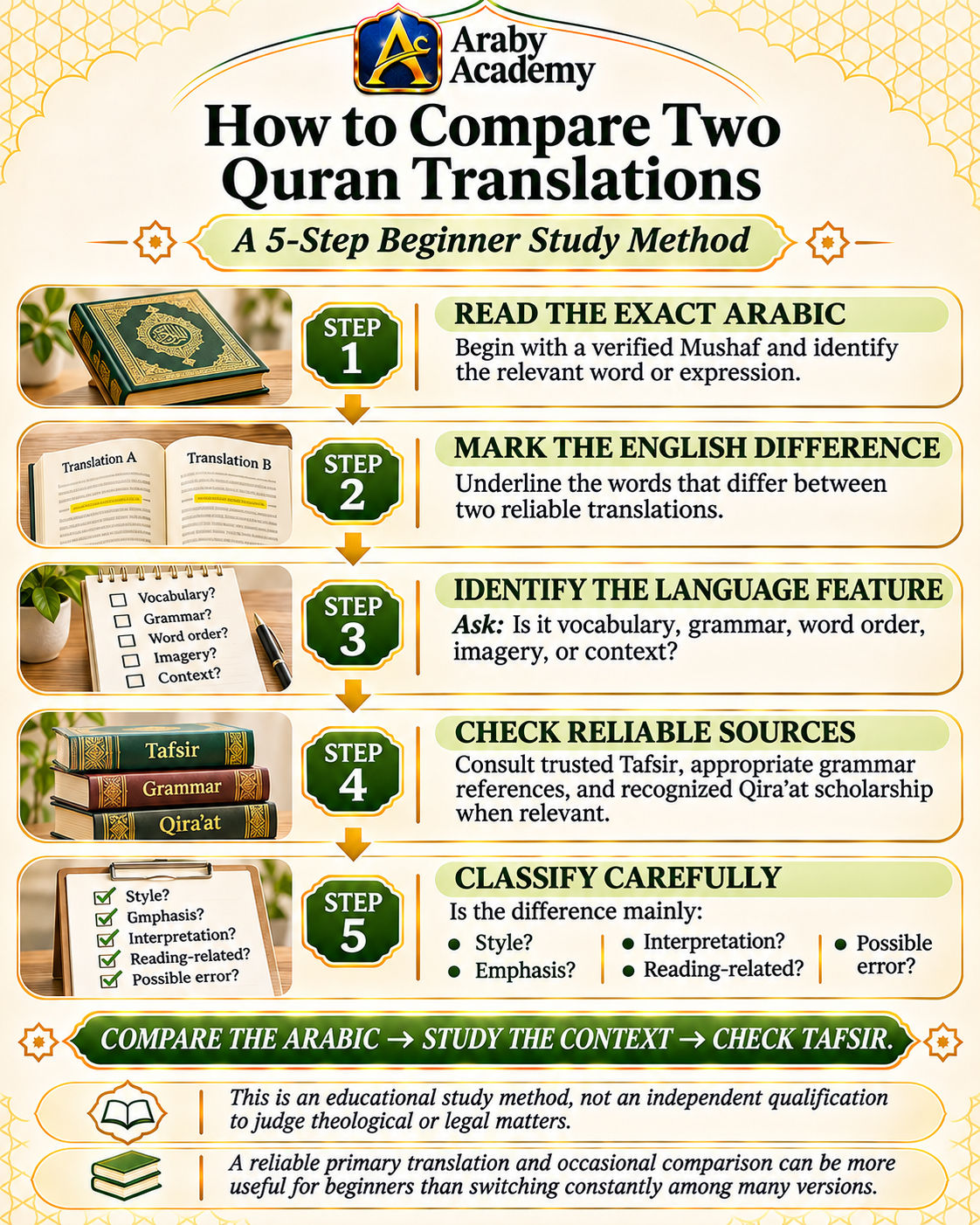
How to Compare Two Quran Translations Step by Step
A simple five-step method keeps comparison disciplined.
Read the exact Arabic. Begin with the verse itself, for example لَعَلَّكُمْ تَتَّقُونَ in 2:183.
Underline the English difference. Mark the words that differ, such as "righteous" and "mindful of God."
Identify the language feature. Ask whether it concerns word meaning, grammar, word order, imagery or context. Here it is semantic range.
Check reliable sources. Consult a classical Tafsir and, when a reading may be involved, Qira'at sources.
Classify. Decide whether the difference is style, emphasis, interpretation, reading-related, or possible error.
English pronouns add another layer of difficulty. A verse may contain divine speech, narration, quotation or embedded dialogue, and a translator may clarify who is speaking, which can change the English sentence. Pronoun differences are easier to evaluate when readers understand [ why the Quran sometimes uses 'He,' 'We,' and 'I'], particularly in passages that move between narration and direct speech.
A Beginner Worksheet
Verse | Arabic | Translator A | Translator B | What differs | Likely reason | Source to verify |
|---|---|---|---|---|---|---|
2:183 | تَتَّقُونَ | Sahih International: "become righteous" | Abdel Haleem: "mindful of God" | Outcome versus awareness | Semantic range | Quranic Arabic Corpus; a classical Tafsir |
(your verse) |
When to Ask a Teacher or Scholar
Seek help when a translation seems to change a theological teaching, a legal ruling looks different, a pronoun's referent is disputed, a reading variation is involved, two translators appear to follow different Tafsir views, or a familiar English word lacks an obvious dictionary basis. Independent learners are not being shamed here; these are simply the places where scholarly training matters most.
Should You Read More Than One Translation?
A reliable primary translation gives continuity, and a second one can illuminate difficult passages. Endlessly switching between many translations without guidance can create confusion, so there is no single prescription for every learner.
Common Misconceptions About Quran Translations
Myth: every translation uses the same wording. Reality: translators make linguistic and editorial decisions.
Myth: different wording always means contradiction. Reality: many differences concern style or emphasis.
Myth: every difference is harmless. Reality: some are substantive interpretive choices, or errors.
Myth: every Arabic word has one perfect English equivalent. Reality: semantic ranges and contexts differ.
Myth: the most literal translation is always best. Reality: literalness may obscure idiom.
Myth: explanatory translation is always inaccurate. Reality: supported explanation helps if identifiable.
Myth: brackets mean invented content. Reality: they usually mark supplied words; conventions vary.
Myth: more words mean more accuracy. Reality: length does not establish accuracy.
Myth: Qira'at explain every English difference. Reality: most need no different reading.
Myth: learning a root reveals the full meaning. Reality: grammar and context matter.
Myth: Tafsir and translation are identical. Reality: they do different jobs.
Myth: every translation is equally well supported. Reality: each rendering needs evaluation against evidence.
Frequently Asked Questions
Why do Quran translations sometimes say different things? Arabic words have ranges of meaning, grammar and emphasis do not map neatly into English, and translators differ in method, audience and use of Tafsir.
Are different Quran translations contradictions? Usually not. Most differences concern wording, emphasis or interpretation, though some require scholarly evaluation and a few may be errors.
Which English Quran translation is the most accurate? No single answer fits every verse or reader. Evaluate specific renderings against the Arabic and reliable Tafsir rather than trusting a general ranking.
Why is Taqwa translated differently? Taqwa involves awareness, guarding and restraint, which no single English word captures. Translators foreground different aspects, as 2:183 shows.
What is the difference between literal and explanatory translation? Literal translation stays close to Arabic wording and structure; explanatory translation adds clarification. Each has strengths and limits.
Can Arabic grammar change how an Ayah is translated? Yes. Voice, pronouns, particles and word forms may need reshaping or extra English words to convey the same relationships.
How are Quranic metaphors translated? Some translators keep the image, others explain it. Explanations should be supported by recognized Tafsir and should not erase the original image.
What is the role of Tafsir in translating the Quran? Tafsir helps clarify context, referents and the sense of difficult words. A translator may follow one supported interpretation.
Can Asbab al-Nuzul affect translation choices? Sometimes, when a reliably established occasion clarifies a passage. Many verses lack a securely established occasion, and weak reports should not decide meaning.
Why do older translations sound different? Older translations use archaic English such as "ye" and "thee." That affects register and familiarity, not automatically accuracy.
Do canonical Qira'at affect English Quran translations? Only in some verses, such as 1:4. Most English differences come from ordinary translation choices, not different readings.
What is the difference between Malik and Maalik in Al-Fatihah? Māliki means owner or master; Maliki means king or sovereign. Both are recognized readings, and they are not translator preferences.
Can learning Quranic Arabic help me compare translations? Yes. Roots, grammar and particles help you see why wording differs, though Tafsir remains necessary for interpretive questions.
Should beginners read several English Quran translations? A reliable primary translation plus occasional comparison can help. Switching constantly without guidance may cause confusion.
What should I do if two translations disagree? Identify the verse and the Arabic word, read the context, check reliable Tafsir, and consult a teacher if the matter is consequential.
Conclusion: Compare the Arabic, Check the Context, and Learn with Care
When two Quran translations use different English words, you do not need to assume immediately that the verse contains a contradiction, or that both renderings must be equally precise. Begin with the Arabic expression, examine the grammatical and contextual clues, and consult reliable Tafsir when the meaning is difficult. Comparing translations thoughtfully can become a valuable part of learning Quranic Arabic, helping you appreciate both the usefulness of English translations and the importance of studying the Quran's original language. If you would like to learn Quranic Arabic and Tafsir step by step, Araby Academy's qualified teachers would be glad to help.