
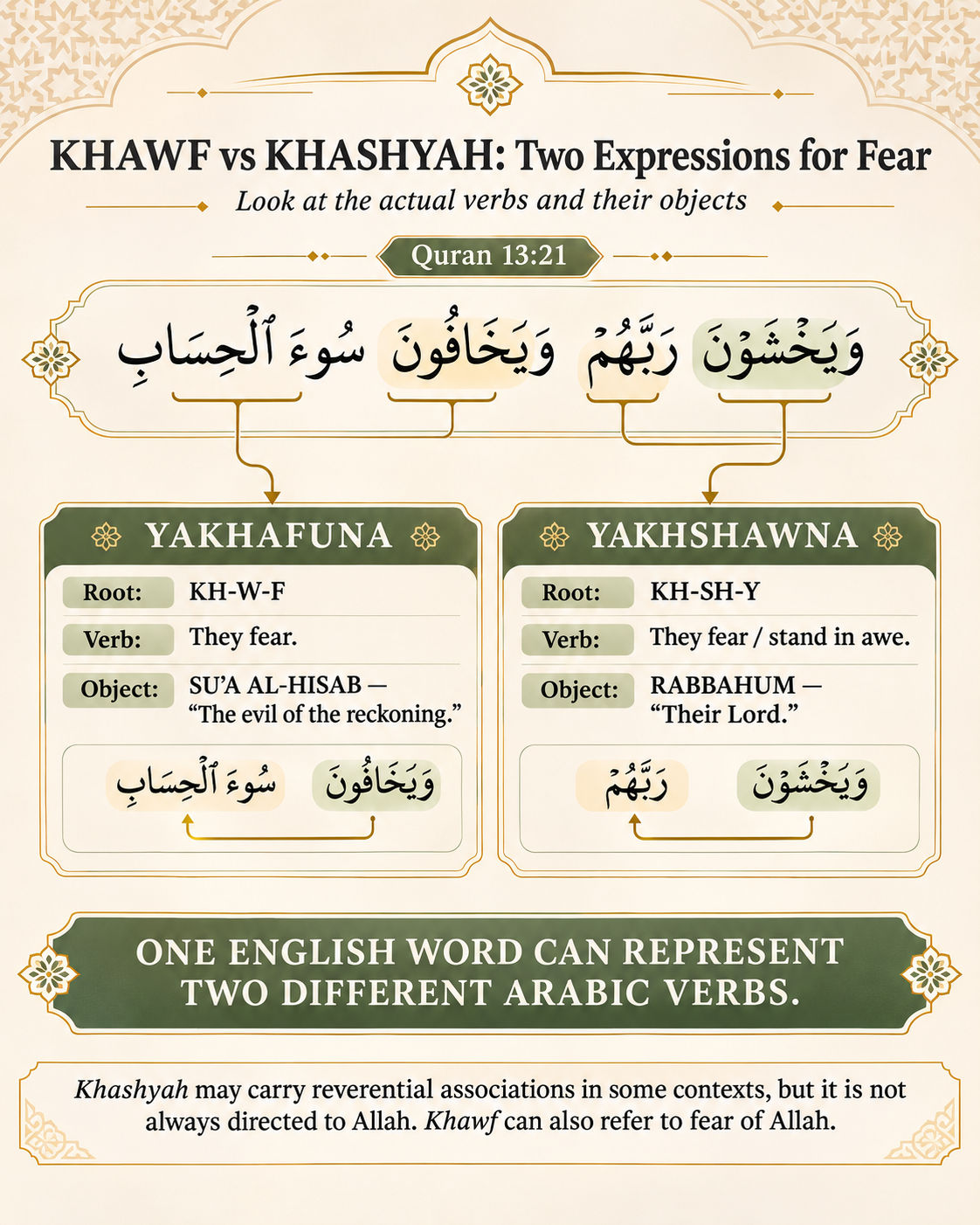
Open two English translations of Quran 13:21 and you may see the word “fear” twice. The Arabic uses two different verbs: وَيَخْشَوْنَ رَبَّهُمْ وَيَخَافُونَ سُوءَ الْحِسَابِ (wa-yakhshawna rabbahum wa-yakhafuna su’a l-hisab). The first, from the root kh-sh-y, takes “their Lord” as its object. The second, from kh-w-f, takes “the evil of the reckoning.”
The useful question is not “Which single English word is always correct?” It is: “What do the Arabic forms, objects, context, and classical explanations tell us?” This article studies ten Quranic word pairs that English tends to bring close together, without inventing distinctions that the Arabic or Tafsir does not support.
Short answer: Some Quranic Arabic words share English translations while keeping different roots, grammatical forms, or contextual uses. Khawf and Khashyah can both be rendered “fear,” and Qalb and Fu’ad can both be rendered “heart.” Their differences are best studied in actual verses, with morphology, context, lexicons, and reliable Tafsir. The words are not automatically interchangeable, but a proposed distinction should never be inflated into a universal rule. Overlap and difference often coexist.
10 Quranic Arabic Word Pairs at a Glance
Pair | English overlap | Difference to investigate | Example |
|---|---|---|---|
Rahmah / Maghfirah | mercy, forgiveness | different roots; forgiveness concerns wrongdoing | 7:156; 3:133 |
Khawf / Khashyah | fear, awe | different objects and collocations | 13:21 |
Qalb / Fu’ad | heart | placement within one verse | 28:10 |
ʿIlm / Hikmah | knowledge, wisdom | related but not identical | 2:32; 2:269 |
Huda / Rushd | guidance | verb and noun working together | 72:2 |
ʿAdl / Qist | justice, fairness | large overlap | 16:90; 4:135 |
Ithm / Dhanb | sin | singular versus plural form | 2:219; 3:135 |
Salah / Du’a | prayer | formal prayer versus supplication | 2:43; 14:40 |
Jannah / Firdaws | paradise, garden | one construction | 18:107 |
Haqq / Sidq | truth | broad, overlapping fields | 17:81; 39:33 |
Why Different Quranic Arabic Words Can Look Similar in English
English and Arabic divide meaning differently. One English word, such as “fear” or “heart,” may cover several Arabic words, and a translator who wants readable English cannot always show every difference. That does not make the translation wrong; it means the Arabic deserves checking. To understand why one English word may represent different Arabic expressions, begin with [ the reasons Quran translations sometimes choose different English wording] rather than assuming translation is a simple one-to-one substitution.
The key principle is that overlap is not identity. Two words sharing an English gloss does not prove they are the same, and it does not prove they are entirely separate. A fair comparison states the shared meaning, any difference the evidence supports, and the limits of that difference. The Quran may well use near-synonyms; the aim is to avoid forcing a sharp contrast where the evidence shows none.
Three phenomena should also be kept apart: different words sharing one gloss (this article’s topic), one word with several senses, and different inflected forms of one word.
What Makes Two Arabic Words Different?
A difference can be of several kinds, which are related but not identical: a different root (kh-w-f versus kh-sh-y), a different word class (verb versus noun), a different morphological pattern, a different collocation (what a word typically pairs with), a different context, or a different meaning. A change of root does not automatically prove total semantic separation, and a shared root does not guarantee interchangeability. Students new to this kind of comparison can first explore [ what Quranic Arabic study involves beyond memorizing vocabulary] to see how grammar, reading, and meaning fit together.
How Roots, Word Forms, and Context Affect Meaning
A root (جَذْر, jidhr) is a set of consonants linking a family of related words. It is a clue to that family, not a complete definition of any individual Quranic word, and no religious interpretation should rest on a root gloss alone. Recognizing [ important Arabic roots that connect related Quranic words] can help learners study vocabulary more systematically, provided each derived form is checked in its actual context.
Forms matter as much as roots. The ten pairs use teaching headwords, but verses use inflected forms: ذَنْب (Dhanb) appears as the plural ذُنُوب (Dhunub) in 3:135, خَوْف (Khawf) is illustrated by the verb يَخَافُونَ (yakhafuna), and هُدًى (Huda) is illustrated by the verb يَهْدِي (yahdi). Each quotation below uses the verse’s actual form. Transliteration is simplified: ʿ marks the letter ʿayn (ع), ’ marks the hamza (ء), and Arabic script is primary. English renderings are plain explanatory glosses, not quotations from a published translation.
10 Quranic Arabic Word Pairs Explained
1. Rahmah vs Maghfirah: Mercy and Forgiveness
رَحْمَة (Rahmah; root ر-ح-م, R-H-M) is a verbal noun, usually rendered “mercy.” مَغْفِرَة (Maghfirah; root غ-ف-ر, GH-F-R) is a noun from the verb ghafara, usually rendered “forgiveness.”
In 7:156, وَرَحْمَتِي وَسِعَتْ كُلَّ شَيْءٍ (“My mercy encompasses all things”), rahmati is a noun with the attached pronoun “my.” In 3:133, وَسَارِعُوا إِلَىٰ مَغْفِرَةٍ مِنْ رَبِّكُمْ (“and hasten to forgiveness from your Lord”), maghfiratin follows the preposition ila.
Maghfirah concerns wrongdoing being forgiven, while rahmah is used more widely, as the phrase “all things” in 7:156 shows. The two also sit close together in the divine names Ghafur and Rahim (2:218). Rahmah and Maghfirah illustrate why some Quranic Arabic words cannot be captured by one simple English equivalent and why a short gloss should be checked against Quranic context.
Insight: Different roots mark different words, even when the ideas are closely connected.
Caution: Do not claim that mercy never includes forgiveness, or that one word is “emotional” and the other “legal.” Many readers understand forgiveness as an expression of mercy, so the concepts are connected.
Try it: Which noun in 3:133 concerns forgiveness? Which noun in 7:156 concerns mercy? What do the roots R-H-M and GH-F-R tell you, and why should the concepts still not be treated as unrelated?
2. Khawf vs Khashyah: Two Expressions for Fear
خَوْف (Khawf; root خ-و-ف, KH-W-F) and خَشْيَة (Khashyah; root خ-ش-ي, KH-SH-Y) are verbal nouns, both often rendered “fear” or “awe.” Note that 13:21 contains the verbs يَخْشَوْنَ (yakhshawna) and يَخَافُونَ (yakhafuna), not these nouns. The nouns appear elsewhere, for example الْخَوْفِ in 2:155 and خَشْيَةِ in 4:77.
In 13:21 the verbs take different objects: “their Lord” (rabbahum) and “the evil of the reckoning” (su’a l-hisab). Al-Raghib’s Mufradat describes khashyah as fear mixed with reverence, most often arising from knowledge of what is feared. Quran 35:28, إِنَّمَا يَخْشَى اللَّهَ مِنْ عِبَادِهِ الْعُلَمَاءُ, is often cited alongside this: Allah is the object and al-ʿulama’ the subject, so those with knowledge are the ones who stand in awe of Allah. That links reverent fear with knowledge in this passage, but one passage is not a dictionary rule.
The limits are visible. In 4:77, يَخْشَوْنَ النَّاسَ (“they fear people”) uses khashyah for people, and in 3:175, وَخَافُونِ (“and fear Me”), khawf is directed to Allah. Readers exploring different Quranic expressions for fear and reverence should also understand [ why Taqwa means more than simply fearing Allah], since it belongs to a related discussion but is not interchangeable with every fear-related term.
Insight: Look at the grammatical object of each fear-related verb before choosing an English word.
Caution: Neither “Khashyah is always reverence for Allah” nor “Khawf is only worldly danger” survives these verses. Consult classical lexicons and Tafsir before assigning a rigid difference.
Try it: Which two verbs appear in 13:21? What are their grammatical objects? Does the verse itself require two completely different English words? Why must context be considered?
3. Qalb vs Fu’ad: Two Words for Heart
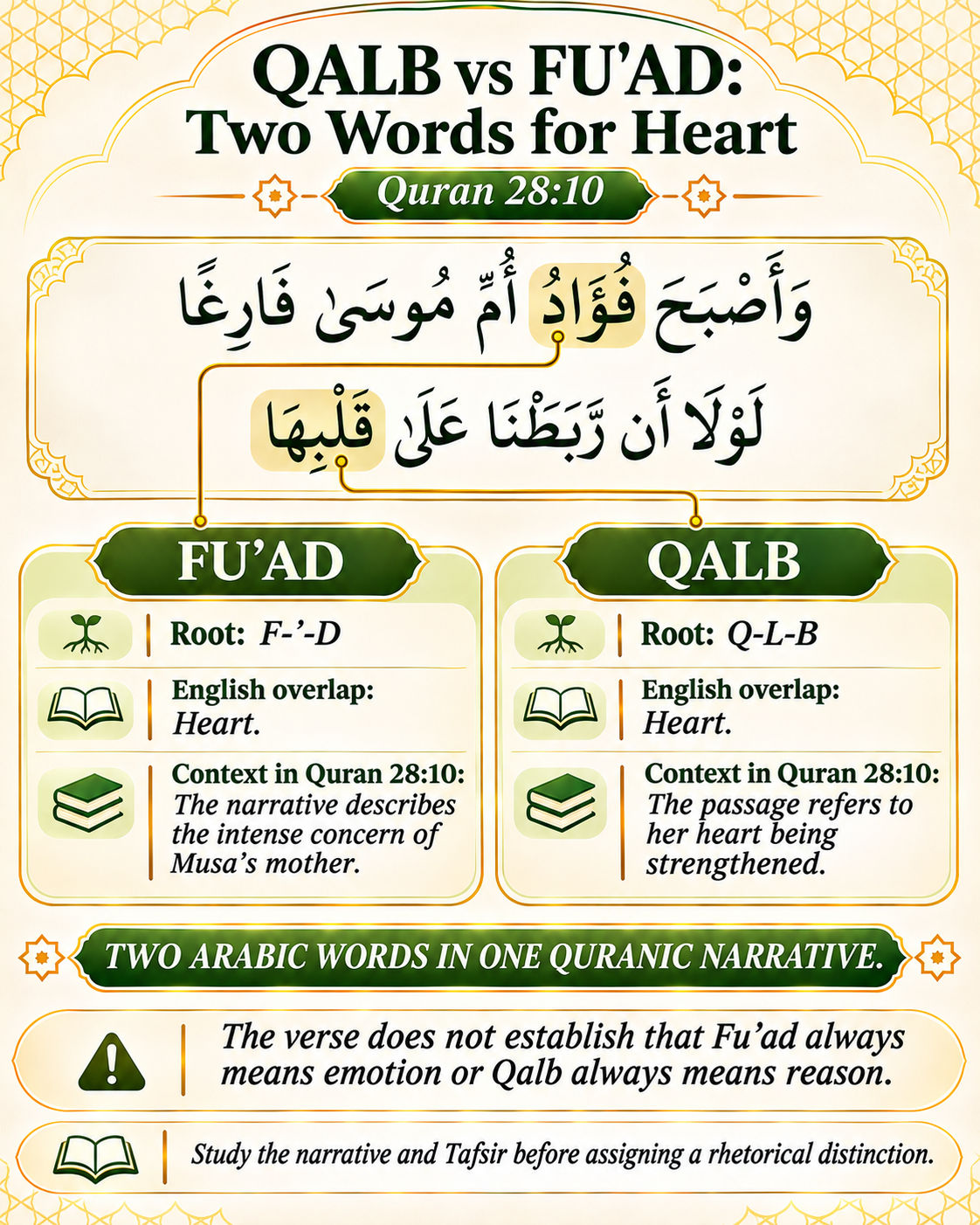
قَلْب (Qalb; root ق-ل-ب, Q-L-B) and فُؤَاد (Fu’ad; root ف-ء-د, F-’-D) are nouns, both often rendered “heart.” Qalb is much the more frequent in the Quran.
Quran 28:10 contains both, in the account of the mother of Musa: وَأَصْبَحَ فُؤَادُ أُمِّ مُوسَىٰ فَارِغًا ... لَوْلَا أَن رَّبَطْنَا عَلَىٰ قَلْبِهَا (“the fu’ad of Musa’s mother became empty ... had We not bound her qalb”). Classical commentators, including al-Tabari, record more than one explanation of “empty,” such as emptied of everything but concern for her son. One may notice distress described through fu’ad and divine strengthening through qalb, but no source makes this a fixed lexical rule.
Other verses complicate any formula. Quran 26:194 places revelation عَلَىٰ قَلْبِكَ (“upon your heart”), while 17:36 lists السَّمْعَ وَالْبَصَرَ وَالْفُؤَادَ (hearing, sight, and fu’ad) among things we will be asked about, which ties fu’ad to perception and accountability, not only emotion. The appearance of Qalb and Fu’ad in one verse demonstrates why [ Quranic expressions can carry more nuance than a short English translation reveals], especially when imagery and narrative context interact.
Insight: Studying both words inside the passage teaches more than memorizing a two-word formula.
Caution: Do not claim that Fu’ad always means emotion, that Qalb always means reason, or that either is exclusively a physical or spiritual organ. The Quran uses both across varied contexts, and any rhetorical contrast in 28:10 needs attributed support.
Try it: Where does Fu’ad appear in 28:10? Where does Qalb appear? Why is it more accurate to study both words in the passage than to invent an emotional-versus-intellectual formula?
4. ʿIlm vs Hikmah: Knowledge and Wisdom
عِلْم (ʿIlm; root ع-ل-م, ʿ-L-M) is a verbal noun meaning knowledge. حِكْمَة (Hikmah; root ح-ك-م, H-K-M) is a noun usually rendered “wisdom.”
In 2:32 the angels say لَا عِلْمَ لَنَا إِلَّا مَا عَلَّمْتَنَا (“We have no knowledge except what You taught us”). In 2:269 we read يُؤْتِي الْحِكْمَةَ مَنْ يَشَاءُ (“He grants wisdom to whom He wills”). Notice that 2:32 ends with the names الْعَلِيمُ الْحَكِيمُ, from these same root families.
In 2:32 knowledge is something taught; in 2:269 hikmah is something granted, and the verse calls it abundant good. Yet 2:129 says the Prophet teaches الْكِتَابَ وَالْحِكْمَةَ, so hikmah can be taught too. Classical commentators record several explanations of hikmah, including understanding of the Quran or religion, the Sunnah, and sound judgment, so its sense depends on the passage. Al-Raghib’s Mufradat connects hikmah with reaching what is right by means of knowledge and reason.
Insight: Related ideas can share a verse, and even a root-family pairing of divine names, without being synonyms.
Caution: Do not reduce Hikmah to “applied knowledge” in every verse, or to a motivational slogan. Related concepts do not become interchangeable merely because they are related.
Try it: Which cited verse contains ʿIlm? Which contains Hikmah? What does the immediate context say, and why do the words not become interchangeable?
5. Huda vs Rushd: Guidance and Right Direction
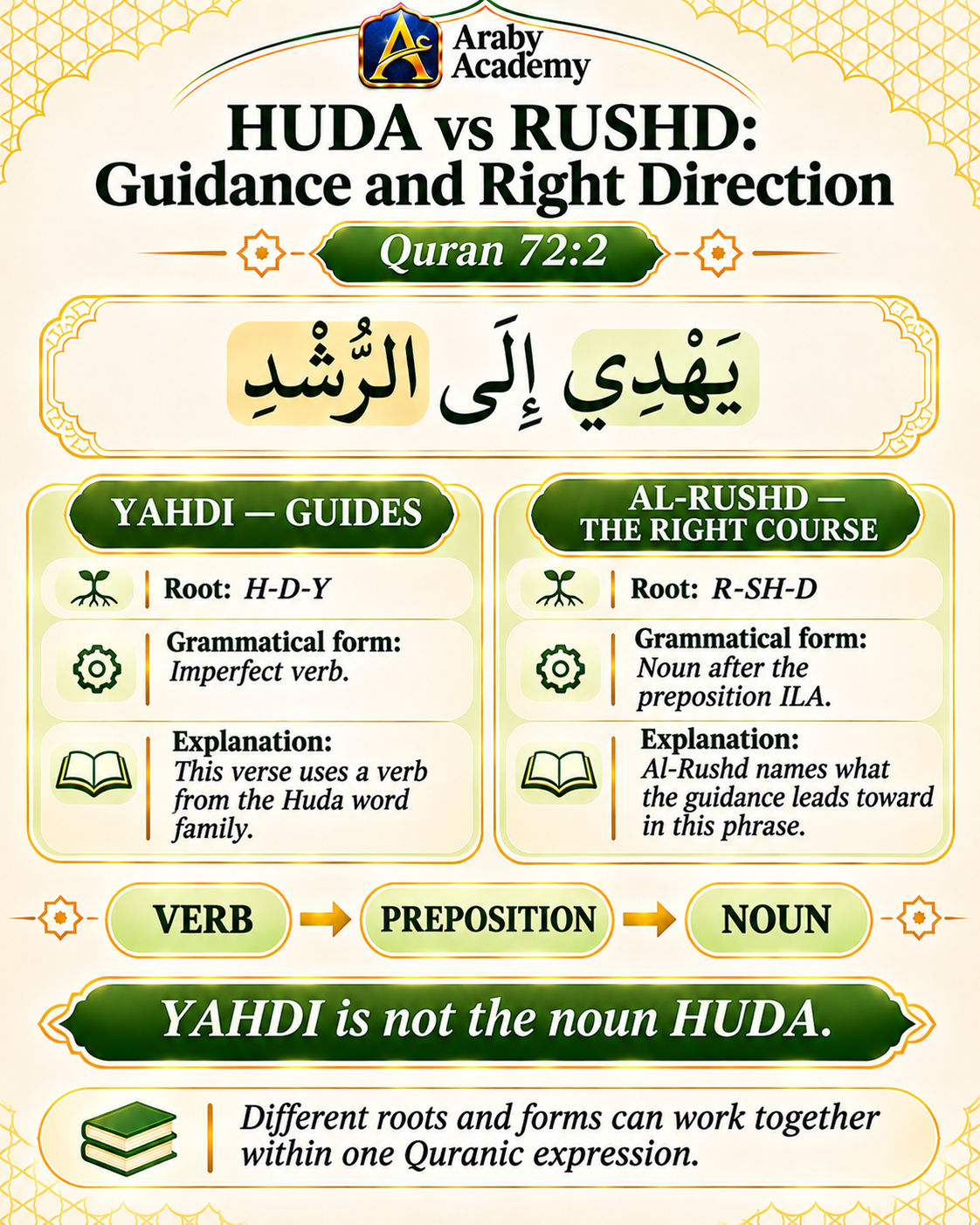
هُدًى (Huda; root ه-د-ي, H-D-Y) is a noun, usually “guidance.” رُشْد (Rushd; root ر-ش-د, R-SH-D) is a noun, usually “right judgment” or “the right course.”
In 2:2, هُدًى لِلْمُتَّقِينَ (“guidance for the God-conscious”), huda is indefinite, and its case ending is hidden by the final alif. In 2:256, قَدْ تَّبَيَّنَ الرُّشْدُ مِنَ الْغَيِّ (“right guidance has become distinct from error”), al-rushd is the subject of tabayyana and is set against al-ghayy.
Quran 72:2 is especially useful: يَهْدِي إِلَى الرُّشْدِ (“it guides to the right course”). Yahdi is a verb from H-D-Y, not the noun huda, and al-rushdi is a noun from R-SH-D following ila. The phrase itself shows guiding leading toward rushd: related meanings, different roots, different grammatical forms.
Insight: One short phrase can show how two word families work together.
Caution: “Huda shows the road, Rushd reaches the destination” can work as a teaching image, but it is not an established dictionary rule. The verses establish a relationship, not a universal formula.
Try it: Which form in 72:2 is a verb? Which is a noun? Which roots do they represent? How does the whole phrase explain their relationship?
6. ʿAdl vs Qist: Justice and Fairness
عَدْل (ʿAdl; root ع-د-ل, ʿ-D-L) is a verbal noun, “justice” or “equity.” قِسْط (Qist; root ق-س-ط, Q-S-T) is a noun, “justice” or “fairness.”
In 16:90, إِنَّ اللَّهَ يَأْمُرُ بِالْعَدْلِ وَالْإِحْسَانِ (“Allah commands justice and excellence”), al-ʿadl is genitive after bi- and joined with al-ihsan. In 4:135, كُونُوا قَوَّامِينَ بِالْقِسْطِ (“be upholders of justice”), qawwamin is an intensive plural participle and al-qist follows bi-. Quran 5:8 uses both roots, بِالْقِسْطِ and the imperative اعْدِلُوا, which shows real overlap.
Q-S-Ṭ needs care. Muqsit (الْمُقْسِطِينَ, 5:42), from aqsata, describes those who act justly, whereas qasit (الْقَاسِطُونَ, 72:14) describes those who deviate. Derivatives of one root need not share a direction of meaning. Comparing related concepts is more reliable when students understand how Nahw and Sarf explain different aspects of Quranic Arabic, because a word's pattern and grammatical role can affect how it is understood.
Insight: Check the pattern of a word, not only its root.
Caution: Do not say that ʿAdl always means courtroom justice or that Qist always means financial fairness. The two overlap substantially, and any lexicographer’s distinction should be attributed precisely rather than universalized.
Try it: Which verse uses ʿAdl? Which uses Qist? How do the surrounding constructions differ? Why can “justice” suit both without proving they are the same Arabic word?
7. Ithm vs Dhanb: Words for Sin
إِثْم (Ithm; root أ-ث-م, ’-TH-M) and ذَنْب (Dhanb; root ذ-ن-ب, DH-N-B) are nouns, both often rendered “sin” or “wrongdoing.”
In 2:219, فِيهِمَا إِثْمٌ كَبِيرٌ (“in them is great sin”), ithmun is singular, indefinite, and nominative, described by kabir. In 3:135, فَاسْتَغْفَرُوا لِذُنُوبِهِمْ (“and sought forgiveness for their sins”), the word is ذُنُوب (Dhunub), the plural of Dhanb, with the attached pronoun “their.” The two cited forms therefore differ first in grammar, singular versus plural, not in severity. The same verse also mentions fahishah and wronging oneself, a reminder that Quranic vocabulary for wrongdoing is wide.
Insight: Identify number and attached pronouns before comparing meaning.
Caution: Do not claim that Ithm means deliberate sin, that Dhanb means accidental sin, or that either marks a major or minor category. Legal classifications require Tafsir and jurisprudence, not lexical guesswork.
Try it: Which selected verse uses Ithm? Which uses the plural Dhunub? What does the grammar tell us? Why should we avoid inventing a universal ranking of severity?
8. Salah vs Du’a: Two Expressions for Prayer
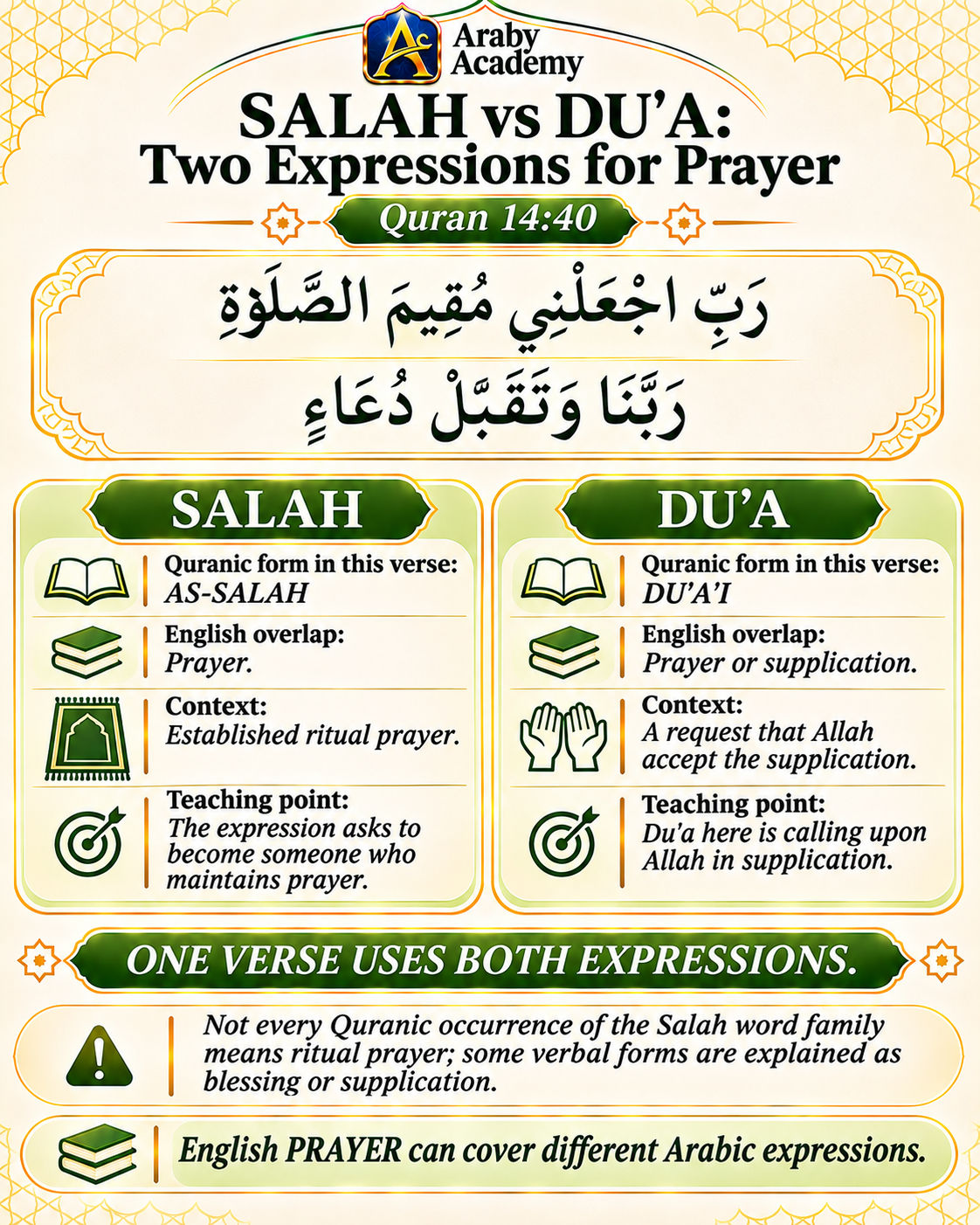
صَلَاة (Salah) is a noun, usually “prayer.” Its root is most often listed as ص-ل-و (S-L-W), including in the Quranic Corpus, though lexicographers discuss it in more than one way, so treat the root lightly. دُعَاء (Du’a) is a verbal noun from the root د-ع-و (D-ʿ-W), “calling upon” or “supplication.”
In 2:43, وَأَقِيمُوا الصَّلَاةَ (“and establish the prayer”), al-salata is the object of the imperative aqimu. Quran 14:40 contains both words: رَبِّ اجْعَلْنِي مُقِيمَ الصَّلَاةِ ... رَبَّنَا وَتَقَبَّلْ دُعَاءِ (“make me an establisher of prayer ... and accept my supplication”), where the kasra in the common Hafs text marks “my.”
In these verses Salah is the established prayer and Du’a a request, a familiar and useful distinction. It is not universal. In 9:103, وَصَلِّ عَلَيْهِمْ is commonly understood as invoking blessing on them, and Tafsir explains the verb يُصَلُّونَ in 33:56 as Allah’s praise or mercy and the angels’ supplication, a view reported from early authorities such as Abu al-ʿAliyah, without implying that Allah performs human ritual prayer. The difference between Salah and Du’a also shows why Quranic Arabic grammar clues can change how an Ayah is understood, especially when similar English glosses conceal distinct Arabic constructions.
Insight: One English word may cover a ritual noun, a request, and a verb of blessing.
Caution: Do not say that every Quranic occurrence of Salah means the five daily prayers, or that Du’a is limited to one narrow form. Only the immediate verse can show which sense is intended.
Try it: What does Salah mean in 2:43? What is the speaker requesting in 14:40? Why can English use “prayer” for both while Arabic keeps distinct expressions?
9. Jannah vs Firdaws: Paradise and Firdaws
جَنَّة (Jannah; root ج-ن-ن, J-N-N) is a feminine noun meaning “garden” or “Paradise,” with the plural جَنَّات (jannat). فِرْدَوْس (Firdaws) is a noun that many lexicographers regard as a borrowed word, so it is not simply a derived form of Jannah. English “heaven” can also mean the sky or heavens (sama’), so it is not always a safe match for Jannah.
In 2:25, جَنَّاتٍ تَجْرِي مِنْ تَحْتِهَا الْأَنْهَارُ (“gardens beneath which rivers flow”), jannat is plural and indefinite. Jannah can even describe an ordinary garden, as in 18:32, جَنَّتَيْنِ. In 18:107, كَانَتْ لَهُمْ جَنَّاتُ الْفِرْدَوْسِ نُزُلًا (“the gardens of Firdaws will be their welcome”), jannatu is the first term of an idafa construction and al-firdawsi, in the genitive, completes it. Firdaws occurs in the Quran only here and in 23:11.
The grammar links the two terms; it does not present two unrelated places. Authentic reports in Sahih al-Bukhari describe Firdaws as the highest part of Paradise, but that is Hadith-based explanation, separate from the lexical evidence of the verse. Jannah and Firdaws are a useful reminder that Tafsir can explain Quranic details that a short English translation does not fully convey, especially when a passage touches on the unseen.
Insight: An idafa construction shows a grammatical relationship before any theology is added.
Caution: Do not conclude that 18:107 proves two unrelated destinations, and do not add details of the unseen beyond Tafsir and authentic reports. Lexical analysis cannot replace them.
Try it: Which verse contains both terms? What is the grammatical connection in Jannat al-Firdaws? Does the wording imply two unrelated places? What further information requires Tafsir or authentic Hadith?
10. Haqq vs Sidq: Truth and Truthfulness
حَقّ (Haqq; root ح-ق-ق, H-Q-Q) is a noun covering “truth,” “reality,” and “what is due.” صِدْق (Sidq; root ص-د-ق, S-D-Q) is a verbal noun of sadaqa, “truthfulness,” also the truth of what is said or brought.
In 17:81, جَاءَ الْحَقُّ وَزَهَقَ الْبَاطِلُ (“the truth has come and falsehood has vanished”), al-haqq is the nominative subject of ja’a and is set against al-batil. In 39:33, وَالَّذِي جَاءَ بِالصِّدْقِ وَصَدَّقَ بِهِ (“the one who brought the truth and confirmed it”), al-sidq is genitive after bi-, and it is what is brought, not merely a personal quality. Commentators discuss who is meant, with the Prophet and those who affirmed him commonly mentioned. The related verb saddaqa (“confirmed”) appears in the same verse.
Sidq’s range is wide: 54:55 speaks of مَقْعَدِ صِدْقٍ, a “seat of truth” or sound standing, which is far from simple honesty.
Insight: Compare what each noun does in its sentence, not just its English gloss.
Caution: Do not write “Haqq is objective truth and Sidq is personal honesty.” Both words need contextual analysis, and case endings alone do not explain their meanings.
Try it: Which verse uses Haqq? Which uses Sidq? What is each sentence about? Why should “truth” not replace every derived form of either root?
All 10 Word Pairs at a Glance
Pair | English overlap | Examples | Careful distinction | Caution |
|---|---|---|---|---|
Rahmah / Maghfirah | mercy, forgiveness | 7:156; 3:133 | forgiveness concerns wrongdoing; mercy is wider | not emotional versus legal |
Khawf / Khashyah | fear, awe | 13:21; 35:28 | different objects; reverence in some passages | 4:77, 3:175 break rigid rules |
Qalb / Fu’ad | heart | 28:10; 17:36 | two terms in one narrative | no emotion-versus-reason rule |
ʿIlm / Hikmah | knowledge, wisdom | 2:32; 2:269 | taught knowledge; hikmah varies by passage | not simply applied knowledge |
Huda / Rushd | guidance | 2:2; 2:256; 72:2 | noun and verb relation | verb yahdi is not the noun huda |
ʿAdl / Qist | justice | 16:90; 4:135 | strong overlap | no courts-versus-trade rule |
Ithm / Dhanb | sin | 2:219; 3:135 | singular versus plural form | no fixed severity ranking |
Salah / Du’a | prayer | 2:43; 14:40 | formal prayer; supplication | Salah has wider uses |
Jannah / Firdaws | paradise | 18:107; 2:25 | idafa construction | no invented unseen details |
Haqq / Sidq | truth | 17:81; 39:33 | distinct families | neither is one narrow sense |
Why a Shared English Translation Does Not Mean Two Arabic Words Are Identical
A translator may use one English word for two Arabic terms for good reasons: the English overlap is legitimate, the audience needs accessible language, space is limited, or the passage matters more than a fine lexical point. That does not make a translation inaccurate. A rendering deserves questioning only when it hides an important distinction or adds meaning the Arabic does not support, and that must be checked against the Arabic and scholarship, not judged by word count or emotional appeal.
Dictionary glosses need the same care. A lexicon may list several English definitions, but only some fit a given passage, so examine the actual form, part of speech, syntax, neighboring words, and context.
When the Quran Uses Both Expressions in One Verse
Same-verse examples are especially useful because both terms can be studied in one shared context: the verbs yakhshawna and yakhafuna in 13:21, fu’ad and qalb in 28:10, yahdi with al-rushd in 72:2, jannat al-firdaws in 18:107, and al-salah with du’a in 14:40. But co-occurrence does not prove a rigid rhetorical contrast. The relationship may be contrast, complementarity, overlap, grammatical dependency, or a descriptive phrase, and each needs scholarly explanation.
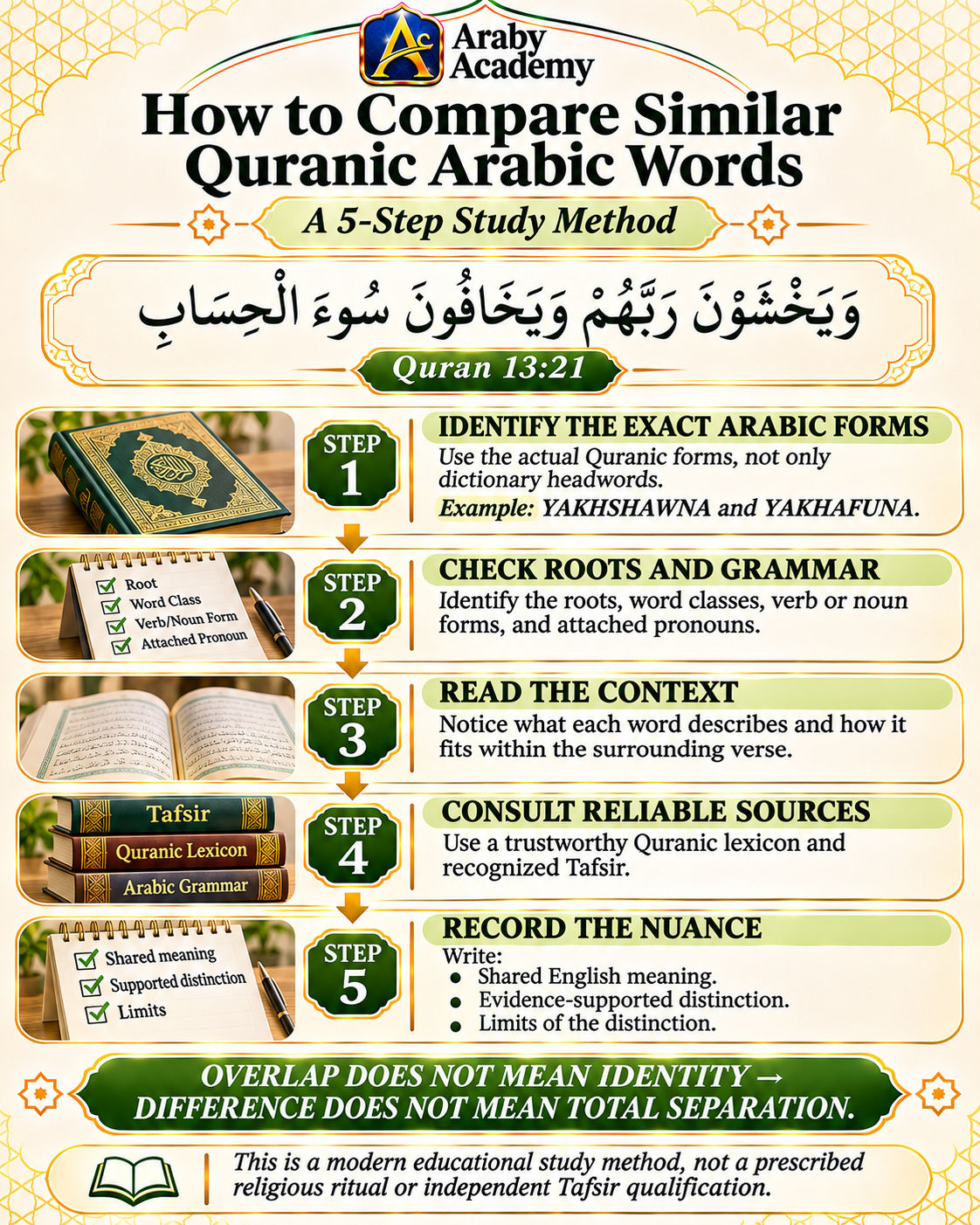
How to Compare Quranic Word Pairs Step by Step
Identify the exact Quranic words, not only the English glosses.
Verify roots and grammatical forms: noun or verb, singular or plural, attached pronouns.
Read the surrounding Arabic and an accurate translation.
Consult a reliable lexicon and Tafsir.
Write the shared meaning, the supported distinction, and the limitations.
The Quranic Arabic Corpus helps verify occurrences, roots, lemmas, parts of speech, and attached pronouns, but it is not a Tafsir, and a short corpus gloss does not settle a semantic debate. Useful lexicons include al-Raghib’s Mufradat fi Gharib al-Quran, Lisan al-ʿArab, and Lane’s Arabic-English Lexicon; check editions. Classical Tafsir such as al-Tabari’s addresses context, speaker, audience, related passages, and scholarly differences, and not every question has one agreed answer. Recognizing ten distinctions is not the same as independently interpreting ten passages.
A sample notebook entry:
Column | Khawf vs Khashyah |
|---|---|
Forms | يَخَافُونَ / يَخْشَوْنَ |
References | 13:21; 35:28; 4:77 |
English gloss | fear |
Difference supported by context | different objects in 13:21; reverence linked with knowledge in 35:28 |
Not established | that either word is always reverent or always worldly |
Next review | check al-Raghib and Tafsir on 13:21 |
A Simple Seven-Day Quranic Vocabulary Study Plan
This optional plan is an introduction, not a promise of mastery. Day 1: Rahmah vs Maghfirah. Day 2: Khawf vs Khashyah. Day 3: Qalb vs Fu’ad. Day 4: ʿIlm vs Hikmah and Huda vs Rushd. Day 5: ʿAdl vs Qist and Ithm vs Dhanb. Day 6: Salah vs Du’a and Jannah vs Firdaws. Day 7: Haqq vs Sidq, then review all ten pairs.
For a flexible ten-minute session, spend 2 minutes reviewing a pair, 3 inspecting one Quranic form, 2 comparing a related form, 2 checking lexicon or Tafsir notes, and 1 recording the key lesson. Readers who want to turn word comparisons into consistent progress can follow [ a step-by-step Quranic Arabic learning roadmap for beginners] while continuing to practice vocabulary, morphology, and grammar.
Common Mistakes When Comparing Quranic Arabic Words
Assuming the same English gloss means identical Arabic words.
Assuming different roots mean unrelated concepts.
Treating a root meaning as the full Quranic definition.
Confusing headwords with exact Quranic forms.
Ignoring morphology.
Ignoring the surrounding verse.
Inventing a universal rule from one example.
Using one English translation as the lexical authority.
Treating all classical explanations as identical.
Drawing religious conclusions from word comparisons without reliable Tafsir.
Frequently Asked Questions
Why do some Quranic Arabic words look the same in English? English often has one word, such as “fear” or “heart,” covering several Arabic words. Translators also prioritize readable English over showing every lexical difference.
Are there synonyms in the Quran? Scholars discuss near-synonyms, and many words overlap, but few are identical in every context. Claims of perfect synonymy or total separation both need evidence.
Can two different Arabic words have the same English translation? Yes. The English may suit both while their roots, forms, and usage differ.
What is the difference between Rahmah and Maghfirah? Rahmah is mercy, used broadly (7:156); Maghfirah is forgiveness of wrongdoing (3:133). They are connected but different words.
What is the difference between Khawf and Khashyah? Both relate to fear. Khashyah is often linked with reverence, but 4:77 uses it for people, so no rigid rule holds.
Why does the Quran use Qalb and Fu’ad? Both are rendered “heart.” Quran 28:10 uses both, but no fixed emotion-versus-intellect rule is established.
Are ʿIlm and Hikmah the same? No, though they are related. ʿIlm is knowledge; Hikmah is wisdom or sound judgment, with interpretations that vary by passage.
What is the difference between Huda and Rushd? Huda is guidance; Rushd is right judgment or the right course. Quran 72:2 pairs the verb yahdi with al-rushd.
Are ʿAdl and Qist interchangeable? They overlap substantially, and 5:8 uses both. Any finer distinction should be attributed to a lexicon or Tafsir, not assumed.
What is the difference between Ithm and Dhanb? They are different word families for sin, and Dhunub is the plural of Dhanb. The words alone do not establish a fixed severity ranking.
Are Salah and Du’a the same kind of prayer? In 2:43 and 14:40, Salah is the established prayer and Du’a is supplication. They are distinct expressions, though English uses “prayer” for both.
Does Salah always mean ritual prayer in the Quran? Not necessarily. Verbal forms in 9:103 and 33:56 are explained as blessing or supplication, so context and Tafsir decide.
What is the difference between Jannah and Firdaws, and is Firdaws in the Quran? Firdaws appears in 18:107 and 23:11. The phrase “gardens of Firdaws” links the terms grammatically; further description comes from Tafsir and authentic Hadith.
What is the difference between Haqq and Sidq? Both relate to truth. Haqq spans truth, reality, and what is due; Sidq covers truthfulness and the truth of what is brought (39:33).
Can Arabic roots reveal the meaning of Quranic words? They indicate word families but are not complete definitions. Always check the form and context.
How can one verse use two similar Arabic words? The relationship may be contrast, complementarity, overlap, or grammatical dependency. Co-occurrence alone does not prove a contrast.
Do I need Tafsir to understand these differences? Yes. Tafsir supplies context, scholarly differences, and theological care that vocabulary study cannot.
How should beginners study similar Quranic Arabic words? Use the five-step method: identify the forms, verify roots, read the verse, consult a lexicon and Tafsir, and record the shared meaning and limits.
Conclusion — Recognize the Word, Check the Context, and Learn the Nuance
Quranic Arabic becomes more rewarding when you begin recognizing the distinctions that a short English translation may not show. Words such as Rahmah and Maghfirah, Qalb and Fu’ad, or Haqq and Sidq can be related without being interchangeable in every context. Learn the Arabic forms, pay attention to their grammatical roles, and check their meanings in real Quranic passages. The goal is not to memorize ten rigid definitions, but to become a more thoughtful and accurate reader of the Quran. If you would like to study Quranic Arabic, vocabulary, and Tafsir with qualified teachers, Araby Academy would be glad to help.