
By Araby Academy. Arabic is shown in simplified vocalized typesetting for teaching; verify against a Mushaf before publication.
15 Small Arabic Words That Completely Change the Meaning of a Quranic Sentence
By Araby Academy. Arabic is shown in simplified vocalized typesetting for teaching; verify against a Mushaf before publication.
Read Quran 2:24 slowly: فَإِنْ لَمْ تَفْعَلُوا وَلَنْ تَفْعَلُوا. An English reader sees two negatives. Arabic grammar sees two different constructions: Lam takes an imperfect verb in the jussive mood, while Lan takes it in the subjunctive and looks toward the future.
Quick answer: Small Arabic words in the Quran often show how the rest of a sentence should be understood. Inna adds emphasis, In can introduce a condition, Lam and Lan form different negative constructions, Illa helps express exception or restriction, and Fa can connect clauses. Their effect depends on grammatical context, not on one English gloss. Learning them helps you notice negation, conditions, emphasis, sequence, and purpose more accurately.
So what other short Arabic words might you be overlooking when reading the Quran? This article studies fifteen, each through one Quranic verse. The title is a curiosity-driven headline: no particle always reverses a verse, but each can make an important grammatical, logical, or rhetorical difference, and we will name that difference precisely.
Why Small Arabic Words Matter in the Quran
Classical grammar sorts words into three categories: ism (nouns and other nominal words), fi'l (verbs), and harf (particle). Here harf does not mean “letter of the alphabet.” Our particles are huruf al-ma'ani, “particles of meaning,” which express relationships rather than supplying the main subject or action. Content words, built on roots, say what is being discussed. Function words say whether it is denied, conditioned, restricted, connected, or intended.
Before studying these particles individually, beginners can explore [what Quranic Arabic is and how its sentences work] to understand why small grammatical words matter as much as vocabulary.
Meaning also depends on the surrounding words, verb form, sentence type, speaker, addressee, wider passage, and reliable Tafsir. A gloss such as “then,” “not,” or “except” is a starting point, not the whole interpretation. Grammar identifies relationships, while Tafsir explains referents, implications, and links to neighboring verses, so particle recognition never replaces it.
Vowel marks matter too. إِنَّ (Inna, with a doubled nun) and إِنْ (In, with a silent nun) are different words with different grammar. The visual difference between Inna and In also shows why [Arabic Harakat help readers distinguish pronunciation and grammatical forms] when studying vocalized Quranic text.
15 Quranic Arabic Particles at a Glance
Particle | Transliteration | Function in this article | Reference | Watch for |
|---|---|---|---|---|
إِنَّ | Inna | Emphasis | 103:2 | Accusative noun follows |
إِنَّمَا | Innama | Restriction or focus | 35:28 | Who is the subject? |
إِنْ | In | “If” | 2:23 | Condition and response |
قَدْ | Qad | Confirmation with a perfect verb | 23:1 | Verb form |
لَا | La | Categorical negation of a noun | 2:2 | No tanween on the noun |
لَمْ | Lam | Negation, jussive | 112:3 | Imperfect verb |
لَنْ | Lan | Future-oriented negation, subjunctive | 2:24 | Not “forever” by itself |
مَا | Ma | Negation here | 93:3 | Other uses exist |
إِلَّا | Illa | Exception or restriction | 11:88 | Read with Ma |
بَلْ | Bal | Correction or transition | 21:5 | Reported claims |
ثُمَّ | Thumma | Sequence, progression | 80:21–22 | Not a stopwatch |
فَـ | Fa | Connection, consequence | 94:7 | Several functions |
أَوْ | Aw | Alternatives | 2:196 | Context-bound |
لَعَلَّ | La'alla | Purpose, expectation | 2:183 | Not divine doubt |
لِـ | Lam of purpose | Purpose | 51:56 | Not every Lam |
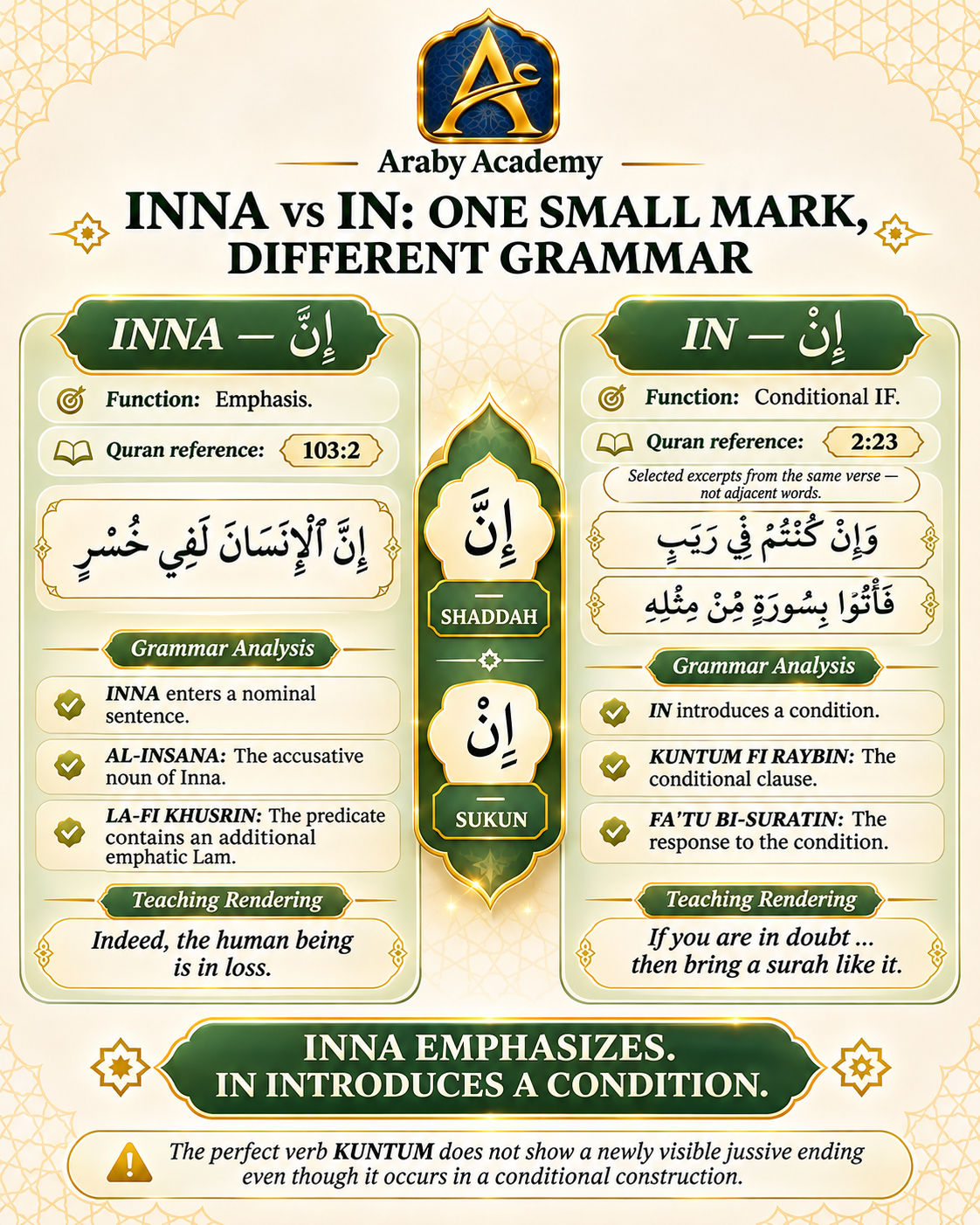
1. Inna (إِنَّ): How One Small Word Adds Emphasis
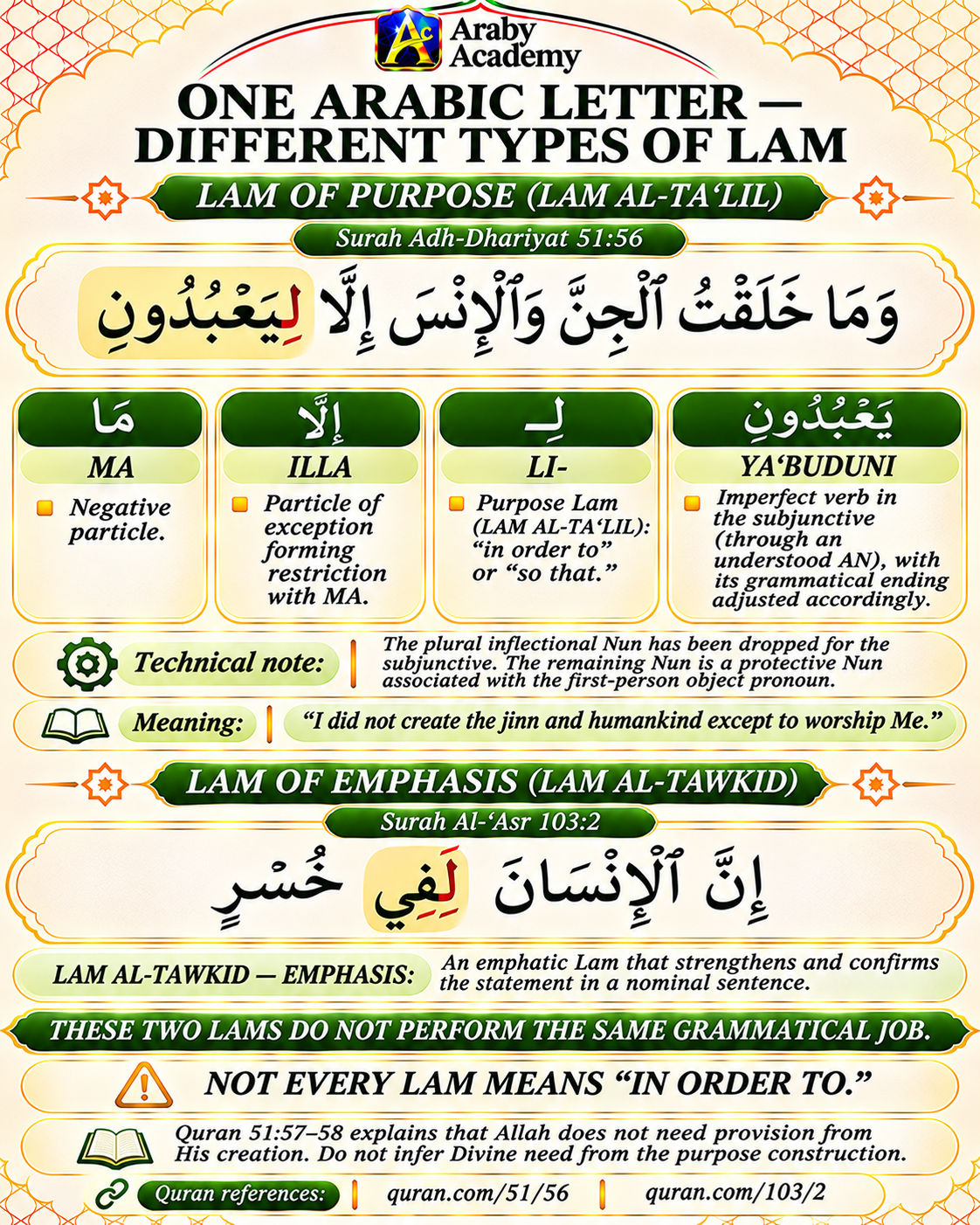
Quran 103:2 (part of verse): إِنَّ الْإِنْسَانَ لَفِي خُسْرٍ
Explanatory rendering: “Truly, the human being is in loss.”
Inna is a harf of the group called Inna wa akhawatuha. It enters a nominal sentence, puts its subject (ism Inna), al-insana, in the accusative, and leaves its predicate (khabar Inna), the phrase la-fi khusrin, in the nominative position. The verse's meaning comes from all its words; Inna contributes emphasis and structure. Recognizing Inna is one of the Quranic Arabic grammar clues that can change how you understand an Ayah, because the particle affects sentence structure as well as emphasis.
A second emphatic element sits on لَفِي: the Lam of emphasis (lam al-tawkid) attached to the predicate. It is not the purpose Lam of section fifteen. English may express the combined force with “indeed,” “truly,” “surely,” or a stressed construction; no single word is required. A misleading rule: “Inna just means ‘indeed.’”
Practice: Which particle opens the verse?
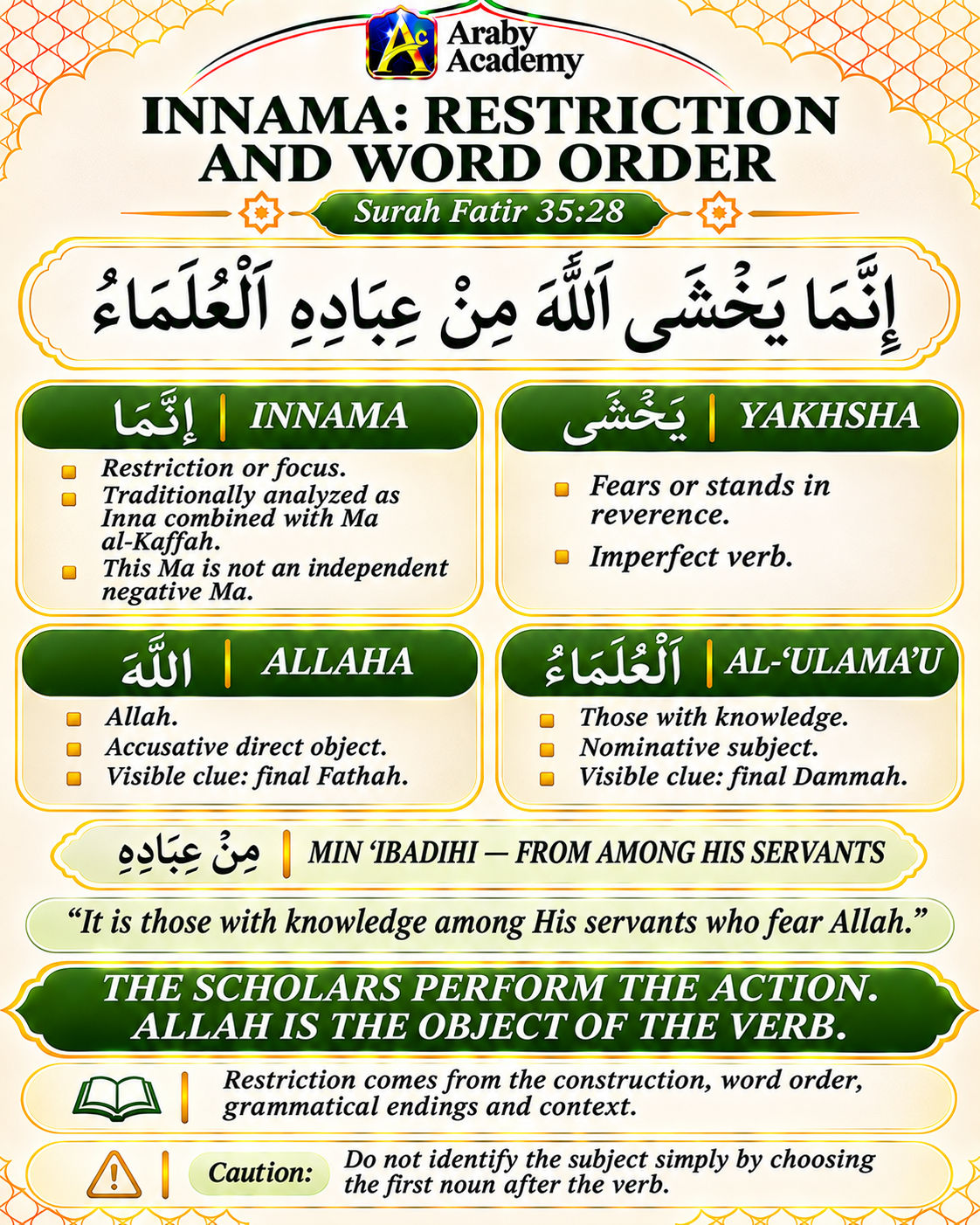
2. Innama (إِنَّمَا): When a Sentence Expresses Restriction
Quran 35:28 (part of verse): إِنَّمَا يَخْشَى اللَّهَ مِنْ عِبَادِهِ الْعُلَمَاءُ
Explanatory rendering: “It is only the learned among His servants who fear Allah.”
Traditional grammar analyzes Innama as Inna joined to Ma al-Kaffah, a “restraining” Ma that stops Inna from acting on a noun, so a verbal sentence can follow. It is not ordinary Inna plus an independent negative Ma. Here yakhsha is the verb, اللَّهَ (Allaha) is its accusative object, and الْعُلَمَاءُ (al-'ulama'u) is its nominative subject.
This example also connects with [Quranic word-order patterns that affect emphasis and focus], because understanding Innama alone is not enough to identify the grammatical subject. The restriction comes from Innama together with word order, case endings, and meaning, not from the particle alone. Commentators explain the fear here as awareness-based reverence. A misleading rule: “Innama always translates as ‘only’ in the same position.”
Practice: Where is Innama, who performs the verb, who is its object, and why is the case ending essential?
3. In (إِنْ): The Tiny Word That Introduces an “If” Clause
Quran 2:23 (opening and response): وَإِنْ كُنْتُمْ فِي رَيْبٍ ... فَأْتُوا بِسُورَةٍ مِنْ مِثْلِهِ
Explanatory rendering: “If you are in doubt ... then bring a surah like it.”
In is a conditional particle. It opens a condition (fi'l al-shart), here kuntum fi raybin, and expects a response (jawab al-shart), here fa'tu bi-suratin, “bring a surah.”
Conditional In is associated with the jussive mood. However, kuntum is a perfect form of Kana with a fixed ending, so no changed vowel appears, although its grammatical position is still jussive. Conditional particles become easier to recognize after studying how I'rab explains Arabic endings and grammatical relationships, especially when a particle affects the form of a following verb.
The pair Inna and In shows how similar spellings can hide different jobs.
Inna emphasizes and puts its noun in the accusative; In opens an “if.” A misleading rule: “every verb after In visibly loses its final vowel.”
Practice: Which form introduces the condition?
4. Qad (قَدْ): Why a Short Particle Changes How a Verb Is Understood
Quran 23:1: قَدْ أَفْلَحَ الْمُؤْمِنُونَ
Explanatory rendering: “The believers have truly succeeded.”
Qad is a harf that occurs with verbs. In 23:1 it precedes أَفْلَحَ (aflaha), a perfect verb, and الْمُؤْمِنُونَ (al-mu'minun) is its nominative plural subject. With a perfect verb, Qad commonly conveys confirmation or realization, which is why translators choose “indeed,” “certainly,” or an emphatic perfect tense.
Qad does not always mean “already.” With imperfect verbs it can carry other nuances, such as possibility or frequency, so the verb form must be checked first. English often folds Qad's force into tense and word order rather than giving it a separate word. A misleading rule: “Qad = already.”
Practice: Which word is Qad, what form is aflaha?
5. La (لَا): How Negation Changes an Entire Arabic Statement
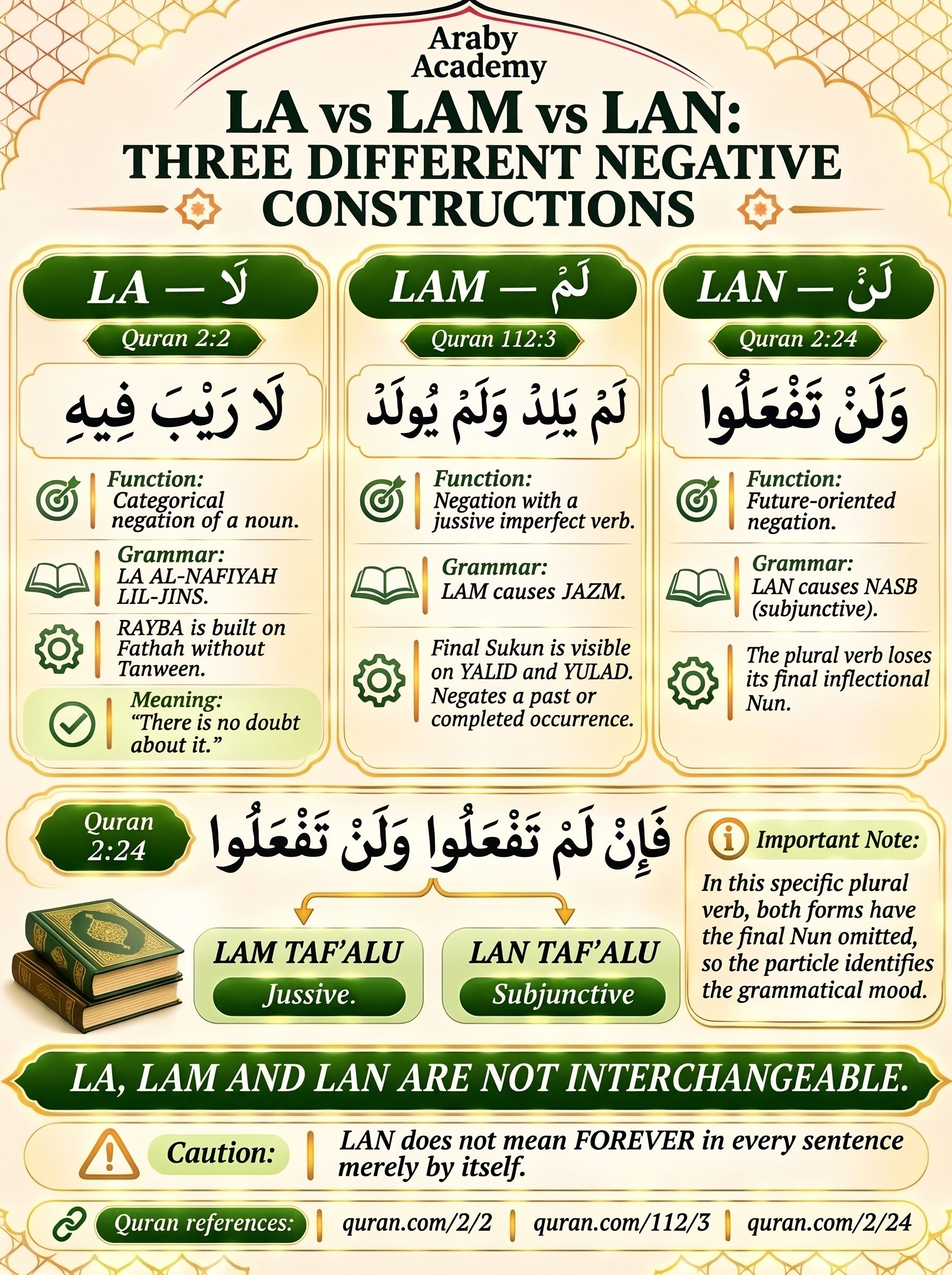
Quran 2:2 (part of verse): لَا رَيْبَ فِيهِ
Explanatory rendering: “There is no doubt in it.”
Grammarians classify this La as La al-nafiya lil-jins, the La that negates a whole class. رَيْبَ (rayba) is its noun, built on the fatha without tanween, and فِيهِ (fihi), “in it,” completes the sentence and refers back to the Book. Because the noun is generic, the denial covers the category “doubt,” not one instance.
This does not claim that no person has ever felt doubt. Commentators generally read it as denying any valid ground for doubt about the Book, so Tafsir is needed. The construction La Rayba Fihi is a useful companion to understanding nominal and verbal sentences in the Quran, because Arabic negation depends partly on the type of structure being negated.
La has other uses, including prohibition with a jussive verb (“do not ...”). A misleading rule: “La always negates a noun in exactly the same way.”
Practice: What is negated, what form follows La, what does fihi refer to, and how would the sentence change without negation?
6. Lam (لَمْ): Negation That Changes the Verb's Mood
Quran 112:3: لَمْ يَلِدْ وَلَمْ يُولَدْ
Explanatory rendering: “He has not begotten, and He was not begotten.”
Lam is a negative and jussive particle. It governs an imperfect verb and puts it in the jussive, shown here by the sukun on the final letters of يَلِدْ (yalid) and يُولَدْ (yuwlad). In context Lam commonly negates a past or completed occurrence, yet the verbs remain morphologically imperfect, not past-tense forms.
The voice difference comes from the verbs, not from Lam: yalid is active, “begets,” while yuwlad is passive, “is begotten.” Surah Al-Ikhlas concerns foundational theology, so rely on recognized Tafsir for its meaning rather than speculation. A misleading rule: “Lam makes the verb past tense.”
Practice: How many times does Lam occur, which verbs follow, what is their mood, and which verb is passive?
7. Lan (لَنْ): Future-Oriented Negation Is Not the Same as Lam
Quran 2:24 (part of verse): فَإِنْ لَمْ تَفْعَلُوا وَلَنْ تَفْعَلُوا
Explanatory rendering: “If you have not done it, and you will not do it.”
Here both particles sit side by side. Lam in lam taf'alu takes the jussive; Lan in lan taf'alu takes the subjunctive. For this verb both moods are shown by dropping the final nun of taf'aluna, so the endings look identical and only the particle tells you the mood. The contrast between Lam and Lan also demonstrates why Quran students need both Nahw and Sarf, since understanding a verb form and understanding the particle governing it are separate but connected tasks.
Particle | Verb mood | Time in context | Example |
|---|---|---|---|
Lam | Jussive | Commonly negates a past or completed event | 112:3; 2:24 |
Lan | Subjunctive | Future-oriented | 2:24 |
Lan does not by itself mean “never for all eternity.” Some grammarians argued it implies permanence, but duration is generally judged from context and other evidence. A misleading rule: “Lam and Lan are interchangeable ways of saying not.”
Practice: Which construction uses Lam, which uses Lan, how do their moods differ?
8. Ma (مَا): Why the Same Small Word Does Not Always Mean “Not”
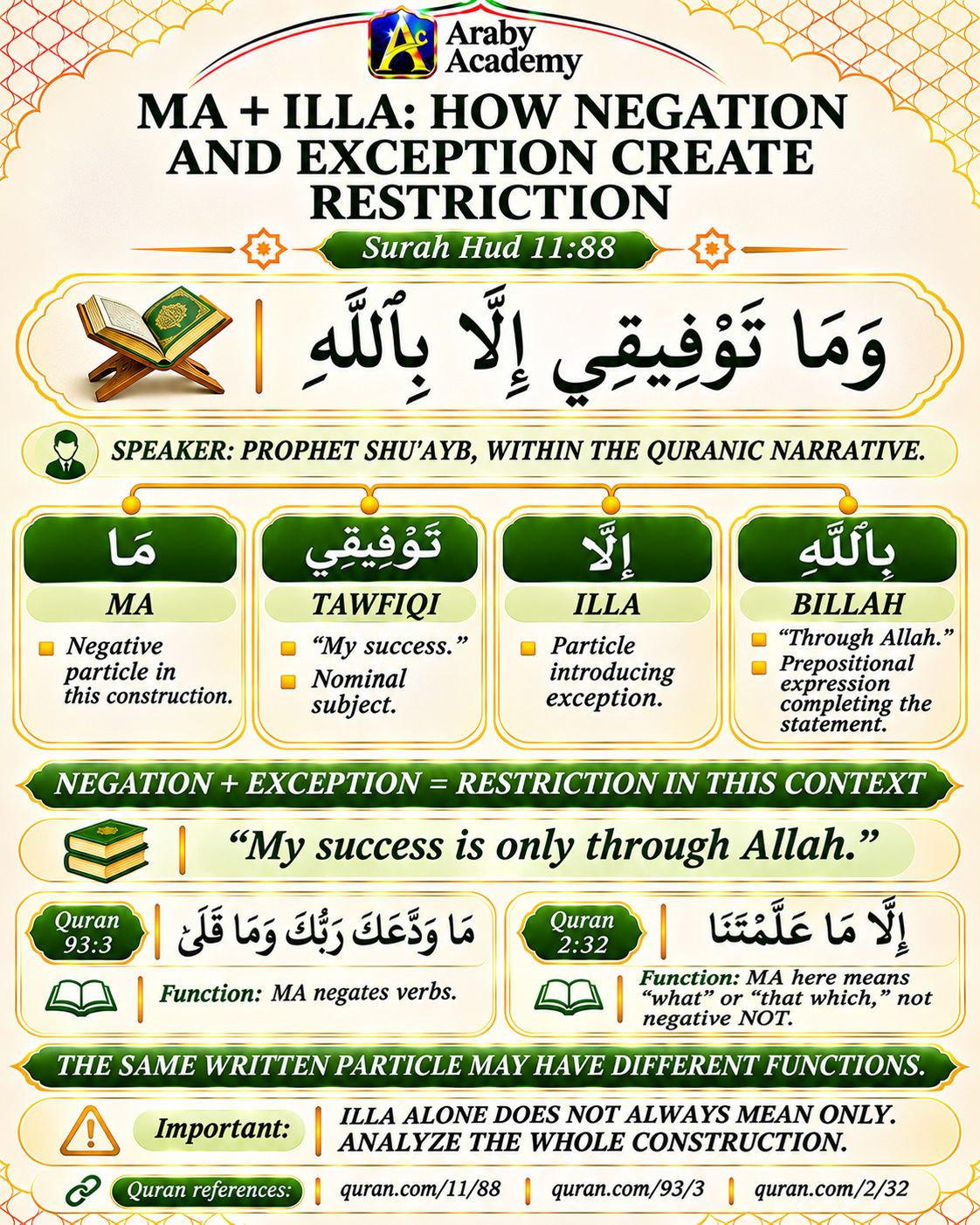
Quran 93:3: مَا وَدَّعَكَ رَبُّكَ وَمَا قَلَىٰ
Explanatory rendering: “Your Lord has not forsaken you, nor has He disliked you.”
Here Ma is the negative Ma, negating two perfect verbs: وَدَّعَكَ (wadda'aka, “abandoned you”) and قَلَىٰ (qala, “disliked”). Tafsir places the passage as reassurance to the Prophet ﷺ during a pause in revelation. In the second clause, grammarians understand an omitted object (“you”) after qala, and some link this brevity to the surah's rhythm. We add no Arabic to the verse to show it.
Ma is not always “not.” In 2:32, إِلَّا مَا عَلَّمْتَنَا (“except what You taught us”), Ma is a relative Ma meaning “that which,” and the negation comes from La earlier in the sentence. Ma can also be interrogative (“what?”). A misleading rule: “Ma always negates.”
Practice: Which two verbal statements are negated, does Ma always mean “not,” and how does Ma in 93:3 differ from Ma in 2:32?
9. Illa (إِلَّا): How “Except” Can Express Restriction
Quran 11:88 (part of verse): وَمَا تَوْفِيقِي إِلَّا بِاللَّهِ
Explanatory rendering: “My success is only through Allah.”
In this verse Ma supplies the negation and Illa introduces the exception. Together, Ma ... Illa forms a restrictive construction (“nothing ... except”), so the meaning is that success comes through Allah alone. The word تَوْفِيقِي (tawfiqi, “my success”) is the subject and بِاللَّهِ (billah) completes the predicate. The speaker is the Prophet Shu'ayb, peace be upon him, addressing his people, so this is his statement of reliance on Allah, not Allah speaking of Himself.
Illa also appears in ordinary exception sentences, so not every Illa construction matches this one. The combination of Ma and Illa illustrates [why Quran translations sometimes phrase the same Arabic construction differently], because an English translator may express restriction with 'only,' 'except,' or another natural construction. A misleading rule: “Illa means ‘only’ by itself.”
Practice: Which word provides negation, which introduces the exception, who is speaking?
10. Bal (بَلْ): When a Sentence Corrects or Changes a Claim
Quran 21:5 (part of verse): بَلْ قَالُوا أَضْغَاثُ أَحْلَامٍ بَلِ افْتَرَاهُ بَلْ هُوَ شَاعِرٌ
Explanatory rendering: “Rather, they said, ‘Muddled dreams!’ Rather, ‘He has invented it!’ Rather, ‘He is a poet!’”
Bal is a particle of idrab, turning away from one statement to another. Depending on the construction it can signal correction, retraction, or transition. In this verse it appears three times, so the speech of the opponents hops from one accusation to the next. The Quran is reporting what disbelievers said and is not affirming it.
The form بَلِ before افْتَرَاهُ is the same particle. In connected reading the Lam receives a kasra, because the next word begins with a connecting hamza that is not pronounced, and this avoids two silent sounds meeting. A misleading rule: “Bal always means ‘but.’”
Practice: How many times does Bal appear, what claims are reported?
11. Thumma (ثُمَّ): How Arabic Expresses Sequence
Quran 80:21–22: ثُمَّ أَمَاتَهُ فَأَقْبَرَهُ ثُمَّ إِذَا شَاءَ أَنْشَرَهُ
Explanatory rendering: “Then He causes him to die and provides him a grave; then, when He wills, He resurrects him.”
Thumma is a coordinating particle traditionally associated with sequence plus a sense of interval or progression. It appears twice here, linking stages in the passage: death, burial, and resurrection. Inside the first clause, فَأَقْبَرَهُ (fa-aqbarahu) uses Fa, which grammarians usually describe as marking a closer succession than Thumma.
These are tendencies, not a stopwatch. Tafsir explains the stages, so avoid adding a timeline or giving Divine actions human physical imagery. A misleading rule: “Thumma always means a long delay, and Fa always means immediate succession.”
Practice: Where does Thumma occur, where does Fa occur?
12. Fa (فَـ): The Tiny Connector That Can Change a Sentence's Logic
Quran 94:7: فَإِذَا فَرَغْتَ فَانْصَبْ
Explanatory rendering: “So when you have finished, then strive.”
There are two Fas here. The first links the verse to the preceding reassurance about ease and introduces a new clause, often described as a Fa of consequence. Idha opens a time-and-condition clause containing فَرَغْتَ (faraghta, “you have finished”). The second Fa ties the response, the imperative فَانْصَبْ (fansab), to that clause. Reading 94:5–8 shows the command inside a surah that moves from ease to exertion to turning toward the Lord. Tafsir records several views on what is finished and what effort follows, so read them rather than a slogan.
A Fa can conjoin, signal consequence, or link a response clause, depending on syntax. A misleading rule: “Fa always means immediately afterward.”
Practice: How many Fa elements occur, what does Idha introduce?
13. Aw (أَوْ): How a Tiny Word Presents Alternatives
Quran 2:196 (part of verse): فَفِدْيَةٌ مِنْ صِيَامٍ أَوْ صَدَقَةٍ أَوْ نُسُكٍ
Explanatory rendering: “Then a ransom of fasting, or charity, or a sacrificial rite.”
Aw connects alternatives. Here three are listed: fasting (siyam), charity (sadaqa), and a sacrificial rite (nusuk). They follow the verse's description of a pilgrim who is ill or has an ailment of the head, so they belong to that specific pilgrimage-related situation and not to any unrelated case.
Aw has other functions elsewhere, such as expressing doubt, division, or distribution, so it does not always mean unrestricted choice. For personal rulings, ask a qualified scholar. A misleading rule: “Aw always grants unrestricted choice.”
Practice: How many alternatives are listed, which particle connects them?
14. La'alla (لَعَلَّ): Purpose and Expectation in Quranic Arabic
Quran 2:183 (part of verse): لَعَلَّكُمْ تَتَّقُونَ
Explanatory rendering: “so that you may become God-conscious.”
La'alla belongs to Inna and her sisters. The attached pronoun كُمْ (“you,” plural) is its noun, in the accusative position, and the verb phrase tattaqun is its predicate. تَتَّقُونَ (tattaqun) is an imperfect verb from the root w-q-y, not the noun taqwa. The purpose clause in Quran 2:183 also becomes clearer when readers explore [the meaning of Taqwa beyond a simple English word for fear], because understanding the verb requires its Quranic context.
La'alla does not mean Allah lacks knowledge. In Divine speech, classical commentators read it as purpose, intended result, or an expectation attributed to the addressees. The fasting context supports a purpose reading, though not every occurrence is interpreted identically. A misleading rule: “La'alla means Allah is uncertain.”
Practice: Which particle introduces the anticipated result, what verb follows?
15. Lam of Purpose (لِـ): How One Letter Connects an Action to Its Purpose
Quran 51:56: وَمَا خَلَقْتُ الْجِنَّ وَالْإِنْسَ إِلَّا لِيَعْبُدُونِ
Explanatory rendering: “I did not create the jinn and humankind except to worship Me.”
The prefixed Lam is Lam al-Ta'lil, the Lam of purpose. It governs the imperfect verb ya'budu, which is subjunctive through an implied An. The ending in li-ya'buduni is not an ordinary plural nun: the plural nun dropped for the subjunctive, and the remaining nun is a protective nun carrying the “Me” pronoun, with its vowel sign indicating the unwritten ya'.
Ma and Illa restrict again: nothing created ... except for this purpose. The emphatic Lam in 103:2 strengthens a predicate, while this Lam states purpose; Arabic also has Lams of ownership and command, so not every لِ means “in order to.” The purpose construction in Quran 51:56 connects naturally with [why Allah created us and how Islam explains the purpose of life], although the verse must be understood through reliable Tafsir rather than grammar alone. Verses 51:57–58 clarify that Allah seeks no provision from creation, so the verse never implies that He needs worship. A misleading rule: “Every Lam means ‘in order to.’”
Practice: What does the prefixed Lam contribute?
All 15 Arabic Particles at a Glance
Particle | Function in this example | Verse | Grammar effect or relationship | Caution |
|---|---|---|---|---|
إِنَّ | Emphasis | 103:2 | Noun in accusative | Not just “indeed” |
إِنَّمَا | Restriction | 35:28 | Inna plus Ma al-Kaffah | Check subject and object |
إِنْ | Condition | 2:23 | Condition and response | Not Inna |
قَدْ | Confirmation | 23:1 | Precedes a perfect verb | Not always “already” |
لَا | Class negation | 2:2 | Noun built on fatha | Other La uses exist |
لَمْ | Negation | 112:3 | Jussive verb | Verb is not a past-tense form |
لَنْ | Future negation | 2:24 | Subjunctive verb | Not eternity by itself |
مَا | Negation here | 93:3 | Negates perfect verbs | Not always negative |
إِلَّا | Exception, restriction | 11:88 | Works with Ma | Read the whole construction |
بَلْ | Correction, transition | 21:5 | Turns between claims | Claims are reported |
ثُمَّ | Sequence, progression | 80:21–22 | Links stages | Not a stopwatch |
فَـ | Consequence, response link | 94:7 | Links clauses | Not always “then” |
أَوْ | Alternatives | 2:196 | Three options | Specific situation |
لَعَلَّ | Purpose, expectation | 2:183 | Inna's sister | No Divine doubt |
لِـ | Purpose | 51:56 | Subjunctive verb | Not every Lam |
Three Particle Comparisons Beginners Should Know
Inna and In share letters but not grammar. Inna (103:2) emphasizes and puts its noun in the accusative, while In (2:23) opens a condition that expects a response.
La, Lam, and Lan are three different negative constructions. La in 2:2 negates a whole class of noun, Lam in 112:3 takes a jussive imperfect verb, and Lan in 2:24 takes a subjunctive one. Check what each particle governs before choosing an English word.
Thumma and Fa are two different ways of linking events or clauses. In 80:21–22, Thumma links the larger stages while Fa joins death and burial more closely, and in 94:7 Fa links a condition to its response. Neither is a universal stopwatch.
Reading Notes: Ma, Restriction, Translation, Mood, and Case
Ma in 93:3 negates verbs, while Ma in 2:32 is a relative “that which” inside an exception. Likewise, Innama (35:28) and Ma ... Illa (11:88) can both communicate restriction, but Innama is a single compound that allows a verbal sentence, while Ma ... Illa pairs a negation with an exception. They are not grammatically identical.
English translations do not always show every particle separately. One Arabic particle may need several English words, several particles may share one natural expression, and sentence order may change, which is not automatically a loss of meaning. Keep four things apart: Arabic analysis, word-by-word gloss, idiomatic translation, and Tafsir-based explanation. The renderings here are teaching paraphrases, not quotations from a named translation.
Mood | Trigger in our examples | Example | Visible sign |
|---|---|---|---|
Indicative | No governing particle | tattaqun (2:183) | Final nun kept in this form |
Subjunctive | Lan; purpose Lam (via An) | lan taf'alu; li-ya'buduni | Fatha on singular verbs; nun dropped in plural forms |
Jussive | Lam | lam yalid (112:3) | Sukun; nun dropped in plural forms |
For case, the nominative usually shows a damma (al-'ulama'u in 35:28), the accusative a fatha (al-insana after Inna; Allaha in 35:28), and the genitive a kasra (khusrin after fi). Rayba after La is built on the fatha.
How to Understand a Small Arabic Word in Any Quranic Verse
Identify the exact particle in the vocalized Arabic text, noting its vowel marks.
Check for more than one function. Ask whether this could be a negator, a relative, a conjunction, or something else.
Identify what it governs or connects: which noun, verb form, or clause.
Read the complete Ayah and consult reliable grammar sources, a Quranic Arabic Corpus, and Tafsir.
Compare with an accurate English translation and record the result.
Quran reference | Particle | Role | Affects | English rendering | Caution | Review date |
|---|---|---|---|---|---|---|
112:3 | لَمْ | Negation, jussive | yalid, yuwlad | “Has not begotten, was not begotten” | Verbs are imperfect forms | ____ |
2:24 | لَنْ | Negation, subjunctive | taf'alu | “You will not do it” | Not “forever” by itself | ____ |
____ | ____ | ____ | ____ | ____ | ____ | ____ |
Optional seven-day plan (not a promise of mastery): Day 1: Inna, Innama, In. Day 2: Qad, La. Day 3: Lam, Lan. Day 4: Ma, Illa. Day 5: Bal, Thumma. Day 6: Fa, Aw. Day 7: La'alla, Lam al-Ta'lil, and review.
A ten-minute routine (a practical suggestion, not a proven optimum): 2 minutes reading a verified phrase; 2 minutes identifying the particle; 2 minutes examining the affected word; 2 minutes checking context and a reliable explanation; 2 minutes writing one learning note.
Common Mistakes and Myths
Ignoring particles, or giving each one English word. Function depends on construction.
Inna equals In; Innama is Inna plus a negative Ma. Each has its own grammar.
Qad means “already”; Lan means “forever.” Verb form and context decide.
Lam equals Lan; all La alike; Ma always “not.” Each has several constructions or moods.
Illa alone means “only.” The whole construction restricts.
Bal is “but”; Thumma is a long delay; Fa is immediate; Aw is free choice. Each depends on its passage, and the claims in 21:5 are reported, not endorsed.
La'alla means Allah is uncertain; every Lam is purpose. Both are false.
Ignoring verb mood, or building theology on one particle. Pair grammar with Tafsir.

Frequently Asked Questions
1. What are Arabic particles in the Quran? Short function words that link, negate, condition, emphasize, or restrict, rather than naming things or actions.
2. Why are small Arabic words important? They govern relationships such as negation, condition, and purpose that vocabulary alone does not reveal.
3. What is the difference between Harf and Ism? An ism is a noun-type word, a harf is a particle expressing a relationship, and a fi'l is a verb.
4. What does Inna mean? It is an emphatic particle that puts the following noun in the accusative; English may say “indeed” or “truly.”
5. What is the difference between Inna and In? Inna emphasizes a nominal sentence; In usually opens a condition (“if”) and expects a response.
6. What does Innama mean? It is Inna plus Ma al-Kaffah, commonly signaling restriction, as in 35:28.
7. What does Qad mean before a verb? With a perfect verb it often confirms or realizes the action; with other verbs the nuance can differ.
8. What does La Rayba Fihi mean grammatically? La negates the whole class “doubt”; rayba has no tanween, and fihi completes the sentence.
9. What is the difference between La, Lam, and Lan? In our examples, La negates a noun, Lam takes a jussive verb, and Lan takes a subjunctive verb with future focus.
10. Does Lan always mean never? No. It is future-oriented; permanence depends on context and other evidence.
11. Can Ma mean something other than not? Yes: it can be relative (“that which,” 2:32), interrogative (“what?”), and more.
12. How does Illa express exception or restriction? In Ma ... Illa, Ma negates and Illa excepts, yielding restriction; read the whole construction.
13. What does Bal mean? It turns from one statement to another, correcting or moving the discourse; in 21:5 it organizes reported accusations.
14. What is the difference between Thumma and Fa? Thumma suggests sequence with progression; Fa connects more closely or marks consequence. Neither measures time precisely.
15. What does Aw mean? It connects alternatives; in 2:196 they apply to a specific situation, while other contexts may express doubt or distribution.
16. What does La'alla mean when Allah speaks? Commentators read purpose, intended result, or expectation attributed to the addressees, never Divine uncertainty.
17. What is Lam al-Ta'lil? A prefixed Lam expressing purpose, followed by a subjunctive verb.
18. Why does 51:56 use Liya'budun? It combines purpose Lam, the subjunctive verb ya'budu, and a protective nun with an unwritten ya' for “Me.”
Conclusion — Don't Skip the Small Words
We began with لَمْ and لَنْ, and now you can see that two small words can differ in mood, time orientation, and structure. When learning Quranic Arabic, the shortest words are sometimes the easiest to overlook. Yet a particle may tell you whether a statement is being emphasized, negated, made conditional, restricted, or connected to another idea. The goal is not to memorize one English definition for every particle, but to recognize each form in its real Quranic setting. By studying the Arabic grammar, checking the surrounding verse, and using reliable Tafsir, you can become a more careful reader of the Quran. If you would like guided study, qualified Araby Academy teachers offer Quranic Arabic and Tafsir lessons for adults and children.